The LHCb collaboration has made the first sightings of the decay of B mesons into two baryons containing no charm quarks. While the collaboration has previously reported on multibody baryonic B decays, these are its first results on the rare two-body charmless modes and will help to address open questions concerning baryon formation in B decays.
Baryonic decays of B mesons were studied extensively by the BaBar and Belle experiments at SLAC and KEK, respectively. The measured branching fractions are typically in the range 10–6–10–4, with charmless modes at the low end of this range and those with charm having larger branching fractions. Decays with double-charm final states have branching fractions up to 10–3 in some cases, which is a surprisingly large value. The channel B+ → ppK+ was the first charmless baryonic B-meson decay mode to be seen, in 2002 (Belle collaboration 2002). Soon after, Belle struck gold again with the first observation of a two-body baryonic B decay, B0 → Λcp, which manifestly has charm (Belle collaboration 2003). However, there were no signs of charmless two-body baryonic decays of B mesons until now.
The suppression of low-multiplicity compared with higher-multiplicity decay modes is a striking feature of B decays to baryons that is not replicated by their two-body and three-body decays to mesons. It is also a key to the theoretical understanding of the dynamics behind these types of decays.
The LHCb collaboration used the 1.0 fb–1 data sample collected in 2011 to study the proton–antiproton spectra with or without an extra light meson – a pion or a kaon. Figure 1 shows the invariant mass distribution of ppK+ candidates in the pK+ mass window 1.44–1.585 GeV/c2, where a B+ → ppK+ signal is visible. The inset shows the pK+ invariant mass distribution near the threshold for B-signal candidates weighted to remove the non-B+ → ppK+ decay background.
The analysis reveals a clear Λ(1520) resonance, with the branching fraction for the decay chain B+→ pΛ(1520) → ppK+ measured to be close to 4 × 10⁻⁷ (LHCb collaboration 2013a). With a statistical significance exceeding 5σ, the result constitutes the first observation of a two-body charmless baryonic B decay, B+ → pΛ(1520).
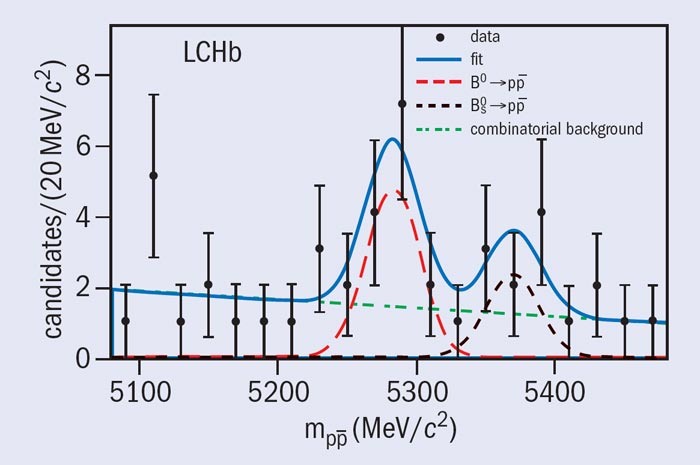
Figure 2 shows a fit from a related analysis, searching for B → pp decay (LHCb collaboration 2013b). An excess of B0 → pp candidates with respect to background expectations is observed with a statistical significance of 3.3σ, giving a measurement of the branching fraction for B0 → pp = (1.47+0.71–0.53) × 10–8. No significant signal is observed for B0s → pp but the current analysis improves the previous bound on the branching fraction by three orders of magnitude.
The GERDA collaboration has obtained new strong limits for neutrinoless double beta decay, which tests if neutrinos are their own antiparticles.
The GERDA (GERmanium Detector Array) experiment, which is operated at the underground INFN Laboratori Nazionali del Gran Sasso, is looking for double beta decay processes in the germanium isotope 76Ge, both with and without the emission of neutrinos. For 76Ge, normal beta decay is energetically forbidden, but the simultaneous conversion of two neutrons with the emission of two neutrinos is possible. This has been measured by GERDA with unprecedented precision with a half-life of about 2 × 10²¹ years, making it one of the rarest decays ever observed. However, if neutrinos are Majorana particles, neutrinoless double beta decay should also occur, at an even lower rate. In this case, the antineutrino from one beta decay is absorbed as a neutrino by the second beta-decaying neutron, which is possible if the neutrino is its own antiparticle.
In GERDA germanium crystals are both source and detector. 76Ge has an abundance of about 8% in natural germanium and its fraction was therefore enriched more than 10-fold before the special detector crystals were grown. To help to minimize the backgrounds from environmental radioactivity, the GERDA detector crystals and the surrounding detector parts have been carefully selected and processed. In addition, the detectors are located in the centre of a huge vessel filled with extremely clean liquid argon, lined by ultrapure copper, which in turn is surrounded by a 10-m diameter tank filled with high purity water. Last, but not least, it is all located underground below 1400 m of rock. The combination of all of these techniques has made it possible to reduce the background to unprecedented levels.
Data taking started in autumn 2011 using eight detectors if 2 kg each. Subsequently, five additional detectors were commissioned. Until recently, the signal region was blinded and the researchers focused on the optimization of the data analysis procedures. The experiment has now completed its first phase, with 21 kg years of accumulated data. The analysis, in which all calibrations and cuts had been defined before the data in the signal region were processed, revealed no signal of neutrinoless double beta decay in 76Ge, which leads to the world’s best lower limit for the half-life of 2.1 × 1025 years. Combined with information from other experiments, this result rules out an earlier claim for a signal by others.
The next steps for GERDA will be to add new detectors, effectively doubling the amount of 76 Ge. Data taking will then continue in a second phase after some further improvements are implemented to achieve even stronger background suppression.
• GERDA is a European collaboration with scientists from 19 research institutes or universities in Germany, Italy, Russia, Switzerland, Poland and Belgium.
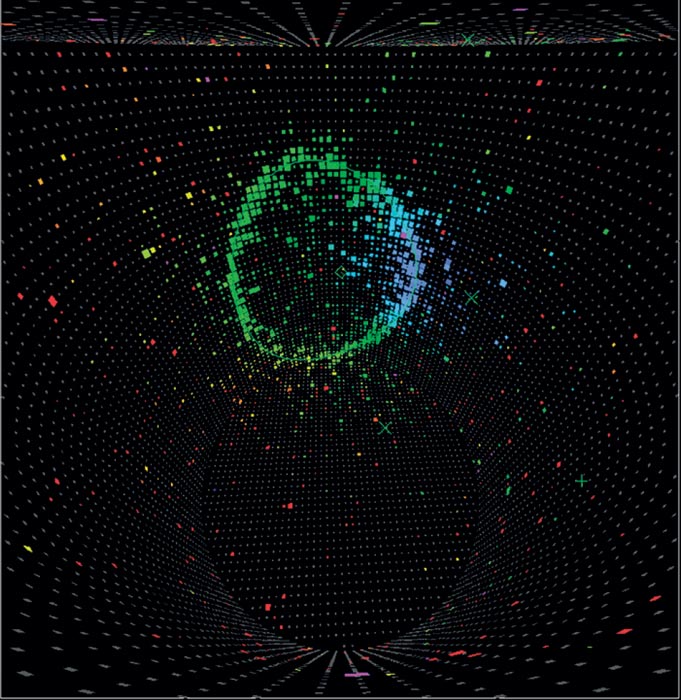
The international T2K collaboration chose the EPSHEP2013 meeting in Stockholm as the forum to announce its definitive observation of the transformation of muon-neutrinos to electron-neutrinos, νμ→νe.
In 2011, the collaboration announced the first signs of this process – at the time a new type of neutrino oscillation. Now with 3.5 times more data, T2K has firmly established the transformation at a 7.5σ significance level.
In the T2K experiment, a νμ beam is produced in the Japan Proton Accelerator Research Complex (J-PARC) in Tokai on the east coast of Japan. The beam – monitored by a near detector in Tokai – is aimed at the Super-Kamiokande detector, which lies underground in Kamioka near the west coast, 295 km away. Analysis of the data from Super-Kamiokande reveals that there are more νe (a total of 28 events) than would be expected (4.6 events) without the transformation process.
Observation of this type of neutrino oscillation opens the way to new studies of charge-parity (CP) violation in neutrinos, which may be linked to the domination of matter over antimatter in the present-day universe. The T2K collaboration expects to collect 10 times more data in the near future, including data with an antineutrino beam for studies of CP violation.
In announcing the discovery, the collaboration paid tribute to the unyielding and tireless effort by the J-PARC staff and management to deliver high-quality beam to T2K after the devastating earthquake in eastern Japan in March 2011. The earthquake caused severe damage to the accelerator complex and abruptly halted the data-taking run of the T2K experiment.
• The T2K experiment was constructed and is operated by an international collaboration, which currently consists of more than 400 physicists from 59 institutions in 11 countries: Canada, France, Germany, Italy, Japan, Poland, Russia, Switzerland, Spain, UK and the US.
Stockholm, with its many stretches of water, islands and old town, provided an attractive setting for the 2013 International Europhysics Conference on High-Energy Physics, EPS-HEP2013 on 18–24 July. Hosted by the KTH (Royal Institute of Technology) and Stockholm University, the conference centres on a busy programme of parallel and plenary sessions.
Like particle physics itself, EPS-HEP has a global reach, with people attending from Asia and the Americas, as well as from Europe. This year there were some 750 participants, including many young people who presented results in both parallel and poster sessions. As many as 440 speakers and more than 100 presenters of posters brought news from a host of experiments around the world, ranging from those at particle accelerators and colliders to others deep underground and in space.
Coming just one year after the announcement of the discovery of a new boson at CERN’s LHC, the conference provided a showcase for the latest results from the ATLAS and CMS experiments, as well as from Fermilab’s Tevatron. Together, they confirm the new particle as a Higgs boson, compatible with the Standard Model, and are making progress in pinning down its properties. Other measurements from the LHC and the Tevatron continue to test the Standard Model, as in the search for rare decay modes. The CMS and LHCb collaborations presented results on the decay Bs → μμ, two years after the CDF collaboration reported a first measurement, in slight tension with the Standard Model, at EPS-HEP2011 in Grenoble. CMS and LHCb now observe this decay at more than 4σ, with a branching fraction that is in good agreement with the Standard Model, therefore closing a potential window on new physics (Strangely beautiful dimuons).
All four of the large LHC collaborations – ALICE, ATLAS, CMS and LHCb – presented results in the dedicated sessions on ultrarelativistic heavy ions, which also featured presentions of measurements from the Relativistic Heavy-Ion Collider at Brookhaven. First results from the proton–lead run at the LHC are yielding surprises, including some intriguing similarities with findings in lead–lead collisions (Charmless baryonic B decays).
Beyond the Standard Model, the worldwide search for dark matter has progressed with experiments that are becoming increasingly precise, gaining a factor of 10 in sensitivity every two years. There are also improved results from experiments at the intensity frontier, in the study of neutrinos and in particle astrophysics. Highlights here included the T2K collaboration’s updated measurement with improved background rejection, which now indicates electron-neutrino appearance at a significance of 7σ (T2K observes νμ→νe definitively). Other news included results from the GERDA experiment, which sets a new lower limit on the half-life for neutrinoless double-beta decay of 2.1 × 1025 years.
Other sessions looked to the continuing health of the field, with presentations of studies on novel ideas for future particle accelerators and detection techniques. These topics also featured in the special session for the European Committee for Future Accelerators, which looked at future developments in the context of the update of the European Strategy for Particle Physics.
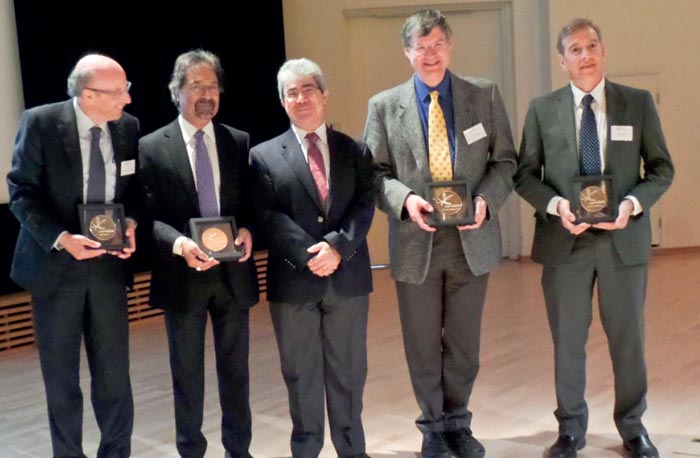
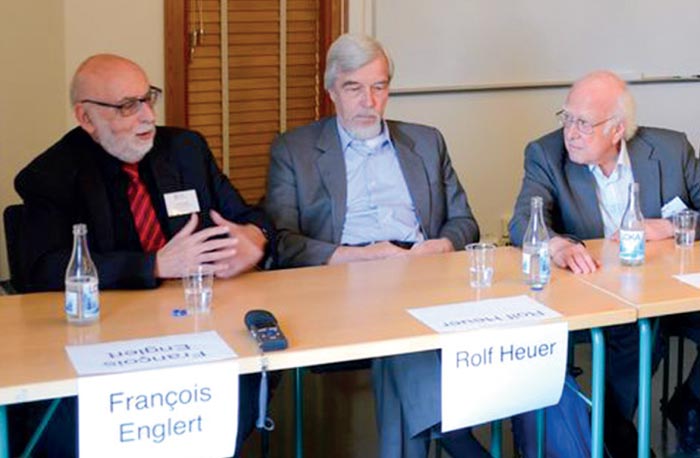
An important highlight of the conference was the awarding of the European Physical Society High Energy and Particle Physics Prize to the ATLAS and CMS collaborations “for the discovery of a Higgs boson, as predicted by the Brout-Englert-Higgs mechanism”, and to Michel Della Negra, Peter Jenni and Tejinder Virdee, “for their pioneering and outstanding leadership roles in the making of the ATLAS and CMS experiments”. François Englert and Peter Higgs were there in person to present the prizes and to take part in a press conference together with the prizewinners. Spokespersons Dave Charlton and Joe Incandela accepted the prizes on behalf of ATLAS and CMS, respectively.
Wrapping up the conference in a summary talk, Sergio Bertolucci, CERN’s director for research and computing, noted that it had brought together many beautiful experimental results for comparison with precise theoretical predictions. “These are lucky times for physics,” he concluded, with experiments and theory providing an “unprecedented convergence of the extremes of scales around a common set of questions”.
• For details on all the talks see http://eps-hep2013.eu. A longer report will appear in a future edition of the CERN Courier.
The ALICE collaboration had a significant presence at two recent major conferences, the 2013 European Physical Society Conference on High-Energy Physics (EPSHEP 2013), in Stockholm (EPS-HEP2013: these are good times for physics), and the 14th Topical Conference on Strangeness in Heavy Flavour Production in Heavy-Ion Collisions – Strangeness in Quark Matter 2013 (SQM2013) – that took place on 22–27 July at Birmingham University in the UK.
The many contributed talks and plenary presentations, in particular at SQM2013, highlighted new results from the proton–lead (pPb) data recorded in early 2013. While this run was initially intended to provide control data sets, several unexpected, and currently unexplained, results have been observed.
Presentations also covered updates on both soft (low pT) and hard (high pT and heavy flavour) probes of PbPb collisions
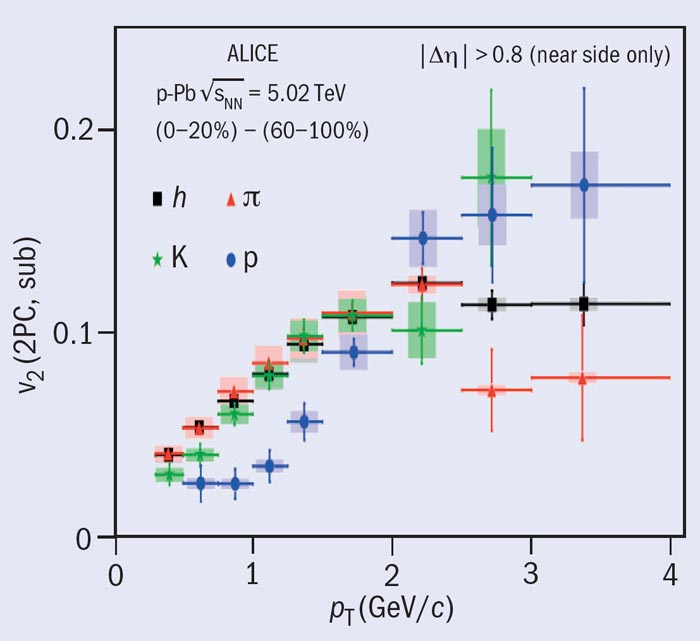
Most intriguingly, both the spectra of identified particles and charged-hadron correlations in high-multiplicity pPb events reveal signals suggestive of collective flow, which are similar to those observed in heavy-ion collisions, as the figure shows. These mass-dependent phenomena do not arise trivially in either the colour glass condensate or in the gluon saturation framework that describes the initial state of the colliding nuclei at the relevant small values of Bjorken-x.
Also in pPb collisions, ALICE’s measurements of minimum-bias spectra for a variety of hadronic species and jets, reveal no strong deviations from the expectations of the scaled number of nucleon–nucleon (binary) collisions. This confirms that the striking suppressions observed so far for all final-state hadrons in lead–lead (PbPb) collisions are a specific feature of quark and/or gluon energy loss via interactions with the quark–gluon plasma (QGP).
Presentations also covered updates on both soft (low pT) and hard (high pT and heavy flavour) probes of PbPb collisions. Higher precision results on nuclear-modification factors and elliptic flow – including measurements on heavy quarks – as a function of the event centrality gave the most detailed picture to date of partonic interactions with the QGP. The measurements of D mesons also indicate that the initial density and temperature of the QGP are so high that the heavy, charm quarks thermalize with the QGP before hadronization. Interestingly, the J/ψ results reveal much less suppression than at Brookhaven’s Relativistic Heavy-Ion Collider, suggesting that significant late-stage regeneration of these quarkonia states occurs as a result of the initial copious production of charm quarks in the heavy-ion collisions at the LHC.
Last, the high-precision soft physics results from the PbPb data underscored the potential significance of a hadronic re-scattering phase at the end of the produced medium’s evolution at the LHC. This phase has not previously been considered important when predicting signatures of the QGP, but it must now be accounted for to model accurately the full dynamics of a heavy-ion collision at the LHC.
There was lively debate at both conferences about the possible interpretations of all of these interesting new results, continuing well after the talks were over. Future studies were proposed that should help to unravel the origin of these intriguing phenomena observed in both pPb and PbPb collisions.
Neutrino experiments – thanks to the nature of the particles themselves – are notoriously difficult and experiments that make use of the natural source of particles within the cosmic radiation face problems of their own. In detecting cosmic neutrinos, the IceCube Neutrino Observatory at the South Pole successfully contends with both of these challenges, as two papers to appear in Physical Review Letters reveal. They illustrate the observatory’s capabilities in particle physics and in astroparticle physics.
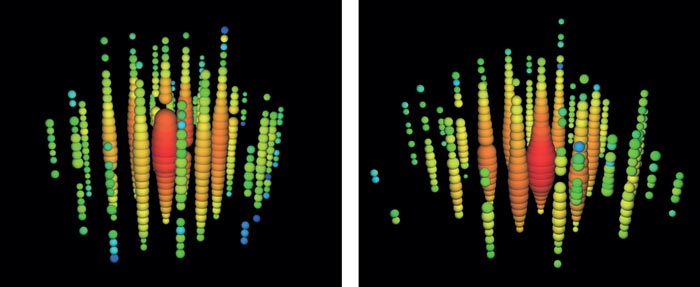
The potential for IceCube to meet its aim of detecting neutrinos from astrophysical sources has been boosted by the observation of two neutrino events with the highest energies ever seen. The events have estimated energies of 1.04±0.16 and 1.14±0.17 PeV – hundreds of times greater than the energy of protons at the LHC. The expected number of atmospheric background events at these energies is 0.082±0.004 (stat.)+0.04–0.057 (syst.) and the probability that the two observed events are background is 2.9 × 10⁻³, giving the signal a significance of 2.8σ (Aartsen et al. 2013a). While this is not sufficient to indicate a first observation of astrophysical neutrinos, the closeness in energy of the two events is intriguing and is already attracting the attention of theorists.
The analysis revealed the disappearance of low-energy, upwards-moving muon neutrinos and rejected the non-oscillation hypothesis with a significance of more than 5σ
Meanwhile, measurements of lower-energy neutrinos produced in the atmosphere have enabled the IceCube collaboration to make the first statistically significant detection of neutrino oscillations in the high-energy region (20–100 GeV). The data used for this analysis were collected between May 2010 and May 2011 by the IceCube and DeepCore detectors, which together make up the IceCube Neutrino Observatory. The IceCube detector consists of an array with 86 strings of digital sensors deployed in Antarctica’s ice sheet at depths in the range 1450–24507 m. This main array defines the high-energy detector, designed to detect neutrinos with energies from hundreds to millions of giga-electron-volts – that is, up to the peta-electron-volts and more of the observed high-energy events. The DeepCore subdetector adds eight additional strings near the centre of this array, six of which were deployed during the period covered by this analysis. The denser core allows lowering the energy threshold to about 20 GeV.
The analysis revealed the disappearance of low-energy, upwards-moving muon neutrinos and rejected the non-oscillation hypothesis with a significance of more than 5σ. This result verifies the first, lower-significance indication reported by the ANTARES collaboration. Using a two-neutrino flavour formalism, the IceCube collaboration derived a new estimation of the oscillation parameters, |Δm223| = 2.3+0.6–0.5 × 10⁻³ eV2 and sin22θ23 > 0.93, with maximum mixing favoured. These values are in good agreement with previous measurements by the MINOS and Super-Kamiokande experiments.
More efficient event-reconstruction methods are being tested, which together with new data sets will increase the sensitivity of the IceCube and DeepCore detectors to atmospheric neutrino oscillations. As a result of these improvements, the IceCube collaboration is expecting to set further constraints on the oscillation parameters in the coming months.
Two teams working on experiments at CERN’s ISOLDE facility have published results that extend knowledge in different areas of nuclear and atomic physics. The ISOLTRAP collaboration has measured the masses of exotic calcium nuclei using the new multi-reflection time-of-flight (MR-TOF) instrument, while a team working at the resonant-ionization laser ion source (RILIS) has made the first determination of the ionization potential of the radioactive-element astatine. The results from the two experiments demonstrate well the versatility of the ISOLDE facility.
The ISOLTRAP team used the facility to make exotic isotopes of calcium, with the aim of finding out how their nuclear “shell structure” evolves with increasing numbers of neutrons. By integrating the MR-TOF system into the experiment, the team has made precise determinations of the masses of calcium isotopes up to 54Ca. While the new device has already been applied successfully as a mass separator, this first use as a mass spectrometer has already led to a key finding and promises further important results in the future.
The results strengthen the prominence in calcium of a “magic number” that was not foreseen in the original nuclear shell model, for which Maria Goeppert-Mayer and Hans Jensen received the Nobel prize in 1963, exactly 50 years ago. In this model, the protons and neutrons in a nucleus form independent “shells” that are similar to those of electrons in atoms. The magic numbers correspond to full nuclear shells, in which the constituents are bound more tightly, leading to greater stability and lighter masses. With 20 protons and 20 neutrons, standard calcium, 40Ca, is doubly magic, while the rare and naturally occurring, long-lived isotope 48Ca has 28 neutrons – another magic number. The measurements by the ISOLTRAP team indicate a new closed-shell structure in 52Ca and therefore a new magic number of 32 (Wienholtz et al. 2013). Its shell strength of about 4 MeV rivals that of the classic magic numbers.
These measurements cast light on how nuclei can be described in the context of the fundamental strong force, in particular in terms of predictions using state-of-the-art theory that includes three-body forces, from physicists at the Technical University of Darmstadt. Calcium is the heaviest isotopic chain for which three-nucleon forces – based on an effective field theory of QCD – have been applied. The ISOLTRAP results are in excellent agreement with the theoretical calculations and they show that a description of extremely neutron-rich nuclei can be closely connected to a deeper understanding of nuclear forces.
One of the strengths of the ISOLDE facility is the RILIS source, which produces many of the beams. At the source, bunches of protons at 1.4 GeV from CERN’s Proton Synchrotron Booster are fired at a thick target of uranium carbide or thorium dioxide. The collisions produce nuclei of many different elements, which diffuse inside a metal cavity held at around 2000°C. Shining overlapping laser beams of chosen wavelengths into this cavity results in the selective ionization of some of the neutral atoms inside. After electrostatic extraction and magnetic mass-separation, the result is a pure beam of one isotope that travels on to a detector.
The latest element to come under scrutiny at RILIS is astatine. With a half-life of just over eight hours for its longest-lived isotope, 210As, astatine is the rarest naturally occurring element and one of the least known. Now, a team at ISOLDE has measured the element’s ionization potential for the first time, giving a result of 9.31751 eV (Rothe et al. 2013).
The measurement fills a long-standing gap in the Periodic Table because astatine is the last element present in nature for which this fundamental property remained unknown. It is of particular interest because isotopes of astatine are candidates for the creation of radiopharmaceuticals for cancer treatment by targeted alpha-particle therapy. The experimental value for astatine also serves as a benchmark for theories that predict the atomic and chemical properties of super-heavy elements, in particular the recently discovered element 117, which is an astatine homologue.
These two results demonstrate beautifully the wealth of ISOLDE’s tool-box for exploring nuclear physics. They complement well the recent results on the shape of radon nuclei that were observed in post-accelerated beams.
In a small fraction of proton collisions at the LHC, the two colliding protons interact only electromagnetically, radiating high-energy photons that subsequently interact or “fuse” to produce a pair of heavy charged particles. Fully exclusive production of such pairs takes place when quasi-real photons are emitted coherently by the protons rather than by their quarks, which survive the interaction. The ability to select such events opens up the exciting possibility of transforming the LHC into a high-energy photon–photon collider and of performing complementary or unique studies of the Standard Model and its possible extensions.
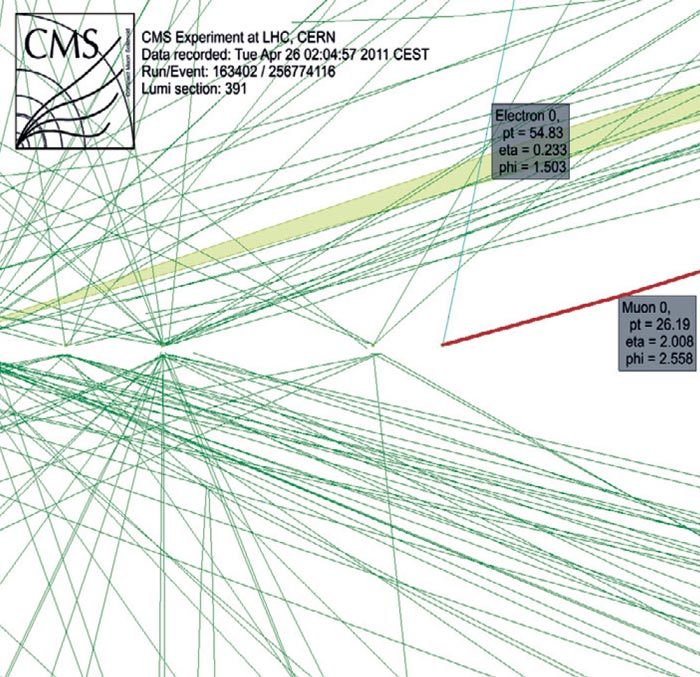
The CMS collaboration has made use of this opportunity by employing a novel method to select “exclusive” events based only on tracking information. The selection is made by requesting that two – and only two – tracks originate from a candidate vertex for the exclusive two-photon production. The power of this method, which was first developed for the pioneering measurement of exclusive production of muon and electron pairs, lies in its effectiveness even in difficult high-luminosity conditions with large event pile-up at the LHC.
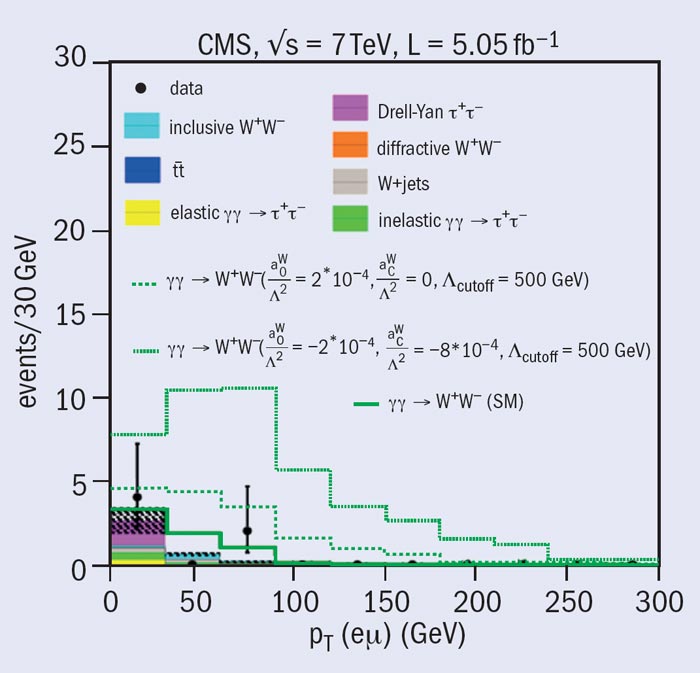
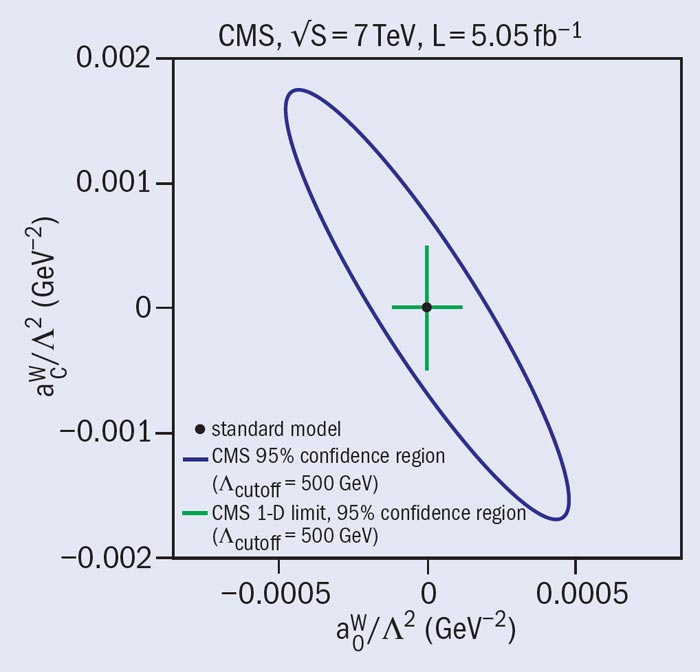
The collaboration has recently used this approach to analyse the full data sample collected at √s=7 TeV and to obtain the first direct evidence of the γγ→WW process. Fully leptonic W-boson decays have been measured in final states characterized by opposite-sign and opposite-flavour lepton pairs where one W decays into an electron and a neutrino, the other into a muon and a neutrino (both neutrinos leave undetected). The leptons were required to have: transverse momenta pT >20 GeV/c and pseudorapidity |η| < 2.1; no extra track associated with their vertex; and for the pair, a total pT >30 GeV/c. After applying all selection criteria, only two events remained – compared with an expectation of 3.2 events: 2.2 from γγ→WW and 1 from background (figure 2).
The lack of events observed at large values of transverse momentum for the pair, which would be expected within the Standard Model, allows stringent limits on anomalous quartic γγWW couplings to be derived. These surpass the previous best limits, set at the Large Electron–Positron collider and at the Tevatron, by up to two orders of magnitude (figure 3).
The value of the Λb lifetime has long been controversial but the situation has recently been clarified by a new measurement from the LHCb experiment.
There are many ways in which the decays of b quarks are used to search for physics beyond the Standard Model. One strategy, used by the CKMfitter and UTfit teams, is to compare the consistency of various sets of measurements and for this a knowledge of the elements |Vcb| and |Vub| of the Cabibbo-Kobayashi-Maskawa (CKM) matrix is essential. One way of determining these from data is to use a theoretical framework called the heavy quark expansion (HQE).
An early prediction from this model was that the Λb lifetime was almost equal to that of the B0 meson but shorter by 1–2%. However, measurements from CERN’s Large Electron–Positron collider using the semileptonic decay Λb→ Λclν gave values of the ratio of the lifetimes, τ(Λb)/τ(B0), of around 0.8. This caused concern over the applicability of HQE and various attempts were made to explain the observations. More recent measurements of τ(Λb), from the CDF experiment at the Tevatron using Λb→Λc π– (Aaltonen et al. 2002) and from ATLAS and CMS at the LHC using Λb→ J/ψΛ0 (Aad et al. 2013, Chatrchyan et al. 2013) have indicated larger values but with relatively large uncertainties.
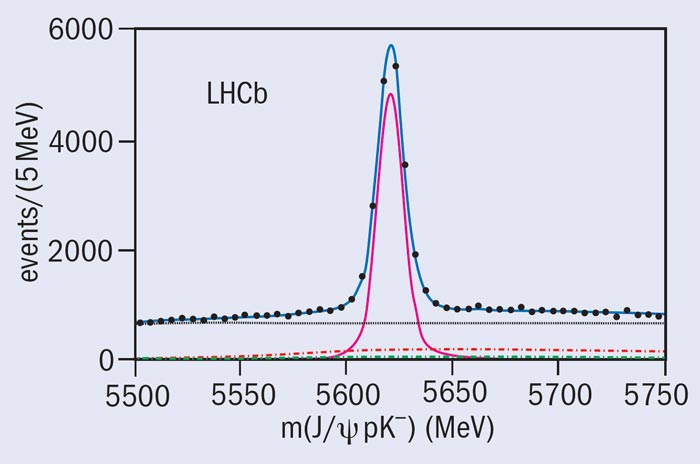
The LHCb collaboration has discovered a new decay mode Λb→ J/ψ pK– that is ideally suited for measuring the lifetime, by determining it relative to that for the decays B0→ J/ψ K*0, K*0→K+π–. In both the Λb and B0 decays, four charged tracks are produced at the position of the b-hadron’s decay. This minimizes systematic uncertainties in the ratio and provides excellent decay-time resolutions of around 40 fs in each mode. The figure shows the signal yield of more than 15,000 Λb decays in 1.0 fb–1 of LHCb data. Use of ring-imaging Cherenkov detectors in the experiment removes most of the backgrounds from Bs→ J/ψ K+ K– and B0→ J/ψ K+π– decays.
The collaboration finds τ(Λb)/τ(B0) = 0.976±0.012±0.006, where the first uncertainty is statistical and the second is systematic (LHCb collaboration 2013). The result demonstrates consistency with the original HQE prediction and should help to resolve issues involving measurements of the CKM parameters |Vcb| and |Vub|. Using the precisely measured value of τ(B0)=1519±7 fs from the Particle Data Group (Beringer et al. 2012) yields a value for τ(Λb)=1482±18±12 fs. This result is about twice as precise as the best previous measurement.
Much of the early work on the HQE was done by Nikolai Uraltsev, whose passing earlier this year is much lamented by the community.
The first collisions occurred in Fermilab’s Tevatron in 1985. Over the following years, both the energy and the luminosity increased and by the time operations ceased in 2011 the collision luminosity had reached 7 × 1032 cm–2 s–1, more than 350 times the original design value. The Tevatron’s unique feature was its collisions of protons with antiprotons. While it requires substantial technical efforts to make antimatter – the Tevatron’s antiproton source was the world’s most powerful producer of antimatter but still incapable by a long way of the destruction imagined in Angels & Demons – the study of proton–antiproton collisions provides the opportunity to study quark–antiquark interactions against low backgrounds. By the final shutdown, a total luminosity of 12 fb–1 had been delivered to each of the two gigantic Tevatron experiments, CDF and DØ, corresponding to around 5 × 10¹⁴ proton–antiproton interactions at a collision energy of 2 TeV.
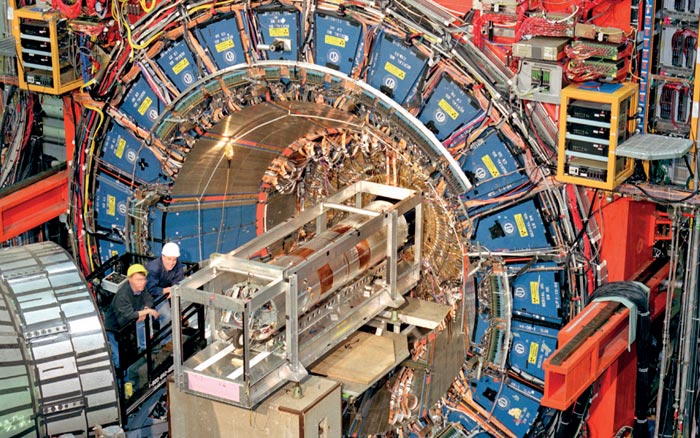
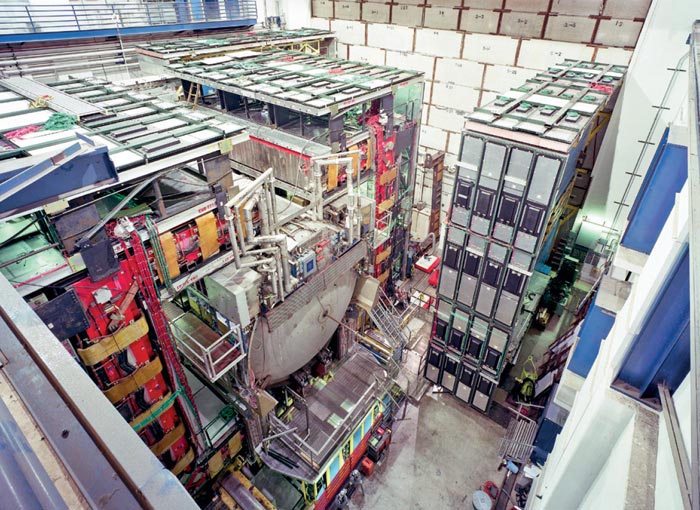
Images of the two experiments (figure 1) appeared on the front pages of many magazines, in artworks and on TV shows. These modern engineering marvels were largely innovative and demonstrated, for example, the power of a silicon detector in a hadron-collider environment, multi-level triggering, uranium–liquid-argon calorimetry and the ability to identify b quarks. From the collisions provided, the teams recorded the 2 × 10¹⁰ most interesting events to tape for detailed examination offline. The analysis effort included searches and studies of new particles, such as the Higgs boson, and precision studies of the parameters of the Standard Model. Many of the exciting results obtained before the end of 2011 have already been summarized in CERN Courier. This article presents an update on some of the results obtained by CDF and DØ over the past two years.
The search for the Higgs boson was among the central physics goals of the programme for Tevatron Run II (2001–2011) and the challenge of understanding the origin of mass in the Standard Model attracted world-leading experimentalists to Fermilab. In 2005, the data sets provided by the Tevatron reached the point where the search for a substantial number of Higgs events above backgrounds could start. From then until 2012, the analysis teams provided not only increasingly stringent direct mass-exclusions but also reduced indirectly the mass range where the Higgs boson could exist, using highly precise measurements of the masses of the top quark and the W boson (see below). By early 2011, results from the Tevatron and CERN’s Large Electron–Positron collider had reduced the allowed mass range to 125±10 GeV, so the joke among experimentalists at the time was: “We know the mass of the Higgs, we just don’t know if it exists.”
The CDF and DØ collaborations developed many new experimental methods in their hunt for the Higgs boson, from the combined searches of hundreds of individual channels for the boson’s production and decay to an extremely precise understanding of the backgrounds and a high-efficiency reconstruction of the Higgs-decay objects. The Tevatron’s high luminosity was the key, because only a few events were expected to remain in the signal region following all of the selections. The unique feature of proton–antiproton collisions was critical for the searches, especially in the decay to a pair of b quarks – the most probable channel for Higgs decay at a mass of 125 GeV. While cross-sections for Higgs production increase with energy and are much higher at the LHC, the increase in the main backgrounds is even faster, so the signal-to-background ratio for this main Higgs-decay channel remains favourable at the Tevatron.
By the early summer of 2012, both CDF and DØ had analysed the full Tevatron data set in all sensitive Higgs-decay modes: bb, WW, ττ, γγ and ZZ. The results included not only larger data sets than before but also substantially improved analysis methods. Multivariate analysis was used to take full advantage of the information available in each event, rather than using the more traditional cuts on kinematical parameters. Such techniques optimize the ratio of signal to background in a multi-dimensional phase space and were critical for reaching sensitivity to the Higgs-boson signal.
What became even more exciting was that in the search channels where the Higgs decays to a pair of b quarks only, the significance of the excess exceeded 3σ
At the Tevatron, the primary search sensitive to Higgs masses below around 135 GeV comes from the associated production of the Higgs boson with W or Z bosons, with the Higgs decaying to a pair of b quarks. This topology increases the signal-to-background ratio, because decays to a pair of b quarks have the highest probability while also minimizing backgrounds as the extra W or Z boson provides useful features, both for triggering and for offline event selection. Nevertheless, reconstructing jets from b quarks – which sometimes consist of hundreds of particles – with high precision is challenging. This is why the expected shape of the Higgs signal is rather wide, with a mass resolution of around 15 GeV, in comparison with searches in the channels where single particles, such as a pair of photons or leptons, are used to reconstruct the mass of the Higgs.
The CDF and DØ collaborations then combined their search results that summer. The excess observed around a mass of 125 GeV, which the experiments had seen for the previous two years, became even more pronounced (figure 2). The significance of the excess was close to 3σ. What became even more exciting was that in the search channels where the Higgs decays to a pair of b quarks only, the significance of the excess exceeded 3σ, indicating evidence for the production and decay of a Higgs boson at 3.1σ (Aaltonen et al. 2012). It was an extremely exciting summer. As the Tevatron passed the baton for Higgs searches (and now studies) to the LHC, its experiments had established evidence of the production and decay of a Higgs boson in the most-probable decay channel to a pair of fermions.
The Standard Model is one of the most fundamental and accurate theories of nature, so precision measurements of its parameters figure among the major goals and results of the Tevatron’s physics programme. Those perfected over the past two years include the determination of the masses of the top quark and the W boson, both of which are fundamental parameters of the Standard Model.
Since the discovery of the top quark at the Tevatron in 1995, measurements of its mass have improved by more than an order of magnitude. In addition to the larger data sets, from some 10 events in 1995 to many thousands in 2012, the analysis methods have also been improved dramatically. One of the innovations developed for precision determination of the top mass – the matrix-element method – is now used in many other studies in particle physics.
In the channel that allows the most accurate mass measurement, the top quark’s final decay products are: a lepton (electron or muon); missing energy from the escaping neutrino; a pair of light quark jets from the decay of the W boson; and two b-quark jets. Determination of the energy of the jets is the most challenging task for precision measurement. In addition to using complex methods to determine the jet energy based on energy conservation in di-jet and γ+jet events, the fact that a pair of light jets come from the decay of a W boson with extremely well known mass (see below) is critical in obtaining high precision for the top-quark mass.
Using a large fraction of the Tevatron data, CDF and DØ reached a precision in the measurement of the top-quark mass of less than 1 GeV (figure 3), i.e. a relative accuracy of 0.5% (Tevatron Electroweak Working Group 2013). This is based on the combination of results from both experiments in many different channels. All of the results are in good agreement, demonstrating the validity of the methods that were developed and used to measure the top-quark mass at the Tevatron. Analyses of the full Tevatron data set are in progress and these should improve the accuracy by a further 20–30%. Experiment collaborations at both the LHC (ATLAS and CMS) and the Tevatron have formed a group to combine the results of the top-quark mass measurements from all four experiments. Such a combination will have a precision that is substantially better than individual measurements, because many of the uncertainties are not correlated between the experiments.
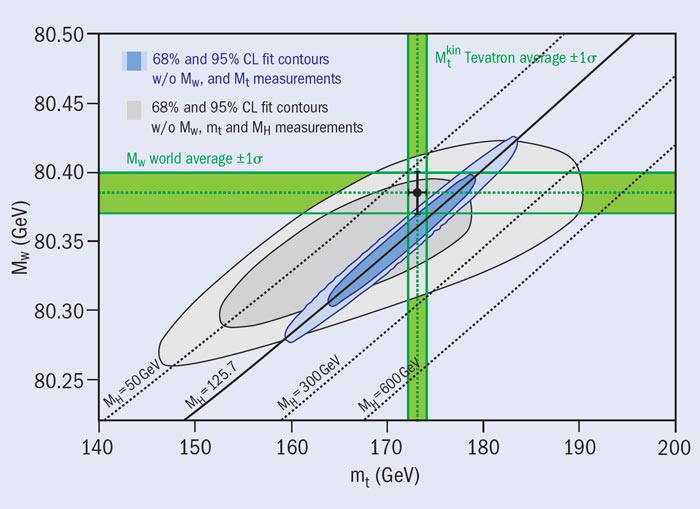
The measurement of the mass of the W boson requires even higher precision. By the end of the Tevatron’s operation, the combined Tevatron measurement for this particle with a mass of 80 GeV reached 31 MeV, or 0.04%. A precise value of the mass of the W boson is critical for understanding the Standard Model; in addition to being closely related to the masses of the Higgs boson and the top quark, it defines the parameters of many important processes. The main decay channel used to measure the W mass is the decay to a lepton (muon or electron) and a neutrino (“missing energy”). The precision calibration of the lepton energy is obtained from resonances with well known masses, such as the J/ψ or the Z boson, while the measurement of missing energy is calibrated using different methods for cross-checks. The calibration of the lepton energy is the most difficult part of the measurement; larger data sets provide more events and improve the accuracy of the measurement.
With up to around 50% of the Tevatron data set, the combined analysis of CDF and DØ gives the mass of the W boson to be 80.387 MeV with an accuracy of 16 MeV – twice as good as only a year previously (Tevatron Electroweak Working Group 2013). The accuracy is now driven by systematic uncertainties. In order to reduce them, careful work and analysis of more data are needed; a precision of around 10 MeV should be reachable using the full data set. Such accuracies were once thought to be impossible to achieve in a “dirty” hadron-collider environment.
In the Standard Model, the masses of the Higgs boson, W boson and top quark are closely related and a cross-check of the relationship is one of the model’s most stringent tests. Figure 4 shows recent results for the top-quark mass (from the Tevatron), the W-boson mass (dominated by the Tevatron, with a world-average accuracy of 15 MeV vs 16 MeV Tevatron only) and the mass of the Higgs boson, as measured by the LHC experiments. The good agreement demonstrates the validity of the Standard Model with high precision.
At its inception, researchers had not expected the Tevatron to be the precision b factory that it became. However, with the success of the silicon vertex detectors in identifying the vertexes of the decays of mesons and baryons containing b quarks, the copious production of these b hadrons and the extremely well understood triggers, detectors and advanced analysis techniques, the Tevatron has proved to be extremely productive in this arena. A large number of new mesons and baryons have been discovered there and the properties of particles containing b quarks have been studied with high precision, including the measurement of the oscillation frequency of the Bs mesons.
Studies of particles with b quarks provide an indirect way to look for physics beyond the Standard Model. The rate of the rare decay of the Bs meson to a pair of muons is tiny in the Standard Model but new physics models, including some versions of supersymmetry, predict enhancements. Figure 5 shows how the steady improvements in the Tevatron limits on the decay rate reached around 10–8 by 2012, as more data and more elaborate analysis methods were developed by CDF and DØ.
In late 2011, the ATLAS collaboration presented results indicating the existence of a new particle, which was interpreted as an excited state of a bb pair, χb(3P). It is always important to confirm observations of a new particle with independent measurements and even more important to see such a particle at another accelerator and detector. Within just a couple of months, the DØ collaboration confirmed the observation by ATLAS (Abazov et al. 2012). This was the first time that a discovery at the LHC was confirmed using data already collected at the Tevatron.
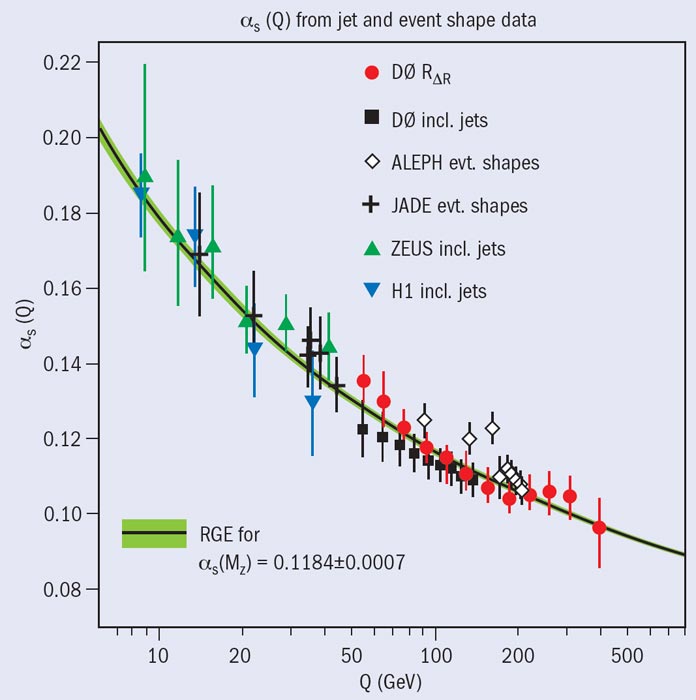
Many important studies performed at the Tevatron measure properties of the strong force, which holds together protons and neutrons in the nucleus and is described by the theory of QCD. These include extremely accurate studies of the production of jets and of W and Z bosons accompanied by jets. The Tevatron articles that provide information for the development of the QCD run to tens of pages long and have tens of plots and tables documenting – with extremely high precision – the details of interactions between strongly interacting particles.
One unusual property of the strong interaction is that, contrary to electromagnetic and gravity interactions where the force increases when objects come closer to each other, the interaction of quarks becomes stronger as they move apart. The experiments at the Tevatron studied the strength of the strong force vs the distance between quarks, the running of the strong coupling constant, and verified that the strong force steadily decreases down to a distance between particles of around 5 × 10–16 cm (figure 6).
During the last month of the Tevatron run in September 2011, the CDF and DØ experiments collected data at energies below 2 TeV, going all of the way down to 0.3 TeV in the centre of mass. Such data are useful for studies of the energy dependence of the strong interaction and to compare with previous colliders results, such as the SppS proton–antiproton collider at CERN. An interesting recent measurement is the energy dependence of the “underlying event” in the hard scattering of the proton and antiproton – that is, everything except the two outgoing hard-scattered jets from a pair of hard-scattered quarks (figure 7).
There are many instances when the course of physics changed when experimental results did not fit the current theoretical predictions. Quantum theory and relativity were both born from such “clouds” on the clear horizon of classical physics. Several puzzles remain in the Tevatron data, which are leading to analysis and re-analysis of the full data set. These include the observed anomalous dimuon asymmetry, where the production of negative muon pairs exceeds positive pairs, in contradiction with expectations from the Standard Model (Abazov et al. 2011). This result has attracted much attention, because it could relate to the observed matter–antimatter asymmetry in the universe.
There is also a puzzling effect in the production of the heaviest known elementary particle, the top quark. When top–antitop pairs are produced, more top quarks follow the direction of the colliding proton than is predicted in the Standard Model (Aaltonen et al. 2013, Abazov et al. 2013). Some of the models of new physics predict such abnormal behaviour.
Both of these “clouds” have a significance of 2–3σ and both are easier to study in the collisions of protons and antiprotons at the Tevatron. Will these measurements point to new physics or will the discrepancies be resolved with the further development of analysis tools or more elaborate theoretical descriptions based on the Standard Model? In any scenario, exciting physics from the Tevatron data is set to continue.
The Tevatron was at the leading edge of the energy frontier in particle-physics research for more than a quarter of a century. More than 1000 students received their doctorates based on data analysis in the Tevatron’s physics programme, which as a result trained generations of particle physicists. So far, in excess of 1000 scientific publications have come out of the programme, helping to shape the understanding of the subnuclear world. Analysis of the Tevatron’s unique data set continues and efforts to preserve the data for future access are in progress. There are sure to be many more exciting results in the coming years.
To provide the best experiences, we use technologies like cookies to store and/or access device information. Consenting to these technologies will allow us to process data such as browsing behavior or unique IDs on this site. Not consenting or withdrawing consent, may adversely affect certain features and functions.
Functional
Always active
The technical storage or access is strictly necessary for the legitimate purpose of enabling the use of a specific service explicitly requested by the subscriber or user, or for the sole purpose of carrying out the transmission of a communication over an electronic communications network.
Preferences
The technical storage or access is necessary for the legitimate purpose of storing preferences that are not requested by the subscriber or user.
Statistics
The technical storage or access that is used exclusively for statistical purposes.The technical storage or access that is used exclusively for anonymous statistical purposes. Without a subpoena, voluntary compliance on the part of your Internet Service Provider, or additional records from a third party, information stored or retrieved for this purpose alone cannot usually be used to identify you.
Marketing
The technical storage or access is required to create user profiles to send advertising, or to track the user on a website or across several websites for similar marketing purposes.