Comsol -leaderboard other pages

Topics

CLOUD sees through the haze

CCnew3_05_14

The CLOUD (Cosmic Leaving OUtdoor Droplets) experiment at CERN, which is studying whether cosmic rays have a climatically significant effect on aerosols and clouds, is also tackling one of the most challenging problems in atmospheric science – understanding how new aerosol particles are formed in the atmosphere and the effect that these particles have on climate. Aerosol particles and clouds have a large net cooling effect on the planet and, according to the Intergovernmental Panel on Climate Change, they represent the largest source of uncertainty in present climate models. A new study published by CLOUD now sheds new light on the first steps of cloud formation, helping to improve our understanding of the aerosol–cloud–climate connection.

Cloud droplets form on aerosol particles – tiny solid or liquid particles suspended in the atmosphere – above a size of about 50 nm. Aerosol particles are either emitted directly into the atmosphere (like sea-spray particles) or else form by the spontaneous clustering (“nucleation”) of trace atmospheric molecules. Around one half of all cloud seeds are thought to originate from nucleated particles, but the process is poorly understood. Sulphuric acid is thought to play a key role, but previous studies by CLOUD have shown that it cannot form new particles in the lower atmosphere without another ingredient to glue the molecules together and prevent them evaporating. CLOUD recently showed one such ingredient to be a class of vapours known as amines. However, these are only found close to primary sources, such as animal husbandry, so another ingredient must be involved.

Vapours at the level of one part in 1012 control atmospheric nucleation, so it is a challenge to meet the technological requirements for studies in the laboratory. The chamber used by the CLOUD collaboration has achieved much lower concentrations of contaminants than previous experiments, allowing nucleation to be measured under atmospheric conditions for the first time without the complicating effect of undetected gases. CLOUD uses state-of-the-art instruments to measure these very low concentrations of atmospheric vapours and also to measure the chemistry and growth of newly formed molecular clusters from single molecules up to stable particles. Another unique aspect of the experiment is the capability to measure nucleation arising from ionization by cosmic rays, or from the enhanced ionization provided by a pion beam from CERN’s Proton Synchrotron – or with the effects of all ionization suppressed completely by means of a strong electric clearing field.

For the latest results, CLOUD studied particle nucleation involving the oxidation products of a volatile biogenic vapour known as alpha-pinene, which gives pine forests their familiar smell. This and similar volatile biogenic vapours are oxidized in the atmosphere to produce daughter vapours with extremely low volatility. During the past few years, numerous studies have shown the importance of these oxidized biogenic vapours for growing freshly nucleated particles to sizes where they can seed cloud droplets. However, it was not known if these oxidized biogenic vapours could provide the glue to help the first sulphuric acid molecules stick together to form embryonic particles.

Now, CLOUD has shown that oxidized biogenic vapours do form new particles with sulphuric acid and, moreover, that this process can explain a large fraction of particle formation observed in the lower atmosphere. Ions produced in the atmosphere by galactic cosmic rays are found to provide significant additional stability to the clusters, but only when the concentrations of sulphuric acid and oxidized organic vapours are relatively low.

In addition to the experimental measurements, the CLOUD team reported theoretical and global modelling studies. Quantum chemical calculations confirm the stability of the embryonic clusters of sulphuric acid and oxidized organics. Moreover, a global modelling study that includes the new nucleation mechanism has captured – for the first time – the pronounced seasonal variation of new particle production that is observed in the atmosphere. The modelling results establish that trees play a fundamental role in forming new particles in the atmosphere, which is familiar as “blue haze” when viewing distant mountains.

• The CLOUD collaboration consists of the California Institute of Technology, Carnegie Mellon University, CERN, Finnish Meteorological Institute, Helsinki Institute of Physics, Johann Wolfgang Goethe University Frankfurt, Karlsruhe Institute of Technology, Lebedev Physical Institute, Leibniz Institute for Tropospheric Research, Paul Scherrer Institute, University of Beira Interior, University of Eastern Finland, University of Helsinki, University of Innsbruck, University of Leeds, University of Lisbon, University of Manchester, University of Stockholm and University of Vienna.

Quark Matter 2014: news from CMS

CCnew12_05_14
CCnew13_05_14

Although the CMS experiment was designed primarily for precise measurements in proton–proton (pp) collisions, in recent years it has demonstrated exceptional capabilities in studying interactions of heavy nuclei. At Quark Matter 2014, the CMS collaboration presented a wealth of new results from their heavy-ion physics programme. The most recent analyses focus on collisions of protons on lead ions (pPb), delivered by the LHC in early 2013.

CCnew14_05_14

At the forefront of such studies, CMS continues its investigation of the surprising “ridge phenomenon”. This long-range particle correlation had previously been observed in nucleus–nucleus (AA) collisions and is interpreted as evidence of the hydrodynamic expansion of the quark–gluon plasma (QGP) created in these collisions. Lighter collision systems such as pp and pPb were not expected to produce a dense enough environment to produce such a flow effect, which is thought to arise from the fluid-like behaviour of the QGP. Nevertheless, a similar correlation was observed in collisions with high particle multiplicity in both systems (CMS collaboration 2013).

Previous measurements focused mainly on correlations between particle pairs. However, it is important to address whether the ridge observed in pPb collisions is really collective in nature, and this can be achieved by looking into correlations among a larger number of particles. Flow effects are measured typically by looking at the azimuthal anisotropy of particle momenta using a Fourier decomposition. Figure 1 shows the magnitude of the second Fourier harmonic (v2), as a function of total particle multiplicity, extracted using a multiparticle cumulant expansion, as well as using Lee–Yang zeros, a technique that probes the correlations among all particles in the event. That v2 shows little dependence on the number of particles used in the correlation supports the interpretation of long-range correlations as a collective effect.

CCnew15_05_14

Further insight into long-range correlations might be gained by exploring their “hadro-chemistry”. The CMS silicon tracking system is well suited to identifying hadrons that contain strange quarks, such as the K0s meson and Λ baryon, via their decay topologies. Figure 2 (left) shows a clear dependence on species when comparing v2 for K0s, Λ and non-identified charged particles in high-multiplicity pPb events. Within about 10–15%, the data (figure 2, right) are found to obey a scaling relation first seen in AA collisions, whereby the v2 per constituent quark is independent of particle species for the same transverse kinetic energy per constituent quark. In AA collisions, such a scaling is typically interpreted as evidence of flow developed at a very early time, before the quarks combine into final-state hadrons.

In addition to their role in elucidating collective effects in small systems, pPb collisions serve as an important reference for phenomena observed in PbPb collisions. Observables intended to probe the QGP might also be influenced by the initial state of the colliding nuclei. Nuclear effects on the parton distribution functions (PDFs) can be constrained with pPb collisions, i.e. in the absence of an extended QGP final state.

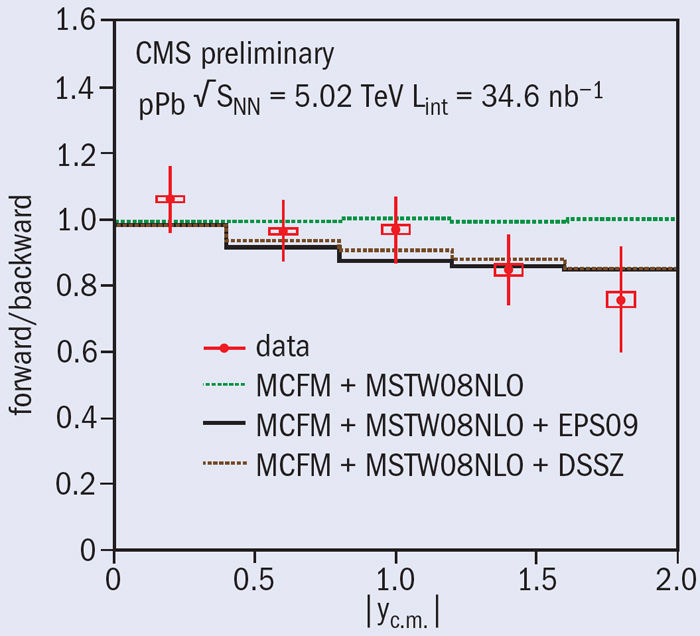
Shortly after the first pPb collisions were recorded, CMS demonstrated sensitivity to nuclear effects on the PDFs via a measurement of the dijet rapidity shift (CMS collaboration 2014). In addition to jets, electroweak bosons are excellent observables for studying PDFs, because their production can be calculated precisely and they can be measured to high precision, given sufficient data. For the rapidity range measured by CMS, the production of Z bosons is sensitive to the parton distributions at large Q2 and Bjorken x in the range 10–3–10–1, a kinematical region that is largely unexplored by previous measurements.

In analysing the 2013 pPb data, the collaboration found more than 2000 Z bosons via their decays to muon pairs. Figure 3 shows the ratio of Z production at forward and backward rapidity in pPb collisions, where forward is the direction of the incident proton. The data are compared to next-to-leading order perturbative calculations produced with the MCFM generator, without and with the nuclear modifications to the parton distributions expected for two different parameterizations of nuclear effects (EPS09 and DSSZ). The data show an indication of the forward–backward asymmetry expected from these calculations. In conjunction with Z boson measurements in the electron channel, as well as other observables such as photons and W bosons, LHC data will soon begin to dominate knowledge of the nuclear parton distributions in some regions of x and Q2.

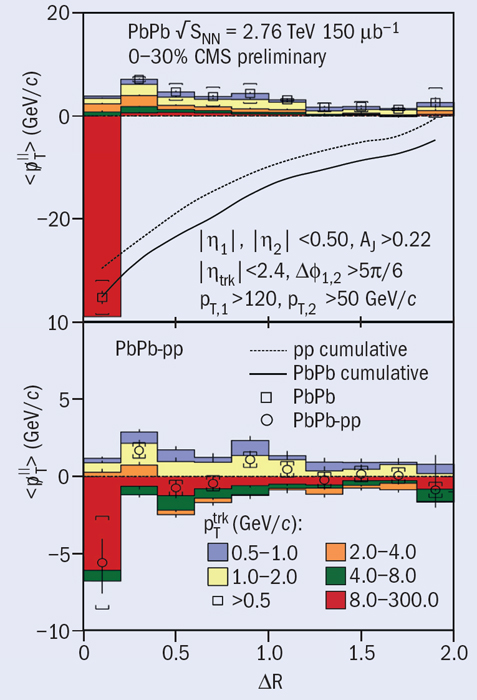
In addition to the pPb studies, CMS continues to perform increasingly detailed studies of the jet-quenching phenomenon, which gives rise to the striking dijet pT asymmetries observed in PbPb collisions (CMS collaboration 2011). Tracing the fate of energy lost by hard-scattered partons in the dense QGP remains a fascinating challenge for the field. To investigate this in more detail, CMS looks at correlations of charged particles with asymmetric dijets in central collisions. To avoid sensitivity to the bulk of particle production, which is largely unrelated to the jets, the vector sum of the transverse momenta with respect to the dijet axis is considered. This “missing pT” is shown in figure 4 (top) as a function of the radial distance from the jets in central collisions for all charged particles, as well as individually for different ranges of pT, for the 30% most central PbPb collisions. The missing-pT analysis allows the first detailed study of the angular dependence of the momentum balance up to large distances from the jet axis (ΔR = 1.8). By evaluating the difference with respect to the same distribution from pp collisions (figure 4, bottom), the angular pattern of the energy flow is shown to be comparable, although it exhibits a large shift in the momentum spectrum of radiated particles in PbPb collisions. The pattern of energy flow provides the most direct window into the dynamics of the jet–QGP interaction observed yet.

The results summarized here represent only a small fraction of the new results from CMS presented at Quark Matter 2014. All the latest CMS heavy-ion results can be found at https://twiki.cern.ch/twiki/bin/view/CMSPublic/PhysicsResultsHIN.

On the trail of exotic particles

Since the quark model was first conceived 50 years ago, physicists have been searching for “exotic” hadrons – strongly interacting particles that are neither quark–antiquark pairs (mesons) nor three-quark states (baryons). Now the LHCb collaboration has published results that for the first time unambiguously demonstrate the exotic nature of one of the candidate exotic hadrons – the Z(4430). At the same time, LHCb’s measurements show that the f0(500) and the f0(980) states cannot be four-quark states (tetraquarks), contrary to what has long been suggested.

CCnew17_05_14

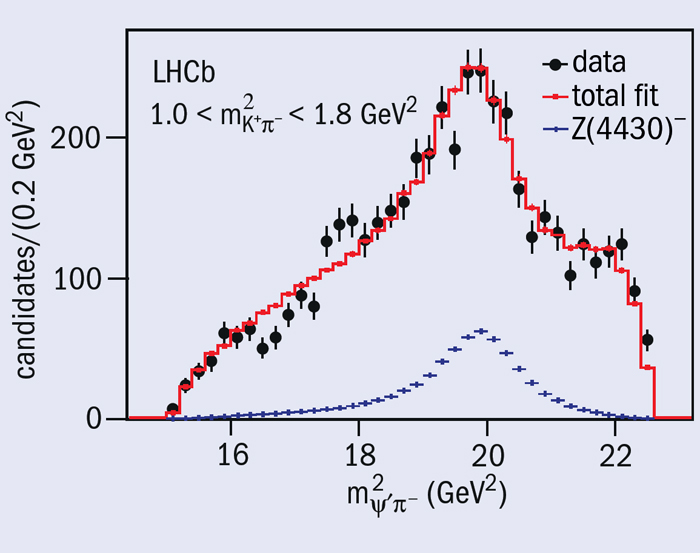
The first evidence for the Z(4430) came in 2008 from the Belle collaboration at KEK’s B-factory, KEKB. It appeared as a narrow peak in the ψ΄π mass distribution in B → ψ΄Kπ decays. With negative charge, the Z(4430) cannot be a charmonium state, raising the possibility that it could be a multiquark state, for example ccud.

LHCb has now analysed about 25,200 decays of the kind B0→ ψ΄Kπ, ψ΄ → μ+μ in data corresponding to an integrated luminosity of 3 fb−1 of proton–proton collisions at the LHC at centre-of-mass energies of 7 and 8 TeV. The collaboration observes the Z(4430) in the ψ΄π mass distribution with a significance of at least 13.9σ, and determines the quantum numbers JP to be 1+, by ruling out 0, 1, 2+ and 2 at more than 9.7σ (LHCb collaboration 2014a). While this emphatically confirms the evidence from Belle, the LHCb analysis also establishes the resonant nature of the observed state. Its Argand diagram (figure 2) shows unambiguously that the Z(4430) really is a particle. Moreover, with a minimal quark content of ccud, it must be a tetraquark state.

CCnew18_05_14

In a related analysis, LHCb has also studied the decay B J/ψπ+π, extracting the invariant mass of the π+π pairs. While this clearly reveals a peak corresponding to the f0(500) meson, there is no evidence for the f0(980). This rules out at 8σ the production of the f0(980) at the rate expected for tetraquarks, which would lead to a much smaller difference in the production rates for the two f0 mesons. However, the f0(980) is clearly visible in the corresponding π+π invariant mass distribution for the decay B0→J/ψπ+π. The absence of the f0(980) in B0 decays and its presence in B0 decays in addition to the presence of the f0(500) only in the B0 decays is exactly what is expected if these states are normal quark–antiquark states (LHCb collaboration 2014b).

ATLAS searches for supersymmetry via electroweak production

The Standard Model is currently the best theory there is of the subatomic world, but it fails to answer several fundamental questions, for example: why are the strengths of the fundamental interactions so different? What makes the Higgs boson light? What is dark matter made of? Such questions have led to the development of theories beyond the Standard Model, of which the most popular is supersymmetry (SUSY). In its most minimalistic form, SUSY predicts that each Standard Model particle has a partner whose spin differs by ½ and an extended Higgs sector with five Higgs bosons. SUSY’s symmetry between bosons and fermions stabilizes the mass of scalar particles, such as the Higgs boson and also the new scalar partners of the Standard Model fermions at high energy. If, as suggested by some theorists, the new particles have a conserved SUSY quantum number (denoted R-parity), the lightest SUSY particle (LSP) cannot decay and primordial LSPs might still be around, forming dark matter.

CCnew20_05_14

Two charginos, χ~±1,2, and four neutralinos, χ~01,2,3,4 – collectively referred to as electroweakinos – are the SUSY partners of the five Higgs and the electroweak gauge bosons. Based on arguments that try to accommodate the light mass of the Higgs boson in a “natural”, non-fine-tuned manner, the lightest electroweakinos are expected to have masses in the order of a few hundred giga-electron-volts. The lightest chargino, χ~±1, and the next-to-lightest neutralino, χ~02, can decay into the LSP, χ~01, plus multilepton final states via superpartners of neutrinos (sneutrinos, ν~) or charged leptons (sleptons, l~), or via Standard Model bosons (W, Z or Higgs). If SUSY exists in nature at the tera-electron-volt scale, electroweakinos could be produced in the LHC collisions.

The ATLAS collaboration’s searches for charginos, neutralinos and sleptons use events with multiple leptons and missing transverse momentum from the undetected LSP. The two-lepton (e, μ) search has dedicated selections that target the production of l~ l~, χ~±1χ~1 and χ~±1χ~02 through their decays via sleptons or W and Z bosons. Meanwhile, the three-lepton (e, μ, τ) analysis searches for χ~±1χ~02 decaying either via sleptons, staus (the SUSY partner of the τ), W and Z bosons, or W and Higgs bosons. Charginos and neutralinos decaying via Standard Model bosons are more challenging to search for than the decays via sleptons, owing to the smaller branching ratio into leptons. The main backgrounds in the two(three)-lepton search are WZ and Z+jets (tt) production, and these are modelled using Monte Carlo simulation and data-driven methods, respectively.

CCnew21_05_14

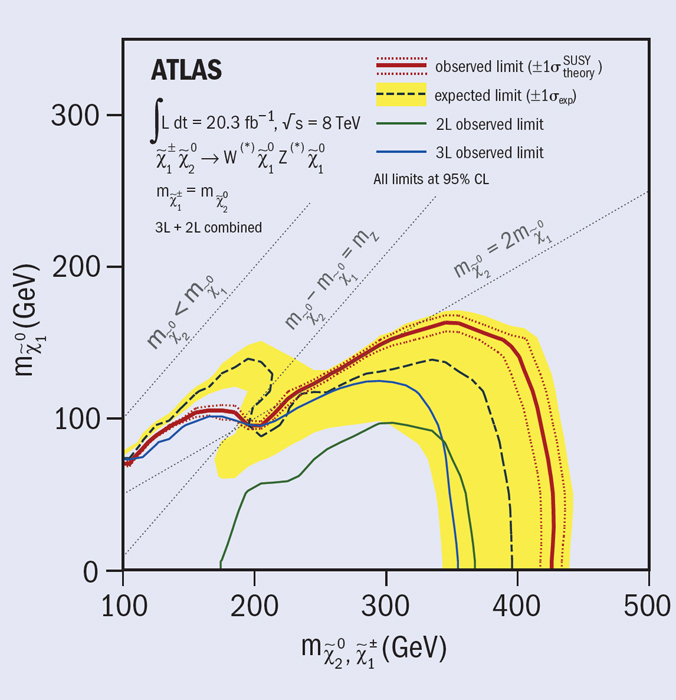
ATLAS has found no significant excess beyond the Standard Model expectation in either the two or three-lepton SUSY searches. This null result can be used to set exclusion limits on SUSY models, narrowing down where SUSY might exist in nature. For example, the two-lepton analysis sets the first direct limits in a simplified SUSY model of χ~±1χ~1, where the chargino decays 100% of the time to a W boson. The selections based on the presence of hadronically decaying τ particles in the three-lepton analysis set exclusion limits for χ~±1χ~02 decaying via W and Higgs bosons.

In some cases, the results of two or more analyses can be combined to strengthen the exclusion limits in a particular SUSY model. This is done for the two and three-lepton searches in a simplified SUSY model of χ~±1χ~02, where the χ~±1 and χ~02 are assumed to decay exclusively via W and Z bosons (figure 1). On its own, the two-lepton analysis excludes χ~±1 and χ~02 masses from 170–370 GeV, while the three-lepton analysis excludes masses from 100–350 GeV. By combining the two searches, the exclusion limit is pushed out much further to χ~±1 and χ~02 masses of 415 GeV for a massless χ~01 (figure 2).

So far, no evidence for SUSY has been observed with the first dataset collected by ATLAS. However, in 2015 the LHC will collide protons at higher energies and rates than ever before. This will be an exciting time as exploration of unchartered territories of higher-mass SUSY particles and rarer signatures begins.

LHC and Tevatron teams announce first joint result

CCnew1_04_14

The collaborations working on the world’s leading particle-collider experiments have joined forces, combined their data and produced the first joint result from Fermilab’s Tevatron collider and CERN’s Large Hadron Collider. Scientists from the four experiments involved – ATLAS, CDF, CMS and D0 – announced their joint findings on the mass of the top quark at the 2014 Rencontres de Moriond international physics conference on 19 March. The four collaborations pooled their data-analysis power to arrive at a world’s best value for the mass of the top quark of 173.34±0.76 GeV/c2.

Experiments at the LHC and the Tevatron collider are the only ones that have observed the top quark – the heaviest-known elementary particle. Its large mass makes it one of the most important tools in the quest to understand the nature of the universe.

The CDF and D0 experiments discovered the top quark in 1995, and the Tevatron produced some 300,000 top-quark events during its 25-year lifetime, before it finally shut down in 2011. Now the LHC is the world’s leading top-quark factory, having produced close to 18-million events with top quarks since it started collider physics operations in 2009.

Each of the four collaborations had previously released their individual measurements of the top-quark mass. Combining them together required close collaboration between the four large groups of researchers, and a detailed understanding of each other’s techniques and uncertainties. Each experiment measured the mass of the top quark using several different methods. The analyses involved a variety of top-quark decay channels, employing sophisticated techniques that have been developed and improved over more than 20 years of top-quark research, beginning at the Tevatron and continuing at the LHC.

More than 6000 researchers from more than 50 countries participated in the four experimental collaborations.

While this article was in preparation, the CMS Collaboration released the world’s most precise single measurement of the top-quark mass in the semileptonic decay channel, using the experiment’s full sample of data at 8 TeV. Combined with the previous CMS results, this gives a mass of 172.22±0.73 GeV/c2. More details will appear in the next edition of CERN Courier.

CMS sets new constraints on the width of the Higgs boson

After the discovery of a Higgs boson at the LHC in 2012, all of the measurements of its properties and tests of its spin-parity have proved to be consistent with the predictions of the Standard Model. One important property is its natural width, which is expected to be small in the Standard Model – approximately 4 MeV. A larger width could indicate, for example, additional non-standard Higgs decays into known or unknown particles.

CCnew4_04_14

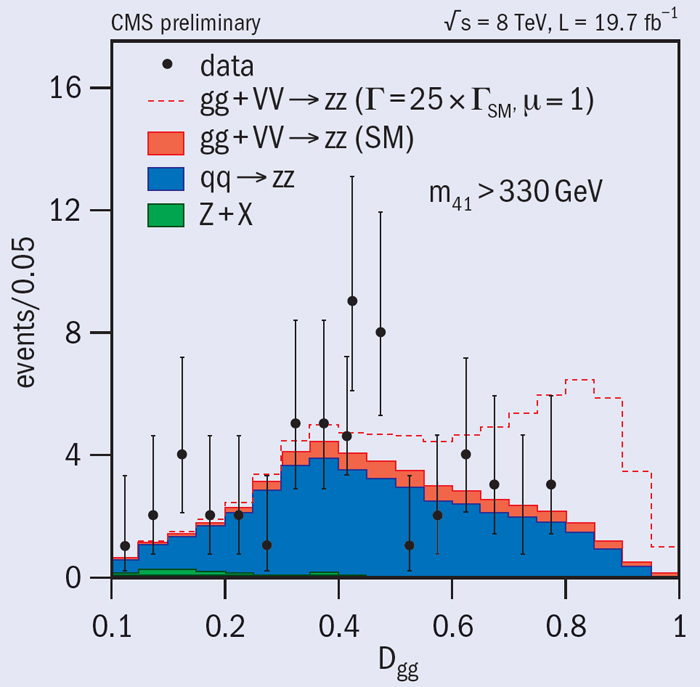
At the 2014 Rencontres de Moriond in March, the CMS collaboration presented new and stronger constraints on the total width of the 125 GeV Higgs boson by applying a novel technique on the data collected at the LHC at a centre-of-mass energy of 8 TeV. Following suggestions from several theorists to measure the ratio of the production rate for Higgs-mediated ZZ events with a mass considerably above the mass of the resonance (larger than approximately 200 GeV) to that on the peak, it is possible to derive precise indications on the maximal size of the Higgs boson’s natural width. For this analysis, CMS exploited two ZZ decay channels of the Higgs boson: H → ZZ → 4 leptons, where the four leptons can be electrons or muons, and H → ZZ → 2 leptons + 2 neutrinos.

To maximize the sensitivity of this analysis, in the 4-lepton channel, CMS took advantage of the kinematic differences between 4-lepton production occurring through gluon–gluon fusion (as for Higgs production) and through quark–antiquark scattering, which constitutes a large background to this analysis. The collaboration employed a matrix-element likelihood discriminant Dgg similar to that used for the standard Higgs analysis to help separate signal from background, and carried out a simultaneous fit of this discriminant versus the 4-lepton mass to measure the cross-section for off-peak production. The figure shows the distribution of the discriminant Dgg for events with high mass.

The 2 lepton + 2 neutrino channel has the advantage of a larger branching ratio, but it comes at the price of more background: owing to the presence of neutrinos, the final state is not fully reconstructed. This channel is based on the presence of large missing transverse energy (MET), and therefore is only sensitive to the off-shell part of the cross-section. In the case of on-peak production, the Z decaying into neutrinos does not have large transverse momentum and does not generate a significant MET. The on-peak cross-section measured from H → ZZ → 4 leptons is used for both channels.

The final result of the analysis is that the two channels have very similar sensitivities. In the Standard Model scenario, each of them is expected to exclude at the 95% confidence level (CL) a Higgs-boson width about 10 times larger than the natural width predicted by the model. The combined result is an exclusion of 17 MeV (35 expected) at 95% CL, which corresponds to 4.2 (8.5 expected) times the width in the Standard Model. Previous direct limits obtained from the measured width of the H → ZZ and H → γγ peaks, which are dominated by the detector resolution, are much weaker (of the order of a few giga-electron-volts).

LHCb’s results become more precise

By the time that the first long run of the LHC ended early in 2013, the LHCb experiment had collected data for proton–proton collisions corresponding to an integrated luminosity of 2 fb–1 at 8 TeV, to add to the 1 fb–1 of data collected at 7 TeV in 2011. The first batch of data allowed the LHCb collaboration to announce a variety of results, many of which have now been updated using the larger data sample and/or by including different decay channels. At the 2014 Rencontres de Moriond conference in March, the collaboration presented more precise results from a number of different analyses.

CCnew6_04_14

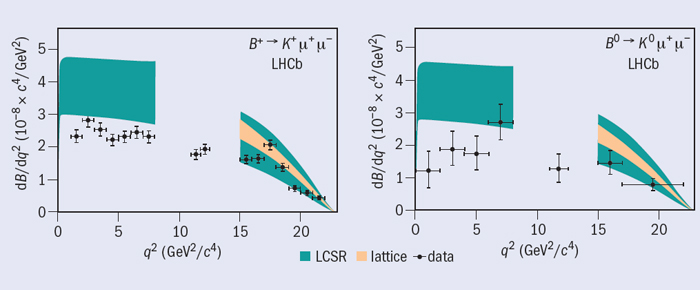
The flavour-changing neutral-current decay B → K*μ+μ is an important channel in the search for new physics because it is highly suppressed in the Standard Model. While there are relatively large theoretical uncertainties in the predictions, these can be overcome by measuring asymmetries in which the uncertainties cancel. One of these is the isospin asymmetry, based on the differences in the results of measurements of B0 → K*μ+μ and B+ → K*+μ+μ. The Standard Model predicts this isospin asymmetry to be small, which LHCb confirmed in 2011, based on 1 fb–1 of data. On the other hand, a similar analysis for decays in which the excited K* is replaced by its ground state K, showed evidence for a possible isospin asymmetry.

Now, the analysis of the full 3 fb–1 of data, which was presented at the Moriond conference, gives results that are consistent with the small asymmetry predicted by the Standard Model in both the K* and K cases. However, even if this confirms that the difference between B0 and B+ decays is small for this channel, there is a tendency for the differential branching fractions to have lower values than the theoretical predictions, as the figures show.

Another interesting result that LHCb has now refined concerned the exotic state X(3872), which was discovered by the Belle experiment at KEK in 2003. The nature of the X(3872) is puzzling because although it appears charmonium-like, it does not fit in to the expected charmonium spectrum. Exotic interpretations include the possibility that it could be a DD* molecule or a tetraquark state.

With the data from 2011, LHCb unambiguously determined its quantum numbers JPC as 1++. At Moriond the collaboration went further by presenting a measurement of the ratio of the branching fractions for the decay of the X(3872) into ψ(2S)γ and J/ψγ. This ratio, Rψγ, is predicted to be different depending on the nature of the X(3872). LHCb finds Rψγ = 2.46±0.64±0.29, which is compatible with other experiments but more precise. This value does not support the interpretation as a pure DD* molecule.

ATLAS uses t → qH decays to pin down the Higgs

Since the observation of a Higgs boson at a mass around 125.5 GeV by ATLAS and CMS in July 2012, both collaborations are making every effort to pin it down and decide if it is indeed the Higgs boson of the Standard Model, or the first member of a somewhat larger family, as predicted by several models that go beyond the Standard Model. Working in this direction, ATLAS used the six million tt pairs produced in Run I of the LHC to look for the possible decay of a top quark or antiquark into a light quark (up or charm) and a Higgs boson, t → qH.

CCnew8_04_14

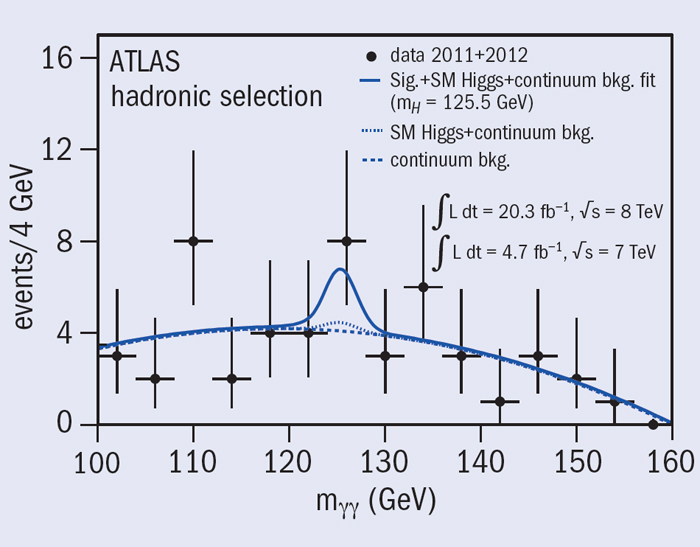
In the Standard Model such decays, which proceed via flavour-changing neutral currents, are highly suppressed, but in more complex models they might be present, albeit with a small branching ratio compared with the dominant t → bW decay. Doing the search using the dominant decay mode of the Higgs boson (H → bb) would lead to final states that are very hard to distinguish from the majority of tt decays. Therefore ATLAS made the choice to use the H → γγ decay mode – which has a clean signature of two photons with high transverse-momentm (pT) clustering as a narrow peak in invariant mass around 125.5 GeV – the power of this decay mode being demonstrated by the Higgs-boson discovery. Unfortunately the use of this decay mode is hampered by a small branching fraction, only 0.23%. Putting numbers together, and taking into account the acceptance of the detector and of the selection, a branching ratio B of 1% for t → qH would lead to about 11 observed events in a topology with two high pT photons and four jets, of which one would be identified as a b-jet. In addition, about three events with two high-pT photons, two jets, a lepton and missing transverse momentum (from the leptonic decay of the W) would also be expected.

After making kinematical cuts to ensure the compatibility of the selected events with the tt final state, ATLAS obtained the diphoton mass-spectrum shown in the figure. This rules out B = 1% immediately because it is clear that there is not an 11-event signal at 125.5 GeV. A detailed statistical analysis gives an expected limit on B of 0.53%. The small, non-significant excess in the 124–128 GeV bin worsens the observed limit to 0.79%, at the 95% confidence level.

This is the first experimental result on this channel and its precision is limited, mainly by the available statistics. When data become available at 13/14 TeV – leading to an increase of the tt- production cross-section of almost a factor of four – and with a larger integrated luminosity, either a much tighter limit will be obtained or, perhaps, a significant signal will show up, giving evidence for physics beyond the Standard Model in the Higgs sector.

LHCf investigates proton–lead collisions

The final run of the LHC in January 2013 prior to the start of the current long shutdown provided collisions between a beam of protons and a beam of lead ions, allowing the LHCf experiment to make further studies related to the interactions of cosmic rays in the Earth’s atmosphere. In particular, the collaboration was able to measure the distribution in transverse momentum (pT) for the inclusive production of neutral pions in the very forward region.

CCnew10_04_14

Despite several experimental indications at the HERA electron–proton collider at DESY, it is still not well understood how the density of partons (quarks and gluons) in a proton target increases or even saturates when Bjorken-x in the target – essentially the fraction of the proton’s momentum – is extremely small. Such phenomena are known to be visible in events at large rapidities – that is, close to the beam direction. Furthermore, in the case of nuclear targets, the parton density in the target is expected to be larger by about A1/3, where A is the nuclear mass number. In hadronic interactions, partons in the projectile hadron would lose their energy while travelling in the dense QCD-governed matter of the nuclear target, and particle production mechanisms would change accordingly when compared with those in nucleon–nucleon interactions.

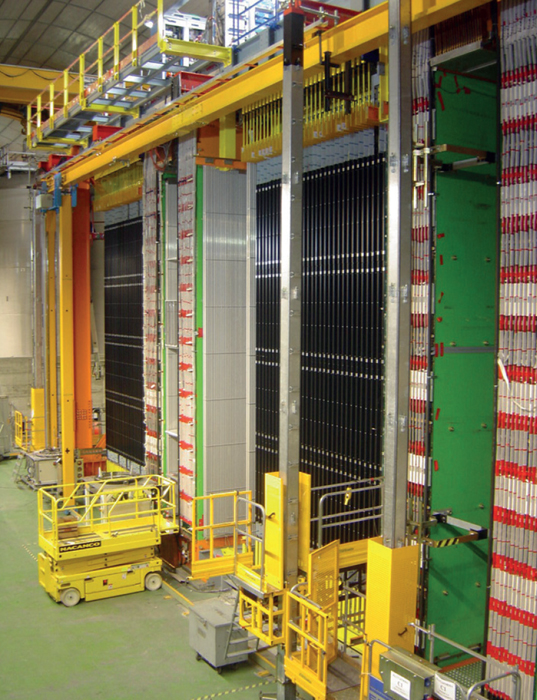
The LHCf detector is designed to measure the hadronic production cross-sections of neutral particles emitted at angles close to the beam direction – the “very forward” region – in proton–proton (pp) and proton–lead (pPb) collisions at the LHC. The detector covers a pseudorapidity range larger than 8.4 and is capable of precise measurements of the forward high-energy inclusive-particle-production cross-sections of neutral particles. Now, the collaboration has analysed the data taken in January 2013 on pPb collisions at nucleon–nucleon centre-of-mass energies of √sNN = 5.02 TeV and a beam-crossing angle of 145 μrad, for an integrated luminosity of 0.63 nb−1.

To obtain the soft-QCD component of the forward pion production, which is sensitive to the parton density in target, unavoidable contamination from ultra-peripheral collisions was first calculated using Monte Carlo simulations and then subtracted from the measured pT spectra. Once the ultra-peripheral collisions have been taken into account, the pT spectum measured by LHCf in the rapidity range −11.0 < ylab < −8.9 and 0 < pT < 0.6 GeV (in the detector reference frame) indicates a strong suppression of the production of neutral pions. This leads to a value of the nuclear modification factor value, RpPb, relative to the interpolated pT spectra in pp collisions at √s = 5.02 TeV, of about 0.1–0.4 – a value that is in overall agreement with the predictions of several Monte Carlo simulations of hadronic interactions.

OPERA sees a fourth τ neutrino

CCnew11_04_14

The OPERA experiment at the INFN Gran Sasso Laboratory has detected a fourth example of neutrino oscillation, with a muon neutrino (νμ) produced at CERN detected as a τ neutrino (ντ) after travelling a distance of 730 km.

The international OPERA experiment, which involves 140 physicists from 28 research institutes in 11 countries, was designed to observe this exceptionally rare phenomenon, gathering data in the neutrino beam produced by the CERN Neutrinos to Gran Sasso (CNGS) project. Generated by decays of pions and kaons made in the interactions of a proton beam from the Super Proton Synchrotron with a graphite target, the beam consisted mainly of νμ that would pass unhindered through the Earth’s crust towards Gran Sasso. The appearance and subsequent decay of a τ lepton in the OPERA experiment provides the telltale sign of νμ to ντ oscillation through a charged-current interaction.

After the first neutrinos arrived at the Gran Sasso Laboratory in 2006, the experiment gathered data for five consecutive years, from 2008 to 2012, during which the CNGS beam delivered a total of 17.97 × 1019 protons on target, yielding 19,500 neutrino events in the detector. The first ντ was observed in 2010, the second and third ones in 2012 and 2013, respectively.

The detection of the fourth ντ is important confirmation of the events seen previously. It means that the νμ to ντ transition has been seen for the first time with a statistical significance exceeding the 4σ level, so that OPERA can now claim the observation of this extremely rare phenomenon. The collaboration will continue to search for ντ in the data that remain to be analysed.

bright-rec iop pub iop-science physcis connect