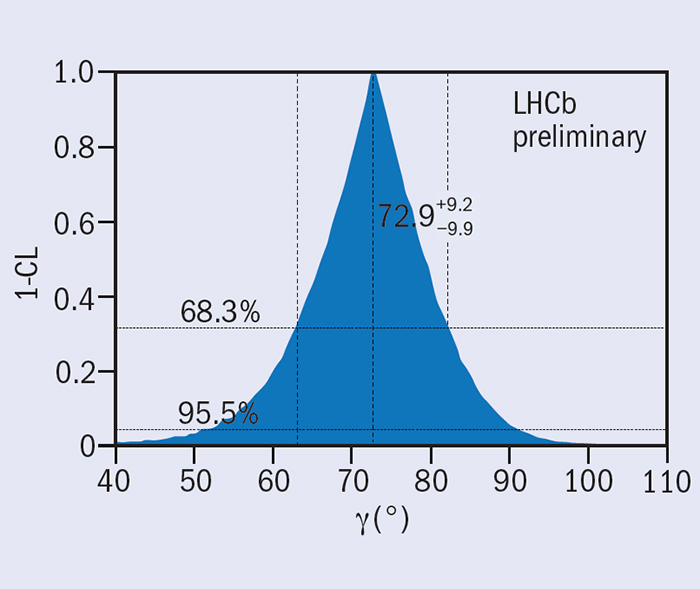
For the first time in a single experiment, LHCb has achieved a precision of better than 10° in measuring the angle γ that is linked to CP violation in the Standard Model.
In the celebrated Cabibbo–Kobayashi–Maskawa (CKM) picture of three generations of quarks, the parameters that describe CP violation are constrained by one of the six triangles linked to the unitarity of the 3 × 3 quark-mixing matrix. The angles of this triangle are denoted α, β and γ, and of these it is γ that is the least precisely known. The precise measurement of γ is one of the most important goals of the LHCb experiment because it provides a powerful method to probe for the effects of new physics.
At the 8th International Workshop on the CKM Unitarity Triangle, CKM2014, which was held in Vienna recently, the LHCb collaboration presented a combination of measurements of the angle γ that yields the most precise determination so far from a single experiment. Using the full data set of 3 fb–1 integrated luminosity from the LHC running in 2011 and 2012, the collaboration has combined results on all its current measurements of “tree-level” decays. In particular, in combining results on B(s) →D(s) K(*) decays – the “robust” combination, in which a B or Bs meson decays into a D or Ds meson, respectively, and a kaon – the researchers find a best-fit value of γ = (72.9+9.2–9.9)° at the 68.3% confidence-level interval (see figure). The full combination presented at CKM2014 includes a large set of observables in B → Dπ decays that are also sensitive to γ, but to a lesser extent than the B → DK-like decays (LHCb Collaboration 2014).
Signs of new physics are not expected to show up in these tree-level decays, but they set a precise base for comparison with measurements where the observation of effects of new physics is possible. Moreover, even before taking into account data from LHC Run 2 from spring 2015, LHCb will be able to improve this result further using the data that has already been collected, because there are important analyses that are still to be completed.
The electric charge of lead ions, when accelerated to ultra-relativistic velocities, is the source of an intense flux of high-energy quasi-real photons. Ultra-peripheral collisions – the interaction of a photon with a target at impact parameters larger than the sum of the radii of the incoming particles, where hadronic interactions are suppressed – provide a clean tool to study photon-induced production processes at the LHC.
ALICE has performed the first measurement of exclusive photoproduction of J/ψ mesons off protons in proton–lead collisions at the LHC, using data collected in early 2013 (Abelev et al. 2014). These data cover a range of photon–proton centre-of-mass energies that were not accessible previously. Such interactions have been studied at the electron–proton collider HERA, and are proposed as a key measurement at a future electron–hadron collider, to probe the gluon distribution in the proton.
The J/ψ mesons were reconstructed from their decay into a μ+μ– pair, where the muons were measured by the ALICE muon spectrometer. Requiring no other activity to be present in the detector enforced the exclusivity condition. Around the middle of the data-taking period, the beam direction was inverted, allowing ALICE to take data first when protons, and later lead ions, were travelling towards the muon spectrometer, providing proton–lead and lead–proton collisions, respectively. The rapidity of the J/ψ, measured with respect to the direction of the proton beam, determines the photon–proton centre of mass energy (Wγp). In lead–proton collisions, the acceptance of ALICE corresponds to values of Wγp more than twice as large as was reached at HERA by the H1 and ZEUS experiments, while the proton–lead collisions correspond to values of Wγp studied previously at HERA and in fixed-target experiments.
According to leading-order calculations in perturbative QCD, this process depends on the square of the gluon distribution in the proton evaluated at a scale close to the J/ψ mass (MJ/ψ) and at x-Bjorken x = (MJ/ψ/Wγp)2. The range in x covered by ALICE therefore extends from about 2 × 10⁻² (proton–lead) to 2 × 10⁻⁵ (lead–proton). It is then possible to study the evolution of the gluon density in the proton at a perturbative scale along three orders of magnitude in x, and probe into the region where the gluon density increases, possibly leading to a saturation regime, in which the proton wave-function is described by a coherent colour field created by the many overlapping gluons.
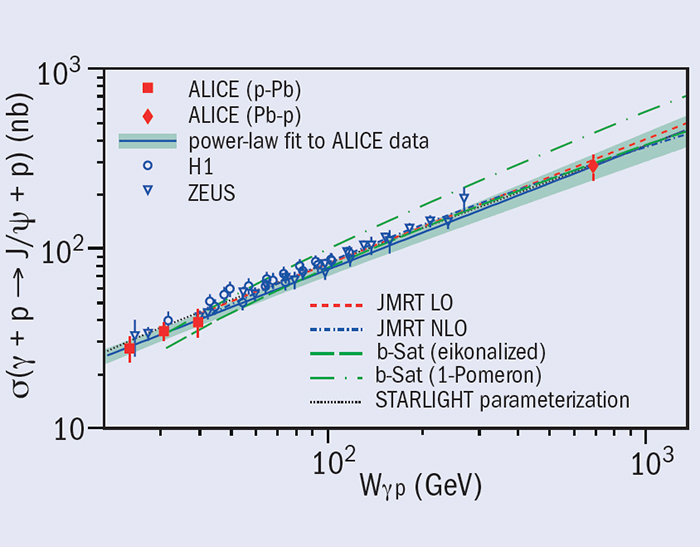
The cross-section measured by ALICE (see figure) has been compared with the predictions of models based on (i) perturbative QCD calculations at leading order (ii) and including the main next-to-leading order contributions, (iii) a saturation prescription including impact parameter dependence and (iv) a parameterization of HERA and fixed-target results. All models were fitted to HERA measurements, and are able to describe the current ALICE data.
ALICE has found that a power law in Wγp can describe the measured cross-section. The value of the power-law exponent is compatible with those found by H1 and by ZEUS. Therefore, no deviation from the same power law is observed up to about 700 GeV, or in a leading-order perturbative QCD context, down to x = 2 × 10⁻⁵, extending by a factor five the maximum x value explored previously.
In conclusion, within the current precision, ALICE has observed no change of regime with respect to what was measured at HERA. Data to be collected during LHC Run 2 at beam energies increased by a factor of two will allow ALICE both to improve the precision of the measurement and to access larger values of Wγp. Lowering the x value to values never reached before will open new opportunities to search for saturation phenomena.
The WW final state was a key component in the discovery of the Higgs boson with a mass of around 125 GeV, and remains essential for the ongoing measurements of the particle’s properties. Now, the ATLAS collaboration has firmly established the existence of this process, observing an excess consistent with H → WW, with a significance of 6.1σ compared with the background-only hypothesis (ATLAS Collaboration 2014a). In addition, ATLAS has measured the inclusive signal strength with a precision of about 20%, thereby taking the next step towards a precision measurement of the strength of the HWW interaction.
The new results are based on the combined 7-and-8-TeV ATLAS datasets from Run 1 of the LHC, and a total integrated luminosity of 25 fb–1. The analysis selects Higgs boson candidate data from events that have two charged leptons: electrons or muons. Improvements since the previous result – including likelihood-based electron identification and missing transverse-energy reconstruction that is more robust to pile-up – have allowed ATLAS to lower kinematic thresholds and so increase the signal acceptance.
The main backgrounds are from WW and top-quark pair production, with important contributions from Drell–Yan, Wγ*, and inclusive W production with a second, “fake” lepton produced by a jet. Categorizing the events by the number of jets separates the signal from the otherwise dominant background of top-quark pair production, and distinguishes between the vector-boson-fusion (VBF) and gluon–gluon fusion (ggF) production modes. Within each category, subdividing the signal regions by the flavours and kinematic properties of the lepton pair enhances the sensitivity by further separating signal from background, and separating different background processes from each other.
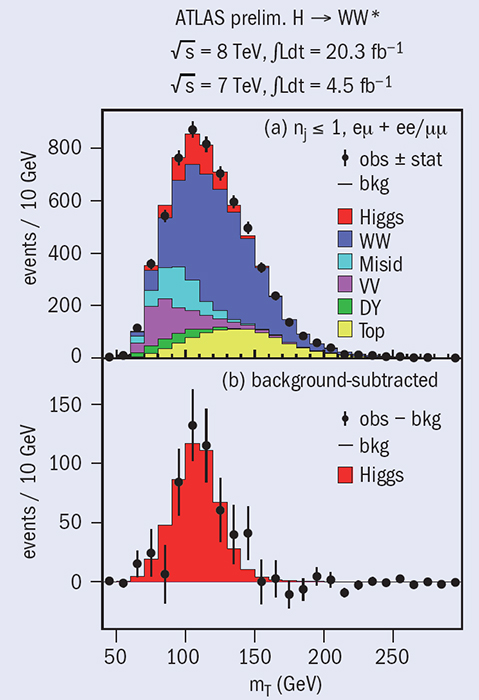
The number of signal events is determined by a fit to the distribution of an event property to separate signal and backgrounds still further. For the ggF categories, the dilepton “transverse mass”, mT, is used. The figure shows the distribution of mT for the 0 and 1 jet categories, compared with the summed signal and background expectation. It demonstrates the good agreement between the prediction, including the Higgs boson signal, and the observed data. For the VBF categories, a fit is made to the output of a boosted decision tree (BDT) – another new development since the previous ATLAS analysis. The BDT is trained using variables that are sensitive to the Higgs boson decay topology, as well as to the distinctive VBF signature of two energetic, well-separated jets.
At 125.36 GeV – the value of the Higgs boson mass measured by ATLAS from the γγ and ZZ* → 4l channels (ATLAS Collaboration 2014b) – the expected significance for an excess in H → WW is 5.8σ, and a significance of 6.1σ is observed. The measured signal strength, defined as the ratio of the measured H → WW cross-section to the Standard Model prediction, is μ = 1.08+0.16–0.15 (statistical) +0.16–0.13 (systematic).
Evidence for VBF production can be seen also from analysis of the categories. The ratio of the VBF and ggF signal strengths does not assume a value for the H → WW branching ratio or the ggF cross-section. A nonzero ratio indicates the presence of the VBF production mode. The result is μVBF/μggF = 1.25+0.79–0.52, which corresponds to a significance of 3.2σ, compared with 2.7σ expected for the Standard Model.
This analysis represents a significant advance in the understanding of the signal and background processes in the challenging dilepton WW channel. It establishes the observation of this decay, and the signal-strength measurement is, at present, the most precise obtained in a single Higgs boson decay channel. The results are consistent with the predictions for a Standard Model Higgs boson, but they remain limited by the statistical uncertainty, pointing to the potential of future measurements with data from Run 2 at the LHC.
Experiments at Fermilab are advancing an intriguing story that began three decades ago, with investigations of coherent neutrino interactions that produce pions yet leave the target nucleus unscathed.
When neutrinos scatter coherently off an entire nucleus, the exchange of a Z0 or W± boson can lead to the production of a pion with the same charge. The first observations of such interactions came in the early 1980s from the Aachen–Padova experiment at CERN’s Proton Synchrotron, followed by an analysis of earlier data from Gargamelle. A handful of other experiments at CERN, Fermilab and Serpukhov provided additional measurements before the end of the 1990s. These experiments determined interaction cross-sections for high-energy neutrinos (5–100 GeV), which were in good agreement with the model of Deiter Rein and Lalit Sehgal of Aachen. Published shortly after the first measurements were made, their model is still used in some Monte Carlo simulations.
More recently, the SciBooNE and K2K collaborations attempted to measure the coherent production of charged pions at lower neutrino energies (less than 2 GeV). However, they found no evidence of the interaction, and published upper limits below Rein and Sehgal’s original estimation. These results, together with recent observations of coherent production of neutral pions by the MiniBooNE and NOMAD collaborations, have now motivated renewed interest and new models of coherent pion production.
In the NuMI beamline at Fermilab – which has a peak energy of 3.5 GeV and energies beyond 20 GeV – coherent charged-current pion production accounts for only 1% of all of the ways that a neutrino can interact. Nevertheless, both the ArgoNeuT and MINERvA collaborations have now successfully measured the cross-sections for charged-current pion production by recording the interactions of neutrinos and antineutrinos.
ArgoNeuT uses a liquid-argon time-projection chamber (TPC), and has results for coherent interactions of antineutrinos and neutrinos at mean energies of 3.6 GeV and 9.6 GeV, respectively (Acciarri et al. 2014). A very limited exposure produced only 30 candidates for coherent interactions of antineutrinos and 24 for neutrinos (figure 1), but a measurement was possible thanks to the high resolution and precise calorimetry achieved by the TPC. It is the first time that this interaction has been measured in a liquid-argon detector. ArgoNeuT’s results agree with the state-of-the-art theoretical predictions (figure 2), but its small detector size (<0.5 tonnes) limits the precision of the measurements.
MINERvA uses a fine-grained scintillator tracker to fully reconstruct and select the coherent interactions in a model-independent analysis. With 770 antineutrino and 1628 neutrino candidates, this experiment measured the cross-section as a function of incident antineutrino and neutrino energy (figure 2). The measured spectrum and angle of the coherently produced pions are not consistent with models used by oscillation experiments (Higuera et al. 2014), and they will be used to correct those models.
The techniques developed during both the ArgoNeuT and MINERvA analyses will be used by larger liquid-argon experiments, such as MicroBooNE, that are part of the new short-baseline neutrino programme at Fermilab. While these experiments will focus on neutrino oscillations and the search for new physics, they will also provide more insight into coherent pion production.
One of my most memorable experiences of CERN is from an early morning in the summer of 1966. I drove to CERN with my two small children, one and three years of age, to fetch their dad who had been on a night shift – there were no guards at the entrance in those days. I found him outside the experimental hall being interviewed by a friendly looking gentleman, who after greeting us continued asking questions and taking notes. The gentleman, as I found out afterwards, was the director-general of CERN, Bernard Gregory. This was for me an inspiring and instructive experience. Since then, CERN has grown a great deal, and attracts so many more people that the probability of a young visiting PhD student being interviewed alone by the director-general must not be so large. For me, there are other exciting new features of CERN these days, such as encountering crowds of enthusiastic young people from across the world.
The young CERN has now turned 60, its official foundation being on 29 September 1954. Its creation was a unique act, based on an unprecedented common effort by a number of distinguished scientists from several countries, not only from Europe but also from the US, among them Robert Oppenheimer and Isidor Rabi. We are all impressed by their dedication and commitment, and are grateful to them for the creation of this organization for basic research in science for peace. Since its creation, CERN has served as a “standard model” for several other international scientific organizations.
However, while CERN has just celebrated its 60th anniversary, there is one part of it that is a little older. The CERN “Group of Theoretical Studies” was created through a resolution passed by the CERN Interim Council in Amsterdam in May 1952. It was possible to form this group very quickly and for it to start work, in Copenhagen, even before the decision had been made as to where CERN would be located. Copenhagen had already been a world centre for theoretical physics for several decades. It was clear that CERN Theory would thrive there, owing to the presence of the great and incredibly influential theoretical physicist Niels Bohr, and his competent local staff. Victor Weisskopf, who was director-general of CERN in the years 1960–1964, knew Bohr well, and used to refer to him as the greatest founder of CERN. CERN Theory in Copenhagen was a lively place, and attracted many distinguished international scientists.
The CERN Annual Report for 1955 informs us that: “The Theoretical Study Division is located in the Theoretical Physics Institute, University of Copenhagen. The work of the Division has proceeded according to the programme fixed during the interim period and includes: a) scientific research on fundamental problems of nuclear physics, including theoretical problems related to the focusing of ion beams in high energy accelerators; b) training of young theoretical physicists; c) development of active co-operation with the laboratories of Liverpool and Uppsala, whose machines and equipment have been placed at the disposal of CERN.” This was what CERN’s “founding fathers” had in mind that the theorists should be doing. But, of course, except for b, that was not what the theorists actually did.
Theory went on to flourish at CERN, and the subsequent history of the Theory Division deserves a book of its own
The 1955 CERN Annual Report also informs us that the Theoretical Study Division in Copenhagen had two full-time senior staff members: Gunnar Källén and Ben R Mottelson (who was to receive the 1975 Nobel Prize in Physics). Note that these “leaders”, both born in 1926, were at the time below the age of 30. This was a general feature of the young CERN – even the accelerators were built by people who many of us would now consider as “youngsters”.
CERN Theory was expected to move gradually to Geneva. However, this took in total about five years, until 1 October 1957, when the Theory Group in Copenhagen was officially closed. The theorists who came to Geneva had their offices first at the University of Geneva, then in barracks at Geneva Airport, until they moved to the current CERN site in Meyrin. Theory went on to flourish at CERN, and the subsequent history of the Theory Division deserves a book of its own.
In 1971, I became the first female fellow of the CERN Theory Division, in 1982 the first female member of CERN’s Scientific Policy Committee, and in 1988 this committee’s first female “old boy”. Later, in the years 1998–2004, I was the adviser on member states to CERN’s director-general. I have enjoyed CERN’s international atmosphere enormously, which has given me ample opportunity to meet and talk with inspiring physicists from across the world. I also feel fortunate to have lived in a period when the amount of information revealed about the nature of the elementary constituents of matter and their interactions has been mind-boggling. CERN has been an important contributor in this respect. Who could have imagined that we would arrive at the Standard Model so “soon” – a highly successful theory of weak, electromagnetic and strong interactions?
In 2004, during the mandate of Robert Aymar as director-general, the CERN Theory Division turned into the Theory Unit, under the CERN Physics Department. Does this imply that CERN wishes to guide the theorists to work on the “focusing of ion beams”, and machines as well as equipment, as envisaged by the founding fathers in 1952? Fortunately, during my visits to CERN since, I have seen no such trend. Long live theory at CERN.
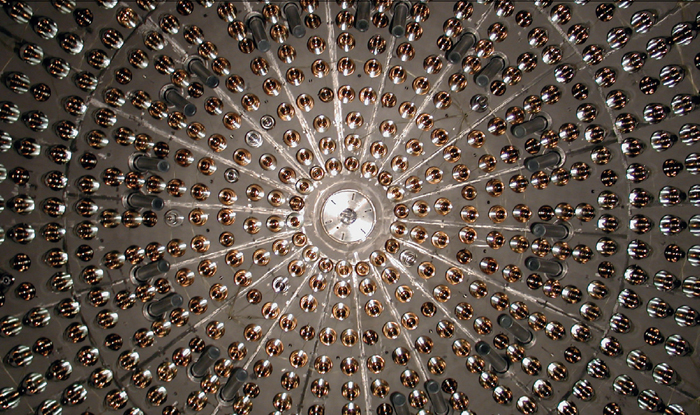
The Borexino experiment at the INFN Gran Sasso National Laboratories has measured the energy of the Sun in real time, showing for the first time that the energy released today at its centre is exactly the same as that produced 100,000 years ago. This has been possible through the experiment’s direct detection of the low-energy neutrinos produced in the initial nuclear reactions occurring in the solar core.
Previous measurements of solar energy have always been made on the radiation (photons) that currently illuminate and heat the Earth. The energy of this radiation originates in the Sun’s nuclear reactions, but, on average, has taken 100,000 years to travel through the dense solar matter and reach the surface. Neutrinos produced by the same nuclear reactions, on the other hand, take only a few seconds to escape from the Sun before making the eight-minute journey to Earth. The comparison between the neutrino measurement now published by the Borexino collaboration and the previous measurements on the emission of radiant energy from the Sun shows that solar activity has not changed during the past 100,000 years.
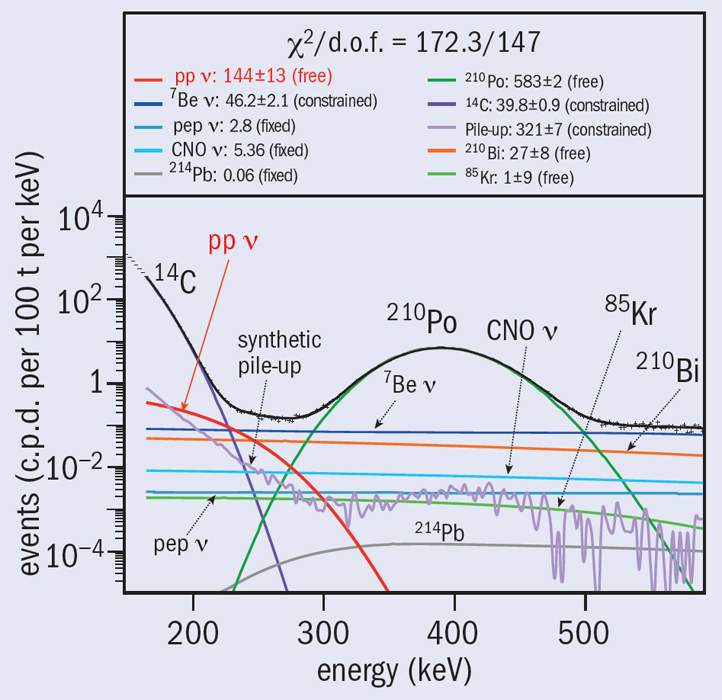
Borexino is an ultra-sensitive liquid-scintillator detector designed to detect low-energy neutrino events in real time at a high rate, in contrast to earlier radioachemical experiments such as Homestake, GALLEX and SAGE. The experiment previously has focussed on measurements of neutrinos from 7Be and 8B – nuclei formed in certain branches of the principal chain of reactions that converts hydrogen to helium at the heart of the Sun. The 7Be neutrinos constitute only 7% of the neutrino flux from the Sun and the 8B neutrinos even less, but they have been key to the discovery and study of the phenomenon of neutrino oscillations, most recently by Borexino. In contrast in this latest work, Borexino has focused on the neutrinos from the fusion of two hydrogen nuclei (protons) to form deuterium – the seed reaction of the nuclear-fusion cycle that produces about 99% of the solar power, some 3.84 × 1033 ergs/s.
The difficulty of the new measurement lies in the extremely low energy of these so-called pp neutrinos, which is smaller than that of the others emitted by the Sun. The capability to do this successfully makes the Borexino detector unique, and has also allowed the study of neutrinos produced by the Earth.
The Borexino experiment is the result of a collaboration between European countries (Italy, Germany, France, Poland), the US and Russia, and it will take data for at least another four years, improving the accuracy of measurements already made and addressing others of great importance, for both particle physics as well as astrophysics.
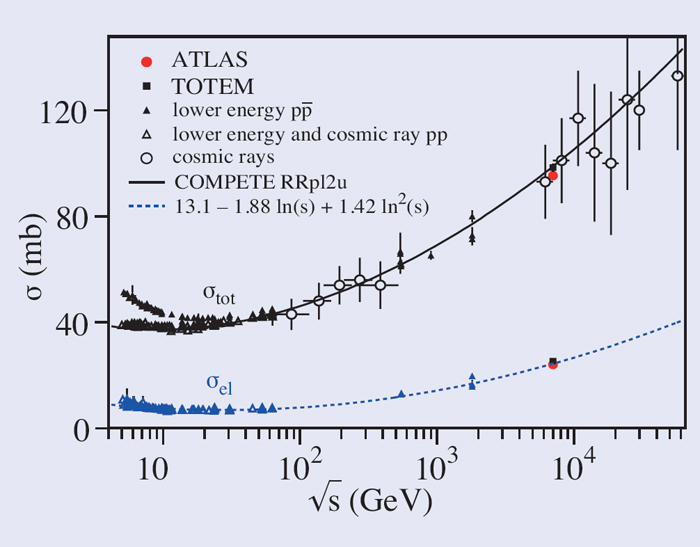
Data from a special run of the LHC using dedicated beam optics at 7 TeV have been analysed to measure the total cross-section of proton–proton collisions in ATLAS. Using the Absolute Luminosity For ATLAS (ALFA) Roman Pot sub-detector system located 240 m from the interaction point, ATLAS has determined the cross-section with unprecedented precision to be σtot (pp → X) = 95.4±1.4 mb.
The total cross-section is a fundamental parameter of the strong interactions, setting the scale of the size of the interaction region at a given energy. To measure the total cross-section, the optical theorem is used, which states that the total cross-section is proportional to the imaginary part of the forward elastic-scattering amplitude, extrapolated to momentum transfer, t = 0. From a measurement of the elastic-scattering cross-section differential in t, the value of the total cross-section is inferred, and is found to increase logarithmically with the centre-of-mass energy (see figure).
Measuring elastic scattering is a challenge because elastically scattered protons escape the interaction at very small angles of tens of micro-radians or less. To detect these protons, dedicated detectors are installed, such as ALFA. To achieve the required focusing properties, the LHC was operated with special beam optics of β* = 90 m. The detectors can then be moved as close as a few millimetres from the LHC beam, to access the smallest scattering angles.
The discovery of a Higgs boson by the ATLAS and CMS collaborations in 2012 marked a new era in particle physics. Since then, the experimental determination of the properties of the new boson, such as its mass and production rate, as well as the study of its decays into as many final states as possible, have became crucial tasks for the LHC experiments.
The ATLAS collaboration has recently published a new set of measurements of the Higgs boson’s properties from the two high-resolution decay channels, to two photons (ATLAS Collaboration 2014a) and to four charged leptons (ATLAS Collaboration 2014b). The new measurements have been performed using the proton–proton collisions delivered by the LHC in 2011 and 2012. They exploit the most accurate knowledge of the detector performance achieved so far, which has also led to an updated measurement of the Higgs mass, mH = 125.36±0.41 GeV (ATLAS Collaboration 2014c).
The Standard Model predicts precisely the couplings of the Higgs boson to all other known elementary particles, once its mass is measured. The simplest way to probe the new boson couplings is to measure the ratio μ (or signal strength) between the number of Higgs bosons measured in the collected data and the number predicted by the theory: a measured μ = 1 would mean that the observation is consistent with the Standard Model Higgs boson. In these latest analyses, the signal strength in the two-photon channel is found to be μ = 1.17±0.27, while it is μ = 1.44+0.40–0.33 in the four-lepton channel. So, within their uncertainties, both results agree with the Standard Model.
The Standard Model also predicts that a Higgs boson can be produced through different mechanisms in proton–proton collisions. The most frequent mechanism (87%) is the scattering (or “fusion”) of strongly interacting gluons to form a Higgs boson. Production through the fusion of W or Z bosons is predicted to occur in 7% of the cases, and has a characteristic event signature of two jets in the forward direction (along the proton beams) that accompany the Higgs boson. The figure shows a candidate event for this production mode. In the recent papers, ATLAS physicists have identified and measured Higgs bosons from various production mechanisms (ATLAS Collaboration 2014a and 2014b).
So far, no surprises have emerged when looking into the details, but the statistical uncertainties are still large. The new data-taking campaign starting in 2015 will be important to improve the precision of the measurements, and will lead to an improved understanding of the nature of the Higgs boson.
CERN’s origins can be traced back to the late 1940s, when a divided Europe was emerging from the ashes of war. A small group of visionary scientists and public administrators, on both sides of the Atlantic, identified fundamental research as a potential vehicle to rebuild the continent and foster peace in a troubled region. It was from these ideas that CERN was born on 29 September 1954, with a dual mandate to provide excellent science, and to bring nations together. Twelve founding member states – Belgium, Denmark, France, the Federal Republic of Germany, Greece, Italy, the Netherlands, Norway, Sweden, Switzerland, the UK and Yugoslavia – signed the convention that officially entered into force 60 years ago.
As CERN’s facilities and research arena grew in size, so too did the extent of collaboration, with more countries becoming involved – in particular with the programme for the Large Electron–Positron (LEP) collider, and more recently with the construction of the Large Hadron Collider (LHC) itself, as well as its experiments. Today, CERN has 21 member states, with one candidate for accession, one associate member in the pre-stage to membership and seven observer states and organizations. In addition, it has co-operation agreements with many non-member states.
This timeline illustrates a few key moments in this collaborative journey, from those early days to 2014, the 60th anniversary year.
The top quark is the heaviest-known fundamental particle, whose mass of about 173 GeV is much larger than that of the other quarks, and comparable to those of the W, Z and Higgs bosons. The copious production of top quark–antiquark pairs via the strong interaction in proton–proton collisions at the LHC allows a rich programme of studies, but it also makes top-pairs one of the key backgrounds to be understood in the search for physics beyond the Standard Model. In a recent paper, the ATLAS collaboration reports on precise measurements of the top-pair cross-section – i.e. the production rate – at centre-of-mass energies (√s) of both 7 and 8 TeV, using the full data sample from 2011 to 2012.
The measurements are made using a distinctive final state in which one top quark decays to an electron, a neutrino and a b quark, and the other to a muon, neutrino and b quark. This gives rise to events with an opposite-sign electron–muon pair, and collimated jets of particles “tagged” as being likely to have originated from b quarks. Events with both one and two such b-tagged jets are counted, reducing the uncertainties associated with jet reconstruction and b-quark tagging compared with earlier measurements at the LHC and at the Tevatron at Fermilab. The total uncertainties are around 4%, giving the most precise top-pair production measurements to date.
Theoretical predictions for the top-pair cross-section are now available at next-to-next-to-leading order (NNLO) accuracy in QCD, with uncertainties of about 5%. The results are in good agreement with these predictions, and give sensitivity to the fraction of the proton momentum carried by gluons. As the figure shows, the cross-section predictions depend on the assumed mass of the top quark mt, so the measurements can be interpreted as a determination of mt, giving mt = 172.9+2.5–2.6 GeV. This technique measures the top-quark pole mass, and the resulting value is in good agreement with values obtained from direct reconstruction of top-quark decay products, involving different theoretical assumptions. Finally, the agreement between measurements and QCD predictions leaves little room for additional top-quark production from physics processes beyond the Standard Model, such as supersymmetry. For example, the measurements exclude supersymmetric top quarks with masses between mt and 177 GeV that decay to top quarks and invisible neutralinos – a mass range that is difficult to address with more traditional searches.
To provide the best experiences, we use technologies like cookies to store and/or access device information. Consenting to these technologies will allow us to process data such as browsing behavior or unique IDs on this site. Not consenting or withdrawing consent, may adversely affect certain features and functions.
Functional
Always active
The technical storage or access is strictly necessary for the legitimate purpose of enabling the use of a specific service explicitly requested by the subscriber or user, or for the sole purpose of carrying out the transmission of a communication over an electronic communications network.
Preferences
The technical storage or access is necessary for the legitimate purpose of storing preferences that are not requested by the subscriber or user.
Statistics
The technical storage or access that is used exclusively for statistical purposes.The technical storage or access that is used exclusively for anonymous statistical purposes. Without a subpoena, voluntary compliance on the part of your Internet Service Provider, or additional records from a third party, information stored or retrieved for this purpose alone cannot usually be used to identify you.
Marketing
The technical storage or access is required to create user profiles to send advertising, or to track the user on a website or across several websites for similar marketing purposes.