Comsol -leaderboard other pages

Topics

COMPASS observes a new narrow meson

Mass spectrum for the f0(980)

The bulk of visible matter originates from the strong interactions between almost massless fundamental building blocks: quarks and antiquarks bound together by gluons. Although these interactions are described by QCD, the understanding of the underlying principle – of how exactly these building blocks form observable matter (hadrons), and which configurations are or are not realized in nature – has been a major challenge for a long time. The question of how hadrons are formed relates directly to the excitation spectrum of hadrons, in particular, mesons, which are made from quark–antiquark pairs. Theoretical predictions on the nature of hadronic bound-states, their masses and decays, have long been based on models, but direct QCD calculations performed on high-performance computers using a discretized space–time lattice are now also reaching a predictive level for new hadron states.

The finding was made using the COMPASS spectrometer to study peripheral (diffractive) reactions of pions.

For many years, experiments have searched for hadronic bound states with exotic contents, such as gluon-only states (glueballs) or multi-quark states with a molecular nature. Some candidates had been found in studying systems with light quarks (glueballs, hybrids) or, most recently, with heavy quarks, revealing the first evidence for explicit multi-quark systems, based on the characteristic combination of charge and flavour.

Mass-dependent phase variation

The COMPASS collaboration has recently observed the existence of an unusual meson made from light quarks at a mass of 1.42 GeV/c2. Since this mass region had been investigated for half a century, this new particle comes as a surprise, and its finding is by virtue of the world’s largest data sample for such studies. The particle is called the a1(1420), reflecting its properties of unit spin/isospin and positive parity, characteristic of the “a” mesons. The finding was made using the COMPASS spectrometer to study peripheral (diffractive) reactions of pions with a momentum of 190 GeV/c on a liquid-hydrogen target at CERN’s Super Proton Synchrotron. Despite its production rate of only 10–3 with respect to known mesons, the existence of the a1(1420) was clearly unravelled using an advanced complex analysis technique that allows a produced superposition of individual quantum states to be disentangled into the individual contributing components, both in terms of quantum numbers and decay paths. The unique signature for this particular observation is a strong narrow enhancement in the mass spectrum of this JPC = 1++ quantum state (figure opposite) in conjunction with an observed phase delay of about 1800 – which any wave undergoes when its frequency (mass) passes a resonance.

The a1(1420) is observed decaying only into the f0(980), which is often discussed as a molecular-type state, and an additional pion, so rendering it unique. Following first announcements of the finding, several explanations have already been put forward. They cover the interpretation of the a1(1420) as a molecular/tetraquark state partnering another known state f1(1420), as well as scenarios in which the a1(1420) is generated by long-range effects of different sorts, all involving the light meson a1(1260). However, despite some remarkable features, not all of the experimental findings can be reproduced by those explanations. Thus, the a1(1420) enters the club of resonances that are unexplained, although experimentally well established.

Latest ATLAS results on the Higgs boson

CCnew6_04_15

ATLAS physicists are making increasingly precise measurements of the properties of the observed Higgs boson, including production and decay rates, as well as the spin. Comparisons of the results with theoretical predictions could indicate whether new particles or phenomena beyond the Higgs field of the Standard Model are required for electroweak-symmetry breaking.

Recently published studies concern the decays of the Higgs boson into vector bosons (γγ, ZZ, WW, Zγ) and fermions (ττ, bb, μμ) in various production modes (ATLAS Collaboration 2015a). Measurements of the signal strength, μ = σ/σSM, allow the measured cross-sections, σ, of each decay channel to be compared to that predicted by the Standard Model, σSM. The figure shows that the results are compatible with the Standard Model’s prediction, that is, μ = 1. The new combination of all of the production and decay channels gives the most precise value from ATLAS to date: μ = 1.18 + 0.15 – 0.14.

Other new results include studies of the rare process of Higgs-boson production in association with two top quarks – a channel that allows physicists to probe directly the mysteriously large top–Higgs Yukawa coupling (ATLAS Collaboration 2015b). The analyses looked at a number of different decay modes of the Higgs boson, including decays into fermions (bb, ττ), and into bosons (WW, ZZ), the latter mode being measured for the first time by ATLAS in association with top quarks. Gathering all of the decay channels together, the data show a small excess of events over background with a strength μ(ttH) = 1.8±0.8. This gives a significance of 2.4σ with respect to a “no ttH” hypothesis. Observation of the Higgs boson in this production mode will require the new data expected in the LHC’s Run 2.

The LHC will soon restart running with a proton–proton collision energy of 13 TeV, more than 60% higher than that of Run 1

ATLAS has also improved its studies of the spin and parity of the Higgs boson (ATLAS Collaboration 2015c). The Standard Model hypothesis of a spin-0 particle with positive parity is favoured at more than 99% confidence level.

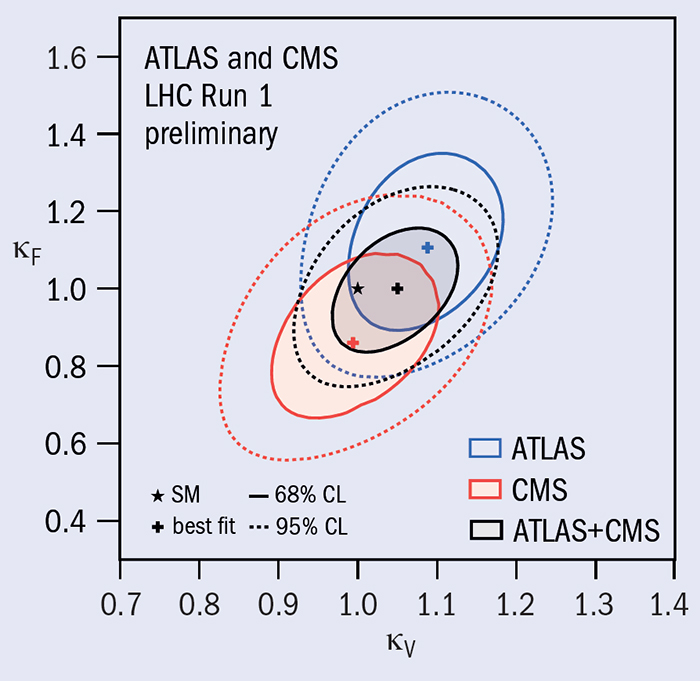
In addition, the ATLAS and CMS collaborations have joined forces to combine their precision measurements of the mass of the Higgs boson, and recently presented a new combined value of mH = 125.09±0.24 (0.21 stat.±0.11 syst.) GeV, with an uncertainty reduced to two parts in a thousand (0.2%).

The LHC will soon restart running with a proton–proton collision energy of 13 TeV, more than 60% higher than that of Run 1. The production rate of the Standard Model Higgs boson will increase by more than a factor of two, and that of the rare ttH process by almost a factor of four. ATLAS is ready to exploit the full potential of Run 2 to study the Higgs boson and to look beyond for new phenomena.

CMS digs deeply into lepton-pair production

Lepton pairs produced in proton–proton collisions at the LHC provide a clear signal that is easy to identify in the detector. The production is dominated by the Drell–Yan process, in which an intermediate Z/γ* boson is produced by the incoming partons. The measurements of the Drell–Yan production cross-section as a function of the mass of the intermediate boson, its rapidity (corresponding to the scattering angle) and its transverse momentum allow sensitive tests of QCD, the theory of the strong interaction. Recently, the CMS collaboration published two new measurements that provide a comprehensive view of the production of dimuons, a pair of oppositely charged muons, via the decay of Z bosons at a collision energy of 8 TeV at the LHC.

The parton structure of the proton and its evolution, governed by the dynamics of the strong interaction, can be scrutinized over a large range of phase space. By comparing the measurements to calculations that employ different parton distribution functions (PDFs) and different theoretical models for the dynamics, the PDFs and their uncertainty can be improved. These studies are also important for investigating other physics processes, for example searches for new resonances decaying into dileptons in models beyond the Standard Model.

In the CMS analysis, dimuon production in the vicinity of the Z-boson peak was parameterized doubly differentially as functions of the transverse momentum (qT) and the rapidity (y) of the Z boson. The analysis used the data sample of proton–proton collisions at a centre-of-mass energy of 8 TeV, amounting to an integrated luminosity of 19.7 fb–1. The measurement probes the production of Z bosons up to high transverse momenta of qT > 100 GeV, a kinematic regime in which the production is dominated by gluon–quark fusion. Therefore, the measurement is sensitive to the gluon PDF in a kinematic regime that is important for Higgs-boson production via gluon fusion. In the future, Z-boson production can also be used to constrain the gluon PDF and provide information complementary to other processes employed, such as direct photon production. The data are well reproduced within uncertainties by the next-to-next-to-leading-order predictions computed with the FEWZ simulation code. The MADGRAPH and POWHEG predictions deviate from data up to 20% at high-z transverse momentum.

CMS has measured the five major angular coefficients A0 to A4 as a function of qT and y

The angular distribution of the final-state leptons in Drell–Yan production is determined by the vector and axial-vector coupling structure of the Standard Model Lagrangian, and by the relative contributions of the quark–antiquark annihilation and quark–gluon Compton processes. In the presence of higher-order QCD corrections, the general structure of the lepton angular distribution in the boson rest-frame is given by a formula that contains a set of angular coefficients.

Using the 8 TeV data, CMS has measured the five major angular coefficients A0 to A4 as a function of qT and y. None of the theoretical models tested describe all of the coefficients satisfactorily. The coefficients A0 and A2 measured by CMS in proton–proton collisions at the LHC are larger than those measured in proton–antiproton collisions at Fermilab’s Tevatron at a lower centre-of-mass energy. This is expected, owing to the significant contribution of the quark–gluon process in proton–proton collisions at the LHC. In addition, as the figure shows, the analysis confirmed for the first time the anticipated deviation from the Lam–Tung relation, A0 = A2 (Lam and Tung 1979). This deviation is expected in QCD calculations beyond the leading order. The measurement by CMS shows that A0 > A2, especially for high qT. Nonzero values were also measured for A1 and A3.

The comprehensive study of the Z-boson production mechanism presented in these two recently published CMS papers lays the foundation for future high-precision measurements, such as the measurement of the mass of the W boson and the electroweak mixing angle.

LHCb’s new analysis confirms an old puzzle

At the recent Moriond Electroweak (EW) conference at La Thuile, the LHCb collaboration presented an updated angular analysis of the decay B → K*0 μ+μ using the experiment’s full data set from the LHC’s Run 1 (LHCb Collaboration 2015). This is an update of an earlier measurement based on the 2011 data alone, which showed a significant discrepancy in one angular observable (referred to as P´5) compared with predictions from the Standard Model. Because the discrepancy could be interpreted as a sign of physics beyond the Standard Model, it provoked considerable discussion within the particle-physics community, and the update with the full Run 1 sample has been eagerly awaited.

The decay of a B meson (containing a b quark and a d quark) into a K*0 meson (s and d) and a pair of muons is quite a rare process, occurring around once for every million B meson decays. At quark level, the decay involves a change of the quark flavour, b → s, without any change in charge. Such flavour-changing neutral processes are forbidden at the lowest perturbative order in the Standard Model, and come from higher-order loop processes involving virtual W bosons. In many extensions of the Standard Model, new particles can also contribute to the decay, leading to an enhancement or (through interference) a suppression in the rate of the decay. The contributions from new particles beyond the Standard Model can also change the angular distributions of the kaon and pion from the K*0 decay, and of the muons.

The analysis shown at Moriond, which is the first by any experiment to explore the full angular distribution of the decay, confirms the discrepancy seen in the 2011 data. At low dimuon masses, there is poor agreement between the current Standard Model predictions and the data for the P´5 observable. The two measurements in the range 4 < q2 < 8 GeV2/c4 are both 2.9σ from the Standard Model calculation (see figure).

Two invited theory talks followed LHCb’s presentation at Moriond. Both speakers were able to give an initial interpretation of the results, and found a consistent picture (see, for example, Straub and Altmannshofer 2015). A model-independent analysis favours a best-fit point that is about 4σ from the current Standard Model predictions.

It is, however, still too soon to claim evidence of new particles. The major challenge in interpreting the results lies in separating the interesting physics from poorly known QCD effects, which could be larger than first expected and hence responsible for the discrepancy. No matter the cause of the anomaly, there will need to be some rethinking of the current understanding of the B → K*0 μ+μ decay.

TOTEM finds evidence for non-exponential elastic pp scattering

Measurements of the differential cross-section in proton–proton (pp) or proton–antiproton (pp) scattering have generally proved consistent with a pure exponential dependence at low values of the square of the four-momentum transfer, ǀtǀ. However, slight deviations have been observed, notably in elastic pp and pp scattering at the Intersecting Storage Rings at CERN. Now, the TOTEM experiment has made a precision measurement of elastic pp scattering at the LHC, and finds that the data exclude a purely exponential behaviour of the cross-section at low ǀtǀ at a total energy of 8 TeV in the centre of mass.

The TOTEM experiment, which co-inhabits point 5 on the LHC with CMS, includes a system of Roman Pots, which allow detectors to be brought close to the beam so as to intercept particles scattered at very small angles to the beam. The Roman Pots are in two stations on opposite sides of interaction point 5, and each station is equipped with detectors at both 214 m and 220 m from the interaction point. The detectors consist of stacks of silicon-strip sensors, specially designed to have a narrow insensitive region, of a few tens of micrometres, along the edge that faces the beam (CERN Courier September 2009 p19).

TOTEM collected the data during a special run at the LHC in July 2012, in which the Roman Pots were brought in to a distance of only 9.5 times the transverse beam size of the beam. During 11 hours of data taking, the experiment amassed 7.2-million tagged elastic events at a collision energy of 8 TeV. The large data set has allowed a precise measurement of the elastic pp cross-section, with both statistical and systematic uncertainties below 1%, except for overall normalization. As a result of this precision, TOTEM is able to exclude a purely exponential differential cross-section in the range 0.027 < |t| < 0.2 GeV2, with a significance greater than 7σ. In contrast, parameterizations with either quadratic or cubic polynomials in the exponent are compatible with the data.

New possibilities for particle physics with IceCube

The IceCube Neutrino Observatory has measured neutrino oscillations via atmospheric muon-neutrino disappearance. This opens up new possibilities for particle physics with the experiment at the South Pole that was originally designed to detect neutrinos from distant cosmic sources.

IceCube records more than 100,000 atmospheric neutrinos a year, most of them muon neutrinos, and its sub-detector DeepCore allows the detection of neutrinos with energies from 100 GeV down to 10 GeV. These lower-energy neutrinos are key to IceCube’s oscillation studies. Based on current best-fit oscillation parameters, IceCube should see fewer muon neutrinos at energies around 25 GeV reaching the detector after passing through the Earth. Using data taken between May 2011 and April 2014, the analysis selected muon-neutrino candidates in DeepCore with energies in the region of 6–56 GeV. The detector surrounding DeepCore was used as a veto to suppress the atmospheric muon background. Nearly 5200 neutrino candidates were found, compared with the 6800 or so expected in the non-oscillation scenario. The reconstructed energy and arrival time for these events were used to obtain values for the neutrino-oscillation parameters, Δm322 = 2.72+0.19–0.20 × 10–3 ev2 and sin2 θ23 = 0.53+0.09–0.12. These results are compatible and comparable in precision to those of dedicated oscillation experiments.

The collaboration is currently planning the Precision IceCube Next Generation Upgrade (PINGU), in which a much higher density of optical modules in the whole central region will reduce the energy threshold to a few giga-electron-volts. By carefully measuring coherent neutrino interactions with electrons in the Earth (the Mikheyev–Smirnov–Wolfenstein effect), this should allow determination of the neutrino-mass hierarchy, and which neutrino flavour is heaviest.

The experiment now known as DUNE

The long-baseline neutrino experiment formerly known as LBNE has a new name: Deep Underground Neutrino Experiment (DUNE). Served by an intense neutrino beam from Fermilab’s Long Baseline Neutrino Facility, DUNE will have near detectors at Fermilab and four 10-kt far detectors at the Sanford Underground Research Facility in South Dakota. In March, the DUNE collaboration – now with more than 700 scientists from 148 institutions in 23 countries – elected two new spokespersons: André Rubbia from ETH Zurich, and Mark Thomson from the University of Cambridge. One will serve as spokesperson for two years, the other for three years, to provide continuity in leadership.

First measurement of ionization potential casts light on ‘last’ actinide

CCnew14_04_15

The quest for new heavy chemical elements is the subject of intense research, as the synthesis and identification of these new elements fill up empty boxes in the familiar Periodic Table. The measurement of their properties for a proper classification in the table has proved challenging, because the isotopes of these elements are short-lived and new methods must be devised to cope with synthesis rates that yield only one atom at a time. Now, an international team led by researchers from the Japanese Atomic Energy Agency (JAEA) in Tokai has developed an elegant experimental strategy to measure the first ionization potential of the heaviest actinide, lawrencium (atomic number, Z = 103).

Using a new surface ion source (figure 1) and a mass-separated beam, the team’s measurement of 4.96±0.08 eV – published recently in Nature (Sato et al. 2015) – agrees perfectly with state-of-the-art quantum chemical calculations that include relativistic effects, which play an increasingly important role in this region of the Periodic Table. The result confirms the extremely low binding energy of the outermost valence electron in this element, therefore confirming its position as the last element in the actinide series. This is in line with the concept of heavier homologues of the lanthanide rare earths, which was introduced by Glenn Seaborg in the 1940s.

In the investigations at JAEA the researchers have exploited the isotope-separation online (ISOL) technique, which has been used for nuclear-physics studies at CERN’s ISOLDE facility since the 1960s. The technique has now been adapted to perform ionization studies with the one-atom-at-a-time rates that are accessible for studies of lawrencium. A new surface-ion source was developed and calibrated with a series of lanthanide isotopes of known ionization potentials. The ionization probability of the mass-separated lawrencium could then be exploited to determine its ionization potential using the calibration master curve.

CCnew15_04_15

The special position of lawrencium in the Periodic Table has placed the element at the focus of questions on the influence of relativistic effects, and the determination of properties to confirm its position as the last actinide. The two aspects most frequently addressed have concerned its ground-state electronic configuration and the value of its first ionization potential.

Relativistic effects strongly affect the electron configurations of the heaviest elements. In the actinides, the relativistic expansion of the 5f orbital contributes to the actinide contraction – the regular decrease in the ionic radii with increasing Z. Together with direct relativistic effects on the 7s and 7p1/2 orbitals, this influences the binding energies of valence electrons and the energetic ordering of the electron configurations. However, it is difficult to measure the energy levels of the heaviest actinides with Z > 100 by a spectroscopic method because these elements are not available in a weighable amount.

The ground-state electronic configuration of lawrencium (Lr) is expected to be [Rn]5f147s27p1/2. This is different from that of its homologue in the lanthanide series, lutetium, which is [Xe]4f146s25d. The reason for this change is the stabilization by strong relativistic effects of the 7p1/2 orbital of Lr below the 6d orbital. Lr, therefore, is anticipated to be the first element with a 7p1/2 orbital in its electronic ground state. As the measurement of the ionization potential directly reflects the binding energy of a valence electron under the influence of relativistic effects, its experimental determination provides direct information on the energetics of the electronic orbitals of Lr, including relativistic effects, and a test for modern theories. However, this measurement cannot answer questions about the electronic configuration itself. Nevertheless, as figure 2 shows, the experimental result is in excellent agreement with a new theoretical calculation that includes these effects and favours the [Rn]5f147s27p1/2 ground-state configuration.

LHCb gets a precise handle on sin 2β

In the first week of March, at Les Rencontres de Physique de la Vallée d’Aoste, La Thuile, the LHCb collaboration announced a precision measurement of CP (charge/parity) violation in decays of neutral B0 mesons to the J/ψ K0S final state.
CCnew6_03_15

The “golden channel”, B0 → J/ψ K0S, allows for a clean determination of the angle β of the triangle that represents the unitarity of the Cabibbo–Kobayashi–Maskawa (CKM) quark-mixing matrix. The matrix describes CP violation in the Standard Model as the result of a single irreducible complex phase. Its unitarity relates observables of many different measurements to a small number of parameters, thereby allowing for a stringent test of the electroweak sector of the Standard Model.

The CP violation in B→ J/ψ K0S arises from the interference of the direct decay and the decay after B0B0 oscillation. It manifests itself as an asymmetry between the decay rates of B0 and B0 mesons that depends on the decay time, t:

CCnew7_03_15

Here, S and C are the CP observables, and Δm/2π is the frequency of the B0B0 oscillation. Because the decay is dominated by a single decay amplitude, C is expected to vanish and S can be identified as sin 2β.

The LHCb collaboration has now analysed the full data set from Run 1 of the LHC, comprising 114,000 reconstructed and selected B→ J/ψ K0S decays (LHC Collaboration 2015). The analysis relies on identifying the initial flavour of the B meson, i.e. whether it was produced as a B0 or a B0 meson. This so-called flavour tagging exploits event properties that are correlated to the production flavour of the B meson. The flavour identification succeeds for 41,560 B→ J/ψ K0S decays, and is correct in 64% of the cases.

The LHCb measurement yields S = 0.731±0.035 (stat.) ±0.020 (syst.), and is in good agreement with the value expected from CKM unitarity when excluding direct measurements of sin 2β 0.771+0.017–0.041 (Charles et al. 2015). Despite the challenges of the hadronic environment of the LHC, the result is at a similar precision to the B→ J/ψ K0S analyses of the BaBar and Belle experiments at the PEP-II and KEKB B factories.

BaBar and Belle established CP violation in the B0 meson system by observing it in B→ J/ψ K0S decays for the first time in 2001. They have since contributed with measurements of sin 2β leading to a very precise world-average value of 0.682±0.019 (Heavy Flavor Averaging Group 2014). Although LHCb’s new result is not yet as precise, it notably demonstrates that the experimental challenges are met, and that a similar precision will be achievable with the data to be collected in the LHC’s Run 2. LHCb will then contribute significantly to our knowledge of this fundamental parameter, and will allow for more stringent tests of CKM unitarity.

ATLAS sets limits on anomalous quartic-gauge couplings

Experiments at the LHC have been exploring every corner of predictions made by the Standard Model in search of deviations that could point to a more comprehensive description of nature. The LHC detectors have performed superbly, producing measurements that, to date, are consistent with the model in every area tested, the discovery of the Higgs boson with Standard Model properties being a crowning achievement of LHC Run 1 data-taking.

CCnew9_03_15

The ATLAS and CMS collaborations are now looking into deeper levels of Standard Model predictions by probing additional ways in which the gauge bosons (W+, W, Z and photon) interact with each other. These self-interactions are at the heart of the model’s electroweak sector. The gauge bosons are predicted to interact through point-like triple and quartic couplings. The triple-gauge couplings have been tested both at the LHC and at Fermilab’s Tevatron, following on from beautiful studies at the Large Electron–Positron collider that demonstrated the existance of these couplings and measured their properties. A new frontier at the LHC is to explore the quartic coupling of four gauge bosons. This can be done through the two-by-two scattering of the bosons, or more directly through the transition of one of the bosons to a final state with three bosons.

The ATLAS experiment has used data collected in 2012 from 8 TeV proton–proton collisions to make a measurement of triple-gauge boson production. The measurement isolates a final state with a W boson decaying to leptonic final states eν or μν plus the production of two photons with transverse energy ET > 20 GeV, and additional kinematic requirements defined by the acceptance of the ATLAS detector and the need to suppress soft photons. This process is sensitive to possible deviations of the quartic-gauge coupling WWγγ from Standard Model predictions.

The rate of WWγγ is six orders of magnitude lower than that of inclusive W production. The isolation of this signal is a challenge, owing to both the small production rate and competition from similar processes containing a W boson with jets and single photons. The measurement relies upon the ability of the ATLAS electromagnetic calorimeter to select isolated, directly produced photons from those embedded in the more prolific production of hadronic jets. The figure shows the m(γγ) mass distribution from the 110 events that pass the final pp → W(μν) γγ + X selection cuts. The data are compared with the sum of backgrounds plus the Wγγ signal expected from the Standard Model.

These data are used to put limits on deviations of the quartic gauge coupling WWγγ from Standard Model predictions by introducing models for anomalous (non-Standard Model) contributions to pp → Wγγ + X production. These contributions typically enhance events with large invariant mass of the two photons. The anomalous quartic coupling limits are imposed using a subset of the pp → Wγγ + X events with m(γγ) > 300 GeV and no central high-energy jets. The resulting limits on various parameters that introduce non-Standard Model quartic couplings show that they are all consistent with zero (ATLAS Collaboration 2015). Once again, the Standard Model survives a measurement that probes a new aspect of its electroweak predictions.

bright-rec iop pub iop-science physcis connect