In the first week of March, at Les Rencontres de Physique de la Vallée d’Aoste, La Thuile, the LHCb collaboration announced a precision measurement of CP (charge/parity) violation in decays of neutral B0 mesons to the J/ψ K0S final state.
The “golden channel”, B0 → J/ψ K0S, allows for a clean determination of the angle β of the triangle that represents the unitarity of the Cabibbo–Kobayashi–Maskawa (CKM) quark-mixing matrix. The matrix describes CP violation in the Standard Model as the result of a single irreducible complex phase. Its unitarity relates observables of many different measurements to a small number of parameters, thereby allowing for a stringent test of the electroweak sector of the Standard Model.
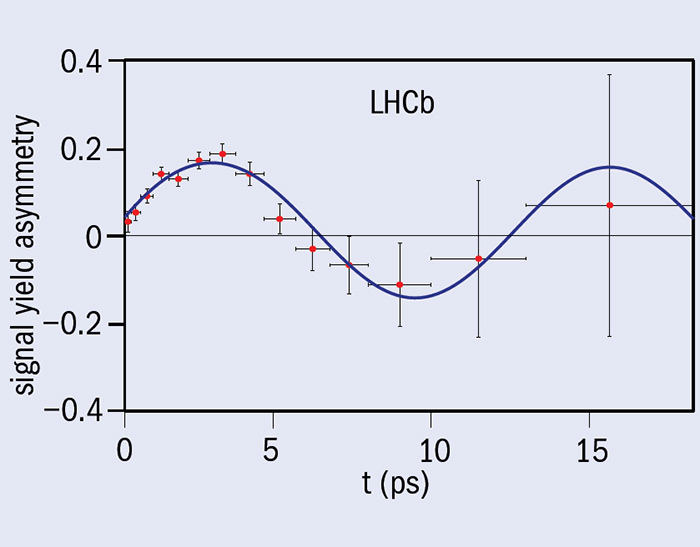
The CP violation in B0 → J/ψ K0S arises from the interference of the direct decay and the decay after B0–B0 oscillation. It manifests itself as an asymmetry between the decay rates of B0 and B0 mesons that depends on the decay time, t:
Here, S and C are the CP observables, and Δm/2π is the frequency of the B0–B0 oscillation. Because the decay is dominated by a single decay amplitude, C is expected to vanish and S can be identified as sin 2β.
The LHCb collaboration has now analysed the full data set from Run 1 of the LHC, comprising 114,000 reconstructed and selected B0 → J/ψ K0S decays (LHC Collaboration 2015). The analysis relies on identifying the initial flavour of the B meson, i.e. whether it was produced as a B0 or a B0 meson. This so-called flavour tagging exploits event properties that are correlated to the production flavour of the B meson. The flavour identification succeeds for 41,560 B0 → J/ψ K0S decays, and is correct in 64% of the cases.
The LHCb measurement yields S = 0.731±0.035 (stat.) ±0.020 (syst.), and is in good agreement with the value expected from CKM unitarity when excluding direct measurements of sin 2β 0.771+0.017–0.041 (Charles et al. 2015). Despite the challenges of the hadronic environment of the LHC, the result is at a similar precision to the B0 → J/ψ K0S analyses of the BaBar and Belle experiments at the PEP-II and KEKB B factories.
BaBar and Belle established CP violation in the B0 meson system by observing it in B0 → J/ψ K0S decays for the first time in 2001. They have since contributed with measurements of sin 2β leading to a very precise world-average value of 0.682±0.019 (Heavy Flavor Averaging Group 2014). Although LHCb’s new result is not yet as precise, it notably demonstrates that the experimental challenges are met, and that a similar precision will be achievable with the data to be collected in the LHC’s Run 2. LHCb will then contribute significantly to our knowledge of this fundamental parameter, and will allow for more stringent tests of CKM unitarity.
Experiments at the LHC have been exploring every corner of predictions made by the Standard Model in search of deviations that could point to a more comprehensive description of nature. The LHC detectors have performed superbly, producing measurements that, to date, are consistent with the model in every area tested, the discovery of the Higgs boson with Standard Model properties being a crowning achievement of LHC Run 1 data-taking.
The ATLAS and CMS collaborations are now looking into deeper levels of Standard Model predictions by probing additional ways in which the gauge bosons (W+, W–, Z and photon) interact with each other. These self-interactions are at the heart of the model’s electroweak sector. The gauge bosons are predicted to interact through point-like triple and quartic couplings. The triple-gauge couplings have been tested both at the LHC and at Fermilab’s Tevatron, following on from beautiful studies at the Large Electron–Positron collider that demonstrated the existance of these couplings and measured their properties. A new frontier at the LHC is to explore the quartic coupling of four gauge bosons. This can be done through the two-by-two scattering of the bosons, or more directly through the transition of one of the bosons to a final state with three bosons.
The ATLAS experiment has used data collected in 2012 from 8 TeV proton–proton collisions to make a measurement of triple-gauge boson production. The measurement isolates a final state with a W boson decaying to leptonic final states eν or μν plus the production of two photons with transverse energy ET > 20 GeV, and additional kinematic requirements defined by the acceptance of the ATLAS detector and the need to suppress soft photons. This process is sensitive to possible deviations of the quartic-gauge coupling WWγγ from Standard Model predictions.
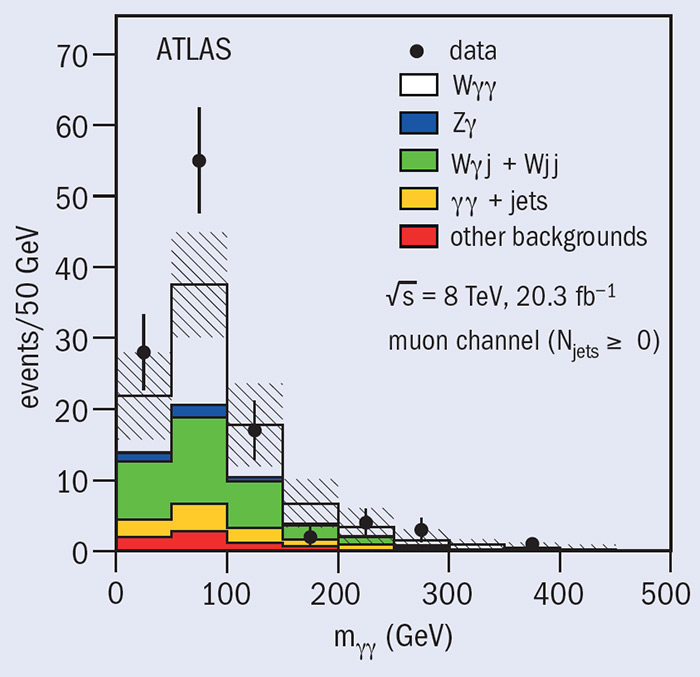
The rate of WWγγ is six orders of magnitude lower than that of inclusive W production. The isolation of this signal is a challenge, owing to both the small production rate and competition from similar processes containing a W boson with jets and single photons. The measurement relies upon the ability of the ATLAS electromagnetic calorimeter to select isolated, directly produced photons from those embedded in the more prolific production of hadronic jets. The figure shows the m(γγ) mass distribution from the 110 events that pass the final pp → W(μν) γγ + X selection cuts. The data are compared with the sum of backgrounds plus the Wγγ signal expected from the Standard Model.
These data are used to put limits on deviations of the quartic gauge coupling WWγγ from Standard Model predictions by introducing models for anomalous (non-Standard Model) contributions to pp → Wγγ + X production. These contributions typically enhance events with large invariant mass of the two photons. The anomalous quartic coupling limits are imposed using a subset of the pp → Wγγ + X events with m(γγ) > 300 GeV and no central high-energy jets. The resulting limits on various parameters that introduce non-Standard Model quartic couplings show that they are all consistent with zero (ATLAS Collaboration 2015). Once again, the Standard Model survives a measurement that probes a new aspect of its electroweak predictions.
As the experiment collaborations get ready for Run 2 at the LHC, the situation of the searches for new physics is rather different from what it was in 2009, when Run 1 began. Many models have been constrained and many limits have been set. Yet a fundamental question remains: why is the mass of the newly discovered Higgs boson so much below the Planck energy scale? This is the so-called hierarchy problem. Quantum corrections to the mass of the Higgs boson that involve known particles such as the top quark are divergent and tend to push the mass to a very high energy scale. To account for the relatively low mass of the Higgs boson requires fine-tuning, unless some new physics enters the picture to save the situation.
A variety of theories beyond the Standard Model attempt to address the hierarchy problem. Many of these predict new particles whose quantum-mechanical contributions to the mass of the Higgs boson precisely cancel the divergences. In particular, models featuring heavy partners of the top quark with vector-like properties are compelling, because the cancellations are then achieved in a natural way. These models, which often assume an extension of the Standard Model Higgs sector, include the two-Higgs doublet model (2HDM), the composite Higgs model, and the little Higgs model. In addition, theories based on the presence of extra dimensions of space often predict the existence of vector-like quarks.
The discovery of the Higgs boson was a clear and unambiguous target for Run 1. In contrast, there could be many potential discoveries of new particles or sets of particles to hope for in Run 2, but currently no model of new physics is favoured a priori above any other.
One striking feature common to many of these new models is that the couplings with third-generation quarks are enhanced. This results in final states containing b quarks, vector bosons, Higgs bosons and top quarks that can have significant Lorentz boosts, so that their individual decay products often overlap and merge. Such “boosted topologies” can be exploited thanks to dedicated reconstruction algorithms that were developed and became well established in the context of the analyses of Run-1 data.
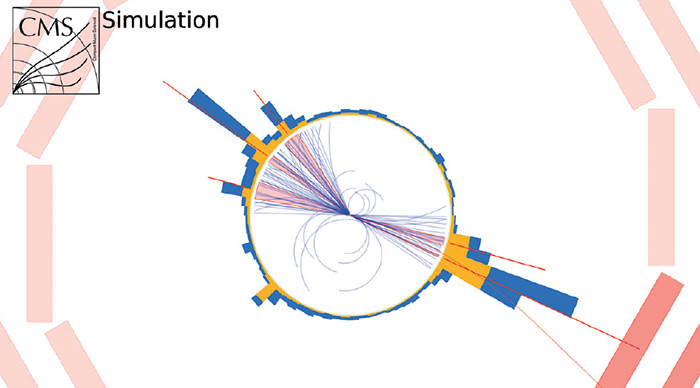
Searches for top-quark partners performed by CMS on the data from Run 1 span a large variety of different strategies and selection criteria, to push the mass-sensitivity as high as possible. These searches have now been combined to reach the best exclusion limit from the Run-1 data: heavy top-quark partners with masses below 800 GeV are now excluded at the 95% confidence level. The figure shows a simulated event with a top-quark partner decaying into a top-quark plus a Higgs boson (T → tH) in a fully hadronic final state.
CMS plans to employ these techniques to analyse boosted topologies not only in the analysis framework, but for the very first time also in the trigger system of the experiment when the LHC starts up this year. The new triggers for boosted topologies are expected to open new regions of phase space, which would be out of reach otherwise. Some of these searches are expected to already be very sensitive within the first few months of data-taking in 2015. The higher centre-of-mass energy increases the probability for pair production of these new particles, as well as of single production. The CMS collaboration is now preparing to exploit the early data from Run 2 in the search for top-quark partners produced in 13 TeV proton collisions.
The Inaugural Symposium of the Hyper-Kamiokande Proto-Collaboration, took place in Kashiwa, Japan, on 31 January, attended by more than 100 researchers. The aim was to promote the proto-collaboration and the Hyper-Kamiokande project internationally. In addition, a ceremony to mark the signing of an agreement for the promotion of the project between the Institute for Cosmic Ray Research of the University of Tokyo and KEK took place during the symposium.
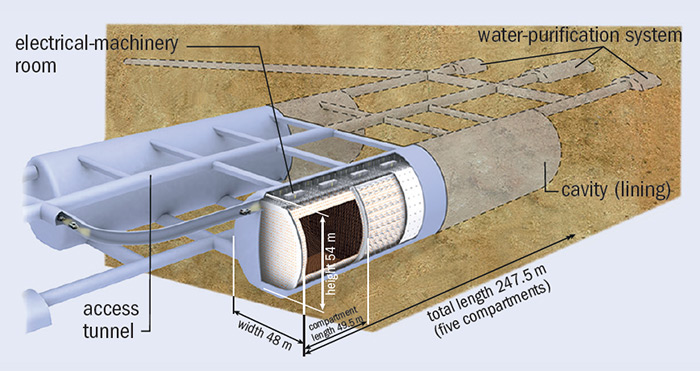
The Hyper-Kamiokande project aims both to address the mysteries of the origin and evolution of the universe’s matter and to confront theories of elementary-particle unification. To achieve these goals, the project will combine a high-intensity neutrino beam from the Japan Proton Accelerator Research Complex (J-PARC) with a new detector based on precision experimental techniques developed in Japan – a new megaton-class water Cherenkov detector to succeed the highly successful Super-Kamiokande detector.
The Hyper-Kamiokande detector will be about 25 times larger than Super-Kamiokande, the research facility that first found evidence for neutrino mass in 1998. Super-Kamiokande’s discoveries that, in comparison to other elementary particles, neutrinos have extremely small masses, and that the three known types of neutrino mix almost maximally in flight, support the ideas of theories that go beyond the Standard Model to unify the elementary particles and forces.
In particular, the Hyper-Kamiokande project aspires not only to discover CP violation in neutrinos, but to close in on theories of elementary-particle unification by discovering proton decay. By expanding solar, atmospheric, and cosmic neutrino observations, as well as advancing neutrino-interaction research and neutrino astronomy, Hyper-Kamiokande will also provide new knowledge in particle and nuclear physics, cosmology and astronomy.
As an international project, researchers from around the world are working to start the Hyper-Kamiokande experiment in 2025.The Hyper-Kamiokande proto-collaboration now includes an international steering committee and an international board of representatives with members from 13 countries: Brazil, Canada, France, Italy, Japan, Korea, Poland, Portugal (observer state), Russia, Spain, Switzerland, the UK and the US.
The neutrino is the most abundant matter-particle in the universe and the lightest, most weakly interacting of the fundamental fermions. The way in which a neutrino’s flavour changes (oscillates) as it propagates through space implies that there are at least three different neutrino masses, and that mixing of the different mass states produces the three known neutrino flavours. The consequences of these observations are far reaching because they imply that the Standard Model is incomplete; that neutrinos may make a substantial contribution to the dark matter known to exist in the universe; and that the neutrino may be responsible for the matter-dominated flat universe in which we live.
This wealth of scientific impact justifies an energetic programme to measure the properties of the neutrino, interpret these properties theoretically, and understand their impact on particle physics, astrophysics and cosmology. The scale of investment required to implement such a programme requires a coherent, international approach. In July 2013, the International Committee for Future Accelerators (ICFA) established its Neutrino Panel for the purpose of promoting both international co-operation in the development of the accelerator-based neutrino-oscillation programme and international collaboration in the development of a neutrino factory as a future intense source of neutrinos for particle-physics experiments. The Neutrino Panel’s initial report, presented in May 2014, provides a blueprint for the international approach (Cao et al. 2014).
The accelerator-based contributions to this programme must be capable both of determining the neutrino mass-hierarchy and of seeking for the violation of the CP symmetry in neutrino oscillations. The complexity of the oscillation patterns is sufficient to justify two complementary approaches that differ in the nature of the neutrino beam and the neutrino-detection technique (Cao et al. 2015). In one approach, which is adopted by the Hyper-K collaboration, a neutrino beam of comparatively low energy and narrow energy spread (a narrow-band beam) is used to illuminate a “far” detector at a distance of approximately 300 km from the source (see “Proto-collaboration formed to promote Hyper-Kamiokande”). In a second approach, a neutrino beam with a higher energy and a broad spectrum (a wide-band beam) travels more than 1000 km through the Earth before being detected.
Since summer 2014, a global neutrino collaboration has come together to pursue the second approach, using Fermilab as the source of a wide-band neutrino beam directed at a far detector located deep underground in South Dakota. In addition to measuring the neutrinos in the beam, the experiment will study neutrino astrophysics and nucleon decay. This experiment will be of an unprecedented scale and dramatically improve the understanding of neutrinos and the nature of the universe.
This new collaboration – currently dubbed ELBNF for Experiment at the Long-Baseline Neutrino Facility – has an ambitious plan to build a modular liquid-argon time-projection chamber (LAr-TPC) with a fiducial mass of approximately 40 kt as the far detector and a high-resolution “near” detector. The collaboration is leveraging the work of several independent efforts from around the world that have been developed through many years of detailed studies. These groups have now converged around the opportunity provided by the megawatt neutrino-beam facility that is planned at Fermilab and by the newly planned expansion with improved access of the Sanford Underground Research Facility in South Dakota, 1300 km from Fermilab. To give a sense of scale, to house this detector some 1.5 km underground requires a hole that is approximately 120,000 m3 in size – nearly equivalent to the volume of Wimbledon’s centre-court stadium.
The principal goals of ELBNF are to carry out a comprehensive investigation of neutrino oscillations, to search for CP-invariance violation in the lepton sector, to determine the ordering of the neutrino masses and to test the three-neutrino paradigm. In addition, with a near detector on the Fermilab site, the ELBNF collaboration will perform a broad set of neutrino-scattering measurements. The large volume and exquisite resolution of the LAr-TPC in its deep underground location will be exploited for non-accelerator physics topics, including atmospheric-neutrino measurements, searches for nucleon decay, and measurement of astrophysical neutrinos (especially those from a core-collapse supernova).
The new international team has the necessary expertise, technical knowledge and critical mass to design and implement this exciting “discovery experiment” in a relatively short time frame. The goal is the deployment of a first detector with 10 kt fiducial mass by 2021, followed by implementation of the full detector mass as soon as possible. The accelerator upgrade of the Proton Improvement Plan-II at Fermilab will provide 1.2 MW of power by 2024 to drive a new neutrino beam line at the laboratory. There is also a plan that could further upgrade the Fermilab accelerator complex to enable it to provide up to 2.4 MW of beam power by 2030 – an increase of nearly a factor of seven on what is available today. With the possibility of space for expansion at the Sanford Underground Research Facility, the new international collaboration will develop the necessary framework to design, build and operate a world-class deep-underground neutrino and nucleon-decay observatory. This plan is aligned with both the updated European Strategy for Particle Physics and the report of the Particle Physics Project Prioritization Panel (P5) written for the High Energy Physics Advisory Panel in the US.
A letter of intent (LoI) was developed during autumn 2014, and the first collaboration meeting was held in mid January at Fermilab. Sergio Bertolucci, CERN’s director for research and computing, and interim chair of the institutional board, ran the meeting. More than 200 participants from around the world attended, and close to 600 physicists from 140 institutions and 20 countries have signed the LoI, to date. The collaboration has chosen its new spokespersons – Mark Thomson of Cambridge University and André Rubbia of ETH Zurich – and will begin the process of securing the early funding needed to excavate the cavern in a timely fashion so that detector installation can begin in the early 2020s.
Mounting such a significant experiment on such a compressed time frame will require all three world regions – Asia, the Americas and Europe – to work in concert. The pioneering work on the liquid-argon technique was carried out at CERN and implemented in the ICARUS detector, which ran for many years at Gran Sasso. To deliver the ELBNF far detector requires that the LAr-TPC technology be scaled up to an industrial scale. To deliver the programme required to produce the large LAr-TPC, neutrino platforms are being constructed at Fermilab and at CERN. A team led by Marzio Nessi is working hard to make this resource available at CERN and to complete in the next few years the R&D needed for both the single- and dual-phase liquid-argon technologies that are being proposed on a large scale (see box).
The steps taken by the neutrino community during the nine months or so since summer 2014 have put the particle-physics community on the road towards an exciting and vibrant programme that will culminate in exquisitely precise measurements of neutrino oscillation. It will also establish in the US one of the flagships of the international accelerator-based neutrino programme called for by the ICFA Neutrino Panel. In addition, ELBNF will be a world-leading facility for the study of neutrino astrophysics and cosmology.
With such a broad and exciting programme, ELBNF will be at the forefront of the field for several decades. The remarkable success of the LHC programme has demonstrated that a facility of this scale can deliver exceptional science. The aim is that ELBNF will provide a second example of how the world’s high-energy-physics community can come together to deliver an amazing scientific programme. New collaborators are still welcome to join in the pursuit.
• In March the new collaboration chose the name DUNE for Deep Underground Neutrino Experiment.
ICARUS and WA105
The ICARUS experiment, led by Carlo Rubbia, employs the world’s largest (to date) liquid-argon detector, which was built for studies of neutrinos from the CNGS beam at CERN. The ICARUS detector with its 600 tonnes of liquid argon took data from 2010 to 2012 at the underground Gran Sasso National Laboratory. ICARUS demonstrated that the liquid-argon detector has excellent spatial and calorimetric resolution, making for perfect visualization of the tracks of charged particles. The detector has since been removed and taken to CERN to be upgraded prior to sending it to Fermilab, where it will begin a new scientific programme.
For more than a decade, the neutrino community has been interested in mounting a truly giant liquid-argon detector with some tens-of-kilotonnes active mass for next-generation long-baseline experiments, neutrino astrophysics and proton-decay searches – and, in particular, for searches for CP violation in the neutrino sector. WA105, an R&D effort located at CERN and led by André Rubbia of ETH Zurich, should be the “last step” of detector R&D before the underground deployment of detectors on the tens-of-kilotonne scale. The WA105 demonstrator is a novel dual-phase liquid-argon time-projection chamber that is 6 m on a side. It is already being built, and should be ready for test beam by 2017 in the extension of CERN’s North Area that is currently under construction
Quarkonium lies at the very foundation of quantum chromodynamics (QCD). In the 1970s, following the discovery of the J/ψ in 1974, the narrow width (and later the hyperfine splittings) of quarkonium states corroborated spectacularly asymptotic freedom as predicted by QCD in 1973 and served to establish it as the theory of the strong interaction (CERN Courier January/February 2013 p24). Further progress in explaining quarkonium physics in terms of QCD turned out, however, to be slow in coming and relied for a long time on models. The reason for these difficulties is that non-relativistic bound states, such as quarkonia, are multiscale systems. While some processes, such as annihilations, happen at the heavy-quark mass scale and, as a consequence of asymptotic freedom, are well described by perturbative QCD, all quarkonium observables are also affected by low-energy scales. If these scales are low enough for perturbative QCD to break down, then they call for a nonperturbative treatment.
In the 1990s, the development of non-relativistic effective field theories such as non-relativistic QCD (1986, 1995) and potential non-relativistic QCD (1997, 1999) led to a systematic factorization of high-energy effects from low-energy effects in quarkonia. Progress in lattice QCD allowed an accurate computation of the latter. Hence, the theory of quarkonium physics became fully connected to QCD. The founding of the Quarkonium Working Group (QWG) in 2002 was driven mostly by this theoretical progress and the urgency and enthusiasm to transmit the new paradigm. Electron–positron collider experiments (BaBar, Belle, BES, CLEO) and experiments at Fermilab’s Tevatron were yielding quarkonium data with unprecedented precision, and QCD was in a position to take full advantage of these data.
The QWG gathered together experimentalists and theorists to establish a common language, highlight unsolved problems, set future research directions, discuss the latest data, and suggest new analyses in quarkonium physics. Its first meeting took place at CERN in November 2002, where the urgency and enthusiasm of 2002 animated long evening sessions that eventually led to the first QWG document in 2005 (Quarkonium Working Group Collaboration 2005). This document reflects the original intent of the QWG: to rewrite quarkonium physics in the language of effective field theories, emphasizing its potential for systematic and precise QCD studies. But surprises were around the corner.
In 2003 the first observation of the X(3872) by Belle – which with more than 1000 citations is the most quoted result of the B-factories – opened an era of new spectroscopy studies sometimes called the “charmonium renaissance” (CERN Courier January/February 2004 p8). From 2003 onwards, several new states were found in the charmonium and bottomonium regions of the spectrum, and they were unlikely to be standard quarkonia. Some of them – the many charged states named Z±c and Z±b – surely were not. Suddenly quarkonium became again a tool for discoveries, not necessarily of new theories, but of new phenomena in the complex realm of low-energy QCD. The second QWG document in 2011 captured this overwhelming flow of new data and the surrounding excitement (Quarkonium Working Group Collaboration 2011). But more excitement and more new data were still to come.
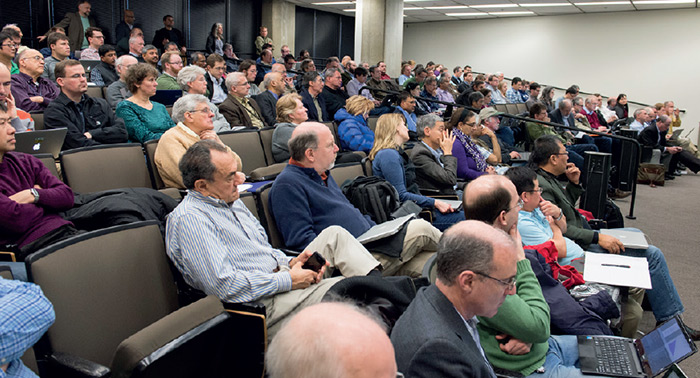
Almost exactly 12 years after the first meeting organized by the QWG, quarkonium experts converged again on CERN for the group’s 10th meeting on 10–14 November 2014. Sponsored by the QWG, the 2014 meeting was organized locally by CERN affiliates and staff members, and supported by the LHC Physics Centre at CERN. The meeting began with several sessions devoted to spectroscopy, with the focus on the new spectroscopy. The ATLAS, Belle, BESIII, CMS and LHCb collaborations all presented new analyses and data. One surprise was BESIII’s observation of an e+e– → γX(3872) signal at s > 4 GeV, perhaps via Y(4260) → γX(3872). If confirmed it would relate two of the best known new states in the charmonium region and challenge the popular interpretation of the Y(4260) as a charmonium hybrid.
In view of the many new states, theoretical effort has concentrated on finding a common framework that could describe them. Molecular interpretations, tetraquarks and threshold cusp-effects were among the possibilities discussed at the meeting. A novelty was the proposal to use lattice data to build hybrid and tetraquark multiplets within the Born–Oppenheimer approximation. Two lively round-table discussions debated the new states further. In a special discussion panel, the Particle Data Group members of the QWG asked for input in establishing a naming scheme for these states. The suggestion that eventually came from the QWG was to call the new states in the charmonium region XcJ if JPC= J++, YcJ if JPC = J–, PcJ if JPC = J–+ and ZcJ if JPC = J+–, and to follow a similar scheme in the bottomonium region.
Presenting new results
Non-relativistic effective field theories, perturbative QCD and lattice calculations played a major role in the sessions that were devoted to precise determinations of the heavy-quark masses, the strong coupling constant and other short-range quantities. Typical results required calculations with three-loop or higher accuracies. New results were presented on the leptonic width of the Υ(1S), the quarkonium spectrum, the heavy-quark masses, heavy-quark pair production at threshold and αs. Lattice QCD provided a valuable input in some of these determinations (figure 1) or an alternative derivation with comparable precision. On the experimental side, the KEDR collaboration highlighted some of its most recent precision measurements in the charmonium region below or close to threshold. Quarkonium observables may serve not only to constrain precisely Standard Model parameters in the QCD sector, but also to determine some otherwise difficult-to-access electroweak parameters. In particular, there was a report on the possibility of measuring the Hcc coupling in the radiative decay of the Higgs boson to J/ψ.
To isolate the relevant signal, it is important that the effects of cold nuclear matter are properly accounted for
The last two days of the workshop were devoted to quarkonium production at heavy-ion and hadron colliders. Measurements of quarkonium production cross-sections in heavy-ion and proton–heavy-ion collisions were presented by the LHC collaborations ALICE, CMS and LHCb, and by PHENIX and STAR at Brookhaven’s Relativistic Heavy-Ion Collider (RHIC). It has been known since 1986 that quarkonium dissociation – induced by the medium that is produced in heavy-ion collisions – may serve as a probe of the properties of the medium, possibly revealing the presence of a new state of matter.
To isolate the relevant signal, it is important that the effects of cold nuclear matter are properly accounted for. This is the motivation behind measurements of proton–heavy-ion collisions, and the many theoretical studies that were presented at the workshop. It is important to account for recombination effects and to look at tightly bound states that are less sensitive to nonperturbative contributions (bottomonium). It is also important to consider the dynamics of thermalization – a key ingredient to link spectral studies to actual data. Finally, it is important to have a controlled way to compute the underlying dissociation processes. This is where major progress was made in recent years with the development of non-relativistic effective field theories for quarkonium in a thermal bath. The main result has been a change in the understanding of quarkonium dissociation. Until recently, dissociation was mostly understood as a consequence of the screening that is induced by the medium, but, nowadays, additional mechanisms of dissociation have been identified, which under some circumstances may be more important than screening. Several speakers reported on the present theoretical situation, as well as lattice calculations in an effective-field-theory framework.
Quarkonium production mechanisms in hadron colliders are at the core of the modern understanding of quarkonium physics. The successful theoretical description of production data from the Tevatron through the so-called colour-octet mechanism helped to establish non-relativistic QCD as a suitable effective field theory for quarkonia in the 1990s. Predictions of non-relativistic QCD continue to be challenged by the enormous amount of data that has been provided over the past years by the experiments at DESY’s HERA collider and at the Tevatron and, most recently, by the LHC experiments. ALICE, ATLAS, CMS and LHCb all presented data on regions of large transverse-momentum that were, up to now, unexplored. The meeting discussed theoretical issues that arise in trying to describe these data, and emphasized the crucial role that experiments must play in resolving these issues. One such issue is that different determinations of the nonperturbative matrix elements of non-relativistic QCD, which rely on fitting to the data in different transverse-momentum regions and/or on different sets of observables, lead to different results. Some of these determinations fail to yield definite predictions for quarkonium polarizations, while others lead to polarization predictions that are in contradiction with polarization data (figure 2).
An important related issue is to establish clearly the transverse-momentum region in which non-relativistic QCD factorization holds. This issue is best addressed by having the greatest possible amount of cross-section and polarization data at high and low transverse-momenta for both charmonium and bottomonium states, including the P-wave χc and χb states. Some speakers pointed out that measurements of additional production processes may further constrain the non-relativistic QCD matrix elements. Finally, others suggested that a resolution of the theoretical issues may not be far away.
A celebration of quarkonium
Embedded in the workshop, Chris Quigg’s seminar in the CERN Physics Department’s series celebrated the first 40 years of quarkonium in the presence of many of the heroes of quarkonium physics. The talk, rich in anecdotes and insights, but also with many highlights on current directions, served as a delightful pause in the packed schedule of the workshop. It also served to put the workshop, whose discussion items focused on the advances of the past year and a half, on a broader, more historical perspective.
Quarkonium is a special system. Its multiscale nature with at least one large energy scale allows for systematic studies of QCD across a range of energy scales. Its clean experimental signatures have led over the years to a significant experimental programme, which is pursued today by, among others, the Belle and BES experiments as well as those at RHIC and at the LHC. Quarkonium has proved to be a competitive, sometimes unique, source for precise determinations of the parameters of the Standard Model (the strong-coupling constant, masses, Higgs-coupling to heavy quarks), a valuable probe for emergent QCD phenomena in vacuum (such as exotic bound states: hybrids, tetraquarks, molecules; or the colour-octet mechanism in quarkonium production and decay) and in medium (such as the state of matter formed in heavy-ion collisions); and, possibly, a probe for new physics. The QWG has provided during the past 12 years an organization in which the advance of quarkonium physics could be shared in a coherent framework among a wide community of physicists. The CERN workshop in 2014 was also a celebration of this achievement.
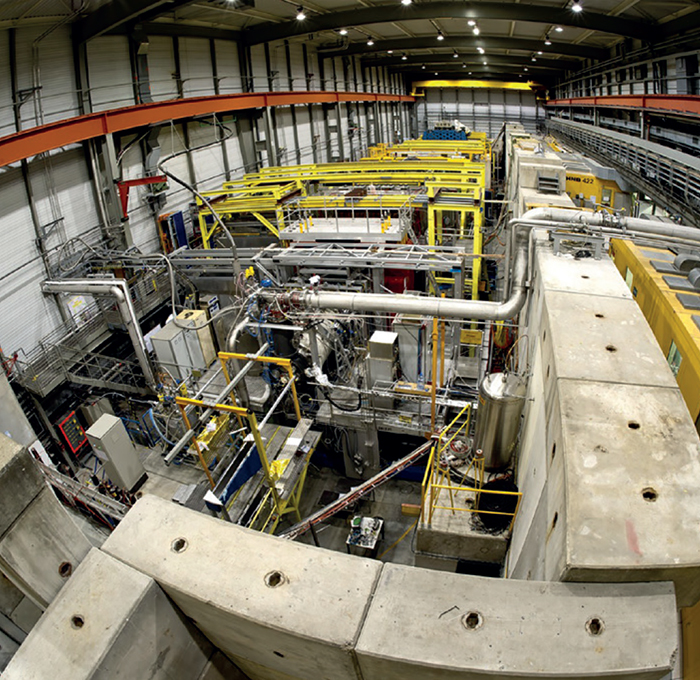
The COMPASS experiment at CERN has made the first precise measurement of the polarizability of the pion – the lightest composite particle built from quarks. The result confirms the expectation from the low-energy expansion of QCD – the quantum field theory of the strong interaction between quarks – but is at variance with the previously published values, which overestimated the pion polarizability by more than a factor of two.
Every composite system made from charged particles can be polarized by an external electromagnetic field, which acts to separate positive and negative charges. The size of this charge separation – the induced dipole moment – is related to the external field by the polarizability. As a measure of the response of a complex system to an external force, polarizability is directly related to the system’s stiffness against deformability, and hence the binding force between the constituents.
The pion, made up of a quark and an antiquark, is the lightest object bound by the strong force and has a size of about 0.6 × 10⁻¹⁵ m (0.6 fm). So to observe a measurable effect, the particle must be subjected to electric fields in the order of 100 kV across its diameter – that is, about 1018 V/cm. To achieve this, the COMPASS experiment made use of the electric field around nuclei. To high-energy pions, this field appears as a source of (almost) real photons, on which the incident pions scatter. Such pion–photon Compton scattering, also known as the Primakoff mechanism, was explored in the early 1980s in an experiment at Serpukhov, but the small data sample led to only an imprecise value for the polarizability of 6.8±1.4 (stat.) ±1.2 (syst.) × 10–4 fm3, where the systematic uncertainty was underestimated, presumably.
COMPASS has now achieved a modern Primakoff experiment, using a 190 GeV pion beam from the Super Proton Synchrotron at CERN directed at a nickel target. Importantly, COMPASS was also able to use muons, which are point-like and hence non-deformable, to calibrate the experiment. The Compton π–γ → π–γ scattering is extracted from the reaction π–Ni → π–γNi by selecting events from the Coulomb peak at small momentum transfer. From the analysis of a sample of 63,000 events, the collaboration obtained a value of the pion electric polarizability of 2.0±0.6 (stat.) ±0.7 (syst.) × 10–4 fm3 – that is, about 2 × 10⁻⁴ of the pion’s volume. This value is in good agreement with theoretical calculations in low-energy QCD, therefore solving a long-standing discrepancy between these calculations and previous experimental efforts to determine the polarizability.
Although this measurement is the first to allow a self-calibration, the accuracy is still below the quoted uncertainty of the calculations. With more data already recorded, the COMPASS collaboration expects to improve on this result by a significant factor in the near future, and thereby probe further a benchmark calculation of non-perturbative QCD.
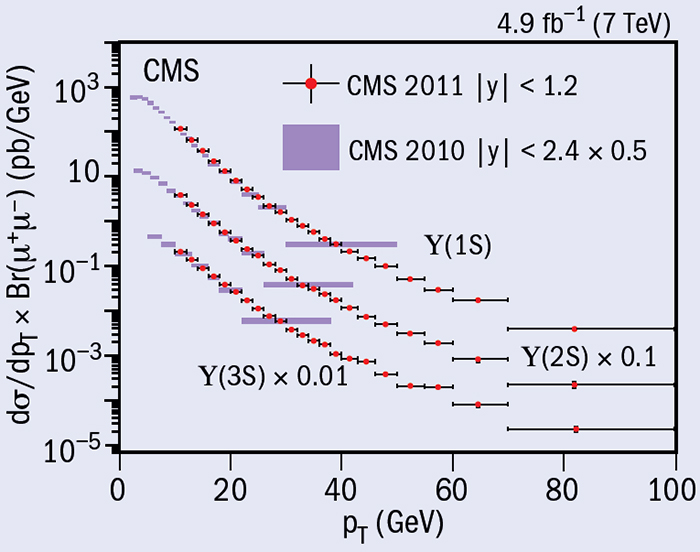
Quarkonia – charm or beauty quark/antiquark bound states – are prototypes of elementary systems governed by the strong force. Owing to the large masses and small velocities of the quarks, their mutual interaction becomes simpler to describe, therefore opening unique insights into the mechanism of strong interactions. For decades, research in the area of quarkonium production in hadron collisions has been hampered by anomalies and puzzles in theoretical calculations and experimental results, so that, until recently, the studies were stuck at a validation phase. Now, new CMS data are enabling a breakthrough by accomplishing cross-section measurements for quarkonium production that reach unprecedentedly high values of transverse momentum (pT).
The latest and most persistent “quarkonium puzzle”, lasting for more than 10 years, was the seeming impossibility of theory to reproduce simultaneously quarkonium yields and polarizations, as observed in hadronic interactions. Polarization is particularly sensitive to the mechanism of quark–antiquark (qq) bound-state formation, because it reveals the quantum properties of the pre-resonance qq pair. For example, if a 3S1 bound state (J/ψ or Υ) is measured to be unpolarized (isotropic decay distribution), the straightforward interpretation is that it evolved from an initial coloured 1S0 qq configuration. To extract this information from differential cross-section measurements requires an additional layer of interpretation, based on perturbative calculations of the pre-resonance qq kinematics in the laboratory reference frame. The fragility of this additional step will reveal itself, a posteriori, as the cause of the puzzle.
In recent years, CMS provided the first unambiguous evidence that the decays of 3S1 bottomonia (Υ(1,2,3S)) and charmonia (J/ψ, ψ(2S)) are always approximately isotropic (CMS Collaboration 2013): the pre-resonance qq is a 1S0 state neutralizing its colour into the final 3S1 bound state. This contradicted the idea that quarkonium states are produced mainly from a transversely polarized gluon (coloured 3S1 pre-resonance), as deduced traditionally from cross-section measurements. After having exposed the polarization problem with high-precision measurements, CMS is now providing the key to its clarification.
The new cross-section measurements allow a theory/data comparison at large values of the ratio pT/mass, where perturbative calculations are more reliable. First attempts to do so, not yet exploiting the exceptional high-pT reach of the newest data, were revealing. With theory calculations restricted to their region of validity, the cross-section measurements are actually found to agree with the polarization data, indicating that the bound-state formation through coloured 1S0 pre-resonance is dominant (G Bodwin et al. 2014, K-T Chao et al. 2012, P Faccioli et al. 2014).
Heading towards the solution of a decades-long puzzle, what of the fundamental question: how do quarks and antiquarks interact to form bound states? Future analyses will disclose the complete hierarchy of transitions from pre-resonances with different quantum properties to the family of observed bound states, providing a set of “Kepler” laws for the long-distance interactions between quark and antiquark.
There is evidence for dark matter from many astronomical observations, yet so far, dark matter has not been seen in particle-physics experiments, and there is no evidence for non-gravitational interactions between dark matter and Standard Model particles. If such interactions exist, dark-matter particles could be produced in proton–proton collisions at the LHC. The dark matter would travel unseen through the ATLAS detector, but often one or more Standard Model particles would accompany it, either produced by the dark-matter interaction or radiated from the colliding partons. Observed particles with a large imbalance of momentum in the transverse plane of the detector could therefore signal the production of dark matter.
Because radiation from the colliding partons is most likely a jet, the “monojet” search is a powerful search for dark matter. The ATLAS collaboration now has a new result in this channel and, while it does not show evidence for dark-matter production at the LHC, it does set significantly improved limits on the possible rate for a variety of interactions. The reach of this analysis depends strongly on a precise determination of the background from Z bosons decaying to neutrinos at large-boson transverse-momentum. By deriving this background from data samples of W and Z bosons decaying to charged leptons, the analysis achieves a total background uncertainty in the result of 3–14%, depending on the transverse momentum.
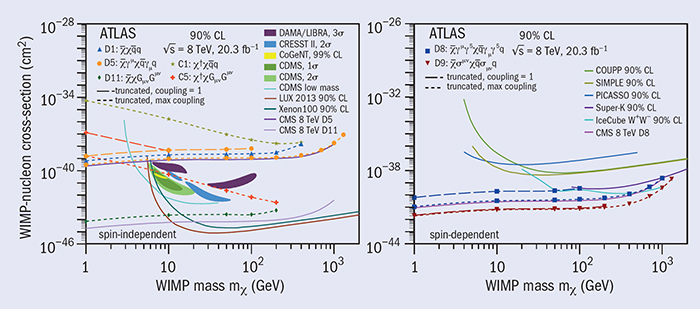
To compare with non-collider searches for weakly interacting massive particle (WIMP) dark matter, the limits from this analysis have been translated via an effective field theory into upper limits on WIMP–nucleon scattering or on WIMP annihilation cross-sections. When the WIMP mass is much smaller than several hundred giga-electron-volts – the kinematic and trigger thresholds used in the analysis – the collider results are approximately independent of the WIMP mass. Therefore, the results play an important role in constraining light dark matter for several types of spin-independent scattering interactions (see figure). Moreover, collider results are insensitive to the Lorentz structure of the interaction. The results shown on spin-dependent interactions are comparable to the spin-independent results and significantly stronger than those of other types of experiments.
The effective theory is a useful and general way to relate collider results to other dark-matter experiments, but it cannot always be employed safely. One advantage of the searches at the LHC is that partons can collide with enough energy to resolve the mediating interaction directly, opening complementary ways to study it. In this situation, the effective theory breaks down, and simplified models specifying an explicit mediating particle are more appropriate.
The new ATLAS monojet result is sensitive to dark-matter production rates where both effective theory and simplified-model viewpoints are worthwhile. In general, for large couplings of the mediating particles to dark matter and quarks, the mediators are heavy enough to employ the effective theory, whereas for couplings of order unity the mediating particles are too light and the effective theory is an incomplete description of the interaction. The figures use two types of dashed lines to depict the separate ATLAS limits calculated for these two cases. In both, the calculation removes the portion of the signal cross-section that depends on the internal structure of the mediator, recovering a well-defined and general but conservative limit from the effective theory. In addition, the new result presents constraints on dark-matter production within one possible simplified model, where the mediator of the interaction is a Z’-like boson.
While the monojet analysis is generally the most powerful search when the accompanying Standard Model particle is radiated from the colliding partons, ATLAS has also employed other Standard Model particles in similar searches. They are especially important when these particles arise from the dark-matter interaction itself. Taken together, ATLAS has established a broad and robust programme of dark-matter searches that will continue to grow with the upcoming data-taking.
In late 2011, ATLAS launched a dedicated programme targeting searches for the supersymmetric partner of the top quark – the scalar top, or “stop” – which could be pair-produced in high-energy proton–proton collisions. If not much heavier than the top quark, this new particle is expected to play a key role in explaining why the Higgs boson is light.
While earlier supersymmetry (SUSY) searches at the LHC have already set stringent exclusion limits on strongly produced SUSY particles, these generic searches were not very sensitive to the stop. If it exists, the stop could decay in a number of ways, depending on its mass and other SUSY parameters. Most of the searches at the LHC assume that the stop decays to the lightest SUSY particle (LSP) and one or more Standard Model particles. The LSP is typically assumed to be stable and only weakly interacting, making it a viable candidate for dark matter. Events with stop-pair production would therefore feature large missing transverse momentum as the two resulting LSPs escape the detector.
The first set of results from the searches by ATLAS were presented at the International Conference on High-Energy Physics (ICHEP) in 2012. A stop with mass between around 225 and 500 GeV for a nearly massless LSP was excluded for the simplest decay mode. Exclusion limits were also set for more complex stop decays.
These searches revealed a sensitivity gap when the stop is about as heavy as the top quark – a scenario that is particularly interesting and well motivated theoretically. Such a “stealth stop” hides its presence in the data, because it resembles the top quark, which is pair-produced roughly six times more abundantly.
Use of the full LHC Run-1 data set, together with the development of novel analysis techniques, has pushed the stop exclusion in all directions. The figure shows the ATLAS limits as of the ICHEP 2014 conference, in the plane of LSP mass versus stop mass for each of the following stop decays: to an on-shell top quark and the LSP (right-most area); to an off-shell top quark and the LSP (middle area); to a bottom quark, off-shell W boson, and the LSP (left-most grey area); or to a charm quark and the LSP (left-most pink area). The exclusion is achieved by the complementarity of four targeted searches (ATLAS Collaboration 2014a–2014d). The results eliminate a stop of mass between approximately 100 and 700 GeV (lower masses were excluded by data from the Large Electron–Positron collider) for a light LSP. Gaps in the excluded region for intermediate stop masses are reduced but persist, including the prominent region corresponding to the stealth stop.
Standard Model top-quark measurements can be exploited to get a different handle on the potential presence of a stealth stop. The latest ATLAS high-precision top–antitop cross-section measurement, together with a state-of-the-art theoretical prediction, has allowed ATLAS to exclude a stealth stop between the mass of the top quark and 177 GeV, for a stop decaying to a top quark and the LSP.
The measurement of the top–antitop spin correlation adds extra sensitivity because the stop and the top quark differ by half a unit in spin. The latest ATLAS measurement (ATLAS Collaboration 2014e) uses the distribution of the azimuthal angle between the two leptons from the top decays, together with cross-section information, to extend the limit for the stealth stop up to 191 GeV.
The rigorous search programme undertaken by ATLAS has ruled out large parts of interesting regions of the stop model and closed in on a stealth stop. It leaves the door open for discovery of a stop beyond the current mass reach, or in remaining sensitivity gaps, at the higher-energy and higher-luminosity LHC Run 2.
To provide the best experiences, we use technologies like cookies to store and/or access device information. Consenting to these technologies will allow us to process data such as browsing behavior or unique IDs on this site. Not consenting or withdrawing consent, may adversely affect certain features and functions.
Functional
Always active
The technical storage or access is strictly necessary for the legitimate purpose of enabling the use of a specific service explicitly requested by the subscriber or user, or for the sole purpose of carrying out the transmission of a communication over an electronic communications network.
Preferences
The technical storage or access is necessary for the legitimate purpose of storing preferences that are not requested by the subscriber or user.
Statistics
The technical storage or access that is used exclusively for statistical purposes.The technical storage or access that is used exclusively for anonymous statistical purposes. Without a subpoena, voluntary compliance on the part of your Internet Service Provider, or additional records from a third party, information stored or retrieved for this purpose alone cannot usually be used to identify you.
Marketing
The technical storage or access is required to create user profiles to send advertising, or to track the user on a website or across several websites for similar marketing purposes.