Comsol -leaderboard other pages

Topics

Gravitational waves and the birth of a new science

On 14 September 2015, the world changed for those of us who had spent years preparing for the day when we would detect gravitational waves. Our overarching goal was to directly detect gravitational radiation, finally confirming a prediction made by Albert Einstein in 1916. A year after he had published his theory of general relativity, Einstein predicted the existence of gravitational waves in analogy to electromagnetic waves (i.e. photons) that propagate through space from accelerating electric charges. Gravitational waves are produced by astrophysical accelerations of massive objects, but travel through space as oscillations of space–time itself.

It took 40 years before the theoretical community agreed that gravitational waves are real and an integral part of general relativity. At that point, proving they exist became an experimental problem and experiments using large bars of aluminium were instrumented to detect a tiny change in shape from the passage of a gravitational wave. Following a vigorous worldwide R&D programme, a potentially more sensitive technique – suspended-mass interferometry – has superseded resonant-bar detectors. There was limited theoretical guidance regarding what sensitivity would be required to achieve detections from known astrophysical sources. But various estimates indicated that a strain sensitivity ΔL/L of approximately 10–21 caused by the passage of a gravitational wave would be needed to detect known sources such as binary compact objects (binary black-hole mergers, binary neutron-star systems or binary black-hole neutron-star systems). That’s roughly equivalent to measuring the Earth–Sun separation to a precision of the proton radius.   

The US National Science Foundation approved the construction of the Laser Interferometer Gravitational-Wave Observatory (LIGO) in 1994 at two locations: Hanford in Washington state and Livingston in Louisiana, 3000 km away. At that time, there was a network of cryogenic resonant-bar detectors spread around the world, including one at CERN, but suspended-mass interferometers have the advantage of broadband frequency acceptance (basically the audio band, 10–10,000 Hz) and a factor-1000 longer arms, making it feasible to measure a smaller ΔL/L. Earth-based detectors are sensitive to the most violent events in the universe, such as the merger of compact objects, supernovae and gamma-ray bursts. The detailed interferometric concept and innovations had already been demonstrated during the 1980s and 1990s in a 30 m prototype in Garching, Germany, and a 40 m prototype at Caltech in the US. Nevertheless, these prototype interferometers were at least four orders of magnitude away from the target sensitivity.

Strategic planning

We built a flexible technical infrastructure for LIGO such that it could accommodate a future major upgrade (Advanced LIGO) without rebuilding too much infrastructure. Initial LIGO had mostly used demonstrated technologies to assure technical success, despite the large extrapolation from the prototype interferometers. After completing Initial LIGO construction in about 2000, we undertook an ambitious R&D programme for Advanced LIGO. Over a period of about 10 years, we performed six observational runs with Initial LIGO, each time searching for gravitational waves with improved sensitivity. Between each run, we made improvements, ran again, and eventually reached our Initial LIGO design sensitivity. But, unfortunately, we failed to detect gravitational waves.

We then undertook a major upgrade to Advanced LIGO, which had the goal of improving the sensitivity over Initial LIGO by at least a factor of 10 over the entire frequency range. To accomplish this, we developed a more powerful NdYAG laser system to reduce shot noise at high frequencies, a multiple suspension system and larger test masses to reduce thermal noise in the middle frequencies, and introduced active seismic isolation, which reduced seismic noise at frequencies of around 40 Hz by a factor of 100 (CERN Courier January/February 2017 p34). This was the key to our discovery of our first 30 solar-mass binary black-hole mergers, which are concentrated at low frequencies, two years ago. The increased sensitivity to such events had expanded the volume of the universe searched by a factor of up to 106, enabling a binary black-hole-merger detection coincidence within 6 ms between the Livingston and Hanford sites.

We recorded the last 0.2 seconds of this astrophysical collision: the final merger; coalescence; and “ring-down” phase, constituting the first direct observation of gravitational waves. The waveform was accurately matched by numerical-relativity calculations with a signal-to-noise ratio of 24:1 and a statistical probability easily exceeding 5σ. Beyond confirming Einstein’s prediction, this event represented the first direct observation of black holes, and established that stellar black holes exist in binary systems and that they merge within the lifetime of the universe (CERN Courier January/February 2017 p16). Surprisingly, the two black holes were each about 30 times the mass of the Sun – much heavier than expectations from astrophysics.

Run 2 surprises

Similar to Initial LIGO, we plan to reach Advanced LIGO design sensitivity in steps. After completion of the four-month-long first data run (called O1) in January 2016, we improved the interferometer at the Livingston site from 60 Mpc to 100 Mpc for binary neutron-star mergers, but fell somewhat short in Hanford due to some technical issues, which we decided to fix after LIGO’s second observational run (O2). We have now reported a total of four black-hole-merger events and are beginning to determine characteristics such as mass distributions and spin alignments that will help distinguish between the different possibilities for the origin of such heavy black holes. The leading ideas are that they originate in low-metallicity parts of the universe, were produced in dense clusters, or are primordial. They might even constitute some of the dark matter.   

We recorded the last 0.2 seconds of this astrophysical collision: the final merger.

Advanced LIGO’s O2 run ended in August this year. Although it seemed almost impossible that it could be as exciting as O1, several more black-hole binary mergers have been reported, including one after the Virgo interferometer in Italy joined O2 in August and dramatically improved our ability to locate the direction of the source. In addition, the orientation of Virgo relative to the two LIGO interferometers enabled the first information on the polarisation of the gravitational waves. Together with other measurements, this allowed us to limit the existence of an additional tensor term in general relativity and showed that the LIGO–Virgo event is consistent with the predicted two-state polarisation picture.

Then, on 17 August, we really hit the jackpot: our interferometers detected a neutron-star binary merger for the first time. We observed a coincidence signal in both LIGO and Virgo that had strikingly different properties from the black-hole binary mergers we had spotted earlier. Like those, this event entered our detector at low frequencies and propagated to higher frequencies, but lasted much longer (around 100 s) and reached much higher frequencies. This is because the masses in the binary system were much lower and, in fact, are consistent with being neutron stars. A neutron star results from the collapse of a star into a compact object of between 1.1–1.6 solar masses. We have identified our event as the merger of two neutron stars, each about the size of Geneva, but having several hundred thousand times the mass of the Earth.

As we accumulate more events and improve our ability to record their waveforms, we look forward to studying nuclear physics under these extreme conditions. This latest event was the first observed gravitational-wave transient phenomenon also to have electromagnetic counterparts, representing multi-messenger astronomy. Combining the LIGO and Virgo signals, the source of the event was narrowed down to a location in the sky of about 28 square degrees, and it was soon recognised that the Fermi satellite had detected a gamma-ray burst shortly afterwards in the same region. A large and varied number of astronomical observations followed. The combined set of observations has resulted in an impressive array of new science and papers on gamma-ray bursts, kilonovae, gravitational-wave measurements of the Hubble constant, and more. The result even supports the idea that binary neutron-star collisions are responsible for the very heavy elements, such as platinum and gold.

Going deeper

Much has happened since our first detection, and this portends well for the future of this new field. Both LIGO and Virgo entered into a 15 month shutdown at the end of August to further improve noise levels and raise their laser power. At present, Advanced LIGO is about a factor of two below its design goal (corresponding to a factor of eight in event rates). We anticipate reaching design sensitivity by about 2020, after which the KAGRA interferometer in Japan will join us. A third LIGO interferometer (LIGO-India) is also scheduled for operation in around 2025. These observatories will constitute a network offering good global coverage and will accumulate a large sample of binary merger events, achieve improved pointing accuracy for multi-messenger astronomy, and hopefully will observe other sources of gravitational waves. This will not be the end of the story. Beyond the funded programme, we are developing technologies to improve our instruments beyond Advanced LIGO, including improved optical coatings and cryogenic test masses.

In the longer range, concepts and designs already exist for next-generation interferometers, having typically 10 times better sensitivity than will be achieved in Advanced LIGO and Virgo (see panel on previous page). In Europe, a mature concept called the Einstein Telescope is an underground interferometer facility in a triangular configuration (see panel on previous page), and in the US a very long (approximately 40 km) LIGO-like interferometer is under study. The science case for such next-generation devices is being developed through the Gravitational Wave International Committee (GWIC), which is the gravitational-wave field’s equivalent to the International Committee for Future Accelerators (ICFA) in particle physics. Although the science case appears very strong scientifically and technical solutions seem feasible, these are still very early days and many questions must be resolved before a new generation of detectors is proposed.

To fully exploit the new field of gravitational-wave science, we must go beyond ground-based detectors and into the pristine seismic environment of space, where different gravitational-wave sources will become accessible. As described earlier, the lowest frequencies accessible by Earth-based observatories are about 10 Hz. The Laser Interferometer Space Antenna (LISA), a European Space Agency project scheduled for launch in the early 2030s, was approved earlier this year and will cover frequencies around 10–1–10–4 Hz. LISA will consist of three satellites separated by 2.5 × 106 km in a triangular configuration and a heliocentric orbit, with light travelling continually along each arm to monitor the satellite separations for deviations from a passing gravitational wave. A test mission, LISA Pathfinder, was recently flown and demonstrated the key performance requirements for LISA in space (CERN Courier November 2017 p37).

Meanwhile, pulsar-timing arrays are being implemented to monitor signals from millisecond pulsars, with the goal of detecting low-frequency gravitational waves by studying correlations between pulsar arrival times. The sensitivity range of this technique is 10–6–10–9 Hz, where gravitational waves from massive black-hole binaries in the centres of merging galaxies with periods of months to years could be studied.

An ultimate goal is to study the Big Bang itself. Gravitational waves are not absorbed as they propagate and could potentially probe back to the very earliest times, while photons only take us to within 300,000 or so years after the Big Bang. However, we do not yet have detectors sensitive enough to detect early-universe signals. The imprint also of gravitational waves on the cosmic microwave background has been pursued by the Bicep2 experiment, but background issues so far mask a possible signal.

Although gravitational-wave science is clearly in its infancy, we have already learnt an enormous amount and numerous exciting opportunities lie ahead. These vary from testing general relativity in the strong-field limit to carrying out multi-messenger gravitational-wave astronomy over a wide range of frequencies – as demonstrated by the most recent and stunning observation of a neutron-star merger. Since Galileo first looked into a telescope and saw the moons of Jupiter, we have learnt a huge amount about the universe through modern-day electromagnetic astronomy. Now, we are beginning to look at the universe with a new probe and it does not seem to be much of a stretch to anticipate a rich new era of gravitational-wave science.

CERN LIGO–Virgo meeting weighs up 3G gravitational-wave detectors

Similar to particle physicists, gravitational-wave scientists are contemplating major upgrades to present facilities and developing concepts for next-generation observatories. Present-generation (G2) gravitational-wave detectors – LIGO in Hanford, Livingston and India, Virgo in Italy, GEO600 in Germany and KAGRA in Japan – are in different stages of development and have different capabilities (see main text), but all are making technical improvements to better exploit the science potential from gravitational waves over the coming years. As the network develops, the more accurate location information will enable the long-time dream of studying the same astrophysical event with gravitational waves and their electromagnetic and neutrino counterpart signals.

The case for making future, more sensitive next-generation gravitational-wave detectors is becoming very strong, and technological R&D and design efforts for 3G gravitational detectors may have interesting overlaps with both CERN capabilities and future directions. The 3G concepts have many challenging new features, including: making longer arms; going underground; incorporating squeezed quantum states; developing lower thermal-noise coatings; developing low-noise cryogenics; implementing Newtonian noise cancellation; incorporating adaptive controls; new computing capabilities and strategies; and new data-analysis methods.

In late August, coinciding with the end of the second Advanced LIGO observational run, CERN hosted a LIGO–Virgo collaboration meeting. On the final day, a joint meeting between LIGO–Virgo and CERN explored possible synergies between the two fields. It provided strong motivation for next-generation facilities in both particle and gravitational physics and revealed intriguing overlaps between them. On a practical level, the event identified issues facing both communities, such as geology and survey, vacuum and cryogenics, control systems, computing and governance.

The time for R&D, construction and commissioning is expected to be around a decade, with problems near to intractable. It is planned to use cryogenics to bring mirrors to the temperature of a few kelvin. The mirrors themselves are coated using ion beams for deposition, to obtain a controlled reflectivity that must be uniform over areas 1 m in diameter. These mirrors work in an ultra-high vacuum, and residual gas-density fluctuations must be minimal along a vacuum cavity of several tens of kilometres, which will be the approximate footprint of the 3G scientific infrastructure.

Data storage and analysis is another challenge for both gravitational and particle physicists. Unlike the large experiments at the LHC, which count or measure energy deposition in millions of pixels at the detector level, interferometers continuously sample signals from hundreds of channels, generating a large amount of data consisting of waveforms. Data storage and analysis places major demands on the computing infrastructure, and analysis of the first gravitational events called for the GRID infrastructure.

Interferometers have to be kept on an accurately controlled working point, with mirrors used for gravitational-wave detection positioned and oriented using a feedback control system, without introducing additional noise. Sensors and actuators are different in particle accelerators but the control techniques are similar.

Comparisons of the science capabilities, costs and technical feasibility for the next generation of gravitational-wave observatories are under active discussion, as is the question of how many 3G detectors will be needed worldwide and how similar or different they need be. Finally, there were discussions of how to form and structure a worldwide collaboration for the 3G detectors and how to manage such an ambitious project – similar to the challenge of building the next big particle-physics project after the LHC.

Barry Barish, the author of this feature, shared the 2017 Nobel Prize in Physics with Kip Thorne and Rainer Weiss for the discovery of gravitational waves (CERN Courier November 2017 p37).

Birth of a symmetry

Weinberg’s paper “A Model of Leptons”, published in Physical Review Letters (PRL) on 20 November 1967, determined the direction of high-energy particle physics through the final decades of the 20th century. Just two and a half pages long, it is one of the most highly cited papers in the history of theoretical physics. Its contents are the core of the Standard Model of particles physics, now almost half a century old and still passing every experimental test.

Most particle physicists today have grown up with the Standard Model’s orderly account of the fundamental particles and interactions, but things were very different in the 1960s. Quantum electrodynamics (QED) had been well established as the description of the electromagnetic interaction, but there were no mature theories of the strong and weak nuclear forces. By the 1960s, experimental discoveries showed that the weak force exhibits some common features with QED, in particular that it might be mediated by a vector boson analogous to the photon. Theoretical arguments also suggested that QED’s underlying “U(1)” group structure could be generalised to the larger group SU(2), but there was a serious problem with such a scheme: the W boson suspected to mediate the weak force would have to be very massive empirically, whereas the mathematical symmetry of the theory required it to be massless like the photon.

The importance of symmetries in understanding the fundamental forces was already becoming clear at the time, in particular how nature might hide its symmetries. Could “hidden symmetry” lead to a massive W boson while preserving the mathematical consistency of the theory? It was arguably Weinberg’s developments, in 1967, that brought this concept to life.

Strong inspiration

Weinberg’s inspiration was an earlier idea of Nambu in which fermions – such as the proton or neutron – can behave like a left- or right-handed screw as they move. If mass is ignored, these two “chiral” states act independently and the theory leads to the existence of a particle with properties similar to those of the pion – specifically a pseudoscalar, which means that it has no spin and its wavefunction changes sign under mirror symmetry. Nambu’s original investigations, however, had not examined how the three versions of the pion, with positive, negative or zero charge, shared their common “pion-ness” when interacting with one another. This commonality, or symmetry, is mathematically expressed by the group SU(2), which had been known in nuclear physics since the 1930s and in mathematics for much longer.

It was this symmetry that Weinberg used as his point of departure in building a theory of the strong force, where nucleons interact with pions of all charges and the proton and neutron themselves form two “faces” of the underlying SU(2) structure. Empirical observations of the interactions between pions and nucleons showed that the underlying symmetry of SU(2) tended to act on the left- or right-handed chiral possibilities independently. The mathematical structure of the resulting equations to describe this behaviour, as Weinberg discovered, is called SU(2)×SU(2).

However, in nature this symmetry is not perfect because nucleons have mass. Had they been massless, they would have travelled at the speed of light, the left- and right-handed possibilities acting truly independently of one another and the symmetry left intact. That nucleons have a mass, so that the left and right states get mixed up when perceived by observers in different inertial frames, breaks the chiral symmetry. Nambu had investigated this effect as far back as 1959, but without the added richness of the SU(2)×SU(2) mathematical structure that Weinberg brought to the problem. Weinberg had been investigating this more sophisticated theory in around 1965, initially with considerable success. He derived theorems that explained the observed interactions of pions and nucleons at low energies, such as in nuclear physics. He was able to predict how pions behaved when they scattered from one another and, with a few well-defined assumptions, paved the way for a whole theory of hadronic physics at low energies.

Meanwhile, in 1964, Brout and Englert, Higgs, Kibble, Guralnik and Hagen had demonstrated that the vector bosons of a Yang–Mills theory (one that is like QED but where attributes such as electric charge can be exchanged by the vector bosons themselves) put forward a decade earlier could become massive without spoiling the fundamental gauge symmetry. This “mass-generating mechanism” suggested that a complete Yang–Mills theory of the strong interaction might be possible. In addition to the well-known pion, examples of massive vector particles that feel the strong force had already been found, notably the rho-meson. Like the pion, this too occurs in three charged varieties: positive, negative and zero. Superficially these rho-mesons had the hallmarks of being the gauge bosons of the strong interactions, but they also have mass. Was the strong interaction the theatre for applying the mass-generating mechanism?

Despite at first seeming so promising, the idea failed to fit the data. For some phenomena, the SU(2)×SU(2) symmetry empirically is broken, but for others where spin didn’t matter it works perfectly. When these patterns were incorporated into the maths, the rho-meson stubbornly remained massless, contrary to reality.

Epiphany on the road

In the middle of September 1967, while driving his red Camaro to work at MIT, Weinberg realised that he had been applying the right ideas to the wrong problem. Instead of the strong interactions, for which the SU(2)×SU(2) idea refused to work, the massless photon and the hypothetical massive W boson of the electromagnetic and weak interactions fitted perfectly with this picture. To call this possibility “hypothetical” hardly does justice to the time: the W boson was not discovered until 1984, and in 1967 was so disregarded as to receive at best a passing mention, if any, in textbooks.

Weinberg needed a concrete model to illustrate his general idea. The numerous strongly interacting hadrons that had been discovered in the 1950s and 1960s were, for him, a quagmire, so he restricted his attention to the electron and neutrino. Here too it is worth recalling the state of knowledge at the time. The constituent quark model with three flavours – up, down and strange – had been formulated in 1964, but was widely disregarded. The experiments at SLAC that would help establish these constituents were a year away from announcing their results, and Bjorken’s ideas of a quark model, articulated at conferences that summer, were not yet widely accepted either. Finally, with only three flavours of quark, Weinberg’s ideas would lead to empirically unwanted “strangeness-changing neutral currents”. All these problems would eventually be solved, but in 1967 Weinberg made a wise choice to focus on leptons and leave quarks well alone.

Following the discovery of parity violation in the 1950s, it was clear that the electron can spin like a left- or right-handed screw, whereas the massless neutrino is only left-handed. The left–right symmetry, which had been a feature of the strong interaction, was gone. Instead of two SU(2), the mathematics now only needed one, the second being replaced by the unitary group U(1). So Weinberg set up the equations of SU(2)×U(1) – the same structure that, unknown to him, had been proposed by Sheldon Glashow in 1961 and by Abdus Salam and John Ward in 1964 in attempts to marry the electromagnetic and weak interactions. His theory, like theirs, required two massive electrically charged bosons – the W+ and W carriers of the weak force – and two neutral bosons: the massless photon and a massive Z0. If correct, it would show that the electromagnetic and weak forces are unified, taking physics a step closer to the goal of a single theory of all fundamental interactions.

“The history of attempts to unify weak and electromagnetic interactions is very long, and will not be reviewed here.” So began the first footnote in Steven Weinberg’s seminal November 1967 paper, which led to him being awarded the 1979 Nobel Prize in Physics with Salam and Glashow. Weinberg’s footnote mentioned Fermi’s primitive idea for unification in 1934, and also the model that Glashow proposed in 1961.

Clarity of thought

Weinberg started his paper by articulating the challenge of unifying the electroweak forces as both an opportunity and a threat. He focused on the leptons – those fermions, such as the electron and neutrino, which do not feel the strong force. “Leptons interact only with photons, and with the [weak] bosons that presumably mediate weak interactions. What could be more natural than to unite these spin-one bosons [the photon and the weak bosons] into a multiplet,” he pondered. That was the opportunity. The threat was that “standing in the way of this synthesis are the obvious differences in the masses of the photon and [weak] boson.”

Weinberg then suggests a solution: perhaps “the symmetries relating the weak and electromagnetic interactions are exact [at a fundamental level] but are [hidden in practice]”. He then draws attention to the ideas of Higgs, Brout, Englert, Guralnik, Hagen and Kibble, and uses these to give masses to the W and Z in his model. In a further important insight, Weinberg shows how this symmetry-breaking mechanism leaves the photon massless.

His opening paragraph ended with the prescient observation that: “The model may be renormalisable.” The argument upon which this remark is based appears at the very end of the paper, although with somewhat less confidence than the promise hinted at the beginning. He begins the final paragraph with a question: “Is this model renormalisable?” The extent of his intuition is revealed in his argument: although the presence of a massive vector boson hitherto had been a scourge, the theory with which he had begun had no such mass and, as such, was “probably renormalisable”. So, he pondered: “The question is whether this renormalisablity is lost [by the spontaneous breaking of the symmetry].” And the conclusion: “If this model is renormalisable, what happens when we extend it…to the hadrons?”

By speculating that his model may be renormalisable, Weinberg was hugely prescient, as ’t Hooft and Veltman would prove four years later. And perhaps it was a chance encounter at the Solvay Congress in Belgium two weeks before his paper was submitted that helped convince Weinberg that he was on the right track.

Solvay secrets

By the end of September 1967, Weinberg had his ideas in place as he set off to Belgium to attend the 14th Solvay Congress on Fundamental Problems in Elementary Particle Physics, held in Brussels from 2 to 7 October. He did not speak about his forthcoming paper, but did make some remarks after other talks, in particular following a presentation by Hans Peter Durr about a theorem of Jeffrey Goldstone and spontaneous symmetry breaking. During a general discussion session following Durr’s talk, Weinberg mused: “This raises a question I can’t answer: are such models renormalisable?” He continued with a similar argument to that which later appeared in his paper, ending with: “I hope someone will be able to find out whether or not [this] is a renormalisable theory of weak and electromagnetic interactions.”

There was remarkably little reaction to Weinberg’s remarks, and he himself has recalled “a general lack of interest”. The only recorded statement came from François Englert, who insisted that the theory is renormalisable; then, remarkably, there is no further discussion. Englert and Robert Brout, then relatively junior scientists, had both attended the same Brussels meeting.

At some point during the Solvay conference, Weinberg presented a hand-written draft of his paper to Durr, and 40 years later I obtained a copy by a roundabout route. Weinberg himself had not seen it in all that time, and thought that all record of his Nobel-winning manuscript had been lost. The original manuscript is notable for there being no sign of second thoughts, or editing, which suggests that it was a provisional final draft of an idea that had been worked through in the preceding days. The only hint of modification after the first draft had been written is a memo squeezed in at the end of a reference to Higgs, to include references to Brout and Englert, and to Guralnik, Hagen and Kibble, for the idea of spontaneous symmetry breaking, on which the paper was based. Weinberg’s intuition about the renormalisability of the model is already present in this manuscript, and is identical to what appears in his PRL paper. There is no mention of Glashow’s SU(2)×U(1) model in the draft, but this is included in the version that was published in PRL the following month. This is the only substantial difference. This manuscript was submitted to the editors of PRL on Weinberg’s return to the US, and received by them on 17 October. It appeared in print on 20 November.

Lasting impact

Weinberg’s genius was to assemble together the various pieces of a jigsaw and display the whole picture. The basic idea of mass generation was due to the assorted theorists mentioned above, in the summer of 1964. However, a crucial feature of Weinberg’s model was the trick of being able to give masses to the W and Z while leaving the photon massless. This extension of the mass-generating mechanism was due to Tom Kibble, in 1967, which Weinberg recognises and credits.

As was the case with his comments in Brussels the previous month, Weinberg’s paper appeared in November 1967 to a deafening silence. “Rarely has so great an accomplishment been so widely ignored,” wrote Sidney Coleman in Science in 1979. Today, Weinberg’s paper has been cited more than 10,000 times. Having been cited but twice in the four years from 1967 to 1971, suddenly it became so important that researchers have cited it three times every week throughout half a century. There is no parallel for this in the history of particle physics. The reason is that in 1971 an event took place that has defined the direction of the field ever since: Gerard ’t Hooft made his debut, and he and Martinus Veltman demonstrated the renormalisability of spontaneously broken Yang–Mills theories. A decade later the W and Z bosons were discovered by experiments at CERN’s Super Proton Synchrotron. A further 30 years were to pass before the discovery of the Higgs boson at the Large Hadron Collider completed the electroweak menu. And in the meantime, completing the Standard Model, quantum chromodynamics was established as the theory of the strong interactions, based on the group SU(3).

This episode in particle physics is not only one of the seminal breakthroughs in our understanding of the physical world, but touches on the profound link between mathematics and nature. On one hand it shows how it is easier to be Beethoven or Shakespeare than to be Steven Weinberg: change a few notes in a symphony or a phrase in a play, and you can still have a wonderful work of art; change a few symbols in Weinberg’s equations and the edifice falls apart – for if nature does not read your creation, however beautiful it might be, its use for science is diminished. Like all great theorists, Weinberg revealed a new aspect of reality by writing symbols on a sheet of paper and manipulating them according to the logic of mathematics. It took decades of technological progress to enable the discoveries of W and Higgs bosons and other entities that were already “known” to mathematics 50  years ago.

• This article draws on material from Frank Close’s history of the path to discovery of the Higgs boson: The Infinity Puzzle (Oxford University Press).

Symmetries, groups and massive insight led to electroweak unification

Weinberg’s 1967 achievement is rooted in the notation of group theory, which is the mathematical language describing the symmetries of a system, and built upon many earlier successes including that of quantum electrodynamics (QED). QED is perhaps the simplest example of a general class of “non-abelian gauge theories”. Since the all-important electric charge in QED is a single number, it can be described mathematically in terms of the first unitary group, U(1). In the 1950s Yang and Mills constructed generalisations of QED in which the U(1) number was replaced by matrices, such as in the groups SU(2) or SU(3). The weak force exhibited tantalising hints that a SU(2) generalisation of QED might be involved, but there was a serious problem: a “W boson” – the analogue of QED’s photon – would have to be very massive empirically, whereas the mathematical symmetry of the theory required it to be massless – like the photon. The only way to give the W and Z particles mass yet leave the photon massless was if nature contained “hidden symmetries” that were somehow broken.

In 1961 Goldstone discovered a theorem suggesting, inter alia, that a theory of the weak force involving hidden symmetry is impossible. However, in 1963, condensed-matter theorist Philip Anderson pointed out that superconductivity manages to evade Goldstone’s theorem, and demonstrated this mathematically in a theory without relativity. The following year several theorists, including Peter Higgs, generalised Anderson’s insights to include relativity. Among the implications were that a theory involving fermions with no mass – with so-called chiral symmetry – could hide this property in empirically consistent ways when particles become massive; that there should be a massive boson without spin (the Higgs boson); and that the W boson could also gain mass while preserving the underlying mathematical symmetry of the theory. It was Weinberg’s 1967 paper that brought all of these pieces together, and today we know that nature follows this path, with the weak and electromagnetic interactions described by a single SU(2)×U(1) structure. At the time, however, the breakthrough was hardly noticed.

Optical survey pinpoints dark-matter structure

During the last two decades the WMAP and Planck satellites have produced detailed maps of the density distribution of the universe when it was only 380,000 years old – the moment electrons and protons recombined into neutral hydrogen, producing today’s cosmic microwave background (CMB). The CMB measurements show that the distribution of both normal and dark matter in the universe is inhomogeneous, which is explained via a combination of inflation, dark matter and dark energy: initial quantum fluctuations in the very early universe expanded and continued to grow as gravity pulled matter together while dark energy worked to force it apart. Data from the CMB have allowed cosmologists to predict a range of cosmological parameters such as the fractions of dark energy, dark matter and normal matter.

Now, using new optical measurements of the current universe from the international Dark Energy Survey (DES), these predictions can be tested independently. DES is an ongoing, five-year survey that aims to map 300 million galaxies and tens of thousands of galaxy clusters using a 570 megapixel camera to capture light from galaxies eight billion light-years away (see figure). The camera, one of the most powerful in existence, was built and tested at Fermilab in the US and is mounted on the 4 m Blanco telescope in Chile.

The DES data sample is set to grow from 26 million to 300 million galaxies

To measure how the clumps seen in the CMB evolved from the early universe into their current state, the DES collaboration first mapped the distribution of galaxies in the universe precisely. The researchers then produced detailed maps of the matter distribution using weak gravitational lensing, which measures small distortions of the optical image due to the mass between an observer and multiple sources. The galaxies observed by DES are elongated by only a few per cent due to lensing and, since galaxies are intrinsically elliptical, it is not possible to measure the lensing from individual galaxy measurements.

The first year of DES data, which includes measurements of 26 million galaxies, has allowed researchers to measure cosmological parameters such as the matter density with a precision comparable to those made using the CMB data. The matter-density parameter, which indicates the total fraction of matter in the universe, measured using optical light is found to be fully compatible with Planck data based on measurements of microwave radiation emitted around 13 billion years ago. Combining the measurements of Planck and DES places further constraints on this crucial parameter, indicating that only about 30% of the universe consists of matter while the rest consists of dark energy. The results are also compatible with other important cosmological parameters such as the fluctuation amplitude, which indicates the amplitude of the initial density fluctuations, and further constrain measurements of the Hubble constant and even the sum of the neutrino masses.

The DES results allow for a fully independent measurement of parameters initially derived using a map of the early universe. With the DES data sample set to grow from 26 million to 300 million galaxies, cosmological parameters will be measured with even higher precision and allow more detailed comparisons with the CMB data.

ITER’s massive magnets enter production

The ITER site

It is 14 m high, 9 m wide and weighs 110 tonnes. Fresh off a production line at ASG in Italy, and coated in epoxy Kapton-glass panels (image top left), it is the first superconducting toroidal-field coil for the ITER fusion experiment under construction in Cadarache, Southern France. The giant D-shaped ring contains 4.5 km of niobium-tin cable (each containing around 1000 individual superconducting wires) wound into a coil that will carry a current of 68,000 A, generating a peak magnetic field of 11.8 T to confine a plasma at a temperature of 150 million degrees. The coil will soon be joined by 18 others like it, 10 manufactured in Europe and nine in Japan. After completion at ASG, the European coils will be shipped to SIMIC in Italy, where they will be cooled to 78 K, tested and welded shut in a 180 tonne stainless-steel armour. They will then be impregnated with special resin and machined using one of the largest machines in Europe, before being transported to the ITER site.

Science doesn’t get much bigger than this, even by particle-physics standards. ITER’s goal is to demonstrate the feasibility of fusion power by maintaining a plasma in a self-sustaining “ignition” phase, and was established by an international agreement ratified in 2007 by China, the European Union (EU), Euratom, India, Japan, Korea, Russia and the US. Following years of delay relating to the preferred site and project costs, ITER entered construction a decade ago and is scheduled to produce first plasma by December 2025. The EU contribution to ITER, corresponding to roughly half the total cost, amounts to €6.6 billion for construction up to 2020.

Fusion for energy

The scale of ITER’s components is staggering. The vacuum vessel that will sit inside the field coils is 10 times bigger than anything before it, measuring 19.4 m across, 11.4 m high and requiring new welding technology to be invented. The final ITER experiment will weigh 23,000 tonnes, almost twice that of the LHC’s CMS experiment. The new toroidal-field coil is the first major magnetic element of ITER to be completed. A series of six further poloidal coils, a central solenoid and a number of correction coils will complete ITER’s complex magnetic configuration. The central solenoid (a 1000 tonne superconducting electromagnet in the centre of the machine) must be strong enough to contain a force of 60 MN – twice the thrust of the Space Shuttle at take-off.

Vacuum-pressure impregnation tooling

Fusion for Energy (F4E), the EU organisation managing Europe’s contribution to ITER, has been collaborating with industrial partners such as ASG Superconductors, Iberdrola Ingeniería y Construcción, Elytt Energy, CNIM, SIMIC, ICAS consortium and Airbus CASA to deliver Europe’s share of components in the field of magnets. At least 600 people from 26 companies have been involved in the toroid production and the first coil is the result of almost a decade of work. This involved, among other things, developing new ways to jacket superconducting cables based on materials that are brittle and much more difficult to handle than niobium-titanium. In total, 100,000 km of niobium-tin strands are necessary for ITER’s toroidal-field magnets, increasing worldwide production by a factor 10.

Since 2008, F4E has signed ITER-related contracts reaching approximately €5 billion, with the magnets amounting to €0.5 billion. Firms that are involved, such as SIMIC where the coils will be tested and Elytt, which has developed some of the necessary tooling, have much to gain from collaborating in ITER. According to Philippe Lazare, CEO of CNIM Industrial Systems Division: “In order to manufacture our share of ITER components, we had to upgrade our industrial facilities, establish new working methods and train new talent. In return, we have become a French reference in high-precision manufacturing for large components.”

CERN connection

Cooling the toroidal-field magnets requires about 5.8 tonnes of helium at a temperature of 4.5 K and a pressure of 6 bar, putting helium in a supercritical phase slightly warmer than it is in the LHC. But ITER’s operating environment is totally different to an accelerator, explains head of F4E’s magnets project team Alessandro Bonito-Oliva: “The magnets have to operate subject to lots of heat generated by neutron irradiation from the plasma and AC losses generated inside the cable, which has to be removed, whereas at CERN you don’t have this problem. So the ITER coolant has to be fairly close to the wire – this is why we used forced-flow of helium inside the cable.” A lot of ITER’s superconductor technology work was driven by CERN in improving the characteristics of superconductors, says Bonito-Oliva: “High-energy physics mainly looks for very high current performance, while in fusion it is also important to minimise the AC losses, which generally brings a reduction of current performance. This is why Nb3Sn strands for fusion and accelerators are slightly different.

CERN entered formal collaboration with ITER in March 2008 via a co-operation agreement concerning the design of high-temperature superconducting current leads and other magnet technologies, with CERN’s superconducting laboratory in building 163 becoming one of the “reference” laboratories for testing ITER’s superconducting strands. Niobium-tin is the same material that CERN is pursuing for the high-field magnets of the High Luminosity LHC and also a possible future circular collider, although the performance demands of accelerator magnets requires significant further R&D. Head of CERN’s technology department, Jose Miguel Jimenez, who co-ordinates the collaboration between CERN and ITER, says that in addition to helping with the design of the cable, CERN played a big role in advising for high-voltage testing of the cable insulation and, in particular, with the metallurgical aspect. “Metallurgy is one of the key areas of technology transfer from CERN to ITER. Another is the HTS current leads, which CERN has helped to design in collaboration with the Chinese group working on the ITER tokamak, and in simulating the heat transfer under real conditions,” he explains. “We also helped with the cryoplants, magnetic-field quality, and on central interlocks and safety systems based on our experience with the LHC.”

ATLAS finds evidence for Higgs to bb

CCnew7_07_17

Five years ago, the ATLAS and CMS collaborations at the LHC announced the discovery of a new particle with properties consistent with those of a Standard Model Higgs boson. Since then, based on proton–proton collision data collected at energies of 7 and 8 TeV during LHC Run 1 and at 13 TeV during Run 2, many measurements have confirmed this hypothesis. Several decay modes of the Higgs boson have been observed, but the dominant decay into pairs of b quarks, which is expected to contribute at a level of 58%, had up to now escaped detection – largely due to the difficulty in observing this decay mode at a hadron collider.

On 6 July, at the European Physical Society conference in Venice, the ATLAS collaboration announced that they had found evidence for H → bb, representing an immense analysis achievement. By far the largest source of Higgs bosons is their production via gluon fusion, gg  H  bb, but this is overwhelmed by the huge background of bb events, which are produced at a rate 10 million times higher. The associated production of a Higgs with a W or Z vector boson (jointly denoted V) offers the most sensitive alternative, despite having a production rate roughly 20 times lower than H bb, because the vector bosons are detected via their decay to leptons and therefore allow efficient triggering and background rejection. Nevertheless, the signal remains orders of magnitude smaller than the backgrounds, which arise from the associated production of vector bosons with jets and from top-quark production.

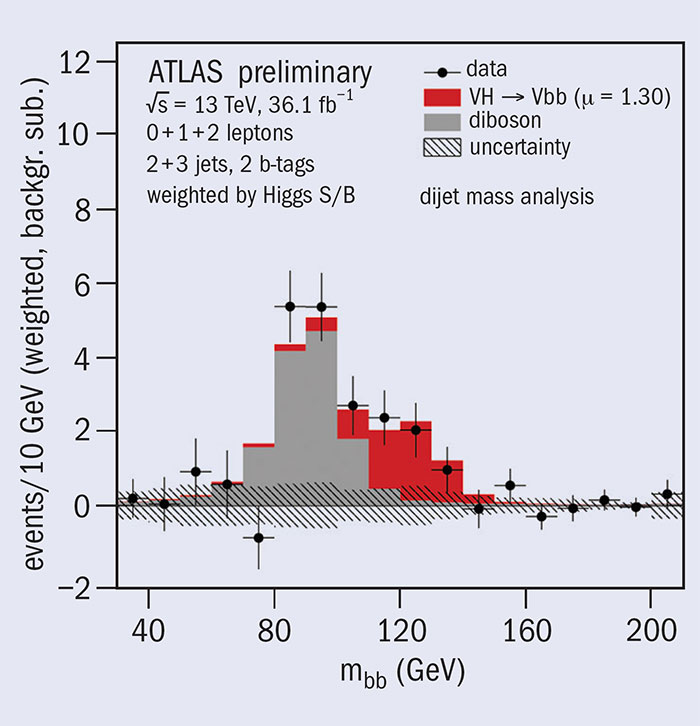
To find evidence for the H  bb decay in the VH production channel, it is necessary to use detailed information on the properties of the decay products. The jets arising from b quarks contain b hadrons, whose long lifetime can be used in sophisticated b-tagging algorithms to discriminate them from jets originating from the fragmentation of gluons or other quark species. These algorithms have benefitted significantly from the new innermost pixel layer installed in ATLAS before Run 2. The kinematic properties of the decay products can also be used to enhance the signal-over-background ratio. The property with the most discriminatory power is the invariant mass of the two-b-jet system, which for the signal accumulates at the mass of the Higgs boson (see figure). To increase the sensitivity of the analysis, this mass is used together with several other kinematic variables as input to a multivariate analysis.

Based on data collected during the first two years of LHC Run 2 in 2015 and 2016, evidence for the H  bb decay is obtained at the level of 3.5σ, slightly increased to 3.6σ after combination with the Run 1 results (compared to an expected significance of 4σ). The measured signal yield is in agreement with the Standard Model expectation, within an uncertainty of 30%. The associated VZ production, with Z  bb, allows for a powerful cross-check of the analysis, as the final states are very similar except for the location of the two-b-jet mass peak (see figure); VZ production is observed with a significance of 5.8σ in the Run 2 data, in agreement with the Standard Model prediction.

This analysis opens a way to study about 90% of the Higgs boson decays expected in the Standard Model, which is a sharp increase from the approximately 30% observed previously. With much more data expected by the end of Run 2 in 2018, a definitive 5σ observation of the H  bb decay may be in sight, with the increased precision providing new opportunities to challenge the Standard Model.

Evidence suggests all stars born in pairs

The reason why some stars are born in pairs while others are born singly has long puzzled astronomers. But a new study suggests that no special conditions are required: all stars start their lives as part of a binary pair. The result has implications not only in the field of star evolution but also for studies of binary neutron-star and binary black-hole formation. It also suggests that our own Sun was born together with a companion that has since disappeared.

Stars are born in dense molecular clouds measuring light-years across, within which denser regions can collapse under their own gravity to form high-density cores opaque to optical radiation, which appear as dark patches. When the densities reach the level where hydrogen fusion begins, the cores can form stars. Although young stars already emit radiation before the onset of the hydrogen-burning phase, it is absorbed in the dense clouds that surround them, making star-forming regions difficult to study. Yet, since clouds that absorb optical and infrared radiation re-emit it at much longer wavelengths, it is possible to probe them using radio telescopes.

Sarah Sadavoy of the Max Planck Institute for Astronomy in Heidelberg and Steven Stahler of the University of California at Berkeley used data from the Very Large Array (VLA) radio telescopes in New Mexico, together with micrometre-wavelength data from the James Clerk Maxwell Telescope (JCMT) in Hawaii, to study the dense gas clumps and the young stars forming in them in the Perseus cluster – a star-forming region about 600 light-years away. Data from the JCMT show the location of dense cores in the gas, while the VLA provides the location of the young stars within them.

Studying the multiplicity as well as the location of the young stars inside the dense regions, the researchers found a total of 19 binary systems, 45 single-star systems and five systems with a higher multiplicity. Focusing on the binary pairs, they observed that the youngest binaries typically have a large separation of 500 astronomical units (500 times the Sun–Earth distance). Furthermore, the young stars were aligned along the long axis of the elongated cloud. Older binary systems, with an age between 500,000 and one million years, were found typically to be closer together and separated around a random axis.

Subsequent to cataloguing all the young stars, the team compared the observed star multiplicity and the features seen in the binary pairs to simulations of stars being formed either as single or binary systems. The only way the model could reproduce the data was if its starting conditions contained no single stars but only stars that started out as part of wide binaries, implying that all stars are formed as part of a binary system. After formation, the stars either move closer to one another into a close binary system or move away from each other. The latter option is likely to be what happened in the case of the Sun, its companion having drifted away long ago.

If indeed all stars are formed in pairs, it would have big implications for models of stellar birth rates in molecular clouds as well as for the formation of binary systems of compact objects. The studied nearby Perseus cluster could, however, just be a special case, and further studies of other star-forming regions are therefore required to know if the same conditions exist elsewhere in the universe.

LHCb discovers new baryon

The LHCb collaboration has discovered a new weakly decaying particle: a baryon called the Ξ++cc, which contains two charm quarks and an up quark. The discovery of the new particle, which was observed decaying to the final-state Λ+c Kπ+π+ and is predicted by the Standard Model, was presented at the European Physical Society conference in Venice on 6 July.

Although the quark model of hadrons predicts the existence of doubly heavy baryons – three-quark states that contain two heavy (c or b) quarks – this is the first time that such states have been observed unambiguously with overwhelming statistical significance (well in excess of 5σ with respect to background expectations). The properties of the newly discovered Ξ++cc baryon shed light on a long-standing puzzle surrounding the experimental status of doubly charmed baryons, opening an exciting new branch of investigation for LHCb.

The team scrutinised large high-purity samples of Λ+c p Kπ+ decays in LHC data recorded at 8 and 13 TeV in 2012 and 2016, respectively, and discovered an isolated narrow structure in the Λ+c Kπ+π+ mass spectrum (associating the Λ+c baryon with further particles) at a mass of around 3620 MeV/c2. After eliminating all known potential artificial sources, the collaboration concluded that the highly significant peak is a previously unobserved state. Corroboration that it is the weakly decaying Ξ++cc came from examining a subset of data in which the reconstructed baryons lived for a measurable period before decaying. Such a requirement eliminates all promptly decaying particles, leaving only long-lived ones that are the hallmark of weak transitions.

Although the existence of baryons with valence-quark content ccu and ccd (corresponding to the Ξ++cc and its isospin partner Ξ+cc) is expected, the experimental status of these states has been controversial. In 2002, the SELEX collaboration at Fermilab in the US claimed the first observation of this class of particle by observing a significant peak of about 16 events at a mass of 3519±1 MeV/c2 in the Λ+c Kπ+ mass spectrum, which they identified as the closely related state Ξ+cc. Puzzlingly, the short lifetime (which was too small to be measured at SELEX) and the very large production rate of the state seemed not to match theoretical expectations for the Ξ+cc. Despite SELEXʼs confirmation of the observation in a second decay mode, all subsequent searches – including efforts at the FOCUS, BaBar and Belle experiments – failed to find evidence for doubly charmed baryons. That left both theorists and experimentalists awaiting a firm observation by a more powerful heavy-flavour detector such as LHCb. Although the new result from LHCb does not fully resolve the puzzle (with a mass difference of 103±2 MeV/c2, LHCbʼs Ξ++cc and SELEXʼs Ξ+cc seem irreconcilable as isospin partners), the discovery is a crucial step to an empirical understanding of the nature of doubly heavy baryons.

ATLAS probes Higgs boson at 13 TeV

The ATLAS collaboration has released new results on measurements of the properties of the Higgs boson using the full LHC proton–proton collision data set collected at a centre-of-mass energy of 13 TeV in 2015 and 2016, corresponding to an integrated luminosity of 36.1 fb–1.

One of the most sensitive measurement channels involves Higgs boson decays via two Z bosons to four leptons (two pairs of oppositely charged electrons or muons). Although only occurring in about one in every 8000 Higgs decays, it gives the cleanest signature of all the Higgs decay modes.

Using this channel, ATLAS measured both the inclusive and differential cross-sections for Higgs boson production. Although these have been measured before at lower LHC collision energy, the increased integrated luminosity and larger cross-section compared to LHC Run 1 allows their magnitudes to be determined with increased precision. In total, around 70 Higgs boson to four-lepton events were measured with a fit to the invariant mass distribution, allowing the inclusive cross-section to be measured with an accuracy of about 16%.

Candidate Higgs boson events were corrected for detector measurement effects and classified according to their kinematic properties to measure differential production cross-sections. Among these, the measurement of the momentum of the Higgs boson transverse to the beam axis probes different Higgs boson production mechanisms. By measuring the number and properties of jets produced in these events, Higgs boson production via the fusion of two gluons was studied. The measured inclusive and differential cross-sections were found to be in agreement with the Standard Model (SM) predictions. The results were used to constrain possible anomalous Higgs boson interactions with SM particles.

Astronomers spot first failed supernova

Massive stars are traditionally expected to end their life cycle by triggering a supernova, a violent event in which the stellar core collapses into a neutron star, potentially followed by a further collapse into a black hole. During this process, a shock wave ejects large amounts of material from the star into interstellar space with large velocities, producing heavy elements in the process, while the supernova outshines all the stars in its host galaxy combined.

In the past few years, however, there has been mounting evidence that not all massive-star deaths are accompanied by these catastrophic events. Instead, it seems that for some stars only a small part of their outer layers is ejected before the rest of the volume collapses into a massive black hole. For instance, there are hints that the birth rate and supernova rate of massive stars do not match. Furthermore, results from the LIGO gravitational-wave observatory in the US indicate the existence of black holes with masses more than 30 times that of the Sun, which is easier to explain if stars can collapse without a large explosion.

The results would explain why we observe less supernovae than expected

Motivated by this indirect evidence, researchers from Ohio State University began a search for stars that quietly form a black hole without triggering a supernova. Using the Large Binocular Telescope (LBT) in Arizona, in 2015 the team identified its first candidate. The star, called N6946-BH1, was approximately 25 times more massive than the Sun and lived in the Fireworks galaxy, which is known for hosting a large number of supernovae. Previously presenting a stable luminosity, the star was seen to become brighter, although not at the level expected for a supernova, during 2009, before completely disappearing in optical wavelengths in 2010 (see image).

The lack of emission observed by the LBT triggered follow-up searches for the star, both using the Hubble Space Telescope (HST) and the Spitzer Space Telescope (SST). While the HST did not find signs of the star in the optical wavelength, the SST did observe infrared emission. A careful analysis of the data disfavoured alternative explanations such as a large dust cloud obscuring the optical emission from the star, and the infrared data were also shown to be compatible with emission from remaining matter falling into a black hole.

If the star did indeed directly collapse into a black hole, as these findings suggest, the in-falling matter is expected to radiate in the X-ray region. The team is therefore waiting for observations from the space-based Chandra X-ray Observatory to search for this emission.

If confirmed in X-ray data, this result would be the first measurement of the birth of a black hole and the first measurement of a failed supernova. The results would explain why we observe less supernovae than expected and could reveal the origin of the massive black holes responsible for the gravitational waves seen by LIGO, in addition to having implications for the production of heavy elements in the universe.

The Higgs adventure: five years in

Where were you on 4 July 2012, the day the Higgs boson discovery was announced? Many people will be able to answer without referring to their diary. Perhaps you were among the few who had managed to secure a seat in CERN’s main auditorium, or who joined colleagues in universities and laboratories around the world to watch the webcast. For me, the memory is indelible: 3.00 a.m. in Watertown, Massachusetts, huddled over my laptop at the kitchen table. It was well worth the tired eyes to witness remotely an event that will happen once in a lifetime.

“I think we have it, no?” was the question posed in the CERN auditorium on 4 July 2012 by Rolf Heuer, CERN’s Director-General at the time. The answer was as obvious as the emotion on faces in the crowd. The then ATLAS and CMS spokespersons, Fabiola Gianotti and Joe Incandela, had just presented the latest Higgs search results based on roughly two years of LHC operations at energies of 7 and 8 TeV. Given the hints for the Higgs presented a few months earlier in December 2011, the frenzy of rumours on blogs and intense media interest during the preceding weeks, and a title for the CERN seminar that left little to the imagination, the outcome was anticipated. This did not temper excitement.

Since then, we have learnt much about the properties of this new scalar particle, yet we are still at the beginning of our understanding. It is the final and most interesting particle of the Standard Model of particle physics (SM), and its connections to many of the deepest current mysteries in physics mean the Higgs will remain a focus of activities for experimentalists and theorists for the foreseeable future.

Speculative theories

The Higgs story began in the 1960s with speculative ideas. Theoretical physicists understood how the symmetries of materials can spontaneously break down, such as the spontaneous alignment of atoms when a magnet is cooled from high temperatures, but it was not yet understood how this might happen for the symmetries present in the fundamental laws of physics. Then, in three separate publications by Brout and Englert, by Higgs, and by Guralnik, Hagen and Kibble in 1964, the broad particle-physics structures for spontaneous symmetry breaking were fleshed out. In this and subsequent work it became clear that a scalar field was a cornerstone of the general symmetry-breaking mechanism. This field may be excited and oscillate, much like the ripples that appear on a disturbed pond, and the excitation of the Higgs field is known as the Higgs boson.

As the detailed theoretical structure of symmetry breaking in nature was later developed, in particular by Weinberg, Glashow, Salam, ’t Hooft and Veltman, the precise role of the Higgs in the SM evolved to its modern form. In addition to explaining what we see in modern particle detectors, the Higgs plays a leading role in the evolution of the universe. In the hot early epoch an infinitesimally small fraction of a second after the Big Bang, the Higgs field spontaneously “slipped” from having zero average value everywhere in space to having an average value equivalent to about 246 GeV. When this happened, any field that was previously kept massless by the SU(2) × U(1) gauge symmetries of the SM instantly became massive.

Before delving further into the vital role of the Higgs, it is worth revisiting a couple of common misconceptions. One is that the Higgs boson gives mass to all particles. Although all of the known massive fundamental particles obtain their mass by interacting with the pervasive Higgs field, there are non-elementary particles, such as the proton, whose mass is dominated by the binding energy of the strong force that holds its constituent gluons and quarks together. So very little of the mass we see in nature comes directly from the Higgs field. Another misconception is that the Higgs boson gives mass to everything it interacts with. On the contrary, the Higgs has very important interactions with two massless fundamental fields: the photon and the gluon. The Higgs is not charged under the forces associated with the photon and the gluon (quantum electrodynamics and quantum chromodynamics), and therefore cannot give them mass, but it can still interact with them. Indeed, somewhat ironically, it was precisely its interactions with massless gluons and photons that revealed the existence of the Higgs boson in the summer of 2012.

The one remaining unmeasured free parameter of the SM at that time, which governs which production and decay modes the particle can have, was the Higgs boson mass. In the early days it was not at all clear what the mass of the Higgs boson would be, since in the SM this is an input parameter of the theory. Indeed, in 1975, in the seminal paper about its experimental phenomenology by Ellis, Gaillard and Nanopoulos, it is notable that the allowed Higgs mass range at that time spanned four orders of magnitude, from 18 MeV to over 100 GeV, with experimental prospects in the latter energy range opaque at best (figure 1).

How the Higgs was found

By 4 July 2012 the picture was radically different. The Higgs no-show at previous colliders, including LEP at CERN and the Tevatron at Fermilab, had cornered its mass to be greater than 114 GeV and not to lie between 147–180 GeV, while theoretical limits on the allowed properties of W- and Z-boson scattering required it to be below around 800 GeV. If nature used the SM version of the Higgs mechanism, there was nowhere left to hide once CERN’s LHC switched on. In the end, the Higgs weighed in at the relatively light mass of 125 GeV. How the different Higgs cross-sections, which are related to the production rate for various processes, depend on the mass are shown in figure 2, left.

Producing the Higgs would alone not be sufficient for discovery. It would also have to be observed, which depends on the different fractional ways in which the Higgs boson will decay (figure 2, right). If heavy, one would have to search for decays to the weak gauge bosons, W and Z; if lighter, a cocktail of decays would light up detectors. Going further, if thousands of Higgs bosons could be produced, then decays to pairs of photons may show up. Thus, by the time of the LHC operation, the basic theoretical recipe was relatively simple: pick a Higgs mass, calculate the SM predictions and search.

On the other hand, the experimental recipe was far from simple. The LHC, a particle accelerator capable of colliding protons at energies far beyond anything previously achieved, was a necessity. But energy alone was not enough, as sufficient numbers of Higgs bosons also had to be produced. Although occurring at a low rate, Higgs decays into pairs of massless photons would prove to be experimentally clean and furnish the best opportunity for discovery. Once detection efficiencies, backgrounds, and requirements of statistical significance are folded into the mix, on the order of 100,000 Higgs bosons would be required for discovery. This is no short order, yet that is what the accelerator teams delivered to the detectors.

With the accelerator running, it remained to observe the thing. This would push ingenuity to its limits. Physicists on the ATLAS and CMS detectors would need to work night and day to filter through the particle detritus from innumerable proton–proton collisions to select data sets of interest. The search set tremendous challenges for the energy-resolution and particle-identification capabilities of the detectors, not to mention dealing with enormous volumes of data. In the end, the result of this labour reduced to a couple of plots (figure 3). The discovery was clear for each collaboration: a significance pushing the 5σ “discovery” threshold. In further irony for the mass-giving Higgs, the discovery was driven primarily by the rare but powerful diphoton decays, followed closely by Higgs decays to Z bosons. Global media erupted in a science-fuelled frenzy. It turns out that everyone gets excited when a fundamental building block of nature is discovered.

The hard work begins

The joy in the experimental and theoretical communities in the summer of 2012 was palpable. If we were to liken early studies of the electroweak forces to listening to a crackling radio, LEP had given us black and white TV and the LHC was about to show us the world in full cinematic colour. Particle physicists now had the work they had waited a lifetime to do. Is it the SM Higgs boson, or something else, something exotic? All we knew at the time was that there was a new boson, with mass of roughly 125 GeV, that decayed to photons and Z bosons.

Despite the huge success of the SM, there was every reason to hope that the new boson would not be of the common variety. The Higgs brings us face-to-face with questions that the SM cannot answer, such as what constitutes dark matter (observed to make up roughly 80% of all the matter in the universe). Unlike the other SM  particles, it is uncharged and without spin, and can therefore interact easily with any other neutral scalar particles. This makes it a formidable tool in the hunt for dark matter – a possibility we often call the “Higgs portal”. The ATLAS and CMS collaborations have been busy exploring the Higgs portal and we now know that the Higgs decay rate into invisible new dark particles must be less than 34% of its total rate into known particles. This is an incredible thing to know for a particle that is itself so elusive, and a significant early step for dark-sector physics.

Another deep puzzle, even more esoteric than dark matter and which has driven the theoretical community to distraction for decades, is called the hierarchy problem. We know that at higher energies (smaller sizes) there must be more structure to the laws of nature: the scale of quantum gravity, the Planck scale, is one example, but there are hints of others. For any other SM particle, this new physics at high energies has no dramatic effect, since fundamental particles with nonzero spin possess special protective symmetries that shield them from large quantum corrections. But the Higgs possesses no such symmetry, and is thus a sensitive creature: quantum-mechanical effects will give large corrections to its mass, pulling it all the way up to the masses of the new particles it is interacting with. That has clearly not happened, given the mass we measure in experiments, so what is going on?

Thus the discovery of the Higgs brings the hierarchy problem to the fore. If the Higgs is composite, being made up of other particles, in a similar fashion to the ubiquitous QCD pion, then the problem simply goes away because there is no fundamental scalar in the first place. Another popular theory, supersymmetry, postulates new space–time symmetries, which protect the Higgs boson from these quantum corrections and could modify its properties. Measurements of the Higgs interactions thus indirectly probe this deepest of questions in modern particle physics. For example, we now know the interaction between the Higgs boson and the Z boson to an accuracy at the level of 10%, a significant constraint on these theories.

It is also crucial that we understand the way the Higgs interacts with fermions. Anyone who has ever looked up the masses of the quarks and leptons will see that they follow cryptic hierarchical patterns, while families of fermions can also mix into one another through the emission of a W boson in peculiar patterns that we do not yet understand. By playing a star role in generating particle masses, and as a supporting actor by also generating the mixings, the Higgs could shed light on these mysteries.

At the time of the Higgs discovery in 2012, the only interactions we were certain of concerned bosons: photons, W and Z bosons, and, to a certain degree, gluons. There was emerging evidence for interactions with top quarks, but it was circumstantial, coming from the role of the top quark in the quantum-mechanical process that generates Higgs interactions with gluons and photons. After a four-year wait, in 2016 ATLAS and CMS combined forces to reach the first 5σ direct discovery of Higgs interactions with a fermion: the τ lepton, to be precise. This was a significant milestone, not least because it also happened to give the first direct evidence of Higgs interactions with leptons.

CChig6_06_17

The scope of the Higgs programme has also broadened since the early days of the discovery. This applies not only to the precision with which certain couplings are measured, but also to the energy at which they are measured. For example, when the Higgs boson is produced via the fusion of two gluons at the LHC, additional gluons or quarks may be emitted at high energies. By observing such “associated production” we may gain information about the magnitude of a Higgs interaction and about its detailed structure. Hence, if new particles that influence Higgs boson interactions exist at high energies, probing Higgs couplings at high energies may reveal their existence. The price to be paid for associated production is that the probability, and hence the rate, is low (figure 2). As an ever increasing number of Higgs production events have been recorded at the LHC in the past five years, this has allowed physicists to begin mapping the nature of the Higgs boson’s interactions.

What’s next?

We have much to anticipate. Although the Higgs is too light to be able to decay into pairs of top quarks, experimentalists will study its interactions with the top quark by observing Higgs produced in association with pairs of top quarks. Another anticipated discovery, which is difficult to pick out above other background processes, is the decay of the Higgs to bottom quarks. Amazingly, despite the incredibly rare signal rate, the upgraded High-Luminosity LHC will be able to discover Higgs decays to muons. This would be the first observation of Higgs interactions with the second generation of fermions, pointing a floodlight towards the flavour puzzle. These measurements will bring the overall picture of how the Higgs generates particle masses into closer focus. Even now, after only five years, the picture is becoming clear: Higgs physics is becoming a precision science at the LHC (figure 4).

There is more to Higgs physics than a shopping list of couplings, however. By the end of the LHC’s operation in the mid-2030s, more than one hundred million Higgs bosons will have been produced. That will allow us to search for extremely rare and exotic Higgs production and decay modes, perhaps revealing a first crack in the SM. On the opposing flank, by observing the standard production processes in extreme kinematic corners, such as Higgs production at very high momentum, we will be able to measure its interactions over a range of energies. In both cases the challenge will not only be experimental, as the SM predictions must also keep pace with the accuracy of the measurements – a fact which is already driving revolutions in our theoretical understanding.

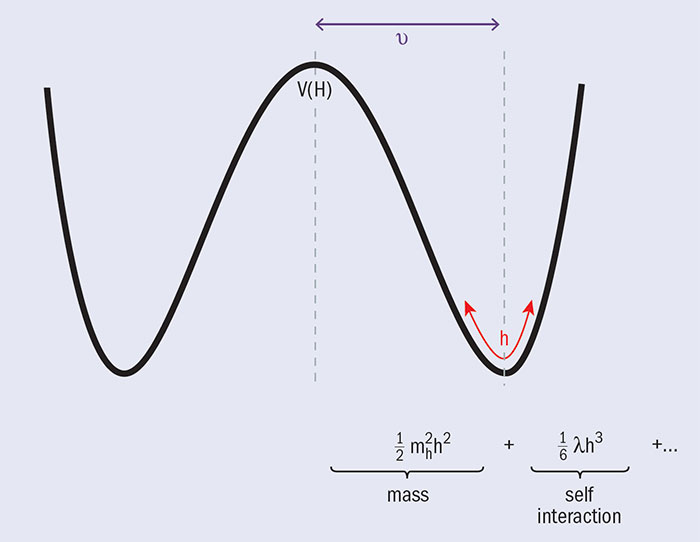
Setting our sights on the distant future of Higgs physics, it would be remiss to overlook the “white whale” of Higgs physics: the Higgs self-interaction. In yet another unique twist, the Higgs is the only particle in the SM that can scatter off itself (figure 5). In contrast, gluons only interact with other non-identical gluons. If we could access the Higgs self-interactions, by determining how a Higgs boson scatters on itself in measurements of Higgs boson pair-production processes, we would be measuring the shape of the Higgs scalar potential. This is tremendously important because, in theory, it determines the fate of the entire universe: if the scalar potential “turns back over” again at high field values, it would imply that we live in a metastable state. There is mounting evidence, in the form of the measured SM parameters such as the mass of the top quark, that this may be the case. Unfortunately, with the LHC we will not be able to measure this interaction well enough to definitively determine the shape of the Higgs scalar potential, and so we must ultimately look to future colliders to answer this question, among others.

The Higgs is the keystone of the SM and therefore everything we learn about this new particle is central to the deepest laws of nature. When huddled over my laptop at 3.00 a.m. on 4 July 2012, I was 27 years old and in the first year of my first postdoctoral position. To me, and presumably the rest of my generation, it felt like a new scientific continent had been discovered, one that would take a lifetime to explore. On that day we finally knew it existed. Today, after five years of feverish exploration, we have in our hands a sketch of the coastline. We have much to learn before the mountains and valleys of the enigmatic Higgs boson are revealed.

bright-rec iop pub iop-science physcis connect