Protons accelerated by the LHC generate a large flux of quasi-real high-energy photons that can interact to produce particles at the electroweak scale. Using the LHC as a photon collider, the ATLAS collaboration announced a set of landmark results at the 40th International Conference on High Energy Physics last week, among which is the first observation of the photo-production of W-boson pairs.
As it proceeds via trilinear and quartic gauge-boson vertices involving two W bosons and either one or two photons, the production of a pair of W bosons from two photons (ɣɣ → WW) tests a longstanding prediction of the Standard Model (SM). This process is extremely rare but predicted precisely by electroweak theory, such that any observed deviation would suggest that new physics is at play. The measurement relies on the large 139 fb–1 dataset of proton–proton collisions recorded by ATLAS in LHC Run 2.
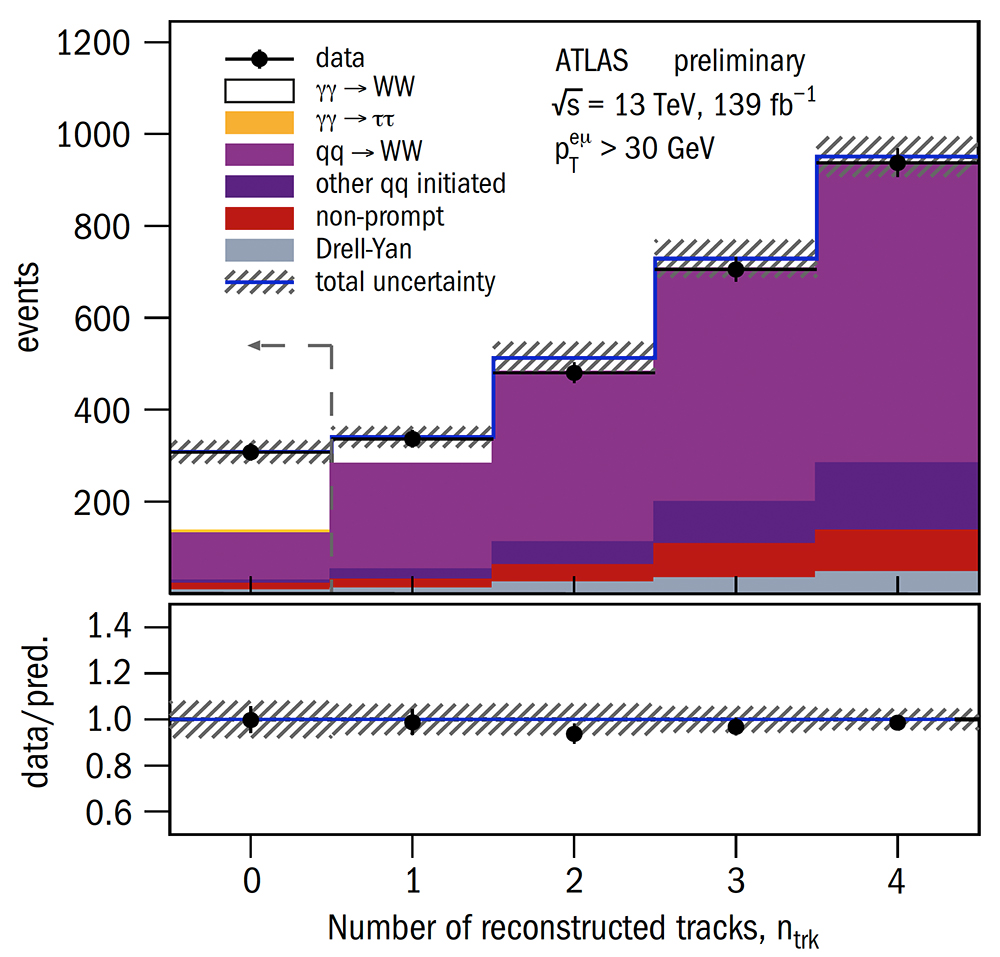
Protons usually remain intact or are excited into a higher energy state in photon collisions, with the products of any subsequent decay not reaching the innermost components of the ATLAS detector. In these cases, the electron and muon decaying from the W bosons – an event topology chosen to avoid the high background for same-flavour lepton pairs – are the only particles detected in the vicinity. However, if charged particles arise from nearby proton–proton collisions, the clean ɣɣ → WW signal can be missed. The main background is W-boson pairs produced in head-on proton–proton collisions where particles from the break-up of the protons are not detected due to imperfect detector coverage or reconstruction (figure 1). A total of 127 background events were predicted compared with 307 events observed in the data, corresponding to a signal excess of 8.4 standard deviations. This establishes the existence of light transforming into particles with weak-scale masses – a remarkable and previously unobserved phenomenon.
Innovation
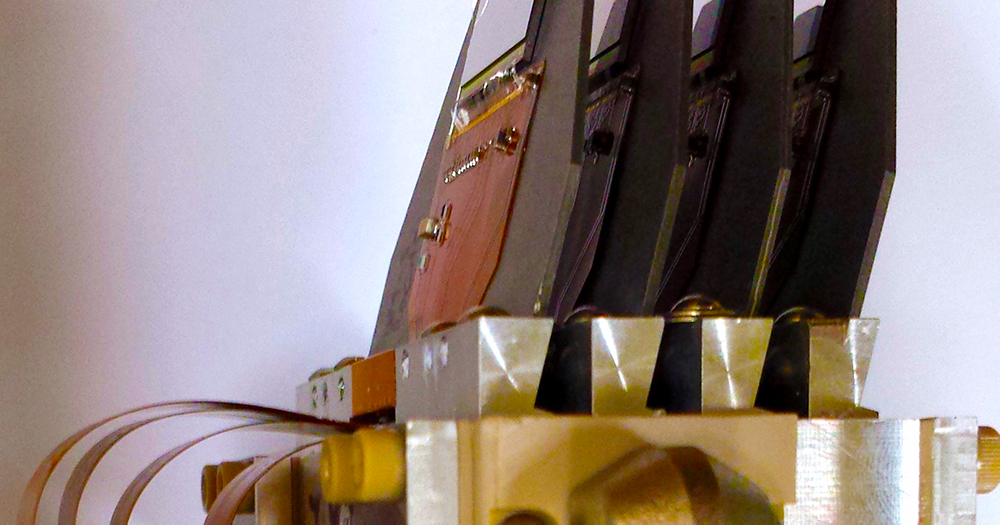
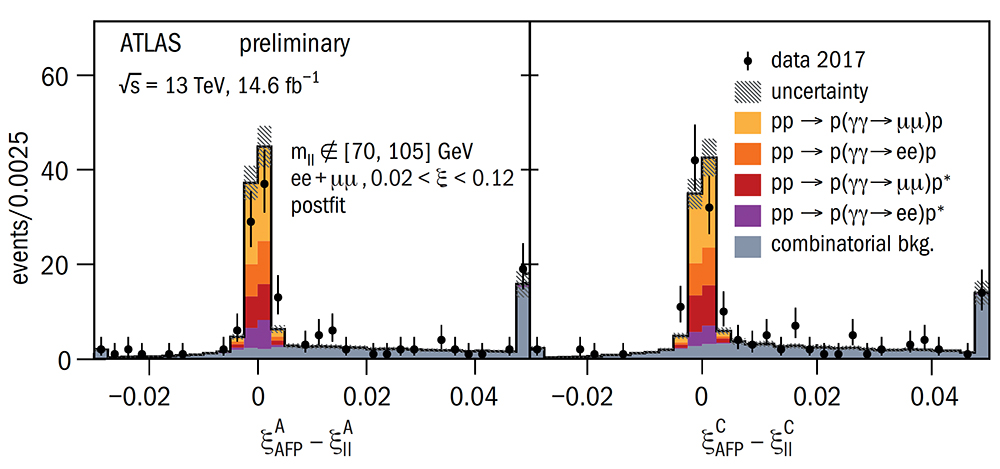
Precisely testing SM predictions of photon collisions requires accurate knowledge of the rate protons remain intact relative to those that break apart. This is challenging to predict theoretically and probing these rates unambiguously requires directly detecting the intact protons. The ATLAS forward-proton spectrometer (AFP) is becoming increasingly indispensable for this task. Among the newest additions to the ATLAS experiment, and located a few millimetres from the beam 210 m either side of the collision point, the AFP can detect protons that have been scattered in photon–photon collisions but which have nevertheless been focused by the LHC’s magnets. Its pioneering results so far analyse a standard-candle process where a proton is scattered in photon collisions that produce electron or muon pairs (ɣɣ → ℓℓ). For these signals, the measured proton energy loss is equal to that predicted from the lepton pairs measured in the main ATLAS detector (figure 2). ATLAS reported 180 events with a proton having matched kinematics to the lepton pair with an expected background of about 20 events. This corresponds to a significance exceeding nine standard deviations for both lepton flavours, establishing the presence of the signal and the successful operation of the AFP spectrometer in high-luminosity data. The detectors were sufficiently well understood to measure the cross sections of these processes.
Observing ɣɣ → WW and scattered protons in ɣɣ → ℓℓ interactions are long-awaited milestones in an emerging experimental programme studying photon collisions. These complement recent heavy-ion results where ATLAS measured muon pairs from photon collisions and the kinematic properties of light-by-light scattering – a very rare process predicted by quantum electrodynamics. Interestingly, the latter was also used to search for the axion-like particles predicted by certain extensions of the SM.
Observing ɣɣ → WW and scattered protons in ɣɣ → ℓℓ interactions are long-awaited milestones
The techniques developed to study ɣɣ → WW and ɣɣ → ℓℓ interactions lay the groundwork for future, more detailed tests of the SM. Further results using the AFP spectrometer can improve theoretical understanding of photon collisions that will also benefit future measurements of ɣɣ → WW production. These landmark experimental feats will only become more interesting with the increased dataset of Run 3 and the high-luminosity LHC.
CERN’s NA62 collaboration has presented its latest progress in the search for K+→π+νν̄ – a “golden decay” with exceptional sensitivity to physics beyond the Standard Model. The new analysis, which includes the full dataset collected until 2018, provides the strongest evidence yet for the existence of this ultra-rare process, at 3.5σ significance. Presenting the result today during the penultimate plenary session of the 40th International Conference on High-Energy Physics, which is being virtually hosted from Prague, lead-analyst Giuseppe Ruggiero of Lancaster University described the result as a great achievement. “After several years of a very challenging analysis, battling ten orders of magnitude of background over the signal, we are proud to have achieved the first statistically significant evidence for a process which has great sensitivity to new physics,” he says.
An important virtue of K+→π+νν̄ is its clean theoretical character
Andrzej Buras
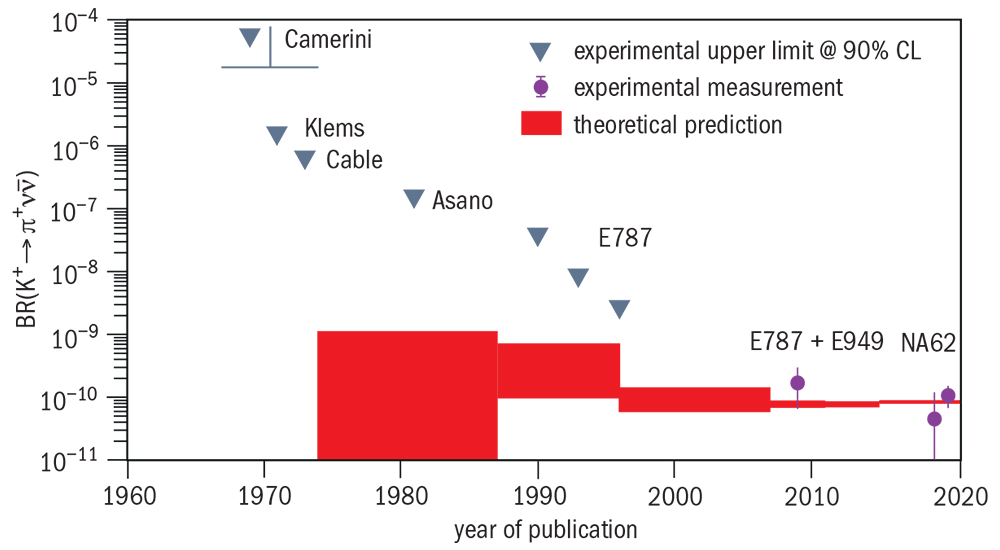
A flavour-changing, neutral-current process, K+→π+νν̄ is highly suppressed in the Standard Model, with contributions from Z-penguin and box diagrams with W, top quark and charm exchanges. The measured branching fraction of 110+40-35 per trillion K+→π+νν̄ decays is in agreement with the Standard Model prediction of 84 ± 10 per trillion (JHEP11 033). “A particular and very important virtue of K+→π+νν̄ is its clean theoretical character, which can only be matched among meson decays by KL→π0νν̄, and possibly Bs,d→μ+μ–,” says Andrzej Buras of the Institute for Advanced Study in Garching, Germany. “This is related to the fact that the low-energy hadronic matrix elements are just those of the quark currents between the hadronic states, which can be extracted from the leading semileptonic decay K+→π0e+ν,” he explains, noting that higher-order QCD and electroweak corrections are already well known, and lattice QCD calculations should soon tackle the small, “long-distance” contributions to the amplitude.
NA62 observes the 6% of positively charged kaons that are produced when 450 GeV protons from the Super Proton Synchrotron strike a beryllium target. The analysis is challenging because of the tiny branching fraction and the presence of a neutrino pair in the final state. Pioneering the technique of observing kaon decays in flight, the collaboration measures the kinematics of both the initial kaon and the final-state pion to isolate the kinematic signature of K+→π+νν̄, before then suppressing other decay modes by a further eight orders of magnitude using particle-identification techniques.
The collaboration’s new result adds a further 17 events to its previous analysis (arXiv:2007.08218, submitted to JHEP), wherein three events observed in 2016 and 2017 yielded an estimated branching fraction of 47 +72-47 decays per trillion. The previous best measurement was by Brookhaven National Laboratory’s E787 and E949 experiments in the 2000s, which together inferred a branching fraction of 173 +115-105 per trillion (Phys. Rev. Lett.101 191802).
Meanwhile in Japan
The NA62 result is expected soon to be complemented by a measurement of the related CP-violating KL→π0νν̄ decay by the KOTO collaboration at the J-PARC research facility in Tokai, Japan. This even rarer process has a predicted Standard Model branching fraction of just 34 ± 6 per trillion. KOTO’s 2015 data yielded no event candidates and a 90% confidence upper limit on the branching fraction of 3.0 per billion (Phys. Rev. Lett.122 021802). The collaboration is now finalising its results from the 2016–2018 run, and plans to improve its sensitivity to less than 0.1 per billion by increasing the beam intensity and upgrading the KOTO detectors.
As experimental uncertainties are expected to approach the theoretical precision in coming years, explains Buras, K+→π+νν̄ and KL→π0νν̄ decays can probe scales as high as a few hundred TeV – beyond the reach of most B-meson decays. “K+→π+νν̄ is most sensitive to hypothetical Z′ gauge bosons, vector-like quark models, supersymmetry and some leptoquark models,” he says. “LHCb studies of KS→ μ+μ– and Belle II studies of B→ K(K*)νν̄ will also have a part to play, allowing a global analysis to test not only the concept of minimal flavour violation, but also probe new CP-violating phases and right-handed currents.”
Theorists expect to reach an accuracy of 5% on the predicted K+→π+νν̄ branching ratio towards the end of the decade. In the same period, the NA62 team is seeking to hone its resolution from the current 30% down to 10%. The collaboration will resume data taking in 2021, following upgrades to both beam and detector taking place during the ongoing second long shutdown of CERN’s accelerator complex.
Sensitivity to decay rates below the 10–11 level is now in sight
Cristina Lazzeroni
“The horizon of a new-physics programme with a sensitivity to decay rates well below the 10–11 level is now in sight,” says NA62 spokesperson Cristina Lazzeroni of the University of Birmingham, UK. “The instruments and techniques developed for the NA62 experiment will lead to the next generation of rare-kaon-decay experiments. For the longer term future, a high-intensity kaon-beam programme is starting to take shape at CERN, with prospects to measure the K+→π+νν̄ decay to a few per cent, address the analogous decay of the neutral kaon, and reach extreme sensitivities to a large variety of rare kaon decays that are complementary to investigations in the beauty-quark sector.”
4,350 people from every continent, including Antarctica, participated from 22 June to 2 July in the XXIX International Conference on Neutrino Physics and Astrophysics, which was hosted online by Fermilab and the University of Minnesota. Originally planned as a five day, in-person June meeting at a large hotel in Chicago city centre, the organisers quickly pivoted in March, due to COVID-19, to an online programme with eight half days over two weeks, four poster sessions with both web-based and virtual-reality displays, and the use of the Slack platform for speaker questions and ongoing discussions.
A highlight of the conference was the first observation of solar CNO neutrinos
A highlight of the conference was the first observation of solar CNO neutrinos by the Borexino collaboration, which operates a 280-tonne liquid-scintillator detector in Italy’s Gran Sasso Laboratory. Dominant in stars more than 1.3 times the mass of the sun, the CNO cycle accounts for about 1% of the sun’s energy and generates a difficult-to-detect neutrino flux similar to backgrounds due to decays in the detector of 210Bi and its daughter nucleus 210Po. Gioacchino Ranucci (INFN, Milano) explained that the spectral fit to the observed data returns only the sum of CNO and 210Bi neutrinos. “The quest for CNO is turned into the quest for 210Bi through 210Po,” he emphasised. “With this outcome, Borexino has completely unravelled the two processes powering the Sun—the pp chain and the CNO cycle.” The final data analysis yielded a 5.1σ statistic against a hypothesis of no CNO neutrinos, and a CNO flux at the Earth of 7.0-1.9+2.9 × 108 cm-2 s-1.
Another highlight from Gran Sasso was the report from the Gerda collaboration on the search for neutrino-less double beta decay. If observed, this process would confirm the long-suspected Majorana rather than Dirac-fermion nature of neutrinos – a beyond the Standard Model feature with intriguing implications for why the neutrino mass is so small. Since Neutrino 2018, Gerda has nearly doubled its Phase 2 exposure and added a liquid-argon veto and a new detector string. The now complete Phase 2 result is a 90% confidence level half-life of >1.8 x 1026 years according to a frequentist analysis, or >1.4 x 1026 years, according to a Bayesian analysis with additional prior assumptions. Talks describing a half-dozen other double-beta-decay experiments displayed the high level of interest in this field.
Sterile neutrinos
Searches for additional “sterile” neutrinos with no Standard-Model gauge interactions were also featured. Takasumi Maruyama (KEK) described the liquid-scintillator JSNS2 experiment as a direct test of the controversial LSND Experiment result, first reported about 25 years ago. JSNS2 collected its first data during the three weeks before Neutrino 2020. Adrien Hourlier (MIT) reported on the now complete analysis of data from MiniBooNE that was collected during the past 17 years. Combining neutrino and anti-neutrino modes, MiniBooNE reports a 4.8σ excess. Hourlier presented soon-to-be published detailed distributions which the collaboration hopes “will guide theorists to explain our data”. Minerba Betancourt (Fermilab) then described the Fermilab Short-Baseline Neutrino (SBN) programme, which will use three detectors to obtain a definitive result on neutrino oscillations for an LSND and MiniBooNE-like ratio of oscillation distance to energy of ~1 m/MeV. The beam neutrino energy peaks at 700 MeV. A new liquid-argon near detector (SBND) will be placed 110 m from the target. The existing MicroBooNE is located at 470 m and the ICARUS Detector, moved from Gran Sasso, is installed at 600 m. Thomas Carroll (Wisconsin) reported on sterile-neutrino limits by muon disappearance determined by the now completed long-baseline MINOS/MINOS+ collaboration. These limits are in tension with the appearance data from both LSND and MiniBooNE when analysed as evidence for sterile neutrinos.
Two talks described the world’s two hundred-kilometre-scale neutrino-oscillation experiments, NOvA and T2K. The degeneracy of mass difference, mixing angle, hierarchy and possible CP violation make interpretation of these experiments’ results quite complex. Interestingly, there is mild tension, albeit only at the 1σ level, between the NOvA and T2K results regarding leptonic CP conservation and the neutrino mass hierarchy. The two collaborations are now working together on a combined analysis. Several talks discussed future initiatives. Lia Merminga (Fermilab) reported on LBNF and PIP-II, which will result in a new neutrino beam from Fermilab to the Sanford Laboratory in South Dakota for the DUNE experiment. Combined, these two projects will result in beam power of 2.4 MW, more than three times the intensity of the current NuMI beam. Michael Mooney (Colorado State) reported on the enormous progress of the DUNE project with two successful prototype detectors operating at CERN and pre-excavation work progressing at Sanford Laboratory. Complementary to the liquid-argon technology of DUNE is the recently approved Hyper-Kamiokande water-Cherenkov detector, which was described by Masaki Ishitsuka (Tokyo University of Science). Hyper-K will have a total mass of 260 kilo-tonne and 8.4 times the fiducial volume of the current Super-Kamiokande detector.
The VR feature attracted 3,409 conference participants
While much of Neutrino 2020 was modelled after the usual features of an in-person conference, the Virtual Reality (VR) poster presentation was novel and unique. Marco Del Tutto (Fermilab) created multiple virtual “rooms” for five posters each, along with additional rooms for topical discussions, sightseeing in Chicago and visiting Fermilab. The most enabling feature of the VR was that the software facilitated dialogue between participants whose avatars could move around the space and speak with one another. For example, if a group of avatars clustered around a poster, the participants could discuss the poster as a group. The VR feature attracted 3,409 participants. The VR was also supplemented by two-minute videos from presenters which enabled 5,800 YouTube views and 60,600 web displays.
In closing remarks, the organisers acknowledged the challenges of an online conference, but also emphasised the strengths of this novel approach. The exciting physics of Neutrino 2020 was made available to an extensive and diverse audience, including many scientists who would not have been able to attend an in-person conference because of funding, visas, family concerns or other issues. About 60% of participants were students or post-docs and the conference reached participants from 67 countries. The Slack discussions and posts on social media indicated wide-spread praise that the online format worked as well as it did. Some aspects of Neutrino 2020 may well affect the planning and organisation of future in-person and online conferences.
In traditional Balinese music, instruments are made in pairs, with one tuned slightly higher in frequency than its twin. The notes are indistinguishable to the human ear when played together, but the sound recedes and swells a couple of times each second, encouraging meditation. This is a beating effect: fast oscillations at the mean frequency inside a slowly oscillating envelope. Similar physics is at play in neutrino oscillations. Rather than sound intensity, it’s the probability to observe a neutrino with its initial flavour that oscillates. The difference is how long it takes for the interference to make itself felt. When Balinese musicians strike a pair of metallophones, the notes take just a handful of periods to drift out of phase. By contrast, it takes more than 1020 de Broglie wavelengths and hundreds of kilometres for neutrinos to oscillate in experiments like the planned mega-projects Hyper-Kamiokande and DUNE.
The zeitgeist began to shift to artificially produced neutrinos
Neutrino oscillations revealed a rare chink in the armour of the Standard Model: neutrinos are not massless, but are evolving superpositions of at least three mass eigenstates with distinct energies. A neutrino is therefore like three notes played together: frequencies so close, given the as-yet immeasurably small masses involved, that they are not just indistinguishable to the ear, but inseparable according to the uncertainty principle. As neutrinos are always ultra-relativistic, the energies of the mass eigenstates differ only due to tiny mass contributions of m2/2E. As the mass eigenstates propagate, phase differences develop between them proportional to squared-mass splittings Δm2. The sought-after oscillations range from a few metres to the diameter of Earth.
Orthogonal mixtures
The neutrino physics of the latter third of the 20th century was bookended by two anomalies that uncloaked these effects. In 1968 Ray Davis’s observation of a deficit of solar neutrinos prompted Bruno Pontecorvo to make public his conjecture that neutrinos might oscillate. Thirty years later, the Super-Kamiokande collaboration’s analysis of a deficit of atmospheric muon neutrinos from the other side of the planet posthumously vindicated the visionary Italian, and later Soviet, theorist’s speculation. Subsequent observations have revealed that electron, muon and tau neutrinos are orthogonal mixtures of mass eigenstates ν1 and ν2, separated by a small so-called solar splitting Δm221, and ν3, which is separated from that pair by a larger “atmospheric” splitting usually quantified by Δm232 (see “Little and large” figure). It is not yet known if ν3 is the lightest or the heaviest of the trio. This is called the mass-hierarchy problem.
“In the first two decades of the 21st century we have achieved a rather accurate picture of neutrino masses and mixings,” says theorist Pilar Hernández of the University of Valencia, “but the ordering of the neutrino states is unknown, the mass of the lightest state is unknown and we still do not know if the neutrino mixing matrix has imaginary entries, which could signal the breaking of CP symmetry,” she explains. “The very different mixing patterns in quarks and leptons could hint at a symmetry relating families, and a more accurate exploration of the lepton-mixing pattern and the neutrino ordering in future experiments will be essential to reveal any such symmetry pattern.”
Today, experiments designed to constrain neutrino mixing tend to dispense with astrophysical neutrinos in favour of more controllable accelerator and reactor sources. The experiments span more than four orders of magnitude in size and energy and fall into three groups (see “Not natural” figure). Much of the limelight is taken by experiments that are sensitive to the large mass splitting Δm232, which include both a cluster of current (such as T2K) and future (such as DUNE) accelerator-neutrino experiments with long baselines and high energies, and a high-performing trio of reactor-neutrino experiments (Daya Bay, RENO and Double Chooz) with a baseline of about a kilometre, operating just above the threshold for inverse beta decay. The second group is a beautiful pair of long-baseline reactor-neutrino experiments (KamLAND and the soon-to-be-commissioned JUNO), which join experiments with solar neutrinos in having sensitivity to the smaller squared-mass splitting Δm221. Finally, the third group is a host of short-baseline accelerator-neutrino experiments and very-short-baseline reactor neutrino experiments that are chasing tantalising hints of a fourth “sterile” neutrino (with no Standard-Model gauge interactions), which is split from the others by a squared-mass splitting of the order of 1 eV2.
Experiments with artificial sources of neutrinos have a storied history, dating from the 1950s, when physicists toyed with the idea of detecting neutrinos created in the explosion of a nuclear bomb, and eventually observed them streaming from nuclear reactors. The 1960s saw the invention of the accelerator neutrino. Here, proton beams smashed into fixed targets to create a decaying debris of charged pions and their concomitant muon neutrinos. The 1970s transformed these neutrinos into beams by focusing the charged pions with magnetic horns, leading to the discovery of weak neutral currents and insights into the structure of nucleons. It was not until the turn of the century, however, that the zeitgeist of neutrino-oscillation studies began to shift from naturally to artificially produced neutrinos. Just a year after the publication of the Super-Kamiokande collaboration’s seminal 1998 paper on atmospheric–neutrino oscillations, Japanese experimenters trained a new accelerator-neutrino beam on the detector.
Operating from 1999 to 2006, the KEK-to-Kamioka (K2K) experiment sent a beam of muon neutrinos from the KEK laboratory in Tsukuba to the Super-Kamiokande detector, 250 km away under Mount Ikeno on the other side of Honshu. K2K confirmed that muon neutrinos “disappear” as a function of propagation distance over energy. The experiments together supported the hypothesis of an oscillation to tau neutrinos, which could not be directly detected at that energy. By increasing the beam energy well above the tau-lepton mass, the CERN Neutrinos to Gran Sasso (CNGS) project, which ran from 2006 to 2012, confirmed the oscillation to tau neutrinos by directly observing tau leptons in the OPERA detector. Meanwhile, the Main Injector Neutrino Oscillation Search (MINOS), which sent muon neutrinos from Fermilab to northern Minnesota from 2005 to 2012, made world-leading measurements of the parameters describing the oscillation.
With νμ→ ντ oscillations established, the next generation of experiments innovated in search of a subtler effect. T2K (K2K’s successor, with the beam now originating at J-PARC in Tokai) and NOvA (which analyses oscillations over the longer baseline of 810 km between Fermilab and Ash River, Minnesota) both have far detectors offset by a few degrees from the direction of the peak flux of the beams. This squeezes the phase space for the pion decays, resulting in an almost mono-energetic flux of neutrinos. Here, a quirk of the mixing conspires to make the musical analogy of a pair of metallophones particularly strong: to a good approximation, the muon neutrinos ring out with two frequencies of roughly equal amplitude, to yield an almost perfect disappearance of muon neutrinos – and maximum sensitivity to the appearance of electron neutrinos.
Testing CP symmetry
The three neutrino mass eigenstates mix to make electron, muon and tau neutrinos according to the Pontecorvo– Maki–Nakagawa–Sakata (PMNS) matrix, which describes three rotations and a complex phase δCP that can cause charge–parity (CP) violation – a question of paramount importance in the field due to its relevance to the unknown origin of the matter–antimatter asymmetry in the universe. Whatever the value of the complex phase, leptonic CP violation can only be observed if all three of the angles in the PMNS matrix are non-zero. Experiments with atmospheric and solar neutrinos demonstrated this for two of the angles. At the beginning of the last decade, short-baseline reactor-neutrino experiments in China (Daya Bay), Korea (RENO) and France (Double Chooz) were in a race with T2K to establish if the third angle, which leads to a coupling between ν3 and electrons, was also non-zero. In the reactor experiments this would be seen as a small deficit of electron antineutrinos a kilometre or so from the reactors; in T2K the smoking gun would be the appearance of a small number of electron neutrinos not present in the initial muon-neutrino-dominated beam.
After data taking was cut short by the great Sendai earthquake and tsunami of March 2011, T2K published evidence for the appearance of six electron-neutrino events, over the expected background of 1.5 ± 0.3 in the case of no coupling. Alongside a single tau-neutrino candidate in OPERA, these were the first neutrinos seen to appear in a detector with a new flavour, as previous signals had always registered a deficit of an expected flavour. In the closing days of the year, Double Chooz published evidence for 4121 electron–antineutrino events, under the expected tally for no coupling of 4344 ± 165, reinforcing T2K’s 2.5σ indication. Daya Bay and RENO put the matter to bed the following spring, with 5σ evidence apiece that the ν3-electron coupling was indeed non-zero. The key innovation for the reactor experiments was to minimise troublesome flux and interaction systematics by also placing detectors close to the reactors.
Since then, T2K and NOvA, which began taking data in 2014, have been chasing leptonic CP violation – an analysis that is out of the reach of reactor experiments, as δCP does not affect disappearance probabilities. By switching the polarity of the magnetic horn, the experiments can compare the probabilities for the CP-mirror oscillations νμ→ νe and νμ→ νe directly. NOvA data are inconclusive at present. T2K data currently err towards near maximal CP violation in the vicinity of δCP = –π/2. The latest analysis, published in April, disfavours leptonic CP conservation (δCP = 0, ±π) at 2σ significance for all possible mixing parameter values. Statistical uncertainty is the biggest limiting factor.
Major upgrades planned for T2K next year target statistical, interaction-model and detector uncertainties. A substantial increase in beam intensity will be accompanied by a new fine-grained scintillating target for the ND280 near-detector complex, which will lower the energy threshold to reconstruct tracks. New transverse TPCs will improve ND280’s acceptance at high angles, yielding a better cancellation of systematic errors with the far detector, Super-Kamiokande, which is being upgraded by loading 0.01% gadolinium salts into the otherwise ultrapure water. As in reactor-neutrino detectors, this will provide a tag for antineutrino events, to improve sample purities in the search for leptonic CP violation.
T2K and NOvA both plan to roughly double their current data sets, and are working together on a joint fit, in a bid to better understand correlations between systematic uncertainties, and break degeneracies between measurements of CP violation and the mass hierarchy. If the CP-violating phase is indeed maximal, as suggested by the recent T2K result, the experiments may be able to exclude CP conservation with more than 99% confidence. “At this point we will be in a transition from a statistics-dominated to a systematics-dominated result,” says T2K spokesperson Atsuko Ichikawa of the University of Kyoto. “It is difficult to say, but our sensitivity will likely be limited at this stage by a convolution of neutrino-interaction and flux systematics.”
The next generation
Two long-baseline accelerator-neutrino experiments roughly an order of magnitude larger in cost and detector mass than T2K and NOvA have received green lights from the Japanese and US governments: Hyper-Kamiokande and DUNE. One of their primary missions is to resolve the question of leptonic CP violation.
Hyper-Kamiokande will adopt the same approach as T2K, but will benefit from major upgrades to the beam and the near and far detectors in addition to those currently underway in the present T2K upgrade. To improve the treatment of systematic errors, the suite of near detectors will be complemented by an ingenious new gadolinated water-Cherenkov detector at an intermediate baseline: by spanning a range of off-axis angles, it will drive down interaction-model systematics by exploiting previously neglected information on the how the flux varies as a function of the angle relative to the centre of the beam. Hyper-Kamiokande’s increased statistical reach will also be impressive. The power of the Japan Proton Accelerator Research Complex (J-PARC) beam will be increased from its current value of 0.5 MW up to 1.3 MW, and the new far detector will be filled with 260,000 tonnes of ultrapure water, yielding a fiducial volume 8.4 times larger than that of Super-Kamiokande. Procurement of the photo-multiplier tubes will begin this year, and the five-year-long excavation of the cavern has already begun. Data taking is scheduled to commence in 2027. “The expected precision on δCP is 10–20 degrees, depending on its true value,” says Hyper-Kamiokande international co-spokesperson Francesca di Lodovico of King’s College, London.
In the US, the Deep Underground Neutrino Experiment (DUNE) will exploit the liquid-argon–TPC technology first deployed on a large scale by ICARUS – OPERA’s sister detector in the CNGS project. The idea for the technology dates back to 1977, when Carlo Rubbia proposed using liquid rather than gaseous argon as a drift medium for ionisation electrons. Given liquid-argon’s higher density, such detectors can serve as both target and tracker, providing high-resolution 3D images of the interactions – an invaluable tool for reducing systematics related to the murky world of neutrino–nucleus interactions.
Spectacular performance
The technology is currently being developed in two prototype detectors at CERN. The first hones ICARUS’s single-phase approach. “The performance of the prototype has been absolutely spectacular, exceeding everyone’s expectations,” says DUNE co-spokesperson Ed Blucher of the University of Chicago. “After almost two years of operation, we are confident that the liquid–argon technology is ready to be deployed at the huge scale of the DUNE detectors.” In parallel, the second prototype is testing a newer dual-phase concept. In this design, ionisation charges drift through an additional layer of gaseous argon before reaching the readout plane. The signal can be amplified here, potentially easing noise requirements for the readout electronics, and increasing the maximum size of the detector. The dual-phase prototype was filled with argon in summer 2019 and is now recording tracks.
The final detectors will have about twice the height and 10 to 20 times the footprint. Following the construction of an initial single-phase unit, the DUNE collaboration will likely pick a mix of liquid-argon technologies to complete their roster of four 10 kton far-detector modules, set to be installed a kilometre underground at the Sanford Underground Research Laboratory in Lead, South Dakota. Site preparation and pre-excavation activities began in 2017, and full excavation work is expected to begin soon, with the goal that data-taking begin during the second half of this decade. Work on the near-detector site and the “PIP-II” upgrade to Fermilab’s accelerator complex began last year.
Though similar to Hyper-Kamiokande at first glance, DUNE’s approach is distinct and complementary. With beam energy and baseline both four times greater, DUNE will have greater sensitivity to flavour-dependent coherent-forward-scattering with electrons in Earth’s crust – an effect that modifies oscillation probabilities differently depending on the mass hierarchy. With the Fermilab beam directed straight at the detector rather than off-axis, a broader range of neutrino energies will allow DUNE to observe the oscillation pattern from the first to the second oscillation maximum, and simultaneously fit all but the solar mixing parameters. And with detector, flux and interaction uncertainties all distinct, a joint analysis of both experiments’ data could break degeneracies and drive down systematics.
“If CP violation is maximal and the experiments collect data as anticipated, DUNE and Hyper-Kamiokande should both approach 5σ significance for the exclusion of leptonic CP conservation in about five years,” estimates DUNE co-spokesperson Stefan Söldner-Rembold of the University of Manchester, noting that the experiments will also be highly complementary for non-accelerator topics. The most striking example is supernova-burst neutrinos, he says, referring to a genre of neutrinos only observed once so far, during 15 seconds in 1987, when neutrinos from a supernova in the Large Magellanic Cloud passed through the Earth. “While DUNE is primarily sensitive to electron neutrinos, Hyper-Kamiokande will be sensitive to electron antineutrinos. The difference between the timing distributions of these samples encodes key information about the dynamics of the supernova explosion.” Hyper-Kamiokande spokesperson Masato Shiozawa of ICRR Tokyo also emphasises the broad scope of the physics programmes. “Our studies will also encompass proton decay, high-precision measurements of solar neutrinos, supernova-relic neutrinos, dark-matter searches, the possible detection of solar-flare neutrinos and neutrino geophysics.”
Half a century since Ray Davis and two co-authors published evidence for a 60% deficit in the flux of solar neutrinos compared to John Bahcall’s prediction, DUNE already boasts more than a thousand collaborators, and Hyper-Kamiokande’s detector mass is set to be 500 times greater than Davis’s tank of liquid tetrachloroethylene. If Ray Davis was the conductor who set the orchestra in motion, then these large experiments fill out the massed ranks of the violin section, poised to deliver what may well be the most stirring passage of the neutrino-oscillation symphony. But other sections of the orchestra also have important parts to play.
Mass hierarchy
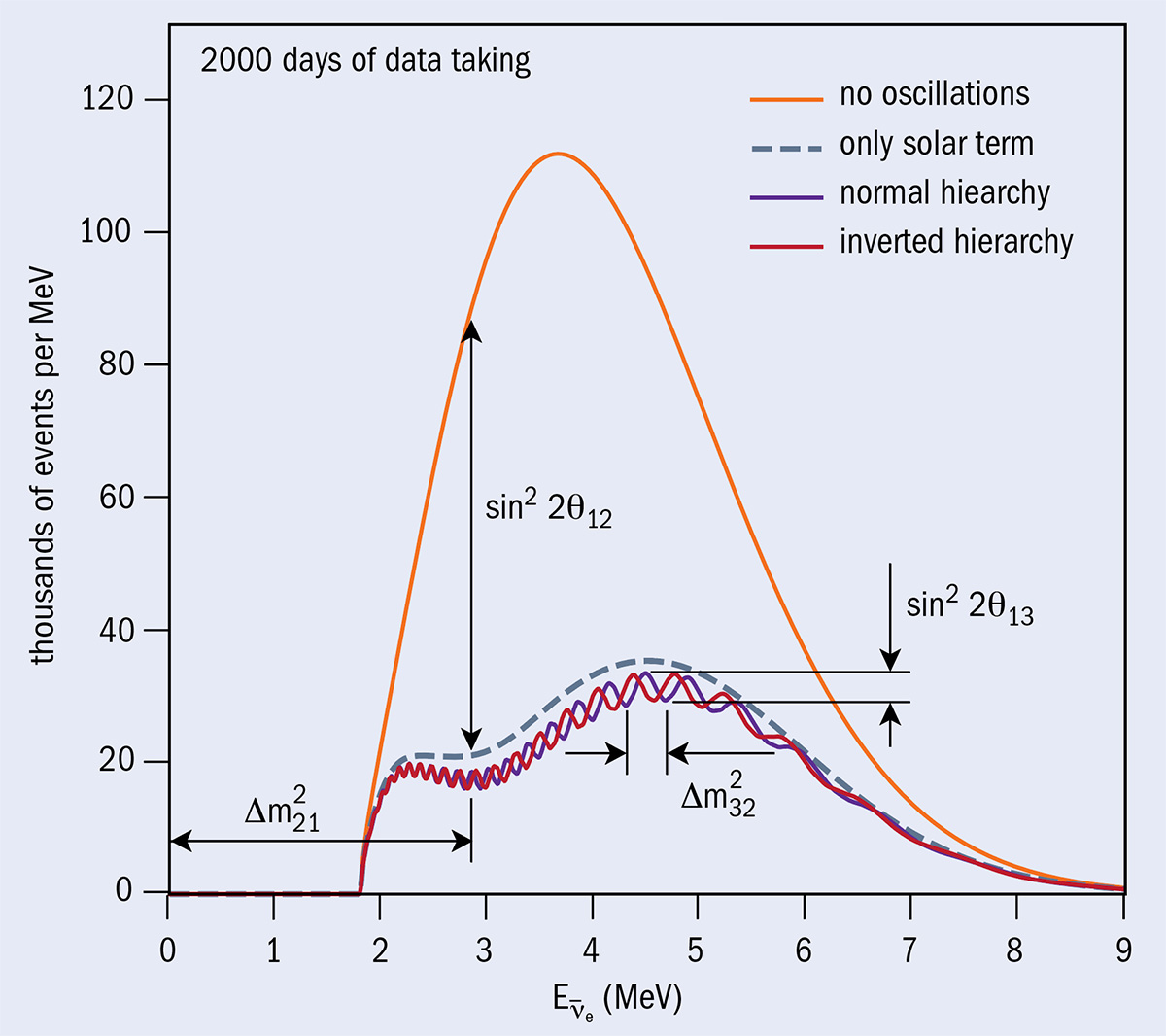
The question of the neutrino mass hierarchy will soon be addressed by the Jiangmen Underground Neutrino Observatory (JUNO) experiment, which is currently under construction in China. The project is an evolution of the Daya Bay experiment, and will seek to measure a deficit of electron antineutrinos 53 km from the Yangjiang and Taishan nuclear-power plants. As the reactor neutrinos travel, the small kilometre-scale oscillation observed by Daya Bay will continue to undulate with the same wavelength, revealed in JUNO as “fast” oscillations on a slower and deeper first oscillation maximum due to the smaller solar mass splitting Δm221 (see “An oscillation within an oscillation” figure).
“JUNO can determine the neutrino mass hierarchy in an unambiguous and definite way, independent from the CP phase and matter effects, unlike other experiments using accelerator or atmospheric neutrinos,” says spokesperson Yifang Wang of the Chinese Academy of Sciences in Beijing. “In six years of data taking, the statistical significance will be higher than 3σ.”
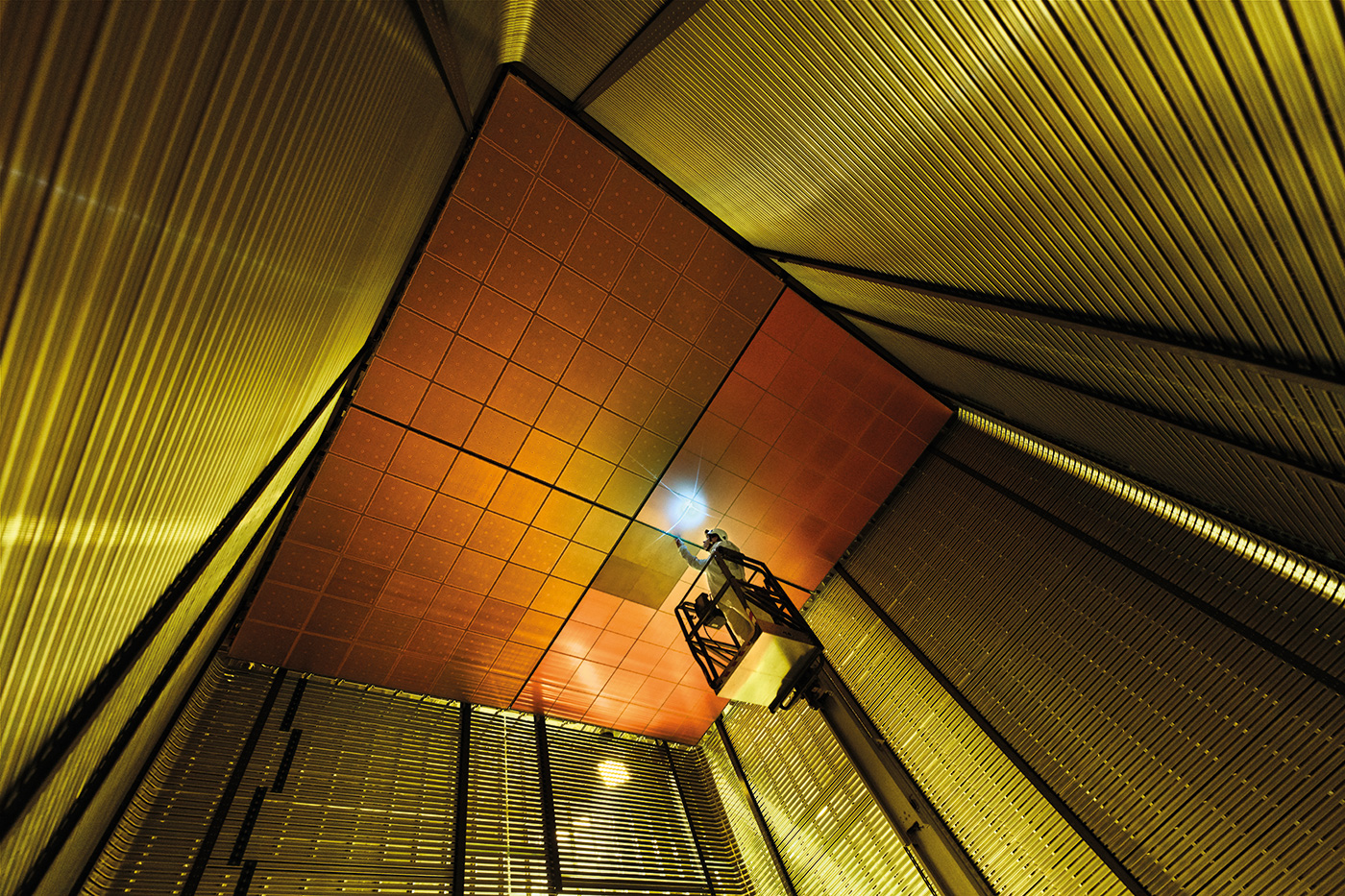
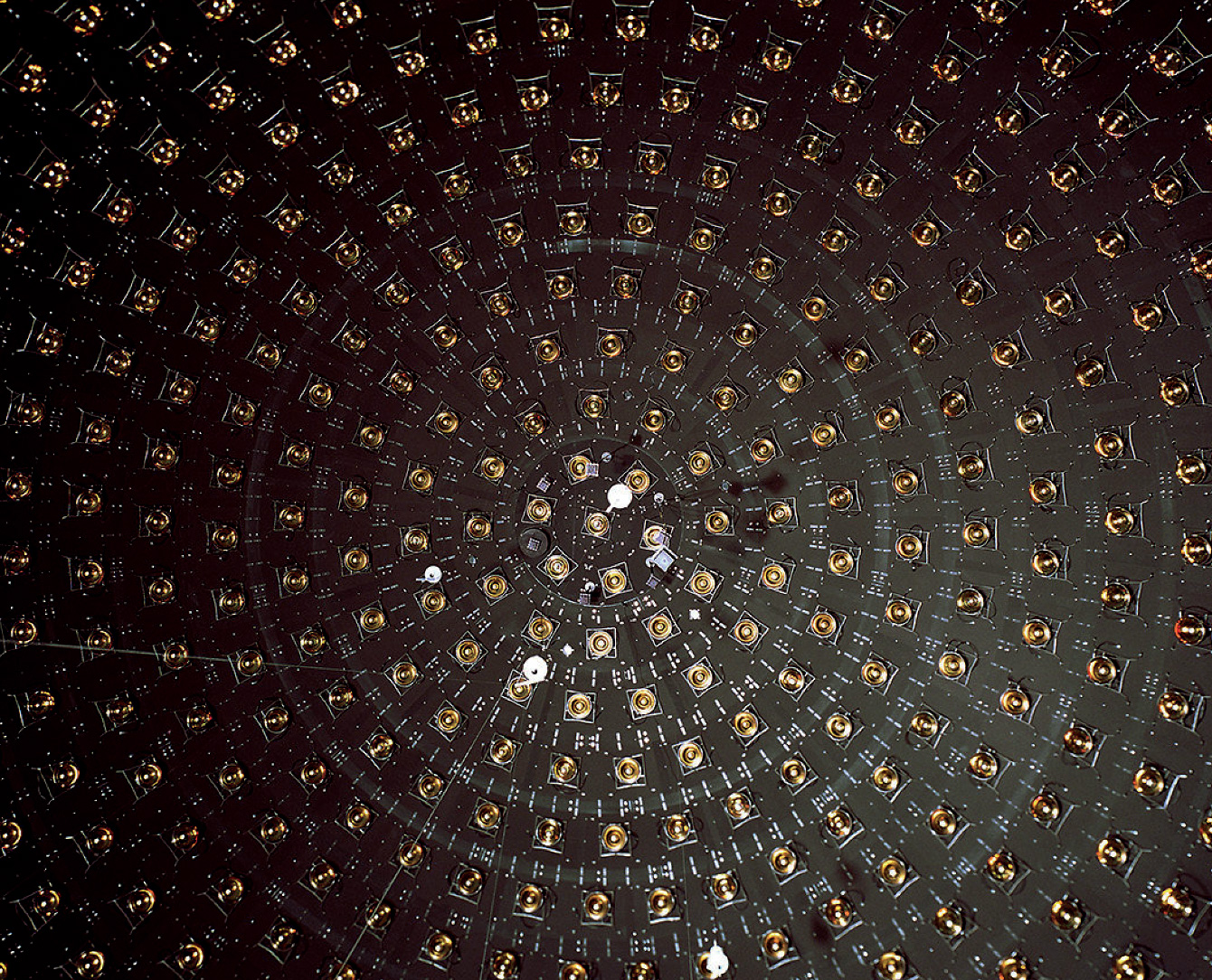
JUNO has completed most of the digging of the underground laboratory, and equipment for the production and purification of liquid scintillator is being fabricated. A total of 18,000 20-inch photomultiplier tubes and 26,000 3-inch photomultiplier tubes have been delivered, and most of them have been tested and accepted, explains Wang. The installation of the detector is scheduled to begin next year. JUNO will arguably be at the vanguard of a precision era for the physics of neutrino oscillations, equipped to measure the mass splittings and the solar mixing parameters to better than 1% precision – an improvement of about one order of magnitude over previous results, and even better than the quark sector, claims Wang, somewhat provocatively. “JUNO’s capabilities for supernova-burst neutrinos, diffused supernova neutrinos and geoneutrinos are unprecedented, and it can be upgraded to be a world-best double-beta-decay detector once the mass hierarchy is measured.”
With JUNO, Hyper-Kamiokande and DUNE now joining a growing ensemble of experiments, the unresolved leitmotifs of the three-neutrino paradigm may find resolution this decade, or soon after. But theory and experiment both hint, quite independently, that nature may have a scherzo twist in store before the grand finale.
A rich programme of short-baseline experiments promises to bolster or exclude experimental hints of a fourth sterile neutrino with a relatively large mixing with the electron neutrino that have dogged the field since the late 1990s. Four anomalies stack up as more or less consistent among themselves. The first, which emerged in the mid-1990s at Los Alamos’s Liquid Scintillator Neutrino Detector (LSND), is an excess of electron antineutrinos that is potentially consistent with oscillations involving a sterile neutrino at a mass splitting Δm2∼ 1 eV2. Two other quite disparate anomalies since then – a few-percent deficit in the expected flux from nuclear reactors, and a deficit in the number of electron neutrinos from radioactive decays in liquid-gallium solar-neutrino detectors – could be explained in the same way. The fourth anomaly, from Fermilab’s MiniBooNE experiment, which sought to replicate the LSND effect at a longer baseline and a higher energy, is the most recent: a sizeable excess of both electron neutrinos and antineutrinos, though at a lower energy than expected. It’s important to note, however, that experiments including KARMEN, MINOS+ and IceCube have reported null searches for sterile neutrinos that fit the required description. Such a particle would also stand in tension with cosmology, notes phenomenologist Silvia Pascoli of Durham University, as models predict it would make too large a contribution to hot dark matter in the universe today, unless non-standard scenarios are invoked.
Three different types of experiment covering three orders of magnitude in baseline are now seeking to settle the sterile-neutrino question in the next decade. A smattering of reactor-neutrino experiments a mere 10 metres or so from the source will directly probe the reactor anomaly at Δm2∼ 1 eV2. The data reported so far are intriguing. Korea’s NEOS experiment and Russia’s DANSS experiment report siren signals between 1 and 2 eV2, and NEUTRINO-4, also based in Russia, reports a seemingly outlandish signal, indicative of very large mixing, at 7 eV2. In parallel, J-PARC’s JSNS2 experiment is gearing up to try to reproduce the LSND effect using accelerator neutrinos at the same energy and baseline. Finally, Fermilab’s short-baseline programme will thoroughly address a notable weakness of both LSND and MiniBooNE: the lack of a near detector.
The Fermilab programme will combine three liquid-argon TPCs – a bespoke new short-baseline detector (SBND), the existing MicroBooNE detector, and the refurbished ICARUS detector – to resolve the LSND anomaly once and for all. SBND is currently under construction, MicroBooNE is operational, and ICARUS, removed from its berth at Gran Sasso and shipped to the US in 2017, has been installed at Fermilab, following work on the detector at CERN. “The short-baseline neutrino programme at Fermilab has made tremendous technical progress in the past year,” says ICARUS spokesperson and Nobel laureate Carlo Rubbia, noting that the detector will be commissioned as soon as circumstances allow, given the coronavirus pandemic. “Once both ICARUS and SBND are in operation, it will take less than three years with the nominal beam intensity to settle the question of whether neutrinos have an even more mysterious character than we thought.”
Muon neutrinos ring out with two frequencies of roughly equal amplitude, to yield almost perfect disappearance
Outside of the purview of oscillation experiments with artificially produced neutrinos, astrophysical observatories will scale a staggering energy range, from the PeV-scale neutrinos reported by IceCube at the South Pole, down, perhaps, to the few-hundred-μeV cosmic neutrino background sought by experiments such as PTOLEMY in the US. Meanwhile, the KATRIN experiment in Germany is zeroing in on the edges of beta-decay distributions to set an absolute scale for the mass of the peculiar mixture of mass eigenstates that make up an electron antineutrino (CERN Courier January/February 2020 p28). At the same time, a host of experiments are searching for neutrinoless double-beta decay – a process that can only occur if the neutrino is its own antiparticle. Discovering such a Majorana nature for the neutrino would turn the Standard Model on its head, and offer grist for the mill of theorists seeking to explain the tininess of neutrino masses, by balancing them against still-to-be-discovered heavy neutral leptons.
Indispensable input
According to Mikhail Shaposhnikov of the Swiss Federal Institute of Technology in Lausanne, current and future reactor- and accelerator-neutrino experiments will provide an indispensable input for understanding neutrino physics. And not in isolation. “To reach a complete picture, we also need to know the mechanism for neutrino-mass generation and its energy scale, and the most important question here is the scale of masses of new neutrino states: if lighter than a few GeV, these particles can be searched for at new experiments at the intensity frontier, such as SHiP, and at precision experiments looking for rare decays of mesons, such as Belle II, LHCb and NA62, while the heavier states may be accessible at ATLAS and CMS, and at future circular colliders,” explains Shaposhnikov. “These new particles can be the key in solving all the observational problems of the Standard Model, and require a consolidated effort of neutrino experiments, accelerator-based experiments and cosmological observations. Of course, it remains to be seen if this dream scenario can indeed be realised in the coming 20 years.”
• This article was updated on 6 July, to reflect results presented at Neutrino 2020
Luckily for us, there is presently almost no antimatter in the universe. This makes it possible for us – made of matter – to live without being annihilated in matter–antimatter encounters. However, cosmology tells us that just after the cosmic Big Bang, the universe contained equal amounts of matter and antimatter. Obviously, for the universe to have evolved from that early state to the present one, which contains quite unequal amounts of matter and antimatter, the two must behave differently. This implies that the symmetry CP (charge conjugation × parity) must be violated. That is, there must be physical systems whose behaviour changes if we replace every particle by its antiparticle, and interchange left and right.
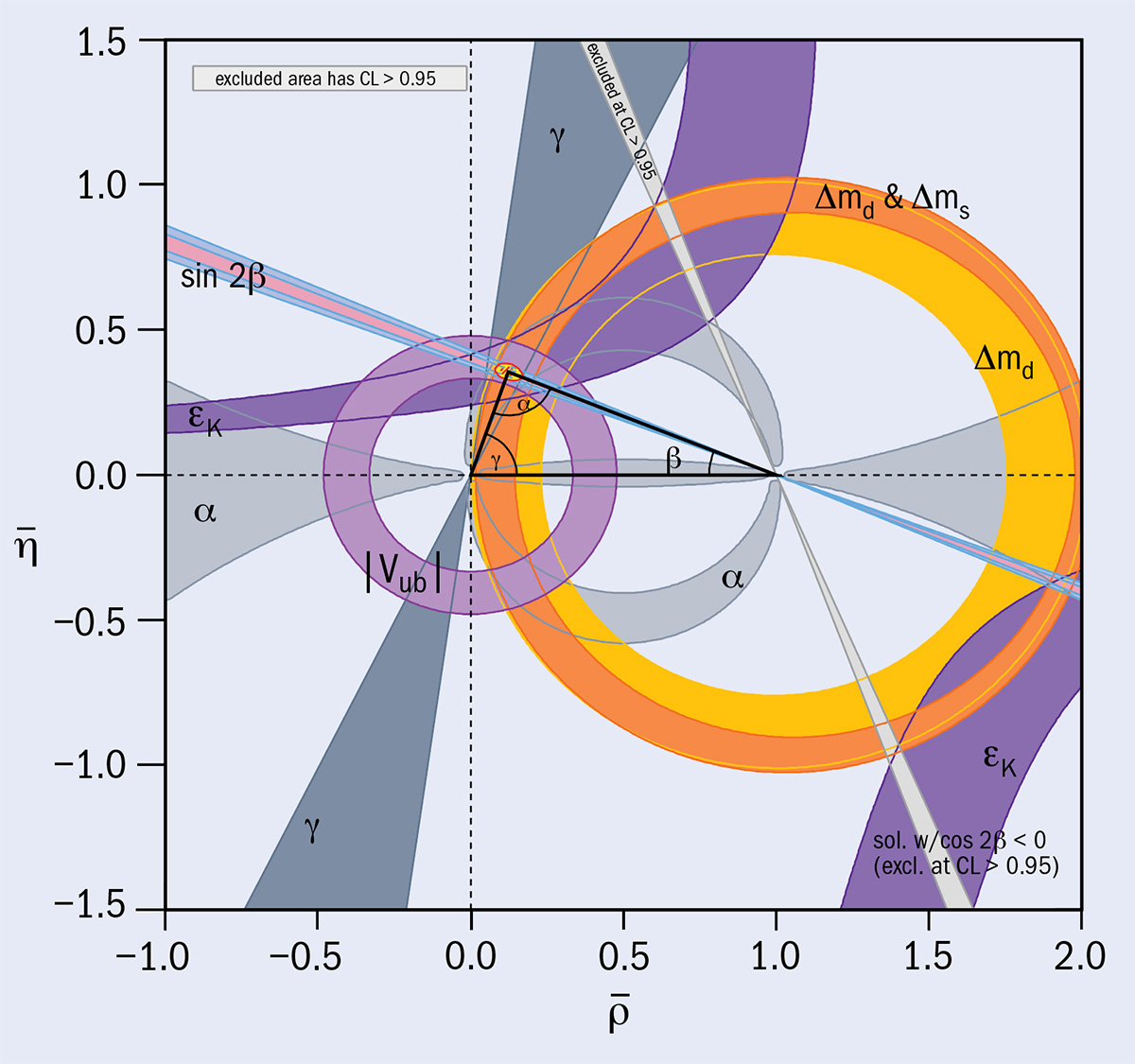
In 1964, Cronin, Fitch and colleagues discovered that CP is indeed violated, in the decays of neutral kaons to pions – a phenomenon that later became understood in terms of the behaviour of quarks. By now, we have observed quark CP violation in the strange sector, the beauty sector and most recently in the charm sector (CERN Courier May/June 2019 p7). The observations of CP violation in B (beauty) meson decays have been particularly illuminating. Everything we know about quark CP violation is consistent with the hypothesis that this violation arises from a single complex phase in the quark mixing matrix. This matrix gives the amplitude for any particular negatively-charged quark, whether down, strange or bottom, to convert via a weak interaction into any particular positively-charged quark, be it up, charm or top. Just two parameters in the quark mixing matrix, ρ and η, whose relative size determines the complex phase, account very successfully for numerous quark phenomena, including both CP-violating ones and others. This is impressively demonstrated by a plot of all the experimental constraints on these two parameters (figure 1). All the constraints intersect at a common point.
Of course, precisely which (ρ, η) point is consistent with all the data is not important. Lincoln Wolfenstein, who created the quark-mixing-matrix parametrisation that includes ρ and η, was known to say: “Look, I invented ρ and η, and I don’t care what their values are, so why should you?”
Having observed CP violation among quarks in numerous laboratory experiments of today, we might be tempted to think that we understand how CP violation in the early universe could have changed the world from one with equal quantities of matter and antimatter to one in which matter dominates very heavily over antimatter. However, scenarios that tie early-universe CP violation to that seen among the quarks today, and do not add new physics to the Standard Model of the elementary particles, yield too small a present-day matter–antimatter asymmetry. This leads one to wonder whether early-universe CP violation involving leptons, rather than quarks, might have led to the present dominance of matter over antimatter. This possibility is envisaged by leptogenesis, a scenario in which heavy neutral leptons that were their own antiparticles lived briefly in the early universe, but then underwent CP-asymmetric decays, creating a world with unequal numbers of particles and antiparticles. Such heavy neutral leptons are predicted by “see-saw” models, which explain the extreme lightness of the known neutrinos in terms of the extreme heaviness of the postulated heavy neutral leptons. Leptogenesis can successfully account for the observed size of the present matter–antimatter asymmetry.
Deniable plausibility
In the straightforward version of this picture, the heavy neutral leptons are too massive to be observable at the LHC or any foreseen collider. However, since leptogenesis requires leptonic CP violation, observing this violation in the behaviour of the currently observed leptons would make it more plausible that leptogenesis was indeed the mechanism through which the present matter–antimatter asymmetry of the universe arose. Needless to say, observing leptonic CP violation would also reveal that the breaking of CP symmetry, which before 1964 one might have imagined to be an unbroken, fundamental symmetry of nature, is not something special to the quarks, but is participated in by all the constituents of matter.
To find out if leptons violate CP, we are searching for what is traditionally described as a difference between the behaviour of neutrinos and that of antineutrinos. This description is fine if neutrinos are Dirac particles – that is, particles that are distinct from their antiparticles. However, many theorists strongly suspect that neutrinos are actually Majorana particles – that is, particles that are identical to their antiparticles. In that case, the traditional description of the search for leptonic CP violation is clearly inapplicable, since then the neutrinos and the antineutrinos are the same objects. However, the actual experimental approach that is being pursued is a perfectly valid probe of leptonic CP violation regardless of whether neutrinos are of Dirac or of Majorana character. In fact, this approach is completely insensitive to which of these two possibilities nature has chosen.
Through a glass darkly
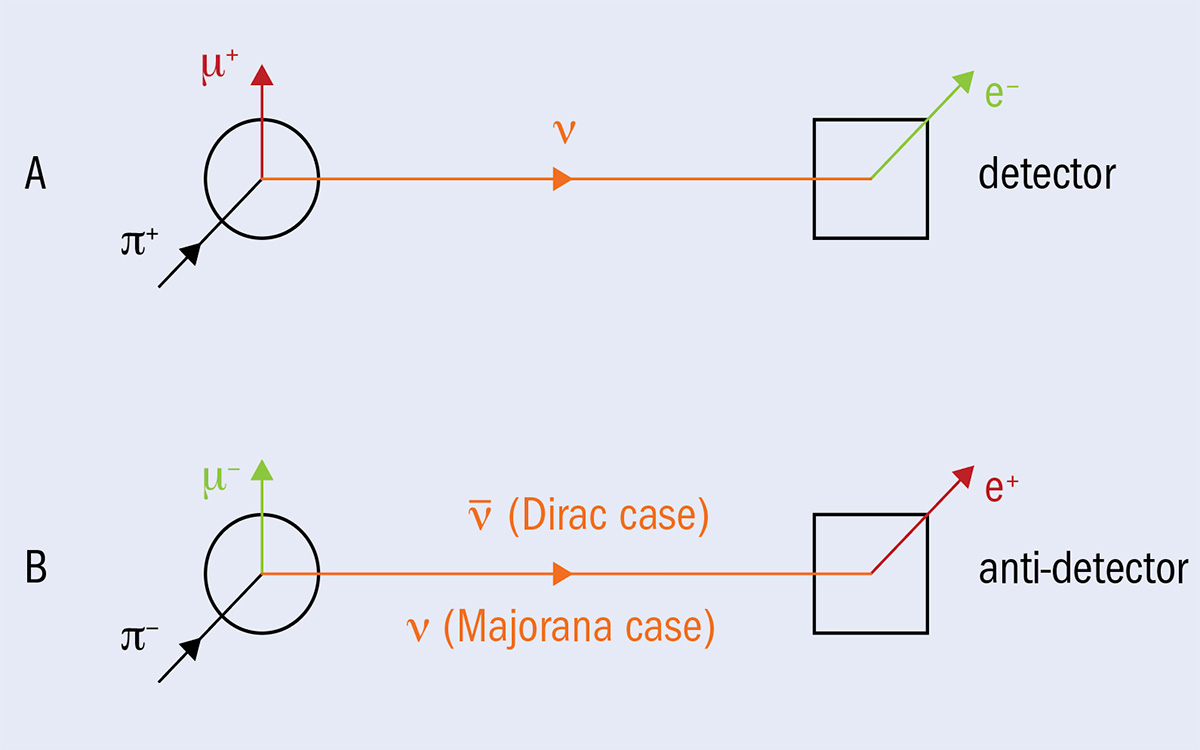
The pursuit of leptonic CP violation is based on comparing the rates for two CP mirror-image processes (figure 2). In process A, the initial state is a π+ and an undisturbed detector. The final state consists of a μ+, an e–, and a nucleus in the detector that has been struck by an intermediate-state neutrino beam particle that travelled a long distance from its source to the detector. Since the neutrino was born together with a muon, but produced an electron in the detector, and the probability for this to have happened oscillates as a function of the distance the neutrino travels divided by its energy, the process is commonly referred to as muon–neutrino to electron–neutrino oscillation.
Leptogenesis can account for the matter–antimatter asymmetry
In process B, the initial and final states are the same as in process A, but with every particle replaced by its antiparticle. In addition, owing to the character of the weak interactions, the helicity (the projection of the spin along the momentum) of every fermion is reversed, so that left and right are interchanged. Thus, regardless of whether neutrinos are identical to their antiparticles, processes A and B are CP mirror images, so if their rates are unequal, CP invariance is violated. Moreover, since the probability of a neutrino oscillation involves the weak interactions of leptons, but not those of quarks, this violation of CP invariance must come from the weak interactions of leptons.
Of course, we cannot employ an anti-detector in process B in practice. However, the experiment can legitimately use the same detector in both processes. To do that, it must take into account the difference between the cross sections for the beam particles in processes A and B to interact in this detector. Once that is done, the comparison of the rates for processes A and B remains a valid probe of CP non-invariance.
The matrix reloaded
Just as quark CP violation arises from a complex phase in the quark mixing matrix, so leptonic CP violation in neutrino oscillation can arise from a complex phase, δCP, in the leptonic mixing matrix, which is the leptonic analogue of the quark mixing matrix. However, if, as suggested by several short-baseline oscillation experiments, there exist not only the three well-established neutrinos, but also additional so-called “sterile” neutrinos that do not participate in Standard Model weak interactions, then the leptonic mixing matrix is larger than the quark one. As a result, while the quark mixing matrix is permitted to contain just one complex phase, its leptonic analogue may contain multiple complex phases that can contribute to CP violation in neutrino oscillations.
Leptonic CP violation is being sought by two current neutrino-oscillation experiments. The NOvA experiment in the US has reported results that are consistent with either the presence or absence of CP violation. The T2K experiment in Japan reports that the complete absence of CP violation is excluded at 95% confidence. Assuming that the leptonic mixing matrix is the same size as the quark one, so that it may contain only one complex phase relevant to neutrino oscillations, the T2K data show a preference for values of that phase, δCP, that correspond to near maximal CP violation. Of course, as Lincoln Wolfenstein would doubtless point out, the precise value of δCP is not important. What counts is the extremely interesting experimental finding that the behaviour of leptons may very well violate CP. In the future, the oscillation experiments Hyper-Kamiokande in Japan and DUNE in the US will probe leptonic CP violation with greater sensitivity, and should be capable of observing it even if it should prove to be fairly small (see Tuning in to neutrinos).
By searching for leptonic CP violation, we hope to find out whether the breaking of CP symmetry occurs among all the constituents of matter, including both the leptons and the quarks, or whether it is a feature that is special to the quarks. If leptonic CP violation should be definitively shown to exist, this violation might be related to the reason that the universe contains matter, but almost no antimatter, so that life is possible.
The electroweak (EW) sector of the Standard Model (SM) predicts self-interactions between W and Z gauge bosons through triple and quartic gauge couplings. Following first measurements at LEP and at the Tevatron during the 1990s, these interactions are now a core part of the LHC physics programme, as they offer key insights into EW symmetry breaking, which, in the case of the SM, causes the W and Z bosons to acquire mass as a result of the Brout–Englert–Higgs mechanism. The quartic coupling can be probed at colliders via rare processes such as tri-boson production, which the CMS collaboration observed for the first time earlier this year, and vector-boson scattering (VBS).
The scattering of longitudinally polarised W and Z bosons is a particularly interesting probe of the SM, as its tree-level amplitudes would violate unitarity at high energies without delicate cancellations from quartic gauge couplings and Higgs-boson contributions. Thus, the study of VBS processes provides key insight into the quartic gauge couplings as well as the Higgs sector. These processes offer sensitivity to enhancements caused by models of physics beyond the SM, which modify the Higgs sector with additional Higgs bosons contributing to VBS.
Vector-boson scattering is characterised by the presence of two forward jets, with a large di-jet invariant mass and a large rapidity separation. CMS previously reported the first observation of same-sign W±W± production using the data collected in 2016. The same-sign W±W± process is chosen because of the smaller background yield from other SM processes compared to the opposite-sign W±W∓ process. The collaboration has now updated this analysis and performed new studies of the EW production of two jets produced in association with WZ, and ZZ boson pairs using data collected between 2016 and 2018 at a centre-of-mass energy of 13 TeV, corresponding to 137 fb–1. Vector-boson pairs were selected by their decays to electrons and muons. The W±W± and WZ production modes were studied by simultaneously measuring their production cross sections using several kinematical observables. The measured total cross section for W±W± production of 3.98 ± 0.45 (± 0.37 stat. only) fb is the most accurate to date, with a precision of roughly 10%. No deviation from SM predictions is evident.
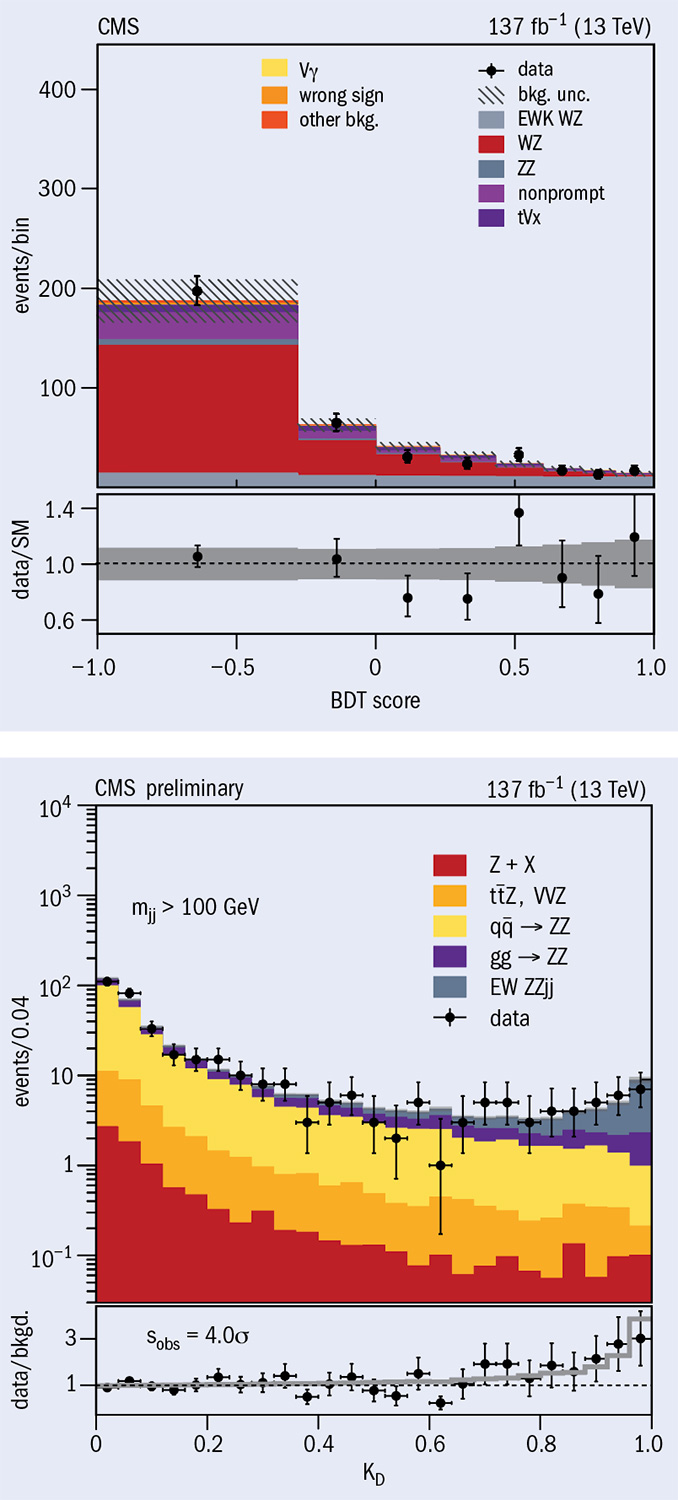
Though the contribution from background processes induced by the strong interaction is considerably larger in the WZ and ZZ final states, the scattering centre-of-mass energy and the polarisation of the final-state bosons can be measured as these final states can be more fully reconstructed than in W±W± production. To optimally isolate signal from background, the kinematical information of the WZ and ZZ candidate events is exploited with a boosted decision tree and matrix element likelihood techniques, respectively (see figure). The observed statistical significances for the WZ and ZZ processes are 6.8 and 4.0 standard deviations, respectively, in line with the expected SM significances of 5.3 and 3.5 standard deviations. The possible presence of anomalous quartic gauge couplings could result in an excess of events with respect to the SM predictions. Strong new constraints on the structure of quartic gauge couplings have been set within the framework of dimension-eight effective-field-theory operators.
The observation of the EW production of W±W±, WZ and ZZ boson pairs is an essential milestone towards precision tests of VBS at the LHC, and there is much more to be learned from the future LHC Run-3 data. The High-Luminosity LHC should allow for very precise investigations of VBS, including finding evidence for the scattering of longitudinally polarised W bosons.
High-energy hadronic collisions, such as those delivered by the LHC, result in the production of a large number of particles. Particle pairs produced close together in both coordinate and momentum space are subject to final-state effects, such as quantum statistics, Coulomb forces and, in the case of hadrons, strong interactions. Femtoscopy uses the correlation of such pairs in momentum space to gain insights into the interaction potential and the spatial extent of an effective particle-emitting source.
Abundantly produced pion pairs are used to assess the size and evolution of the high-density and strongly interacting quark–gluon plasmas, which are formed in heavy-ion collisions. Recently, high-multiplicity pp collisions at the LHC have raised the possibility of observing collective effects similar to those seen in heavy-ion collisions, motivating detailed investigations of the particle source in such systems as well. A universal description of the emission source for all baryon species, independent of the specific quark composition, would open new possibilities to study the baryon–baryon interaction, and would impose strong constraints on particle-production models.
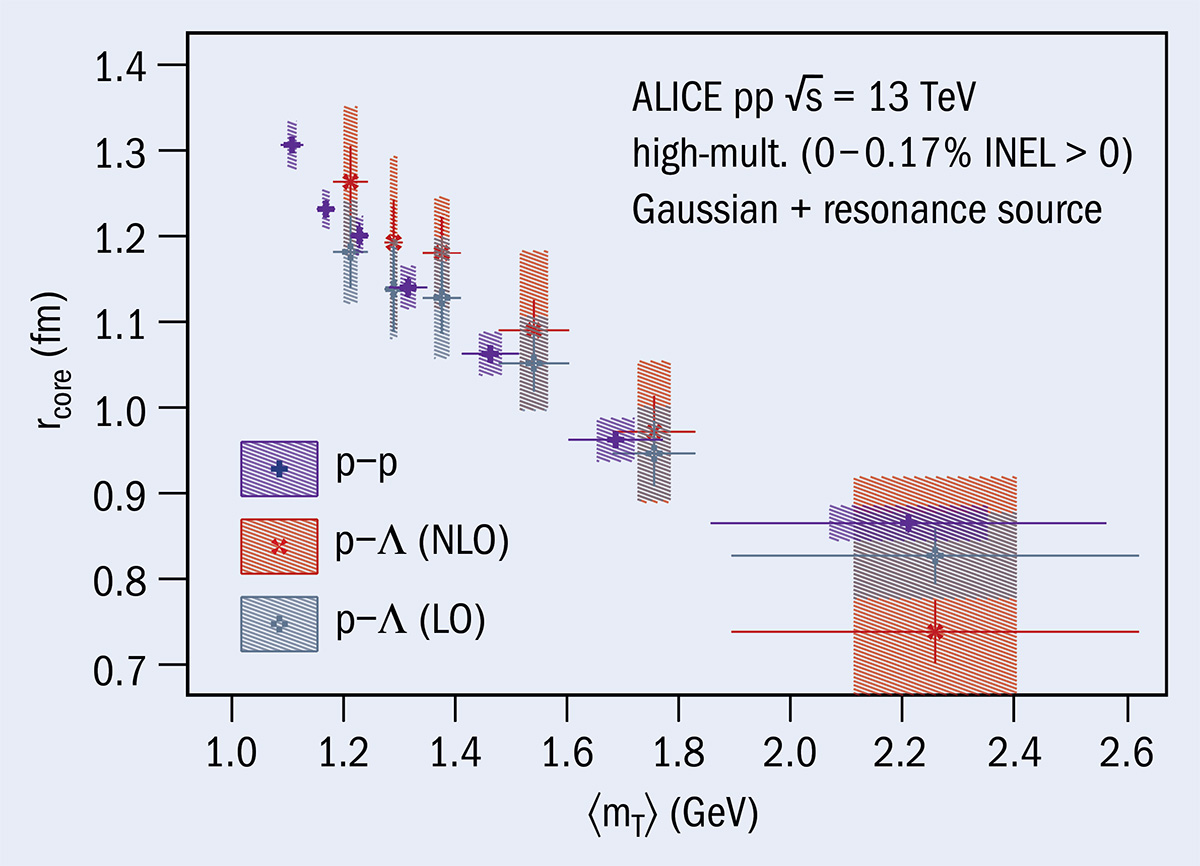
The ALICE collaboration has recently used p–p and p–Λ pairs to perform the first study of the particle-emitting source for baryons produced in pp collisions. The chosen data sample isolates the 1.7 permille highest-multiplicity collisions in the 13 TeV data set, yielding events with 30 to 40 charged particles reconstructed, on average, per unit of rapidity. The yields of protons and Λ baryons are dominated by contributions from short-lived resonances, accounting for about two thirds of all produced particles. A basic thermal model (the statistical hadronisation model) was used to estimate the number and composition of these resonances, indicating that the average lifetime of those feeding to protons (1.7 fm) is significantly shorter than those feeding to Λ baryons (4.7 fm) – this would have led to a substantial broadening of the source shape if not properly accounted for. An explicit treatment of the effect of short-lived resonances was developed by assuming that all primordial particles and resonances are emitted from a common core source with a Gaussian shape. The core source was then folded with the exponential tails introduced by the resonance decays. The resulting root-mean-square width of the Gaussian core scales from 1.3 fm to 0.85 fm as a function of an increase in the pair’s transverse mass (mT) from 1.1 to 2.2 GeV, for both p–p and p–Λ pairs (see figure). The transverse mass of a particle is its total energy in a coordinate system in which its velocity is zero along the beam axis. The two systems exhibit a common scaling of the source size, indicating a common emission source for all baryons. The observed scaling of the source size with mT is very similar to that observed in heavy-ion collisions, wherein the effect is attributed to the collective evolution of the system.
This result is a milestone in the field of correlation studies, as it directly relates to important topics in physics. The common source size observed for p–p and p–Λ pairs implies that the spatial- temporal properties of the hadronisation process are independent of the particle species. This observation can be exploited by coalescence models studying the production of light nuclei, such as deuterons or 3He, in hadronic collisions. Moreover, the femtoscopy formalism relates the emission source to the interaction potential between pairs of particles, enabling the study of the strong nuclear force between hadrons, such as p–K–, p–Ξ–, p–Ω– and Λ–Λ, with unprecedented precision.
Urban particle pollution ranks fifth in the risk factors for mortality worldwide, and is a growing problem in many built-up areas. In a result that could help shape policies for reducing such pollution, the CLOUD collaboration at CERN has uncovered a new mechanism that drives winter smog episodes in cities.
Winter urban smog episodes occur when new particles form in polluted air trapped below a temperature inversion: warm air above the inversion inhibits convection, causing pollution to build up near the ground. However, how additional aerosol particles form and grow in this highly polluted air has puzzled researchers because they should be rapidly lost through scavenging by pre-existing aerosol particles. CLOUD, which uses an ultraclean cloud chamber situated in a beamline at CERN’s Proton Synchrotron to study the formation of aerosol particles and their effect on clouds and climate, has found that ammonia and nitric acid can provide the answer.
Deriving in cities mainly from vehicle emissions, ammonia and nitric acid were previously thought to play a passive role in particle formation, simply exchanging with ammonium nitrate in the particles. However, the new CLOUD study finds that small inhomogeneities in the concentrations of ammonia and nitric acid can drive the growth rates of newly formed particles up to more than 100 times faster than seen before, but only in short spurts that have previously escaped detection. These ultrafast growth rates are sufficient to rapidly transform the newly formed particles to larger sizes, where they are less prone to being lost through scavenging, leading to a dense smog
episode with a high number of particles.
“Although the emission of nitrogen oxides is regulated, ammonia emissions are not and may even be increasing with the latest catalytic converters used in gasoline and diesel vehicles,” explains CLOUD spokesperson Jasper Kirkby. “Our study shows that regulating ammonia emissions from vehicles could contribute to reducing urban smog.”
It’s basically a cloud chamber, but not a conventional one as used in particle physics. We realistically simulate selected atmospheric environments in an ultraclean chamber and study the formation of aerosol particles from trace vapours, and how they grow to become the seeds for cloud droplets. We can precisely control all the conditions found throughout the atmosphere such as gas concentrations, temperature, ultraviolet illumination and “cosmic ray” intensity with a beam from CERN’s Proton Synchrotron (PS). The aerosol processes we study in CLOUD are poorly known yet climatically important because they create the seeds for more than 50% of global cloud droplets.
We have 22 institutes and the crème de la crème of European and US atmospheric and aerosol scientists. It’s a fabulous mixture of physicists and chemists, and the skills we’ve learned from particle physics in terms of cooperating and pooling resources have been incredibly important for the success of CLOUD. It’s the CERN model, the CERN culture that we’ve conveyed to another discipline. We implemented the best of CERN’s know-how in ultra-clean materials and built the cleanest atmospheric chamber in the world.
How did CLOUD get off the ground?
The idea came to me in 1997 during a lecture at CERN given by Nigel Calder, a former editor of New Scientist magazine, who pointed out a new result from satellite data about possible links between cosmic rays and cloud formation. That Christmas, while we visited relatives in Paris, I read a lot of related papers and came up with the idea to test the cosmic ray–cloud link at CERN with an experiment I named CLOUD. I did not want to ride into another field telling those guys how to do their stuff, so I wrote a note of my ideas and started to make contact with the atmospheric community in Europe and build support from lab directors in particle physics. I managed to assemble a dream team to propose the experiment to CERN. The hard part was convincing CERN that they should do this crazy experiment. We proposed it in 2000 and it was finally approved in 2006, which I think is a record for CERN to approve an experiment. There were some people in the climate community who were against the idea that cosmic rays could influence clouds. But we persevered and, once approved, things went very fast. We started taking data in 2009 and have been in discovery mode ever since.
Do you consider yourself a particle physicist or an atmospheric scientist?
An experimental physicist! My training and my love is particle physics, but judging by the papers I write and review, I am now an atmospheric scientist. It was not difficult to make this transition. It was a case of going back to my undergraduate physics and high-school chemistry and learning on the job. It’s also very rewarding. We do experiments, like we all do at CERN, on a 24/7 basis, but with CLOUD I can calculate things in my notebook and see the science that we are doing, so we know immediately what the new stuff is and we can adapt our experiments continuously during our run.
On the other hand, in particle physics the detectors are running all the time but we really don’t know what is in the data without years of very careful analysis afterwards, so there is this decoupling of the result from the actual measurement. Also, in CLOUD we don’t need a separate discipline to tell us about the underlying theory or beauty of what we are doing. In CLOUD you’re the theorist and the experimentalist at the same time – like it was in the early days of particle physics.
How would you compare the Standard Model to state-of-the-art climate models?
It’s night and day. The Standard Model (SM) is such a well formed theory and remarkably high-quality quantitatively that we can see incredibly subtle signals in detectors against a background of something that is extremely well understood. Climate models, on the other hand, are trying to simulate a very complex system about what’s happening on Earth’s surface, involving energy exchanges between the atmosphere, the oceans, the biosphere, the cryosphere … and the influence of human beings. The models involve many parameters that are poorly understood, so modellers have to make plausible yet uncertain choices. As a result, there is much more flexibility in climate models, whereas there is almost none in the SM. Unfortunately, this flexibility means that the predictive power of such models is much weaker than it is in particle physics.
There are skills such as the handling of data, statistics and software optimisation where particle physics is probably the leading science in the world, so I would love to see CERN sponsor a workshop where the two communities could exchange ideas and perhaps even begin to collaborate. This is what CLOUD has done. It’s politically correct to talk about the power of interdisciplinary research, but it’s very difficult in practical terms – especially when it comes to funding because experiments often fall into the cracks between funding agencies.
How has CLOUD’s focus evolved during a decade of running?
CLOUD was designed to explore whether variations of cosmic rays in the atmosphere affect clouds and climate, and that’s still a major goal. What I didn’t realise at the beginning is how important aerosol–particle formation is for climate and health, and just how much is not yet understood. The largest uncertainty facing predictions of global warming is not due to a lack of understanding about greenhouse gases, but about how much aerosols and clouds have increased since pre-industrial times from human activities. Aerosol changes have offset some of the warming from greenhouse gases but we don’t know by how much – it could have offset almost nothing, or as much as one half of the warming effect. Consequently, when we project forwards, we don’t know how much Earth will warm later this century to better than a factor of three.
Many of our experiments are now aimed at reducing the aerosol uncertainties in anthropogenic climate change. Since all CLOUD experiments are performed under different ionisation conditions, we are also able to quantify the effect of cosmic rays on the process under study. A third major focus concerns the formation of smog under polluted urban conditions.
What have CLOUD’s biggest contributions been?
We have made several major discoveries and it’s hard to rank them. Our latest result (CLOUD clarifies cause of urban smog) on the role of ammonia and nitric acid in urban environments is very important for human health. We have found that ammonia and nitric acid can drive the growth rates of newly formed particles up to more than 100 times faster than seen before, but only in short spurts that have previously escaped detection. This can explain the puzzling observation of bursts of new particles that form and grow under highly polluted urban conditions, producing winter smog episodes. An earlier CLOUD result, also in Nature, showed that a few parts-per-trillion of amine vapours lead to extremely rapid formation of sulphuric acid particles, limited only by the kinetic collision rate. We had a huge fight with one of the referees of this paper, who claimed that it couldn’t be atmospherically important because no-one had previously observed it. Finally, a paper appeared in Science last year showing that sulphuric acid–amine nucleation is the key process driving new particle formation in Chinese megacities.
In CLOUD you’re the theorist and the experimentalist at the same time – like it was in the early days of particle physics
A big result from the point of view of climate change came in 2016 when we showed that trees alone are capable of producing abundant particles and thus cloud seeds. Prior to that it was thought that sulphuric acid was essential to form aerosol particles. Since sulphuric acid was five times lower in the pre-industrial atmosphere, climate models assumed that clouds were fewer and thinner back then. This is important because the pre-industrial era is the baseline aerosol state from which we assess anthropogenic impacts. The fact that biogenic vapours make lots of aerosols and cloud droplets reduces the contrast in cloud coverage (and thus the amount of cooling offset) between then and now. The formation rate of these pure biogenic particles is enhanced by up to a factor 100 by galactic cosmic rays, so the pristine pre-industrial atmosphere was more sensitive to cosmic rays than today’s polluted atmosphere.
There was an important result the very first week we turned on CLOUD, when we saw that sulphuric acid does not nucleate on its own but requires ammonia. Before CLOUD started, people were measuring particles but they weren’t able to measure the molecular composition, so many experiments were being fooled by unknown contaminants.
Have CLOUD results impacted climate policy?
The global climate models that inform the Intergovernmental Panel on Climate Change (IPCC) have begun to incorporate CLOUD aerosol parameterisations, and they are impacting estimates of Earth’s climate sensitivity. The IPCC assessments are hugely impressive works of the highest scientific quality. Yet, there is something of a disconnect between what climate modellers do and what we do in the experimental and observational world. The modellers tend to work in national centres and connect with experiments through the latter’s publications, at the end of the chain. I would like to see much closer linkage between the models and the measurements, as we do in particle physics where there is a fluid connection between theory, experiment and modelling. We do this already in CLOUD, where we have several institutes who are primarily working on regional and global aerosol-cloud models.
What’s next on CLOUD’s horizon?
The East Hall at the PS is being completely rebuilt during CERN’s current long shutdown, but the CLOUD chamber itself is pretty much the only item that is untouched. When the East Area is rebuilt there will be a new beamline and a new experimental zone for CLOUD. We think we have a 10-year programme ahead to address the questions we want to and to settle the cosmic ray–cloud–climate question. That will take me up to just over 80 years old!
Will humanity succeed in preventing catastrophic climate change?
I am an optimist, so I believe there is always a way out of everything. It’s very understandable that people want to freeze the exact temperature of Earth as it is now because we don’t want to see a flood or desert in our back garden. But I’m afraid that’s not how Earth is, even without the anthropogenic influence. Earth has gone through much larger natural climate oscillations, even on the recent timescale of homo sapiens. That being said, I think Earth’s climate is fundamentally stable. Oceans cover two thirds of Earth’s surface and their latent heat of vaporisation is a huge stabiliser of climate – they have never evaporated nor completely frozen over. Also, only around 2% of CO2 is in the atmosphere and most of the rest is dissolved in the oceans, so eventually, over the course of several centuries, CO2 in the atmosphere will equilibrate at near pre-industrial levels. The current warming is an important change – and some argue it could produce a climate tipping point – but Earth has gone through larger changes in the past and life has continued. So we should not be too pessimistic about Earth’s future. And we shouldn’t conflate pollution and climate change. Reducing pollution is an absolute no brainer, but environmental pollution is a separate issue from climate change and should be treated as such.
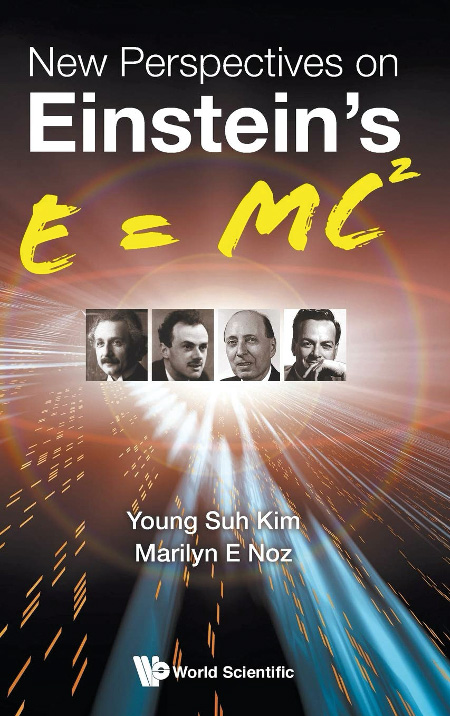
New Perspectives on Einstein’s E = mc2 mixes historical notes with theoretical aspects of the Lorentz group that impact relativity and quantum mechanics. The title is a little perplexing, however, as one can hardly expect nowadays to discover new perspectives on an equation such as E = mc2. The book’s true aim is to convey to a broader audience the formal work done by the authors on group theory. Therefore, a better-suited title may have been “Group theoretical perspectives on relativity”, or even, more poetically, “When Wigner met Einstein”.
The first third of the book is an essay on Einstein’s life, with historical notes on topics discussed in the subsequent chapters, which are more mathematical and draw heavily on publications by the authors – a well-established writing team who have co-authored many papers relating to group theory. The initial part is easy to read and includes entertaining stories, such as Einstein’s mistakes when filing his US tax declaration. Einstein, according to this story, was calculating his taxes erroneously, but the US taxpayer agency was kind enough not to raise the issue. The reader has to be warned, however, that the authors, professors at the University of Maryland and New York University, have a tendency to make questionable statements about certain aspects of the development of physics that may not be backed up by the relevant literature, and may even contradict known facts. They have a repeated tendency to interpret the development of physical theories in terms of a Hegelian synthesis of a thesis and an antithesis, without any cited sources in support, which seems, in most cases, to be a somewhat arbitrary a posteriori assessment.
There is a sharp distinction in the style of the second part of the book, which requires training in physics or maths at advanced undergraduate level. These chapters begin with a discussion of the Lorentz group. The interest then quickly shifts to Wigner’s “little groups”, which are subgroups of the Lorentz group with the property of leaving the momentum of a system invariant. Armed with this mathematical machinery, the authors proceed to Dirac spinors and give a Lorentz-invariant formulation of the harmonic oscillator that is eventually applied to the parton model. The last chapter is devoted to a short discussion on optical applications of the concepts advanced previously. Unfortunately, the book finishes abruptly at this point, without a much-needed final chapter to summarise the material and discuss future work, which, the previous chapters imply, should be plentiful.
Young Suh Kim and Marilyn Noz’s book may struggle to find its audience. The contrast between the lay and expert parts of this short book, and the very specialised topics it explores, do not make it suitable for a university course, though sections could be incorporated as additional material. It may well serve, however, as an interesting pastime for mathematically inclined audiences who will certainly appreciate the formalism and clarity of the presentation of the mathematics.
To provide the best experiences, we use technologies like cookies to store and/or access device information. Consenting to these technologies will allow us to process data such as browsing behavior or unique IDs on this site. Not consenting or withdrawing consent, may adversely affect certain features and functions.
Functional
Always active
The technical storage or access is strictly necessary for the legitimate purpose of enabling the use of a specific service explicitly requested by the subscriber or user, or for the sole purpose of carrying out the transmission of a communication over an electronic communications network.
Preferences
The technical storage or access is necessary for the legitimate purpose of storing preferences that are not requested by the subscriber or user.
Statistics
The technical storage or access that is used exclusively for statistical purposes.The technical storage or access that is used exclusively for anonymous statistical purposes. Without a subpoena, voluntary compliance on the part of your Internet Service Provider, or additional records from a third party, information stored or retrieved for this purpose alone cannot usually be used to identify you.
Marketing
The technical storage or access is required to create user profiles to send advertising, or to track the user on a website or across several websites for similar marketing purposes.