Comsol -leaderboard other pages

Topics

ALPHA sheds light on antihydrogen’s fine structure

The ALPHA collaboration at CERN has reported the first measurements of fine-structure effects and the Lamb shift in antihydrogen atoms. The results, published in Nature in February, bring further scrutiny to comparisons between antimatter and ordinary matter, which, if found to behave differently, would challenge CPT symmetry and shake the foundations of the Standard Model.

In 1947, US physicist Willis Lamb and his colleagues observed an incredibly small shift in the n = 2 energy levels of hydrogen in a vacuum. Under traditional physics theories of the day, namely the Dirac equation, these states should have the same energy and the Lamb shift shouldn’t exist. The discovery spurred the development of quantum electrodynamics (QED), which explains the discrepancy as being due to interactions between the atom’s constituents with vacuum-energy fluctuations, and won Lamb the Nobel Prize in Physics in 1955.

Antimatter spectroscopy

The ALPHA team creates antihydrogen atoms by binding antiprotons delivered by CERN’s Antiproton Decelerator (AD) with positrons. The antiatoms are then confined in a magnetic trap in an ultra-high vacuum, and illuminated with a laser to measure their spectral response. This technique enables the measurement of known quantum effects such as the fine structure and the Lamb shift, which have now been measured in the anti­hydrogen atom for the first time. The ALPHA team previously used this approach to measure other quantum effects in antihydrogen, the most recent being a measurement of the Lyman–alpha (1S–2P) transition in 2018.
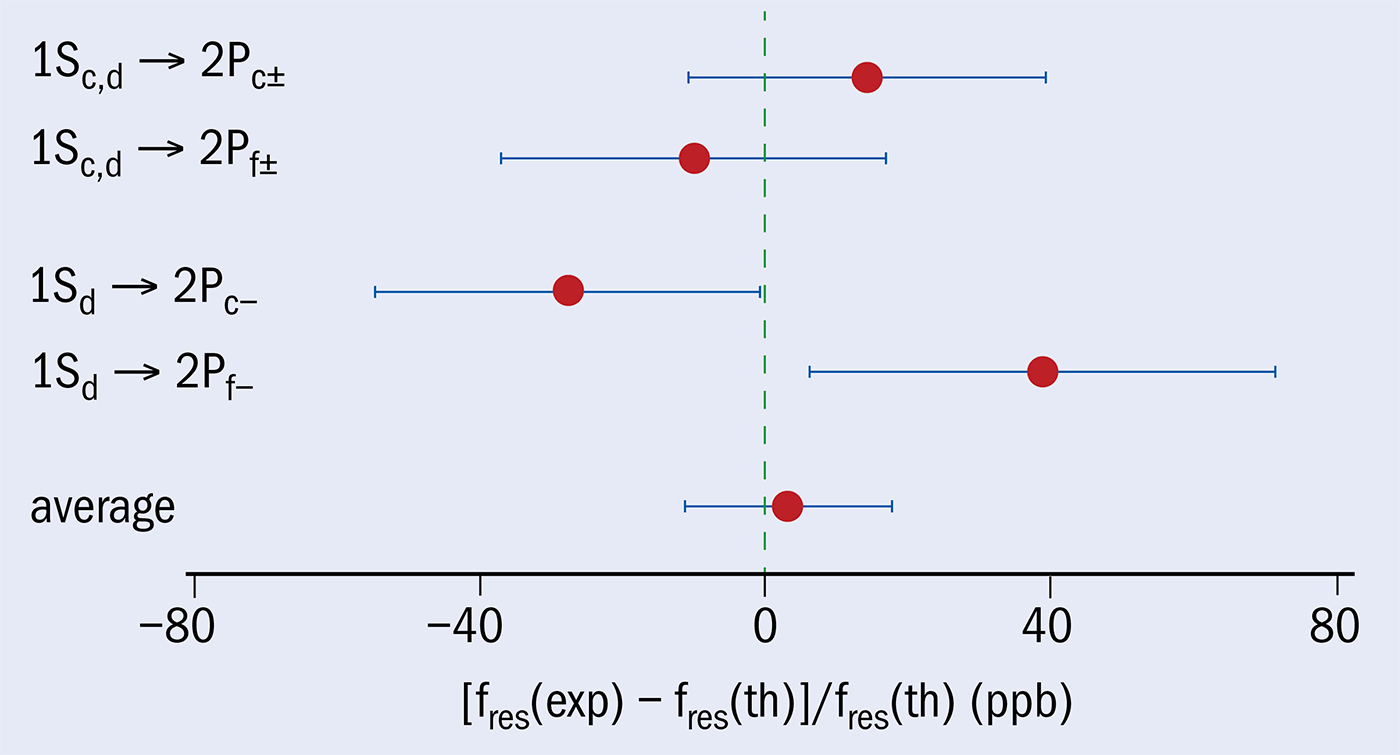
Measured frequencies

The splitting of the n = 2 energy level of hydrogen is a separation between the 2P3/2 and 2P1/2 levels in the absence of a magnetic field, and is caused by the interaction between the electron’s spin and the orbital momentum. The classic Lamb shift is the splitting between the 2S1/2 and 2P1/2 levels, also in the absence of a magnetic field, and is the result of the effect on the electron of quantum fluctuations associated with virtual photons.

The work confirms that a key portion of QED holds up in both matter and antimatter

Jeffrey Hangst

In its new study, the ALPHA team determined the fine-structure splitting and the Lamb shift by inducing transitions between the lowest (n = 1) energy level of antihydrogen and the 2P3/2 and 2P1/2 levels in the presence of a 1  T magnetic field. Using the value of the frequency of a previously measured transition (1S–2S), the team was able to infer the values of the fine-structure splitting and the Lamb shift. The results were found to be consistent with theoretical predictions of the splittings in normal hydrogen, within the experimental uncertainties of 2% for the fine-structure splitting and 11% for the Lamb shift. “The work confirms that a key portion of QED holds up in both matter and antimatter, and probes aspects of antimatter interaction – such as the Lamb shift – that we have long looked forward to addressing,” says ALPHA spokesperson Jeffrey Hangst.

The seminal measurements of antihydrogen’s spectral structure that are now possible follow more than 30 years of effort by the low-energy antimatter community at CERN. The first antihydrogen atoms were observed at CERN’s LEAR facility in 1995 and, in 2002, the ATHENA and ATRAP collaborations produced cold (trappable) antihydrogen at the AD, opening the way to precision measurements of antihydrogen’s atomic spectra. In addition to spectral measurements, the charge-to-mass ratios for the proton and antiproton have been shown to agree to 69 parts per trillion by the BASE experiment, and the antiproton-to-electron mass ratio has been measured to agree with its proton counterpart to a level of 0.8 parts per billion by the ASACUSA experiment. The newly completed ELENA facility at the AD will increase the number of available antiprotons by up to two orders of magnitude.

Next for the ALPHA team is chilling large samples of antihydrogen using state-of-the-art laser cooling techniques. “These techniques will transform antimatter studies and will allow unprecedentedly high-precision comparisons between matter and antimatter,” says Hangst.
ATLAS extends search for top squark

Figure 1

Supersymmetry is an attractive extension of the Standard Model, and aims to answer some of the most fundamental open questions in modern particle physics. For example: why is the Higgs boson so light? What is dark matter and how does it fit in with our understanding of the universe? Do electroweak and strong forces unify at smaller distances?

Supersymmetry predicts a new partner for each elementary particle, including the heaviest particle ever observed – the top quark. If the partner of the top quark (the top squark, or “stop”) were not too heavy, the quantum corrections to the Higgs boson mass would largely cancel, thereby stabilising its small value of 125 GeV. Moreover, the lightest supersymmetric particle (LSP) may be stable and weakly interacting, providing a dark-matter candidate. Signs of the top squark, and thus supersymmetry, may yet be lurking in the enormous number of proton–proton collisions provided by the LHC.

Two new searches

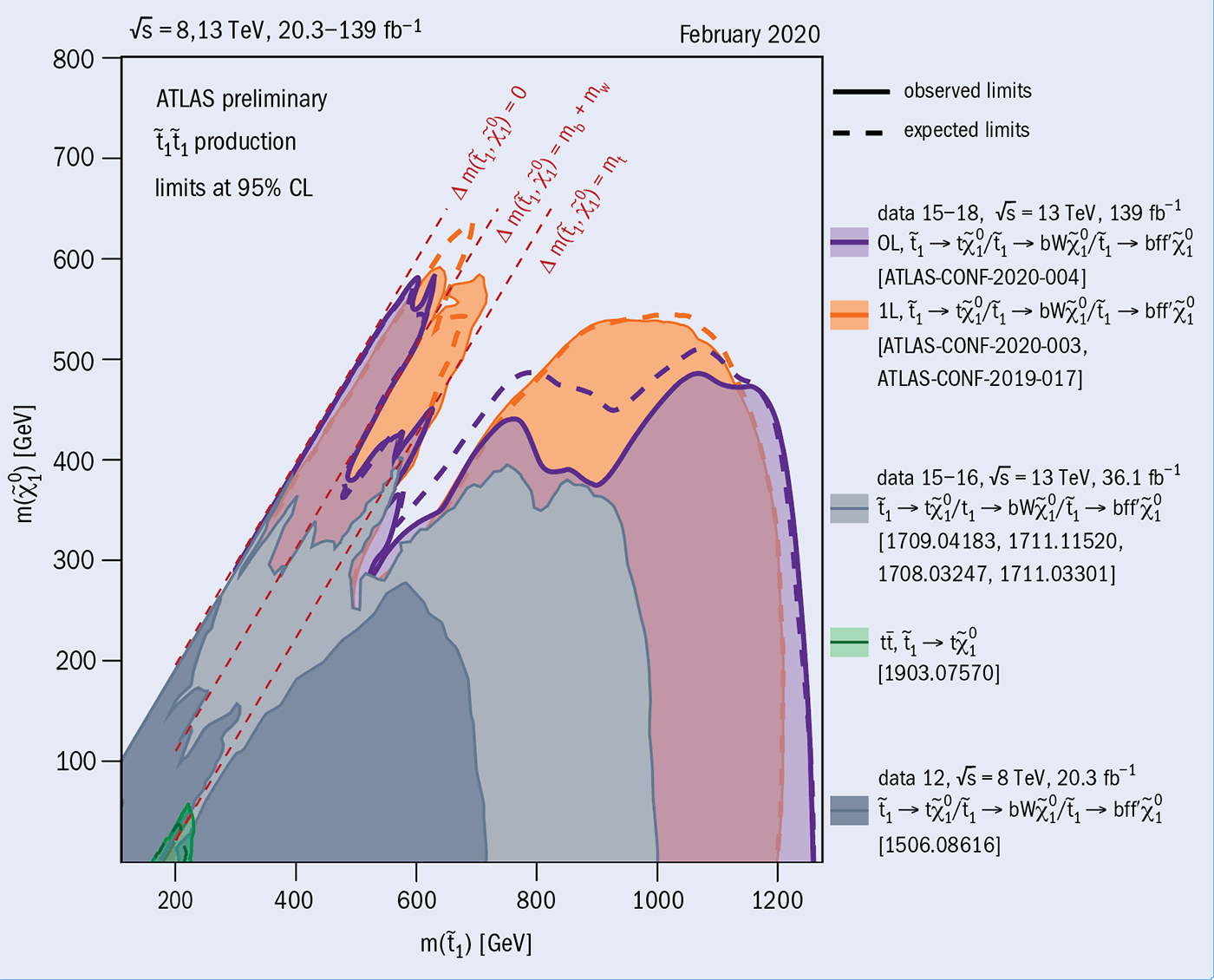
The ATLAS collaboration recently released two new searches, each looking to detect pairs of top squarks by exploring the full LHC dataset corresponding to an integrated luminosity of 139 fb–1 recorded during Run 2. Each top squark decays to a top quark and an LSP that escapes the detector without interacting. Thus, our experimental signature is an event that is energetically unbalanced, with two sets of top-quark remnants and a large amount of missing energy.

A challenge for such searches is that the masses of the supersymmetric particles are unknown, leaving a large range of possibilities to explore. Depending on the mass difference between the top squark and the LSP, the final decay products can be (very) soft or (very) energetic, calling for different reconstruction techniques and sparking the development of new approaches. For example, novel “soft b-tagging” techniques, based on either pure secondary-vertex information or jets built from tracks, were implemented for the first time in these analyses to extend the sensitivity to lower kinematic regimes. This allowed the searches to probe small top squark–LSP mass differences down to 5 GeV for the first time.

Leptoquark decays would exhibit a similar experimental signature to top-squark decays

Other sophisticated analysis strategies, including the use of machine-learning techniques, improved the discrimination between the signal and Standard-Model background and maximised the sensitivity of the analysis. Furthermore, these two searches are designed in such a way as to fully complement one another. Together they greatly extend the reach in the top squark mass versus LSP mass plane, including the challenging region where the top squark masses are very close to the top mass (figure 1). No evidence of new physics was found in any of these searches.

Beyond supersymmetry, these search results are intriguing for other new-physics scenarios. For example, the decay of a hypothetical top quark–neutrino hybrid, called a leptoquark, would exhibit a similar experimental signature to a top-squark decay. The results also constrain models predicting dark matter produced with a pair of top quarks that do not originate from supersymmetry.

Boosting top-quark measurements

Figure 1

Weighing in at 180 times the mass of the proton, the top quark is the heaviest elementary particle discovered so far. Because of its large mass, it is the only quark that does not form bound states with other quarks but decays immediately after it has been produced. Despite its short lifetime, its existence has far-reaching consequences. It governs the stability of the electroweak vacuum, gives large contributions to the mass of the W boson, and influences many other important observables through quantum-loop corrections. An accurate knowledge of its mass is important for our understanding of fundamental interactions.

The top quark governs the stability of the electroweak vacuum

The LHC’s high centre-of-mass energy makes it an ideal laboratory to study the properties of the top quark with unprecedented precision. Such studies demand that jets originating from light and bottom quarks are measured very accurately, however, subtleties remain even then, as exact calculations are not possible for low-energy quarks and gluons once they start to form bound states. In this regime, our approximations become inaccurate, because the mass of the bound states becomes as large as the energy of the underlying process. An exciting way to overcome these difficulties is to measure top quarks that have been produced with very high transverse momenta and thus large Lorentz boosts. In these topologies, the decay products are highly collimated, and can be clearly assigned to a decaying top quark. Effects from the formation of hadrons play a minor effect in boosted topologies as the top quarks, which were originally produced in quark–antiquark pairs, move apart from each other fast enough that their decays can be considered to happen independently.

Boosted precision

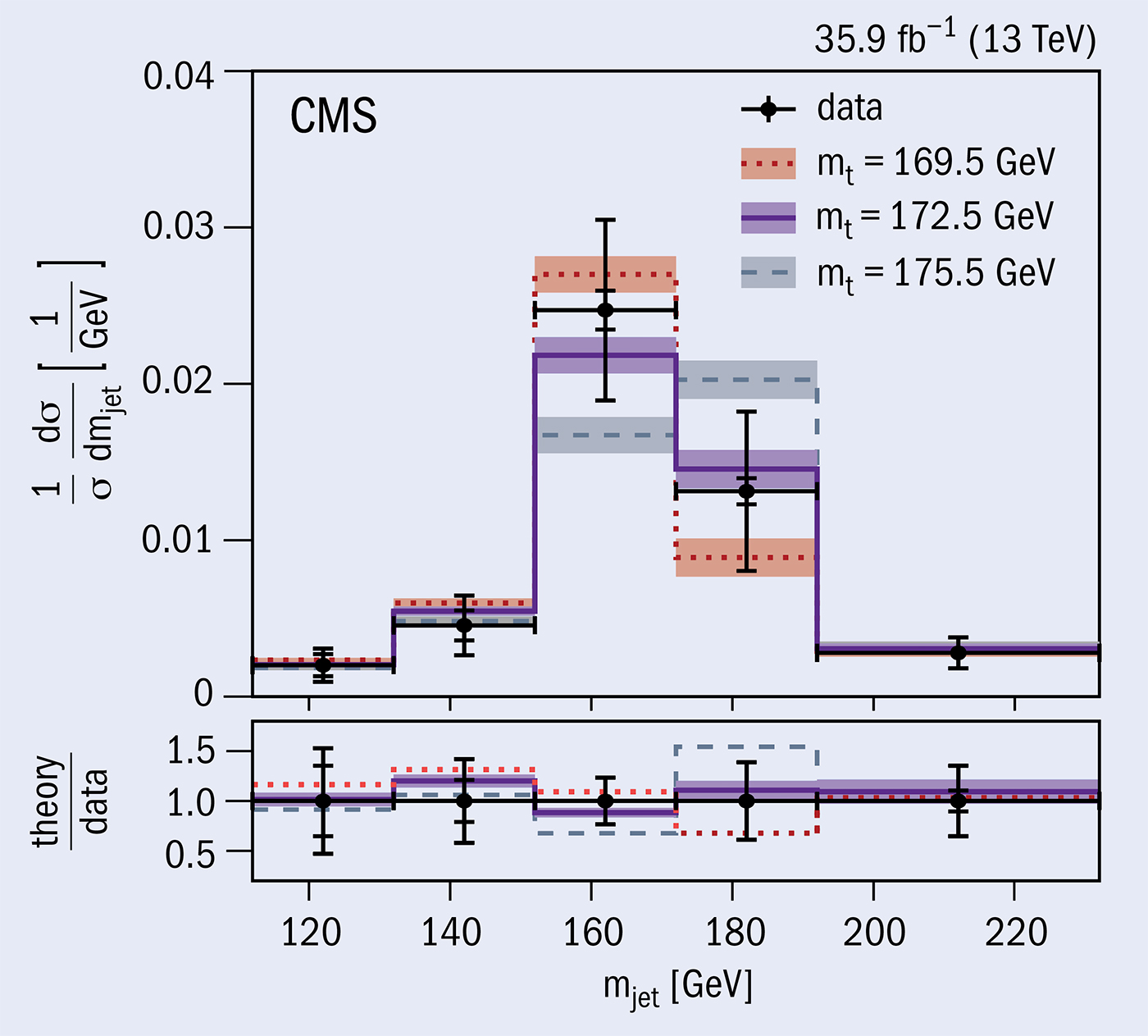
By reconstructing a boosted top quark in a single jet, a measurement of the jet mass can be translated into one of the top-quark mass. The CMS collaboration has carried out such a measurement using the √s = 13 TeV data collected in 2016, reconstructing the top-quark jets with the novel XCone algorithm to obtain a top quark mass of 172.6 ± 2.5 GeV (figure 1). Due to this new way of reconstructing jets, an improvement of more than a factor of three relative to an earlier measurement at √s = 8 TeV has been achieved. Although the uncertainty is larger than for direct measurements, where top quarks are reconstructed from multiple jets or leptons and missing transverse momentum (which currently yield a world average of 172.9 ± 0.4 GeV from a combination of CMS, ATLAS and Tevatron measurements), this new result shows for the first time the potential of using boosted top quarks for precision measurements.

The jet mass can be translated into the top-quark mass

Measuring the properties of the top quark at high momenta enables detailed studies of a theoretically compelling kinematic regime that has not been accessible before. Different effects, such as the collinear radiation of gluons and quarks, govern its dynamics compared to top-quark production at low energies. Exploiting the full Run-2 dataset should allow CMS to extend this measurement to higher boosts, and establish the boosted regime for a number of precision measurements in the top-quark sector in Run 3 and at the high-luminosity LHC.

A first taste of neutrino physics

A string of optical detectors for the KM3NeT neutrino telescope

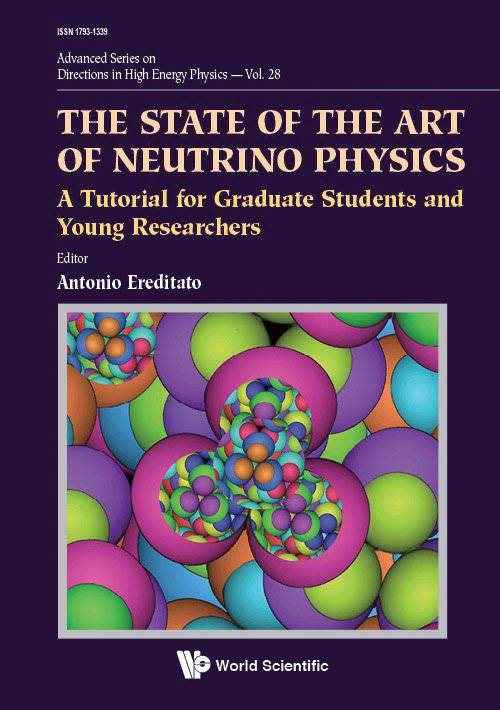
Almost 90 years since Pauli postulated its existence, much remains to be learnt about the neutrino. The observation in 1998 of neutrino oscillations revealed that the particle’s flavour and mass eigenstates mix and oscillate. At least two must be massive, like the other known fermions, though with far smaller masses. The need for a mechanism to generate such small masses strongly hints at the existence of new physics beyond the Standard Model. Faced with such compelling questions, neutrino experiments are springing up at an unprecedented rate, from a plethora of searches for neutrinoless double-beta decay to gigantic astrophysical–neutrino detectors at the South Pole (IceCube) and soon in the Mediterranean Sea (KM3NeT), and two projects of enormous scope on the horizon in DUNE and Hyper-Kamiokande. Now, then, is a timely moment for the publication of a tutorial for graduate students and young researchers who are entering this fast-moving field.

Access all areas

Edited by former spokesperson of the OPERA experiment Antonio Ereditato, The State of the Art of Neutrino Physics provides an historical account and introduction to basic concepts, reviews of the various subfields where neutrinos play a significant role, and gives a detailed account of the data produced by present experiments in operation. An extremely valuable compilation of topical articles, the book covers essentially all areas of research in experimental neutrino physics, from astrophysical, solar and atmospheric neutrinos to accelerator and reactor neutrinos. The large majority of the articles are written in a didactic style by leading experts in the field, allowing young researchers to acquaint themselves with the diverse research in the field. In particular the chapter describing the formalism of neutrino oscillations should be required reading for all aspiring neutrino physicists. In all cases special attention is given to experimental challenges.

The State of the Art of Neutrino Physics: A Tutorial for Graduate Students and Young Researchers

From the theory side, chapters cover measurements at neutrino experiments of the low-energy interactions of neutrinos with nuclei (a key way to reduce systematic uncertainties), the phenomenology and consequences of the yet-to-be-determined neutrino-mass hierarchy, and the possibility of CP violation in the lepton sector. A very detailed account of solar neutrinos and matter effects in the Sun is written by Alexei Smirnov, one of the inventors of the celebrated Mikheyev–Smirnov–Wolfenstein effect, which describes how weak interactions with electrons modify oscillation probabilities for the various neutrino flavours. More speculative scenarios, for example on the possibility of the existence of sterile neutrinos, are discussed as well.

For a book like this, which has the ambition to address a broad palette of neutrino questions, it is always difficult to be totally complete, but it comes close. Some topics have evolved in the details since 2016, when the material upon which the book is based was written, but that doesn’t take away from the book’s value as a tutorial. I recommend it very highly to young and not-so-young aspiring
neutrino aficionados alike.

Tau pairs speed search for heavy Higgs bosons

Figure 1

After the discovery of the long‑sought Higgs boson at a mass of 125 GeV, a major question in particle physics is whether the electroweak symmetry breaking sector is indeed as simple as the one implemented in the Standard Model (SM), or whether there are additional Higgs bosons. Additional Higgs bosons would occur, for example, in the presence of a second Higgs field, as realised in two‑Higgs doublet models, among which is the well‑known minimal supersymmetric extension of the SM (MSSM). The discovery of additional Higgs bosons could therefore be a gateway to new symmetries in nature.

ATLAS has recently released results of a search for heavy Higgs bosons decaying into a pair of tau leptons using the complete LHC Run 2 dataset (139 fb–1 of 13 TeV proton–proton data). The new analysis provides a considerable increase in sensitivity to MSSM scenarios compared to previous results.

The MSSM features five Higgs bosons

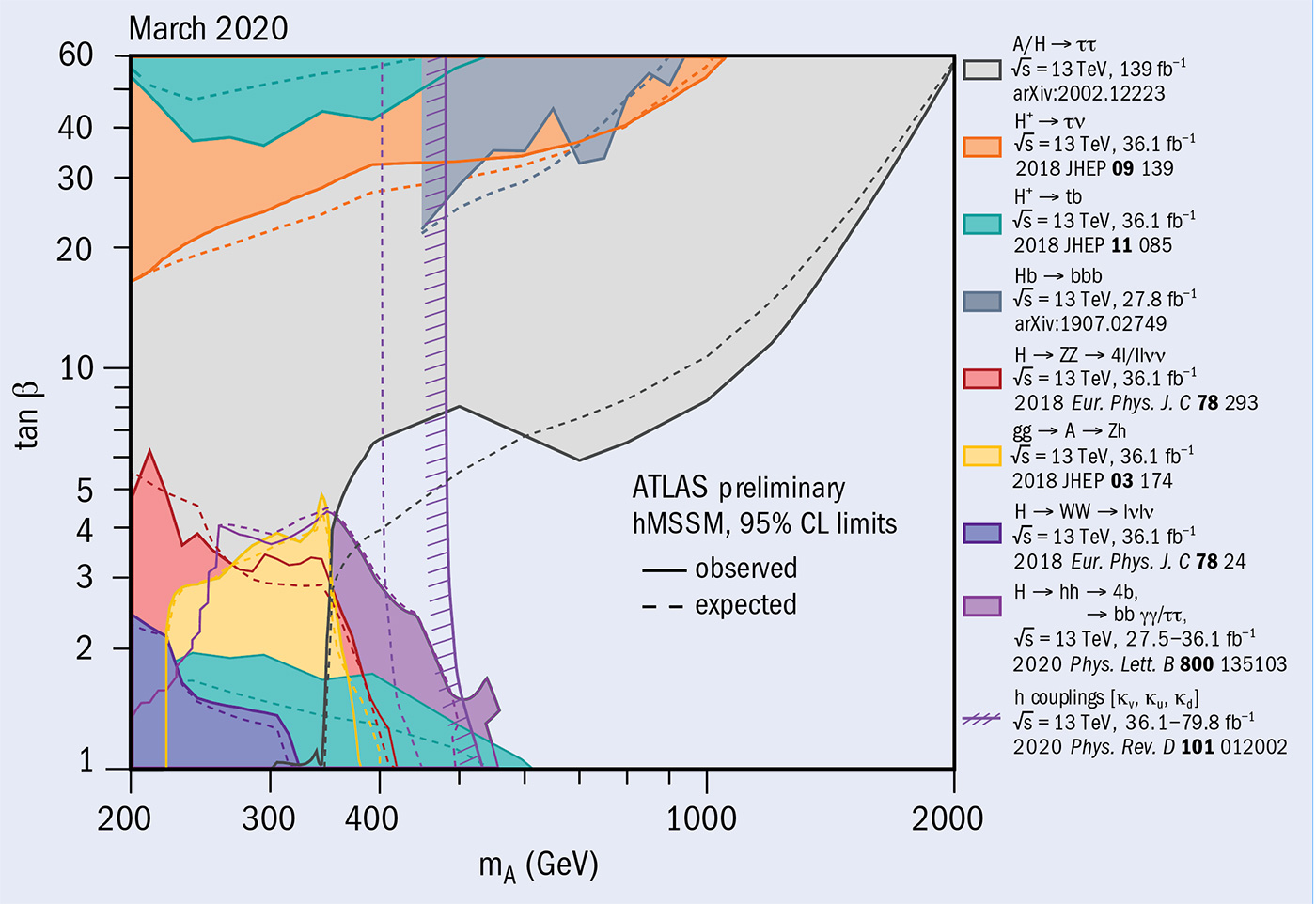
The MSSM features five Higgs bosons, among which, the observed Higgs boson can be the lightest one. The couplings of the heavy Higgs bosons to down‑type leptons and quarks, such as the tau lepton and bottom quark, are enhanced for large values of tan β – the ratio of the vacuum expectation values of the two Higgs doublets, and one of the key parameters of the model. The heavy neutral Higgs bosons A (CP odd) and H (CP even) are produced mainly via gluon–gluon interactions or in association with bottom quarks. Their branching fractions to tau leptons can reach sizeable values across a large part of the model‑parameter space, making this channel particularly sensitive to a wide range of MSSM scenarios.

Figure 2

New search

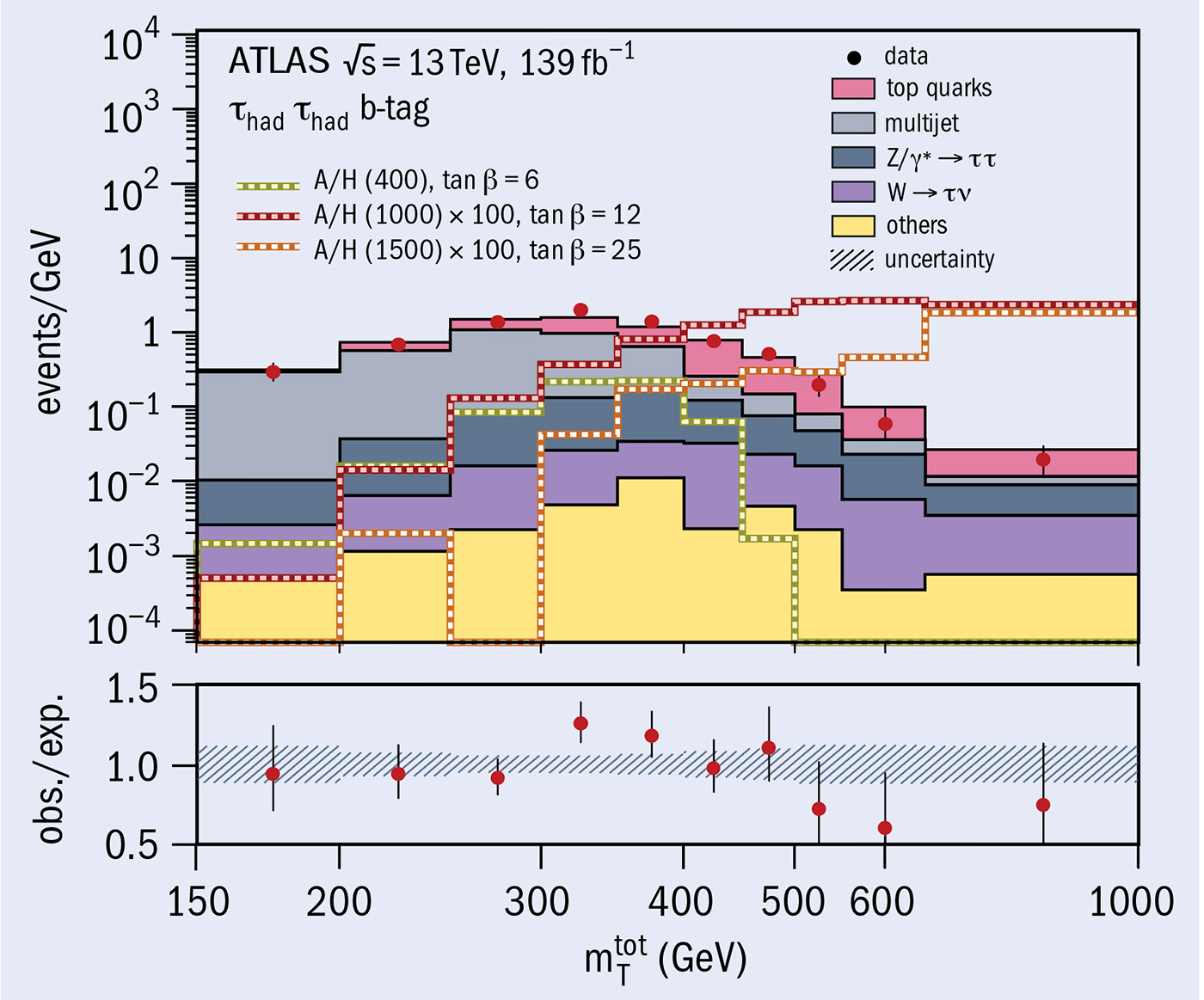
The new ATLAS search requires the presence of two oppositely charged tau‑lepton candidates, one of which is identified as a hadronic tau decay, and the other as either a hadronic or a leptonic decay. To profit from the enhancement of the production of signal events in association with bottom quarks at large tan β values (for example when the heavy Higgs boson is radiated by a b‑quark produced in the collision of two gluons), the data are further categorised based on the presence or absence of additional b‑jets. One of the challenges of the analysis is the misidentification of backgrounds with hadronic jets as tau candidates. These backgrounds are estimated from data by measuring the misidentification probabilities and applying them to events in control regions representative of the event selection. The final discriminant is on the quantity mTtot, which is built from the combination of the transverse masses of the two tau‑lepton decay products (figure 1).

The data agree with the prediction assuming no additional Higgs bosons, despite a small, non‑significant excess around a putative signal mass value of 400 GeV. The measurement places limits on the production cross section that can be translated into constraints on MSSM parameters. One realisation of the MSSM is the hMSSM scenario, in which the knowledge of the observed Higgs‑boson mass is used to reduce the number of parameters. The A/H → ττ exclusion limit dominates over large parts of the parameter space (figure 2), but still leaves room for possible discoveries at masses above the top‑anti‑top quark production threshold. ATLAS continues to refine this and conduct further searches for heavy Higgs bosons in various final states.

First sight of the running of the top-quark mass

Figure 1

The coupling between quarks and gluons depends strongly on the energy scale of the process. The same is true for the masses of the quarks. This effect – the so‑called “running” of the strong coupling constant and the quark masses – is described by the renormalisation group equations (RGEs) of quantum chromodynamics (QCD). The experimental verification of the RGEs is both an important test of the validity of QCD and an indirect search for unknown physics, as physics beyond the Standard Model could modify the RGEs at scales probed by the Large Hadron Collider. The running of the strong coupling constant has been established at many experiments in the past, and, over the past 20 years, evidence for the running of the masses of the charm and bottom quarks was demonstrated using data from LEP, SLC and HERA, though the running of the top‑quark mass has hitherto proven elusive.

CMS has probed the running of the mass of the top quark for the first time

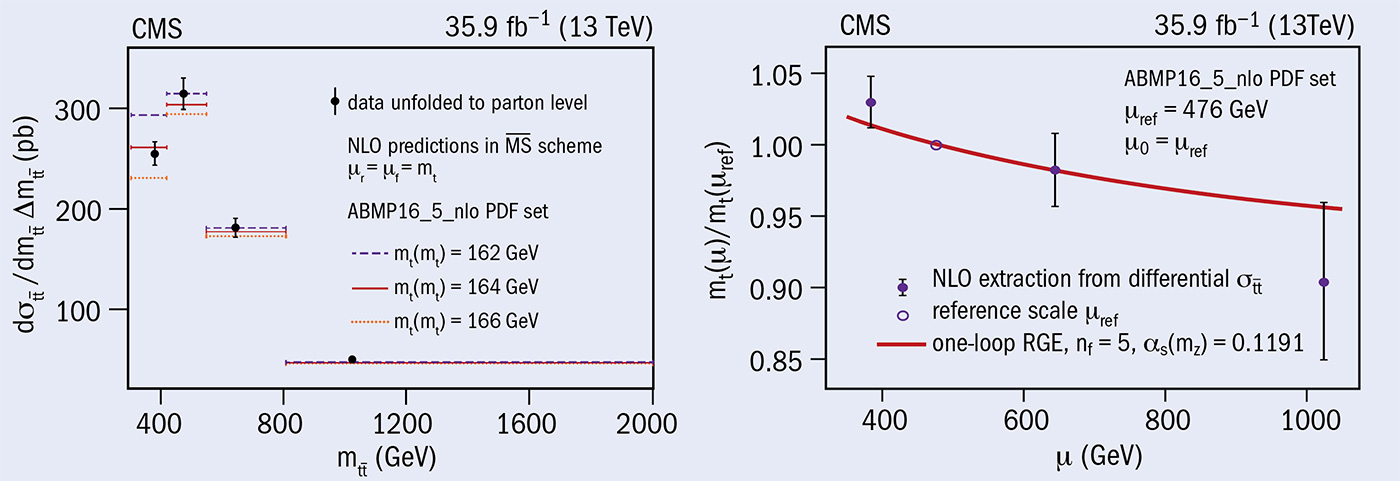
The CMS collaboration has now, for the first time, probed the running of the mass of the top quark. The measurement was performed using proton–proton collision data at a centre‑of‑mass energy of 13 TeV, recorded by the CMS detector in 2016. The top quark’s mass was determined as a function of the invariant mass of the top quark–antiquark system (the energy scale of the process), by comparing differential measurements of the system’s production cross section with theoretical predictions. In the vast majority of the cases, top quarks decay into a W boson and a bottom quark. In this analysis, candidate events are selected in the final state where one W boson decays into an electron and a neutrino, and the other decays into a muon and a neutrino.

One-loop agreement

The cross section was determined using a maximum‑likelihood fit to multi‑differential distributions of final‑state observables, allowing the precision of the measurement to be significantly improved by comparison to standard methods (figure 1). The measured cross section was then used to extract the value of the top‑quark mass as a function of the energy scale. The running was determined with respect to an arbitrary reference scale. The measured points are in good agreement with the one‑loop solution of the RGE, within 1.1 standard deviations, and a hypothetical no‑running scenario is excluded at above 95% confidence level.

This novel result supports the validity of the RGEs up to a scale of the order of 1 TeV. Its precision is limited by systematic uncertainties related to experimental calibrations and the modelling of the top‑quark production in the simulation. Further progress will not only require a significant effort in improving the calibrations of the final‑state objects, but also substantial theoretical developments.

ALICE extends quenching studies to softer jets

Figure 1

Jets are the most abundant high‑energy objects produced in collisions at the LHC, and often contaminate searches for new physics. In heavy‑ion collisions, however, these collimated showers of hadrons are not a background but one of the main tools to probe the deconfined state of strongly interacting matter known as the quark‑gluon plasma.

There are many open questions about the structure of the quark‑gluon plasma: What are the relevant degrees of freedom? How do high‑energy quarks and gluons interact with the hot QCD medium? Do factorisation and universality hold in this extreme environment? To answer these questions, experiments study how jets are modified in heavy‑ion collisions, where, unlike in proton‑proton collisions, they may interact with the  constituents of the quark‑gluon plasma. Since jet production and interactions can be computed in perturbative QCD, comparing theoretical calculations to measurements can provide insight to the properties of the quark‑gluon plasma.

Soft power

In this spirit, the ALICE collaboration has measured the inclusive jet production yield in both Pb‑Pb and proton–proton (pp) collisions at a centre‑of‑mass energy of 5.02 TeV. Jets were reconstructed from a combination of information from the ALICE tracking detectors and electromagnetic calorimeter for a variety of jet radii R. The detectors’ excellent performance with soft tracks was exploited to allow the measurements to cover the lowest jet transverse momentum (pT,jet) region measured at the LHC, where jet modification effects are predicted to be strongest. The measured jet yields in Pb‑Pb collisions exhibit strong suppression compared to pp collisions, consistent with theoretical expectations that jets lose energy as they propagate through the quark‑gluon plasma (figure 1). For relatively narrow R = 0.2 jets, the data show stronger suppression at lower pT, jet than at higher pT,jet, suggesting that lower pT,jet jets lose a larger fraction of their energy. Additionally, the data show no significant R dependence of the suppression within the uncertainties of the measurement, which places constraints on the angular distribution of the “lost” energy.

Several theoretical models, spanning a range of physics approximations from jet‑medium weak‑coupling to strong‑coupling, were compared to the data. The models are able to generally describe the trends of the data, but several models exhibit hints of disagreement with the measurements. These data complement existing jet measurements from ATLAS and CMS, and take advantage of ALICE’s high‑precision tracking system to provide additional constraints on jet‑quenching models in heavy‑ion collisions at low pT. Moreover, these measurements can be used in combination with other jet observables to extract properties of the medium such as the transverse momentum diffusion parameter, which describes the angular broadening of jets as they traverse the quark–gluon plasma, as a function of the medium temperature and the jet pT.

The “reference” measurements in pp collisions contain important QCD physics themselves. This new set of measurements was performed systematically from R= 0.1 to R= 0.6, in order to span from small R, where hadronisation effects are large, to large R, where underlying event effects are large. These data can be used to constrain the perturbative structure of the inclusive jet cross section, as well as hadronisation and underlying event effects, which are of broad interest to the high‑energy physics community.

Going forward, ALICE is actively working to further constrain theoretical predictions in both pp and Pb‑Pb collisions by exploring complementary jet measurements, including jet substructure, heavy‑flavour jets, and more. With a nearly 10 times larger Pb‑Pb data sample collected in 2018, upcoming analyses of the data will be important for connecting observed jet modifications to properties of the quark‑gluon plasma.

First foray into CP symmetry of top-Higgs interactions

One of the many doors to new physics that have been opened by the discovery of the Higgs boson concerns the possibility of finding charge-parity violation (CPV) in Higgs-boson interactions. Were CPV to be observed in the Higgs sector, it would be an unambiguous indication of physics beyond the Standard Model (SM), and could have important ramifications for understanding the baryon asymmetry of the universe. Recently, the ATLAS and CMS collaborations reported their first forays into this area by measuring the CP-structure of interactions between the Higgs boson and top quarks.

While CPV is well established in the weak interactions of quarks (most recently in the charm system by the LHCb collaboration), and is explained in the SM by the existence of a phase in the CKM matrix, the amount of CPV observed is many orders of magnitude too small to account for the observed cosmological matter-antimatter imbalance. Searching for additional sources of CPV is a major programme in particle physics, with a moderate-significance suggestion of CPV in lepton interactions recently announced by the T2K collaboration. It is likely that sources of CPV from phenomena beyond the scope of the SM are needed, and the detailed properties of the Higgs sector are one of several possible hiding places.

Based on the full LHC Run 2 dataset, ATLAS and CMS studied events where the Higgs boson is produced in association with one or two top quarks before decaying into two photons. The latter (ttH) process, which accounts for around 1% of the Higgs bosons produced at the LHC, was observed by both collaborations in 2018. But the tH production channel is predicted to be about six times rarer. This is due to destructive interference between higher order diagrams involving W bosons, and makes the tH process particularly sensitive to new-physics processes.

Exploring the CP properties of these interactions is non-trivial

According to the SM, the Higgs boson is “CP-even” – that is, it is possible to rotate-away any CP-odd phase from the scalar mass term. Previous probes of the interaction between the Higgs and vector bosons by CMS and ATLAS support the CP-even nature of the Higgs boson, determining its quantum numbers to be most consistent with JPC = 0++, though small CP-odd contributions from a more complex coupling structure are not excluded. The presence of a CP-odd component, together with the dominant CP-even one, would imply CPV, altering the kinematic properties of the ttH process and modifying tH production. Exploring the CP properties of these interactions is non-trivial, and requires the full capacities of the detectors and analysis techniques.

The collaborations employed machine-learning (Boosted Decision Tree) algorithms to disentangle the relative fractions of the CP-even and CP-odd components of top-Higgs interactions. The CMS collaboration observed ttH production at significance of 6.6σ, and excluded a pure CP-odd structure of the top-Higgs Yukawa coupling at 3.2σ. The ratio of the measured ttH production rate to the predicted production rate was found by CMS to be 1.38 with an uncertainty of about 25%. ATLAS data also show agreement with the SM. Assuming a CP-even coupling, ATLAS observed ttH with a significance of 5.2σ. Comparing the strength of the CP-even and CP-odd components, the collaboration favours a CP-mixing angle very close to 0 (indicating no CPV) and excludes a pure CP-odd coupling at 3.9σ. ATLAS did not observe tH production, setting an upper limit on its rate of 12 times the SM expectation.

In addition to further probing the CP properties of the top–Higgs interaction with larger data samples, ATLAS and CMS are searching in other Higgs-boson interactions for signs of CPV.

Gamma-ray polarisation sharpens multi-messenger astrophysics

POLAR polarisation plot

Recent years have seen the dawn of multi-messenger astrophysics. Perhaps the most significant contributor to this new era was the 2017 detection of gravitational waves (GWs) in coincidence with a bright electromagnetic phenomenon, a gamma-ray burst (GRB). GRBs consist of intense bursts of gamma rays which, for periods ranging from hundreds of milliseconds to hundreds of seconds, outshine any other source in the universe. Although the first such event was spotted back in 1967, and typically one GRB is detected every day, the underlying astrophysical processes responsible remain a mystery. The joint GW–electromagnetic detection answered several questions about the nature of GRBs, but many others remain.

Recently, researchers made the first attempts to add gamma-ray polarisation into the mix. If successful, this could enable the next step forward within the multi-messenger field.

So far, three photon parameters – arrival time, direction and energy – have been measured extensively for a range of different objects within astrophysics. Yet, despite the wealth of information it contains, the photon polarisation has been neglected. X-ray or gamma-ray fluxes emitted by charged particles within strong magnetic fields are highly polarised, while those emitted by thermal processes are typically unpolarised. Polarisation therefore allows researchers to easily identify the dominant emission mechanism for a particular source. GRBs are one such source, since a consensus on where the gamma rays actually originate from is still missing.

Difficult measurements

The reason that polarisation has not been measured in great detail is related to the difficulty of performing the measurements. To measure the polarisation of an incoming photon, details of the secondary products produced as it interacts in a detector need to be measured. With gamma rays, for example, the angle at which the gamma ray scatters in the detector is related to its polarisation vector. This means that, in addition to detecting the photon, researchers need to study its subsequent path. Such measurements are further complicated by the need to perform them above the atmosphere on satellites, which complicates the detector design significantly.

The 2020s should see the start of a new type of astrophysics

Recent progress has shown that, although challenging, polarisation measurements are possible. The most recent example came from the POLAR mission, a Swiss, Polish and Chinese experiment fully dedicated to measuring the polarisation of GRBs, which took data from September 2016 to April 2017. The team behind POLAR, which was launched to space in 2016 attached to a module for the China Space Station, recently published its first results. Though they indicate that the emission from GRBs is likely unpolarised, the story appears to be more complex. For example, the polarisation is found to be low when looking at the full GRB emission, but when studying it over short time intervals, a strong hint of high polarisation is found with a rapidly changing polarisation angle during the GRB event. This rapid evolution of the polarisation angle, which is yet to be explained by the theoretical community, smears out the polarisation when looking at the full GRB. In order to fully understand the evolution, which could give hints of an evolution of a magnetic field, finer time-binning and more precise measurements are needed, which require more statistics.

POLAR-2

Two future instruments capable of providing such detailed measurements are currently being developed. The first, POLAR-2, is the follow-up of the POLAR mission and was recently recommended to become a CERN-recognised experiment. P OLAR-2 w ill b e a n order of magnitude more sensitive (due to larger statistics and lower systematics) than its predecessor and therefore should be able to answer most of the questions raised by the recent POLAR results. The experiment will also play an important role in detecting extremely weak GRBs, such as those expected from GW events. POLAR-2, which will be launched in 2024 to the under-construction China Space Station, could well be followed by a similar but slightly smaller instrument called LEAP, which recently progressed to the final stage of a NASA selection process. If successful, LEAP would join POLAR-2 in 2025 in orbit on the International Space Station.

Apart from dedicated GRB polarimeters, progress is also being made at other upcoming instruments such as NASA’s Imaging X-ray Polarimetry Explorer and China-ESA’s enhanced X-ray Timing and Polarimetry mission, which aim to perform the first detailed polarisation measurements of a range of astrophysical objects in the X-ray region. While the first measurements from POLAR have been published recently, and more are expected soon, the 2020s should see the start of a new type of astrophysics, which adds yet another parameter to multi-messenger exploration.

Neutrino oscillations constrain leptonic CP violation

Physicists working on the T2K experiment in Japan have reported the strongest hint so far that charge-conjugation × parity (CP) symmetry is violated by the weak interactions of leptons. Based on an analysis of nine years of neutrino-oscillation data, the T2K results indicate discrepancies between the way muon-neutrinos transform into electron-neutrinos and the way muon-antineutrinos transform into electron-antineutrinos, at 3σ confidence. While further data are required to confirm the findings, the result strengthens previous observations and offers hope for a future discovery of leptonic CP violation at T2K or at next-generation long-baseline neutrino-oscillation experiments due to come online this decade.

These exciting results are thanks to the hard work of hundreds of T2K collaborators

Federico Sanchez

“These exciting results are thanks to the hard work of hundreds of T2K collaborators involved in the construction, data collection and data analysis for T2K over the past two decades,” says T2K international co-spokesperson Federico Sanchez of the University of Geneva.

Discovered in 1964, CP violation has so far only been observed in the weak interactions of quarks, mostly recently in the charm system by the LHCb collaboration. Since the size of the effect in quarks is too small to explain the observed matter-antimatter disparity in the universe, finding additional sources of CP violation is one of the outstanding mysteries in particle physics. The quantum mixing of neutrino flavours as neutrinos travel over large distances, the discovery of which was marked by the 2015 Nobel Prize in Physics, provides a way to probe another potential source of CP violation: a complex phase, δCP, in the neutrino mixing matrix. Though models indicate that no value of δCP could explain the cosmological matter-antimatter asymmetry without new physics, the observation of leptonic CP violation would make models such as leptogenesis, which feature heavy Majorana partners for the Standard Model neutrinos, more plausible.

Muon and e-like rings in Super-Kamiokande

Long baseline

The T2K (Tokai-to-Kamioka) experiment uses the Super Kamiokande detector to observe neutrinos and antineutrinos generated by a proton beam at the J-PARC accelerator facility 295 km away. As the beams travel through Earth, a fraction of muon neutrinos and antineutrinos in the beam oscillate into electron neutrinos that are recorded via nuclear-recoil interactions in Super Kamiokande’s 50,000-tonne tank of ultrapure water, where the charged lepton generated by the weak interaction creates a Cherenkov ring which can be distinguished as being created by an electron or muon (see image above). Since the beam-line and detector components are made out of matter and not antimatter, the observation of neutrinos is already enhanced. The T2K analysis therefore includes corrections based on data from magnetised near-detectors (ND280, which uses the magnet originally built for the UA1 detector at CERN’s Spp̄S collider) placed 280m from the target.

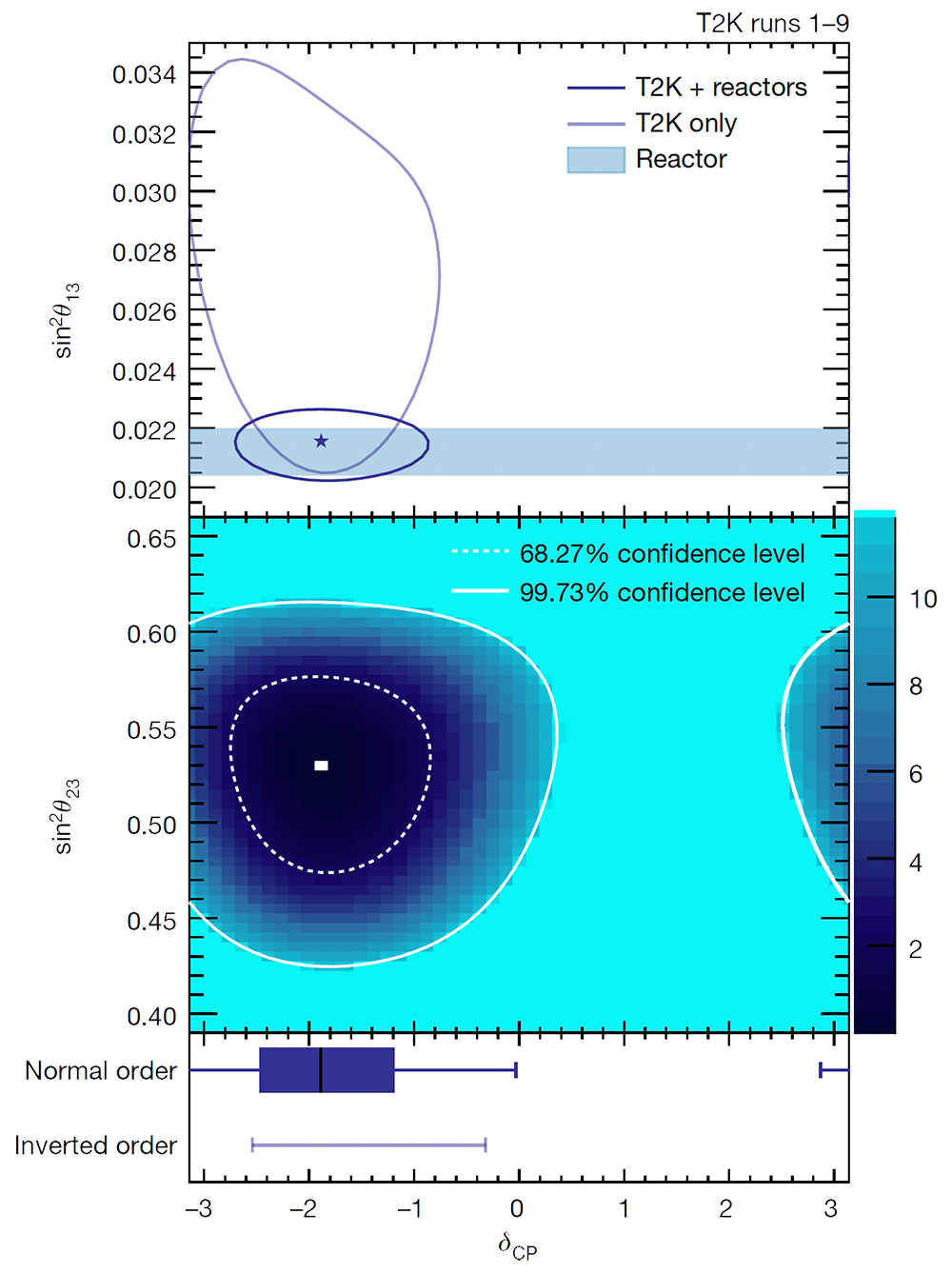
T2K 3 sigma bound in Nature

The δCP parameter is a cyclic phase: if δCP=0, neutrinos and antineutrinos will change from muon- to electron-types in the same way during oscillation; any other value would enhance the oscillations of either neutrinos or antineutrinos, violating CP symmetry. Analysing data with 1.49×10²¹ and 1.64×10²¹ protons produced in neutrino- and antineutrino-beam mode respectively, T2K observed 90 electron-neutrino candidates and 15 electron-antineutrino candidates. This may be compared with the 56 and 22 events expected for maximal antineutrino enhancement (δCP=+π/2), and the 82 and 17 events expected for maximal neutrino enhancement (δCP=−π/2). Being most compatible with the latter scenario, the T2K data disfavour almost half of the possible values of δCP at 3σ confidence. For the “normal” neutrino-mass ordering favoured by T2K and other experiments, and averaged over all other oscillation parameters, the measured 3σ confidence-level interval for δCP is [−3.41, −0.03], while for the “inverted” mass ordering (in which the first mass splitting is greater than the second) it is [−2.54, −0.32]. Averaged over all oscillation parameters, δCP=0 is now disfavoured at 3σ confidence, though it is still within the 3σ bound for some allowed values of the mixing angle θ23 (see figure, above).

“Our results show the strongest constraint yet on the parameter governing CP violation in neutrino oscillations, one of the few parameters governing fundamental particle interactions that has not yet been precisely measured,” continues Sanchez. “These results indicate that CP violation in neutrino mixing may be large, and T2K looks forward to continued operation with the prospect of establishing evidence for CP violation in neutrino oscillations.”

Next steps

To further improve the experimental sensitivity to a potential CP-violating effect, the collaboration plans to upgrade the near detector to reduce systematic uncertainties and to accumulate more data, while J-PARC will increase the beam intensity by upgrading its accelerator and beam line.

“This is the first time ever CP-violation is glimpsed in the lepton sector and it has the potential of being a very large effect,” says Albert De Roeck, group leader of the CERN neutrino group, which has participated in the T2K experiment since last year. “Future neutrino CP violation measurements will be further performed by currently running neutrino experiments, and then the torch will be passed to the planned high precision neutrino experiments DUNE and Hyper-Kamiokande that will provide measurements of the exact degree of CP violation in the neutrino system.”

bright-rec iop pub iop-science physcis connect