It has been almost a century since Dirac formulated his famous equation, and 75 years since the first QED calculations by Schwinger, Tomonaga and Feynman were used to explain the small deviations in hydrogen’s hyperfine structure. These calculations also predicted that deviations from Dirac’s prediction a = (g–2)/2, where g is the gyromagnetic ratio e/2me, should be non-zero and thus “anomalous”. The result is famously engraved on Schwinger’s tombstone, standing as a monument to the importance of this result and a marker of things to come.
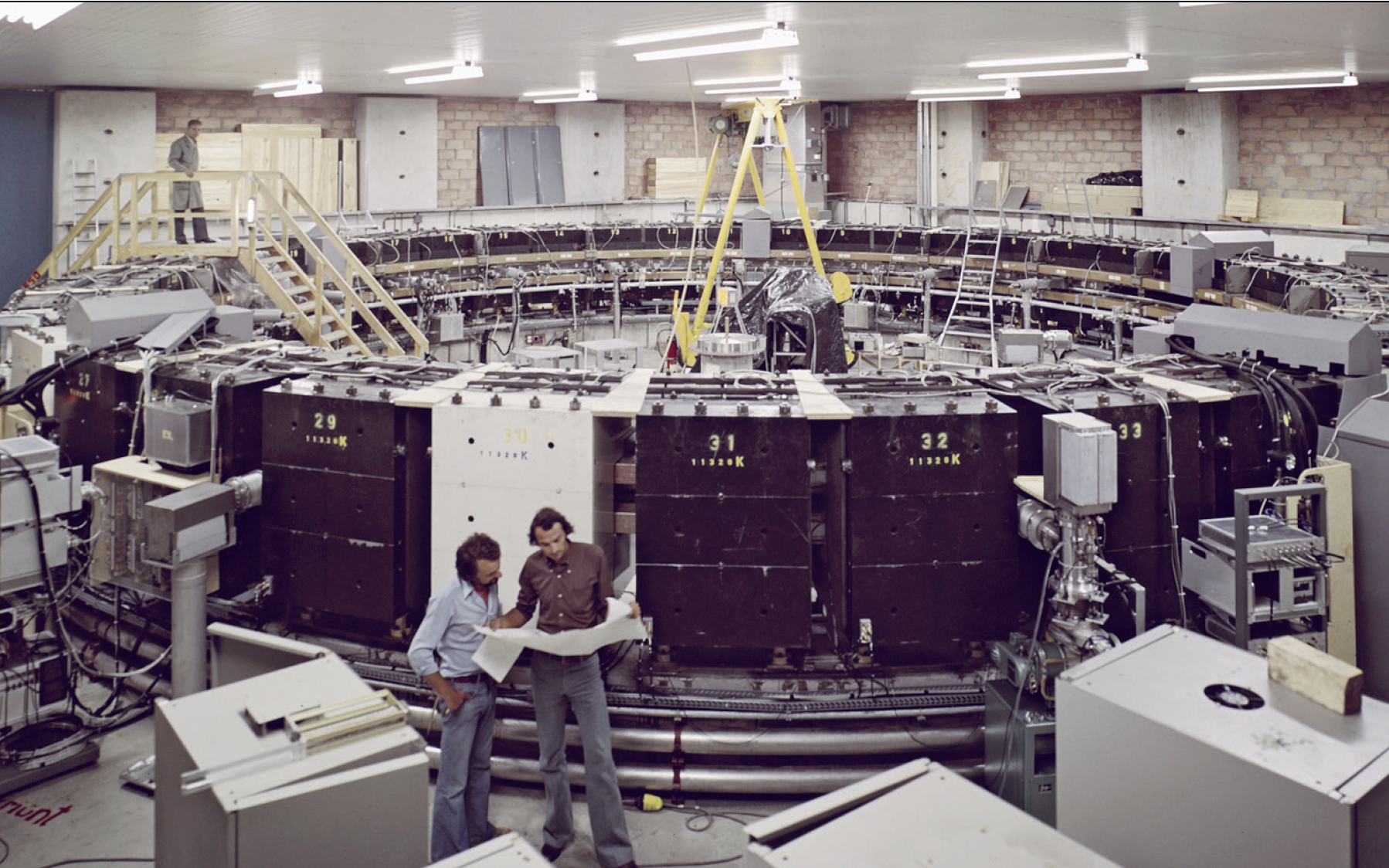
In January 1957 Garwin and collaborators at Columbia published the first measurements of g for the recently discovered muon, accurate to 5%, followed two months later by Cassels and collaborators at Liverpool with uncertainties of less than 1%. Leon Lederman is credited with initiating the CERN campaign of g–2 experiments from 1959 to 1979, starting with a borrowed 83 × 52 × 10 cm magnet from Liverpool and ending with a dedicated storage ring and a precision of better than 10 ppm.
Why was CERN so interested in the muon? In a 1981 review, Combley, Farley and Picasso commented that the CERN results for aμ had a higher sensitivity to new physics by “a modification to the photon propagator or new couplings” by a factor (mμ/me)2. Revealing a deeper interest, they also admitted “… this activity has brought us no nearer to the understanding of the muon mass [200 times that of the electron].”
With the end of the CERN muon programme, focus turned to Brookhaven and the E821 experiment, which took up the challenge of measuring aμ 20 times more precisely, providing sensitivity to virtual particles with masses beyond the reach of the colliders at the time. In 2004 the E821 collaboration delivered on its promise, reporting results accurate to about 0.6 ppm. At the time this showed a 2–3σ discrepancy with respect to the Standard Model (SM) – tantalising, but far from conclusive.
Spectacular progress
The theoretical calculation of g–2 made spectacular progress in step with experiment. Almost eclipsed by the epic 2012 achievement of calculating the QED contributions to five loops from 12,672 Feynman diagrams, huge advances in calculating the hadronic vacuum polarisation contributions to aμ have been made. A reappraisal of the E821 data using this information suggested at least a 3.5σ discrepancy with the SM. It was this that provided the impetus to Lee Roberts and colleagues to build the improved muon g–2 experiments at Fermilab, the first results from which are described in this issue, and at J-PARC. Full results from the Fermilab experiment alone should reduce the aμ uncertainties by at least another factor of three – down to a level that really challenges what we know about the SM.
Muon g–2 is a clear demonstration that theory and experiment must progress hand in hand
Of course, the interpretation of the new results relies on the choice of theory baseline. For example, one could choose, as the Fermilab experiment has, to use the consensus “International Theory Initiative” expectation for aμ. One could also take into account the new results provided by LHCb’s recent RK measurement, which hint that muons might behave differently than electrons. There will inevitably be speculation over the coming months about the right approach. Whatever one’s choice, muon g–2 is a clear demonstration that theory and experiment must progress hand in hand.
Perhaps the most important lesson is the continued cross-fertilisation and impetus to the physics delivered both at CERN and at Fermilab by recent results. The g–2 experiment, an international collaboration between dozens of labs and universities in seven countries, has benefited from students who cut their teeth on LHC experiments. Likewise, students who have worked at the precision frontier at Fermilab are now armed with the expertise of making blinded ppm measurements and are keen to see how they can make new measurements at CERN, for example at the proposed MUonE experiment, or at other muon experiments due to come online this decade.
“It remains to be seen whether or not future refinement of the [SM] will call for the discerning scrutiny of further measurements of even greater precision,” concluded Combley, Farley and Picasso in their 1981 review – a wise comment that is now being addressed.
A fermion’s spin tends to twist to align with a magnetic field – an effect that becomes dramatically macroscopic when electron spins twist together in a ferromagnet. Microscopically, the tiny magnetic moment of a fermion interacts with the external magnetic field through absorption of photons that comprise the field. Quantifying this picture, the Dirac equation predicts fermion magnetic moments to be precisely two in units of Bohr magnetons, e/2m. But virtual lines and loops add an additional 0.1% or so to this value, giving rise to an “anomalous” contribution known as “g–2” to the particle’s magnetic moment, caused by quantum fluctuations. Calculated to tenth order in quantum electrodynamics (QED), and verified experimentally to about two parts in 1010, the electron’s magnetic moment is one of the most precisely known numbers in the physical sciences. While also measured precisely, the magnetic moment of the muon, however, is in tension with the Standard Model.
Tricky comparison
The anomalous magnetic moment of the muon was first measured at CERN in 1959, and prior to 2021, was most recently measured by the E821 experiment at Brookhaven National Laboratory (BNL) 16 years ago. The comparison between theory and data is much trickier than for electrons. Being short-lived, muons are less suited to experiments with Penning traps, whereby stable charged particles are confined using static electric and magnetic fields, and the trapped particles are then cooled to allow precise measurements of their properties. Instead, experiments infer how quickly muon spins precess in a storage ring – a situation similar to the wobbling of a spinning top, where information on the muon’s advancing spin is encoded in the direction of the electron that is emitted when it decays. Theoretical calculations are also more challenging, as hadronic contributions are no longer so heavily suppressed when they emerge as virtual particles from the more massive muon.
All told, our knowledge of the anomalous magnetic moment of the muon is currently three orders of magnitude less precise than for electrons. And while everything tallies up, more or less, for the electron, BNL’s longstanding measurement of the magnetic moment of the muon is 3.7σ greater than the Standard Model prediction (see panel “Rising to the moment”). The possibility that the discrepancy could be due to virtual contributions from as-yet-undiscovered particles demands ever more precise theoretical calculations. This need is now more pressing than ever, given the increased precision of the experimental value expected in the next few years from the Muon g–2 collaboration at Fermilab in the US and other experiments such as the Muon g–2/EDM collaboration at J-PARC in Japan. Hotly anticipated results from the first data run at Fermilab’s E989 experiment were released on 7 April. The new result is completely consistent with the BNL value but with a slightly smaller error, leading to a slightly larger discrepancy of 4.2σ with the Standard Model when the measurements are combined (see Fermilab strengthens muon g-2 anomaly).
Hadronic vacuum polarisation
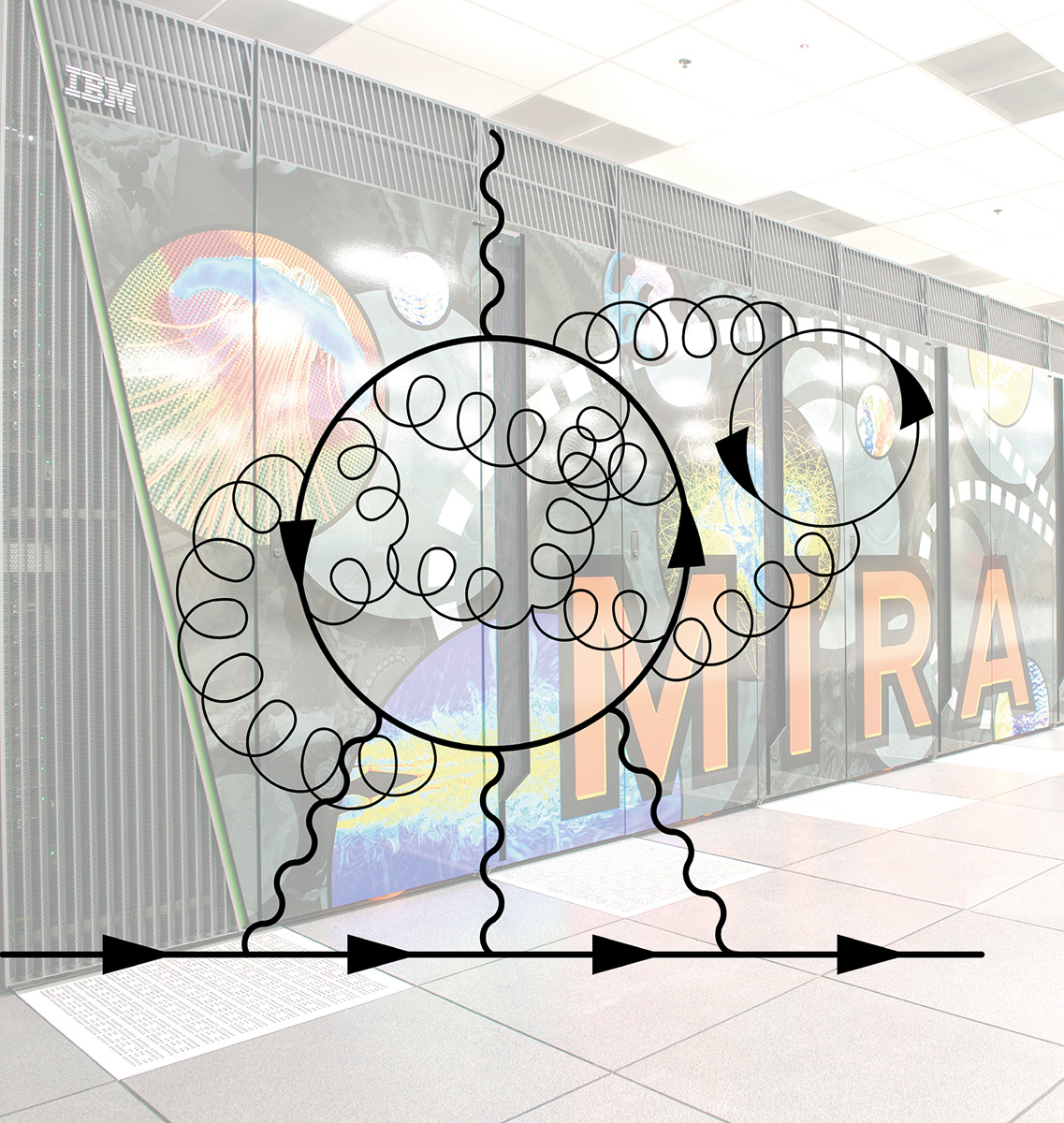
The value of the muon anomaly, aμ, is an important test of the Standard Model because currently it is known very precisely – to roughly 0.5 parts per million (ppm) – in both experiment and theory. QED dominates the value of aμ, but due to the non-perturbative nature of QCD it is strong interactions that contribute most to the error. The theoretical uncertainty on the anomalous magnetic moment of the muon is currently dominated by so-called hadronic vacuum polarisation (HVP) diagrams. In HVP, a virtual photon briefly explodes into a “hadronic blob”, before being reabsorbed, while the magnetic-field photon is simultaneously absorbed by the muon. While of order α2 in QED, it is all orders in QCD, making for very difficult calculations.
In the Standard Model, the magnetic moment of the muon is computed order-by-order in powers of a for QED (each virtual photon represents a factor of α), and to all orders in as for QCD.
At the lowest order in QED, the Dirac term (pictured left) accounts for precisely two Bohr magnetons and arises purely from the muon (μ) and the real external photon (γ) representing the magnetic field.
At higher orders in QED, virtual Standard Model particles, depicted by lines forming loops, contribute to a fractional increase of aμ with respect to that value: the so-called anomalous magnetic moment of the muon. It is defined to be aμ = (g–2)/2, where g is the gyromagnetic ratio of the muon – the number of Bohr magnetons, e/2m, which make up the muon’s magnetic moment. According to the Dirac equation, g = 2, but radiative corrections increase its value.
The biggest contribution is from the Schwinger term (pictured left, O(α)) and higher-order QED diagrams.
aμQED = (116 584 718.931 ± 0.104) × 10–11
Electroweak lines (pictured left) also make a well-defined contribution. These diagrams are suppressed by the heavy masses of the Higgs, W and Z bosons.
aμEW = (153.6 ± 1.0) × 10–11
The biggest QCD contribution is due to hadronic vacuum polarisation (HVP) diagrams. These are computed from leading order (pictured left, O(α2)), with one “hadronic blob” at all orders in as (shaded) up to next-to-next-to-leading order (NNLO, O(α4), with three hadronic blobs) in the HVP.
Hadronic light-by-light scattering (HLbL, pictured left at O(α3) and all orders in αs (shaded)), makes a smaller contribution but with a larger fractional uncertainty.
Neglecting lattice–QCD calculations for the HVP in favour of those based on e+e– data and phenomenology, the total anomalous magnetic moment is given by
This is somewhat below the combined value from the E821 experiment at BNL in 2004 and the E989 experiment at Fermilab in 2021.
aμexp = (116 592 061 ± 41) × 10–11
The discrepancy has roughly 4.2σ significance:
aμexp– aμSM = (251 ± 59) × 10–11.
Historically, and into the present, HVP is calculated using a dispersion relation and experimental data for the cross section for e+e–→ hadrons. This idea was born of necessity almost 60 years ago, before QCD was even on the scene, let alone calculable. The key realisation is that the imaginary part of the vacuum polarisation is directly related to the hadronic cross section via the optical theorem of wave-scattering theory; a dispersion relation then relates the imaginary part to the real part. The cross section is determined over a relatively wide range of energies, in both exclusive and inclusive channels. The dominant contribution – about three quarters – comes from the e+e–→ π+π– channel, which peaks at the rho meson mass, 775 MeV. Though the integral converges rapidly with increasing energy, data are needed over a relatively broad region to obtain the necessary precision. Above the τ mass, QCD perturbation theory hones the calculation.
Several groups have computed the HVP contribution in this way, and recently a consensus value has been produced as part of the worldwide Muon g–2 Theory Initiative. The error stands at about 0.58% and is the dominant part of the theory error. It is worth noting that a significant part of the error arises from a tension between the most precise measurements, by the BaBar and KLOE experiments, around the rho–meson peak. New measurements, including those from experiments at Novosibirsk, Russia and Japan’s Belle II experiment, may help resolve the inconsistency in the current data and reduce the error by a factor of two or so.
The alternative approach, of calculating the HVP contribution from first principles using lattice QCD, is not yet at the same level of precision, but is getting there. Consistency between the two approaches will be crucial for any claim of new physics.
Lattice QCD
Kenneth Wilson formulated lattice gauge theory in 1974 as a means to rid quantum field theories of their notorious infinities – a process known as regulating the theory – while maintaining exact gauge invariance, but without using perturbation theory. Lattice QCD calculations involve the very large dimensional integration of path integrals in QCD. Because of confinement, a perturbative treatment including physical hadronic states is not possible, so the complete integral, regulated properly in a discrete, finite volume, is done numerically by Monte Carlo integration.
Lattice QCD has made significant improvements over the last several years, both in methodology and invested computing time. Recently developed methods (which rely on low-lying eigenmodes of the Dirac operator to speed up calculations) have been especially important for muon–anomaly calculations. By allowing state-of-the-art calculations using physical masses, they remove a significant systematic: the so-called chiral extrapolation for the light quarks. The remaining systematic errors arise from the finite volume and non-zero lattice spacing employed in the simulations. These are handled by doing multiple simulations and extrapolating to the infinite-volume and zero-lattice-spacing limits.
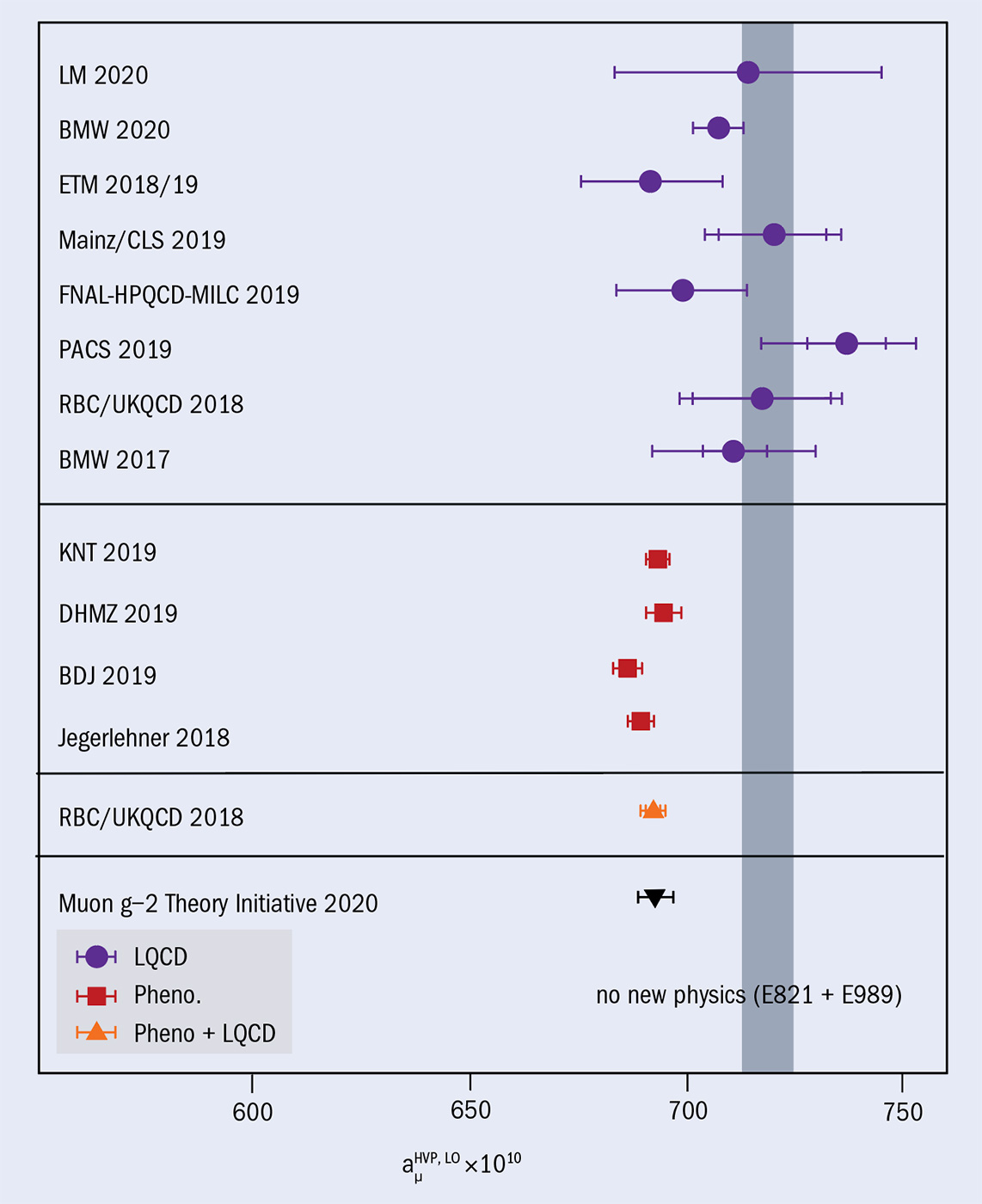
The HVP contribution can readily be computed using lattice QCD in Euclidean space with space-like four-momenta in the photon loop, thus yielding the real part of the HVP directly. The dispersive result is currently more precise (see “Off the mark” figure”), but further improvements will depend on consistent new e+e– scattering datasets.
Rapid progress in the last few years has resulted in first lattice results with sub-percent uncertainty, closing in on the precision of the dispersive approach. Since these lattice calculations are very involved and still maturing, it will be crucial to monitor the emerging picture once several precise results with different systematic approaches are available. It will be particularly important to aim for statistics-dominated errors to make it more straightforward to quantitatively interpret the resulting agreement with the no-new-physics scenario or the dispersive results. In the shorter term, it will also be crucial to cross-check between different lattice and dispersive results using additional observables, for example based on the vector–vector correlators.
With improved lattice calculations in the pipeline from a number of groups, the tension between lattice QCD and phenomenological calculations may well be resolved before the Fermilab and J-PARC experiments announce their final results. Interestingly, there is a new lattice result with sub-percent precision (BMW 2020) that is in agreement both with the no-new-physics point within 1.3σ, and with the dispersive-data-driven result within 2.1σ. Barring a significant re-evaluation of the phenomenological calculation, however, HVP does not appear to be the source of the discrepancy with experiments.
The next most likely Standard Model process to explain the muon anomaly is hadronic light-by-light scattering. Though it occurs less frequently since it includes an extra virtual photon compared to the HVP contribution, it is much less well known, with comparable uncertainties to HVP.
Hadronic light-by-light scattering
In hadronic light-by-light scattering (HLbL), the magnetic field interacts not with the muon, but with a hadronic “blob”, which is connected to the muon by three virtual photons. (The interaction of the four photons via the hadronic blob gives HLbL its name.) A miscalculation of the HLbL contribution has often been proposed as the source of the apparently anomalous measurement of the muon anomaly by BNL’s E821 collaboration.
Since the so-called Glasgow consensus (the fruit of a 2009 workshop) first established a value more than 10 years ago, significant progress has been made on the analytic computation of the HLbL scattering contribution. In particular, a dispersive analysis of the most important hadronic channels has been carried out, including the leading pion–pole, sub-leading pion loop and rescattering diagrams including heavier pseudoscalars. These calculations are analogous in spirit to the dispersive HVP calculations, but are more complicated, and the experimental measurements are more difficult because form factors with one or two virtual photons are required.
The project to calculate the HLbL contribution using lattice QCD began more than 10 years ago, and many improvements to the method have been made to reduce both statistical and systematic errors since then. Last year we published, with colleagues Norman Christ, Taku Izubuchi and Masashi Hayakawa, the first ever lattice–QCD calculation of the HLbL contribution with all errors controlled, finding aμHLbL, lattice = (78.7 ± 30.6 (stat) ± 17.7 (sys)) × 10–11. The calculation was not easy: it took four years and a billion core-hours on the Mira supercomputer at Argonne National Laboratory’s Large Computing Facility.
Our lattice HLbL calculations are quite consistent with the analytic and data-driven result, which is approximately a factor of two more precise. Combining the results leads to aμHLbL = (90 ± 17) × 10–11, which means the very difficult HLbL contribution cannot explain the Standard Model discrepancy with experiment. To make such a strong conclusion, however, it is necessary to have consistent results from at least two completely different methods of calculating this challenging non-perturbative quantity.
New physics?
If current theory calculations of the muon anomaly hold up, and the new experiments reduce its uncertainty by the hoped-for factor of four, then a new-physics explanation will become impossible to ignore.The idea would be to add particles and interactions that have not yet been observed but may soon be discovered at the LHC or in future experiments. New particles would be expected to contribute to the anomaly through Feynman diagrams similar to the Standard Model topographies (see “Rising to the moment” panel).
Calculations of the anomalous magnetic moment of the muon are not finished
The most commonly considered new-physics explanation is supersymmetry, but the increasingly stringent lower limits placed on the masses of super-partners by the LHC experiments make it increasingly difficult to explain the muon anomaly. Other theories could do the job too. One popular idea that could also explain persistent anomalies in the b-quark sector is heavy scalar leptoquarks, which mediate a new interaction allowing leptons and quarks to change into each other. Another option involves scenarios whereby the Standard Model Higgs boson is accompanied by a heavier Higgs-like boson.
The calculations of the anomalous magnetic moment of the muon are not finished. As a systematically improvable method, we expect more precise lattice determinations of the hadronic contributions in the near future. Increasingly powerful algorithms and hardware resources will further improve precision on the lattice side, and new experimental measurements and analysis methods will do the same for dispersive studies of the HVP and HLbL contributions.
To confidently discover new physics requires that these two independent approaches to the Standard Model value agree. With the first new results on the experimental value of the muon anomaly in almost two decades showing perfect agreement with the old value, we anxiously await more precise measurements in the near future. Our hope is that the clash of theory and experiment will be the beginning of an exciting new chapter of particle physics, heralding new discoveries at current and future particle colliders.
Hotly anticipated results from the first run of the muon g-2 experiment at Fermilab were announced today, increasing the tension between measurements and theoretical calculations. The last time this ultra-precise measurement was performed, in a sequence of results at Brookhaven National Laboratory in the late 1990s and early 2000s, it disagreed with the Standard Model (SM) by 3.7σ. After almost eight years of work rebuilding the Brookhaven experiment at Fermilab and analysing its first data, the muon’s anomalous magnetic moment has been measured to be 116 592 040(54)×10-11. The result is in agreement with the Brookhaven measurement and is 3.3σ greater than the SM prediction: 116 591 810(43)×10-11. Combined with the Brookhaven result, the world-average value for the anomalous magnetic moment of the muon is 116 592 061(41)×10-11, representing a 4.2σ departure from the SM.
“Today is an extraordinary day, long awaited not only by us but by the whole international physics community,” says Graziano Venanzoni of the INFN, who is co-spokesperson of the Fermilab muon g-2 collaboration. “A large amount of credit goes to our young researchers who, with their talent, ideas and enthusiasm, have allowed us to achieve this incredible result.”
Today is an extraordinary day, long awaited not only by us but by the whole international physics community
Graziano Venanzoni
The Fermilab result was unblinded during a Zoom meeting on 25 February in the presence of around 200 collaborators from around the world. “We were all very excited to finally know our result and the meeting was very emotional,” says Venanzoni. The analysis took almost three years from data taking to the release of the result and the collaboration decided to unblind only when all the steps of the analysis were completed and there were no outstanding questions. Venanzoni adds that no further analysis was completed after the unblinding and the results are unchanged.
The previous Brookhaven measurement left physicists pondering whether the presence of unknown particles in loops could be affecting the muon’s behaviour. It was clear that further measurements were needed, but it turned out to be much cheaper to move the apparatus to Fermilab than to build a new, more precise experiment at Brookhaven. So in the summer of 2013, the experiment’s 14-m diameter, 1.45 T superconducting magnet was transported from Long Island to the suburbs of Chicago. The Fermilab team reassembled the magnet and spent a year “shimming” its field, making it three times more uniform than the one it created at Brookhaven. Along with a new beamline to deliver a purer muon beam, Fermilab’s muon g-2 reincarnation required entirely new instrumentation, along with new detectors and a control room.
When a muon travels through the strong external magnetic field of a storage ring, the direction of its magnetic moment precesses at a rate that depends on its strength g. The Dirac equation predicts that all fermions have a g-factor equal to two. But higher order loops add an “anomalous” moment, aμ = (g-2)/2, which can be calculated extremely precisely. At Fermilab, muons with an energy of about 3.1 GeV are vertically focused in the storage ring via quadrupoles, and their precession frequency is determined from decays to electrons using 24 electromagnetic calorimeters located along the ring’s inner circumference. The intense polarised muon beam suppresses the pion contamination that challenged the Brookhaven measurement, while new calibration systems and simulations allow better control of systematic uncertainties.
It is so gratifying to finally be resolving this mystery
Chris Polly
The Fermilab muon g-2 collaboration took its first dataset in 2018, with over eight billion muon decays resulting in an overall uncertainty approximately 15% better than Brookhaven’s. Data analysis on the second and third runs is already under way, while a fourth run is ongoing and a fifth is planned. The collaboration is targeting a final precision of around 0.14 ppm – four times greater than the previous measurement.
“After the 20 years that have passed since the Brookhaven experiment ended, it is so gratifying to finally be resolving this mystery,” said Fermilab’s Chris Polly, a co-spokesperson for the current experiment and a graduate student on the Brookhaven experiment. “So far we have analysed less than 6% of the data that the experiment will eventually collect. Although these first results are telling us that there is an intriguing difference with the Standard Model, we will learn much more in the next couple of years.”
Theory baseline Developments in the theory community are equally vital. The Fermilab muon g-2 collaboration takes as its theory baseline the value for aμ obtained last year by the Muon g-2 Theory Initiative. Uncertainties in the calculation are dominated by hadronic contributions, in particular a term called the hadronic vacuum polarization (HVP). The Theory Initiative incorporates the HVP value obtained by well-established “dispersive methods”, which combine fundamental properties of quantum field theory with experimental measurements of low-energy hadronic processes. An alternative approach gaining traction is to calculate the HVP contribution using lattice QCD. In a paper published in Nature today, one group reports lattice calculations of HVP which, if included in the theory result, would significantly reduce the discrepancy between the experimental and theoretical values for aμ. The result is in 2σ tension with the value obtained from the dispersive approach, and is currently dominated by systematic uncertainties stemming from approximations used in the lattice calculations, say Muon g-2 Theory Initiative members.
“This being the first lattice result at sub-percent precision, it is premature to draw firm conclusions from this comparison,” reads a statement from the Muon g-2 Theory Initiative steering committee. “Indeed, given the complexity of the computations, independent results from different lattice groups with commensurate uncertainties are needed to test and check the lattice calculations against each other. Being entirely based on Standard Model theory, once the lattice results are well tested and precise enough, they will play an important role in understanding how new physics enters into the discrepancy.”
Despite the strong indirect evidence for the existence of dark matter, a plethora of direct searches have not resulted in a positive detection. The exception to this are the famous results from the DAMA/NaI experiment at Gran Sasso underground laboratory in Italy, first reported in the late 1990s, which show a modulating signal compatible with Earth moving through a region containing Weakly Interacting Massive Particles (WIMPs). These results were backed-up more recently with measurements from the follow-up DAMA/LIBRA detector. Combining the data in 2018, the evidence reported for a dark-matter signal is as high as 13 sigma.Now, the Annual modulation with NaI Scintillators (ANAIS) collaboration, which aims to directly reproduce the DAMA results using the same detector concept, has published the results from their first three years of operations. The results, which were presented today at Rencontres de Moriond, show a clear contradiction with DAMA, indicating that we are still no closer to finding dark matter.
The DAMA results are based on searches for an annual modulation in the interaction rate of WIMPs in a detector comprising NaI crystals. First theoretically proposed in 1986 by Andrzej Drukier, Katherine Freese and David Spergel, this modulation is a result of the difference in velocity of Earth with respect to the dark-matter halo of the galaxy. On 2 June, the velocities of Earth and the Sun are aligned with respect to the galaxy, whereas half a year later they are oppositely aligned, resulting in a lower cross section for WIMPs with a detector placed on Earth. Although this method has advantages compared to more direct detection methods, it requires that other potential sources of such a seasonal modulation be ruled out. Despite the significant modulation with the correct phase observed by DAMA, its results were not immediately accepted as a clear signal of dark matter due to the remaining possibility of instrumental effects, seasonal background modulation or artifacts from the analysis.
Over the years the significance of the DAMA results has continued to increase while other dark-matter searches, in particular with the XENON1T and LUX experiments, found no evidence of WIMPs capable of explaining the DAMA results. The fact that only the final analysis products from DAMA have been made public has also hampered attempts to prove or disprove alternative origins of the modulation. To overcome this, the ANAIS collaboration set out to reproduce the data with an independent detector intentionally similar to DAMA, consisting of NaI(Tl) scintillators readout by photomultipliers placed in the Canfranc Underground Laboratory deep beneath the Pyrenees in northern Spain. Using this method ANAIS can rule out any instrument-induced effects while producing data in a controlled way and studying it in detail with different analysis procedures.
The ANAIS results agree with the first results published by the COSINE-100 collaboration
The first three years of ANAIS data have now been unblinded, and the results were posted on arXiv on 1 March. None of the analysis methods used show any signs of a modulation, with a statistical analysis ruling out the DAMA results at 99% confidence. The results therefore narrow down the possible causes of the modulation observed by DAMA to either differences in the detector compared to ANAIS, or in the analysis method. One specific issue raised by the ANAIS collaboration regards the background-subtraction method. In the DAMA results the mean background rate for each year is subtracted from the raw data for that full year. In case the background during that year is not constant, however, this will produce an artificial saw-tooth shape which, with the limited statistics, can be fitted with a sinusoidal. This effect was already pointed out in a publication by a group from INFN in 2020, which showed how a slowly increasing background is capable of producing the exact modulation observed by DAMA. The ANAIS collaboration describes their background in detail, shows that it is indeed not constant, and provides suggestions for a more robust handling of the background.
The ANAIS results also agree with the first results published by the COSINE-100 collaboration in 2019 which, again using a NaI-based detector, found no evidence of a yearly modulation. Thanks to the continued experimental efforts of these two groups, and with the ANAIS collaboration planning to make their data public to allow independent analyses, the more than 20 year-old DAMA anomaly looks likely to be settled in the next few years.
The principle that the charged leptons have identical electroweak interaction strengths is a distinctive feature of the Standard Model (SM). However, this lepton-flavour universality (LFU) is an accidental symmetry in the SM, which may not hold in theories beyond the SM. The LHCb collaboration has used a number of rare decays mediated by flavour-changing neutral currents, where the SM contribution is suppressed, to test for deviations from LFU. During the past few years, these and other measurements, together with results from B-factories, hint at possible departures from the SM.
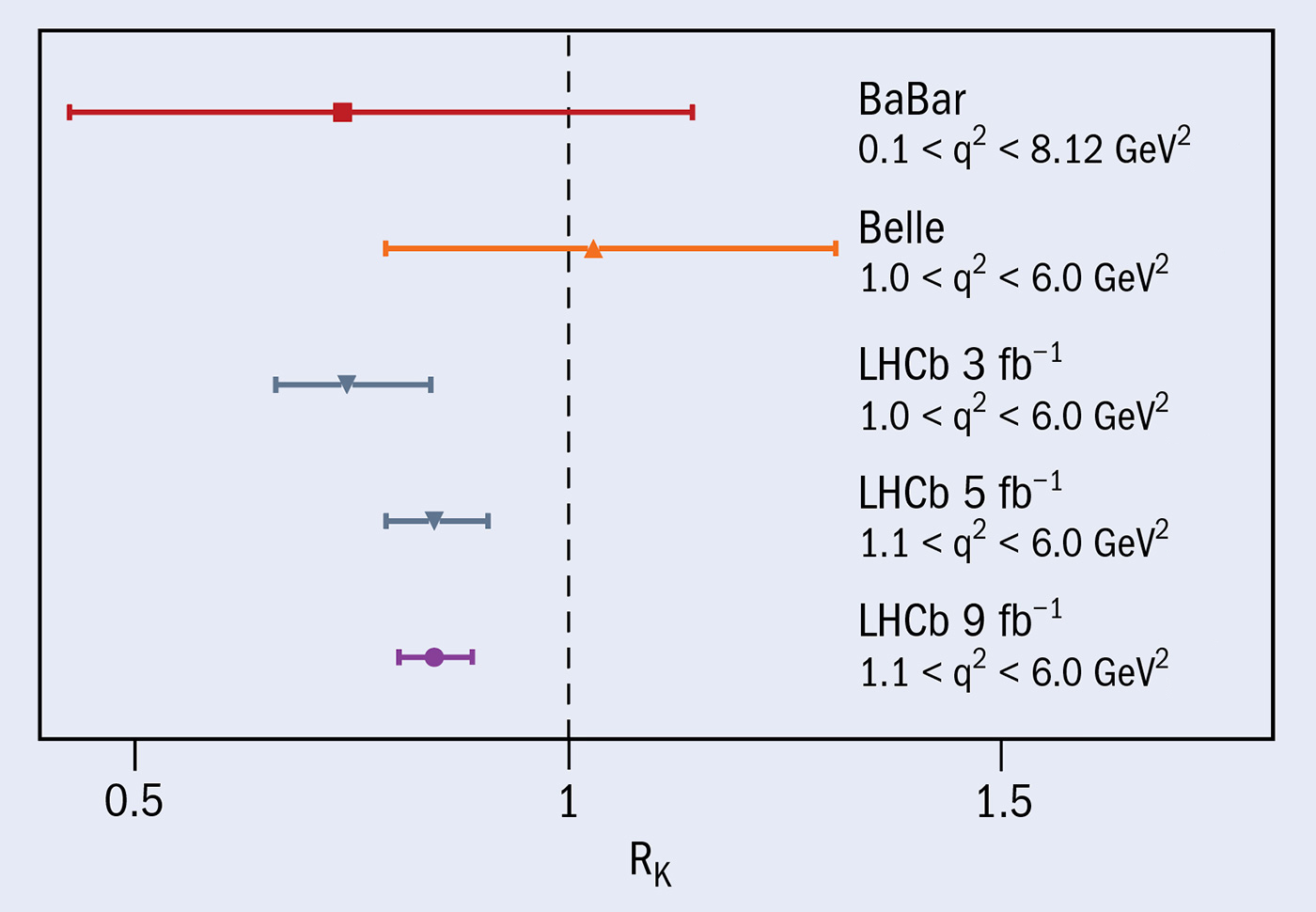
In a new measurement of a LFU-sensitive parameter “RK” with increased precision and statistical power, reported today at the Rencontres de Moriond, LHCb has strengthened the significance of the flavour anomalies. The value RK probes the ratio of B-meson decays to muons and electrons: RK = BR(B+→K+μ+μ–)/BR(B+→K+e+e–). Testing LFU in such b→sℓ+ℓ– transitions has the advantage that not only are SM contributions suppressed, but the theoretical predictions are very precise. Therefore, any significant deviation of RK from unity would imply physics beyond the SM.
The experimental challenge lies in the fact that, while electrons and muons interact via the electroweak force in the same way, the small electron mass means it interacts with detector material much more than muons. For example, electrons radiate a significant number of bremsstrahlung photons when traversing the LHCb detector, which degrades reconstruction efficiency and signal resolution compared to muons. The key to control this effect is to use the decays J/ψ→e+e– and J/ψ→μ+μ–, which are known to have the same decay probability and can be used to calibrate and test electron reconstruction efficiencies. High precision tests with the J/ψ are compatible with LFU, which provides a powerful cross-check on the experimental analysis.
Previous LHCb measurements of RK and RK* (which probes B0→K*ℓ+ℓ– decays) in 2019 and 2017 respectively, provide hints of deviations from unity. The latest analysis of RK, which uses the full dataset collected by the experiment in Run 1 and Run 2 of the LHC, represents a substantial improvement in precision on the previous measurement (see figure) thanks to doubling the dataset. The RK ratio is measured to be three standard deviations from the SM prediction (see figure). This is the first time that a departure from LFU above this level has been seen in any individual B-meson decay, with a value of RK=0.846+0.042-0.039 (stat.) +0.013-0.012 (syst.).
Although it is too early to conclude anything definitive at this stage, this deviation is consistent with a pattern of anomalies which have manifested themselves in b→s ℓ+ℓ– and similar processes over the course of the past decade. In particular, the strengthening RK anomaly may be considered alongside hints from other measurements of these transitions, including angular asymmetries and decay rates.
The LHCb experiment is well placed to clarify the potential existence of new-physics effects in these decays. Updates on a suite of b→s ℓ+ℓ– related measurements with the full Run 1 and Run 2 dataset are underway. A major upgrade to the detector during the ongoing second long shutdown of the LHC will offer a step change in precision in Run 3 and beyond.
The TOTEM collaboration at the LHC, in collaboration with the DØ collaboration at the former Tevatron collider at Fermilab, have announced the discovery of the odderon – an elusive three-gluon state predicted almost 50 years ago. The result was presented in a “discovery talk” on Friday 5 March during the LHC Forward Physics meeting at CERN, and follows the joint publication of a CERN/Fermilab preprint by TOTEM and DØ reporting the observation in December 2020.
This result probes the deepest features of quantum chromodynamics
Simone Giani
“This result probes the deepest features of quantum chromodynamics, notably that gluons interact between themselves and that an odd number of gluons are able to be ‘colourless’, thus shielding the strong interaction,” says TOTEM spokesperson Simone Giani of CERN. “A notable feature of this work is that the results are produced by joining the LHC and Tevatron data at different energies.”
States comprising two, three or more gluons are usually called “glueballs”, and are peculiar objects made only of the carriers of the strong force. The advent of quantum chromodynamics (QCD) led theorists to predict the existence of the odderon in 1973. Proving its existence has been a major experimental challenge, however, requiring detailed measurements of protons as they glance off one another in high-energy collisions.
While most high-energy collisions cause protons to break into their constituent quarks and gluons, roughly 25% are elastic collisions where the protons remain intact but emerge on slightly different paths (deviating by around a millimetre over a distance of 200 m at the LHC). TOTEM measures these small deviations in proton–proton (pp) scattering using two detectors located 220 m on either side of the CMS experiment, while DØ employed a similar setup at the Tevatron proton–antiproton (pp̄) collider.
Pomerons and odderons
At low energies, differences in pp vs pp̄ scattering are due to the exchange of different virtual mesons. At multi-TeV energies, on the other hand, proton interactions are expected to be mediated purely by gluons. In particular, elastic scattering at low-momentum transfer and high energies has long been explained by the exchange of a pomeron – a colour-neutral virtual glueball made up of an even number of gluons.
However, in 2018 TOTEM reported measurements at high energies that could not easily be explained by this traditional picture. Instead, a further QCD object seemed to be at play, supporting models in which a three-gluon compound, or one containing higher odd numbers of gluons, was being exchanged. The discrepancy came to light via measurements of a parameter called ρ, which represents the ratio of the real and imaginary parts of the forward elastic-scattering amplitude when there is minimal gluon exchange between the colliding protons and thus almost no deviation in their trajectories. The results were sufficient to claim evidence for the odderon, although not yet its definitive observation.
The new work is based on a model-independent analysis of data at medium-range momenta transfer. The TOTEM and DØ teams compared LHC pp data (recorded at collision energies of 2.76, 7, 8 and 13 TeV and extrapolated to 1.96 TeV), with Tevatron pp̄ data measured at 1.96 TeV. The odderon would be expected to contribute with different signs to pp and pp̄ scattering. Supporting this picture, the two data sets disagree at the 3.4σ level, providing evidence for the t-channel exchange of a colourless, C-odd gluonic compound.
“When combined with the ρ and total cross-section result at 13 TeV, the significance is in the range 5.2-5.7σ and thus constitutes the first experimental observation of the odderon,” said Christophe Royon of University of Kansas, who presented the results on behalf of DØ and TOTEM last week. “This is a major discovery by CERN/Fermilab.”
In addition to the new TOTEM-DØ model-independent study, several theoretical papers based on data from the ISR, SPS, Tevatron and LHC, and model-dependent inputs, provide additional evidence supporting the conclusion that the odderon exists.
How likely is it for a b quark to partner itself with an s quark rather than a light d or u quark? This question is key for understanding the physics of fragmentation and decay following the production of a b quark in proton–proton collisions. In addition, the number of Bs0 mesons to be produced, formed by a pair of b and s quarks, is required for measuring its decay probabilities, most notably to final states that are sensitive to physics beyond the Standard Model, such as the Bs0 → μ+μ– decay.
The knowledge of fs/fd – the ratio of the fragmentation fraction of a b quark to a Bs0 or a B0 meson – is thus a key parameter at the LHC. So far it has been measured with limited precision and has been the dominant systematic uncertainty for most B0s branching fractions. Now, however, the LHCb collaboration has, in a recent publication, combined the efforts of five different analyses with information on this parameter. The fs/fd ratio was measured in previous publications through semileptonic decays, hadronic decays with D mesons and hadronic decays with J/ψ mesons in the final state. Some of these measurements are only sensitive to the product of the fragmentation fraction and the branching fractions. This new work analyses these results simultaneously, obtaining a precise measurement of fs/fd as well as branching fraction measurements of two important decays, B0s → D–s π+ and B0s → J/ψ φ. These are golden channels for mixing and CP violation measurements in the B0ssector.
Precision leap
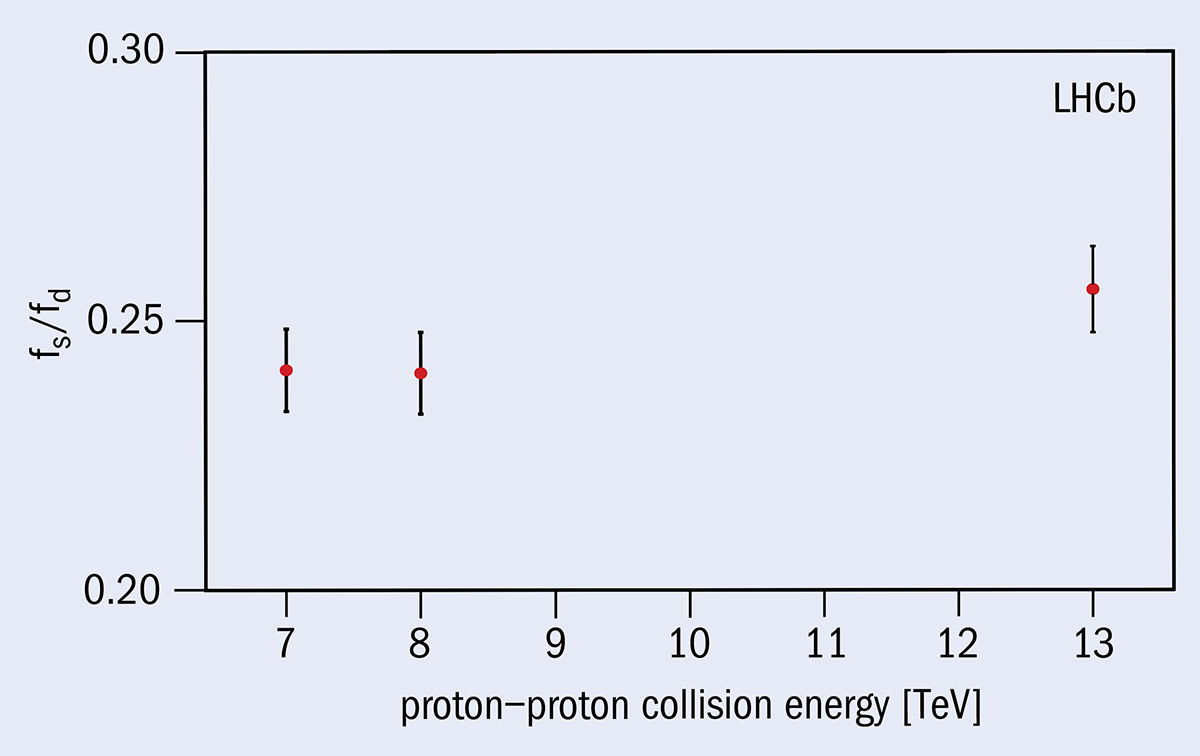
The results reduce the uncertainty on fs/fd by roughly a factor of two for collisions at 7 TeV, and a factor of 1.5 for collisions at 13 TeV, yielding a precision of about 3%. They also confirm the dependence of fs/fd on the transverse momentum of the B0s meson, and indicate a slight dependence on the centre-of-mass energy of proton–proton collisions (figure 1). The results are used in this work to update the previous branching-fraction measurements of about 50 different B0s decay channels, significantly improving their precision, and boosting several searches for new physics.
The Standard Model (SM) cannot be the complete theory of particle physics. Neutrino masses evade it. No viable dark-matter candidate is contained within it. And under its auspices the electric dipole moment of the neutron, experimentally compatible with zero, requires the cancellation of two non-vanishing SM parameters that are seemingly unrelated – the strong-CP problem. The physics explaining these mysteries may well originate from new phenomena at energy scales inaccessible to any collider in the foreseeable future. Fortunately, models involving such scales can be probed today and in the next decade by a series of experiments dedicated to searching for very weakly interacting slim particles (WISPs).
WISPs are pseudo Nambu–Goldstone bosons (pNGBs) that arise automatically in extensions of the SM from global symmetries which are broken both spontaneously and explicitly. NGBs are best known for being “eaten” by the longitudinal degrees of freedom of the W and Z bosons in electroweak gauge-symmetry breaking, which underpins the Higgs mechanism, but theorists have also postulated a bevy of pNGBs that get their tiny masses by explicit symmetry breaking and are potentially discoverable as physical particles. Typical examples arising in theoretically well-motivated grand-unified theories are axions, flavons and majorons. Axions arise from a broken “Peccei–Quinn” symmetry and could potentially explain the strong-CP problem, while flavons and majorons arise from broken flavour and lepton symmetries.
Being light and very weakly interacting, WISPs would be non-thermally produced in the early universe and thus remain non-relativistic during structure formation. Such particles would inevitably contribute to the dark matter of the universe. WISPs are now the target of a growing number and type of experimental searches that are complementary to new-physics searches at colliders.
Among theorists and experimentalists alike, the axion is probably the most popular WISP. Recently, massive efforts have been undertaken to improve the calculations of model-dependent relic-axion production in the early universe. This has led to a considerable broadening of the mass range compatible with the explanation of dark matter by axions. The axion could make up all of the dark matter in the universe for a symmetry-breaking scale fa between roughly 108 and 1019 GeV (the lower limit being imposed by astrophysical arguments, the upper one by the Planck scale), corresponding to axion masses from 10–13 eV to 10 meV. For other light pNGBs, generically dubbed axion-like particles (ALPs), the parameter range is even broader. With many plausible relic-ALP-production mechanisms proposed by theorists, experimentalists need to cover as much of the unexplored parameter range as possible.
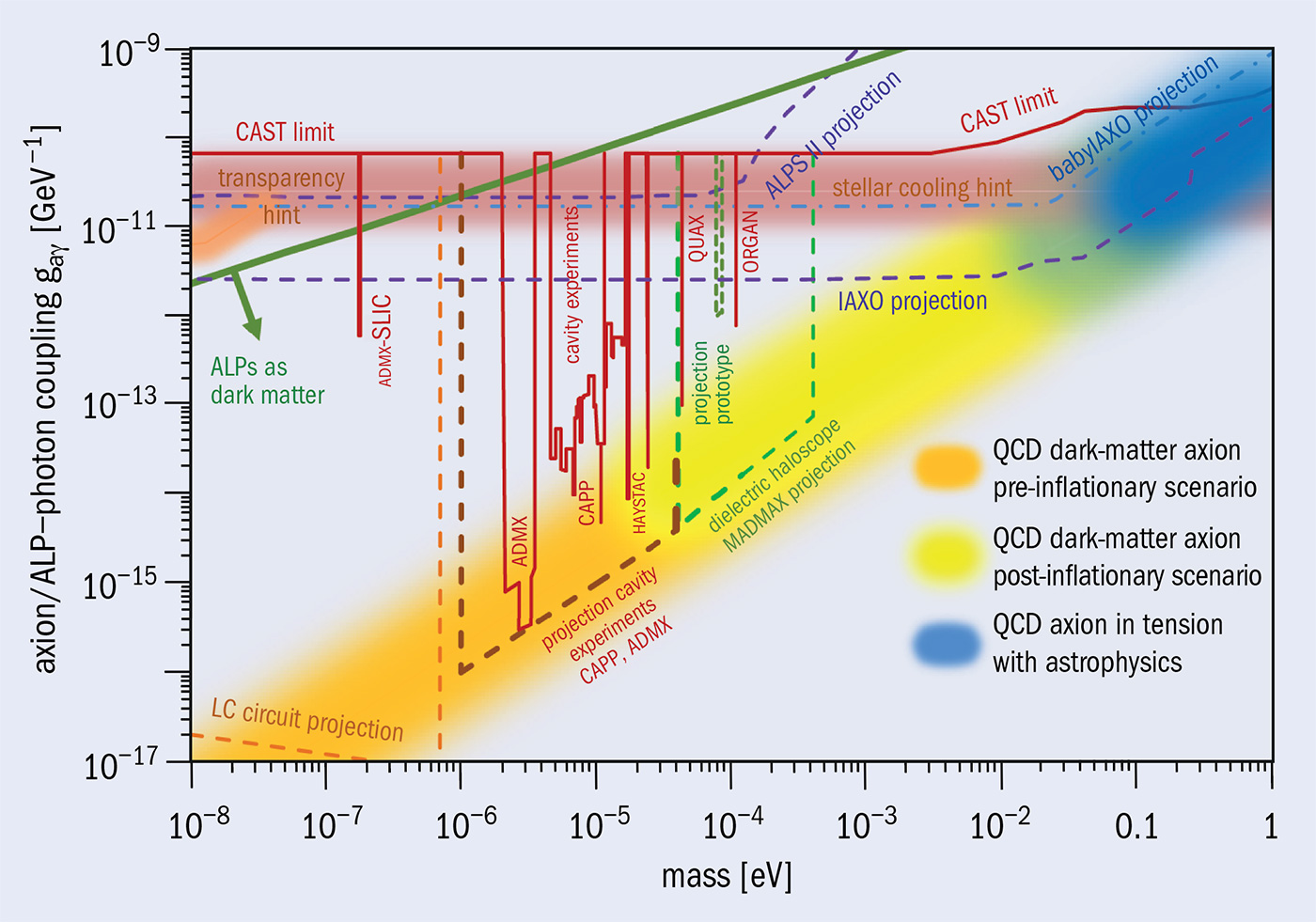
Although the strengths of the interactions between axions or ALPs and SM particles are very weak, being inversely proportional to fa, several strategies for observing them are available. Limits and projected sensitivities span several orders of magnitude in the mass-coupling plane (see “The field of play” figure).
IAXO’s design profited greatly from experience with the ATLAS toroid
Since axions or ALPs can usually decay to two photons, an external static magnetic field can substitute one of the two photons and induce axion-to-photon conversion. Originally proposed by Pierre Sikivie, this inverse Primakoff effect can classically be described by adding source terms proportional to B and E to Maxwell’s equations. Practically, this means that inside a static homogeneous magnetic field the presence of an axion or ALP field induces electric-field oscillations – an effect readily exploited by many experiments searching for WISPs. Other processes exploited in some experimental searches and suspected to lead to axion production are their interactions with electrons, leading to axion bremsstrahlung, and their interactions with nucleons or nuclei, leading to nucleon-axion bremsstrahlung or oscillations of the electric dipole moment of the nuclei or nucleons.
The potential to make fundamental discoveries from small-scale experiments is a significant appeal of experimental WISP physics, however the most solidly theoretically motivated WISP parameter regions and physics questions require setups that go well beyond “table-top” dimensions. They target WISPs that flow through the galactic halo, shine from the Sun, or spring into existence when lasers pass through strong magnetic fields in the laboratory.
Dark-matter halo
Haloscopes target the detection of dark-matter WISPs in the halo of our galaxy, where non-relativistic cold-dark-matter axions or ALPs induce electric field oscillations as they pass through a magnetic field. The frequency of the oscillations corresponds to the axion mass, and the amplitude to B/fa. When limits or projections are given for these kinds of experiments, it is assumed that the particle under scrutiny homogeneously makes up all of the dark matter in the universe, introducing significant cosmological model dependence.
The furthest developed currently operating haloscopes are based on resonant enhancement of the axion-induced electric-field oscillations in tunable resonant cavities. Using this method, the presently running ADMX project at the University of Washington has the sensitivity to discover dark-matter axions with masses of a few µeV. Nuclear resonance methods could be sensitive to halo dark-matter axions with mass below 1 neV and “fuzzy” dark-matter ALPs down to 10–22 eV within the next decade, for example at the CASPEr experiments being developed at the University of Mainz and Boston University. Meanwhile, experiments based on classical LC circuits, such as ABRACADABRA at MIT, are being designed to measure ALP- or axion-induced magnetic field oscillations in the centre of a toroidal magnet. These could be sensitive in a mass range between 10 neV and 1 µeV.
ALPS II is the first laser-based setup to fully exploit resonance techniques
For dark-matter axions with masses up to approximately 50 µeV, promising developments in cavity technologies such as multiple matched cavities and superconducting or dielectric cavities are ongoing at several locations, including at CAPP in South Korea, the University of Western Australia, INFN Legnaro and the RADES detector, which has taken data as part of the CAST experiment at CERN. Above ~40 µeV, however, the cavity concept becomes more and more challenging, as sensitivity scales with the volume of the resonant cavity, which decreases dramatically with increasing mass (as roughly 1/ma3). To reach sensitivity at higher masses, in the region of a few hundred µeV, a novel “dielectric haloscope” is being developed by the MADMAX (Magnetized Disk and Mirror Axion experiment) collaboration for potential installation at DESY. It exploits the fact that static magnetic-field boundaries between media with different dielectric constants lead to tiny power emissions that compensate the discontinuity in the axion-induced electric fields in neighbouring media. If multiple surfaces are stacked in front of each other, this should lead to constructive interference, boosting the emitted power from the expected axion dark matter in the desired mass range to detectable levels. Other novel haloscope concepts, based on meta-materials (“plasma haloscopes”, for example) and topological insulators, are also currently being developed. These could have sensitivity to even higher axion masses, up to a few meV.
Staying in tune
In principle, axion-dark-matter detection should be relatively simple, given the very high number density of particles – approximately 3 × 10¹³ axions/cm3 for an axion mass of 10 µeV – and the well-established technique of resonant axion-to-photon conversion. But, as the axion mass is unknown, the experiments must be painstakingly tuned to each possible mass value in turn. After about 15 years of steady progress, the ADMX experiment has reached QCD-axion dark-matter sensitivity in the mass regime of a few µeV.
ADMX uses tunable microwave resonators inside a strong solenoidal magnetic field, and modern quantum sensors for readout. Unfortunately, however, this technology is not scalable to the higher axion-mass regions as preferred, for example, by cosmological models where Peccei–Quinn symmetry breaking happened after an inflationary phase of the universe. That’s where MADMAX comes in. The collaboration is working on the dielectric-haloscope concept – initiated and led by scientists at the Max Planck Institute for Physics in Munich – to investigate the mass region around 100 µeV.
Weakly interacting slim particles (WISPs) could be produced in hot astrophysical plasmas and transport energy out of stars, including the Sun, stellar remnants and other dense sources. Observed lifetimes and energy-loss rates can therefore probe their existence. For the axion, or an axion-like particle (ALP) with sub-MeV mass that couples to nucleons, the most stringent limit, fa > ~108 GeV, stems from the duration of the neutrino signal from the progenitor neutron star of Supernova 1987A.
Tantalisingly, there are stellar hints from observations of red giants, helium-burning stars, white dwarfs and pulsars that seem to indicate energy losses with slight excesses with respect to those expected from standard energy emission by neutrinos. These hints may be explained by axions with masses below 100 meV or sub-keV-mass ALPs with a coupling to both electrons and photons.
Other observations suggest that TeV photons from distant blazars are less absorbed than expected by standard interactions with extragalactic background light – the so-called transparency hint. This could be explained by the conversion of photons into ALPs in the magnetic field of the source, and back to photons in astrophysical magnetic fields. Interestingly, these would have about the same ALP–photon coupling strength as indicated by the observed stellar anomalies, though with a mass that is incompatible with both ALPs which can explain dark matter and with QCD axions (see “The field of play” figure).
MADMAX will use a huge ~9 T superconducting dipole magnet with a bore of about 1.35 m and a stored energy of roughly 480 MJ. Such a magnet has never been built before. The MADMAX collaboration teamed up with CEA-IRFU and Bilfinger-Noell and successfully worked out a conceptual design. First steps towards qualifying the conductor are under way. The plan is for the magnet to be installed at DESY inside the old iron yoke of the former HERA experiment H1. DESY is already preparing the required infrastructure, including the liquid-helium supply necessary to cool the magnet. R&D for the dielectric booster, with up to 80 adjustable 1.25 m2 disks, is in full swing.
A first prototype, containing a more modest 20 discs of 30 cm diameter, will be tested in the “Morpurgo” magnet at CERN during future accelerator shutdowns (see “Haloscope home” figure). With a peak field strength of 1.6 T, its dipole field will allow new ALP-dark-matter parameter regions to be probed, though the main purpose of the prototype is to demonstrate the operation of the booster system in cryogenic surroundings inside a magnetic field. The MADMAX collaboration is extremely happy to have found a suitable magnet at CERN for such tests. If sufficient funds can be acquired within the next two to three years for magnet construction, and provided that the prototype efforts at CERN are successful, MADMAX could start data taking at DESY in 2028.
While direct dark-matter search experiments like ADMX and MADMAX offer by far the highest sensitivity for axion searches, this is based on the assumption that the dark matter problem is solved by axions, and if no signal is discovered any claim of an exclusion limit must rely on specific cosmological assumptions. Therefore, other less model-dependent experiments, such as helioscopes or light shining through a wall (LSW) experiments, are extremely beneficial in addition to direct dark-matter searches.
Solar axions
In contrast to dark-matter axions or ALPs, those produced in the Sun or in the laboratory should have considerable momentum. Indeed, solar axions or ALPs should have energies of a few keV, corresponding to the temperature at which they are produced. These could be detected by helioscopes, which seek to use the inverse Primakoff effect to convert solar axions or ALPs into X-rays in a magnet pointed towards the Sun, as at the CERN Axion Solar Telescope (CAST) experiment. Helioscopes could cover the mass range compatible with the simplest axion models, in the vicinity of 10 meV, and could be sensitive to ALPs with masses below 1 eV without any tuning at all.
The CAST helioscope, which reused an LHC prototype dipole magnet, has driven this field in the past decade, and provides the most sensitive exclusion limits to date. Going beyond CAST calls for a much larger magnet. For the next-generation International Axion Observatory (IAXO) helioscope, CERN members of the international collaboration worked out a conceptual design for a 20 m-long toroidal magnet with eight 60 cm-diameter bores. IAXO’s design profited greatly from experience with the ATLAS toroid.
In the past three years, the collaboration, led by the University of Zaragoza, has been concentrating its activities on the BabyIAXO prototype in order to finesse the magnet concept, the X-ray telescopes necessary to focus photons from solar axion conversion and the low-background detectors. BabyIAXO will increase the signal-to-noise ratio of CAST by two orders of magnitude; IAXO by a further two orders of magnitude.
In December 2020 the directorates of CERN and DESY signed a collaboration agreement regarding BabyIAXO: CERN will provide the detailed design of the prototype magnet including its cryostat, while DESY will design and prepare the movable platform and infrastructure (see “Prototype” figure). BabyIAXO will be located at DESY in Hamburg. The collaboration hopes to attract the remaining funds for BabyIAXO so construction can begin in 2021 and first science runs could take place in 2025. The timeline for IAXO will depend strongly on experiences during the construction and operation of BabyIAXO, with first light potentially possible in 2028.
Light shining through a wall
In contrast to haloscopes, helioscopes do not rely on the assumption that all dark matter is made up by axions. But light-shining-through-wall (LSW) experiments are even less model dependent with respect to ALP production. Here, intense laser light could be converted to axions or ALPs inside a strong magnetic field by the Primakoff effect. Behind a light-impenetrable wall they would be re-converted to photons and detected at the same wavelength as the laser light. The disadvantage of LSW experiments is that they only reach sensitivity to ALPs with a mass up to a few hundred µeV with comparably high coupling to photons. However, this is sensitive enough to test the parameter range consistent with the transparency hint and parts of the mass range consistent with the stellar hints (see “Astrophysical hints” panel).
The Any Light Particle Search (ALPS II) at DESY follows this approach. By seeking to observe light shining through a wall, any ALPs would be generated in the experiment itself, removing the need to make assumptions about their production. ALPS II is based on 24 modified superconducting dipole magnets that have been straightened by brute-force deformation, following their former existence in the proton accelerator of the HERA complex. With the help of two 124 m-long high-finesse optical resonators, encompassed by the magnets on both sides of the wall, ALPS II is also the first laser-based setup to fully exploit resonance techniques. Two readout systems capable of measuring a 1064 nm photon flux down to a rate of 2 × 10⁻⁵ s–1 have been developed by the collaboration. Compared to the present best LSW limits provided by OSQAR at CERN, the signal-to-noise ratio will rise by no less than 12 orders of magnitude at ALPS II. Nevertheless, MADMAX would surpass ALPS II in the sensitivity for the axion-photon coupling strength by more than three orders of magnitude. This is the price to pay for a model-independent experiment – however, ALPS II principally targets not dark-matter candidates but ALPs indicated by astrophysical phenomena.
Tunelling ahead
The installation of the 24 dipole magnets in a straight section of the HERA tunnel was completed in 2020. Three clean rooms at both ends and in the centre of the experiment were also installed, and optics commissioning is under way. A first science run is expected for autumn 2021.
In the overlapping mass region up to 0.1 meV, the sensitivities of ALPS II and BabyIAXO are roughly equal. In the event of a discovery, this would provide a unique opportunity to study the new WISP. Excitingly, a similar case might be realised for IAXO: combining the optics and detectors of ALPS II with simplified versions of the dipole magnets being studied for FCC-hh would provide an LSW experiment with “IAXO sensitivity” regarding the axion-photon coupling, albeit in a reduced mass range. This has been outlined as the putative JURA (Joint Undertaking on Research for Axions) experiment in the context of the CERN-led Physics Beyond Colliders study.
The past decade has delivered significant developments in axion and ALP theory and phenomenology. This has been complemented by progress in experimental methods to cover a large fraction of the interesting axion and ALP parameter range. In close collaboration with universities and institutes across the globe, CERN, DESY and the Max Planck society will together pave the road to the exciting results that are expected this decade.
An ultra-relativistic electromagnetically charged projectile carries a strongly contracted field that can be thought of as a flux of quasi-real photons. This is known as the equivalent-photon approximation, and was proposed by Fermi and later developed by Weizsäcker and Williams. In practice, this means that the proton or lead (Pb) beams of the LHC, moving at ultra-relativistic energies, also carry a quasi-real photon beam, which can be used to look inside protons or nuclei. The ALICE collaboration is in this way using the LHC as a photon–hadron collider, shining light inside lead nuclei to measure the photoproduction of charmonia and provide constraints on nuclear shadowing.
The intensity of the electromagnetic field, and the corresponding photon flux, is proportional to the square of the electric charge. This type of interaction is therefore greatly enhanced in the collisions of lead ions (Z = 82). Ultra-peripheral collisions (UPCs), in which the impact parameter is larger than the sum of the radii of two Pb nuclei, are a particularly useful way to study photonuclear collisions. Here, purely hadronic interactions are suppressed, due to the short range of the strong force, and photonuclear interactions dominate. The photoproduction of vector mesons in these reactions has a clean experimental signature: the decay products of the vector meson are the only signals in an otherwise empty detector.
Nuclear shadowing was first observed by the European Muon Collaboration at CERN in 1982
Coherent heavy-vector–meson photoproduction, wherein the photon interacts consistently with all the nucleons in a nucleus, is of particular interest because of its connection with gluon distribution functions (PDFs) in protons and nuclei. At low Bjorken-x values, gluon PDFs are significantly suppressed in the nucleus relative to free proton PDFs – a phenomenon known as nuclear shadowing that was first observed by the European Muon Collaboration at CERN in 1982 by comparing the structure functions of iron and deuterium in the deep inelastic scattering of muons.
Heavy-vector–meson photoproduction measurements provide a powerful tool to study poorly known gluon-shadowing effects at low x. The scale of the four-momentum transfer of the interaction corresponds to the perturbative regime of QCD in the case of heavy charmonium states. The gluon shadowing factor – the ratio of the nuclear PDF to the proton PDF – can be evaluated by measuring the nuclear suppression factor, defined to be the square root of the ratio of the coherent vector–meson photonuclear production cross section on nuclei to the photonuclear cross-section in the impulse approximation that is based on the exclusive photoproduction measurements with a proton target.
Ultra-peripheral collisions
The ALICE collaboration recently submitted for publication the measurement of the coherent photoproduction of J/ψ and ψ′ at midrapidity |y| < 0.8 in Pb–Pb UPCs at 5.02 TeV. The J/ψ is reconstructed using the dilepton (ℓ+ℓ–) and proton–antiproton decay channels, while for the ψ′, the dilepton and the ℓ+ℓ– π+π– decay channels are studied. These data complement the ALICE measurement of the coherent J/ψ cross-section at forward rapidity, –4 < y < –2.5, providing stringent constraints on nuclear gluon shadowing.
The nuclear gluon shadowing factor of about 0.65 at Bjorken-x between 0.3 × 10⁻³ and 1.4 × 10⁻³ is estimated from the comparison of the measured coherent J/ψ cross-section with the impulse approximation at midrapidity, which implies moderate nuclear shadowing. The measured rapidity dependence of the coherent cross-section is not completely reproduced by models in the full rapidity range. The leading twist approximation of the Glauber–Gribov shadowing (LTA-GKZ) and the energy-dependent hot-spot model (GG-HS (CCK)) gives the best overall description of the rapidity dependence but shows tension with data at semi-forward rapidities 2.5 < |y| < 3.5 (figure 1). The data might be better explained with a model where shadowing has a smaller effect at Bjorken x~ 10–2 or x~ 5∙10–5, corresponding to this rapidity range.
The ratio of the ψ′ to J/ψ cross-sections at midrapidity is consistent with the ratio of photoproduction cross sections measured by the H1 and LHCb collaborations, with the leading twist approximation predictions for Pb–Pb UPCs as well as with the ALICE measurement at forward rapidities. This leads to the conclusion that shadowing effects are similar for 2S (ψ′) and 1S (J/ψ) states.
In LHC Run 3 and 4, ALICE expects to collect a 10-times-larger data sample than in Run 2, taking data in a continuous mode, and thus with higher efficiency. UPC physics will profit from this by large integrated luminosity as well as lower systematic uncertainty connected to the measurement and will be able to provide the shadowing factor differentially in wide Bjorken-x intervals.
The LHCb collaboration has added four new exotic particles to the growing list of hadrons discovered so far at the LHC. In a paper posted to the arXiv preprint server yesterday the collaboration reports the observation of two tetraquarks with a new quark content (cc̄us̄): a narrow one, Zcs(4000)+, and a broader one Zcs(4220)+. Two other new tetraquarks, X(4685) and X(4630), with a quark content cc̄ss̄, were also observed. The results, which emerged thanks to adding the statistical power from LHC Run 2 to previous datasets, follow four tetraquarks discovered by the collaboration in 2016 and provide grist for the mill of theorists seeking to explain the nature of tetraquark binding mechanisms.
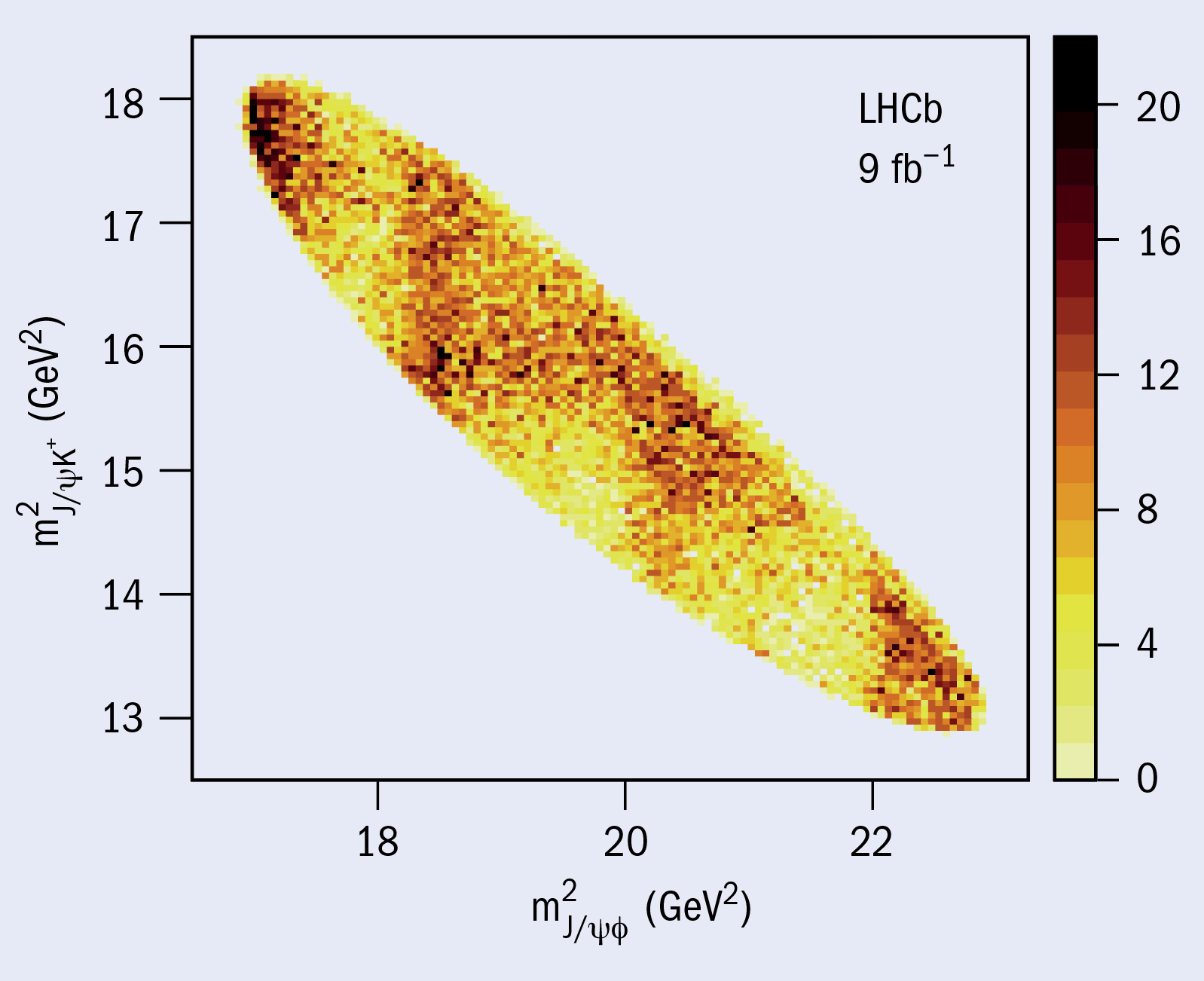
The new exotic states were observed in an almost pure sample of 24 thousand B+→J/ψφK+ decays, which, as a three-body decay, may be visualised using a Dalitz plot (see “Mountain ridges” figure). Horizontal and vertical bands indicate the temporary production of tetraquark resonances which subsequently decay to a J/ψ meson and a K+ meson or a J/ψ meson and a φ meson, respectively. The most prominent vertical bands correspond to the cc̄ss̄ tetraquarks X(4140), X(4274), X(4500) and X(4700) which were first observed in June 2016. The collaboration has now resolved two new horizontal bands corresponding to the cc̄us̄ states Zcs(4000)+ and Zcs(4220)+, and two additional vertical bands corresponding to the cc̄ss̄ states X(4685) and X(4630).
These states may have very different inner structures
Liming Zhang
The results have already triggered theoretical head scratching. In November, the BESIII collaboration at the Beijing Electron–Positron Collider II reported the discovery of the first candidate for a charged hidden-charm tetraquark with strangeness, tentatively dubbed Zcs(3985)– (CERN Courier January/February 2021 p12). It is unclear whether the new Zcs(4000)+ tetraquark can be identified with this state, say physicists. Though their masses are consistent, the width of the BESIII particle is ten times smaller. “These states may have very different inner structures,” says lead analyst Liming Zhang of the LHCb collaboration. “The one seen by BESIII is a narrow and longer-lived particle, and is easier to understand with a nuclear-like hadronic molecular picture, where two hadrons interact via a residual strong force. The one we observed is much broader, which would make it more natural to interpret as a compact multiquark candidate.”
The new observations take the tally of new hadronic states discovered at the LHC – which includes several pentaquarks as well as rare and excited mesons and baryons – to 59 (see “Diagram of discovery” figure). Though quantum chromodynamics naturally allows the existence of states beyond conventional two- and three-quark mesons and baryons, the detailed mechanisms responsible for binding multi-quark states are still largely mysterious. Tetraquarks, for example, could be tightly bound pairs of diquarks or loosely bound meson-meson molecules – or even both, depending on the production process.
Who would have guessed we’d find so many exotic hadrons?
Patrick Koppenburg
“Who would have guessed we’d find so many exotic hadrons?” says former LHCb physics coordinator Patrick Koppenburg, who put the plot together. “I hope that they bring us to a better modelling of the strong interaction, which is very much needed to understand, for instance, the anomalies we see in B-meson decays.”
To provide the best experiences, we use technologies like cookies to store and/or access device information. Consenting to these technologies will allow us to process data such as browsing behavior or unique IDs on this site. Not consenting or withdrawing consent, may adversely affect certain features and functions.
Functional
Always active
The technical storage or access is strictly necessary for the legitimate purpose of enabling the use of a specific service explicitly requested by the subscriber or user, or for the sole purpose of carrying out the transmission of a communication over an electronic communications network.
Preferences
The technical storage or access is necessary for the legitimate purpose of storing preferences that are not requested by the subscriber or user.
Statistics
The technical storage or access that is used exclusively for statistical purposes.The technical storage or access that is used exclusively for anonymous statistical purposes. Without a subpoena, voluntary compliance on the part of your Internet Service Provider, or additional records from a third party, information stored or retrieved for this purpose alone cannot usually be used to identify you.
Marketing
The technical storage or access is required to create user profiles to send advertising, or to track the user on a website or across several websites for similar marketing purposes.