Ultra-relativistic heavy-ion collisions create a system of deconfined quarks and gluons known as the quark–gluon plasma (QGP). Among other particles, a large number of light nuclei such as the deuteron, triton, helium-3, helium-4 and their corresponding antinuclei are produced, and can be measured with very good precision by the ALICE experiment at the LHC thanks to its excellent tracking and particle-identification capabilities via specific energy loss and time-of-flight measurements. Considering that the binding energies of light (anti)nuclei do not exceed a few MeV, it is not clear how such fragile objects can survive the hadron gas phase created after the phase transition from the QGP to hadrons, where particles rescatter with a typical momentum transfer in excess of 100 MeV. The production mechanism of light (anti)nuclei in these collisions is still not understood and is under intense debate in the scientific community. Constraining models of light antinuclei production is also important for predicting the backgrounds to indirect dark-matter searches using cosmic rays, as performed by experiments in space and in hot-air balloons, for which light antinuclei are promising signals.
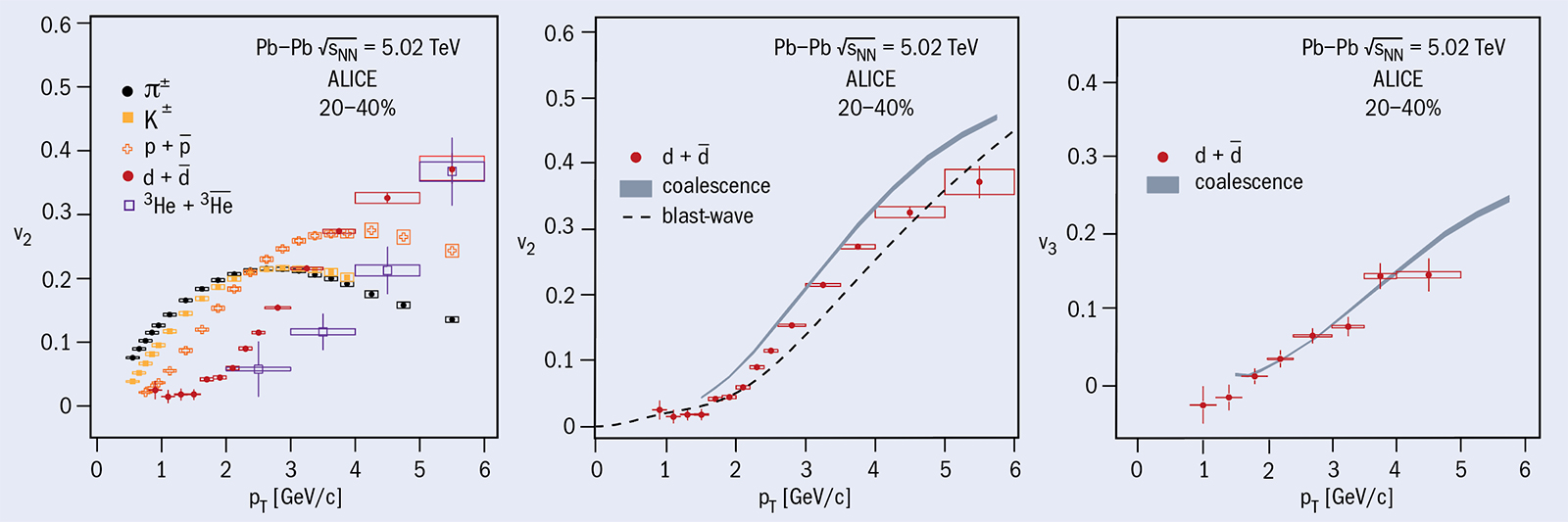
The measured elliptic flow of light nuclei is bracketed by the simple coalescence approach and the blast-wave model
Azimuthal anisotropies of light (anti)nuclei production with respect to the symmetry plane of the collision are key observables to study interactions in the hadron-gas phase, and can shed light on the production mechanism of these fragile objects. The ALICE collaboration has recently reported the measurements of two harmonic coefficients (vn) in a Fourier decomposition of the azimuthal distribution of deuterons in Pb–Pb collisions at √sNN = 5.02 TeV: their elliptic flow, v2, and the first measurement of their triangular flow, v3. A clear mass ordering is observed in the elliptic flow of non-central Pb–Pb collisions at low pT when the deuteron results are compared with other particle species, as expected for an expanding hydrodynamic system (figure 1, left).
Blast wave is best
The results are often compared to three phenomenological models, namely the statistical hadronisation model, the coalescence model, and the blast-wave model. In the statistical hadronisation model, light (anti)nuclei are assumed to be emitted by a source of thermal and hydrochemical equilibrium, like other hadron species, and their abundances fixed at the chemical freeze-out – the time at which inelastic interactions cease. However, this model only describes their yields, and not their flow. On the other hand, the coalescence model predicts that light nuclei are formed by the coalescence of protons and neutrons that are close in phase space at the kinetic freeze-out – the time at which elastic interactions cease. The blast-wave model, which is based on a simplified version of relativistic hydrodynamics, describes their transverse momentum spectra with just a few parameters, such as the kinetic freeze-out temperatures and transverse velocity.
In the new ALICE results, the measured elliptic flow of light nuclei is bracketed by the simple coalescence approach and the blast-wave model, which describe the data in different multiplicity regimes (figure 1, middle). The deuteron triangular flow is consistent with the coalescence model predictions, but large uncertainties do not allow a conclusive statement (figure 1, right). This specific aspect will be addressed with the larger data sample that ALICE will record in Run 3, which will also allow measurement of the flow of heavier nuclei. These results will contribute to shed light on their production mechanism and to study the properties of the hadron gas phase.
The Standard Model (SM) groups quarks and leptons separately to account for their rather different observed properties, but might they be unified through a new particle that couples to both and turns one into the other? Such “leptoquarks” emerge quite naturally in several theories that extend the SM. Searches for leptoquarks have been an important part of the LHC’s research programme since the beginning, and have received additional attention recently in the light of hints of deviations from the principle of lepton universality – the so-called flavour anomalies.
In a recent CMS analysis, where the events collected in pp collisions during Run 2 (137 fb–1) are analysed, researchers have challenged the SM by investigating a previously unexplored leptoquark signature involving the third generation of fermions. The motivation for considering the third generation is to confront the principle of lepton universality, which asserts that the couplings of leptons with gauge bosons are flavour independent. This principle is built into the SM, but has recently been put under stress by a series of anomalies observed in precision measurements of certain B-meson decays by the LHCb, Belle and BaBar collaborations. A possible explanation for these anomalies, which are still under investigation and not yet confirmed, lies in the existence of leptoquarks that preferentially couple to the heaviest fermions.
These results are the most stringent limits to date on the presence of leptoquarks that couple preferentially to the third generation
The new CMS search looks for both single and pair production of leptoquarks. It considers leptoquarks that decay to a quark (top or bottom) and a lepton (tau or neutrino), targeting the signature with a top quark, a tau lepton, missing transverse momentum due to a neutrino, and, in the case of double production, an additional bottom-quark jet. This is the first search to simultaneously consider both production mechanisms by categorising events with one or two jets originating from a bottom quark. The analysis also includes a dedicated selection for the case of a large mass splitting between the leptoquark and the top quark, which would boost the top quark and could cause its decay products to be inseparable given the spatial resolution of jets.
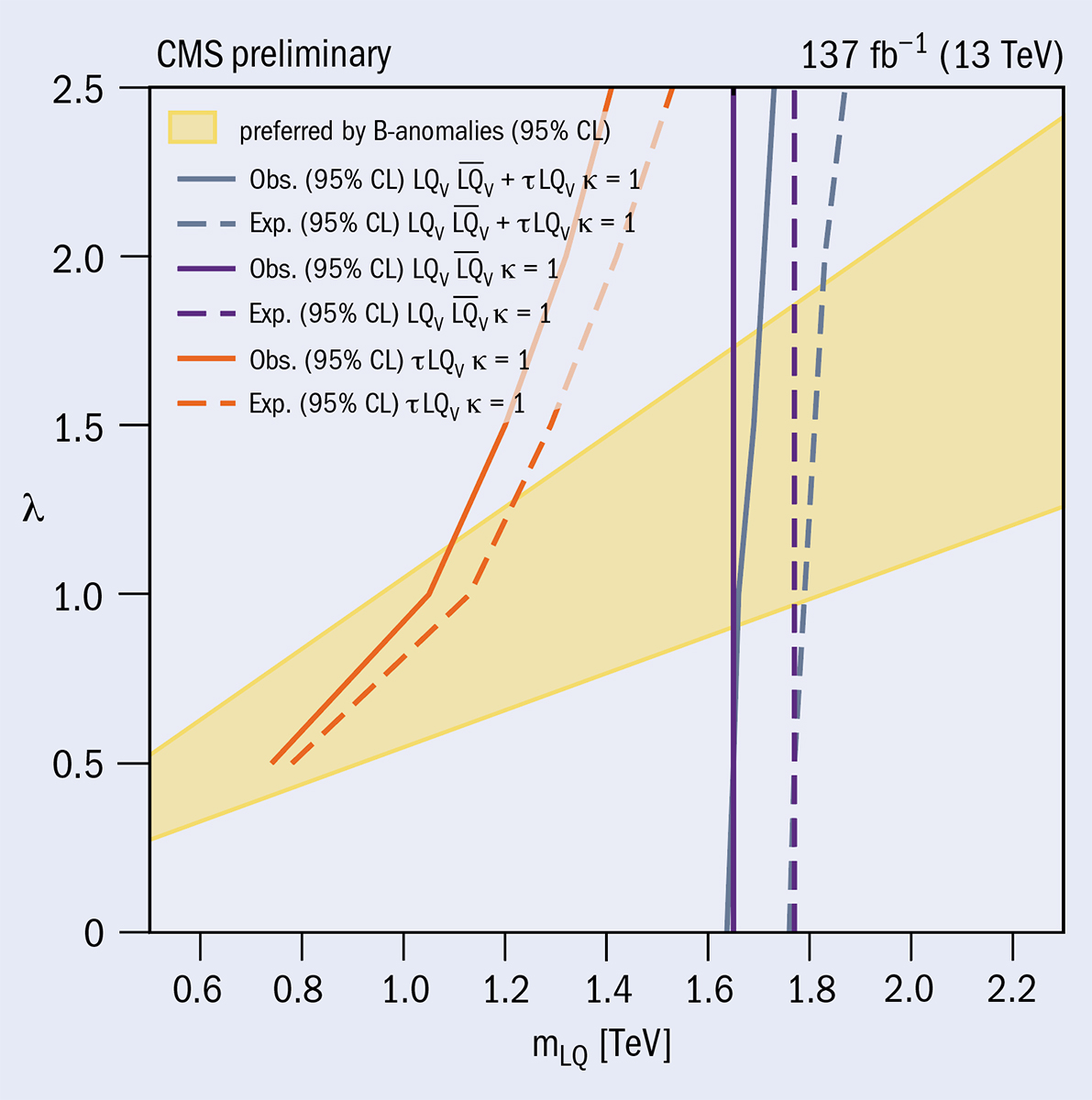
The observations are found to be in agreement with the SM prediction, and exclusion limits are derived in the plane of the leptoquark–lepton–quark vertex coupling λ and the leptoquark mass. The results are derived separately for hypothetical spin-0 and spin-1 (figure 1) leptoquarks, reflecting the two types allowed by theoretical models. The analysis assumes that the leptoquark decays half the time to each of the possible quark–lepton flavour pairs, for example, in the case of a spin-1 leptoquark, to a top quark and a neutrino, or to a bottom quark and a tau lepton. CMS finds a range of lower limits on the leptoquark mass between 0.98 and 1.73 TeV, at 95% confidence, depending on λ and the spin.
These results are the most stringent limits to date on the presence of leptoquarks that couple preferentially to the third generation of fermions. They also probe the parameter space preferred by the B-physics anomalies in several models, excluding relevant portions. As theories predict leptoquark masses as high as many tens of TeV, the pursuit of this promising solution for the unification of quarks and leptons must continue. The CMS collaboration has a broad programme for further investigations that will exploit the larger data samples from Run 3 and the high-luminosity LHC under different hypotheses. If leptoquarks exist, they may well be revealed in the coming data.
Dark matter is estimated to account for an unseen 85% of matter in the universe, but its nature is unknown. One possible explanation is weakly-interacting massive particles, or WIMPs, which could interact with ordinary matter through the exchange of a Higgs boson (“Higgs-portal” models) or a new mediator field yet to be discovered. The ATLAS collaboration has recently released two new investigations of WIMPs based on the full Run-2 data set.
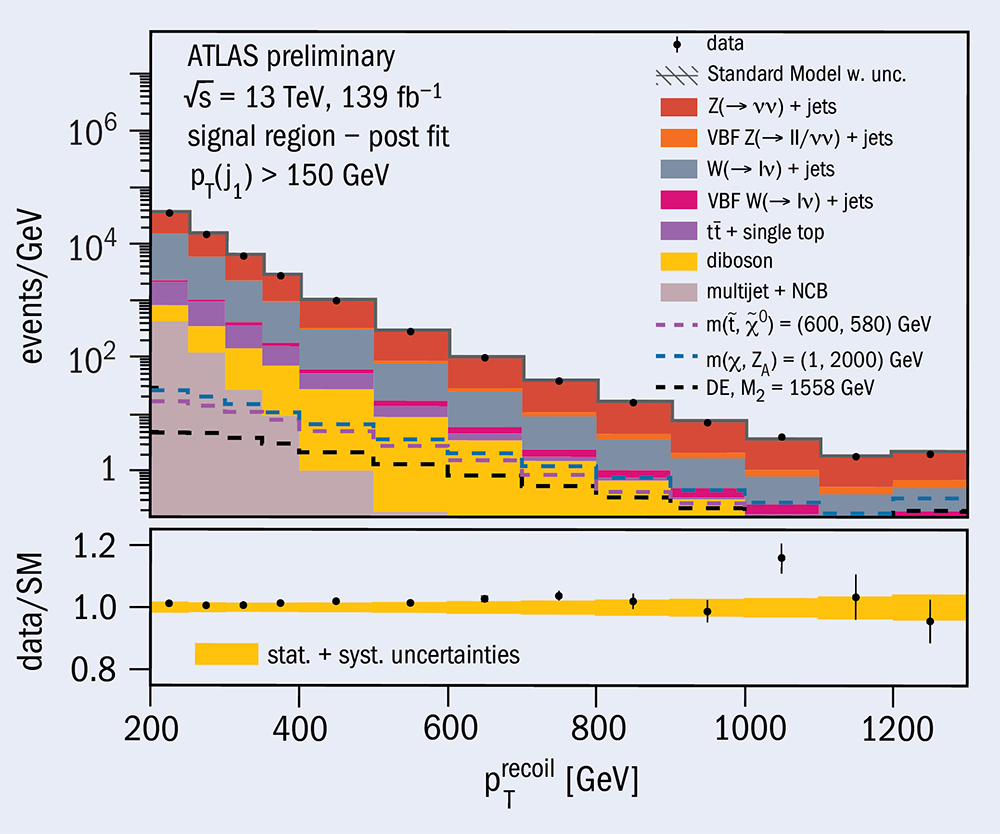
At the LHC, a mediator may be produced and decay into a pair of stable WIMPs, which then escape the detector unseen – an undetectable process, unless the mediator is produced, for example, in association with a high-pT gluon radiated from one of the incoming protons. This would provide a clear signature: a high-pT jet and significant missing transverse momentum (MET). A first “monojet” analysis sought events with MET in excess of 200 GeV, recoiling against a jet with pT > 150 GeV, with up to three additional jets and no leptons or photons. The leading background arises from events wherein a Z boson decays to neutrinos – a process experimentally indistinguishable from WIMP production. The predictions of this and other backgrounds benefitted from stateof- the-art theoretical calculations, detailed groundwork on particle reconstruction in ATLAS, and the use of data-control regions rich in W and Z boson decays. No significant excess was observed with respect to the Standard Model (SM) (figure 1).
As invisible Higgs-boson decays have a branching fraction of just 10–3, any signal would indicate new physics
Dijet analysis
A second “dijet” WIMP analysis searches for invisible decays of Higgs bosons produced via vector-boson fusion. Though accounting for just 10% as many Higgs bosons as the dominant gluon-fusion process at the LHC, the topology’s clear signature, with two widely separated jets in pseudorapidity, lends itself to searching for MET, as the jets tend to be close together in the transverse plane when recoiling against a Higgs boson with pT > 200 GeV. The art of this analysis is again in the precise modelling of SM backgrounds – a feat accomplished here with extrapolations from control regions and the use of jet kinematics to separate signal events from Z-boson decays to neutrinos, and W decays with an undetected charged lepton. As invisible Higgs-boson decays in the SM (chiefly H → ZZ* → 4ν) have a branching fraction of just 10–3, any significant signal would indicate new physics. No deviation from the SM was observed, allowing a 95% confidence upper limit to be placed on the branching fraction for invisible Higgs-boson decays of 13% – a factor two improvement in sensitivity compared to the previous analysis, despite the increase in pileup – or 9% when combining with other ATLAS Higgs-boson measurements. The results are complementary to direct-detection experiments looking for relic WIMPs with deep underground detectors, as they plumb lower WIMP masses than direct-detection experiments can currently access (figure 2).
These results also translate into limits on alternative dark-matter-related theories such as axion-like-particles (ALPs) and large extra-dimensions, and into model-independent limits on new phenomena. ATLAS will continue to explore the parameter space of dark-sector models such at ALPs, dark photons, dark scalars and heavy neutral leptons, complementing the results of dedicated smaller-scale experiments.
The nature of dark matter (DM) remains one of the most intriguing unsolved questions of modern physics. Astrophysical and cosmological observations suggest that DM accounts for roughly 27% of the mass-energy of the universe, with dark energy comprising 68% and ordinary baryonic matter as described by the Standard Model accounting for a paltry 5%. This massive hole in our understanding of the universe continues to drive multiple experimental searches for DM both in the laboratory and in space. No clear evidence for DM has yet been found, severely constraining the parameter space of the most popular “thermal” DM models.
Assuming DM is a material substance comprised of particles – not an illusion resulting from an imperfect understanding of gravity – there are three independent ways to search for it. One is to directly measure the production of DM particles in a high-energy collider such as the LHC. Another is to infer the presence of DM particles via their scattering off nuclei, as investigated by large underground detectors such as XENON1T and LUX. A third, similarly indirect, strategy is to search for the annihilation or decay of DM particles into ordinary (anti) particles such as positrons or antinuclei – as employed by the AMS experiment on board the International Space Station and in balloon-borne experiments such as GAPS. Low-energy light antinuclei, such as antideuterons and antihelium, are particularly promising signals for such indirect DM searches, since the background stemming from ordinary collisions between cosmic rays and the interstellar medium is expected to be low with respect to the DM signal.
ALICE is the only experiment at the LHC that is able to study the production and annihilation of low-energy antinuclei
The ability to interpret any future observation of antinuclei in our galaxy – especially when trying to identify their creation in exotic processes like DM annihilations – requires a quantitative understanding of light antinuclei production and annihilation mechanisms within the interstellar medium. However, the production of light antinuclei in hadronic collisions between cosmic rays and the interstellar medium is still not fully understood: different models compete to explain how these loosely bound objects can be formed in such high-energy collisions. Furthermore, the inelastic annihilation cross section of light antinuclei with matter is completely unknown in the kinematic region relevant for indirect DM searches, forcing current estimates to rely on extrapolations and modelling.
Fortunately, both the antinuclei production mechanism and the interactions between antinuclei and ordinary matter can be studied on Earth using large accelerators. The main contributions so far have come from the LHC at CERN and from the Relativistic Heavy Ion Collider (RHIC) at Brookhaven National Laboratory. Thanks to its unique low-material-budget tracker, which provides excellent tracking and particle-identification performance for low-momentum particles, ALICE is the only experiment at the LHC that is able to study the production and annihilation of low-energy antinuclei.
Antinucleosynthesis in the lab
While antinuclei can also be produced at lower collision energies, only at the LHC are matter and antimatter generated in equal abundances in the region transverse to the beam direction. The most abundant non-trivial antinucleus produced is the antideuteron, which consists of an antineutron and an antiproton. At low momentum, deuterons and antideuterons can be clearly identified thanks to their high energy loss in the ALICE detector’s time-projection chamber. At larger momenta, a clean identification of antideuterons is possible using the ALICE time-of-flight detector. This information, combined with the measured track length and the particle momentum, provide a precise determination of the particle mass. Using these and other techniques, the ALICE collaboration has recently measured the production of (anti)deuterons in proton–proton collisions, as well as in other colliding systems, and set tight constraints on the production models of (anti)nuclei.
There are two main ways to model the production mechanism of (anti)nuclei. Coalescence models assume that primary (anti)neutrons and (anti)protons can bind if they are close enough in phase space. Statistical hadronisation models, on the other hand, assume that hadrons and (anti) nuclei emerge when the collision system reaches thermodynamical equilibrium, making the temperature and the volume of the system the key parameters. Measurements of nuclei-to-proton ratios in various colliding systems have recently enabled the ALICE collaboration to compare the two model approaches in detail (see “Competing models” figure). As can be seen, the two models give different predictions for the evolution of the nuclei-to-proton ratio versus particle multiplicity, with the latest ALICE measurements slightly favouring the coalescence approach.
Similar conclusions about the two models can be drawn using heavier antinuclei, like 3He and 4He, which were already measured by ALICE in p–Pb and Pb–Pb collisions. The achievable precision of the measurement is limited by the available data: the antinuclei production rate in pp collisions goes down by a factor of about 1000 for every additional antinucleon in the antinucleus.
The precision of the measurements from proton–proton collisions places strong constraints on the production models, which can then be used to predict the antinuclei fluxes in space. Indeed, the ALICE measurements combined with different coalescence models have already been employed to estimate the antideuteron and antihelium flux from cosmic-ray interactions measurable by the AMS and GAPS experiments. These predictions will allow correct interpretations of the eventual antinuclei signal that might be observed in the future by the two collaborations.
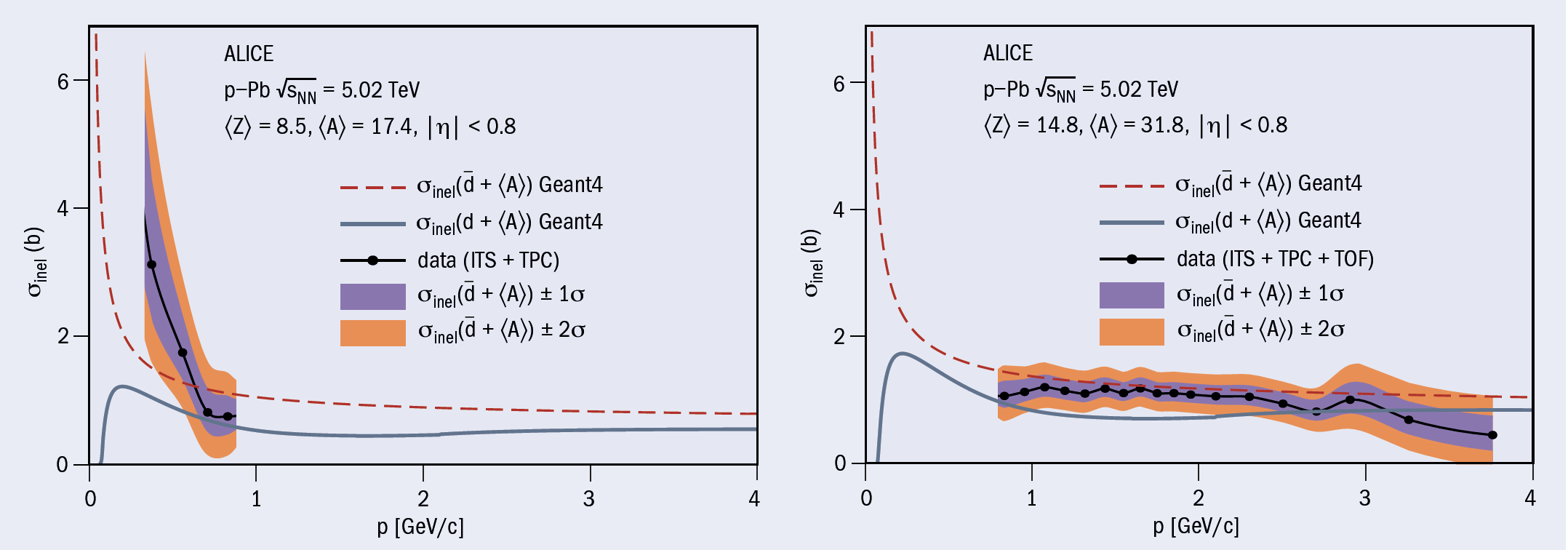
Further helping clarify the results of indirect DM searches, ALICE has recently performed the first measurement of the antideuteron inelastic cross section in the momentum range 0.3 < p < 4 GeV/c – significantly extending our knowledge about this cross section from previous measurements at momenta of 13 and 25 GeV/c at the Serpukhov accelerator complex in Russia in the early 1970s. The collaboration took advantage of the ability of antideuterons produced at the LHC to interact inelastically with the detector material. To quantify this process, ALICE has employed a novel approach based on the antideuteron- to-deuteron ratio reconstructed in collisions of protons and heavy ions at a centre-of-mass energy per nucleon–nucleon pair of 5.02 TeV. Such a ratio depends on both of the inelastic cross sections of deuterons and antideuterons. The former has been measured in various previous experiments at different momenta; the latter can be constrained from the ALICE data by comparing the measured ratio with detailed Monte Carlo simulations.
The resulting antideuteron inelastic cross section is shown (see “Interaction probability” figure), where the two panels correspond to the different sub-detectors employed in the analysis and therefore to different average material crossed by (anti)deuterons – corresponding to a difference of about a factor two in average mass number. The inelastic cross sections include all possible inelastic antideuteron processes such as break-up, annihilation or charge exchange, and the analysis procedure was validated by demonstrating consistency with existing antiproton results from traditional scattering experiments.
The momentum range covered is of particular importance to evaluate the signal predictions for indirect dark-matter searches
The momentum range covered in this latest analysis is of particular importance to evaluate the signal predictions for indirect dark-matter searches. Additionally, these measurements can help researchers to understand the low-energy antideuteron inelastic processes and to model better the inelastic antideuteron cross sections in widely-used toolkits such as Geant4. Together with the proper modelling of antinuclei formation, the obtained results will impact the antideuteron flux expectations at low momentum for ongoing and future satellite- and balloon-borne experiments.
The heavier, the better
ALICE is studying the full range of antinuclei physics with unprecedented precision. These results, which have started to emerge only since 2015, are contributing significantly to our understanding of antinuclei formation and annihilation processes, with important ramifications for DM searches. Both the statistical hadronisation and coalescence models can describe antideuteron production at the LHC, while the detector material can be used as an absorber to study the antinuclei inelastic cross section at low energies relevant for the astrophysical applications.
For the foreseeable future, ALICE will continue to provide an essential reference for the interpretation of astrophysics measurements of antinuclei in space. With the increased integrated luminosity that will be acquired by ALICE during LHC Run 3 from early 2022, it will be possible to extend the current analyses to heavier (anti)nuclei, such as 3He and 4He, with even better precision than the currently available measurements for (anti)deuterons. This will allow the collaboration to perform fundamental tests of the production and annihilation mechanisms with heavier, doubly-charged antinuclei, which are more easily identified by satellite-borne experiments and thus expected to provide an even clearer DM signature.
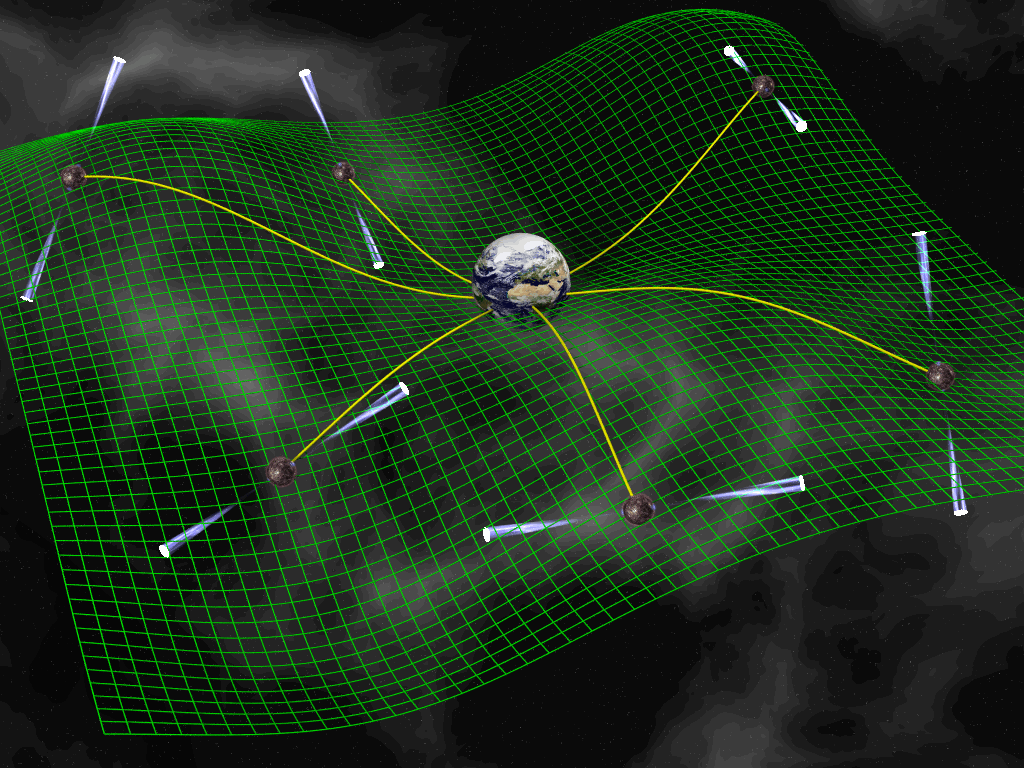
The direct detection of a gravitational wave (GW) in 2015 by the LIGO and Virgo collaborations confirmed the existence of these long sought after events. However, these and other GW events detected so far constitute only a small fraction – in the kHz regime — of the vast GW spectrum. As a result, they only probe certain phenomena such as stellar mass black-hole and neutron-star mergers. On the opposite side of the spectrum to LIGO and Virgo are Pulsar Timing Array (PTA) experiments, which search for nHz frequency GWs. Such low-frequency signals can originate from supermassive black-hole binaries (SMBHBs), while in more exotic models they can be proof of cosmic strings, phase transitions or a primordial GW background. The NANOGrav (North American Nanohertz Observatory for Gravitational Waves) collaboration has now found possible first hints of low-frequency GWs.
To detect such rumblings of space—time, which also have minute amplitudes, researchers need to track subtle movements of measurement points spread out over the size of a galaxy. For this purpose, the NANOGrav collaboration uses millisecond pulsars, several tens of which have been detected in our galaxy. Pulsars are quickly rotating neutron stars which emit cones of electromagnetic emission from their poles. When a pole points towards Earth it is detected as a short pulse of electromagnetic radiation. Not only is the frequency of millisecond pulsars high, making it easier to detect small variations in arrival time, but it is very stable over periods of many years. Combined with their great distances from Earth, this makes millisecond-pulsar emissions sensitive to any small alterations in their travel path — for example, those introduced by distortions of space–time by low-frequency gravitational waves. Such waves would cause the pulses to arrive a few nanoseconds early during January and a few nanoseconds late in June, for instance. By observing the radio emission of these objects once a week throughout many years, researchers can search for such effects.
The new results show a clear sign of a common spectrum between the studied pulsars
The problem is that GWs are not the only things which can cause a change in the arrival time of the pulses. Changes in the Earth’s atmosphere already alter the arrival time, as do changes in the position of the pulsar itself (which is usually part of a quickly rotating binary system), and the movement of Earth with respect to the source. The complexity of the measurements lies mostly in correcting for all of these effects. The latest results from NANOGrav, for example, reduce systematics by incorporating unprecedented precision (of the order of tens of km) in the orbital parameters of Jupiter.
Whereas previous results by NANOGrav and other PTA collaborations only allowed upper limits to be set on the amplitude of the GW background travelling through our galaxy, the new results show a clear sign of a common spectrum between the studied pulsars. Based on 12.5 years of data and a total of 47 pulsars studied using the ultra-sensitive Arecibo Observatory and Green Bank Telescope, the spectrum of variations in the pulsar signal arrival time was found to agree with theoretical predictions of the GW background produced by SMBHBs. The uncertainties remain large, however, which admits alternative interpretations such as cosmic strings which predict only a slightly different spectral shape. Furthermore, a key ingredient is still missing: a spatial correlation between the pulsar variations, which would confirm the quadrupole nature of GWs and provide clear proof of the nature of the signal. Finding this “smoking gun” will require longer observation times, more pulsars and smaller systematic errors — something the NANOGrav team is now working towards.
While the NANOGrav collaboration remains cautious, several exotic interpretations have already been proposed. The final sentences of their preprint summarise the status of this exciting field well: “The LIGO–Virgo discovery of high-frequency, transient GWs from stellar black-hole binaries appeared meteorically, with incontrovertible statistical significance. By contrast, the PTA discovery of very-low-frequency GWs from SMBHBs will emerge from the gradual and not always monotonic accumulation of evidence and arguments. Still, our GW vista on the unseen universe continues to get brighter”.
Quarkonia, the bound states of charm and anti-charm or bottom and anti-bottom quarks, are an important tool to test our knowledge of quantum chromodynamics (QCD). At the LHC, the study of quarkonia polarisations offers a valuable new window onto how heavy quarks bind together in such states. Understanding quarkonium polarisation has already proven to be difficult at lower energies, however, and measurements at the LHC pose significant further challenges.
ALICE measures quarkonia spin orientations with respect to a chosen axis via a measurement of the anisotropy in the angular distribution of the decay products. The angular distribution is parametrised in terms of the polarisation parameters, λθ, λφ and λθφ, where θ and φ are the polar and azimuthal emission angles. If all of them are null, no polarisation is present, whereas (λθ = 1, λφ = 0, λθφ = 0) and (λθ = –1, λφ = 0, λθφ = 0) indicate a polarisation of the spin in the transverse and longitudinal directions, respectively.
Polarisation studies represent a valuable tool for the study of the properties of quark–gluon plasma
In pp collisions, polarisation has been mainly used to investigate the J/ψ production mechanism. Reproducing the small values of polarisation parameter λθ observed at the LHC is a challenge for many theoretical models. Until recently, no corresponding results were available for nucleus–nucleus collisions, and in this domain polarisation studies represent a valuable tool for the study of the properties of quark–gluon plasma (QGP). The formation of this deconfined, strongly interacting medium impacts differently on the various quarkonium resonances, inducing a larger suppression on the less bound excited states ψ(2S) and χc, and modifying their feed-down fractions into the ground state, J/ψ. This effect may lead to a variation of the overall polarisation values since different charmonium states are expected to be produced with different polarisations. In addition, the recombination of uncorrelated heavy-quark pairs inside the QGP gives rise to an extra source of J/ψ, which can further modify the overall polarisation with respect to pp collisions.
The ALICE experiment has recently made the first measurements of the J/ψ and ϒ(1S) polarisation in Pb–Pb collisions. The data correspond to a centre-of-mass energy √(sNN) = 5.02 TeV, and the rapidity range 2.5 < y < 4. The measurements were carried out in the dimuon decay channel, and results were obtained in two different reference frames, helicity and Collins–Soper, each of them with its own definition of the quantisation axis. In the helicity frame, the quarkonium momentum direction in the laboratory is chosen, while the bisector of the angle formed by the two colliding beams boosted in the quarkonium rest frame is used in the Collins–Soper frame. The J/ψ polarisation parameters, evaluated in three pT bins covering the range between 2 and 10 GeV, are close to zero, but with a maximum positive deviation for λθ (corresponding to a transverse polarisation) of 2σ for 2 < pT < 4 GeV in the helicity reference frame. Interestingly, the corresponding LHCb pp result for prompt J/ψ at √(sNN) = 7 TeV instead shows a small but significant longitudinal polarisation.
The observation of a significant difference between J/ψ polarisation results in pp and Pb–Pb collisions motivates further experimental and theoretical studies, with the main goal of connecting this observable with the known suppression and regeneration mechanisms in heavy-ion collisions. For the rarer ϒ(1S), a bound state of a bottom and an antibottom quark, the inclusive polarisation parameters were found to be compatible with zero within sizeable uncertainties. A higher precision and momentum-differential measurement will be enabled by the ten-fold larger Pb–Pb luminosity expected in Run 3 of the LHC.
The possibility that dark-matter particles may interact via an unknown force, felt only feebly by Standard Model (SM) particles, has motivated substantial efforts to search for dark forces. The force-carrying particle for such hypothesised interactions is often referred to as a dark photon, in analogy with the ordinary photon that mediates the electromagnetic interaction.
In the minimal dark-photon scenario, the dark photon does not couple directly to SM particles; however, quantum-mechanical mixing between the photon and dark-photon fields can generate a small interaction, providing a portal through which dark photons may be produced and through which they might decay into visible final states.
Hidden-valley scenarios exhibit confinement in the dark sector, similarly to how the strong nuclear force confines quarks
While the minimal dark-photon model is both compelling and simple, it is not the only viable dark-sector scenario. Many other well-motivated dark-sector models exist, and some of these would have avoided detection in all previous experimental searches. Fully exploring the space of dark sectors is vital given the lack of signals observed thus far in the simplest scenarios. For example, so-called hidden-valley (HV) scenarios exhibit confinement in the dark sector, similarly to how the strong nuclear force confines SM quarks, would produce a high multiplicity of light hidden hadrons from showering processes in a similar way to jet production in the SM. These hidden hadrons would typically decay displaced from the proton–proton collision, thus failing the criteria employed in previous dark-photon searches to suppress backgrounds due to heavy-flavour quarks. Therefore, it is desirable to perform experimental searches for dark sectors that are less model dependent, by not focusing solely on the minimal dark-photon scenario.
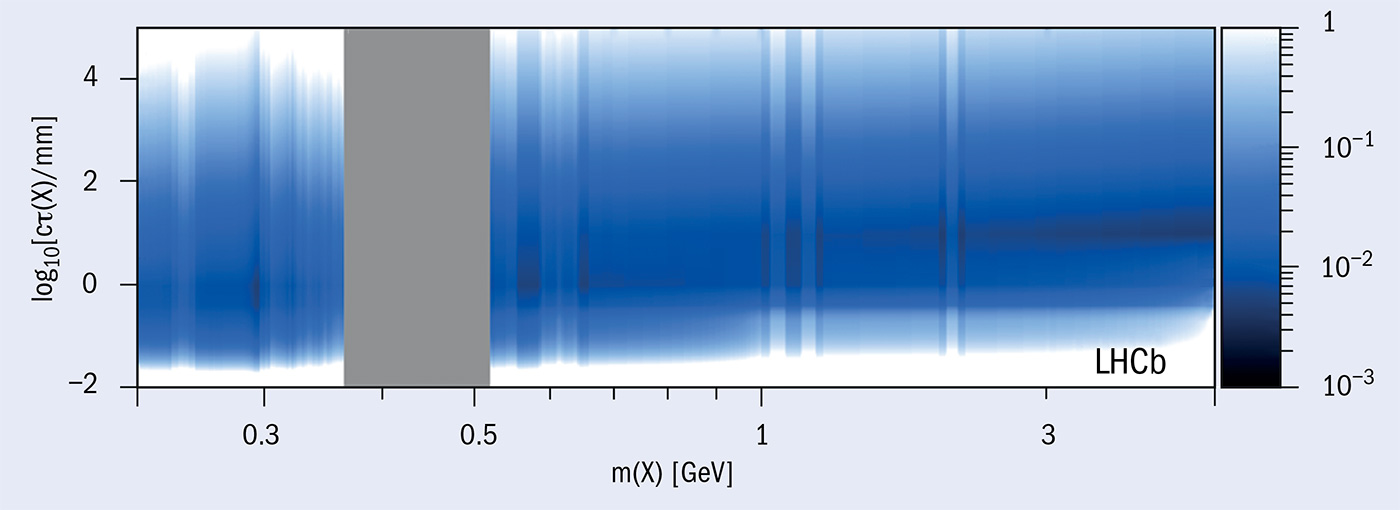
Using its Run-2 data sample, LHCb recently performed searches for both short-lived and long-lived exotic bosons that decay into the dimuon final state. These searches explored the invariant mass range from near the dimuon threshold up to 60 GeV. None of the searches found evidence for a signal and exclusion limits were placed on the X →μ+μ– cross sections, each with minimal model dependence.
For many types of dark-sector models, these limits are the most stringent to date. This is especially true for the HV scenario (see figure), for which LHCb has placed the first such constraints on physically relevant HV mixing strengths in this mass range.
These results demonstrate the unique sensitivity of the LHCb experiment to dark sectors. Looking forward to Run 3, the trigger will be upgraded, greatly increasing the efficiency to low-mass dark sectors, and the luminosity will be higher. Taken together, these improvements will further expand LHCb’s world-leading dark-sector programme.
Exotic charmonium-like states are a very active field of study at the LHC. These states have atypical properties such as non-zero electric charges and strong decays that violate isospin symmetry. The exotic X(3872) charmonium state discovered by the Belle collaboration in 2003 displays such isospin-violating strong decays and has a natural width of about 1 MeV, which is unexpectedly narrow for a state with mass very close to the D*0D0 threshold.
Luciano Maiani and collaborators pointed out that the new CMS measurement can naturally be explained by a tetraquark model of X(3872)
Several theoretical interpretations of the internal structure of these charmonium-like states have been proposed to explain their peculiar properties. To choose the most adequate model for each state, we must continue studying their properties and improving the determination of their parameters. As for the X(3872), although it is inconsistent with the predicted conventional charmonium states and does not have a definite isospin, its production partially resembles that of ordinary charmonium states such as ψ(2S) or χc1(1P). One of the ways to evaluate the degree of similarity between X(3872) and ψ(2S) is to compare their production rates in exclusive b-hadron decays. In the case of ψ(2S), which is a conventional charmonium state, the branching fractions of the decays B0s → ψ(2S)φ, B+ → ψ(2S)K+, and B0 → ψ(2S)K0, are approximately equal to each other. Recent CMS measurements of the corresponding rates for decays to X(3872) show differences, however, which may provide a clue to the nature of this exotic charmonium-like state.
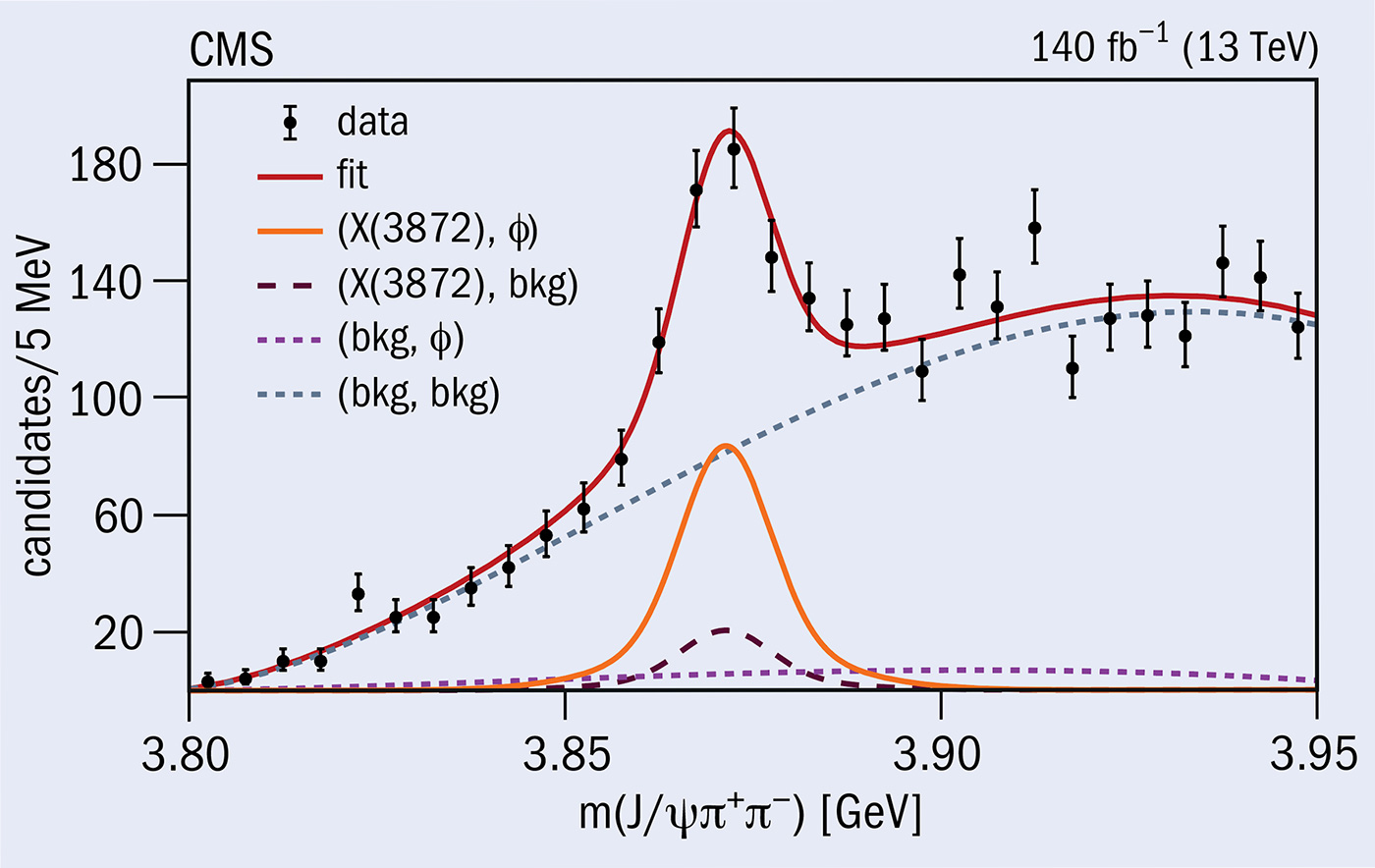
Recently the CMS collaboration observed the decay B0s → X(3872)φ for the first time, with a significance exceeding five standard deviations. The X(3872) is reconstructed via its decay to J/ψπ+π–, followed by a decay of the J/ψ meson into a pair of muons, and of the φ meson to a pair of charged kaons (figure 1).
Diquark hypothesis
At a simple Feynman-diagram level, this decay is a close analogue to the B+ → X(3872)K+ and B0 → X(3872)K0 decays that have previously been observed. The ratio of the branching fractions of this new B0s decay to that of the B+ decay is significantly below unity at 0.48 ± 0.10, while a similar ratio for the decays involving ψ(2S) is consistent with unity. This is not expected from naive “spectator-quark” considerations, based on a simple tree-level diagram, and assuming X(3872) is a pure charmonium state. The measured ratio also happens to be consistent with the analogous ratio for the B0 → X(3872)K0 to B+ → X(3872)K+ decays, though the latter ratio has not yet been measured with high accuracy. The results suggest that spectator quarks behave differently in the B+ and B0(s) two-body decays into X(3872) and a light meson. In a recent theoretical paper, former CERN Director-General Luciano Maiani and collaborators pointed out that the new CMS measurement can naturally be explained by a tetraquark model of X(3872), which describes this exotic particle as a bound state of a diquark (charm and up quarks) and its anti-diquark.
Further studies of X(3872) are now important in order to gain a deeper understanding of its exotic properties and uncover its mysterious nature. The results may have interesting consequences for our understanding of quantum chromodynamics.
Understanding how the strong interaction binds the ingredients of atomic nuclei is the central quest of nuclear physics. Since the 1960s CERN’s ISOLDE facility has been at the forefront of this quest, producing the most extreme nuclear systems for examination of their basic characteristic properties.
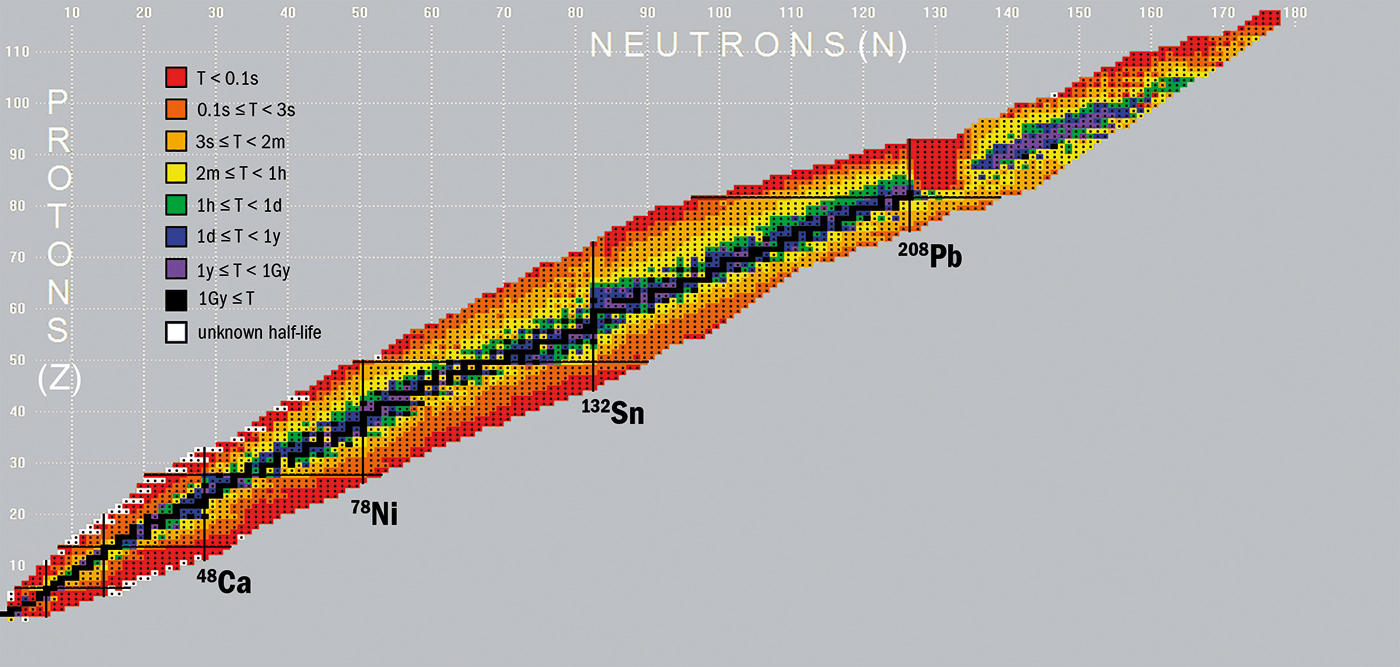
A chemical element is defined by the number of protons in its nucleus, with the number of neutrons defining its isotopes. Apart from a few interesting exceptions, all elements in nature have at least one stable isotope. These form the so-called valley of stability in the nuclear chart of atomic number versus neutron number (see “Nuclear landscape” figure). Adding or removing neutrons disturbs the nuclear equilibrium and creates isotopes that are generally radioactive; the greater the proton–neutron imbalance, the faster the radioactive decay.
Most of the developments have been exported to other radioactive beam facilities around the world
The mass of a nucleus reveals its binding energy, which reflects the interplay of all forces at work within the nucleus from the strong, weak and electromagnetic interactions. Indications of sudden changes in the nuclear shape, when adding neutrons, are often revealed first indirectly as a sudden change in the mass, and can then be probed in detail by measurements of the charge radius and electromagnetic moments. Such diagnosis – performed by ion-trapping and laser-spectroscopy experiments on short-lived (from a few milliseconds upwards) isotopes – provides the first vital signs concerning the nature of nuclides with extreme proton-to-neutron ratios.
Recent mass-spectrometry measurements and high-precision measurements of nuclear moments and radii at ISOLDE demonstrate the rapid progress being made in understanding the stubborn mysteries of the nucleus. ISOLDE’s state-of-the-art laser-spectroscopy tools are also opening an era where molecular radioisotopes can be used as sensitive probes for physics beyond the Standard Model.
Tools of the trade
Progress in understanding the nucleus has gone hand in hand with the advancement of new techniques. Mass measurements of stable nuclei pioneered by Francis Aston nearly a century ago revealed a near-constant binding energy per nucleon. This pointed to a characteristic saturation of the nuclear force, which underlies the liquid-drop model and led to the semi-empirical mass formula for the nucleus developed by Bethe and von Weizsäcker. With the advent of particle accelerators in the 1930s, more isotopic mass data became available from reactions and decays, bringing new surprises. In particular, comparisons with the liquid drop revealed conspicuous peaks at certain so-called “magic” numbers (8, 20, 28, 50, 82, 126), analogous to the high atomic-ionisation potentials of the closed electron-shell noble-gas elements. These findings inspired the nuclear-shell model, developed by Maria Goeppert-Mayer and Hans Jensen, which is still used as an important benchmark today. The difference with the atomic system is that the force that governs the nuclear shells is poorly understood. This is because nucleons are themselves composite particles that interact through the complex interplay of three fundamental forces, rather than the single electromagnetic force governing atomic structure. The most important question in nuclear physics today is to describe these closed shells from fundamental principles (e.g. the strong interaction between quarks and gluons inside nucleons), to understand why shell structure erodes and how new shells arise far from stability.
A key to reaching a deeper understanding of nuclear structure is the ability to measure the size and shape of nuclei. This was made possible using the precision technique of laser spectroscopy, which was pioneered with tremendous success at ISOLDE in the late 1970s. While increased binding energy is a tell-tale sign of a deforming nucleus, it gives no specific information concerning nuclear size or shape. Closed-shell configurations tend to favour spherical nuclei, but since these are rather rare, a particularly important feature of nuclei is their deformation. Inspecting electromagnetic moments derived from the measured atomic hyperfine structure and the change in charge radii derived from its isotopic shift provides detailed information about nuclear shapes and deformation, beautifully complementing mass measurements.
During the past half-century, nuclear science at ISOLDE has expanded beyond fundamental studies to applications involving radioactive tracers in materials (including biomaterials) and the fabrication of isotopes for medicine (with the MEDICIS facility). But the bulk of the ISOLDE physics programme, around 70%, is still devoted to the elucidation of nuclear structure and the properties of fundamental interactions. These studies are carried out through nuclear reactions, by decay spectroscopy, or by measuring the basic global properties – mass and size – of the most exotic species possible.
Half a century of history
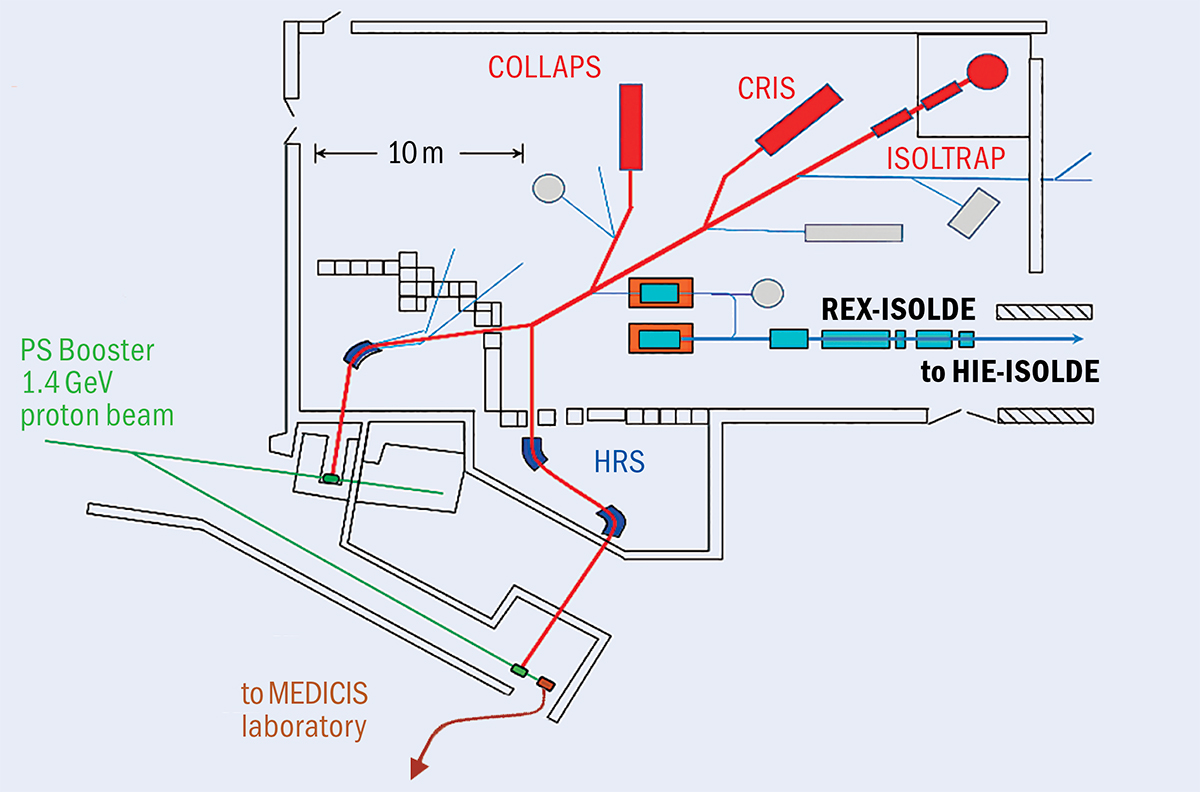
The fabrication of extreme nuclear systems requires a driver accelerator of considerable energy, and CERN’s expertise here has been instrumental. After many years receiving proton beams from a 600 MeV synchrocyclotron (the SC, now a museum piece at CERN), ISOLDE now lies just off the beam line to the Proton Synchrotron (PS), receiving 1.4 GeV beam pulses from the PS Booster (see “ISOLDE from above” figure). ISOLDE in fact receives typically 50% of the pulses in the so-called super-cycle that links the intricate complex of CERN’s injectors for the LHC.
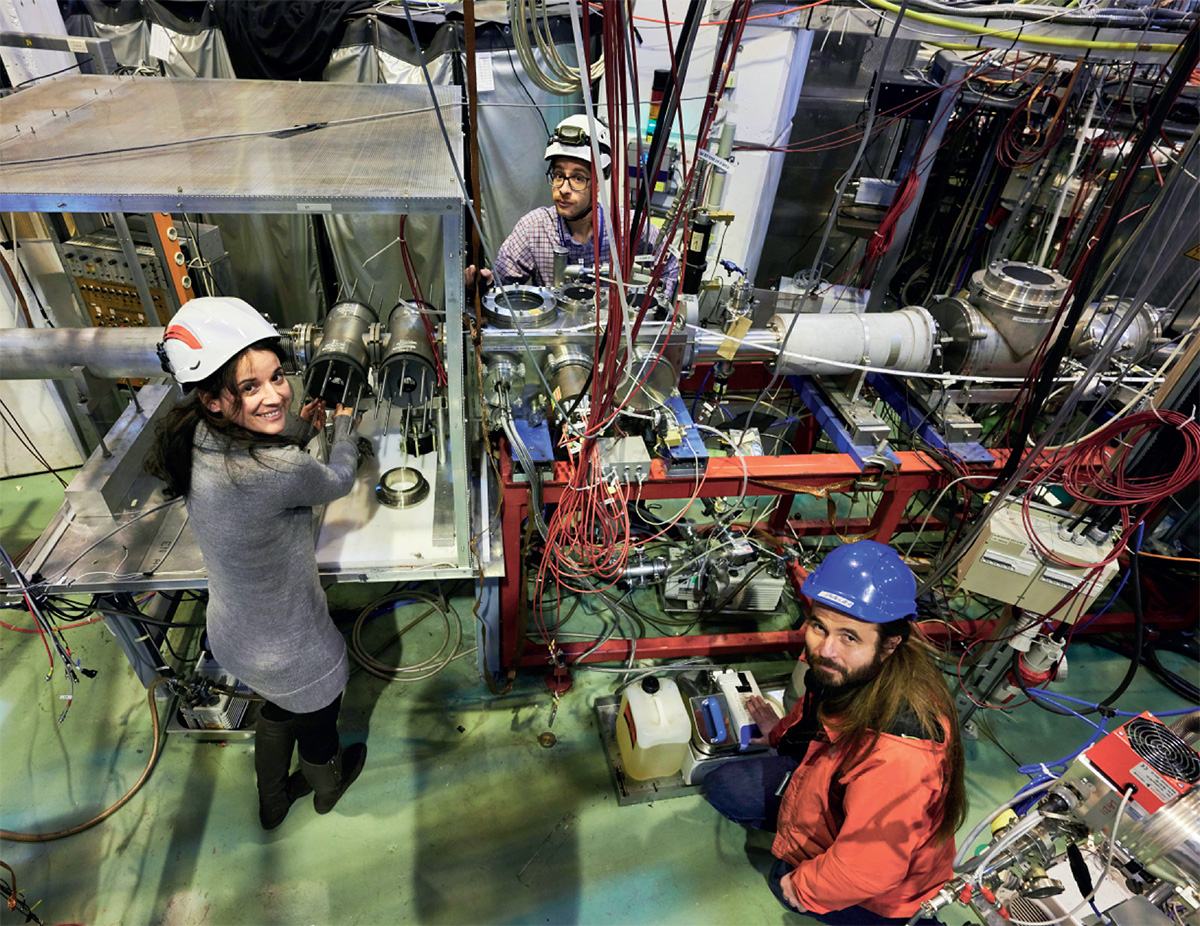
The heart of ISOLDE is a cylindrical target that can contain various different materials. The stable nuclei in the target are dissociated by the proton impact and form exotic combinations of protons and neutrons. Heating the target (up to 2000 degrees) helps these fleeting nuclides to escape into an ionisation chamber, in which they form 1+ ions that are electrostatically accelerated to around 50 keV. Isotopes of one particular mass are selected using one of two available mass separators, and subsequently delivered to the experiments through more than a dozen beamlines. A similar number of permanent experimental setups are operated by several small international collaborations. Each year, more than 40 experiments are performed at ISOLDE by more than 500 users. More than 900 users from 26 European and 17 non-European countries around the world are registered as members of the ISOLDE collaboration.
A new era for fundamental physics research has opened up
ISOLDE sets the global standard for the production of exotic nuclear species at low energies, producing beams that are particularly amenable to study using precision lasers and traps developed for atomic physics. Hence, ISOLDE is complementary to higher energy, heavy-ion facilities such as the Radioactive Isotope Beam Factory (RIBF) at RIKEN in Japan, the future Facility for Rare Isotope Beams (FRIB) in the US, and the Facility for Antiproton and Ion Research (FAIR/GSI) in Europe. These installations produce even more exotic nuclides by fragmenting heavy GeV projectiles on a thin target, and are more suitable for studying high-energy reactions such as breakup and knock-out. Since 2001, ISOLDE has also driven low-energy nuclear-reaction studies by installing a post-accelerator that enables exotic nuclides to be delivered at MeV energies for the study of more subtle nuclear reactions, such as Coulomb excitation and transfer. Post-accelerated radioactive beams have superior optical quality compared to the GeV beams from fragment separators so that the radioactive beams accelerated in the REX and more recent HIE-ISOLDE superconducting linacs enable tailored reactions to reveal novel aspects of nuclear structure.
ISOLDE’s state-of-the art experimental facilities have evolved from more than 50 years of innovation from a dedicated and close-knit community, which is continuously expanding and also includes material scientists and biochemists. The pioneering experiments concerning binding energies, charge radii and moments were all performed at CERN during the 1970s. This work, spearheaded by the Orsay group of the late Robert Klapisch, saw the first use of on-line mass separation for the identification of many new exotic species, such as 31Na. This particular success led to the first precision mass measurements in 1975 that hinted at the surprising disappearance of the N = 20 shell closure, eight neutrons heavier than the stable nucleus 23Na. In collaboration with atomic physicists at Orsay, Klapisch’s team also performed the first laser spectroscopy of 31Na in 1978, revealing the unexpected large size of this exotic isotope. To reach heavier nuclides, a mass spectrometer with higher resolution was required, so the work naturally continued at the expanding ISOLDE facility in the early 1980s.
Meanwhile, another pioneering experiment was initiated by the group of the late Ernst-Wilhelm Otten. After having developed the use of optical pumping with spectral lamps in Mainz to measure charge radii, Otten’s group exploited ISOLDE’s first offerings of neutron-deficient Hg isotopes and discovered the unique feature of shape-staggering in 1972. Through continued technical improvements, the Mainz group established the collinear laser spectroscopy (COLLAPS) programme at ISOLDE in 1979, with results on barium and ytterbium isotopes. When tunable lasers and ion traps became available in the early 1980s, the era of high-precision measurements of radii and masses began. These atomic-physics inventions have revolutionised the study of isotopes far from stability and the initial experimental set-ups are still in use today thanks to continuous upgrades and the introduction of new measurement methods. Most of these developments have been exported to other radioactive beam facilities around the world.
Mass measurements with ISOLTRAP
ISOLTRAP is one of the longest established experiments at ISOLDE. Installed in 1985 by the group of Hans-Jürgen Kluge from Mainz, it was the first Penning trap on-line at a radioactive beam facility, spawning a new era of mass spectrometry. The mass is determined from the cyclotron frequency of the trapped ion, and bringing the technique on line required significant and continuous development, notably with buffer-gas cooling techniques for ion manipulation. Today, ISOLTRAP is composed of four ion traps, each of which has a specific function for preparing the ion of interest to be weighed.
Since the first results on caesium, published in 1987, ISOLTRAP has measured the masses of more than 500 species spanning the entire nuclear chart. The most recent results, published this year by Vladimir Manea (Paris-Saclay), Jonas Karthein (Heidelberg) and colleagues, concern the strength of the N = 82 shell closure below the magic (Z = 50) 132Sn from the masses of (Z = 48) 132,130Cd. The team found that the binding energy only two protons below the closed shell was much less than what was predicted by global microscopic models, stimulating new ab-initio calculations based on a nucleon–nucleon interaction derived from QCD through chiral effective-field theory. These calculations were previously available for lighter systems but are now, for the first time, feasible in the region just south-east of 132Sn, which is of particular interest for the rapid neutron-capture process creating elements in merging neutron stars.
The other iconic doubly magic nucleus 78Ni (Z = 28, N = 50) is not yet available at ISOLDE due to the refractory nature of nickel, which slows its release from the thick target so that it decays on the way out. However, the production of copper – just one proton above – is so good that CERN’s Andree Welker and his colleagues at ISOLTRAP were recently able to probe the N = 50 shell by measuring the mass of its nuclear neighbour 79Cu, finding it to be consistent with that of the doubly magic 78Ni nucleus. Masses from large-scale shell-model calculations were in excellent agreement with the observed copper masses, indicating the preservation of the N = 50 shell strength but with some deformation energy creeping in to help. Complementary observables from laser spectroscopy helped to tell the full story, with results on moments and radii from the COLLAPS and the more recent Collinear Resonance Ionization Spectroscopy (CRIS) experiments adding an interesting twist.
Laser spectroscopy with COLLAPS and CRIS
Quantum electrodynamics provides its predictions of atomic energy levels mostly by assuming the nucleus is point-like and infinitely heavy. However, the nucleus indeed has a finite mass as well as non-zero charge and current distributions, which impact the fine structure. Thus, complementary to the high-energy scattering experiments used to probe nuclear sizes, the energy levels of orbiting electrons offer a marvellous probe of the electric and magnetic properties of the nucleus. This fact is exploited by the elegant technique of laser spectroscopy, a fruitful marriage of atomic and nuclear physics realised by the COLLAPS collaboration since the late 1970s. COLLAPS uses tunable continuous-wave lasers for high-precision studies of exotic nuclear radii and moments, and similar setups are now running at other facilities, such as Jyvaskyla in Finland, TRIUMF in Canada and NSCL-MSU in the US.
A recent highlight from COLLAPS, obtained this year by Simon Kaufmann of TU Darmstadt and co-workers, is the measurement of the charge radius of the exotic, semi-magic isotope 68Ni. Such medium-mass exotic nuclei are now in reach of the modern ab-initio chiral effective-field theories, which reveal a strong correlation between the nuclear charge radius and its dipole polarisability. With both measured for 68Ni, the data provide a stringent benchmark for theory, and allow researchers to constrain the point-neutron radius and the neutron skin of 68Ni. The latter, in turn, is related to the nuclear equation-of-state, which plays a key role in supernova explosions and compact-object mergers, such as the recent neutron-star merger GW170817.
Building on pioneering work by COLLAPS, the collinear laser beamline, CRIS, was constructed at ISOLDE 10 years ago by a collaboration between the groups of Manchester and KU Leuven. In CRIS, a bunched atom beam is overlapped with two or three pulsed laser beams that are resonantly laser-ionised via a particular hyperfine transition. These ions are then deflected from the remaining background atoms and counted in quasi background-free conditions. CRIS has dramatically improved the sensitivity of the collinear laser spectroscopy method so that beams containing just a few tens of ions per second can now be studied with the same resolution as the optical technique of COLLAPS.
Ruben de Groote of KU Leuven and co-workers recently used CRIS to study the moments and charge radii of the copper isotopes up to 78Cu, providing critical information on the wave function and shape of these exotic neighbours, and insight on the doubly magic nature of 78Ni. Both the ISOLTRAP and CRIS results provide a consistent picture of fragile equilibrium in 78Ni, where the failing strength of the proton and neutron shell closures is shored up with binding energy brought by slight deformation.
These precision measurements in new regions of the nuclear chart bring complementary observables that must be coherently described by global theoretical approaches. They have stimulated and guided the development of new ab-initio results, which now allow the properties of extreme nuclear matter to be predicted. While ISOLDE cannot produce absolutely all nuclides on the chart (for example, the super-heavy elements), precision tests in other, key regions provide confidence in the global-model predictions in regions unreachable by experiment.
Searches for new physics
By combining the ISOLDE expertise in radioisotope production with the mass spectrometry feats of ISOLTRAP and the laser spectroscopy prowess from the CRIS and RILIS (Resonant Ionization Laser Ion Source) teams, a new era for fundamental physics research has opened up. It is centred on the ability of ISOLDE to produce short-lived radioactive molecules composed of heavy pear-shaped nuclei, in which a putative electric dipole moment (EDM) would be amplified to offer a sensitive test of time-reversal and other fundamental symmetries. Molecules of radium fluoride (RaF) are predicted to be the most sensitive probes for such precision studies: the heavy mass and octupole-deformed (pear shape) of some radium isotopes, immersed in the large electric field induced by the molecular RaF environment, makes these molecules very sensitive probes for symmetry-violation effects, such as the existence of an EDM. However, these precision studies require laser cooling of the RaF molecules, and since all isotopes of Ra are radioactive, the molecular spectroscopy of RaF was only known theoretically.
This year, for the very first time, an ISOLDE collaboration led by CRIS collaborator Ronald Garcia Ruiz at CERN was able to produce, identify and study the spectroscopy of RaF molecules, containing different long-lived radioisotopes of radium. Specific Ra isotopes were chosen because of their octupole nature, as revealed by experiments at the REX- and HIE-ISOLDE accelerators in 2013 and 2020. The measured molecular excitation spectral properties provide clear evidence for an efficient laser-cooling scheme, providing the first step towards precision studies.
Many interesting new-physics opportunities will open up using different kinds of radioactive molecules tuned for sensitivity to specific symmetry violation aspects to test the Standard Model, but also with potential impact in nuclear physics (for example, enhanced sensitivity to specific moments), chemistry and astrophysics. This will also require dedicated experimental set-ups, combining lasers with traps. The CRIS collaboration is preparing these new set-ups, and the ability to produce RaF and other radioactive molecules is also under investigation at other facilities, including TRIUMF and the low-energy branch at FRIB. More than 50 years after its breakthrough beginning, ISOLDE continues to forge new paths both in applied and fundamental research.
The discovery of the Higgs boson in 2012 was the culmination of almost five decades of research, beginning in 1964 with the theoretical proposal of the Brout–Englert–Higgs (BEH) mechanism. This discovery was monumental, but was itself just a beginning, and research into the properties of the Higgs boson and the BEH mechanism, which has unique significance for the dynamics of the Standard Model, stretches the horizons of even the most ambitious future-collider proposal. Despite this, the ATLAS and CMS collaborations have already made three major discoveries relating to the Higgs boson. These are the jewels in the crown of LHC research so far: an elementary spin-zero particle, the mechanism that makes the weak interaction short range, and the mechanism that gives the third-generation fermions their masses. They can be related to three distinct classes of measurements: the decay of the Higgs boson into two photons, and its production from and decays into the weak force carriers and third-generation fermions, respectively.
Until 2012, the list of elementary particles could be divided into just two broad classes: spin-1/2 matter particles (fermions) and spin-1 force carriers (vector bosons), with a spin-2 force carrier (the graviton) pencilled in by most theorists to mediate the gravitational force. The first jewel in the LHC’s crown is the discovery of an elementary spin-0 particle – the first and only particle of this type to have been discovered. The question of the spin of the Higgs boson is intrinsically linked to the dominant discovery mode in 2012: the decay into two photons. Conservation laws insist that only a spin-0 or spin-2 particle can decay into two photons.
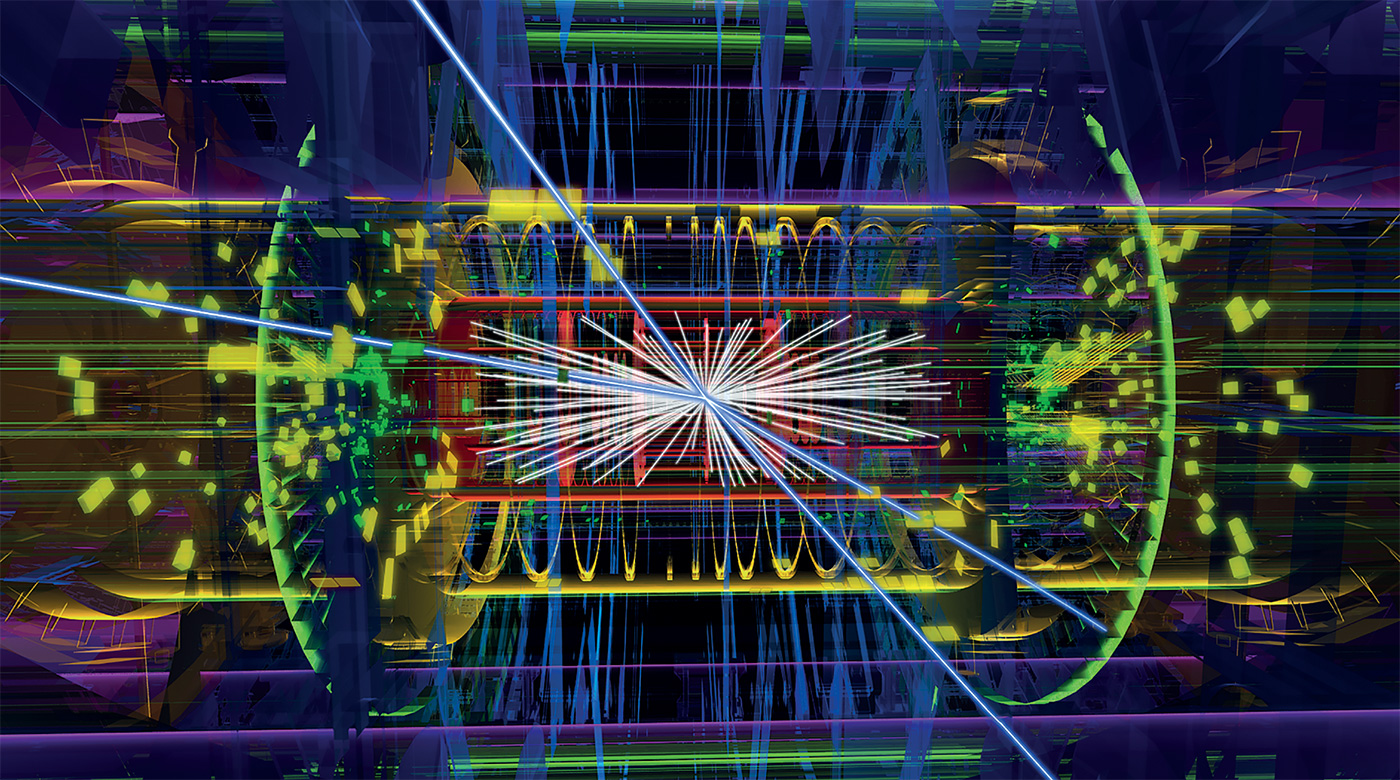
To decide between the two spin options, a more complex study than just measuring decay rates was needed. The spin of the parent particle affects the angular distributions of the daughter particles of Higgs-boson decays. Studies began immediately within ATLAS and CMS, showing unambiguously that the newly discovered particle was spin-0. The ways in which this particle is produced and the ways in which it decays call for its identification with the only particle that was predicted by the Standard Model of particle physics that had not been observed by 2012 – the Higgs boson. The field related to this particle is the BEH field.
The next question was whether this new particle is elementary or composite. If the Higgs boson is actually a composite spin-0 particle, then there should be a whole series of new composite particles with different quantum numbers – in particular, spin-1 particles whose mass scale is roughly inversely proportional to the distance scale that characterises their internal structure.
One can test the question of whether the Higgs boson is elementary or composite in three ways. Firstly: indirectly. The virtual effects of these heavy spin-1 particles would modify the properties of the W and Z bosons. Part of the legacy of the LEP experiments, which operated at CERN between 1989 and 2000, and the SLD experiment, which operated in SLAC between 1992 and 1998, is a large class of precision measurements of these properties. The other two ways are pursued by the LHC experiments: the direct search for the new spin-1 particles, and precision measurements of properties of the Higgs boson itself, such as its couplings to electroweak vector-boson pairs, which would differ if it were composite. No such composite excitations have been discovered to date, and the Higgs boson shows no signs of internal structure down to a scale of 10–19 m – some four orders of magnitude smaller than the proton.
The electromagnetic and strong interactions are mediated by massless mediators – the photon and the gluon. Consequently, they are long-range, though colour confinement – the phenomenon that quarks and gluons cannot be isolated – renders the long-range effects of the strong interaction unobservable. By contrast, weak interactions are mediated by massive mediators – the W and Z bosons – with masses of the order of 100 times larger than that of the proton. As a result, the weak force is exponentially suppressed at distances larger than 10–18 m.
A common feature of the electromagnetic, strong and weak forces is that their mediators are all spin-1. This type of interaction is very special. By assuming that nature has certain gauge symmetries, our current quantum field theories can predict the existence of these types of interactions, and many of their features. There are numerous predictions stemming from these symmetries that have been successfully tested by experiments, such as the identical couplings between gluons and quarks of all flavours, the fact that photons don’t interact with each other, and the structure of higher-order corrections, for example the running of coupling constants and the anomalous magnetic moment of the electron and the muon. Yet, as the mass term in the Lagrangian isn’t invariant under gauge transformations, gauge symmetry predicts, at least naively, that the spin-1 force carriers should be massless. So, while the symmetries that predict the electromagnetic and strong interactions also explain why their force carriers are massless, the symmetry principle that predicts the weak interaction is challenged by the experimental fact that its force carriers are massive.
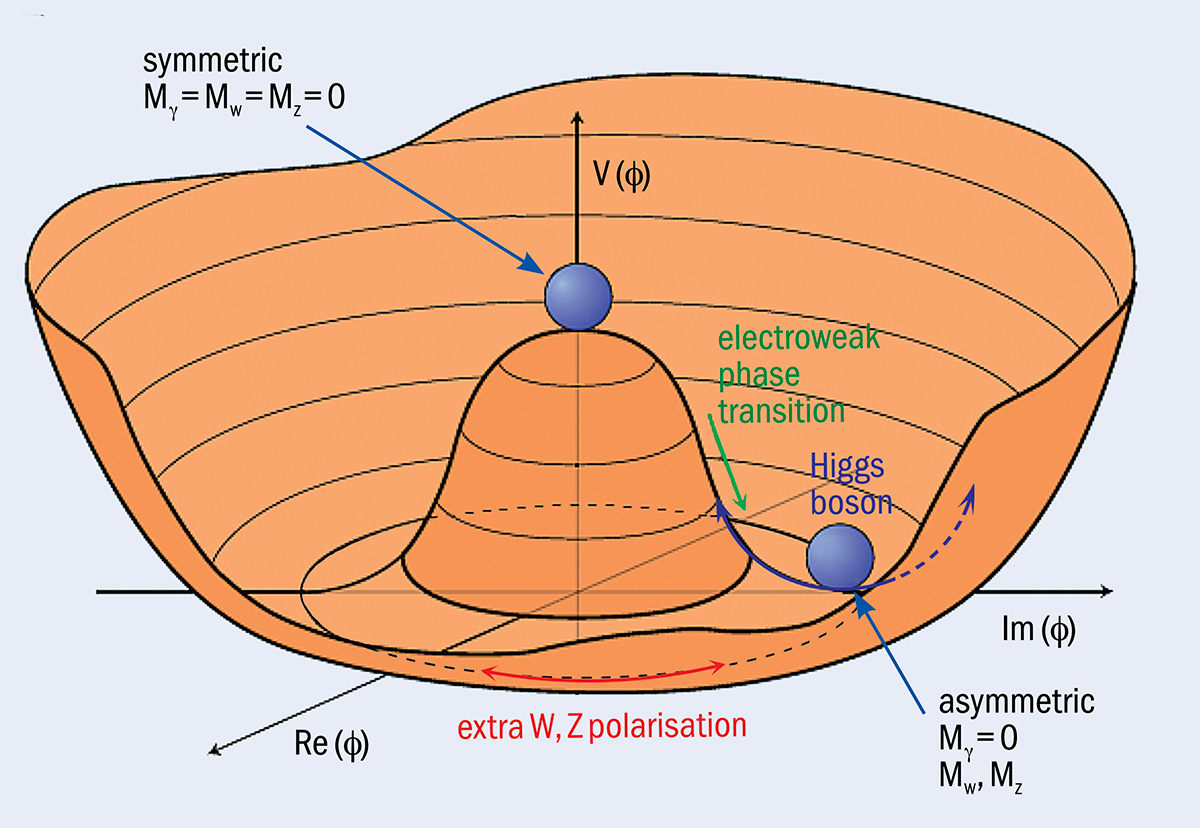
This conundrum has a possible solution if a symmetry is respected by the quantum field theory but not by the ground state of the universe (see “Broken symmetry” image). The theory’s predictions will then be different from those that would follow if the ground state were also symmetric. One way in which the symmetry can be broken is if there is a scalar field that does not vanish in the ground state. This is the case for the Higgs potential, which, unlike a purely parabolic potential, does not have rotational symmetry around its ground state. The weak-force carriers are affected by their interaction with the BEH field, and this interaction slows them down. Moving at speeds slower than the speed of light – the consequence of interacting with the BEH field in the ground state – is equivalent to having non-zero masses, making weak interactions short range. These insights also transformed our understanding of the early universe. Following the Glashow–Weinberg–Salam breakthrough shortly after the BEH proposal, the Standard Model presents a universe in which the ground state transitioned from zero to non-zero due to the spontaneous breaking of electroweak symmetry – a cosmological event that took place when the universe was about 10-11 seconds old.
A BEH field different from zero in the ground state of the universe has important observational and experimental consequences. For example, if the symmetry were unbroken, a process where a single Higgs particle decays into a pair of Z bosons would be forbidden. But, once the ground state of the universe breaks the symmetry – the BEH field is non-zero – this process is allowed to occur. (Strictly speaking, the Higgs boson cannot decay into two Z bosons because the sum of their masses is larger than the mass of the Higgs boson, however, the Higgs boson can decay into a real Z boson and a virtual one that produces a pair of fermions.) Similarly, the symmetry would not allow a single Higgs-boson production from Z-boson fusion. But, once the ground state of the universe breaks the symmetry, the latter process is also allowed to occur.
An asymmetric ground state costs the theory none of its predictive power. The strength of the interaction of the Z boson with the BEH field, measured by the mass it gains from this interaction, is closely related to the strength of the interaction of the Z boson with the Higgs particle, measured by the rate at which the Higgs boson decays into two Z bosons, or by the rate at which it is produced by Z-boson fusion. This relation is commonly expressed as the ratio μZZ* between the measured and the predicted rates: if the field related to the newly discovered spin-0 particle is indeed responsible for the mass of the Z boson, then μZZ* = 1.
ATLAS and CMS have established a new law of nature
The rate of the Higgs decay into two Z bosons was first measured with 5σ significance by the ATLAS and CMS experiments in 2016. Its current value is μZZ* ≈ 1.2 ± 0.1. The rate at which the Higgs boson decays into a pair of W bosons was measured in the same year. Its current value of μWW* ≈1.2 ± 0.1 also corresponds to the strength of interaction that would give the W boson its mass. Finally, the experiments measured the rate at which a single Higgs boson is produced in vector-boson fusion to be μVBF ≈ 1.2 ± 0.2. Thus, ATLAS and CMS have established a new law of nature: the force carriers of the weak interaction gain their masses via their interactions with the everywhere-present BEH field. The strength of this interaction is precisely the right size to limit the effects of the weak interaction to distances shorter than 10–18 metres.
Third generation, third jewel
The third jewel in the crown of the LHC is the explanation for how the tau-lepton and the top and bottom quarks – members of the third, heaviest fermion family – gain their masses. The same electroweak symmetry that predicts that the weak-force carriers should be massless also predicts that all 12 spin-1/2 matter particles known to us should also be massless. Experiments have shown, however, that all the matter particles are massive, with the one possible exception of the lightest neutrino. The fact that this symmetry is broken in the ground state of the universe also opens the door to the possibility that matter particles gain masses. But via what mechanism? For the ground state of the BEH field to slow down the fermions as well as the W and Z bosons, a new type of interaction has to exist: an interaction with a spin-0 mediator – the Higgs boson itself. Discovering a Higgs-boson decay into a pair of fermions would mean the discovery of this new type of spin-0 mediated interaction, which was first proposed in a different context by Hideki Yukawa in the 1930s.
Yukawa interactions are fundamentally different from the interactions through which the W and Z bosons get their mass because they are not deduced from a symmetry principle. Another difference, in contrast not only to weak, but also to strong and electromagnetic interactions, is that the interaction strength is not quantised. However, the strength of the interaction of a matter particle with the BEH field, measured by the mass it gains from this interaction, is still closely related to the strength of the Yukawa interaction of that matter particle with the Higgs boson, measured by the rate at which the Higgs boson decays into two such fermions. Once again, if the field that gives the matter particles their masses is indeed the one related to the newly discovered spin-0 particle, then the measured decay rate of the Higgs particle to fermion pairs should give a value of unity to the corresponding μ-ratio.
The three heaviest spin-1/2 particles – the top quark, the bottom quark and the tau lepton – are expected to have the strongest couplings to the Higgs boson, and consequently the largest rates of Yukawa interactions with it. The first Yukawa interaction to be measured, with the significance in both the ATLAS and CMS analyses rising to 5σ in 2015, concerned the decay of a Higgs boson into a tau lepton–antilepton pair. The current decay rate is μτ+τ– ≈ 1.15 ± 0.15, which, within present experimental accuracy, corresponds to the strength of interaction that would give the tau lepton its mass. The rate of Higgs-boson decays into the bottom quark–antiquark pair was measured by ATLAS and CMS three years later. The current value is μbb– ≈ 1.04 ± 0.13. Within present experimental accuracy, this corresponds to the strength of interaction that would give the bottom quark its mass.
The potential of the LHC to discover new facts about nature and the universe is far from saturated
In the case of the top quark, the Higgs boson has a vanishingly tiny decay rate into a top–antitop pair, because the mass of each is individually larger than that of a Higgs boson, and both would have to be produced virtually. To extract the strength of the Higgs–top interaction, experiments instead measure the rate at which this trio of particles is produced. The rate of the production of a Higgs boson together with a top quark–antiquark pair was measured by the ATLAS and CMS experiments in 2018. The current value is μtt–h ≈ 1.3 ± 0.2. Within present experimental accuracy, this value corresponds to the strength of interaction that would give the top quark its mass. (The remaining third-generation particle, a neutrino, is at least 12 orders of magnitude lighter than the top quark, and is suspected to derive its mass via a different mechanism, which is unlikely to be tested experimentally in the near future.)
ATLAS and CMS have therefore discovered a new fact about nature: the third-generation charged particles – the tau lepton, the bottom quark and the top quark – also gain their masses via their interaction with the everywhere-present BEH field. This is also the discovery of the new and rather special Yukawa interactions among elementary particles, which are mediated by a spin-0 force carrier, the Higgs boson.
The path forward
Answering questions about nature’s fundamental workings almost always leads to new questions. The discovery of the Higgs boson has already been the source of at least two. Firstly, the value of the Higgs boson’s mass suggests the possibility that our universe is likely in an unstable state. In the extremely distant future, a transition to an entirely different universe with a different ground state could occur. Should this remain true as precision improves, not only is there nothing special about Earth, nor the solar system, nor even Milky Way galaxy, but the fundamental structure of the universe is itself only temporary. What’s more, the lightness of the mass of the Higgs boson compared to both the Planck scale (above which quantum-gravity effects become significant) and the “seesaw scale” (below which new particles, beyond those of the Standard Model, are predicted to exist), poses a challenge to the basic framework that we use to formulate the laws of nature. In quantum field theory, cancellations between tree-level and higher order loop-diagram contributions to the mass of the Standard Model Higgs boson are huge, and require extreme fine-tuning, perhaps by as many as 32 orders of magnitude, between seemingly unrelated constants of nature. Various ideas of how to restore “naturalness”, such as supersymmetry and Higgs compositeness, have been suggested, but the LHC experiments have not uncovered any of the TeV-scale particles predicted by these models and are ruling out ever-increasing swathes of parameter space for the models.
The potential of the LHC to discover new facts about nature and the universe is far from saturated. There are at least two additional, big open questions that are guaranteed to be answered, at least in part, by the LHC experiments. First is the understanding of the mechanism that gives second-generation particles – in particular the muon and the charm quark – their masses. That may be the same mechanism as the one that has been shown to give the third-generation fermions masses, or it may be different (for the latest progress, see Turning the screw on H → μμ). Second is the question of what happened at the electroweak phase transition in the early universe? It may have been a smooth crossover, where the value of the BEH field changed from zero to its present value continuously and uniformly in space, as predicted by the combination of the Standard Model of particle physics and the Big Bang model, or it may have been a first-order phase transition, where bubbles with a finite value of the BEH field nucleated within the surrounding plasma. A first-order phase transition could open the door to a new mechanism to explain the matter–antimatter imbalance in the universe. These deep questions depend on a new chapter of Higgs research concerning the self-interaction of the Higgs boson, which will be carried forward by a future collider.
Beyond constituting amazing intellectual and technological achievements, the LHC experiments have already made a series of profound discoveries about nature. The existence of a spin-0 particle whose non-zero force field is responsible for both the short range of weak interactions and, in a distinct way, the masses of spin-1/2 particles, represents three major discoveries. That theorists have long speculated on these new laws of nature ideas must not diminish the significance of establishing them experimentally. These three jewels in the crown of LHC research, the first steps in the exploration of Higgs physics, begin a trek to some of the most significant open questions in particle physics and cosmology.
To provide the best experiences, we use technologies like cookies to store and/or access device information. Consenting to these technologies will allow us to process data such as browsing behavior or unique IDs on this site. Not consenting or withdrawing consent, may adversely affect certain features and functions.
Functional
Always active
The technical storage or access is strictly necessary for the legitimate purpose of enabling the use of a specific service explicitly requested by the subscriber or user, or for the sole purpose of carrying out the transmission of a communication over an electronic communications network.
Preferences
The technical storage or access is necessary for the legitimate purpose of storing preferences that are not requested by the subscriber or user.
Statistics
The technical storage or access that is used exclusively for statistical purposes.The technical storage or access that is used exclusively for anonymous statistical purposes. Without a subpoena, voluntary compliance on the part of your Internet Service Provider, or additional records from a third party, information stored or retrieved for this purpose alone cannot usually be used to identify you.
Marketing
The technical storage or access is required to create user profiles to send advertising, or to track the user on a website or across several websites for similar marketing purposes.