Supersymmetry (SUSY) provides elegant solutions to many of the problems of the Standard Model (SM) by introducing new boson/fermion partners for each SM fermion/boson, and by extending the Higgs sector. If SUSY is realised in nature at the TeV scale, it would accommodate a light Higgs boson without excessive fine-tuning. It could furthermore provide a viable dark-matter candidate, and be a key ingredient to the unification of the electroweak and strong forces at high energy. The SUSY partners of the SM bosons can mix to form what are called charginos and neutralinos, collectively referred to as electroweakinos.
Electroweakinos would be produced only through the electroweak interaction, where their production cross sections in proton–proton collisions are orders of magnitude smaller than strongly produced squarks and gluinos (the supersymmetric partners of quarks and gluons). Therefore, while extensive searches using the Run 1 (7–8 TeV) and Run 2 (13 TeV) LHC datasets have turned up null results, the corresponding chargino/neutralino exclusion limits remain substantially weaker than those for strongly interacting SUSY particles.
The ATLAS collaboration has recently released a comprehensive analysis of the electroweak SUSY landscape based on its Run 2 searches. Each individual search targeted specific chargino/neutralino production mechanisms and subsequent decay modes. The analyses were originally interpreted in so-called “simplified models”, where only one production mechanism is considered, and only one possible decay. However, if SUSY is realised in nature, its particles will have many possible production and decay modes, with rates depending on the SUSY parameters. The new ATLAS analysis brings these pieces together by reinterpreting 10 searches in the phenomenological Minimal Supersymmetric Standard Model (pMSSM), which includes a range of SUSY particles, production mechanisms and decay modes governed by 19 SUSY parameters. The results provide a global picture of ATLAS’s sensitivity to electroweak SUSY and, importantly, reveals the gaps that remain to be explored.
The 19-dimensional pMSSM parameter space was randomly sampled to produce a set of 20,000 SUSY model points. The 10 selected ATLAS searches were then performed on each model point to determine whether it is excluded with at least 95% confidence level. This involved simulating datasets for each SUSY model, and re-running the corresponding analyses and statistical fits. An extensive suite of reinterpretation tools was employed to achieve this, including preserved likelihoods and RECAST – a framework for preserving analysis workflows and re-applying them to new signal models.
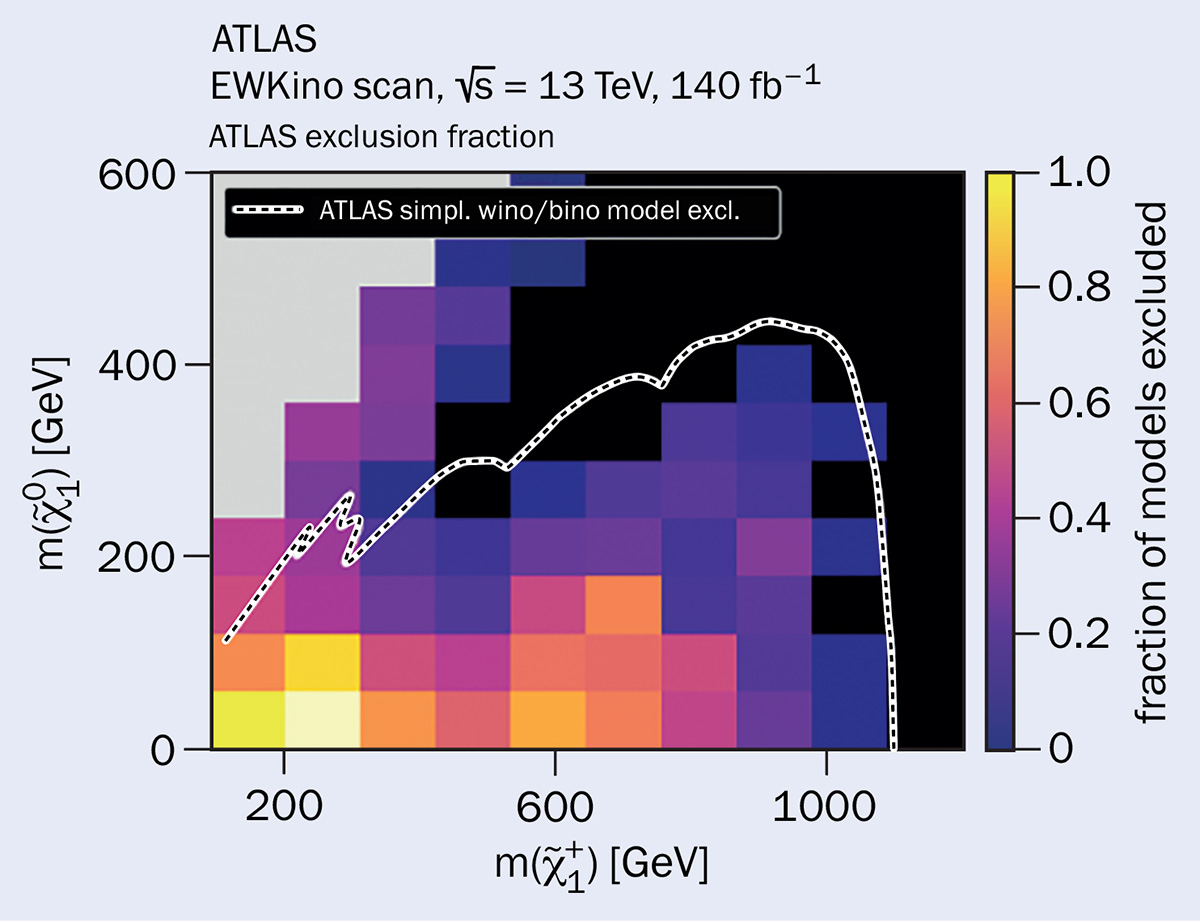
The results show that, while electroweakino masses have been excluded up to 1 TeV in simplified models, the coverage with regard to the pMSSM is not exhaustive. Numerous scenarios remain viable, including mass regions nominally covered by previous searches (inside the dashed line in figure 1). The pMSSM models may evade detection due to smaller production cross-sections and decay probabilities compared to simplified models. Scenarios with small mass-splittings between the lightest and next-to-lightest neutralino can reproduce the dark-matter relic density, but are particularly elusive at the LHC. The decays in these models produce challenging event features with low-momentum particles that are difficult to reconstruct and separate from SM events.
Beyond ATLAS, experiments such as LZ aim at detecting relic dark-matter particles through their scattering by target nuclei. This provides a complementary probe to ATLAS searches for dark matter produced in the LHC collisions. Figure 2 shows the LZ sensitivity to the pMSSM models considered by ATLAS, compared to the sensitivity of its SUSY searches. ATLAS is particularly sensitive to the region where the dark-matter candidate is around half the Z/Higgs-boson mass, causing enhanced dark-matter annihilation that could have reduced the otherwise overabundant dark-matter relic density to the observed value.
The new ATLAS results demonstrate the breadth and depth of its search programme for supersymmetry, while uncovering its gaps. Supersymmetry may still be hiding in the data, and several scenarios have been identified that will be targeted, benefiting from the incoming Run 3 data.
The measured all-particle energy spectrum for cosmic rays (CRs) is famously described by a steeply falling power law. The spectrum is almost featureless from energies of around 30 GeV to 3 PeV, where a break (also known as the “knee”) is encountered, after which the spectrum becomes steeper. It is believed that CRs with energies below the knee have galactic origins. This is supported by the observation of diffuse gamma rays from the galactic disk in the GeV range (a predominant mechanism for the production of gamma rays is via the decay of neutral pions created when relativistic protons interact with the ambient gas). The knee could be explained by either the maximum energy that galactic sources can accelerate CR particles to, or the escape of CR particles from the galaxy if they are energetic enough to overcome the confinement of galactic magnetic fields. Both scenarios, however, assume the presence of astrophysical sources within the galaxy that could accelerate CR particles up to PeV energies. For decades, scientists have therefore been on the hunt for such sources, reasonably called “pevatrons”.
Recently, researchers at the High-Altitude Water Cherenkov (HAWC) observatory in Mexico reported the observation of ultra-high energy (> 100 TeV) gamma rays from the central region of the galaxy. Using nearly seven years of data, the team found that a point source, HAWC J1746-2856, with a simple power-law spectrum and no signs of a cutoff from 6 to 114 TeV best describes the observed gamma-ray flux. A total of 98 events were observed at energies above 100 TeV.
To analyse the spatial distribution of the observed gamma rays, the researchers plotted a significance map of the galactic centre. On this map, they also plotted the point-like supernova remnant SNR G0.9+0.1 and an unidentified extended source HESS J1745-303, both located 1° away from the galactic centre. While supernova remnants have long been a favoured candidate for galactic pevatrons, HAWC did not observe any excess at either of these source positions. There are, however, two other interesting point sources in this region: Sgr A* (HESS J1745-290), the supermassive black hole in the galactic centre; and HESS J1746-285, an unidentified source that is spatially coincident with the galactic radio arc. Imaging atmospheric Cherenkov telescopes such as HESS, VERITAS and MAGIC have measured the gamma-ray emissions from these sources up to an energy of about 20 TeV, but HAWC has an angular resolution about six times larger at such energies and therefore cannot resolve them.
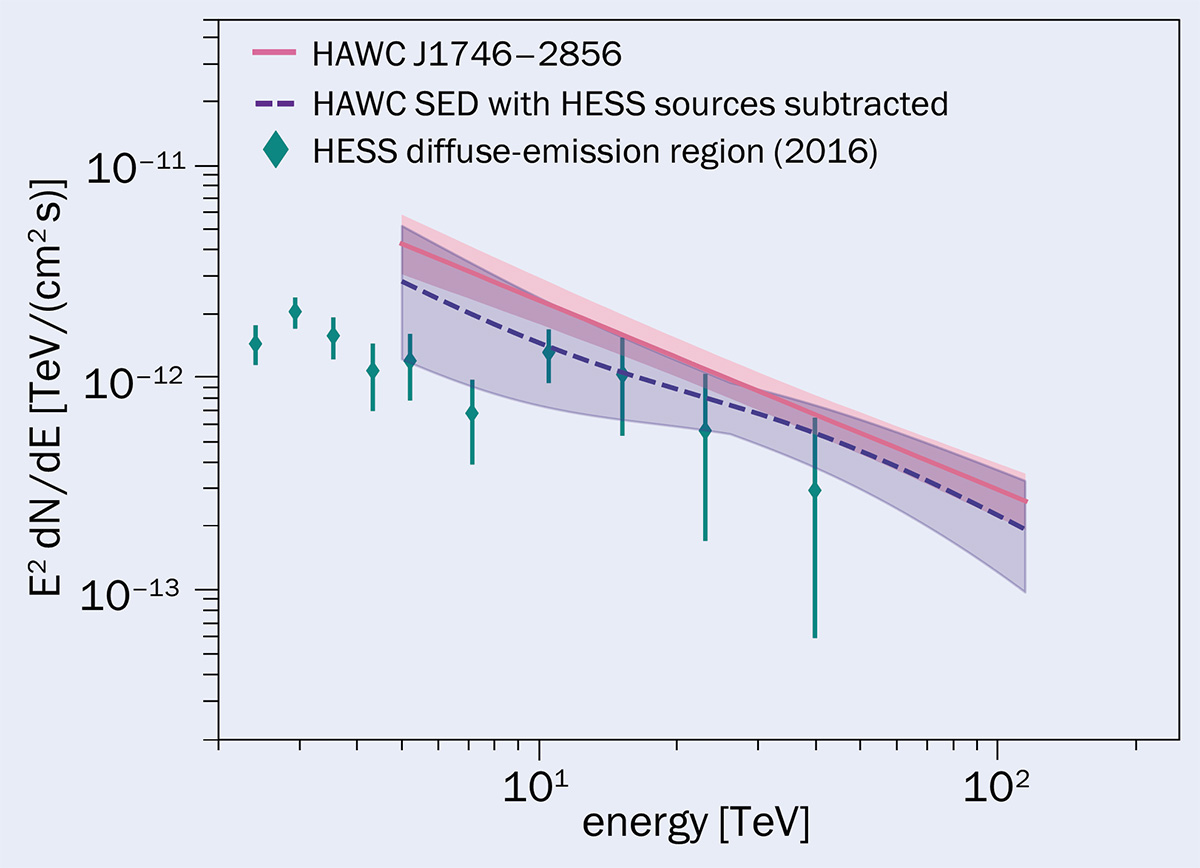
To eliminate the contamination to the flux from these sources, the authors assumed that their spectra cover the full HAWC energy range and then estimated the event count by convolving the reported best-fit model from HESS with the instrument-response functions of HAWC. The resulting HAWC spectral energy distribution, after subtracting these sources (see figure), seems to be compatible with the diffuse emission data points from HESS while still maintaining a power-law behaviour, with no signs of a cutoff and extending up to at least 114 TeV. This is the first detection of gamma rays at energies > 100 TeV from the galactic centre, thereby providing convincing evidence of the presence of a pevatron.
This is the first detection of gamma rays at energies > 100 TeV from the galactic centre
Furthermore, the diffuse emission is spatially correlated with the morphology of the central molecular zone (CMZ) – a region in the innermost 500 pc of the galaxy consisting of enormous molecular clouds corresponding to around 60 million solar masses. Such a correlation supports a hadronic scenario for the origin of cosmic rays, where gamma rays are produced via the interaction of relativistic protons with the ambient gas. In the leptonic scenario, electrons with energies above 100 TeV produce gamma rays via inverse Compton scattering, but such electrons suffer severe radiative losses; for a magnetic field strength of 100 μG, the maximum distance that such electrons can traverse is much smaller than the CMZ. On the other hand, in the hadronic case the escape time for protons is orders of magnitude shorter than the cooling time (via π0 decay). The stronger magnetic field could confine them for a longer period but, as the authors argue, the escape time is also much smaller than the age of the galaxy, thereby pointing to a young source that is quasi-continuously injecting and accelerating protons into the CMZ.
The study also computes the energy density of cosmic-ray protons with energies above 100 TeV to be 8.1 × 10⁻³eV/cm3. This is higher than the 1 × 10⁻³eV/cm3 local measurement from the Alpha Magnetic Spectrometer in 2015, indicating the presence of newly accelerated protons in the energy range 0.1–1 PeV. The capabilities of this study did not extend to the identification of the source, but with better modelling of the CMZ in the future, and improved performances of upcoming observatories such as CTAO and SWGO, candidate sites in the galactic centre are expected to be probed with much higher resolution.
In 1974, Kenneth G Wilson suggested modelling the continuous spacetime of quantum chromodynamics (QCD) with a discrete lattice – space and time would be represented as a grid of points, with quarks on the lattice points and gluons on the links between them. Lattice QCD has only grown in importance since, with international symposia on lattice field theory taking place annually since 1984. Since then the conference has developed and by now furnishes an important forum for both established experts and early-career researchers alike to report recent progress, and the published proceedings provide a valuable resource. The 41st symposium, Lattice 2024, welcomed 500 participants to the University of Liverpool from 28 July to 3 August.
Hadronic contributions
One of the highest profile topics in lattice QCD is the evaluation of hadronic contributions to the magnetic moment of the muon. For many years, the experimental measurements from Brookhaven and Fermilab have appeared to be in tension with the Standard Model (SM), based on theoretical predictions that rely on data from e+e– annihilation to hadrons. Intense work on the lattice by multiple groups is now maturing rapidly and providing a valuable cross-check for data-driven SM calculations.
At the lowest order in quantum electrodynamics, the Dirac equation accounts for precisely two Bohr magnetons in the muon’s magnetic moment (g = 2) – a contribution arising purely from the muon interacting with a single real external photon representing the magnetic field. At higher orders in QED, virtual Standard Model particles modify that value, leading to a so-called anomalous magnetic moment g–2. The Schwinger term adds a virtual photon and a contribution to g-2 of approximately 0.2%. Adding individual virtual W, Z or Higgs bosons adds a well defined contribution a factor of a million or so smaller. The remaining relevant contributions are from hadronic vacuum polarisation (HVP) and hadronic light-by-light (HLBL) scattering. HVP and HLBL both add hadronic contributions integrated to all orders in the strong coupling constant to interactions between the muon and the external electric field, which also feature additional virtual photons. Though their contributions to g-2 are in the ballpark of the small electroweak contribution, they are more difficult to calculate, and dominate the error budget for the SM prediction of the muon’s g-2.
Christine Davies (University of Glasgow) gave a comprehensive survey of muon g–2 that stressed several high-level points: the small HLBL contribution looks to be settled, and is unlikely to be a key piece to the puzzle; recent tensions among the e+e– experiments for HVP have emerged and need to be better understood; and in the most contentious region, all eight recent lattice–QCD calculations agree with each other and with the very recent e+e–→ hadrons experiment CMD 3 (2024 Phys. Rev. Lett.132 231903), though not so much with earlier experiments. Thus, lattice QCD and CMD 3 suggest there is “almost certainly less new physics in muon g–2 than previously hoped, and perhaps none,” said Davies. We shall see: many groups are preparing results for the full HVP, targeting a new whitepaper from the Muon g–2 Theory Initiative by the end of this year, in anticipation of the final measurement from the Fermilab experiment sometime in 2025.
New directions
While the main focus of Lattice calculations is the study of QCD, lattice methods have been applied beyond that. There is a small but active community investigating systems that could be relevant to physics beyond the Standard Model, including composite Higgs models, supersymmetry and dark matter. These studies often inspire formal “theoretical” developments that are of interest beyond the lattice community. Particularly exciting directions this year were the development on emergent phases, non-invertible symmetries and their possible application to formulate chiral gauge theories, one of the outstanding theoretical issues in lattice gauge theories.
The lattice QCD community is one of the main users of high-performance computing resources
The lattice QCD community is one of the main users of high-performance computing resources, with its simulation efforts generating petabytes of Monte Carlo data. For more than 20 years, a community wide effort, the international lattice data grid (ILDG), has allowed this data to be shared. Since its inception, ILDG implemented the FAIR principles – data should be findable, accessible, interoperable and reusable – almost fully. The lattice QCD community is now discussing Open Science. Ed Bennett (Swansea) led a panel discussion that explored the benefits of ILDG embracing open science, such as higher credibility for published results, and not least the means to fulfill the expectations of funding bodies. Sustainably maintaining the infrastructure and employing the personnel required calls for national or even international community efforts to convince the funding agencies to provide corresponding funding lines, but also the researchers of the benefits of open science.
The Kenneth G. Wilson Award for Excellence in Lattice Field Theory was awarded to Michael Wagman (Fermilab) for his lattice-QCD studies of noise reduction in nuclear systems, the structure of nuclei and transverse-momentum-dependent hadronic structure functions. Fifty years on from Wilson’s seminal paper, two of the field’s earliest contributors, John Kogut (US Department of Energy) and Jan Smit (University of Amsterdam), reminisced about the birth of the lattice in a special session chaired by Liverpool pioneer Chris Michael. Both speakers gave fascinating insights into a time where physics was extracted from a handful of small-volume gauge configurations, compared to hundreds of thousands today.
Lattice 2025 will take place at the Tata Institute of Fundamental Research in Mumbai, India, from 3 to 8 November 2025.
In the famous double-slit experiment, an interference pattern consisting of dark and bright bands emerges when a beam of light hits two narrow slits. The same effect has also been seen with particles such as electrons and protons, demonstrating the wave nature of propagating particles in quantum mechanics. Typically, experiments of this type produce interference patterns at the nanometre scale. In a recent study, the ALICE collaboration measured a similar interference pattern at the femtometre scale using ultra-peripheral collisions between lead nuclei at the LHC.
In ultra-peripheral collisions, two nuclei pass close to each other without colliding. With their impact parameter larger than the sum of their radii, one nucleus emits a photon that transforms into a virtual quark–antiquark pair. This pair interacts strongly with the other nucleus, resulting in the emission of a vector meson and the exchange of two gluons. Such vector-meson photoproduction is a well-established tool for probing the internal structure of colliding nuclei.
In vector-meson photoproduction involving symmetric systems, such as two lead nuclei, it is not possible to determine which of the nuclei emitted the photon and which emitted the two gluons. Crucially, however, due to the short range of the strong force between the virtual quark–antiquark pair and the nucleus, the vector mesons must have been produced within or close to one of the two well-separated nuclei. Because of this and their relatively short lifetime, the vector mesons decay quite rapidly into other particles. These decay products form a quantum-mechanically entangled state and generate an interference pattern akin to that of a double-slit interferometer.
In the photoproduction of the electrically neutral ρ0 vector meson, the interference pattern takes the form of a cos(2φ) modulation of the ρ0 yield, where φ is the angle between the two vectors formed by the sum and difference of the transverse momenta of the two oppositely charged pions into which the ρ0 decays. The strength of the modulation is expected to increase as the impact parameter decreases.
Using a dataset of 57,000 ρ0 mesons produced in lead–lead collisions at an energy of 5.02 TeV per nucleon pair during Run 2 of the LHC, the ALICE team measured the cos(2φ) modulation of the ρ0 yield for different values of the impact parameter. The measurements showed that the strength of the modulation varies strongly with the impact parameter. Theoretical calculations indicate that this behaviour is indeed the result of a quantum interference effect at the femtometre scale.
In the ongoing Run 3 of the LHC and in the next run, Run 4, ALICE is expected to collect more than 15 million ρ0 mesons from lead–lead collisions. This enhanced dataset will allow a more detailed analysis of the interference effect, further testing the validity of quantum mechanics at femtometre scales.
In high-energy hadronic and heavy-ion collisions, strange quarks are dominantly produced from gluon fusion. In contrast to u and d quarks, they are not present in the colliding particles. Since strangeness is a conserved quantity in QCD, the net number of strange and anti-strange particles must equal zero, making them prime observable to study the dynamics of these collisions. Various experimental results from high-multiplicity pp collisions at the LHC demonstrate striking similarities to Pb–Pb collision results. Notably, the fraction of hadrons carrying one or more strange quarks smoothly increases as a function of particle multiplicity in pp and p–Pb collisions to values consistent with those measured in peripheral Pb–Pb collisions. Multi-particle correlations in pp collisions also closely resemble those in Pb–Pb collisions.
Explaining such observations requires understanding the hadronisation mechanism, which governs how quarks and gluons rearrange into bound states (hadrons). Since there are no first-principle calculations of the hadronisation process available, phenomenological models are used, based on either the Lund string fragmentation (Pythia 8, HIJING) or a statistical approach assuming a system of hadrons and their resonances (HRG) at thermal and chemical equilibrium. Despite having vastly different approaches, both models successfully describe the enhanced production of strange hadrons. This similarity calls for new observables to decisively discriminate between these two approaches.
The data indicate a weaker opposite-sign strangeness correlation than that predicted by string fragmentation
In a recently published study, the ALICE collaboration measured correlations between particles arising from the conservation of quantum numbers to further distinguish the two models. In the string fragmentation model, the quantum numbers are conserved locally through the creation of quark–antiquark pairs from the breaking of colour strings. This leads to a short-range rapidity correlation between strange and anti-strange hadrons. On the other hand, in the statistical hadronisation approach, quantum numbers are conserved globally over a finite volume, leading to long-range correlations between both strange–strange and strange–anti-strange hadron pairs. Quantum-number conservation leads to correlated particle production that is probed by measuring the yields of charged kaons (with one strange quark) and multistrange baryons (Ξ– and Ξ+) on an event-by-event basis. In ALICE, charged kaons are directly tracked in the detectors, while Ξ baryons are reconstructed via their weak decay to a charged pion and a Λ-baryon, which is itself identified via its weak decay into a proton and a charged pion.
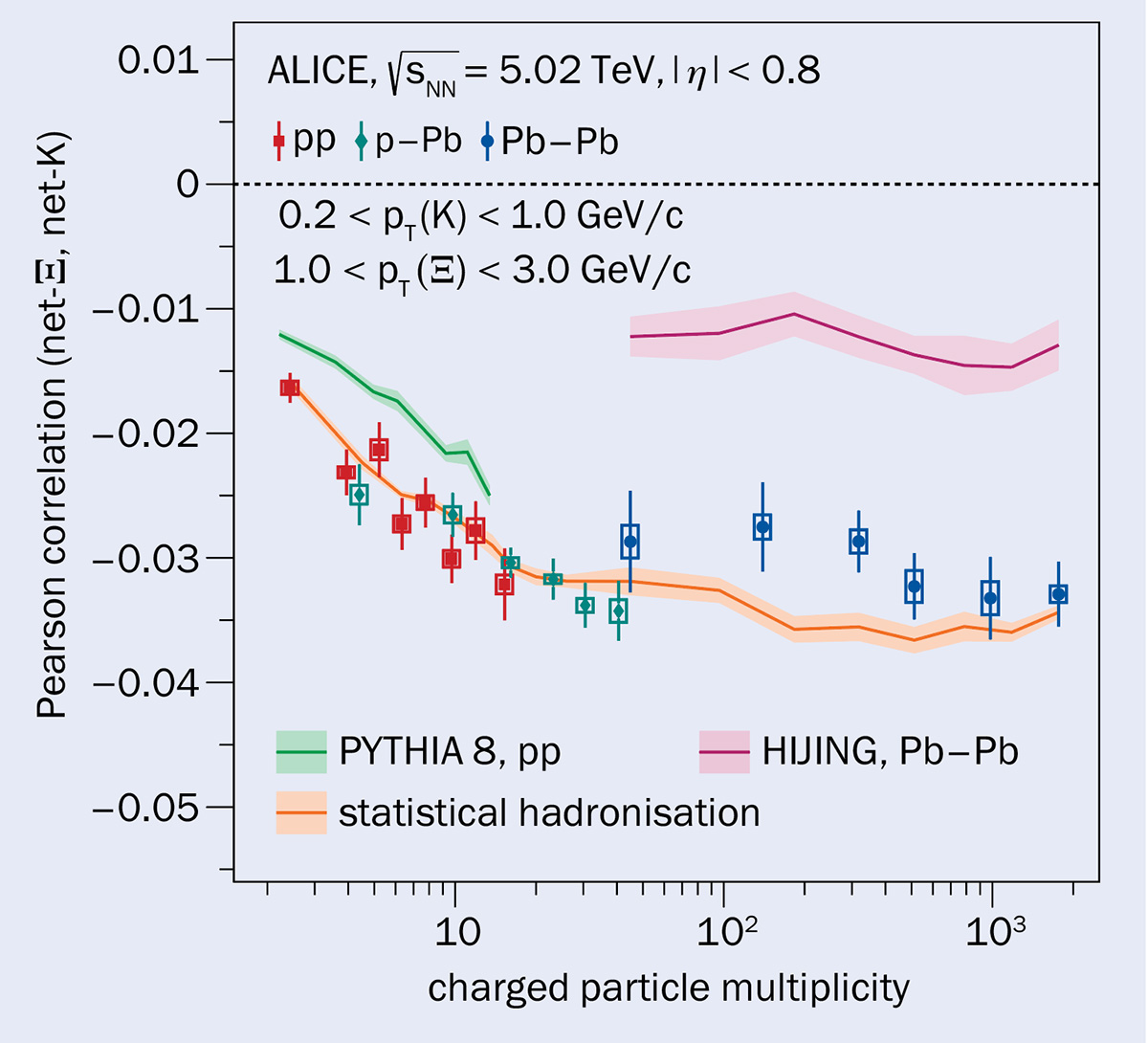
Figure 1 shows the first measurement of the correlation between the “net number” of Ξ baryons and kaons, as a function of the charged-particle multiplicity at midrapidity in pp, p–Pb and Pb–Pb collisions, where the net number is the difference between particle and antiparticle multiplicities. The experimental results deviate from the uncorrelated baseline (dashed line), and string fragmentation models that mainly correlate strange hadrons with opposite strange quark content over a small rapidity range fail to describe both observables. At the same time, the measurements agree with the statistical hadronisation model description that includes opposite-sign and same-sign strangeness correlations over large rapidity intervals. The data indicate a weaker opposite-sign strangeness correlation than that predicted by string fragmentation, suggesting that the correlation volume for strangeness conservation extends to about three units of rapidity.
The present study will be extended using the recently collected data during LHC Run 3. The larger data samples will enable similar measurements for the triply strange Ω baryon, as well as the study of higher cumulants.
Immediately after the Big Bang, all the particles we know about today were massless and moving at the speed of light. About 10–12 seconds later, the scalar Higgs field spontaneously broke the symmetry of the electroweak force, separating it into the electromagnetic and weak forces, and giving mass to fundamental particles. Without this process, the universe as we know it would not exist.
Since its discovery in 2012, measurements of the Higgs boson – the particle associated with the new field – have refined our understanding of its properties, but it remains unknown how closely the field’s energy potential resembles the predicted Mexican hat shape. Studying the Higgs potential can provide insights into the dynamics of the early universe, and the stability of the vacuum with respect to potential future changes.
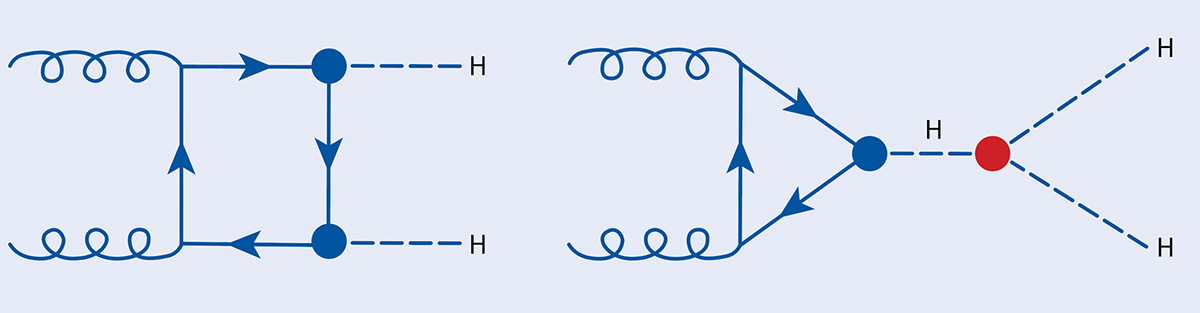
The Higgs boson’s self-coupling strength λ governs the cubic and quartic terms in the equation describing the potential. It can be probed using the pair production of Higgs bosons (HH), though this is experimentally challenging as this process is more than 1000 times less likely than the production of a single Higgs boson. This is partly due to destructive interference between the two leading order diagrams in the dominant gluon–gluon fusion production mode.
The ATLAS collaboration recently compiled a series of results targeting HH decays to bbγγ, bbττ, bbbb, bbll plus missing transverse energy (ETmiss), and multilepton final states. Each analysis uses the full LHC Run 2 data set. A key parameter is the HH signal strength, μHH, which divides the measured HH production rate by the Standard Model (SM) prediction. This combination yields the strongest expected constraints to date on μHH, and an observed upper limit of 2.9 times the SM prediction (figure 1). The combination also sets the most stringent constraints to date on the strength of the Higgs boson’s self-coupling of –1.2 < κλ < 7.2, where κλ = λ/λSM, its value relative to the SM prediction.
Each analysis contributes in a complementary way to the global picture of HH interactions and faces its own set of unique challenges.
Despite its tiny branching fraction of just 0.26% of all HH decays, HH → bbγγ provides very good sensitivity to μHH thanks to the ATLAS detector’s excellent di-photon mass resolution. It also sets the best constraints on λ due to its sensitivity to HH events with low invariant mass.
The HH → bbττ analysis (7.3% of HH decays) exploits state-of-the-art hadronic–tau identification to control the complex mix of electroweak, multijet and top-quark backgrounds. It yields the strongest limits on μHH and the second tightest constraints on λ.
HH → bbbb (34%) has good sensitivity to μHH thanks to ATLAS’s excellent b-jet identification, but controlling the multijet background presents a formidable challenge, which is tackled in a fully data-driven fashion.
Studying the Higgs potential can provide insights into the dynamics of the early universe
The decays HH → bbWW and HH → bbττ in fully leptonic final states have very similar characteristics and are thus targeted in a single HH → bbll+ETmiss analysis. Contributions from the bbZZ decay mode, where one Z decays to charged light leptons and the other to neutrinos, are also considered.
Finally, the HH → multilepton analysis is designed to catch decay modes where the HH system cannot be fully reconstructed due to ambiguity in how the decay products should be assigned to the two Higgs bosons. The analysis uses nine signal regions with different multiplicities of light charged leptons, hadronic taus and photons. It is complementary to all the exclusive channels discussed above.
For the ongoing LHC Run 3, ATLAS designed new triggers to enhance sensitivity to the hadronic HH → bbττ and HH → bbbb channels. Improved b-jet identification algorithms will increase the efficiency in selecting HH signals and distinguishing them from background processes. With these and other improvements, our prospects have never looked brighter for homing in on the Higgs self-coupling.
At the International Conference on High-Energy Physics in Prague in July, the LHCb collaboration presented an updated measurement of the weak mixing angle using the data collected at the experiment between 2016 and 2018. The measurement benefits from the unique forward coverage of the LHCb detector.
The success of electroweak theory in describing a wide range of measurements at different experiments is one of the crowning achievements of the Standard Model (SM) of particle physics. It explains electroweak phenomena using a small number of free parameters, allowing precise measurements of different quantities to be compared to each other. This facilitates powerful indirect searches for beyond-the-SM physics. Discrepancies between measurements might imply that new physics influences one process but not another, and global analyses of high-precision electroweak measurements are sensitive to the presence of new particles at multi-TeV scales. In 2022 the entire field was excited by a measurement of the W-boson mass that is significantly larger than the value predicted within these global analyses by the CDF collaboration, heightening interest in electroweak measurements.
The weak mixing angle is at the centre of electroweak physics. It describes the mixing of the U(1) and SU(2) fields, determines couplings of the Z boson, and can also be directly related to the ratio of the W and Z boson masses. Excitingly, the two most precise measurements to date, from LEP and SLD, are in significant tension. This raises the prospect of non-SM particles potentially influencing one of these measurements, since the weak mixing angle, as a fundamental parameter of nature, should otherwise be the same no matter how it is measured. There is therefore a major programme measuring the weak mixing angle at hadron colliders, with important contributions from CDF, D0, ATLAS, CMS and LHCb.
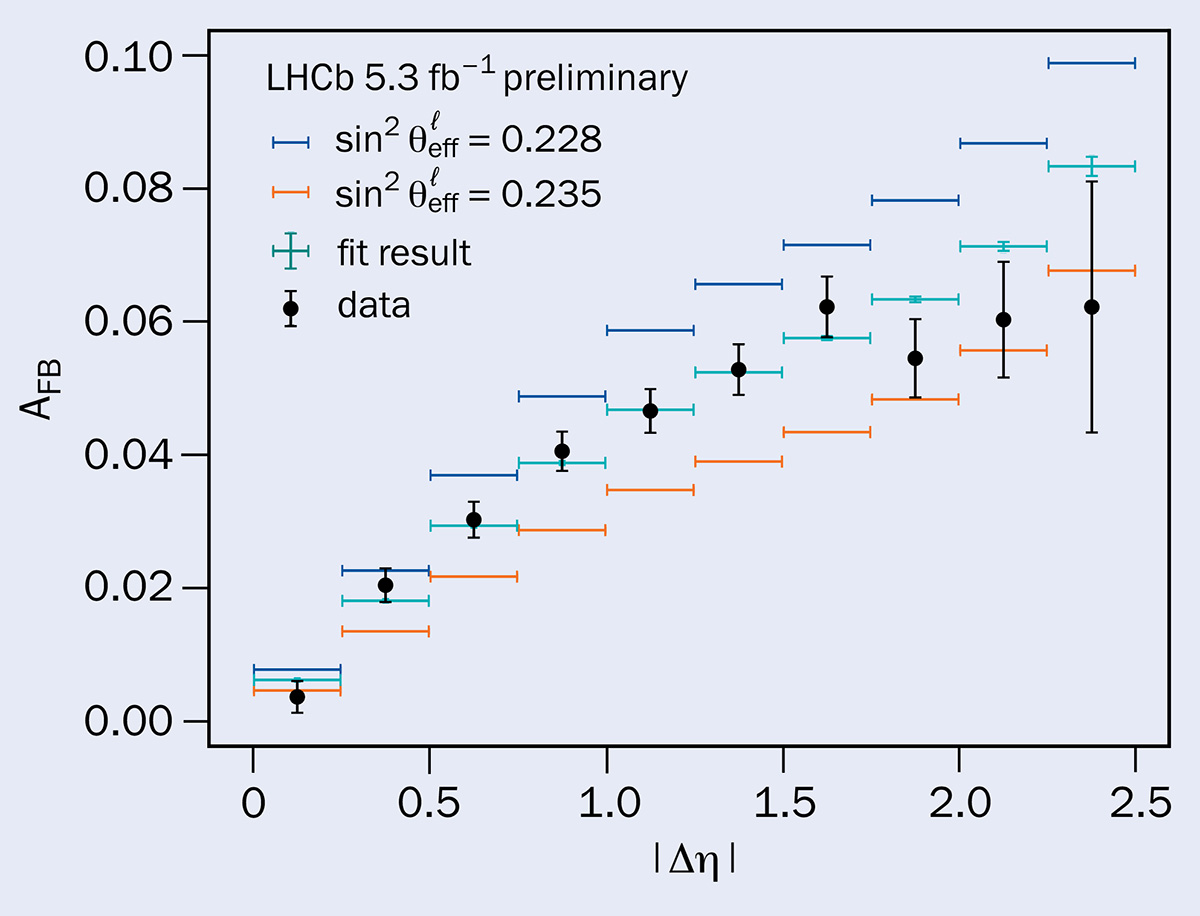
Since the weak mixing angle controls Z-boson couplings, it can be determined from measurements of the angular distributions of Z-boson decays. The LHCb collaboration measured around 860,000 Z-boson decays to two oppositely charged muons, determining the relative rate at which negatively charged muons are produced closer to the LHC beamline than positively charged muons as a function of the angular separation of the two muons. Corrections are then applied for detector effects. Comparison to theoretical predictions based on different values of the weak mixing angle allows the value best describing the data to be determined (figure 1).
The unique angular coverage of the LHCb detector is well-suited for this measurement for two key reasons. First, the statistical sensitivity to the weak mixing angle is largest in the forward region close to the beamline that the LHCb detector covers. Second, the leading systematic uncertainties in measurements of the weak mixing angle at hadron colliders typically arise from existing knowledge of the proton’s internal structure. These uncertainties are also smallest in the forward region.
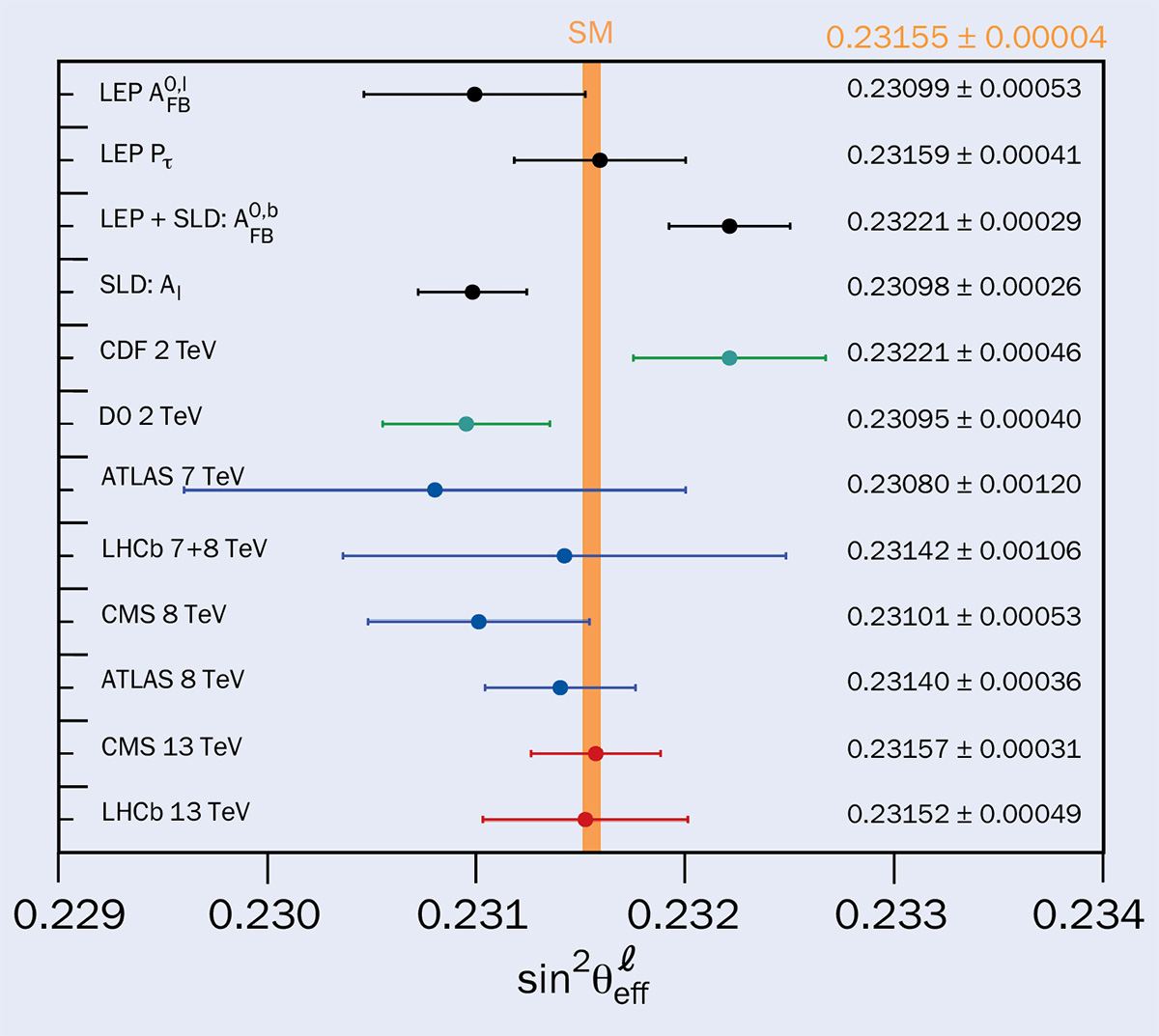
The value of the weak mixing angle measured by LHCb is consistent with previous measurements and with SM expectations (see “Weak mixing angle” figure). Notably, the precision of the LHCb measurement remains limited by the size of the data sample collected, such that further improvements are expected with the data currently being collected using the upgraded LHCb detector. In addition, while other experiments profile effects associated with the proton’s internal structure to reduce uncertainties, the unique forward acceptance means that this is not yet necessary at LHCb. This advantage will also be important for future measurements: the small theoretical uncertainty means that the forthcoming Upgrade 2 of the LHCb experiment is expected to achieve a precision more than a factor of two better than the most precise measurements to date.
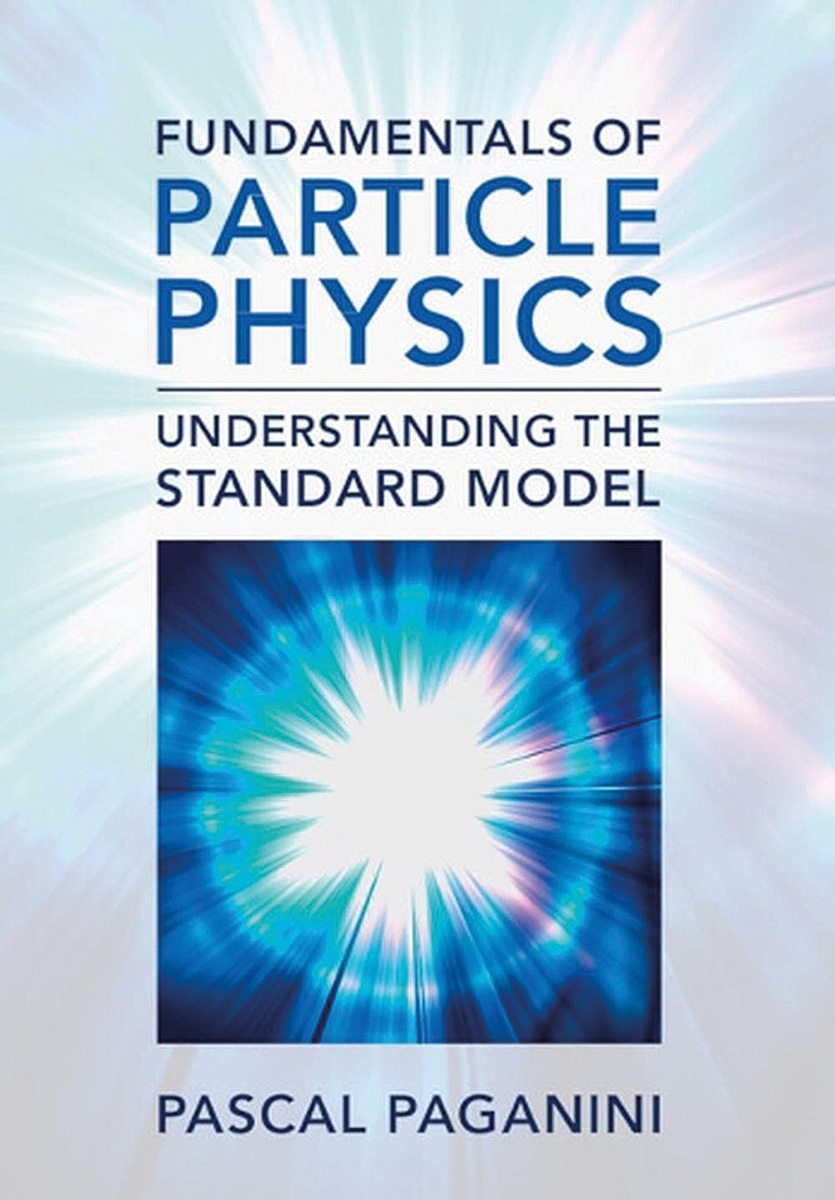
This textbook for advanced undergraduate and graduate students, written by experimental particle-physicist Pascal Paganini of Ecole Polytechnique, aims to teach Standard Model calculations of quantities that are relevant for modern experimental research. Each chapter ends with a collection of unsolved problems to help the student practice the discussed calculations. The level is similar to the well-known textbook Quarks and Leptons by F Halzen and A D Martin (Wiley, 1984), but with a broader introduction and including more up-to-date material. The notation is also similar, and shared with several other popular textbooks at the same level, making it easy for students to use it along with other resources.
Comprehensive
Fundamentals of Particle Physics starts with a general introduction that is around 50 pages long and includes information on detectors and statistics. It continues with a recap of relativistic kinematics, quantum mechanics of angular momentum and spin, phase–space calculations for cross sections and decays as well as symmetries. The main part of the book begins with a discussion of relativistic quantum mechanics, covering the equations of motion of spin 0, 1 and ½ particles along with a detailed description of Dirac spinors and their properties. Then, it addresses quantum electrodynamics (QED), including the QED Lagrangian, standard QED cross-section calculations and a section dedicated to magnetic moments (g-2). About 100 pages are devoted to hadronic physics: deep inelastic scattering, parton model, parton-distribution functions and quantum chromodynamics (QCD). Calculations in perturbative QCD are discussed in some detail and there is also an accessible section in non-perturbative QCD that can serve as a very nice introduction to beginner graduate students.
The book continues with weak interactions, covering the Fermi theory, W-boson exchange, CKM matrix, neutrinos, neutrino mixing and CP-violation. The following chapter presents the electroweak theory and introduces gauge-boson interactions. A dedicated chapter is reserved for the Higgs boson. This includes a nice section about the discovery of the particle and the measurements that are performed at the LHC, as well as some comments about the pre-history (LEP and Tevatron) and the future (HL-LHC and FCC). A clear discussion about naturalness and several other conceptual issues offers a light and useful read for students of any level. The final chapter goes through the Standard Model as a whole, including a very useful evaluation of its successes and weaknesses. In terms of beyond-Standard Model physics, only dark matter and neutrino masses are covered.
Although this is not a quantum field-theory textbook, some of its elements are introduced; in particular second quantisation, S-matrix, Dyson’s expansion and a few words about renormalisation are included. These are very useful in bridging the gap between practical calculations and their theoretical background, also serving as a quick reference.
There are several useful appendices, most notably a 30-page introduction to group theory that can serve as a guide for a short standalone course in the subject or as a quick reference. The book also includes elements of the Lagrangian formalism, which could have been a bit more expanded to include a more detailed presentation of Noether’s theorem, probably in an additional appendix.
Overall the book achieves a good balance between calculations and more conceptual discussions. All students in the field can benefit from the sections on the Higgs-boson discovery and the Standard Model. Being concise and not too long, Fundamentals of Particle Physics can easily be used as a primary or secondary textbook for a particle-physics course that introduces calculations using Feynman diagrams in the Standard Model to students.
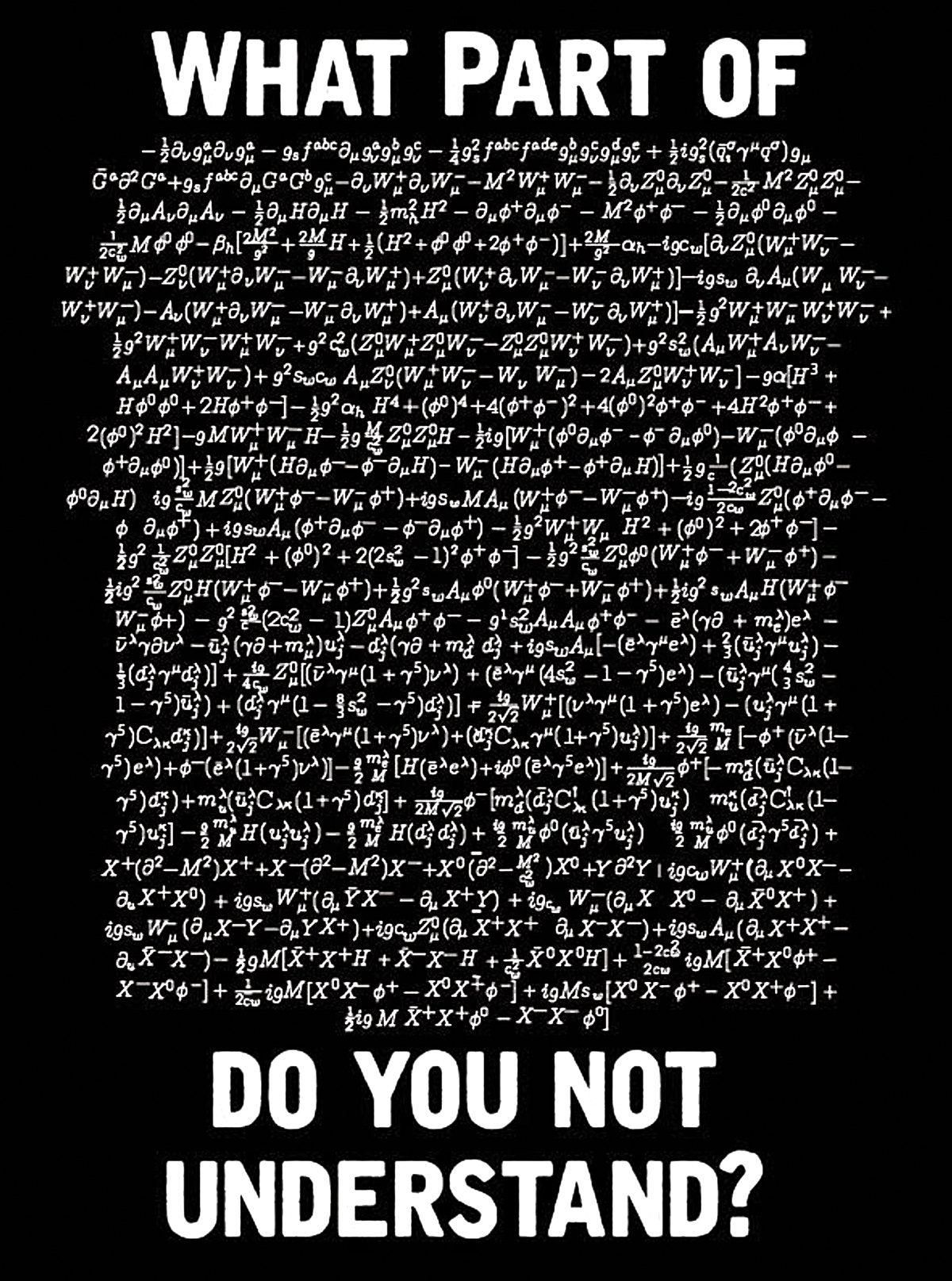
The Standard Model – an inconspicuous name for one of the great human inventions. It describes all known elementary particles and their interactions, except for gravity. About 19 free parameters tune its behaviour. To the best of our knowledge, they could in principle take any value, and no underlying theory yet conceived can predict their values. They include particle masses, interaction strengths, important technical numbers such as mixing angles and phases, and the vacuum strength of the Higgs field, which theorists believe has alone among fundamental fields permeated every cubic attometre of the universe, since almost the beginning of time. Measuring these parameters is the most fundamental experimental task available to modern science.
The basic constituents of matter interact through forces which are mediated by virtual particles that ping back and forth, delivering momentum and quantum numbers. The gluon mediates the strong interaction, the photon mediates the electromagnetic interaction, and the W and Z bosons mediate the weak interaction. Although the electromagnetic and weak forces operate very differently to each other in everyday life, in the Standard Model they are two manifestations of the broken electroweak interaction – an interaction that broke when the Higgs field switched on throughout the universe, giving mass to matter particles, the W and Z bosons, and the Higgs boson itself, via the Brout–Englert–Higgs (BEH) mechanism. The electroweak theory has been extraordinarily successful in describing experimental results, but it remains mysterious – and the BEH mechanism is the origin of some of those free parameters. The best way to test the electroweak model is to over-constrain its free parameters using precision measurements and try to find a breaking point.
Ever since the late 1960s, when Steven Weinberg, Sheldon Glashow and Abdus Salam unified the electromagnetic and weak forces using the BEH mechanism, CERN has had an intimate experimental relationship with the electroweak theory. In 1973 the Z boson was indirectly discovered by observing “neutral current” events in the Gargamelle bubble chamber, using a neutrino beam from the Proton Synchrotron. The W boson was discovered in 1983 at the Super Proton Synchrotron collider, followed by the direct observation of the Z boson in the same machine soon after. The 1990s witnessed a decade of exquisite electroweak precision measurements at the Large Electron Positron (LEP) collider at CERN and the Stanford Linear Collider (SLC) at SLAC National Accelerator Laboratory in the US, before the crown jewel of the electroweak sector, the Higgs boson, was discovered by the ATLAS and CMS collaborations at the Large Hadron Collider (LHC) in 2012 – a remarkable success that delivered the last to be observed, and arguably most mysterious, missing piece of the Standard Model.
What was not expected, was that the ATLAS, CMS and LHCb experiments at the LHC would go on to make electroweak measurements that rival in precision those made at lepton colliders.
Discovery or precision?
Studying the electroweak interaction requires a supply of W and Z bosons. For that, you need a collider. Electrons and positrons are ideally suited for the task as they interact exclusively via the electroweak interaction. By precisely tuning the energy of electron–positron collisions, experiments at LEP and the SLC tested the electroweak sector with an unprecedented 0.1% accuracy at the energy scale of the Z-boson mass (mZ).
Hadron colliders like the LHC have different strengths and weaknesses. Equipped to copiously produce all known Standard Model particles – and perhaps also hypothetical new ones – they are the ultimate instruments for probing the high-energy frontier of our understanding of the microscopic world. The protons they collide are not elementary, but a haze of constituent quarks and gluons that bubble and fizz with quantum fluctuations. Each constituent “parton” carries an unpredictable fraction of the proton’s energy. This injects unavoidable uncertainty into studies of hadron collisions that physicists attempt to encode in probabilistic parton distribution functions. What’s more, when a pair of partons from the two opposing protons interact in an interesting way, the result is overlaid by numerous background particles originating from the remaining partons that were untouched by the original collision – a complexity that is exacerbated by the difficult-to-model strong force which governs the behaviour of quarks and gluons. As a result, hadron colliders have a reputation for being discovery machines with limited precision.
The LHC has collided protons at the energy frontier since 2010, delivering far more collisions than comparable previous machines such as the Tevatron at Fermilab in the US. This has enabled a comprehensive search and measurement programme. Following the discovery of the Higgs boson in 2012, measurements have so far verified its place in the electroweak sector of the Standard Model, although the relative precisions of many measurements are currently far lower than those achieved for the W and Z bosons at LEP. But in defiance of expectations, the capabilities of the LHC experiments and the ingenuity of analysts have also enabled many of the world’s most precise measurements of the electroweak interaction. Here, we highlight five.
1. Producing W and Z bosons
When two streams of objects meet, how many strike each other depends on their cross-sectional area. Though quarks and other partons are thought to be fundamental objects with zero extent, particle physicists borrow this logic for particle beams, and extend it by subdividing the metaphorical cross section according to the resulting interactions. The range of processes used to study W and Z bosons at the LHC spans a remarkable eight orders of magnitude in cross section.
The most common interaction is the production of single W and Z bosons through the annihilation of a quark and an antiquark in the colliding protons. Measurements with single W and Z boson events have now reached a precision well below 1% thanks to the excellent calibration of the detector performance. They are a prodigious tool for testing and improving the modelling of the underlying process, for example using parton distribution functions.
The second most common interaction is the simultaneous production of two bosons. Measurements of “diboson” processes now routinely reach a precision better than 5%. Since the start of the LHC operation, the accelerator has operated at several collision energies, allowing the experiments to map diboson cross sections as a function of energy. Measurements of the cross sections for creating WW, WZ and ZZ pairs exhibit remarkable agreement with state-of-the art Standard Model predictions (see “Diboson production” figure).
The large amount of collected data at the LHC has recently allowed us to move the frontier to the observation of extremely infrequent “triboson” processes with three W or Z bosons, or photons, produced simultaneously – the first step towards confirming the existence of the quartic self-interaction between the electroweak bosons.
2. The weak mixing angle
The Higgs potential is famously thought to resemble a Mexican hat. The Higgs field that permeates space could in principle exist with a strength corresponding to any point on its surface. Theorists believe it settled somewhere in the brim a picosecond or so after the Big Bang, breaking the perfect symmetry of the hat’s apex, where its value was zero. This switched the Higgs field on throughout the universe – and the massless gauge bosons of the unified electroweak theory mixed to form the photon and W and Z boson mass eigenstates that mediate the broken electroweak interaction today. The weak mixing angle θW is the free parameter of the Standard Model which defines that mixing.
The θW angle can be studied using a beautifully simple interaction: the annihilation of a quark and its antiquark to create an electron and a positron or a muon and an antimuon. When the pair has an invariant mass in the vicinity of mZ, there is a small preference for the negatively charged lepton to be produced in the same direction as the initial quark. This arises due to quantum interference between the Z boson’s vector and axial-vector couplings, whose relative strengths depend on θW.
The unique challenge at a proton–proton collider like the LHC is that the initial directions of the quark and the antiquark can only be inferred using our limited knowledge of parton distribution functions. These systematic uncertainties currently dominate the total uncertainty, although they can be reduced somewhat by using information on lepton pairs produced away from the Z resonance. The CMS and LHCb collaborations have recently released new measurements consistent with the Standard Model prediction with a precision comparable to that of the LEP and SLC experiments (see “Weak mixing angle” figure).
Quantum physics effects play an interesting role here. In practice, it is not possible to experimentally isolate “tree level” properties like θW, which describe the simplest interactions that can be drawn on a Feynman diagram. Measurements are in fact sensitive to the effective weak mixing angle, which includes the effect of quantum interference from higher-order diagrams.
A crucial prediction of electroweak theory is that the masses of the W and Z bosons are, at leading order, related by the electroweak mixing angle: sin2θW = 1–m2W/m2Z, where mW and mZ are the masses of the W and Z bosons. This relationship is modified by quantum loops involving the Higgs boson, the top quark and possibly new particles. Measuring the parameters of the electroweak theory precisely, therefore, allows us to test for any gaps in our understanding of nature.
Surprisingly, combining this relationship with the mZ measurement from LEP and the CMS measurement of θW also allows a competitive measurement of mW. A measurement of sin2θW with a precision of 0.0003 translates into a prediction of mW with 15 MeV precision, which is comparable to the best direct measurements.
3. The mass and width of the W boson
Precisely measuring the mass of the W boson is of paramount importance to efforts to further constrain the relationships between the parameters of the electroweak theory, and probe possible beyond-the-Standard Model contributions. Particle lifetimes also offer a sensitive test of the electroweak theory. Because of their large masses and numerous decay channels, the W and Z bosons have mean lifetimes of less than 10–24 s. Though this is an impossibly brief time interval to measure directly, Heisenberg’s uncertainty principle smudges a particle’s observed mass by a certain “width” when it is produced in a collider. This width can be measured by fitting the mass distribution of many virtual particles. It is reciprocally related to the particle’s lifetime.
While lepton-collider measurements of the properties of the Z boson were extensive and achieved remarkable precision, the same is not quite true for the W boson. The mass of the Z boson was measured with a precision of 0.002%, but the mass of the W boson was measured with a precision of only 0.04% – a factor 20 worse. The reason is that while single Z bosons were copiously produced at LEP and SLC, W bosons could not be produced singly, due to charge conservation. W+W– pairs were produced, though only at low rates at LEP energies.
In contrast to LEP, hadron colliders produce large quantities of single W bosons through quark–antiquark annihilation. The LHC produces more single W bosons in a minute than all the W-boson pairs produced in the entire lifetime of LEP. Even when only considering decays to electrons or muons and their respective neutrinos – the most precise measurements – the LHC experiments have recorded billions of W-boson events.
But there are obstacles to overcome. The neutrino in the final state escapes undetected. Its transverse momentum with respect to the beam direction can only be measured indirectly, by measuring all other products of the collision – a major experimental challenge in an environment with not just one, but up to 60 simultaneous proton–proton collisions. Its longitudinal momentum cannot be measured at all. And as the W bosons are not produced at rest, extensive theoretical calculations and ancillary measurements are needed to model their momenta, incurring uncertainties from parton distribution functions.
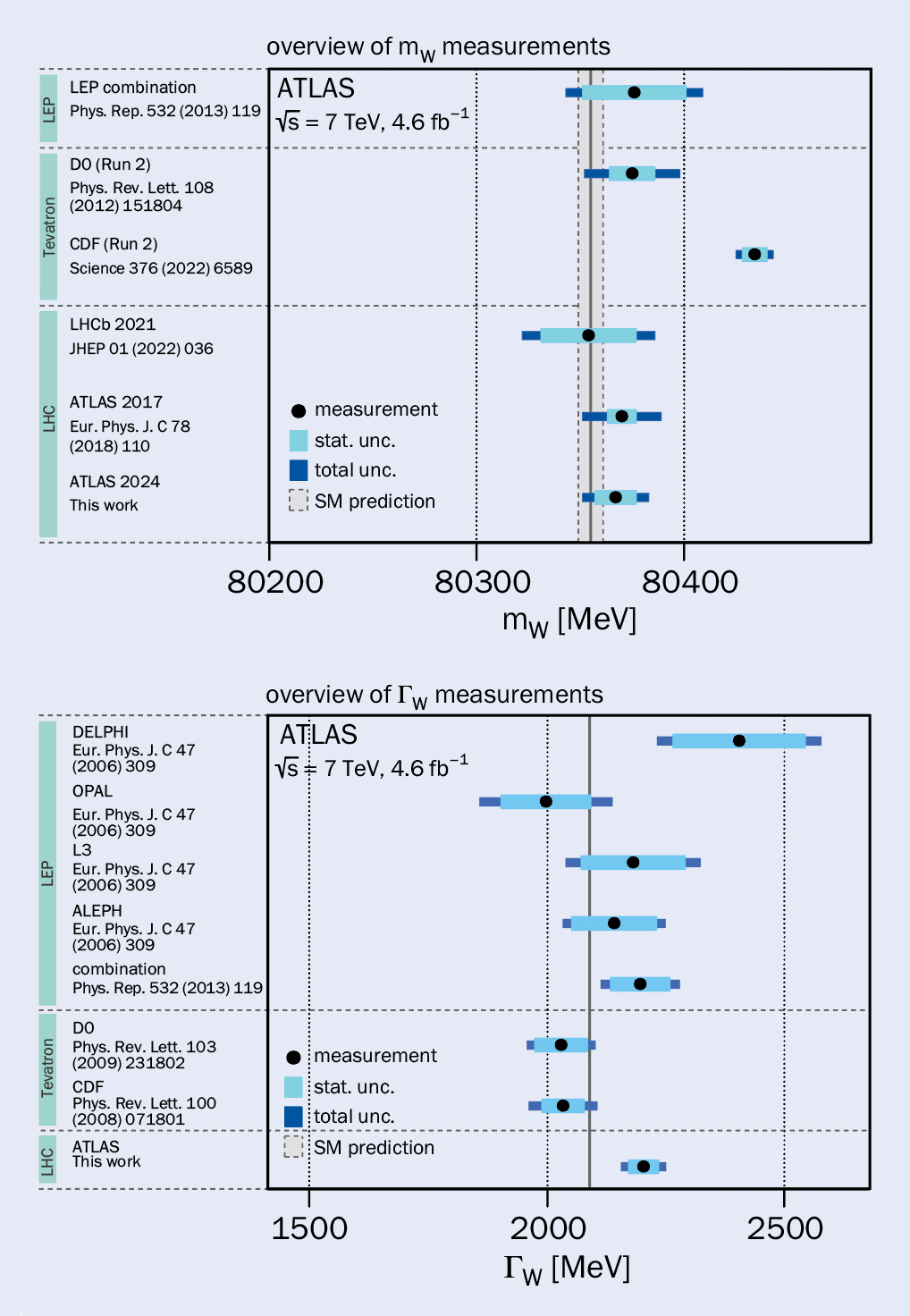
Despite these challenges, the latest measurement of the W boson’s mass by the ATLAS collaboration achieved a precision of roughly 0.02% (see “Mass and width” figure, top). The LHCb collaboration also recently produced its first measurement of the W-boson mass using W bosons produced close to the beam line with a precision at the 0.04% level, dominated for now by the size of the data sample. Owing to the complementary detector coverage of the LHCb experiment with respect to the ATLAS and CMS experiments, several uncertainties are reduced when these measurements are combined.
The Tevatron experiments CDF and D0 also made precise W-boson measurements using proton–antiproton collisions at a lower centre-of-mass energy. The single most precise mass measurement, at the 0.01% level, comes from CDF. It is in stark disagreement with the Standard Model prediction and disagrees with the combination of other measurements.
A highly anticipated measurement by the CMS collaboration may soon weigh in decisively in favour either of the CDF measurement or the Standard Model. The CMS measurement will combine innovative analysis techniques using the Z boson with a larger 13 TeV data set than the 7 TeV data used by the recent ATLAS measurement, enabling more powerful validation samples and thereby greater power to reduce systematic uncertainties.
Measurements of the W boson’s width are not yet sufficiently precise to constrain the Standard Model significantly, though the strongest constraint so far comes from the ATLAS collaboration (see “Mass and width” figure, bottom). Further measurements are a promising avenue to test the Standard Model. If the W boson decays into any hitherto undiscovered particles, its lifetime should be shorter than predicted, and its width greater, potentially indicating the presence of new physics.
4. Couplings of the W boson to leptons
Within the Standard Model, the W and Z bosons have equal couplings to leptons of each of the three generations – a property known as lepton flavour universality (LFU). Any experimental deviation from LFU would indicate new physics.
As with mass and width, lepton colliders’ precision was superior for the Z boson than the W boson. LEP confirmed LFU in leptonic Z-boson decays to about 0.3%. Comparing the three branching fractions of the W boson in the electron, muon and tau–lepton decay channels, the combination of the four LEP experiments reached a precision of only about 2%.
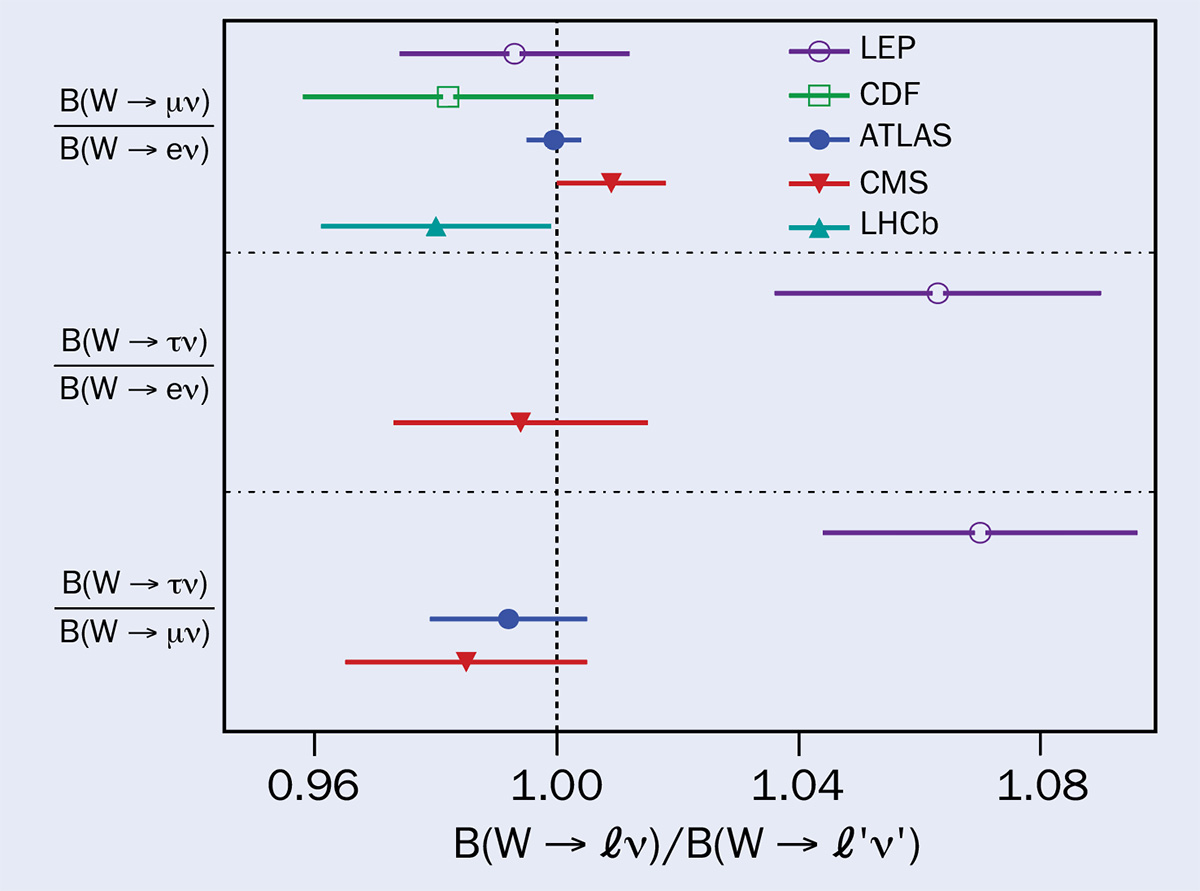
At the LHC, the large cross section for producing top quark–antiquark pairs that both decay into a W boson and a bottom quark offers a unique sample of W-boson pairs for high-precision studies of their decays. The resulting measurements are the most precise tests of LFU for all three possible comparisons of the coupling of the lepton flavours to the W boson (see “Couplings to leptons” figure).
Regarding the tau lepton to muon ratio, the ATLAS collaboration observed 0.992 ± 0.013 decays to a tau for every one decay to a muon. This result favours LFU and is twice as precise than the corresponding LEP result of 1.066 ± 0.025, which exhibits a deviation of 2.6 standard deviations from unity. Because of the relatively long tau lifetime, ATLAS was able to separate muons produced in the decay of tau leptons from those produced promptly by observing the tau decay length of the order of 2 mm.
The best tau to electron measurement is provided by a simultaneous CMS measurement of all the leptonic and hadronic decay branching fractions of the W boson. The analysis splits the top quark–antiquark pair events based on the multiplicity and flavour of reconstructed leptons, the number of jets, and the number of jets identified as originating from the hadronisation of b quarks. All CMS ratios are consistent with the LFU hypothesis and reduce tension with the Standard Model prediction.
Regarding the muon to electron ratio, measurements have been performed by several LHC and Tevatron experiments. The observed results are consistent with LFU, with the most precise measurement from the ATLAS experiment boasting a precision better than 0.5%.
5. The invisible width of the Z boson
A groundbreaking measurement at LEP deduced how often a particle that cannot be directly observed decays to particles that cannot be detected. The particle in question is the Z boson. By scanning the energy of electron–positron collisions and measuring the broadness of the “lineshape” of the smudged bump in interactions around the mass of the Z, LEP physicists precisely measured its width. As previously noted, a particle’s width is reciprocal to its lifetime and therefore proportional to its decay rate – something that can also be measured by directly accounting for the observed rate of decays to visible particles of all types. The difference between the two numbers is due to Z-boson decays to so-called invisible particles that cannot be reconstructed in the detector. A seminal measurement concluded that exactly three species of light neutrino couple to the Z boson.
The LEP experiments also measured the invisible width of the Z boson using an ingenious method that searched for solitary “recoils”. Here, the trick was to look for the rare occasion when the colliding electron or positron emitted a photon just before creating a virtual Z boson that decayed invisibly. Such events would yield nothing more than a single photon recoiling from an otherwise invisible Z-boson decay.
The ATLAS and CMS collaborations recently performed similar measurements, requiring the invisibly decaying Z boson to be produced alongside a highly energetic jet in place of a recoil photon. By taking the ratio with equivalent recoil decays to electrons and muons, they achieved remarkable uncertainties of around 2%, equivalent to LEP, despite the much more challenging environment (see “Invisible width” figure). The results are consistent with the Standard Model’s three generations of light neutrinos.
Future outlook
Building on these achievements, the LHC experiments are now readying themselves for a more than comparable experimental programme, which is yet to begin. Following the ongoing run of the LHC, a high-luminosity upgrade (HL-LHC) is scheduled to operate throughout the 2030s, delivering a total integrated luminosity of 3 ab–1 to both ATLAS and CMS. The LHCb experiment also foresees a major upgrade to collect an integrated luminosity of more than 300 fb–1 by the end of the LHC operations. A tenfold data set, upgraded detectors and experimental methods, and improvements to theoretical modelling will greatly extend both experimental precision and the reach of direct and indirect searches for new physics. Unprecedented energy scales will be probed and anomalies with respect to the Standard Model may become apparent.
Despite the significant challenges posed by systematic uncertainties, there are good prospects to further improve uncertainties in precision electroweak observables such as the mass of the W boson and the effective weak mixing angle, thanks to the larger angular acceptances of the new inner tracking devices currently under production by ATLAS and CMS. A possible programme of high-precision measurements in electron–proton collisions, the LHeC, could deliver crucial input to reduce uncertainties such as from parton distribution functions. The LHeC has been proposed to run concurrently with the HL-LHC by adding an electron beam to the LHC.
Beyond the HL-LHC programme, several proposals for future particle colliders have captured the imagination of the global particle-physics community – and not least the two phases of the Future Circular Collider (FCC) being studied at CERN. With a circumference three to four times greater than that of the LEP/LHC tunnel, electron–positron collisions could be delivered with very high luminosity and centre-of-mass energies from 90 to 365 GeV in the initial FCC-ee phase. The FCC-ee would facilitate an impressive leap in the precision of most electroweak observables. Projections estimate a factor of 10 improvement for Z-boson measurements and up to 100 for W-boson measurements. For the first time, the top quark could be produced in an environment where it is not colour-connected to initial hadrons, in some cases reducing uncertainties by a factor of 10 or more.
The LHC collaborations have made remarkable strides forward in probing the electroweak theory – a theory of great beauty and consequence for the universe. But its most fundamental workings are subtle and elusive. Our exploration is only just beginning.
The simplest possible interaction in nature is when three identical particle lines, with the same quantum numbers, meet at a single vertex. The Higgs boson is the only known elementary particle that can exhibit such behaviour. More importantly, the strength of the coupling between three or even four Higgs bosons will reveal the first picture of the shape of the Brout–Englert–Higgs potential, responsible for the evolution of the universe in its first moments as well as possibly its fate.
Since the discovery of the Higgs boson at the LHC in 2012, the ATLAS and CMS collaborations have measured its properties and interactions with increasing precision. This includes its couplings to the gauge bosons and to third-generation fermions, its production cross sections, mass and width. So far, the boson appears as the Standard Model (SM) says it should. But the picture is still fuzzy, and many more measurements are needed. After all, the Higgs boson may interact with new particles suggested by theories beyond the SM to shed light on mysteries including the nature of the electroweak phase transition.
Line of attack
“The Higgs self-coupling is the next big thing since the Higgs discovery, and di-Higgs production is our main line of attack,” says Jana Schaarschmidt of ATLAS. “The experiments are making tremendous progress towards measuring Higgs-boson pair production at the LHC – far more than was imagined would be possible 12 years ago – thanks to improvements in analysis techniques and machine learning in particular.”
The dominant process for di-Higgs production at the LHC, gluon–gluon fusion, proceeds via a box or triangle diagram, the latter offering access to the trilinear Higgs coupling constant λ (see figure). Destructive interference between the two processes makes di-Higgs production extremely rare, with a cross section at the LHC about 1000 times smaller than that for single-Higgs production. Many different decay channels are available to ATLAS and CMS. Those with a high probability to occur are chosen if they can also provide a clean way to be distinguished from backgrounds. The most sensitive channels are those with one Higgs boson decaying to a b-quark pair and the other decaying either to a pair of photons, τ leptons or b quarks.
During this year’s Rencontres de Moriond, ATLAS presented new results in the HH → bbbb and HH → multileptons channels and CMS in the HH → γγττ channel. In May, ATLAS released a combination of searches for HH production in five channels using the complete LHC Run 2 dataset. The combination provides the best expected sensitivities to HH production (excluding values more than 2.4 times the SM prediction) and to the Higgs boson self-coupling. A combination of HH searches published by CMS in 2022 obtains a similar sensitivity to the di-Higgs cross-section limits. “In late 2023 we put out a preliminary result combining single-Higgs and di-Higgs analyses to constrain the Higgs self-coupling, and further work on combining all the latest analyses is ongoing,” explains Nadjieh Jafari of CMS.
The Higgs self-coupling is the next big thing since the Higgs discovery
Considerable improvements are expected with the LHC Run 3 and much larger High-Luminosity LHC (HL-LHC) datasets. Based on extrapolations of early subsets of its Run 2 analyses, ATLAS expects to detect SM di-Higgs production with a significance of 3.2σ (4.6σ) with (without) systematic uncertainties by the end of the HL-LHC era. With similar progress at CMS, a di-Higgs observation is expected to be possible at the HL-LHC even with current analysis techniques, along with improved knowledge of λ. ATLAS, for example, expects to be able to constrain λ to be between 0.5 and 1.6 times the SM expectation at the level of 1σ.
Testing the foundations
Physicists are also starting to place limits on possible new-physics contributions to HH production, which can originate either from loop corrections involving new particles or from non-standard couplings between the Higgs boson and other SM particles. Several theories beyond the SM, including two-Higgs-doublet and composite-Higgs models, also predict the existence of heavy scalar particles that can decay resonantly into a pair of Higgs bosons. “Large anomalous values of λ are already excluded, and the window of possible values continues to shrink towards the SM as the sensitivity grows,” says Schaarschmidt. “Furthermore, in recent di-Higgs analyses ATLAS and CMS have been able to establish a strong constraint on the coupling between two Higgs bosons and two vector bosons.”
For Christophe Grojean of the DESY theory group, the principal interest in di-Higgs production is to test the foundations of quantum field theory: “The basic principles of the SM are telling us that the way the Higgs boson interacts with itself is mostly dictated by its expectation value (linked to the Fermi constant, i.e. the muon and neutron lifetimes) and its mass. Verifying this prediction experimentally is therefore of prime importance.”
To provide the best experiences, we use technologies like cookies to store and/or access device information. Consenting to these technologies will allow us to process data such as browsing behavior or unique IDs on this site. Not consenting or withdrawing consent, may adversely affect certain features and functions.
Functional
Always active
The technical storage or access is strictly necessary for the legitimate purpose of enabling the use of a specific service explicitly requested by the subscriber or user, or for the sole purpose of carrying out the transmission of a communication over an electronic communications network.
Preferences
The technical storage or access is necessary for the legitimate purpose of storing preferences that are not requested by the subscriber or user.
Statistics
The technical storage or access that is used exclusively for statistical purposes.The technical storage or access that is used exclusively for anonymous statistical purposes. Without a subpoena, voluntary compliance on the part of your Internet Service Provider, or additional records from a third party, information stored or retrieved for this purpose alone cannot usually be used to identify you.
Marketing
The technical storage or access is required to create user profiles to send advertising, or to track the user on a website or across several websites for similar marketing purposes.