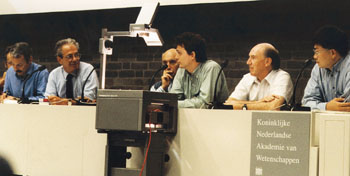
Neutrino oscillations continuous changes of neutrino type or “flavour” might not only explain the observed lack of neutrinos from the Sun and the atmosphere, but may also provide a very sensitive probe for tiny mass differences between neutrinos of different flavour. These possibilities were on the agenda on 6 September when 130 physicists from all over the world gathered in an Amsterdam brewery for the Neutrino Oscillation Workshop NOW’98.
Recently the SuperKamiokande underground experiment in Japan presented evidence for neutrino oscillations and thereby neutrino mass. Although these masses are believed to be much smaller than that of any other particle, neutrinos are so abundant that they would even with such a tiny mass contribute significantly to the mass of the universe and to its gravitational fate.
At NOW’98, recent results presented in morning sessions provided ground for discussions on the future directions of neutrino oscillation physics during the afternoons.
The workshop opened with a talk by M Nakagawa (Meijo), a godfather of neutrino oscillations, who covered the underlying theory from a historical perspective. Currently available data and their phenomenological implications were reviewed by G L Fogli (Bari), while P G Langacker (Pennsylvania) focused on fundamental aspects of neutrino masses and mixing.
Atmospheric neutrino data were presented by W Gajewski (Irvine), of course paying much attention to the recent SuperKamiokande result. K Nishikawa (KEK) explained how from next year, neutrinos produced at the KEK laboratory will be detected by SuperKamiokande, 250 kilometres away. This will be the first of probably several “long baseline” experiments; in the US plans are being drawn up to direct a neutrino beam over 730 kilometres from Fermilab to the Soudan mine, while in Europe a neutrino beam could be directed from CERN to the Italian Gran Sasso underground laboratory at a similar distance.
The afternoon sessions concentrated on the theory of neutrino oscillations, on solar and atmospheric neutrino experiments, short, medium and long-baseline experiments, reactor experiments and on neutrino beams.
In one morning session, S Sarkar (Oxford) brought cosmology down to earth, showing how measurements of the cosmological microwave background radiation and scenarios for the development of large-scale structures in the universe can constrain the mass of neutrinos and may even require neutrinos to be massive.
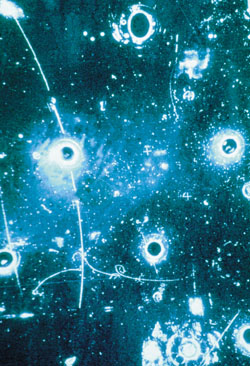
A quarter of a century ago, after raging controversy and nailbiting doubt, an experiment at CERN discovered “neutral currents” in neutrino interactions. For the first time, the weak force had been seen to act without shuffling electric charges
The saga has been covered many times, notably by Don Perkins of the Gargamelle collaboration speaking at the 1992 “Rise of the Standard Model” historical seminar held at the Stanford Linear Accelerator Center (SLAC). Five years ago, for the 20th anniversary of the discovery, several CERN Courier articles recalled those momentous times, when two complementary experiments Gargamelle at CERN and the E1A electronic experiment at Fermilab had to resolve difficult problems chasing a will-o’-the-wisp physics effect, while in the wings many physicists steadfastly refused to believe in neutral currents.
In 1973 CERN had yet to reach full scientific maturity. European physicists were not used to making major discoveries at their accelerators and were sometimes hesitant to swim against powerful currents of opinion. The discovery enabled CERN to attain research maturity.
It was not the first time in modern physics history that dogma had to be revised virtually overnight. For a quarter of a century, physicists had believed that quantum mechanisms are unaffected by space reflection (parity) and particleantiparticle charge conjugation. The dramatic overthrow of these principles in 195657, following a bold hypothesis by T D Lee and C N Yang, underlined how much weak interaction physics could be ignored by so many for so long.
The weak interaction scene had been set in the early 1930s when Enrico Fermi formulated his classic theory of beta decay, in which a neutron spontaneously decays into a proton, an electron and an antineutrino four particles meeting at a single space-time point. In this process, electric charge gets shuffled around, an initial neutral particle producing two oppositely charged particles.
Rearranging the four legs of the Fermi interaction gave other reactions, such as a neutrino interacting with a neutron to produce a proton and an electron. But electric charge was always rearranged the interaction was always a “charged current”.
In principle, other reactions could be imagined for example a neutrino or an electron bouncing off a proton in which electric charge was not rearranged: a “neutral current”. But no such reactions with neutrinos had been seen, while the corresponding effect with electrons was in any case blanketed by electromagnetic scattering.
In the 1960s, with no experiment ever having seen a weak neutral current effect, some physicists spoke of a “no neutral current selection rule”. Occasionally a new search for such effects was mounted, but nothing was found and the disbelief in weak neutral currents grew.
With the emergence of modern quantum electrodynamics in the 1940s following the work of Feynman, Schwinger and Tomonaga, and of Dyson, physicists realized the importance of “renormalization”, the process of carefully constructing a theory so that it did not throw up nonsensical infinite probabilities for things that were clearly finite. In quantum electrodynamics, for example, the mass and electric charge of the participating particles (which have to be put in by hand anyway) can be redefined to sidestep these infinities. Quantum electrodynamics is “renormalizable”.
However, the Fermi theory of weak interactions as it stood could not be made renormalizable. While some theorists took this warning lightly, others declared “there is no theory of weak interactions”.
Like members of a close-knit family, quarks and gluons behave like free particles when they are very close together, but feel much stronger forces if they are separated. This result, paradoxical at first sight and embodied in the term “asymptotic freedom”, is basically why quarks and gluons cannot be isolated as free particles. They can only be studied in their native habitat, using high-energy particle beams to spy on them deep inside protons and neutrons and other strongly interacting particles.
The idea was pointed out in two landmark papers by David Gross and Frank Wilczek at Princeton and by David Politzer at Harvard, published in the June 1973 issue of Physical Review Letters. In his presentation at the 1992 history seminar at Stanford, now published in The Rise of the Standard Model (edited by Lillian Hoddeson, Laurie Brown, Michael Riordan and Max Dresden, Cambridge University Press, 1997), David Gross described this breakthrough: “For me, the discovery of asymptotic freedom was totally unexpected. Like an atheist who has just received a message from a burning bush, I became an immediate true believer.”
But the idea had been noticed elsewhere. In his book In Search of the Ultimate Building Blocks (Cambridge University Press, 1997), Gerard ‘t Hooft relates: “In 1972 a small conference took place in Marseille. On arriving at Marseille airport, I discovered that (prominent field theorist) Kurt Symanzik and I had shared the same plane… He had been trying to understand Bjorken scaling [the behaviour seen in high-energy scattering when the incoming projectile particle transfers a lot of momentum to the target Ed.] in a quantum field theory, but had limited himself to what he considered to be the prototype of all field theories, a simple spin zero model. Unfortunately it had the wrong scaling behaviour.
” ‘If only I could turn this scaling behaviour round, ‘ Symanzik said,’then you would get a theory where particles at close distance behave almost as free particles, but when they separate to larger distances they would feel much stronger forces.’
” ‘Well, ‘ I [‘t Hooft] cried,’that is exactly what you get in a Yang-Mills (spin one) gauge theory!’
“Symanzik replied: ‘You should publish this quickly, because this would be very important.’ ”
“Much to my later regret, I did not follow this sensible advice, ” says ‘t Hooft, whose 1971 work on the renormalizability of Yang-Mills theories had underlined the importance of gauge fields for understanding particle behaviour. However,’t Hooft did air his idea for spin one fields following Symanzik’s talk at the Marseille meeting.
This idea was the key to quantum chromodynamics (QCD), the field theory of quarks and gluons. A host of theoreticians contributed to the subsequent development of the theory, many of whom, including Gross (now at Santa Barbara) and ‘t Hooft (Utrecht), attended the 6th international QCD conference (QCD 98) held in Montpellier from 28 July. The QCD series, now an established event in the particle physics calendar, is run by Stephan Narison of Montpellier.
The very successful Standard Model summarizes our present understanding of the constituents of matter and the forces that control their behaviour. Descriptions of this model usually emphasize its content quarks, leptons, W and Z bosons, and gluons and do not stress that it embodies three very important conceptual advances.
First, according to the Standard Model all forces are generated by the exchange of particles. For example, when an electron scatters from a proton, energy and momentum are carried from one to the other by a particle of light, called a photon. Thus, force is not a separate concept given the existence of particles, and of interactions that allow particles to be emitted and absorbed, forces follow!
Second, Nature elegantly allows all conventions to be fixed locally, and this determines the form of all the known forces. For example, quarks (the constituents of nuclear particles such as the proton) are distinguished by different labels, but their properties are unchanged when the labels are switched in certain ways. The assignment of these labels is therefore a matter of convention (such independence of the choice of a convention is known generally as a symmetry). Remarkably, this convention does not have to be fixed once and for all, but can be chosen differently at different times and places. The possibility of choosing conventions locally requires the existence of the observed force carrying particles and fixes their interactions.
Third, the Standard Model contains “hidden symmetries”, symmetries in the underlying mathematical description that do not show up in Nature. In particular, there is excellent evidence for a symmetry that relates the electromagnetic and the weak forces. But it must be hidden otherwise the choice of the labels “W”, “Z” and “photon” would be a matter of convention, and the massive W and Z particles, that carry the weak force, would be massless like the photon, which carries the electromagnetic force. The exciting discovery that Nature hides symmetries opens the possibility that they are hidden links between other phenomena.
To strengthen research links between theorists working on physics beyond the Standard Model, high-energy theory groups at Bonn (H P Nilles), Oxford (G Ross), Padua (F Zwirner), Pisa (R Barbieri), Warsaw (S Pokorski), Ecole Polytechnique in Palaiseau (I Antoniadis), CERN (J Ellis), and ICTP (G Senjanovic) and SISSA (A Masiero) in Trieste initiated a new series of annual meetings “From Planck Scale to Electroweak Scale”, emphasizing the span of the underlying fundamental processes.
The first meeting was organized in Kazimierz, Poland, an old grain-shipping town on the Vistula, this spring. Its topicality was underlined by the Superkamiokande results for neutrino oscillations and new limits on the proton decay life time.
A major focus of the meeting was the status of the search for the Higgs boson. The Higgs boson is not only the missing link of the Standard Model, but its discovery would also be a bridge to new physics. The new lower limit on the Higgs boson mass from CERN’s LEP2 (above 90 GeV) pushes it for the first time into the region most expected from fits to electroweak precision data and central for the predictions of the Minimal Supersymmetric Standard Model.
With the discovery potential in the last phase of LEP2 extending to the Higgs masses up to almost 110 GeV,
the long-awaited particle could make a dramatic appearance. As confirmed by recent theoretical calculations, this region covers most of the range for the Higgs mass predicted by supersymmetry.
The second major theme of the meeting was what is generally now considered as the most plausible framework for the Theory of Everything, what was formerly known as string theory. This approach is now formulated in a non-perturbative manner, termed M-theory.
The focus was on phenomenological aspects of M-theory, to find low energy, observable and testable predictions of various theoretical frameworks for this large-scale physics.
M-theory unifies in a phenomenologically successful way all known forces of Nature, including gravity. Thus the longstanding problem of string theory, the mismatch between the gauge coupling and gravity unification scales, is solved. The basic ingredient of this solution is the presence of an extra, fifth, dimension at the energy scale well below the gauge coupling unification scale.
Recent investigations, reported at the meeting, explore other phenomenological consequences of such a five dimensional world, which opens up at the energy scale 1015 GeV (or, as some speculate, even much below). For instance the fifth dimension could be seen via the pattern of soft supersymmetry breaking or in proton decay.
The next meeting in the series will be organized by Bonn and held 1924 April 1999 in Bad Honnef (Germany). The plans for the year 2000 are to have a meeting in Gran Sasso, organized by the Italian groups.
A continuing challenge is to find this missing matter material we cannot see but which has to be there to explain the gravitational behaviour we do see.
While cosmology is one of the oldest of sciences, it is only this century that it has become truly quantitative, with measurements from ground-based detectors extending beyond the traditional visible window and, more recently, with data from an impressive array of space-borne instrumentation. Underlining the new maturity of the science are the emerging values for the basic parameters of the cosmological equations.
A latter-day Copernican revolution came when Edwin Hubble discovered in the 1920s that the universe is still expanding, subsequently understood to be the aftermath of the initial Big Bang. Ever since, observational cosmology has tried to pin down how this expansion has evolved. The “Hubble constant” the apparent ratio between expansion velocity and distance has long been controversial. One typical “result” was the paradox that the universe appeared to be younger than its oldest stars the “old wine in new bottles” dilemma.
Thanks to new data, including parallax measurements from the Hipparcos satellite, the Hubble constant and the age of far-flung objects in the universe are now more compatible. The oldest stars are of the same vintage as our universe.
Talks at the CERN meeting, covering observations from the Hubble Space Telescope and other satellites and from systematic supernova searches, showed that the “world average” Hubble constant now looks to be about 67, with a likely age of the universe about 14 gigayears.
Wendy Freedman of the Hubble Space Telescope team showed that the spectrum of the Hubble flow looks remarkably smooth (with the local “infall” drift towards Virgo subtracted). With reliable new data, statistical fluctuations have largely gone away, and the emphasis turns instead to systematic effects.
Observations of distant supernovae, which exploded when the universe was still young, reveal how the universe has since expanded. For the supernova search teams, Saul Perlmutter and Robert Kirshner demonstrated how the subtle effects now being seen at these extreme distances cannot be fitted by a single Hubble constant, and the idea of a “cosmological constant” an anti-gravity repulsion has made a comeback.
According to the basic Big Bang/Hubble picture, the further away an object is, the faster it appears to recede, with the expansion of the universe inexorably slowing as gravity steadily applies the brakes. However, the data from supernovae suggest this is an oversimplified picture, with an anti-gravity effect assisting the expansion, so that the Big Bang can sometimes appear to accelerate.
This reopens the debate on whether the universe is “open”, continuing to expand for ever, or “closed”, ultimately to disappear in a final “Big Crunch”. Neither is yet excluded.
At the CERN workshop, inflation pioneer Andrei Linde showed how an infant universe born in a quantum fluctuation supposedly attained its present proportions due to a brief initial flash of “inflation” which transformed a quantum bubble into a living universe. The incredible rate of this explosion strongly suggests total reconciliation with gravity, so that what we now see should be “flat”, neither continually expanding nor destined to recombine.
Achieving a flat universe with the new cosmological data is not ruled out, but the cosmological constant plays an important role. Flatness is not achieved by conventional gravitational pull alone.
Dark matter
Although inflation practically dictates a flat universe, there is not enough visible matter out there to accomplish the task, and invisible “dark matter” is invoked to provide the extra gravitational pull needed to close the universe. A continuing challenge is to find this missing matter material we cannot see but which has to be there to explain the gravitational behaviour we do see. However, the arrival of a non-zero cosmological constant provides an additional gravitational effect to help close the universe using less dark matter.
One dark matter candidate is MACHOS Massive Astrophysical Compact Halo Objects. At the CERN workshop, Michel Spiro summarized the search for MACHOs using gravitational lensing, in which otherwise invisible intervening matter can affect the image of more distant objects as they move across the sky.
One MACHO-seeking collaboration, itself called MACHO, now has 14 candidates in the direction of the Large Magellanic Cloud (LMC), whose durations range from 15 to 90 days. Another collaboration EROS has two, each lasting about four weeks. MACHO covers most of the LMC, but with low efficiency, while the complementary EROS search covers a restricted area containing some 150,000 stars with high efficiency. Taken together, these results imply that planetary mass objects account for less than 10% of the halo. Their attention is now also extended to the Small Magellanic Cloud, while other dark-matter searches have also joined the hunt.
The CabibboKobayashiMaskawa (CKM) matrix codifies the probabilities of quark or antiquark transitions in weak interactions. Its individual elements the probabilities that a quark or antiquark will turn into a different kind of quark or antiquark in a weak interaction are not predicted by theory, and measuring them has been a major preoccupation of physicists in recent years. With the step up in energy to the W-boson production threshold at LEP in 1996, the experiments at CERN’s flagship collider have begun to make their contribution to this important area of particle physics. Results from LEP’s first two years of W-boson running were presented at this year’s major particle physics conference, ICHEP’98, in Vancouver in July.
The CKM matrix owes its origins to the phenomenon of CP-violation, a subtle difference between Nature’s treatment of matter and antimatter. CP-violation was discovered by James Cronin and Val Fitch at Brookhaven in 1964. At the time, physicists knew of just three quarks, up, down and strange, whose transitions were described by Nicola Cabibbo. His picture did not allow CP violation since the transition probabilities for quarks and antiquarks were identical, putting matter and antimatter on equal footing.
Extended matrix
To accommodate Cronin and Fitch’s observation, the Japanese physicists Makoto Kobayashi and Toshihide Maskawa extended Cabibbo’s ideas to six quarks with the resulting 3×3 CKM matrix whose nine elements govern the transition probabilities between these quarks or their antiquarks. Since the CKM formulation does not specify whether these probabilities are the same for quarks and antiquarks, it opens the door to CP-violation.
To a good approximation, the CKM elements on the diagonal, which relate quarks of the same family, up and down, charm and strange, and top and bottom, are expected to be close to one. In other words quarks prefer to keep things in the family, the probability of changing into a quark or antiquark from a different family being small.
Up to now, most CKM measurements have been made by studying the weak decays of quarks, but many have been hampered by the fact that it is generally not a quark which is observed to decay but a hadron. As a consequence, assumptions about the behaviour of the hadron have to be folded in with the experimental measurement in order to extract a result.
The best measured CKM element, Vud, which gives the probability that an up quark will become a down quark, does not suffer from this problem. It is measured to a few parts in a thousand by comparing beta decay with muon decay, processes which do not involve assumptions about hadron structure. The next element on the diagonal however, Vcs, does suffer from hadronic uncertainties. It is measured only to an accuracy of around 16% from the decays of c quark-containing D mesons into s quark containing kaons.
The advent of W-boson production at LEP has opened up a new route to measuring Vcs without relying on hadron decays. LEP’s four experiments, Aleph, Delphi, L3, and Opal, identify and count particles containing c quarks emerging from W decays. They then divide this number by the total number of W decays producing hadrons. Since there are six known quark combinations a W boson can decay to, three of which involve c quarks, the resulting ratio is expected to be a half. Any deviation could indicate that W-bosons can decay in ways unknown to the Standard Model (the theory which encapsulates our current knowledge of elementary particle interactions). Combining the results from all the experiments, however, yields a ratio of 0.506 with an uncertainty of 12%. Good news for the Standard Model.
The LEP measurement of Vcs comes from combining this ratio with previously measured values of the other CKM elements. This yields a value of 0.987 with an uncertainty of under 12%, a marked improvement on the previous 16% measurement. However, the LEP result is still dependent on measurements of other matrix elements. An alternative analysis, which requires more data to become competitive, aims to overcome this hurdle. By simultaneously identifying particles containing c quarks and particles containing s quarks, the aim is to measure Vcs directly from W decays into a c and an s. As more data are analysed, the LEP experiments hope to reduce the uncertainty on Vcs to a few percent. If this matrix element can be so accurately measured, perhaps it will shed light on hadron models instead of the other way round.
Weinberg’s irreverent remark about quantum electrodynamics (made in his 1986 Dirac Memorial Lecture) is just one among many made by such luminaries as Dirac, who suggested that the remarkable agreement between QED calculations and experiment was a “fluke”, and Feynman, who described such calculations as a mathematical “hocus-pocus” (and who suspected that the renormalization technique that produces the agreement is not mathematically self-consistent).
In spite of this bad press, QED has not only survived but prospered after more than 50 years it has become the prototype against which every other quantum field theory is measured, and its status as the most successful theory we have ever had in physics remains unchallenged.
To some particle physicists, this very success seems to have excluded the notion that there might still be a QED scientific frontier. In fact, at least three of them could be discerned at a workshop held in June in Sandansky, Bulgaria, entitled “Frontier tests of QED and physics of the vacuum”.
The first concerns such exotic atomic systems as metastable antiprotonic helium (a helium atom with an antiproton substituted for one electron), singly-charged heavy ions such as uranium-91+, muonium (a bound state of a muon and an electron), and antihydrogen (an antiproton with an orbital positron). Beyond a certain level of experimental precision, each of these hydrogen- and helium-like systems is a testbench atom for one QED aspect or another.
The second frontier is the study of macroscopic consequences of QED, with effects like vacuum polarization (spontaneous transient particles) and zero-point energy (the “dressing” surrounding a bare particle); hence the weak birefringence acquired by a vacuum under a magnetic field (a consequence of vacuum polarization) and the Casimir force between objects in the vacuum, this being related to the change of zero-point energy when the vacuum’s domain of quantization is restricted by boundaries. (The Casimir force between two parallel plates is proportional to the inverse fourth power of their separation and has magnitude of about 0.2×10⁵ newtons for 1 cm2 plates separated by 0.5 microns equivalent to a mosquito standing on one of the plates.)
Finally there is what might be called the Popperian frontier the line beyond which QED might yet be found lacking. The holy grail of researchers in this latter domain is to discover some effect that does not agree with the predictions of Feynman’s hocus-pocus.
As with geographical frontiers, there is some mystery and not a little argument about where QED frontiers begin, end, and overlap. The first of them is perhaps of most interest to particle physicists, much of the research having been done at CERN and other accelerator laboratories. Thus, several Sandansky talks dealt with experimental and theoretical aspects of the antiprotonic helium atom, which has been investigated spectroscopically by experiment PS205 at CERN’s LEAR low-energy antiproton ring. The steady advance in the measurement precision of spectral lines reported by H A Torii and E Widmann (Tokyo) has led this work into the parts-per million domain where QED and spin effects must be taken into account in calculating expected transition frequencies. These calculations were discussed by D Bakalov (Sofia) and V I Korobov (Dubna). The experiments will be taken yet further by the ASACUSA experiment at CERN’s AD Antiproton Decelerator. Its first results, expected in summer 1999, should inspire theorists to make still more refined QED calculations.
Also coming into sight at the AD are spectroscopic experiments on antihydrogen. As the underlying concepts of local field theory assert that there is no difference between the QED of hydrogen and antihydrogen atoms, laser spectroscopy can provide extremely precise tests by comparing identical spectral features in the two atoms.
The status of ATRAP, which is one of the two AD antihydrogen experiments, was discussed by G Gabrielse (Harvard), who also announced the latest results of his group’s ever-more precise determination of the antiproton charge/mass ratio. Other topics were improved measurements of the the muon magnetic moment (V Hughes, Yale) and of the hyperfine structure of the muonium atom (K Jungmann, Heidelberg). Muonium, containing no strongly interacting particles, is free of complications arising from hadron charge and magnetic form factors.
Röntgen’s discovery of X-rays in 1895 startled the world of science and immediately motivated other researchers to investigate fresh paths. In the Cavendish Laboratory in Cambridge, J J Thomson ordered a general mobilization of research effort on the new Röntgen phenomena. The result was that Thomson himself discovered the electron in 1897 and a young New Zealand student called Ernest Rutherford stopped playing about with his electromagnetic wave generator and turned to the new subatomic physics instead.
In 1896, the discovery by Henri Becquerel that uranium emitted mysterious radiation had provided fresh physics stimulation. However, in contrast to the immediate impact of the earlier Röntgen discovery, the implications of Becquerel’s radioactivity breakthough took longer to appraise. Becquerel himself turned to the investigation of another new discovery, the Zeeman effect.
In Paris, one resolute young researcher was continuing with the study of Becquerel rays Marie Curie. Working with her husband, Pierre, she showed that the ability of uranium compounds to emit the rays was a property of uranium itself, and went on to coin the name “radioactive”. During 1898, in a heroic analysis of uranium-rich minerals, Marie and Pierre Curie identified two new radioactive substances polonium and radium.
Marie Curie, the driving force in this work, did not finish her PhD thesis until 1903, that same year sharing the Nobel Physics prize with her husband and with Henri Becquerel for their work on radioactivity. Pierre Curie was killed in a Paris traffic accident in 1906, and Marie succeeded him as Sorbonne professor.
On the other side of the Channel, Rutherford had been working with Thomson, studying the gas ionization generated by X-rays and developing the parallel-plate electroscope. In 1898 the young New Zealand student turned to the ionization produced by Becquerel rays. While previously Rutherford had been looking at the effects of radiation (“the electrified gases from Röntgen’s rays”), this time he focused on the nature of the radiation itself.
Setting the style for his subsequent work, simple but incisive methods produced remarkable insights. By covering his sources with layers of foil, Rutherford showed that Becquerel rays were inhomogeneous, with at least two distinct components, one of which was absorbed by just a few foils, which he called alpha-radiation, the other beta-radiation being more penetrating.
Rutherford’s initial paper on radioactivity was completed at Cambridge on 1 September 1898, just before he left to take up the MacDonald Chair of Physics at McGill University, Montreal, where he was to continue his epic studies of radioactivity.
One hundred years later, the CurieRutherford nomenclature of radioactivity and alpha particles remains in everyday use.
The size and precision of components for the four big experiments being prepared for CERN’s new LEP electron–positron collider make special demands on designers and manufacturers.
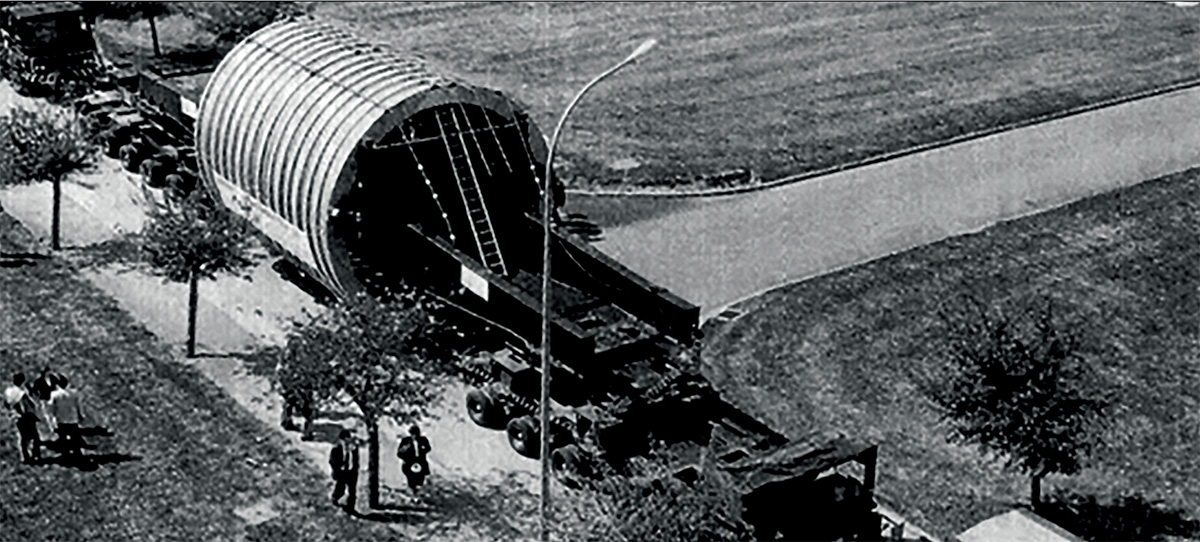
An example is the superconducting solenoid for the ALEPH experiment at CERN’s LEP electron–positron collider, contracted to the lnstitut de recherche fondamentale of the French Atomic Energy Commission (CEA) in 1983.
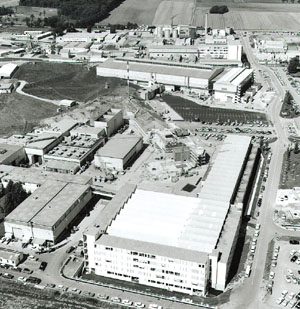
It was designed and built by engineers and technicians of the Department of Elementary Particle Physics of the CEN’s Saclay Laboratory. Recent tests at Saclay were highly successful, with current attaining 60 per cent of its design value, the (temporary) absence of shielding not permitting it to go any higher.
Weighing 60 tons, 5 metres across and 7 metres long, the ALEPH solenoid produces a magnetic field of 15 kilogauss (1.5 tesla) in a volume of 130 m3. The use of a superconducting coil reduces electric power requirements by a factor of 40 and overall weight by a factor of four. Producing the required field involves 9 million ampere-turns and a stored magnetic energy of 130 million joules.
Special technology had to be developed for its manufacture in view of the dimensions of the coil and the constraints imposed by the detector design – minimum weight and a minimum of material to be traversed by the particles produced by LEP.
Applying this technology on the required scale called for special tooling for winding, impregnation, fitting and transport. Tests at Saclay checked that the adopted solutions could reach the required performance levels.
Special features of the coil also include: almost exclusive use of aluminium; superconducting niobium-titanium cable coextruded in a pure aluminium sheath (30 kilometres to handle a current of 5000 amperes); the collar constraining the magnetic forces being used as the winding mandrel – the conductor being wound inside the collar; vacuum impregnation of the coil; and indirect coil cooling through tubes welded on the collar.
Meanwhile the barrel yoke for the ALEPH magnet has been reassembled at CERN after initial assembly by Ferriera-Cattaneo and INNSE in Milan.
The coil for the other superconducting coil for a LEP experiment, that for DELPHI, is undergoing tests at Rutherford Appleton Laboratory, UK, while the barrel yoke using Soviet steel is being assembled at CERN.
To provide the best experiences, we use technologies like cookies to store and/or access device information. Consenting to these technologies will allow us to process data such as browsing behavior or unique IDs on this site. Not consenting or withdrawing consent, may adversely affect certain features and functions.
Functional
Always active
The technical storage or access is strictly necessary for the legitimate purpose of enabling the use of a specific service explicitly requested by the subscriber or user, or for the sole purpose of carrying out the transmission of a communication over an electronic communications network.
Preferences
The technical storage or access is necessary for the legitimate purpose of storing preferences that are not requested by the subscriber or user.
Statistics
The technical storage or access that is used exclusively for statistical purposes.The technical storage or access that is used exclusively for anonymous statistical purposes. Without a subpoena, voluntary compliance on the part of your Internet Service Provider, or additional records from a third party, information stored or retrieved for this purpose alone cannot usually be used to identify you.
Marketing
The technical storage or access is required to create user profiles to send advertising, or to track the user on a website or across several websites for similar marketing purposes.