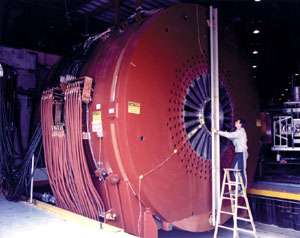
An experiment at Long Island’s Brookhaven laboratory has just reported a long-awaited result: the observation of only the second decay of a positive kaon into a positive pion accompanied by a neutrino and an antineutrino.
The E787 experiment at the laboratory’s Alternating Gradient Synchrotron began 12 years ago with the aim of detecting this extremely rare kaon decay. The first sighting was reported four years ago, and some 6 trillion events have since been analysed in the quest for confirmation.
The Standard Model of particle physics forbids the direct decay of positive kaons into positive pions. Instead the decay must proceed via a two-step process involving massive gauge bosons. That’s what makes it so rare.
Theory predicts that such two-step decays should occur just a few times for every hundred billion kaon decays. The theoretical uncertainty on rare kaon decays is very small, so measuring them is an important test of the Standard Model, as well as being a sensitive indicator for new physics.
A new collaboration, known as KOPIO, has formed round the core of E787 to study another rare kaon decay – that of the long-lived neutral kaon to a neutral pion accompanied by a pair of neutrinos. KOPIO has support from Canada and Japan and is awaiting congressional approval in the US for National Science Foundation funding.
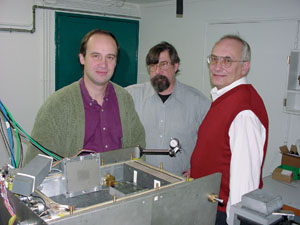
Gravity and quantum mechanics rarely mix in laboratory circles. The weakness of the gravitational interaction makes measuring its effects difficult at the quantum level. However, researchers at the Institut Laue-Langevin (ILL) in Grenoble, France, have now observed quantum effects of gravity on ultracold neutrons trapped in the Earth’s gravitational field. Their technique relies on bouncing neutrons off a reflective surface and observing quantization in the height of the bounce.
The key to the experiment was using ultracold neutrons from the ILL reactor. Neutrons do not bounce, except when they strike a surface at very grazing incidence. Instead, they are absorbed or transmitted. However, by firing neutrons with a velocity of less than 8 cm/s over a horizontal mirror, the ILL researchers were able to reduce the vertical component of the neutrons’ velocity as they fell under gravity to just 1.7 cm/s. These neutrons bounced along the mirror like flat pebbles across a pond until they were captured by a detector at the far end of the mirror. A neutron absorber could be positioned at varying heights above the mirror, allowing the researchers to identify the lowest-energy neutrons passing through the apparatus.
The ILL apparatus behaved as a neutron trap, bound from below by the mirror and from above by gravity. According to quantum mechanics, neutrons in such a trap should occupy discrete gravitational energy levels just as electrons trapped by nuclei occupy discrete electromagnetic energy levels.
This result shows that the lowest level occupied by neutrons in the trap is 1.41 x 10⁻¹² eV. Comparison with the minimum energy for an electron in a hydrogen atom, 13.6 eV, shows why the quantization of energy in a gravitational potential has not been seen before.
The next step is to use a more intense beam and a trap mirrored on all sides to prolong the period of entrapment and thus improve the resolution of the apparatus. This will allow a precision test of the equivalence between gravitational and inertial mass.
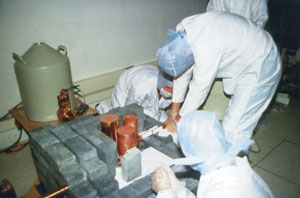
Scientists at the Max Planck Institute for Nuclear Physics in Heidelberg, Germany, have reported evidence of neutrinoless double beta decay. This result comes from members of the long-running Heidelberg-Moscow double beta decay experiment at Italy’s Gran Sasso underground laboratory. Neutrinoless double beta decay violates lepton number conservation, a fundamental tenet of particle physics. If confirmed, the consequences for particle physics will be profound.
In the conventional picture of particle physics, neutrinos and antineutrinos are distinct. Beta decay proceeds via the transformation of a neutron into a proton with the emission of a neutrino and an electron. However, if the neutrino is its own antiparticle, a rather more exotic process becomes possible. In this case, two successive neutron decays could occur, with the neutrino emitted by the first being absorbed by the second. Two electrons would emerge from the nucleus with no neutrinos, leaving a nucleus that contains two more protons than the original.
In the latest paper from the Heidelberg-Moscow collaboration (2001 Modern Physics Letters A16 (37) 2409-2420), the authors claim evidence for neutrinoless double beta decay with a half-life of around 1.5 x 1025 years from 10 years of running with an enriched sample of germanium-76. This would be compatible with a neutrino mass of around 0.4 eV, which is difficult to reconcile with neutrino mass results from other experiments and would require a special neutrino mass scenario. A previous limit from this experiment was reported in an earlier issue of CERN Courier.
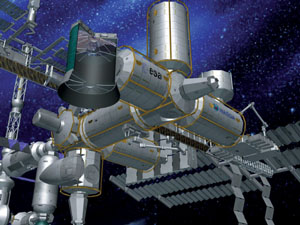
Joining the Pierre Auger Observatory in the long term will be ESA’s Extreme Universe Space Observatory (EUSO), which is scheduled to fly on the International Space Station from 2008. Comprising a wide-angle telescope that is sensitive to the ultraviolet region, the EUSO array will look down on Earth, some 400 km below, to pick up the fluorescence that is generated by cosmic rays above the Greisen, Zatsepin, Kuzmin (GKZ) cut-off.
EUSO will take in much larger areas than the Auger Observatory, with its 60° field of view sweeping over 150,000 sq. km of the Earth’s atmosphere at every pass. As cosmic-ray showers develop in the atmosphere, light is also generated through the Cherenkov effect, with photons being emitted in a narrow cone that follows the particle trajectories. On reaching the surface this light is reflected, resulting in a terminal flash in the EUSO telescope that will be used to reconstruct the cosmic-ray track.
Conceptually simple, the telescope’s 2.5 m diameter optics consist of Fresnel lenses that focus light onto a plane surface made up of multinode photomultipliers with 250,000 pixels. Each pixel covers approximately 1 sq. km of the Earth’s surface. This resolution is sufficient because at such high energies a cosmic shower can cover dozens of square kilometres when it reaches the Earth.
The total number of excited pixels is governed by the random background noise from residual light on a moonless night. The experiment therefore only takes data when the telescope passes through the Earth’s shadow; for the EUSO telescope, night lasts only 45 min and is repeated 16 times every 24 h. In the three years scheduled for the EUSO mission, some 3000 events above the GKZ cut-off are expected.
Ordinary matter composed of baryons – essentially protons and neutrons – is responsible for only a tenth of the gravitation observed in the universe. This result has just been independently confirmed by measuring the abundance of helium-3 ions in our galaxy.
The abundance of helium-3 is observed by measurements of its 8.665 GHz spin-flip transition. Observations made using the US National Radio Astronomy Observatory’s radiotelescope at Green Bank, West Virginia, show that the concentration of helium-3 is almost the same in star-forming regions as in the rest of the Milky Way. This suggests that stars enrich the interstellar medium with helium-3 very little and therefore that the quantity of helium-3 in our galaxy has hardly increased since the Big Bang.
The abundance of baryons with respect to photons in the universe is linked directly to the concentration of helium-3 relative to hydrogen. Measurements of helium-3 in our galaxy indicate that ordinary matter – in the form of baryons – represents only about 4% of the total matter and energy content of the universe. The rest of the universe appears to consist of non-baryonic dark matter of an as yet unknown nature and “dark energy”, the repulsive force that is considered to be responsible for accelerating the rate of expansion of the universe.
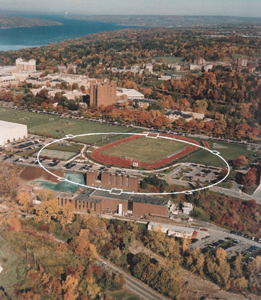
The Cornell Laboratory for Nuclear Studies was established in 1946 by scientists returning from Los Alamos after the Second World War. Its given mission was “to investigate the particles of which atomic nuclei are composed and to discover more about the nature of the forces which hold these particles together”. Under Robert R Wilson’s guidance, a succession of electron accelerators ensued, culminating in a $10 million proposal for a 10 GeV machine to be built under the university’s sports grounds. By the time this was completed, in 1968, Wilson had moved on to become the founding director of Fermilab, but during his time at Cornell he had instilled in the laboratory a “can-do” spirit that remains to this day. Wilson believed in value for money and in getting things done by being clever, no matter how tight the budget.
By the 1970s, following pioneering work in the early 1960s at Frascati and the Stanford Linear Accelerator Center (SLAC), colliding beam machines were gaining ground. Cornell’s new director, Boyce McDaniel, decided to build an electron-positron collider at Cornell using the 10 GeV synchrotron as an injector. His first task was to convince the National Science Foundation, Cornell’s main funding agency, that a synchrotron could provide the necessary positron currents for such a machine. Happily for Cornell, accelerator expertise was on hand in the form of Maury Tigner, who had built a table-top electron storage ring in 1959 while a student of Wilson’s. Tigner had also been the first scientist to bring the idea of building an electron-positron collider to Cornell following conversations with Bjørn Wiik at Hamburg’s DESY laboratory. It was natural for McDaniel to appoint Tigner as project leader.
Building the storage ring
Tigner’s immediate challenge was to find a way of getting an intense beam of positrons into the proposed electron-positron storage ring. With the linac that Cornell used to feed the synchrotron, the process of building up a single intense bunch of positrons by accelerating individual bunches through the accelerator chain would be a long and difficult one. Tigner’s solution, which was later described as “fiendishly clever” by Karl Berkelman (the laboratory’s director through much of the Cornell Electron Storage Ring era), overcame the problem by accelerating multiple bunches and then coalescing them through a sequence of particle gymnastics in the synchrotron and the storage ring.
Under Tigner’s scheme the storage ring would be 61/60 of the circumference of the synchrotron and it would be filled with 60 bunches. In this way each bunch – starting with bunch number 2 – could be diverted into the synchrotron in turn. After n – 1 turns in the synchrotron, bunch n would be aligned with bunch 1 and could be reinjected into the storage ring, where it would coalesce.
The physics motivation for building a storage ring received a boost in November 1974 when the J/psi particle was discovered by Burton Richter at SLAC and by Sam Ting at Brookhaven. Six months later, Cornell submitted its proposal. It was then that the facility acquired its grand title. “For a while it was open season on creative names,” recalled Berkelman. “One of the wackiest I remember was suggested by Hywel White: CORNell COlliding Beams, or CORNCOB.” Eventually McDaniel ended the debate with Cornell Electron Storage Ring (CESR).
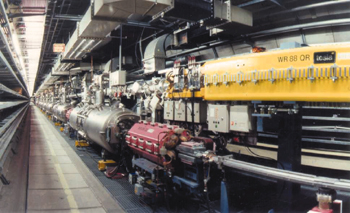
In 1979, CESR collided its first beams using Tigner’s novel coalescing scheme and the facility ran this way for several years. It was the first step in a proud tradition of Cornell particle gymnastics that would see CESR hold the world luminosity record for many years and that would be copied by other labs around the world. In the pursuit of ever-higher luminosity for CESR, Cornell physicist Rafael Littauer came up with the idea of putting more bunches in the storage ring by making the beams follow eccentric, pretzel-shaped orbits. Later on, Robert Meller’s idea of colliding the beams at a small angle, thus permitting yet more bunches, allowed the luminosity to be pushed still higher. Both of these ideas have been adopted by other labs and allow CESR to run today with a total of 45 on 45 colliding bunches in the ring.
A question of serendipity
The discovery of b anti-b quark bound states – upsilon particles – by Leon Lederman’s group at Fermilab in 1977 was “a fabulously serendipitous gift of nature that would guarantee the productivity of CESR for decades”, said Berkelman. The resonance found by Lederman’s group had a mass in the 9.4-10.4 GeV range, precisely where CESR would be looking. This was an extremely happy coincidence for Cornell, since the size of the ring, and hence its energy range, was determined by no more fundamental a parameter than the size of Cornell’s sports ground.
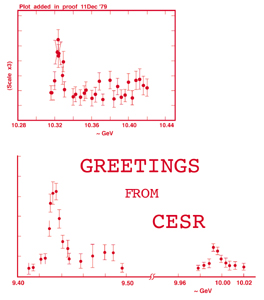
CESR’s detectors, CLEO and CUSB, soon resolved Lederman’s resonance into three separate peaks and McDaniel chose to announce the lab’s new facility to the world in the form of a greetings card showing these peaks. The more orthodox announcement came in the form of CLEO’s first paper, which was submitted to Physical Review Letters in February 1980. Cornell went on to play a leading role in the world of b-quark physics until 2000, when the dedicated B-factories at SLAC and KEK came into operation.
Serendipity is not the only thing that has kept Cornell in the world particle physics spotlight. “We take accelerator physics and technology very seriously as a branch of physics,” said Berkelman. It is this approach that has turned Cornell into a recognized centre of excellence in the field, with influence well beyond its Ithaca campus. Many innovations in accelerator physics, such as the concept of a linear collider and the innovation of an energy-recovery linac, have found fertile ground at Cornell over the years.
Superconducting radiofrequency is Cornell’s forte, with a tradition going back to the 1960s. Cornell was first to apply superconducting RF technology to cyclic accelerators for particle physics, installing a superconducting cavity in the 10 GeV synchrotron as early as 1975. This presented quite a challenge, since heat-load due to synchrotron radiation could easily warm the cavities to above their critical temperature. The technology developed for the synchrotron was adopted for the Continuous Electron Beam Accelerator Facility (CEBAF) – now known as the Jefferson Laboratory – in Virginia, the construction of which began in 1987 and occupied a large part of the Cornell group.
By then, Hasan Padamsee, who chose to remain at Cornell, was promoting the idea of superconducting RF for linear colliders, and in 1990 Cornell hosted the first TESLA workshop. This time it was Bjørn Wiik’s turn to take home an idea, and DESY soon became the standard bearer for the TESLA project.
Today, Cornell remains at the forefront of accelerator R&D, and the tradition that began when CEBAF adopted Cornell technology continues. As well as being used at CEBAF and TESLA, superconducting RF technology pioneered at Cornell is now finding applications in light sources, free-electron lasers, spallation neutron sources and radioactive ion-beam facilities.
The problem with proton spin is that it does not add up. A recent workshop, which was held at the European Centre for Theoretical Studies (ECT) in Trento, Italy, brought together 34 leading theorists and experimentalists from 12 countries to discuss the theoretical and experimental status of the “proton-spin problem”, to identify the key quantities and to formulate a strategy for measuring them.
Particular emphasis was given to comparing the contributions expected from new polarized (spin-oriented) scattering experiments at CERN, DESY (Hamburg) and SLAC (Stanford), polarized proton-proton collisions at Brookhaven’s new Relativistic Heavy-Ion Collider (RHIC), an electron-ion collider (EIC), also at Brookhaven and a possible new polarized HERA electron-proton collider at DESY.
For polarized HERA, the spin of the existing proton beam would be made directional. Looking further ahead, the THERA scheme plans to use electrons from the TESLA superconducting electron-positron linacs and polarized protons in HERA.<textbreak=Missing spin>Polarized scattering experiments at CERN, DESY and SLAC in which the incident beams probe deep inside the target particles suggest that only about 20-30% of the proton’s spin is carried by the intrinsic spin of its quark and antiquark constituents – less than half the prediction of quark models. Where is the spin coming from? This mystery has inspired vast theoretical and experimental activity to analyse and understand the spin structure of the proton.
The present status of experimental data from fixed-target experiments was reviewed by Alessandra Fantoni (Frascati and HERMES) and Fabienne Kunne (Saclay and SMC/COMPASS). Detailed presentations also covered polarized deep-inelastic measurements at small parton momentum x (x is the fractional momentum of the quark; Barbara Badelek, Uppsala), hard exclusive processes (Moskov Amarian, NIKHEF) and nuclear effects (Valeria Muccifora, Frascati). Albert De Roeck (CERN) and Naohito Saito (RIKEN-Brookhaven) reviewed the new physics possibilities at polarized electron-proton colliders (HERA, THERA and EIC) and at polarized proton-proton collisions at RHIC.
The spin decomposition of the proton was discussed in the opening talk by Robert Jaffe (MIT), who underlined the theoretical subtleties in the definition and measurability of quark orbital angular momentum and the physics prospects for measuring spin from transversely polarized targets.
The prospects for measuring the spin-flavour structure of the proton were discussed by Jechiel Lichenstadt (Tel Aviv), Giovanni Ridolfi (Genova) and Gaby Rädel (Palaiseau), who emphasized that tightly confined sprays (“jets”) of particles from quark-antiquark pairs deep inside high-energy, polarized electron-proton collisions provide a “gold-plated” measurement of gluon polarization in the proton. This mechanism is not dependent on theoretical interpretation.
Steven Bass (Trento) stressed the possible connection between the spin structure of the proton and the long range gluon dynamics that are responsible for the unaccountably large mass of the h´ meson (the famous “U(1) problem” of quantum chromodynamics). These ideas could be tested through elastic neutrino-proton scattering, which provides complementary information about the spin structure of the proton. Rex Tayloe (Indiana) reported on an exciting possibility for a definitive neutrino-proton elastic experiment using the miniBooNE set up at Fermilab.
Polarized electron-proton colliders could map out the spin-dependent structure function, g1, down to x of about 10-4, providing powerful new constraints on small x physics in addition to decisive measurements of gluon polarization in the proton. Pointing out complementary studies, Anthony Thomas (Adelaide) emphasized that polarized deep-inelastic scattering at large x (almost unity) is a sensitive probe of the valence quark structure of the nucleon. Precision measurements of the large-x region are planned at Jefferson Laboratory.
Sum rule status
In polarized photoproduction, the present status of tests of the Drell-Hearn-Gerasimov (DHG) sum rule was reported by Klaus Helbing (Erlangen) and Zein-Eddine Meziani (Temple). The DHG sum rule relates spin dependent total cross-sections to the anomalous magnetic moment of the proton target and is derived from fundamental principles. Any violation of this sum rule would challenge our present understanding of spin in QCD.
The theory and status of spin transfer reactions, in which the spin of both the target and the outgoing particle is measured, was discussed by Jacques Soffer (Marseille). The potential of polarized colliders to probe new physics was reviewed by Jean-Marc Virey (Provence). Contributions were made on developments in QCD parton phenomenology, transverse polarization observables, single-spin asymmetries and exclusive channels, and this motivated a great deal of discussion about the physics potential of future experiments to unravel the spin structure of the proton.
The workshop ended with a presentation and comparison of the physics prospects of polarized electron-proton collider projects – polarized HERA (Albert De Roeck, CERN) and the electron-ion collider (EIC; Abahy Deshpande, RIKEN-Brookhaven and Witek Krasny, Paris), which are currently under discussion respectively at DESY and, particularly, at Brookhaven. A workshop on the EIC project is scheduled for March 2002 at Brookhaven. Possible future fixed-target programmes were also discussed by Wolf-Dieter Nowak (DESY Zeuthen).
Polarized proton-proton and electron-proton colliders are potentially a very useful tool for the investigation of the spin and chiral structure of any new physics beyond the minimal electroweak Standard Model that might be revealed with the corresponding unpolarized colliders. Building on the programme of polarized proton-proton collisions currently under way at RHIC in the US, it is worthwhile to investigate the physics potential of future polarized proton-proton collisions in CERN’s LHC. The workshop revealed considerable enthusiasm within the spin community for possible future developments with the LHC.
CERN’s new nuclear physics facility, REX-ISOLDE, was commissioned at the end of October, opening up new horizons for the laboratory’s nuclear physics community. REX-ISOLDE builds on CERN’s existing radioactive beam facility, taking radioactive ions and boosting them to energies of up to 2.2 MeV per nucleon.
ISOLDE, the isotope separator on line, has a history stretching back over 30 years supporting experiments from basic nuclear physics to the life sciences. To date, these have focused on radioactive nuclei at energies of less than 60 keV – an upper limit that was starting to constrain the facility’s potential. REX, the newly commissioned radioactive beam experiment, remedies this by opening up the 0.8-2.2 MeV range for exploration.
REX-ISOLDE has been built round a new linear accelerator, which was funded and constructed by a broad European collaboration. ISOLDE’s 60 keV ions are accumulated in a Penning trap, charge bred in an Electron Beam Ion Source and then finally accelerated in the linac. The first beams to be accelerated consisted of neutron rich sodium isotopes, which reached 2 MeV per nucleon on 30 October.
Researchers at the facility’s main detector system – a gamma detector array known as Miniball – are now starting early experiments probing whether the magic numbers N = 20 and N = 28 of the nuclear shell model are still valid for very neutron-rich nuclei. Future experiments will address topics that include the structure of nuclei with equal numbers of protons and neutrons, proton radioactivity and nuclear astrophysics.
Just as physicists were getting used to the idea of all particle physics measurements agreeing with each other and with the all-embracing Standard Model, a major experiment at Fermilab has announced a surprising neutrino measurement.
The NuTeV collaboration at Fermilab’s Tevatron compares the different types of neutrino interaction and finds a vital parameter to be 0.2277, not 0.2227. At the level of precision being explored in particle physics, this is a major upset and needs confirmation. However, the NuTeV experiment has now terminated, and the Fermilab Tevatron has ceased operations for fixed target studies, such as those using neutrino beams.
Over a period of 15 months in 1996 and 1997, NuTeV shone beams of neutrinos and their antiparticles at a 700 tonne target. The energy of the neutrinos was 125 GeV, and that of the antineutrinos was 115 GeV.
Neutrinos do not interact readily with matter – at NuTeV, only one in a billion neutrinos registered a hit inside the target. Together, some 2 million neutrino and antineutrino hits were patiently collected. Neutrinos, which are electrically neutral, almost massless, particles, can interact with other matter through the weak nuclear interaction in one of two ways. In the classic form, related to nuclear beta decay, the neutrino changes a nuclear proton into a neutron (or vice versa) and an electrically charged muon (or electron) is emitted. This type of reaction shuffles round the charges of the participating particles and is therefore known as a “charged current”.
In 1973, neutrinos were also discovered to be capable of interacting with matter without permuting electric charge – a “neutral current”. This discovery was vital evidence in favour of the then new “electroweak” theory, which unifies weak interactions and electromagnetism. By looking to see whether neutrino interactions were accompanied by a muon, NuTeV could distinguish between charged and neutral current interactions – only the former produced an outgoing muon.
By comparing the ratio of neutral and charged current production by neutrinos and antineutrinos, the experiment finds a value for the vital mixing parameter (Weinberg angle), which dictates the weights of the electromagnetic and weak effects in the combined electroweak theory and also relates the masses of the Z boson (the particle that mediates the neutral current) and the W boson (the charged-current carrier).
The history of the neutrino has been full of surprises
Beginning with high-energy neutrino studies at CERN in the late 1970s, and continuing with precision measurements of Z and W properties in proton-antiproton colliders at CERN and Fermilab and at electron-positron colliders at CERN and SLAC in the 1990s, physicists had built up a precision picture of weak interaction parameters. However, the latest NuTeV result does not fit in with this.
The history of the neutrino has been full of surprises. The prediction of such a bizarre particle was itself a surprise, and the fact that neutrinos could be observed was another. More came when physicists discovered that neutrinos come in different forms, which could even transform into each other. Is the latest NuTeV result a blip or another neutrino surprise? Only time will tell.
Muon magnetism OK
A heroic reappraisal of complicated calculations means that an intriguing physics anomaly has gone away, but in an unexpected way. Last year a precision measurement of the muon’s magnetism at Brookhaven reported a slight disagreement with the expected value. In some quarters, this was heralded as possible evidence for new physics. After carefully re-examining the underlying calculations, experts found that there was, in fact, a mathematical error in the predicted value. The Brookhaven team’s measured value has not changed, but is no longer a puzzle. The muon’s magnetism looks to be in order.
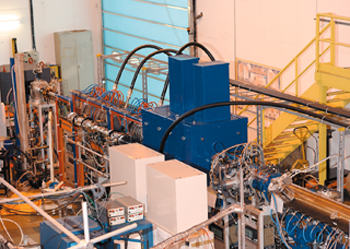
While plans to update the Beijing Electron-Positron Collider (BEPC) and the Beijing Spectro-meter (BESII) experiment go ahead, the BES experiment has completed its second highly successful run at the J/psi resonance this year.
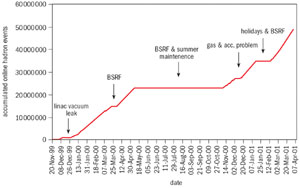
The first run began in November 1999 and lasted until May 2000. The second lasted from December 2000 until May 2001. BES accumulated 24 million and 27 million J/psi events in the two running periods respectively, making a total of 51 million events (figure 1). This is the world’s largest sample of J/psi events produced from electron-positron annihilation. Previous large data samples of 6-8 million J/psi events were collected by MARKIII (SLAC, Stanford), DM2 (DCI, Orsay) and BES (Beijing) experiments. The new sample will allow the properties and decays of the J/psi to be studied with unprecedented precision.
The discovery in 1974 of the J/psi particle, composed of a charmed quark and antiquark, was crucial in establishing the quark model. In this model, almost all observed mesons and baryons can be described as composite objects made of quarks that are held together by the strong nuclear force. The theory that describes this is called quantum chromodynamics (QCD). In this theory, the carriers of the strong nuclear force are gluons and the quarks are held together by the exchange of gluons.
However, QCD also predicts the existence of exotic hadrons. These are glueballs, which are made up entirely of gluons, and hybrids, which contain both quarks and gluons. Masses of glueballs and hybrids are predicted by lattice QCD calculations and other theoretical models. Establishing the existence of exotic hadrons experimentally is very important in order to confirm QCD.
Many experiments have searched and some exotic hadron candidates have been reported, but they have not yet been confirmed to everyone’s satisfaction. J/psi decays are excellent places to search for these exotic particles.
During the latest BES run, the luminosity increased gradually. A peak BEBC luminosity of 5 ¥ 1030cm2/s was attained and a record number of 0.42 million J/psi events were accumulated in one day. After completion of the first round of reconstruction of all J/psi events, careful off-line calibration of the data shows that the BES detector performed well with a barrel time-of-flight resolution of 180 ps, energy loss rate resolution of 8% and a momentum resolution of 1.78%.
According to QCD, radiative decays of J/psi particles, where a photon is also produced in the decay, are regarded as an important process to search for glueballs. Physicists at BES have started to study radiative decays of J/psi particles, including those producing a pair of neutral kaons, a proton-antiproton pair and so on. Searches for possible 0++ and 2++ glueball candidates will be made. BES is carrying out detailed analyses on many different J/psi decays to determine the spin and parity of the final states.
The large J/psi sample will also allow many other studies. Hadronic decays of the J/psi provide a wealth of opportunities for searching for hybrids; studying light meson spectroscopy; observing excited baryonic states; measuring SU(3) mixing angles; and probing lepton flavour violation and CP violation.
To provide the best experiences, we use technologies like cookies to store and/or access device information. Consenting to these technologies will allow us to process data such as browsing behavior or unique IDs on this site. Not consenting or withdrawing consent, may adversely affect certain features and functions.
Functional
Always active
The technical storage or access is strictly necessary for the legitimate purpose of enabling the use of a specific service explicitly requested by the subscriber or user, or for the sole purpose of carrying out the transmission of a communication over an electronic communications network.
Preferences
The technical storage or access is necessary for the legitimate purpose of storing preferences that are not requested by the subscriber or user.
Statistics
The technical storage or access that is used exclusively for statistical purposes.The technical storage or access that is used exclusively for anonymous statistical purposes. Without a subpoena, voluntary compliance on the part of your Internet Service Provider, or additional records from a third party, information stored or retrieved for this purpose alone cannot usually be used to identify you.
Marketing
The technical storage or access is required to create user profiles to send advertising, or to track the user on a website or across several websites for similar marketing purposes.