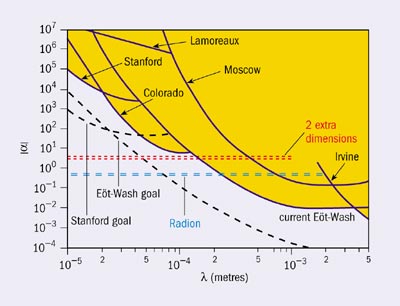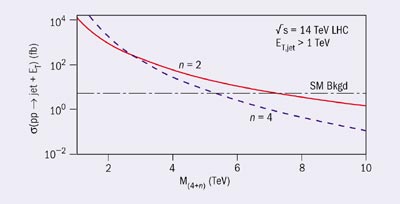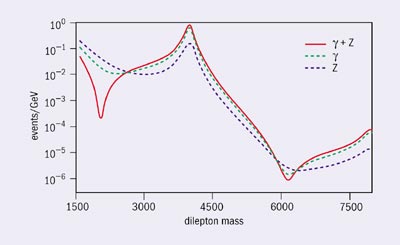
Physicists working at the spallation neutron source at the Research Centre for Nuclear Physics at Osaka University in Japan have for the first time produced ultracold neutrons using phonon excitations in a quantum liquid. A group led by Yasuhiro Masuda of KEK succeeded in the efficient production of ultracold neutrons in superfluid helium, which is free from the limitations of previous ultracold neutrons sources, imposed by Liouville’s theorem.
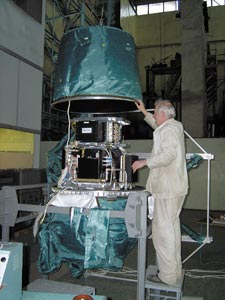
Ultracold neutrons (UCN) are important experimentally because, although neutrons are very small when compared with the interatomic distances in a material, UCN can be confined in a material bottle due to their wave properties. The attractive nuclear force inside a nucleus in a material distorts the wave associated with a neutron, pushing it back from the centre of the nucleus. Moreover, neutrons of long wavelength (low energy) see the nuclear force of many nuclei in a material. As a result, neutrons below a critical energy – UCN – are completely reflected from a material surface and can be confined in a bottle. UCN are also confined by the magnetic potential in a magnetic bottle (figure 1).
As neutrons are a fundamental constituent of the universe, confined neutrons can be used in various experiments to study the creation of matter in the universe, nucleosynthesis after the Big Bang, and the burning of the Sun. The energy available at the time of the Big Bang created a huge number of particle and antiparticle pairs, which annihilated and transformed back to energy. However, a CP-violating interaction broke the balance of particle and antiparticle numbers, and in due course quarks and leptons were formed. The quarks then condensed into protons and neutrons, and the protons and neutrons formed the nuclei of heavier elements in the process of nucleosynthesis. The nuclei later joined with electrons to form atoms, and eventually stars were born.
The neutron lifetime and the neutron cross-sections of nuclei together played a crucial role in nucleosynthesis immediately after the Big Bang. The neutron lifetime is also relevant to the proton-proton chain in the burning of the Sun. In addition, the same CP violating that created the imbalance between matter and antimatter in the early universe induces an electric dipole moment (EDM) in the neutron. UCN are used for precision measurements of both the EDM and the lifetime of the neutron, and can be used in neutron cross-section measurements. They are also useful for other precision experiments on neutron beta-decay and gravity, and are used in research in surface physics.
In any of these experiments, a high UCN density is very desirable. At the reactor at the Institut Laue-Langevin (ILL) in Grenoble, France, UCN have been extracted from a cold neutron source using gravity and a mechanical decelerator to produce the world’s highest UCN density – 10 UCN per cubic centimetre in an experimental bottle. Further improvement in the density is, however, not expected because of the limitations imposed by Liouville’s theorem, which says that the density in phase space should remain constant.
Now the Japanese group has employed a new UCN production method. Neutrons are produced in a spallation reaction, which generates a smaller photon (γ) to neutron production ratio than in a reactor. A pulsed proton beam, with a typical pulse width of 40 s and a power of 78 W, was used for the spallation reaction. The spallation neutrons, with energies in the MeV region, were then moderated down to cold neutron energies by collisions in thermal (300 K) and cold (20 K) heavy water (figure 2). The cold neutrons were further cooled down to UCN velocities through phonon interactions in 1.2 K superfluid helium. This cooling process is not limited by Liouville’s theorem because the decrease of neutron phase space is compensated by the increase in phase space of the phonons.
The UCN were then extracted, with negligible losses, through a guide tube into an experimental bottle, where the number of UCN was counted using two (15 and 24 mm diameter) solid-state detectors behind a 6Li film. A typical UCN count time was 60 s, and the UCN were found to remain in the bottle with a decay time constant of 14 s (figure 3). The UCN density was 0.7 UCN per cubic centimetre at the beginning of the counting, and this doubled to 1.4 UCN per cubic centimetre when the proton beam power was doubled.
The new UCN source is expected to produce a UCN density of greater than 10,000 UCN per cubic centimetre, through improvements in the proton beam power, the UCN lifetime in the bottle, etc. The main limitation comes from the ability of the cryostat cooling to remove γ heating in the superfluid helium after the spallation reaction. The above expectation is based on practical values of superfluid helium temperature (0.8 K) and proton beam power (30 kW).
The discovery of the J/Ψ particle in November 1974 by the teams led by Burton Richter at SLAC and Sam Ting at Brookhaven came as a great surprise. However, after a period of uncertainty, ended by the discovery of the Ψ′ at SLAC, the J/Ψ was identified as a bound state of a charm quark and an antiquark, c-cbar, which had been explicitly predicted in 1970 by Sheldon Glashow, John Iliopoulos and Luciano Maiani. In the J/Ψ and the Ψ′, the spins of the c and ccbar are parallel and form a triplet state (spin 1) associated with a space wave function of orbital momentum l=0. However, as in positronium (e+e–), there also exist singlet states in which the spins are antiparallel, with orbital angular momentum l=0 or l>=1, as shown in figure 1.
The story of the experimental search for the l=0 singlet states and the efforts of theoreticians to explain the successive and contradictory experimental results, is an interesting one. The table summarises the history of the ground and first excited singlet states, ηc and ηc′ (or ηc(2S)). Δm and Δm′ give the hyperfine splittings, or in other words, the mass differences between these singlet states and the related triplet states.
In the late 1970s, experiments found Δm, the mass difference between the ηc and the J/Ψ, to be about 300 MeV (Braunschweig et al. 1977, Apel et al. 1978). However, this result was difficult to swallow for two reasons. First, naive estimates of the hyperfine splitting give much smaller values, and second, the radiative decay width J/Ψ → ηc + γ is proportional to Δm3, so any theory correctly predicting Δm ~300 MeV would overestimate this width. This is why most theoreticians were extremely sceptical about the result from the DASP experiment (Braunschweig et al. 1977). Fortunately, the Mark II and Crystal Ball groups found in J/Ψ → ηc + γ what we believe is the true ηc, with a splitting of Δm = 119 MeV (Himel et al. 1980, Partridge et al. 1980).
A little later, the Crystal Ball group also found a candidate for the ηc′, again by radiative decay, but from the Ψ′ (Edwards et al. 1982). The Δm′ =~ 90 MeV splitting they found is acceptable – for instance Wilfried Buchmuller, Yee Jack Ng and Henry Tye found 80±10 MeV in a QCD-inspired calculation (Buchmuller, Ng and Tye 1981). However, the ratio Δm′/Δm seems difficult to accept. First, a naive estimate using a Fermi-like hyperfine interaction suggests that Δm′/Δm is related to the ratio of the leptonic widths of the Ψ′ and J/Ψ. This gives Δm′/Δm =~ 0.6±0.1, which is hardly consistent with the Crystal Ball result. In addition, there are effects due to the coupling of the ccbar bound states to the charm-anticharm meson pairs, D(*)Dbar(*), as we pointed out in 1981. The coupling to the very close DDbar threshold is allowed for a vector state, so this should make the Ψ′ lower than predicted by naive potential-model calculations. The pseudoscalar ηc, on the other hand, does not couple to DDbar and so is shifted much less. Using the Cornell model (Eichten et al. 1978, 1980), we found that this effect reduces Δm′ by at least 20 MeV.
The puzzling Crystal Ball result on ηc′ was never confirmed. Searches for the ηc′ in formation experiments in proton-antiproton collisions, first at the ISR and then at the Fermilab accumulator, were unsuccessful. This may be because these experiments had too high a resolution in energy, and perhaps because of prejudice that the ηc′ would not be too close to the Ψ′. The coupling of the ηc′ to proton-antiproton might also be less favourable than for ηc. Meanwhile the ηc was seen at LEP, in its γγ decay mode, but no signal was found for the ηc′.
Charmonium can also be investigated through B decay, as proposed by several authors (e.g. Eichten et al. 2002). The Belle experiment at KEK, whose primary purpose is to study the CP violation in B decays, has seen both the ηc and ηc′ in two distinct channels, which we can call Belle I and Belle II. The BaBar experiment at SLAC should also produce similar results.
In Belle I, the decays B → Kηc(ηc′) → KKsK–π+ reveal two main peaks, as in figure 2 (Choi et al. 2002). The first is clearly the ηc, while the second is most likely the ηc′, as the background from B → K + J/Ψ or K + Ψ′ is expected to be rather small. This implies that m(ηc′) = 3654±6 MeV, i.e. Δm′ = 32±6 MeV, which is much smaller than the Crystal Ball-obtained value, and even smaller than we expected from the effect of the coupling to charm-anticharm channels.
In Belle II, the reaction studied is e+e– → J/Ψ + ccbar, i.e. double ccbar production with one pair constrained to match the J/Ψ (Abe et al. 2002). The recoil spectrum against the J/Ψ gives a set of ccbar bound states. If the process takes place via e+e– annihilating into one photon, charge conjugation conservation strictly forbids J/Ψ and Ψ′, and three peaks corresponding to ηc, Χ0 and ηc′ can be seen (figure 2). This time Δm′ is somewhat higher, about 60 MeV, which is more consistent with our 1981 expectation. On the other hand, the ηc is shifted with respect to the standard value of the Particle Data Group. The imperfect agreement between Belle I and Belle II will hopefully disappear in the final analysis and in particular it should be decided whether or not a background B → Ψ′ + K or (unlikely) e+e– → J/Ψ + Ψ′ contributes to the observed spectrum. In any case, we are very close to the complete clarification of the ηc′, with a mass much closer to the Ψ′ than was indicated by the Crystal Ball group.
Theory also predicts a ccbar singlet P-state called hc. Paradoxically, the corresponding state in positronium has only been observed relatively recently (Conti et al. 1993). First indications for hc came from the R704 experiment at the ISR, in which a cooled antiproton beam collided with a gas jet target (Baglin et al. 1986). This was at the time when the ISR was to be stopped and dismantled. At the request of one of us (A M), a few extra days running were granted by the director-general, Herwig Schopper, but no firm conclusion could be reached. Years later a similar experiment, E760, was carried out at Fermilab and gave strong indications of the hc at the same mass that happens to agree with the most naive prediction, i.e. the weighted average of the triplet P-state masses (Armstrong et al. 1992). However, these indications have disappeared in the latest experiment, E835 (Patrignani et al. 2001). Assuming that E760 was right, it is tempting to wonder if the same scenario will not repeat itself with the Higgs search: indication in the last runs of LEP of a Higgs at 115 GeV, which might be right and so be definitely seen years later with the LHC.
Quantum chromodynamics (QCD), the theory of the strong force, is a marvellous example of how the physical laws that describe a large variety of complex phenomena can be condensed into a very simple and elegant mathematical structure, known as non-abelian gauge theory. The fundamental equations can be written down in a single line, yet they describe how the nucleons acquire their masses from “nothing”, or how two nucleons smashed together at high energies disintegrate into dozens of new particles bundled into “jets” – the visible manifestations of the quarks and gluons. The fundamental equations are extremely hard to solve. At higher energies where the strong force weakens, the equations may be expanded in a perturbation series, where each new term demands more sophisticated analytical or numerical methods of computation. At energies of the order of the proton mass, the equations can only be solved by large-scale computers.
From September 24-27, 2002, approximately 130 high-energy physicists gathered in Hamburg at the annual DESY Theory Workshop to discuss their recent advances in the development of computational methods, and their successes (and sometimes failures) in comparing their calculations with experiments that continue to become more precise or to explore new phenomena. As emphasized by many talks at the workshop, these efforts go far beyond understanding how hadronic phenomena work. As the high-energy community gathers its resources to attack the fortress of the Standard Model, which has stood unconquered for the past 30 years, the strong interaction is a faithful, though not always loved, companion. Whether protons collide at the LHC to produce perhaps the Higgs boson or new particles, whether B mesons decay at SLAC and KEK to reveal the subtle asymmetry of matter and anti-matter, or whether the anomalous magnetic moment of the muon is measured to a part in a billion, an accurate computation of strong interaction effects will be required to ascertain finally a failure of the Standard Model.
Inside the proton
What is a proton? The answer is more difficult than just “three quarks”. In high-energy collisions the proton appears as a bunch of quarks and gluons collectively called partons. The (longitudinal) momentum distributions of these partons are fundamental input to the computation of any proton collision. James Stirling of Durham reviewed the current knowledge of parton distributions and concluded that the global fit is satisfactory. Methods are now being developed to assign reliable errors to these functions, which may soon be known with higher (“next-to-next-to-leading order”) theoretical accuracy. Closely related to the conventional parton distributions are the diffractive parton distributions, which give the probability of finding a parton in the proton under the additional condition that the proton stays intact in the collision. One of the surprising results of DESY’s HERA experiments is that this probability remains large, even at the highest momentum transfers. The physical interpretation of this was provided by John Collins of Penn State, who also emphasized that models of soft interactions in diffractive scattering should be taken as models for the corresponding parton distributions.
At high collision energies the number of partons with small momentum fraction x of the proton increases rapidly and the conventional, perturbative equations should break down. They should be replaced by an equation that sums logarithms in x, known as the BFKL equation. In the leading approximation, the solution to the BFKL equation overestimates the growth of high-energy cross sections. Victor Fadin of Novosibirsk discussed the progress made towards a next-to-leading approximation. With many parts now being completed, the calculation of the so-called photon impact factor is required before a comparison with experiments can be attempted. Whatever the result, at very small momentum fraction the growth of parton densities must stop. As explained by Alfred Mueller of Columbia, this occurs for quarks because the Pauli principle limits the number of fermions per phase space cell. For gluons, however, “saturation” already occurs classically when the density of gluons is so high that their combined field strength is non-perturbatively large. Mueller discussed the applicability of a classical description and estimates of the saturation scale during various stages of the collision process under the conditions at HERA and at Brookhaven’s RHIC collider.
The experimental verification of these phenomena at HERA remains ambiguous, according to Brian Foster of Bristol. He also showed an impressive amount of jet data – all in agreement with QCD computations – and demonstrated that the strong coupling constant can now be determined from electron-proton collisions with high accuracy. The HERA collider has become a veritable QCD factory, providing data over many orders of magnitude in momentum transfers and for many final states that probe different aspects of the strong interaction. Understanding the transition to soft, non-perturbative physics remains one of the most difficult challenges. This transition appears to be surprisingly smooth. Hans-Günther Dosch of Heidelberg showed that a simple model which views the QCD vacuum as an ensemble of Gaussian gauge field fluctuations, allows many features of soft hadronic interactions at high energy to be related to properties of the QCD vacuum.
The spin of the proton is 1/2, but how is it distributed over the various partons? A decade ago the “spin crisis” was proclaimed, after it was observed that the quarks carry only a fraction of the total spin. The talks by Elke-Caroline Aschenauer of DESY and Daniel Boer of Amsterdam highlighted that experimentalists and theorists still struggle to account for the remainder. For example, the gluon’s contribution to the spin remains largely unknown and its direct determination requires less inclusive measurements than polarised deep-inelastic scattering. Getting hold of orbital angular momentum is even harder and demands the introduction of new theoretical concepts (“generalized parton distributions”), which can be constrained by observing Compton scattering of virtual photons off protons.
Lattice calculations
Perturbative approximations are not adequate for ab initio calculations of hadron masses or, more generally, hadronic matrix elements, which are governed by strong-coupling physics. In these cases numerical simulation of QCD on a discrete space-time lattice provides the only systematic approach. Lattice QCD benefits greatly from the increasing speed of computers, where the scale of machines is currently set by TeraFlops (1012 operations per second). However, as emphasized by several speakers at this workshop, conceptual progress and the improvement of simulation algorithms play at least an equally important role.
Most calculations are still performed with a truncated version of QCD, which neglects quark-antiquark quantum fluctuations. Allowing quarks to fluctuate is costly, as discussed by Sinya Aoki of Tsukuba, and forces the use of smaller, coarser space-time lattices. Aoki showed that the computed hadron spectrum is in much better agreement with observations for dynamical quarks, but pointed to the need for better algorithms that would allow the simulation of light quarks with masses closer to their real values.
A different avenue was pursued by Hartmut Wittig of DESY, who reviewed the various methods to put massless (but still non-dynamical) quarks on the lattice. This became a real possibility a few years ago when it was discovered that QCD at finite lattice spacing has an exact symmetry that approaches the conventional chiral symmetry in the continuum limit. Wittig showed that the efforts to put this into practice are now bearing fruit for quantities such as the strange quark mass or the quark condensate, where the chiral behaviour is particularly important. Chiral symmetry is also important for kaon physics, where results from lattice calculations have a large impact on the interpretation of direct and indirect CP-violating effects. Indirect CP violation in kaon decay to two pions poses a particular challenge to lattice theorists, since the relevant matrix elements include final state interactions. Chris Sachrajda of Southampton described new ideas to extract these matrix elements by exploiting the finite size of the lattice.
Another impressive demonstration of progress in lattice gauge theory was given by Martin Lüscher of CERN. Using a new algorithm that allows the computation of large Wilson loops, he showed that the large-distance behaviour is consistent with the assumption that the low energy limit of SU(N) gauge theory is a bosonic string theory. Moreover, the perturbative regime joins smoothly to the string regime at a distance of about 0.5 fm.
Charm and bottom quarks are produced in large numbers at today’s high-energy colliders. The theory of single-inclusive heavy meson production and of quarkonium production was reviewed by Bernd Kniehl of Hamburg, who described the efforts to treat heavy quark mass effects correctly at all energy scales. He also concluded that, with the exception of polarisation measurements, the non-relativistic factorization approach to quarkonium production appears to be supported by existing data. A particularly interesting quarkonium system consists of a top-antitop pair. Although this system decays after little more than 10-25 s, the strong Coulomb force the quarks exert on each other leaves a visible enhancement in the energy dependence of the production cross section. This can be used (at an electron-positron collider) to determine the top quark mass to an accuracy of less than a permille. Thomas Teubner of CERN showed that many of the theoretical difficulties involved in the calculation of the threshold cross section have now been solved with non-relativistic effective field theory. Very similar calculations also determine the bottom and charm quark mass from quarkonium systems.
A complementary method uses inclusive heavy quark production in e+e– collisions far above the production threshold. The corresponding hadronic spectral functions also provide an indispensable source of information for other fundamental constants, such as the strong coupling, the hadronic contribution to the electromagnetic coupling (at the scale of the Z mass) or the anomalous magnetic moment of the muon. The accuracy needed for these quantities is reflected in the development of sophisticated symbolic manipulation programs, which enable the computation of thousands of multi-loop Feynman diagrams. Matthias Steinhauser of Hamburg discussed recent advances, particularly in including quark mass effects and their impact on precision determinations of the coupling constants. Similar methods of algebraic reduction of Feynman integrals are now also being applied for jet physics, where many further difficulties come from the more complicated kinematics. The new frontier, stated Nigel Glover of Durham, is set by next-to-next-to-leading order calculations. He explained that while all the two-loop virtual effects are now completed, the construction of a usable Monte Carlo program that combines them with bremsstrahlung effects will probably require another few years of hard work.
QCD and the Standard Model
Many processes that would otherwise provide clean probes of fundamental interactions are ultimately sensitive to QCD through quantum fluctuations. One particularly well known example is the flavour-changing neutral current process B → Xsγ, reviewed by Mikolaj Misiak of Warsaw, where strong interaction effects double the predicted branching fraction. Experiment and theory currently agree, but to what precision can one compute strong interaction effects? Misiak explained how quark mass renormalization prescriptions influence the prediction, but concluded that the dominant uncertainties can still be reduced by perturbative calculations. They would however be very difficult. The discussion was continued with a review of exclusive heavy meson decays, where the problem of hadronization is even more direct. Understanding decays such as B → ππ, which can now be studied in detail at the B-factories, is crucial in order to ascertain the (in)consistency of the Kobayashi-Maskawa mechanism for CP violation in the quark sector. Gerhard Buchalla of Munich reported progress in applying QCD factorization methods to exclusive B decays, which have led to new insights into dynamical details of these reactions.
The anomalous magnetic moment of the muon has remained a hot topic since the announcement of the result by Brookhaven in 2001 (CERN CourierApril 2001 p4 and September 2002 p8). The experimental value, precise to 0.7 ppm, is not quite in agreement with the theoretical result, but whether the discrepancy is the first signal of a breakdown of the Standard Model is a matter of debate. The blame could once more be on the strong interaction. The current status of theoretical calculations was presented by Eduardo de Rafael of Marseille and Fred Jegerlehner of DESY. A controversy on the sign of the so-called light-by-light scattering contribution, a tiny but relevant quantum effect has now been settled, bringing the prediction in better agreement with the data. However, the size of the effect itself remains quite uncertain. Another important development concerns hadronic photon vacuum polarisation effects, which must be determined from low-energy data, in particular around the ρ meson resonance. This year has seen new results from CMD-2 and from an analysis of τ-decays at LEP. Unfortunately, the two do not agree, the difference being more than twice the estimated error. Depending on the input, the theoretical muon anomalous magnetic moment is now 1 to 3 standard deviations smaller than Brookhaven’s experimental result.
QCD also matters in the production of new particles, foremost the Higgs boson. Michael Krämer of Edinburgh reviewed higher order calculations of Higgs, Higgs with top-antitop, and supersymmetric particle production. All these processes are now under good theoretical control. Krämer emphasized, however, that the calculation of signal processes must be accompanied by an equally detailed understanding of backgrounds.
Extreme conditions
The investigation of quark or nuclear matter under extreme conditions of temperature and density has a long history, with possible applications to neutron stars and quark-to-nuclear matter phase transitions in the early universe. With the advent of heavy-ion collisions, most recently (and on-going) at Brookhaven’s RHIC collider, these phenomena are now subject to terrestrial explorations. An interpretation of the first RHIC results was given by Miklos Gyulassy of Columbia, who described the geometric and saturation effects that appear in the collisions of large nuclei. Some of these effects are clearly seen in the data. He also explained how the pattern of energy loss should reveal information about the matter density in the collision region. While the dynamics of a nuclear collision is extremely complicated, the thermodynamics of strong matter is amenable to simulations in lattice QCD. The critical temperature and energy density at the phase transition are now rather well determined, says Edwin Laermann of Bielefeld, at least in the approximation that all quarks are massless. The influence of the strange quark mass on the phase diagram is a very interesting question. Recent theoretical developments concern lattice simulations at finite chemical potential. The difficulty lies in numerical cancellations that occur for a complex action. Laermann explained that it is now possible to investigate small chemical potentials using expansions, reweighting methods or analytic continuation from imaginary chemical potentials.
The phase diagram in the direction of chemical potential was illustrated in the concluding talk by Krishna Rajagopal of MIT, who showed that gluon exchange makes the Fermi surface unstable, rendering dense quark matter a BCS-like colour superconductor. Many more phenomena can occur, depending on the number of quark flavours or the strange quark mass, such as a condensation of colour and flavour quanta in an intertwined pattern. The workshop concluded with the tantalizing speculation that quark matter could actually be crystalline, and a review of the possibilities of detecting this phenomenon in supernovae explosions or pulsar quakes.
The plenary talks were preceded by introductory lectures on Deep Inelastic Scattering and Jets (Keith Ellis of Fermilab), Lattice QCD (Karl Jansen of NIC and DESY), Non-perturbative Methods (Andreas Ringwald of DESY) and Finite-temperature Field Theory (Dietrich Bödeker of Bielefeld), which were very well received both by students and experts. The interest of the community in strong interaction physics was also reflected by around 35 parallel session talks given by young researchers from different countries.
The first workshop of the recently founded Quarkonium Working Group (QWG) took place at CERN on 8-10 November 2002, nearly 30 years after the observation of charmonium – the first of the heavy quarkonia states. Almost 100 experimentalists and theorists from places as far away as Japan and Hawaii came together to discuss recent advances and open problems in the field of quarkonium physics, which should eventually also include studies of toponium. The topics covered ranged from spectroscopy and decays of quarkonium to its production in quark-gluon plasma. With 58 plenary talks, parallel talks and discussion sessions, this successful first workshop has already achieved the QWG’s first goals: to bring together experts from the various branches of the field, to clarify the status of experiments and theory, and to formulate the key questions that should be addressed in the framework of the QWG. Specific projects are now being organized in sub-groups, and future meetings as well as a comprehensive write-up are planned.
The first results from six months of data-taking by the KamLAND experiment in Japan indicate that electron antineutrinos from distant nuclear reactors are “disappearing” on their way to the detector. This is the first observation of such a disappearance in a reactor-based experiment. The results support evidence from solar neutrino experiments for neutrino oscillations, in which the electron neutrinos change into another type.
KamLAND, which consists primarily of a 13 m diameter “balloon” filled with liquid scintillator viewed by more than 1800 photomultiplier tubes, is located on Japan’s main island of Honshu, near the city of Toyama. It is exposed to electron antineutrinos emitted from some 51 nuclear reactors in Japan, plus 18 in South Korea, at a variety of distances. While experiments detecting solar neutrinos have for more than 30 years found fewer electron neutrinos reaching the Earth than expected, there has been no evidence for a similar effect in experiments studying neutrinos from nuclear reactors. However, the mounting evidence for oscillations from experiments with solar and atmospheric neutrinos show that in these experiments, the detectors were too close to the reactors to observe an effect. Now KamLAND has found a clear deficit in the number of electron antineutrinos arriving from an average distance of about 180 km.
KamLAND detects electron antineutrinos through the inverse beta-decay process, in which an electron antineutrino interacts with a proton to create a positron and a neutron. For data collected on 145.1 days between March and October 2002, the experiment recorded 54 electron antineutrino events in the energy range 1-10 MeV, as opposed to around 86 events predicted by the Standard Model, assuming that no oscillations occur. More precisely, the ratio of the number of observed inverse beta-decay events to the expected number (i.e. without disappearance) was found to be 0.611 ± 0.085 (stat) ± 0.041 (syst), for antineutrino energies greater than 3.4 MeV.
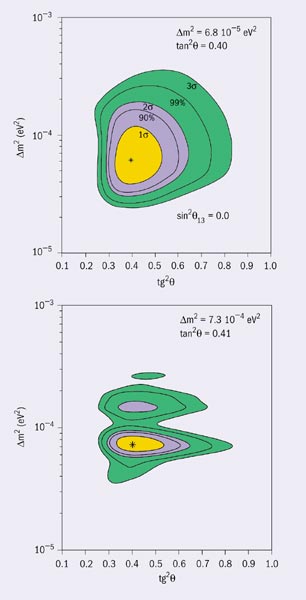
These results agree well with those of recent best-fit predictions of the large mixing angle (LMA) oscillation solutions, and indeed reduce the allowed LMA region for the oscillation parameters sin22θ and Δm2. The best fit to the KamLAND data in the physical region for the parameters gives sin22θ = 1.0 and Δm2 = 6.9 x 10⁻⁵ eV2. Further analysis with more data should reduce the errors and provide a higher precision measurement of these key parameters.
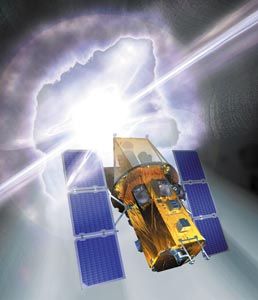
At the end of last year, the first images from the INTEGRAL gamma-ray satellite were released to enthusiastic astronomers. The first observations were of Cygnus X-1, a nearby black hole, just 10,000 light-years from Earth. Fittingly, the observations coincided with the emission of a gamma-ray burst from that very same region of sky.
Gamma-ray bursts are one of the exotic and poorly understood phenomena that INTEGRAL was launched to investigate. They are by far the most powerful events known to occur since the Big Bang, and the mechanisms fuelling them are still unknown. Right from the moment of first light, INTEGRAL has shown a promise of many interesting discoveries to come.
Launched last autumn, INTEGRAL is designed to detect hard X-ray and gamma-ray sources in the energy range 15 keV-10 MeV. The satellite contains an imager and a spectrometer, plus X-ray and optical monitors. Gamma-ray sources are often highly variable, fluctuating on timescales of minutes or seconds, despite their size. This makes it crucial to record information simultaneously at different wavelengths.
Picture of the month
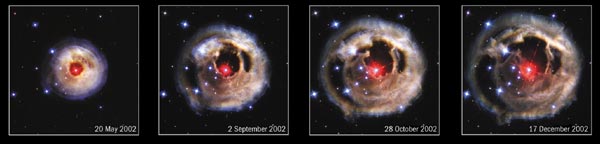
The light from these distant galaxies has been bent by a huge cluster of intervening matter which acts as a gravitational lens. The lensing helps bring the distant universe into focus, revealing faint galaxies that would otherwise be missed. The image was taken by the Hubble Space Telescope’s new Advanced Camera for Surveys with a 13 h exposure time. Some of the distant galaxies in the image are thought to be twice as faint as those on the original Hubble Deep Field images, and to have a redshift greater than 6. This is a new milestone for the Hubble, improving once more our view of the early universe. (NASA/ESA.)
The natural constants are to some extent abnormal features of the theories considered today. On one hand they are needed to describe the theories, but on the other hand nobody understands their rather strange values. Indeed, no-one knows if they are accidents, or whether they can be calculated from some basic principles – a question that ranks in the top 10 unsolved problems for string theorists.
Recent observations in astrophysics suggest that α, the fine structure constant (see “The magic number ” box), which is of fundamental importance in describing the electromagnetic interaction, was in earlier periods a little smaller than today. A research group from Australia, the UK and the US analysed the spectra of distant objects, obtained in particular at the Keck I telescope in Hawaii. They studied around 150 quasars, some of them about 11 billion light-years away (Webb et al. 2001). The redshifts of the objects varied between 0.5 and 3.5, which corresponds to ages varying between 23 and 87% of the age of the universe. The team used the so-called “many multiplet” method – in particular on the spectra of iron, nickel, magnesium, zinc and aluminium – and found a value of α at early times of close to 1/137.037, as opposed to near 1/137.036, as is observed today. This is a small departure – the observations indicate Δα/α = (-0.72 ± 0.18) x 10-5 – but it could have important consequences for theory.
The idea that certain fundamental constants are not constant at all, but have a certain cosmological time dependence, is not new. In the 1930s, the idea was discussed by Paul Dirac (Dirac 1937) and by Arthur Milne (Milne 1937), but with respect to the gravitational constant. Dirac wrote his article at that time during the holiday following his marriage, prompting his colleague George Gamow to remark: “That happens if people get married.”
At around the same time, Pascal Jordan discussed the possibility that other constants could also be time-dependent (Jordan 1937; 1939), but he refused to consider that the constant of the weak interactions or the ratio of the electron and proton mass might be time-dependent. Later, Lev Landau considered the possibility of a time dependence of α in connection with the renormalization of the electric charge (Landau 1955).
We can also say something about the time dependence of α by studying the remains of the natural reactor found near Oklo in Gabon, West Africa, which was in operation about 2 billion years ago. The isotopes of the rare earths, for example of samarium, were produced by the fission of uranium. The observed distribution of the isotopes today is consistent with calculations, assuming that the isotopes were exposed to a strong neutron flux. The value of α that one can deduce agrees rather precisely with the value observed today. The change of α has to be smaller than about 10-17 per year, according to the calculations by Thibault Damour and Freeman Dyson (Damour and Dyson 1996). Taking the astrophysics values and the Oklo data together, one arrives at the curious possibility that the value of α increased in the early universe by a few 10-5, but has remained constant during the past 2 billion years.
However, the significance of the Oklo data becomes less clear if, besides a change of α, changes of other parameters are also considered, for example the parameters of the strong interaction. The limit for the change in α comes from the observation that the cross-section for the scattering of thermal neutrons off samarium-149 is dominated by a nuclear resonance. The position of this resonance cannot have changed during the past 2 billion years, according to experimental data, and this limits the change of α. Because of the Coulomb repulsion in the nucleus, an increase of α would lead to an increase in the energy of the resonance. However, a change of the strong coupling constant, αs, could easily compensate for this effect.
Observing a time dependence of α is certainly an important, if not spectacular result, but a certain measure of scepticism should be kept. If the fundamental constants really do depend on time, rather severe consequences are expected for cosmological evolution since the Big Bang. Nevertheless, the data should be taken seriously, as there are no strong theoretical arguments why the constants should really be absolutely constant.
Grand unification
In the Standard Model of the elementary particles, the overall gauge group is given by SU(3) x SU(2) x U(1), and the electromagnetic and weak interactions are described by the subgroup SU(2) x U(1). Both the Z boson and the photon are superpositions of the neutral SU(2) component and the U(1) boson. This means that the electromagnetic coupling constant e, i.e. the fine structure constant, is not a basic coupling constant. It is related to the basic coupling constant of the SU(2) theory by the relation: e = g/2 sinθw. Experiments give the value of the weak angle, renormalized at the mass of the Z boson, as sin2θw(Q2 =Mz2) = 0.2113 ± 0.00015.
The three coupling constants of the strong and the electroweak interactions vary with energy, but they converge if they are extrapolated to very high energies (about 1016 GeV). This is precisely what one expects if the three interactions are unified. Such a “grand unification” is realized if the gauge groups of the strong interactions, i.e. the colour group SU(3) and the two gauge groups of the electroweak interactions, SU(2) and U(1), are subgroups of a simple group that unifies the three interactions.
Two groups are of particular interest – SU(5) (Georgi and Glashow 1974) and SO(10) (Fritzsch and Minkowski 1975). The group SU(5) has the property that the fermions of one generation are described by two representations. The group SO(10) has an interesting property: the leptons and quarks of one generation can be described by a single representation, the so-called spinor representation or 16-representation. For example, for the fermions of the first generation, this contains six quarks (u and d in three colours) and six antiquarks, together with the electron, positron, a left-handed electron-neutrino and a right-handed electron-neutrino. Note the introduction, in addition to the normal left-handed neutrino, of a right-handed neutrino, which in the normal weak interaction does not appear. However, its existence is important for the appearance of a mass for the neutrino. In fact, in the SO(10) theory, one expects in general that neutrinos have a mass, in accordance with evidence from current experiments.
The coupling constants of the Standard Model seem to converge if extrapolated to high energies. It turns out that in the SU(5) model, they do not come together at one point, but in models based on the SO(10) group a convergence can be achieved, since in those theories a new energy scale besides the unification energy plays a role at high energies. However, one can also achieve a convergence of the coupling constants in the SU(5) model, if supersymmetry is realized at energies above about 1 TeV. The contributions of the supersymmetric particles change the renormalization coefficients so that a convergence takes place at about 1016 GeV.
If we take the idea of grand unification seriously, it implies that the variation of α in time should go parallel to a variation in time of the unifying coupling constant gun – otherwise the grand unification would only work at a particular time, which does not make much sense. Consequently we would expect that all three coupling constants g1, g2 and g3, would be time-dependent. Of particular interest here is a time dependence of the QCD coupling, i.e. of αs, since this coupling determines the hadronic mass scale and many other parameters in hadronic and nuclear physics.
Consider now the behaviour of αs in lowest order only. It is given by the renormalization group equations as follows:
Here µ is a reference scale, ß0 = -11 +2/3 x nf (nf is the number of quark flavours), and Λs is the QCD scale parameter.
Experiments, especially the measurements carried out at LEP, give αs = 0.116 + 0.003/-0.005 (exp.) ± 0.003 (theory). A typical value for the scale parameter is Λs = 213 + 38/-35 MeV. Of course, if αs is not only a function of the reference scale, but also of time, then the scale parameter Λs also varies with time. We find for the time dependence:
The relative time dependencies are related by: δΛ/Λ = (δαs/αs) ln (µ/Λ). It follows that the relative change of αs cannot be uniform, i.e. identical for all reference scales, but must change logarithmically if the reference scale changes. We could, for example, consider a relative change of αs at very high energies, for example close to the energy where the grand unification sets in. The corresponding change of Λ would then be larger by a factor ln (µ/Λ) =~ 38.
Further time dependencies
In QCD, the proton mass as well as all other hadronic mass scales are proportional to Λ, if the quark masses are neglected. In fact, the masses of the light quarks, mu, md and ms, are different from zero, but the mass terms contribute only a little to the total mass, typically less than 10%. We shall not consider these contributions, and we shall also neglect a small contribution of electromagnetic origin to the nucleon mass.
So if the QCD coupling or the QCD scale parameter changed in time, we would expect a corresponding change in time of the nucleon mass and of the masses of the atomic nuclei (Calmet and Fritzsch 2002). Such a change could be observed through a measurement of the mass ratio me/mp. Since a change in the QCD parameters would not influence the electron mass, the result would be a change in this mass ratio.
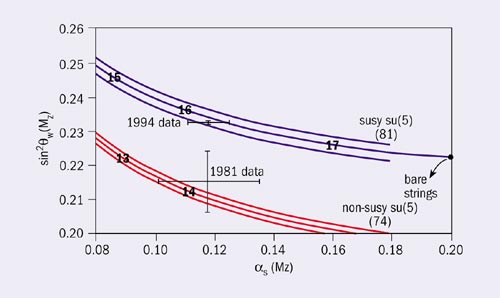
Independent of the details of the unification scheme, one would expect that a change in time would in particular imply a change in time of the unified coupling constant, defined for example at the point of unification. In order to be specific, consider as an example SU(5) theory with supersymmetry, which is broken at about 1 TeV to yield the Standard Model. The change in time of the three gauge couplings is given in figure 1. The unification takes place at ΛGUT = 1.5 x 10¹⁶ GeV, where the coupling constant is αun = 0.03853.
A variation in time can occur through a time dependence of the unified coupling constant, but also through a time dependence of the energy at which unification takes place. In the case where only the coupling constant varies with time, one finds that the time change of α and αs are related. In fact, both time changes are linked to each other by the ratio 8/3 x (α/αs), which is about 1/10. That is, the time change of the strong coupling constant is roughly an order of magnitude larger than the time change of the electromagnetic coupling constant.
In the case where the coupling constant remains invariant, but the energy at which the unification takes place depends on time, one finds that the time change of the scale Λ for the strong interactions is about 31 times larger than the time change of α, but has the opposite sign. This is interesting. While α increases with a rate of about 10-15 per year, Λ and the nucleon mass both decrease at a rate of about 2 x 10-14 per year. At the same time, the magnetic moments of the proton and of the nuclei would slowly increase, at a rate of about 3 x 10-14 per year.
Future observations
A change in time of the proton mass and of α could be observed through precise measurements in quantum optics. The wavelength of light emitted in hyperfine transitions, for example in the transitions that are measured in caesium clocks, is proportional to α4me/Λ, which would be time-dependent via both α and Λ. On the other hand, the wavelength of light that is generated in atomic transitions depends only on α, and would vary in time accordingly. We would expect that light emitted in hyperfine transitions should vary in time about 17 times more strongly than light emitted in normal atomic transitions, but in the opposite direction, i.e. the atomic wavelength becomes smaller with time, but the hyperfine wavelength increases.
The second is currently defined as the duration of 6,192,631,770 cycles of microwave light, which is emitted in the hyperfine transitions of caesium-133. If Λ were to change in time, it would mean that the flow of time, which is measured with caesium clocks, does not fully correspond to the flow of time tested in atomic transitions. Experiments to look for an effect of this kind will be carried out soon at the Max-Planck-Institute for Quantum Optics in Munich, under the leadership of Theodor Haensch.
If such an effect is discovered, it will be important to determine the sign and magnitude of the double ratio R (equation 2). If one obtains R ~ -20, it would be a strong indication for unification of the strong and electroweak interactions. Furthermore, this value would be of great interest in better understanding any changes in the constants of nature with time.
The fine structure constant α is composed of e, h/2π and c. Thus, if α depends on time, it would mean that at least one of these numbers depends on time. Today we usually start with the hypothesis that h/2π and c are fundamental unities, which in suitable systems can also be set to 1. Thus a change of time of α would correspond to a change of e.
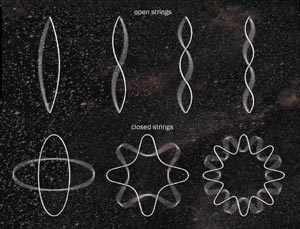
In the theories of “superstrings”, one has, in fact, an additional motivation that fundamental constants are not really constant. In these theories, dimensionless coupling constants such as α are related to functions of vacuum expectation values of scalar fields, which could easily depend on time. Furthermore, a time dependence could also easily arise if, besides the three space dimensions, there are more hidden dimensions.
It would be particularly interesting to find information about the coupling constants such as α or αs in the early universe. A direct measurement is not possible, but recent measurements of the cosmic microwave background, which has its origin in the early universe, do not show within an accuracy of about 10% any time dependence of α. Data from the MAP satellite, launched in 2001, will allow us to improve this limit or to find an effect. Further hints towards a time dependence of α or αs, or both, will have important consequences.
Last September, the 265 seats of Chicago’s Adler Planetarium, on the Lake Michigan shoreline, were filled with participants at the COSMO-02 International Workshop on Particle Physics and the Early Universe. The conference was co-organized by the Center for Cosmological Physics at the University of Chicago, the Adler Planetarium and the Theoretical Astrophysics Group at Fermi National Accelerator Laboratory. COSMO conferences provide a forum for particle physicists, cosmologists and astrophysicists to discuss new results in the exciting and fast-moving field of particle astrophysics and cosmology. One of the new features this year was the presence of string theorists, showing that the latest cosmological observations have attracted the attention of a very large and diverse physics community.
The conference opened with a talk by Wendy Freedman of Carnegie, who addressed the recent emergence of a “standard model” in cosmology. From an observational point of view, our universe can be described by only a few parameters, such as the Hubble “constant” and the contribution of the different constituents of the universe to the total energy density. As Robert Kirshner of Harvard, David Weinberg of Ohio and Tim McKay of Michigan pointed out, a combination of the results of different cosmological observations already allows us to measure those parameters with unprecedented accuracy (by cosmological standards). Moreover, ongoing or planned projects, such as large-scale structure catalogues (2dF, SDSS), cosmic microwave background maps (MAP, Planck) and supernova surveys (ESSENCE, SNAP) will soon allow further significant reductions in the error bars. These precision measurements will help us to refine our understanding of the universe, and will certainly shed light on what is currently the most challenging puzzle for cosmologists and particle physicists – the nature of dark energy. This is currently the dominant energy component of the universe that causes its expansion to accelerate.
On the theoretical side, the standard model of cosmology rests on two pillars: cold dark matter (CDM) and inflation. In a CDM cosmology, most of the matter of the universe consists of non-baryonic, non-relativistic and collisionless particles. Numerical simulations show that the gravitational attraction between these particles yields structures – galaxies, clusters and superclusters – that agree with the ones observed in the universe, possibly up to certain discrepancies at subgalactic scales. The potential problems of the CDM scenario and the properties of some alternative scenarios, such as self-interacting dark matter or modified Newtonian dynamics, were critically discussed by Marc Kamionkowski of Caltech and Arthur Kosowsky of Rutgers. At this stage it is still disputed whether the CDM scenario is free of problems, but as the talk by Andreas Albrecht of Davis suggested, it is fair to say that theorists continue to be in the dark regarding dark energy.
Inflation goes on and on
Inflation remains one of the cornerstones of modern cosmology. According to the inflationary paradigm, the early universe experienced a stage of accelerated expansion. As a result of this expansion, inflation produces a homogeneous and flat universe, as confirmed by cosmic microwave background (CMB) measurements. Inflation also explains the origin of the tiny primordial density fluctuations that developed into galaxies and clusters by gravitational instability. David Wands of Portsmouth described how inflation relates these primordial density perturbations to quantum fluctuations of the scalar field that drives inflation. Despite the fact that there is no theoretically preferred inflationary scenario, most inflationary models make definite predictions about the properties of these primordial density perturbations. They should be Gaussian, adiabatic and nearly scale-invariant. These predictions have been confirmed in an impressive series of experiments, and as Lloyd Knox of Davis reported, new CMB missions, such as the MAP and Planck satellites, will further test, scrutinize and constrain inflationary models.
Essentially the same mechanism that explains the origin of primordial density perturbations – quantum fluctuations of the inflation field – seems to imply that inflation will be eternal. As discussed by Alan Guth of MIT, who also delivered a widely attended public lecture at the Adler Planetarium, an inflating universe resembles a fractal. In a given inflating region of the universe, inflation has a finite lifetime, but at any given moment of time, there are always patches of the universe that continue to inflate. It is unclear whether such a prediction can be experimentally tested, but it certainly poses dramatic views on the global structure of the universe.
An important confirmation that our theoretical understanding about CMB fluctuations is on the right track came with the announcement by John Carlstrom of Chicago of the first measurement of CMB polarization by the DASI experiment. According to the standard theory, the temperature anisotropies we observe in the CMB are due to acoustic oscillations of the primordial baryon-radiation plasma. If this is true, the light that last scattered at the time of recombination – i.e. the CMB – should be partially polarized. The measurement of such polarization is a success of the standard theory, and represents the first step towards more ambitious measurements of the properties of the CMB polarization. As Alessandra Buonanno of Paris pointed out, the sea of relic gravitational waves that inflation predicts should leave a characteristic imprint on the polarization pattern of the CMB. This imprint could be used to determine the amplitude of gravitational waves produced during inflation, which in turn fixes the energy scale at which inflation took place.
Because of the high-energy scale at which inflation is expected to take place (around 1015 GeV in the simplest models), the primordial perturbations generated during inflation might be our only hope of probing the physics close to the Planck scale. This possibility was explored in a plenary talk by Nemanja Kaloper of Davis. Although in some inflationary models, Planck-scale suppressed corrections may leave an observable imprint in the primordial spectrum, Kaloper argued that generically, such an imprint is expected to be too small to be observable in ongoing experiments. Such a conclusion was also the subject of a lively debate in the parallel sessions.
Neutrinos, neutralinos and WIMPs
The major experimental accomplishment in particle physics in recent years has been the evidence for non-vanishing neutrino masses from solar and atmospheric neutrinos. This has provided the first solid hint of physics beyond the Standard Model. While neutrino oscillation experiments provide information on the neutrino mass squared difference, the absolute scale of neutrino masses is so far unknown. To date, as Alexander Dolgov of INFN Ferrara mentioned in his talk, “astronomy opens the best way to measure mn.” Big Bang nucleosynthesis, large-scale structure and CMB radiation constrain the contribution of massive neutrinos to the total mass density. A recent limit obtained in the 2 Degree Field (2dF) galaxy redshift survey gives an upper bound on the sum of neutrino mass eigenvalues Simi < 1.8 eV. In the near future, the Sloan Digital Sky Survey, combined with the CMB data of the MAP satellite, should reach a sensitivity of Smn ~ 0.65 eV. As far as sterile neutrinos are concerned, George Fuller of San Diego devoted an entire plenary talk to their effects on the dynamics of the universe and how cosmology can constrain them.
One of the fundamental unsolved questions of astroparticle physics is the origin of ultra-high-energy cosmic rays, a topic that was reviewed by Günter Sigl of Paris. To understand the acceleration and sky distribution of cosmic rays, a better knowledge of the strength and distribution of cosmic magnetic fields is needed. Sigl stressed that ultra-high-energy cosmic rays with energies above 1018 eV involve centre of mass energies above 1 TeV, which are beyond the reach of accelerator experiments. They thus provide a low-cost laboratory to probe potential new physics beyond the electroweak scale.
The question “How can particle accelerators directly attack major cosmological issues?” was addressed by Joe Lykken of Fermilab. The two main topics about which both theorists and experimentalists in particle physics have much to say are dark matter and baryogenesis. If supersymmetry has anything to do with the stabilization of the electroweak scale, the superparticles are expected to be seen at the LHC, and the hypothesis of a neutralino as a dark matter candidate – also discussed by Leszek Roszkowski of Lancaster – will be covered by the LHC with a great degree of complementarity with direct (elastic scattering) and indirect (signals from its cosmic annihilation) neutralino searches. The status of other supersymmetric dark matter candidates was reviewed (sneutrinos: ruled out; gravitinos: safe) as well as the recently proposed TeV mass Kaluza-Klein dark matter candidate, which will also be probed at the LHC. As for non-accelerator searches of CDM candidates, Maryvonne De Jesus of Lyon reported the results from and prospects for the numerous ongoing and planned direct searches for WIMPs via elastic scattering experiments, while Georg Raffelt of MPI, Munich, described the status of axion searches.
Regarding baryogenesis, the theory of electroweak baryogenesis in the Minimal Supersymmetric Standard Model (MSSM), which was reviewed by Mariano Quiros as well as Mark Trodden, has exciting prospects. The remaining very tiny corner of parameter space for which it works corresponds to a light Higgs and a light stop. Those should be found by Tevatron Run II if the MSSM is consistent with electroweak baryogenesis.
Other important activities led by high-energy physicists were emphasized at the conference – in particular, B physics will teach us about the sources of CP violation. Still in the domain of flavours, experiments with neutrino beams (such as MiniBooNE at FNAL) will help us to understand neutrino flavours. And finally, we heard that “electroweak precision measurements are not boring”: the measurement of the anomalous magnetic moment of the muon at Brookhaven, the electroweak mixing angle by the NuTeV collaboration, and the bottom quark forward-backward asymmetry at LEP look like anomalies in the present global fit to electroweak data, and could be a sign of new physics.
Extra dimensions and strings
The field of extradimensional cosmology was well represented in plenary talks by Ruth Gregory of Durham, Lev Kofman of Toronto and Lisa Randall of Harvard. Extradimensional cosmology is very rich, but it is still in its infancy, and there is much left to explore. The evolution of the universe at late times can be described within the context of extradimensional cosmology, or in other words, the presence of extra dimensions can be reconciled with constraints from late-time cosmology. On the other hand, extradimensional cosmology at early times is much more difficult to understand. There is no experimental constraint to guide model-builders overwhelmed by an excessive freedom. Kofman reported new ideas on inflation from extra dimensions (for example colliding branes and radion potentials), as well as recent work on string signatures on cosmological observations.
Regarding attempts by particle theorists to explain dark energy with something other than a cosmological constant, Maxim Perelstein of Berkeley discussed networks of domain walls – quite generic in attempts to go beyond the Standard Model of particle physics. Another proposal to interpret supernovae data, presented by John Terning of Los Alamos, is to introduce photon-axion oscillations in an intergalactic magnetic field as a way of rendering supernovae dimmer, an explanation that does not need cosmic acceleration (but still requires a dark energy component of negative pressure).
Joe Polchinski of Santa Barbara addressed the question “Does string theory have vacua like ours, i.e. with (nearly) zero cosmological constant, a non supersymmetric spectrum and a stable (or long-lived) vacuum?” To date, there is no positive satisfying answer to this question. Polchinski also showed how the simplest string moduli potentials have difficulty in describing “quintessence”.
Will string theory lead to a theory of the Big Bang? Nathan Seiberg of Princeton explained how string theorists are trying to address the problem of cosmological singularities, and presented the new challenges and recent explorations in the field of time-dependent solutions in string theory. In a very different approach, Willy Fischler of Texas presented a new cosmological model in which the primordial universe is dominated by a dense gas of black holes.
The question of whether string theory will yield the principle that determines the history of the universe was also raised by David Gross of Santa Barbara, who gave the closing talk of the conference. Gross confessed that his major feeling at the end of the conference was envy: “This is a golden age of cosmology: beautiful observations and the emergence of a standard model.” He made the comparison with the situation he experienced 30 years ago when the Standard Model of particle physics was emerging. Astrophysical observations represent a testing ground for fundamental physics; experimental cosmology will provide increasingly precise tests of the Standard Model and constraints on new physics.
The Beyond the Desert 02 – Accelerator, Non-accelerator and Space Approaches conference was held on 2-7 June 2002. It was the third in the series of “Beyond conferences” that began in 1997. Traditionally the scientific programme has covered almost all of modern particle physics, and this meeting was no exception, ranging from SUSY and extra dimensions to dark matter and neutrino mass.
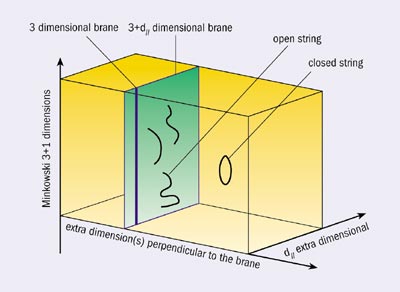
The conference began with sessions on new theoretical developments in extending the Standard Model by means of grand unified and SUSY theories, followed by new results on the search for Higgses, SUSY particles, R-parity violation, leptoquarks and excited fermions at the LEP and HERA colliders. The revival of a g-2 signal for the muon deviating from the Standard Model, and its consequences for SUGRA models, were addressed by Pran Nath of Boston who, together with Dick Arnowitt of Texas, first introduced SUGRA 20 years ago. Later, extra dimensions, M-theory and fundamental symmetries were also presented. Ignatios Antoniadis of CERN, while talking about string and D-brane physics at low energies, pointed out that although no-one has ever observed strings or the space of extra dimensions where they live, the “hidden” dimensions of string theory may be much larger than we thought in the past, and may come within experimental reach in the near future.
The long-standing and very intriguing problem of dark matter in the universe, with its connection to new physics and new phenomena, was another important topic. Results and perspectives for direct dark matter experiments with scintillators (DAMA and LIBRA) and germanium detectors with big target mass (GENIUS and GENIUS-TF) were presented by Rita Bernabei of Roma and Irina V Krivosheina of Heidelberg and Nizhnij Novgorod. These are currently the only two experiments that can in principle use seasonal modulation to see (and indeed DAMA has seen) a positive signal from the interactions of dark matter particles by direct detection. Other experiments, for example with sophisticated cryogenic detectors exploiting ionization (or scintillation)-to-heat discrimination, are currently unable to register such a modulation in WIMP interactions because of their very small detecting mass.
Astrophysical data are becoming increasingly important for modern particle physics. For example, the excellent talk by Naoshi Sugiyama of Tokyo – “Cosmic Microwave Background: a new tool for cosmology and fundamental physics” – made it evident that an unexpectedly huge amount of fundamental information can be extracted from current research into the cosmic microwave background. Astrophysical investigations are also intimately connected with the exciting question of neutrino properties. Cosmic high-energy neutrinos can interact with relic neutrinos, producing Z-bursts which could explain the mysterious origin of extremely-high-energy cosmic rays, as Sandor Katz of Eotvos, Hungary, explained. This mechanism requires the neutrino mass to be in the 0.02-2.2 eV range, which intriguingly fits with recent results obtained from neutrinoless beta decay of germanium in the Heidelberg-Moscow experiment. Neutrinos from supernovae also figure in current theoretical investigations, as Alexei Yu Smirnov of Trieste and Moscow described.
Neutrino physics was undoubtedly the central topic of the conference. Rabindra Mohapatra of Maryland presented the modern understanding and a general view of neutrino masses and mixings. This was followed by several presentations on solar neutrinos, with Oliver K Manuel of Missouri describing the Standard Solar Model and modern experimental hints for an elemental composition of the Sun that is radically different from the usual current assumptions. Extended discussion of the experimental achievements in solar and atmospheric neutrino oscillation experiments included the Sudbury Neutrino Observatory (SNO) and its results from the recent analysis with a pure heavy water target, presented by Mike Dragowsky of Los Alamos. The consequences of the neutral current rate measured in SNO for resolving the solar neutrino puzzle were discussed by Sandhya Choubey of Southampton. SNO performed the first measurements of the total active neutrino flux, and claims evidence for neutrino flavour transformation at a 5.3 sigma level.
Global MSW analysis of the neutrino oscillation experiments favours the large mixing angle (LMA) region, and can be tested in new experiments. At the conference, the running status and prospects for the new and near-future neutrino oscillation experiments KamLAND, K2K and Superkamiokande, and new facilities such as neutrino factories and the JHF-SK project, were presented and discussed. For example, KamLAND (presented by Fumihiko Suekane of Tohoku), is a very long baseline reactor neutrino oscillation experiment with a 1000 tonne liquid scintillator detector. It can directly test the MSW-LMA solution with only six months of data, and will determine the oscillation parameters with very high accuracy if the LMA case is true. The experiment started data-taking in 2002, and the first results have been announced (KamLAND experiment discovers that reactor antineutrinos ‘disappear’). Rebuilding of the Superkamiokande detector began in 2002, and full reconstruction is expected by 2007, as Takaaki Kajita of Tokyo described. The physics potential and status of the second-generation proton decay and neutrino experiment ICARUS (Imaging Cosmic And Rare Underground Signals) in the Gran Sasso Laboratory were also discussed by Fulvio Mauri of Pavia and Ines Gil-Botella of Zurich.
The exact nature of neutrinos remains an exciting problem. Are these most mysterious objects Dirac or Majorana particles, and what are their masses? One of the best tools to find the answer is neutrinoless double beta decay. The evidence for observation of neutrinoless double beta decay of the isotope 76Ge claimed by the Heidelberg-Moscow collaboration took a central part in the discussions. Alexander Dietz of MPI, Heidelberg, described the mathematical approach to the accurate treatment of statistics of rare events used by this collaboration. The very accurate data on the Q-value of the 76Ge double beta-decay – which are crucial to the analysis and are determined from accurate mass measurements in a Penning trap – were presented by Ingmar Bergstrom of Stockholm.
Hans Volker Klapdor-Kleingrothaus of Heidelberg then outlined the present evidence for neutrinoless beta decay, as well as the general future for double beta decay experiments. The Heidelberg-Moscow collaboration fixes the effective neutrino mass in the region of 0.05-0.84 eV (95% confidence level). The important question of nuclear matrix elements for double beta decay was described thoroughly by Fedor Simkovic of Bratislava, who showed that transitions to different excited daughter states could help to distinguish between different mechanisms triggering the neutrinoless beta decay process. Important new constraints on neutrino mixing parameters following from the results of the Heidelberg-Moscow collaboration were also discussed by Hiroaki Sugiyama of Tokyo.
Still on the question of the nature of the neutrino, Dharamvir V Ahluwalia of Zacatecas, Mexico, reported on a new theoretical concept concerning massive Majorana particles and outlined the consequences for the structure of space-time. He showed that the Majorana nature of the neutrino tells us that space-time has realized a construct that is central to the formulation of supersymmetric theories. These various discussions showed that neutrinos at extremely low energies, as well as at extremely high energies, are particles that can supply us with exciting discoveries in the future. Together with the other topics, they made the conference a valuable contribution to the fruitful exchange of ideas between physicists working in particle physics, nuclear physics and cosmology.
Proceedings will be published by Institute of Physics Publishing, Bristol, UK.
This is a great time to be an astrophysicist. Over the past 30 years, almost all of the roughly 70 octaves of the electromagnetic spectrum accessible for study have been opened up. Telescopes using new technologies have expanded our view of the cosmos far beyond what we see in the single octave available to traditional optical astronomy. The size, age and shape of the universe have been measured, and its black holes, neutron stars and extrasolar planets have been catalogued. We are on the threshold of using cosmic rays, neutrinos and gravitational waves to find new sources, and we are encountering a world of extremes. We must contemplate the diffuse intergalactic medium, as well as singularities with a nominal density more than 120 orders of magnitude larger. Similarly, we infer a difference in magnetic field strength between intergalactic space and the field in “magnetars” that ranges over 30 orders of magnitude.
Over the same period, the Standard Model of elementary particles has been largely completed. Almost all of the standard particles have been detected, and their properties fitted into a pattern. It is easy for physicists to take this for granted, but describing this framework surely ranks as one of the greatest scientific accomplishments of all time. Furthermore, the intellectual connection of this model to the equally rich fields of nuclear, atomic and condensed matter physics is well developed.
Now, in both astronomy and physics, the scientific focus is shifting from asking “what?” to trying to understand “why?” We want to understand why galaxies have the regular properties that are observed locally, just as we want to understand such things as the electron-proton mass ratio. In many cases, researchers from the two disciplines seem to be looking at the same problem from different perspectives. I expect that closer collaboration between the fields will lead to exciting advances in many areas where they intersect.
For example, astronomers have discovered that roughly seven-eighths of the matter in the universe is in a “dark” form whose properties they do not recognize. Meanwhile, physicists suspect that there is a whole new family of hitherto undetected supersymmetric partners to the standard particles. Both communities have concluded that they are probably discussing the same thing. In another instance, physicists are developing the theory of supersymmetric strings and its generalization as a tool for understanding the basis of the Standard Model, while astronomical measurements of the expansion of the universe have revealed the presence of “dark energy”, which strikes at the heart of string theory.
Recently, cosmic rays have been discovered with energies as large as 50 J – 10 million times more energetic than can be made at particle accelerators. Astronomers are divided as to whether these particles come from black holes and neutron stars, or if they derive from exotic matter left over from the Big Bang. If the former is correct, then the means by which the particles are boosted to these energies may be similar to some advanced concepts that have been developed for future particle accelerators. If the latter is correct, then nature is performing experiments for our benefit that we will never be able to carry out on Earth.
Finally, the technology and methodology of astronomical observation has changed from individual acquisition and scrutiny of mainly photographic images and spectra. The field now relies mainly on large teams of astrophysicists using modern, solid-state detectors which produce terabytes of digital data that must be processed, manipulated and archived – just as in particle physics experiments.
It is therefore clear that astronomers and physicists will be working together increasingly on everything from equations to electronics. However, this poses some interesting sociological challenges, because historically the two communities have worked in quite different ways. Physicists are used to designing active experiments, while astronomers are used to performing passive observations. The present time represents an extraordinary opportunity to build a facility capitalizing on the rich scientific heritages of astronomy and particle physics, and the complementary strengths that they bring to the emerging science at their interface.
Physicist Fred Kavli and the Kavli Foundation have pledged $7.5 million (€6.9 million) to establish an institute that will focus on recent developments in astrophysics, high-energy physics and cosmology. The new Kavli Institute for Particle Astrophysics and Cosmology will be located in a new building at the Stanford Linear Accelerator Center (SLAC), and will open its doors in 2005. I am honoured to have been chosen as the inaugural director. Steven Kahn of Columbia will join me as deputy director and assistant director of research at SLAC.
Initially, we intend to follow a balanced growth plan with theory, computational astrophysics and phenomenology on one hand, and experimental astrophysics and high-energy observing on the other. We will draw upon existing strengths at Stanford in theoretical (especially high-energy) physics and astrophysics, gamma-ray and X-ray astronomy, gravitational physics, microwave background instrumentation and underground physics.
Part of the excitement of the field is that it is impossible to predict where it will be in five years’ time and what its scientific focus will be. What is clear is that the time is right to build a world-class centre.
To provide the best experiences, we use technologies like cookies to store and/or access device information. Consenting to these technologies will allow us to process data such as browsing behavior or unique IDs on this site. Not consenting or withdrawing consent, may adversely affect certain features and functions.
Functional
Always active
The technical storage or access is strictly necessary for the legitimate purpose of enabling the use of a specific service explicitly requested by the subscriber or user, or for the sole purpose of carrying out the transmission of a communication over an electronic communications network.
Preferences
The technical storage or access is necessary for the legitimate purpose of storing preferences that are not requested by the subscriber or user.
Statistics
The technical storage or access that is used exclusively for statistical purposes.The technical storage or access that is used exclusively for anonymous statistical purposes. Without a subpoena, voluntary compliance on the part of your Internet Service Provider, or additional records from a third party, information stored or retrieved for this purpose alone cannot usually be used to identify you.
Marketing
The technical storage or access is required to create user profiles to send advertising, or to track the user on a website or across several websites for similar marketing purposes.