Comsol -leaderboard other pages

Topics

The challenge of the pentaquarks

Pentaquarks – baryons made from five quarks – have been postulated and searched for in hadronic processes for decades. They are allowed by quantum chromodynamics (QCD), the theory of quarks and gluons, but until recently all searches for pentaquark states had been inconclusive. The breakthrough came in 1997 in a paper by three Russian physicists, Dmitri Diakonov, Victor Petrov and Maxim Polyakov. Within a chiral soliton model, they predicted an antidecuplet of 10 ground-state pentaquarks, three of which had exotic-flavour quantum numbers, meaning that their quantum numbers cannot be constructed from only three quarks. One of the states was predicted to be long-lived, and with a mass near 1530 MeV. It took another five years before a state close to this mass was reported from several experiments. This state, initially known as the Z+, is now called the Θ+(1540).

The discovery took the community by surprise. However, within only four months of the broad public announcement in July 2003, more than 60 theoretical papers appeared on the subject. It was therefore timely for the Department of Energy’s Thomas Jefferson Laboratory (JLab) to organize the first topical workshop on the subject. While around 30 to 35 physicists were originally expected to attend, almost 120 experimentalists and theorists from all over the world participated in the two-day workshop, which was organized into plenary and focus sessions. The latest results were presented by representatives from a number of experimental groups: GRAAL in France; COSY, ELSA and HERMES in Germany; SPring-8 in Japan; ITEP in Russia; JLab and RHIC in the US, and CERN.

Experimental evidence

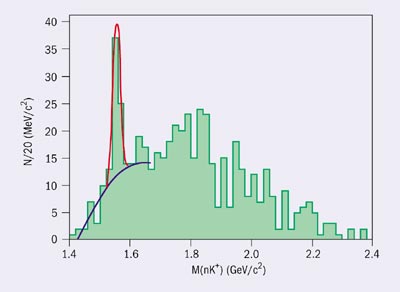
Takashi Nakano from Osaka discussed the original finding of the Θ+ in the photoproduction of K+K pairs off a plastic scintillation counter that happened to be installed in the beamline as a veto counter. He also presented very preliminary new data using a linearly polarized photon beam and a deuterium target. Representing the CLAS experiment, Valery Kubarovsky presented new experimental evidence for the Θ+ from JLab. The CLAS collaboration observed a signal with a significance of about 7.8 σ for the production on proton targets, the highest significance for this state to date (see figure 1). These data also show some evidence for production of the Θ+ through an intermediate excited nucleon, N*, with a mass near 2400 MeV. Such a state is also likely to be a pentaquark baryon, though with non-exotic quantum numbers. If this result is confirmed, it will be the first hint of a connection between the Θ+ and the spectroscopy of non-exotic baryon states.
cernpen1_4-04

New evidence has also come from the mining of old data. The re-analysis of neutrino bubble-chamber data presented by Mikhail Kubantsev of Fermilab shows a clear signal at the Θ+ mass in pKso, as does the HERMES experiment at DESY, which studied the same channel, as reported by Wolfgang Lorenzon. While this channel measures the absolute strangeness quantum number |S| = 1, it does not determine the sign. Although the exotic nature of the signal is not uniquely identified in this reaction, the absence of known Σ states that could mimic a pentaquark in this mass range is used to identify the state indirectly as the Θ+.

Michael Ostrick from Bonn presented data from the SAPHIR experiment at the ELSA machine, using photoproduction on protons. This included a re-analysis of the published results using a different technique to identify the Kso, which is used to tag the Θ+. He concluded that there is no obvious discrepancy between the published results and the re-analysed data. Carlo Schaerf of INFN Roma reported on searches for the Θ+ at the GRAAL detector at the European Synchrotron Radiation Facility using a photon beam on a deuterium target and a non-magnetic detector with a large BGO (bismuth gemanate) calorimeter. Although the reported statistics are currently too low to conclude much, the search in the exclusive channel with a ΛΘ+ in the final state looks promising.

Other searches are also underway at the COSY synchrotron at the Jülich Research Centre using proton-proton scattering, where the Θ+ may be produced in association with a Σ+ hyperon, and with the STAR and PHENIX detectors at Brookhaven’s Relativistic Heavy Ion Collider (RHIC). For central gold-gold collisions at the RHIC, one expects about one Θ+ per collision accompanied by thousands of other particles.

Cascade particles

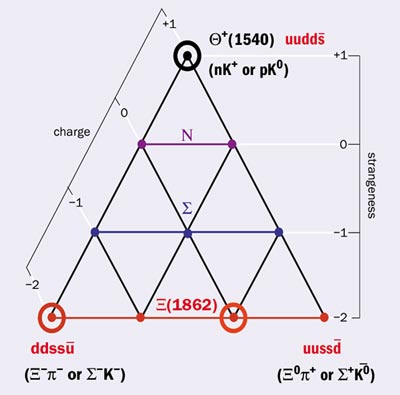
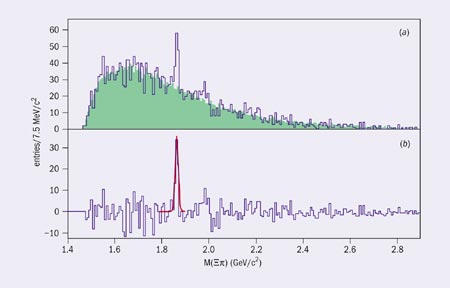
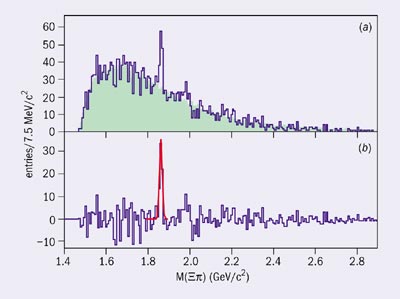
The Θ+ is not the only pentaquark state that the models predict. In the chiral soliton model the Θ+ is an isosinglet member of an antidecuplet of 10 states that, in a quark picture, are made of four quarks and one antiquark. The model predicts nine other pentaquark states, two of which have exotic-flavour quantum numbers. These are the cascade particles, Ξ and Ξ+. Indeed the Ξ may have been observed at CERN in the NA49 experiment. Representing NA49, Kreso Kadija reported evidence for a narrow cascade Ξ at a mass of 1862 MeV and with a width of less that 18 MeV (figure 2). Such a state must have exotic-flavour quantum numbers requiring at least five quarks. These data lend support to the symmetry properties of pentaquark states as predicted in the chiral soliton model, or in the quark-cluster picture.
cernpen2_4-04

Representatives of all theoretical persuasions were present at the workshop. Dmitri Diakonov of NORDITA in Copenhagen presented reasons why the Θ+ might be so light. In the chiral soliton model, it is a collective excitation of the mean chiral field that binds the baryons, and not a sum of the constituent quarks. For the same reasons it would be narrow. In the infinite momentum frame it can only decay in transitions between the Θ+ and the five-quark component of the nucleon wave function. Simon Capstick of Florida State presented an overview of various theoretical models for pentaquarks. A natural explanation for the narrowness of the Θ+ is that it is an isotensor baryon. However, this possibility is currently not supported by the experimental data.

Alternative models

Robert Jaffe of MIT presented the quark cluster model that starts from two diquark clusters and one strange antiquark. This model also predicts an antidecuplet but with mass assignments that differ from the one predicted by the chiral soliton models. One unresolved problem is that this model needs a narrow nucleon-like five-quark state, which is identified with the Roper resonance at 1440 MeV. However, this state has a width of more than 300 MeV. Marek Karliner of Cambridge University discussed an alternative quark cluster model, developed with Harry Lipkin of the Weizmann Institute, where the five-quark states are composed of triquark-diquark clusters. They predict that narrow five-quark states analogous to the Θ+ should also occur in the charm and bottom sector.
cernpen3_4-04

Michal Praszalowicz of Brookhaven discussed pentaquarks in the SU(3) Skyrme and chiral quark soliton models. The first lattice QCD results presented by Kei-Fei Liu of Kentucky University and Tamas Kovacs of Wuppertal do not present a consistent picture. Two groups (Kovacs and Shoichi Sasaki) measured a pentaquark signal consistent in mass with the experimental observation, while a third group (Liu) saw no resonant signal. The groups with a positive result predict the parity of the Θ+(1540) to be negative, while both the chiral soliton and quark cluster models require positive parity.

Discussions in the focus sessions addressed questions of how to obtain more information on properties such as spin/parity and the natural widths of the Θ+(1540), as well as new experiments that can identify other predicted pentaquark states. Expected new data from JLab should have sufficient statistics to measure full angular distributions and determine the spin. Identification of the parity, meanwhile, may require measurements using linearly polarized photon beams or experiments with hadron beams.

The mass of the Θ+(1540) is not as well established as one might expect from a narrow state, and ranges from 1528 to 1555 MeV, which is outside the uncertainties given by the experiments. It was emphasized that this issue should be addressed urgently as it has impact on mass predictions for other five-quark states.

cernpen4_4-04

The question: “why have pentaquark states not been seen before?” was asked frequently and some answers were given. For example, data on K+n phase shifts are quite poor in the corresponding mass range and have obvious holes. At the end of the workshop one piece of early evidence was shown from data on K+p scattering from the 2 m bubble chamber at CERN. The data show a small but significant peak at a pK0 mass of 1540 MeV, however only at the highest K+ beam momentum.

In the final session Kim Maltman of York University, Toronto, put the experimental evidence and theoretical approaches into their proper perspectives and discussed the relative merits of the different theoretical concepts. A second workshop on pentaquarks is planned for July 2004, and will be held at SPring-8 in Japan. A Program Advisory Meeting held at JLab from 12-16 January 2004 also accepted four additional pentaquark experiments, which will continue to add to the collective knowledge about this baryon system.

•For the full programme, including all the talks, see: www.jlab.org/intralab/calendar/archive03/pentaquark/program.html.
ISOLTRAP pins down masses of exotic nuclei

cernnews1_3-04

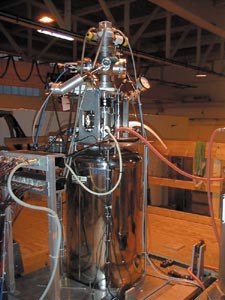
The mass of a nuclide is one of its most fundamental properties, being a unique “fingerprint”, and its measurement contributes to a variety of fundamental studies including tests of the Standard Model and the weak interaction. Now researchers using the Penning trap mass spectrometer, ISOLTRAP, at the ISOLDE facility at CERN have published new high-precision measurements of the mass of short-lived radionuclides of argon and copper, which provide important information for weak interaction and nuclear shell model physics.

The studies make use of recent improvements to ISOLTRAP, which can now analyse radionuclides with very short half-lives (~50 ms) produced in small numbers (~100 ions/s). The apparatus, which is fed by the 60 keV ion beam from ISOLDE, consists of three traps. A radiofrequency quadrupole ion trap accumulates and bunches the ions, and a first Penning trap then cools and purifies the beam. A second Penning trap finally provides the mass measurement by using a time-of-flight detection technique to determine the cyclotron frequency of the ions of interest.

cernnews2_3-04

A team from CERN, CSNSM-IN2P3-CNRS Orsay, GSI-Darmstadt and Michigan State University has measured the masses of 32Ar (half-life of 98 ms) and 33Ar (half-life 173 ms) with relative uncertainties of 6.0 x 10⁻⁸ and 1.4 x 10⁻⁸, respectively (Blaum et al. 2003) – the greatest precision to date on these nuclides. The results provide a stringent test of the isobaric-multiplet mass equation, which relates the masses of an isospin multiplet; 33Ar is a member of a quartet with an isospin of 3/2, while 32Ar is a member of a quintet with an isospin of 2. Such tests are of practical importance as the equation can predict unmeasured nuclear masses and energy levels, used for example in calculations of astrophysical processes. The mass of 32Ar also provides a better value for the beta-neutrino angular correlation coefficient, used to provide constraints on scalar contributions to the weak interaction.

In a second recent experiment, a larger collaboration, including members from the universities of Greifswald, Gent, Stockholm, IKS Leuven and the Russian Academy of Science, identified unambiguously three beta-decaying isomers in 70Cu. In this case the unique combination of resonant laser ionization, nuclear spectroscopy and mass measurements has allowed the determination of the low-energy nuclear structure of 70Cu. Using mass spectrometry the ground state (half-life of 44.5 s) and two excited states (half-lives of 33 and 6.6 s) were clearly distinguished and identified (Van Roosbroeck et al. 2004). As 70Cu has 41 neutrons, the results provide an important step in understanding the complex structure of nuclides with one neutron less, N = 40, which corresponds to a closed sub-shell. It also demonstrates, for future nuclear-structure studies, the power of the techniques used.

Further reading

K Blaum et al. 2003 Phys. Rev. Lett. 91 260801.

J Van Roosbroeck et al. 2004 Phys. Rev. Lett. (in print; see also CERN-EP/2003-076).

The atomic nucleus as a laboratory

The Mazurian Lakes meeting, held in a picturesque region with thousands of lakes and forests, has evolved from a bi-annual school on nuclear physics into the conference it is nowadays. At the same time, nuclear physics has also evolved, so that it now contains many more subfields than the traditional areas of nuclear structure and reactions (figure 1). The 2003 meeting covered several of these subfields and included important excursions into astrophysics (neutron stars and supernovae) and particle physics (neutrinos).

cernmaz1_3-04

There was a special anniversary touch to the subjects of the 2003 conference. In 1953 the first hypernucleus was observed in Warsaw by Marian Danysz and Jerzy Pniewski, followed by the discovery of a double hypernucleus by the same two physicists. Fifty years later, the physics of hypernuclei is experiencing a large-scale revival, in particular with the FINUDA program at DAFNE in Frascati and the PANDA project at GSI in Darmstadt, both of which were the subject of presentations at the conference. Andrzej Wróblewski from Warsaw gave a historical review, describing – with many previously unknown or neglected details – the turbulent history of hypernuclei and strangeness, their discovery and progress in the field during the past half century.

Strange behaviour

Numerous hypernuclei containing a single-Λ particle and a few double-Λ hypernuclei have now been discovered and studied experimentally. However, compared with the enormous amount of data and knowledge that has been accumulated over the years for normal nuclei, relatively little is still known about hypernuclei. The reasons, of course, lie in the difficulties related both to producing them and studying them within the narrow window of their lifetimes. At the meeting, Yusuke Miura from Tohoku talked about the recent important progress in the γ-spectroscopy studies of hypernuclei. The basic strengths of Λ-Λ versus nucleon-Λ interactions, which were discussed by Abraham Gal from Jerusalem, are still being debated, but some conclusions can be drawn from the simplest binding-energy differences between single-Λ and double-Λ hypernuclei.

Both Wanda Alberico of Torino and Hyoung Chan Bhang of Seoul discussed the weak non-mesonic decay rates of hypernuclei. The long-standing and still-debated issue here is the so-called Γnp puzzle, i.e. the fact that the observed widths for Λ + n → n + n decays seem to be much larger relative to Λ + p → n + p than those that were obtained theoretically. However, the recent progress, both in theory and in experiment, seems to yield more convergent results.

Helmut Oeschler from CERN and Helena Bialkowska from Warsaw presented some theoretical and experimental studies that aim at seeing the quark-gluon plasma (QGP) through the “lens” of strangeness production in high-energy heavy-ion collisions. If a flavour-equilibrated fireball of quark matter is produced in energetic nucleus-nucleus collisions, then the production of strange and non-strange particles should be comparable. This can be quantified in the form of the Wróblewski factor, λS = 2ssbar/(uubar + ddbar), and studied through the production of strange mesons, strange baryons, or hidden strangeness. However, experimental maxima in λS, which reach values of approximately 0.6, can also be explained in a statistical model by a kinematical cut through the T-µB plane (where T is temperature and µB is baryon chemical potential). These maxima therefore do not necessarily signal the presence of the QGP. Other signals, such as an atypical energy dependence for strangeness production, may also be invoked but must be confronted with data from hadron-hadron and hadron-nucleus collisions.

Nuclear medium and nuclear matter

The question of how to measure the hadron mass in the nuclear medium was discussed by Piotr Salabura from Cracow. He argued that the two-body decays into e+e pairs could be used to measure the invariant mass of a decaying hadron directly, because leptons travelling through the nuclear medium are not perturbed in their final states. Dalitz decays, in which the e+e pair is accompanied by a hadron, can also be used; the problem here lies in the necessity of disentangling contributions coming from various decaying hadrons. The HADES experiment at GSI in Darmstadt is directed at studies of this kind.

cernmaz2_3-04

A very interesting idea to study the equilibration process in nucleus-nucleus collisions – that is, the extent to which they come to equilibrium in an intermediate state – was discussed by Norbert Herrmann from Heidelberg. By using projectiles and targets that have different isospin compositions, one can, in a sense, tag the nucleons that originate from the projectile or target, to see if they bounce off each other, equilibrate, or pass each other. Experimental data obtained at GSI at the heavy-ion synchrotron, SIS, at energies of 100-200 A MeV clearly indicate that the colliding systems are never fully stopped and that the transparency increases with incident energy. Thus, at least in this case, we have a clear experimental indication that the systems are not really equilibrated.

At a completely different scale of energies of 130 and 200 GeV, studied at Brookhaven’s Relativistic Heavy Ion Collider (RHIC), Terry Awes from Oak Ridge compared the nuclear modification factors for Au + Au and d + Au collisions in order to pin down the so-called jet-quenching effect. At these energies, jets of particles are produced when the projectile and target quarks collide and create flux tubes that then break into colourless hadrons. The nuclear modification factor gives a rate of the production of a given hadron in a nucleus-nucleus collision relative to that for a proton-proton collision. It is supposed to tell us how much the medium in which the particle is produced influences the observed outflow of particles after the collision. For a fairly wide region of transverse momenta, the values of the d + Au modification factor are close to 1, while those for Au + Au are suppressed at about 0.3. This is a strong indication that a new kind of medium (possibly the QGP) is created in the Au + Au collisions.

Neutron stars and neutrinos

In the session on astrophysics, Karlheinz Langanke from Aarhus talked about how the properties of stellar objects may depend strongly on detailed nuclear-structure properties. First he showed the impressive results of large-scale shell-model calculations for the Gamow-Teller strength distributions. These calculations agree incredibly well with the newly measured data (obtained with 100 keV resolution), indicating that the low-energy nuclear properties are kept well under control by using two-body interactions in a restricted valence space. Then he showed how similar calculations, performed in heavier nuclei within the Monte Carlo shell model, modify simplistic electron capture rates, which have been used up till now to model supernovae explosions. The effect is truly dramatic because the capture on nuclei now turns out to be more important than the capture on protons as assumed previously. During a special session, Piotr Magierski from Warsaw, the winner of the 2003 Zdzislaw Szymanski Prize, also talked about neutron stars when he gave a lecture on the thermodynamic properties of the neutron star crust.

At the frontier between astrophysics and neutrino physics, there were two interesting talks about stellar objects viewed through their neutrino emission. Matthias Liebendörfer from Toronto has investigated the time and energy characteristics of neutrinos emitted during a supernova explosion. If such an explosion happens again nearby, we may be able to learn from the observed neutrino flux about how such an event proceeds, provided we have a good model at hand. Dima Yakovlev from St Petersburg and Pawel Haensel from Warsaw both talked about neutron-star cooling due to neutrino emission and strange particles in the core. Since the cooling process crucially depends on details of occupations near the Fermi surfaces, and thus on correlations, proton and neutron pairing in the neutron star matter may strongly influence the rate of cooling. Experimental data seem to suggest that proton pairing may be preferred over neutron pairing.

Among several talks on neutrino physics, Yuri Kamyshkov of Oak Ridge and Joanna Zalipska of Warsaw presented experimental studies performed at the KamLAND and Super-Kamiokande facilities, respectively. They discussed neutrino oscillation phenomena studied by the observations of reactor electron antineutrinos and atmospheric muon neutrinos, and the so-called large mixing angle solution for the neutrino mass difference and mixing angle.

Calculating the nucleus

Wolfram Weise from Trento presented studies at the triple frontier between quantum chromodynamics (QCD), the hadronic medium and nuclear structure. Recent developments in this field are fascinating because we may be witnessing the birth of derivations of nuclear forces from first principles, and an explanation of nuclear binding based on QCD. By applying ideas based on chiral symmetry breaking, the chiral condensate and effective field theory (EFT), we can describe nucleon-nucleon (NN) scattering and finite nuclei almost directly from low-energy QCD considerations. One starts by postulating the chiral Lagrangian of nucleons and pions, then adding symmetry-dictated contact terms that are supposed to describe all unresolved high-energy effects. Such a result shows that the short-distance NN repulsion does not need to be modelled by any kind of hard-core potential or heavy-meson exchange potential, but is a generic feature of these unresolved high-energy effects. As Weise explained, one may perform in-medium chiral calculations and derive the energy-density functional, which within the relativistic-mean-field approximation is directly applicable to finite nuclei. At the expense of fitting one parameter – the EFT cut-off energy – the correct saturation energy, saturation density and symmetry energy can be obtained. From there, standard nuclear-structure calculations lead to describing nuclear masses (only for N = Z nuclei at present) with a precision of about 1 MeV.

cernmaz3_3-04

Witek Nazarewicz of Oak Ridge and Warsaw talked, among other things, about recent progress in the exact calculations for low-energy states in light nuclei. There, the necessity for NNN interactions has been convincingly shown. Moreover, the NNN forces may also be responsible for a known inadequacy of the G-matrix method to derive the shell-model interactions. Nazarewicz discussed the challenges that nuclear-structure theory faces in describing exotic systems such as those with very large neutron or proton excess, very large angular momentum, or very large mass. In view of the important projects to study these exotica in experiments (RIA, GSI, RIKEN, EURISOL, etc), theoretical efforts in these domains must also be adequately expanded.

In two more talks, Marek Ploszajczak from GANIL and Krzysztof Rykaczewski from Oak Ridge discussed other aspects of exotic nuclei. Ploszajczak presented methods that combine advanced descriptions of bound nuclear states with equally advanced descriptions of scattering states. For weakly bound nuclei, such combined methods are essential. Unfortunately, however, they remained neglected for too long a time because of the necessity to treat expertly two fairly different physical situations. The so-called Gamow shell model has recently been devised to remedy this through a shell-model-like treatment of the particle continuum. Rykaczewski showed that, on the other side of the mass table, i.e. for proton-unstable nuclei, proton emission could be used as a fantastically efficient probe of nuclear states. By a careful analysis of proton radioactivity in deformed nuclei, we can explicitly see that the initial proton really is in a deformed state. This is one of the nicest examples of how spontaneous symmetry breaking works in finite systems.

Recent advances in experimental verifications of the Standard Model of particle physics were also presented at the conference, in the talk by Krzysztof Doroba of Warsaw. He described experiments that precisely measure the mass, width and other characteristics of the Z and W bosons, and convinced us that once these basic physical constants are measured many things can be calculated rigorously within the Standard Model. Some recent novelties were also reported, with Hideki Kohri from Osaka talking about the observation of the pentaquark baryon, Θ.

Looking to the future of experiments in nuclear physics, Peter Senger from Darmstadt gave a very interesting account of the international accelerator facility planned for GSI. He described the main scientific directions in which the facility will aim, namely hadron spectroscopy, the structure of nuclei far from stability and compressed baryonic matter, which will make it a true nuclear-physics facility! This is a superb project that will provide a tremendous amount of data and boost our knowledge of nuclear systems. We all hope that the missing 25% of European funding will be found, and that the project will go ahead at full steam as rapidly as possible.

Altogether about 100 participants – experienced lecturers as well as young PhD students – attended the conference, coming from 14 countries; mostly European but also from China, Israel, Russia and the US. Whilst evolving, the school/conference has maintained most of the traditions for which it is widely known. Matching the scientific programme were a number of social highlights. Two of these are hallmarks of the Mazurian meetings: the first-class chamber music in the local church (the Warsaw string quartet, Camerata, with Samuel Barber, Karol Szymanowski and Johannes Brahms) and of course the regatta, with the the sailing race being won by a woman, Krystyna Wosinska, for the first time. The conference was organized by the Andrzej Soltan Institute for Nuclear Studies in Swierk and Warsaw University, and thanks to the support of the European Physical Society, young European physicists could apply for grants to attend.

German astroparticle physics shows its strength

cernastpart1_3-04

On 16-18 September 2003 German astroparticle physicists and ministry representatives met at the University of Karlsruhe to discuss recent scientific advances, future funding and organizational support by the German Ministry of Education and Research (BMBF). The Karlsruhe workshop was the third in a series initiated by BMBF deputy director-general Hermann-Friedrich Wagner to maintain a close contact between scientists and the ministry. These open discussions have allowed each side to understand the other’s needs better, and have led to the very fast and fruitful development of astroparticle physics in Germany.

As in the previous workshops, which took place in 1999 and 2001 at DESY Zeuthen, high-energy and nuclear physicists, astronomers and astrophysicists also joined and participated in lively cross-disciplinary debates. The large increase in the number of participants (rising from 57 and 124 in 1999 and 2001, respectively, to more than 240 in 2003) reflects the growing interest in astroparticle physics.

The workshop began with special lectures for students, and Werner Hofmann of MPI for Nuclear Physics, Heidelberg, gave an entertaining and surprising evening talk on two very different fictional futures of high-energy physics. Scientific achievements, future prospects and new ideas were then presented in sessions dedicated to selected astroparticle-physics topics.

New astronomies

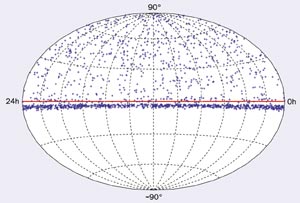
Wolfgang Rhode of Wuppertal and Jürgen Hößl from Erlangen-Nürnberg reported on the ongoing activities related to large-volume neutrino detectors in the Antarctic ice shield and in natural water in Lake Baikal and the Mediterranean sea. Results from AMANDA at the South Pole and BAIKAL are already beginning to constrain theoretical models on dark-matter annihilations, magnetic monopoles and astrophysical high-energy neutrino production. AMANDA has shown the first ever 100 GeV neutrino sky map and thus opened a new window for astrophysics (figure 1). As expected from the detector’s moderate sensitivity, the sky map does not show evidence for extra-terrestrial neutrino sources, but is compatible with the predicted neutrino production by charged cosmic rays in the Earth’s atmosphere. Based on this proof of principle, the significantly larger ICECUBE project is now under way. The first photomultiplier strings for the 1 km3 detector will be deployed during the next Antarctic summer, in 2004/2005. The installation of all the strings will be finished in 2010. The ANTARES collaboration plans to install 12 detector strings in the Mediterranean by 2006 to test the experimental concept and address the first astrophysical questions. The possibility of realizing a km3 detector in the Mediterranean seems, however, to depend not only on technology and engineering, but also on the strong will of the ANTARES, NEMO and NESTOR collaborations to join behind one common proposal.

cernastpart2_3-04

Götz Heinzelmann of Hamburg gave an introduction on high-energy gamma astronomy, focusing on the results of the imaging air Cherenkov telescopes (IACTs) of the HEGRA (High Energy Gamma Ray Astronomy) detector on La Palma in the Canary Islands. The pioneering work of HEGRA on new experimental techniques and analysis methods has been extremely fruitful. Although the experiment shut down in 2002, surprising results have since been announced: TeV gamma rays from the shell-type supernova remnant Cassiopeia A may indicate that this source accelerates nucleons to relativistic energies. This observation could be a key to the solution of the 90-year-old mystery of the acceleration sites of cosmic rays. The HEGRA collaboration also presented the first TeV gamma source unidentified at other wavelengths (figure 2), thereby giving an insight into a previously unknown area of the relativistic universe.

Many even more exciting results are expected with the new generation of IACTs now coming into operation. These experiments will be an order of magnitude more sensitive and will provide a reduced energy threshold. Werner Hofmann presented first results of the HESS (High Energy Stereoscopic System) detector in Namibia, and Florian Goebel from MPI for Physics, Munich, reported on the status of the MAGIC telescope at La Palma. Measurements of the cosmologically important extragalactic background light, of dark-matter annihilations, and perhaps even of hints on quantum gravitation are to be expected. Roland Diehl and Gottfried Kanbach, both from MPI for Extraterrestrial Physics, Garching, Martin Merck of Würzburg, Hinrich Meyer of Wuppertal and Masahiro Teshima from MPI for Physics, complemented the session with talks on gamma-ray astronomy with satellites, new ideas for IACTs, and the ultra-high-energy cosmic-ray detector, EUSO, which will be based on the International Space Station (ISS).

Charged cosmic rays

Air shower experiments on the energy spectrum and mass composition of charged cosmic rays focus on the so-called knee region around 1015 eV, where the slope of the energy spectrum suddenly changes, and on the highest energies beyond 1019 eV. Peter Biermann from MPI for Radioastronomy, Bonn, summarized the current theoretical models, while Andreas Haungs from the Research Centre Karlsruhe explained the still puzzling experimental situation around the knee. Data from the KASCADE experiment at Karlsruhe hint at a knee position proportional to the charge, Z, of the nuclei in cosmic rays, but uncertainties in the interpretation of the air shower data remain. At present no simulation is able to provide a consistent description of all KASCADE’s data on particle interactions in the atmosphere; more multi-parameter data are required. In recent years KASCADE has been expanded to KASCADE Grande (covering 640,000 m2), which will extend the accessible energy range up to 3 x 10¹⁷ eV. KASCADE Grande should be able to identify the knee for iron-like nuclei and hence prove the above-mentioned Z dependence. This would strongly support the assumption of cosmic-ray acceleration in the shells of supernova remnants – as is also implied by the HEGRA Cherenkov telescope data on Cassiopeia A.

cernastpart3_3-04

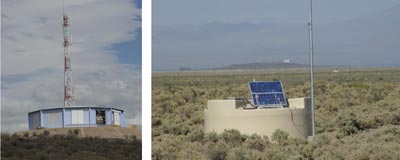
Karl-Heinz Kampert of Wuppertal reported on the experimental situation at the highest cosmic-ray energies. Data from the Akeno Giant Air Shower Array (AGASA) in Japan provide strong evidence for the existence of cosmic rays with energies beyond the Greisen-Zatzepin-Kuzmin (GZK) cut-off – the energy threshold of pion production due to the interaction of very energetic protons with the cosmic 2.7 K background radiation. By contrast, data from the HIRES detector in the US are also compatible with the existence of the GZK cut-off. This discrepancy should be resolved by the 3000 km2 AUGER experiment in Argentina. AUGER will provide much larger event statistics at the highest energies and combine the experimental techniques of AGASA and HIRES to minimize systematic uncertainties. The first data for extended air showers have already been taken successfully, while the production of detector components for AUGER will be finished in 2005. Hans Klages from the Research Centre Karlsruhe described possible expansions of AUGER on its southern and northern sites and stressed the sensitivity of AUGER to neutrino-induced horizontal air showers.

Heino Falcke from MPI for Radioastronomy and the University of Nijmegen, reported on a prototype set-up to detect radio emission from air showers. This project was launched after a discussion at the 2001 astroparticle workshop at DESY Zeuthen, and combined data taking with KASCADE has just begun. With a proof of principle at KASCADE, radio detection of air showers would allow the realization of inexpensive and very extended air shower experiments. Rolf Nahnhauer of DESY presented studies on the acoustic detection of neutrino interactions in ice and water, which potentially would also make extended and inexpensive set-ups possible. Manfred Simon of Siegen closed this session with a summary of the status of the PAMELA experiment, which is to be launched in 2004.

Cosmology and dark matter

Hans Böhringer from MPI for Extraterrestrial Physics opened the session on cosmology and dark matter with a talk on the astrophysical evidence for the existence of dark matter. The recent detailed data of the WMAP satellite on cosmic background radiation rule out the as-yet alternative scenarios of modified Newtonian dynamics (MOND) models. Wolfgang Seidel from MPI for Physics then summarized experimental attempts to detect dark-matter particles directly. The positive evidence published by the DAMA collaboration is still controversial. New experiments with event-by-event background suppression through the simultaneous measurement of heat and ionization are beginning to overtake the sensitivity of older large-mass detectors. In the near future an increase in sensitivity by two orders of magnitude will be reached by different experiments. Wim de Boer of Karlsruhe hinted at a surprising concordance: both the not very well understood galactic emission of GeV photons and the measured amount of positrons and antiprotons can be described very well hypothetically if neutralino annihilations are taken into account together with standard astrophysics. However, experimental uncertainties and a lack of knowledge about the astrophysical sources in the galaxy still prevent firmer conclusions on the existence of supersymmetric particles. Next-generation dark-matter experiments, the indirect searches with IACTs, and the AMS-II experiment on board the ISS will help to clarify the situation.

cernastpart4_3-04

Dieter Hoffmann from the Technical University of Darmstadt presented the successful start-up of the CAST experiment at CERN, which is looking for axions from the Sun. This experiment is an example of the symbiosis of different branches of physics in astroparticle physics: CAST uses an old prototype magnet for the Large Hadron Collider, combined with particle-physics detectors and X-ray techniques from space-born experiments. Finally, Jens Niemeyer of Würzburg presented the current understanding of the most mysterious ingredient of our universe, dark energy.

Further topics

Christian Weinheimer of Bonn began the session on neutrino masses and low-energy neutrino astronomy with an overview on the limits on neutrino masses derived from astrophysical observations. Although new astrophysical data are already quite sensitive to neutrino properties, firm model-independent measurements of the neutrino mass require analysis of the endpoint of the energy spectrum in beta decays. Here the KATRIN experiment at Karlsruhe, which should start up in 2007, will improve the sensitivity of the current experiments by an order of magnitude, to 0.2 eV. Supplementary experiments will look for neutrinoless double-beta decays. Stefan Schönert from MPI for Nuclear Physics reported on a proposal for a corresponding initiative to realize a large-scale 76Ge underground detector, and Thierry Lasserre of CEA proposed new reactor neutrino experiments to determine mixing parameters. Franz von Feilitzsch from the Technical University of Munich presented the status of low-energy neutrino astronomy, focusing on the Gallium Neutrino Observatory and the somewhat unlucky BOREXINO experiment, which was at the origin of the environmental issues at the Gran Sasso underground laboratory. However, BOREXINO is still important as the ultimate test of astrophysical models of the Sun.

Lothar Oberauer, also from the Technical University of Munich, described a feasibility study for a 30 kilotonne liquid-scintillator underground detector and its fundamental impact on geophysics, astrophysics, neutrino physics and proton-decay searches. Such an experiment on Low Energy Neutrino Astrophysics (LENA) would also be sensitive enough to detect relic supernova neutrinos, and hence provide data on the history of star formation. A large European initiative will be necessary to realize LENA. Hans Thomas Janka from MPI for Extraterrestrial Physics complemented the session with a presentation on supernova neutrinos.

cernastpart5_3-04

Karsten Danzmann from MPI for Gravitational Physics, Hannover/ Golm, gave a summary on the status of laser interferometer experiments to detect gravitational waves. Four first-generation experiments – GEO600 near Hannover, LIGO at two sites in the US, TAMA close to Tokyo and VIRGO near Pisa – have begun to or will take data within the next year. Their observation programmes are coordinated to increase the probability of correlated detections. Second-generation experiments are already planned (LIGO with the GEO600 technique) and the path to even more ambitious experiments seems to lie straight ahead, pointing to the ultimate challenge of observing primordial gravitational waves. The Big Bang Observatory could be realized around 2020.

Franz Käppeler from the Research Centre Karlsruhe stressed the need for the central topics of nuclear astrophysics of precise measurements of cross-sections, as well as of the lifetimes and masses of neutron-rich isotopes. Experimental uncertainties on these quantities currently limit our understanding of the energy production in stars and nuclear synthesis.

A strong future

Looking ahead, Hermann-Friedrich Wagner announced that from 2005 the funding of astroparticle physics in German universities will change from the present start-up scenario to a three-year periodic scheme, as applied, for example, in high-energy, nuclear and astrophysics. This decision means that astroparticle physicists in Germany can now make plans on a solid funding basis. In addition, the German Helmholtz association of large research centres now supports so-called “virtual institutes”. These networks will strengthen the co-operation of university groups and research centres.

The maturity astroparticle physics has now reached and the self-confidence of its proponents was also visible at the workshop with the establishment of the KAT (Komitee für Astroteilchenphysik) committee. KAT will be an elected committee responsible for expressing the opinions and needs of astroparticle physicists in Germany, and will be a negotiation partner for similar groups in other branches of physics, funding agencies and international organizations.

On the European scene APPEC, the Astroparticle Physics European Coordination has grown through new members Belgium, Greece, Spain and Poland. APPEC, as Thomas Berghöfer and Christian Spiering of DESY reported, is continuing its peer reviews of major astroparticle-physics activities in Europe. The ILIAS (Integrating Large Infrastructures for Astroparticle Science) proposal, triggered by APPEC as a joint proposal, was recently funded by a €7.5 million grant within the EU’s 6th Framework Programme.

This third workshop on the status and perspectives of astroparticle physics in Germany has revealed a research field that has left its teenage years. Astroparticle physics is now much better anchored in Germany than it was three years ago. Fortunately, however, both the growing importance of astroparticle physics for fundamental physics and astrophysics, as well as the personal enthusiasm of the physicists in this field of research, have retained their youthful sprightliness.

New g-2 measurement deviates further from Standard Model

cernnews3_1-04

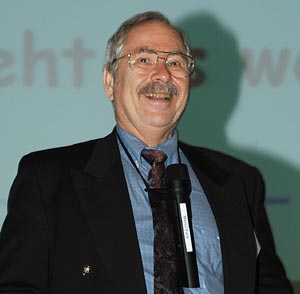
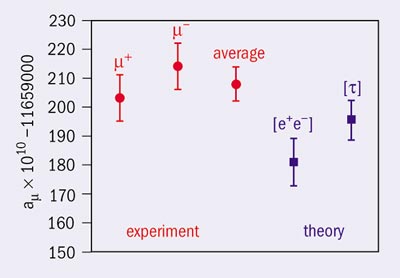
On 8 January the muon (g-2) collaboration, E821, which has been working for the past 15 years at the Brookhaven Alternating Gradient Synchrotron to measure the anomalous magnetic moment of the muon, released their final result, their first for the negative muon. The new result, which has been submitted to Physical Review Letters, has a relative precision of 0.7 parts per million (ppm), and as expected from CPT symmetry agrees well with the collaboration’s earlier 0.7 ppm measurement for the positive muon (Bennett et al. 2004). The combined precision is 0.5 ppm, a factor of 14 more precise than the famous experiments done at CERN in the 1970s, which reached 7.3 ppm. There has been considerable interest in these measurements because of the potential sensitivity to new physics such as supersymmetry, which would show up as a difference between the Standard Model value and the experimental one.

The E821 experiment ran at Brookhaven between 1997 and 2001, and was conducted by a collaboration of scientists not only from the US but also from Germany, Japan, the Netherlands and Russia. It was led by co-spokespersons Lee Roberts of Boston University and the late Vernon Hughes of Yale University. The collaboration’s first precise measurement, which was reported in 2001, differed from the Standard Model value by 2.6 standard deviations (Brown et al. 2001). The Standard Model theory for g-2 is composed of contributions from the weak, the electromagnetic and the strong forces. While the contributions from the weak and electromagnetic forces can be calculated from first principles, the contribution from the strong force cannot, and must be determined using experimental data. The direct determination uses data obtained by colliding electrons and anti-electrons, and measuring the production of hadrons in the collision. The indirect method uses data from the decay of tau leptons into hadrons, along with the conserved vector-current hypothesis plus the appropriate isospin corrections. At present the two methods do not agree very well, and in light of this disagreement some physicists use only the direct method to determine the theoretical value.

After the first announcement was made in 2001, many theoretical and experimental physicists took a closer look at the predicted theoretical value for g-2. In October 2001 Marc Knecht and Andreas Nyffeler from the University of Marseille found a sign mistake in a piece of the hadronic contribution, which moved theory closer to experiment (Knecht and Nyffeler 2002). Since then, progress has been made on both the experimental and theoretical fronts. The new value for the negative muon differs from the latest direct theoretical value by 2.8 standard deviations, the combined value differs by 2.7 standard deviations (Davier et al. 2003), and the difference from the indirect determination is 1.4 standard deviations.

X marks the spot: a new particle appears in two experiments

A new and unusual particle – the X(3872) – has been discovered by the Belle collaboration at the High Energy Accelerator Research Organization, KEK, in Tsukuba, Japan, and confirmed by an entirely different experiment, the Collider Detector at Fermilab (CDF), in the US.

Belle operates at KEK’s electron-positron collider, KEKB, which is designed to produce large numbers of B mesons at centre-of-mass energies around 10.58 GeV. While investigating the various ways that the B can decay, the Belle team found a small peak near 3.872 GeV in the mass plot for combinations of a J/Ψ with two π mesons – a little higher in energy than the large spike produced by the well known Ψ'(3686), which can decay to the same final state (Choi et al. 2003). This indicated the production of a new particle, which has been called the X(3872). Evidently the B can decay into an X and a K meson. The X(3872) then decays almost instantly into a J/Ψ and two π mesons.

Responding to these results, the CDF team quickly found the X(3872) in the rather different environment of 2 TeV proton-antiproton collisions at Fermilab’s Tevatron (Acosta et al. 2003). Their observation suggests that the X is produced not only in the weak decays of B mesons but also through the strong interaction, which dominates proton-antiproton interactions. The two observations are also nicely complementary. While Belle has found about 60 X events with little background, CDF has seen about 700 X events with a background of about 6000 events.

As its name implies, the X(3872) particle does not fit easily into any known particle scheme. Belle found the particle while looking for missing states of charmonium (bound states of a charm quark and antiquark), but the mass and decay properties of the X(3872) do not match theoretical expectations. As a result the X has attracted a considerable amount of attention from the world’s physics community, and theoretical physicists are considering a number of alternative explanations. These include the possibility that the X(3872) is a new type of exotic meson made from two quarks and two antiquarks – a multiquark “molecular state” of a D0 meson bound to an anti-D*0 – or a hybrid meson made from a charm quark and antiquark and a gluon.

New five-quark states found at CERN

cernnews1_12-03

Only a few months after the first burst of excitement over the appearance at several laboratories of what seems to be a new five-quark particle, evidence has been found for a different five-quark state that appears to be closely related.

The constituent quark model of hadrons that was invented in the 1960s has been very successful in describing the known baryons as composites of three valence quarks. Quantum chromodynamics (QCD), the theory of strong interactions, does not forbid baryons containing more than three quarks. In fact, such states were proposed a long time ago but no good candidates were found by experiments until recently. The search was revived by the theorists Dmitri Diakonov, Victor Petrov and Maxim Polyakov. They predicted that the masses of the lightest pentaquark (4q,qbar) baryon multiplet, an antidecuplet (see figure 1), were rather small and that the width of its lightest member was expected to be very narrow (Diakonov et al. 1997). Recent evidence for this state, named Θ+, has opened up a new chapter in baryon spectroscopy that will help to elucidate QCD in the non-perturbative regime. The Θ+ is a manifestly exotic baryon, that is, it cannot be composed of three quarks. This is also the case for the other two corner members of the antidecuplet depicted in figure 1. The latter have a strangeness of S = -2, a charge of Q = -2,+1, and form members of an isospin quartet of Ξ states.

cernnews2_12-03

Experiment NA49 at the CERN Super Proton Synchrotron has searched for the Θ+ and the Ξ states in proton-proton collisions at a beam energy of 158 GeV (Alt et al. 2003). Tracks of particles produced in the reactions are recorded by the detector’s four large time-projection chambers. Their high resolution allows for a precise reconstruction of the particle trajectories and momenta as well as their identification via the measurement of the energy loss in the chamber gas. The reconstruction of secondary decay vertices makes possible the observation of the complex decay chains of the pentaquark states. After suppression of the overwhelming background by suitable selection cuts, the summed Ξπ mass distribution shows a narrow peak of 5.6 standard deviations at a mass of 1.862 ±0.002 GeV/c2 (see figure 2). The true width of the peak must be smaller than the observed full width at a half maximum of 0.017 GeV/c2, which is consistent with the resolution of the detector.

In fact, peaks are seen at the same mass in the individual Ξπ and Ξπ+ mass distributions, as well as in those of the antiparticles. No signal has been found yet for the Θ+, for which the background in the potentially observable decay channel pKOs is less favourable. The exotic Ξ with S = -2, Q = -2 and the Ξ0 with S = -2, Q = 0 are good candidates for the isospin quartet of predicted pentaquark states with quark content (ddssubar) and (dussdbar). Their discovery represents an important step towards the experimental confirmation of the existence of the hypothesized baryon antidecuplet.

GSI Darmstadt gains credit for new element

The Joint Working Party (JWP) on the priority of claims to the discovery of new elements has officially credited the research collaboration led by Sigurd Hofmann at the Gesellschaft für Schwerionenforschung (GSI) with the discovery of element 111. In addition, the four independent experts from the International Union of Pure and Applied Chemistry (IUPAC) and its physics sister the IUPAP, have officially approved the naming of element 110, also discovered by GSI, as darmstadtium (Ds).

The researchers at GSI first created element 111 in December 1994, when they bombarded a target of bismuth (209Bi) with a beam of nickel (64Ni) and observed three sets of localized alpha-decay chains, which they attributed to the decay of nuclei with 111 protons and 161 neutrons. Two of the decay chains, however, involved isotopes of bohrium and meitnerium (264Bh and 268Mt), which were then unknown. The JWP therefore decided that further results would be needed. In a repeat of the experiment in 2000, the GSI team observed further decay chains originating from element 111, bringing the total number of events to six. Due to the high quality of the data, the JWP has now accepted the results and confirmed the GSI team’s priority for the discovery of element 111.

The JWP also assessed evidence for the production of elements 112, 114 and 116 by GSI and a collaboration led by Yuri Oganessian at the Joint Institute for Nuclear Research in Dubna. Although the JWP found the evidence encouraging, they concluded that confirmation from further results is needed.

Deuterons display surprising spin gymnastics

cernnews8_12-03

Just before the Cooler Ring at the Indiana University Cyclotron Facility (IUCF) passed into history, it produced another impressive result using the ring’s unique accelerator physics capabilities. A team of accelerator spin physicists from Michigan and Indiana, led by Alan Krisch, used their RF-solenoid once again to spin-flip a beam of stored polarized particles. However, in this case the particles were not spin-1/2 Fermi-Dirac protons or electrons, but instead were spin-1 Bose-Einstein deuterons, and the results were quite surprising.

Manipulating a deuteron’s spin is much harder than manipulating a proton’s spin because the deuteron’s anomalous magnetic moment is more than 12 times smaller. However, Vassili Morozov, a graduate student, found ways to strengthen the RF-solenoid’s strength to its limit, so allowing a first glance at the behaviour of spin-1 particles when their spin is manipulated.

Polarized beams of spin-1/2 protons and electrons are not only easier to spin-manipulate, they are also easier to understand, since their classical spin motion in a ring’s magnetic field can only be either counter-clockwise (up) or clockwise (down). The well known polarization of a beam of protons or electrons is simply the difference between the fractions of the beam spinning in these two directions. The vector polarization of a beam of spin-1 deuterons is defined in the same way; however, the vector polarization alone does not fully describe spin-1 particles. There is also a tensor polarization, which involves the fraction of deuterons spinning (classically) in any and all sideways directions perpendicular to the ring’s magnetic field. This part of the classical picture for spin-1 particles seems paradoxical.

While the quantum mechanics of spin-1 particles has been known for decades, the behaviour of spin-1 deuterons undergoing spin-manipulation has apparently never been studied experimentally. The upper part of the figure above shows that the deuterons’ vector polarization behaviour can be fit to the classical Froissart-Stora equation, as can the polarization of spin-1/2 protons. The deuterons’ vector polarization appeared to be spin-flipped, although with less efficiency due to the smaller anomalous magnetic moment.

By contrast, the behaviour of the tensor polarization was quite striking, and at first surprising. When the spin-manipulating solenoid was activated for a longer time (Δt), both tensor states (Pzz = +1 and -2) first reversed their signs as their magnitudes dropped by about 50%. Then, as the spin-manipulation time was further increased, the Pzz signs again reversed to their original signs and approached their original values. Notice also that the tensor polarization reached its minimum value at exactly the same place where the vector polarization passed through zero.

It turned out that this striking behaviour of the tensor polarization could be directly related to the vector polarization behaviour by using the known rotational properties of the vector and tensor polarizations of spin-1 particles (see the curves drawn in the figure). This confirmed that polarized spin-1 Bose-Einstein particles were indeed being spin-manipulated. Taken together, the two-part figure shows how all the vector and tensor polarizations of the spin-1 polarized deuteron beam in the Cooler Ring were spin-manipulated and flipped.

Now that the venerable IUCF Cooler Ring has been decommissioned, the Michigan team is continuing deuteron spin-manipulation studies at the 3 GeV COSY Cooler Ring in Jülich, Germany, along with new colleagues from COSY, Bonn and Hamburg, and long-term colleagues from KEK and Brookhaven. In February 2003, the new SPIN@COSY collaboration flipped the first polarized deuteron beam at COSY with about 50% efficiency using a prototype air-core RF-dipole. A new stronger ferrite RF-dipole has recently been successfully tested for use in COSY’s polarized deuteron run in December.

Physics from heaven and Earth

cerneps1_12-03

In the tradition of the HEP-EPS conferences, the meeting hosted this year by the University of Aachen on 17-23 July offered two well-balanced parts: three days of parallel sessions, followed by review talks from invited speakers. This formula, which also provides a forum for younger physicists, resulted in a rich and informative set of parallel sessions, illustrating the scientific progress made during the past two years. HEP 2003 also presented a good balance between news “coming from the Earth” (colliders and “terrestrial” neutrino physics) and results “coming from heaven” (astroparticle physics and cosmology).

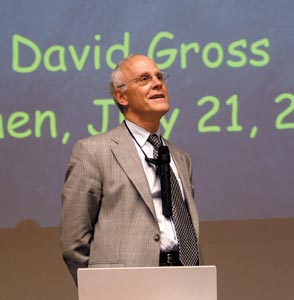
The plenary meeting was opened by the presentations of EPS prizes to David Gross, David Politzer and Frank Wilczek (the High Energy and Particle Physics Prize), Nima Arkani-Hamed (the Gribov Medal), Guillaume Unal (the Young Physicist Prize), and Rolf Landua and Nicholas Tracas (the Outreach Prize). Also during the conference the EPS HEP Board held a special meeting and elected Jose Bernabeu of Valencia as its chairperson, who replaces Michel Spiro of IN2P3 in France.

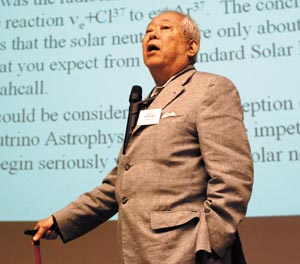
The scientific plenary sessions began with a very stimulating talk on the birth of neutrino astrophysics by the 2002 Nobel laureate Masatoshi Koshiba of Tokyo. Pippa Wells of CERN then summarized the close-to-final results from the era of the Large Electron-Positron Collider (LEP) and the SLAC Linear Collider (SLC) and the impact they had on electroweak theory. In nearly all domains the quality and accuracy of the final results on Z and W physics were much better than predicted – as, for instance, at a meeting also held in Aachen, 16 years ago, as Daniel Treille from CERN recalled. Summarizing the whole set of available electroweak measurements by performing a global fit shows that the Standard Model (SM) accounts for the data in a satisfactory but imperfect way: the probability of the fit is only 4.5%. However, this value increases to 27.5% if the measurement of the weak mixing angle by the NuTeV experiment at Fermilab is excluded. This is the most outlying measurement, but it is suspected that there are “standard” explanations. The other noticeable disagreement unfortunately concerns the two most precise electroweak measurements, namely the spin asymmetry (ALR) at SLC and the forward-backward asymmetry of beauty production (AbFB) at LEP. These give values of the weak mixing angle differing by 2.9σ, with no hint of an explanation. Ignoring this disagreement and considering only the mean value of the results leads in the strict frame of the SM to the preferred Higgs mass region of mh = 91+58-37 GeV (mh ≤219 GeV at 95% CL).

An ambiguity that is not yet resolved concerns the theoretical interpretation of the muon g-2 measurement obtained in Brookhaven with an experimental accuracy of around 7 x 10⁻⁷. To predict its value requires the inclusion of subsidiary experimental data. Using the hadronic tau-decays leads to a fair agreement between theory and experiment, whereas using hadronic production in low-energy e+e collisions results in an excess of around 2.5σ of experiment over expectation. This disagreement needs further study, especially because the g-2 observable is potentially a powerful sign of new physics, in particular of supersymmetry (SUSY).

Beyond the Standard Model

Moving on to the searches for new physics, Arnulf Quadt of Bonn gave an exhaustive review of the direct searches at colliders and updated the existing limits. Unfortunately, besides the DsJ particle found by the B-factories and the pentaquark (see “New five-quark states found at CERN”) – presented in a special talk by Frank Wilczek from MIT – no discovery has shown up at the high-energy frontier. Nevertheless, the motivation to go beyond the SM is more compelling than ever. Traditionally the routes leading beyond the SM either call for new levels of structure and/or new forces, as technicolour does, or involve an additional symmetry, as in the case of SUSY. Here SM particles and their “superpartners” conspire to solve the hierarchy problem.

While technicolour meets serious problems in passing the tests of electroweak measurements, SUSY, widely discussed in Aachen, keeps its eminent merits. An important and well-known result, derived from LEP data, is the quasi-perfect convergence near 1016 GeV of the electromagnetic, weak and strong coupling “constants” in the frame of SUSY.

it is important to appreciate correctly the existing limits, drawn either from accelerators or from astrophysics.

Daniel Treille

With the diversity of its possible breaking mechanisms, SUSY presents a complex phenomenology with many different mass spectra possible for the supersymmetric particles. However, its minimal version offers a golden test: it predicts a very light Higgs boson, i.e. ≤130 GeV (for mtop = 175 GeV) and even less for all versions of supergravity that are currently considered as reference points for the future. The final lower mass limit of direct searches at LEP is 114.4 GeV, with a 1.7σ effect near 115 GeV. The whole mass window could have been covered with 80 additional superconducting cavities (i.e. 30% more) and the magnificent performances of the accelerating field finally reached at LEP, and its exploration remains the first objective of future research programmes. If SUSY represents the truth, the Large Hadron Collider (LHC) at CERN, or maybe, with much luck and considerable improvements, the Tevatron at Fermilab, will discover SUSY by observing some supersymmetric particles besides the light Higgs boson. But a linear collider will be needed to complete precise measurements in the mass domain such a machine would access.

Other interesting new routes beyond the SM have appeared in recent years and were summarized by Lawrence Hall of Berkeley and Ferruccio Feruglio from Padova, while Jose Barbon of CERN presented the state of the art in the field of superstrings. The “little Higgs” scenario leaves aside the big hierarchy problem for the time being, and tackles first the small hierarchy one, namely the fact that LEP has suggested a light Higgs boson while it pushes beyond several tera-electron-volts all new physics (except SUSY, which can still be “behind the door”). The other new road postulates the existence of extra new dimensions of space, large enough to generate visible effects at future experiments. Such an eventuality- so far uncontradicted by experiments – has to be fully explored and would be an extraordinary opportunity for the LHC. However, as recalled by Treille, it is important to appreciate correctly the existing limits, drawn either from accelerators or from astrophysics.

QCD, beauty and heavy ions

Peter Schleper of Hamburg illustrated the numerous experimental successes of quantum chromodynamics (QCD), the theory of the strong interaction. The values of αS(MZ) obtained from very different sectors are now in very good agreement. The nucleon structure and the parton distributions are increasingly better known and understood, thanks especially to HERA at DESY. However, when spin intervenes, our understanding of hadrons is still poor. Pilar Hernandez of Valencia emphasized the progress of lattice simulations, which have become basic tools, crucial for many domains. It is important to underline that much remains to be done in matters of QCD if we are to enter the LHC era in optimal conditions, i.e. with a very good understanding of the SM prediction for the many different topologies that searches will explore. This is particularly true for the indispensable Monte Carlo programs.

cerneps2_12-03

Sheldon Stone of Syracuse and Hitoshi Yamamoto of Tohuku described in great detail the impressive progress of beauty physics. One must first underline the remarkable performances of the B-factories, in particular of KEKB in Japan, the first machine to deliver a luminosity of 1034 cm-2 s-1. It is clear that a very successful first round of experiments has been accomplished. The direct measurement of one of the angles of the unitary triangle (called ß or φ1, depending on the continent) via the very clean mode B → J/Ψ KS is in excellent agreement with the determination of the tip of the triangle through the measurement of its sides made during the past decade from B and K physics results at LEP and elsewhere. This is another important success of the SM.

However, revealing new physics calls for a much better accuracy. The roadmap, concerning this second round of measurements, defines an ambitious programme, which involves many different beauty decay modes and is extremely demanding from the experimental as well as from the theory side, as described in detail by Thomas Mannel from Karlsruhe. Equally promising are rare K and µ decay modes where the expected performance is very impressive indeed, as for instance in future searches at the Paul Scherrer Institute (PSI) for µ → eγ with a sensitivity of 10-14.

Saskia Mioduszewski from Brookhaven reviewed results coming from gold-gold collisions up to 200 A GeV produced at Brookhaven’s Relativistic Heavy Ion Collider (RHIC). The most prominent signatures that could reveal a quark-gluon plasma are not yet available from RHIC, but results are still coming from the Super Proton Synchrotron (SPS) at CERN. For example, the J/Ψ suppression, confirmed by the analyses of CERN’s NA50 experiment, keeps all its interest. Unfortunately no unique prediction of this effect exists for RHIC and the LHC. More data are needed: the next should come from the PHENIX experiment at RHIC and from NA60 at CERN.

Hitoshi Murayama and Kevin Lesko, Berkeley, shared the review of neutrino physics, which is in a truly revolutionary era. After the triumph of the SuperKamiokande experiment in Japan, the recent results of the KEK to Kamioka (K2K) neutrino-oscillation experiment, the Sudbury Neutrino Observatory (SNO) and the Japanese reactor experiment KamLAND have strengthened our knowledge of neutrino oscillations. The main open question is whether there exists a fourth neutrino, of a sterile nature, as suggested by the Liquid Scintillator Neutrino Detector (LSND) at Los Alamos, but strongly disfavoured by the other results. Fermilab’s MiniBooNE experiment will settle the matter in the coming years. The big unknown now is the magnitude of the third mixing angle θ13 of the neutrino-mixing matrix. Its value will reveal if the ultimate stage in neutrino physics, namely the measurement of CP violation in this sector, is accessible or not.

Oscillations give access only to mass differences. To know the absolute mass values one must consider the beta decay of tritium, which, through its end-point, gives access to mνe (present limit at 2.2 eV from Mainz and Troitsk, future one near 0.2 eV from KATRIN in Karlsruhe), and neutrinoless double beta decay. The existence of the latter would imply that the neutrino is of Majorana type. Interesting news concerning neutrino physics also came from cosmology. A combination of the results from the Wilkinson Microwave Anisotropy Probe (WMAP) and the 2dF Galaxy Redshift Survey seems to indicate that Σmνi ≤0.71 eV. This limit implies a mass range for the heaviest neutrino of 0.03 ≤m3 ≤0.24 eV (95% CL). However, at the meeting Steen Hannestad of Odense called for some caution in deriving such limits.

Cosmic particles

Astroparticle physics, covered partly by the plenary talk of Stefan Schael from Aachen and quite abundantly in parallel sessions, is a vast domain, now concerning all types of particles. One of the goals is to extract information about cosmological objects or events, and the number of such non-accelerator research programmes is increasing very rapidly.

The enigma of ultrahigh-energy cosmic rays, beyond the Greisen-Zatsepin-Kuzmin (GKZ) cut-off, remains unsolved. Even their existence is still to be demonstrated definitively, as current experiments cannot settle the issue. The Pierre Auger Observatory, now in its initial phase (see “Auger ready for ultra-high-energy cosmic rays”), should provide the answer and perhaps say something about their nature. The main objective of gamma astronomy, on the other hand, is to fill the gap between low energies (a few giga-electron-volts, the domain of satellites) and high ones (a few hundred giga-electron-volts, the threshold of ground-based detectors up to now). Preliminary results from HESS in Namibia and the imminent start of MAGIC on La Palma (see “MAGIC opens up the gamma-ray sky”) were reported in the parallel sessions. Astrophysics of high-energy neutrinos, detected either by atmospheric Cherenkov telescopes, such as AUGER and the Extreme Universe Space Observatory (EUSO) under study, or by sub-ice experiments, such as AMANDA and its successor ICECUBE at the south pole, and submarine experiments, such as ANTARES in the Mediterranean Sea and NESTOR in Greece, is certainly a fascinating objective. However, the proof of principle has still to be demonstrated and no detection of high-energy neutrinos of extra-terrestrial origin has been reported so far.

The content of the universe

As for cold dark matter, whose contribution to the content of the universe has been accurately determined by WMAP (23%), the search is in full swing. For the baryonic part (4.4%), the possibility that it could be due mostly to dark objects like “failed stars” is now excluded. Instead, gas and dust may be the answer. For non-baryonic dark matter, the neutralino (the lightest SUSY particle) and the axion are still the favoured candidates. The DAMA experiment at the Gran Sasso National Laboratory (LNGS), now with a further year of data, continues to present a result that suggests a seasonal variation in its counting rate, for a very low threshold. An unidentified systematic effect is not excluded and it is important to confirm this observation in an independent manner. Neither the Cryogenic Dark Matter Search (CDMS) nor the EDELWEISS experiment under the French Alps confirms it, and at first sight they seem to exclude the mass and cross-section regions corresponding to the DAMA effect. However, this conclusion has to be considered with caution, given the very low threshold used by DAMA, as well as the potential role of spin-dependent interactions.

cerneps3_12-03

A striking result from 2003, well illustrated in Aachen by Schael, is WMAP’s measurement of the power spectrum of the microwave background with a much better accuracy than previously. From the position and the respective heights of the observed peaks, a large number of cosmological parameters have been extracted with an impressive accuracy. The flatness of the universe seems in particular to be proven without ambiguity. As Viatcheslav Mukhanov of Munich underlined in his lively talk, WMAP appears to have confirmed two of the three major predictions of inflation: the flatness of the universe, linked to the superluminal expansion, and the existence of density perturbations corresponding to a quasi scale-invariant spectrum (inflation actually predicts a slight deviation from invariance, which still needs experimental confirmation). The third prediction, the existence of gravitational waves originating from inflation, is out of reach of the interferometer experiments, including the space mission LISA. However, relevant information can come from the experimental programmes able to measure the cosmic microwave background radiation (CMBR) polarization, in particular WMAP itself and, later, the PLANCK mission. On the contrary, the various models of inflation on the market are still rather unconstrained by the present data and the nature of the inflation remains a deep mystery.

R&D on the road ahead

The most innovative aspects of instrumentation were reviewed by Daniel Fournier of Orsay. All the breakthroughs he described could happen only as a result of long and vigorous R&D activity: its continuation is a key for the future of our field. As David Stickland of Princeton illustrated, this must be accompanied by a mutation of the computing means and of the distribution of information on a worldwide scale: this is the aim of the Grid.

An important part of the conference was devoted to the Road Map for High Energy Physics discussed in a joint session of the European Committee for Future Accelerators (ECFA) and EPS. This round table was supplemented by a comprehensive review from Cornell’s Maury Tigner of accelerator R&D. The near future is clearly dominated by the LHC, which should start up in 2007. It is well-known, but it is important to recall the challenge of the LHC (the machine as well as the detectors), the vital importance of its success and the enormous physics potential it offers. Given the timescale that a new project implies, it is however crucial to plan the longer-term future. The choice of an e+e linear collider, which should complement the LHC through the accuracy of its measurements, is unanimous. This too is a difficult enterprise that requires intense accelerator R&D, as Tigner discussed. He also argued for a stronger involvement by high-energy physicists in the R&D of accelerator physics. This important suggestion – influencing the future of particle physics – should be supported.

Treille gave an impressive conference summary. He highlighted the most important results presented and included additional information, thus giving a very comprehensive overview of the present status and future perspectives of our field. The résumé presented here is certainly influenced by this concluding talk.

This conference in the beautiful town of Aachen was organized in an exemplary way. The participants enjoyed not only a very stimulating conference, but also a welcome reception by the city of Aachen in the “Aula Carolina”, a place of ancestral dignity, and an exceptional event on Monday evening – a performance of Verdi’s La Traviata, arranged specially for this conference. Christoph Berger and his local organizing committee did an outstanding job indeed. They have set high standards for the forthcoming 2005 EPS HEP conference, which will take place in Portugal.

bright-rec iop pub iop-science physcis connect