Almost every current theoretical model of neutrino masses introduces sterile (“right-handed”) fields, which mix with the ordinary (“left-handed”) neutrinos. Ordinary neutrinos have no electrical charge and interact through the weak force, but there may also exist rogue sterile neutrinos that feel only gravity. Most models make these new particles very heavy, while also trying to explain the small masses of ordinary neutrinos. Now Peter Biermann of the Max Planck Institut for Radioastronomy, Bonn, and Alexander Kusenko of University of California, Los Angeles, have suggested that if some of the sterile neutrinos are relatively light, they could resolve several astrophysical puzzles. In particular, sterile neutrinos with kilo-electron-volt (keV) masses could account for dark matter, the origin of the rapid motion of observed pulsars and re-ionization of the universe (Biermann and Kusenko 2006).
These relatively light sterile neutrinos were the topic of a recent workshop, Sterile Neutrinos in Astrophysics and Cosmology, held in Crans Montana in March. The meeting looked not only at how keV sterile neutrinos can solve a variety of problems in astrophysics, but also at how their existence might be detected.
Dark-matter sterile neutrinos could decay into a lighter neutrino and an X-ray photon, and this seems to be the most promising path to discovery. The workshop brought together particle physicists and X-ray observers, who presented the current limits and discussed ways to search for dark-matter neutrino decays. One important feature of dark matter in the form of the sterile neutrinos is the smoothing of structures on small scales. This “warm” dark matter – in contrast with the “cold” and “hot” alternatives – would be indistinguishable from cold dark matter on large scales, but it would yield stellar structures with the smallest size relative to the dark-matter particle mass. Recent studies of dwarf spheroid satellite galaxies have reported seeing the minimal halo size, indicative of warm dark matter.
The same decays into X-ray photons happening in the early universe could have produced enough ionization to catalyse a rapid production of molecular hydrogen, which is the most important cooling agent for primordial gas. Enriched with molecular hydrogen, haloes of gas would cool and collapse, forming the first stars. These stars could have re-ionized the universe, in agreement with observations of the Wilkinson Microwave Anisotropy Probe.
The role of sterile neutrinos in pulsars originates in supernova explosions, where sterile neutrinos with a mass of several keVs from the cooling nascent neutron star would be emitted preferentially in one direction, set by the star’s magnetic field. Although the neutrinos would not interact with the magnetic field, they would scatter off fermions polarized along the magnetic field in the neutron star. The anisotropy of sterile-neutrino emission would be sufficient to give the neutron star a recoil velocity of hundreds of kilometres a second. This agrees with observations of pulsars – magnetized rotating neutron stars – all of which have very large velocities. The origin of these velocities is a long-standing puzzle, which would have a simple explanation if sterile neutrinos exist.
On 15 October 1991 the highest-energy cosmic-ray particle ever measured struck Earth’s atmosphere tens of kilometres above the Utah Desert. Colliding with a nucleus, it lit up the night for an instant and then was gone. The Fly’s Eye detector at the Dugway Proving Grounds in Utah captured the trail of light emitted as the cascade of secondary particles created in the collision made the atmosphere fluoresce. The Fly’s Eye researchers measured the energy of the unusual ultra-high-energy cosmic-ray event – dubbed the “Oh-My-God (OMG) event” – at 320 exa-electron-volts (EeV), or 320 × 1018 eV. In SI units, the particle, probably a proton, hit the atmosphere with a total kinetic energy of about 5 J. For a microscopic particle this is a truly macroscopic energy – enough to lift a mass of 1 kg half a metre against gravity. On 3 December 1993, on the opposite side of the world, the Akeno Giant Air Shower Array (AGASA) in Japan recorded another OMG event with an energy of 200 EeV. In this case the cosmic ray was recorded using a large array of detectors on the ground to measure the extended air shower (EAS) resulting from the primary cosmic ray interacting with the atmosphere.
Since these first observations at least a dozen OMG events have been recorded, confirming the phenomenon and mystifying cosmic-ray physicists. It seemed that particles with energies more than about 50 EeV should not reach Earth from any plausible source in the universe more than around 100 million parsecs distant, as they should rapidly lose their energy in collisions with the 2.7 K cosmic-microwave background radiation from the Big Bang – the Greisen-Zatsepin-
Kuzmin limit. While many explanations have been proposed, experiments have so far failed to decipher a clear message from these highly energetic messengers, and the existence of the OMG events has become a profound puzzle. Now a new eye on these ultra-high-energy events has come into focus, based on the great plain of the Pampa Amarilla in western Argentina. The Pierre Auger Observatory (PAO), with its unprecedented collecting power, has begun to study cosmic rays at the highest energies.
However signs of the extreme-energy universe may also come in a different guise – not as a single OMG event but rather as bursts of events of more-modest energy. On 20 January 1981, near Winnipeg, a cluster of 32 EASs – with an estimated mean energy of 3000 tera-electron-volts – was observed within 5 min (Smith et al. 1983). Only one such event would have been expected. This observation was the only one of its kind during an experiment that recorded 150,000 showers in 18 months. In the same year an Irish group reported an unusual simultaneous increase in the cosmic-ray shower rate at two recording stations 250 km apart (Fegan et al. 1983). The event, recorded in 1975, lasted 20 s and was the only one of its kind detected in three years of observation.
There have since been a few hints of such “correlated” cosmic-ray phenomena seen by some small cosmic-ray experiments dotted around the world, such as a Swiss experiment that deployed four detector systems in Basel, Bern, Geneva and Le Locle, with a total enclosed area of around 5000 km2. In addition, the Baksan air-shower-array group has presented evidence from data from 1992 to 1996 for short bursts of super-high-energy gamma rays from the direction of the active galactic nucleus Markarian 501. The AGASA collaboration has also reported small-scale clustering in arrival directions, and possibly in the arrival times of these clustering events.
One mechanism that could generate correlated showers over hundreds of kilometres is the photodisintegration of high-energy cosmic-ray nuclei passing through the vicinity of the Sun, first proposed by N M Gerasimova and Georgy Zatsepin back in the 1950s. Other more recent and more exotic examples of phenomena that could give rise to large-area non-random cosmic-ray correlations include relativistic dust grains, antineutrino bursts from collapsing stellar systems, primordial black-hole evaporation and even mechanisms arising from the presence of extra dimensions.
Whichever way the high-energy universe is incarnated on Earth, the signs should be exceedingly rare, requiring large numbers of detectors deployed over vast areas to provide a reasonable signal. The detection of a single OMG particle requires dense EAS arrays and/or atmospheric fluorescence detectors, with detector spacings of the order of a kilometre, as in the PAO. Detection of cosmic-ray phenomena correlated over very large areas requires even bigger detection areas, which at present are economically feasible only with more sparse EAS arrays (on average much fewer than one detector per km2). In fact, global positioning system (GPS) technology makes it possible to perform precision timing over ultra-large areas, enabling a number of detector networks to be deployed as essentially one huge array. An example is the Large Area Air Shower array, which started taking data in the mid-1990s. It comprises around 10 compact EAS arrays spread across Japan, forming a sparse detector network with an unprecedented enclosed area of the order of 30,000 km2.
Now, however a new dimension to cosmic-ray research has opened up. In 1998 in Alberta, building on a proposal first presented in 1995, the first node of a new kind of sparse very-large-area network of cosmic-ray detectors began to take data. The innovative aspect of the Alberta Large-area Time-coincidence Array (ALTA) is that it is deployed in high schools. By the end of 1999 three high-school sites were operating, each communicating with the central site at the University of Alberta. In 2000 the Cosmic Ray Observatory Project (CROP), centred at the University of Nebraska, set up five schools with detectors from the decommissioned Chicago Air Shower Array. Around the same time the Washington Large-area Time-coincidence Array (WALTA) installed its first detectors.
The ALTA, CROP and WALTA projects have a distinct purpose – to forge a connection between two seemingly unrelated but equally important aims. The first is to study the extreme-energy universe by searching for large-area cosmic-ray coincidences and their sources; the second is to involve high-school students and teachers in the excitement of fundamental research. These “educational arrays”, with their serious research purpose, provide a unique educational experience, and the paradigm has spread to many other sites in North America. The detector systems are simple but effective. Following the ALTA/CROP model they use a small local array of plastic scintillators, which are read by custom-made electronics and which use GPS for precise coincidence timing with other nodes in a network of local arrays over a large area. Most of the local systems forming an array use three or more detectors, which, with a separation of the order of 10 m and a hard-wired coincidence, allow accurate pointing at each local site. Today the ALTA/CROP/WALTA arrays involve more than 60 high schools and there are three further North American educational arrays in operation: the California High School Cosmic Ray Observatory (CHICOS) and the Snowmass Area Large-scale Time-coincidence Array (SALTA) in the US, and the Victoria Time-coincidence Array (VICTA) in Canada. At least seven more North American projects are planned.
The CHICOS array is the largest ground-based array in the Northern Hemisphere. Its detectors, donated by the CYGNUS collaboration, are deployed on more than 70 high-school rooftops across 400 km2 in the Los Angeles area. Each site has two 1 m2 plastic scintillator detectors separated by a few metres. Local pointing at each site is not possible, nor is it required as CHICOS uses GPS pointing across multiple sites to concentrate on the search for single ultra-high-energy cosmic-ray air showers. Recently the collaboration reported their results at the 29th International Cosmic Ray Conference in Pune, India (McKeown et al. 2005).
Innovative detection techniques have also been employed in this burgeoning collaboration between researchers and high-school students and teachers in North America. A prime example is the project for Mixed Apparatus for Radar Investigation of Cosmic Rays of High Ionization (MARIACHI), based at Brookhaven National Laboratory, New York. The plan is for the experiment to detect ultra-high-energy cosmic rays using the passive bistatic radar technique, where stations continuously listen to a radio frequency that illuminates the sky above it. The ionization trails of ultra-high-energy cosmic-ray showers – as well as meteors, micro-meteors and even aeroplanes – in the field of the radio beam will reflect radio waves into the high-school-based detectors. These schools will also be equipped with conventional cosmic-ray air-shower detectors. The technique, if successful, will speed the construction of ultra-large-area cosmic-ray detectors.
The European endeavour
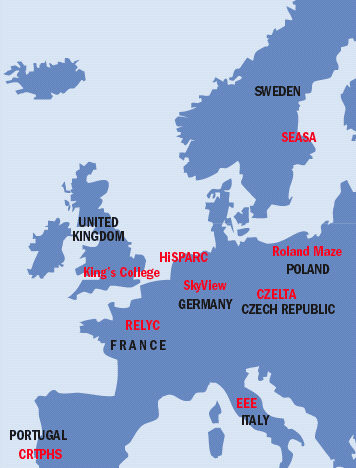
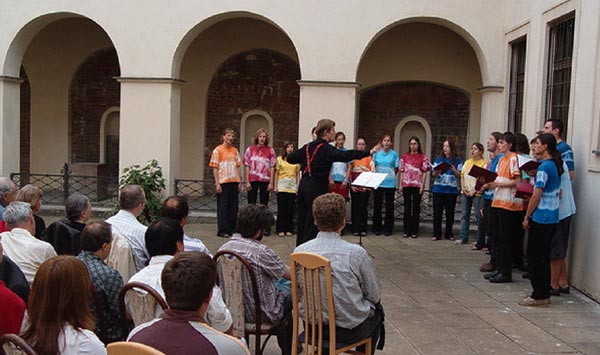
Across the Atlantic, schools in many European countries are also getting involved in studying the extreme-energy universe (see figure 1). In 2001 physicists from the University of Wuppertal proposed SkyView – the first European project to suggest using high-school-based cosmic-ray detectors. This ambitious project proposed an immense 5000 km2 array, the size of the PAO, using thousands of universities, colleges, schools and other public buildings in the North Rhine-Westphalia area. Roughly a year later CERN entered the field with a collaborative effort to distribute cosmic-ray detectors from the terminated High Energy Gamma Ray Astronomy project in schools around Dusseldorf. A test array of 20 counters was set up at Point 4 on the tunnel for the Large Electron-Positron (LEP) collider, with the aim of studying coincidences with counters installed about 5 km away at Point 3 as part of cosmic-ray studies by the L3 experiment on the LEP.
Also in 2002 the High School Project on Astrophysics Research with Cosmics (HiSPARC), initiated by physicists from the University of Nijmegen in the Netherlands, joined the European effort. HiSPARC now has five regional clusters of detectors being developed in the areas of Amsterdam, Groningen, Leiden, Nijmegan and Utrecht. Around 40 high schools are participating so far and more are joining. In March 2005 the HiSPARC array registered an event of energy 8 × 10¹⁹ eV, in the ultra-high-energy “ankle” region of the cosmic-ray energy spectrum, which was also reported at the international conference in Pune (Timmermans 2005).
The HiSPARC collaboration is also planning to use a recent and exciting development of the Low Frequency Array (LOFAR) Prototype Station (LOPES) experiment in Karlsruhe. Using a relatively simple radio antenna, LOPES detects the coherent low-frequency radio signal that accompanies the showers of secondary particles from ultra-high-energy cosmic rays. A large array of these low-frequency radio antennas, the LOFAR observatory, is already being constructed in the Netherlands. Such technology can also be exploited by high-school-based observatories around the world to expand their capability rapidly to become effective partners in the search for point sources of ultra-high-energy particles.
Elsewhere, the School Physics Project was initiated in Finland and is now under development. Also in 2002 the Stockholm Educational Air Shower Array (SEASA) was proposed to the Royal Institute of Technology in Stockholm. SEASA has two stations of cosmic-ray detectors running at the AlbaNova University Centre and the first cluster of stations for schools in the Stockholm area is now in the production stage. Meanwhile, in the Czech Republic the Technical University in Prague and the University of Opava in the province of Silesia – working closely with the ALTA collaboration – each have a detector system taking data, with a third to be deployed this summer.
A number of other European efforts are gearing up, including two that have links to the discovery of cosmic-ray air showers in 1938 by Pierre Auger, Roland Maze and Thérèse Grivet-Meyer working at the Paris Observatory. The Reseau de Lycées pour Cosmiques (RELYC) project, centred on the College de France/Laboratoire Astroparticule et Cosmologie in Paris, is preparing to install detectors in high schools close to where Auger and colleagues performed their ground-breaking experiments. The Roland Maze project is centred on the Cosmic Ray Laboratory of the Andrzej Soltan Institute for Nuclear Studies in Lodz, Poland, where it continues a long tradition in studies of cosmic-ray air showers initiated in partnership with Maze some 50 years ago. The plans are to deploy detectors in more than 30 local high schools. In the UK, physicists from King’s College London in collaboration with the Canadian ALTA group will place detector systems in the London area during 2006. In northern England, Preston College is continuing to work on a pilot project, initiated in 2001, to develop an affordable cosmic-ray detection system as part of the Cosmic Schools Group Proposal, involving the University of Liverpool and John Moores University in Liverpool. Finally, a project to set up cosmic-ray telescopes with GPS in 10 Portuguese high schools is underway, spearheaded by the Laboratório de Instrumentação e Física Experimental de Partículas and the engineering faculty of the Technical University in Lisbon.
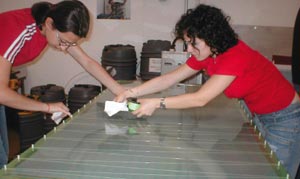
While the majority of the European projects are based on plastic scintillators, the Italian Extreme Energy Events (EEE) project has opted instead for multigap resistive plate chambers (MRPCs) as their basic detector element. These allow a precise measurement of the direction and time of arrival of a cosmic ray. The aim of this project, the roots of which date back to 1996, is to have a system of MRPC telescopes distributed over a surface of 106 km2, for precise detection of extreme-energy events (Zichichi 1996). These chambers are similar to those that will be used in the time-of-flight detector for the ALICE experiment at CERN’s Large Hadron Collider. Three MRPC chambers form a detector “telescope” that can reconstruct the trajectories of cosmic muons in a shower. At present 23 schools from across Italy are involved in the pilot project, with around 100 others on a waiting list from the length and breadth of the Italian peninsula. More than 60 MRPCs have been built at CERN by teams of high-school students and teachers under the guidance of experts from Italian universities and the INFN.
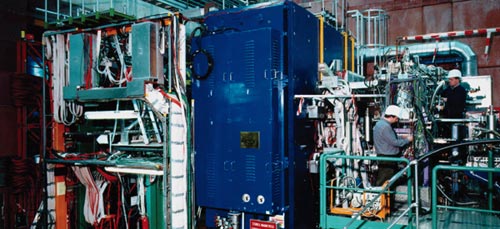
Most of the major groups in Canada and the US have formed a loose collaboration – the North American Large-area Time Coincidence Arrays (NALTA) – with more than 100 detector stations spread across North America (figure 2). The aim is to share educational resources and information. However, it is also planned to have one central access point where students and researchers can use data from all of the NALTA sites, creating in effect a single giant array. Such a combined network across North America could eventually consist of thousands of cosmic-ray detectors, with the primary research aim of studying ultra-high-energy cosmic-ray showers and correlated cosmic-ray phenomena over a very large area. Until the PAO collaboration constructs its second array in Colorado, US, the NALTA arrays, along with their European counterparts, will dominate the ground-based investigation of the extreme-energy universe in the Northern Hemisphere.
The European groups are also developing a similar collaboration, called Eurocosmics. It is clear that a natural next step is to combine the North American and European networks into a worldwide network that could contribute significantly to elucidating the extreme-energy universe. Such a network could aid and encompass other efforts throughout the world, including in developing countries where it could provide a natural bridgehead into the global scientific culture.
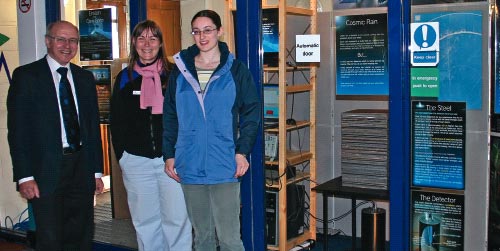
Studying cosmic rays from mountain tops has a grand tradition with famous observatories in dramatic surroundings, such as the Jungfraujoch in Switzerland, the Pic du Midi in France and Mount Chacaltaya in Bolivia. Last year one of Scotland’s highest mountains, Cairn Gorm, temporarily joined the elite club when Ingrid Burt from Beeslack High School in Penicuik, near Edinburgh, set up a high-school cosmic-ray project. Rather than measuring cosmic-ray showers, as many schools projects are now doing, Burt set out during World Year of Physics to test Albert Einstein’s special theory of relativity.
Burt spent six weeks funded by a Nuffield Bursary looking at the feasibility of doing such an experiment with a small muon detector, using a UK mountain. Peter Reid from the Scottish Science and Technology Road Show and myself of the Particle Physics Group at the University of Edinburgh guided her studies. The study and the subsequent experiment were undertaken in conjunction with the Particle Physics for Scottish Schools outreach project, which also provided the detector. The aim was to verify time dilation by comparing the number of cosmic-ray muons detected near the top of the mountain at 1097 m with the number arriving in the university 76 m above sea level.
The amount of dilation depends on the particle’s velocity, so a key part of the experiment was to ensure that the muons detected in the physics department at close to sea-level had the same speed when they passed the altitude of Cairn Gorm as the muons actually detected on the mountain. To do this we used steel sheets to slow the muons until they stopped in a thick scintillator detector and subsequently decayed. The “signal” was thus a pulse in a thin counter from a muon entering the apparatus followed within 20 μs by a delayed pulse from the exiting electron created in the muon’s decay.
For a student in Edinburgh, Cairn Gorm was a clear choice for an experiment at altitude. It is only 227 km from Edinburgh and, like the Jungfraujoch, has a mountain railway – an important criterion where heavy equipment is involved. To this end, Burt asked CairnGorm Mountain Ltd, the company that operates the funicular railway, for help in transporting the 400 kg of steel and other apparatus.
We took the first measurements at the Ptarmigan Top Station of the Cairn Gorm funicular railway, where we needed 49.3 cm of steel to slow the muons so that they would stop and decay in the scintillator. Given that we can calculate the energy losses in both materials, this accurately measures the velocity of the muons as they enter the top of the steel at this altitude before they stop and decay in the scintillator.
The energy lost as a muon of this velocity passes through the atmosphere can also be accurately calculated, so we compensated for this loss between the Cairn Gorm and university sites by removing 21 cm of steel – the equivalent to the slowing power of the intervening 1021 m of atmosphere – and ran the experiment at the university with 28.3 cm of steel. This meant that the muons detected at both experimental sites had the same energies and speeds. As muons travel down from Cairn Gorm to the university, they change velocity and their numbers reduce according to the exponential decay law. The number of muons detected each minute decreases as they travel downwards, and the reduction depends solely on the time elapsed. Without the effect of time dilation, the reduction in this experiment would be a factor of about 4; taking time dilation into account gives a reduction factor of 1.3.
For 10 days in October 2005, visitors arriving at the top of the Cairn Gorm funicular had the chance to see the experiment in action as it counted stopping muons there – at a rate of 1.3 a minute. This meant that if Einstein was right, we should detect 1 a minute at the university, and it was no surprise to do so.
Burt is now refining these calculations to estimate the errors in the predictions, but we do not expect these to render the results invalid. It would be interesting to repeat the experiment with a greater height difference, for example at CERN and at the top of Jungfraujoch railway.
• Ingrid Burt was a gold finalist at the British Association 2006 Crest Science Fair, and won a week at the London International Science Fair in August.
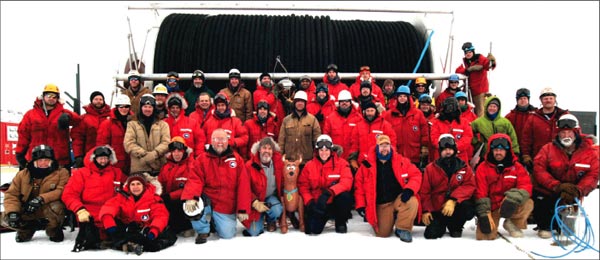
The second season of construction for the IceCube detector in Antarctica has recently ended as summer in the Southern Hemisphere has drawn to a close. Now with nine strings of sensors, IceCube is the largest neutrino detector in the world, and is well on the way to its goal of detecting extraterrestrial neutrinos with energies of more than 100 GeV.
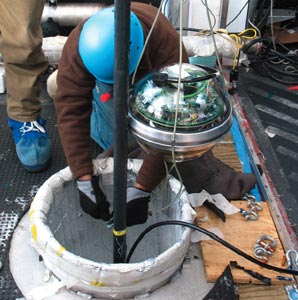
By early February, eight strings, each comprising 60 optical sensors had been deployed, bringing the total number of in-ice sensors to 540. Each sensor includes a 25 cm photomultiplier tube in a pressure vessel. The associated electronics provides integrated trigger, readout, control, data-formatting and calibration functions, essentially forming a “mini-satellite”.
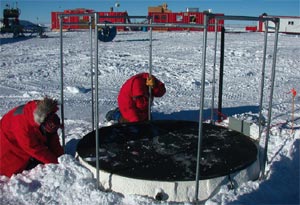
The strings form a triangular grid with 125 m sides, with the sensors installed 1450-2450 m below the surface, encompassing a volume of more than 3000 million tonnes of ice. A laser “standard candle” and a “dust-logger” to measure ice properties were also deployed. In addition, 24 IceTop tanks were installed, expanding the surface air-shower array to 32 tanks. The schedule was helped by generally good weather, with temperatures remaining above -30 °C until the end of January.
The season also saw the start of rapid production drilling, in which the heating system supplied hot water to one drill tower while a second tower was moved to the next hole. Although drilling got off to a late start, by the end of January holes were being drilled every four days, with string deployment smoothly following drilling. By the end of the season, it only took about 12 hours to connect the optical modules to the cable and lower the string into place. Strings were commissioned soon after deployment. About 99% of the detectors appear fully functional; the half-dozen or so failures stem from a variety of causes.
In addition to preparing for this season, IceCube has been collecting data from the single string and eight tanks that were deployed in 2004/05. Several different types of events have been studied: downward-going cosmic-ray muons, air showers and “flasher” events designed to mimic showers from the interactions of electron neutrinos. Flasher events are produced by the 12 LEDs contained in each sensor module. Events have also been studied that contain coincidences between the new strings and tanks, as well as between the new strings and the Antarctic Muon and Neutrino Detector Array (IceCube’s predecessor) and the South Pole Air Shower Array.
The initial data analyses included a search for neutrino events. Two clear muon neutrinos were observed, appearing as near-vertical, upward-going muons. One event was seen by 50 detectors, which tracked the muon over an 850 m trajectory. The other muon was observed by 35 sensors over about 650 m. These tracks correspond to minimum muon energies of about 420 and 330 GeV, respectively. The ratio of upward-going to downward-going muons is about 500,000:1; being able to separate clean neutrino events with a single string shows the power of the detector. Several additional possible candidates were observed with shorter tracks, with 8-11 hits. However, with a single string, these lower-multiplicity events could not be conclusively identified as neutrinos.
These data have been closely scrutinized to measure detector performance. Both the muon and light-flasher data demonstrate that the timing across the entire array (including the surface detectors) is consistent to better than 3 ns. The sensors are highly efficient for single photoelectrons, but also have adequate dynamic range to measure light pulses of up to 10,000 photoelectrons. Directional comparisons between air showers reconstructed with IceTop, and coincident muons seen in the deep ice were used to verify the pointing accuracy and angular resolutions. For muons, the angular resolution is better than 10° for events with 8 sensors hit, improving to 1.5° for events with more than 30 hits; the muon and neutrino directions are nearly co-linear.
The detector’s dark-noise rates are particularly important for supernova searches; a pulse of low-energy neutrinos from a supernova will manifest itself as an increase in the noise rates in the phototubes. Shortly after the phototubes were deployed, their noise rates rose dramatically owing to triboluminescence – light produced by friction as the ice freezes. However, after the freeze-in was complete, the phototube rates dropped to an average of 650 Hz. With 51 μs of deadtime after each pulse to remove correlated light, the rate drops to 350 Hz. This rate is even less than anticipated, increasing IceCube’s sensitivity to supernovae.
These successes bode well for the future of IceCube and physics analyses are now beginning. Working groups are forming to search for point sources of neutrinos, such as active galactic nuclei and gamma-ray bursters, to search for diffuse extra-terrestrial neutrinos and to study the composition of cosmic rays. IceCube will also shed light on many areas of nuclear and particle physics through searches for signs of supersymmetry, annihilation of weakly interacting massive particles in the Sun and Earth, and for exotica such as magnetic monopoles. It will also probe quantum chromodynamics, through a measurement of neutrino cross-sections at high energies (via absorption in Earth) and thereby explore saturation in nuclear-parton distributions at low parton energy fraction, i.e. low x. With a full programme of physics to explore, detailed plans for deployment are being made for the coming seasons, with at least 75 strings expected to be complete by 2011.
• IceCube is a collaboration of about 250 scientists and engineers from 30 institutions in the US, Europe, Japan and New Zealand. The $270 m project is funded largely by the US National Science Foundation, with smaller contributions from the US Department of Energy, the University of Wisconsin and several European countries.
An experiment at the Institut Laue Langevin (ILL), Grenoble, has produced a new, tighter limit on the electric-dipole moment (EDM) of the neutron. This result has a high potential impact for theories beyond the Standard Model that attempt to explain the origin of CP violation and hence the baryon asymmetry of the universe.
One way to test theories likely to explain the matter-antimatter asymmetry that characterizes our universe is to study the corresponding asymmetry in sub-atomic particles, by looking for slight distortions in their charge distributions. The existence of such an EDM in the neutron, and in other particles, would violate time-reversal and hence CP symmetry. While the Standard Model predicts an immeasurably small neutron EDM and a baryon asymmetry that is far too modest, theories that go beyond it almost invariably predict values for both that are many orders of magnitude larger. Accurate measurements of EDMs thus provide strong constraints on such theories.
The neutron EDM has been sought for more than 50 years, and many candidate theories have been eliminated along the way. Experiments are now sensitive enough to test currently popular theories such as supersymmetry. The experiment that has recently been carried out at ILL by a collaboration from the University of Sussex, the Rutherford Appleton Laboratory and ILL, has produced an upper limit on the absolute value of the neutron EDM of 3 × 10-26 ecm (Baker et al. 2006). This represents an improvement of a factor of two over its intermediate result and almost a factor of four with respect to earlier measurements (Harris et al. 1999).
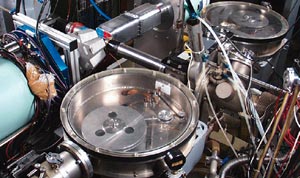
The experiment used ultracold neutrons produced at the high-flux ILL reactor. These neutrons were stored in batches in a trap permeated by uniform electric and magnetic fields. Spurious signals from magnetic-field fluctuations were reduced to insignificance by the use of a cohabiting atomic-mercury magnetometer (Green et al. 1998). The ratios of neutron to mercury-atom precession frequencies were measured; shifts in this ratio that are proportional to the applied electric field may in principle be interpreted as EDM signals.
The collaboration, which has now expanded to include Oxford University and the University of Kure in Japan, is constructing a new version of the experiment in which the neutron trap will be submerged in a bath of liquid helium, half a degree above absolute zero. The increase in neutron density and electric field strength that this will allow should yield a hundredfold increase in sensitivity.
Research on elementary particles – a frontier area of physics – emerged as a distinct field during the mid-20th century, following the discovery of the pion and strange particles, and the construction of particle accelerators reaching energies of more than 100 MeV. The first high-energy physicists had grown up as nuclear or cosmic-ray scientists, but in subsequent years the liaison between cosmic-ray physics and accelerator-based elementary particle physics seemed to fade, with little communication between these two lively and interesting areas of physics. Recently this situation has begun to change, with closer interaction between the two fields. Cosmic-ray physicists need better data on particle interactions and production, and particle physicists at accelerators are interested in exploring phenomena reported from cosmic-ray studies. Also, some theorists are looking at effects that should be detectable at the future Large Hadron Collider (LHC) and may be even more notable at cosmic-ray energies.
It was in this spirit that physicists at the Institute of Physics of the Czech Academy of Sciences, the Czech Technical University and Charles University in Prague organized the conference From Colliders to Cosmic Rays (C2CR) in September 2005. Their aim was to bring together cosmic-ray and particle-accelerator physicists to discuss their latest results and problems common to both communities. An International Advisory Committee was established, representing a broad spectrum of universities and laboratories in Europe and America, with Jan Ridky of the Institute of Physics as head of the Local Organizing Committee.
A significant antecedent to the C2CR meeting was the Needs from Accelerator Experiments for the Understanding of High-Energy Extensive Air-Showers (NEEDs) workshop held in Karlsruhe in April 2002. Also relevant was the 12th (biennial) International Symposium on Very High Energy Cosmic Ray Interactions, which was held at CERN in July 2002.
A common thread in these discussions is the fact that the flux of primary cosmic rays of energies above a few hundred tera-electron-volts is so low that direct observation is not practical from balloon- or satellite-borne detectors. Our understanding of the composition and energy spectra of these cosmic rays is totally dependent on ground-level observations, and on the simulation of primary interactions and atmospheric cascades based on accelerator data. In this context, there are constant efforts to improve the interaction Monte Carlo simulation programs, which are essential components for the interpretation of the cosmic-ray data. At C2CR, Sergey Ostapchenko from the Forschungszentrum Karlsruhe presented the theoretical input into his latest version of the QGSJET program, where gluon saturation is taken into account, while his colleague Tanguy Pierog described numerical methods used in the simulation of showers that involve tens of billions of secondary particles. CERN’s Hans-Peter Wellisch also raised interest by his claim that extensive cosmic-ray air showers can be simulated within the framework of GEANT4, the latest version of the well-known toolkit for simulating the passage of particles through matter.
The experimental information available and efforts or proposals to carry out new measurements of hadronic interactions at accelerator and collider energies formed a major topic. Representatives from the experimental collaborations presented recent results from the CDF and D0 experiments at Fermilab’s Tevatron collider, from the HERA collider at DESY, and from the Hadron Production Experiment at the Proton Synchrotron accelerator at CERN. Heavy-ion physics results were also reported from experiments at CERN’s Super Proton Synchrotron and from the BRAHMS and PHOBOS experiments at Brookhaven’s Relativistic Heavy Ion Collider. Martin Block of Northwestern University presented a projection of the proton-proton total cross-section to LHC energies, and both he and Leonid Frankfurt of Tel Aviv discussed other cross-sections, such as proton-air and nucleus-nucleus, at higher energies.
The observables from cosmic-ray interactions are dominated by the most energetic final-state particles and these are mostly produced at small forward angles. Among the talks on this topic, Mark Strikman of Penn State University discussed small-x physics and forward dynamics in proton-proton and proton-nucleus ultra-high-energy collisions. Others described the discovery potential of the LHC, as well as the potential in diffraction and forward physics of the CMS/TOTEM/CASTOR experiment complex at the LHC, and LHCf, a proposed zero-degree calorimeter at the LHC.
Currently, the Karlsruhe Shower Core and Array Detector (KASCADE) with its associated muon and hadron detectors is the most sophisticated and productive cosmic-ray air-shower experiment in operation, and the Karlsruhe group was well represented in Prague. Marcus Risse, Andreas Haungs and Holger Ulrich discussed different aspects of the KASCADE data, results and interpretation, including the sensitivity of the interpretation of their data to models of the primary hadron interaction.
The intercommunication between accelerator-based and cosmic-ray physicists is perhaps nowhere more apparent than in the area of neutrino physics, with the studies of neutrino masses and mixing. The meeting heard about various aspects of neutrino physics, including results from existing detectors, theoretical ideas and plans for new detectors. For example, the Antarctic Impulsive Transient Antenna and the Salt Shower Array are planned to detect radio pulses from coherent Cherenkov radiation produced by the reaction products of ultra-high-energy cosmic-ray neutrinos interacting in ice and rock salt, respectively.
No cosmic-ray conference nowadays would be complete without some discussion of the highest-energy cosmic rays and indeed C2CR had several excellent reports. These covered the current status of the problem with ultra-high-energy cosmic rays, the latest from the High Resolution Fly’s Eye experiment, and the status and first results from the Pierre Auger Observatory. Jim Cronin of Chicago, one of the founders of the observatory and spokesman emeritus for the collaboration, was a lively and valuable participant.
An interesting cross-link between the cosmic-ray and accelerator physics communities is the use of the large detectors at colliders for studies of cosmic-ray muons. The meeting heard reports on physics results obtained with cosmic-ray muons in the detectors for the Large Electron-Positron collider at CERN. These included muon multiplicity studies and absolute differential muon spectra, both of which have been obtained with greater precision than was previously possible with detectors built for cosmic-ray studies.
Participants also heard about the latest generation of cosmic-ray detectors, with talks on Super-Kamiokande, the BAIKAL experiment, the Search for Light Magnetic Monopoles on Mount Chacaltaya in Bolivia, the AMANDA and IceCube detectors at the South Pole, the satellite-borne Cosmic Ray Energetics and Mass detector, and the planned 1 km3 Neutrino Mediterranean Observatory.
Around 60 people attended the conference, which proved a successful opportunity for the participants to learn new physics, to interact with colleagues in other areas of elementary-particle physics and particle astrophysics – and also to enjoy Prague, with a trip to the nearby Konopiste Castle over the weekend and the conference banquet aboard a river cruise boat.
During the discussions at the meeting’s final session, it was suggested that the topic of colliders and cosmic rays might appropriately become the theme of a biennial conference series. A probable site and time for the next conference is the Granlibakken Conference Center on Lake Tahoe, California, 25 February – 1 March 2007.
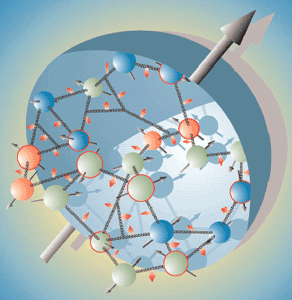
At the end of the 1980s, a major part of the nucleon’s spin suddenly went missing. The European Muon Collaboration at CERN uncovered what has since been called the “spin puzzle” – the fact that the spins of the valence quarks that make up the nucleon account for only about 25-30% of the nucleon’s spin. The finding was soon confirmed by second-generation experiments at CERN and SLAC. Designed to determine the total spin contribution of the quarks, however, they left several questions unanswered. If the quark spin contribution is so small, what then are the main contributions? What is the contribution of the different quark flavours? Is there a polarization in the quark sea that could account for the missing spin? In 1995, the HERMES experiment at DESY’s HERA electron-proton collider in Hamburg took over the search, with the goal of finding an answer to just these questions.
In contrast to its predecessors, most of which could detect only the scattered electron and thus measure inclusive deep inelastic scattering (DIS) reactions, the HERMES collaboration took a new experimental approach. Its combination of a longitudinally polarized high-energy electron beam from the HERA storage ring incident on undiluted polarized atomic gas targets is unique in the field, and its spectrometer is designed to identify all types of hadrons produced in coincidence with the scattered electron. Using such semi-inclusive DIS reactions on longitudinally polarized targets, the HERMES team achieved the world’s first assumption-free flavour separation of the quark contributions to the nucleon spin, thereby slotting a major new piece into the nucleon-spin puzzle.
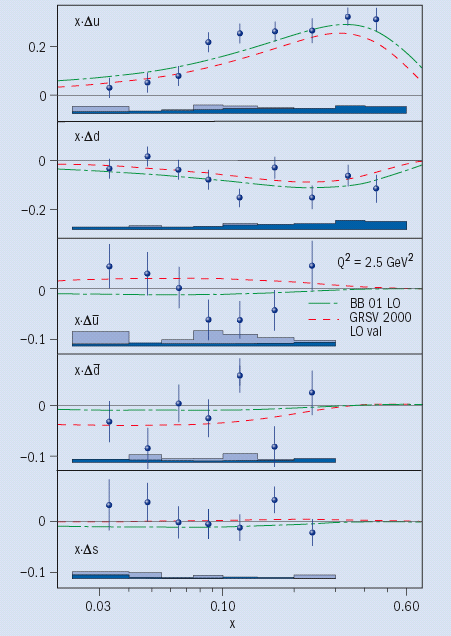
The results obtained from data taken during HERMES’ first run (1995-2000) are the most precise information available so far on quark helicity distributions – the spin alignment of the quarks with respect to the nucleon spin – and they provide for the first time separate determinations of the polarizations of the up, down and strange sea quarks (figure 3). They reveal that the largest contribution to the nucleon spin comes from the valence region, where the up quarks give a positive contribution as their spin is preferably aligned with the spin of the nucleon, while the down quarks give a contribution with opposite sign. The polarizations of the sea quarks are all consistent with zero – an especially important result.
The interpretation of the inclusive data from previous experiments was based on the assumption of SU(3) flavour symmetry – the postulation that all flavours of quark, including up, down and the virtual strange quarks, behave in the same way dynamically inside the nucleon despite the substantially greater mass of the strange quark. The older analyses therefore led to the conclusion that the strange quarks play a significant, cancelling, role in the nucleon spin, even though their existence there is fleeting. The HERMES results now show that the polarizations of the sea quarks are all small: there is thus little evidence for such a “cancellation” between the contributions of valence and sea quarks. In particular, there is no evidence in the measured range in x, the momentum fraction carried by the quarks, that the contribution of the strange quarks is negative, as was indicated by the model-dependent analysis.
Taken together, all these measurements definitely show that the spin of the quarks generates less than half of the spin of the nucleon, and that the quark spins that do contribute come almost exclusively from the valence quarks. The proton-spin puzzle thus continues to evolve and the contributions of the orbital angular momenta of the quarks, as well as the spins and orbital angular momenta of the gluons, are now expected to be important.
The HERMES team has already reported the first evidence that the gluon polarization could make a positive contribution to the nucleon spin and new results will follow soon. The gluon polarization is also currently being investigated in the COMPASS experiment at CERN and at the Relativistic Heavy Ion Collider at the Brookhaven National Laboratory. As recent theoretical insights have shown, the orbital angular momentum can in principle be probed by hard exclusive processes leaving the target nucleon intact – a field that HERMES is now exploring in detail during its ongoing second run, which will last until summer 2007.
During HERMES’ first run, the emphasis was on the determination of the helicity structure of the nucleon using longitudinally polarized targets and beam. For HERA Run II, the collaboration has turned its attention to transversely polarized targets (i.e. with polarizations perpendicular to the electron beam direction) to extract the so-called transversity distribution – the last unknown leading-twist quark distribution function of the nucleon.
Probing transversity
Phenomenologically, the nucleon can be characterized in terms of parton distribution functions that describe how often the constituents of the nucleon will be found in a certain state. Within this framework, there are three fundamental quark distributions: the quark number density, which has been measured with very high precision, for example with the HERA collider experiments H1 and ZEUS; the helicity distribution, which was the main result of the HERMES run on longitudinally polarized targets; and the transversity distribution, which describes the difference in the probabilities to find quarks in a transversely polarized nucleon with their spin aligned to the spin of the nucleon and quarks with their spin anti-aligned.
In absence of relativistic effects, the transversity and helicity distributions should be the same. A difference between the two distributions would therefore be a measure of the extent to which relativistic effects have to be considered in the description of the nucleon.
Transversity has remained unmeasured so far because it is odd under chirality transformations, whereas hard interactions conserve chirality (they are chiral even). However, it may be probed by a process involving some additional chiral-odd structure. In semi-inclusive DIS, as done at HERMES, this could be a chiral-odd fragmentation function. The so-called Collins fragmentation function is the most prominent candidate, as this gives rise to an asymmetry in the angular distribution of the hadrons produced during the scattering process if they are generated from a transversely polarized quark. Results from the BELLE collaboration at KEK suggest that the Collins function has a substantial magnitude, and thus measurements of single-spin asymmetries in semi-inclusive DIS employing transverse target polarization are expected to constrain transversity itself.
There is even more to explore, however. Using a transversely polarized target one can also study a new class of more complex distribution functions that depend not only on the longitudinal momentum fraction carried by the quarks, but also on their transverse momentum inside the nucleon. One such function is the so-called Sivers distribution function, which describes an asymmetry in the distribution of unpolarized quarks in a transversely polarized nucleon.
The Sivers function generates transverse single-spin asymmetries. As such it is a so-called T-odd distribution function. The time-reversal symmetry properties of quantum chromodynamics should therefore forbid its existence, or so it was believed for a long time. Only recently has it become clear that there are loopholes in the theory, for example, missing gauge links in the description of nucleon structure, which permit such T-odd distribution functions. The study of the Sivers function is thus doubly interesting. On one hand, it may be used to test the validity of these theoretical considerations, and may lead to a better understanding of results from hadron-hadron collision experiments where large but unexplained transverse single-spin asymmetries have been observed. On the other hand, the Sivers function must vanish in the absence of quark orbital angular momentum. A measurement of the Sivers function may thus provide important constraints on this missing piece in the nucleon-spin puzzle.
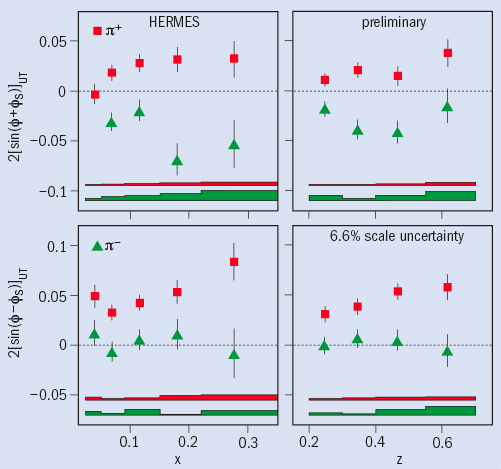
The measurement both of transversity and of the Sivers function can be carried out using semi-inclusive DIS events. By reversing the spin direction of the nucleon, one can study the dependence of the preferred direction of the outgoing hadron on the nucleon’s spin direction. After its first year of data-taking with a transversely polarized target, HERMES has observed enough scattering events of this kind to venture a worldwide first look at these angular dependencies (figure 4).
One striking result is the comparably large signal for the π– Collins effect. This came as quite a surprise, since a behaviour similar to that seen with a longitudinally polarized target had been expected, namely a signal that is larger in size for the π+ than for the π–. This result will have important consequences for understanding how the hadron is formed from the struck quark. Currently the statistical significance is insufficient to make definite statements about the exact behaviour of the involved functions. However, since the Collins asymmetries are clearly non-vanishing, the HERMES team has good reason to hope that the data collected in 2005, which are more than doubling the statistics taken in the years before, will indeed allow them to achieve a first measurement of transversity using the information on the Collins fragmentation function collected by BELLE.
An equally interesting result is the observation that for the π+ the signal for the Sivers function is significantly positive. This is the first confirmation that the Sivers function is indeed non-zero and thus some first evidence for a non-vanishing T-odd parton distribution function. More data on the Sivers asymmetries from HERMES up to November 2005 should allow an extraction of the Sivers function for up and down quarks.
Exclusive reactions
The contributions of the orbital angular momenta of quarks and gluons are the last unknown pieces in the puzzle of the spin content of the nucleon; how to determine them has been hotly debated for several years. In the middle of the 1990s, it was realized that the framework of generalized parton distributions (GPDs) might give access to these orbital angular momentum contributions. Quite apart from that, the study of these off-forward extensions of the standard parton distribution functions can provide a wealth of new information on the structure of the nucleons.
The GPDs can be determined in exclusive reactions – scattering processes in which the target nucleon does not fragment but instead remains in its ground state, or close to it. The various scattering reactions provide access to different GPDs: exclusive vector-meson production allows the determination of unpolarized GPDs, whereas the exclusive production of pseudoscalar mesons can be used to measure the polarized GPDs. Because of the multidimensional structure of the GPDs, it is essential to study as many different processes as possible to be able to disentangle the functions from the measured observables. In particular, measurements with the transversely polarized target at HERMES are sensitive to the two main GPDs (H and E) necessary to determine Jq, the total orbital angular momentum of quarks in the nucleon.
The cleanest example of a reaction that provides direct access to GPDs is deeply virtual Compton scattering (DVCS), an exclusive reaction in which a real photon is created. This type of reaction was identified for the first time in 2001 by the H1, ZEUS and HERMES experiments at DESY, and the CEBAF Large Angle Spectrometer in Hall B at Jefferson Lab. Since then, a large body of data has been collected on DVCS. Here, HERMES is in a rather fortunate position. Despite the DVCS cross-section being usually much lower than that of an indistinguishable process – the Bethe-Heitler process – with identical final state, the interference term between the processes allows the study of DVCS because it leads to observable asymmetries in the azimuthal angular dependence of the real photons produced from the nucleon. As HERMES can measure all azimuthal asymmetries involving polarized beams and/or polarized targets and different charges, the collaboration was able to determine the DVCS target-spin asymmetry by using an unpolarized beam incident on a transversely polarized target. This asymmetry is sensitive to the GPD E and thus allowed HERMES to realise the first model-dependent extraction of Ju, the total angular momentum of the up quark (figure 5).
To study these asymmetries in even more detail, the HERMES collaboration decided to run during its final phase from 2006 to 2007 with a new recoil detector in combination with an unpolarized target. The device will employ silicon detectors and scintillating fibre trackers as well as a detector to measure photons. It will sit closely around the target and detect the slow-moving recoil proton in coincidence with the electron and the photon, thus ensuring full exclusivity of the data sample.
The enhanced selectivity of these measurements will provide a unique opportunity to assess the promise of GPDs as the next step in understanding the spin structure of the nucleon. In particular, data taken with this new detector will put serious constraints on the GPD H. In combination with the already existing DVCS data and measurements of the only other known reaction to access the GPD E on a proton target – the elastic electroproduction of ρ0 vector mesons with the proton being transversely polarized, already measured at HERMES (2002-2005) – these forthcoming results will eventually allow an extraction of the total angular momentum of the up quark in the nucleon through the remaining GPD models.
In addition to these studies on polarized targets, the physics programme at HERMES also includes a great variety of other points of interest, such as measurements of unpolarized DIS events. These allow the collaboration to search for pentaquark exotic baryon states, give insight into quark propagation in nuclear matter and quark fragmentation, and provide a rigorous test of factorization. DESY’s HERA accelerator will continue operations through to summer 2007. Every effort is being made at HERMES to maximize the impact of the remaining beam time, with the goal of fitting in as many pieces of the nucleon-spin puzzle as possible.
Form factors are the most fundamental dynamical quantities for describing the inner properties of a composite particle. The nucleon form factors provide detailed information about the spatial distribution of charges and currents in the nucleon.
They are directly accessible from experiment by differential cross-section and polarization observables and from theory by all nucleon models as they enter explicitly in the expression of the hadronic current. On 12-14 October 2005 the first workshop specifically dedicated to a global view on electromagnetic hadron form factors in both space-like and time-like regions was held at the INFN-Laboratori Nazionali di Frascati (LNF). The N’05 Workshop on Nucleon Form factors attracted 85 participants from 18 countries. Forty-five talks, followed by animated discussions during breaks and dinners covered the most recent findings, ideas and suggestions for future developments in experiments and theory.
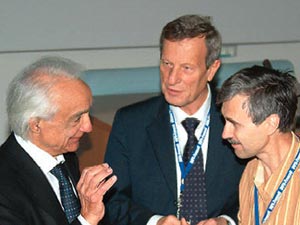
After the opening welcome from Mario Calvetti, director of the LNF, Antonino Zichichi of Bologna and CERN presented a vivid historical introduction to the topic of electromagnetic form factors. He recalled his first measurements at CERN in 1963, and underlined the role played by Frascati in the field, in particular for time-like neutron form factors, where the only existing data were collected by the FENICE collaboration at the end of 1980s. He also discussed the role that Frascati could and should play in the future.
The experimental evidence, that form factors are twice as large in the time-like region as in the space-like region and that time-like neutron form factors are much larger than time-like proton form factors, could be owing to a possible NBar resonance below threshold. Discovering and studying the properties of this resonance through dedicated and precise measurements in the threshold region would be an important step in understanding nucleon structure and nucleon spectroscopy. In Zichichi’s opinion, this is one of the 10 most compelling problems in high-energy physics, which he listed in his impressive review. Dan Olof Riska of Helsinki underlined the importance of precise data on all hadron form factors – transition, axial, and strange. He drew particular attention to the role of two-photon exchange in solving the discrepancy among electric proton form-factor data, and the importance of the pion cloud in the nucleon structure.
The first session following the overview was dedicated to the current status of the research programmes at Jefferson Lab, the Bates Linear Accelerator at the Massachusetts Institute of Technology and at the Mainz Microtron. Presentations paid special attention to the discrepancies among the recent precise measurements of the electric proton form factor at large values of momentum-transfer squared, Q2, whether measured through the recoil proton-polarization method or via the unpolarized differential cross-section in elastic electron-
proton scattering. Polarization measurements have been implemented only recently, after the advent of high-luminosity polarized-electron beams and the development of hadron polarimeters and polarized targets. The surprising feature revealed by the polarization experiments, which are far more sensitive to the small electric contribution, is that the electric and magnetic distributions inside the proton are different, contrary to what was previously assumed and suggested by results from experiments based on the unpolarized method.
The search for a solution to this problem focuses on radiative corrections, particularly on the possibility of a mechanism where momentum is not transferred by only one photon, as generally assumed, but equally shared by two photons. This would change the angular dependence of the cross-section, and, at least qualitatively, provide a better agreement between the two sets of data. The presence of such a mechanism would make life much more complicated in all electron-induced reactions, and would call for a revision of many other sets of data. Two-photon exchange induces complex amplitudes, which should be mostly imaginary. A non-zero, but small imaginary part has been found in very precise measurements on parity violating terms, as Frank Maas of Mainz described, but no experimental evidence confirms the presence of the two-photon mechanism (real part) in the present data. Therefore, theoretical and experimental efforts continue and the question remains open. Such a mechanism should be more evident in the time-like region, where form factors are complex, and could be an interesting topic for the future at Frascati, with the DAFNE storage ring upgraded in energy.
Into the time-like region
The experimental situation in the time-like region was clearly described by Diego Bettoni of Ferrara, who pointed out that until now no separation of the electric and magnetic form factors has been possible, owing to the lack of statistics. He also drew attention to the importance of a precise measurement of the neutron form factors as well as of the relative phase of form factors and the role of the possible narrow resonance below threshold. Note that the Rosenbluth separation technique in the space-like region implies measurements at fixed Q2, which requires changing both the energy of the electron beam and the scattering angle of the emitted electron, whereas, in the time-like region, it requires a precise angular distribution of the emitted nucleon (or antinucleon) while keeping the beam conditions unchanged.
Form factors have been recently accessed from initial state radiation at the BaBar experiment at SLAC. The results, presented by Vladimir Druzhinin and Evgeni Solodov of Novosibirsk, are impressive and raise new questions about the ratio of the electric and magnetic form factors, GE/GM, near threshold. Contrary to measurements at CERN’s Low Energy Antiproton Ring, the new results show that GE/GM increases quickly and also reveal unexpected evidence for a step-like behaviour of the proton time-like form factor, at threshold, around 2.2 GeV and around 2.9 GeV.
Stanislav Dubnicka of Bratislava presented model-independent properties of polarization observables in the time-like region. The extension of this formalism has recently been derived for scattering and annihilation channels in the presence of two-photon exchange and was presented for proton-antiproton annihilation into two leptons by Gennady Gakh of Kharkov.
The strange and axial nucleon form factors are strongly related to the electromagnetic form factors, and their extraction from experimental observables is largely influenced by our knowledge of these quantities, thanks to the impressive precision that experiments have achieved. The first data from the G0 experiment at Jefferson Lab were presented during a review of current experiments on parity violation by Serge Kox of Grenoble. The precision of the measurement of the asymmetry in electron-proton unpolarized scattering – around 10-6 (parts per million) – is impressive, and the combined result is surprising, as it suggests a large and positive strange-proton form factor.
Theory and outlook
The session devoted to theory covered various nucleon models. Mauro Giannini of Genova and Gottfried Holzwarth of Siegen, for example, underlined the role of relativistic corrections in the constituent quark model, and in the soliton model, respectively. A global description of the four nucleon form factors in the space-like and time-like regions can be obtained by vector-dominance models and also through dispersion relations, which can be analytically continued to the time-like region. Simone Pacetti of Frascati presented an original approach based on an extrapolation from the time-like region of dispersion-relation requirements. This showed that BaBar data would constrain a zero of GE/GM in the space-like region.
Form factors are intimately related to other quantities describing the nucleon. For example, they provide a boundary for generalized parton distributions (GPDs), which are supposed to give a global, 3D picture of the nucleon. The connections with this important subject were discussed in a dedicated session. Recent results on real, virtual and deeply virtual Compton scattering (DVCS) show in particular that single-spin observables are very promising for selecting DVCS and describing the nucleon from GPDs. Nucleon polarizabilities, interpreted in the context of dispersion relations, also show evidence for a pion cloud. Peter Kroll of Wuppertal presented a first attempt to extract the GPDs from form-factor data from Jefferson Lab. A correlation with time-odd GPDs and a test of time-reversal invariance in electromagnetic interactions would be possible with a future energy upgrade of the DAFNE linac.
Looking to the future, plans for the Facility for Antiproton and Ion Research at GSI will allow precision form-factor measurements and access their phase, in particular in the region of large momentum- transfer. The PANDA experiment will allow proton time-like form factors to be measured individually and PAX will focus on polarized measurements. At the Budker Institute for Nuclear Physics in Novosibirsk, a measurement is planned at the existing linac of the two-photon contributions in electron/positron-proton scattering. An exploration of the proton form factor very near threshold is also foreseen at the new electron-positron collider, VEPP-2000. The meeting also heard about the future programme for BESIII, together with first results in the threshold region from the Bejing Electron-Positron Collider.
The project for a complete measurement of the nucleon form factors in the time-like region at Frascati with the upgraded DAFNE storage-ring, which has already triggered a great deal of interest within the community, was presented by Marco Mirazita of Frascati. An upgrade in luminosity and energy of the machine would provide a unique tool for measuring individual nucleon form factors, in particular for the neutron. The additional possibility of measuring the polarization of the outgoing nucleon would provide the first determination of the relative phase of the form factors, in addition to their moduli.
Stan Brodsky of SLAC concluded the meeting with a talk in which he stressed the importance of the high-momentum behaviour of form factors as a fundamental test of scaling in perturbative quantum chromodynamics (QCD), helicity structure and asymptotic freedom. He also showed the potentiality of a formalism based on duality between string theory in anti-de Sitter space and conformal field theory, which should provide a direct connection between QCD and nucleon amplitudes.
• N’05 was financially supported by Istituto Nazionale di Fisica Nucleare, the Hadron Physics Integrated Infrastructure Initiative and the US Department of Energy’s Jefferson Lab. For the full programme and the complete list of speakers see www.lnf.infn.it/conference/nucleon05.
Since soon after its discovery by Henri Becquerel in 1896, radioactivity has been known to involve the emission of helium nuclei (alphas), electrons (betas) and photons (gammas). Then, in 1960, proton-rich nuclei with an odd or an even atomic number Z were predicted to decay through one- and two-proton radioactivity, respectively. Single-proton radioactivity was discovered in 1981, while the first evidence for two-proton radioactivity was obtained in 2002 in the decay of 45Fe.
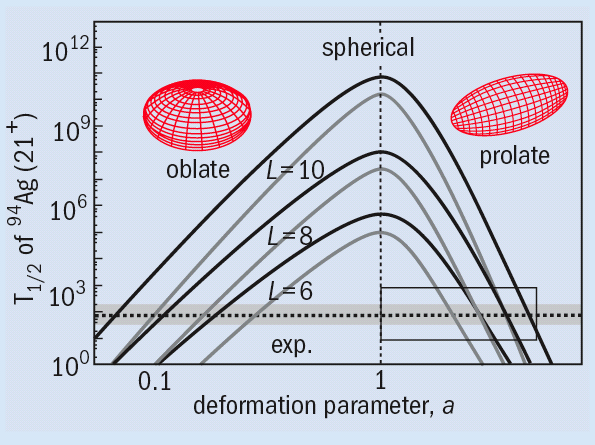
Now in an experiment on 94Ag, an international team lead by Ivan Mukha and Ernst Roeckl has made the first experimental observation of nuclear decay involving both one- and two-proton radioactivity (Mukha et al 2006). The researchers attribute the two-proton emission behaviour and the unexpectedly large probability for this decay mechanism to a very large deformation of the parent nucleus into a prolate (cigar-like) shape, which facilitates emission of protons either from the same or from opposite ends of the “cigar”.
Working at the GSI research centre, the researchers synthesized the lightest known isotopes of silver (94Ag) using nuclear reactions between accelerated 40Ca ions and 58Ni atoms. After purification by online mass separation the 94Ag nuclei were implanted into a catcher positioned in a highly segmented array of silicon and germanium detectors. The simultaneous two-proton emission was identified from a long-lived (0.4 s), high-spin state of 94Ag. This (21+) isomer is also known to undergo one-proton decay (Mukha et al 2005).
Both disintegration modes were unambiguously identified by “tagging” γ rays that are known to de-excite the high-spin states populated in the daughter nuclei 93Pd and 92Rh for one-proton and two-proton decay, respectively. In particular, the team searched for direct two-proton decay of the isomer by measuring coincidences between double-hit events recorded by the silicon detectors and γ-γ events registered by the germanium detectors. The observed two-proton decay is unexpectedly fast.
This first measurement of correlation data in two-proton radioactivity calls for further experimental studies of the properties of this truly exotic isomer. It also demands a more quantitative theoretical description of the observed two-proton decay behaviour.
A five-part workshop has been launched at CERN to study the interplay between the physics of particle flavour and the physics achievable at particle colliders. In particular, it aims to consider the future directions for flavour physics when the Large Hadron Collider (LHC) starts up at CERN in 2007.
Flavour physics and charge-parity (CP) violation have played an outstanding role in the exploration of particle-physics phenomenology for more than four decades. After a long and exciting history of K-decay studies, the experimental stage is currently dominated by the decays of B+ and B0d mesons. Thanks to the efforts at the e+e– B-factories at SLAC and KEK, with their detectors BaBar and Belle respectively, CP violation is now well-established in the B-meson system, and for the first time several strategies to test the flavour structure of the Standard Model can be confronted with experimental data.
Further valuable insights can be obtained from studies of the B0s system, with first results from experiments at CERN’s Large Electron-
Positron collider and the SLAC Linear Collider, as well as from Fermilab’s Tevatron. In future, the physics potential of B0s decays can be fully exploited at the LHC, in particular by the LHCb experiment. Moreover, there are also plans for a “super B-factory”, with a significant increase in luminosity relative to the e+e– colliders currently operating.
As far as the kaon system is concerned, the future lies in particular in investigations of the very rare decays K+ → π+vbar v and KL → π+vbar v, which are very clean from the theoretical point of view, but unfortunately hard to measure. There is a new proposal to measure the former channel at CERN’s Super Proton Synchrotron, and efforts to explore the latter at KEK/J-PARC in Japan. There are also many other fascinating aspects of flavour physics, such as charm and top physics, flavour violation in the charged lepton and neutrino sectors, electric dipole moments and studies of the anomalous magnetic moment of the muon.
The hope and final goal of these flavour studies is to find indications of physics beyond the Standard Model and to study its properties. So far, the Standard Model remains in good shape, with the exception of a couple of flavour puzzles that do not give definite conclusions on the presence of new physics. On the other hand, neutrino oscillations, as well as the evidence for dark matter and the baryon asymmetry of the universe, show that the Standard Model is incomplete. Moreover, specific extensions of the model usually contain new sources of flavour and CP violation, which may manifest themselves at flavour factories.
The LHC, it is hoped, will provide direct evidence for physics beyond the Standard Model through the production and decays of new-physics particles that arise, for example, in supersymmetric extensions of the Standard Model. There should be a very fruitful interplay between these “direct” studies of new physics and the “indirect” information provided by flavour physics.
The goal of the new CERN workshop, Flavour in the era of the LHC, is to outline and document a programme for flavour physics for the next decade, addressing in particular the complementarity and synergy between the LHC and the flavour factories with respect to the discovery and exploration potential for new physics. The workshop follows the standard CERN format, consisting of three working groups, which are devoted to the collider aspects of flavour physics at high-Q, the physics of the B-, K- and D-meson systems, and flavour physics in the lepton sector.
The opening meeting with plenary sessions to review the state-of-the-art of these topics, which also started the working group activities, took place at CERN on 7-10 November 2005. This attracted more than 200 participants from all over the world, and was followed by a second meeting at CERN on 6-8 February. There will be two further meetings before the final plenary meeting at the end of 2006 or the beginning of 2007. A CERN report will then publish the results and conclusions of the workshop.
• Anyone interested in joining the workshop is still very welcome. For information, see http://cern.ch/flavlhc. The next meeting will be at CERN on 15-17 May.
To provide the best experiences, we use technologies like cookies to store and/or access device information. Consenting to these technologies will allow us to process data such as browsing behavior or unique IDs on this site. Not consenting or withdrawing consent, may adversely affect certain features and functions.
Functional
Always active
The technical storage or access is strictly necessary for the legitimate purpose of enabling the use of a specific service explicitly requested by the subscriber or user, or for the sole purpose of carrying out the transmission of a communication over an electronic communications network.
Preferences
The technical storage or access is necessary for the legitimate purpose of storing preferences that are not requested by the subscriber or user.
Statistics
The technical storage or access that is used exclusively for statistical purposes.The technical storage or access that is used exclusively for anonymous statistical purposes. Without a subpoena, voluntary compliance on the part of your Internet Service Provider, or additional records from a third party, information stored or retrieved for this purpose alone cannot usually be used to identify you.
Marketing
The technical storage or access is required to create user profiles to send advertising, or to track the user on a website or across several websites for similar marketing purposes.