A report from the CMS experiment.
Fourteen years of measurements have shown the Higgs boson to behave exactly as the Standard Model (SM) prescribes. However, the data remain compatible with a bound state of undiscovered constituents, held together by a new strong interaction. A recent CMS analysis places stringent constraints on composite-Higgs scenarios by searching for their signatures in high-mass dilepton production.
The possibility has long been motivated by the hierarchy problem (CERN Courier July/August 2022 p47). Quantum corrections tend to drive the Higgs-boson mass far above the electroweak scale, requiring an unnatural cancellation to recover the measured value of 125 GeV. Composite Higgs bosons evade this fine-tuning, as the scale of the new interaction naturally cuts off quantum corrections. The same dynamics predicts additional heavy resonances and small deviations from SM expectations, with lepton pairs offering one of the cleanest examples. The CMS collaboration searched for these effects in dielectron and dimuon events recorded at centre-of-mass energies of 13 and 13.6 TeV.
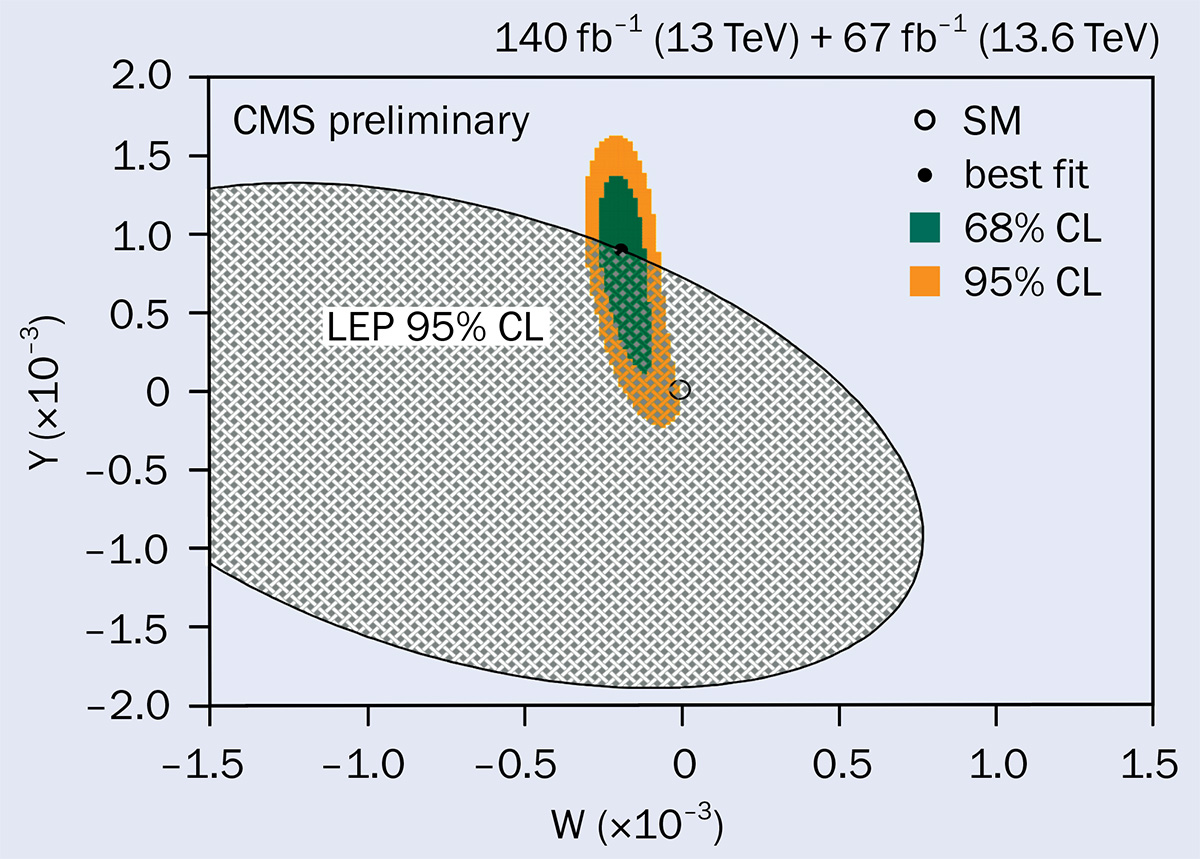
Rather than generating dedicated samples for each theoretical model, the collaboration reweighted simulated events using next-to-leading-order QCD predictions, allowing a wide range of scenarios to be tested efficiently. Two complementary signatures were investigated. The first is a broad, mass-dependent distortion of the dilepton spectrum, characterised by the electroweak oblique parameters W and Y, which vanish in the SM and quantify new contributions that can be absorbed as modifications to the propagation of the electroweak bosons. The second is a localised excess from a massive vector-boson resonance coupling to fermions and bosons, among the heavy states that composite-Higgs models predict.
Precision measurements can probe physics at energy scales beyond direct collider reach
No significant deviation from the SM was observed. When fitted separately, the W and Y parameters are consistent with zero, yielding tight constraints on both. A simultaneous fit reveals instead a mild excess at the 2σ level, largely driven by a single dielectron event with an invariant mass of 5.2 TeV recorded in 2022 (CERN Courier July/August 2026 p12). The excess is compatible with a statistical fluctuation, and further data will clarify its origin.
By combining these results with previous CMS constraints on W from a search in final states with one high-energy lepton and missing transverse momentum, the analysis delivered the most stringent limits to date on the oblique parameters (see figure 1). Limits were also set on the Z′ resonances predicted by Y-universal and Little Higgs scenarios with custodial symmetry, within or slightly above the visible mass spectrum.
The result illustrates how precision measurements can probe physics at energy scales beyond direct collider reach. Even without discovering new particles, exclusion limits guide theoretical development and experimental priorities, and the combination of direct resonance searches and indirect oblique-parameter constraints sharpens the picture of the allowed scenarios. As larger datasets accumulate during Run 3 and the High-Luminosity LHC era, increasingly precise measurements of the dilepton spectrum will continue to test the SM at energy scales approaching 10 TeV.
Further reading
CMS Collab. 2026 CMS-PAS-EXO-25-001.