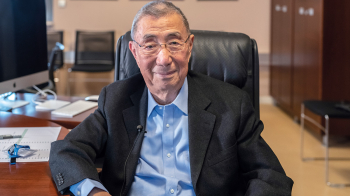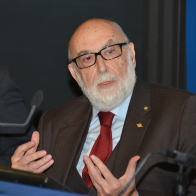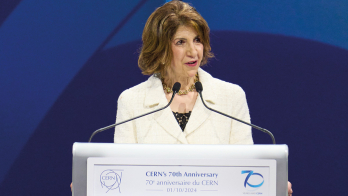
We were sad to hear of the passing of Marvin Marshak, who died on 2 April at the age of 80. Marshak was born in Buffalo, New York, on 11 March 1946. He attended Cornell University as an undergraduate and the University of Michigan for his PhD in physics, completing it in 1970. He then started a long and illustrious career at the University of Minnesota, where he served as chair of the physics department for a decade and as provost and vice-president of the university for a year.
Motivated by grand unified theories, which predicted that protons could decay with measurable rates, Marshak led one of several projects that took particle physicists away from accelerator laboratories to underground facilities – where rare processes could be studied with substantially lower cosmic-ray backgrounds. He negotiated the use of the Soudan mine in Northern Minnesota, which was being operated as a tourist attraction. Some 600 m underground, it became, from 1981, the site of the Soudan 1 and 2 experiments and later the MINOS long-baseline neutrino experiment, using the NuMI beam from Fermilab. Finally, the NOvA experiment, using the same beam, was located nearby on the surface.
Marshak’s research at the Soudan mine began by putting together a collaboration of US and UK scientists, motivated by the search for nucleon decay and the opportunity to build unique detectors in the search for new physics. While the search for nucleon decay proved unavailing, the atmospheric neutrino background serendipitously became a treasure trove of evidence for neutrino oscillations, using the differing path lengths of neutrinos from opposite sides of the Earth, created when cosmic rays strike the atmosphere. It was Soudan 2 that first confirmed the discovery of neutrino oscillations by Super-Kamiokande in 1998. The mine then became the ideal location for far detectors in the long-baseline neutrino oscillation experiments MINOS and NOvA, to which Marshak made key contributions. He also played a leading role in using underground detectors in novel ways to search for the astrophysical sources of cosmic rays. Recently, he played an important role in helping to organise the international DUNE collaboration by serving several years as the chair of the institutional board for the precursor Long-Baseline Neutrino Experiment.
Marshak had an amazingly varied skill set that helped particle physics overcome increasingly complex challenges. He had a keen intuition for worthwhile problems and for which issues to tackle. He became an expert in the challenges of underground construction engineering. He could deal with administrators and politicians at the state and federal level, successfully obtaining money for ambitious projects, and he managed the installation of the 14,000 tonne NOvA Far Detector.
However, he will be remembered best for his one-on-one interactions with students and colleagues. When he gave a seminar, his enthusiasm was infectious. He knew when to provide direction for his graduate students and when to stand back and let them struggle to find their own limitations. He could motivate undergraduates in a classroom and then find them a role in an exciting experiment. He would always take his share of the unsensational work that is required on any project, such as scanning the not-too-frequent neutrino interactions and categorising them. But what is remembered most of all by his friends and colleagues is his indomitable energy, his charm and the perpetual smile on his face.