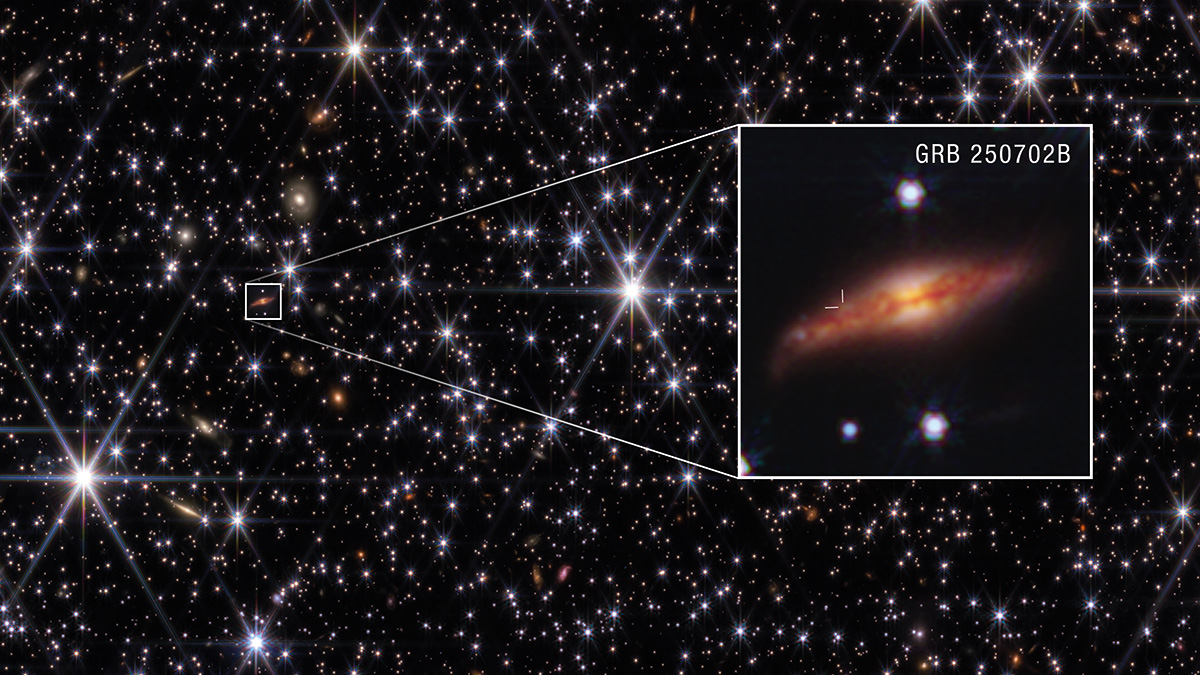
On 2 July 2025, NASA’s Fermi Gamma-ray Space Telescope observed a gamma-ray burst (GRB 250702B) of a record seven hours in duration. Intriguingly, high-resolution images from the Hubble Space Telescope (HST) and the James Webb Space Telescope (JWST) revealed that the burst emerged nearly 1900 light-years from the centre of its host galaxy, near the edge of its disc. But its most unusual feature is that it was seen in X-rays a full day before any gamma rays arrived.
The high-energy transient sky is filled with a cacophony of exotic explosions produced by stellar death. Short GRBs of less than two seconds are produced by the merging of compact objects such as black holes and neutron stars. Longer GRBs are produced by the death of massive stars, with “ultralong” GRBs most often hypothesised to originate in the collapse of massive blue supergiants, as they would allow for accretion onto their central black-hole engines over a period from tens of minutes to hours.
Peculiar observations
GRB 250702B lasted for at least 25,000 seconds (7 hours), superseding the previous longest GRB 111209A by over 10,000 seconds. However, the duration alone was not enough to identify this event as a different class of GRB or as an extreme outlier. Two other observations immediately marked GRB 250702B as peculiar: the multiple gamma-ray episodes seen by Fermi and other high-energy satellites; and the soft X-rays from 0.5 to 4 keV seen by China’s Einstein Probe over a period extending a full day before gamma rays were detected.
No previous GRB is known to have been preceded by X-ray emission over such a period. Nor is it an expectation of standard GRB models, even those invoking a blue supergiant. Instead, these X-rays suggest a relativistic tidal disruption event (TDE) – the shredding of a star by a massive black hole, launching a jet that moves near the speed of light. All known relativistic TDE systems are produced by supermassive black holes weighing a million times the mass of our Sun, or more. Such black holes are found at the centre of their host galaxies, but the HST and JWST observations revealed that the transient had occurred near the edge of its host galaxy’s disc (see “Not from the nucleus” image).
This peripheral origin opens the door to a more exotic scenario involving an intermediate-mass black hole (IMBH) weighing hundreds to thousands of solar masses. IMBHs are a missing link in black-hole evolution between the stellar-mass black holes that gravitational-wave detectors frequently see merging and the supermassive black holes found at the centre of most galaxies. Alternative scenarios reduce the black-hole mass even further, and include a micro-TDE, where a star is shredded by a stellar-mass black hole, or a helium star being eaten by a stellar-mass black hole.
There is little consensus on the origin of GRB 250702B, beyond that it involved an accreting black hole
The rapid gamma-ray variability observed by Fermi and other high-energy satellites is an important clue. The time variability of relativistic jets is thought to be orders of magnitude slower than the characteristic scale set by a black hole’s Schwarzschild radius. While an intermediate-mass black hole of a few hundred solar masses is not incompatible, the observed variability is nearly 100 times faster than that seen in relativistic TDEs. By contrast, with characteristic physical scales smaller in proportion to the smaller masses of their black holes, micro-TDEs and helium-star black-hole mergers have no difficulty accommodating such short-timescale variability.
The environment of the transient also provides crucial clues into its origin. JWST spectroscopy revealed that the light from the transient and its host galaxy was emitted 8 billion years ago, when the universe was just a teenager. The galaxy is among the largest and most massive at that age in the universe, and – unusually for galaxies hosting GRBs – a massive dust lane splits its disc in half. Ongoing star formation at the transient’s location suggests a stellar-mass progenitor, as opposed to an IMBH.
Despite numerous studies, there is little consensus on the origin of GRB 250702B, beyond that it involved an accreting black hole. Its exceptional duration and early X-ray emission initially suggested a supermassive black hole, but its rapid variability and location in its host galaxy instead point to a stellar-mass black hole, with a far rarer IMBH potentially splitting the difference. Given that it is a notably rare once-every-50-years event, the wait for the next ultralong GRB may be long, but astrophysicists are optimistic that theoretical advances will disentangle the different progenitor scenarios and reveal the origin of this extraordinary transient.
Further reading
B O’Connor et al. 2025 ApJL 994 L17.
J Carney et al. 2025 ApJL 994 L46.