European Laboratories for Accelerator Based Sciences (EURO-LABS) aims to provide unified transnational access to leading research infrastructures across Europe. Taking over from previously running independent programmes, it brings together the nuclear physics, the high-energy accelerator, and the high-energy detector R&D communities. With 33 partners from European countries, EURO-LABS forms a large network of laboratories and institutes ranging from modest sized test infrastructures to large-scale ESFRI facilities such as SPIRAL2. Its goal is to enable research at the technological frontiers in accelerator and detector development and to open wider avenues in both basic and applied research in diverse topics, from optimal running of reactors to mimicking reactions in the stars. Within this large network, EURO-LABS will ensure diversity and actively support researchers from different nationalities, gender, age, grade, and variety of professional expertise.
Sharing information to support users at test facilities is pivotal. Targeted improvements such as new isotope-enriched targets for high-quality standard medical radioisotope production, improved beam- profile monitors, or magnetic-field measurement instruments in cryogenic conditions will further enhance the capabilities of facilities to address the challenges of the coming decades. Through an active and open data management plan following the FAIR principle, EURO-LABS will act as a gateway for information to facilitate research across disciplines and provide training for young researchers.
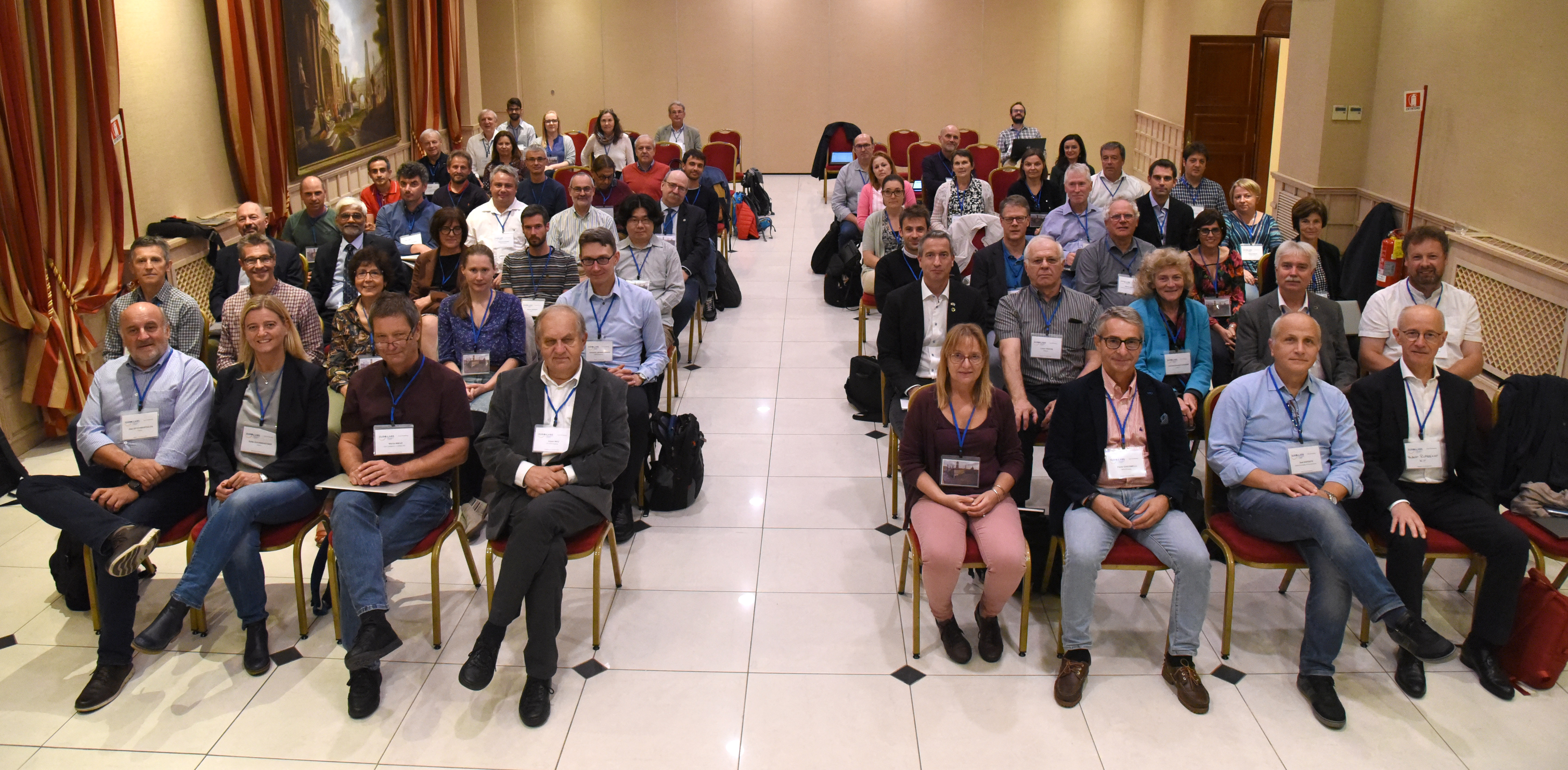
Funded by the European Commission, EURO-LABS started on 1 September and will run until August 2026. At the kick off meeting, held in Bologna from 3 to 5 October, presentations offered a detailed overview of the research infrastructures and facilities providing particle and ion beams at energies from meV to GeV. Exchanges during the meeting gave participants a view of the strengths and synergies on offer, planting the seeds for fruitful collaborations.
Prospects for testing and developing techniques for present and future accelerators were among the highlights of the meeting. In the high-energy accelerator sector, this requires state of the art test benches for cryogenic equipment such as magnets, superconducting cavities and associated novel materials, electron and plasma beams, as well as specialised test-beam facilities. Facilities at CERN, DESY and PSI, for example, allow the study of performances and radiation effects on detectors for the HL-LHC and beyond while also enabling nuclei to be explored under extreme conditions. Benefiting from past experiences, a streamlined procedure for handling transnational-access applications to all research infrastructures across the different fields of EURO-LABS was defined.
On the last day of the meeting, the consortium’s governing board, chaired by Edda Gschwendtner (CERN), met for the first time. The governing board further appointed Navin Alahari (GANIL, France) as EURO-LABS scienfitic coordinator, Paolo Giacomelli (INFN-BO, Italy) as project corodinator, Maria Colonna (INFN-LNS, Italy), Ilias Efhymiopoulos (CERN) and Marko Mikuz (Univ.Lubljana, Slovenia) as deputy scientific coordinator and work-package and Maria J G Borge (CSIC, Spain) and Adam Maj (IFJ, Poland) as work-package leaders.
With all facilities declaring their readiness to receive the first transnational users, the next annual meeting will be hosted by IFJ-PAN in Krakow, Poland.
After five years of arduous and continuous activity, the main civil-engineering works for the High-Luminosity LHC project (HL–LHC) are on track to be completed by the end of the year. Approved in June 2016 and due to enter operation in 2029, the HL-LHC is a major upgrade that will extend the LHC’s discovery potential significantly. It relies on several innovative and challenging technologies, including new superconducting quadrupole magnets, compact crab cavities to rotate the beams at the collision points, and 80 m-long high-power superconducting links, among many others.
These new LHC accelerator components will be mostly integrated at Point 1 and Point 5 of the ring, where the two general-purpose detectors ATLAS and CMS are located, respectively. As such, the HL-LHC requires new, large civil-engineering structures at each site to house the services, technical infrastructure and accelerator equipment required to power, control and cool the machine’s new long-straight sections.
Connections
At each Point, the underground structures consist of a vertical shaft (80 m deep and 10 m in diameter) leading to a service cavern (16 m in diameter and 46 m long). A power-converter gallery (5.6 m in diameter and 300 m long), two service galleries (3.1 m in diameter and 54 m long), two radio-frequency galleries (5.8 m in diameter and 68 m long), as well as two short safety galleries, complete the underground layout. The connection to the LHC tunnel will be made via 12 vertical cores (1 m in diameter and 7 m deep), which will be drilled later and completed during long-shutdown 3 after the removal of the existing LHC long-straight sections.
The two sites generated 120 jobs on average from 2018 to 2021, solely for companies in charge of civil-engineering construction
Luz Anastasia Lopez-Hernandez
The surface structures consist of five buildings. Three are constructed from reinforced concrete to house noisy equipment such as helium compressors, cooling towers, water pumps, chillers and ventilation units. The other two buildings have steel-frame structures to house electrical distribution cabinets, a helium refrigerator cold-box and the shaft access system. The buildings are interconnected via buried technical galleries.
The HL-LHC civil-engineering project is based on four main contracts. Two consultancy service contracts are dedicated to the design and construction administration: Setectpi-CSD-Rocksoil (ORIGIN) at Point 1 and Lombardi-Artelia-Pini (LAP) at Point 5. Two supply contracts are dedicated to the construction of both the underground and surface structures: Marti Tunnelbau – Marti Österreich – Marti Deutschland (JVMM) at Point 1 and Implenia Schweiz – Baresel – Implenia Construction (CIB) at Point 5.
In total, 92,000 m3 of spoil has been excavated from the underground structures, while 30,000 m3 of concrete and 5000 tonnes of reinforcement-steel were used to construct the underground structures. At Point 5, based on the experience of civil engineering for the CMS shaft, groundwater infiltration was envisaged to make HL-LHC shaft excavation difficult. A different execution methodology and a dry summer in 2018 made the task easier, although the discovery of unexpected hydrocarbon layers (not seen during the CMS works) added some additional difficulties in the management of the polluted spoil. At Point 1, the expected quantity of spoil polluted by hydrocarbon was managed accordingly. The construction of the surface structures, meanwhile, required 6 km of anchor piles, 15,000 m3 of concrete, 1400 tonnes of reinforcement-steel and 700 tonnes of steel frames.
Opportunities
“The two sites generated 120 jobs on average from 2018 to 2021, solely for companies in charge of civil-engineering construction,” says Luz Anastasia Lopez-Hernandez, head of the project-portfolio management group of the site and civil-engineering department.
Special care was taken to limit worksite nuisance with respect to CERN’s neighbours. Truck wheels were systematically washed before leaving the worksites, and temporary buildings were erected on top of the shaft heads to limit the noise impact of the excavation work. The only complaint received during the construction period was related to light pollution at Point 5, after which it was decided to limit worksite lighting during nightfall to the minimum compatible with worker safety. As the excavation of the two shafts started in 2018 in parallel with LHC operation, special care was taken to limit the vibration level by using electrically driven road-header excavators.
The COVID-19 pandemic, which, among other things, required the two worksites to be closed for several weeks in 2020, caused a delay of one-to-two months with respect to the initial construction schedule. The Russian Federation’s invasion of Ukraine also impacted activities this year by delaying some deliveries.
“The next step is to equip these new structures with their technical infrastructures before the next long shutdown, which will be dedicated to the installation of the accelerator equipment,” says Laurent Tavian, work-package leader of the HL–LHC infrastructure, logistics and civil engineering.
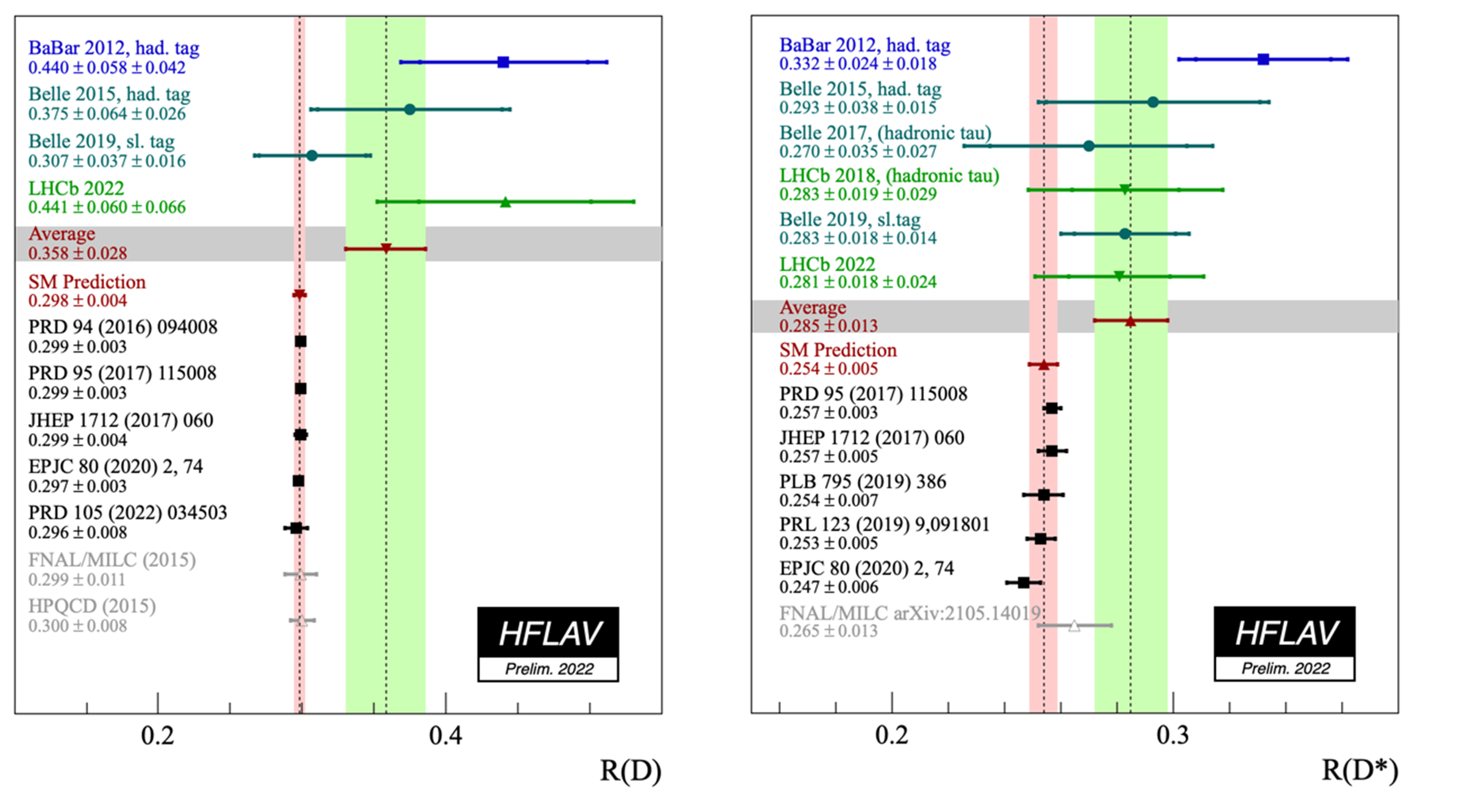
Complementing previous results by Belle, BaBar and LHCb, the LHCb collaboration has reported a new test of lepton flavour universality in b → cℓ νℓ decays. At a seminar at CERN on Tuesday 18 October, the collaboration announced the first simultaneous measurements of the ratio of the branching fraction of B-meson decays to D mesons: R(D*)= BR(B→D*τ–ντ)/BR(B→D*μ–νμ) and R(D)= BR(B–→D0τ–ντ)/BR(B–→D0μ–νμ) at a hadron collider. Based on Run 1 data recorded at a centre-of-mass energy of 7 and 8 TeV, they found R(D*) = 0.281 ± 0.018 (stat.) ± 0.024 (syst.) and R(D) = 0.441 ± 0.060 (stat.) ±0.066 (syst.). The values, which are consistent with the Standard Model (SM) expectation within 1.9 σ, bring further information to the pattern of “flavour anomalies” reported in recent years.
Lepton-flavour universality holds that aside from mass differences, all interactions must couple identically to different leptons. As such, the rate of B-meson decays to different leptons is expected to be the same, apart from known differences due to their different masses. Global fits of R(D(*)) measurements, which probe b → c quark transitions, show that the ratio of B-meson to D-meson decays tends to be larger (by about 3.2 σ) than the SM prediction. The ratios of electronic to muonic B-meson decays, R(K), which probe b → s quark transitions, are also under scrutiny to test this basic principle of the SM.
To reconstruct b → cτ–ντ decays, LHCb used the leptonic τ–→μ–νν decay to identify the visible decay products D(*) and µ–. “We use the measurement of the B flight direction to constrain the kinematics of the unreconstructed particles, and with an approximation reconstruct the rest frame kinematic quantities,” says LHCb’s Greg Ciezarek, who presented the results. “The challenge is then to understand the modelling of the various background processes which also produce the same visible decay products but have additional missing particles different distributions in the rest frame quantities. We use control samples selected based on these missing particles to constrain the modelling of background processes and justify our level of understanding.”
The respective SM predictions for the ratios R(D) and R(D*) are very clean because they are independent of uncertainties induced by the CKM-matrix element Vcb and hadronic matrix elements. The new values of R(D) and R(D*) are compatible both with the current world average compiled by the HFLAV collaboration, and with the SM prediction (at 2.2σ and 2.3σ). The combined LHCb result provides improved sensitivity to a possible lepton-universality breaking process.
“Rare B-meson decays and ratios such as R(K) and R(D(*)) are powerful probes to search for beyond the Standard Model particles, which are not directly detectable at the LHC,” says Ben Allanach, theorist at the University of Cambridge.
In 1997, physics undergraduate Manuel Hegelich attended a lecture by a visiting professor that would change the course of his career. A new generation of ultra-short-pulse lasers had opened the possibility to accelerate particles to high energies using high-power lasers, a concept first developed in the late 1970s. “It completely captured my passion,” says Hegelich. “I understood the incredible promise for research and industrial advancement if we could make this technology accessible to the masses.”
Twenty-five years later, Hegelich founded TAU Systems to do just that. In September the US-based firm secured a $15 million investment to build a commercial laser-driven particle accelerator. The target application is X-ray free-electron lasers (XFELs), only a handful of which exist worldwide due to the need for large radio-frequency linacs to accelerate electrons. Laser-driven acceleration could drastically reduce the size and cost of XFELs, says Hegelich, and offers many other applications such as medical imaging.
Beam time
“As a commercial customer it is difficult to get time on the European XFEL at DESY or the LCLS at SLAC, but these are absolutely fantastic machines that show you biological and chemical interactions that you can’t see in any other way,” he explains. “TAU Systems’ business model is two-pronged: we will offer beam time, data acquisition and analysis as a full-service supplier as well as complete laser-driven accelerators and XFEL systems for sale to, among others, pharma and biotech, battery and solar technology, and other material-science-driven markets.”
Laser-driven accelerators begin by firing an intense laser pulse at a gas target to excite plasma waves, upon which charged particles can “surf” and gain energy. Researchers worldwide have been pursuing the idea for more than two decades, demonstrating impressive accelerating gradients. CERN’s AWAKE experiment, meanwhile, is exploring the use of proton-driven plasmas that would enable even greater gradients. The challenge is to be able to extract a stable and reliable beam that is useful for applications.
Hegelich began studying the interaction between ultra-intense electromagnetic fields and matter during his PhD at Ludwig Maximilian University in Munich. In 2002 he went to Los Alamos National Laboratory where he ended up leading their laser-acceleration group. A decade later, the University of Texas at Austin invited him to head up a group there. Hegelich has been on unpaid leave of absence since last year to focus on his company, which currently numbers 14 employees and rising. “We have got to a point where we think we can make a product rather than an experiment,” he explains.
The breakthrough was to inject the gas target with nanoparticles with the right properties at the right time, so as to seed the wakefield sooner and thus enable a larger portion of the wave to be exploited. The resulting electron beam contains so much charge that it drives its own wave, capable of accelerating electrons to 10 GeV over a distance of just 10 cm, explains Hegelich. “The whole community has been chasing 10 GeV for a very long time, because if you ever wanted to build a big collider, or drive an XFEL, you’d need to put together 10 GeV acceleration stages. While gains were theorised, we saw something that was so much more powerful than what we were hoping for. Sometimes it’s better to be lucky than to be good!”
The breakthrough was to inject the gas target with nanoparticles with the right properties at the right time
Hegelich says he was also lucky to attract an investor, German internet entrepreneur Lukasz Gadowski, so soon after he started looking last summer. “This is hardware development: it takes a lot of capital just to get going. Lukasz and I met by accident when I was consulting on a totally different topic. He has invested $15 million and is very interested in the technical side.”
TAU Systems (the name comes from the symbol used for the laser pulse duration) aims to offer its first products for sale in 2024, have an XFEL service centre operational by 2026 and start selling full XFEL systems by 2027. Improving beam stability will remain the short-term focus, says Hegelich. “At Texas we have a laser system that shoots once per hour or so, with no feedback loop, so sometimes you get a great shot and most of the time you don’t. But we have done some experiments in other regimes with smaller lasers, and other groups have done remarkable work here and shown that it is possible to run for three days straight. Now that we have this company, I can hire actual engineers and programmers – a luxury I simply didn’t have as a university professor.”
He also doesn’t rule out more fundamental applications such as high-energy physics. “I am not going to say that we will replace a collider with a laser, although if things take off and if there is a multibillion-dollar project, then you never know.”
Announced on 4 October, the 2022 Nobel Prize in Physics has been awarded to Alain Aspect, John Clauser and Anton Zeilinger for groundbreaking experiments with entangled photons that open a path to advanced quantum technologies. Working independently in the 1970s and 1980s, their work established the violation of Bell inequalities – as formulated by the late CERN theorist John Bell – and pioneered the field of quantum information science.
First elucidated by Schrödinger in 1935, entanglement sparked a long debate about the physical interpretation of quantum mechanics. Was it a complete theory, or was the paradoxical correlation between entangled particles due to hidden variables that dictate in which state an experiment will find them? In 1964 John Bell proposed a theorem, known as Bell’s inequalities, that allowed this question to be put to the test. It states that if hidden variables are in play, the correlation between the results of a large number of measurements will never exceed a certain value; conversely, if quantum mechanics is complete, this value can be exceeded, as measured experimentally.
John Clauser (J F Clauser & Associates, US) was the first to investigate Bell’s theorem experimentally, obtaining measurements that clearly violated a Bell inequality and thus supported quantum mechanics. Alain Aspect (Université Paris-Saclay and École Polytechnique, France) put the findings on even more solid ground by devising ways to perform measurements of entangled pairs of photons after they had left their source, thus ruling out the effects of the setting in which they were emitted. Using refined tools and a long series of experiments, Anton Zeilinger (University of Vienna, Austria) used entangled states to demonstrate, among other things, quantum teleportation.
These delicate, pioneering experiments not only confirmed quantum theory, but established the basis for a new field of science and technology that has applications in computing, communication, sensing and simulation. In 2020 CERN joined this rapidly growing global endeavour with the launch of the CERN Quantum Technology Initiative.
Foundational work in quantum-information science was also the subject of the 2023 Breakthrough Prize in Fundamental Physics, announced in September, for which Charles H Bennett (IBM), Gilles Brassard (Montréal), David Deutsch (Oxford) and Peter Shor (MIT) will receive $3 million each.
On 16 August 2022, pioneering theorist Harald Fritzsch unexpectedly died at the age of 79. His essential contributions to the development of quantum chromodynamics and the grand unification of the fundamental forces made a lasting and profound impact on the field of theoretical physics.
Harald Fritzsch was born on 10 February 1943 in Zwickau, Germany. He studied physics and completed his diploma thesis at Leipzig University in June 1968. At this time, he had already contemplated leaving the German Democratic Republic (GDR) and so sent his diploma thesis to Werner Heisenberg in Munich. In 1968, in an adventurous and dramatic escape by boat across the Black Sea from the Eastern Block to Turkey, Fritzsch and a friend fled the GDR and relocated to the Federal Republic of Germany. Fritzsch went straight to Munich, where Heisenberg accepted him as a doctoral student in his research group at the Max Planck Institute for Physics. His thesis, supervised by Heinrich Mitter and completed in 1971, dealt with light-cone algebra and the quantisation of the strong interaction. In 1970 Fritzsch received a DAAD scholarship for a six-month stay at SLAC and met Murray Gell-Mann for the first time, in Aspen.
After receiving his doctorate, Fritzsch spent a year as a research fellow at CERN, followed by four years as a senior research associate at Caltech. The collaboration between Fritzsch and Gell-Mann continued and led to groundbreaking work on the strong interaction. In 1977 Fritzsch followed a call as professor at the University of Wuppertal, which changed to become the University of Bern. Then, in 1979, he became Ordinarius at Ludwig Maximilian University in Munich.
In 1971 Fritzsch and Gell-Mann introduced the colour quantum number as the exact symmetry underlying the strong interactions, thereby solving the long-standing problem of preserving the exclusion principle as discussed, for example, by Han and Nambu in 1965. A year later, Fritzsch and Gell-Mann proposed a Yang–Mills gauge theory with local colour symmetry, which is now called quantum chromodynamics (QCD). This new idea was first presented by Gell-Mann in the fall of 1972 at a conference in Chicago, and then in a joint conference paper by Fritzsch and Gell-Mann. In 1973 their famous paper on the colour-octet model of QCD, now also with Heinrich Leutwyler, appeared in Physics Letters. This publication, together with the papers by Gross, Politzer and Wilczek about asymptotic freedom in non-Abelian gauge theories, all published in the same year, is regarded as the beginning of QCD.
Fritzsch wrote many other scientific papers that are of great importance for theoretical particle physics, for example on SO(10) grand-unification, weak interactions, the famous Fritzsch mass matrices and composite models. For his significant scientific achievements, he was awarded the Dirac Medal of the University of New South Wales in Australia in 2008. He was a member of the Society of German
Natural Scientists and Physicians, and of the Berlin–Brandenburg Academy of Sciences. In 2013 he was awarded an honorary doctorate from Leipzig University.
Fritzsch is also widely known as an author of popular scientific books. His book Quarks, published in 1980, was translated into more than 20 languages, and in 1994 he was awarded the Medal for Scientific Journalism of the German Physical Society.
In addition to his outstanding scientific achievements, we also admired Harald for his strong, determined, honest and straightforward mind, and for his courage to express his sound opinions and to tackle problems and disputes, even if inconvenient to some.
Until the very end, Harald was seen in his university office almost every day. He will be sadly missed, but never forgotten.
The Institut Laue-Langevin (ILL) is an international research centre at the leading edge of neutron science and technology. As a service institute, the ILL makes its expertise available to about 1400 researchers every year across a suite of 40 state-of-the-art instruments. Taken together, those instruments provide the engine-room for a portfolio of unique analytical techniques that enables process, materials and device characterisation far beyond what’s possible in a traditional academic or industry laboratory – as well as spanning a diversity of disciplines from the physical sciences and engineering to pharmaceutical R&D, food science and cultural heritage.
Yet while neutrons are unique and ubiquitous, they are neither widely available nor routinely accessible for applications in front-line research. Intense, tunable neutron beams can only be produced at nuclear reactors (like the ILL) or with high-power proton accelerators (so-called spallation sources). By default, there are no laboratory-based neutron sources for initial training of early-career scientists and preliminary experiments – in contrast to the established development pathway afforded scientists transitioning from laboratory X-ray techniques to the large-scale synchrotron X-ray facilities.
By extension, scientists seeking to access neutrons as a research tool can only do by securing beam time at large-scale facilities. That’s not always straightforward. Large-scale neutron facilities have their own dedicated proposal and contract mechanisms for accessing beam time, adding to perceptions of “impenetrability” for new and occasional users – especially those working in industry. All of which begs a leading question: how can ILL – indeed Europe’s large-scale research facilities generally – build on their successes to date in engaging the industrial R&D community and, in so doing, broaden their collective user base while simultaneously amplifying their societal and economic impact?
Scaling industry engagement
The Industry Liaison Unit (ILU) at ILL, nominally with two full-time staff, leads the laboratory’s industry outreach activities – typically through dedicated local, national and international industry events, all of which are supported by an active online and social media presence. By preparing contracts and agreements as required, the ILU also acts as the interface between the industry partners and ILL instrument scientists who will perform the experiments.
Working with industry can proceed along several routes, each with its own merits. For context, 80% of beam time at ILL is awarded through a competitive peer-review process, with two calls for proposals each year. For this so-called public access model, including precompetitive research at low technology readiness level (TRL), the ILL data policy requires open data and publishable results, with industry partners in many cases collaborating with academic research groups (and, in turn, tapping the latter’s high level of expertise in neutron science). Such “indirect” use of the ILL facilities is the most common access model for industry – though conversely the most difficult for the ILU to capture since the industry partners are not always “visible” members of the research collaboration.
At the other end of the spectrum, and often for projects with a high TRL, industry is able to request proprietary beam time for business-critical research using a paid-for access model. In return, any resulting experimental data remains private, the work can be covered by a non-disclosure agreement, any resulting intellectual property (IP) stays with the client, and experiments are scheduled on an appropriate timescale (usually as soon as possible). Often this sort of work may take the form of a consultancy, in which case the results (rather than just experimental data) are delivered by ILL scientists with the support of the ILU.
In between these limiting cases, precompetitive research collaborations are an ideal way to build long-term industry engagement with ILL. Backed by European and/or national research funding, these initiatives typically run for several years and are often governed by memoranda of understanding. As such, the collaborative model allows an industry partner to gain experience and confidence at ILL while confirming the feasibility (or not) of its R&D goals – all of which can potentially lead on to requests for proprietary beam time. Partners often include established European technology companies – the likes of Rolls-Royce, EDF and STMicroelectronics, for example – or research and technical organisations (RTOs) – among them the French Alternative Energies and Atomic Energy Commission (CEA) and Germany’s Fraunhofer institutes.
Operationally, the main experimental techniques used by industry at ILL are neutron imaging (specifically, radiography and tomography – the former used to reveal the internal structure of manufactured components, while the latter generates 3D images of a sample by measuring neutron absorbance); small-angle neutron scattering or SANS (elastic neutron scattering to investigate the structure of samples at the mesoscopic scale between 1–100 nm); powder diffraction (a form of elastic scattering that reveals atomic and magnetic structures); and strain scanning (which provides insights into strain and stress fields deep within an engineering component). Worth adding as well that neutron imaging takes full advantage of the very intense, continuous neutron beams at ILL and offers potential for significant growth in industry engagement, assuming that capacity can be created to match demand.
Where we are now
It’s fair to say that ILL’s engagement with industry, while on an upward trajectory, remains a work in progress. The latest estimate of “indirect” use of beam time at ILL is that 15% of experiments (about 100 per year) are industry-relevant and likely to involve an industry partner. By monitoring who actually comes to ILL to carry out experiments, the ILU has identified 106 companies using the facility over the last decade. What’s more, proprietary beam time in 2021 involved 26 measurement periods by 14 unique industry customers with an aggregate income to ILL of €0.51 million.
In large part, though, it is pan-European and national research collaborations (precompetitive, low TRL) that continue to stimulate industry interaction with ILL. A case in point is the Integrated Infrastructure Initiative for Neutron Scattering and Muon Spectroscopy(NMI3), in which dedicated workshops were held with diverse industry partners, with the follow-on project, Science and Innovation with Neutrons in Europe 2020 (SINE2020), including an industry consultancy work package with a budget of €1.5 million. The primary focus of the work package was to provide free feasibility studies for companies seeking to evaluate neutron techniques versus their R&D requirements. In all, SINE2020 carried out 37 studies, 14 of which were conducted by ILL.
Two current European projects, BrightnESS-2 and EASI-STRESS, have a common focus on neutron measurements of residual stress – a critical factor, for example, in the mechanical stability of 3D-printed (additive-manufactured) components. The EASI-STRESS project aims to strengthen industrial access and uptake of non-destructive synchrotron X-ray and neutron-diffraction-based characterisation tools. The goal: to enable a better understanding of the formation and progression of residual stresses by direct incorporation of measured data into modelling tools. In parallel, part of the BrightnESS-2 remit is to support ongoing work at ILL about the standardisation of measurements across neutron facilities and instruments, delivering a quality approach that has been formalised as a Neutron Quality Label trademark.
In this respect, it helps that ILL is colocated on the European Photon and Neutron Campus in Grenoble – a geographical convenience that allows close coordination with the adjacent European Synchrotron Radiation Facility (ESRF) when engaging with existing and prospective industry users. The two laboratories are core partners in the EASI-STRESS initiative as well as BIG-MAP, another pan-European project that brings together academic and industry partners on low-TRL battery research as part of the EU’s Battery2030+ roadmap.
ILL and ESRF are also collaborating within the national IRT Nanoelec project, which enables ILL to showcase its unique analytical capabilities to address key R&D questions in the microelectronics industry. In this context, ILL has created a dedicated irradiation station that allows users to evaluate the sensitivity – and reliability – of electronic components subjected to low-energy (thermal) neutrons.
Industry success stories
Successful case studies for industry engagement can be found along several operational coordinates at ILL. In terms of the proprietary access model – with paid-for beam time plus full IP rights and confidentiality allocated to the customer – projects will typically focus on targeted lines of enquiry relating to a company’s manufacturing, R&D or failure-analysis requirements.
As part of its quality control, for example, French aerospace company Dassault Aviation makes regular use of the ILL’s neutron imaging capability, with the focus on radiographic analysis of high-reliability pyrotechnic equipment for rocket launchers such as Ariane. Materials and process innovation also underpin a series of ILL measurements carried out by OHB and MT Aerospace (a group of companies specialising in space transportation, satellites and aircraft equipment), mainly to investigate residual stress on friction stir welds (when two facing metal workpieces are joined together by the heat generated from friction). The non-destructive determination of strain and stress maps provides primary data to optimise the company’s numerical models while also benchmarking versus destructive lab-based analysis techniques.
Notwithstanding the proprietary pathway, collaborative projects represent the most popular route for direct interaction between ILL and industrial researchers and RTOs. For example, a joint R&D initiative on metal additive manufacturing (MAM) kicked off in 2018 with the Fraunhofer-Institut für Werkstoff-und Strahltechnik (IWS) in Dresden. Using in-situ laser printing at SALSA, the stress-scanning instrument at ILL, the partners are delivering new knowledge of lasing parameters to ensure robust industrial production of MAM pieces. The initial 24-month project, involving teams from ILL and the Fraunhofer IWS, will be followed by further measurements in 2023 (part of a European Space Agency project that will also include additional X-ray imaging measurements at the ESRF).
The InnovaXN PhD programme represents a ground-breaking approach to working with industry – a joint initiative between the ESRF and ILL in which 40 research projects are split between the two large-scale facilities (although most projects require the use of both synchrotron and neutron analytical probes). Launched in 2019, the programme is co-funded by the ESRF (25%) and ILL (25%), with the remainder covered by a Marie Skłodowska-Curie Actions grant agreement within the European Union’s Horizon 2020 programme.
All InnovaXN projects have an academic and an industry partner (as well as the ESRF and/or ILL), with each PhD student spending at least three months at the industry partner during the course of their research. In this way, the programme attracts industry R&D teams and activities to ESRF and ILL to explore the use of their unique, cutting-edge synchrotron and neutron capabilities for precompetitive research.
Equally important is the fact that InnovaXN students are exposed to the industry research environment, offering an additional career path post-PhD (either with the industry PhD partner or with another company). This represents the best form of industry awareness for ESRF and ILL, effectively seeding trained scientists in an industry setting. On the other hand, if students end up pursuing an academic career pathway, they will know how to collaborate with industry and how to exploit large-scale facilities when necessary. A win-win.
So far, there have been two intakes of InnovaXN students (in 2020 and 2021). In-progress projects involve 35 unique industry partners (some partners are involved in more than one project), with a quarter of these being SMEs or technology R&D centres. The top three industry sectors covered are energy production and storage; catalysis and chemistry; and pharmaceuticals and biotechnologies – a ranking that reflects the broad reach of neutron and synchrotron techniques for industrial applications.
Another example of collaboration involves Airbus Avionics, which is running a project to mitigate the risks associated with high- and low-energy (thermal) neutrons for avionics programmes. The ILL’s instruments were first used by Airbus to predict thermal neutron risks for state-of-the art semiconductor technologies – with direct measurements being the only way to estimate the real thermal neutron flux inside an aircraft. In 2021, the ILL therefore provided thermal neutron detectors for on-board use in commercial flights, whilst also sharing its technical expertise in this area. The design, development and implementation of advanced neutron detectors is at the heart of the ILL’s activity, as all of its scientific instruments require detectors with unique technical specifications.
Meanwhile, there are many examples of precompetitive research performed at ILL in partnership with industry, often linked to the “indirect” use of the facility highlighted previously. A timely example is the work involving pharmaceutical company AstraZeneca, in which SANS was used to study lipid nanoparticles containing messenger RNA2 – the delivery mechanism for COVID-19 vaccines produced by Pfizer-BioNTech and Moderna. BioNTech also performed a SANS experiment at ILL in 2020.
Lessons learned, new perspectives
With these and other notable success stories to build on, it’s evident that industry use of large-scale research facilities like ILL will remain on an upward trajectory for the foreseeable future. Yet while the laboratory’s near-term thrust is on outreach to industry – raising awareness of the unique R&D opportunities herein – there’s also a requirement for a dedicated selection path for applied R&D projects, with appropriate criteria to give industry streamlined access. Equally important is the ability for companies to study industry-relevant processes, samples and devices on ILL beam lines (“bringing industry to the neutrons”), while delivering experimental data or analysed research outcomes to the industrial customer per their requirements. Improved tracking (and subsequent promotion) of outcomes is another priority, with impact evaluated not just on a financial basis, but acknowledging other metrics such as savings versus energy and raw materials.
Hitting the target on medical radioisotopes
Radioisotope production is a core function of nuclear research reactors. At the ILL, which delivers one of the highest neutron fluxes available within the neutron science community, the focus is on producing low-yield, neutron-rich radioisotopes – and especially nonconventional medical radioisotopes with applications in highly targeted radionuclide cancer therapy. Examples include 177-lutetium, which has been used in the treatment of over 1000 patients to date, and 161-terbium, currently in the preclinical trial phase.
In 2021, ILL income from radioisotope production was close to €1 million, and plans are taking shape to increase production over the medium term. The ILL’s work in this area feeds into PRISMAP, an EU-funded initiative to develop an extensive infrastructure for nonconventional medical radioisotope production.
At the same time, so-called mediator companies are a growing – and increasingly vital – part of the mix. Operating at the interface between large-scale facilities and industry, these intermediary providers offer a broad portfolio of consultancy services – everything except the beam time – to enable industry customers to fast-track their R&D projects by easing access to the unique measurement capabilities offered by the big-science community. Examples include ANAXAM, a spin-off from the Paul Scherrer Institute in Switzerland, and Grenoble-based IROC Technologies – both of which are already connecting industry end-users with large-scale neutron facilities like ILL. Other companies – including Novitom in Grenoble and Finden in the UK – are facilitating industry research at synchrotron facilities like the ESRF, though could ultimately evolve to cover neutron techniques see “Prioritising the industry customer”.
Industry use of large-scale research facilities like ILL will remain on an upward trajectory for the foreseeable future
In the long term, ILL and other laboratories like it must focus on lowering the barriers to engage small and medium-sized enterprises, as well as established technology companies, such that they come to see Europe’s large-scale research facilities as a natural extension of their R&D and innovation pipeline. While indirect industry use of ILL will continue to grow, what constitutes success a decade from now would be an increase in the direct use of the facility by industry for precompetitive and proprietary research. Opportunity knocks.
The authors would like to acknowledge the role of various colleagues in industry-related work at ILL: Duncan Atkins (ILU); Manon Letiche (IRT Nanoelec); Sandra Cabeza, Thilo Pirling, Ralf Schweins, Lionel Porcar, Alessandro Tengattini, Lukas Helfen (all instrument scientists at ILL); Ed Mitchell, Ennio Capria (both ESRF).
The European Network for Research Infrastructures and Industry for Collaboration (ENRIITC) has emerged as something of a bridge-builder between large-scale science facilities and key stakeholders in industry since its formation in January 2020. With over 500 network members – including more than 100 industry liaison and contact officers (ILOs/ICOs) from Europe’s big-science labs and the university research sector – ENRIITC’s goal is to accelerate the societal and economic impact of national and pan-European research programmes, working together to define best practices for industry’s relationship (as supplier, user or collaborator) with Europe’s large-scale research infrastructures (RIs).
Here Anne-Charlotte Joubert, ENRIITC project coordinator and grants officer at the European Spallation Source (ESS), a neutron science facility currently under construction in Lund, Sweden, tells CERN Courier how ENRIITC is helping ILOs and ICOs to join the dots between big science and industry.
How does ENRIITC connect ILOs, ICOs and industry?
Connection and collaboration underpin the ENRIITC mission to build a permanent pan-European network of ILOs and ICOs supporting cross-border partnerships between industry and RIs. Our first formal community meeting, for example, took place in October 2020 when Europe was in the midst of the COVID-19 pandemic. Although a virtual rather than face-to-face experience, we attracted more than 120 RI and industry representatives from 21 countries for two days of interactive sessions and workshops to address topics relating to the growth and impact of the ENRIITC network.
Building on this initial success, we established #ENRIITCyourCoffee, a virtual meeting series to bring network members together on a weekly basis for group discussion on “issues arising” at the interface between big science and industry (with 38 sessions held to date attracting more than 200 unique participants). Initially launched to sustain the collective conversation among ENRIITC members through the Europe-wide lockdowns, #ENRIITCyourCoffee is now an established and ongoing part of the project mix.
What about support for training and education of ENRIITC members?
Under the snappy banner ENRIITC your Knowledge (you see what we’re doing here), the ENRIITC consortium organised a programme of eight training webinars (concluding in May this year) to encourage knowledge transfer, skills development and best practice around the ILO/ICO core competencies needed for successful industry engagement. The series attracted 140 new individual members into the network. In a different direction – with the aim of raising industry awareness about business and R&D opportunities at Europe’s RIs – the project consortium organised five brokerage events for existing and prospective RI industrial users and equipment suppliers (as well as funding five other brokerage events).
What lessons has ENRIITC learned about the relationship between Europe’s large-scale research facilities and industry?
ENRIITC members have conducted two surveys to map the level and scope of engagement between industry and RIs, looking specifically at “Industry as an RI supplier” and “Industry as an RI user”. The surveys focused, among other things, on the nature of the RI access routes used by industry; business sector and enterprise size; the effectiveness of current ILO and ICO performance indicators; as well as drivers of (and barriers to) closer collaboration between RIs and industry.
This granular mapping exercise laid the foundations for a set of complementary strategies, subsequently articulated by ENRIITC, to enhance collaboration between RIs and industry. The headline goal here: to promote – and scale – the role of RIs in supporting applied R&D, technology innovation and long-term growth opportunities for Europe’s technology companies. Equally important is the emphasis on coordinated operational implementation, with separate strategies to guide ILO/ICO training on industry outreach (including brokerage events) and policy recommendations to follow on optimisation of ILO/ICO performance.
The current iteration of the ENRIITC project wraps up in December. What are the priorities until then?
Although a lot has been achieved, there is much work still to do. Our immediate priority is the second ENRIITC community networking meeting, which takes place in October at the Big Science Business Forum (BSBF) in Granada, Spain, when we will bring together ILO/ICO members for a series of intensive knowledge-sharing, networking and training activities. Longer term, a policy paper is in the works to ensure the sustainability of the network, covering: strategic goals and propositions for the project’s continuation; the need to secure funding for a follow-on ENRIITC 2.0 initiative; a transition plan for 2023/24 to build support for our partners and associates; and a business case for the registration of ENRIITC as an independent legal structure. From there we hope to agree a memorandum of understanding between RIs and the ILO/ICO community.
Tell us about ENRIITC 2.0
Right now, the ENRIITC consortium is looking for sources of funding to support an ENRIITC 2.0 initiative, the plan being to consolidate a pan-European ILO/ICO network and secure the successes of the initial project phase. The business model for this follow-up activity is still under discussion, though it is already clear there will be a transition period between the current publicly funded network (within the EU’s Horizon 2020 programme) to a set-up that is necessarily self-sustaining in the long term – likely some sort of mixed membership model that is part open access and part membership/fee-based service offering. Operationally, one of the fundamental objectives of ENRIITC 2.0 will be to establish what we’re calling the Innovation and Industry Services Central Support Hub. The idea is for an online platform to deliver training, connectivity and professional development for ILOs and ICOs, while also streamlining industry engagement with a common pathway to handle the flow of requests from companies to RIs.
Define success for ENRIITC
Success is all about longevity: if the ENRIITC network is strong and sustained, the project has succeeded. What does that look like? I guess one tangible measure of success over the next decade will be the launch, and widescale adoption, of the ENRIITC Innovation and Industry Services Central Support Hub – a unifying vehicle to scale and diversify the innovation ecosystem connecting RIs with industry.
ENRIITC is running a specialist workshop, “Infrastructures and industry engagement – enabling European innovation”,on 19 October at the International Conference on Research Infrastructures (ICRI 2022) in Brno, Czech Republic. The event is organised in collaboration with CzechInvest, the Investment and Business Development Agency of the Czech Republic.
Mediator companies (also known as science-service companies) have emerged as one of the main engines of connection and collaboration between Europe’s large-scale research facilities and industry. A case in point is Finden, a UK-based outfit that helps applied scientists and engineers in a range of industry sectors – energy, industrial chemistry, catalysis and automotive, among others – to access leading-edge materials characterisation services at Europe’s synchrotron research laboratories. Finden managing director Simon Jacques talked to CERN Courier about the company’s science-as-a-service business model and plans to diversify beyond conventional X-ray analysis techniques and synchrotron science.
How is Finden helping the big-science community to grow its industry user base?
As a regular user of large-scale synchrotron facilities within Europe, we enable our industry customers to fast-track R&D projects through unique measurement capabilities tailored to their needs. Put simply, Finden helps industry clients to solve complex materials problems that they’re unable to solve on their own. It’s a winning formula: many of our customers come back to us on a serial basis, tapping the collective expertise of the Finden team and the streamlined access we provide to Europe’s synchrotron light sources.
What do you mean by streamlined access?
There are often significant logistics overheads when it comes to finding and securing beam time at a synchrotron facility – a barrier to direct industry engagement with big science. At Finden, we have the know-how, as well as an extensive network of contacts within the synchrotron community, to take care of all the associated “legwork” for our clients, matching the right beamline and scientific instruments to the industrial problem at hand. That translates into express workflows and turnaround – the key to successful delivery of high-end materials characterisation services for industrial problem-solving.
Operationally, how do new industry clients engage with Finden?
For the most part, our client base comprises established companies rather than small and medium-sized enterprises. First contact can happen in a variety of ways: an exploratory conversation with a Finden scientist at a conference, for example, or sometimes a synchrotron facility may point an industry enquiry in our direction. Once the dialogue is under way, we’ll meet with the client to understand their materials problem at a granular level – often under a non-disclosure agreement to ensure commercial confidentiality. My task as managing director is to make sure we’ve got all the right people in the room from Finden to establish the appropriate characterisation methods versus the client’s problem and specified timeline – as well as an accurate financial quotation for the plan of work.
Do all of the industry problems you tackle require synchrotron beam time?
Not all of them. We have access to a suite of powerful materials analysis techniques here on the Harwell campus (in Oxfordshire) and those lab-based tools often represent a cheaper and more efficient option for our industry clients. When we do engage with the large-scale facilities – for example, the nearby Diamond Light Source or the European Synchrotron Radiation Facility (ESRF) in Grenoble – we make all the necessary arrangements and carry out the work on behalf of the client. Sometimes our scientists will conduct materials studies at the synchrotron beamline – “eyes on the sample” so to speak – though even when working remotely the team will be conducting on-the-fly data analysis and liaising throughout with scientists and technicians in situ.
What does the business model look like for the provision of these big-science services?
It might seem counter-intuitive, but we don’t charge a premium for synchrotron beam time. That’s all billed at-cost to mitigate the chance of the customer going direct to the synchrotron. Our differentiation – and where we make our money – lies in the collective expertise of the Finden team in synchrotron science, instrumentation and techniques – not least our capabilities across experimental design, data analysis and interpretation. By extension, one of the growth opportunities we’re now pursuing is the application of machine-learning and deep-learning technologies to high-throughput data analysis. It’s early days, but we’re already securing industry contracts that tap this capability exclusively, including projects that do not require any experimental data collection on our part.
How is Finden structured right now?
Finden is really two parallel and complementary businesses under one roof. The mediator company, which provides specialist materials science capabilities to industry, rents laboratory space and equipment across the Harwell Innovation Campus on an as-needed basis, while developing a pipeline of higher-level characterisation projects that require access to Europe’s synchrotron light sources. Alongside the science-service business, we run our own dedicated research laboratory that we lease from the Science and Technology Facilities Council, a UK government funding agency. This lab is largely ring-fenced for in-house R&D and innovation initiatives under the broad themes of catalysis and machine learning – essentially longer-term bets with a view to building sustainable royalty and licensing revenues from the associated intellectual property portfolio.
What do the growth opportunities look like for Finden?
Diversification is very much part of Finden’s development roadmap. Right now, the heart of our business is materials characterisation using diffraction, spectroscopy and imaging techniques spanning conventional X-ray and synchrotron science. Conceptually, it’s a logical progression to apply those transferable capabilities to other modalities used in fundamental and applied materials research. In summary: expect to see Finden scientists tackling industry’s R&D problems at large-scale neutron and laser facilities in the not-too-distant future.
CERN sits at the epicentre of a diverse innovation ecosystem. Developing and implementing the enabling technologies for the laboratory’s particle accelerators, detectors and computing systems is only possible thanks to the sustained support of a global network of specialist industrial and institutional partners. Those applied R&D and product development collaborations come in many forms: from the upstream procurement of equipment and services across multiple industry supply chains to the structured transfer of CERN domain knowledge to create downstream growth opportunities for new and established technology companies. Emphasising the role of big science in delivering broad societal and economic impacts, the following snapshots showcase a technology innovation programme that is, quite simply, one on its own.
Procurement: a world of opportunity
CERN is budgeted to spend CHF 2.5 billion (Euro 2.6 billion) on procurement of equipment and services for the period 2022–26 and is always looking to engage new industry suppliers. Contracts are awarded following price enquiries or invitations to tender. The former relate to contracts with an anticipated value below CHF 200,000 and are issued to a limited number of selected firms. Invitations to tender, meanwhile, are required for contracts with a value above CHF 200,000 and issued to firms qualified and selected based on a preceding open market survey. Prospective industry suppliers should visit https://procurement.web.cern.ch/ to register for CERN’s procurement database.
For industry suppliers, the benefits of doing business with CERN go well beyond direct financial returns on a given contract. Like all big science projects, CERN provides fertile ground for technology innovation. As such, industry partners are also investing in future visibility and impact within their given commercial setting. CERN, after all, is well known for its technological excellence, which means preferred suppliers must, as standard, push the boundaries of what’s possible, creating a virtuous circle of positive impacts versus firms’ product innovation, sustainable practices, profitability and competitiveness. A 2018 research study, for example, investigated whether becoming a CERN supplier was linked to enhanced innovation performance within partner companies, and it showed a statistically significant correlation between CERN procurement contracts and corporate R&D, knowledge creation and commercial outcomes (see “Further reading”).
Following the procurement roadmap
The LHC is undergoing a major upgrade to sustain and extend its discovery potential. Scheduled to enter operation in 2029, the High-Luminosity LHC (HL-LHC) project is a complex undertaking that requires at-scale industry engagement for all manner of technology innovations, whether that’s cutting-edge superconducting magnets or compact, ultraprecise superconducting RF cavities for beam rotation. What’s more, the machine’s enhanced luminosity (i.e. increased rate of collisions) will make new demands on the supporting vacuum, cryogenics and machine protection systems, while advanced concepts for collimation and diagnostics, beam modelling and beam-crossing schemes will also be required to maximise physics outputs. Industry is front-and-centre and has a pivotal role to play in delivering the core technologies needed to achieve the HL-LHC’s scientific goals. Down the line, even bigger opportunities will come into play as the HL-LHC draws to a close (in 2040 or thereabouts). Designs are now in the works for the proposed Future Circular Collider (FCC), an advanced research infrastructure that would push the energy and intensity frontiers of particle accelerators into uncharted territory, reaching collision energies of 100 TeV (versus the LHC’s current 13.6 TeV) in the search for new physics.
The engine-room of knowledge transfer
Although fundamental physics might not seem the most obvious discipline in which to find emerging technologies with marketable applications, CERN’s unique research environment – reliant as it is on diverse types of radiation, extremely low temperatures, ultrahigh magnetic fields and high-voltage power systems – represents a rich source of innovation spanning particle accelerators, detectors and scientific computing. Industry partnerships underpin CERN’s core research endeavour through the procurement of specialist services and co-development of cutting-edge components, subsystems and instrumentation – a process known as upstream innovation. Conversely, companies looking to solve innovation challenges are able to tap CERN’s capabilities to support technology development and growth opportunities within their own R&D pipeline – a process known as downstream innovation. In this way, companies and research institutes collaborate with CERN scientists and engineers to deliver breakthrough technologies ranging from cancer therapy to environmental monitoring, radiation-hardened electronics to banking and finance.
Knowledge transfer at CERN: unique technologies, unprecedented performance
The applied R&D and technology advances that underpin CERN’s scientific mission are a rich source of product innovation for companies working across multiple industry sectors. Industry collaborations with CERN scientists and engineers – including the projects below – are overseen by the laboratory’s Knowledge Transfer Group.
An R&D collaboration involving scientists from CERN and Lausanne University Hospital (CHUV) seeks to fast-track the development of a next-generation radiotherapy modality that will exploit very-high-energy electron (VHEE) beams to treat cancer patients. A dedicated VHEE facility, based at CHUV, will exploit the so-called FLASH effect to deliver high-dose VHEE radiation over short time periods (less than 200 ms) to destroy deep-seated tumours while minimising collateral damage to adjacent healthy tissue and organs at risk. The pioneering treatment system is based on the high-gradient accelerator technology developed for the proposed CLIC electron–positron collider at CERN. Teams from CHUV and its research partners have been performing preclinical studies related to VHEE and FLASH at the CERN Linear Electron Accelerator for Research (CLEAR), one of the few facilities available for characterising VHEE beams.
CERN has unique capabilities in real-time data processing. When beams of particles collide at the centre of a particle detector, new particles fly out in all directions. Different detector systems, arranged in layers around the collision point, use a range of techniques to identify the resulting particles, generating an enormous flow of data. Similar challenges apply to the development of autonomous vehicles, with the need for rapid interpretation of a multitude of real-time data streams generated under normal driving conditions. Zenseact, owned primarily by Volvo Cars, worked with CERN scientists to optimise machine learning algorithms, originally developed to support LHC data acquisition and analysis, for collision-avoidance scenarios in next-generation autonomous vehicles.
Another high-profile innovation partner for CERN is ABB Motion, a technology leader in digitally enabled motor and drive solutions to support a low-carbon future for industry, infrastructure and transportation. The partnership has been launched to optimise the laboratory’s cooling and ventilation infrastructure, with the aim of reducing energy consumption across the campus. Specifically, CERN’s cooling and ventilation system will be equipped with smart sensors, which convert traditional motors, pumps, mounted bearings and gearing into smart, wirelessly connected devices. These devices will collect data that will be used to develop “digital twins” of selected cooling and ventilation units, allowing for the creation of energy-saving scenarios. Longer term, the plan is to disseminate the project learning publicly, so that industry and large-scale research facilities can apply best practice on energy-efficiency.
Intellectual property: getting creative
A curated portfolio of intellectual property (IP) policies provides the framework for transferring CERN’s applied R&D and technology know-how to industry and institutional partners. Democratisation is the driver here, whatever the use-case. Many of the organisation’s projects, for example, are available via CERN’s Open Hardware Repository under the CERN Open Hardware Licence, offering a large user community the chance to transform prototype products and services into tangible commercial opportunities. CERN also encourages the creation of new spin-offs – companies based, partially or wholly, on CERN technologies – and supports such ventures with a dedicated IP policy. Custom licensing opportunities are available for more established start-up businesses seeking to apply CERN technologies within an existing product development programme.
Innovation partnerships: a call to action
The Knowledge Transfer team at CERN is exploring a range of innovation partnerships across applied disciplines as diverse as energy and environment, healthcare, quantum science, machine learning and AI, and aerospace engineering. The unifying theme: to translate CERN domain knowledge and enabling technologies into broader societal and economic impacts. Companies should visit CERN’s Knowledge Transfer website (https://kt.cern/) to learn more about partnership opportunities, including R&D collaborations; technology licensing; services and consultancy; and starting up a new business based on CERN technology.
IdeaSquare: networking young innovators
IdeaSquare is CERN’s platform for early-stage collaborations between students, scientists, other CERN personnel and relevant organisations working across multiple disciplines. The initiative operates at what it calls the “fuzzy front end” of the R&D and innovation process and seeks to “trigger transformations in the way we think about societal challenges and…identify solutions that will have a real impact on people’s lives”. In this way, IdeaSquare ties science innovation at CERN to the UN’s Sustainable Development Goals, engaging young innovators in the CERN Entrepreneurship Student Programme (CESP), for example, or Challenge-Based Innovation (CBI). Other activities include selected EU R&D projects; prototyping and innovation workshops; as well as international educational programmes. Prospective partners should visit https://ideasquare.cern and https://kt.cern/cesp for more information about the latest opportunities.
To provide the best experiences, we use technologies like cookies to store and/or access device information. Consenting to these technologies will allow us to process data such as browsing behavior or unique IDs on this site. Not consenting or withdrawing consent, may adversely affect certain features and functions.
Functional
Always active
The technical storage or access is strictly necessary for the legitimate purpose of enabling the use of a specific service explicitly requested by the subscriber or user, or for the sole purpose of carrying out the transmission of a communication over an electronic communications network.
Preferences
The technical storage or access is necessary for the legitimate purpose of storing preferences that are not requested by the subscriber or user.
Statistics
The technical storage or access that is used exclusively for statistical purposes.The technical storage or access that is used exclusively for anonymous statistical purposes. Without a subpoena, voluntary compliance on the part of your Internet Service Provider, or additional records from a third party, information stored or retrieved for this purpose alone cannot usually be used to identify you.
Marketing
The technical storage or access is required to create user profiles to send advertising, or to track the user on a website or across several websites for similar marketing purposes.