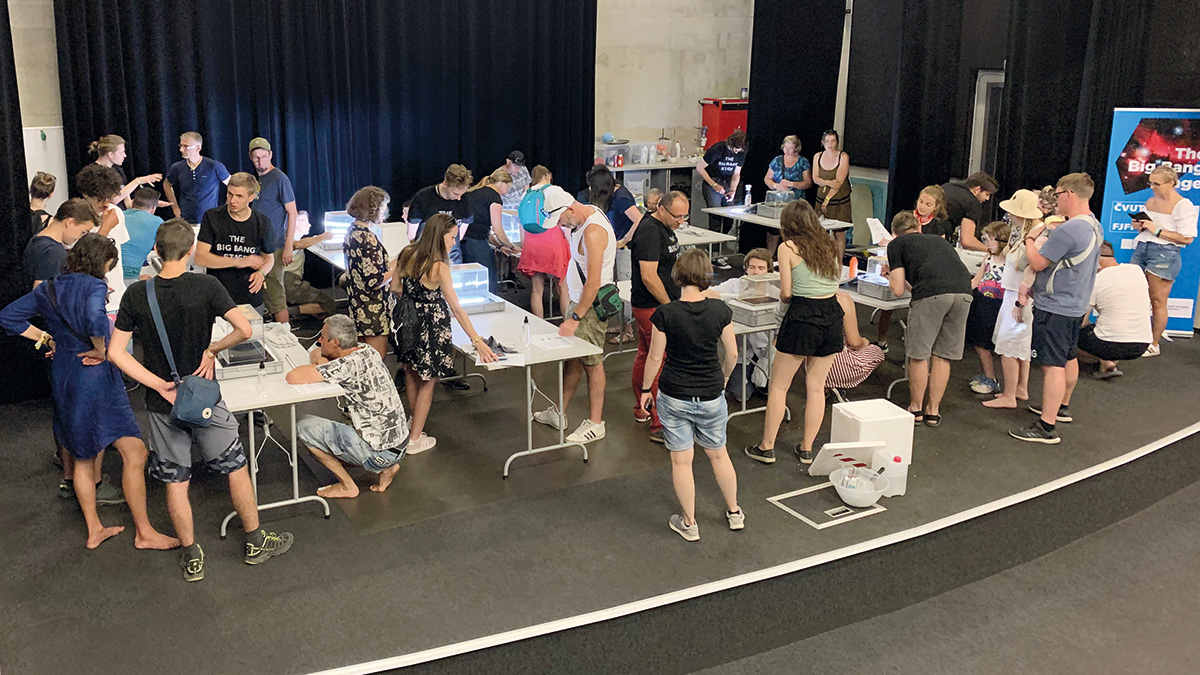
Neutrinos are the least understood of all elementary particles, and the fact that they have mass is a firm indication of physics beyond the Standard Model. Decades of effort have been devoted to exploring the properties of neutrinos. However, there are still many important questions to address. For example, little is known about the absolute mass scale and neutrino-mass ordering. Also, we have not achieved a decent measurement of the CP phase in the neutrino mixing “PMNS” matrix. Furthermore, the nature of neutrino masses, i.e. whether they are Dirac or Majorana, remains unknown.
From 30 July to 6 August the 23rd NuFACT workshop hosted by the University of Utah reviewed recent developments in neutrino physics, particle physics and astroparticle physics. The workshop brought together experts from all leading neutrino experiments and discussed theoretical aspects, with the aim of facilitating new connections between different disciplines and theorists and experimentalists.
Talking points
NuFACT2022 topics were spread into seven working groups: neutrino oscillations; neutrino scattering physics; accelerator physics; muon physics; neutrinos beyond PMNS; detectors; and inclusion, diversity, equity, education and outreach. The latter was newly established at this year’s workshop to become an integral part of the series.
Three mini-workshops took place. One explored plans for the second phase of the European Spallation Source neutrino Super Beam (ESSνSB) project, for which the European Union has recently decided to continue its support for another four years. This second phase will study new components that open additional physics opportunities including muon studies, precise neutrino cross-section measurements and sterile-neutrino searches.
The two-day mini-workshop “Multi- messenger Tomography of the Earth”, involving 22 talks, saw leading neutrino physicists and geoscientists exchange ideas on how Earth’s interior models may impact high-precision measurements of neutrino oscillation parameters. Participants also addressed the potential of using neutrino absorption at high energies (PeV–TeV) and neutrino oscillation at low energies (~GeV) inside Earth to locate the core–mantle boundary, determine the density of the core and mantle, and measure the chemical composition of the core. A third workshop targeted career development, with the aim of improving communication and negotiation skills among early-career scientists.
Progress in using neutrino-oscillation measurements to search for hints of new physics and symmetries in nature was discussed extensively. Central questions to be addressed include: is the neutrino-mixing angle θ23 exactly 45°, which might hint at a new symmetry in nature? Is the PMNS matrix unitary or could it indicate there are additional neutrinos or something fundamentally wrong with our understanding of the neutrino sector? Are there more than the three active neutrinos? Do we see indications for CP violation in the neutrino sector or is it even maximal? Do neutrino-mass eigenstates follow the same “normal” ordering as observed for quarks, for which there is currently a slight preference in the global fit data ?
The latest results from leading experiments including IceCube, KM3NeT/ORCA, NOvA,Super-K and T2K were presented. T2K presented a new analysis using the same data runs as last year, but using more data from the near and far detector samples combined with upgraded cross-section and flux models. T2K and NOvA data preferences on δCP and sin2θ23 are broadly compatible and joint fit results can be expected for late 2022. For the normal-mass ordering case, the most probable regions are distinct, and the significant contour overlap of 1σ, while no preference on CP violation can be inferred. For the inverted mass ordering case, T2K and NOvA contours overlap and are consistent with maximal CP violation in the neutrino sector.
Particularly competitive results of neutrino oscillation-parameter measurements with neutrino telescopes are available from IceCube–DeepCore and ORCA, and are now approaching the precision of accelerator-based neutrino experiments.
Various theoretical aspects of neutrino physics were covered. The nature of the neutrino mass, either Dirac or Majorana, remains a key focus. Different see-saw mechanism types and their experimental consequences were intensively discussed. In particular, recent progress in Majorana neutrino tests using both neutrinoless double-beta decay experiments as well as LHC measurements by the new FASER experiment were reported. Connecting neutrino and muon experiments, such as charged-lepton-flavour violation and the application of a possible muon collider to neutrino physics, were extensively addressed. The existence of sterile neutrinos and their properties remain of high importance to the field and future experimental results are highly anticipated, such as the short-baseline program at Fermilab and JSNS2 at J-PARC. Alternative explanations for various neutrino anomalies were also discussed, including more general dark-sector searches using neutrino experiments. The electron low-energy excess at MicroBooNE in particular draws attention. The focus is on improved event reconstructions, which may unveil the nature of this anomalous excess. Assuming the existence of one species of sterile neutrino, 3+1 oscillation analyses have been carried out to interpret the anomaly and compare with results from other experiments. Although inconclusive, this anomaly triggers many interesting ideas that will motivate follow-up studies.
Taking place shortly after the Snowmass Summer Meeting in Seattle (see Charting the future of US particle physics), NuFACT2022 also offered an opportunity to summarise the scientific vision for the future of neutrino physics in the US. The neutrino frontier in Snowmass has 10 topical groups, with physics beyond the Standard Model and neutrinos as messengers emerging as major focuses. Many possible synergies between neutrino physics and other branches of physics were also highlighted.
The International Union of Pure and Applied Physics (IUPAP) is an offspring of the International Research Council, a temporary body created after the First World War to rebuild and promote research across the sciences. IUPAP was established in 1922 with 13 member countries and held its first general assembly in Paris the following year. Originally, neither the International Research Council nor IUPAP included any of the countries of the Central Powers (Germany, Austria–Hungary, Bulgaria and the Ottoman Empire). Many lessons in science diplomacy had to be learned before IUPAP and the other scientific unions became truly international and physicists from all countries could apply to join. Today, with 60 member countries, the union strongly advocates that no scientist shall be excluded from the scientific community as long as their work is based on ethics and the principles of science in its highest ideals – an aspect that certainly will be further elaborated by the working group on ethics established by IUPAP in October last year.
Information exchange
Among IUPAP’s commissions covering all the different disciplines of physicsis the Commission on Symbols, Units, Nomenclature, Atomic Masses and Fundamental Constants (C2), formed in 1931. The task of this commission is to promote the exchange of information and views among the members of the international scientific community in the general field of fundamental constants. As an example, the international system of units (SI) was originally recommended by IUPAP in 1960, and C2 has maintained its role in recommending further improvements, including resolutions supporting the choice of constants to define the new SI as well as the decision to proceed with the redefinition of four of the seven units made in May 2019.
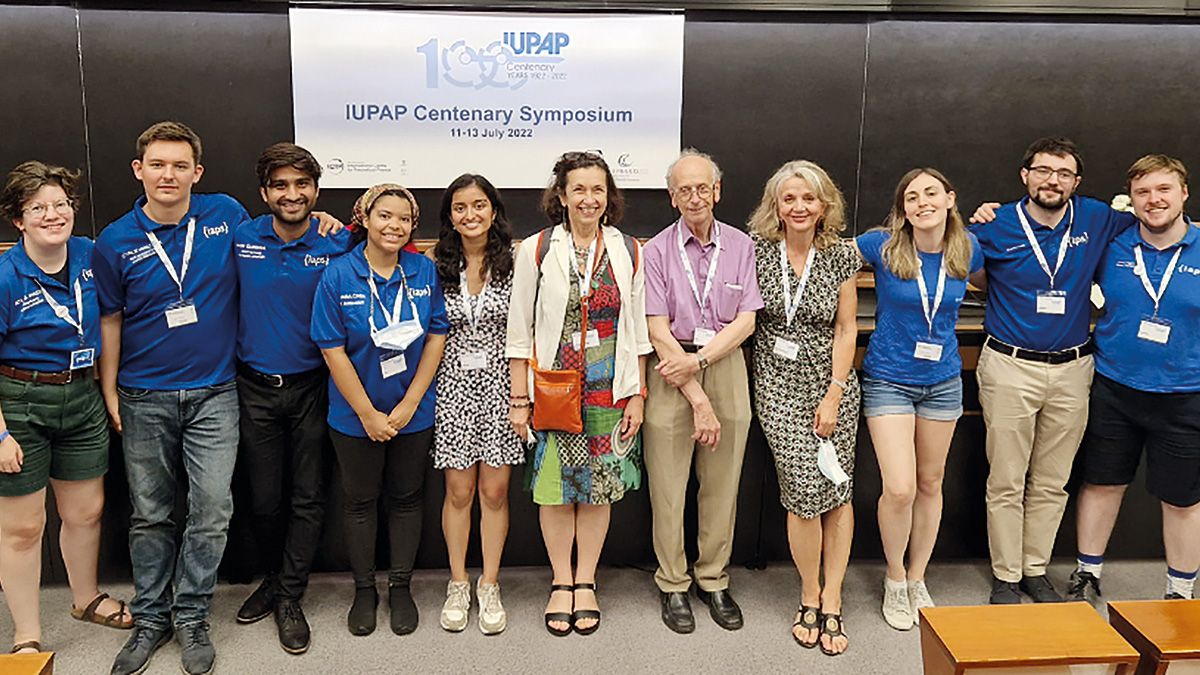
From 11 to 13 July, around 250 physicists from some 70 countries gathered to celebrate the 100th birthday of IUPAP at a symposium held at the Abdus Salam International Centre for Theoretical Physics (ICTP) in Trieste, Italy. The symposium was one of the official events of the International Year of Basic Sciences for Sustainable Development, which was officially inaugurated only a few days earlier at the UNESCO headquarters in Paris. About 40% of the participants were physically present, while the rest connected online. Various panels composed of international experts discussed important issues in alignment with the IUPAP’s core aims, including: how to support and encourage early-career physicists, how to improve diversity in physics, how to strengthen the ties to physicists working in industry, how to improve the quality of physics education, and how to promote physics in less developed countries.
IUPAP continues to promote physics as an essential tool for development and sustainability in the next century
A number of influential scientists, including Giorgio Parisi (La Sapienza) and Laura Greene (Florida State University), described their roles in providing evidence-based advice to their respective governments on science and shared best practices that could be useful across borders. Other prominent speakers included William Phillips (Maryland), who covered the quantum reform of modern metric systems; Donna Strickland (Waterloo), who discussed the physics of high-intensity lasers; and Takaaki Kajita (Tokyo), who presented 100 years of neutrino physics via an online connection with the International Conference on High Energy Physics (ICHEP) in Bologna. Climate scientist Tim Palmer (Oxford) argued that a supercomputing facility modelled on the organisation of CERN would enable a step-change in quantifying climate change, while Stewart Prager (Princeton) outlined a new project sponsored by the American Physical Society to engage physicists in reducing nuclear threat. Dedicated panels discussed the development of physics in Africa and the Middle East, Asia and the Pacific, and Latin America. It is clear that in these regions IUPAP has a large potential to foster further international collaboration.
IUPAP enhances the vital role of young physicists, among others, through the award of early-career scientist prizes. In Trieste, several recent recipients of the prize were invited to present their research. The talks were all striking and left the audience with high hopes for the future of physics. Furthermore, the logistics in the auditorium and the handling of all the questions that came in from online participants were smoothly taken care of by members of the International Association of Physics Students.
The centennial symposium was an opportunity to reflect on IUPAP’s role in promoting international cooperation and to welcome Ukraine as a new member. The decision to admit Ukraine was expedited to send a strong signal of support for the war-torn country – a war that has not spared its scientific institutions and the people who work there, as expressed by the president of the Ukrainian Academy of Sciences Anatoly Zagorodny in a powerful online presentation. IUPAP has issued a statement strongly condemning the Russian aggression in Ukraine, while also expressing the principle that no scientist should be excluded from union-sponsored conferences, as long as he or she carries out work not contributing to weapons development. To overcome difficulties related to conferences, IUPAP has put in place that excluded scientists can participate using the Union as their affiliation – similar to the model applied for the Olympic Games.
IUPAP has served the physics community for 100 years and has strong ambitions to continue to assist in the worldwide development of physics and to promote physics as an essential tool for development and sustainability in the next century.
In the dark abysses of the Mediterranean Sea, what promises to be the world’s largest neutrino telescope, KM3NeT, is rapidly taking shape. Using transparent seawater as the detection medium, its large three-dimensional arrays of photosensors will instrument a volume of more than one cubic kilometre and detect the faint Cherenkov light induced by the passage of charged particles produced in nearby neutrino interactions. The main physics goals of KM3NeT are to detect high-energy cosmic neutrinos and identify their astrophysical origins, as well as to study the fundamental properties of the neutrino itself.
KM3NeT (the Cubic Kilometre Neutrino Telescope) is the successor to the ANTARES neutrino telescope, which operated continuously from 2008 and has recently been decommissioned (see “The ANTARES legacy” panel). KM3NeT comprises two detectors: ARCA (Astroparticle Research with Cosmics in the Abyss), located at a depth of 3500 m offshore from Sicily, and ORCA (Oscillation Research with Cosmics in the Abyss), located at a depth of 2450 m offshore from southern France. ARCA is a sparse detector of about 1 km3 that is optimised for the detection of TeV–PeV neutrinos, while ORCA is a 7 Mt-dense detector optimised for sub-TeV neutrinos. The KM3NeT collaboration comprises more than 250 scientists from 16 countries.
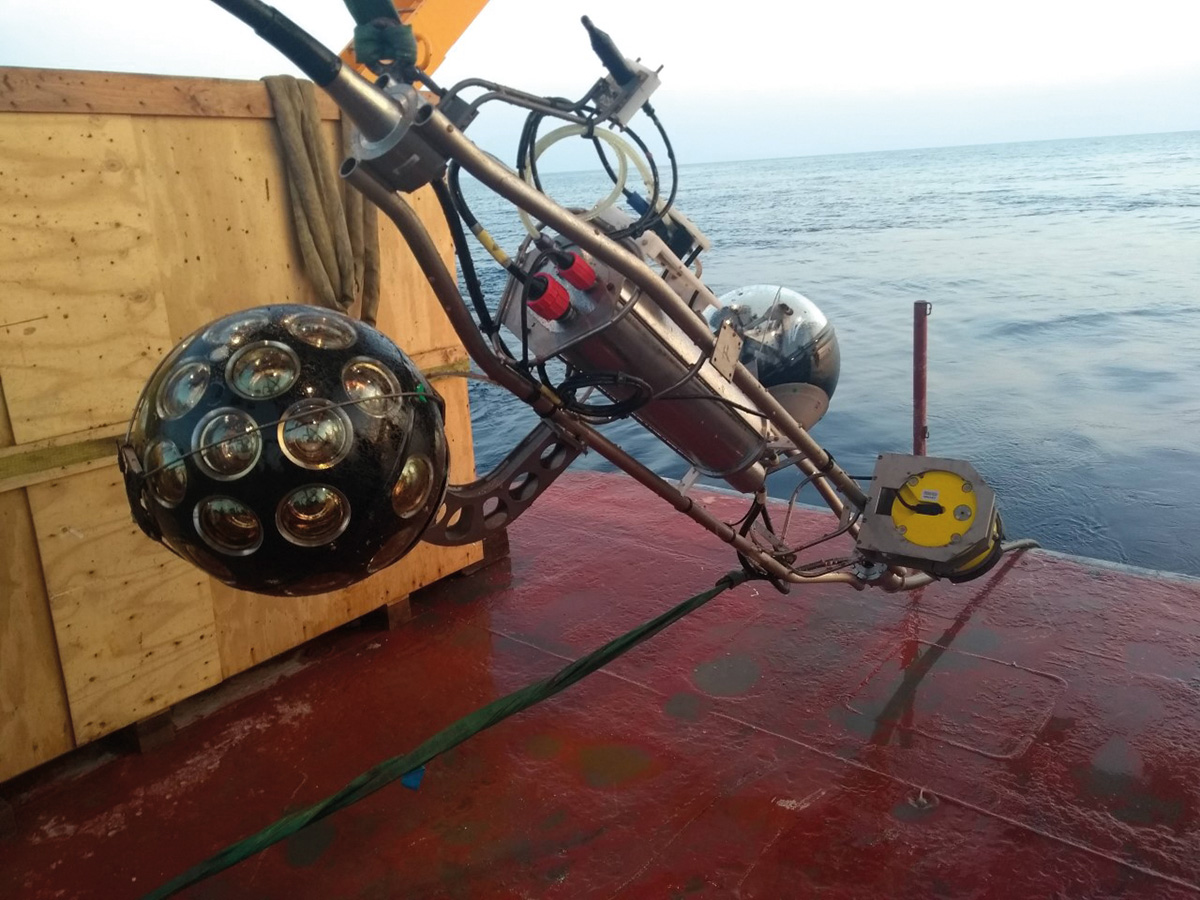
The key technology is the digital optical module (DOM) – a pressure-resistant glass sphere hosting 31 three-inch photomutiplier tubes, various calibration devices and the readout electronics (see “Modular” image). A total of 18 DOMs are hosted on a single detection line, and the lines are anchored to the seafloor and held taut by a submerged buoy. The ORCA detector will comprise around 100 lines and the ARCA detector will have twice as many. The bases of the lines are connected via cables on the seafloor to junction boxes, from which electro-opticalcables many tens of kilometres long bring the data to shore along optical fibres. Information on every single photon is transmitted to the shore stations, where trigger algorithms are applied to select interesting events for offline analysis.
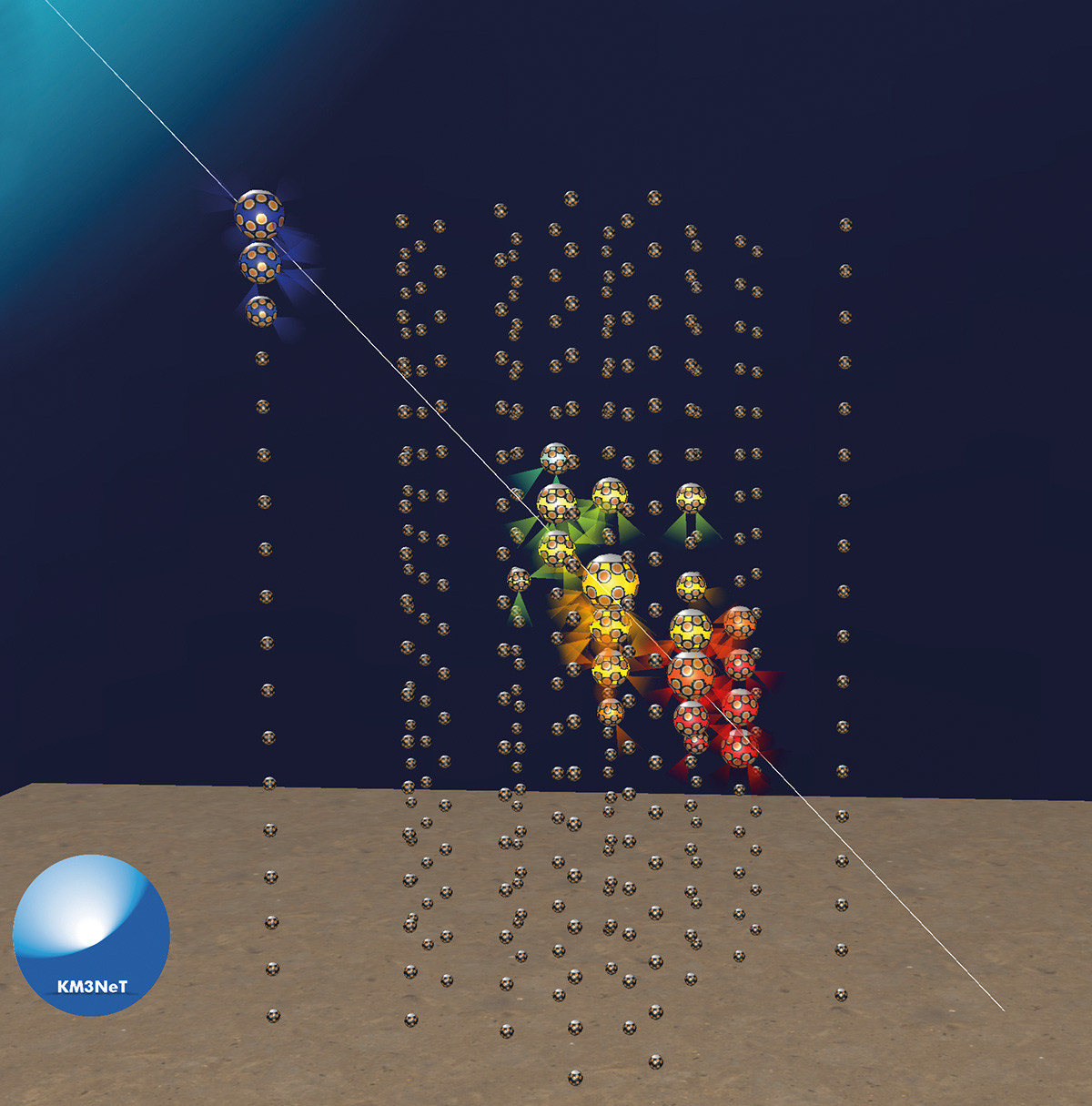
From the light pattern recorded by the DOMs, the energy and the direction of a neutrino can be estimated. Furthermore, the neutrino flavour can also be distinguished; muon neutrino charged–current (CC) interactions produce an extended track-like signature (see “Subsea shower” image) whereas electron– and tau–neutrino CC interactions, as well as neutral-current interactions, produce more compact shower-like events. By selecting up-going neutrinos, i.e. those that have travelled from the other side of Earth, the large background from down-going atmospheric muons can be rejected and a clean sample of neutrinos obtained.
The first KM3NeT detection line was connected in 2016 and currently a total of 32 lines are operating at the two sites. The first science results with these partial detectors have already been obtained.
Fundamental neutrino properties
Sixty-six years after their discovery, neutrinos remain the most mysterious of the fermions. As they whiz through the universe, barely interacting with any other particles, they have the unique ability to oscillate between their three different types or flavours (electron, muon and tau). The observation of neutrino oscillations in the late 1990s implies that neutrinos have a non-zero mass, contrary to the Standard Model expectation. Understanding the origin and order of the neutrino masses could therefore unlock a path to new physics. Numerous neutrino experiments around the world are closing in on the neutrino’s properties, using both artificial (accelerator and reactor) and natural (atmospheric and extraterrestrial) neutrino sources.
The KM3NeT/ORCA array is optimised for the detection of atmospheric neutrinos, produced when cosmic rays strike atomic nuclei at an altitude of around 15 km. Such interactions produce a cascade of particles on Earth’s surface, mostly pions and kaons, which decay to neutrinos capable of traversing the entire planet. About two thirds of these are muon neutrinos and antineutrinos, and the remainder are electron neutrinos and antineutrinos.
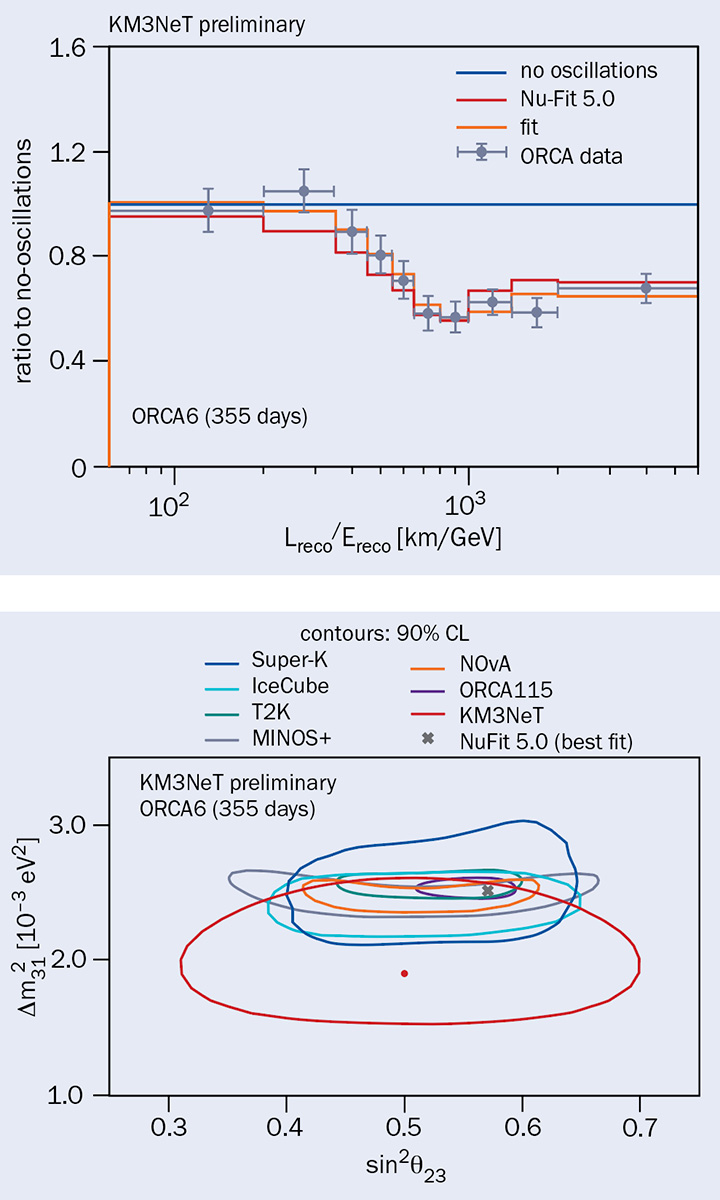
Measuring the directions and energies of the detected atmospheric neutrinos allows the oscillatory behaviour of neutrinos to be studied, and thus elements of the leptonic “PMNS” mixing matrix to be determined. The measured direction is used as a proxy for the distance the atmospheric neutrino has travelled through Earth between its points of production and detection. First preliminary results with six ORCA lines and one year of data clearly show the expected disappearance of muon neutrinos with increasing baseline/energy. The corresponding constraints on θ23 (the mixing angle between the m2 and m3 states) and Δm232 (the mass difference of the squared masses) already start to be competitive with multi-year results from the current long-baseline accelerator experiments (see “Physics debut” figure).
Building a telescope anchored deep at the bottom of the sea requires skill, patience and expertise. KM3NeT would not be on its way without the invaluable experience gained from its older sibling, the ANTARES telescope. ANTARES operated continuously for more than 15 years, and pioneered solutions to construct and operate a neutrino detector in the challenging environment of the deep sea. Despite ANTARES containing only 12 detector lines compared to 86 in IceCube, its superior angular resolution (due to the intrinsic water properties) and its Northern Hemisphere location provided competitive results and valuable insights and constraints in various domains.
Following IceCube’s discovery of a diffuse flux of cosmic neutrinos, the ANTARES all-flavour neutrino data sample revealed a mild (1.8σ) excess of high-energy events consistent with the neutrino signal detected by IceCube. ANTARES also contributed strongly to the multi-messenger endeavour, participating in the search for a neutrino counterpart to major alerts from the LIGO/Virgo gravitational-wave interferometers, IceCube, ground-based imaging air Cherenkov telescopes, as well as X- and gamma-ray satellites. For instance, the TXS0506+056 blazar is the second most significant point source, with a local significance of 2.8σ, strengthening its case as the first high-energy neutrino source. ANTARES also distributed its own neutrino alerts with an unprecedented low latency for a neutrino telescope.
Its energy threshold of a few tens of GeV allowed the study of atmospheric muon neutrino disappearance due to neutrino oscillations and to constrain the “3+1” neutrino model. In this domain, results consistent with world best-fit values were obtained, as well as competitive limits on non-standard interactions. The data were also used to search for dark-matter particles that would have accumulated in astrophysical bodies like the Sun or the galactic centre before annihilating or decaying into neutrinos. Since no excesses were found, competitive limits were set that reduce the parameter space to be explored by direct, indirect (including KM3NeT) and collider dark-matter experiments.
Recently superseded in sensitivity by KM3NeT, ANTARES was finally decommissioned in February 2022.
A longer-term physics goal of KM3NeT is to determine the neutrino mass ordering, i.e. whether the third neutrino mass eigenstate is heavier or lighter than the first two. This is important to help constrain the plethora of theoretical models proposed to explain the neutrino masses. Due to the large distances travelled by atmospheric neutrinos as they pass through Earth’s mantle and core, subtle matter effects come into play and distort the expected oscillation pattern in the zenith angle/energy plane. By comparing the observed distortions to those expected for either “normal” or “inverted” mass ordering, and thanks to the large neutrino sample collected, the neutrino mass ordering can be determined.
A 115-line configuration of ORCA operating for three years is expected to provide a three-sigma sensitivity for most θ23 values. KM3NeT could therefore be the first detector to unambiguously determine the neutrino mass ordering, on a time scale in advance of the planned long-baseline accelerator experiments. New-physics scenarios (for example, non-standard interactions, neutrino decays and sterile neutrinos) that modify the oscillation patterns recorded in both ORCA and ARCA have already been explored. While no significant deviations from the Standard Model have been observed, the enhanced sensitivity as the detectors grow will push the existing limits and probe uncharted territories.
Neutrino astronomy
At the beginning of the 1960s, it was realised that the neutrino could play a special role in the study of the universe at large. Weakly interacting with matter and electrically neutral, it enables exploration at greater distances and higher energies than is possible with conventional electromagnetic probes. In addition, neutrinos are the unambiguous smoking gun of hadronic acceleration processes occurring at their source.
Since the observation of a significant flux of cosmic high-energy neutrinos in the TeV–PeV range by the IceCube Neutrino Observatory at the South Pole in 2013, the focus of neutrino astronomers has been to identify the astrophysical origins of these neutrinos. Amongst the diverse possible sources, a multi-messenger approach has identified the first: the flaring blazar TXS0506+056. While other source candidates have appeared, such as tidal disruption events and radio-bright blazars, the currently identified source population(s) cannot fully explain the detected flux. Having a neutrino telescope with a sensitivity similar to that of IceCube and with a complementary field of view allows the full neutrino sky to be continuously monitored. KM3NeT’s location in the Northern Hemisphere provides an optimal view of the galactic plane and makes it the ideal instrument to detect, characterise and resolve sources that may emit galactic neutrinos.
Soon, KM3NeT will start sending alerts to its multi- messenger partners – including conventional electromagnetic telescopes but also other neutrino telescopes such as IceCube and Baikal/GVD – when a neutrino candidate with a high probability of astrophysical origin is detected. This is right on time for the fourth observing run of the LIGO, Virgo and KAGRA gravitational-wave interferometers. While so far no neutrinos have been observed from binary compact systems detected through gravitational waves, a joint detection would reveal unique information on the high-energy processes in the environment of the mergers. Furthermore, the exceptional pointing resolution of KM3NeT would significantly reduce the region of interest where electromagnetic partners should search for a counterpart. The ARCA detector, for example, will benefit from the low optical scattering of deep seawater to reconstruct the direction of muon-neutrino events to less than 0.1 degrees at 100 TeV and around 1 degree for the electron/tau neutrino flavours.
Last but not least, KM3NeT is already waiting for the next close-by core-collapse supernova. Such astrophysical events are rare: the first and only one ever detected in neutrinos, SN1987a, occurred 35 years ago. The KM3NeT DOMs are continuously monitoring for a short-duration increase in counting rates on many DOMs simultaneously – the signature of a flash of MeV supernova neutrinos passing through the detectors – and the detector is networked with other neutrino telescopes via the SuperNova Early Warning System (SNEWS). If a galactic supernova would happen today, the number of neutrinos detected by SNEWS would be four orders of magnitude more than for SN1987a!
Whether the cosmic-neutrino sources are point-like, extended, transient or variable, the KM3NeT collaboration has developed reconstruction techniques, event selections and statistical frameworks to identify them and determine their characteristics. Disentangling the galactic from the extragalactic components, the steady from the transient and the electromagnetically bright from the obscure are on KM3NeT’s to-do list for the coming decade.
Marine science
KM3NeT is important not only for particle physics, but is also a powerful tool for marine sciences. The acquisition of long-term oceanographic data helps researchers understand and eventually mitigate the harmful effects of global processes, such as climate change and anthropogenic impact, as well as study episodic events such as earthquakes, tsunamis, biodiversity changes and pollution – all of which are difficult to study with short-term conventional marine expeditions. To this end, the seafloor infrastructures of first the ANTARES and now the KM3NeT sites are unique cabled marine observatories. They are open to all scientific communities, and as such are important nodes of the European Multidisciplinary Seafloor and water-column Observatory, EMSO.
Sixty-six years after their discovery, neutrinos remain the most mysterious of the fermions
Furthermore, the KM3NeT optical sensors and the acoustics sensors (used for the positioning of the DOMs) themselves provide unique information on deep-sea bioluminescence and bioacoustics. The ANTARES collaboration has several publications studying deep-sea bioluminescence and acoustic detection of cetaceans, and recently KM3NeT invited citizen scientists to analyse its optical and acoustic data via the Zooniverse platform in the context of the EU project REINFORCE.
The KM3NeT detectors will continue to grow in size and sensitivity as additional new lines are installed over the next five years. With three major neutrino telescope facilities now online – Baikal/GVD, IceCube and KM3NeT – neutrino astronomy is truly entering its golden era.
During the past several decades of intense experimental and theoretical research, particle physicists have come to rely on the Standard Model to describe phenomena at the smallest scales and highest energies. This highly predictive, relativistic spontaneously-broken gauge theory has pointed the way to a sequence of discoveries, including that of the W and Z bosons, the gluons, and the charm and top quarks. At each point, it gave us an approximate mass scale or energy range to explore, which told us what kind of facilities we needed to build to observe predicted phenomena. Finally, in 2012, its most remarkable prediction – the existence of a Higgs particle associated with an apparently fundamental scalar field responsible for electroweak symmetry breaking – was confirmed. There are, however, big questions in particle physics to which we don’t know the answers.
Every seven to 10 years since 1982, high-energy physicists in the US have undertaken a community planning exercise to identify the most important questions for the following two decades and the facilities, infrastructure and R&D needed to pursue them. For many years these efforts, which are sponsored by the Division of Particles and Fields (DPF) of the American Physical Society (APS) and include scientists from other countries and related fields, concluded with a summer workshop in Snowmass, Colorado. The planning exercise focuses on scientific issues, whereas establishing project priorities is the task of a Particle Physics Project Prioritization Panel “P5”, charged by the US Department of Energy (DOE) and the National Science Foundation (NSF).
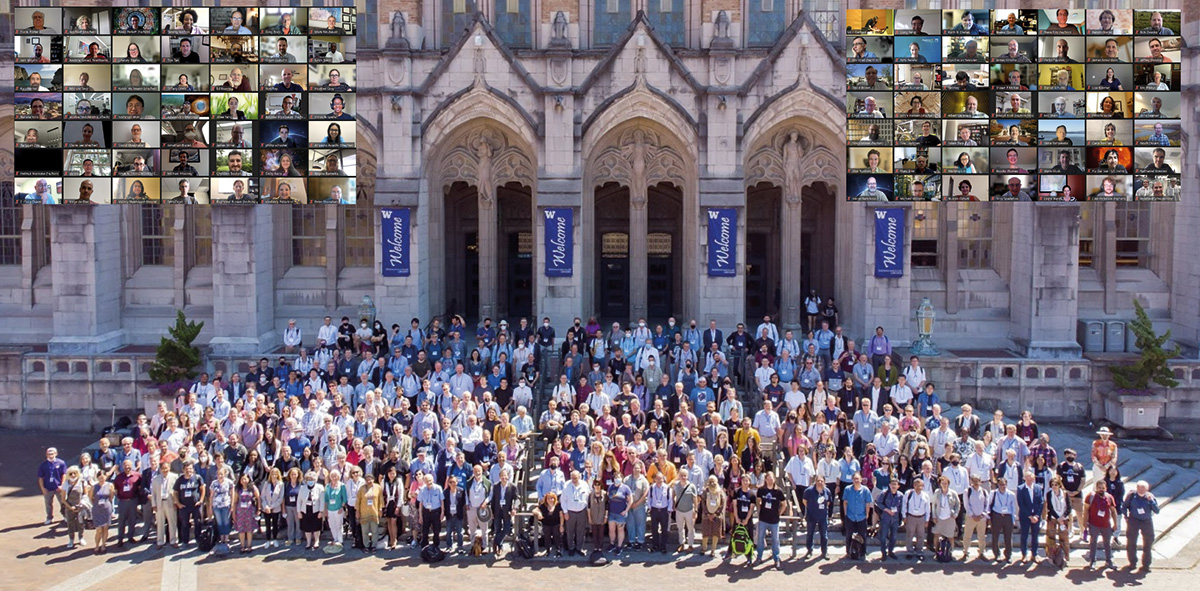
The latest study, “Snowmass 2021” (CERN Courier January/February 2022 p43) was meant to conclude in July 2021, but had to be delayed due to the COVID-19 pandemic. Despite the challenges, our community accomplished an amazing amount of work. The final discussions and synthesis of all the white papers, seminars, workshops and other materials took place at the University of Washington in Seattle from 17–26 July 2022. At the end of themeeting, Hitoshi Murayama (UC Berkeley and the University of Tokyo) was named chairperson of the new P5 subpanel, which will take input from Snowmass 2021.
Snowmass in context
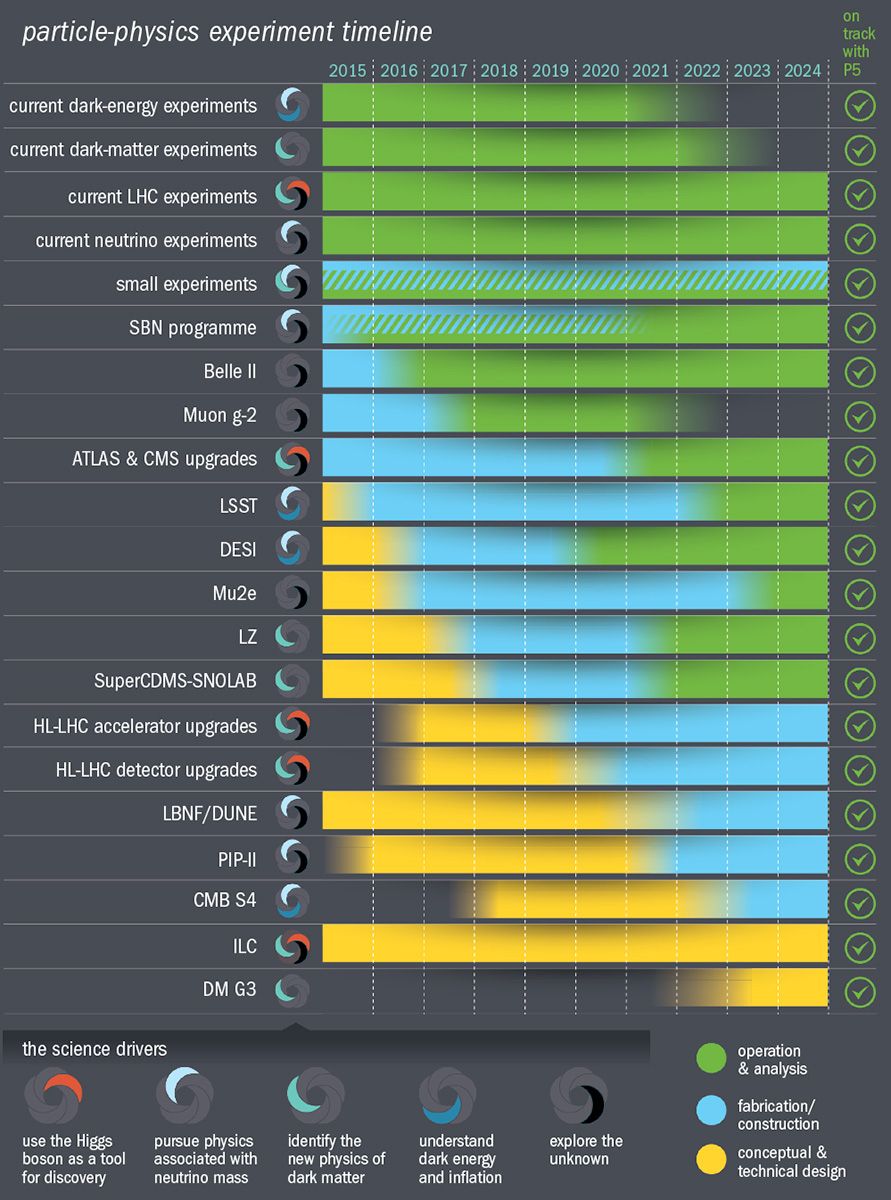
The last US community planning exercise was held in 2013. The subsequent P5 report synthesised the questions identified into five physics drivers: use the Higgs boson as a tool for discovery; pursue the physics associated with neutrino mass; identify the new physics of dark matter; understand cosmic acceleration; and explore the unknown. It also made 29 project-oriented recommendations. The two projects assigned the highest priority were participation in the High-Luminosity LHC and the ATLAS and CMS experiments; and the construction of the LBNF/DUNE long-baseline neutrino experiment, which will detect neutrinos produced at Fermilab interacting in massive underground detectors 1300 km away in the Homestake mine in South Dakota.
Nearly a decade since the last Snowmass/P5 exercise, some elements of the recommended experimental programme have taken data and have succeeded in pushing the boundaries of our knowledge. But despite some hints, they have not yet produced a result that points us in a specific direction. Snowmass 2021 reconfirmed the relevance of the physics drivers, and added a proposal for a sixth: flavour physics as a tool for discovery. Specifically, we don’t understand why three generations of matter particles exist nor the origin of the mass patterns that they exhibit. We do not know why the quark and the lepton mixing matrices are so different, or whether CP violation exists in the neutrino sector and how it relates to the observed matter–antimatter asymmetry of the universe. There are, currently, several tantalising hints of new particles and interactions that could explain various anomalies in the weak decays of B mesons and the anomalous magnetic moment of the muon. Depending on what the near-future brings, dedicated next-generation flavour experiments are likely to be required and could play a key role in the quest for physics beyond the Standard Model.
Snowmass 2021 was organised into 10 working groups or “frontiers”: accelerator, cosmic, community engagement, computational, energy, instrumentation, neutrinos, rare processes and precision measurements, theory, and underground facilities and infrastructure. Each frontier divided its work into several topical groups, taking into account input from the 2020 update of the European strategy for particle physics and other international studies. More than 500 new white papers were produced. An early-career organisation assisted young physicists in contributing to the Snowmass process and international participation was encouraged, with leaders of international institutes and laboratories including Fabiola Gianotti (CERN), Masanori Yamauchi (KEK) and Yifang Wang (IHEP) giving presentations during special plenary sessions at the Seattle workshop. In describing the US programme, Fermilab director Lia Merminga emphasised the importance of international collaboration, citing the close relationship between the US and CERN.
There was broad agreement that a successful future programme should include a healthy breadth and balance of physics topics, experiment sizes and timescales, supported via a dedicated, robust and ongoing funding process. Completion of existing experiments and execution of DUNE and the HL-LHC programmes are critical for addressing the science drivers in the near-term. Strong and continued support for formal theory, phenomenology and computational theory is needed, as are stronger, targeted efforts connecting theory to experiment. Both R&D directed to specific future projects and generic research needs to be supported in critical enabling technologies such as accelerators, instrumentation/detectors and computation, and in new ones such as quantum science and machine learning. Finally, a cohesive, strategic approach to promoting diversity, equity and inclusion, and to improving outreach and engagement, is required.
A panoply of ideas were discussed at Snowmass 2021. Here, in the context of the 10 frontiers, we list some of the larger projects and programmes that are proposed to be carriedout, or at least started, in the next two decades, and some important conclusions concerning enabling technologies and infrastructure, with the disclaimer that these may change as the final Snowmass frontier reports are written.
The cosmic frontier
The cosmic frontier is focused on understanding how fundamental physics shapes the behaviour of the universe, in particular concerning the nature of dark matter (DM) and dark energy. The space of DM models encompasses a dizzying array of possibilities representing many orders of magnitude in mass and couplings, making the DM programme one of the most interdisciplinary investigations in high-energy and particle physics. The cosmic frontier DM programme will “delve deep, search wide” by employing a range of direct searches for WIMPs interacting with targets on Earth or produced at accelerators, indirect searches for the products of DM annihilation and probes based on analyses of cosmic structure. A complementary thrust is building the next generation of cosmological probes. The next big project in this arena is CMB-S4, a system of telescopes to study the cosmic microwave background and address the mystery of cosmic inflation, which is expected to operate through to at least 2036 (CERN Courier March/April 2022 p34). Additional projects that would start after 2029 are Spec-S5 (the follow-on spectroscopic device to DESI), a project to carry out line intensity mapping (LIM), and planning efforts to increase the sensitivity of gravity wave detection by at least a factor of 10 (103 in sensitive volume)beyond what will be achieved by LIGO/Virgo.
The immediate goal for the energy frontier is to carry out the 2014 P5 recommendations to complete the HL-LHC upgrade and execute its physics programme. A new aspect of the proposed programme is the emergence of a variety of auxiliary experiments, examples of which are FASER (operational) and MATHULSA (proposed), that can use the existing LHC interaction regions to explore parts of discovery space in the far-forward regions. These are mid-scale detectors in cost and complexity, and provide room for additional innovation at the HL-LHC. The energy frontier supports the construction of a global e+e– Higgs factory as soon as possible. Either a linear collider or a circular collider can provide the necessary sensitivity, and a programme of directed detector and accelerator R&D for a Higgs factory is needed immediately to enable US participation. To ensure the long-term viability of the field, the energy frontier wants to begin accelerator and detector R&D towards a 10 TeV muon collider or a 100 TeV-scale hadron collider, in collaboration with partners worldwide. Finally, the US energy-frontier community has expressed renewed interest and ambition to develop options for an energy-frontier collider that could be sited in the US, specifically either an e+e– Higgs factory or a muon collider, while maintaining its international collaborative partnerships and obligations with, for example, CERN future-collider R&D projects.
The neutrino frontier
What are the neutrino masses? Are neutrinos their own antiparticles? How are the masses ordered? What is the origin of neutrino mass and flavour? Do neutrinos and antineutrinos oscillate differently? And are there new particles and interactions that can be discovered? These are among the fascinating questions elaborated by the neutrino frontier. The DUNE R&D programme, propelled by the development of large-scale liquid-argon detectors in the US and Europe, in particular through the CERN Neutrino Platform, has demonstrated the power and feasibility of this technique. Following the completion of DUNE Phase 1 by 2030, DUNE Phase 2 is the neutrino community’s highest priority project for 2030–2040. The Phase 2 project has three components: a replacement of the Fermilab 8 GeV Booster to deliver 2.4 MW to the DUNE target and possibly to provide beam for other experiments; the construction of an additional 20 kT (fiducial) of far-detectors at Homestake; and a fully capable near-detector complex at Fermilab to provide very precise control of the systematic uncertainties for the far-detector measurements, besides carrying out a rich physics programme of their own. DUNE will perform definitive studies of neutrino oscillations, test the three-flavour paradigm, search for new neutrino interactions, and will resolve the mass hierarchy question and hopefully observe CP violation. There are many other aspects of neutrino physics that merit study, including the absolute mass, the search for neutrinoless double beta decay (which bears on the issue of whether the neutrino is a Dirac or a Majorana fermion), the measurement of cross sections, and the search for sterile neutrinos. Several of these will be part of the US neutrino programme, either based in the US or through collaboration abroad.
Rare processes and precision measurements
The rare processes and precision measurements frontier is currently working on two mid-sized US projects at Fermilab endorsed by P5 in 2014: the Muon g−2 experiment, which has produced exciting results and will continue to take data for at least a few more years; and the Mu2e experiment, which is under construction. The programme also has important investments in flavour physics through support of the Belle II experiment in Japan and LHCb at CERN. Priorities for the next few years are to complete g−2, begin taking data with Mu2e, and continue collaboration at Belle II and LHCb, including participation in future upgrades. Looking ahead, the central themes are to understand quark and lepton flavour and its violation measurements, and the search for dark-matter production in the mass range from sub-MeV to a few GeV in fixed-target proton and electron experiments. There is a proposal to study muon science in an advanced muon facility at Fermilab that would greatly improve the search for lepton-flavour violation in µ → eγ, µN → eN and µ → 3e decays. This would require an intense proton beam with unique characteristics and accumulator rings to manage the production of muon beams with different energies and time profiles.
Theory frontier
Theoretical particle physics seeks to provide a predictive mathematical description of matter, energy, space and time that synthesises our knowledge of the universe, analyses and interprets existing experimental results and motivates future experimental investigation. Theory connects particle physics to other areas (e.g. gravity and cosmology) and extends the boundaries of our understanding (e.g. quantum information). Together, fundamental, phenomenological and computational theory form a vibrant ecosystem whose health is essential to all aspects of the US high-energy physics programme. The theory frontier recommends, among others, invigorated support for a broad programme of research as part of a balanced portfolio and an emphasis on targeted initiatives to connect theory to experiment.
Nearly a decade since the last Snowmass exercise, the recommended experimental programme has succeeded in pushing the boundaries of our knowledge
Accelerator frontier
The accelerator frontier, which has many crossovers with the energy frontier, aims to prepare for the next generations of major accelerator-based particle physics projects to explore the energy, neutrino and rare-process-and-precision frontiers. In the near term, a multi-MW beam-power upgrade of the Fermilab proton accelerator complex is required for DUNE phase 2. Studies are required to understand what other requirements the Fermilab accelerator complex needs to meet if the same upgrade is to be used for related rare-decay and precision experiments. In the energy frontier, a global consensus for an e+e– Higgs factory as the next collider has been reaffirmed. While some options (e.g. the International Linear Collider) have mature designs, other options (such as FCC-ee, C3, HELEN and CLIC) require further R&D to understand if they are viable. In order to further explore the energy frontier, a very high-energy circular hadron collider or a multi-TeV muon collider will be needed, both of which require substantial study to see if construction is feasible in the decade starting 2040 or beyond. It is proposed that the US establish a national integrated R&D programme on future colliders to carry out technology R&D and accelerator design studies for future collider concepts. Since machines of this magnitude will require international collaboration, the US R&D programme must be well-aligned and consistent with international efforts. Also under consideration are new acceleration techniques, such as wakefield acceleration, and ERLs, along with proposed R&D programmes that could indicate how they would contribute to the design of future colliders.
Computational frontier
Software and computing are essential to all high-energy physics experiments and many theoretical studies. However, computing has entered a new “post-Moore’s law” phase. Speed-ups in processing now come from the use of heterogeneous resources such as GPUs and FPGAs developed in the commercial sector, with significant implications for the way we develop and maintain software. We are also beginning to rely on community hardware resources such as high-performance computing centres and the cloud rather than dedicated experiment resources. Finally, new machine-learning approaches are changing the way we work. This new computing environment requires new approaches to address the long-term development, maintenance and user support of essential software packages and cross-cutting R&D efforts. Additionally, strong investment in career development for software and computing researchers is needed to ensure future success. The computational frontier therefore recommends the creation of a standing coordinating panel for software and computing under the auspices of the APS DPF, mirroring the Coordinating Panel for Advanced Detectors established in 2012.
Instrumentation frontier
Improved instrumentation is the key to progress in neutrino physics, collider physics and the physics of the cosmic and rare-processes frontiers. Many aspects now at the cutting-edge of detector development were hardly present 10 years ago, including quantum sensors, machine-learning and precision timing. Funding for instrumentation in the US, however, is actually declining. Key elements of a rejuvenated instrumentation effort include programmes to develop and maintain a sufficiently large and diverse workforce, including physicists, engineers and technicians at universities and national laboratories; double the US detector R&D budget over the next five years and modify funding models to enable R&D consortia; expand and sustain support for innovative detector R&D and establish a separate review process for such pathfinding endeavours; and develop and maintain critical facilities, centres and capabilities for sharing knowledge and tools.
Underground experiments address some of the most important areas of particle physics, including the search for dark matter, neutrino physics (including neutrinoless double beta decay and atmospheric neutrinos), cosmic-ray physics and searches for proton decay. The underground frontier concluded that future experiments and their enabling R&D require more space than is currently planned. They proposed a possible addition of the underground space at a depth of 4850 feet at SURF/Homestake and possible additional space at a depth of 7400 feet. These would open up space to develop new experiments and would provide the opportunity for SURF to host next-generation dark-matter or neutrinoless double beta decay experiments.
Community engagement
The community engagement frontier concentrated on seven areas: interaction with industry; career pipeline and development; diversity, equity and inclusion; physics education; public education and outreach; public policy and government engagement; and environmental and societal impacts. The inclusion of this broad array of issues as a “frontier” was a novel aspect of Snowmass 2021 and led to the formulation of many proposals for consideration and implementation by the community as a whole. These issues impact the ability of all frontiers to successfully complete their work, and some, such as the need to broaden representation, are highlighted by other frontiers too. While many recommendations apply directly to the DOE and NSF programmes and could be considered by P5, many others are directed to the HEP community as a whole. We in DPF are considering how best to pursue these issues with government agencies, APS and other groups.
The exciting road ahead
Almost three months since the Seattle workshop, the individual frontier reports are now nearly all complete and the process of synthesising the results has begun. One important theme is to stay the course on the programme approved by the last P5 in the hopes that the hints and anomalies that have shown up since then will provide some guidance for physics beyond the Standard Model. The second theme is that, in the absence of a specific target, we will have to plan a very diverse programme of experiments, theoretical studies and machine and detector R&D in which we broadly explore the large space of possibilities. In all cases, a global effort will be required, and much thought is being applied to ensuring that the US can play an appropriate role.
A global effort will be required, and much thought is being applied to ensuring that the US can play an appropriate role
We believe that members of the US high-energy physics community left the Seattle workshop with an appreciation of the great opportunities present in each frontier, the interconnections between the frontiers and the connections to programmes in the rest of the world. We hope that our report will help P5 produce recommendations that we can unite behind, as we did in 2014. That has proven to be an effective step in convincing the public and policy makers that we have conducted a rigorous process and achieved a consensus that is worthy of their support.
Studies of rare B-meson decays at the LHC provide a sensitive probe of physics beyond the Standard Model (SM) and allow us to explore energy scales much higher than those directly accessible. A key factor in the success of these studies is the availability of precise theoretical predictions that can be compared with experimentally accessible processes. The dimuon decays B0S→ μ+μ– and B0→ μ+μ– are a case in point. In particular, studies of these decays could help researchers to understand the nature of several anomalies seen in other rare B-meson decays.
The CMS collaboration recently reported a new measurement of the B0S→ μ+μ– branching fraction and effective lifetime, as well as the result of a search for the B0→ μ+μ– decay, using data recorded during LHC Run 2. This new study benefits not only from a large event sample but also from advanced machine-learning algorithms, which are used to uncover the rare signal events out of the overwhelming background. The B0S→ μ+μ– signal is very clearly seen (see figure 1), leading to more precise measurements than previously achieved. The B0S→ μ+μ– branching fraction is measured to be (3.8 ± 0.4) × 10–9, the relative uncertainty of 11% being a remarkable improvement with respect to that of the previous CMS result, 23%.
This measured value is consistent with the SM prediction of (3.7 ± 0.1) × 10–9, and reduces a previous tension between theory and experiment, which was based on the combination of the previous CMS result with the ATLAS and LHCb values. The variation in the central value of the CMS measurements is mostly driven by the use of a larger data sample and by the change of the B-hadron fragmentation fraction ratio (by about 8%). The measured effective lifetime of the B0S→ μ+μ–decay, 1.8 ± 0.2 ps, is also consistent with the SM prediction. The precision of this measurement is approaching the level necessary to probe the CP properties of B0S→ μ+μ–, which could differ from the SM prediction. Finally, the B0→ μ+μ– decay remains unseen.
CMS physicists are looking forward to continuing these rare-decay studies with the large data samples to be collected during LHC Run 3. Besides the improved precision expected for B0S→ μ+μ– measurements, seeing the first evidence of B0→ μ+μ– is high on their wish list.
The LHCb experiment is designed to study heavy-flavour particles containing beauty and charm quarks. Nevertheless, thanks to the large strangeness production cross-sections at the LHC as well as the excellent reconstruction performance of LHCb at low momenta, the experiment is also able to produce precise results in strange decays, complementary to those from dedicated experiments such as NA62 and KOTO. The collaboration has recently released a “trillio-scale” upper limit on the branching fraction of the decay K0S→ μ+μ–μ+μ–, being the first at this scale at the LHC. The same dataset was used to search for K0L→ μ+μ–μ+μ–, yielding the world best upper limit f and the first LHC result on a K0L decay.
According to the Standard Model (SM), K0S (K0L) mesons decay into four muons at a very small rate of a few 10–14 (10–13). The decay rates of these processes are very sensitive to possible contributions from new, yet-to-be discovered particles such as dark photons, which could significantly enhance or suppress the decay rate via quantum interference with the SM amplitude. Despite the unprecedented K0-meson production rate at the LHC, performing this search is challenging due to the low transverse momentum (typically a few hundred MeV) of the muons. LHCb exploits its unique capability to select, in real time, low transverse-momentum muons – a capability that has improved in recent years thanks to the versatility of its online trigger system. The analysis used machine learning to discriminate long-lived particles from combinatorial background, as well as a data-driven and detailed map of the detector material around the interaction point. The invariant mass of the four-muon system is used as a control variable to statistically separate the potential signal from the remaining combinatorial background.
No selected event consistent with the decay of K0S into four muons, which should appear in the region around the K0S mass of 498 MeV, was observed (see figure 1). In the absence of a signal, upper limits on the respective branching fractions are set to 5.1 × 10⁻¹² for the K0S decay mode and 2.3 × 10⁻⁹ for the K0L mode at 90% CL. These results represent the world’s most precise searches for these decays, and the branching fraction for K0S→ μ+μ–μ+μ– is the most stringent upper limit on a K0S decay mode.
The upgraded LHCb detector, which started data-taking this year, offers excellent opportunities to further improve the search precision and eventually find evidence of this decay. In addition to the increased luminosity, the LHCb upgrade has a fully software trigger, which is expected to significantly improve the efficiency for K0 decays into four muons and other decays with very soft final-state particles.
The study of elastic hadron scattering is a cornerstone in understanding the non-perturbative properties of strong interactions. A key role is played by experiments at the LHC, where it is possible to precisely measure proton–proton (pp) interactions at a very high centre-of-mass energy. The goal is to detect the process pp → pp, in which the interacting protons remain intact and are scattered at angles of a few microradians with respect to the beamline. The importance of such measurements follows from their relation to the total hadronic pp cross section via the optical theorem, and to properties of proton interactions at asymptotically high energies via dispersion relations.
In ATLAS, elastic scattering is studied using a dedicated experimental setup – the ALFA detectors, which allow measurements of scattered-proton trajectories inside the beam pipe, just a few millimetres from the LHC beam. They are installed inside so-called Roman pots located at distances of 237 and 245 m on either side of the ATLAS interaction point.
Recently, ATLAS reported a measurement of elastic scattering at a centre-of-mass energy of 13 TeV. The data were collected with a special setting of the LHC magnets characterised by a high β* of 2500 m, which results in a large beam-spot size and a very small beam divergence. The latter allows precise measurements of small scattering angles. With these optics, the ALFA system detected events characterised by very small values of the Mandelstam t variable, which is proportional to the scattering angle squared. Measurements of small |t| values give access to the Coulomb–nuclear interference (CNI) kinematic region, where the contribution from electromagnetic and strong interactions are of similar magnitude.
The ALFA detectors use scintillating- fibre technology to measure the position of the passing proton. The t value for each event is reconstructed from the measured positions using knowledge of the magnetic fields of the LHC magnets between the interaction point and the detectors. The selection of candidate events is based on the strong correlations between the elastically scattered protons, resulting from energy and momentum conservation. The analysis is heavily based on data-driven techniques, which are used for the alignment of the detectors, background estimation, evaluation of reconstruction efficiency and optics tuning.
Figure 1 presents the measured differential elastic cross section as a function of t. The shape of the distribution is sensitive to important physics parameters, such as the total cross section (σtot) and the ρ parameter, defined as the ratio of real to imaginary parts of the forward scattering amplitude. The smallest |t| values, and thus the smallest scattering angles, are dominated by the electromagnetic interaction between the protons. The CNI effects are strongest for |t| around 10–3 GeV2 and provide the sensitivity to the ρ parameter. For larger |t| values, the strong interaction dominates, and the spectrum depends on the value of σtot. The physics parameters are extracted from a fit to the t distribution.
The ρ parameter is related, through dispersion relations, to the energy dependence of σtot, with a certain sensitivity also to energies above those at the LHC. In addition, ρ is sensitive to possible differences between pp and pp scattering amplitudes at asymptotic energies. ATLAS measured ρ = 0.098 ± 0.011, in agreement with a previous TOTEM measurement. The result is in conflict with pre-LHC theoretical expectations (see the COMPETE line in figure 2), which assumed that no pp/pp difference is present asymptotically and that σtot increases proportionally to the squared logarithm of the centre-of-mass energy, similarly to the evolution observed at accessible energies back then. This suggests that one of the above assumptions is incorrect: either the increase of σtot slows down above LHC energies, or protons and antiprotons interact differently at asymptotic energies. The second statement is often associated with the so-called odderon exchange. Both possibilities affect our understanding of the high-energy behaviour of strong interactions.
ATLAS also measured the total pp hadronic cross section σtot = (104.7 ± 1.1) mb. This is the most precise measurement to date at this energy, due to a dedicated luminosity measurement that contributed less than 1 mb to the total systematic uncertainty. However, the long-standing tension between the ATLAS and TOTEM σtot measurements, with the latter being about 5% higher than ATLAS, persists.
ATLAS has collected more elastic scattering data in LHC Run 2, which are currently being analysed. New data taking is planned during Run 3, where a special run is foreseen at a centre-of-mass energy of 13.6 TeV.
At the LHC, light nuclei and antinuclei are produced both in proton–proton and in heavy-ion collisions. Unstable nuclei, called hypernuclei, are also produced. First observed in cosmic rays in 1953, hypernuclei are formed by a mix of protons, neutrons and hyperons containing one or more strange quarks and undergo weak decays. Almost 70 years since their discovery, hypernuclei are still a source of fascination for nuclear physicists since their production is very rare and the measurement of their properties is extremely challenging.
The only hypernucleus observed so far at the LHC is the hypertriton (3ΛH), composed of a Lambda baryon (Λ), a proton and a neutron. While, traditionally, hypernuclei are studied in low-energy nuclear experiments, the hundreds of hypertritons and antihypertritons produced in each lead–lead run at the LHC provide one of the largest data samples for their study. The hypertritons fly for a few centimetres in the experimental apparatus before decaying into a 3He nucleus and a charged pion, which are then identified by the detectors.
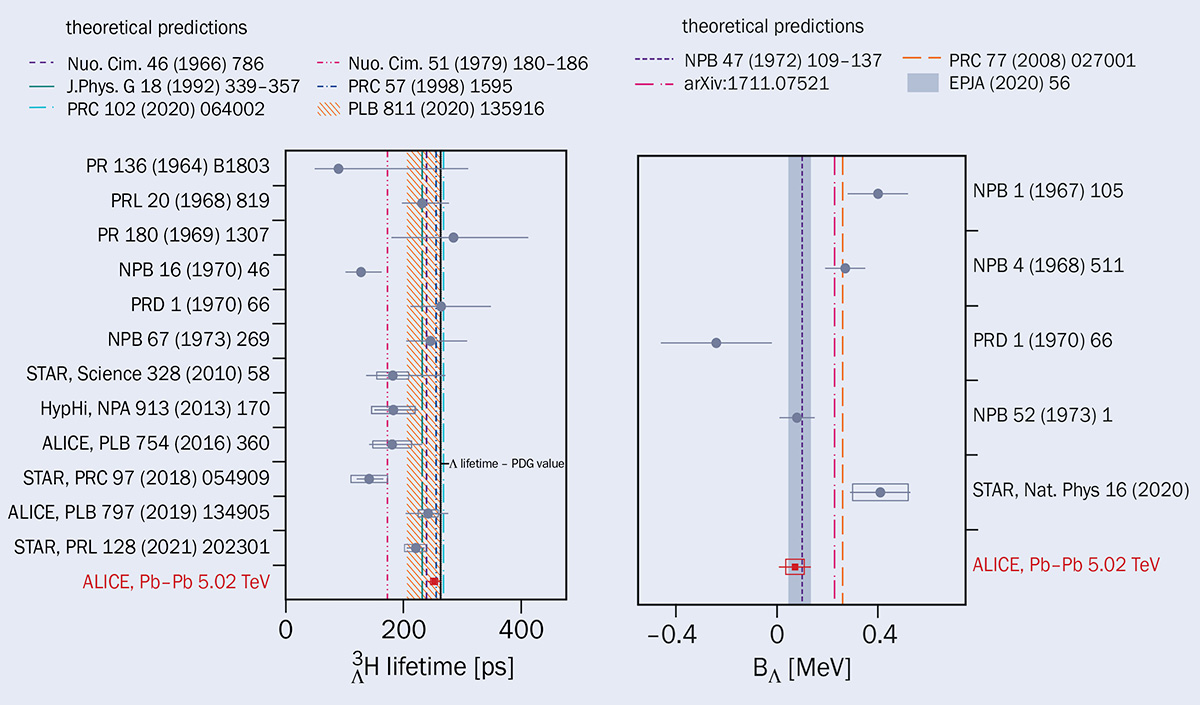
The ALICE collaboration recently completed a new analysis of the largest Run 2 data sample, achieving the most precise measurements to date of the hypertriton lifetime and its Λ-separation energy (the energy required to separate the Λ from the rest of the hypertriton). The lifetime, measured from the distribution of reconstructed two-body decay lengths, was found to be 253 ± 11 (stat.) ± 6 (syst.) ps, while the separation energy, obtained from the hypertriton invariant-mass distribution, was measured to be 72 ± 63 (stat.) ± 36 (syst.) keV.
These two quantities are fundamental to understand the structure of this hypernucleus and therefore the nature of the strong interaction. While the strong force binding neutrons and protons inside atomic nuclei is well understood, the characteristics of the strong force binding nucleons and hyperons are not precisely known.
The study of this interaction is not only interesting per se, but it is also an input for modelling of the dense core of neutron stars. Indeed, the creation of hyperons is energetically favoured compared to ordinary nucleonic matter in the inner core of neutron stars. Therefore, detailed knowledge of the interactions between nucleons and hyperons is required to understand these compact astrophysical objects.
The new ALICE measurements indicate that the interaction between the hyperon inside the hypertriton and the other two nucleons is extremely feeble (see figure 1). This is also confirmed by the lifetime of the hypertriton, which is compatible with the free Λ-baryon lifetime. Finally, since at the LHC matter and antimatter are produced in the same amount, the ALICE collaboration could compare the lifetimes of the antihypertriton and the hypertriton. Within the experimental uncertainty, the lifetimes were found to be compatible, as expected from CPT invariance.
During LHC Run 3, ALICE will extend its studies to heavier hypernuclei, putting tighter constraints on the interaction models among hyperons and nucleons.
This year, the International Particle Physics Outreach Group (IPPOG) celebrates its 25th anniversary. Our group is an international collaboration of active particle physicists, communication experts and educators dedicated to disseminating the goals and accomplishments of fundamental scientific research to the public. Our audiences range from young schoolchildren to college graduates and teachers, from the visiting public to heads of state, and we engage them in classrooms, laboratories, experimental halls, music festivals, art exhibitions, office buildings and government offices across the planet. The activities we use to reach these diverse audiences include public lectures, visits, games, exhibits, books, online apps, and pretty much anything that can be used to demonstrate scientific methodology and instil appreciation for fundamental research.
What drives us to commit so much effort to outreach and public engagement when we are already deeply invested in a field that is both time and labour intensive? First of all, we love doing it. Particle physics is an active and exciting field that lies at the forefront of human understanding of the universe. The analysis methods and tools we employ are innovative, our machines and detectors are jaw-dropping in their size and complexity, and our international collaborations are the largest, most diverse ever assembled. It is a privilege to be part of this community and we love sharing that with those around us.
Secondly, we’ve learned that public engagement improves us as scientists. Learning how to distil complex scientific concepts into understandable descriptions, captivating stories and relatable analogies helps us to better comprehend the topics ourselves. It gives us a clearer picture in our own minds of where our work fits into the larger frame of society. It also significantly improves our communication skills, yielding capabilities that help us down the road as we apply for grants and propose new projects or analyses.
Thirdly, we also understand our moral obligation to share the results of our research with society. The endeavour to improve our understanding of the world around us is rooted in millennia of human evolution and culture. It is how we not only improve our own lives, but also how we provide the tools future generations need to survive. In more practical terms, we realise the importance of engaging those who support our research. That includes funding bodies, as well as the voters who select those bodies and prioritise the deployment of resources.
Finally, but equally as important, we realise the value to both our own field and society at large of encouraging our youth to pursue careers in science and technology. The next generation of experiments will include machines, detectors and collaborations that are even larger than the ones we have today. Given their projected lifetimes, the grandchildren of today’s students will be among those analysing the data. And we need to train that workforce today.
Birth and evolution
Dedicating time and resources to outreach efforts is not easy. As researchers, our days (and often nights) are taken up by analysis meetings, detector shifts, conference deadlines and institutional obligations. So, when we do make the effort it needs to be done in an effective manner, reaching as large and diverse an audience as possible, with messages that are clear and coherent.
Former CERN Director-General Chris Llewellyn Smith certainly had this in mind when he first proposed the establishment of the European particle physics outreach group (EPOG) in 1997. The group held its first meeting on 19 September that year, under the chairmanship of Frank Close. Its primary objectives were to exchange ideas and best practices in particle-physics education and outreach, to define common goals and activities, and to develop and share materials supporting the efforts.
The original members of EPOG were delegates from the CERN Member States, one each from the four major LHC experiments, one each from the CERN and DESY laboratories, and a chair and deputy chair assigned by the European Committee for Future Accelerators (ECFA) and the high-energy physics branch of the European Physical Society. Over the course of the following 25 years, EPOG has expanded beyond Europe (becoming IPPOG), developed major worldwide programmes, including International Masterclasses in Particle Physics and Global Cosmics, and established itself as an international collaboration, defined and supported by a memorandum of understanding (MoU).
Today, the IPPOG collaboration comprises 39 members (32 countries, six experiments and one international lab) and two associate members (national labs). Each member, by signing the MoU, commits to supporting particle-physics outreach worldwide. Members also provide modest funding, which is used to support IPPOG’s core team, its administration and communication platforms, thus facilitating the development and expansion of its global programmes and activities.
The Masterclasses programme now reaches tens of thousands of students in countries spread around the globe, and is engaging new students and training new physics mentors every year. The Global Cosmics portal, hosted on the IPPOG website, provides access to a wide variety of projects distributing cosmic-ray detectors and/or data into remote classrooms that would not normally have access to particle-physics research. And a modest project budget has helped the IPPOG collaboration to establish a presence at science, music and art festivals around the globe by supporting the efforts of local researchers.
Most recently, IPPOG launched a new website, featuring information about the collaboration, its programmes and activities, and giving access to a growing database of educational resources. The resource database serves teachers and students, as well as our own community, and includes searchable, high-quality materials, project descriptions and references to related resources procured and contributed by our colleagues.
Our projects and activities are reviewed and refined periodically during twice-annual collaboration meetings hosted by member countries and laboratories. They feature hands-on activities and presentations by working groups, members, partners and panels of world-renowned topical experts. We present and publish the progress of our activities each year during major physics and science-education conferences. Presentations are made in parallel and poster sessions, and plenary talks, to share developments with the greater community and offer opportunities for their own contributions.
The challenging road ahead
While these accomplishments are noteworthy and lay a strong basis for the development of particle-physics outreach, they are not enough to face the challenges of tomorrow. Or even today. The world has changed dramatically since the days we first advocated for the construction of our current accelerators and detectors. And we are partly to blame. The invention of the web at CERN more than 30 years ago greatly facilitated access to and propagation of scientific facts and publications. Unfortunately, it also became a tool for the development and even faster dissemination of lies and conspiracy theories.
Effective science education is crucial to stem the tide of disinformation. A student in a Masterclass, for example, learns quickly that truth is found in data: only by selecting events and plotting measurements is she/he able to discover what nature has in store. And it might not agree with her/his original hypothesis. It is what it is. This simple lesson teaches students how to extract signal from background, truth from fiction. Other important lessons include the value of international collaboration, the symmetries and beauty of nature and the applications of our technology to society.
How do we, as scientists, make such opportunities available to a broader audience? First and foremost, we need more of us doing outreach. Many physicists do not make the effort because they perceive it as costly to their career. Taking time away from analysis and publication can be detrimental to our advancement, especially for students and junior faculty, unless there is sufficient support and recognition. Our community needs to recognise that outreach has become a key component of scientific research. It is as essential as hardware, computing and analysis. Without it, we won’t have the support we need to build future facilities. That means senior faculty must value experience in outreach on a par with other qualities when selecting new hires, and their institutions need to support outreach activities.
We also need to increase the diversity of our audience. While particle physics can boast of its international reach, our membership is still quite limited in social, economic and cultural scope. We are sorely missing women, people of diverse ethnicities and minorities. Communication strategies and educational methods can be adopted to address this, but they require resources and dedicated personnel.
That’s what IPPOG is striving for. Our expertise and capabilities increase with membership, which is continually on the rise. This past year we have been in discussion with Mexico, Nepal, Canada and the Baltic States, and more are planned for the near future. Some will sign up, others may need more time, but all are committed to maintaining and improving their investment in science education and public engagement. We invite Courier readers to join us in committing to build a brighter future for our field and our world.
The challenge of casting space–time and gravity in the language of quantum mechanics and unravelling their fundamental structure has occupied some of the best minds in physics for almost a century. Not only is it one of the hardest problems out there – requiring mastery of general relativity, quantum field theory, high-level mathematics and deep conceptual issues – but distinct sub-communities of researchers have developed around different and apparently mutually exclusive approaches.
Historically, this reflected to a large extent the existing subdivision of theoretical physics between the particle-physics community and the much smaller gravitational physics one, with condensed-matter theorists entirely alien, at the time, to the quantum gravity (QG) problem. Until 30 years ago, the QG landscape roughly featured two main camps, often identified simply with string theory and canonical loop quantum gravity, even if a few more hybrid formalisms already existed. Much progress has been achieved in this divided landscape, somehow maintaining each camp in the belief that one only had to push forward its own strategies to succeed. At a more sociological level, intertwined with serious scientific disagreements, this even led, in the early 2000s, to what the popular press dubbed the “String Wars”.
A new generation has grown up in a diverse, if conflicting, scientific landscape
Today there is a growing conviction that if we are going to make progress towards this “holy grail” of physics, we need to adopt a more open attitude. We need to pay serious attention to available tools, results and ideas wherever they originated, pursuing unified perspectives when suitable and contrasting them in a constructive manner otherwise. In fact, the past 30 years has seen the development of several QG approaches, the birth of new (hybrid) ones, fresh directions and many results. A new generation has grown up in a diverse, if conflicting, scientific landscape. Today there is much more emphasis on QG phenomenology and physical aspects, thanks to parallel advances in observational cosmology and astrophysics, alongside the recognition that some mathematical developments naturally cut across specific QG formalisms. There is also much more contact with “outside” communities such as particle physics, cosmology, condensed matter and quantum information, which are not interested in internal QG divisions but only in QG deliverables. Furthermore, several scientific overlaps between QG formalisms exist and are often so strong that they make the definition of sharp boundaries between them look artificial.
Introducing the ISQG
The time is ripe to move away from the String Wars towards a “multipolar QG pax”, in which diversity does not mean irreducible conflict and disagreement is turned into a call for better understanding. To this end, last year we created the International Society for Quantum Gravity (ISQG) with a founding committee representing different QG approaches and more than 400 members who do not necessarily agree scientifically, but value intelligent disagreement.
ISQG’s scientific goals are to: promote top-quality research on each QG formalism and each open issue (mathematical, physical and in particular conceptual); stimulate cross-fertilisation across formalisms (e.g. by focusing on shared mathematical ingredients/ideas or on shared physical issues); be prepared for QG observations and tests (develop a common language to interpret experiments with QG implications, and a better understanding of how different approaches would differ in predictions); and push for new ideas and directions. Its sociological goals are equally important. It aims to help recognise that we are a single community with shared interests and goals, overcome barriers and diffidence among sub-communities, support young researchers and promote QG outside the community. A number of initiatives, as well as new funding schemes, are being planned to help achieve these goals.
We envision the main role of the ISQG as sponsoring and supporting the initiatives proposed by its members, in addition to organising its own. This includes a bi-annual conference series to be announced soon, focused workshops and schools, seminar series, career support for young researchers and the preparation of outreach and educational material on quantum gravity.
So far, the ISQG has been well received, with more than 100 participants attending its inaugural workshop in October 2021. Researchers in quantum gravity and related fields are welcome to join the society, contribute to its initiatives and help to create a community that transcends outdated boundaries between different approaches, which only hinder scientific progress. We need all of you!
To provide the best experiences, we use technologies like cookies to store and/or access device information. Consenting to these technologies will allow us to process data such as browsing behavior or unique IDs on this site. Not consenting or withdrawing consent, may adversely affect certain features and functions.
Functional
Always active
The technical storage or access is strictly necessary for the legitimate purpose of enabling the use of a specific service explicitly requested by the subscriber or user, or for the sole purpose of carrying out the transmission of a communication over an electronic communications network.
Preferences
The technical storage or access is necessary for the legitimate purpose of storing preferences that are not requested by the subscriber or user.
Statistics
The technical storage or access that is used exclusively for statistical purposes.The technical storage or access that is used exclusively for anonymous statistical purposes. Without a subpoena, voluntary compliance on the part of your Internet Service Provider, or additional records from a third party, information stored or retrieved for this purpose alone cannot usually be used to identify you.
Marketing
The technical storage or access is required to create user profiles to send advertising, or to track the user on a website or across several websites for similar marketing purposes.