A planet of a mass of only about five times that of the Earth has been discovered at a distance of about 20,000 light years, not far from the centre of the Milky Way. It circles its parent low-mass star in about 10 years at more than three times the Sun-Earth distance. The planet must therefore be very cool with an estimated temperature of -220 °C. The lightest extra-solar planet ever detected around a normal star, it may have a thin atmosphere, like the Earth, but its rocky surface is probably deeply buried beneath frozen oceans. It may therefore more closely resemble a more massive version of Pluto, rather than the rocky inner planets such as Earth and Venus.
Since the discovery in 1995 of the first planet orbiting a star other than the Sun, nearly two hundred extra-solar planets (or exoplanets) have been detected (see CERN Courier October 2004 p19). Almost all of them orbit nearby stars and have been detected using the radial velocity method, which measures the wobble of the star induced by the gravitational pull of the orbiting planet. However, the newly discovered planet, designated as OGLE-2005-BLG-390Lb, is only the third planet to be discovered through gravitational microlensing, an effect noted by Albert Einstein in 1912.
The planet was detected because it crossed the line of sight to a background star. By moving exactly in front of the remote star, the mass of the planet and its parent star distort space-time locally and act as lenses, focusing the light of the background star and making it appear brighter.
The first indication of the discovery was the brightening of a star first noticed by the Optical Gravitational Lensing Experiment (OGLE) on 11 July 2005, although it was just one out of about 500 microlensing events detected each year by scanning most of the central Milky Way every night. These events are owing to intervening stars and last about a month. Any planet orbiting a star can produce a small additional signal, lasting days for giant planets down to hours for Earth-mass planets. To detect the signature of low-mass planets, astronomers must observe these events more frequently than OGLE’s one survey a night. This was done by an international collaboration called the Probing Lensing Anomalies Network, which is able to observe 24 hours a day with a set of telescopes distributed all around the world. The signal of the small planet was detected during the night of 10-11 August 2005 mainly with the Australian Perth telescope and the Danish telescope at La Silla, Chile.
Microlensing is probably the only method currently capable of detecting planets similar to Earth, which are the most difficult to detect. That the third planet discovered this way is a low-mass planet is encouraging and could mean that they are more common than their larger, Jupiter-like brethren. The quest to find a twin for Earth continues.
The Joint Institute for Nuclear Research (JINR) was established through a convention signed in Moscow on 26 March 1956 by representatives from 11 founder states. Their aim was to unite their scientific and material potential in order to study the fundamental properties of matter. Nearly a year later, on 1 February 1957 the institute was registered with the United Nations.
JINR is situated in Dubna, 120 km north-east of Moscow on the Volga River. It is known today around the world as a centre where fundamental research, both theoretical and experimental, is successfully integrated with new technology, the latest techniques and university education.
The main fields of JINR’s research are theoretical and experimental studies in elementary-particle physics, nuclear physics, and condensed-matter physics. The research programme is aimed at obtaining highly significant scientific results. In nuclear physics alone, around half the 80 or so discoveries in the former USSR were made at JINR. The decision of the General Assembly of the International Committee of Pure and Applied Chemistry to award the name Dubnium to element 105 of the periodic table stands in recognition of the achievements of the institute’s researchers and their contribution to modern physics and chemistry.
At present JINR has 18 member states: Armenia, Azerbaijan, Belarus, Bulgaria, Cuba, Czech Republic, Georgia, Kazakhstan, Democratic People’s Republic of Korea, Moldova, Mongolia, Poland, Romania, Russia, Slovakia, Ukraine, Uzbekistan and Vietnam. Germany, Hungary, Italy and the Republic of South Africa also participate in JINR’s activities through bilateral agreements signed at governmental level.
JINR is a genuinely international institution. Its supreme governing body is the Committee of Plenipotentiaries of all 18 member states. The research policy is determined by the Scientific Council, which consists of eminent scientists from the member states, as well as well known researchers from France, Germany, Italy, the US and CERN.
From firm foundations
Since its beginnings, JINR has instigated a wide range of research, and scientific personnel of the highest qualification have been trained for the institute’s member states. Among them are presidents of national academies of sciences, along with leaders of large nuclear centres and universities in many of the member states.
Before JINR’s foundation, the Institute of Nuclear Problems (INP) of the USSR Academy of Sciences had been set up in the late 1940s in the town that was to grow into modern Dubna. The INP had launched a broad research programme on fundamental and applied studies of the properties of nuclear matter using what was at the time the largest charged-particle accelerator – the synchrocyclotron. At the same time, the Electrophysical Laboratory (EPhLAN) of the USSR Academy of Sciences was set up at the same place and it was here that research to develop a new accelerator – the 10 GeV Synchrophasotron (figure 2) – was conducted under the guidance of Vladimir Veksler. When this machine started up in 1957 it was the world’s highest-energy accelerator.
By the mid-1950s the world had come to realize that nuclear science could not be kept locked in secret laboratories and that only broad-based international co-operation could ensure progress in this fundamental realm of human knowledge and in the peaceful utilization of atomic energy. In 1954 CERN was established to unite the efforts of Western European countries in studying the fundamental properties of the microcosm. About the same time, under the stimulus of the government of the USSR, the countries then belonging to the socialist world took a decision to establish JINR, based on the INP and EPhLAN.
After the agreement for the foundation of JINR was signed, specialists from all the member states came to Dubna. As the town took on its international flavour, research began in many fields of nuclear physics of interest to the scientific centres of the member states. The first director of JINR was Dmitri Blokhintsev (figure 3), who had just successfully developed the world’s first atomic power station in Obninsk. Marian Danysz from Poland and Vaclav Votruba from Czechoslovakia became vice-directors, and together this first directorate led the institute through one of the most difficult and crucial periods in its life – the time of its establishment.
The history of JINR is associated with many outstanding scientists including Nikolai Bogoliubov, Igor Kurchatov, Igor Tamm, and Lajos Janossy. Many others were involved in developing the institute and its main scientific branches, such as Alexander Baldin, Vladimir Veksler, Moissey Markov, Bruno Pontecorvo and Georgi Flerov to name but a few.
Since JINR’s founding, nuclear research has been marked by important discoveries and crucial changes. In 1961 the JINR Prizes were established, and a group of physicists led by Veksler and Wang Ganchang from China were awarded the first such prize for their discovery of the antisigma-minus-hyperon. No-one doubted at the time that this particle was elementary, but a few years later, this hyperon, the proton, neutron, pion and other hadrons had lost their elementary quality. They turned out to be complex particles consisting of quarks and antiquarks, which have in turn gained the “right” to be called elementary. Physicists at Dubna have clarified to a great extent the concept of the quark structure of hadrons. Among their latest research are the ideas of colour quarks, the hadron quark model known as “the Dubna bag”, and so on.
In addition to this mainstream progress over the past 50 years, there has been another, quite opposite theme – research that was far ahead of its time. Fifty years ago, soon after JINR had been established, Bruno Pontecorvo suggested the existence of neutrino oscillations. It took scientists dozens of years to find experimental confirmation of such oscillations, which are now a central issue of the physics of weak interactions. At the 97th session of the JINR Scientific Council in January 2005 Art MacDonald, director of the Sudbury Neutrino Observatory (SNO) received the Pontecorvo Prize for the discovery in SNO of evidence for solar neutrino oscillations.
JINR publications are distributed in more than 50 countries. About 600 preprints and communications a year are issued
The modern JINR comprises eight laboratories, each being comparable with a large institute in the scale and scope of investigations performed. It employs more than 6000 people, including more than 1000 scientists, including full members and corresponding members of national academies of sciences, more than 260 Doctors of Science and 630 Candidates of Science, and around 2000 engineers and technicians. The current director, as from 1 January 2006, is Alexei Sissakian, with Mikhail Itkis and Richard Lednick as vice-directors.
The institute possesses a remarkable choice of experimental facilities for physics: Russia’s only superconducting accelerator of nuclei and heavy ions, the Nuclotron (figure 4); the U-400 and U-400M cyclotrons with record beam parameters for experiments on the synthesis of heavy and exotic nuclei; the unique neutron pulsed reactor IBR-2; and the Synchrophasotron proton accelerator which is used for radiation therapy. JINR also has powerful and fast computing facilities, which are integrated into the worldwide computer network.
JINR has established excellent conditions for training talented young specialists. Its University Centre organizes research experience annually at the institute’s facilities for students from higher-education institutions in Russia and other countries. In 1994, on the initiative of the JINR directorate, and with the active support of the Russian Academy of Natural Sciences, the town of Dubna and the Moscow region administrations established the Dubna International University of Nature, Society and Man. There are dozens of JINR staff members – all renowned scientists – among the university staff. The university educational base is actively developed on the territory of JINR, so that Dubna has become a town of students as well as physicists.
Each year JINR submits more than 500 scientific papers and reports written by about 3000 authors to the editorial offices of many journals and organizing committees. JINR publications are distributed in more than 50 countries. About 600 preprints and communications a year are issued. JINR publishes the journals Physics of elementary particles and atomic nucleus, Physics of elementary particles and atomic nucleus letters, the annual report on JINR activities, the information bulletin JINR News, as well as proceedings of conferences, schools and meetings organized by the institute.
For 50 years JINR has been a bridge between the West and the East promoting the development of broad international scientific and technical co-operation. It collaborates with nearly 700 research centres and universities in 60 countries. In Russia alone – the largest JINR partner – co-operation is conducted with 150 research centres, universities, industrial enterprises and companies from 40 Russian cities.
A clear example is JINR’s co-operation with CERN, which facilitates decisions about many theoretical and experimental efforts in high-energy physics. JINR is currently participating in the Large Hadron Collider (LHC) project, taking part in development and construction of parts of the ATLAS, CMS and ALICE detector systems and in the LHC itself. Thanks to its supercomputer centre, JINR is also participating in the development of the Russian regional centre for processing experimental data from the LHC, which is planned as part of the LHC Computing Grid project.
More than 200 scientific centres, universities and enterprises from 10 countries in the Commonwealth of Independent States (CIS) participate in implementing JINR’s scientific programme. The institute may be regarded as a joint scientific centre for the CIS countries, functioning successfully on the international scale. The large and positive experience accumulated at JINR for mutually profitable scientific and technical co-operation on the international scale could provide a discussion topic for a meeting of CIS leaders in Dubna in the context of a summit of the CIS member states.
JINR also maintains mutually beneficial contacts with the IAEA, UNESCO, the European Physical Society and the International Centre for Theoretical Physics in Trieste. Each year more than 1000 scientists from JINR’s partner states visit Dubna, and the institute grants scholarships to physicists from developing countries. JINR’s own researchers are frequent participants at many national and international scientific conferences. In its turn, the institute annually holds up to 10 large conferences and more than 30 international workshops, as well as traditional schools for young scientists.
In the late 1990s, the concept of JINR as a large multidisciplinary international centre for fundamental research in nuclear physics and related fields of science and technology was adopted. The aim is to transfer the results of highly technological research at JINR to applications in industrial, medical and other technical areas, so as to provide additional sources of financing for fundamental research and the organization of new working places for specialists who are involved with these broader topics at the institute. There are also plans for assisting JINR member states to develop new facilities and scientific programmes, such as a cyclotron centre in Bratislava in the Slovak Republic and the DC-60 cyclotron in Astana in Kazakhstan.
JINR has thus entered the 21st century as a large multidisciplinary international scientific centre where fundamental research is conducted in fields related to the structure of matter. It is now integrated with the development and application of new science-intensive technology and the development of university education in related fields of science and it looks forward to its next half century.
The fourth biennial workshop on astroparticle physics in Germany took place at DESY, Zeuthen, in October 2005. It provided scientists in all branches of astroparticle physics, high-energy physics and astronomy with the opportunity to meet representatives of the German Ministry of Education and Research (BMBF) and discuss the status and future strategies of astroparticle physics.
Astroparticle physics in Germany is mainly pursued by the Helmholtz Association – at the Forschungszentrum Karlsruhe (FZK) and DESY – the Max Planck Society and several universities. It has rapidly achieved many successes in various topics, mainly through international collaborations. However, the next generation of experiments will surpass the funding available in Germany and it may be necessary to set priorities even though the advances in many areas are promising. As Johannes Blümer, chair of the Committee for Astroparticle Physics in Germany (KAT) – which is elected by the German astroparticle physics community – noted at the workshop: “Everything is possible, but not all at the same time”.
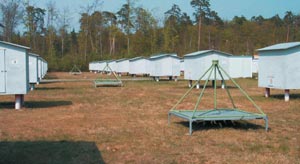
The main success story in astroparticle physics concerns the observations of the highest energy photons by imaging air Cherenkov telescopes (IACTs). These telescopes register the Cherenkov light emitted by extensive air showers that are initiated by photons in the atmosphere. After a long and sometimes painful period of poking around in the dark, in 1989 the Crab nebula was discovered to be a source of photons of multi-tera-electron-volt energies – the first such astrophysical source. With the latest generation of IACTs – the Major Atmospheric Gamma Imaging Cherenkov (MAGIC) telescope on the island of La Palma and most notably the High Energy Stereoscopic System (HESS) telescope array in Namibia – a wealth of galactic and extragalactic sources has since shown up (figure 1). The German community has a major involvement in both HESS and MAGIC.
This research has opened up a new branch of observational astrophysics, as IACTs have detected mysterious galactic tera-electron-volt photon sources that have no counterpart at any other wavelength. Surely more surprises are to be expected.
In charged cosmic rays, the energy spectrum exhibits what is called a “knee” around 1-10 PeV and for years the solution to understanding the origin of cosmic rays in this energy region seemed to be just out of reach. A detailed multi-parameter analysis of the energy spectrum of groups of chemical elements by the Karlsruhe Shower Core and Array Detector (KASCADE) collaboration at FZK has resolved the knee into successively heavier elements. However, it has hit a wall due to the limited theoretical understanding of high-energy interactions in the atmosphere. Data from the Large Hadron Collider (LHC) at CERN may help to improve simulations of these interactions.
Registering cosmic rays at the highest energies, around 1020eV, the Pierre Auger Observatory (in which German universities and the FZK are major participants) is now moving quickly forward. “Hybrid” events, which were presented at the Zeuthen workshop (figure 2), made a strong impression. Although Auger is not fully operational yet, timescales are such that next-generation experiments need to be discussed now. These include, for example, the Extreme Universe Space Observatory, a space-born experiment to observe fluorescent and Cherenkov light from huge air showers. It would provide a sensitive area about one order of magnitude larger than Auger and would be perfectly suited to events above the famous Greisen-Zatsepin-Kuzmin cut-off (if indeed there are any), as well as for neutrino astronomy beyond 5 × 10¹⁹ eV.
The measurement of the radio emission from air showers has witnessed its own breakthrough. At the KASCADE ground array, the LOPES collaboration records geosynchrotron radio emission from air showers (figure 3). A realistic modelling of the radio emission has been achieved, which in turn enables the derivation of air-shower parameters from the radio data. The radio technique will allow for potentially very large and cost-effective installations. In the near future, more details will be investigated in conjunction with the Pierre Auger Observatory. This workshop series had its share in this success, as the possibility of new radio measurements was presented at the first meeting in 1999. Financial support was quickly provided by the BMBF and LOPES came into being.
Following the proof of principle of cosmic-neutrino detection by the Antarctic Muon and Neutrino Detector Array at the South Pole and the array in Lake Baikal, the installation of the 1 km3 sized IceCube neutrino telescope is now under way at the South Pole, with major participation from DESY and several German universities. IceCube should reach a sensitivity sufficient to identify sources of cosmic neutrinos. Technology tests by the ANTARES collaboration for a similar neutrino telescope in the Mediterranean have been concluded successfully.
A direct measurement of neutrino mass is badly needed to set the absolute scale for the mass differences derived from neutrino flavour oscillations. The Karslruhe Tritium Neutrino Experiment at FZK is likely to be the ultimate detector for a direct measurement of the neutrino mass from tritium decays. It aims for a mass sensitivity of 0.2 eV. The Germanium Detector Array, which is being pushed by German astroparticle physicists, is used to search for neutrinoless double beta decays and could reach a sensitivity of 0.1 eV for Majorana neutrinos.
Low-energy solar-neutrino spectroscopy is still required for a detailed understanding of the Sun and may prove the existence of matter effects in neutrino oscillations. The BOREXINO experiment, which has German participation, should start taking data in summer 2006. However, technology now allows us to aim for much larger future installations, such as the Low Energy Neutrino Astronomy project (with 50 kt of scintillator), up to 1 Mt water Cherenkov detectors or 100 kt liquid argon “bubble chambers”, as are being developed by the ICARUS collaboration. These new experiments would enable the measurement of “time resolved” neutrino spectroscopy in correlation with helioseismology. In addition, they could give access to relic and galactic supernova neutrinos and geoneutrinos, and could provide sensitive results on proton decay.
There are many convincing indirect arguments for the existence of dark matter in the universe. Theories predict weakly interacting massive particles (WIMPs) with masses above a few tens of giga-electron-volts as constituents of dark matter. Workshop participants heard of interesting evidence for galactic dark matter from archival data of the EGRET satellite. Meanwhile, three strategies are being followed in the hunt for WIMPs: they could be created at particle colliders (one of the prime targets for the LHC), while “natural” WIMPs are being searched for through their annihilation products, by satellites, IACTs and neutrino telescopes, or by elastic scattering processes in specialized detectors. A fourth line of attack is to try to detect axions, which may be created in non-thermal processes in the universe and hence provide cold dark-matter particles with masses in the region of 100 μeV.
There is already a good deal of indirect evidence for the existence of gravitational waves through the observation of energy losses in binary pulsar systems. However, the experimental systems of the Laser Interferometer Gravitational Wave Observatory (LIGO) in the US, the Virgo detector at Pisa in Italy and GEO600 near Hannover in Germany could directly detect gravitational waves, for example from the collision of two neutron stars. Unfortunately, the predicted event rates vary between one in a few years to one in a few thousand years. The advanced LIGO instrument, to which the German Max Planck Society will contribute, will achieve a much higher sensitivity. It is scheduled to start data taking in 2013. The space mission LISA, a joint effort between ESA and NASA, will extend the observational window to much lower frequencies and may even make primordial gravitational waves accessible. The decisions in Europe and the US on LIGO and LISA show the high priority that is being given to this research field, although in Germany only the Max Planck Society is significantly involved so far.
A stimulating one-day multimessenger workshop after the meeting discussed methods to combine observations of photons from radio to tera-electron-volt energies with those of neutrinos, gravitational waves and charged cosmic rays. The aim would be to extend the classical multiwavelength approach of astronomy towards a true multimessenger strategy.
Organizational issues
The total funding of astroparticle physics in Germany for 2005 amounted to approximately €35 million, while the corresponding amount for Europe is about €130 million a year. This may be compared with the investments of roughly €30 million that will be necessary for a next-generation experiment for the direct identification of dark-matter constituents, of about €8 million for each telescope in a next-generation IACT system, or of €500 million for a 1 Mt water Cherenkov detector. It is evident that such installations will be realized only within international collaborations.
An even greater challenge is to create the roadmaps necessary to guide the way into the future of astroparticle physics. Consequently, the scientific community is being asked to produce roadmaps on national, European and international levels. The most important European organizations in this respect are the Astroparticle Physics European Coordination (APPEC) in which funding agencies of 10 European countries are members at present, and the European Strategy Forum on Research Infrastructures (ESFRI). The German KAT takes a central role in linking the roadmaps for the future of astroparticle physics in Europe and Germany.
Astroparticle physics has applied for EU support (€28 million in total) for four projects with important German participation:
the Integrated Large Infrastructures for Astroparticle Science to concentrate on dark-matter searches, double beta decay and gravitational waves (granted);
a High Energy Astroparticle Physics Network (not granted);
KM3NeT to develop a deep-sea facility in the Mediterranean for neutrino astronomy (granted);
the Astroparticle ERAnet to improve further the coordination within Europe giving a solid operational basis to APPEC (granted).
In Germany the Helmholtz Association has taken the initiative to improve networking between universities and research institutes in the country by funding three “virtual institutes”: VIKHOS (high-energy radiation from the cosmos), VIDMAN (dark matter and neutrino physics) and VIPAC (particle cosmology).
In conclusion, astroparticle physics is making good progress in Germany and elsewhere. While tera-electron-volt astronomy is firmly established, several other fields are now just reaching the sensitivities for making breakthroughs. Further progress is imaginable only in the context of international collaborations following well-accepted roadmaps. The required organizational structures are being put into place and the next decade will decide on the future of many areas of astroparticle physics.
Luckily, imagination, fascination and fantasy remain unbroken. Astroparticle physicists continue to dream of utilizing the Moon as an ultimate target for observing the interactions of the highest energy cosmic rays or for listening to the feeble sound emitted in neutrino interactions in water and ice.
The Institute of High Energy Physics (IHEP) in Beijing is looking forward to a new era as construction of the upgraded Beijing Electron-Positron Collider (BEPC) moves into its final stage.
The BEPC II linac is now in place and installation of the storage ring has started. At the same time, the muon identifier and the superconducting magnet have been installed in the third incarnation of the Beijing Spectrometer (BES III). This was therefore an important time for the BES III collaboration meeting held in January, during which new members from GSI and the universities of Giessen and Bochum were accepted, and a new organizational structure of the collaboration was formally adopted.
BEPC II is a two-ring e+e– collider running in the tau-charm energy region (Ecm = 2.0-4.2 GeV), which, with a design luminosity of 1 × 1033 cm-2s-1 at the beam energy of 1.89 GeV, is an improvement of a factor of 100 over its successful predecessor, BEPC. The upgrade will use the existing tunnel, some major infrastructure items, and some of the old magnets. The 202 m long linac of the new machine can accelerate electrons and positrons up to 1.89 GeV with a positron injection rate of 50 mA/min. Its installation was completed in the summer of 2005 and it has reached most of the design specifications.
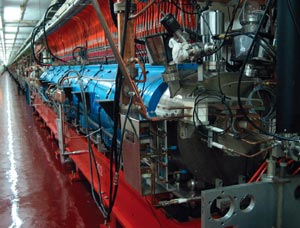
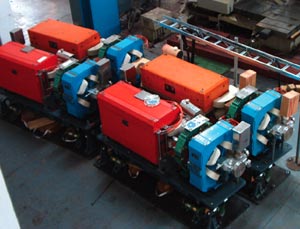
The collider consists of two 237.5 m long storage rings, one for electrons and one for positrons. They collide at the interaction point with a horizontal crossing angle of 11 mrad and a bunch spacing of 8 ns. Each ring holds 93 bunches with a beam current of 910 mA. The machine will also provide a high flux of synchrotron radiation at a beam energy of 2.5 GeV. The manufacture of major equipment such as magnets, superconducting RF cavities (with the co-operation of the Japanese high-energy physics laboratory, KEK, and the company MELCO) and quadrupole magnets (with the co-operation of the Brookhaven National Laboratory), as well as the cryogenics system, have been completed, and their installation is under way. The pre-alignment of magnets has made good progress. Figure 2 shows the mock-up of the installation of four pre-alignment units in the tunnel. Actual installation in the tunnel will begin soon and beam collisions are expected in the spring of 2007.
The BES III detector consists of a helium-based, small-celled drift chamber, time-of-flight (TOF) counters for particle identification, a calorimeter of thallium-doped caesium iodide CsI(Tl) crystals, a super-conducting solenoidal magnet with a field of 1 T, and a muon identifier that uses the magnet yoke interleaved with resistive plate counters (RPCs). Figure 3 shows a perspective view of the detector.
The wiring of the drift chamber has been completed, and the assembly of the chamber has started. Beam tests of prototypes have been performed at KEK and IHEP with electronics prototypes, and both tests show that all design specifications have been satisfied and that the single wire resolution is 110 μm. CsI(Tl) crystals are being produced by Saint-Gobain Crystals, by the Shanghai Institute of Ceramics, and by Hamamatsu (Beijing). More than two-thirds of the crystals have been delivered, with satisfactory light yield, uniformity and radiation hardness. A beam test shows that the electronics noise from the preamplifier, main amplifier, charge digitizer and 18 m of cable was less than 1000 electrons equivalent per crystal, corresponding to about 220 keV of energy.
The scintillator and phototubes for the TOF system will be delivered before summer. All the RPCs for the muon identifier, made of bakelite but without the linseed oil surface treatment, have been manufactured, tested, and installed (figure 4). The average dark current and noise level for all chambers installed after one week’s training is 1.6 μA/m2 and 0.095 Hz/cm2, respectively, for a high voltage corresponding to an average efficiency of 95%.
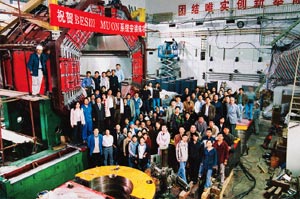
The BES III superconducting magnet is the first of its kind built in China. The vacuum cylinder and the supporting cylinder are made in China, in collaboration with the Wang NMR company of California. The wiring of the superconducting cable and the epoxy curing, the assembly and testing were all done at IHEP, with advice from experts all over the world. The superconducting magnet coil has now been successfully installed into the detector (figure 5) and will be cooled soon.
The latest BES III collaboration meeting was held on 10-12 January at IHEP. More than a hundred collaborators attended the meeting, coming from 21 institutions in 5 countries, namely China, Germany, Japan, Russia and the US. The meeting reviewed the current status of the BES III construction and discussed technical details. The collaboration accepted new groups as members, including teams from GSI, the University of Bochum and the University of Giessen, all from Germany. This meeting was also historic as the governance rules of the collaboration were approved and used for the first time. Under these rules, the Institutional Board was established and Hongfang Chen from the University of Science and Technology of China was elected as the chair, with Weiguo Li from IHEP chosen as deputy chair. Yifang Wang from IHEP was elected as spokesperson, and Yuanning Gao from Tshinghua University and Frederick Harris from the University of Hawaii were elected as co-spokespersons. The next collaboration meeting is scheduled to be held at IHEP on 8-9 June, immediately after the Charm 2006 workshop on 5-7 June, also at IHEP.
Le Globe de la Science et de l’Innovation, grand bâtiment sphérique en bois érigé aux portes du site principal du CERN, à Meyrin en Suisse, est devenu un emblème pour le laboratoire. Il a ouvert ses portes l’an passé pour faire partager au grand public, à la population locale et aux partenaires du CERN, les travaux scientifiques du Laboratoire et les technologies qui y sont développées.
Avec 27 mètres de hauteur et 40 mètres de diamètre, le Globe est à peu près de la taille de la chapelle Sixtine à Rome. Repère visuel de jour comme de nuit, il se démarque dans le paysage des vignobles genevois. Symbole du développement durable par sa structure en bois, le Globe porte un message sur la science, la physique des particules, les technologies de pointe et leurs applications dans la vie quotidienne.
Le bois de l’enveloppe extérieure du Globe de la Science et de l’Innovation a d’abord été utilisé pour le Pavillon suisse à l’exposition universelle de Hanovre en 2000, conçu par l’architecte Peter Zumthor. Ces planches, symbolisant le développement durable, ont ensuite été transformées en secteurs sphériques à claire-voie pour composer l’enveloppe extérieure du bâtiment actuel, conçu par l’ingénieur Thomas Büchi (Charpente Concept) et l’architecte Hervé Dessimoz (Groupe H) pour l’exposition nationale suisse Expo.02.
Le bâtiment, alors nommé Palais de l’Equilibre, était dédié au développement durable. Durant les six mois de l’exposition, il a accueilli 1.9 millions de visiteurs. Après cette exposition, le Gouvernement suisse a réalisé un appel à propositions pour une réutilisation durable de l’édifice. Le CERN a proposé d’en faire un lieu de partage de la culture scientifique, technique et industrielle pour le grand public, ainsi qu’un espace d’échanges sur les technologies innovantes en partenariat avec des entreprises privées et des institutions publiques. La proposition a été retenue et le bâtiment a été offert en 2003 par la Confédération Suisse pour le 50e anniversaire du CERN célébré l’année suivante.
Reconstruit sur le site actuel en 2004, le Globe a été utilisé pour la première fois le 19 octobre 2004 à l’occasion des célébrations officielles du 50e anniversaire du CERN. Des travaux complémentaires de sécurité, d’isolation thermique et phonique ont complété l’édifice.
Un lieu d’échanges entre science et société
Après la période d’inauguration à la fin 2004, le Globe de la science et de l’innovation a été réellement ouvert au public le 16 septembre 2005, avec une exposition temporaire en hommage au prix Nobel de physique du CERN Georges Charpak. L’exposition “Einstein, 100 ans après”, inaugurée à l’occasion de la fête de la science 2005, y a ensuite été installée dans le cadre de l’Année mondiale de la physique. Le Globe fonctionne ainsi actuellement avec des activités temporaires qui associent des expositions, des présentations ou des événements. Tourné vers tous les publics visitant le CERN, le bâtiment devient un élément clé de la stratégie de communication du laboratoire.
Dans la perspective de 2007 et de la mise en service du Grand collisionneur de hadrons (LHC), l’accueil des 25,000 visiteurs annuels doit être repensé. Ils peuvent aujourd’hui accéder aux expériences souterraines du LHC qui leur montre le gigantisme des installations nécessaires pour traquer les particules invisibles. L’exposition Microcosm vient compléter l’information de ceux qui le souhaitent. A partir de 2007, les installations du LHC étant en service, il ne sera plus possible d’organiser ces visites souterraines. L’offre pour les visiteurs doit donc évoluer.
La richesse et la diversité des installations du CERN permettront d’organiser des itinéraires thématiques offrant aux visiteurs la possibilité de choisir en fonction de leurs centres d’intérêt: physique, technologie, machines, histoire…. En surface, des expositions sur site permettront de comprendre la physique en train de se faire en sous-sol et de découvrir les techniques associées. Mais les visiteurs qui souhaiteront en savoir plus, appréhender les enjeux, pénétrer dans le monde des particules devront avoir la possibilité d’explorer à leur rythme et plus en détail l’univers du CERN. Le Globe de la science et de l’innovation jouera alors un rôle important dans ce renouvellement de l’offre aux visiteurs.
Un outil au service de tous
Pour répondre à cette demande, le bâtiment nécessite des équipements complémentaires. Les différentes fonctions facilitant l’accueil du public ont été rassemblées dans un projet de structure périphérique sur 180 degrés, appelée bâtiment couronne. Le développement de ce bâtiment complémentaire, la transformation du bâtiment hébergeant l’exposition Microcosm, la redéfinition des visites, l’étude d’une future liaison entre les deux côtés de la route nécessitent d’importants moyens. En 2007, une exposition permanente sera inaugurée au rez-de-chaussée du Globe. La physique des particules y sera mise à la portée de tous. Et les technologies innovantes inventées au CERN y occuperont une place importante pour permettre aux visiteurs de comprendre comment le physique du 21e siècle s’inscrit dans leur vie quotidienne.
Le Globe accueille actuellement des expositions temporaires au niveau supérieur. C’est sur ce même étage très spectaculaire (une coupole de plus de 12 mètres de haut!) que peuvent être organisés des événements en collaboration avec les Etats membres de l’organisation, les collectivités locales, les industriels et le grand public.
Expositions temporaires, conférences, animations, rencontres, débats résonneront dans le Globe comme autant de démarches pour développer des liens entre science, industrie et société. Les enjeux sont multiples: augmenter le goût des jeunes pour les sciences, mieux éduquer les futurs scientifiques, informer et former les enseignants, permettre aux citoyens européens de participer à l’évolution des connaissances, comprendre les enjeux scientifiques de notre époque, favoriser les passerelles entre science et industrie, participer au rapprochement des pays, associer le plaisir de la découverte avec le partage des connaissances.
En mettant en place un tel lieu d’échange, le CERN a évidemment aiguisé l’intérêt de nombreux musées et centres de culture scientifique. Le laboratoire devient dans ce domaine un important partenaire jouant le rôle de centre de ressources à la disposition de tous.
Un partenariat exemplaire
Le 26 septembre 2005, le Globe a hébergé un événement de l’Institut international des ingénieurs en électrotechnique et électronique (IEEE). Cette manifestation “IEEE milestone event” a permis de rendre à la fois hommage au CERN pour ses inventions en matière de détecteurs et à l’un de ses brillants physiciens, le prix Nobel Georges Charpak. Ce type d’événement n’est possible qu’avec un réseau de partenaires en l’occurrence ici l’IEEE, la plus grande association au monde pour l’avancement des technologies. Nos remerciements vont à sont Président W Cleon Anderson et à l’ensemble des contributeurs pour leur aide, en particulier le principal partenaire Walter LeCroy.
Afin de développer autour du Globe un réseau pour soutenir son action, le CERN a souhaité créer des outils de dialogue.
Une lettre électronique destinée à toute personne membre du personnel CERN ou non. Le but de cette lettre baptisée Globe-info est de diffuser les informations relatives aux activités éducatives, culturelles, scientifiques, techniques et industrielles du CERN. Ces informations concernent le public le plus large. La lettre annonce les conférences, les expositions, les ateliers, les événements, les visites, les pièces de théâtre, les journées portes ouvertes, les nouveaux documents, les informations scientifiques, techniques ou industrielles.
Nous avons également proposé de créer “Les Amis de la Science et de l’Innovation”, un regroupement destiné aux personnes physiques souhaitant soutenir les buts du CERN au travers des actions grand public mises en place.
Enfin, un Club des partenaires du CERN pour la Science et l’Innovation a été mis en place. Ce club réunit à la fois des fondations, des collectivités, des partenaires industriels et des donateurs acquittant une contribution de membre. Pour être membre du Club, les sociétés doivent impérativement adhérer aux objectifs et valeurs du CERN. Le Club permet aux collectivités et aux industriels d’être partenaires des actions vers tous les publics, tels que expositions, conférences, spectacles. De nouveaux projets d’expositions, de bâtiments ou d’éléments scénographiques spectaculaires pourront être réalisés grâce aux aides fournies dans le cadre de ce Club privilégié. Par exemple, en complément du Globe, le bâtiment couronne pourrait permettre dans quelques années de mieux accueillir les visiteurs qui pour une heure ou une demi-journée auront la possibilité d’explorer, visiter, comprendre, échanger, discuter avec les scientifiques et guides du CERN.
Le Club des Partenaires du CERN pour la Science et l’Innovation a pour principal objectif de favoriser la diffusion, auprès des publics cibles, des informations sur la science, la technologie, les débouchés industriels et les grands sujets de débat et d’actualité. En tant qu’organisation internationale, le CERN est habilité à recevoir des dons. Un document est délivré afin que les contributeurs puissent faire valoir leur don auprès des services fiscaux.
Un programme de démarrage éclectique
Ouvert au public depuis peu, le Globe a déjà accueilli une exposition en hommage à Georges Charpak, une exposition sur “Einstein, 100 après”, la création en avant-première de l’opéra scientifique Kosmos, des événements, des conférences, des ateliers, des animations et même deux pièces de théâtre (“Signé Jules Verne” de la compagnie genevoise Mimescope et “Einstein au Pays des neutrinos” du physicien François Vannucci).
En février et mars 2006, le Globe propose l’exposition Einstein prolongée, un atelier de physique pour les tout-petits et une pièce de théâtre loufoque et poétique autour des mathématiques, “Mad Math”. Suivront une exposition artistique “Utopies Urbaines” organisé avec la commune de Meyrin et une exposition et des animations autour de l’astrophysique.
Par toutes ces actions, le Globe accompagne les quatre missions fondamentales du CERN:
Apporter des réponses aux questions sur l’Univers
Repousser les frontières de la technologie
Former les scientifiques de demain
Rapprocher les pays grâce à la science
Dans les années à venir, le CERN va se projeter dans un futur très stimulant en démarrant des machines innovantes, en produisant une nouvelle physique et en appuyant sa communication sur ce bâtiment emblématique: le Globe de la Science et de l’Innovation.
The International Conference on Accelerator and Large Experimental Physics Control Systems (ICALEPCS) is the prime conference in the field of controls for experimental-physics facilities, namely particle accelerators and detectors, optical and radio telescopes, thermo-nuclear fusion installations, lasers, nuclear reactors, gravitational antennas, and so on. The initiative to create this series of biennial conferences was taken at the end of 1985. An initial group of six laboratories – CERN, the Grand Accelerateur National d’Ions Lourds, the Hahn-Meitner Institut, Kern Forschung Anlage, Los Alamos National Laboratory and the Paul Scherrer Institut – were called upon to create an interdivisional group on Experimental Physics Control Systems within the European Physical Society (EPS) with the purpose, among others, of supporting these conferences. As a next step, CERN offered to organize the first ICALEPCS in 1987, in Villars-sur-Ollon.
The ICALEPCS circulate around the globe with meetings in Europe, America and Asia, co-organized by the EPS-EPCS, under the auspices of the Institute of Electrical and Electronics Engineers through its Nuclear and Plasma Science Society, the Association of Asia Pacific Physics Societies, the American Physical Society, the International Federation of Automatic Control, and the International Federation for Information Processing through its Technical Committee on Computer Applications in Technology.
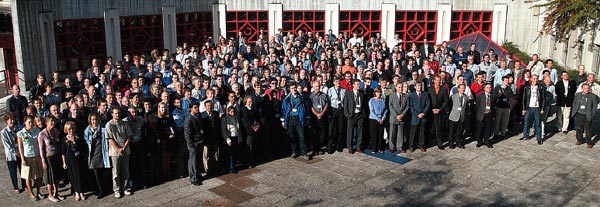
ICALEPCS 2005, the 10th meeting in the series, fell auspiciously during the World Year of Physics, being held from 10-15 October 2005 at the Geneva International Conference Centre (CICG). It was hosted by CERN together with the Centre de Recherches en Physique des Plasmas (CRPP) of the École Polytechnique Fédérale de Lausanne (EPFL), and chaired jointly by CERN’s Bertrand Frammery and Jonathan Lister from CRPP-EPFL. Attendance reached 442, with delegates from 160 laboratories, universities and industries in 27 countries in Europe, America, Asia, and Oceania-Australia.
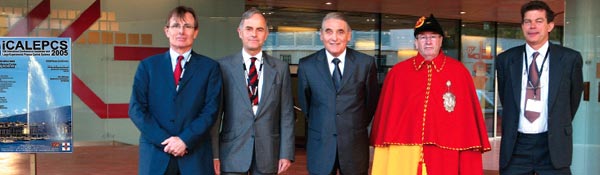
In the opening session, Axel Daneels of CERN, who is chairman of the International Scientific Advisory Committee and who has steered the ICALEPCS since their inception, introduced ICALEPCS 2005, and invited Carlo Lamprecht, Minister of Economy and Councillor of the State of Geneva to express his welcome and his support to the conference. Co-chair Lister welcomed the participants in his turn and was followed by Jos Engelen, CERN’s chief scientific officer, who presented the challenges raised by the CERN’s Large Hadron Collider (LHC) project – both the accelerator and the detectors.
Down to business
The first main sessions consisted of status reports on several major new and planned experimental-physics facilities around the world, with an emphasis on controls. Particle accelerators were represented by the LHC, the Japan Proton Accelerator Research Complex and CERN’s Low Energy Ion Ring. Synchrotron light sources covered the ELETTRA laboratory in Trieste, the SOLEIL synchrotron at Saint Aubin and the ALBA synchrotron near Barcelona. The fusion community described the controls of the National Ignition Facility (NIF) at Lawrence Livermore National Laboratory, the Angara-5 facility at the Troitsk Institute for Innovation and Fusion Research and the data challenges of the international project ITER. The presentations on telescopes discussed the controls of the Atacama Large Millimetre Array radio telescope in the Andes and the proposed Low Frequency Array in the Netherlands. CERN presented control systems for the CMS and ALICE detectors for the LHC. There were also presentations on the 8 GeV X-ray free-electron laser at the Japanese synchrotron radiation facility, SPring-8, and on VIRGO, the 3 km French-Italian gravitational-wave detection facility.
Special sessions
The session on process tuning, automation and synchronization heard how automation systems are crucial for reliable, coherent, safe and flexible operation of complex facilities such as NIF, VIRGO and the LHC detectors. The operation of tokamaks, such as the Joint European Torus in the UK and the Korea Superconducting Tokomak Advanced Research project, relies on real-time measurements and accurate synchronization systems. Low-level RF control systems were presented for the superconducting RF quadrupoles for the new positive-ion injector, Piave, at the INFN Laboratori Nazionali di Legnaro and for the LINAC-3 cavities at CERN. Synchrotron light sources, such as the Indus-2 storage ring at the Centre for Advanced Technology in Indore and Bessy II in Berlin, rely on orbit control and active feedback loops to position their optical components.
The session on security and other major challenges considered interlock systems combined with alarm-handling systems that monitor facilities operating in harsh environments in terms of radiation, temperature and so on. Security of computing networks for controls is an issue of concern for example at SPring-8 and CERN. The design of control systems for security and dependability was discussed in the context of the Dependable Distributed Systems (DeDiSys) research project supported by the European Union. Dependability covers availability, reliability, maintainability, safety and security.
Experimental-physics facilities are becoming more sophisticated and hence more demanding in matters of controls. However, control systems with many appropriate features are huge projects in themselves, which conflict with the reduction in resources that prevails in the research community. Laboratories are thus being driven into collaboration on the joint development of systems based on commercial hardware and software components – the topic of the session on development approaches. Collaboration frameworks are being developed to assure a streamlined and standard approach when integrating commercial components into a coherent system and to ease debugging, testing, deployment and maintenance. Collaborative projects include the Joint Controls Project for the LHC detector controls; the TANGO project for synchrotron radiation facilities, developed jointly by ALBA, ELETTRA, SOLEIL and the European Synchrotron Radiation Facility (ESRF) in Grenoble; and the ALMA Common Software project for distributed control.
The session on the evolution of hardware technology looked at how control-system architectures are evolving towards a higher granularity, thanks to the availability of small-size boards with an Ethernet port. This approach reduces the cost and improves the overall reliability. More specifically, while standard peripheral component interconnect (PCI) is still being supported for less demanding applications, PCI Express is becoming the only standard for connecting devices with high bandwidth requirements. In the domain of networking, 1 Gbit/s Ethernet is a consolidated standard, but a bandwidth up to 100 Gbit/s can already be found in projects such as ALMA. Networks with a low bandwidth are used as field buses. Programmable logic devices are the building blocks of digital controllers and are replacing complex boards based on digital-signal processors. Their importance is growing as they allow the integration of standard functions with custom application logic.
Middleware frameworks such as NIF’s large-scale CORBA framework were one of the topics of the session on the evolution of software technology. These have matured, and attention is shifting from mere deployment towards easier development. Application developers can be now shielded from particular middleware products and testing and integration of components can be facilitated through software simulation. Access to remote distributed resources is increasingly based on Web and Grid technologies. HyperDAQ, an application to provide access to distributed DAQ systems, employs web and peer-to-peer technology. The Virtual Instrument Grid Service, a part of the GRIDCC project, will use Grid computing to control distributed instrumentation.
The session on operational issues considered machine operations, which are tightly coupled to data management, alarm handling and remote collaboration. Operational information is managed through relational databases, as for example the configuration database for the LHCb experiment, while the commercial Geographical Information Systems are being applied to accelerator configuration management. Intelligence is added to alarm-handlers to reduce the incidence of unimportant alarms. Common frameworks, such as CERN’s Directory Services, tend to be introduced to integrate diverse systems operationally.
Experimental-physics facilities involve large investments and evolve during their lifetime – the subject of the session on dealing with evolution. Control systems must thus cope with this evolution while protecting the investment, so their architectures must be modular, data-driven and based on commercial products and standards. Examples are the JAPC Code (Java API for Parameter Control) developed to ease the programming of the LHC application software. Evolution often also implies proliferation of computers. Facing this phenomenon and to limit hardware failure and maintenance, SPring-8 has applied virtualization technology by which many computers are accommodated into a reduced number of virtual machines, each with independent resources (CPU, discs etc) as if they were stand-alone. Three virtualization approaches were discussed at the meeting: emulation of hardware or specific guest operating systems; multiplexing of physical resources by software; and application shielding to isolate applications from each other. By contrast, medical accelerators are designed for minimal upgrades and limited improvement during a lifetime, for safety and regulatory reasons.
Additional activities
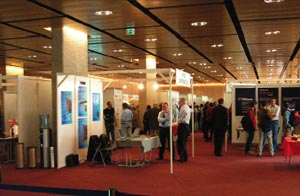
The scientific programme was complemented by a three-day exhibition involving 17 companies and 10 technical seminars in which companies presented their views on the evolution of their technology as well as their strategy, and which were particularly well attended. In the week preceding ICALEPCS 2005, 150 controls specialists had also attended four workshops: Experimental Physics and Industrial Control System (organized by Matthias Clausen of DESY), ALMA Common Software (organized by Gianluca Chiozzi of ESO), TANGO (organized by Andy Götz of ESRF) and a Joint ECLIPSE Workshop (organized by Clausen and Götz). These workshops were held in France at Archamps, the Haute-Savoie’s business park near Geneva, and fully supported by the Conseil Général de la Haute-Savoie. In addition, Markus Völter from Völter-Ingenieurbüro für Softwaretechnologie, Germany, gave a tutorial on Model-driven Development of Distributed Systems at the CICG.
The conference also included a social programme featuring a welcome reception sponsored by Hewlett-Packard; wine-tasting parties, sponsored by the Canton wine producers; an organ and brass concert in the St Pierre Cathedral in Geneva’s old town, sponsored by the Republic and Canton of Geneva; a cruise with a banquet on lake Geneva; and at the closing session, an ICALEPCS tenth anniversary cake. Technical visits, attended by more than 120 participants, were organized to two of CERN’s LHC experiments (CMS and LHCb), and to the CRPP-EPFL Tokomak.
ITER should be bold and as restrictive as possible on standards and equipment.
The registration fee for the 26 participants from industrially emerging nations was waived and 17 of them received an additional grant through one of the following organizations: the EPS, namely the East West Fund and the Young Physicists Fund; the Abdus Salam International Centre for Theoretical Physics; the programme for Scientific Co-operation between Eastern Europe and Switzerland 2005-2008 of the Swiss National Science Foundation and the Swiss Agency for Development and Co-operation; and the International Association for the Promotion of Co-operation with Scientists from the New Independent States of the Former Soviet Union.
At the ends of the special sessions about 80 people took part in a round-table discussion on the in-kind procurement of large systems for collaborative experiments. The future ITER project was taken as an example, although the proposed International Linear Collider will have similar considerations to make. The discussion aroused much interest but generated little conflict. The general agreement was that ITER should be bold and as restrictive as possible on standards and equipment, even though there was no evidence suggesting this has been possible in the past.
ICALEPCS 2005 closed with an invited talk on the test system for the Airbus 380 and with an invitation to ICALEPCS 2007 in Knoxville, to be jointly hosted by Oak Ridge National Laboratory and Jefferson Lab.
• ICALEPCS 2005 was sponsored by the Swiss Federal Government, through the CICG, the Republic and State of Geneva, the Département de la Haute Savoie in France and its Archamps site, as well as by several industrial companies: Agilent Technologies, Hewlett-Packard and Siemens. DELL, an ICALEPCS 2005 partner, supplied the entire informatics infrastructure. SWISS, the Swiss airline and the ICLEPCS 2005 official carrier, offered a free return flight to an Indian delegate.
by E Walter Kellermann, Stamford House Publishing. Paperback ISBN 1904985092, £8.99.
The story of the flight of Jewish physicists from the Nazis and their allies in the 1930s is well known, told usually in the context of major players, such as Albert Einstein, or Enrico Fermi. So it is interesting to read of how the events of that time touched someone less well known, but who nevertheless went on to a full and rewarding career in physics. In 1937 Walter Kellermann fled to the UK, where he was to establish his career in physics, in particular in cosmic rays. This book is his story.
After completing his schooling in Berlin, Kellermann left his native Germany in 1933, as the Nazis were making it impossible for Jews to enter university there. To continue his studies, he went to Austria – not the best choice – where he had relatives in Vienna. University regulations there were flexible and after only four semesters he was accepted as a physics-research student with Karl Przibram. Then with German occupation imminent and a DPhil to his credit, he fled to Britain in October 1937, and with some ingenuity secured work at Edinburgh University under Max Born. It was there that he made an important contribution to solid-state physics, calculating for the first time the phonon spectrum.
With the outbreak of war in 1939, Kellermann found himself interned, like many others, despite his refugee status, and was even sent to Canada on a dangerous voyage, during which the internees were kept in a barbed-wire enclosure. Fortunately, he was soon released, and joined the teaching staff at Southampton University.
After the war, Kellermann moved to join Patrick Blackett’s group at Manchester, to work on cosmic rays. This was to become his field for the rest of his academic life, in particular from 1949 onwards at Leeds University. At Leeds, he was one of the main instigators of the extensive air-shower detector array at Haverah Park, the forerunner of major modern projects such as the Pierre Auger Observatory. In the early 1970s his “15 minutes of fame” came when Kellermann’s group observed a bump in the hadron energy spectrum in cosmic rays, detected in an innovative hadron calorimeter. This could have been due to a new particle, which the researchers dubbed the Mandela. Sadly, the bump was eventually found to be due to a burned-out connection in the detector’s custom-built computer. Soon afterwards, Kellermann reached retirement age, but went on to a second career in science policy in Britain, the subject of the final chapter.
Kellermann’s account makes fascinating reading, describing the aspirations and frustrations of a physicist who was not centre stage, but moved among a cast of famous names. These included not only Born and Blackett, but also Klaus Fuchs, best known as a spy. The book also presents a revealing view of the British university system, with some alarming examples of racism, in particular in the 1930s and 1940s when departments were keen to keep down the number of refugees.
by Claus Grupen, Springer. Hardback ISBN 3540253122, €37.40, (£27, $59.95).
Claus Grupen provides a comprehensive and up-to-date introduction to the main ideas and terminology of the study of elementary particles originating from astrophysical objects. In fact, as is evident from the historical introduction, astroparticle physics reaches beyond elementary particles and includes gamma radiation, X-rays, gravitational waves, and extensions of the current Standard Model.
The style and presentation of the material make the book accessible to a broad audience with a basic knowledge of mathematics and physics. A good selection of simple exercises with solutions increases its pedagogical value and makes it suitable as a textbook for an undergraduate course. Non-specialists who want to follow the main issues of current research in the field or to have a general overview before more advanced readings can also benefit from Grupen’s book.
A distinguishing feature of the book is the use of relatively simple models directly tied, where possible, to experimental data; these illustrate physical mechanisms or problems without unnecessary details. The main physical motivations for a theory are introduced, its experimental consequences discussed together with the current status of the key parameters and the expected future developments. Both the pedagogical nature and the emphasis on the experimental basis of models are signalled by a chapter dedicated to particle and radiation detectors and, especially, by the many instructive figures and diagrams that illustrate data and their theoretical interpretations.
A good third of the book deals with cosmic rays, our main experimental window on the universe. Grupen presents the astronomy of neutrinos, gammas and X-rays, and discusses and reviews the basic mechanisms for particle acceleration and production, and important topics such as extended atmospheric showers initiated by the highest-energy cosmic rays or gamma-ray bursts. This part constitutes the foundation of astroparticle physics.
The next largest part of the book, about one quarter, is devoted to the thermal history of the early universe, including an extensive description of Big Bang nucleosynthesis.
Introductions to standard cosmology and to basic statistical mechanics are included. In addition there is a concise description of the important information carried by the cosmic microwave background radiation – in particular, the bearings of the latest measurements of the radiation’s angular anisotropy on key cosmological parameters, such as the total energy density, the baryon-to-photon ratio and the Hubble constant.
Before the stimulating overview of some of the open problems and perspectives of the field the author reserves two chapters for inflation and dark matter. These fundamental concepts in modern astrophysics not only answer specific experimental and theoretical questions (rotational curves of galaxies, monopoles, flatness, etc), but raise new ones and stimulate experimental tests.
CERN’s director-general, Robert Aymar praised the immense progress made towards the Large Hadron Collider (LHC) project when he addressed the 135th session of the CERN Council on 16 December 2005. “In one year, we have made great progress,” he said. “The challenge is not over, of course, but we have great confidence of maintaining the schedule for start-up in 2007.”
The LHC is the leading project for the world’s particle-physics community. Experiments performed there will investigate perplexing questions including why fundamental particles have the masses they have, and focus on understanding the missing mass and dark energy of the universe; visible matter seems to make up just 5% of what must exist. Physicists will also explore the reason for nature’s inclination for matter over antimatter, and probe matter as it existed immediately after the Big Bang.
Aymar’s congratulations come after a challenging year with delays imposed by repairing defects in the LHC’s cryogenic-fluid distribution system. These delays are now largely recovered. The cryogenic system is now well advanced and installation of the LHC’s magnets is progressing rapidly. Almost 1000 of the 1232 dipole magnets have been delivered to CERN and more than 200 magnets are already installed in the LHC’s underground tunnel. An average of 20 magnets a week are currently being installed, but this needs to increase to 25 a week in 2006 to reach the 2007 start-up deadline. A review of this schedule is planned for Spring 2006.
Aymar also informed delegates that CERN’s new visitor and networking centre, the Globe of Science and Innovation, opened its doors to the public in September 2005. The Globe is scheduled to host a permanent exhibition about scientific works at CERN, coinciding with the LHC start-up in 2007.
Eighty representatives from several major physics publishers, European particle-physics laboratories, learned societies, funding agencies and authors from Europe and the US met at CERN on 7-8 December 2005 for the first discussions on promoting open-access publishing. One of the results was the formation of a task-force mandated to bring action by 2007.
Open access is currently a hot topic at universities, publishing houses and governments, as digitized documentation and electronic networking become more mainstream. The particle-physics community has already implemented one of the possible ways for open access to work, whereby institutional libraries, such as CERN’s, make their own information available on the Internet. The other approach is to work directly with scientific publishers to develop open access to the journals.
The aim of open access is to bring greater benefit to society by allowing electronic access to journals to be free to the public, while being paid for by the authors. The time-honoured practice consisted of publishers financing journals through reader subscriptions and ensuring quality by peer review; however, this model favours the wealthier universities and institutions as they can afford the expensive costs of the journals. The challenge for open access is to maintain the quality guaranteed by academic publishers, while broadening access to the information.
The creation of an open-access task-force comes at a crucial time for the world particle-physics community as 2007 brings the launch of a new major facility, the Large Hadron Collider at CERN.
To provide the best experiences, we use technologies like cookies to store and/or access device information. Consenting to these technologies will allow us to process data such as browsing behavior or unique IDs on this site. Not consenting or withdrawing consent, may adversely affect certain features and functions.
Functional
Always active
The technical storage or access is strictly necessary for the legitimate purpose of enabling the use of a specific service explicitly requested by the subscriber or user, or for the sole purpose of carrying out the transmission of a communication over an electronic communications network.
Preferences
The technical storage or access is necessary for the legitimate purpose of storing preferences that are not requested by the subscriber or user.
Statistics
The technical storage or access that is used exclusively for statistical purposes.The technical storage or access that is used exclusively for anonymous statistical purposes. Without a subpoena, voluntary compliance on the part of your Internet Service Provider, or additional records from a third party, information stored or retrieved for this purpose alone cannot usually be used to identify you.
Marketing
The technical storage or access is required to create user profiles to send advertising, or to track the user on a website or across several websites for similar marketing purposes.