by Anthony M Green (ed.), World Scientific. Hardback ISBN 981256022X, £54 ($88).
The aim of this book is to introduce lattice quantum chromodynamics to non-specialists, in particular undergraduates and graduates, theorists and experimentalists, who have a background in particle and nuclear physicists. In particular it chooses topics that generally have analogies with more conventional areas in these fields, such as the interquark potential and interactions between hadrons.
by Rabindra N Mohapatra and Palash B Pal, World Scientific. Hardback ISBN 9812380701, £76 ($103). Paperback ISBN 981238071X, £34 ($46).
The third edition of this well-known book provides an up-to-date discussion of the latest massive-neutrino results for the active researcher, and an introduction to various related theoretical and phenomenological issues for the non-expert. Elementary discussions on topics such as grand unification, left-right symmetry and supersymmetry are presented, and there is special emphasis on the implications of neutrino discoveries for the nature of new forces.
by Laurie M Brown (ed.), World Scientific. Hardback ISBN 9812563660, £17 ($28). Paperback ISBN 9812563806, £9 ($14).
The title pretty much sums up this interesting short book, the latest Feynman work to be published since his death in 1988. It reproduces, in modern typeset, Feynman’s PhD thesis entitled “The Principle of Least Action in Quantum Mechanics”. In it Feynman outlined his brilliant reformulation of quantum mechanics in terms of the path integrals that now bear his name, together with two supporting papers and a preface.
Historians and physicists alike will enjoy this easy-to-read little book (119 pages plus the preface). Supplementing the thesis itself, which is just 69 pages long (if only all theses said so much in so little space), are reprints of Feynman’s “Space-Time Approach to Non-Relativistic Quantum Mechanics”, which was published in Reviews of Modern Physics in 1948 and Paul Dirac’s “The Lagrangian in Quantum Mechanics”. Dirac’s paper is a little harder to find since it’s from the Physikalische Zeitschrift der Sowjetunion and dates back to 1933. These provide excellent supporting material and in many ways bracket the thesis. Dirac’s paper is not as widely read as it should be, and is of great importance as it provided much of the initial impetus for Feynman’s work, making quite explicit the role of exp(iLdt/ħ) as a transition amplitude between states separated by an infinitesimal time dt, and its connection to the classical principle of least action. Feynman’s article is certainly well known and is perhaps rather more formal than the thesis itself, and therein lies much of charm of this book.
Brown also provides a 16 page introduction that essentially walks the reader through reading the thesis, summarizing the content of each section and adding many interesting historical anecdotes and quotations.
The thesis itself is a masterpiece of clear exposition. While there is little in the thesis that is likely to surprise most physicists, it is written in Feynman’s uniquely chatty style, and reminiscent of the famous Feynman lectures. It is a delight to read and is likely to offer an insight, even to non-physicists, into both physics and the workings of Feynman’s mind. I would not hesitate to recommend the book to anyone – working physicists, historians, philosophers and even “curious fellows” who would like to “peek over the shoulder” of one of the 20th century’s great physicists at work.
Where do art and physics meet, and what kind of interaction might they enjoy? In this hour-long film, CERN physicists Michael Doser (anti-hydrogen experimenter) and John March-Russell (theorist) talk to author and artist John Berger (best-known for his 1972 book Ways of Seeing) and Ken McMullen, artist and director of the film.
Their discussion is interspersed with sequences of sculptures, installations and other artworks inspired by particle physics – most from the Signatures of the Invisible exhibition of 2000-2001. I particularly liked Paola Pivi’s Prototype 3 installation of needles on wires performing a kind of synchronized dance and McMullen’s work, Lumen de Lumine, featuring two women (or perhaps one woman, mirrored) whirling balls of light round and round in unison. There are also brief close-ups of famous physics equations being written on a whiteboard, for instance Paul Dirac’s dynamics of spin 1/2 fermions (which led him to predict the existence of antimatter).
The core of the film is the frequently thought-provoking discussion between the scientists and artists. Subjects covered include the symmetry of physics equations versus the arrow of time; what Berger calls “the banal question” of how the huge costs of particle physics can be justified (to which Doser replies that, first, both art and science go beyond the everyday to give meaning to life and, second, pure research can give rise to wholly new types of technology, not just incremental improvements); the contrast between “risky” experiments that hope to gain fundamental insights and “safe” ones that accumulate data; classical versus probabilistic physics (“Where does necessity come into the quantum world?” Berger asks); the search for authenticity in art and for purity in science; and the mesmerizing quality that equations can hold for a physicist, even when they may be used to develop something like the H-bomb.
It is notable that the artists are asking the questions, and the physicists are providing answers. The flow of influence seems to be one way. The profound, often counter-intuitive ideas that science in general, and physics in particular, throw up – quantum theory, antimatter, chaos theory, multiple dimensions – provide non-standard concepts and metaphors to inspire artistic work.
How art might inspire or influence physics is less obvious. In the film, Doser and March-Russell don’t ask Berger or McMullen about their techniques, purposes, or productions. But perhaps the art/science interaction is asymmetric. The general culture that art helps to shape is the pond in which the working physicist swims. And it’s not just pure science that takes time – sometimes more than a century, as Doser points out – to be absorbed into the general culture; the same is true of radically new art.
Interactions of art and physics such as this film can play an important part in making scientific ideas more widely assimilated. Much work and funding go into sometimes rather patronizing efforts to increase the “public understanding of science” – as if bombarding children (and adults) with enough gee-whizzery is bound, sooner or later, to make them interested. This film, like the Signatures of the Invisible exhibition, stands for a more sophisticated and long-term approach, in which science, via art in this case, feeds ideas and inspiration to the broader culture.
• The DVD includes a number of additional items: extracts from the discussion not included in the main feature; a 15 minute film about the manufacture in a CERN workshop of McMullen’s sculpture In Puris Naturalibus; and a reading and discussion of Simon Weil’s poem, “Chance”.
The impressive breadth and depth of European particle physics was on display in Orsay, France, at an open symposium organized by the CERN Council Strategy Group at the end of January. Established in 2005, the Strategy Group is charged with preparing a long-term vision for European particle physics for presentation to CERN Council at a special meeting to be held in Lisbon on 14 July this year. The Orsay symposium was designed to give a strong voice in the process to a broad spectrum of European particle physicists. Some 400 came together in Orsay, and were joined by representatives of the North American and Asian particle-physics communities and a remote audience of more than 70.
CERN Council’s decision to establish the Strategy Group recognizes the distinction between the Council and the laboratory that has become synonymous with the name CERN. CERN Council is an intergovernmental body, established in 1954 to “provide for collaboration among European states in nuclear research of a pure scientific and fundamental character”. As such, it is an appropriate choice as the strategic body for particle physics in Europe: an agreement in Council will show the determination of the 20 member states to work together to make the best use of the available resources in uncovering nature’s most fundamental secrets.
The task of the Strategy Group is far from simple: Europe’s particle-physics landscape is complex, with the CERN laboratory in Geneva, a range of national laboratories that carry out world-class research in their own right, and numerous university- and institute-based groups. “Our aim,” explained Torsten Åkesson, chair of the European Committee for Future Accelerators (ECFA) and co-chair of the Strategy Group, “is to be all inclusive, to build on the diversity of European particle physics through a strategy that includes all elements.”
The composition of the group is a reflection of this philosophy, with one particle physicist nominated by each of CERN Council’s 20 delegations, together with the directors of the major particle-physics laboratories in CERN’s member states, and a number of particle physicists from CERN’s Scientific Policy Committee (SPC) and ECFA. Åkesson is joined by Ken Peach, chair of the SPC, as co-chair, and there is also a scientific secretary from CERN.
The approach that Åkesson and Peach adopted with the Orsay Symposium was to invite input from members of the European particle-physics community about their wishes and aspirations, while studying existing European and global infrastructure to see how Europe can best contribute to the future of particle physics on the worldwide scale. “If we are to propose a strategy for the future of particle physics in Europe,” explained Peach, “we can’t operate in a vacuum. We have to listen to what the community wants, particularly the younger members, since this will be their strategy.”
The Orsay symposium put the emphasis on discussion, with presentations kept short to allow more time for discussion. The result was a lively and all-encompassing debate. While the major infrastructures – notably the Large Hadron Collider (LHC) and its possible future upgrades, the International Linear Collider (ILC) and future neutrino facilities – dominated proceedings, smaller experiments such as neutrinoless double-beta decay and a possible renewed effort on muon g-2 also had their place. In all the discussions, a key message that emerged was that physics, not technology, should lead the way. Another recurring theme was the date 2010, by which time physics results from the LHC will be pointing the way to future research needs, a full technical design for the ILC will be ready, and the results of the Compact Linear Collider study, CLIC, will have shown whether the concept has a viable future.
The Strategy Group next meets at DESY’s Zeuthen laboratory in May to distil all the information gathered in Orsay into a brief draft strategy document. This will be presented to CERN Council in July, where approval will depend on a unanimous vote.
• Further details of the CERN Council Strategy Group can be found at: www.cern.ch/council-strategygroup, where input to this important process for the future of European particle physics is invited until 15 March.
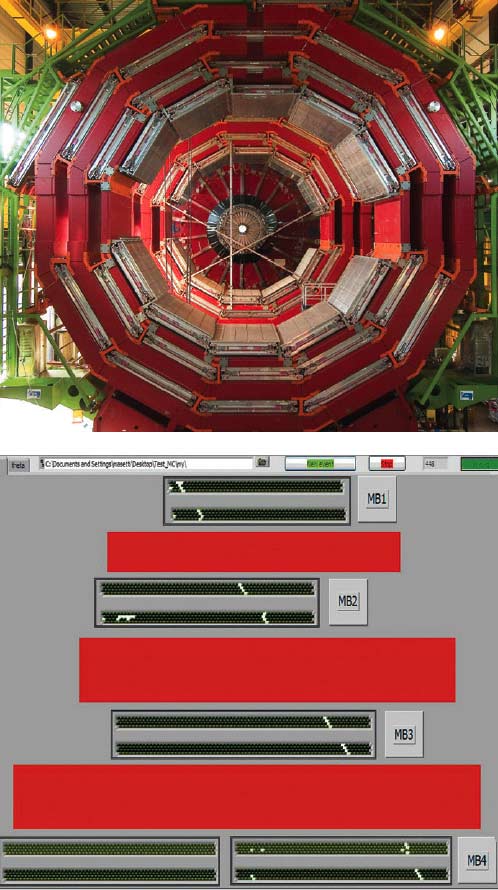
The CMS collaboration has for the first time operated a whole sector of drift-tube chambers (DTCs) and detected cosmic muons. This is the first stage in commissioning the CMS Muon Barrel detector prior to installation below ground later in 2006.
Since the summer of 2004, the team building the DTCs – from Aachen, Bologna, Madrid (CIEMAT), Padova and Torino – has been engaged in the delicate and complex operation of installing the chambers in the CMS experiment’s iron yoke. The chambers have 12 layers of drift tubes, arranged in three groups of four, two measuring the R-φ coordinate and one measuring the z-coordinate. Each layer has up to 60 tubes. Unlike conventional drift-tube systems, consecutive layers are staggered by half a tube-width, enabling the DTCs to generate trigger signals for CMS, using a “mean timer” method.
Chambers constructed in the collaborating institutes are first assembled on the main site at CERN together with their on-chamber cables, pipes and mini-crates. These “dressed” chambers require very few external components to become operational, and so undergo thorough pre-installation tests before being transported to the CMS site at Cessy. There they are inserted into the CMS iron yoke in the surface building. The chambers are then ready for final commissioning tests, which include long data-taking runs that exploit the chamber’s self-triggering capability with cosmic muons. By February two of the five wheels in the CMS barrel yoke had been instrumented, and 82 DTCs commissioned.
This first sector test marked the beginning of a long series of tests that will culminate this spring with the CMS Cosmic Challenge. At this point the five barrel wheels and the two endcaps will be pushed together in the surface building and the superconducting solenoid operated for the first time. Segments of all sub-detectors will be present and cosmic muons will be detected and measured. The lowering of the CMS sections into the underground cavern is due to begin in the summer.
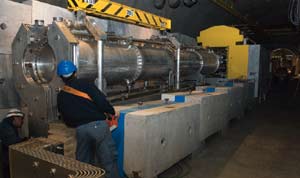
The magnetic system that focuses the beam of particles arising from the graphite target of the CERN Neutrinos to Gran Sasso project (CNGS) has been installed in its final position in the tunnel. This represents the final milestone of the project prior to testing all systems in preparation for the first commissioning with beam, at the end of May.
The CNGS secondary beam magnetic system consists of two elements: the horn and the reflector, both acting as focusing lenses for the positively-charged pions and kaons produced by proton interactions in the target. Most of these pions and kaons will decay in a 1 km-long vacuum pipe. At the end of this, a barrier, comprising 3 m of graphite and 15 m of iron, will absorb the remaining hadrons, leaving behind a beam of muons and neutrinos. Muons are quickly absorbed downstream in the rock, leaving only muon-neutrinos to traverse the Earth’s crust towards the Gran Sasso laboratory 732 km away in Italy.
Both the horn and the reflector came originally from LAL/IN2P3 before major modification at CERN. They are 7 m long and weigh more than a tonne each. They work with high pulsed currents, 150 kA for the horn and 180 kA for the reflector. These currents flow for a few milliseconds at the instant when the proton-beam pulse hits the target.
The heat that the current produces and the energy deposited by stray particles require a complex water cooling system. To avoid modifications in the mechanical properties of the aluminium alloy that makes up the whole system, the temperature must not exceed 80 °C. Cooling power is extracted from the chilled-water network by means of a heat exchanger. Demineralized water is sprayed onto the inner conductor, then collected at the bottom of the horn and the reflector, and finally pumped back to the system in a closed circuit.
The neutrino beam will be remotely monitored from the newly built central control room at CERN’s Prévessin site. The completion of the CNGS project, that is the hand- over to the teams in charge of regular operation of the beam, is planned for mid July.
Since soon after its discovery by Henri Becquerel in 1896, radioactivity has been known to involve the emission of helium nuclei (alphas), electrons (betas) and photons (gammas). Then, in 1960, proton-rich nuclei with an odd or an even atomic number Z were predicted to decay through one- and two-proton radioactivity, respectively. Single-proton radioactivity was discovered in 1981, while the first evidence for two-proton radioactivity was obtained in 2002 in the decay of 45Fe.
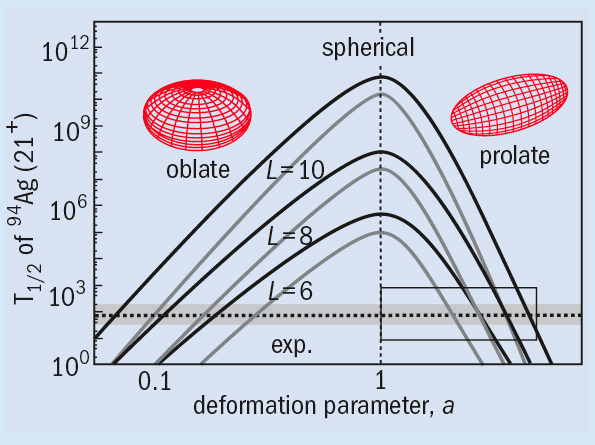
Now in an experiment on 94Ag, an international team lead by Ivan Mukha and Ernst Roeckl has made the first experimental observation of nuclear decay involving both one- and two-proton radioactivity (Mukha et al 2006). The researchers attribute the two-proton emission behaviour and the unexpectedly large probability for this decay mechanism to a very large deformation of the parent nucleus into a prolate (cigar-like) shape, which facilitates emission of protons either from the same or from opposite ends of the “cigar”.
Working at the GSI research centre, the researchers synthesized the lightest known isotopes of silver (94Ag) using nuclear reactions between accelerated 40Ca ions and 58Ni atoms. After purification by online mass separation the 94Ag nuclei were implanted into a catcher positioned in a highly segmented array of silicon and germanium detectors. The simultaneous two-proton emission was identified from a long-lived (0.4 s), high-spin state of 94Ag. This (21+) isomer is also known to undergo one-proton decay (Mukha et al 2005).
Both disintegration modes were unambiguously identified by “tagging” γ rays that are known to de-excite the high-spin states populated in the daughter nuclei 93Pd and 92Rh for one-proton and two-proton decay, respectively. In particular, the team searched for direct two-proton decay of the isomer by measuring coincidences between double-hit events recorded by the silicon detectors and γ-γ events registered by the germanium detectors. The observed two-proton decay is unexpectedly fast.
This first measurement of correlation data in two-proton radioactivity calls for further experimental studies of the properties of this truly exotic isomer. It also demands a more quantitative theoretical description of the observed two-proton decay behaviour.
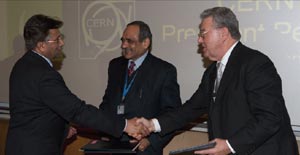
On 25 January Pervez Musharraf, president of Pakistan, visited CERN with five government ministers, Parvez Butt, president of Pakistan’s Atomic Energy Commission (PAEC), and an eminent former president of the Commission, Ishfaq Ahmad, who pioneered co-operation with CERN. The visit included a tour of CMS, to which Pakistan is making a substantial contribution, and an opportunity for Musharraf to address CERN’s Pakistani scientists.
During the visit, Butt and CERN’s director-general, Robert Aymar, signed an addendum to the 2003 Protocol Agreement covering the supply of additional equipment for the Large Hadron Collider (LHC). They also signed a letter of intent aimed at strengthening scientific and technical co-operation between CERN and Pakistan. The document envisages an extension of the existing partnership not only in new accelerators, detectors and information technologies, but also in educating and training scientists and technical experts.
In 1994 CERN and Pakistan signed their first formal collaboration agreement, and in 1997 a protocol was signed for the supply of eight huge steel feet for the CMS magnet yoke. This was supplemented in 2000 by a memorandum of understanding for the production of 288 muon chambers and electronic components for the experiment. Three years later, the co-operation gained new impetus with a new protocol of understanding with CERN.
There are currently 75 Pakistani physicists and engineers taking part in three major CERN projects: CMS, ATLAS and the development of the Computing Grid for the LHC (LCG).
A five-part workshop has been launched at CERN to study the interplay between the physics of particle flavour and the physics achievable at particle colliders. In particular, it aims to consider the future directions for flavour physics when the Large Hadron Collider (LHC) starts up at CERN in 2007.
Flavour physics and charge-parity (CP) violation have played an outstanding role in the exploration of particle-physics phenomenology for more than four decades. After a long and exciting history of K-decay studies, the experimental stage is currently dominated by the decays of B+ and B0d mesons. Thanks to the efforts at the e+e– B-factories at SLAC and KEK, with their detectors BaBar and Belle respectively, CP violation is now well-established in the B-meson system, and for the first time several strategies to test the flavour structure of the Standard Model can be confronted with experimental data.
Further valuable insights can be obtained from studies of the B0s system, with first results from experiments at CERN’s Large Electron-
Positron collider and the SLAC Linear Collider, as well as from Fermilab’s Tevatron. In future, the physics potential of B0s decays can be fully exploited at the LHC, in particular by the LHCb experiment. Moreover, there are also plans for a “super B-factory”, with a significant increase in luminosity relative to the e+e– colliders currently operating.
As far as the kaon system is concerned, the future lies in particular in investigations of the very rare decays K+ → π+vbar v and KL → π+vbar v, which are very clean from the theoretical point of view, but unfortunately hard to measure. There is a new proposal to measure the former channel at CERN’s Super Proton Synchrotron, and efforts to explore the latter at KEK/J-PARC in Japan. There are also many other fascinating aspects of flavour physics, such as charm and top physics, flavour violation in the charged lepton and neutrino sectors, electric dipole moments and studies of the anomalous magnetic moment of the muon.
The hope and final goal of these flavour studies is to find indications of physics beyond the Standard Model and to study its properties. So far, the Standard Model remains in good shape, with the exception of a couple of flavour puzzles that do not give definite conclusions on the presence of new physics. On the other hand, neutrino oscillations, as well as the evidence for dark matter and the baryon asymmetry of the universe, show that the Standard Model is incomplete. Moreover, specific extensions of the model usually contain new sources of flavour and CP violation, which may manifest themselves at flavour factories.
The LHC, it is hoped, will provide direct evidence for physics beyond the Standard Model through the production and decays of new-physics particles that arise, for example, in supersymmetric extensions of the Standard Model. There should be a very fruitful interplay between these “direct” studies of new physics and the “indirect” information provided by flavour physics.
The goal of the new CERN workshop, Flavour in the era of the LHC, is to outline and document a programme for flavour physics for the next decade, addressing in particular the complementarity and synergy between the LHC and the flavour factories with respect to the discovery and exploration potential for new physics. The workshop follows the standard CERN format, consisting of three working groups, which are devoted to the collider aspects of flavour physics at high-Q, the physics of the B-, K- and D-meson systems, and flavour physics in the lepton sector.
The opening meeting with plenary sessions to review the state-of-the-art of these topics, which also started the working group activities, took place at CERN on 7-10 November 2005. This attracted more than 200 participants from all over the world, and was followed by a second meeting at CERN on 6-8 February. There will be two further meetings before the final plenary meeting at the end of 2006 or the beginning of 2007. A CERN report will then publish the results and conclusions of the workshop.
• Anyone interested in joining the workshop is still very welcome. For information, see http://cern.ch/flavlhc. The next meeting will be at CERN on 15-17 May.
To provide the best experiences, we use technologies like cookies to store and/or access device information. Consenting to these technologies will allow us to process data such as browsing behavior or unique IDs on this site. Not consenting or withdrawing consent, may adversely affect certain features and functions.
Functional
Always active
The technical storage or access is strictly necessary for the legitimate purpose of enabling the use of a specific service explicitly requested by the subscriber or user, or for the sole purpose of carrying out the transmission of a communication over an electronic communications network.
Preferences
The technical storage or access is necessary for the legitimate purpose of storing preferences that are not requested by the subscriber or user.
Statistics
The technical storage or access that is used exclusively for statistical purposes.The technical storage or access that is used exclusively for anonymous statistical purposes. Without a subpoena, voluntary compliance on the part of your Internet Service Provider, or additional records from a third party, information stored or retrieved for this purpose alone cannot usually be used to identify you.
Marketing
The technical storage or access is required to create user profiles to send advertising, or to track the user on a website or across several websites for similar marketing purposes.