Comsol -leaderboard other pages

Topics

Workshop focuses on top-quark physics

Coimbra, in central Portugal, was the country’s capital from 1143 to 1255 and in historical importance ranks behind only Lisbon and Oporto. Its university was founded in 1290 and was the only one in Portugal until the beginning of the 20th century. Its ancient setting contrasted well with the central theme of TOP2006: the top quark, discovered only in 1995 in experiments at Fermilab’s Tevatron.
CCEwor1_09-06

The workshop itself grew from the idea of developing a strong collaboration between theorists and experimentalists who are interested in studying the properties of the top quark. The first properties of this unique particle were measured during Run I of the Tevatron by the CDF and D0 experiments; with Run II more data are now becoming available. Though not yet sufficient to perform the precision tests required to challenge (once again) the Standard Model, the data acquired so far are already providing valuable information on top-quark physics. The knowledge of the physics of the top quark will then enter a totally new phase – the precision era – with the start-up of the Large Hadron Collider (LHC) at CERN, foreseen towards the end of 2007.

CCEwor2_09-06

The top quark is the heaviest quark found (mt = 172.5±2.3 GeV/c2) and is still believed to be a fundamental particle. It completes the third-generation structure of the Standard Model, as the isospin partner of the b (bottom) quark. Why it is so heavy and why its Yukawa coupling to the Higgs field (after spontaneous symmetry breaking) is of the order of 1 is a mystery. Its solution requires an answer to the question: does the top quark play a special role in the electroweak symmetry-breaking mechanism of the Standard Model?

Although mainly produced via the strong interaction at particle colliders (double production via gluon–gluon fusion or qqbar annihilation), the top quark decays through the weak force to a b quark and a W boson with a branching ratio of almost 100%. Because of their large mass and decay rate (Γ = 1.42 GeV at next-to-leading order), top quarks, unlike any other quark, are produced and decay as free particles. With a very short lifetime (around 10–25 s), the top quark decays before hadronization can take place. For the same reason no toponium bound states with sharp binding energy are expected in the Standard Model; any evidence of a ttbar bound state would be a sign of physics beyond the model. The flavour-changing neutral-current decays of the top quark are also highly suppressed in the Standard Model, with branching ratios at the level of around 10–12 to 10–14; any evidence of decays such as t → qZ, qγ or qg would therefore constitute a sign of new physics.

Top-quark properties

The first day of the workshop was dedicated to the current theoretical and experimental status of top-quark physics, in the morning and afternoon sessions, respectively. C P Yuan of Michigan State University recalled the need for a precise measurement of the top-quark mass to constrain the Higgs mass when combined with the measurement of the W mass. Within the context of current theoretical knowledge, the day also covered the importance of the rate of single top production at colliders (not yet observed) as a probe for the element Vtb in the Cabibbo–Kobayashi–Maskawa matrix. He also stressed the fact that the different channels (s, t and Wt) that contribute to single top production are important processes for the search for physics beyond the Standard Model.

Aurelio Juste from Fermilab reviewed the current experimental status of the top quark starting from the total cross-section measurement at the Tevatron, with a relative precision of around 25% in Run I, dominated essentially by statistics. In Run II, with a luminosity of 2 fb–1, this error is expected to be reduced to about 10%. The mass is by far the most precisely measured property of the top quark, with a relative error less than 2%. The top charge, anomalous couplings and single top production were also discussed.

The second day examined the experimental methods used to select top quarks at colliders, and the leading-order and next-to-leading-order generators and theoretical methods available for understanding the data. Evelyn Thomson of the University of Pennsylvania presented the experimental methods that are used in the selection and analysis of top-quark decays at hadron colliders. In particular, she discussed the importance of the trigger, the difficult question of the background rejection and estimation (as W+jets and Z+jets), the need for a detailed calibration and determination of the jet energy scale (a major source of systematic error), and b-tagging, a key tool to reduce the background. She stressed the need to fine-tune the available Monte Carlo to reproduce data accurately. Available top-selection tools involve multivariate analysis and different statistical techniques.

Werner Bernreuther, of RWTH (Rheinisch-Westfälische Technische Hochschule) Aachen, described spin effects in hadronic top-pair production and polarized top decays, ttbar spin correlations (which are transferred to the decay products), and the possible existence of heavy ttbar resonances. As the top polarization is reliably calculable, it is well suited for experimental checks of the predictions of the Standard Model and its extensions. Bernreuther concluded that the top-quark physics is an excellent probe to test electroweak symmetry breaking and that it provides powerful observations to determine the structure of the tbW vertex. Sergey Slabospitsky of the Institute for High Energy Physics, Protvino, and Borut Kersevan of the Josef Stefan Institute presented the status of the important event generators that are being developed and used at the Tevatron and LHC to simulate top production and decays.

Top prospects

The prospects for top physics on the up-coming colliders were discussed on the third day of the workshop. In the morning, Dominique Pallin of Blaise Pascal University presented the expected performance of the LHC as a top factory. In particular, he showed the work going on for early top-quark studies, such as the measurement of the ttbar production cross-section and the top mass, as well as the determination of the W and top polarizations, in the lepton+jets channel. The top quark is a very useful calibration tool for early data (for the jet energy scale, b-tagging, trigger etc), which can also be used to check detector performance. With the increase of luminosity at the LHC many precision measurements of top-quark properties will be possible.

In the afternoon, Lynne Orr of the University of Rochester gave a talk about top physics at the LHC and a future International Linear Collider (ILC). She described the electroweak symmetry breaking mechanism and the hierarchy problem. She also discussed top-quark physics in models beyond the Standard Model, which are possible solutions to this problem: supersymmetry, little Higgs, technicolour and its descendents, and modified space–time models with extra dimensions. Finally, the sensitivity of different top-quark couplings at the LHC and ILC was reviewed. Brian Foster of Oxford University presented the status of the ILC.

Finally John Womersley, of the CCLRC, Rutherford Appleton Laboratory, presented a lively and appealing workshop summary talk. He also covered the status and the open questions in particle and astroparticle physics. All in all, the workshop was a fruitful opportunity for interesting discussions on the exciting subject of top-quark physics. The participants are looking forward to the next workshop, which will probably take place two years from now, where the latest results of the Tevatron’s Run II and the first results from the LHC in top-quark physics will be presented and discussed, and new challenges to the Standard Model will be tested.

Iron Dominated Electromagnets: Design, Fabrication, Assembly and Measurements

by Jack T Tanabe, World Scientific. Hardback ISBN 981256327X, £29 ($48). Paperback ISBN 9812563814, £17 ($28).

419ZEXVV4ZL._SX335_BO1,204,203,200_

Written by one of the foremost specialists, this book is devoted to the design of low and medium field electromagnets, the field level and quality (uniformity) of which are dominated by the pole-shape and saturation characteristics of the iron yoke. Iron Dominated Electromagnets covers a wide scope of material ranging from the physical requirements for typical high-performance accelerators, through the mathematical relationships that describe the shape of two-dimensional magnetic fields, to the mechanical fabrication, assembly, installation and alignment of magnets in a typical accelerator lattice. Derived from lecture notes used in a course at Lawrence Livermore National Laboratory, it is a useful resource for students planning to enter high-energy physics, as well as those already working with particle accelerators.

Symmetry and the Monster: One of the Greatest Quests of Mathematics

by Mark Ronan, Oxford University Press. Hardback ISBN 0192807226, £14.99 ($27).

CCEboo1_09-06

Simple symmetry groups are groups of geometric operations (rotations, reflections, etc) that cannot be decomposed into simpler groups. Symmetry and the Monster is about identifying and classifying the finite simple symmetry groups and discovering exceptions that do not fit into the overall pattern. The largest exception is the Monster. This book is the first telling of a mathematical odyssey spanning two centuries and the biographical accounts linking the technical sections are lively and informative, although they become more reticent as we reach modern times with living protagonists.

Ronan insists on calling simple groups the “atoms of symmetry” (atoms are not simple) and classifying them in “periodic tables”. However, even Ronan’s first table is mysterious, with Lie groups classified in “families”, labelled A through G (rows), operating in dimensions 1 through 9 (columns). Ronan does not tell the reader what the family members have in common, but says that some groups don’t appear because they are not “simple” or are the same as others. For example, D3 is apparantly the same as A3. And it doesn’t get any easier.

Oxford University Press considers this book “a must-read for all fans of popular science”. In his blog, Lieven le Bruyn, professor of algebra and geometry at the University of Antwerp, suggests that “Mark Ronan has written a beautiful book intended for the general public”. However, he goes on to say: “this year I’ve tried to explain […] to an exceptionally good second year of undergraduates, but failed miserably […] Perhaps I’ll give it another (downkeyed) try using Symmetry and the Monster as reading material”.

As an erstwhile mathematician, I found the book more suited to exceptional maths undergraduates than to the general public and would strongly encourage authors and/or publishers to pass such works before a few fans of popular science before going to press.

Theory and Phenomenology of Sparticles: An Account of Four-Dimensional N = 1 Supersymmentry in High Energy Physics

by Manuel Drees, Rohini M Godbole and Probir Roy, World Scientific. Hardback ISBN 9810237391, £62 ($108). Paperback ISBN 9812565310, £37 ($64).

416RJTYNVWL

A theoretical and phenomenological account of sparticles, this book provides a comprehensive, pedagogical and user-friendly treatment of the subject of four-dimensional N = 1 supersymmetry, as well as its observational aspects in high-energy physics and cosmology. Search strategies for sparticles, supersymmetric Higgs bosons, nonminimal scenarios and cosmological implications are some of the many topics that are covered. Additional features include self-contained presentations of collider signals of sparticles plus supersymmetric Higgs bosons and of supersymmetric cosmology.

Brane-Localized Gravity

by Philip D Mannheim, World Scientific. Hardback ISBN 9812565612, £33 ($58).

315YGSx+eAL

In this book the author provides a detailed introduction to the brane-localized gravity of Randall and Sundrum, in which gravitational signals can localize around our four-dimensional world in the event that it is a brane embedded in an infinitely sized, higher dimensional anti-de Sitter bulk space. Mannheim pays particular attention to issues that are not ordinarily covered in brane-world literature, such as the completeness of tensor gravitational fluctuation modes, and the causality of brane-world propagators. This self-contained development of the material that is needed for brane-world studies also contains a significant amount of previously unpublished material.

LHC start-up confirmed for 2007

First collisions in the Large Hadron Collider (LHC) will occur in November 2007, LHC project leader Lyn Evans told the 137th meeting of the CERN Council on 23 June. A two month run in 2007, with beams colliding at an energy of 0.9 TeV, will give the accelerator and detector teams the opportunity to run-in their equipment, ready for a run at the full collision energy of 14 TeV to start in Spring 2008.

CCEnew1_07-06

The schedule announced to the Council ensures the fastest route to a high-energy physics run with substantial quantities of data in 2008, while optimizing the commissioning schedules for the accelerator and the detectors that will study the particle collisions. It foresees closing the 7 km ring of the LHC in August 2007 for equipment commissioning. Two months of running will start the following November, allowing the accelerator and detector teams to test their equipment with low-energy beams. After a winter shutdown, during which commissioning will continue without beam, the full-energy run will begin. Data collection will then continue until a predetermined amount of data has been accumulated, allowing the experimental collaborations to announce their first results.

CCEnew2_07-06

Progress with the LHC project is being closely followed by a machine advisory committee composed of experts from around the world. This committee believes that “experience indicates that [the proposed schedule] is the most efficient way to get to high-energy, high-luminosity operation at the earliest date”.

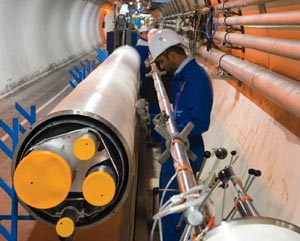
Meanwhile, installation of the LHC accelerator has reached full speed, and all of the industrial procurement projects are coming to a conclusion. The last magnet for the LHC will be delivered to CERN in October 2006 and magnet testing will conclude by December. The last magnet will be installed in the LHC ring in March 2007, after which the machine will be closed ready for commissioning in August, with first collisions scheduled for November.

At the meeting the Council also unanimously approved a preliminary draft budget for 2007 and took note of projections for 2008-2012, with no new initiatives in the scientific programme. However, this exercise is continuing in parallel with the definition of a European strategy for particle physics. If approved by the Council at its meeting in Lisbon on 14 July, this strategy will have financial implications and will require new resources, which will have to be taken into account when the medium-term plan for CERN is discussed later this year.

MAGIC discovers variable very-high-energy gamma-ray emission from a microquasar

CCEnew3_07-06

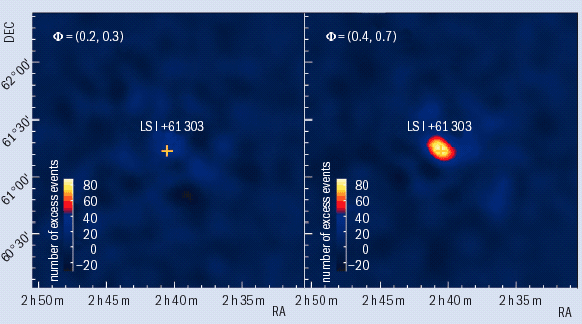
The Major Atmospheric Gamma-ray Imaging Cherenkov (MAGIC) Telescope has discovered variable very-high-energy gamma-ray emission from a microquasar. The telescope, on the island of La Palma, observed the microquasar called LS I +61 303 between October 2005 and March 2006. The observations show a clear variation with time and suggest that gamma-ray production may be a common property of microquasars.

Microquasars are gravitationally bound binary-star systems consisting of a massive ordinary star and a compact object of a few solar masses that is either a neutron star or a black hole. The two stars orbit a common centre and when close enough the mutual tides can cause a sudden transfer of mass from the normal star onto the compact companion. Some of the gravitational energy released in this exchange gives rise to jets of particles ejected at close to the speed of light, together with spectacular emission of radiation. Microquasars appear to be scaled-down versions of quasars, but in this case the small mass of the compact object means that events occur on a much smaller timescale – days rather than years – making them interesting objects to study. They are also a possible source of high-energy cosmic rays.

MAGIC detected LS I +61 303, one of about 20 known microquasars, at a rate of one gamma ray per square metre per month (Albert 2006). The telescope registers gamma rays through the Cherenkov radiation produced by the showers of particles created by the gamma rays as they enter the atmosphere.

LS I +61 303 was observed over six orbital cycles and a clear variability was found that is consistent with the orbital changes in aspect of the compact object (see figure). There is also evidence of periodicity. This shows that the very-high-energy gamma-ray emission is directly related to the interaction between the two stars.

Further reading

J Albert et al. 2006 Science 312 1771.

EIFast workshop presents XFEL project to international industry

A total of 57 companies and 14 institutions from 13 countries demonstrated their interest in the European X-ray free-electron laser (XFEL) project at an industry workshop held at DESY on 9-10 May. Organized by the European Industry Forum for Accelerators with Superconducting RF Technology (EIFast), the event was intended to inform potential suppliers from European industry about the current design status of this new large European machine, for which construction should start at the beginning of 2007.

Companies attending were asked to comment and give their opinion on the technical layout of the XFEL facility, the purchasing strategy and other relevant issues.

The decision to hold the workshop before an agreement has been reached at the political level to create and finance the European XFEL Facility GmbH was considered to be a wise move, as it demonstrated to companies that the preparation of the project has come to maturity. More than 170 participants attended, representing the whole spectrum of services required for the construction of the XFEL, from the building of the surface halls and underground facilities to the development and supply of components and measurement devices. Attendees unanimously agreed that the workshop had been highly beneficial, and praised the detailed presentation of the XFEL project and the timely involvement of industry, which allows potential suppliers to plan the required capacities and make the necessary technical preparations on time.

Parametric X-ray radiation yields new tool to detect relativistic nuclei

Researchers at the Nuclotron at the Laboratory for High Energies at the Joint Institute for Nuclear Research (JINR), Dubna, have observed parametric X-ray radiation (PXR) from moderately relativistic nuclei interacting with crystals. Predicted theoretically in 1971, PXR has already been detected and investigated in electron beams at various energies, but this is the first time that it has been observed for heavy charged particles. It could lead to a new diagnostic method for use in nuclear beams at high-energy accelerators.

CCEnew4_07-06

PXR emission by fast charged particles in crystals occurs when the virtual-photon field of the particles is diffracted by the crystallographic planes. The radiation arises from the uniform straight-line motion of the charged particle in the crystal and the yield depends only weakly on the value of the particle’s relativistic factor γ. It was natural to assume that the observation of PXR from heavy charged particles – relativistic nuclei – was a real possibility. Moreover, PXR from nuclei with a charge Z > 1 should be more intense than PXR from electrons, because the parametric-radiation yield is proportional to the square of Z.

The variation of the yield with γ contrasts with the case for radiation produced by the change of a particle’s velocity, such as bremsstrahlung and synchrotron radiation, where there is a strong dependence on γ. Both bremsstrahlung and synchrotron radiation are practically absent for protons and nuclei with the energies typical of the Nuclotron in contrast with electrons with the same energies.

The measurements at the Nuclotron were performed by a collaboration from JINR, the Institute of Physical-Technical Problems in Dubna, the Nuclear Physics Institute in Tomsk Polytechnical University and the Moscow State Institute of Electronic Technology. The team used silicon and graphite crystals in extracted beams of 5 GeV protons and 2.2 GeV/u carbon nuclei. The beam fell onto a thin (001) silicon-crystal target, inclined to the beam axis at an angle, θB, near 20°. The detector was placed close to an angle 2θB, which is the diffraction angle of virtual photons in a particle field from the (001) planes.

The figures show the X-ray spectra measured for a 5 GeV proton beam and a 2.2 GeV/u carbon-nuclei beam incident on the silicon crystal. The peaks α and β correspond to the characteristic radiation of nickel atoms that were excited in the detector casing by secondary particles. The peaks Eγ are due to parametric radiation.

The angular density of the parametric radiation was found to be 2.25 × 10-6 and 9.76 × 10-5 photon/(particle·sr) from protons and carbon nuclei, respectively, for a crystal inclination angle θB = 22.5°. The considerably higher radiation density from carbon nuclei confirms qualitatively the dependence of the parametric-radiation yield on particle charge Z.

This observation of parametric X-ray radiation from relativistic nuclei in the experiments at the Nuclotron opens possibilities for applications of the effect as a nuclear-beam diagnostic at other high-energy accelerators. The significant advantage is the large angle of PXR photons to the beam direction. The crystal target for the diagnostics can be made very thin – less than 100 μm – to decrease its influence on the beam. The application of bent crystals for collimation of the LHC beams is also under investigation. Detection of PXR generated by the beam halo particles in the crystal collimator could provide information about the stability of its angular position and also, as a by-product, about the structure of the crystal.

ALICE experiment sees first cosmic-ray events

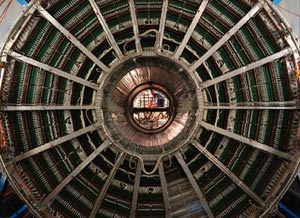
On 16 June the time projection chamber (TPC) for the ALICE experiment at the Large Hadron Collider (LHC) started to record its first real events, reconstructing the tracks of cosmic rays. ALICE will search for evidence for quark-gluon plasma in head-on collisions of lead ions at the LHC. This requires precise tracking to record the paths of thousands of particles produced in the collisions. ALICE is therefore built around the largest TPC in the world. Based on a cylindrical field cage 5 m long and 5 m in diameter, the TPC is now nearing completion, with all the read-out chambers installed and the custom electronics complete for the approximately 560,000 read-out channels.

CCEnew5_07-06

The TPC consists of a field cage made of carbon-fibre composites, which contains the central high-voltage electrode and four potential-divider chains to create a uniform electric drift field in the active volume of 95 m3, filled with a mixture of Ne, CO2 and N2. The high-voltage electrode is run at 100 kV and shielded to the outside by containment vessels filled with CO2 gas. The detector is now running stably at 100 kV with the final gas mixture.

CCEnew6_07-06

The TPC read-out system on the aluminium endplates is partitioned into 18 sectors on each side. Each sector comprises an inner (small) and outer (large) trapezoidal read-out chamber based on multiwire proportional chambers with pad read-out. The signals from the pads are passed via flexible Kapton cables to 4356 front-end cards located some 10 cm away from the pad plane. In the front-end cards, the signals are amplified, converted to digital format, and then pre-processed by a specially designed combination of read-out chips. With the ultra-low power consumption of its electronics (<45 mW/channel), the whole TPC requires about 25 kW of electrical power for full operation. However, only a fraction of the power and of the corresponding water-cooling plant is available in the clean room, so commissioning is proceeding with two sectors at a time.

The tests use the ALICE cosmic muon trigger detector ACORDE, as well as a specially designed UV laser system, to produce tracks in the detector. Preliminary analysis of the cosmic-ray events and the laser-induced tracks indicate that the drift velocity and diffusion of electrons liberated by traversing charged particles, as well as the spatial resolution, are very close to the design values. Commissioning, during which every one of the 36 sectors will be turned on and its performance studied, will last until October. The TPC will then be transferred into the ALICE underground area prior to installation and final connection of all services ready for first collisions in November 2007.

bright-rec iop pub iop-science physcis connect