edited by Richard Brenner, Carlos P de los Heros and Johan Rathsman, World Scientific. Hardback ISBN 9812566627, £56 ($98).
The Lepton–Photon symposia are among the most popular conferences in high-energy physics, since they give in-depth snapshots of the status of the field as provided by leading experts. Inside this volume, readers will find the latest results on flavour factories, quantum chromodynamics, electroweak physics, dark-matter searches, neutrino physics and cosmology, from a phenomenological point of view. It also offers a glimpse of the immediate future through summaries on the status of the next generation of high-energy accelerators and planned facilities for astroparticle physics. The review nature of the articles makes the volume useful to students, as well as to established researchers in high-energy and astroparticle physics.
Edited by Cosmas K Zachos, David B Fairlie and Thomas L Curtright, World Scientific. Hardback ISBN 9812383840, £64 ($86).
Wigner’s quasi-probability distribution function in phase space is a special (Weyl) representation of the density matrix. It has been useful in describing quantum transport in quantum optics; nuclear physics; decoherence, quantum computing and quantum chaos. It is also important in signal processing and the mathematics of algebraic deformation. A remarkable aspect of its internal logic, pioneered by Groenewold and Moyal, has emerged in the last quarter-century, furnishing a third, alternative, formulation of quantum mechanics, independent of the conventional Hilbert space or path integral formulations. This book is a collection of the seminal papers on this formulation, with an introductory overview, an extensive bibliography, and simple illustrations, suitable for application to a broad range of physics problems.
by Mohsen Razavy, Imperial College Press. Hardback ISBN 1860945252, £51 ($84). Paperback ISBN 1860945309, £29 ($48).
The aim of this book is to elucidate the origin and nature of dissipative forces and to present a detailed account of attempts to study dissipative phenomena in both classical mechanics and quantum theory. It begins with an introductory review of phenomenological damping forces, and the construction of the Lagrangian and Hamiltonian for the damped motion, and moves on to investigate the use of the classical formulation in the quantization of dynamical systems, and finally the problem of dissipation in interacting quantum mechanical systems. A number of important applications, such as the theory of heavy-ion scattering and the motion of a radiating electron, are also discussed.
by James P Sethna, Oxford University Press. Hardback ISBN 019856676X, £49.95 ($99.50). Paperback ISBN 0198566778, £24.95 ($44.50).
In each generation, scientists must redefine their fields: abstracting, simplifying and distilling the previous standard topics to make room for new advances and methods. This book takes this step for statistical mechanics – a field rooted in physics and chemistry whose ideas and methods are now central to information theory, complexity and modern biology. Aimed at advanced undergraduates and early graduate students in all of these fields, Sethna limits his main presentation to the topics that future mathematicians and biologists, as well as physicists and chemists, will find fascinating and central to their work. The large supply of carefully crafted exercises, each an introduction to a whole field of study, covers everything from chaos through information theory to life at the end of the universe.
by Theodore Arabatzis, The University of Chicago Press. Hardback ISBN 0226024202, £44.50 ($70). Paperback ISBN 0226024210, £18 ($28).
Both a history and a metahistory, this book focuses on the development of various theoretical representations of electrons from the late 1890s until 1925, and the methodological problems associated with writing about unobservable scientific entities. Here, the electron – or rather its representation – is used as a historical actor in a novel biographical approach. Arabatzis illustrates the emergence and gradual consolidation of its representation in
physics, its career throughout old quantum theory, and its appropriation and reinterpretation by chemists. Furthermore, he argues that the considerable variance in the representation of the electron does not undermine its stable identity or existence. The book should appeal to historians, philosophers of science and scientists alike.
edited by Howard E Haber and Ann E Nelson, World Scientific. Hardback ISBN 9812388923, £105 ($172).
This book features three lecture-series courses given at the School of the Theoretical Advanced Study Institute (TASI) on Elementary Particle Physics in 2002. The phenomenology lectures cover a broad spectrum of the research techniques used to interpret present day and future collider data. The TeV-scale physics lectures focus on modern speculations about physics beyond the Standard Model, with an emphasis on supersymmetry and extra-dimensional theories. The series on astroparticle physics looks at recent developments in theories of dark matter and dark energy, the cosmic microwave background, and prospects for the upcoming era of gravitational wave astronomy. Researchers and graduate students in high-energy physics, mathematical physics and astrophysics will find topics of interest.
by Afsar Abbas, Indian Institute of Advanced Study. Hardback ISBN 8179860604, Rs150.
This “new perspective” discusses the philosophical issues inherent within the research pursued by scientists at the forefront today. Examples from modern science, in particular the current hot topics in physics, have been provided to clarify the issues under discussion. The book is written so as to be accessible even to non-experts, but experts will find much that is new in the philosophy of science presented here. Detailed treatment of mathematics and space, along with time and matter, have also been provided.
The ATLAS Collaboration passed a major milestone during the evening of 1 August. The Central Solenoid, in its final position in the ATLAS cavern and with the final equipment, was commissioned up to 8.0 kA without quenches, exceeding its operational current of 7.73 kA for the magnetic field of 2 T. This makes the ATLAS Central Solenoid the first superconducting magnet to be fully commissioned in the underground areas of CERN’s Large Hadron Collider (LHC).
It is 12 years since the team led by Takahiko Kondo and Akira Yamamoto of the KEK laboratory in Japan proposed a thin solenoid magnet for the ATLAS experiment at the LHC. The solenoid provides a magnetic field of 2 T for momentum measurement in the inner detector part of the huge construction. Located inside the electromagnetic calorimeter, it must be thin to present as little material as possible to particles, in particular electrons and photons, produced in the proton collisions at the centre of the detector. The KEK proposal was to use specially hardened aluminium stabilizer for superconducting cables, saving about 30% in material thickness.
The solenoid also shares a common cryostat/vacuum vessel with the barrel liquid-argon (LAr) calorimeter, eliminating the need for two vacuum-vessel walls. This special configuration meant that the solenoid and LAr cryogenics teams had to collaborate perfectly from the beginning of the design stage all the way through to the commissioning that ended at the beginning of August. A highlight during construction was an exchange of final and test inner vacuum cylinders between the two projects in 2000, when the solenoid and the LAr barrel cryostat, which was the responsibility of Brookhaven National Laboratory, were being manufactured on the same Japanese island.
The solenoid commissioning has not only proved that the solenoid magnet built by KEK performs well, but it has demonstrated that all the control, cryogenic, power, vacuum and safety systems worked coherently – a major accomplishment by various CERN teams. In particular, very-high-precision current generation by the digitally-controlled power supplies enables the magnetic field to be reproduced reliably to an accuracy of 10–5. Following the commissioning, the collaboration also mapped the solenoid field.
Only a few days previously, a site-wide electric power failure had struck CERN for several hours, but thanks to well-designed emergency and recovery countermeasures, the solenoid was commissioned. This success with the ATLAS solenoid was a good start for commissioning even larger and more complex systems for the LHC and its experiments in the near future.
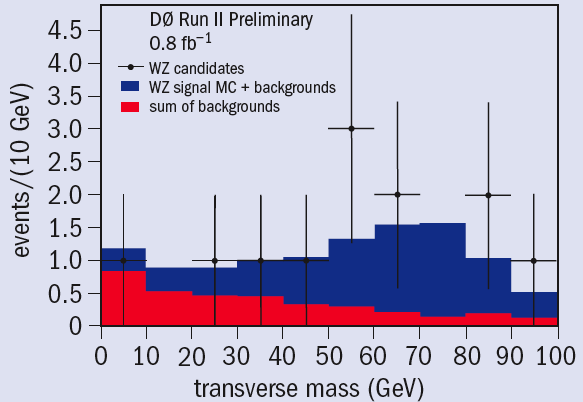
The D0 Collaboration at Fermilab has announced the first measurement of the cross-section for WZ pair production in proton–antiproton collisions. The cross-section times branching ratio for the process is the smallest ever measured at a hadron collider. The data for this result were taken from more than 1 fb–1 of total collision data at the Tevatron, and a sample of 1.5 thousand million events.
Making this measurement requires events in which both the W and Z boson decay to leptons, but while such events provide the cleanest signature of WZ events, they constitute only 1.4% of all WZ decays. D0 found 12 events, each containing three charged leptons with high transverse momentum together with missing transverse energy (indicating an undetected neutrino), with an expected background of 3.6±0.2 events. The probability that the background accounts for these 12 events is 4.1 × 10⁻⁴, which constitutes 3.3 σ evidence for WZ pair production. With these events D0 measures the WZ production cross-section to be 4.0 +1.9–1.5 pb, which is consistent with the Standard Model prediction of 3.6±0.3 pb.
The coupling of the weak vector bosons is an important consequence of the non-Abelian nature of the Standard Model, and the rate for the associated production of W and Z bosons in proton–antiproton collisions allows this coupling to be probed. The kinematics of the Z boson decay can also be used to characterize the interaction between the W and Z and provide further constraints on the nature of the electroweak force. In addition, measuring the cross-section times branching ratio for Standard Model processes with such low rates is an important stepping stone in the search for the Higgs boson at the Tevatron.
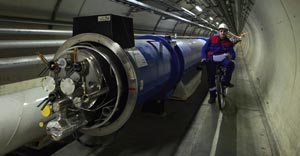
Technicians and engineers continue to work day and night carefully installing 20 magnets a week. This is three times faster than originally planned, with four magnets able to be transported underground simultaneously. However, the 65 team members that are responsible for this task face daily challenges owing to the limited space inside the tunnel. Some areas leave only a few centimetres of leeway, requiring a tightly coordinated operation.
Each of the dipoles weighs 34 tonnes and is 15 m long. Once they have been lowered down the specially constructed shaft on the Meyrin site, they begin a slow progression to their final destinations in the LHC tunnel, taking about 10 hours to arrive at Point 6, the furthest point on the LHC ring. Upon arrival, each of the dipoles is aligned and interconnected to the magnets that are already installed.
During the summer, the installation of Sector 7-8 of the LHC, comprising the first continuous chain of magnets and cryostats, along with their cryogenic distribution line, will be completed, in readiness for cool-down and testing before the end of the year.
To provide the best experiences, we use technologies like cookies to store and/or access device information. Consenting to these technologies will allow us to process data such as browsing behavior or unique IDs on this site. Not consenting or withdrawing consent, may adversely affect certain features and functions.
Functional
Always active
The technical storage or access is strictly necessary for the legitimate purpose of enabling the use of a specific service explicitly requested by the subscriber or user, or for the sole purpose of carrying out the transmission of a communication over an electronic communications network.
Preferences
The technical storage or access is necessary for the legitimate purpose of storing preferences that are not requested by the subscriber or user.
Statistics
The technical storage or access that is used exclusively for statistical purposes.The technical storage or access that is used exclusively for anonymous statistical purposes. Without a subpoena, voluntary compliance on the part of your Internet Service Provider, or additional records from a third party, information stored or retrieved for this purpose alone cannot usually be used to identify you.
Marketing
The technical storage or access is required to create user profiles to send advertising, or to track the user on a website or across several websites for similar marketing purposes.