by Keisuke Fujii, David J Miller and Amarjit Soni (eds), World Scientific. Hardback ISBN 9812389083, £60 ($98).
The high-energy electron–positron linear collider is expected to provide crucial clues to many of the fundamental questions of our time. What is the nature of electroweak symmetry breaking? Does a Standard Model Higgs boson exist or does nature take the route of supersymmetry, technicolour, extra dimensions or none of the these? This book contains articles by experts on many of the most important topics on which the linear collider will focus. It is aimed primarily at graduate students but will be useful to any researcher interested in the physics of the next-generation linear collider.
Researchers at the Lawrence Berkeley National Laboratory (LBNL), together with colleagues from the University of Oxford , have accelerated electrons to more than 1 GeV in only 3.3 cm. This is the highest energy achieved with laser-wakefield acceleration, which harnesses the electric field of a plasma wave driven by a laser beam. Nature Physics have published the results (W P Leemans et al. 2006).
In laser-wakefield acceleration, a laser pulse travelling through a plasma excites plasma waves in its wake, setting up electric fields that accelerate electrons from the plasma. This produces accelerating gradients of 10–100 GV m-1, compared with 10–50 MV m-1 for radio-frequency-based systems, but it has proved difficult both to sustain the laser-wakefield acceleration over the distances needed to reach energies greater than about 100 MeV and to control the energy spread. About two years ago, however, Leemans and colleagues in the Laser Optics and Accelerator Systems Integrated Studies (L’OASIS) group at LBNL, and two other teams in France and the UK, reported using intense laser pulses in millimetre-length gas jets to reach energies of 70–200 MeV with much-reduced energy spreads (see CERN Courier November 2004 p5).
The teams in Europe used laser pulses of 30 TW with relatively large spot sizes to produce sufficiently long laser–plasma interaction lengths in the gas jet. The L’OASIS group developed an alternative solution by creating a plasma density channel in the gas jet to guide the laser drive pulse. An igniter pulse forms a narrow channel of plasma, which is shaped by a heater pulse to create a guide channel for the final drive pulse. Using this method in hydrogen gas, the L’OASIS team reached around 80 MeV with a drive pulse of just 9 TW in a channel 2 mm long.
To achieve higher energies with these techniques implies using petawatt lasers or channelling over longer distances. However, the latter option at first seemed limited. One problem in wakefield acceleration is that the electrons tend to outrun the wake, limiting the length of the accelerator and hence the energy reached. This limiting distance, called the dephasing length, can be increased by lowering the plasma density, but the formation of the plasma guide channel by the igniter-heater method becomes less efficient at lower densities.
The solution emerged when Leemans met Simon Hooker from Oxford University and discovered that Hooker’s group was using capillary guide channels in sapphire. Now the groups have joined forces and built a system that accelerates electrons for centimetres rather than millimetres.
The capillary is laser-machined in two halves in the faces of two blocks of sapphire, which are fixed together to form a thin tube 3.3 cm long. Hydrogen gas then flows in through other slots to fill the tube. A high-voltage discharge across the capillary both turns the hydrogen gas into plasma and heats it, creating a low-density region along the centre. When a laser drive pulse passes through this channel, the wakefield accelerates the plasma electrons.
The team has measured the energy of the bunches of electrons leaving the capillary accelerator using a 1.2 T spectrometer, which deflects the electrons onto a phosphor screen that is viewed by a CCD camera. With drive pulses of 12 TW, density of 3.5 × 1018 cm-3 and a capillary 225 μm in diameter, the researchers reliably produce a 0.48 GeV beam with an energy spread of less than 5% rms. Increasing the diameter to 310 μm and the power to 40 TW (density 4.3 × 1018 cm-3), yields a 1 GeV beam with spread of 2.5% rms, although the performance is less stable.
Leemans and his colleagues are now looking at injecting particles into the capillary, which may help with stability, and increasing the energy by “staging” sequential capillary sections. They are also considering what will be needed to reach 10 GeV.
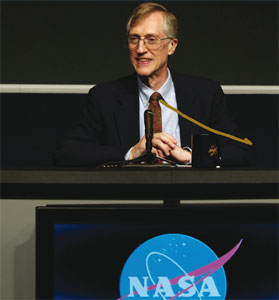
The Nobel Prize in Physics 2006 recognizes research that studies the young universe, before the first stars were born and before galaxies began to form. John Mather of the NASA Goddard Space Flight Center (GSFC) and George Smoot of the Lawrence Berkeley National Laboratory share the prize “for their discovery of the blackbody form and anisotropy of the cosmic microwave background (CMB) radiation”. Both physicists’ work involved the Cosmic Background Explorer (COBE) satellite, which in the early 1990s provided an exciting new view of CMB radiation. This carries the imprint of the universe as it was some 300,000 years after the Big Bang, when radiation and matter decoupled and atoms began to form. COBE’s findings strongly supported the Big Bang and began to turn cosmology into a precise observational science.
Mather and Smoot share a long-standing interest in cosmology. For Smoot this followed a PhD in 1970 in particle physics, and he soon concentrated on producing experimental data about the early universe – in particular to study the CMB, the discovery of which by Arno Penzias and Robert Wilson in 1964 had, in Steven Weinberg’s words, shown that there was such a thing as an early universe to study. (Penzias and Wilson went on to share the Nobel prize in 1978.) By 1974, Smoot had submitted a proposal to NASA to measure and map the CMB in search of imprints of what had happened at earlier epochs.
At the same time, Mather, with an interest in infrared astronomy, led efforts for the first proposal for COBE. After moving to the GSFC, he became study scientist (1976) and then project scientist (1988) for COBE, as well as principal investigator for the Far Infrared Absolute Spectrophotometer (FIRAS) on board COBE. Smoot, meanwhile, became principal investigator of COBE’s Differential Microwave Radiometer (DMR).
The original plan was for a space shuttle to launch COBE, but shuttle operations came to a standstill in 1986 after Challenger‘s horrific accident. However, Mather and his collaborators negotiated the use of a rocket and launched the satellite in November 1989. The FIRAS, designed to measure the CMB radiation spectrum with unprecedented precision, soon revealed a blackbody spectrum perfect to within 50 ppm, corresponding to 2.725±0.002 K, formidable evidence for the Big Bang.
More slowly, Smoot and his colleagues analysed the DMR measurements to create maps of the sky that revealed tiny temperature variations (about 10 ppm) in the generally uniform radiation. These indicated density variations in the primordial universe, which would eventually lead to regions of galaxies and clusters of galaxies separated by empty space. The data proved invaluable in constraining models of the early universe.
A thousand physicists, engineers and others involved in the project both before and after the satellite’s launch contributed to COBE’s success. The satellite took data until the end of 1993, and in 2003 its successor, the Wilkinson Microwave Anisotropy Probe, provided an even more detailed look, measuring temperature fluctuations to millionths of a degree.
Researchers from the Technion – Israel Institute of Technology have used the Accelerator Test Facility (ATF) at the US Department of Energy’s Brookhaven National Laboratory to demonstrate the feasibility of particle acceleration by stimulated emission of radiation (PASER). This is in effect a particle analogue of the laser process.
Levi Schächter at Technion initially demonstrated theoretically the concept behind PASER. Its essence relies on the possibility of transferring energy stored in an active medium (with excited atoms) directly to electrons interacting with the medium, and thereby increasing their energy.
In lasers, photons traversing an active medium stimulate the atoms via collisions so that the atoms give up their excess energy as additional photons forming a coherent beam. In PASER, the atoms in the active medium transfer their energy directly to an electron beam in a coherent way.
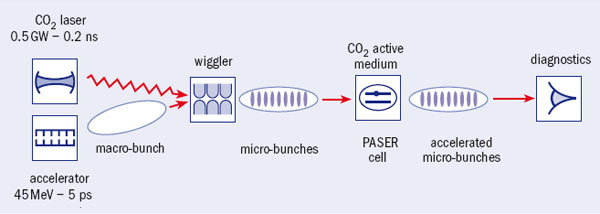
To reach significant acceleration in a PASER, a macro-bunch of electrons injected into the PASER cavity should be modulated, forming a train of micro-bunches with a periodicity identical to the resonance frequency of the medium. In other words, coherent collisions of the second kind between the electrons in the train and the excited molecules should occur.
In the proof-of-principle experiment by Samer Banna, Valery Berezovsky and Schächter, electrons in a macro-bunch with an energy of 45 MeV were modulated by their interaction with a high-power CO2 laser in a wiggler, to make a train consisting of about 150 micro-bunches, each several femtoseconds long. About 15% of the electrons in the train collected at the spectrometer at the end of the PASER cavity had absorbed energy stored in the cavity, increasing the total kinetic energy of the macro-bunch by about 0.15%.
Accelerating electrons in this way provides new opportunities as the effective quality factor of such a cavity may become comparable to that of macroscopic superconducting cavities. In particular it will be a challenge to try to use this technique to generate ultra-low-emittance beams.
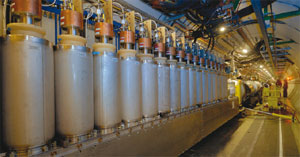
The first cryogenic feedbox designed to supply electricity to the superconducting magnets for one of eight arcs has been installed at Point 8 of the Large Hadron Collider (LHC). This milestone is the precursor to the cool-down of sector 7-8, scheduled for the coming months. Researchers will position a total of 16 such feedboxes at either end of the eight arcs, forming the ends of the continuous sections of cryostat. Each one weighs 12.7 t, is 10 m long and must withstand a pressure of 0.25 MPa.
Power leads, the lower extremities of which are immersed in liquid helium, bring the electrical power from room temperature to cryogenic temperature. Helium gas actively cools them and is injected at their base at 20 K and comes out at room temperature at the top. The power leads use ceramic high-temperature superconductor to limit the heat loads – the first time that these materials have been used on this scale.
The power supply to the LHC’s straight sections requires smaller electrical feedboxes. There will be 44 feedboxes around the LHC ring, equipped with 1200 current leads carrying 120–13,000 A.
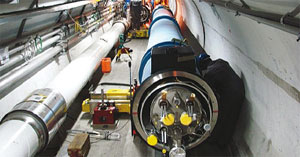
Meanwhile, on 5 September the 1000th cryomagnet (superconducting magnet system) was installed between Point 3 and Point 4. During the same week, the final cryomagnet for sector 8-1 was also installed. There are 1746 cryomagnets, of which 1232 are the famous dipoles.
While most of the LHC experiments are on a grand scale, LHC forward (LHCf) is quite different. Unlike the massive detectors that are used by ATLAS or CMS, LHCf’s largest detector is a mere 30 cm. Rather like the TOTEM detector, this experiment focuses on forward physics at the LHC. The aim of LHCf is to compare data from the LHC with various shower models that are widely used to estimate the primary energy of ultra-high-energy cosmic rays.
The LHCf detectors will be placed on either side of the LHC, 140 m from the ATLAS interaction point. This location will allow the observation of particles at nearly zero degrees to the proton beam direction. The detectors comprise two towers of sampling calorimeters designed by Katsuaki Kasahara from the Shibaura Institute of Technology. Each is made of tungsten plates and plastic scintillators of 3 mm thickness for sampling.
Yasushi Muraki from Nagoya University leads the LHCf collaboration, with 22 members from 10 institutions and four countries. For many of the collaborators this is a reunion, as they had worked on the former Super Proton Synchrotron experiment UA7.
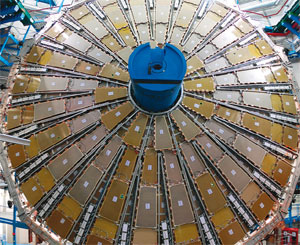
September saw the completion in the underground cavern of the first of the big wheels for the ATLAS muon spectrometer. The muon spectrometer includes four large wheels at each end of the barrel part of the detector, each measuring 25 m across. Six of these wheels will be composed of thin-gap chambers for the muon trigger system – the first wheel is one of these – while the other two will be made of monitored drift tubes to measure the position of the muons.
Japanese astronomers using the Subaru Telescope in Hawaii have detected the most distant known galaxy in the universe. Light from this source was emitted 780 million years after the Big Bang, at a time when the universe was eight times smaller. The surprise is that such distant galaxies are apparently much less numerous than expected. Are we seeing the very first massive galaxies emerging from the dark ages?
Twenty years ago, the remotest known galaxy was at a redshift z of less than 2. This was pushed back to a redshift of 4.55 ten years later and since 2002 the record redshift was 6.56. Then in 2004 the detection of galaxies amplified through gravitational lensing at z = 7 and even z = 10 was announced (see CERN Courier May 2004 p13).
While the first of these detections has not yet been confirmed spectroscopically, the nature of the second galaxy is still a puzzle, although it is now quite clear that it is not at a redshift of 10.
A new step forward has now been achieved with the definite detection of a galaxy at a redshift of 6.96 by a Japanese team led by Masanori Iye. They found the galaxy with a special filter and camera mounted on the 8.2 m aperture Subaru Telescope at the summit of Mauna Kea on Hawaii. The filter is designed to catch Lyman-alpha emission from star-forming galaxies at a redshift between 6.94 and 7.11. The near-infrared camera has 84 million pixels to cover a relatively wide field of view. Among 41,533 sources detected through this filter only two objects are not detected at shorter wavelengths. Spectroscopic follow-up observations of the brightest of these two sources clearly identified the Lyman-alpha emission line shifted by a factor of z + 1 = 7.96 from its rest wavelength of 121.6 nm to an observed wavelength of 968.2 nm. The second candidate source was too faint to be confirmed spectroscopically.
The detection of only one or possibly two galaxies in this survey is well below the expectation of six sources, based on the number of galaxies observed in the same field at a photometric redshift of 6.6. A similar deficit of high-redshift galaxies was also found by R J Bouwens and G D Illingworth at the University of California Santa Cruz. They found only one candidate galaxy between a redshift of 7 and 8 in the Hubble Ultra Deep Field instead of the 10 expected, based on the galaxies found at a redshift around 6. Both results suggest that very luminous galaxies are rare around 700 million years after the Big Bang.
This is an important result as it gives the timescale needed for the building up of luminous galaxies. According to the polarization measurements of the cosmic microwave background by the Wilkinson Microwave Anisotropy Probe (see CERN Courier May 2006 p12) the first stars in the universe were formed at a redshift of up to 12 or 13 some 300 million years after the Big Bang. Another 400 million years would have been needed to allow small galaxies to merge and form the luminous galaxies we start detecting at a redshift of 7. To detect the fainter galaxies emerging from the dark ages we might have to wait for the launch of the James Webb Space Telescope (JWST) currently scheduled for 2013.
Further reading
R J Bouwens and G D Illingworth 2006 Nature443 189.
M Iye et al. 2006 Nature443 186.
The CERN Neutrinos to Gran Sasso (CNGS) facility was built to create a neutrino beam to search for oscillations between muon-neutrinos and tau-neutrinos. An intense, almost 100% pure beam of muon-neutrinos is produced at CERN in the direction of the Gran Sasso National Laboratory (LNGS), almost 732 km away in Italy . There, the OPERA experiment is being constructed to find interactions of tau-neutrinos among those of other neutrinos.
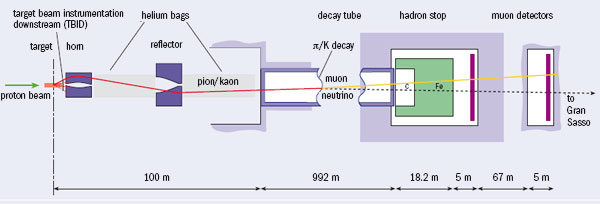
The production of the CNGS beam of muon-neutrinos follows the “classic” scheme that was first used in the 1960s at Brookhaven and CERN, and has been refined ever since. An intense proton beam from CERN’s Super Proton Synchrotron (SPS) is sent to strike a target, in this case graphite. Protons that interact with nuclei in the target produce many particles, mostly unwanted, but including positively charged pions and kaons – mesons that decay naturally into pairs of muons and muon-neutrinos. Two magnetic lenses – the horn and the reflector – collect these mesons within a selected momentum range and focus them into a parallel beam towards LNGS. After a decay tube nearly 1 km long, all the hadrons – i.e. protons that have not interacted in the target, pions and kaons that have not yet decayed, and so on – are absorbed in a hadron stopper; only neutrinos and muons can traverse this solid block of graphite and iron. The muons, which are ultimately absorbed downstream in around 500 m of rock, are measured first in two detector stations. Only the neutrinos are left to travel onwards through the top layer of the Earth’s crust towards LNGS.
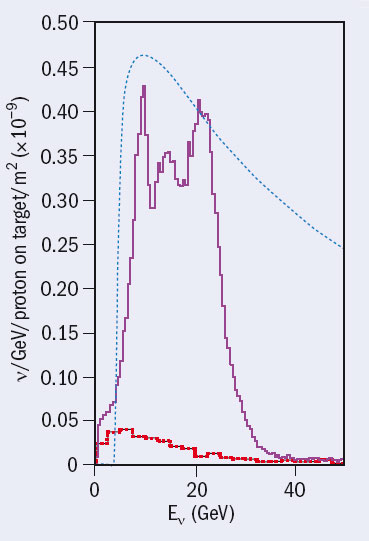
For the experimenters at LNGS, the beam’s key feature is the energy spectrum, as this determines the number of events that they can expect to measure. Two important energy-dependent ingredients have to be taken into account to maximize the number of tau-neutrino events that are anticipated: the probability for muon neutrino to tau-neutrino oscillation over the 732 km, and the probability for the tau-neutrino to leave a signal in a detector, i.e. the interaction cross-section for tau-neutrinos in matter, which is zero below a threshold of around 4 GeV. The product (convolution) of these two energy-dependent probabilities defines in effect an envelope in which the actual energy spectrum of the beam should fit. The graph below compares this convolution with the energy spectrum that was expected for the CNGS beam, as derived through Monte Carlo simulation, and shows how closely the match has been achieved. Note that the event rate at the OPERA detector at LNGS is very low. It will take many months of continuous CNGS running before the experiment can be expected to produce a neutrino energy spectrum like that in the graph below.
Six years in the making
CERN council approved the CNGS project in December 1999. Civil construction work began in September 2000 and was completed in June 2004. The underground work included the tunnel around 50–80 m below the surface for the 800 m proton beam line, as well as several caverns and access galleries. The facility uses protons from an extraction region at point 4 on the SPS, in common with the proton transfer line TI 8 for the Large Hadron Collider (LHC). A switch magnet at 100 m decides where the proton batches are sent: if the magnet is off, beam goes to the LHC, and if it is on, beam goes to the CNGS target. The beam line for CNGS then slopes down from the level of the SPS to a final slope of 5.6%, so that it points towards the LNGS.
While civil construction work continued, between July 2003 and April 2004 the beam dump (hadron stopper) and the 1 km decay tunnel were installed. Then in July 2004, with the construction work complete, an intense period of work began to install the electrical services, water-cooling and air-handling facilities. The overhead crane in the target chamber is an unusual feature that uses a rack-and-pinion system to cope with the slope of the tunnel. As well as being used in installation work, it will be needed for remote-handling in the harsh environment that is expected in the target chamber once the beam is operating at high intensity.
During the summer of 2005, installation of the services gradually gave way to the equipment installation in the proton beam tunnel as well as in the target chamber. By the end of November 2005, the proton beam was fully installed and the vacuum system closed, while work in the target chamber continued until spring 2006.
During February to April of 2006, large parts of the CNGS facility closed as detailed tests of all components in the facility began. In particular, all of the 119 dipole and quadrupole magnets in the proton beam line were tested at nominal power and their polarities checked, and the water-cooling and ventilation systems were operated under nominal conditions. The control-system experts artificially introduced magnet faults in all of the elements to test in detail how the beam interlock system responded to such errors.
At the same time technicians performed exercises in which they completely changed the target and horn under realistic conditions, performing a large fraction of the work remotely, using the crane in the target chamber. The exercises allowed detailed log-sheets of every step to be established, recording the crane co-ordinates for the approach, picking-up, lifting, translating and depositing for every shielding block as well as for the target and horn systems.
Once the equipment experts had tested all of the CNGS components, it was time for the commissioning team to move to the CERN Control Centre (CCC). Using a wealth of computers and display screens, the team tested every aspect of the CNGS facility under the most realistic conditions – as if there was beam, but without beam. This was a stressful period for the controls group and colleagues in the SPS operations team who were writing software. However, they responded to the challenge and, as commissioning with beam later demonstrated, these dry runs meant that the systems were working, saving much valuable beam time.
Large parts of the CNGS facility were closed on 19 May, in time for start-up with beam on 29 May. However, a last-minute schedule change, caused by a powering problem at the Proton Synchrotron, which feeds the SPS, implied that the first proton beam to CNGS could not be delivered until 10 July. This change of schedule allowed for another useful set of dry runs.
Beam commissioning begins
During the week of 10 July, the first of three CNGS beam commissioning weeks, the atmosphere in the SPS corner of the CCC was cheerful, but tension was nevertheless palpable. Initial tests of the extraction system with a CNGS-type beam had been done in autumn 2004, closely linked to the initial tests of the TI 8 beam. So it was no surprise to find that after only a few iterations, the kickers and septum magnets of the extraction channel from the SPS towards CNGS were well tuned, establishing a “golden trajectory”. On 11 July the first proton batch headed off to the CNGS target, and it was reassuring to see the proton beam well centred in all of the eight screens along the proton beam line.
The next step was to bring the beam position monitors (BPM) into operation. These important monitors were recuperated from the Large Electron–Positron collider, and equipped with sophisticated log-amp electronics, allowing them to measure the beam position rapidly and accurately. They revealed that the proton line was well tuned over its 800 m, with the maximum beam excursion far less than the permitted ±4 mm.
The CNGS commissioning also allows a valuable test for the Beam Interlock System that was developed for the LHC. The BPMs provide one of the crucial inputs to this system: any beam position that is more than 0.5 mm from the nominal trajectory creates an interlock to inhibit the next proton extraction and, in turn, provides an alarm to the SPS operations team. In addition, a series of beam loss monitors (BLMs) along the path of the protons measure tiny losses of protons, which would indicate that the beam is off course. Together, the BPMs and BLMs form a powerful means to protect the equipment in the CNGS proton beam line against damage from any losses larger than permitted by the very low thresholds in the system.
The beam size along the proton beam line was very close to the expectations from simulations. For a high-intensity beam – some 1013 protons for each extraction – the beam spot at the target was the expected 0.5 mm rms. The measured beam position stability is about 50 μm rms averaged over several days, and is much better than initially specified. Both the size and the stability of the beam are extremely important for protecting the target rods against rupture from the thermo-mechanical shock that is caused by the intense beam pulse: the beam size must not be too small (and hence concentrated) and the beam must hit the target close to the centre.
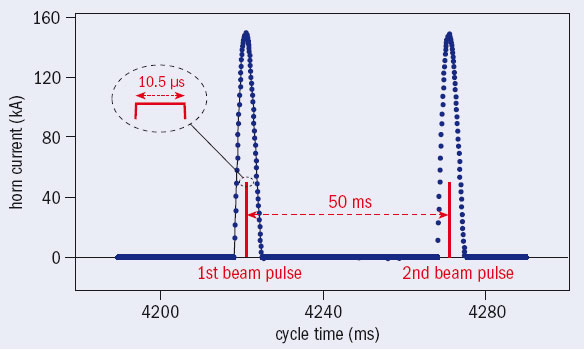
Much of the CNGS beam commissioning was done using a very low intensity proton beam – around a hundred times lower than the nominal value of 2.4 × 10¹³ protons for each extraction. This was necessary to protect the equipment from potential faults and other surprises. It was only during the last two days of commissioning that intensities reached the 1013 range. As a result of this economic use of the beam, less than 7 × 10¹⁵ protons were sent to CNGS during the entire commissioning phase, corresponding to about an hour of standard CNGS operation. In addition, while standard CNGS operation is foreseen with two 10.5 μs 400 GeV/c proton beam extractions for every SPS–CNGS magnet cycle, most of the commissioning work was done with one extraction only.
Lining up
The CNGS proton beam is directed at a graphite target. The target consist of 13 graphite rods 10 cm long and 9 cm apart; the first two rods are 5 mm in diameter, while the others rods are 4 mm in diameter. The rods need to be thin and interspaced with air to let high-energy pions and kaons that are produced at smaller angles fly out of the target without interacting again. This is important for the relatively high-energy neutrino beam at CNGS, as pions of higher energies decay in flight into neutrinos of higher energies. Beyond the target lie the magnetic focusing system comprising the horn and reflector. The two focusing systems are operated with a pulsed current of 150 kA for the horn and 180 kA for the reflector. Both horn and reflector are pulsed twice for each SPS cycle; the two pulses are separated by 50 ms, in-time with the two beam pulses.
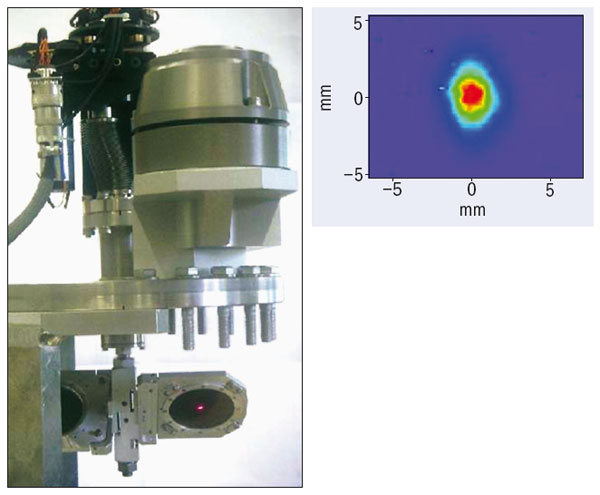
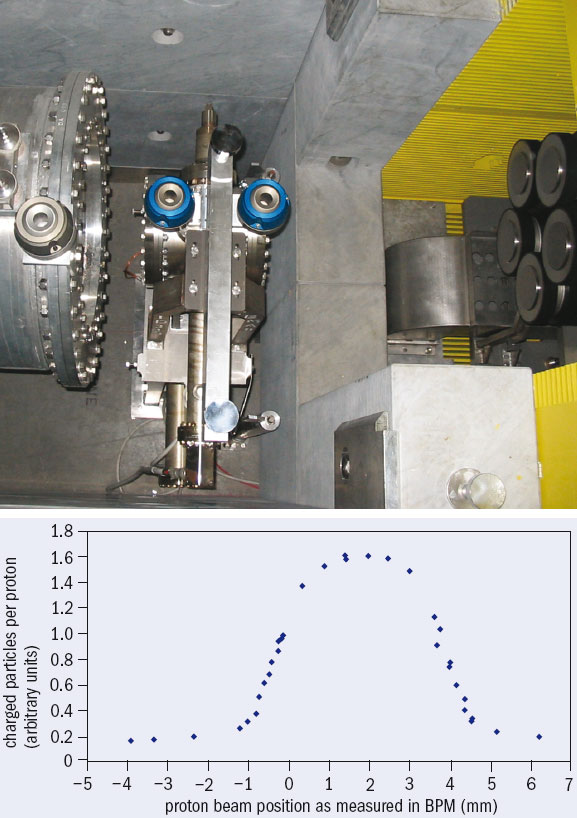
An important step during the beam commissioning was to cross-check the centring of the proton beam on the target. This is done by the Target Beam Instrumentation Downstream (TBID) monitor in which secondary electrons are produced by charged particles traversing a 145 mm diameter, 12 μm thick titanium sheet in a vacuum box. A beam scan across the target provides information on the maximum production of charged particles, in other words, on the best alignment of the proton beam with respect to the target.
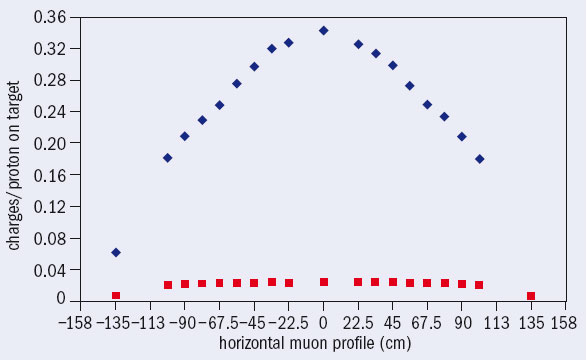
The last check that can be made along the neutrino beam line is on the production of muons that are created in association with the muon-neutrinos in the decay of the pions and kaons produced in the target. Unlike the neutrinos, the muons are charged and can be rather easily detected, so during beam commissioning muon detector stations provided online feedback for the quality control of the neutrino beam. In CNGS these detectors must register up to 108muons for each cm2 in a very short pulse of 10.5 μs. This implies that the muons cannot be counted individually. So to monitor the muons CNGS uses nitrogen-filled, sealed ionization chambers. Such detectors have been used for many years, for example as BLMs around the SPS. CNGS users could take advantage of the most recent development of ionization chambers, which will be used as BLMs at the LHC. The first 76 of more than 3000 of these BLMs are now in use at CNGS. There are 37 fixed muon detectors in each of the two muon detector chambers. The monitors are arranged in a cross-shaped array to record permanently the horizontal and vertical profile. An identical motorized monitor is installed downstream of the fixed ones to allow cross-calibration of the fixed monitors and to probe the muon profile where there is no fixed monitor.
Muons passing through the monitors produce electron–ion pairs, which are collected on sets of electrodes that are 5 mm apart at 800 V. Each muon monitor has 64 electrodes over an active length of 345 mm. The signal recorded is the integral number of charges for each beam pulse. The CNGS beam commissioning team used the muon detector stations as an online feedback for the quality control of the neutrino beam. The measurement is in reasonably good agreement with the preliminary expectations based on the FLUKA simulation package.
• CERN funded the CNGS project with special contributions from Belgium , France (in kind, via LAL/IN2P3), Germany , Italy (INFN and Compania di San Paolo), Spain and Switzerland . The CNGS proton-beam magnets were built in Novosibirsk , within a collaboration agreement between the Budker Institute for Nuclear Physics, DESY and CERN. The CNGS facility has been constructed and the beam commissioned on schedule and within budget. We would like to thank the many colleagues involved in CNGS, who have worked hard to help make this project a success.
Neutrino physics is a special field in which large-mass targets, which are needed to detect these elusive particles, are often combined with the ambitious goal of precision measurements, which are needed for firm conclusions. The Oscillation Project with Emulsion-tRacking Apparatus (OPERA) is a good example. It aims to directly observe the appearance of tau neutrinos (ντ) in oscillations from muon neutrinos (νμ→ντ) in the long-baseline beam of the CERN Neutrinos to Gran Sasso (CNGS) project. This would confirm the oscillation hypothesis for atmospheric neutrinos and unambiguously clarify its nature.
In 1998, the Super-Kamiokande collaboration announced that muon neutrinos change flavour (oscillate). The evidence came from detecting fewer muon neutrinos than expected in showers created by cosmic-ray interactions in the atmosphere. More recently, the KEK-to-Kamioka (K2K) experiment, using a man-made neutrino beam from KEK to the Super-Kamiokande detector, and the MINOS experiment, which uses a neutrino beam from Fermilab, have confirmed the oscillations that were observed in the atmospheric neutrinos. These experiments showed that muon neutrinos disappear, but there is no evidence of what they become. Only detecting the appearance of tau neutrinos from muon neutrinos will confirm the current theories underlying neutrino oscillation.
OPERA is searching for ντ by directly detecting the decay of the tau lepton that is produced in charged-current interactions of the ντ with nucleons in matter. To be sensitive to the oscillation parameters that are indicated by the deficit of muon neutrinos in the Super-Kamiokande data (Δm2 = 1.9–3.1 × 10⁻³ eV2, 90% CL, full mixing) and confirmed by the K2K and MINOS experiments, the experiment uses a 732 km baseline from the neutrino source to the detector – the distance from CERN to the Gran Sasso National Laboratory (LNGS) under the Gran Sasso massif in Italy. The νμ beam of CNGS has been optimized to obtain the maximum number of ντ charged-current interactions at OPERA and has an average νμ energy of about 17 GeV.
Detecting the ντ through the charged-current interaction is a challenging task. It demands not only a massive neutrino target (about 1.8 kilotonne), but also particle tracking at micrometre resolution to reconstruct the topology of the tau decay: either the kink – a sharp change (> 20 mrad) in direction occurring after about 1 mm – as the original tau lepton decays into a charged particle and one or more neutrinos, or the vertex for the decay mode into three charged particles plus a neutrino. For this purpose, the emulsion cloud chamber (ECC) – exploited by the DONUT collaboration at Fermilab for ντ detection in a beam-dump experiment in 2000 – combines in a sandwich-like cell the high-precision tracking capabilities of nuclear emulsions (two 40 μm layers on both sides of a 200 μm plastic base) and the large target mass provided by lead plates (1 mm thick).
Anatomy of the detector
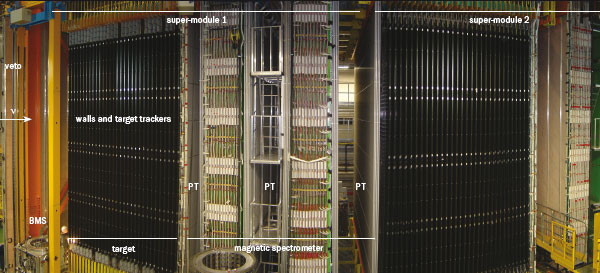
The design of OPERA is completely modular and allows real-time analysis of neutrino interactions. The target will eventually consist of 206,336 bricks, each comprising 56 consecutive ECC cells with transverse dimensions of 10.2 × 12.7 cm and weighing 8.3 kg. The bricks are being built underground at LNGS in the automated brick-assembly machine (BAM). They are then inserted into the experiment by two robots – the brick manipulator system (BMS) – into planar structures, or walls, which are interleaved with planes of scintillator tracker (5900 m2), built from vertical and horizontal strips of plastic scintillator 2.6 cm wide. The scintillators provide an electronic trigger for neutrino interactions, localize the particular brick in which the neutrino has interacted, and perform a first tracking of muons within the target. Localizing the brick is the first step in locating events in OPERA’s emulsions; the electronic trackers then provide predictions for the search for the particle tracks in the vertex brick with a position resolution of the order of 1 cm and an angular accuracy (on the muon tracks) of about 20 mrad.
The target sections are arranged in two independent super-modules, each with 31 walls and 64 layers of 52 bricks for each wall. Each super-module includes a muon spectrometer after the target section. The study of the muonic tau-decay channel needs muon identification and charge measurement. More generally, they are fundamental handles for suppressing the background from the decay of charmed particles, which are produced in ordinary_νμ charged-current interactions and decay similarly to the tau. The identification, with more than 95% efficiency, of the primary muon from the neutrino interaction that produces the charmed particle, allows this background to be effectively killed.
Each muon spectrometer comprises a dipolar magnet made of two iron arms (1 kilotonne of iron magnetized at 1.55 T), interleaved by pairs of 7 m long vertical drift-tube stations, 8064 tubes in total. These are the precision trackers (PTs) for precisely measuring the bending in the spectrometer. Twenty-two planes of resistive plate counters, 1525 m2 for each magnet, are inserted between the iron plates to provide coarser tracking in the magnet and a range measurement of stopping particles. An Ethernet-based data-acquisition system time-stamps and records asynchronously all detector hits in the target trackers and the spectrometers.
Selected bricks can be extracted daily from the target by the BMS for emulsion development and analysis. Each brick is equipped externally with a pair of emulsion sheets – the changeable sheets (CSs) – attached to its downstream face. Once a brick with an event has been localized, the CSs provide a first confirmation of the neutrino interaction and the initialization for the scanning analysis of the brick. Automatic fast microscopes scan large areas of emulsion and perform track reconstruction, searching for the tau-decay topologies and measuring the event kinematics. Track momenta are measured from their multiple scattering in the brick, while energies of electrons and photons are reconstructed from the development of electromagnetic showers.
Industrial production
When OPERA is fully operational, about 30 bricks a day will be extracted from the target with 1800 emulsion foils. The total emulsion surface to be measured corresponds to a few thousand square metres in five years. To cope with the real-time analysis of the neutrino interactions, high-speed automatic scanning microscopes were developed in Europe and Japan. These scan around 20 cm2 an hour – 20 times faster than in previous experiments.
As well as the special development of the microscopes, a large automation effort had to be put in to the brick production and handling, emulsion processing and chemical development, which together represent a small industry. Brick production has to be done underground to minimize the number of background tracks from cosmic rays and environmental radiation – LNGS has an average overburden of 1400 m of rock. Owing to space constraints the bricks must then be inserted immediately into the detector.
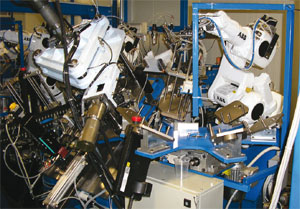
BAM specifications imply the production of about 1000 bricks a day, with 0.1 mm accuracy in each dimension. The BAM consists of an automated production line with several stations arranged in three different sections: input/output, BAM-in-light and BAM-in-dark. The input/output section manages the input of the lead containers (8 tonnes a day) and the output of bricks (1000 a day). In the BAM-in-light section (a class 10,000 clean room) the lead containers are automatically opened and pallets of lead are dispatched towards the dark room. In the BAM-in-dark room (class 10,000 and red light) the bricks, each comprising 57 emulsion sheets interleaved with 56 lead plates, are piled up under a pressure of 3 bar. This operation is performed in parallel by five piling/pressing stations, each using two anthropomorphic robots and a custom-built press machine. The brick pile has to be aligned within 50 μm precision, while its components must be handled in such a way as to guarantee 10 μm flatness. The bricks are then wrapped with aluminium adhesive tape by a large anthropomorphic robot. Once the bricks are light-tight they are sent back to the BAM-in-light section where their dimensions are checked, they are equipped with Teflon skates (to reduce friction during insertion into the detector) and a CS box, and labelled.
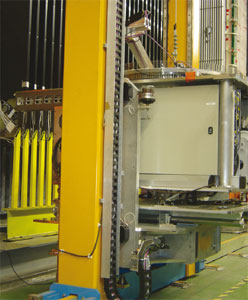
The bricks are stored in a transport cage – the drum – which brings them in groups of 234 to OPERA, where the BMS positions them in the walls. This must be done simultaneously on both sides of the detector to maintain a balance, and so requires two independent BMS units. Each BMS comprises a 10 m high portico that can slide along the side of the two super-modules. A platform on the portico moves vertically to reach the different parts of the walls, which it accesses with a lift bridge with micrometre accuracy. The platform has a rotating buffer disk (or carousel) hosting 32 bricks and with devices for inserting the bricks (the pusher) and extracting them. The latter is a small vehicle with a vacuum (VV) sucker on the front.
To place bricks into a wall, the drum is placed on a loading station, and bricks are loaded into the BMS. They are then pushed one at a time on the lift bridge with the pusher, until a row of 26 bricks has been inserted and aligned to its nominal position in the semi-wall. This operation is repeated for each wall layer until the 64 layers are complete. Each BMS can handle about 500 bricks a day, following the BAM speed. It will take a year to fill the detector.
During extraction, the VV approaches the bricks on the appropriate wall layer through the lift bridge. The bricks are extracted by suction one by one onto the carousel until the selected one is found. The remaining bricks are then pushed back into the wall together with a replacement brick from the periphery of the target, which becomes slowly smaller with time.
The analysis chain
The bricks with neutrino interactions are placed in the drums and transported to a brick-handling area where the CS is removed and processed while the bricks wait for the analysis to confirm an event. If an interaction is not confirmed, the brick is equipped with a new CS box and placed back in OPERA. However, if the analysis confirms an event, the brick is brought to the external LNGS laboratory, exposed for a day to cosmic rays for alignment and then disassembled. The films are stamped with an identifier and reference marks, developed with an automatic system with several parallel processing chains as in a big photographic laboratory, and dispatched to the scanning laboratories. (The scanning of the CS is performed locally to provide fast feedback.)
A charged particle crossing an emulsion layer ionizes the medium along its path, leaving a sequence of aligned silver grains, with a linear size of about 0.6 μm. Typically, a minimum ionizing particle leaves about 30 grains in 100 μm. Observing with a high-magnification optical microscope, silver grains appear as black spots on a bright field. To reconstruct particles’ trajectories, the computer-driven microscope adjusts the focal plane of the objective lens through the whole thickness of the emulsion, obtaining an optical tomography at different depths of each field of view with typically one image every 3 μm. Each image is filtered and digitized in real time to recognize track grains as clusters of dark pixels. A tracking algorithm reconstructs 3D sequences of aligned grains and extract a set of relevant parameters for each sequence. The position accuracy obtained for the reconstructed tracks is about 0.3 μm, with a resulting angular resolution of about 2 mrad – adequate for reconstructing the tau-decay topology.
Matching tracks in the two CSs are extrapolated in the most downstream foil of the brick and followed plate by plate until the interaction vertex is located. A plate-by-plate alignment procedure is applied so that tracks can be followed back with a precision of few micrometres and the search for each track can be performed in one field of view (about 300 μm × 300 μm). Once the vertex has been located, a volume scan (about 5 mm × 5 mm in several consecutive plates) around the interaction point is done. All track segments that are found in this volume are recorded. Vertex reconstruction algorithms are applied to classify the event and search for particle decay topologies. Taking advantage of cosmic-ray tracks, recorded during the deliberate exposure of the bricks after their extraction, sub-micrometre precision can be reached on the reconstructed vertex, as required for detecting kink topologies with angles of a few milliradians and for the kinematical analysis of the event.
Commissioning and running
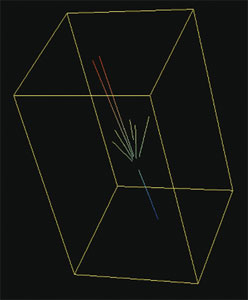
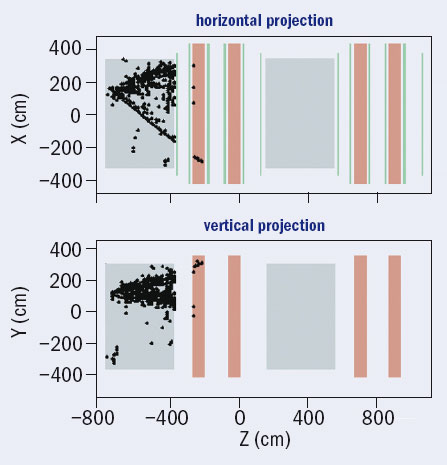
OPERA was proposed in 2000, with installation starting in May 2003; it detected the first neutrinos from CNGS on 18 August 2006. This first run was of 11 days, with 5 days of equivalent beam time. It was devoted to the final commissioning of the electronic detectors (target trackers and spectrometers) with data-taking in global mode, to check the synchronization of the OPERA and CNGS clocks and to test the reconstruction algorithms. The detector collected more than 300 neutrino interactions, with a live-time greater than 95%. These interactions mainly occurred in the rock and in the iron of the two magnets.
The August run was conceived to tune the electronic detector performance with CNGS neutrino interactions without bricks. OPERA has now started the next phase, which aims to observe neutrino interactions in the bricks. Brick production and insertion started in the second half of September, ramping up to 1000 a day. A first test run of three weeks with some thousand bricks exposed to CNGS is scheduled to begin in mid-October. Then the full tau search will proceed with the run in 2007.
Researchers foresee the experiment running for five years, with an integrated fluence of 2.25 × 10²⁰ protons on the CNGS target. OPERA is sensitive to practically all of the tau-decay modes, with very low background levels: overall a total background of 1 event is expected. If νμ→ντ_oscillations occur, the average number of detected signal events will be 8.0–21.2 in the Super-Kamiokande 90% CL region and corresponds to 13.9 events for the best-fit value (Δm2 = 2.5 × 10⁻³ eV2, full mixing, Walter and Inoue 2006). OPERA can also search for_νμ→νe_oscillations with improved sensitivity on the still-unknown mixing angle θ13, compared with the best world limit obtained by the reactor experiment CHOOZ in 1998.
To provide the best experiences, we use technologies like cookies to store and/or access device information. Consenting to these technologies will allow us to process data such as browsing behavior or unique IDs on this site. Not consenting or withdrawing consent, may adversely affect certain features and functions.
Functional
Always active
The technical storage or access is strictly necessary for the legitimate purpose of enabling the use of a specific service explicitly requested by the subscriber or user, or for the sole purpose of carrying out the transmission of a communication over an electronic communications network.
Preferences
The technical storage or access is necessary for the legitimate purpose of storing preferences that are not requested by the subscriber or user.
Statistics
The technical storage or access that is used exclusively for statistical purposes.The technical storage or access that is used exclusively for anonymous statistical purposes. Without a subpoena, voluntary compliance on the part of your Internet Service Provider, or additional records from a third party, information stored or retrieved for this purpose alone cannot usually be used to identify you.
Marketing
The technical storage or access is required to create user profiles to send advertising, or to track the user on a website or across several websites for similar marketing purposes.