
Comsol -leaderboard other pages

Topics

Hard Probes conference focuses on jet quenching

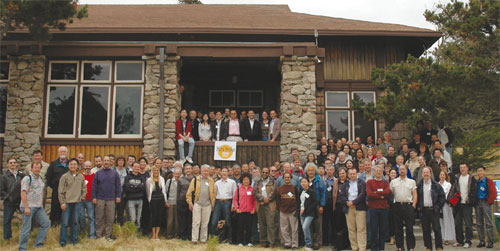
The beautiful Asilomar resort, on the Pacific coast of the Monterey Peninsula in northern California, attracted 130 participants to the Second International Conference on Hard Probes of High Energy Nuclear Collisions, on 11–19 June 2006. The Hard Probes series brings together experimentalists and theorists to discuss perturbative quantum chromodynamics (pQCD) in the context of relativistic heavy-ion physics. Penetrating, hard probes provide essential tools for understanding the properties of the hot and dense QCD matter that is produced in nuclear collisions at the Super Proton Synchrotron (SPS), the Relativistic Heavy Ion Collider (RHIC) and, in the near future, at the Large Hadron Collider (LHC). The programme was divided into three areas: jets and high transverse-momentum (high pT) hadrons, heavy flavour and quarkonia, and photons and dileptons.

Jet quenching

Producing jets by the hard scattering of quarks and gluons from incoming projectile particles is the hard probe par excellence. One of the most striking early results at RHIC was the discovery that jets are quenched in hot QCD matter, providing a direct measurement of the parton number density and transport properties of the system that is produced. Since that initial discovery, RHIC experiments have extended their studies of jet quenching in many directions. The Pioneering High Energy Nuclear Interaction eXperiment (PHENIX) now measures strong suppression of pion production up to a pτ of 20 GeV, while observing that direct photons (which do not carry colour charge, in contrast to the jets generating the pions) are not suppressed, as Gabor David of Brookhaven National Laboratory (BNL) explained.

CCEion1_12-06

One of the highlights of the conference was the discussion of the unexpectedly large suppression of high-pτ D and B mesons, measured by PHENIX and by the Solenoidal Tracker At RHIC (STAR). These results challenge the robust QCD prediction that heavy quarks experience smaller radiative energy loss in matter than light quarks or gluons, as Carlos Salgado from the University of Rome “La Sapienza”, Magdalena Djordevic of Ohio State University, Che-Ming Ko of Texas A&M University and others described. Matteo Cacciari from the Université Pierre et Marie Curie reviewed the pQCD calculations of charm and bottom production at colliders and the implications for RHIC. In addition, in two exciting ad hoc night sessions, theorists debated vigorously the merits of various approaches to calculating radiative energy loss in QCD, while the experimentalists kept score.

New insights into jet quenching featured in the talk by Krishna Rajagopal of Massachusetts Institute of Technology (MIT). He presented a recent calculation of the jet quenching parameter q^ in string theory using the intriguing anti-de Sitter space/conformal field theory correspondence between strongly coupled QCD and weakly coupled gravity. Other non-static parameters of QCD-like hot matter can also be calculated in this approach, in particular the viscosity and heavy-quark diffusion coefficient, as discussed by Ed Shuryak of Stony Brook University (SUNY), Pavel Kovtun of the Kavli Institute for Theoretical Physics, and Urs Wiedemann from CERN. These new theoretical developments provide insight into dynamical properties of non-perturbative QCD that cannot be directly treated by either perturbative or lattice methods.

Another important focus of discussion was the modification of dijet azimuthal correlations in the medium. Thomas Peitzmann, of Utrecht University/NIKHEF, showed how STAR has put the back-to-back nature of dijets to good use, most recently reporting the measurement of the high-momentum “punch through” products of the recoiling jet. Given the large jet-energy loss, it is natural to ask where the lost energy goes and how the medium responds to it. Theorists have proposed that Mach cones or Cherenkov radiation might be produced in the process, as Abhijit Majumder of Duke University and Thorsten Renk of Jyvaskyla University discussed. Two-particle correlation measurements have shown previously that the recoiling jet is both softened and broadened in matter, but insight into the specific mechanisms at play requires higher-order correlations. Marco van Leeuwen of Lawrence Berkeley National Laboratory (LBNL) reviewed three-particle correlation techniques and their subtleties, and Jason Ulery of Purdue University and Nuggehalli Ajitanand of SUNY presented new, high-statistics three-particle correlation measurements from STAR and PHENIX, respectively. The data suggest the formation of a cone structure from shock waves or Cherenkov radiation. With improved statistical and systematic uncertainties in the near future, such a measurement could provide important information on the speed of sound or the dielectric constant in the strongly interacting quark–gluon plasma.
CCEion2_12-06

The STAR collaboration also reported “near side” correlations in which the jet structure is elongated owing to coupling with the longitudinally flowing medium, a theoretical prediction that Nestor Armesto of Santiago de Compostela reviewed. The jet-quenching results from RHIC have stimulated the reanalysis of high pτ heavy-ion data from the SPS, described by Christoph Blume and Mateusz Ploskon of Frankfurt University, which show surprisingly similar (albeit less spectacular) effects. Jet measurements will undoubtedly play an important role in the heavy-ion programme at the LHC, as CERN’s Andreas Morsch, MIT’s Gunther Roland, and BNL’s Helio Takai from the ALICE, cmS and ATLAS experiments, respectively, explained.

Heavy quarkonium and dimuouns

In 1986, Helmut Satz of Bielefeld University, together with Tetsuo Matsui, suggested that deconfinement would be signalled by the melting of heavy quarkonium states, and quarkonium suppression was well represented at the conference. Masayuki Asakawa of Osaka University, Takashi Umeda from BNL and Agnes Mocsy from RIKEN-BNL presented the latest lattice gauge calculations on heavy quarkonium at finite temperature which show that, in contrast to early calculations, the ground states (J/ψ, Y) survive at least up to twice the critical QCD temperature, whereas excited states such as the ψ’ and χc melt around Tcrit. At the conference Satz interpreted the similar J/ψ suppression pattern at RHIC and SPS, reported by Abigail Bickley of Colorado University/PHENIX and Roberta Arnaldi of INFN Torino/NA60, respectively, as resulting from the dissociation of ψ’ and χc, which contribute via feed-down decay to 40% of the J/Ψ yield. Robert Thews of Arizona University argued alternatively that direct J/ψ suppression is partially counterbalanced by heavy-quark recombination in the dense medium.

The venerable heavy-ion programme at the SPS continues to provide surprising and interesting results. Sanja Damjanovic from CERN presented the NA60 experiment’s new, high-statistics low-mass dimuon measurements, which address the important question of the restoration of chiral symmetry. The spectral shape of the ? meson in hot matter broadens but is not shifted in mass, in contrast to a long-standing prediction by Gerry Brown of SUNY and Mannque Rho of Saclay. Theorists were excited by these new data, which may provide a new window into the mechanisms underlying the breaking of chiral symmetry in the strong interaction.

All in all, the conference showed once again that hard processes are excellent probes of matter under extreme conditions of temperature and density. The large attendance, lively discussions, and marked experimental and theoretical progresses reported during the conference guarantee a strong future for the Hard Probes conference series. To maintain the now-traditional venue beside the sea, the next in the series will be held in 2008 at the spectacular thermal resort of A Toxa, on the Galician coast of the Iberian Peninsula.
Cracow meeting looks forward to the LHC

About 200 physicists were in Cracow on 3–8 July to attend Physics at LHC 2006, organized by the Henryk Niewodniczanﳳki Institute of Nuclear Physics of the Polish Academy of Sciences and the University of Science and Technology, and hosted by the Polish Academy of Arts and Sciences. The third conference in the series, it should be the last to review only plans, expectations, hopes and nightmares related to the Large Hadron Collider (LHC). The next conference, in 2008, should summarize some first results.

CCElhc1_12-06

Jos Engelen, CERN’s chief scientific officer, opened the 2006 conference with a review of the status of the LHC project: apart from small delays, it should run on schedule. The rest of the first day focused on the Higgs problem. Robert Harlander of the Bergische Universität Wuppertal presented a theoretical overview of Higgs particles in the Standard Model (SM) and its various extensions. Vanina Ruhlmann-Kleider from Dapnia and Guillaume Unal from CERN then reviewed LHC plans, and Oscar Gonzalez Lopez of the Centro de Investigaciones Energéticas, Medioambientales y Technológicas, Madrid, reviewed results from Fermilab’s Tevatron. Several further talks by experimentalists and theorists considered specific “Higgs discovery potentials” for LHC experiments in various decay channels.

The second day focused on supersymmetry (SUSY). CERN’s Peter Jenni and Ludwik Dobrzynﳳki of the Laboratoire Leprince-Ringuet presented the plans that the ATLAS and cmS collaborations have, respectively, for searching for SUSY particles. Jan Kalinowski of Warsaw University gave a theoretical overview of the subject both within and beyond the minimal supersymmetric SM (MSSM). He stressed that new physics at the tera-electon-volt scale is almost unavoidable, and that SUSY seems to be the best candidate. Elemer Nagy of the Centre de Physique des Particules de Marseille presented a summary of Tevatron results on SUSY, and CERN’s Maria Spiropulu gave a general review of the LHC’s potential in this field. Further talks followed on specific problems of SUSY particles and searches at the LHC, including astrophysical aspects.

A short session on the morning of the third day covered diffractive physics, and included a report on the HERA for LHC workshop by Albert de Roeck of CERN and a theoretical review by Joachim Bartels of the University of Hamburg. Valentina Avati from CERN described the TOTEM experiment, which will investigate diffractive physics at the LHC.

Fermilab’s Joseph Lykken began the fourth day with an overview of theoretical physics, Standard Model and Beyond. He appealed for so-called “negative results” of searches for SM violations to be treated as exciting discoveries that may bring new understanding in particle physics. Marek Zielinﳳki of Rochester University and Chris Hays of Oxford University reported on Tevatron results of SM tests, and Maarten Boonekamp of CEA/Saclay described the possibilities at the LHC. Stefan Pokorski of Warsaw University presented various theoretical routes beyond the SM (other than the MSSM). Sung-Won Lee of Texas Tech University reported on related searches at the Tevatron, and Reyes Alemany-Fernandez of the Laboratório de Instrumentação e Física Experimental de Partículas in Lisbon looked forward to the LHC. There were also more specific short talks.

Heavy flavours and heavy ions shared the fifth day. Ikaros Bigi of Notre Dame University gave an inspired theoretical review of heavy-flavour physics, and Jianming Qian of Michigan University and Rainer Bartoldus of SLAC reported on results from the Tevatron and B-factories, respectively. CERN’s Tatsuya Nakada presented the future LHCb experiment. In heavy-ion physics, Carlos Salgado of the University of Rome “La Sapienza” and Gunther Roland of MIT presented theoretical and experimental reports, respectively. In this session, Eugenio Nappi of INFN reported on the ALICE experiment and other perspectives of heavy-ion research at the LHC. In the afternoon, parallel sessions covered more specific problems in both subjects.

The last day looked further into the future. Brian Foster of Oxford University presented the status of the International Linear Collider study, and Masa Yamauchi of KEK described the plans for super B-factories. Peter Saulson of Syracuse University looked at present and future searches for gravitational waves, and Pierre Binetruy of APC-Collége de France discussed the plans that astroparticle physicists have for the LHC and elsewhere, in particular the Laser Interferometer Space Antenna project.

CERN’s John Ellis concluded the day and reflected on events beyond the conference by presenting past, recent and future events around the LHC as a World Cup football match: from the training camps, team selections and preparation, through the first and second half including injury time, and the extra time and penalty shooting. This corresponded to the early planning of the accelerator and experiments, forming the collaborations, detailed planning and construction, future early measurements, planned upgrades of detectors, possible necessary unexpected changes and plans for future accelerators. He stressed very strongly the role of the first LHC results in further planning. For example, it is quite possible that these results may prove that the energy range of a future electron linear collider must be far beyond present plans.

The conference was a success and showed the broad scope of problems to be dealt with at the LHC. It led to many new ties between existing members of the LHC community and others present, who may soon become involved in this great particle-physics adventure. The speakers, representing both the LHC management level and enthusiastic young physicists, allowed a better understanding of the unique role that this project will play in developing particle physics.

The organizing committee assured the smooth running of the conference and a pleasant atmosphere. All the participants are looking forward to the next conference in the series, in which the first LHC results should be presented.

Nuclear science hits new frontiers

Nuclear science is undergoing a renaissance as it confronts new and previously unapproachable research opportunities. One such opportunity, the study of short-lived nuclei far from stability, is emerging as a major frontier in nuclear science. Rare-isotope research is tied to astrophysics and mesoscopic science, fields in which voracious demand for new data is generating worldwide interest in high-power, next-generation accelerators.

CCEvie1_12-06

New facilities will probe the limits of nuclear stability and determine nuclear properties in uncharted regions of nuclei with unusual proton-to-neutron ratios. The new data will challenge descriptions of nuclei that are based on data limited to nuclei near the valley of nuclear stability. These improved models of nuclei – two component, open mesoscopic systems – will increase our understanding of mesoscopic systems in fields such as chemistry, biology, nanoscience and quantum information. More directly, the models will greatly boost our understanding of the cosmos.

Today, our descriptions of stellar evolution, and especially of explosive events, such as X-ray bursts, core-collapse supernovae, gamma-ray bursts, thermonuclear (Type Ia) supernovae and novae, are limited by inadequate knowledge of important nuclear properties. We need new data for nuclei far from stability and better nuclear theories to develop accurate models of these astrophysical phenomena. Improved models, in turn, will help astrophysicists make better use of data from ground- and space-based observatories, understand the nuclear processes that produce the elements observed in the cosmos and learn about the environments in which they were formed.

We already have the first concrete evidence that nuclear structure, well established for nuclei near the line of stability, can change dramatically as we move away from the line of stability. The effective interactions far from stability – pairing, proton–neutron, spin-orbit and tensor – are different, but largely unknown. We need quantitative experimental information to refine theoretical treatments that describe these exotic isotopes.
There are several particularly promising research directions. For example, nuclei with unusual density distributions have been discovered for the lighter elements, but little is known about the properties of heavier, very neutron-rich nuclei. These heavier nuclei may have multi-neutron halo distributions with unusual cluster or molecular structures, which otherwise only occur at the surface of neutron stars. Such nuclei provide a unique opportunity to study the nucleon–nucleon interaction in early pure neutron matter.

Intense beams of neutron-rich isotopes will be used to synthesize transactinide nuclei that are more neutron-rich than is possible with stable beams. These nuclei are predicted to be sufficiently strongly bound and long-lived for detailed chemical study.

Energetic nucleus–nucleus collision experiments with beams of very neutron-rich and very neutron-poor isotopes will explore the asymmetry energy term in the equation of state of neutron-rich nuclear matter. This term is important in understanding the properties of neutron stars.

Nuclei are self-sustaining finite droplets of a two-component – neutron and proton – Fermi-liquid. Selectively prepared nuclei will allow us to study, on a femtoscopic scale, typical mesoscopic phenomena: self-organization and complexity arising from elementary interactions, symmetry and phase transformations, coexistence of quantum chaos and collective dynamics. The openness of loosely bound nuclei owing to strong coupling to the continuum allows us to probe general mesoscopic concepts, such as information processing and decoherence, which are key ideas in quantum computing.

The interplay of strong, electromagnetic and weak interactions determine detailed nuclear properties. Selecting nuclear systems that isolate or amplify the specific physics of interest will allow better tests of fundamental symmetries and fuel the search for new physics beyond the Standard Model.

Beyond advancing basic research questions, new accelerators should yield practical benefits for science and society. In fact, nuclear science has a long record of such applications. Technologies rooted in nuclear science – such as positron-emission tomography, the use of radioactive isotopes for treating or diagnosing disease, and more recently, the use of dedicated accelerators for treating cancer patients – have transformed medicine. Sterilization of fresh produce or surgical instruments with ionizing radiation is growing in importance. Ultra-sensitive nuclear detection, such as Rutherford backscattering, proton-induced X- and gamma-ray emission and accelerator mass spectrometry, has provided diagnostic tools for archaeology and material science.

Next-generation rare-isotope research and this tradition of applied work promise new opportunities for cross-disciplinary collaboration on national and international security, biomedicine, materials research and nuclear energy. Nuclear science is well positioned to deliver new benefits to physics and society in the coming decades.

Physics of Intensity Dependent Beam Instabilities

by K Y Ng, World Scientific. Hardback ISBN 9812563423, £52 ($86).

31TOGLOnaEL._SX337_BO1,204,203,200_

This book comprehensively covers intensity-dependent particle-beam instabilities in accelerating rings. It briefly reviews the concept of wake potentials and coupling impedances in the vacuum chamber, and then discusses static and dynamic solutions to their effects on particle beams. It separately emphasizes proton and electron machines. Other topics include Landau damping, Balakin–Novokhatsky–Smirnov damping, Sacherer’s integral equations, saw-tooth instability, Robinson stability criteria, beam loading, transition crossing and collective instability issues of isochronous rings. It provides a thorough description of experimental observations and discusses cures for the instabilities.

Laser-driven Particle Accelerators: New Sources of Energetic Particles and Radiation

by Keith Burnett, Dino Jaroszynski and Simon Hooker (eds), The Royal Society. Paperback ISSN 1364503X, £100 ($170).

The strong electromagnetic fields that are generated when intense laser pulses interact with plasma could produce a new generation of extremely compact particle accelerators. Laser-driven plasma accelerators are potentially versatile sources of energetic particle beams and coherent radiation that ranges from terahertz frequencies to X-rays. This issue of Philosophical Transactions of the Royal Society A contains papers by leading experts, beginning with basic concepts in plasma accelerators and the status and evolution of plasma-wakefield particle accelerators. It includes inverse free-electron lasers, high-intensity laser-driven proton acceleration and femtosecond electron diffraction.

An Invitation to Astrophysics

by Thanu Padmanabhan, World Scientific. Hardback ISBN 9812566384, £38 ($66). Paperback ISBN 9812566872, £21 ($36).

51T7RbyKnQL._SX329_BO1,204,203,200_

This book describes several aspects of astrophysics and cosmology in a way that a physicist or beginner in astrophysics can understand. It emphasizes current research and exciting new frontiers, and introduces complex results with simple, novel derivations, which strengthen the conceptual understanding of the subject. The book has more than 100 exercises, which will benefit students. Undergraduate and graduate physics and astrophysics students, as well as physicists who are interested in quickly grasping astrophysical concepts, will find this book useful.

Analytical Mechanics

by Antonio Fasano and Stefano Marmi, Oxford University Press. Hardback ISBN 9780198508021, £49.50 ($89.50).

3b50ef25084006e89fea5fdf3e37c10f6a0c82ed_BF2000-2000

Analytical mechanics is the investigation of motion with the rigorous tools of mathematics – a classical subject with fascinating developments and still rich with open problems. This book is intended to fill a gap between elementary expositions and more advanced material, explaining ideas and showing applications using plain language and “simple” mathematics. Basic calculus is enough for the reader to understand this volume; any further mathematical concepts are fully introduced in simple language.

Time and Matter: Proceedings of the International Colloquium on the Science of Time

by Ikaros I Bigi and Martin Faessler (eds), World Scientific. Hardback ISBN 9812566341, £56 ($98).

41C-er1JbhL._AC_SY580_

Time and matter are the most fundamental concepts in physics and in any science-based description of the world around us. Quantum theory has, however, revealed many novel insights into these concepts in non-relativistic, relativistic and cosmological contexts. The implications of these novel perspectives have been realized and, in particular, probed experimentally only recently. The papers in this publication discuss these issues in an interdisciplinary fashion from philosophical and historical perspectives. The leading contributors, including Nobel laureates T W Hänsch and G ‘t Hooft, address both experimental and theoretical issues. Physicists, philosophers, historians of science, and graduate physics students will find this an interesting read.

Handbook on Secondary Particle Production and Transport by High-energy Heavy Ions

by Takashi Nakamura and Lawrence Heilbronn, World Scientific. Hardback ISBN 9812565582, £33 ($58).

417QMtYh4TL

This handbook is a timely resource for the rapidly growing field of heavy-ion transport-model theory and its applications in accelerator development, heavy-ion radiotherapy and shielding of accelerators, as well as in space. Data from more than 20 years of experiments in the production of secondary neutrons and spallation products are contained in the handbook and on the accompanying CD. Transport modellers and experimentalists will find the detailed descriptions of the experiments and subsequent analyses valuable in utilizing the data for their applications.

Adventures in Theoretical Physics: Selected Papers with Commentaries

by Stephen L Adler, World Scientific. Hardback ISBN 9812563709 £62, ($108). Paperback ISBN 9812565221 £33, ($58).

4151R07VFFL._SX355_BO1,204,203,200_

From 1964–1972, Stephen L Adler wrote seminal papers on high-energy neutrino processes, current algebra, soft pion theorems, sum rules and perturbation-theory anomalies, which helped lay the foundations for the current Standard Model of elementary-particle physics. These papers are reprinted here with detailed historical commentaries describing how they evolved, their relation to other work in the field and their connection to recent literature. The commentaries and reprints also cover later important work by Adler on a range of topics in fundamental theory, phenomenology and numerical methods. This book is a valuable resource for graduate students and researchers, and for historians of physics in the final third of the 20th century.

bright-rec iop pub iop-science physcis connect