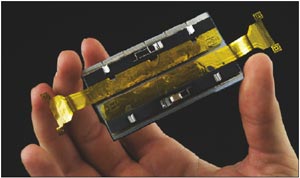
After 10 years of hard work the last of the 42 modules for the LHCb Vertex Locator (VELO) arrived at CERN in early March. The VELO comprises two rows of 21 double-sided semi-circular silicon detectors, each about 8 cm in diameter. It was designed and constructed at Liverpool University and will be placed just 5 mm from the beam line.
The LHCb experiment will study B particles at the LHC to explore the imbalance between matter and antimatter, and the VELO is crucial. It will track particles spraying out of the forward regions of the detector, where the greatest numbers of b– b pairs are expected.
The VELO is unique in that it will act as both detector and beam pipe. Special bellows designed at NIKHEF will allow both sides of the VELO to retract to a safer distance of 3 cm away from the beam line while the beam is being set up. In addition, to maintain the LHC vacuum of 10–8 millibar, a special corrugated foil will separate the beam line from the VELO detector vacuum. By the summer the VELO team will finish assembly and prepare for installation in the pit.
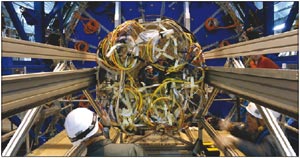
On 15 March 100 physicists and engineers gathered in the ALICE underground cavern to witness the end of a 15 year journey of development, construction, commissioning and testing before the Inner Tracking System (ITS) was inserted into the time projection chamber (TPC) at the heart of the experiment. Using the smallest amounts of the lightest material, the ITS has been made as lightweight and delicate as possible.
The ITS comprises six layers of high-precision silicon detectors, with double-sided silicon strips in the outer two layers, silicon drift detectors in the middle two layers and silicon pixels in the two inner layers. With almost 5 m2 of double-sided silicon strip detectors and more than 1 m2 of silicon drift detectors, it is the largest system using both types of silicon detector.
The silicon layers were integrated in Utrecht and Torino for a testing phase before being moved to the ALICE underground cavern. Passing the ITS through the TPC was challenging, with barely enough room for it to fit inside. It took two hours to move just a few dozen metres. The four outermost layers have been installed and the silicon pixel detector is scheduled to be installed this summer.
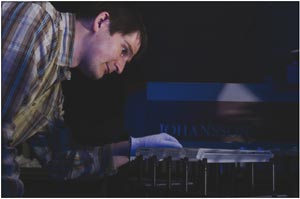
The last of the 62,960 lead tungstate crystals arrived at CERN on 9 March, marking the end of a 15 year project for the CMS experiment and the Crystal Clear Collaboration. These crystals will form the 36 supermodules of the barrel electromagnetic calorimeter.
Lead tungstate crystals were chosen because of their high density and ability to stop particles over short distances. In addition, they offer good scintillation properties and radiation hardness. In 1994, the development of the avalanche photodiode detector, which allows small amounts of light to be read in a magnetic field, provided the possibility of using the crystals. By 1998 the Bogoroditsk factory in the Tula region of Russia had begun producing the crystals. The Shanghai Institute of Ceramics in China supplemented this factory in 2005.
Half of the crystals were delivered to the CERN regional centre and the other half to INFN/ENEA. Each crystal underwent strict quality-control where automatic machines measured 67 parameters. There are 1700 crystals in one supermodule of the electromagnetic calorimeter. The first supermodule was inserted in mid-April and the final one should be installed by June 2007.
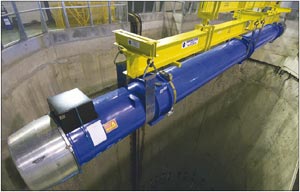
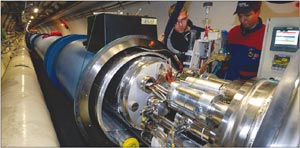
On 26 April, the last superconducting magnet for the LHC descended into the accelerator tunnel. The hundreds of guests attending the final lowering ceremony applauded as the superconducting dipole, 15 m long and weighing 34 tonnes, descended through the PM12 shaft. Few of the guests would be well-versed in the Welsh language, but all intuitively understood the inscription on the banner at the top of the shaft: “Magned olaf yr LHC” (Last magnet for the LHC), in honour of Lyn Evans, the LHC’s (Welsh) Project Leader.
The PM12 shaft, which was created for the express purpose of lowering the long magnets into the tunnel, has seen 1232 dipoles pass down over the past two years, and 1746 magnets in total. Before going underground, the magnets were fitted with beam screens and underwent final tests and welds in the SM12 hall above the shaft. The lowering operation was a massive challenge owing to the quantity, size and fragility of the items, not to mention the tight deadlines. In addition, it took nearly 10,000 truck journeys to transport the magnets from the various locations where they were stored in France and Switzerland – a total of some 40,000 km, all at 10 kph.
Earlier in the month, on 4 April, work began on the last stretch of interconnections in the LHC as brazers began welding on the final octant, between Points 1 and 2. All of the LHC magnets will be interconnected by September, by which time the teams working on them will have made 123,000 connections in only two years. The task of connecting up all of the machine components has also been a challenge. Vacuum systems, superconducting cables, beam screens, cryogenic pipes and thermal and electrical insulations all have to be interconnected, with each interconnection requiring about 60 operations.
For all of the teams involved, another great challenge is to work in parallel with other ongoing activities. During the final phase, some 200 engineers and technicians, half from CERN and half from the contractor, are working in the LHC tunnel under rather difficult conditions. The work involves a collaboration between CERN, the Krakóv Institute of Nuclear Physics (HNINP) and the Franco–Dutch consortium IEG, which took responsibility for the interconnection work and for supplying welding and brazing machines.
At the same time, physicists and engineers from CERN, Fermilab, Lawrence Berkeley National Laboratory and KEK are preparing to repair 18 sets of structural supports for quadrupole magnets built at Fermilab, one of which failed a high-pressure test in the LHC tunnel in March. The failure was in a magnet that is part of an “inner triplet” of three magnets, Q1, Q2 and Q3. To fix a design flaw in the supports, the team has proposed to add to each Q1 and each Q3 a set of four cartridges that can absorb the longitudinal force generated during the pressure test. The cartridges are stiff mechanical springs that will be installed parallel to the magnet’s cold mass.
The final design reviews for the cartridges will take place at Fermilab and CERN before the end of May and installation of the cartridges in the Q1 and Q3 magnet of at least one inner triplet is scheduled to be complete in early June, in time for the next pressure test. The work can be done in the LHC tunnel, with the magnets in place. Only the inner triplet damaged during the previous pressure test will be removed for repairs of its structural supports.
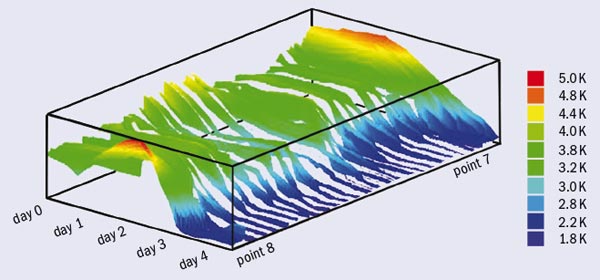
The first sector of the LHC to be cooled reached its operating temperature of 1.9 K for the first time on 10 April. Although only an eighth of the LHC ring, this sector is already the world’s largest superconducting installation. This achievement marks the end of more than two months of commissioning work, which began in January and was carried out in three stages.
The 3.3 km sector comprises more than 200 dipole magnets and short straight sections, which contain quadrupole magnets, and has a total mass of 4700 tonnes. During the first stage, it was pre-cooled to 80 K, just above the temperature of liquid nitrogen. At this temperature, the material reaches 90% of its final thermal contraction, representing a 3 mm shrinkage for each metre of the steel structures. The total contraction over the sector as a whole is close to 10 m, and special devices (bellows and expansion loops) in the interconnections between the magnets compensate for this.
On 5 March, the teams began work on the second stage, which involved cooling the sector to 4.5 K using the gigantic refrigeration plants. For the final stage, which began in mid-March, the 1.8 K refrigeration plants came into play. These use a sophisticated pumping system to bring down the heat-exchanger saturation pressure to cool the magnets and the 10 tonnes of helium that they contain to 1.9 K. To achieve a pressure of 15 millibars, the system uses a combination of hydrodynamic centrifugal compressors operating at low temperature and positive-displacement compressors operating at room temperature. At 1.9 K, helium is superfluid, flowing with virtually no viscosity and allowing greater heat-transfer capacity.
The complexity and large number of sub-systems to be commissioned for the first time, together with various interface conditions to be managed, account for the time needed to cool the sector. The control system of one sector has to manage approximately 4000 inputs/ouputs and 500 regulation loops that need to be adjusted. In addition, the teams have carried out extensive checks to make sure that the cooling was done with all the necessary caution. This learning phase, which was long but vital, has also enabled the teams to prepare for cooling the other sectors.
While the sector cooling progressed steadily, problems arose in a different sector when a quadrupole magnet, one of an “inner triplet” of three focusing magnets, failed a high-pressure test at Point 5 on 27 March. Each inner triplet set of magnets contains two quadrupole magnets (Q2 and Q3) built at KEK and one (Q1) built at Fermilab. The asymmetric force generated during the test broke the supports, made of the glass cloth–epoxy laminate G-11, that hold the Q1 magnet’s cold mass inside the cryostat, and also damaged electrical connections.
CERN and Fermilab now know that this is an intrinsic design flaw that must be addressed in all triplet magnets assembled at Fermilab. Computer-aided calculations after the accident show that the G-11 support structure could not withstand the associated longitudinal forces. Review of engineering designs reveals that the longitudinal force from asymmetric loading was not included in the engineering design or identified as an issue in the four design reviews. An external review committee will analyse how this problem occurred and determine the root causes and the lessons learned.
The goal at CERN and Fermilab is now to redesign and repair the inner triplet magnets and, if necessary, the electrical distribution feed-box without affecting the LHC start-up schedule. Teams at CERN and Fermilab have identified potential repairs that could be carried out without removing undamaged triplet magnets from the tunnel. In the meantime, all three of the pressure-tested triplet magnets at Point 5, plus the associated feed-box, will be removed from the tunnel for inspection and, if necessary, repair.
It is more than 50 years since researchers first observed particle–antiparticle mixing, with the discovery of a second, longer-lived neutral kaon state. This discovery pre-dated the quark model, but the effect became understood in terms of transitions between the quarks (s and d) in these neutral mesons. Thirty years later, scientists found the phenomenon in neutral Bd mesons (b and d quarks), and then last year the D⁰ and CDF collaborations at Fermilab’s Tevatron reported mixing in neutral Bs mesons (b and s). This left the neutral D meson (c and u quarks) as the only system remaining where mixing was possible, but not yet observed.
Now, experiments at the two B-factories, KEKB at KEK in Japan and PEP-II at SLAC in the US, have filled the gap, with reports of the first evidence for D⁰–D⁰ mixing. On 13 March at the Rencontres de Moriond in La Thuile, Marko Staric presented results for D⁰–D⁰ mixing from the Belle experiment at KEKB. Kevin Flood followed with evidence from the BaBar experiment at the PEP-II storage rings.
As in the kaon and B-meson systems, the D⁰–D⁰ are created in “flavour” eigenstates consisting of a quark and an antiquark, but in each case mixing through weak interactions between the quarks should give rise to two different mass eigenstates that are particle–antiparticle mixtures and have different lifetimes. Mixing should therefore modify the decay times of D mesons by a small but observable amount.
The Belle Collaboration has compared decay times in three decay modes of D mesons: two decays to CP-even eigenstates, K⁺K⁻ and π⁺π⁻, and a “flavour-specific decay” to a mixed CP state, D⁰ → K⁻π⁺. The mass eigenstates are CP eigenstates, assuming no CP violation, one being CP-odd, the other CP-even, so in comparing these decay modes, the team is in effect comparing the lifetimes, τ, of the mass eigenstates, which would be the same in the absence of mixing. They measure the relative lifetime difference, yCP = {τ(K⁻π⁺)/τ(K⁺K⁻)} – 1 to be (1.31 ± 0.32(stat.) ± 0.25(syst.))% (M Starič et al. 2007). This differs from zero by 3.2 σ after including systematic uncertainties, and so represents clear evidence for D⁰ mixing.
The BaBar Collaboration has approached the problem slightly differently by focusing on the decay D⁰ → K⁺π⁻, and analysing the data in terms of the parameters, x’ and y’. (These are rotations through a strong phase of the mixing parameters x = ΔM/Γ and y = ΔΓ/2Γ, which depend on the differences in mass (ΔM) and width (ΔΓ) of the mass eigenstates, where Γ is the average width.) They find y’ = (9.7 ± 4.4(stat.) ± 3.1(syst.)) × 10⁻³, while x’² is consistent with zero – a result that they say is inconsistent with the hypothesis of no mixing at 3.9 σ (Aubert et al. 2007).
Both collaborations have also analysed the data for CP violation associated with D⁰–D⁰ mixing but have found no evidence for this. The new results, meanwhile, can be compared with the Standard Model to search for new physics, as D-meson mixing is particularly sensitive to any contributions from particles or processes that have not so far been observed.
The properties of quark–gluon plasma (QGP), where the quarks and gluons are no longer confined within hadrons, lead to intriguing effects that have already been studied in heavy-ion collisions at CERN’s Super Proton Synchrotron (SPS) and at the Relativistic Heavy Ion Collider (RHIC) at Brookhaven. However, the hot, dense medium produced momentarily in the collisions is a challenging environment for calculations in quantum chromodynamics (QCD), the theory that describes the strong interactions between the quarks and gluons. Though the medium is hot enough for the hadrons to “melt” into the QGP state, its temperature is still relatively low and the couplings between the quarks and gluons remain too strong to allow the use of perturbative QCD, which relies on the couplings being weak at high energies.
To get to grips with the strong couplings, a small group of theorists has taken inspiration from string theory. Hong Liu and Krishna Rajagopal of MIT and Urs Wiedemann of CERN make use of “gauge-gravity duality”, in which a gauge theory and a gravitational theory provide alternative descriptions of the same physical system. They map more complex calculations in a strongly coupled gauge theory onto a simpler problem in a dual gravitational string theory, and have looked at two intriguing effects observed in heavy-ion collisions – “jet quenching” and the suppression of the production of J/Ψ mesons.
Strictly speaking, they are not working directly with QCD as no one yet knows which string theory is dual to QCD. They work instead with a duality that works for a large class of gauge theories that behave similarly to QCD at high temperature. They then conjecture that the effects they find should also hold for QCD, and have made some predictions that can be tested at RHIC and at CERN’s LHC.
Jet quenching is one of the most dramatic pieces of evidence for the strong-coupling nature of the quark–gluon matter produced at RHIC. Here highly energetic quarks and gluons produced in the collisions interact with the matter so strongly that they are stopped within much less than a nuclear diameter, “quenching” the jet of hadrons that would normally materialize from the liberated quark or gluon. Previous attempts using perturbative techniques to calculate the parameter that characterizes this effect produced values an order of magnitude too small. Now, using the dual technique, Liu and colleagues have calculated a quenching parameter that is consistent with the data from RHIC, and had for the first time the right order of magnitude (Liu et al. 2006).
In a second calculation, the theorists have turned their attention to the problem of J/Ψ suppression. Screening effects in QGP are sufficient to reduce the attraction between a c and a c in the plasma to the extent that they are less likely to bind together to form a J/Ψ. This should lead to a reduction in the number of J/Ψ mesons produced in energetic heavy-ion collisions relative to proton–proton or proton–nucleus collisions. Previous calculations of this effect have depended on the non-perturbative approaches of lattice QCD. However, in lattice QCD the J/Ψ mesons are produced at rest, whereas in reality they will move at high velocities; from the viewpoint of the mesons, they will be in a “wind” of hot QGP.
With the aid of the dual approach, Liu and colleagues have calculated the screening effect of such a hot wind, and how it depends on velocity (Liu et al. 2007). Assuming that the same effect holds in QCD, the calculations indicate that additional suppression should occur for J/Ψ mesons with higher values of transverse momentum. This should be observable in future in high-luminosity runs at RHIC, and at the LHC, where the temperatures of the QGP may even be high enough to give suppression of the heavier Υ mesons.
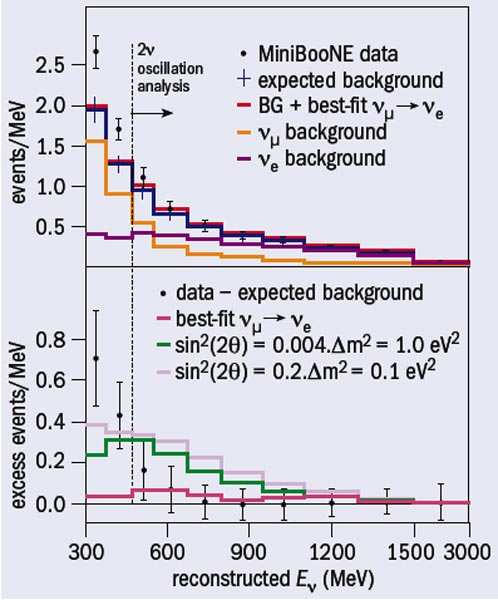
The MiniBooNE Collaboration at Fermilab has revealed its first findings. The results announced on 11 April resolve questions that were raised in the 1990s by observations of the LSND experiment at Los Alamos, which appeared to contradict findings of other neutrino experiments. MiniBooNE now shows conclusively that the LSND results could not be due to simple neutrino oscillation.
The observations made by LSND suggested the presence of neutrino oscillation, but in a region of neutrino mass vastly different from other experiments. Reconciling the LSND observations with the other oscillation results would have required the presence of a fourth, or “sterile” type of neutrino, with properties different from the three standard neutrinos. The existence of sterile neutrinos would indicate physics beyond the Standard Model, so it became crucial to have some independent verification of the LSND results.
The MiniBooNE experiment took data for this analysis from 2002 until the end of 2005 using muon neutrinos produced by the Booster accelerator at Fermilab. The detector consists of a 250,000 gallon tank filled with ultrapure mineral oil, located about 500 m from the point at which the muon neutrinos were produced. A layer of 1280 light-sensitive photomultiplier tubes, mounted inside the tank, detects collisions between neutrinos and carbon nuclei in the oil.
For this analysis the collaboration looked for electron neutrinos created by the muon neutrinos in the region indicated by the LSND observations, using a blind-experiment technique to ensure the credibility of their analysis and the results. While collecting the data, the researchers did not permit themselves access to data in the region, or “box,” where they would expect to see the same signature of oscillations as LSND. When the team opened the box and “unblinded” its data, the telltale oscillation signature was absent.
Although this work has decisively ruled out the interpretation of the LSND results as being due to oscillation between two types of neutrinos, the collaboration has more work ahead. Since January 2006, the MiniBooNE experiment has been collecting data using beams of antineutrinos instead of neutrinos and expects further results from these new data.
Future studies also include a detailed analysis of an apparent discrepancy in data observed at low energy, for which the source is currently unknown, together with investigations of more exotic neutrino-oscillation models.
Calculations of the structure of heavy nuclei have long suffered from the difficulties presented by the sheer complexity of the many-body system, with all of its protons and neutrons. Using theory to make meaningful predictions requires massive datasets that tax even high-powered supercomputers. Recently researchers from Michigan State and Central Michigan universities have reported dramatic success in stripping away much of this complexity, reducing computational time from days or weeks to minutes or hours.
One way to tackle the many-body problem is first to construct mathematical functions that describe each particle, and then start multiplying these functions together to get some idea of the underlying physics of the system. This approach of making the full configuration-interaction (CI) calculation works well enough to describe light nuclei, but becomes extremely challenging with heavier elements. For example, to calculate wave functions and energy levels for the pf-shell structure of 56Ni, it means in effect solving an equation with around 109 variables.
Researchers face a similar problem in quantum chemistry in studying molecules with many dozens of interacting electrons. For several years, however, they have used a computationally cost-effective alternative to CI known as coupled-cluster (CC) theory, which was originally suggested in nuclear theory, but largely developed by quantum chemists and atomic and molecular physicists. Now the CC method is making its way back into nuclear physics, first in calculations of light nuclei, and most recently in developments for heavy nuclei. The key is correlation, the idea that some pairs of fermions in the system (whether nucleons or electrons) are strongly linked and related.
The researchers first used the Michigan-State High Performance Computing Center and the Central Michigan Center for High Performance Scientific Computing for the several-week-long task of solving the CI equation describing 56Ni, to create a benchmark against which they could compare the results of the CC calculation (M Horoi et al. 2007). They found then that the CC theory produced near identical results and that the time spent crunching the numbers – on a standard laptop – was often measured in minutes or even seconds.
This research bodes well for next-generation nuclear science. Because of existing and planned accelerators around the world, the next few decades promise to yield many heavy isotopes for study. Theoretical models will need to keep pace with the expected avalanche of experimental data. To date, many such models have treated the nucleus as a relatively undifferentiated liquid, gas or other set of mathematical averages – all of which tends to gloss over subtle nuclear nuances. In contrast, coupled-cluster theory may be the only manageable and scalable model that takes a particle-by-particle approach.
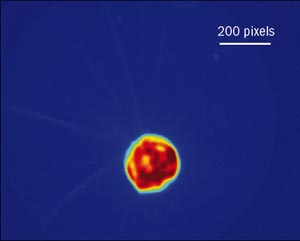
Commissioning of the Linac Coherent Light Source (LCLS) at SLAC began on 5 April when physicists and engineers started up the electron-injector system for the first time, and created and accelerated a bunch of electrons. This injector is the first stage in a free-electron X-ray laser that will use the last kilometre of SLAC’s 3 km linac to accelerate electrons before they pass through an undulator magnet and emit X-rays of 800 eV – 8 keV.
In the injector facility at Sector 20, a drive laser initiates the process by sending a short burst of UV light to a radio-frequency (RF) gun. The RF gun not only creates a precisely shaped bunch of electrons but also gives the electrons their initial accelerating boost with microwaves. Once they enter the linac, the bunches will pass through compressors that pack them into even shorter bunches before they ultimately pass through the undulator.
To provide the best experiences, we use technologies like cookies to store and/or access device information. Consenting to these technologies will allow us to process data such as browsing behavior or unique IDs on this site. Not consenting or withdrawing consent, may adversely affect certain features and functions.
Functional
Always active
The technical storage or access is strictly necessary for the legitimate purpose of enabling the use of a specific service explicitly requested by the subscriber or user, or for the sole purpose of carrying out the transmission of a communication over an electronic communications network.
Preferences
The technical storage or access is necessary for the legitimate purpose of storing preferences that are not requested by the subscriber or user.
Statistics
The technical storage or access that is used exclusively for statistical purposes.The technical storage or access that is used exclusively for anonymous statistical purposes. Without a subpoena, voluntary compliance on the part of your Internet Service Provider, or additional records from a third party, information stored or retrieved for this purpose alone cannot usually be used to identify you.
Marketing
The technical storage or access is required to create user profiles to send advertising, or to track the user on a website or across several websites for similar marketing purposes.