The final crystals for the CMS electromagnetic calorimeter (ECAL) arrived from China and Russia at CERN in March, completing a mammoth production process nearly 10 years after the delivery of the first production crystal in September 1998. These final crystals will be used to complete the endcaps of the ECAL, which contains more than 75,000 crystals.
The huge quantity of leadtungstate crystals used in the ECAL in CMS is the largest number produced for a single experiment. The superb quality of the crystals, in terms of both their optical properties and their radiation resistance, is the result of intense work and collaboration between the producers and ECAL groups, as well as the network of crystallography and solid-state physics experts from the Crystal Clear collaboration.
Five CMS institutes – CERN; the Italian National Agency for New Technologies, Energy and the Environment; the Swiss Federal Institute for Technology Zurich; the Institute for Nuclear Problems Minsk and Rome University I – have been prominent in monitoring and overseeing quality control of this long production process. The optical properties of each crystal were measured by custom-designed automatic equipment. Radiation resistance was systematically controlled through test sampling and required complex logistics coordinated by CERN and ETHZ for the Russian and Chinese crystals respectively. Many other institutes were also involved in their early development.
The 61,200 crystals of the ECAL barrel were successfully installed inside CMS last year and the final phase will be the installation of the endcaps, which contain 14,648 crystals. The first endcap is due to be lowered into the cavern in June and the second endcap should follow later in the summer. More than 90% of the endcap crystals have already been qualified and equipped with their photo-sensors.
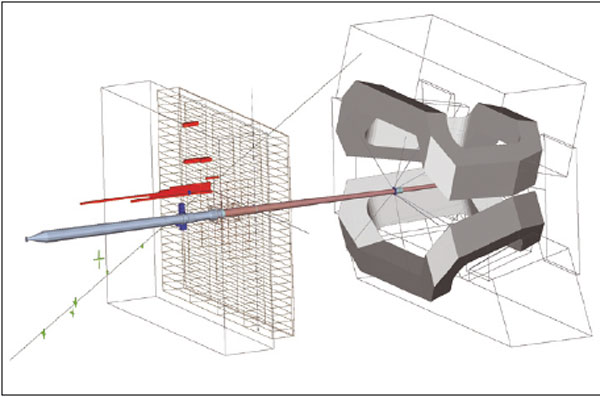
The LHCb team has for the first time measured cosmic rays passing through three of the experiment’s subdetectors simultaneously, selected by muon triggers.
During a global-commissioning run on 3 April, the LHCb team used three of the experiment’s subdetectors – the electromagnetic calorimeter (ECAL), the hadronic calorimeter (HCAL) and the muon system – to trace the paths of cosmic-ray muons. The successful detection of cosmic rays confirms that the different detectors are synchronized, that the software chain works and that the raw data make sense. The software enabled the LHCb team to see 3D reconstructions of the tracks of the muons passing through the subdetectors, illustrating the energy deposited in each of the activated calorimeter cells and the signals in the muon chambers.
The LHCb detector looks different from the standard hadron collider detector because of its focus on heavy flavour particles, which are produced at predominantly low angles and in the same “forward” cone. The subdetectors are arranged in vertical planes along the beamline, more like a fixed-target experiment. This means that tests using cosmic rays, which are predominantly vertical, can only be carried out on certain subdetectors, such as the calorimetry and muon systems, which have large surface areas and can detect particles coming from all directions.
The Muon Ionisation Cooling Experiment (MICE) project, an accelerator research experiment for a major component of a future neutrino factory, has achieved an important milestone with the successful transport of muons along the MICE muon beamline. The international team can now turn its attention to tuning the beam and working towards the demonstration of ionization cooling.
Neutrinos, though challenging to detect because they are only weakly interacting, have already proved to harbour indications of physics beyond the Standard Model. Observations of atmospheric and solar neutrinos have shown that they oscillate between three forms – electron, tau and muon. This can only occur if they have mass, although in the Standard Model they have no mass. To learn more about these mysterious particles requires a new way to generate high-intensity, high-energy beams of neutrinos of known characteristics, such as composition and energy.
A neutrino factory would store muons inside a decay ring with long straight sections pointing to large detectors hundreds, or thousands, of kilometres away. Neutrinos produced in the decay of the muons within these straight sections would travel through the Earth to the distant detectors. Studies have shown that such a facility can be built, but a number of challenges must be solved before a technical design can be completed. One major challenge arises because the muons, produced in the decays of pions, will need “cooling” to form bunches of particles with similar momentum and direction if they are to be accelerated and stored. The problem is that muons decay in about 2 μs.
Ionization cooling is the only technique that can cool the muons fast enough. In this process, passage through matter (liquid hydrogen) reduces the momentum of the muon, and one component of the momentum is then restored by acceleration with RF electric fields. Understanding the efficiency of this cooling technique requires a detailed knowledge of the behaviour of muons in many materials, for example in the windows of the vessel containing the liquid hydrogen.
The MICE project aims to demonstrate the technologies required for ionization cooling and prove that muons can be assembled into cold bunches small enough to allow the muon beam to be accelerated and stored. The MICE collaboration is designing, building and testing a section of a realistic cooling channel on a beamline on the ISIS facility at the Science and Technology Facilities Council’s Rutherford Appleton Laboratory (RAL). Achieving this will give confidence that a full ionization-cooling channel, consisting of many cooling sections, can be designed and built economically.
The successful transport of the first muons along the new beamline is the latest of several significant steps the MICE team has taken since the formation of the collaboration in 2001, and more recently in commissioning the beamline. They have completed the installation and testing of the pion-production target in the ISIS proton synchrotron, built the pion decay line and installed beam counters and other equipment in the experimental hall. Over the coming months, the MICE spectrometer system will be installed and the experiments will finally begin. The cooling channel will be built over the next two or three years, culminating in the demonstration of ionization cooling in 2010.
• The MICE project is a major collaboration involving 150 scientists and engineers from across the world, with collaborators in Bulgaria, China, Italy, Japan, the Netherlands, Switzerland, the UK and the US.
CERN is a de facto global laboratory, with the LHC set to be the centre of particle-physics research for a decade or more, and comprises the largest scientific user community in the world. More than just a particle factory, CERN is a knowledge factory, enabling scientists to make discoveries, disseminate them and train younger generations. CERN is an example to the world of international scientific, technical and human collaboration.
The Council recognized – in the European Strategy for Particle Physics – that the next five years will be crucial, not only for CERN but for the future of particle physics in general. The start of LHC exploitation will provide a unique capability to explore new experimental vistas and an opportunity to seek support for possible new projects, such as upgrading the LHC itself and for a successor to explore the LHC’s breakthroughs.
Gathering the necessary support will require motivating and mobilizing the energies of all CERN stakeholders, both internal and external. Not only is it essential that the LHC be a technical success, but also that the implications of its discoveries for possible new projects be evaluated promptly and convincingly. This new physics should excite the imaginations not only of high-energy physicists, but also the wider scientific community and the general public – even schoolchildren and politicians. Only then could the future of accelerator-based research into the fundamental nature of matter – and any major new project – be assured.
Even so, it will be essential to optimize the deployment of the resources available for particle physics at CERN and other European laboratories. Any new project will surely be global in nature, so it will also be necessary to amplify the dialogue with our prospective partners in other regions of the world.
Possible directions
The European Strategy for Particle Physics also recognizes the importance of R&D on possible future projects in the period before LHC results set the favoured direction for particle physics. The Proton Accelerators for the Future group that advises the director-general has already made an initial plan for upgrading CERN’s Proton Accelerator Complex (Garoby 2007). Following these studies, the director-general set out the R&D priorities that have been approved by CERN Council.
Another report, by the CERN advisory group on Physics Opportunities with Future Proton Accelerators (POFPA) (Blondel et al. 2006), also reviewed some of the scientific motivation for upgrading the LHC. This report discusses possible synergies of upgrades of the LHC injector chain with research programmes in fixed-target physics, neutrino physics and nuclear physics.
Beyond the LHC, there is a general consensus that the priority for the next major international project is a linear electron–positron collider. The International Linear Collider (ILC) concept is potentially very interesting if the LHC reveals new physics within its energy range. Nevertheless, even in this case, physics will eventually require higher energies, hence the need for R&D on the Compact Linear Collider (CLIC) concept, within the international framework provided by the CLIC Test Facility 3 collaboration. CLIC, however, is ambitious; significant technical hurdles remain to be overcome before its feasibility can be demonstrated.
In view of the different options for the location, energy and timescale of a future linear electron–positron collider, CERN should collaborate with partners in Europe and elsewhere on R&D for a possible next-generation neutrino project. This might be based on the “super-beam” and “beta-beam” concepts, or it might be a full-blown “neutrino factory” based on a muon storage ring. The choice between these options will depend on technical feasibility as much as new results in neutrino physics, such as measurements of – or constraints on – the third neutrino-mixing angle.
In parallel with these major projects, the European Strategy recognizes the importance of a variety of smaller-scale projects at CERN that address complementary issues in particle and nuclear physics. Many of these, such as the Antiproton Decelerator, ISOLDE, nTOF and some fixed-target experiments are of unique global scientific interest. Such projects broaden the appeal of CERN and help train many young physicists. The POFPA report underlined the interest of several proposals for the future, in addition to those that would be made possible by upgrades of the LHC injector chain.
While the laboratory’s technical strength is the bedrock upon which any future CERN project will be built, this is likely to be even more global in nature than the LHC, with CERN becoming recognized explicitly as a “world laboratory”. Hence, CERN will need to nurture and build on its existing international partnerships with Canada, Japan, Russia and the US, while collaboration with emerging powers such as China and India should be expanded. CERN’s growing contact with other world regions such as the Middle East and Latin America will also become more important. CERN’s future plans should be discussed with its international collaborators in a spirit of partnership, in which the interests of all regions of the world are respected.
In particle physics, as in much of the rest of physics and engineering, the practitioners are generally men. However, women do become involved and some even break through to important positions. In a series of interviews made for the Italian magazine, Newton, Paula Catapano found out more about some of the women working on different aspects of CERN’s LHC, from environmental impact and radiation safety to the complex experiments. Their answers give some idea of what makes these talented women tick, as well as an insight into their views on working in a “man’s world”.
Ana-Paula Bernades. Portuguese and French. Environmental engineer.
Thirty-five years old and the mother of a three-year-old child, Ana-Paula Bernades graduated in environmental engineering at the Grenoble Polytechnic. She arrived at CERN in 1999 and soon after started work on building safety and ergonomics. In 2003 she became section leader within CERN’s Safety Commission and has since worked on the LHC’s environmental impact, particularly on the management of acoustic disturbances generated by the sites around the 27 km ring, in collaboration with EdF. When the LHC begins operating, she will be in charge of personnel safety training and will be a consultant on general safety, acoustics and ergonomics.
Did you have any particular difficulty in working as a woman in a male-dominated environment?
Not really. Being a woman in the world of safety is an advantage. In this field it is impossible to force things, in a typically male manner, so this makes you develop negotiation techniques to convince your counterparts at CERN to invest money and time on safety issues.
Isabel Brunner is 33 years old and has two children aged two and four. A graduate of the Berufsakademie in Karlsruhe, she came to CERN in 1999 as the radiation protection engineer responsible for radiation protection in the SPS West Area, the RF test facilities and the n-TOF installation. Her current tasks include radiological responsibility for the SPS North Area, the RF installations in the SPS complex and the LHC. She is the radiation protection engineer responsible for the LHC injection test and will participate in the operational radiation protection of the LHC. Measurements she made during cold tests of RF modules for the LHC provided input data for the shielding at Point 4, where the RF is located.
Have you ever encountered any disadvantages/differences in your studies and career as a result of being a woman?
My answer is a clear “no”. Even during my two pregnancies – where I was not able, or allowed, to perform my work in radiation controlled areas – I can’t say that I had any disadvantages. I like my job and I have a great supervisor who treats everyone as an equal. However, working in a “man’s world” is not always easy and it needs plenty of self-esteem and force to stand up and get your point through. I’ve only had one conflict regarding gender differences, and I put an end to it when I confronted the person. This was not easy, but eventually it was the best solution to the problem.
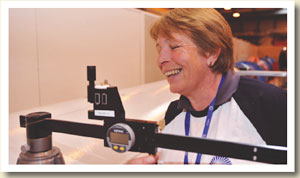
Monique Dupont. French. Surveyor.
Monique Dupont arrived at CERN in 1978 as “industrial support” within the team looking after the topography of buildings, which at the time was expanding. Today she is a member of the metrology group, comprised of 40 people. She has worked on the alignment of magnets for each new accelerator at CERN, as well as on their realignment at each shut down. These highly accurate measurements involve the use of hi-tech instruments, often designed within the metrology group. Since 1996, she has studied and worked on the alignment for the LHC, which has more than 1800 magnet systems. To check the curvature of the magnets, the group used microprobes in the beam tube, making a measurement every 50 cm with laser technology.
Have you experienced any difficulties as a woman working in a typically male career?
I was the only woman in a school of 1000 students. The profession did not attract women at the time – probably because the surveyor’s work is principally outside and the instruments were heavy. Nowadays modern technologies enable you to work comfortably and I think for this reason that the number of women surveyors has increased. In my group, I have always been welcomed and appreciated for my work, but maybe CERN is an exception. The environment here is so international that there are really no differences of race, culture, religion or even gender.
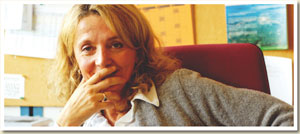
At 46 years old, Fabiola Gianotti is a woman who has reached one of the highest peaks during her career at CERN – that of deputy spokesperson for the largest LHC collaboration, ATLAS. She graduated at the University of Milan and completed her PhD at CERN. When physics allows, she finishes her day jogging or playing the piano – she has a professional diploma from the Milan conservatory. At the LHC, and with her experiment in particular, she would like to find dark-matter particles because of their connection with the universe. “That would be really fantastic.” She is also hoping for a surprise to come from the LHC: “Something really amazing, completely new and unexpected.”
Is it an obstacle to be a woman in a typically male career?
Physics is, unfortunately, often seen as a male subject; sterile and without charm or emotion. But this is not true, because physics is art, aesthetics, beauty and symmetry. Women have obstacles in the field for merely social reasons. Research does not allow you to make life plans. And the difficulties for women with a family are many. Something should be done, for instance, to develop more structures that would enable women with children to go through a physics career without too many obstacles, starting with nursery schools.
Virginia Greco. Italian. Electronics Engineer.
Born in the southern Italian city of Lecce, Virginia Greco is 29 and has a degree in electronics engineering from Pisa University. She is part of a team of engineers in charge of the design and installation of electronics for data acquisition in TOTEM, one of the LHC’s smaller experiments designed to focus on forward particles. Research has always been her passion and has brought her to work in many different international laboratories, from Fermilab to CERN. She also studies theatre, has worked as a radio journalist and is interested in politics, movements in ecology and international cooperation.
Undoubtedly. In Italy, in all technical and scientific environments, there’s a substrate of machismo. Some professors and male colleagues at my university were often convinced that, as a woman, I would never reach the level of a man, but I was never the victim of any real discrimination. In general, I think women have to make more effort than men to be taken seriously, to show they’re worth something and that they have the same skills as men. At the moment I am working in a very open international environment. I have only been here a short time and cannot make any final statements. However, I have the feeling that CERN is a meritocratic place where efficiency and productivity count more than any prejudice. But I still keep my eyes open for possible obstacles, so as not to stumble on them.
Monica Pepe is married to a theoretical physicist and is the mother of two children aged 18 and 13. She became a physicist almost by accident, after “risking” a career first as an actress and then as an architect. Having come to CERN with a postdoctorate research grant in 1983, she now leads a team of 60 CERN physicists in LHCb, a collaboration of 700 physicists from 48 universities in 14 countries. Her main role is to coordinate interaction between the LHCb collaboration and CERN, and to manage the manpower and financial resources of the team. In addition to this largely managerial role, she also handles the technical work of preparing the online data quality monitoring, which will be crucial for acquiring immediately full control of the quality of data collected by the detector once it sees collisions in the LHC. The only “luxuries” she can afford in her little spare time are two hours of yoga per week at lunchtime and jogging with her dog on Sundays.
Is being a woman an obstacle for a physicist’s career?
I was never hindered in my career by the fact of being a woman. In general, I have never seen it as a problem. And from some points of view it has even been an advantage, since people tend to remember you more easily. The real difficulty is conciliating family, children and work. In my case we had to invest a lot of organizational effort, help from my family (my parents), my partner’s availability and understanding, and an important economic investment in baby sitters and carers. I’ve been lucky because both my husband and I have good positions from the same employer (CERN). But it is clear that working days are really long when you have small kids. The advantage is that working as a physicist you can afford some flexibility in organizing your time, which is very helpful. I always think that I will have to help my daughter Giulia, who has just started her architectural studies at EPFL Lausanne, the same way as my mother has helped me.
Eva Sanchez Corral. Spanish. Computer engineer.
Forty-three years old and the mother of eight-year-old twin boys, Eva Sanchez Corral gained her degree in computer engineering from the Madrid Polytechnic University in 1989. She came to CERN in 1991 as a CERN fellow and today she is one of three women in the LHC access-control group.
Any difficulty working in a predominantly male environment?
Today we are three women in the project team, and I find that extraordinary. When I arrived at CERN in 1994 I was the first “staff” woman engineer in the whole department. In the beginning, my colleagues, all men and older in general, looked at me with curiosity and even with a defiant attitude. They treated me in the way men usually treat women, rather than as a colleague. Then, little by little, the old staff were replaced by young engineers, and a few were also women. So the group started treating us as a new resource. Today, our managers especially realize that women can really make a valuable contribution to team work. We are more flexible but also more
methodical, have more energy, we are less individualistic and are good at conflict solving and negotiating. These qualities are particularly appreciated now during LHC commissioning. The real challenge for us is when children come. It’s really two jobs, and it demands a super level of organization between home and the office. Luckily they are not kids forever – they grow up and when they are older, our partners can help more.
Gilda Scioli. Italian. Experimental physicist.
Gilda Scioli is 30 years old and is from Abruzzi in central Italy. After grammar school in Lanciano, she gained a degree in physics from the University of Bologna and arrived at CERN in a postdoctoral role in the ALICE collaboration. She helped construct the complex detectors that will record the 50,000 collisions per second between lead nuclei.
Why do you think there are more men than women in the world of physics?
Because being a researcher is not an easy profession for women. What we do can only be done here. But if I had a small child and an experiment to do, what should I do? Do I say good-bye to everybody, leave for a year and ask my husband to breast-feed the baby?
Archana Sharma. Indian. Experimental physicist.
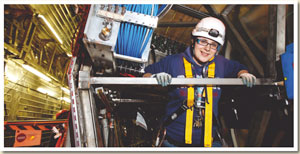
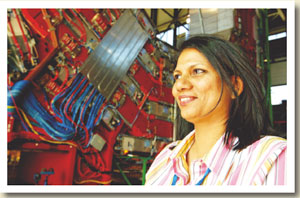
Archana Sharma is married and has an 18-year-old son. She has a PhD in physics from Delhi University and another from Geneva University. She came to CERN in 1989 as a student in the famous Charpak–Sauli group, and after many temporary contracts, where she worked mainly on the development of particle detectors, she is now a CERN staff member within the CMS Collaboration. In CMS, she works in the Technical Coordination Group, which is in charge of integration, installation and commissioning of the experiment.
Is being a woman an advantage or a disadvantage for tackling such a big responsibility?
This job requires both a good knowledge of particle detector technology, which is my field, and also excellent communication skills to be able to interact with people from diverse countries and cultures – such as the physicists from China, Pakistan, Russia and the US. And women are natural communicators. The real challenge, however, is the juggling act: work doesn’t stop when you get home, where there’s a family to look after.
When physicists at CERN try to understand the basic building blocks of the universe, they build gigantic detectors – complex, intricately wired instruments that are capable of measuring and identifying hundreds of particles with extraordinary precision. In a sense, they build “brains” to analyse the particle interactions. For prominent neuroscientist Wolf Singer, director of the Max Planck Institute for Brain Research in Frankfurt, the challenge is quite the opposite. He and other researchers are trying to decode the dynamics of a mass of intricate “wiring”, with as many as 1011 neurons connected by 1014 “wires”. The brain is the most complex living system, and neuroscientists are only beginning to unravel its secrets.
Until recently, according to Singer, the technical tools available to neuroscientists were rather primitive. “Until a decade ago, most researchers in electrophysiology used handmade electrodes – either of glass tubes or microwires – to record the activity of a single element in this complex system,” explained Singer. “The responses were studied in a meticulous way and it was hoped that a greater understanding would arise of how the brain works. It was believed that a central entity was the source of our consciousness, where decisions are made and actions are initiated. We have now learned that the system isn’t built the way we thought – it is actually a highly distributed system with no central coordinator.”
Myriads of processes occur simultaneously in the brain, computing partial results. There is no place in this system where all of the partial results come together to be interpreted coherently. The fragments are all cross-connected and researchers are only now discovering the blueprint of this circuitry.
This mechanism poses some new and interesting problems that have intrigued Singer for many years. How is it possible for the partial results that are distributed in the brain to be bound together in dynamical states, even though they never meet at any physical location? Singer gives the example of looking at a barking dog. When this happens, all 30 areas of the cerebral cortex that deal with visual information are activated. Some of these areas are interested in colour, some in texture, others in motion and still others in spatial relations. All of these areas are simultaneously active, processing various signals and applying memory-based knowledge in order to perceive a coherent object. A tag is needed in this distributed system at a given moment of time so as to distinguish between the myriads of neurons activated by a particular object or situation, and those activated by simultaneous background stimuli. In 1986 Singer discovered that neurons engage in synchronized oscillatory activity. His hypothesis is that the nervous system uses synchronization to communicate.
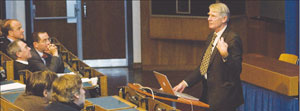
Singer stresses that researchers in his field are closer to theorists in high-energy physics, because the tools necessary to decode the large amount of data generated by the brain’s activity do not exist yet. “This morning when I toured the ATLAS experiment, I heard how the data generated at the collision point is much richer, but physicists use filters to extract the most interesting data, which they formulate in highly educated ways,” said Singer. “The amount of data generated by the sensory organs is more than the brain could digest, so it reduces redundancy. Due to this enormous amount of data, the brain, by evolution, developed a way to filter it all. The most important information for us is based on survival, such as where food can be found or how our partners look.”
Brain function and communication
Singer began his career as a medical student at the Ludwig Maximilian University in 1962 in his hometown of Munich. He was inspired to specialize in neuroscience after attending a seminar by Paul Matussek and Otto Creutzfeldt, who discussed schizophrenia and “split brain” patients. After his postgraduate studies in psychophysics and animal behaviour at the University of Sussex, he worked on the staff of the Department of Neurophysiology at the Max Planck Institute for Psychiatry in Munich and completed his Habilitation in physiology at the Technical University of Munich. In 1981 he was appointed director at the Max Planck Institute for Brain Research in Frankfurt and in 2004 he co-founded the Frankfurt Institute for Advanced Studies.
The 20th century brought many advances in fundamental physics, including the discovery of elementary particles. During this same period, neuroscience provided greater illumination of the brain’s functions. One of the most significant is the identification of individual nerve cells and their connections by Camillo Golgi and Santiago Ramón y Cajal, winners of the Nobel Prize for Medicine in 1906. Another important advance was the introduction of the discontinuity theory, which regards neurons as isolated cells that transmit chemical signals to each other. This understanding allowed neuroscientists to determine the way in which the brain communicates with other parts of itself and the rest of the body.
Some of the results of the first studies of the relationships between function and the different areas of the brain were made using patients injured during the First World War. Later, with the discovery of magnetic imaging to study brain function, researchers were able to turn to non-invasive methods, but there is still much more development needed. With procedures such as magnetic resonance imaging, a neurologist can find out where a signal originates; but the signal is indirect, coming from the more oxygenated areas. A magnetic field of 3 T applied to an area of a square millimetre can show which part of the brain is activated (e.g. by emotions and pain) and reveal the various networks along which the signals travel.
The system is so complex and we are constantly learning new things
Wolf Singer
At the same time, neuroscientists are trying to decode the system and explain how biophysical processes can produce what is experienced in a non-material way – a meta-to-mind kind of riddle – with new entities and the creation of social realities such as sympathy and empathy. This is leading to a new branch of neuroscience, known as social neuroscience.
In other research, colleagues of Singer are studying the effects of meditation on the brain. They found that it creates a huge change in brain activity. It increases synchronization and is in fact a highly active state, which explains why it cannot be achieved by immature brains, such as in small children. Buddhist monks use their attention to focus the “inner eye” on their emotional outlet and so cleanse their platform of consciousness. In 2005 Singer attended the annual meeting for the Society of Neuroscience in Washington, DC, together with the Dalai Lama. Their meeting resulted in discussions about the synchronization of certain brain waves when the mind is highly focused or in a state of meditation.
Singer is also no stranger to controversy. His ideas about how some of the results of brain research could have an impact on legal systems caused a sensation in 2004. His theory that free will is merely an illusion is based on converging evidence from neurobiological investigations in animals and humans. He states that in neurobiology the way in which someone reacts to events is something that he or she could not have done much differently. “In everyday conditions the system is deterministic and you want your system to function reliably. The system is so complex and we are constantly learning new things,” explained Singer. There are many factors that determine how free someone is in their will and thinking. Someone could have false wiring in the part of the brain that deals with moral actions, or perhaps does not store values properly in their brain, or could have a chemical imbalance. All of these biological factors contribute to how someone reacts in a given situation.
Singer feels strongly that the general public should be aware of what scientists are working on and that enlightenment is essential. “Science should be a cultural activity,” he said, adding that in society the people who are considered “cultured” generally are knowledgeable in art, music, languages and literature, but not well versed in mathematics and science.
In 2003 he received the Communicator Prize of the Donors’ Association for the Promotion of Sciences and Humanities and the Deutsche Forschungsgemeinschaft in Germany. Communicating his passion to the young has been a challenging and yet highly rewarding experience. He works to engage society in discussions about the research in his field, providing greater transparency and comprehension. His dedication to improving communication between scientists and schools is evident in the programme that he has initiated: Building Bridges – Bringing Science into Schools. This creates a stronger dialogue between scientists, students and teachers. • For Wolf Singer’s colloquium at CERN, “The brain, an orchestra without conductor”, see indico.cern.ch/conferenceDisplay.py?confId=26835
Channelling of particles by the arrangement of atoms in crystals has been known for many decades. The effect is nowadays used in accelerators to steer high-energy beams, which are guided by the strong coherent electric field arising from the nuclear charges in bent crystals. Some 20 years ago, Alexander Taratin and S A Vorobiev predicted that the coherent field of a bent crystal could also reflect particles through small angles (Taratin and Vorobiev 1987). It was only in 2006, however, that experiments with 1 GeV and 70 GeV protons made the first observation and measurement of this “volume reflection” effect (Ivanov et al. 2006). A year later, a team at CERN’s SPS reported a nice demonstration of the effect with 400 GeV protons.
These studies have found that the range of entrance angles over which ions undergo volume reflection can be much greater than the critical angle of channelling. Furthermore, the experiment at the SPS showed that the probability of reflection far exceeds that of channelling. It is still less than 100%, however, because some particles “stick” to the atomic planes instead of bouncing back – because incoherent scattering (volume capture) traps them into channelled states.
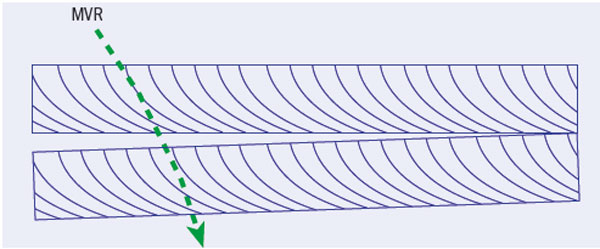
A single-volume reflection at the energy of the SPS is of the order of 14 μrad. It is possible to obtain greater deflection by reflecting the particles from several bent-crystal layers, as figure 1 indicates. This leads to a multiple-volume reflection (MVR) angle that increases in proportion to the number of layers (Taratin and Scandale 2007, Breese and Biryukov 2007). One experimental limitation is that some particles are volume captured with every reflection, therefore reducing the number of reflected particles linearly with the number of reflections, N.
Computer simulations have shown two ways to overcome this limitation and increase the reflection efficiency to remarkably high values (Biryukov and Breese 2007). One way is to arrange each subsequent bent layer to reflect the complete distribution of particles passing through the layer above, including the tail of volume-captured particles. Simulations show that, in this case, the MVR angle grows linearly with N, while the efficiency remains constant, limited mainly by the volume capture in the last layer. The second way to increase reflection efficiency is to suppress the volume-capture process itself. The volume-captured particles occupy the top of the potential well and are easily affected by variations in the crystal curvature – an effect already known from experiments at 70 GeV and from theory. To suppress fully the few per cent probability of volume capture observed in single-volume reflection, the curvature should vary significantly over the length of the crystal so that it quickly releases most of the volume-captured particles.
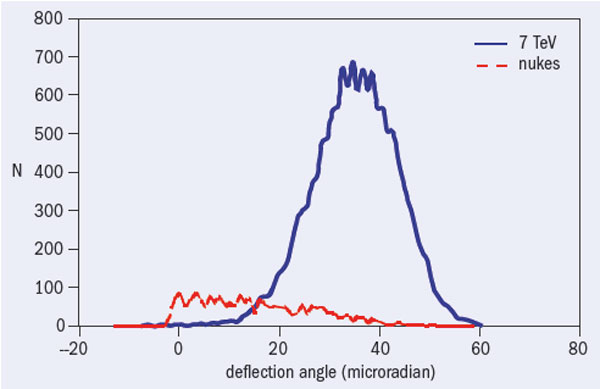
Computer studies of 7 TeV protons show that the rate of volume capture is suppressed by a factor of 20 in a silicon crystal, in which the curvature varies by 40% along its length compared to the same crystal with a constant curvature. Figure 2 shows a 7 TeV proton beam bent through an angle of about 40 μrad, which could serve well for collimation purposes at the LHC. Here, a structure comprising 20 (110) layers of silicon, each bent through 65 μrad with a radius of 50 m, has deflected 7 TeV protons with an efficiency of 99.95%. This efficiency level by far outperforms the capabilities of channelling in crystals and the angular acceptance of this structure is 65 μrad, which is around 20 times greater than the acceptance of bent-crystal channelling. Such perfect deflection efficiency over a broad angular acceptance makes MVR ideal for collimation.
The near-100% deflection efficiency obtained in the single encounter of a particle with the multilayered structure may be important in many types of accelerators, including linear machines (such as a future International Linear Collider), machines with a short beam lifetime (such as muon or short-cycle machines) and in high-intensity beams with a fast-developing instability. The possibility of an efficiency of close to 100% makes MVR attractive for high-intensity beam applications, where beam losses usually rule out the use of bent-crystal channelling.
At an energy of 7 TeV, the crystal material along the beam direction in this example becomes as long as 6.5 cm. Some protons undergo inelastic nuclear interactions in the crystal layers. Figure 2 shows the deflection angle for these protons at the moment of nuclear interaction. On average they are bent by half the bending angle of non-interacting protons, with a bending efficiency of a remarkably high 95%. This is different behaviour compared to both an amorphous target and to bent-crystal channelling, where the products of nuclear interactions move in a forward direction. When using MVR for collimation, not only are the primary particles bent towards an absorber but the debris of the particles that have interacted with the crystal nuclei are also bent towards an absorber with high efficiency.
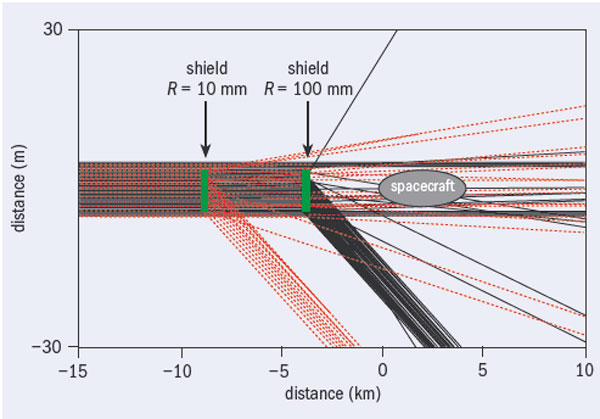
MVR also provides an attractive mechanism for a space shield that can deflect ions with energies of mega- or giga-electron volts per nucleon. Here, highly efficient deflection over a range of entrance angles at high energies is of paramount importance for the design of a space shield for radiation protection that is based on curved crystals. Such a bent-crystal shield was recently proposed for deflecting cosmic-radiation ions of all atomic numbers away from spacecraft (Breese 2007). A team at the National University of Singapore fabricated a bent-crystal shield with a surface area of 1 × 1 cm2 that is capable of deflecting ions with energies of up to 100 GeV/nucleon. Figure 3 shows the simulated results of the crystal shield protecting a spacecraft from high-energy ions approaching from a single direction. This adds yet another link between the microcosm of a particle-physics laboratory and the macrocosm of space travel.
The next big advances in particle physics are expected to happen at the “terascale”. The tremendous complexity and size of experiments at the LHC and the proposed International Linear Collider (ILC) challenge the way that physicists have traditionally worked in high-energy physics. The German project Physics at the Terascale – a Helmholtz Alliance that will receive €25 m over five years from Germany’s largest organization of research centres, the Helmholtz Association – will address these challenges.
The Alliance bundles and enhances resources at 17 German universities, two Helmholtz Centres (the Forschungszentrum Karlsruhe and DESY) and at the Max Planck Institute for Physics in Munich. It focuses on the creation of a first-class research infrastructure and complements the existing funding mechanisms in Germany at local and federal level. With the help of the new project, central infrastructures are developed and are shared among all Alliance members. The Alliance will fund many of these measures for the first few years. From the beginning, a central point of the proposal has been that the long-term future of these activities is guaranteed by the universities and the research centres beyond the running period of the Alliance funds.
The Alliance supports four well defined research topics (physics analysis, Grid computing, detector science and accelerators) and a number of central “backbone” activities, such as fellowships, interim professorships, communication and management.
Close-knit infrastructure
What is new about this common infrastructure? Previously, each of these institutes developed their infrastructure and expertise for their own purposes. Now, triggered by the Alliance, different institutes share their resources. Common infrastructures are developed and are made available to all physicists in Germany working on terascale physics. For example, this means that if PhD student Jenny Boek of Wuppertal wants to develop a chip for slow controls, she can now use the infrastructure and take advantage of the expertise in chip design in Bonn.
These central infrastructures can be concrete installations – like a chip development and design laboratory, located at a specific location – or virtual ones, like the National Analysis Facility, which will help all LHC groups in Germany to participate more efficiently in the analysis of data from the LHC. Common to all of these is that these infrastructures are open to all members of the Alliance, and are initially funded through it.
An important goal of the Alliance is to organize interactions between the different experimental groups and between the experiment and theory communities on all topics of interest for physics analysis at the terascale. This includes meetings and the formation of working groups with members from all interested communities, the organization of schools and other common activities. It can also mean basic services, such as the design and maintenance of Monte Carlo generators, or include exchanges on the underlying theoretical models. In all of these studies, while the focus is initially on the LHC, the role of the ILC will also feature as a future facility of key importance in the field.
In the same spirit, Alliance funds are used to improve the Grid infrastructure significantly in Germany, to serve the global computing needs of the LHC as well as the specific requirements of German physicists to contribute to the data analysis. Funds are provided to supplement the existing Tier-2 structure in Germany by building up Tier-2s at several universities, and to support the National Analysis Facility at DESY. Additional money is provided to allow for significant contributions to improve Grid technologies with the emphasis on making the Grid easier for the general user.
The third research topic, detector development, involves plans for the future beyond the immediate data flow from the LHC. Institutes are already developing next-generation detectors for the ILC and for LHC upgrades. A Virtual Laboratory for Detector Development will provide central infrastructures to support the different groups for these projects. A number of universities and DESY are setting up infrastructures with special emphasis on chip design, irradiation facilities, test beams and engineering support. Again, although these facilities are at specific locations, they serve the whole community.
Fostering young talent
The Alliance also wants to increase the involvement of universities in accelerator research in Germany. Through a number of programmes – for example a school for students on accelerator science or lectures at universities – the Alliance tries to increase the involvement of universities in accelerator research over the long term. Rolf Heuer of DESY, one of the initiators of the project, explains the motivation: “Germany led the way to the TESLA technology collaboration and its success, and we want to stay at the forefront of accelerator development. Without it, progress in many areas of science will not be possible.”
A substantial part of the Alliance’s funding goes into the creation of more than 50 positions for young scientists and engineers all over Germany. The five Alliance Young Investigators groups and the Alliance fellowships play a special role: they are supposed to attract young physics talents from all over the world to Germany and to the terascale. Many of these positions are tenure-track, something quite rare in Germany. In addition, positions are created to support the infrastructure activities, to set up the central tasks and support the work of the Alliance. More than 250 people have already applied for the new positions over the last eight months.
A significant fraction of the accepted applications are from women. This is in accordance with the Alliance’s aim to enhance the role of women in physics. One way to attract smart and ambitious young people to the German research landscape is the dual career option – the Alliance pays half a salary for the partner to work at the same institution. So when Karina Williams, now in the final year of her particle physics phenomenology PhD at Durham University in the UK, applied for postdoctorate positions, she made sure that the places where she applied would also have a job for her partner. It worked out at Bonn University, where she and her partner start later this year. “I think it’s wonderful that schemes like this exist,” she says. “I know so many people who have either had to put up with very long-distance relationships or left the subject because their partner could not get a job nearby. When I first started applying for jobs, I was told that long-distance relationships were just part of the postdoc life.”
Centralized community
DESY plays a special role within the Alliance. It provides unique and basic infrastructures for accelerator research, as well as large-scale engineering support for detector research. This is a tradition that goes back to when DESY ran accelerators for high-energy physics. A new role for DESY is to host central services for the German physics community to support physics analysis in Germany. One of these services is the Analysis Centre, where research will focus on areas of general interest, which are often emphasised less at universities. Examples of these topics are statistical tools or parton distribution functions, where the Alliance will profit from the outstanding expertise at DESY from HERA. Of course it is not only R&D that researchers at the Analysis Centre will pursue; another purpose is to form a kind of helpdesk to answer questions and offer help in organizing topical workshops. Expanding on its role as an LHC Tier-2 centre, DESY is also setting up the National Analysis Facility, a large-scale computer installation to support the user analysis of LHC data. The first processors are already installed in DESY’s computing centre, providing fast computing power for efficient analyses by German LHC groups.
Another example of “central services” – like Alliance fellowships, equal opportunity measures or dual career options – is a “scientist replacement” programme. The goal of scientist replacement is to enable senior professors to take up roles of responsibility at the LHC experiments by sponsoring junior professors to replace them at university. Karl Jakobs is physics coordinator at ATLAS and a part-time bachelor. His home and family are in Freiburg in southern Germany, but he has had a flat in Saint Genis-Pouilly near CERN since October last year and a great deal of long-term responsibility within the experiment – something that would have been impossible less than a year ago. Now the Alliance is funding his replacement in Freiburg. In this way, German particle physicists can play leading roles in current and future experiments more easily. This may sound like a trivial thing – but all German professors are obliged both to do research and to teach, binding them to their university and only releasing them during breaks and the occasional half-year sabbatical. Jakobs’ classes are currently, until the end of the summer, being taught by Philip Bechtle from DESY. Another example is Ian Brock, scientific manager of the Alliance, whose replacement during his leave of absence from Bonn University is paid for and provided by the Alliance.
The Alliance was officially approved in May last year, funding started in July, and it is already a prominent part of the German landscape of particle physics. It had an impressive start and most of the structures of the Alliance have begun working intensively. A major event was the “kick-off” workshop at DESY in December. With 354 registered participants (many of them undergraduate, graduate and PhD students), a large part of the German high-energy physics community was there. The workshop proved a great opportunity for young particle physicists to get to know each other and exchange ideas: Terascale gives them a backbone structure that they will now fill with content.
The Alliance is already changing the way particle physics is done in Germany. The main idea is to establish cooperation among the different pillars of German research in particle physics. Expertise, which is scattered around many different places, is being combined to become more efficient. As Heuer explains: “The Alliance strengthens R&D on LHC physics in Germany, pushes for accelerator physics and prepares for the ILC. It is our hope that this helps in the worldwide effort to unravel the basic structure of matter and to understand how the universe has developed.”
Jakobs, meanwhile, is happy to benefit from the arrangement at CERN. “Everything is happening here. You cannot be physics coordinator and not be stationed at CERN. There are regular meetings, you talk to people all the time, watch their progress and coordinate to optimize.” As physics coordinator he has to make sure that all ATLAS people who work on Higgs analysis and other special topics work together in a coherent way. There is a complicated sub-group structure and all simulations and data have to be perfectly understood. “The good thing is that after my job here, I will be able to return to Freiburg with a clear conscience and spend a lot of time analysing the data I helped to prepare,” he explains. “Administration, teaching, funding proposals, forms and management – all that takes time at home. It is a great luxury to be able to concentrate on one thing only here: pure physics.
• For more information about Physics at the Terascale, see www.terascale.de.
• For further information about the Helmholtz research association, see www.helmholtz.de/en
After five years observing the oldest light in the universe, NASA’s Wilkinson Microwave Anisotropy Probe (WMAP) is refining our understanding of the universe. It finds evidence for cosmic neutrinos permeating the universe and discriminates models for the burst of expansion in the universe’s first fraction of a second.
Each cubic centimetre of space contains about 400 photons from the Cosmic Microwave Background (CMB). They come from all directions in space but from a given time about 380,000 years after the Big Bang. It is the time of decoupling of light and matter making the universe transparent to radiation. The decoupling results from the formation of the first atoms by the combination of electrons and protons. Although the CMB is almost uniform on the sky, its pattern of very small fluctuations in intensity can be analysed to derive the universe’s age, composition and development.
The first three years of WMAP data already provided accurate measurements of the main cosmological parameters (CERN Courier May 2006 p12). On 7 March the WMAP science team released an update of these results with the addition of two years of data acquisition and improved calibration. The gain in sensitivity – which scales with the square root of observing time – being only a factor 1.3, it is not surprising that the new results do not drastically change the findings published two years ago. They confirm with increased precision the standard model of cosmology. In this so-called ΛCDM model, the present energy content of the universe is dominated by dark energy with an equation of state suggesting a pure cosmological constant (w = –0.97±0.06) and cold dark matter (CDM) of unknown nature. Their contribution to the energy content of the present universe is of 72±2% and 23±1%, respectively, the remaining being essentially "ordinary" baryonic matter accounting for 4.6±0.2%. The contribution from neutrinos is currently less than 1%, but used to be much higher (around 10%) when the CMB light was emitted.
The existence with greater than 99.5% confidence of such a "cosmic neutrino background" from the early universe is a new result from WMAP. Its presence influences the fluctuations of the CMB on the smallest angular scales that are now more accurately measured. The second main finding from the new WMAP data is a refined determination of the epoch of reionization of the universe by the first stars found to have occurred at a redshift of z = 10.8±1.4, about 400 million years after the Big Bang. Finally, various possible inflation scenarios are also better constrained now by a more accurate determination of the scalar spectral index found to be n = 0.960±0.014, meaning a small but significant deviation from scale-invariant density fluctuations.
WMAP is still operating and continuously observing the CMB radiation first identified in 1965 by Arno Penzias and Robert Wilson, who were jointly awarded the Nobel Prize in 1978. The breakthrough of WMAP was to show that the content and evolution of the universe can be derived from the CMB with great precision. ESA’s Planck mission to be launched at the end of the year shall soon take over and further refine our understanding of the cosmos.
• The quoted values are derived from WMAP data with additional constraints from Type-Ia supernovae and from the large-scale distribution of galaxies.
A meticulous new examination performed at the INFN laboratories in Milano-Bicocca and Pavia in Italy has shown that arsenic poisoning did not kill Napoleon. The researchers demonstrated that there is no evidence of a significant increase in the levels of arsenic in the emperor’s hair during the final period of his life.
Physicists performed the study using a small nuclear reactor located at the university in Pavia, which was built for the Cryogenic Underground Observatory for Rare Events (Cuore) experiment. Currently in development at the INFN’s National Laboratories in Gran Sasso, the completed Cuore facility will be the most advanced experiment for studying the rare phenomenon of neutrinoless double-beta decay and for measuring neutrino mass.
To examine Napoleon’s hair, the team used the technique of neutron activation, which has two important advantages: it does not destroy the sample and it provides extremely precise results, even from samples with a small mass. The researchers placed Napoleon’s hair in the core of the nuclear reactor in Pavia and used neutron activation to establish that all of the hair samples contained traces of arsenic. They chose to test for arsenic in particular because various historians have hypothesized that guards poisoned Napoleon during his imprisonment in Saint Helena. A diverse sample of hairs from different periods of Napoleon’s life were examined, along with hair samples from people living today, to compare arsenic levels.
The examination produced some surprising results. First, the level of arsenic in all of the hair samples from 200 years ago is 100 times as great as the average level detected in samples from people living today. In other words, people at the beginning of the 19th century evidently ingested arsenic from the environment in quantities that are today considered dangerous. The other surprise is that there was no significant difference in arsenic levels between when Napoleon was a boy and during his final days in Saint Helena. According to the toxicologists who participated in the study, this provides evidence that this was not a case of poisoning, but rather the result of a lifetime’s absorption of arsenic.
To provide the best experiences, we use technologies like cookies to store and/or access device information. Consenting to these technologies will allow us to process data such as browsing behavior or unique IDs on this site. Not consenting or withdrawing consent, may adversely affect certain features and functions.
Functional
Always active
The technical storage or access is strictly necessary for the legitimate purpose of enabling the use of a specific service explicitly requested by the subscriber or user, or for the sole purpose of carrying out the transmission of a communication over an electronic communications network.
Preferences
The technical storage or access is necessary for the legitimate purpose of storing preferences that are not requested by the subscriber or user.
Statistics
The technical storage or access that is used exclusively for statistical purposes.The technical storage or access that is used exclusively for anonymous statistical purposes. Without a subpoena, voluntary compliance on the part of your Internet Service Provider, or additional records from a third party, information stored or retrieved for this purpose alone cannot usually be used to identify you.
Marketing
The technical storage or access is required to create user profiles to send advertising, or to track the user on a website or across several websites for similar marketing purposes.