Comsol -leaderboard other pages

Topics

The LHC sees its first circulating beam

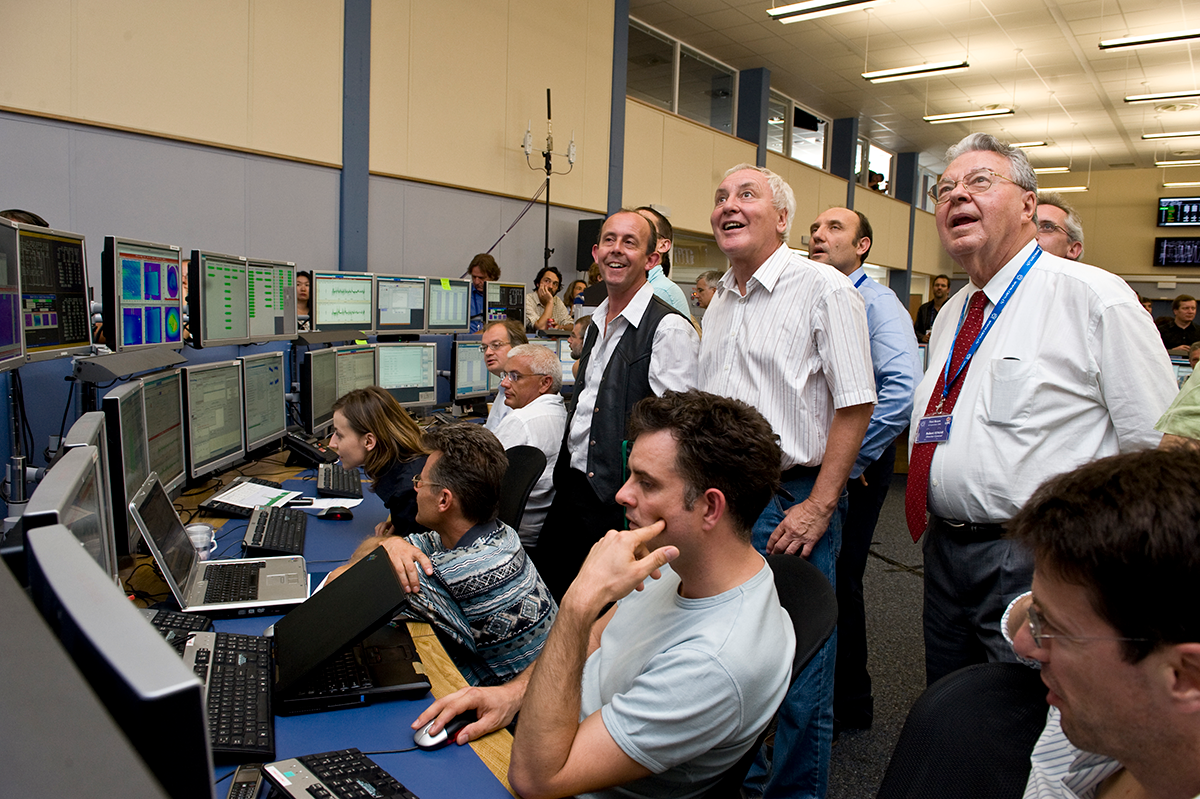
At 10.28 am on 10 September, the first beam made the full 27 km journey around the LHC, travelling in a clockwise direction. Cheers and applause filled the CERN Control Centre (CCC) as two spots appeared on the screen, indicating that the beam had completed the full circle, from injection at Point 2 round to the same point. The emotion was echoed around CERN where staff and users had been watching events unfold via screens in the main auditorium and elsewhere, as well as in the control rooms of the LHC experiments. Also keenly watching the action were some 250 journalists attending the event, many in the Globe of Science and Innovation.

Delighted faces in the CERN Control Centre

It had taken the operations team in the CCC, just less than an hour to allow the beam to progress carefully, through one sector at a time. Finally, the beam made three circuits before the team decided to take a well-earned pause before starting the procedures for the beam travelling in the opposite direction. Then in the afternoon, again taking about one hour for the complete journey sector-by-sector, the first beam travelled anticlockwise all the way from injection at Point 7, finally making a total of two circuits.

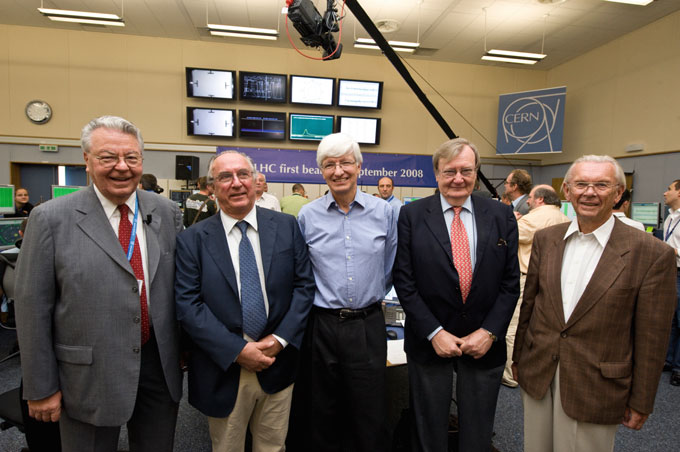
Present in the crowd in the CCC, were all the directors-general of CERN who had watched over the proposals, approval and construction of the LHC. Herwig Schopper (1981–1988) had overseen the construction of the LEP collider, with its 27 km tunnel that the LHC now occupies; Carlo Rubbia had been a tireless and inspirational advocate for the machine (1989–1993); Chris Llewellyn Smith (1994–1998) had conducted the hard negotiations that led to the project’s approval in 1996; Luciano Maiani (1999–2003) was at the helm as major construction got under way; and Robert Aymar, the current director-general, has seen the project to its successful completion. The crowd also included Giorgi Brianti, the “father” of the machine with its unique twin-aperture, two-in-one magnet system.

Past director-generals who between them have seen the LHC dream become reality.

Only very careful planning and preparatory work had made it possible for the Operations Team to be able to propose starting up the machine under the eyes of the world’s media. Although common practice for the launch of space vehicles, for example, this was a “first” in the world of particle physics – and not without additional stress for the operators. From 9.00 am to 6.00 pm at CERN, regular live action from the CCC was broadcast by many TV channels. The journalists in the Globe were also able to attend a press conference in the afternoon, given by the current director-general, together with Llewellyn Smith, Rubbia, Schopper, Brianti, Evans, and Jos Engelen, CERN’S Chief Scientific Officer.

The sight of first beam marks the end of a long journey for the LHC project, from the first proposals in 1984 to the final hardware commissioning this past summer. It is also the first step in the process of bringing the LHC into operation. The next stage for the operations team will be to establish beams that circulate continuously, for hours at a time. The final step will be to commission the LHC’s acceleration system to boost the energy to 5 TeV per beam – the target energy for 2008, which will be a world record energy and another “first” for CERN.

The LHC: from dream to reality

Robert Aymar

On 10 September the world watched as protons travelled around the ring of the Large Hadron Collider for the very first time – in both directions. Now, only a month later, we are able to celebrate another major event for CERN and the particle physics community world wide, with the official inauguration of the LHC on 21 October.

The start-up of the LHC marks the end of an eventful journey from the first ideas, through the long stages of planning and approval, construction and commissioning, to the start of operations. It began in 1984 with a debate on the possible objectives of a future accelerator, based on the state of our knowledge at that time. The CERN Council then approved the construction of the LHC in 1996, giving the go-ahead for the work that has now reached completion.

For the past 12 years, physicists, engineers and technicians from CERN and its associated institutes have been engaged in constructing the three pillars of the LHC: the accelerator (including the upgrade of the existing accelerator chain), the four experiments, and the computing infrastructure needed to store and analyse the data. An enormous amount of effort has gone into these three major endeavours and we are all about to reap the fruits of those labours.

As the current director-general of CERN I feel tremendous pride in the commitment and dedication shown by everyone at CERN, at its partner institutions in the member states and non-member states, and at the many contractors involved, in overcoming the various hurdles on the way to completing this unique endeavour.

What lies ahead is more important still, as the LHC is poised to generate new knowledge that we will share with the whole of mankind. For that is precisely why CERN was founded – to restore Europe to its place at the forefront of science and, in particular, at the forefront of physics.

Neutron-rich nuclei reveal new secrets

Two research teams at Michigan State University’s National Superconducting Cyclotron Laboratory (NSCL) have reported fresh findings about neutron-rich nuclei. In separate experiments, groups measured a critical energy gap in oxygen nuclei and achieved their first-ever success using a new technique for finding isomers.

One important area of study with these nuclei focuses on the neutron drip line – the limit in the number of neutrons (N) that can bind to a given number of protons. For oxygen, that line was known to lie at 16 neutrons, and indeed indicated a new shell closure at N=16 in neutron-rich nuclei. However, theoretical calculations disagreed on the difference in binding energy between 24O, with a closed shell of 16 neutrons, and 25O, the first isotope beyond the drip line – in other words, the binding energy of the 17th neutron.

Calem Hoffman from Florida State University and colleagues have now pinpointed this quantity. The group used the NSCL’s coupled cyclotrons to accelerate a beam of 26F onto a fixed target, where they observed 25O for the first time. The 25O decays too quickly for direct detection, but the group was able instead to track its decay products: 24O and a single free neutron, measured with the Modular Neutron Array. The team then used the angles, energies and momenta of the decay products to calculate the mass of the 25O, which in turn allowed them to infer the difference in binding energy from 24O, and ultimately the N=16 shell gap, which they find to be 4.86(13) MeV (Hoffman et al. 2008).

The second experiment, conducted by NSCL’s Georg Bollen and colleagues, focused on nuclear isomers, in which neutrons are excited to a higher-energy arrangement for anywhere from fractions of a second to years. The team has discovered a previously unknown isomer of 65Fe, a nucleus that is intriguing for its proximity in terms of proton and neutron numbers to 68Ni, a particularly enigmatic isotope. 68Ni displays some characteristics of doubly magic nuclei, but nuclei with slightly fewer protons and neutrons than 68Ni reveal pronounced changes in structure – which generally is not the case for isotopes near others that are doubly magic. Researchers have little idea what is happening in this nuclear region, and so are keen to make more measurements.

These nuclei are a target for the Low Energy Beam and Ion Trap (LEBIT), which experimenters at NSCL use to collect high-speed products of cyclotron-spawned collisions. After firing a beam of germanium nuclei into a thin target, Bollen’s team captured the products in LEBIT and directed them into a Penning trap, allowing them to make very precise mass measurements of the particles caught. The team measured two distinct masses for 65Fe, indicating nuclei with different energy states – one the ground state and one a novel isomer at an excitation energy of 402(5) keV (Block et al. 2008) This is the first use of Penning trap mass spectrometry of this kind. Previous isomer studies have instead employed gamma-ray spectroscopy.

Gas detectors advance into a second century

In 1908, Rutherford was the first to use a gas-filled wire counter to study natural radioactivity. To celebrate 100 years of gas counters, and in particular to look ahead to new developments in gas-based detectors, some 100 physicists gathered at Nikhef, Amsterdam, on 16–18 April. They were on a mission: to work towards the foundation of the RD51 collaboration, devoted to further research and development of micropattern gas detectors (MPGDs).

CCdet1_09_08

Fabio Sauli from the TERA Foundation and CERN reviewed how, in 100 years, gas detectors developed from Geiger counters to multiwire proportional chambers, drift chambers and time-projection chambers (TPCs) – detectors that are now widely used in high-energy and nuclear physics experiments. The need for gas detectors that could operate at high counting rates led to the development of micro-strip gas chambers. However, they proved difficult to operate in challenging conditions and were prone to aging and sparking. Nevertheless, the gas-detector community stood up to the challenge. The invention of MPGDs, such as the micromesh gaseous structure chamber (the MicroMegas) and gas-electron multiplier (GEM) detector, appears to have solved these problems.

Progress in MPGDs

These detectors have small avalanche gaps and therefore a rapid signal development, implemented in slightly different ways. In MicroMegas detectors the electron multiplication takes place in the narrow gap between a thin cathode mesh with holes and the anode. GEMs, on the other hand, have an insulating polymer foil with thin metal coatings on both sides, and the multiplication takes place in the holes in the foil. Such MPGDs are already in use in difficult environments, such as in the COMPASS experiment at CERN, and various ideas exist to develop MPGDs further into robust, economic, fast and, potentially, large-area tracking detectors with a low material budget (one-fifth to one-tenth of that in typical silicon detectors).

The workshop heard about progress towards various further improvements for MPGDs. Ioannis Giomataris of DAPNIA-Saclay presented new developments in MicroMegas detectors, such as bulk and large-area construction, and also spoke about various applications. Recent advances in thick GEM detectors formed the focus of the talk by Amos Breskin of the Weizmann Institute, while CERN’s Serge Duarte looked at how to make large GEMs. In a slightly different vein, Vladimir Peskov from CERN described work on resistive-electrode thick GEMS, which are designed to give higher gain without sparking.

With recent developments in silicon wafer processing technology it is now possible to grow the thin cathode grid of a MicroMegas detector right on top of a silicon pixel chip (figure 1). Such a set-up (known as “Ingrid”) integrates detector and read-out electronics optimally in one structure, as Victor Blanco Carballo from Twente University and Lucie de Nooij from Nikhef demonstrated (figure 2). Sparks in the narrow gap between the cathode and the anode can destroy the pixel chip, but Nicolas Wyrsch of the Institute of Microtechnology, Neuchatel, showed that with a layer of amorphous silicon on the pixel chip, the detector can withstand sparking.

There are numerous applications of MPGDs, a few of which were discussed during the workshop. In R&D studies, thick GEMs are used for the detection of single photons in Cherenkov imaging counters. At Jefferson Lab, a new multipurpose spectrometer is being developed, where GEMs could be used in particle tracking at high rates. GEMs are also being developed for digital hadron calorimetry in experiments proposed for the International Linear Collider (ILC) – a very high granularity can be achieved with small cells that are either “on” or “off”. Groups working on experiments for the ILC have in addition designed large TPCs with MPGD read-out, and both GEMs and MicroMegas are being considered for this role.

In other developments, MicroMegas detectors could read out a TPC for the Tokai-to-Kamioka experiment in Japan, or be used as muon detectors at high counting rates, such as in the upgrade of the ATLAS detector at CERN for the upgraded LHC, the Super-LHC (SLHC). A gas-pixel transition-radiation tracker based on MicroMegas is under study, and MicroMegas detectors are excellent technology choices for experiments that aim to detect rare events, such as searches for weakly interacting massive particles and solar axions, and studies of neutrinoless double beta-decay. MPGDs also have applications in astronomy and medicine as X-ray imaging detectors, and in neutron detection.

CCdet2_09_08

The workshop also discussed future read-out chips. The TimePix chip is derived from the Medipix2 chip, but with a time measurement for each pixel, which is an important asset for gas detectors. Michael Campbell from CERN talked about the Medipix3 chip, which is now under development, and Jan Timmermans of Nikhef discussed the requirements of TimePix-2, a successor of TimePix, and how this chip could be a general purpose read-out chip.

The RD51 collaboration

In a workshop at CERN in September 2007, participants realized that future progress in MPGDs would be best served by tighter collaboration. This led to the formation of a protocollaboration, working towards an R&D proposal: “Development of micropattern gas detectors technologies.” Now some 50 institutes in Europe, the US and Asia have declared an interest, and a proposal for this collaboration, RD51, was submitted to the LHC committee on 2 July, following the workshop at Nikhef where Leszek Ropelewski from CERN was elected spokesperson, and Maxim Titov of CEA-Saclay was elected co-spokesperson.

The objectives of RD51 are to form a technology-oriented collaboration; to share common investments and infrastructure, such as test beams, radiation facilities and production lines; to develop common standards; to optimize the communication and sharing of knowledge; and to collaborate with industrial partners. The collaboration intends to perform technological studies for the optimization and industrialization of each manufacturing technology, and to develop radiation-hard devices that can operate beyond the limits of present devices (e.g. for detector upgrades for the SLHC). In addition, RD51 will work towards the integration of detector-simulation software, such as Garfield and Magboltz, with Geant4. It will also study the synthesis of MPGD front-end electronics into a number of read-out approaches, optimize read-out integration with detectors, and develop large-area MPGDs with CMOS read-out.

• Slides from the workshop are available online at Indico: see indico.cern.ch/conferenceDisplay.py?confId=25069
The next RD51 workshop will take place in Paris on 13–15 October 2008. For further details, visit http://indico.cern.ch/conferenceDisplay.py?confId=35172

Energy options and the role of nuclear fusion

Chris Llewellyn Smith is no stranger to CERN. He served five years as director-general, from 1994 to 1998. During his mandate, LEP was successfully upgraded and the LHC project was approved. On his most recent visit to CERN, however, Llewellyn Smith did not address the audience gathered in the main auditorium on particle physics or high-energy accelerators. Instead, he talked about the shortage of energy sources in the world, a popular topic these days.

With the price of oil fluctuating, subjects such as “hydrogen-driven” cars, “solar-fed” devices and “biomasses” appear increasingly in newspapers and magazines, with various experts constantly presenting new scenarios. According to the International Energy Agency, a huge increase in energy use is expected in the coming decades. Most of it is needed to lift billions of people out of poverty, including more than 25% of the world’s population who still lack electricity.

Llewellyn Smith: from CERN to nuclear fusion.
Image credit: UKAEA.


According to Llewellyn Smith: “Fossil fuels supply 80% of the world’s primary energy. When they are exhausted, it currently looks as if much of their role will have to be taken over by nuclear fission (conventional nuclear reactors at first, then fast breeders when the cheaper uranium is exhausted), and possibly solar power, but this will need technological advances to decrease the cost, and in storage and transmission. And then, of course, we should use any alternative energy that works such as wind, biomasses and hydro. We also must become much more economical. For large-scale production power plants, we hope that a major role will be played by fusion.”

The idea of producing energy using nuclear fusion dates back to the early 1950s. About 20 years after its discovery, at the first Conference on the Peaceful Uses of Atomic Energy held in Geneva in 1955, Homi Bhabha said: “I venture to predict that a method will be found for liberating fusion energy in a controlled manner within the next two decades.” (Vandenplas and Wolf 2008). Unfortunately, after the first enthusiastic moments, major technological hurdles prevented fusion from becoming the easy option for energy supply that was originally expected.

Now the future of fusion is ITER, the joint international research and development project that aims to demonstrate the scientific and technical feasibility of fusion power. “The biggest fusion device in the world at the moment is the Joint European Torus, JET, at Culham in the UK,” explains Llewellyn Smith. “In order to show that fusion can really work, we need to build something that is twice as big in every dimension and that will be ITER. There are other devices currently being built in the world but they are all smaller, so there is no competition for ITER.” Europe, Japan, Russia, US, China, South Korea and India are all involved in the ITER project. “Between them,” continues Llewellyn Smith, “these countries are home to more than half the population of the world. So, this is really a global response to a global problem.”

CERN is directly contributing to support ITER through some recently signed agreements (CERN Courier May 2008 p26). “ITER is starting from nothing,” says Llewellyn Smith, who is currently chairman of the ITER Council. “They need experts in a large number of areas and CERN can help by making expertise available. Some of these areas, such as superconductivity, have been used in fusion but not on the scale that has been used at CERN. The expertise of CERN people will certainly help to build up the project and make it work quickly.”

Strong links between CERN and the fusion facilities also exist at a more managerial level. Llewellyn Smith was called to lead the UK nuclear fusion programme after his mandate at CERN and then obtained the chair of the ITER Council, whereas CERN’s current director-general, Robert Aymar, did quite the opposite and came to CERN after having led the ITER project. “The first example of exchange between CERN and fusion dates back to John Adams in the 1960s,” confirms Llewellyn Smith. “He was an engineer who went from building the PS to founding the Culham fusion laboratory, which I now direct, and then went back to CERN to build the SPS.”

Particle physics and fusion use similar techniques, such as superconducting magnets, high-vacuum systems, RF systems, and detectors that have to work with high levels of radiation. However, it is not only the development of new technologies that Llewellyn Smith brought from CERN to the fusion projects; it is also the experience of big international scientific projects. “I joined fusion at a time when Europe was trying to reach agreement to build ITER with the other members,” he continues. “The experience that I had negotiating to get the Americans, Japanese, Russians, Indians, Canadians etc involved at CERN, was valuable; I had dealt with many of the governments in ITER before, and even many of the same people.”

Big projects have high potential but they also bring a great deal of uncertainty concerning their feasibility, the huge amount of money they cost and their actual duration. ITER is not even a real fusion reactor yet, it is an experimental device. It will take at least 10 years to build it and another decade to understand its results, and only then might people start building an actual prototype power station. “The time-scale is slow,” confirms Llewellyn Smith. “It is slow because we are dealing with very difficult, large-scale, first-of-a-kind projects. In fact, it will take considerably more than 30 years before fusion can be rolled out on a large scale. A very good question is if it will still be needed. The answer is ‘yes’, because the energy need is going to increase and – even forgetting about CO2 and climate change – at a certain point there will be no oil, no coal, and no gas, and we will really need additional options. So we have to go on with fusion as fast as we can.” As it seems inevitable that the world’s remaining fossil fuels will be used, “developing the technology to capture and store the CO2, and then deploying it on a large scale, must be a priority” according to Llewellyn Smith.

A particular attraction of fusion is that it is environmentally responsible. “Fusion doesn’t produce CO2, and it’s not possible to have some sort of runaway reaction or explosion,” explains Llewellyn Smith. “Fusion reactors can have all sorts of problems but it is very difficult to imagine accidents that will harm people. Fusion uses tritium, which is of course radioactive, but the active amount in a fusion power station will be less than a gram. The walls of the reactor become radioactive, but by choosing the materials correctly, we can make sure that the radioactivity has a half-life of around 10 years. So, a fusion reactor will become radioactive but 100 years later you could recycle the material. Unless you burn it, the waste from a conventional nuclear reactor is radioactive for many thousands of years.”

Changes in energy sources in the long-term future will alter the political balance of the world. Wealthy countries whose internal economy depends on the oil trade may become less wealthy, and western economies based on the use and transformation of oil derivatives may suffer from the change in the global energy scene. “The problem we face today is that the very poor countries generally have very limited energy resources,” says Llewellyn Smith. “One quarter of the world’s population has no electricity at the moment. They need more energy to enjoy anything like what we would regard as an acceptable standard of living. We need some sort of solidarity, and equity.” He adds: “At the moment 80% of our energy comes from oil, coal and gas, which are going to end in the next decades. So the world is going to be different. I can’t predict what it will be like but the concern is to make sure that it is viable for everybody. It is unlikely that very high-tech solutions like fusion will become widely available in less wealthy countries. So maybe we in the developing world should be adopting such high-tech solutions and they should be using fossil fuels as long as they last. That is a political problem.”

Politics and the role of science: this is an interesting point. How much are scientists driven by politicians and vice-versa? “In the end politicians must make the decisions,” says Llewellyn Smith. “The responsibility for scientists is to make sure that decisions are made on the basis of true facts. Long-term projects are very difficult to deal with because politicians only tend to look until the next election. They are beginning to say the right things about climate change, but words are not enough. We cannot stop the consequences of the things we are already doing, which will happen (e.g. rising temperatures) during the next 20 to 30 years. As scientists, it is our duty to make sure that governments understand what the potential solutions are and what alternative solutions should be developed. Our responsibility is providing information in an easy and understandable form.”

The primary concern of scientists is to understand the world, not change it, but as Llewellyn Smith concedes: “As a by-product they can help to change and shape it; in fusion we are trying to help shape the world by providing another major energy option.”

Nobel expectations for new physics at the LHC

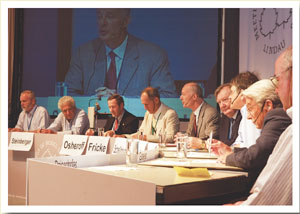
The opportunity for young scientists to meet with Nobel laureates makes the Lindau meeting a very special occasion. This year it was even more special for CERN, with four young participants from the laboratory and a press event where several of the laureates spoke of their expectations for the LHC. The following extracts give some flavour of their opinions.

David Gross: “a super world”

CClin1_09_08

Gross shared the 2004 Nobel Prize in Physics with David Politzer and Franck Wilczek “for the discovery of asymptotic freedom in the theory of the strong interaction”. He is currently director of the Kavli Institute of Theoretical Physics at the University of California, Santa Barbara.

I expect new discoveries that will give us clues about the unification of the forces, and maybe solve some of the many mysteries that the Standard Model (SM) leaves open. I personally expect supersymmetry to be discovered at the LHC; and that enormous discovery, if it happens, will open up a new world – a super world. It will give the LHC enough to do for 20 years and will help us to understand some of the deepest problems in the structure of matter and elementary particles physics and beyond. Supersymmetry is not just a beautiful speculative idea, it has three incredibly strong vantage points in the LHC energy range: the unification of forces, the mass hierarchy and the existence of dark matter, where its abundance is observed. These three indirect hints from experimental observations all point to a TeV regime that can be naturally accommodated in extentions of the SM that were invented long before these indications appeared.

Gerardus ’t Hooft: “a Higgs, or more”

CClin2_09_08

’t Hooft shared the 1999 Nobel Prize in Physics with Martinus Veltman “for elucidating the quantum structure of electroweak interactions in physics”. He is currently professor of theoretical physics at the Spinoza Institute of Utrecht University.

The first thing we expect – we hope to see – is the Higgs. I am practically certain that the Higgs exists. My friends here say it is almost certain that if it exists, the LHC will find it. So we’re all prepared and we’re very curious because there’s little known about the Higgs except some interaction signs. There could be more than one Higgs, several Higgs, and there could be a composite Higgs, but most of us think it should be an elementary particle… My real dream is that the Higgs comes up with a set of particles that nobody has yet predicted and doesn’t look in any way like the particles that all of us expect today. That would be the nicest of all possibilities. We would then really have work to do to figure out how to interpret those results.

Douglas Osheroff: “lots of new particles”

CClin3_09_08

Osheroff shared the 1996 Nobel Prize in Physics with David Lee and Robert Richardson for “their discovery of superfluidity in helium-3”. He is currently professor of physics and applied physics at Stanford University.

The LHC is an incredible piece of engineering, there is no doubt about that; 27 kilometres of superfluid helium is a mind-boggling thing. However, if you look at any little piece of that, it is a simple technology, carried to the absolute limit of what we could imagine that man would ever do. But of course the most fascinating part of CERN isn’t the cryogenics, it’s the particles that we hope the LHC will produce… If we don’t get the Higgs, that would in fact be a bit more interesting, but I am hoping that there will be lots of new particles and resonances that no one ever expected. That will be really exciting.

Carlo Rubbia: “Nature will tell”

CClin4_09_08

Rubbia shared the 1984 Nobel Prize in Physics with Simon van der Meer for their work that led to the discovery of the W and Z bosons at CERN. Rubbia was director-general of CERN from 1989 to 1993 and is still based mainly at CERN, pursuing a variety of research projects in the fields of neutrino physics, dark matter and new forms of renewable energy.

I think Nature is smarter than physicists. We should have the courage to say: “Let Nature tell us what is going on.” Our experience of the past has demonstrated that in the world of the infinitely small, it is extremely silly to make predictions as to where the next physics discovery will come from and what it will be. In a variety of ways, this world will always surprise us all. The next breakthrough might come from beta decay, or from underground experiments, or from accelerators. We have to leave all this spectrum of possibilities open and just enjoy this extremely fascinating science.

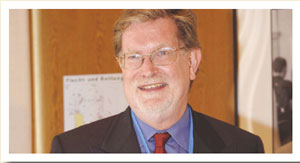
George Smoot: “the nature of dark matter”

CClin5_09_08

Smoot shared the 2006 Nobel Prize in Physics with John Mather “for their discovery of the blackbody form and anisotropy of the cosmic microwave background radiation”. He currently works in the field of cosmology at the Lawrence Berkeley National Laboratory and is a collaborator on the Planck project.

For a cosmologist, one of the great things is that cosmology and high-energy physics are merging – they begin to overlap and are necessary for each other. For the LHC, I am very excited because it turns out that one of the missions I am doing, the Planck mission, has had the same schedule as the LHC for 14 years. We’ll probably launch a little later… I am looking forward to hearing about the Higgs, because I’d like to see the Standard Model completed and understood. I’m also hoping that the LHC will begin to unveil extra dimensions, and that will have huge applications across the board. But what I am really looking forward to is supersymmetry or something that shows what dark matter is made of, so I have really high hopes, perhaps too high hopes.

Martinus Veltman: “the unexpected”

CClin6_09_08

Veltman shared the 1999 Nobel Prize in Physics with his student Gerardus ’t Hooft “for elucidating the quantum structure of electroweak interactions in physics”. He is professor emeritus at the University of Michigan, Ann Arbor.

What I expect from the LHC? That’s a big problem. What I would like to see is the unexpected. If it gives me what the Standard Model predicted flat out – the Higgs with a low mass – that would be dull. I would like something more exciting than that. I sincerely hope that we do not find something strictly according to the Standard Model because that will make it a closed thing of which we see no door out, though it is still full of questions. Anything except the two-photon decay of the Higgs… But there is also the possibility that other products might come up because the machine, after all, enters a new domain of energy and will perhaps show us things we didn’t know existed. It’s a very exciting thing for me and my guts can’t wait…

The first presence at Lindau

CClin7_09_08

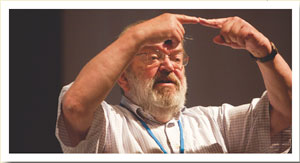
CERN was first officially present at Lindau in 1971, when I was sent there to talk to Werner Heisenberg about the latter’s future attitude towards CERN. My boss Edwin Shaw, head of the Public Information Office, picked me because I spoke German. This was no easy mission. I was very fearful of speaking to Heisenberg because, in 1969, the Nobel laureate had advised the German government not to finance “Supercern” – a more powerful accelerator at a new site in Europe. For Heisenberg, the era of ever-larger machines continuing to yield important discoveries was ending. A universal formula would answer all outstanding questions in particle physics. His peers strongly disagreed with him and he was persuaded to back the lower-cost 300 GeV project at the existing CERN site.

Simon Newman, CERN (1968–1985).

First impressions

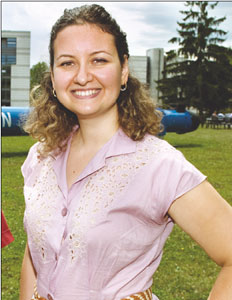
For a second year, CERN was offered the opportunity to send young scientists to Lindau. The four selected candidates represented the diverse range of the laboratory’s research. Here are some of their impressions of the event:

CClin8_09_08

“It’s just my second day here in Lindau… We already heard four Nobel lectures and all of them were different and extremely interesting. Some of them were more quiet, some more ready to give advice and even joked during their talks. But even meeting so many students from so many countries is incredibly interesting, to exchange ideas and experiences. I am sure that I am going to learn a lot and remember Lindau for a long time.”

– Magda Kowalska, ISOLDE.


CClin9_09_08

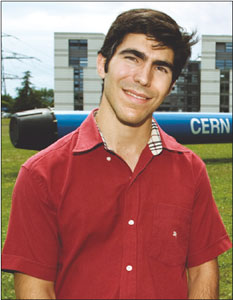
“Lindau is a very nice experience. There are many students from all over the world and many Nobel Laureates from different fields in physics. It is a unique opportunity to meet them and talk in an informal way about many subjects. It is very encouraging for us students to have such role models for our future.”


– Rafael Ballabriga, Medipix/PH Department.


CClin10_09_08

“I’ve had very little time so far to talk to the Nobel laureates, but it’s been really great to talk to other students and learn about what they’re doing and how they work on their research. Generally, when I go to conferences in particle physics, I only talk with particle physicists. Here I get exposed to a lot of other different fields like superconductors and plasma physics. I just had a discussion at lunch about it and that was really fun.”


– Bilge Demirkoz, ATLAS.


CClin11_09_08

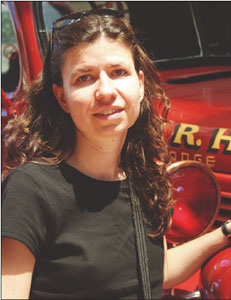
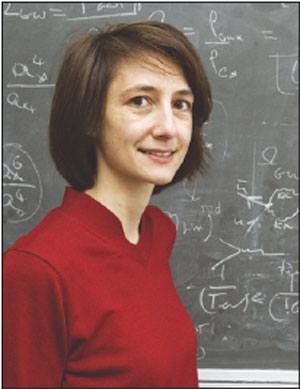
“In Lindau, what I find interesting is to learn physics that is actually outside my field of research and to be aware of what other fields of research do in other areas. Yesterday, for instance, we learnt about quantum optics and today, biophysics. It is very interesting to be exposed to all these new ideas – in case we don’t find anything at the LHC and I’ll have to change field!”


– Geraldine Servant, Theory Unit.

Nobel dreams at Lindau

Every summer since 1951 a large number of Nobel laureates gather in Lindau, Germany, at Lake Constance (the Bodensee) and meet with talented young scientists from around the world. These annual meetings, today a permanent institution supported by a foundation, were initiated by the late Count Lennart Bernadotte, a member of the Swedish royal family who had settled on the nearby Island of Mainau in Lake Constance. Count Bernadotte, an outstanding personality with philanthropic, ecological, cultural and scientific interests, established these meetings of Nobel laureates with young scientists with the intention of fostering scientific excellence as well as international cooperation in the spirit of pacifism. Today the foundation is headed by Countess Sonja Bernadotte, assisted by Wolfgang Schürer, visiting professor for public affairs at St Gallen University.

Initially only young scientists from Germany were invited, but over the years the meetings were expanded to participants from Europe and then the world. Some 550 students, postgraduates and fellows currently take part each year, selected by the scientific board of the Foundation Lindau Nobel Prizewinners Meetings. The delegates come from more than 60 countries, of which about 40% are from outside Europe. The proportion of young female scientists has been constantly increasing, reaching 50% last year.

The Lindau meetings usually focus on one of the Nobel prize fields in the natural sciences – physics, chemistry, and physiology or medicine – and rotates between them; a separate meeting on economic sciences with winners of the Bank of Sweden Prize in Economic Sciences in Memory of Alfred Nobel is held every two years. The one-week programme of the meeting of Nobel laureates consists of lectures by the laureates, scientific discussions between them and the young scientists, a round table and social events. The informal contacts are of course a crucial element.

CCnob1_09_08

This year the Meeting of Nobel Laureates – the 58th in the series – was on physics, with 24 participating laureates, including several particle physicists with close links to CERN, namely David Gross, Gerardus ’t Hooft, Carlo Rubbia, Jack Steinberger, and Martinus Veltman. The lectures included talks by Veltman on “The development of particle physics”, Gross on “The Large Hadron Collider and the Super World”, Steinberger on “What future for energy and climate?” and ’t Hooft on “Humanity in the cosmos”. Also from the field of particle physics, Donald Glaser, who received the Nobel prize for the invention of the bubble chamber, talked about the role of cortical noise in vision, and cosmologist George Smoot described the beginning and development of the universe. The round table centred on energy and climate, following on from talks by three chemistry laureates, and featured contributions from both Rubbia and Steinberger.

Beyond these eminent names, CERN participated this year with a highly visible press event in which Jos Engelen and Lyn Evans talked about the LHC start up and where several laureates discussed questions on the expected results of the LHC. During the event a video link was established to the CERN control centre so that the audience could observe the ramp up of sector 7/8 of the LHC to 8500 A (5 TeV) as it happened.

CERN was also represented among the young scientists attending the meeting. In 2007, I had established contacts with the Lindau Foundation, and as a result, CERN was invited to nominate a candidate with a link to medicine, the field of last year’s meeting. Benjamin Frisch, a student on the Austrian doctoral student programme, working at CERN on the medical applications of microelectronics, was selected. This year CERN was again invited to nominate young scientists. The four candidates selected were a good representation of the range of science and technology at CERN, as well as the laboratory’s international nature.

The annual Nobel meeting in Lindau was once again an outstanding event, full of enthusiasm and brilliant ideas. For the young scientists it was a unique opportunity to exchange ideas and network beyond and outside their scientific subject, making it a veritable feast of science. The international context and the commitment to scientific excellence are basic elements that are common to both the Nobel foundation and to CERN – a good reason to maintain and intensify the links between both organizations.

Neutrino physicists get together down under

In recent years neutrinos have moved onto centre stage in both astrophysics and particle physics, and the latest developments were on show at the XXIII International Conference on Neutrino Physics and Astrophysics on 26–31 May. Supported by the International Union of Pure and Applied Physics, Neutrino 2008 took place in Christchurch, New Zealand, where it was organized by the University of Canterbury and the IceCube collaboration, which uses Christ church as its staging area and gateway to Antarctica. Conference-goers celebrated the 100th anniversary of the award of the Nobel Prize to a former undergraduate of the University of Canterbury, Ernest Rutherford, whose life was the topic of the opening presentation by Cecilia Jarlskog from Lund.

CCneu1_09_08

The question “Where are we?” is beloved of neutrino physicists. Alexei Smirnov of the Abdus Salam International Centre for Theoretical Physics in Trieste noted that a quarter of the papers found on the SPIRES high-energy physics database with this title are in neutrino physics. With the discoveries of neutrino masses and lepton-flavour mixing now established, there is a standard neutrino scenario in which neutrinos have masses in the sub-electron-volt range and there are two large mixings and one small or zero mixing between the three neutrino flavours. Neutrino experiments have moved into an era of precision measurements, motivated by the belief that neutrino mass and mixing are manifestations of physics beyond the Standard Model. However, as Smirnov noted, despite many years of effort and many trials, the physics underlying neutrino mass and mixing remains unidentified.

Roadmap of theoretical possibilities

Understanding neutrinos is a two-step process. The first step is to determine the values of the three mixing angles, the masses of the three mass eigenstates, and the value of the CP-violating phase. It is also necessary to find out whether the neutrino is its own antiparticle, that is whether it is as described by the physics of Paul Dirac or of Ettore Majorana. The second step is to try to understand why the neutrino matrix elements and the neutrino masses are what they are and what they tell us about physics well beyond the Standard Model. Stephen King from Southampton presented a roadmap of theoretical possibilities, including extra dimensions and possible grand unified theories, with each theoretical path linked to future experimental results.

Two of the mixing angles are now well determined: one through the solar-neutrino experiments and the other through the atmospheric- and accelerator-neutrino studies. The third angle, θ13, is much less constrained but is no less important because it determines how close the mixing matrix is to the theoretically interesting, highly symmetric “tribimaximal” configuration. The best limits on θ13 are currently from the Double Chooz experiment. If θ13 is large enough, it may be possible to observe CP violation with neutrinos, and Yosef Nir from the Weizmann Institute explained how a large value for the CP-violating parameter, δ, could explain the observed baryon asymmetry in the universe via the process called leptogenesis.

Speakers from solar-neutrino experiments were the first to present their results, beginning with reports from the Borexino detector located at Gran Sasso National Laboratory in Italy, and from the third and final phase of the Sudbury Neutrino Observatory (SNO) in Canada. SNO’s third phase included 3He proportional counters to measure the rate of neutral-current interactions in the detector’s heavy water. The Borexino experiment has results from 192 days of data taking and, as with earlier solar-neutrino measurements, these are best described by neutrino-flavour oscillation. The electron-neutrino flavour eigenstate, to a good approximation, is a linear combination of two mass eigenstates with masses m1 and m2. Neutrinos from the same energy range but at a much shorter baseline are detected by the KamLAND experiment in Japan, which observes antineutrinos from nuclear reactors. A combined analysis of the solar and KamLAND data now gives precise results for the mixing angle, Δ12, and mass difference Δm122, of the two mass eigenstates. The result of analysis with two flavours gives Δ12 = 33.8 + 1.4 –1.3 ° and Δm122 = 7.94 + 0.42 – 0.26 × 10–5 eV2.

The Super-Kamiokande experiment in Japan is now fully recovered from the accident in 2001, which destroyed around half of the original photomultiplier tubes. It has provided a high-precision measurement of neutrino oscillations by detecting atmospheric neutrinos in an energy range of hundreds of millions of electron-volts to a few tera-electron-volts. Jennifer Raaf from Boston gave the results from a combined analysis of the pre-accident and post-accident data taking. These include a mixing angle with sin223 > 0.94 at 90% confidence, which is the best constraint so far obtained for this parameter. The experiment also places limits on non-oscillation physics, such as neutrino decoherence, which is excluded at 5.0 σ, and neutrino decay, which is excluded at 4.1 σ.

Neutrino beams produced at particle accelerators offer the greatest control over the neutrino sources. They have been used to study the same neutrino oscillations that take place in atmospheric neutrino oscillation. The KEK-to-Kamioka (K2K) experiment was the first long-baseline neutrino experiment to operate, using neutrinos sent from the KEK laboratory to the Super-Kamiokande detector 250 km away. The K2K collaboration has previously reported results consistent with the Super-Kamiokande atmospheric neutrino results using data collected between 1999 and 2004. At the conference Hugh Gallagher from Tufts University presented new results from the Main Injector Neutron Oscillation Search (MINOS) experiment. This uses a muon–neutrino beam that is produced at Fermilab and observed at two sites: a near detector at Fermilab and a far detector 734 km away at the Soudan Underground Laboratory in Minnesota. MINOS now has the tightest constraint on the mass difference, finding Δm232 = 2.43 ±0.13 × 10–3 eV–2 and a result for the mixing angle that is consistent with that for Super-Kamiokande.

The conference also heard reports on future experiments that aim to measure θ13. These include the reactor-neutrino experiments Double Chooz in France, Daya Bay in China and the Reactor Experiment for Neutrino Oscillation at Yonggwang in Korea, as well as the accelerator-neutrino experiments T2K, OPERA at the Gran Sasso National Laboratory, and NOvA at Fermilab.

Many efforts are under way to determine directly the absolute neutrino mass scale in laboratory experiments through nuclear beta-decay or neutrinoless double beta-decay, which is possible if the neutrino is Majorana. Beta-decay experiments can be categorized by the detector type and there were reviews of tracking, solid-state, calorimetric and scintillator detectors, with energy resolution being the crucial common ingredient. The neutrino mass scale can also be probed through cosmology; the relic neutrino density influences the evolution of large-scale structure in the universe. Richard Easther from Yale presented the latest results obtained by combining cosmic microwave background and supernova observations. The best fit constrains the mass sum from all neutrino flavours to be less than 1 eV, with better precision obtainable if the Hubble constant is known independently.

Neutrinos also probe a range of physical processes, from the heat source of the Earth to the location of high-energy cosmic accelerators. Bill McDonough of Maryland discussed how the detection of geoneutrinos can put limits on the amount of heat generated by uranium and thorium inside the Earth. KamLAND has already placed limits on this but is restricted by the background from reactor neutrinos. The next step may be the Hawaii Anti-Neutrino Observatory, HANOHANO – a proposed 10 kilotonne liquid scintillation detector designed to be transportable and deployable in the deep ocean. Its goal is to measure the neutrino flux from the Earth’s mantle for the first time.

Cosmic neutrinos may also unveil the very high-energy, cosmic-ray accelerators. Unlike photons or charged particles, neutrinos can emerge from deep inside their sources and travel across the universe uninterrupted. Julia Becker of Gothenberg University discussed some potential sources of cosmic neutrinos, including some of the most energetic objects in the universe, such as supernova remnants, microquasars and active galactic nuclei. To date, no experiment has observed extraterrestrial high-energy neutrinos, but cubic-kilometre telescopes (e.g. KM3Net, which is planned for the Mediterranean, and IceCube, under construction at the South Pole) are expected to be large enough to observe these cosmic neutrinos. Spencer Klein from the Lawrence Berkeley National Laboratory gave an update on the IceCube neutrino observatory, which uses the ice at the South Pole as a Cherenkov medium for the detection of high-energy neutrinos. The observatory comprises an in-ice, three-dimensional array of photomultiplier tubes and a surface air shower array. In February, half of the detector had been deployed, bringing the instrumented volume to roughly 0.5 km3.

Although the field of neutrino physics has moved into a precision era, many puzzles remain and there is still much to be explained. A number of experiments are anticipating new results in the near future, so we can look forward to the next Neutrino conference, to be held in Athens in 2010.

London welcomes DIS international workshop

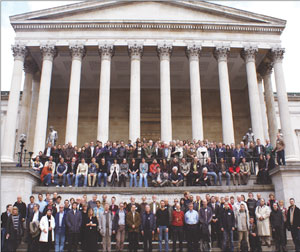
This spring the XVI International Workshop on Deep-Inelastic Scattering and Related Subjects (DIS 2008) took place at University College London (UCL), and was jointly organized by the high-energy particle physics groups of the University of Oxford and UCL. Some 300 participants attended the workshop, which was held on 7–11 April and consisted of approximately 270 talks covering a multitude of subjects.

The provost and president of UCL, Malcolm Grant, opened the first day, which consisted mainly of plenary talks, with speakers detailing recent experimental and theoretical highlights, and looking at future developments in the field of deep-inelastic scattering (DIS), QCD and collider physics. The opening plenary speakers greatly helped to set the tone of the meeting with excellent overviews and positive outlooks. In the late afternoon, the workshop split into working groups with specialized talks, with up to six groups in parallel at any one time.

CCdis1_09_08

The parallel sessions covered a range of subjects, including structure functions and low-x; diffraction and vector mesons; electroweak measurements and physics beyond the Standard Model; hadronic final states and QCD; heavy flavours; spin physics; and future facilities. There were many excellent presentations, including high-quality results from both experiment and theory, together with extensive discussions. The parallel sessions continued throughout the next two days, culminating with a packed additional session organised by Hannes Jung from DESY on “What HERA can still provide”. That so many people were prepared to forego an evening meal to participate in an extra session at the end of a busy day demonstrates the unique legacy of HERA, the world’s first and only electron–proton collider, which ceased operation at DESY in June 2007. On the afternoon and morning of the final two days, the convenors of the working groups reported on the highlights of their sessions. Finally, Brian Foster of the University of Oxford beautifully summarized the whole workshop, again highlighting the vitality of both the field and the workshop.

Work on the structure of the proton – the main subject of the DIS workshop series – has seen tremendous advances recently. The H1 and ZEUS collaborations have made the first measurements of the longitudinal structure function, FL, and have combined data on inclusive DIS cross sections from the HERA I run in a preliminary HERA fit of the parton density functions. The quantity FL is an integral part of the description of the proton’s structure and is directly sensitive to the gluon density and the QCD evolution with momentum transfer. Both collaborations have measured FL using two special low-energy proton runs taken at the end of HERA data taking. While the data are consistent with QCD predictions of the parton densities, which are based on fits to the inclusive measurements of F2, they cannot yet distinguish between different predictions, although significant improvements to the measurements are expected.

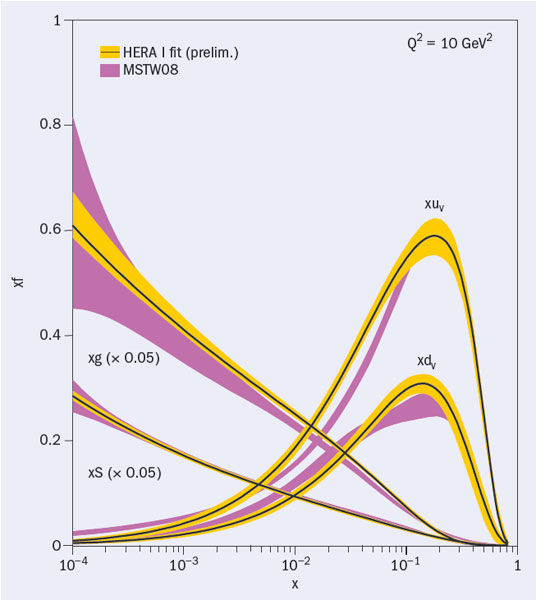
Taking advantage of the different detectors and their systematics, the combination of the F2 measurements from H1 and ZEUS has produced results that are significantly more precise than the simple effect of doubling statistics. The effective “cross calibration” has led to uncertainties of 1–2% over a wide range in Bjorken-x and in photon virtuality, Q2. The combined HERA data alone have in turn been used in a fit of the parton distributions in the proton and this leads to results that are competitive with global fits that use data from many different sources (see figure). Data from the Tevatron at Fermilab are also placing strong constraints on the structure of the proton. Results on the charge asymmetry of the W particle from the CDF experiment have a precision that is significantly better than the uncertainties on the parton distribution functions. Additionally, inclusive-jet cross sections from the D0 experiment yield constraints at the highest scales, up to 600 GeV. They also provide a wonderful verification of QCD predictions across 10 orders of magnitude in the cross section, differential in jet pT and rapidity.

All of the above results are crucial inputs to our understanding of QCD, and in particular the structure of the proton, which is needed as the starting point for most of the physics at CERN’s LHC. Along with the new measurements, theory is keeping pace with a number of advances that are either already made or planned. With the recent development of next-to-next-to-leading order QCD corrections (NNLO) for F2, groups are working on the implementation of NNLO for general 2 &raar; 2 parton scattering and the extension to the next order for F2. Of course with every order in the perturbation expansion, the number of diagrams increases exponentially, but new approaches using formal mathematics developed for other applications, such as twistors, are helping to reduce the number of diagrams by over an order of magnitude.

CCdis2_09_08

Spin physics – fully polarized DIS – attracted many talks. The exquisite experiments of HERMES at HERA, COMPASS at CERN and those at RHIC and Jefferson Lab are matched by exotic new varieties of observables and dreams of reconstructing the proton structure in 3D. Despite all this activity, however, the “spin crisis” remains. The quarks do not carry much of the proton’s spin, and new results show that neither do the gluons. That leaves angular momentum – dubbed “dark angular momentum” by Xiangdong Ji of Maryland during his introductory talk on spin, because it will be so difficult to measure. Much remains to be done to clarify this area at the upgraded Jefferson Lab and/or RHIC.

The workshop programme made room for several social events including a welcome reception, held in the North Cloisters at UCL, and a brilliant concert at the Queen Elizabeth Hall by violinist Jack Liebeck and pianist Katya Apekisheva. The social highlight was the dinner held at Lord’s Cricket Ground – “the home of cricket”. After an excellent dinner, Norman McCubbin from the Science and Technology Facilities Council/Rutherford Appleton Laboratory gave a speech entitled “The scattering of balls: an English obsession”. He explained the delights of this English game, such as its length, the many and complicated options for when tea can be taken and the history of Lord’s. This was all supported by props showing how the game relates to physics and specifically deep-inelastic scattering.

DIS 2008 demonstrated how “DIS and Related Subjects” permeates almost all areas of high-energy physics, from hadron colliders to spin physics, neutrino physics and more. There is still much to be done and learnt in the field. Apart from the immediate excitement of the LHC start-up, another promising development for the future is the LHeC project, discussed on the last day, which would see the introduction of an electron ring in the LHC tunnel, allowing electron–proton collisions.

The European Committee for Future Accelerators has recently approved a conceptual design study and work is rapidly increasing on this project to assess its physics potential and technical realization, with a series of dedicated workshops starting this year. We are now all looking forward to seeing how this flourishing subject will be continued in Madrid at DIS 2009.

• The workshop was generously supported by CERN, DESY, FNAL, Jefferson Lab, STFC, IPPP Durham, UCL Maths and Physical Sciences Faculty, John Adams Institute, Cockcroft Institute, Cambridge University Press and Oxford University Press. As co-chairs we would like to thank all members of the Local Organizing Committee, in particular Christine Johnston, who quietly and efficiently carried most of the administrative burden, and the student helpers who made the conference such a great success.

The rise of the FFAG

The concept of fixed-field alternating-gradient (FFAG) accelerators was put forward in the early 1950s, as a possible way of applying the methods of strong focusing and phase stability to particle acceleration. An FFAG ring is a circular assembly of fixed-field magnets that strongly focus the accelerated beam, similar to that in an alternating-gradient synchrotron. However, as the magnetic field remains constant by definition, the beam spirals radially during the acceleration process, as in a cyclotron. Consequently, FFAGs feature magnets with a large transverse aperture and therefore high-beam acceptances in both momentum and space. Fast acceleration, high repetition rate and a large 6-D acceptance are the potential benefits of FFAGs that triggered their rebirth at the end of the 1990s, mainly in Japan. Since then the concept has been revisited in depth and this has led to a dual machine classification: scaling (invariant-focusing) FFAGs and non-scaling FFAGs.

In scaling FFAGs, the orbit shape and the optics of the beam are kept unchanged during the acceleration by applying a non-linear magnetic field of the form B = B0 (r/r0)k, where k is the field index. Scaling FFAGs may be seen as an evolution of the synchrocyclotron concept, but offering more flexibility and potentially better performance in various application domains. The Japanese have recently constructed prototypes of radial-sector proton rings following this concept. They showed that modern 3D computer-aided methods allow accurate and reliable design of the sophisticated non-linear FFAG magnets. They also led to the development of a broadband and high-gradient RF cavity technology that makes fast acceleration and high repetition rates possible.

CCffa1_09_08

In non-scaling FFAGs, on the other hand, the betatron tunes are allowed to vary during the acceleration process. This freedom opens up new concepts that have been investigated with the help of modern particle-tracking computing techniques. Under the hypothesis that the total acceleration time is kept sufficiently short, the fast crossing of betatron resonances should have little effect on the beam stability. This new regime is sometimes referred to as “curved linear acceleration”, meaning that there is no cyclic component in the beam motion equations. Non-scaling FFAGs tend to have much smaller transverse apertures than scaling machines.

FFAGs in Japan

The world’s first proton FFAG accelerator, the Proof-of-Principle FFAG (POP-FFAG) was built at KEK in Japan in 2000. At approximately the same time, researchers recognized that FFAG accelerators can feature rapid acceleration with large momentum acceptance. These are exactly the properties required for muon acceleration, for the production of medical proton beams and for accelerator-driven systems (ADS) for nuclear energy. To investigate this potential, a team at KEK developed the first prototype of a large-scale proton FFAG accelerator. In 2004, it successfully accelerated a proton beam up to 150 MeV with a repetition rate of 100 Hz. Since then, intensive studies and discussions have taken place and various novel ideas have emerged that have led ultimately to new application projects for FFAG accelerators at several institutes in Japan.

A team at the University of Kyoto has developed a proton FFAG accelerator for basic research on ADS experiments. Here, the beam is delivered to the existing critical assembly of the Kyoto University Research Reactor Institute (KURRI). The whole machine is a cascade of three FFAG rings (figure 1). The beam was recently successfully accelerated up to 100 MeV and the first ADS experiment is due to start this summer.

CCffa2_09_08

Medical applications of FFAG accelerators have also been proposed in two different fields: hadron therapy and boron neutron-capture therapy (BNCT). For BNCT, an accelerator-based intense thermal or epithermal neutron source has been developed at KURRI, using an FFAG storage ring with a thin internal beryllium target (figure 2). The growth of the beam emittance and the energy distortion caused by scattering in the target can be controlled using ionization cooling, a functionality that could not be used in a cyclotron owing to the lack of space. After completion of the whole system, recently the beam was successfully accumulated in the ring and neutron production has already been observed. This constitutes the first experimental demonstration of the efficiency of ionization cooling.

At the University of Osaka there is a proposal to build a highly intense muon source using the 50 GeV proton beam of the synchrotron at the Japan Proton Accelerator Research Complex. In the project, called PRISM, longitudinal phase-space rotation to narrow the initial energy spread of a muon beam by a scaling FFAG ring – featuring a large energy acceptance – has been developed to search for lepton-flavour violation in muon interactions. The ring consists of 10 magnets and 5 magnetic alloy RF cavities with a frequency and a gradient of 5 MHz and 200 kV/m, respectively.

The University of Kyusyu also has a new accelerator facility under construction. The main machine will be a 150 MeV proton FFAG accelerator whose design closely follows the one at KEK described above. This will be available for various applications, such as nuclear physics and material science.

EMMA in the UK

In the UK, non-scaling FFAGs are currently being studied for a variety of applications, including hadron therapy, ADS and the rapid acceleration of muons for a neutrino factory and a muon collider. The unique features of such machines mean that detailed development for these applications requires the construction of a proof-of-principle accelerator to explore in detail the beam dynamics to gain experience in the design and construction of non-scaling FFAGs, and to benchmark the computer codes employed in the studies.

This new machine, the Electron Model for Many Applications (EMMA) will be built at the Daresbury Laboratory of the Science and Technology Facilities Council (STFC). EMMA has been funded as part of the British Accelerator Science and Radiation Oncology Consortium (BASROC), which has also funded the design of a non-scaling FFAG, PAMELA, for the acceleration of carbon ions and protons for hadron therapy, and for studies of other potential applications of this technology.

EMMA will be a 10–20 MeV electron linear, non-scaling FFAG, designed with the necessary flexibility to allow the detailed studies required. In addition, it will use the linac for the Accelerators and Lasers In Combined Experiments (ALICE) project as an injector (figure 3). ALICE can deliver beams at any energy between 10 and 20 MeV, an important requirement for a complete study of resonance crossings in EMMA.

CCffa3_09_08

EMMA will use a doublet lattice and the ring will consist of 42 cells, each about 40 cm long. There will be 1.3 GHz RF cavities in every other cell, except around the injection and extraction regions. The intermediate cells will be used for diagnostics and pumps. The experimental nature of the accelerator means that it is important to have sufficient diagnostic devices. Within the EMMA ring, there will be two beam-position monitors in each cell, two wire scanners, two motorized screens and a wall current monitor. A beam-loss monitor, segmented into four sections, will surround the ring. A number of measurements can be made only outside the ring and hence an extraction line has been designed to include emittance, longitudinal beam profile and momentum measurements. There will also be instruments in the injection line to measure the beam properties on entrance to EMMA.

The designs of the ring and the injection and extraction lines are now complete, and detailed engineering studies are far advanced. Prototypes for some major systems have already been built and tested, and construction of the others will take place this year. Construction of the machine itself should be finished towards the end of 2009.

RACCAM in France

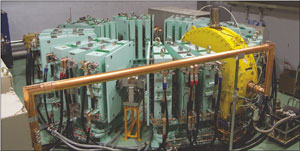
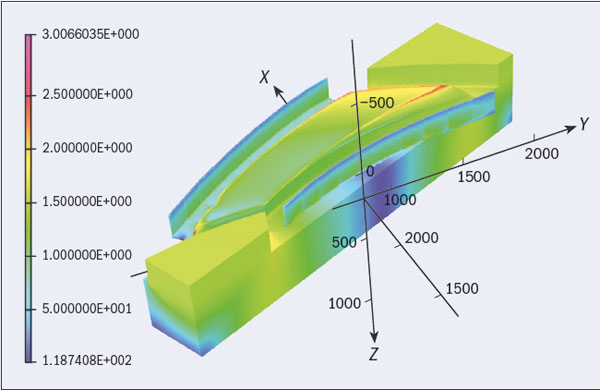
Scaling spiral-sector FFAGs are now seen as good candidates for hadron therapy applications, with various potential advantages, such as variable extracted energy and high repetition rates compared with cyclotrons, and simplicity of operation when compared with synchrotrons. These considerations have motivated the R&D project Recherche en Accélérateurs et Applications Médicales (RACCAM), which is based at the Laboratoire de Physique Subatomique et de Cosmologie (LPSC) in Grenoble and has received a grant for 2006–2008 from the French National Research Agency. The RACCAM project aims to produce a preliminary design study of a variable-energy proton installation, based on a 5–15 MeV H injector cyclotron followed by a spiral-lattice FFAG ring with an extraction energy of 70–180 MeV. This study is now close to completion. The project also includes the prototyping of a spiral magnet capable of delivering the required rk. field. A magnet of this type is now under construction at SIGMAPHI in France (figure 4).

CCffa4_09_08

RACCAM began in 2005 as a collaboration between LPSC, the radiotherapy department at the Grenoble University Hospital, and the magnet constructor SIGMAPHI. The collaboration has since rapidly expanded to include two more companies, IBA and AIMA, and the Antoine Lacassagne proton therapy clinic in Nice. Preliminary studies have led to a prototype proton therapy accelerator project, which could be hosted by the Antoine Lacassagne proton-therapy clinic (see cover). RACCAM has organized several international-scale meetings, including the FFAG 2007 workshop in Grenoble, and the Fixed-Field Synchrotrons and Hadrontherapy workshop, the first of the kind, in Nice in November 2007.

The international accelerator community is rapidly gaining knowledge of FFAGs and of their rich potential in several key applications. More than four large-scale prototypes are presently either under construction or commissioning in JAPAN and in the UK. There is no doubt that we are now getting close to the first real use of FFAGs for physics research or medicine.

bright-rec iop pub iop-science physcis connect