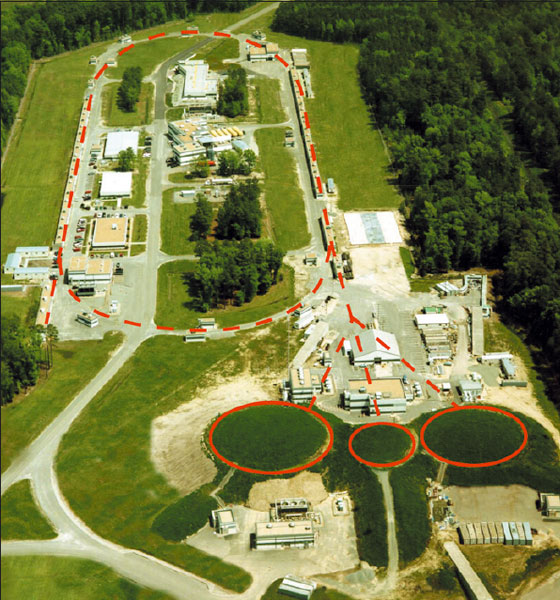
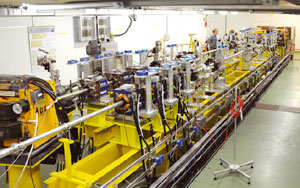
On 15 September, the Thomas Jefferson National Accelerator Facility (Jefferson Lab) received approval from the US Department of Energy (DOE) to begin construction of a $310 million upgrade to the 12 GeV Continuous Electron Beam Accelerator Facility (CEBAF). The upgrade project has been a high priority for the DOE’s Office of Science since it published its landmark report, Facilities for the Future of Science: A Twenty Year Outlook, in 2003.
The construction approval, known as Critical Decision 3, concludes an exhaustive, multi-year review process that clearly established the scientific need, merit and quality of the 12 GeV CEBAF upgrade project that will see DOE’s Jefferson Lab double the energy of its accelerated electron beam from 6 GeV to 12 GeV.
It will also construct a new experimental hall and upgrade the equipment in its three existing experimental halls. Construction funds are requested in the US president’s fiscal year 2009 budget request and project completion is planned for 2015.
With the upgrade, researchers at Jefferson Lab plan to investigate quark confinement further and to map in detail the distributions of quarks in space and momentum, culminating in measurements that will provide a 3D picture of the internal structures of protons and neutrons. They also plan to study the role of quarks in the structure and properties of atomic nuclei, as well as how these quarks interact with a dense nuclear medium. Once completed, the upgraded facility will allow studies of the limits of the Standard Model.
Seven major articles on the LHC and its detectors have been published electronically in a special issue of the Journal of Instrumentation (JINST). Together they form the complete scientific documentation on the design and construction of the LHC machine and the six detectors (ALICE, ATLAS, CMS, LHCb, LHCf and TOTEM), and thus on the entire LHC project.
This landmark publication is probably the first time for a major new accelerator project to be documented in such a comprehensive, coherent, and up-to-date manner prior to going into operation. The papers should for many years to come serve as key references for the stream of scientific results that will begin to emerge from the LHC after the first collisions next year. They provide a much-needed update of the Technical Design Reports, some of which are now 10 years old.
Although published in a refereed scientific journal, the articles are completely free to download and read online under an Open Access scheme, without requiring a journal subscription. JINST is an online-only journal published jointly by the International School for Advanced Studies in Trieste, Italy, and the IOP Publishing in Bristol, under the scientific direction of Amos Breskin from the Weizmann Institute of Science in Rehovot. Since commencing in 2006, it has quickly become popular in the LHC community as a platform for publishing techincal papers.
With 1600 pages authored by 8000 scientists and engineers the special issue is the most significant manifestation of CERN’s Open Access policy thus far. It is an important milestone on the road to converting all particle-physics literature to Open Access under the initiative of the Sponsoring Consortium for Open Access Publishing in Particle Physics (SCOAP3).
In the same room that hosted the first Solvay conference in 1911 at the Hotel Metropôle in Brussels, on 29–30 September the AStro Particle ERAnet (ASPERA) network presented the European strategy for astroparticle physics. As a result of two years of intensive coordination and brainstorming work, the document highlights seven large-scale projects that should shed light on some of the most exciting questions about the universe.
Questions surrounding dark matter, the origin of cosmic rays, violent cosmic processes and the detection of gravitational waves are among those that the “magnificent seven” of ASPERA’s roadmap will address. Specifically, the projects are: CTA, a large array of Cherenkov Telescopes for detection of cosmic high-energy gamma rays; KM3NeT, a cubic-kilometre-scale neutrino telescope in the Mediterranean sea; tonne-scale detectors for dark matter searches; a tonne-scale detector for the determination of the fundamental nature and mass of neutrinos; a megatonne-scale detector for the search for proton decay, neutrino astrophysics and the investigation of neutrino properties; a large array for the detection of charged cosmic rays; and a third-generation underground gravitational antenna.
Each of these large-scale projects may cost several hundred-million euros, and therefore needs to gather funds through large international collaborations that extend beyond Europe. The ASPERA conference gathered about 200 scientists and officials from funding agencies around the world. Representatives from Canada, China, the EU, India, Japan, Russia and the US agreed on the importance of defining a global strategy and coordinating efforts worldwide. In line with this approach, the Astroparticle Physics European Coordination (the initiator of the ASPERA network) is starting negotiation with the OECD Science Global Forum.
The EU will nevertheless remain a major actor, having funded ASPERA and will fund the follow-up, ASPERA2. It also supports the European Strategy Forum on Research Infrastructures (ESFRI). The ESFRI committee released a first road map in 2006 and is expected to release an updated road map at the end of 2008, including some of the projects selected by ASPERA.
The Belle collaboration has announced the discovery at the Japanese B-factory, KEKB, of three new exotic sub-atomic particles, which they have labelled the Z1, Z2 and Yb. The Z1 and Z2 states appear to be particles consisting of four quarks, while the Yb may be the first clear example of an exotic hybrid particle, containing an excited gluon in addition to a quark–antiquark pair.
In the past few years, a number of peculiar new particles, including the X(3872), Y(4260), X(3940) and Y(3940), have been found both at Belle and at the BaBar experiment at SLAC. Last year, the Belle team reported the first exotic particle containing a c and c quark with non-zero electric charge, the Z(4430) (CERN Courier May 2005 p7 and CERN Courier January/February 2008 p7).
The Belle collaboration has now found further new particle states in the decay products of B mesons produced at KEKB. The team searched for states decaying into a π and χc1, a well known charmonium meson, and found mass peaks at 4051 MeV and 4248 MeV (figure 1), which they have named the Z1 and Z2 respectively (Mizuk et al. 2008). Like the Z(4430), the states have non-zero electric charge and could be further examples of particles consisting of four quarks – a c and c bound together with a quark and different antiquark, as in cucd, for example.
The Yb state was found in a different way: in an energy scan of the KEKB accelerator where the Belle team observed a dramatic increase in the production rate of the upsilon together with two pions at an energy of 10,890 MeV (figure 2). This indicates the production of a new particle decaying into an upsilon and two pions. This could be the first example of an exotic bottomonium particle, consisting of a bound state of a b and b together with an excited gluon, although there are other possible interpretations.
The D0 collaboration at Fermilab’s Tevatron has made the first observation of the Ωb, consisting of two s quarks and a b quark. This follows the discovery at Fermilab of the strange b baryon, Ξb, in 2007, and echoes that of the original Ω– particle.
The prediction of the original Ω– dates back to the early 1960s, when assigning the known baryons to symmetry groups according to properties including spin, isospin and strangeness hinted at the existence of a new, triply strange spin–3/2 baryon with a charge of –1. In a triumphant interplay between experiment and theory, the particle was discovered in 1964 in a photograph made at the 80 inch bubble chamber at Brookhaven National Laboratory. Subsequent events turned up soon after at CERN. The success of the symmetry group structure led to the quark model, with three initial types or “flavours” of quark, u, d, and s, where the s quark endows the property of strangeness. The Ω– is a baryon, consisting of three quarks, sss.
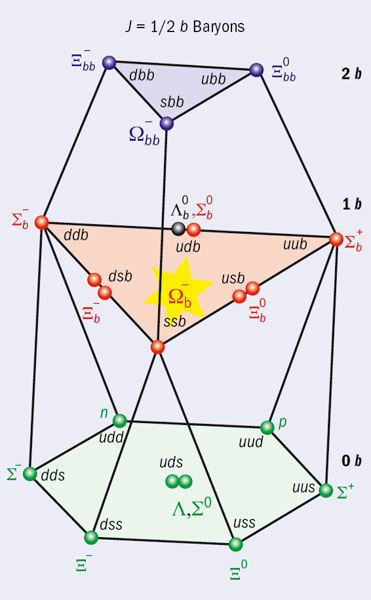
The subsequent decades revealed three additional flavours of quark, c, b and t, and the quark model now predicts the existence of baryons made of quarks of all flavours but t. (The heavy top quark, t, decays too quickly to form bound states.) This leads to new multiplets of spin–1/2 and spin–3/2 baryons of u, d, s and b quarks. The newly discovered Ωb baryon is a heavy cousin of the Ω–, with a b quark replacing one of the s quarks occupying the position indicated in figure 1 for the spin–1/2 baryons.
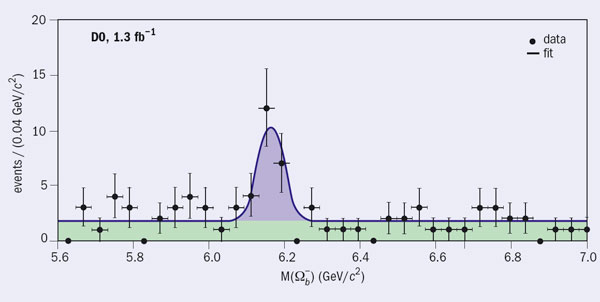
Sifting through the data collected at the proton–antiproton collisions at the Tevatron during 2002–2006, the D0 collaboration identified 18 Ωb candidate events at a mass of 6.165 ± 0.017 GeV/c2, approximately six times as great as the proton mass (Abazov et al. 2008). This makes it the heaviest baryon observed so far. The Ωb candidates were reconstructed from decay daughter particles: Ωb → J/ψΩ–, J/ψ → μ+μ–, Ω– → ΛK– and Λ → pπ–. While the Ω– and Λ have decay lengths of a few centimetres, the Ωb travels only a millimetre or so before decaying. The analysis uses a sample of events with muon pairs from J/ψ decays, followed by successive reconstructions of Λ and Ω– particles from charged tracks before a final combination of J/ψ and Ω– candidates. Figure 2 shows the effective mass spectrum of the J/ψ and Ω– combinations, with a peak of more than 5 σ significance and the observation of the Ωb–.
The Ωb now joins the σb± and Ξb baryons recently observed at the Tevatron. These new states allow detailed study of the strong force, which holds quarks together to form all baryons, and the weak force, which is responsible for their decays.
Broken symmetry in particle physics is the underlying theme for the 2008 Nobel Prize in Physics. Yoichiro Nambu, emeritus professor at the University of Chicago, has received a half share of the prize “for the discovery of the mechanism of spontaneous broken symmetry in subatomic physics”; Makoto Kobayashi, emeritus professor at KEK, and Toshihide Maskawa, former director of the Yukawa Institute for Theoretical Physics at Kyoto University, share the other half “for the discovery of the origin of the broken symmetry which predicts the existence of at least three families of quarks in nature”. The work of the three theoreticians underpins significant parts of the current Standard Model of particle physics, and is also reflected in key questions that are driving current experimental research in the field.
Nambu left his native Japan for the US in 1952, and has been at the University of Chicago since 1958. He has made several important contributions to particle physics, but it was the theory of superconductivity published in 1957 by John Bardeen, Leon Cooper and Robert Shrieffer that led Nambu towards spontaneous symmetry breaking in particle physics. In 1960 he looked at how to maintain gauge invariance (the underlying symmetry of electromagnetism) in a field theory of superconductivity – a phenomenon that spontaneously breaks gauge invariance (Nambu 1960). He went on to develop these ideas in field theories for elementary particles, and to bring in the concept of spontaneously broken symmetry not just in matter but in empty space (CERN Courier January/February 2008 p17). In particular, this led to ideas about the generation of mass (Nambu and Jona-Lasinio 1961).
Three of the people who took note of these ideas were Robert Brout, François Englert and Peter Higgs, whose work is now encapsulated in the Brout–Englert–Higgs (BEH) mechanism for generating mass through spontaneous symmetry breaking in the Standard Model (CERN Courier October 2008 p83). All three acknowledge Nambu’s influence on their work in 1964. Some 40 years later, the search for the scalar boson (Higgs particle) associated with the field required by the BEH mechanism is an important element in the physics to be studied at the LHC at CERN.
In 1972 two Japanese theorists at the University of Kyoto began to look at a different broken symmetry. Kobayashi and Maskawa decided to investigate the violation of CP symmetry in weak interactions (which had been discovered in the neutral kaon system in 1964) in the context of renormalizability. At the time only three quarks were known, but building on work on unitary symmetry in weak decays by Nicola Cabibbo and the need for four states to suppress strangeness-changing neutral currents, Kobayashi and Maskawa concluded that “no realistic models of CP violation exist in the quartet scheme without introducing any other new fields” (Kobayashi and Maskawa 1973). However, one option that they showed would work was to broaden the quartet of states to six. This led to a 3 × 3 unitary mixing matrix, which included a phase that imposed CP violation in certain transitions. The paper did not arouse much excitement at first, but within the next two years, not only was the fourth quark, c, discovered, but also a third charged lepton, τ, indicating a third generation of leptons and hence a third generation of quarks.
Since then, not only have the fifth and sixth quarks, b and t, been discovered, but CP violation has also been found in the neutral b-quark system, the B-mesons. The Cabibbo–Kobayashi–Maskawa matrix has become an intrinsic part of the Standard Model, which is being tested with high precision with neutral kaons and in particular with B-mesons at the B-factories and in future at the LHC. At the same time, CP violation in general remains a puzzle, as the effect observed in weak interactions is by no means sufficient to account for the domination of matter over antimatter in the universe.
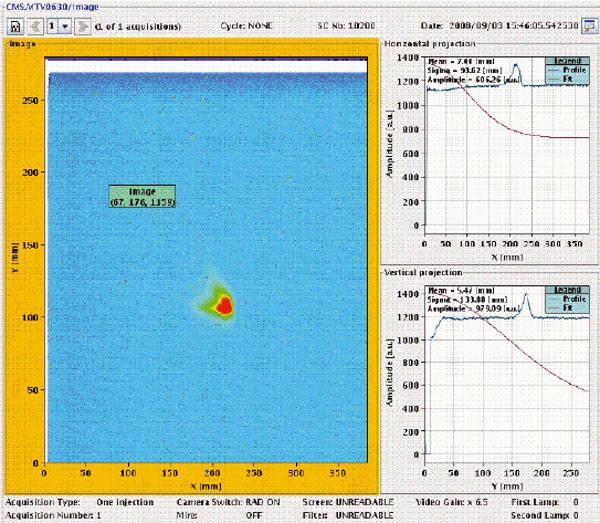
The Compact Linear Collider (CLIC) study collaboration has for the first time sent beam right to the end of the drive beamline in the CLIC Test Facility (CTF3). Early in the afternoon of 3 September, all eyes in the CTF3 control room were fixed on the camera display that showed a small beam-profile screen installed at the far end of their accelerator complex. A few minutes later the first bunch of electrons was lighting up this monitor.
Building on this success, a major effort will now go into commissioning the whole CTF3 complex to reach nominal beam parameters. CLIC’s accelerating principle is based on a two-beam scheme: a drive beam provides power for the accelerating structures, which accelerate the main beam. The programme for CTF3 foresees bringing the linac into operation for initial acceleration of the main beam, then installing and testing a first decelerating structure in the drive-beam line.
Commissioning of the LHC came to an abrupt halt at midday on 19 September, when an incident occurred in sector 3-4 that resulted in a large helium leak in the LHC tunnel. The time necessary for the investigation and repairs precludes a restart before CERN’s obligatory winter-maintenance period, pushing the date for restart of the accelerator complex to early spring 2009.
The incident occurred only nine days after the successful “first-beam” day (LHC first beam: a day to remember). During a period with no beam, owing to the replacement of a faulty transformer, the commissioning team was completing work to allow the machine to run at 5 TeV per beam, originally planned for later this year. All but one of the eight sectors had already been commissioned to 5.5 TeV before start up, and it was while bringing the magnets in sector 3-4 up to the appropriate field strengths that the incident happened. Indeed, it was the last circuit to be tested, and it had reached a current equivalent to just higher than 5 TeV.
Preliminary investigations indicate that the most likely cause of the problem was a faulty electrical connection between two magnets, which probably melted at high current, leading to a rupture of the helium vessel and the release of high-pressure gas into the cyrostat. The gas then discharged into the tunnel through the pressure-relief valves designed for this purpose. At the same time, the quench-protection circuits on some 100 magnets fired, all working perfectly to protect the magnets as foreseen. A sector consists of 154 main superconducting dipoles plus straight sections with 40 main quadrupoles and various other magnets. CERN’s strict safety regulations ensured that at no time was there any risk to people.
The LHC, like other major particle accelerators, has been built at the cutting edge of technology but with unprecedented complexity, owing to its unique two-in-one superconducting magnet system. No fewer than 123,000 interconnections were needed for the 27 km ring, including 65,000 electrical connections with superconducting cables. All the other circuits had passed their tests to 9000 A with flying colours.
A full investigation of the incident is underway, but the whole sector must be warmed up to room temperature and the magnets involved opened up for inspection before this can be completed. Only at this stage will the extent of collateral damage caused by the sudden release of helium be fully known. The warm up is expected to be completed towards the end of October.
by Miguel Alcubierre, Oxford University Press Series: International Series of Monographs on Physics, Volume 140. Hardback ISBN 9780199205677 £55 ($110).
An introduction to the modern field of 3+1 numerical relativity, this book has been written so as to be as self-contained as possible, assuming only a basic knowledge of special relativity. Starting from a brief introduction to general relativity, it discusses the different concepts and tools necessary for the fully consistent numerical simulation of relativistic astrophysical systems, with strong and dynamical gravitational fields. The topics discussed in detail include: hyperbolic reductions of the field equations, gauge conditions, the evolution of black hole space-times, relativistic hydrodynamics, gravitational wave extraction and numerical methods. There is also a final chapter with examples of some simple numerical space–times. The book is for graduates and researchers in physics and astrophysics.
by Peter Rowlands, World Scientific Series of Knots and Everything, Volume 41. Hardback ISBN 9789812709141 £48 ($88).
This book uses a methodology that is entirely new, creating the simplest and most abstract foundations for physics to date. The author proposes a fundamental description of process in a universal computational rewrite system, leading to an irreducible form of relativistic quantum mechanics from a single operator. This seems to be simpler, more fundamental, and also more powerful than any other quantum mechanics formalism available. The methodology finds immediate applications in particle physics, theoretical physics and theoretical computing. In addition, taking the rewrite structure more generally as a description of process, the book shows how it can be applied to large-scale structures beyond the realm of fundamental physics.
To provide the best experiences, we use technologies like cookies to store and/or access device information. Consenting to these technologies will allow us to process data such as browsing behavior or unique IDs on this site. Not consenting or withdrawing consent, may adversely affect certain features and functions.
Functional
Always active
The technical storage or access is strictly necessary for the legitimate purpose of enabling the use of a specific service explicitly requested by the subscriber or user, or for the sole purpose of carrying out the transmission of a communication over an electronic communications network.
Preferences
The technical storage or access is necessary for the legitimate purpose of storing preferences that are not requested by the subscriber or user.
Statistics
The technical storage or access that is used exclusively for statistical purposes.The technical storage or access that is used exclusively for anonymous statistical purposes. Without a subpoena, voluntary compliance on the part of your Internet Service Provider, or additional records from a third party, information stored or retrieved for this purpose alone cannot usually be used to identify you.
Marketing
The technical storage or access is required to create user profiles to send advertising, or to track the user on a website or across several websites for similar marketing purposes.