Comsol -leaderboard other pages

Topics

Georges Charpak: hardwired for science

Physicist Georges Charpak joined CERN 50 years ago on 1 May 1959. He retired from the organization in 1991 and now lives in Paris, where he studied and worked for the CNRS before coming to CERN. In August 2008 I visited him (with a cameraman and photographer) at his apartment in rue Pierre et Marie Curie. There is perhaps no better address for a physicist who developed detection techniques that have not only allowed a deeper study of the structure of matter but also found important applications in medicine and other fields. This work led to his Nobel Prize in 1992.

The photo session was to complete CERN’s Accelerating Nobels exhibition with photographs by Volker Steger, which was one of the features of the LHC inauguration. As we entered Charpak’s chaotic but charming office, he made jokes about his Nobel Prize: “Ca devait être une année creuse” (“It must have been a slack year”) for the Nobel Committee. Then he patiently accepted Steger’s request to make a drawing of his discovery with coloured pens on a big sheet of white paper, and finally to sit for the photo session.

CCint1_03_09

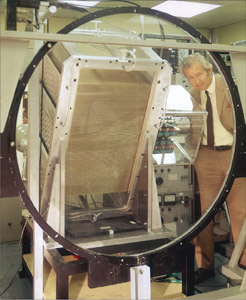
The caption that he added to his drawing of a wire chamber is a good summary of the value that his contribution made to particle physics: “D’un fil isolé à des centaines de milliers de fils independents” (“From an isolated wire to hundreds of thousands of independent wires”). As Charpak explains in his latest book (Mémoires d’un Déraciné, Physicien, Citoyen du Monde), in 1968 his first 10 × 10 cm2 proportional multiwire chamber “was perfectly capable of detecting in an independent way, and on each of the wires, separated by a millimetre, the pulses produced by the nearby passage of an ionizing particle. In this way we could fill the space with thousands or hundreds of thousands of wires to visualize the trajectory of charged particles”.

This was an experimental technique that many others had attempted but had until then produced catastrophic results, ending in the destruction of “a thousand dollars’ worth of amplifiers”. What was missing was an understanding of the formation of pulses in a proportional multiwire chamber. Charpak realized that they were produced by the movement of positive ions, which induced pulses of opposite polarity near the wires. This approach to solving experimental problems, through an in-depth study of the phenomena involved, reveals the theoretical physicist’s spirit in Charpak. His secret dream, as he confesses in his book, has always been to be a theoretician.

You had a long career in experimental physics. Which result are you most proud of?

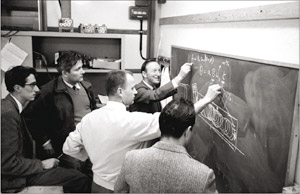
It was my first experiment, with Richard Garwin and Leon Lederman (five scientists signed the paper), and CERN’s first large experiment at the time: g-2. That was an extraordinarily elegant experiment. At last, we had contributed to measuring the magnetic moment of the muon to some 10 decimal places, and that was a real tour de force.

Then, of course, came our research on wire chambers, which were very small and became huge – with large groups making all sorts of experiments, also with cosmic rays. They were incredibly successful. The teams using wire chambers in medical applications are very small – I like teams where I can keep human contact with people and where I can minimize bureaucracy.

The wire chambers led to the Nobel Prize in Physics. What did this bring to you?

Free coffee whenever I entered a bar, a lot of visibility in the streets of Paris because of the television – people still stop me to express their admiration – a lot of travelling and even a dozen pairs of shoes that were offered by fans.

What would your advice be to a young physicist who would like to receive the Nobel prize?

If I were a young experimentalist, I would do experimental physics with cosmic rays because they enable you to reach much higher energies than at the LHC, even if you have to build a 1 × 1 km2 or 10 × 10 km2 detector, and even if there’s only one good event per year – that one event will bring something extraordinary. Then I think that sooner or later physics will need very good thinkers – theoreticians who are able to imagine new things. Theoretical physicists have an important role to play, provided that they do not become dictators. I understand the excitement that they get from the prospects in high-energy physics today. I think physics is experiencing a rejuvenation.
CCint2_03_09

After your research work at CERN, you devoted your time to the industrial applications of detectors. Tell us about that.

I do not have the gifts to be a department – or even group – leader. I’ve never been anything like that outside my own group. I’m very unorganized and I hate hierarchies. Very quickly my small detectors were used inside big detectors, but when I saw groups with more than 1000 physicists I became scared. So I decided to switch to the application of my detectors to medicine and biology. I have had some success in radiology for children – the best instrument available is still the one that I proposed.

Another question is to see whether it will sell, or flood hospitals because it is the best, but this unfortunately is a commercial question. Physicists are not necessarily businessmen. You can have as many Nobel Prizes as you want, but once you go out to industry it’s a completely different story. I go to many conferences on children’s diseases, I make presentations about the instruments I make, but the difficulty is in introducing these new instruments to hospitals. You need the approval of the US Food and Drug Administration and the agreement of insurers to reimburse, and this is not my competence. But I am not ruined yet and I’ll go on.
CCint3_03_09

What are you busy with at the moment?

I am annoyed because I lost part of my autonomy after a small accident. I survive. I continue doing some physics – that’s the easiest – and I am working on a book to teach nuclear physics to children. I took out a patent three months ago, and built a detector 50 times less expensive than a standard one. I hope to be able to offer cultivated people the possibility of buying a book for their children that is written by very good physicists (I did not do it all by myself). I have proposed building instruments that make measuring radioactivity a very trivial thing. So I am working in education.

For the last 12 years I have been involved with a huge educational project, La Main à la Pâte, which certainly is my most important contribution to society – schools in the Amazon basin practise La Main à la Pâte. This new educational method based on learning science through direct experiment is becoming more and more popular. We need a revolution in science education because we live in a world where obscurantism has too big a role, for my taste, and this is my personal fight against obscurantism in collaboration with people from around the world. I received a prize for it in Mexico together with Leon Lederman, which was a very pleasant surprise for me. It indicated that what we do in France with children has reached such a level, that even in a place as monopolized by the US as Mexico is, our work is recognized.

CERN’s immediate future lies with the LHC. What discoveries do you expect?

We expect the unknown – to see things that are not necessarily foreseen by theory. Because there are still mysteries in physics – dark matter, for example – there are answers from theoreticians and there are many questions from experimentalists like myself. If theory were completely accurate we would not need to build an accelerator.

The LHC might bring unexpected results, and the fact that we have a suspicion about the existence of a form of matter that is not the same as the one that makes up the known universe is very exciting. Personally, I find it very amusing to expect new matter. Is it true or false? If it’s false it’s a myth, and maybe some people will have to give back their Nobel medals because they will have foreseen false entities. But if it is true, it is very exciting because there are still extraordinary things to discover in the universe. Young people who enter the field now are lucky that this physics is not completed.

• For a longer video version of this interview in French, visit http://cdsweb.cern.ch/record/1138212.

CERN leads the way with novel beam extraction

In 2001 a team at CERN proposed a new scheme for ejecting beam from a circular particle accelerator over a few turns using magnets that generate nonlinear fields. The aim was to replace the so-called continuous transfer (CT) technique, which is used to transfer protons between the PS and the SPS for fixed-target physics and the CERN Neutrinos to Gran Sasso (CNGS) project.

CCbea1_03_09

CT dates from the 1970s and is based on slicing beam onto an electrostatic septum that is used to split off some of the orbiting beam. In the scheme, the horizontal tune (the number of betatron oscillations per turn, QH) is set to 6.25 so that the beam rotates by 90° in phase space every turn. A system of slow- and fast-pulsing dipoles (acting on a few milliseconds and microseconds, respectively) is used to displace the proton beam horizontally across the septum so that at each turn approximately one-fifth of the beam is sliced off by the septum blade (figure 1). This slice is then deflected by the field of the septum so that it enters into a second septum downstream – the magnetic extraction septum. The whole beam is extracted in five turns.

The choice of a five-turn extraction is dictated by the use of two PS cycles to fill the SPS ring, which has a circumference that is 11 times as large as that of the PS. By ejecting the beam over five turns at the end of two consecutive PS cycles, ten-elevenths of the SPS circumference is filled. One-eleventh of the circumference remains empty to avoid interference between the circulating beam and the transient times of the SPS injection kickers.

Making beamlets

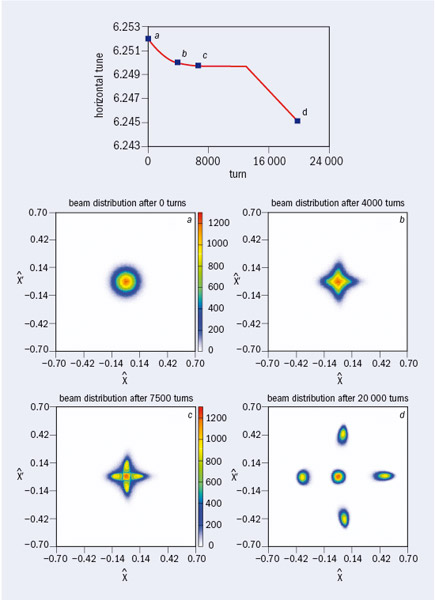
In the new scheme, which has been named multiturn extraction (MTE), the beam is split horizontally into five beamlets – one in the centre and four in stable islands of the horizontal phase space. These islands are generated by nonlinear fields of sextupole and octupole magnets and are separated by sweeping the horizontal tune through the stable one-fourth resonance, QH = 6.25 (figure 2). The beamlets circulate in the PS until they are moved, turn by turn, beyond the magnetic extraction septum by dedicated slow and fast closed bumps. The separation of the beamlets that is necessary to avoid intercepting the extraction septum is controlled by the value of the horizontal tune at the end of the resonance crossing, as well as by the strength of the nonlinear magnets. This method no longer requires the electrostatic septum.

CCbea2_03_09

This approach has several advantages compared with the original CT extraction. First, there is no interaction between the beam and the septum blade, the losses of which limit high-intensity operations. Second, the beamlets trapped in the islands can have the same intensity, emittance and optical parameters at extraction. This eases the matching with the receiving accelerator, which would not be possible with CT. Third, several parameters, such as the strengths of the nonlinear magnets, the speed at which the resonance is crossed and the final horizontal tune, are available to adjust and optimize the parameters and separation of the beamlets simultaneously. In CT, only the fast-bump amplitude can be used to equalize the intensities or emittances of the beamlets. Moreover the MTE scheme can be time reversed, which could allow a multiturn injection (MTI) based on stable islands.

MTE in practice

To complement the theoretical analysis, extensive measurement campaigns began at the PS in 2002 to assess the feasibility of loss-free beam-splitting by crossing the stable one-fourth resonance. This was essential before undertaking any hardware upgrade of the PS machine, such as new octupole magnets and fast dipoles for a dedicated orbit bump. In 2004 the tests achieved the necessary loss-free beam-splitting even with a high-intensity, single-bunch beam of about 6 × 1012 protons. The next step was to ensure that an equal intensity was shared between the four beamlets trapped in the islands and the beam core. To avoid unwanted transient effects in the SPS, the scheme has to give a maximum difference of about 5% in the relative intensities of the islands and the core. In tests, the best beam-sharing that we achieved was about 18% in each of the four islands and about 28% in the central core. This intensity ratio is slightly out of specification but should be compared with the accuracy of the determination of the beamlets’ profiles and hence their intensity, which is a few per cent.

CCbea3_03_09

The positive outcome of the experimental tests led to the approval of the PS MTE project. This should provide a considerable reduction of beam losses in the PS, which is particularly crucial for the production of high-intensity proton beams for CNGS. The project, started in 2006, should last until 2010 with the peak effort for hardware production and installation occurring during the winter shutdown of 2007/2008 and first beam commissioning by mid-2008.

Implementing MTE has involved a considerable number of hardware modifications in the PS ring. The slow bump that is used to displace the split beam towards the magnetic extraction septum is generated by six magnets, each with independent power converters. This is necessary to shape the bump to optimize the available mechanical aperture. (Originally the extraction bump was generated by only four magnets that shared a common power supply.) The fast bump that is used to move the split beam across the extraction septum is generated by three fast dipoles (kickers) with three new pulse-forming networks (PFNs). In addition, new octupole magnets have been designed and built – two straight sections have each been equipped with two sextupoles and one octupole to generate and manipulate the stable islands used for beam trapping. Globally, a review of the mechanical aperture, in the light of higher requirements imposed by the split beam, implied the need for a larger vacuum chamber in the extraction region, including the complex y-shaped chamber at the extraction point. A second phase will be implemented during the winter shutdown of 2009/2010. This will aim to improve the performance of the kickers in the ring and in the transfer line, the latter being used to correct the trajectory variations among the extracted turns.

Extraction testing

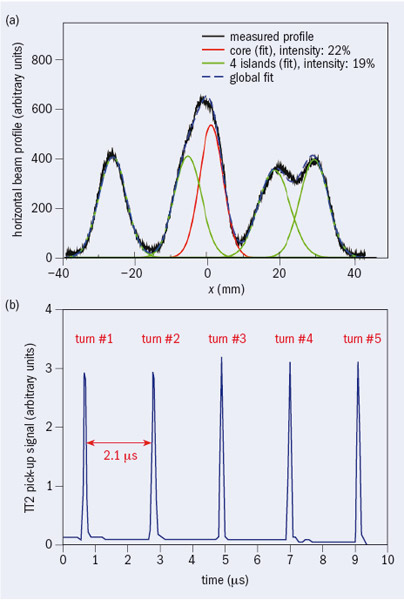
In May and June 2008 beam splitting was resumed using the newly installed sextupoles and octupoles, again achieving a loss-free process with a single bunch of about 3 × 1012 protons. At the same time the new slow bump was commissioned so that it was ready for the extraction tests in July 2008 when the PFNs, completed and hardware-commissioned, became available for the beam tests. Then, on 1 August, five beamlets with almost the same intensity were successfully created from a single bunch of 3 × 1012 protons and extracted in the first part of the transfer line, TT2, to the SPS. Figure 3a shows the measured horizontal beam profile in the PS at the end of the splitting process, with a fit of the five beamlets superimposed. Figure 3b shows the intensity signal of a pick-up in the TT2 transfer line. Each of the five peaks corresponds to a beamlet extracted over a single turn, whereas the distance between them corresponds to the PS revolution time of 2.1 μs.

CCbea4_03_09

The rest of the commissioning period until the end of the SPS-physics run on 3 November 2008 was dedicated to studying the best longitudinal structure for beam delivery and injection into the SPS, and it included a campaign of measurements of the optical parameters in the transfer line between the PS and the SPS machines. In the end it was possible to extract from the PS a beam bunched on harmonic number h = 16, corresponding to 16 × 5 beamlets, for a total intensity of about 0.7 × 1013 protons. This beam was injected into the SPS, accelerated and then extracted onto the CNGS target to produce the first neutrinos from an MTE beam.

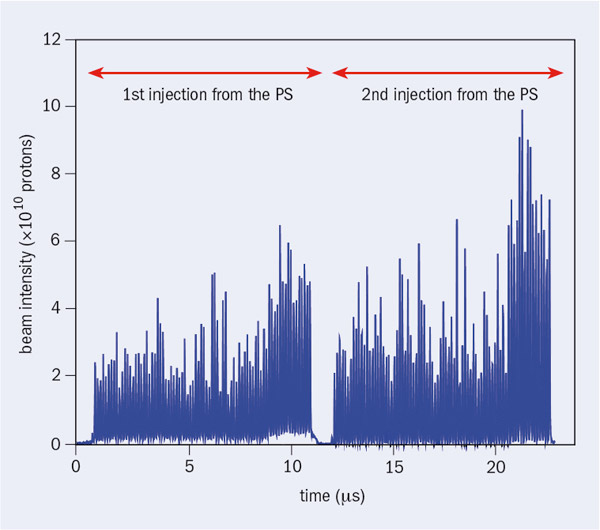
Figure 4 shows the signal from the fast beam-current transformer in the SPS after the injection of the second PS cycle. The two batches separated by the gaps required by the finite rise time of the SPS injection kickers are clearly visible, as well as the bunched structure. During the last part of the PS run, when the SPS was already shut down, it was possible to set up a new completely debunched MTE beam – that is, with the longitudinal structure that provides the best SPS performance – with a total intensity of about 1.3 × 1013 protons. This yielded typical extraction efficiencies of 97–98%, with peaks of 99%. This is the maximum theoretical efficiency, given the unavoidable losses owing to the finite rise time of the PS extraction kickers. The corresponding extraction efficiency for a CT beam with the same intensity is 95%. In addition, the losses for MTE are localized around the extraction magnetic septum, while in the case of the CT, the losses are distributed through a wider part of the machine circumference, affecting a larger number of active elements.

For the 2009 start-up the plan is to begin by delivering CT beams to the SPS, but to resume MTE operation with a view to replacing the low-intensity CT extraction for fixed-target physics by mid-2009. Soon after, the beam for CNGS will also be generated with MTE, with the intensity gradually increased towards the nominal value.

CERN Council rings in the changes

CCnew1_01_09

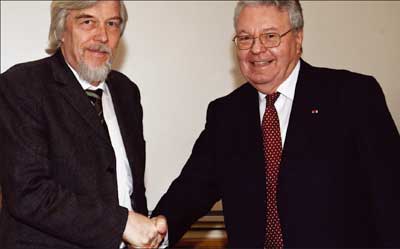
At its meeting on 12 December, CERN Council thanked the organization’s outgoing management and welcomed in the new. It was an occasion to take stock of the achievements of the past five years and to look forward to the next. Robert Aymar, the departing director-general, looked back on his five years at the helm, while his successor, Rolf Heuer, presented his vision for the future.

Aymar’s five-year mandate encompassed both CERN’s 50th anniversary and the first beams in the LHC. “It has been a privilege to lead this great organization for the last five years,” Aymar told Council. “My mandate started on a high note – the celebration of 50 years at the cutting edge of science and innovation – and it is also finishing on a positive. After a year of highs and lows, I am leaving CERN with a clear route to physics at the LHC in 2009.”

Council was also informed of the actions taken following the incident that brought LHC commissioning to a halt on 19 September (Mobilizing for the LHC). The scientific policy committee, an advisory body for Council, had an extensive session on this matter and reported its findings, endorsing the robust manner in which CERN is addressing the issue. “We have been impressed by the rapid and professional manner in which this situation has been mastered,” said Torsten Åkesson, president of Council, “and look forward to the LHC experiments collecting their first colliding-beam data in 2009.” Council’s confidence was underlined by its endorsement of the existing LHC project-management team until the machine is handed over for routine operation.

Presenting his ambition for the future, Heuer stressed that physics at the LHC would be the top priority in 2009. Looking farther ahead, he outlined his vision of a key role for CERN in an increasingly global basic-research environment. “CERN is a European lab hosting a global project,” he said. “The LHC project has evolved this way. In the future, however, we need to go further, working together with our partners around the world on the basic programme, with national projects, regional projects and global projects all serving a common goal. Now is the time for us to lay the foundations for such future programmes, which will be built on strong national and regional pillars in the Americas, Europe and Asia. In my view, CERN is Europe’s pillar.”

Following a period of study, Romania was formally accepted as a candidate for accession to membership of CERN. Its membership will be phased in over a five-year period during which the country’s contributions will ramp up to normal member-state levels in parallel with Romanian participation in CERN projects.

Setting a marker for the future, Council approved the creation of a study group to examine the geographical and scientific enlargement of CERN. This group will hold its first meetings in early 2009.

In its European strategy session, Council decided on the procedure to recognize and follow projects that are relevant to the European strategy for particle physics, including projects that are not necessarily based at CERN’s Geneva laboratory. Council followed these new procedures in recognizing four projects in the EU’s Seventh Framework Programme that are related to accelerator R&D and future facilities.

Mobilizing for the LHC

Investigations following the incident in Sector 3-4 of the LHC on 19 September have confirmed that the cause was a faulty electrical connection between two magnets. This resulted in mechanical damage and the release of helium from the magnet cold masses. CERN has published two reports on the incident and confirmed that the accelerator will be restarted in summer this year.

An interim report issued on 15 October gave the result of preliminary investigations. A more detailed report followed on 5 December, confirming that a small resistive zone developing in a bus connection in the circuit that conducts current between magnets probably caused the incident. Arising during the ramping-up of current in the main dipole circuit at the nominal rate of 10 A/s, in less than a second the zone led to a resistive voltage of 1 V at 9 kA. The resistance was small – 200 nΩ – dissipating of the order of 10 W at high current intensity. The power supply, unable to maintain the current ramp, tripped off and the energy-discharge switch opened, inserting dump resistors into the circuit to produce a fast decrease in current. In this sequence of events, the quench-detection, power converter and energy-discharge systems behaved as expected. Within a second, an electrical arc developed, puncturing the helium enclosure and leading to a release of helium into the insulation vacuum of the cryostat. After three and four seconds, the beam vacuum also degraded in beam pipes 2 and 1, respectively.

The insulation vacuum then started to degrade in the two neighbouring subsectors. (A vacuum subsector consists of two lattice cells, each with six dipoles and two quadrupoles, with “vacuum barriers” at both ends.) The spring-loaded relief discs on the vacuum enclosure opened when the pressure exceeded atmospheric, thus releasing helium into the tunnel, but they were unable to contain the pressure rise below the nominal 0.15 MPa in the vacuum enclosure of the central subsector. This resulted in large pressure forces acting on the vacuum barriers separating the damaged subsector from its neighbours.

Investigation teams confirmed the location of the electrical arc and, while they found no electrical or mechanical damage in neighbouring interconnections, they discovered contamination by soot-like dust, which propagated over some distance in the beam pipes. They also found damage to the multilayer insulation blankets of the cryostats. In addition, the forces on the vacuum barriers attached to the quadrupoles at the subsector ends were such that the cryostats housing these quadrupoles broke their anchors in the concrete floor of the tunnel and moved, with the electrical and fluid connections pulling the dipole cold-masses in the subsector from cold supports inside their undisplaced cryostats. The displacement of the quadrupole cryostats – short straight sections (SSS) – also damaged jumper connections to the cryogenic-distribution line.

As soon as the gravity of the incident was clear, a campaign for cryostating and testing of spare cold masses – both dipoles and quadrupoles – was immediately launched. After the sector had been warmed up, by the end of October, the repair programme began in earnest with the inspection of all the affected magnets – first underground and then at the surface. The programme also includes the inspection of the beam pipes and screens for contamination by soot-like metal dust and debris from the damaged insulation blankets. All the affected sections will be cleaned.

Virtually all the cold masses of magnets in the affected zone seem to be intact, with the possible exception of the bus bars in the end zone. The damage has been mainly to components located between the cryostat and the cold masses, as a result of the displacement that occurred. In all, from a total of 57 magnets (42 dipoles and 15 SSS) in the affected zone, 53 magnets (39 dipoles and 14 SSS) have been removed from the tunnel for inspection and/or cleaning or repair. Of the magnets to be re-installed, 39 (30 dipoles and 9 SSS) will have new cold masses, almost depleting CERN’s stock of spares. The decision was taken to reuse spare cold masses as much as possible to enhance operational safety. Nine of the dipoles removed are believed to be undamaged and will simply be inspected and retested. Five SSS will be reused after reconditioning of the cryostat (i.e. change of multilayer insulation blankets and the cold supports).

This work is being carried out in building SMI2, where the cryostat facility is based, and also in B904 at the Prévessin site. Meanwhile a temporary line for decryostating dipoles has been installed in B180 (West Hall) to recover quickly cryostat components that will be used for new cryodipoles based on new cold masses.

All magnets will undergo complete warm and cold testing in building SM18, where they were tested before original installation. They are being tested up to 12 850 A, which corresponds to a field of 9 T, compared with the 8.3 T for nominal LHC operation at 7 TeV. It will be possible to test up to five magnets a week, once more cryogenic capacity has been brought on line in February. In addition, the circuits of the main magnets are undergoing power tests to detect any abnormal resistances. As a result, a magnet in Sector 1-2 will also be replaced.

As of mid-January, all 53 magnets had been brought to the surface and the first eight replacement units had been installed in the tunnel. The goal is to have all the magnets in place in the tunnel by the beginning of April. Making the interconnections will start at the beginning of February, with enhanced quality control.

New electronic boards will protect the magnets by constantly measuring the resistance of the busbars and the interconnections. These additional electronics will also measure other parameters. Installation will start at the beginning of April. In addition, a better use of the present quench-protection scheme will help to single out possible bad connections inside cold masses already installed in the tunnel. The final stage will be the testing of the entire sector in June and July.

• For the two reports, see http://press.web.cern.ch/press/PressReleases/Releases2008/PR17.08E.html.

ALICE achieves energy recovery at Daresbury and Cockcroft Institute

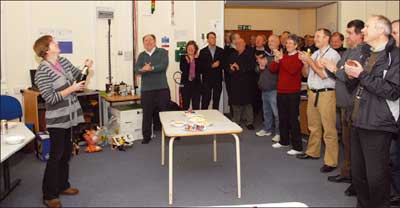
At 2.00 a.m. on 13 December 2008, the commissioning team at the ALICE facility of the UK’s Daresbury Laboratory and Cockcroft Institute successfully demonstrated “energy recovery” from a relativistic electron beam at 11 MeV back into the microwave source that powers the linear accelerator. Although the FEL facility and the CEBAF at Jefferson Lab in the US recently demonstrated energy recovery, this is a first for a European team.

ALICE is designed to produce ultrabright and ultrashort pulses of electrons, coherent-synchrotron radiation, FEL and tailored Compton-scattered light, which can be used – in conjunction with modern ultrafast lasers – in cutting-edge experiments in physical and life sciences. At the same time, accelerator research at the facility could revolutionize the way that high-energy particle accelerators, colliders and accelerator-based photon- and neutron-research facilities are designed in the future. A major design goal is to achieve efficient energy recovery (i.e. the repeated exchange and recycling of energy between particles and microwaves). This is a critical requirement for both the scientific reach in beam brightness and the economic viability and affordability of future high-power, high-energy particle accelerators. High-energy beams from ALICE will also be used to explore technology for new cancer treatments in a linked demonstration project known as EMMA.

After more than four years of planning and construction, ALICE achieved its first high-energy beam at 12.54 a.m. on 24 October in the 4 MeV booster. This consists of a superconducting accelerator cavity fed by a photoinjector. The photoinjector is a high-brightness electron gun capable of generating extremely short pulses of electrons, which are fired into the booster at a rate of 81 million shots a second.

CCnew2_01_09

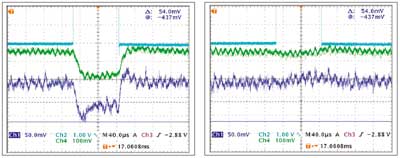
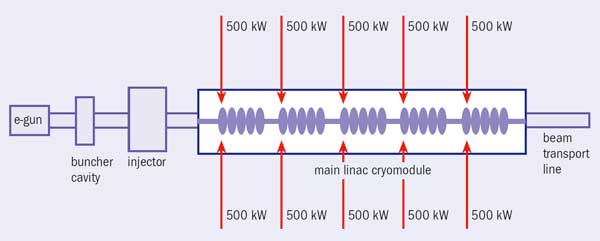
At 5.00 p.m. on 7 December, after the booster had accelerated the high-quality electron beam from the photoinjector to 4 MeV, the commissioning team took the beam from the booster up to relativistic energies of 11 MeV in a linear superconducting microwave accelerator (figure 1). The stage was then set for the final act, where the beam is threaded through 360° of beam-transport systems back to the start of the same linac. By recirculating in the opposite microwave phase, the beam undergoes deceleration to achieve energy recovery, where the energy used to accelerate the beam can be recovered and reused after each circuit of the machine.

CCnew3_01_09

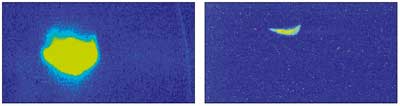
Less than a week later, at 2.00 a.m. on 13 December, the superconducting linac accelerated electrons to a total energy of 11 MeV and the beam was successfully sent round the total circuit, demonstrating energy recovery for the first time outside the US. At 10.50 p.m. on 20 December, energy recovery was achieved at 20.8 MeV (figure 2).

CCnew4_01_09

The next stage will be to commission the facility to its full operating energy of 35 MeV.

• ALICE is financed by the UK’s Science and Technology Facilities Council with seed funding from the North West Development Agency. It is operated by the ASTeC team within the Cockcroft Institute which is developing its advanced accelerator-research programme.

CMS does a full cosmic-data run

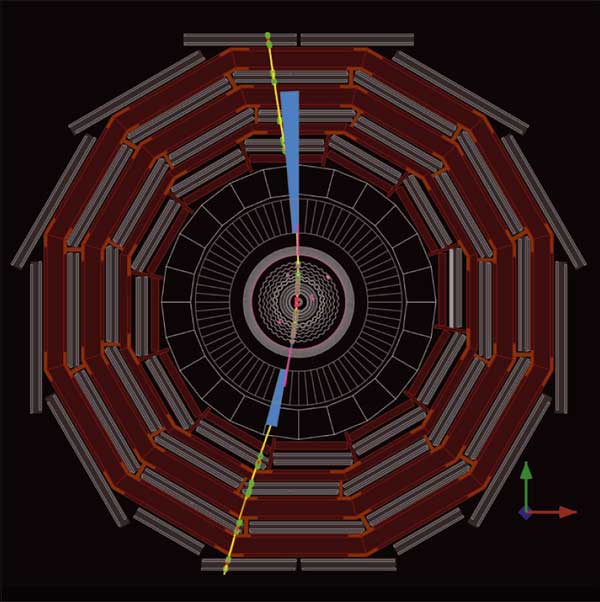
Event display of a cosmic muon

On 11 November 2008 the conclusion of a month-long, major data-taking run by the CMS collaboration brought a two-year commissioning phase to a successful close. The aim of the Cosmic Run At Four Tesla (CRAFT) was to run CMS continuously as a complete experiment, 24 hours a day, to gain further operational experience even without LHC beams. Data from 300 million cosmic muons were recorded with the solenoid at its operating point of 3.8 T for detailed detector studies. By the end of the exercise more than 7 million tracks in the strip tracker and around 75,000 tracks in the pixel tracker were available for alignment and other studies. The data volume totalled an impressive 400 TB. Runs were reconstructed at the Tier-0 centre with a typical latency of six hours before shipping to several Tier-1 and Tier-2 centres.

The CMS data flow was stressed during CRAFT in a way similar to what is foreseen for LHC operations, with calibration and/or alignment sequences performed for the electromagnetic calorimeter, the tracker and the muon systems during the run. Random triggers added on top of the cosmic-muon triggers emulated the trigger rates that will be experienced at the LHC. The high-level trigger ran a menu similar to the one used for the LHC start-up, with the installed complement of nearly 4500 filter processors for the CMS filter farm (around 40% of the final number) being deployed for the first time at the end of the run. Along with the main cosmic data, special raw-data streams created for specific calibration and alignment purposes were shipped to the Tier-0 centre. Teams residing at the CMS analysis facility in Meyrin and at remote centres including DESY and Fermilab checked the data quality offline and validated the online quality-assignments of the data-quality monitoring system.

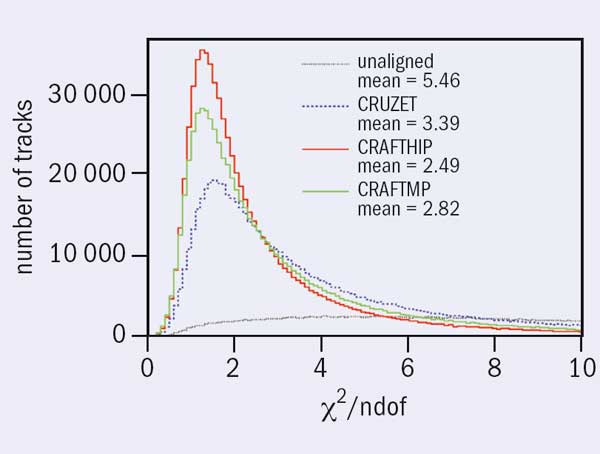
transverse-momentum distribution

The precision of tracker alignment previously obtained with data recorded without a magnetic field is now improving significantly with the data collected during CRAFT because the momentum measurement enables better control of the uncertainty that arises from multiple scattering. The run also allowed an initial alignment of the modules comprising the barrel pixel detector. The collaboration completed a first reprocessing of the CRAFT data, incorporating these newly determined calibration and alignment constants, in early December 2008. Several analysis teams will use these data to perform some basic physics measurements, including measurements of the charge ratio and momentum distribution of cosmic muons.

Residuals for the inner-barrel 7_01_09

The success of the continuous operation of CMS in “LHC-like” conditions marks the end of a commissioning phase that started two years ago: in November 2006 both the underground experimental cavern and the adjoining service cavern (which is now buzzing with all of the off-detector readout electronics) were empty. The CMS teams are looking back with understandable pride at what has been achieved since then and are looking forward to the challenges of operation with colliding LHC beams in 2009. The commissioning programme to improve the readiness for LHC physics will resume after the annual cooling maintenance, which is expected to take place in late January 2009.

MW linacs could supply medical isotopes

CCnew8_01_09

In late 2007, owing to an extended shutdown of Canada’s National Research Universal (NRU) reactor at Chalk River, North America experienced a critical shortage of the medical isotope molybdenum-99 (99Mo). Currently some 80–85% of the 40 million nuclear-medicine procedures worldwide each year use 99Mo. The NRU reactor, which has been operating since 1957, produces about half of the world’s supply. A second reactor in the Netherlands produces the balance. It too has suffered from age-related shutdowns.

The 99Mo isotope has traditionally been manufactured using nuclear reactors to irradiate highly enriched uranium targets because high neutron fluxes are available. Now, in the light of advances in accelerators – particularly in superconducting RF (SRF) cavities that enable high beam power (Superconducting RF success) – TRIUMF, Canada’s national laboratory for particle and nuclear physics, has led a study of alternative techniques for producing 99Mo. The North American study group that was convened by TRIUMF included physics and chemistry experts, as well as clinical professionals representing industry.

CCnew9_01_09

The most favoured approach uses photons from a high-power electron linear accelerator to produce 99Mo from natural uranium. The researchers concluded that significant quantities of 99Mo can be produced using this method, although several laboratory experiments will be needed to establish efficiencies, equivalency of products, reliability of operation and capacity. A single multimegawatt machine could supply the entire Canadian market or 5–7% of the total North American market. The radiochemistry needed to recover and refine the 99Mo generated through photofission from natural uranium targets is likely to resemble that which is currently in use for reactors using highly enriched uranium targets. The similarity of the initial 99Mo-recovery step will depend on the volume of the target for photofission, which relies in detail on the optimization of design and performance parameters. The study group recommended the formation of a steering group, which would oversee laboratory demonstrations of the entire process, ultimately leading to a full-scale design process.

The study has attracted widespread interest in Europe, Asia and North America, with each region investigating options for securing a reliable supply of 99Mo. In many cases, however, these are highly dependent on the future plans for nuclear power, because manufacturers of power plants are likely to construct and operate their own research reactors. Canada’s five-year plan for TRIUMF (2010–2015) already includes the construction and operation of a high-power electron linear accelerator using SRF. This machine could be an important testbed for the proposed 99Mo technology because it will operate at similar power densities.

High-energy physics team sets data-transfer world records

An international team led by the California Institute of Technology (Caltech), with partners from Michigan, Florida, Tennessee, Fermilab, Brookhaven, CERN, Brazil, Estonia, Korea and Pakistan, set new world records for sustained data transfer among storage systems during the successful SuperComputing 2008 (SC08) conference held in Austin, Texas, in November.

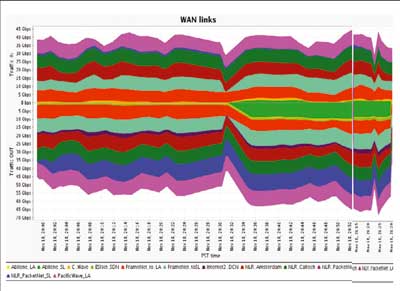
Caltech’s exhibit at SC08 by the High-Energy Physics (HEP) group and the Center for Advanced Computing Research (CACR) demonstrated new applications and systems for globally distributed data analysis for the LHC at CERN, together with Caltech’s global monitoring system, MonALISA, and its collaboration system, Enabling Virtual Organizations. A highlight of the exhibit was the HEP team’s record-breaking demonstration of storage-to-storage data transfers. This achieved a bidirectional peak throughput of 114 Gbit/s and a sustained data flow of more than 110 Gbit/s among clusters of servers on the show floor and at Caltech, Michigan, CERN, Fermilab, Brazil (Rio de Janiero, São Paulo), Korea, Estonia and locations in the US LHCNet network in Chicago, New York, Geneva and Amsterdam.

CCnew10_01_09

The team used a small fraction of the global LHC Grid to transfer data between the Tier-1, Tier-2 and Tier-3 facilities at the partners’ sites and between a Tier-2-scale computing and storage facility that the HEP and CACR team had constructed on the exhibit floor in fewer than two days. Rates of more than 40 Gbit/s were sustained in both directions for several hours (and up to 71 Gbit/s in one direction). One of the key elements in this demonstration was Fast Data Transfer (FDT), an open-source Java application based on TCP developed by the Caltech team in close collaboration with colleagues at Politechnica Bucharest. FDT works dynamically with Caltech’s MonALISA system to monitor the capability of the storage systems, as well as the network path, in real time. It also sends data out to the network at a rate that is matched to the capacity of long-range network paths.

A second major milestone was achieved by the HEP team working together with Ciena Corporation, which had just completed its first OTU4-standard optical link carrying a 100 Gbit/s payload over a single wavelength with forward-error correction. The teams used a fibre-optic cable with 10 fibre-pairs to link their neighbouring booths together; Ciena’s system to multiplex and demultiplex ten 10 Gbit/s links onto the single OTU4 wavelength running on an 80 km fibre loop; and some of the Caltech nodes used in setting the wide-area network records, together with FDT. Thanks to the system’s high throughput capabilities and the error-free links between the booths, the teams managed to achieve a maximum of 199.90 Gbit/s bidirectionally (memory-to-memory) within minutes, and an average of 191 Gbit/s during a 12 hour period that logged the transmission of 1.02 PB overnight.

Pierre Auger Collaboration inaugurates observatory

CCnew11_01_09

More than 200 guests and 100 collaboration members celebrated the inauguration of the Pierre Auger Observatory at its southern site in Malargüe, Argentina, on 14 November. The event marked the completion of the first phase of the observatory construction and the beginning of the project’s second phase, which includes plans for a northern-hemisphere site in Colorado, US. Also planned are several enhancements to the southern-hemisphere site.

The Pierre Auger Collaboration began construction of its Southern Observatory in 2000. This consists of an array of 1600 detectors spread over 3000 km2 in Argentina’s Mendoza Province. Surrounding the array is a set of 24 fluorescence telescopes that view the faint ultraviolet light emitted by the cosmic-ray shower particles as they cascade through the atmosphere. More than 40 funding agencies are contributing to the observatory, which cost approximately $53 million to construct.

Guests at the inauguration ceremony included Julio Cobos, the vice-president of Argentina, Celso Jaque, the governor of Mendoza, several ambassadors, many high-level officials from funding agencies, the directors of CERN and Fermilab, and research officers from universities associated with the project. In addition to a symposium, guests enjoyed a dusty two-hour ride across the Pampa Amarilla to inspect some of the 1600 particle detectors.

DESY awards two building contracts for European XFEL

DESY has commissioned two consortia of renowned building contractors to construct the underground buildings (tunnels, shafts and halls) for the 3.4 km long X-ray laser facility, European XFEL.

The contracts for the sites at Schenefeld, in the Pinneberg district (Schleswig-Holstein), and Osdorfer Born, in Hamburg – which add up to nearly €206 million – were awarded to the consortium Hochtief/Bilfinger Berger. The commission for the civil-engineering works at the Hamburg site of DESY-Bahrenfeld amounts to €36 million and goes to the consortium Züblin/Aug. Prien. The contracts were awarded on 12 December and construction started officially on 8 January. DESY is at present acting for the future not-for-profit company European XFEL GmbH, which is to be founded in spring 2009 and will be in charge of the construction and operation of the new research facility.

The 3.4 km long research facility will be located between the DESY site at Bahrenfeld and the neighbouring town of Schenefeld. It will begin at DESY, where the central supply stations will be situated. In the last kilometre, the tunnel will fan out into several separate tunnels in which the X-ray laser flashes will be generated and transferred to the experiment stations. The site at Osdorfer Born, which will comprise another access and supply building, will be established at the beginning of this tunnel fan. The underground experiment hall at the end of the facility will be located on the future 15 ha research campus in Schenefeld and provide space for 10 experiment stations. It will be 14 m deep, with a surface area of 4500 m2. The contracts that were awarded in December cover all civil-engineering works. These comprise eight shafts leading into underground halls, the experiment hall and all of the tunnels. The total length of tunnel system will be 5.8 km and will be constructed using tunnel-boring machines.

The investment costs for the European X-ray laser facility amount to €986 million (at 2005 price levels). As the host country, Germany will cover as much as 60% of the investment costs and at least 40% will be borne by the international partner countries. Alongside the German federal ministry of education and research, the City of Hamburg and the German federal state of Schleswig-Holstein, 13 countries are participating: China, Denmark, France, Greece, Hungary, Italy, Poland, Russia, Slovakia, Spain, Sweden, Switzerland and the UK.

bright-rec iop pub iop-science physcis connect