Comsol -leaderboard other pages

Topics

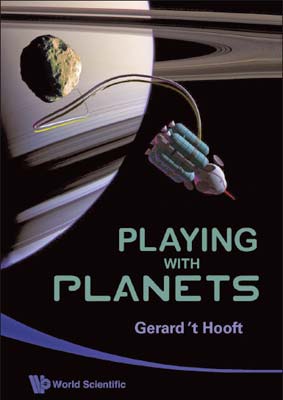
Playing with Planets

by Gerard ‘t Hooft, World Scientific. Hardback ISBN 9789812793072, £25 ($48). Paperback ISBN 9789812790200, £14 ($23).
CCboo2_06_09

At the Rijksmuseum in Amsterdam they currently offer an audio tour by the artist Jeroen Krabbé. In a lovely, soft-accented English he recounts his personal experiences with the various exhibits over the many years that he has been visiting the museum – from the view as a child, a painter and actor, a parent and as a grand parent. His insights are both moving as well as fascinating and deep.

While reading Playing with Planets, I heard a similar voice in my head. Starting with personal experiences, Gerard ‘t Hooft lets his mind wander over the various aspects of life, speculating on the affects of new scientific developments on our lives in the future. The topics that he covers include flying kites (What is the highest you can possibly let a kite fly?), rising sea levels from global warming, modern dike construction and building floating cities on the ocean or in the sky. The topic that really grips his mind, however, seems to be space travel and colonization (mainly by robots), as well as ultimately moving around asteroids or even planets. (The latter is the origin of the title of the book.)

It is clearly important to ‘t Hooft that each of these speculations is firmly based on current scientific knowledge. They can thus be a motivation or even inspiration for actual scientific progress or technical developments. On this point he seems to take issue with the unfounded, wild speculations that he perceives to feature in most, if not all of, science-fiction writing. I am not much of a sci-fi buff myself, but to me such novels were always more of an enquiry into human nature – by placing people in unusual circumstances – rather than a real attempt at predicting or driving scientific progress. All the same, the author is well aware that he is stretching the limits of the possible when considering astro-mechanics.

My only criticism of his space-related speculations is that I believe they are severely constrained by the limited resources on Earth. When we realize that we have hit Peak Oil (or the equivalent for other materials), any interest in space travel and colonization will be put on the back burner. Nevertheless, I much enjoyed wandering the world, following this enquiring and original mind.

The Martians of Science: Five Physicists Who Changed the Twentieth Century

by István Hargittai, Oxford University Press. Paperback ISBN 9780195365566, £8.99 ($15.95).

CCboo1_06_09

The music was enchanting. The Dysons stopped before the door, not wanting to break the magic of the superbly played Bach prelude. When the last cadence had rung down they walked in to find Edward Teller sitting at the piano apologizing that he was just passing by and that the instrument begged to be played while he was waiting for them to return home. It was a remarkable journey that had brought Teller, best known as the father of the hydrogen bomb, to the Dysons’ home at Berkeley. Even more remarkably, his journey was not without parallels.

If we were to trace back the wordlines of influential physicists to their birth, we would find several of them to converge in a tiny domain of space–time: Budapest, fin de siècle. In fact, those of Theodore von Kármán, Leo Szilard, Eugene Wigner, John von Neumann and Edward Teller never really diverged significantly. These compatriots all went from Hungary to Germany and eventually to the US. And they all changed the history of the 20th century.

Kármán Tódor, Szilárd Leó, Wigner Jeno˝, Neumann János and Edward Teller (Teller Ede in Hungarian) were all born to well-to-do Jewish families living within walking distance of each other. They all completed their studies in Germany, learning from masters such as Ludwig Prandtl, Albert Einstein and Werner Heisenberg. Eventually they found refuge in the US from the menace of anti-Semitism, where they all joined the defence effort: von Kármán helped establish the modern US Air Force and founded the Jet Propulsion Laboratory; Szilard patented the nuclear chain reaction and triggered the Manhattan Project, through a letter signed by Einstein to President Roosevelt; Wigner played an instrumental role in building the first nuclear reactor; von Neumann did important calculations for the Manhattan Project and described the principle of modern computer architecture; and Teller drove the creation of thermonuclear weapons.

In his book, first published in 2006 and now available in paperback, István Hargittai follows the lives of these five “Martians of Science”, and asks the inevitable questions: What was behind this remarkable surge of talent? Was it just a random rogue wave? What made these broadly educated, brilliant men seek the ultimate weapon? How did they see the role of scientists in society?

The author makes a critical assessment in the final chapter of their roles and weightings in science in comparison with other scientists of the 20th century. He even ventures to answer the intriguing counterfactual: What if they had stayed in Hungary?

That these five represented just the crest of a bigger wave is borne out in George Marx’s Voice of the Martians (Akademiai Kiado 2001). In addition to them, Marx presents personalities such as Dennis Gabor, the inventor of hologram; Arthur Koestler, the writer whose Darkness at Noon can be compared in its influence to George Orwell’s 1984; Paul Erdõs, the vagabond mathematician of “Erdõs number 0”; Val Telegdi, whose experiments explored the nature of weak interactions and who spent much of his time at CERN until his death a few years ago; and many others. From this long list of portraits a broader picture emerges, that of the fate of the central-European scientist in the 20th century.

Both authors draw on existing biographies but they supplement them with a wealth of detail from their personal conversations with their subjects or their respective colleagues, friends and family. Even so, with their scope and emphasis on exploring trends and connections, these books cannot do justice to each individual. They are instead excellent introductions that invite, and provide a guide to, further reading.

Superconducting RF separator emerges from its long sleep

cryostat for deflector RFI

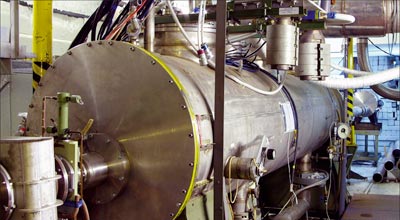
The first superconducting high-frequency device made for particle physics has begun a new life at the U-70 proton synchrotron at the Institute for High Energy Physics (IHEP) at Protvino. It forms a key part of the new 200 m long high-intensity beam line for 12.5 GeV/c sup positively charged secondary particles, which was commissioned last December. With a content of 25% kaons the beam will be used in the OKA project, which will search for new physics in rare kaon decays. The high fraction of kaons in the beam is provided by the superconducting RF separator, the two niobium deflectors of which are cooled by liquid helium at a temperature of 1.8 K.

The separator was originally designed and constructed in 1970–1977 at the Institute für Kernphysik of the Kernforschungszentrum Karlsruhe, under the leadership of Herbert Lengeler of CERN. Until 1981 it was successfully used to provide a beam enriched in kaons and antiprotons for the Omega spectrometer at CERN. On completion of the experimental programme with the separated beam at Omega, the deflectors were stored at CERN under high vacuum for 17 years. Then, after vacuum-leak tests and other necessary preparations, the deflectors were transported from CERN to IHEP in 1998 (CERN Courier April 1998 p12).

Preparations for a new life for the deflectors began in 2006. First, comprehensive tests took place, together with the restoration of nominal working parameters of deflector RF2, which was damaged at CERN during preparation for the shipment to Russia. Then the two deflectors were placed 76.3 m apart on the beam line and connected to the cryogenic system, which has a refrigerating power of 250 W for superfluid helium at a temperature of 1.8 K. At the same time as the tests the group led by Boris Prosin designed and implemented an RF-feed and phasing system for the deflectors, based on modern microwave elements and the rubidium frequency-standard as a source of the signal. A set of power amplifiers and the common DC power supply, previously used in the antiproton cooling system at CERN, were connected to the output of the microwave system and a completely oil-free high-vacuum system was designed and arranged for each deflector.

Fridhelm Caspers from CERN and Axel Matheisen from DESY have provided important advice and practical help with some equipment for the preparation of the separator. Successful commissioning of the superconducting device was also substantially aided by the use of equipment remaining from a “warm” RF separator, which was developed at CERN 40 years ago for joint IHEP–CERN experiments at U-70 with the French bubble chamber “Mirabelle”. This separator had then been preserved in a very good condition at IHEP.

Stable working of the cryogenic system and the RF separator during the April run at U-70 provided the start of the data-taking at the OKA experimental facility for the study of rare kaon decays. Future efforts will aim to increase the intensity and quality of the separated beam and thereby ensure the success of the OKA experiment.

The ESA Planck spacecraft heads off to its final destination after successful launch

CCnew2_06_09

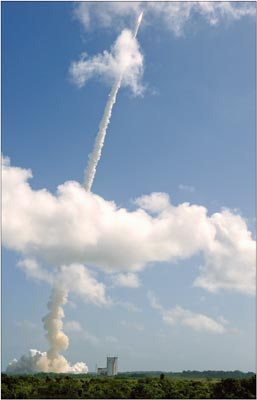
Planck, ESA’s new spacecraft to map the cosmic microwave background, successfully took its first steps into space on 14 May when it was launched together with the far-infrared space telescope Herschel from Europe’s Spaceport in French Guiana. The two spacecraft were on board an Ariane 5 launcher that took off from Kourou at 13.12 UTC.

Planck is designed to map tiny irregularities in fossil radiation left over from the very first light in the Universe, emitted shortly after the Big Bang. Herschel, equipped with the largest mirror ever launched into space, will observe a mostly uncharted part of the electromagnetic spectrum to study the birth of stars and galaxies as well as dust clouds and planet-forming discs around stars (XMM-Newton observes emission from matter around a black hole).

Almost 26 minutes after launch, Herschel and then Planck were released separately on an escape trajectory towards the second Lagrangian point (L2) of the Sun–Earth system, some 1.5 million km from Earth in the opposite direction to the Sun. This triggered the execution of automatic sequences on board, including switch-on of the high-frequency radio transmitters. Nine minutes later, the first signals from both spacecraft were acquired by ESA’s New Norcia and Perth stations. Shortly afterwards, telemetry confirmed that both spacecraft were in good health.

On 5 June, Planck carried out the critical mid-course manoeuvre to place the spacecraft on its final trajectory for arrival at L2 early in July. The manoeuvre, in which Planck’s main thrusters make repeated “pulse burns”, lasted about 46 hours. This pulse-burn technique is necessary because Planck is slowly spinning as it travels through space, rotating at 1 rpm. The thrusters, which are fixed to the spacecraft and are not steerable, can only burn when they are oriented in the correct direction, which occurs for 6 seconds during each 60 second rotation. The successful manoeuvre provided an overall change in speed of 155 m/s in an initial speed of 105,840 km/h with respect to the Sun. A “touch-up” manoeuvre was scheduled for 17 June to provide a final 5–10 m/s correction.

Element 112 receives official recognition

CCnew3_06_09

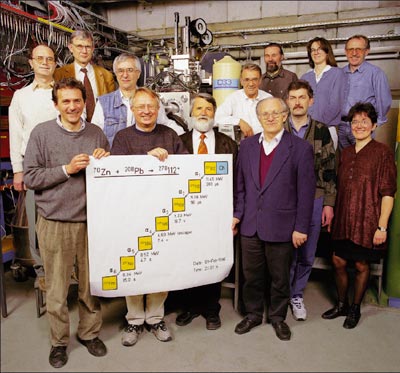
Element 112, discovered at GSI Darmstadt, has been officially recognized as a new element by the International Union of Pure and Applied Chemistry (IUPAC). IUPAC confirmed this recognition in an official letter to the head of the discovery team, Sigurd Hofmann. The letter also asks the discoverers to propose a name for the new element, which is the heaviest so far in the periodic table. Once the proposed name has been thoroughly assessed by IUPAC, the element will receive its official name.

A team of 21 scientists from Germany, Finland, Russia and Slovakia was involved in the experiments that discovered the new element. They created the first atom of 112 in 1996 when they directed a beam of zinc ions onto a target of lead at the accelerator at GSI; a second example followed in 2002. Subsequent accelerator experiments at the Japanese RIKEN accelerator facility produced more atoms of element 112, unequivocally confirming GSI’s discovery.

Since 1981, accelerator experiments at GSI have yielded six new chemical elements, which carry the atomic numbers 107 to 112. GSI has already named the officially recognized elements 107 to 111: element 107 is called bohrium, element 108 hassium, element 109 meitnerium, element 110 darmstadtium and element 111 is named roentgenium.

LHC restart remains on schedule

CCnew4_06_09

At the 151st session of the CERN Council on 19 June, director-general Rolf Heuer confirmed that the LHC remains on schedule for a restart this autumn, albeit about 2–3 weeks later than originally foreseen. Following the incident of 19 September 2008 that brought the LHC to a standstill, a great deal of work has been done to understand the causes of the incident and to ensure that a similar incident cannot happen again.

The root cause of the September incident was a faulty splice in the high-current superconducting cable between two magnets in LHC sector 3-4. New non-invasive techniques have been developed to investigate the splices, of which there are some 10,000 around the LHC ring, and to determine whether they are safe for running or whether they need to be repaired. As part of this process one more sector of the LHC, sector 4-5, is currently being warmed up. This will bring increased confidence that the splices are fully understood.

Sector 4-5 has been measured at a temperature of 80 K, indicating at least one suspect splice. By warming the sector, the results of this measurement can be checked at room temperature, thereby confirming the reliability of testing at 80 K. If the 80 K measurements are confirmed then any suspect splices in this sector will be repaired. More importantly, validation of the 80 K measurements will allow the splice resistance in the last three sectors to be measured at this temperature – thereby avoiding the time needed for re-warming. The measurements in these sectors will provide the information needed to determine the start-up date and initial operating energy of the LHC in the range 4–5 TeV. Running at 4 TeV should be possible without further repairs, whereas 5 TeV could require extra work to be done.

A key part of the modifications being made to the LHC is the quench-protection system (QPS), which triggers evacuation of the stored magnetic energy quickly and safely should a part of the LHC’s superconducting system warm up slightly and cease to be superconducting. Following the September incident, a new enhanced QPS system was designed and is now under construction. The new system will be fully tested and operational in late summer 2009 and will protect the LHC from incidents similar to that of last September.

Work on the new QPS is just one aspect of the work in the LHC tunnel being carried out by teams from CERN, who are supported by scientists from other particle-physics laboratories around the world. New pressure-relief valves are being installed, the ultrahigh-vacuum system is being improved and the systems anchoring the LHC magnets to the floor are being strengthened. All of this contributes to preparing the machine for a long and safe operational lifetime.

“We’ve received an unprecedented level of support from physics labs and institutes around the world through the manpower that they have provided to help us through the repairs and consolidation, as well as the invaluable advice we’ve received from the external committees that have studied the measures we’re taking,” Heuer explained. “It’s a sign of the increasingly global nature of particle physics and we’re extremely grateful for the solidarity we’re seeing.”

• CERN publishes regular updates on the LHC in its internal Bulletin, available at www.cern.ch/bulletin, as well as via Twitter (www.twitter.com/cern) and YouTube (www.youtube.com/cern). Further details of the 151st session of the CERN Council are available at http://council.web.cern.ch/council/en/Governance/NewsGovJune09.html.

Knocking on the door again

CCnew5_06_09

The LHC’s anti-clockwise beam transfer system was tested on 6 and 7 June. Particle bunches were sent from the SPS through the 2.8 km transfer line towards the LHC where it intersects just before the LHCb cavern. The beam went down the transfer line and stopped just before reaching the LHC tunnel, where a beam stopper – 4 m of graphite – is physically placed in the beam line to prevent the beam from taking the last step into the LHC. Part of the LHCb detector was turned on during the beam test, allowing the reconstruction of tracks through the Vertex Locator.

GSI reveals new magic numbers in nuclei

In two recent experiments at the accelerator facility at GSI Darmstadt, groups led by Reiner Krücken of the Technical University Munich and Rituparna Kanungo of St Mary’s University, Halifax, in collaboration with international teams, revealed further evidence for new magic shell closures at the limit of nuclear existence in the neutron-rich isotopes 24O and 54Ca.

The shell structure of atomic nuclei with its magic numbers (2, 8, 20, 28, 50, 82, 126) for protons and neutrons corresponding to an enhanced binding is a cornerstone in understanding the structure and dynamics of nuclei. The explanation of the magic numbers in 1949 as a result of the strong spin-orbit interaction was awarded the Nobel Prize in 1963. Until recently these magic numbers were assumed to remain universal across the whole nuclear chart, but mounting experimental evidence and theoretical predictions indicate that the shell gaps associated with the numbers are not universal. Instead they can change locally under the influence of variations in the effective interaction of the nucleons in the nucleus. Such changes in the shell structure can have dramatic effects on the production of elements in stellar explosions.

The experiments used precise momentum measurements to study the dynamics of reactions where a single neutron is knocked out from a neutron-rich nucleus. The results provide crucial information about the energies and occupation of the neutron single-particle orbitals in the respective nuclei. In the experiment with 24O (8 protons and 16 neutrons), the measurements revealed the spherical nature of the shell closure for the 16 neutrons, thus establishing 24O as a doubly magic nucleus, with a new magic number of 16 (R Kanungo et al. 2009). The second experiment studied one-neutron knockout in 56Ti (22 protons and 34 neutrons). It confirmed that shell-model calculations predicting a new shell closure in 54Ca (20 protons and 34 neutrons) correctly describe the single-particle structure in the neighbouring nucleus 55Ti (P Maierbeck et al. 2009).

The experiments were highly challenging because 24O and 56Ti form unstable radioactive beams, which can only be produced with a yield of a few particles a second, compared with the 109 ions a second that is typical of experiments with stable nuclei. The results also demonstrate the capability of the fragment separator, FRS, at GSI for high-precision momentum measurement with such extremely rare isotopes. This capability will be developed further in the near future at the Facility for Antiproton and Ion Research in Darmstadt.

CERN openlab enters phase three

CCnew6_06_09

On 2–3 April CERN’s director-general, Rolf Heuer, officially launched the third phase of the CERN openlab at the 2009 annual meeting of the CERN openlab Board of Sponsors. During his introductory speech Heuer stressed the importance of collaborating with industry and building closer relationships with other key institutes, as well as the European Commission. The board meeting provided an opportunity for partner companies (HP, Intel, Oracle and Siemens), a contributor (EDS, an HP company) and CERN to present the key achievements obtained during openlab-II and the expectations for openlab-III.

Each phase of CERN openlab corresponds to a three-year period. In openlab-I (2003–2005) the focus was on the development of an advanced prototype called opencluster. CERN openlab-II (2006–2008) addressed a range of domains from platforms, databases and the Grid to security and networking, with HP, Intel and Oracle as partners and EDS, an HP company, as a contributor. Disseminating the expertise and knowledge has also been a key focus of openlab. Regular training sessions have taken place and activities include openlab contributions to the CERN School of Computing and the CERN openlab Summer Student Programme, with its specialized lectures.

With the start of the third phase of CERN openlab, new projects have already been initiated with the partners. These are structured into four Competence Centres (CC): Automation and Controls CC; Database CC; Networking CC; and Platform CC. Through the Automation and Controls CC, CERN, Siemens and ETM Professional Control (a subsidiary of Siemens) are collaborating on security, as well as the move of automation tools towards software engineering and handling of large environments. In partnership with Oracle, the Database CC focuses on items such as data distribution and replication, monitoring and infrastructure management, highly available database services and application design, as well as automatic failover and standby databases.

One focus of the Networking CC is a research project launched by CERN and HP ProCurve to understand the behaviour of large computer networks (with 10,000 nodes or more) in high-performance computing or large campus installations. Another activity involves the grid-monitoring and messaging projects carried out in collaboration with EDS, an HP company. The Platform CC project focuses on PC-based computing hardware and the related software. In collaboration with Intel it addresses important fields such as thermal optimization, application tuning and benchmarking. It also has a strong emphasis on teaching. During the third phase, the team will not only capitalize on and extend the successful work carried out in openlab-II, but it will also tackle crucial new areas. Additional team members have recently joined and the structure is now in place to collaborate and work on bringing these projects to fruition.

The openlab team consists of three complementary groups of people: the young engineers hired by CERN and funded by the partners (21 people over the past eight years); technical experts from partner companies involved in the openlab projects; and CERN management and technical experts working partly or fully on the joint activities. The people involved are not concentrated in a single group at CERN. They span many different units in the IT department, as well as the Industrial Controls and Electronics Group in the engineering department, since the arrival of Siemens as an openlab partner. The distributed team structure permits close collaboration with computing experts in the LHC experiments, as well as with engineers and scientists from the various openlab partners who contribute greatly to these activities. In addition, significant contributions are made by the students participating in the CERN openlab Summer Student Programme, both directly to the openlab activities and more widely to the Worldwide LHC Computing Grid, the Enabling Grids for E-sciencE project and other Grid- and CERN-related activities in the IT Department. Since the inception of openlab, more than 100 young computer scientists have participated in the programme, where they spend two months at CERN. This summer the programme will be welcoming 14 students of 11 different nationalities.

• The activities carried out from May 2008 to May 2009 are presented in the eighth CERN openlab annual report available from the CERN openlab web site at www.cern.ch/openlab.

XMM-Newton observes emission from matter around a black hole

CCast1_06_09

A recent observation by the XMM-Newton satellite revealed two prominent emission lines in the X-ray spectrum of the Seyfert galaxy 1H 0707-495. These lines are attributed to iron fluorescence and appear skewed towards lower energies as expected from relativistic effects in the close vicinity of a black hole. This is the strongest evidence yet for matter swirling just outside the event horizon of a super-massive black hole.

Seyfert galaxies are the less luminous analogues of quasars. They are named after Carl Seyfert, who in 1943 published the properties of 12 galaxies with peculiar optical emission lines emanating from the nucleus. These lines are now known to be emitted by atoms in gas clouds located light-weeks away from super-massive black holes.

Another emission line, this time in X-rays, has fascinated astronomers for more than a decade. Emitted at an energy of 6.4–7.0 keV, it arises from the fluorescent de-excitation of K-shell electrons in iron atoms. Excitement arose in 1995 when the Japanese Advanced Satellite for Cosmology and Astrophysics observed such a line strongly skewed towards lower energies. This was consistent with the relativistic distortion expected for matter orbiting a black hole.

With the potential to probe the inner-most stable orbit around a black hole, the precise characterization of the iron K line was an important scientific justification for ESA’s XMM-Newton satellite launched in December 1999. The superior spectral resolution of this mission enabled the identification of a rapidly spinning black hole in the galactic source XTE J1650-500 based on the shape of the iron K line. But the detailed XMM-Newton spectra also brought some confusion to the field with several studies showing evidence that the observations in some Seyfert galaxies can be interpreted without invoking a relativistically broadened iron line. The detection of similarly looking iron lines around neutron stars and even white dwarfs is also puzzling the community.

Is the relativistic broadening scenario a misinterpretation of the data?

The latest, extremely accurate observations by XMM-Newton of the Seyfert galaxy 1H 0707-495, published by Andy Fabian from the Cambridge Institute of Astronomy and collaborators, give renewed and unprecedented evidence for the relativistic interpretation. Besides the usual iron K line, for the first time they detect a second line attributed to iron L-shell transitions at an energy just below 1 keV. Both lines are so strongly distorted towards lower energies that they imply a black hole spinning at an almost maximum rate. A measured delay of about 30 s in the variations of the iron L line with respect to the continuum emission gives additional evidence for the relativistic scenario. The two iron lines would thus originate from the illumination of the inner accretion disk about one gravitational radius away from the horizon of the black hole by an X-ray continuum source located a little further out.

bright-rec iop pub iop-science physcis connect