Comsol -leaderboard other pages

Topics

Phenomenology of Ultra-Relativistic Heavy-Ion Collisions

By Wojciech Florkowski

World Scientific

Hardback: £66 $96

CCboo1_01_11

Wojciech Florkowski’s book on ultra-relativistic heavy-ion collisions appears right at the beginning of a new era in the field. In 2010, two new experimental heavy-ion programmes started at CERN. First, lead nuclei were accelerated to the highest ever energy – 1.38 TeV per nucleon – at the LHC and rich experimental results were released by the ALICE, ATLAS and CMS collaborations, even during the first data-taking period in November/December 2010. Second, in parallel, a new fixed-target heavy-ion programme at CERN’s Super Proton Synchrotron (SPS) was launched with the acceleration of lead beams to the lowest-ever energy in the SPS, namely 13.9 GeV per nucleon. This was to study the use of the fragment separator in producing secondary light-ion beams for the NA61/SHINE experiment. These two research programmes are perfectly complementary. The one at the LHC aims at a systematic investigation of hot and dense quark-gluon plasma. The one at the SPS, on the other hand, will search for the critical point of strongly interacting matter and study the properties of the onset of deconfinement.

This book by Florkowski is highly relevant for all participants in the new programmes at CERN. I am convinced that it may also help all non-heavy-ion physicists involved in experiments at CERN to understand the language and excitement of their heavy-ion colleagues.

Furthermore, it gives an excellent introduction to and an in-depth review of the standard theoretical framework that is used to interpret the heavy-ion data. It provides a clear, logical and unified description of statistical, hydrodynamical and kinetic models. All this is illustrated by a selection of the most relevant experimental results of the past programmes at Brookhaven’s Alternating Gradient Synchrotron and Relativistic Heavy Ion Collider, as well as at the SPS. Finally, there are various exercises in each chapter for use as a textbook in a graduate course.

All in all, this book is highly recommendable both for heavy-ion and non-heavy-ion physicists.

Quantum Field Theory in Curved Spacetime: Quantized Fields and Gravity and Exact Space–Times in Einstein’s General Relativity

Quantum Field Theory in Curved Spacetime: Quantized Fields and Gravity

By Leonard Parker and David Toms

Cambridge University Press

Hardback: £48 $83 E-book: $64

Exact Space–Times in Einstein’s General Relativity

By Jerry B Griffiths and Jirˇí Podolský

Cambridge University Press

Hardback: £80 $129 E-book: $100

CCboo2_01_11

Long ago, more or less immediately after Einstein’s formulation of general relativity, one of the dreams of physics was to understand why flat space–time is so special. Why are quantum mechanics and field theory formulated in flat space while their curved-space analogues are sometimes ill defined, at least conceptually? Can we hope, as Richard Feynman speculated, to quantize gravity in flat space–times and then construct all of the most complicated geometries as coherent states of gravitons?

The dreams of a more coherent picture of gravity and of gauge interactions in flat space are probably still there, but nowadays theorists invest a great deal of effort in understanding the subtleties of the quantization of fields, particles, strings and (mem)branes in geometries that are curved both in space and in time. Cambridge University Press was one of the first publishers to voice these attempts with the classic Quantum Fields in Curved Space by N B Birrel and P C W Davies, which is now well known to many students since its first edition in 1982. Leonard Parker (distinguished professor emeritus at the University of Wisconsin) and David Toms (reader in mathematical physics and statistics at the University of Newcastle) were both abundantly quoted in the book by Birrel and Davies and they have now published Quantum Field Theory in Curved Spacetime, also with Cambridge. While readers of Birrel and Davies will certainly like this new book, newcomers and students will appreciate the breadth and the style of a treatise written by two well known scientists who have dedicated their lives to the understanding of the treatment of quantum fields in a fixed gravitational background.

The book consists of seven chapters spread evenly between pure theory and applications. One of its features is the attention to the introductory aspects of a problem: students and teachers will like this aspect. The introductory chapter reminds the reader of various concepts arising in field theory in flat space–time, while the second chapter introduces the basic aspects of quantum field theory in curved backgrounds. After the central chapters dealing with useful applications (including the discussion of pair creation in black-hole space–times) the derivation of effective actions of fields of various spins is presented, always by emphasizing the curved-space aspects.

CCboo3_01_11

A rather appropriate companion volume is Exact Space-Times in Einstein’s General Relativity by Jerry Griffiths and Jiří Podolský, published by Cambridge in late 2009. Here, the interested reader is led through a review of the monumental work performed by general relativists over the past 50 years. The book also complements (and partially extends) the famous work by Dietrich Kramer, Hans Stephani, Malcolm MacCallum and Eduard Herlt, Exact Solutions of Einstein’s Field Equations, first published, again by Cambridge, in 1980.

Like its famous ancestor, the book by Griffiths and Podolský will probably be used as a collection of exact solutions by practitioners. However this risk is moderated to some extent by a presentation in the style of an advanced manual of general relativity (GR). The 22 chapters cover in more than 500 pages all of the most important solutions of GR. After two introductory chapters the reader is guided on a tour of the most important spatially homogeneous and spatially inhomogeneous, four-dimensional background geometries, starting from de Sitter and anti-de Sitter space–times but quickly moving to a whole zoo of geometries that are familiar to theorists but which may sound rather arcane to scientists who are not directly working with GR.

Both books reviewed here can also be recommended because they tell of the achievements of a generation of theorists whose only instruments were, for a good part of their lives, a pad of paper and a few pencils.

The Housekeeper and the Professor

by Yoko Ogawa, translated by Stephen Snyder, Vintage Books. Paperback ISBN 9780099521341, £7.99. E-book ISBN 9781409076667, £8.16.

CCboo7_10_10

I first came to know the housekeeper, her son and the memory-impaired professor through their roles in an in-flight movie en route from Tokyo to Frankfurt. The filmmaking is beautiful and the acting sublime, but the real surprise is the subject matter. This is a story about “Euler’s identity”, and it carries it off brilliantly, leaving behind a true appreciation of the beauty of numbers. I stepped off the plane wondering if Hollywood could ever do such a thing, and so was happy to discover that at least the novel on which the film was based has an English translation, now available in paperback.

The Housekeeper and the Professor tells the story of a mathematician whose short-term memory following an accident is limited to 80 minutes. He makes his way through the day thanks to Post-it notes, but each morning is a new beginning. It’s a story of platonic affection, shared between the professor, his housekeeper and her 10-year-old son and as such is reminiscent of Helene Hanff’s 84 Charing Cross Road. Where it diverges, however, is in its core theme. Rather than through a shared love of books, the protagonists’ relationship blossoms by way of mathematics.

Maths is perhaps the most difficult of sciences to popularize. Even Marcus du Sautoy, mathematician and Professor of Public Understanding of Science at Oxford, struggles to convey the beauty of numbers in his engaging BBC documentary, The Story of Maths. But where du Sautoy bravely tackles the full story, Ogawa focuses on just one of mathematics’ most remarkable equations, e+1=0, gently preparing the reader to understand why this deceptively simple collection of symbols is so extraordinary.

The key to Ogawa’s success is the pace of the story, dictated by the fact that the professor begins every day anew. Each morning starts with the same basic conversation, pointing out the significance of a particular number. “What’s your shoe size?” asks the professor, for example. “24,” comes the reply and the professor goes on to explain that this is the factorial of four. As the conversation develops, we learn that the housekeeper’s phone number is the total number of primes between one and 100 million, and a little more maths appears with each conversation.

The square root symbol makes its first appearance as early as the first page – “Root” is what the professor calls the housekeeper’s boy. “With this one little sign, we can come to know an infinite range of numbers, even those we can’t see,” he explains. And sure enough, the square root of –1 makes its introduction two pages later. For e and π, we have to wait until much later.

The maths is never overwhelming, each step being carefully introduced for the benefit of the housekeeper and Root. A shared passion for baseball proves fertile ground for mathematical conversation. We learn, for example, that Babe Ruth’s 1935 record of 714 home runs multiplied by its successor (715 set by Hank Aaron in 1974) is equal to the product of the first seven primes and that the sum of the prime factors of 714 and 715 is the same. Because consecutive numbers with this property are rare – there are only 26 such pairs up to 20,000 – they’re known as Ruth-Aaron pairs. Mathematics like this weaves its way through the story so that by the time Euler’s identity is unveiled, the shock of finding a square root on the first page has been replaced by the pleasure of playing with numbers. Euler’s identity is the breathtaking icing on the cake.

The Housekeeper and the Professor is a beautifully told and ultimately touching tale. But perhaps its greatest achievement is that it leaves the reader with a sense of awe at the beauty of numbers.

Yoko Ogawa has published more than 20 works of fiction and non-fiction and won every major Japanese literary prize, says her biography on the Macmillan Publishing website. Two of her novels and a collection of short stories are now available in English. Her non-fiction collaboration with mathematician Masahiko Fujiwara has not yet been translated. Personally, I can’t wait.

Massive: The Hunt for the God Particle by Ian Sample, Virgin Books.

Hardback ISBN 9781905264957, £18.99. Paperback ISBN 9780753522110, £13.99.

CCboo1_10_10

CERN Courier readers don’t need to be told that the search for the Higgs boson consumes a considerable fraction of resources in modern particle physics. I am certain that many of you have been asked by family, friends and neighbours for an explanation of what the fuss is all about.

Ian Sample’s Massive is a marvellous book and well worth reading by both researchers and the layman. In it, Sample describes the history and the personalities behind the search for the Higgs boson. He dispels the common simplifying myth that a single lone genius named Peter Higgs was the sole theoretical mind behind the idea. Instead, Sample gives appropriate credit to the many theorists who made equally critical intellectual contributions.

The author also guides us through history, stopping at points of interest along the way, from the prediction of and the discovery of the W and Z bosons, to the debacle that was the Superconducting Super Collider, to today’s exciting efforts at both the Tevatron and the LHC. Along the journey, he relates entertaining anecdotes that he gleaned from interviews with many researchers central to the effort to search for the Higgs over the past several decades. I know personally many of the people whose names appear throughout the book, and I can attest that Sample has accurately conveyed their voices without the distortions that one often observes when reading a report in the media.

Sample’s book does have an intentional weakness. He has clearly chosen to focus on the history and personalities involved in the saga of the Higgs boson and to gloss over many technical physics details. A reader who wants to understand more about quarks and leptons and the forces that tie them together will find many other books that do a much better job with these and similar concepts. The book contains only as much physics as is necessary to tie together the human narrative and these two topics are melded together into a seamless and pleasant read.

I did find one physics error in the book. While describing the search for the Higgs boson at the LHC, Sample writes about the decay modes for Higgs bosons with both low and high mass. For the high mass, he states that the expectation is to see four leptons, while at low mass he mentions only the two-photon decay mode. He gives the false impression that this is the dominant mode, rather than simply the one that is popular at the LHC owing to the lower backgrounds. This regrettable error will offend only the purists and does not detract from what I think is an excellent book. I strongly recommend it.

On Fact and Fraud: Cautionary Tales from the Front Lines of Science

by David Goodstein, Princeton University Press. Hardback ISBN 9780691139661, £15.95 ($22.95). E-book ISBN 9781400834570, $22.95.

CCboo5_10_10

Now that we can easily access scientific papers without leaving our offices, thanks to the availability of electronic versions of the most important journals, many of us at CERN rarely visit the library. Yet there are many other good reasons to stop by, among them the recently created bookshop, which houses a diverse collection of interesting books. This is where I first saw this book, in which David Goodstein shares his knowledge and reflections on scientific misconduct, including first-hand reports on some of the allegations that he studied as Caltech’s vice provost.

Throughout the book, Goodstein presents several cases with considerable detail, such that the reader is invited to judge whether scientific misconduct happened or not. The opening case describes Robert Millikan’s determination of the electron’s charge, based on measurements of 58 oil droplets, and addresses the allegation that this was a subset of all observations, selected because they were in line with the experimenter’s convictions. The verdict, “not guilty”, is supported by 22 informative pages, offering the reader a tour of the difficulties of the experiment – in the context of 1912 – including an explanation of why viscosity played a more important role than gravity or electricity in understanding the movement of the oil drops. I particularly enjoyed seeing four pages from the original notebooks where the measurements were written down. Rather than “manipulating” his data, Millikan carefully selected high-quality observations to obtain an accurate measurement: his result agrees with the modern value within its quoted 0.2% uncertainty.

The book also contains a highly entertaining report of the “strange and complex case of cold fusion”, following the saga from March 1989 to recent days. Here there is also no evidence of scientific fraud, defined by the author as “faking or fabricating data or plagiarism”. Martin Fleischmann and Stanley Pons should not have announced their “discovery” as they did (in a press conference) and when they did (too early, fearing to be scooped by someone else). Nuclear fusion on a tabletop would really be too good to be true and many physicists and electrochemists promptly dismissed those claims after finding that they could not reproduce the results in their own labs; but “self-delusion, misperceptions, unrealistic expectations and flawed experimentation are not instances of scientific fraud”. Real fraud, in physics, is illustrated by the putative discovery of element 118 by Victor Ninov (Lawrence Berkeley National Laboratory) and by the “remarkable” breakthroughs of Jan Hendrik Schön (Bell Labs) in the field of organic semiconductors. Caltech’s own problems of research misconduct are illustrated with two cases in biology.

The first chapter is particularly worth reading, reminding us of the main ideas of Francis Bacon and Karl Popper regarding the scientific method, although I prefer the elegant summary provided by Bo Anderson back in 1984: “Nature never tells you when you are right but only when you are wrong; therefore, you have only learned something when you disagree with the data.” Also, Richard Feynman argued that scientists should carefully report everything they are aware of that could invalidate their measurements or models. Goodstein shows that these laudable ideas are not really suitable in the real world, to ensure rapid and robust scientific progress. Based on his own experience, he argues that bad theories and the experiments that prove them wrong are “quickly and quietly forgotten”. Who has ever received a Nobel prize for showing that a model disagreed with data? After listing “fifteen seemingly plausible ethical principles for science”, he systematically reveals their insufficiencies as guidelines to sound scientific conduct and replaces them with a more pragmatic “user’s manual” on how to pursue a successful and honest career in science.

I would have liked to have seen more examples of scientific fraud, including cases of fabricated data in biology and medicine, but it is understandable that Goodstein prefers to address cases he knows well. Although a little “Caltech-centric”, this is an interesting and easy-to-read book, suitable for relaxing with at the end of the year.

The Miniatom Project: A Science Thriller

by Richard M Weiner, CreateSpace. Paperback ISBN 9781451501728, $9.99.

CCboo6_10_10

Still looking for Christmas presents? Maybe one for your auntie who still doesn’t understand what you find so fascinating about physics? You may have already tried buying her popular science books, but they are sitting on a shelf, unread? Well, here is a book with an interesting basic idea: a novel about a scientist, a young genius with well developed mad streaks, a dramatic death in a computing centre, capable and less capable police forces from various countries, privately funded research organizations, CERN (as we do and don’t know it) and a theory. What if one could change the constants of nature? What if, for example, the charge of the electron could be modified in a way that it would have an influence on the size of atoms? Do smaller atoms mean smaller people, and would that solve the world’s energy crisis?

Richard Weiner, author and professor of theoretical physics, based at Marburg University in Germany and the University of Paris-Sud, France, thought that this idea was worth exploring – at least in fiction. His first “science thriller”, published in 2006 in German and in 2010 in English, first kills scientist Trevor McCallum and then traces his steps from geeky childhood via troubled adolescence to genial research and his last moments before he dies of an improbable surge in computational power. Sounds like good holiday reading?

Well, unfortunately your auntie might not be too impressed because The Miniatom Project does not really hold what it promises. While the precept is certainly original and the idea to use it in a novel to engage the non-scientist is laudable, the plot is very constructed, dialogues and characterizations clunky and the tone at times verges on being patronizing. Inconsistencies about CERN and thinly disguised CERN personalities (an attempt at a roman à clef?) will not trouble your auntie that much, but the translation is likely to grate with her. CERN certainly is fertile soil for art and fiction of all kinds but The Miniatom Project could have done with more editing before going to print.

Postcards from the Edge of the Universe

by Lee Pullen, Mariana Barrosa and Lars Christensen (ed.), ESO. Hardback ISBN 9783923524648. €9.90. Free PDF version available from www.postcardsfromuniverse.org.

CCboo3_10_10

I’m a sucker for beautiful astronomy books and this one ticks all of the right boxes, right from the table of contents, which shows an artist’s view of the Earth stretching out into deep space. It is a good visualization of the depth and breadth of the science covered by the book.

This is no ordinary astronomy photo book. It is a compilation of articles by the Cosmic Diary bloggers who told their story throughout the International Year of Astronomy, 2009. As an anthology of front-line astronomy, it will soon date but it will have lasting value as a snapshot of the different researchers – first-person accounts that personalize the science and give a picture of the reality of life in research. The biographies serve to underline the truly international dimension of the research. Indeed, I am impressed by the variety of the bloggers, spanning five continents, which is no mean feat.

The array of subjects is also impressive – from a fascinating account of meteorites to the recipe for making stars. However, as the links between particle physics and astronomy become stronger, I would have liked to have read something about neutrinos or on gravitational waves, rather than a third description of how to detect exoplanets.

It is perhaps inevitable that the book’s biggest strength – its diversity – also gives rise to some weaknesses. This includes a mixed bag of writing styles and a few rather acronym-heavy, dry accounts. And the English does not always flow comfortably. But the approach of only light-handed editing is an attractive one because it allows the writers’ personalities to show through. The vast majority of the contributions are written in a chatty, friendly style and take the reader on a visual voyage of discovery.

If I chose to study physics, it was partly because I stumbled on a book in my school library about the mysteries surrounding the superluminal jets emanating from the quasar 3C273. Wow, I thought. I want to know more&ellip; I can quite imagine Postcards providing the same inspiration.

Buy it for your teenagers now!

Hubble: A Journey Through Space and Time

by Edward Weiler, Abrams. Hardback ISBN 9780810989979, £19.95 ($29.95).

CCboo4_10_10

The publisher and NASA have joined forces to celebrate the 20th anniversary of the Hubble Space Telescope with the release of this inspirational “coffee-table” book. It not only pieces together the story of the telescope itself and the remarkable fruits of its labour, but also gives much prominence to the unparalleled teamwork by the men and women in conceiving, building, launching and operating Hubble – not to mention including detailed information and photographs from various NASA servicing missions.

Being the most celebrated celestial observer since Galileo assembled his first optical instruments, Hubble has without a doubt revolutionized astronomy and produced many of the most significant space photographs of our time.

In this “journey”, notable scientists describe the meaning and significance of the top-20 Hubble images and mission astronauts write about their experiences servicing it on various shuttle missions. The book includes a description of how the telescope works before presenting the wondrous world of our solar system, the stars and interstellar clouds. A later chapter explores the outer galaxies and Hubble’s quest to document them.

This book makes an ideal gift for readers young and old with an interest in science, space and astronomy. Younger readers will marvel at more than 100 classic photographs – many of them full page – and older ones will relish the accompanying text and captions.

The Shape of Inner Space: String Theory and the Geometry of the Universe’s Hidden Dimensions

by Shing-Tung Yau and Steve Nadis, Basic Books. Hardback ISBN 9780465020232, $30.

CCboo2_10_10

Geometry is the architecture of space, explains Shing-Tung Yau at the start of this book. For most of history, this architecture used the rigid straight lines inherited from Pythagoras, Euclid and other Ancient Greeks. Then, René Descartes, Carl Friedrich Gauss and Bernhard Riemann in turn showed how it could become more flexible.

Whichever way it was constructed, geometry remained largely abstract until almost 100 years ago, when Albert Einstein’s theory of general relativity showed how matter influences the space around it. Ever since this pioneer synthesis, mathematicians have been exploring the possibilities of geometry for physics, and vice versa. One early milestone was the attempt by Theodor Kaluza and Oskar Klein to extend space from four to five dimensions. Although their attempt to extract new physics failed, it has never stopped physicists and mathematicians from exploring the potential of multidimensional spaces.

In the same way that Einstein’s work revolutionized the theory of gravity, so in the closing years of the 20th century string theory emerged as a new way of viewing elementary particles and their various interactions. Unlike Brian Greene’s The Elegant Universe, this book is not an introduction to the physics fundamentals of string theory. Instead, it is more concerned with the mathematics that string theory uses.

In 1950, a geometer named Eugenio Calabi launched a bold new conjecture. More than a quarter of a century later, this conjecture was proved by Shing-Tung Yau, and the geometry has since been known as Calabi-Yau manifolds. The two names have become so closely associated that Yau wryly points out how many people assume that his first name is Calabi!

Following a description of such arcane mathematics is difficult, the proof even more so. However, it is dutifully done, in a way redolent of Simon Singh’s Fermat’s Last Theorem, which commendably made mathematics understandable without using equations. Some of Yau’s explanations are difficult to follow but a glossary of mathematical terms at the end of the book is a great help. The remainder of the book explains the potential of Calabi-Yau geometry as a framework for string theories – a subject that seems to have taken a place alongside rocket science as a perceived pinnacle of intellectual ingenuity.

While books with two co-authors are not unusual, this one is: one author writes a narrative in the first person, the other uses the third person. Nevertheless it works. For anyone interested in string theory it is a good book for understanding what has been achieved so far, and by whom (however, some notable contributions are missing). It is also a timely reminder of the latent power and elegance of mathematics. Calabi-Yau manifolds could help revolutionize our understanding of the world around us in the same way that Riemannian geometry did. However, while many great minds have chipped away at the problem, the ultimate latter-day Einstein has yet to emerge.

LHC begins physics with lead ions

CCnew1_10_10

Four days is all that it took for the LHC operations team at CERN to complete the transition from protons to lead ions in the LHC. After extracting the final proton beam of 2010 on 4 November, commissioning the lead-ion beam was underway by early afternoon. First collisions were recorded at 0.30 a.m. on 7 November, and stable running conditions marked the start of physics with heavy ions at 11.20 a.m. on 8 November.

Since the first proton collisions occurred at 7 TeV in the centre-of-mass at the end of March, the machine and experiment teams have achieved all of their objectives for the first year of proton physics in the LHC at this record energy. A major target for 2010 was to reach a peak luminosity of 1032 cm–2s–1. This was achieved on 13 October, with two weeks to spare. Before proton running came to an end the machine had reached twice this figure, allowing experiments to double the amount of data collected in the space of only a few days. For the rest of the year the LHC is moving to a different phase of operation, with lead ions being brought into collision in the machine for the first time.

CCnew2_10_10

Operating the LHC with lead ions is completely different from operating it with protons. From the source to collisions, operational parameters have to be re-established for the new type of beam. For lead ions, as for protons before them, the procedure started with threading a single beam round the ring in one direction and steadily increasing the number of orbits before repeating the process for the other beam.

Once circulating beams were established, they could be accelerated to the full energy of 287 TeV per beam – an energy much higher than for proton beams, because the lead ions contain 82 protons. Another period of careful adjustment was needed before lining the beams up for collision, and then finally declaring that nominal data-taking conditions had been established. The three experiments recording data with lead ions, ALICE, ATLAS and CMS, can now look forward to continuous lead-ion running until CERN’s winter technical stop begins on 6 December.

CCnew3_10_10

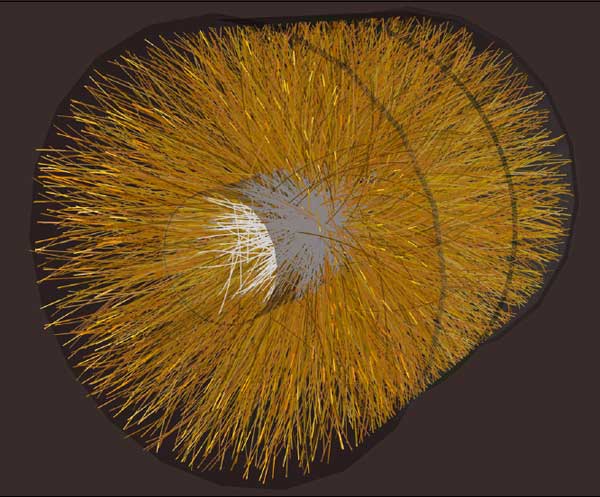
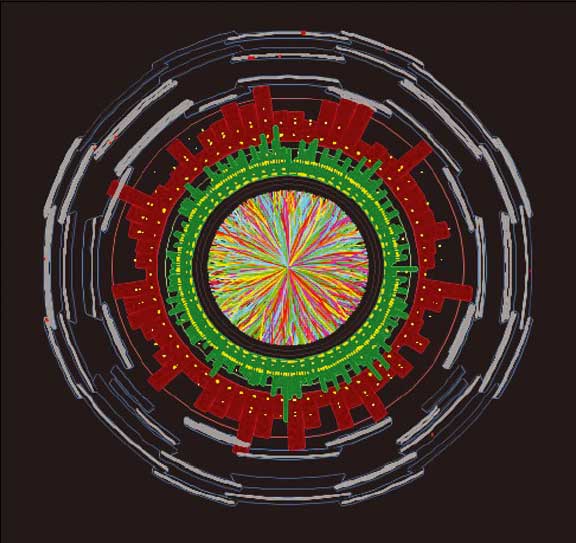
Lead-ion running opens up an entirely new avenue of exploration for the LHC programme, probing matter as it would have been in the first instants of the universe’s existence. One of the main objectives is to produce tiny quantities of such matter, which is known as quark-gluon plasma, and to study its evolution into the kind of matter that makes up the universe today. This exploration will shed further light on the properties of the strong interaction, which binds the particles called quarks, into bigger objects, such as protons and neutrons.

Following the winter technical stop, operation of the collider will start again with protons in February and physics runs will continue through 2011.

bright-rec iop pub iop-science physcis connect