Comsol -leaderboard other pages

Topics

Field Computation for Accelerator Magnets: Analytical and Numerical Methods for Electromagnetic Design and Optimization

By Stephan Russenschuck

Wiley

Hardback: £165 €204 $275

CCboo3_03_11

The LHC is an amazing engineering achievement supported by a long programme of developments. CERN has been encouraging the development of technologies required to complete the project since the late 1960s (for example, the GESSS collaboration between the Saclay, Karlsruhe and Rutherford Laboratories). The quality of this work has been recognized internationally and it has contributed to spin-off activities, especially in the development of superconductors and in magnetic-field computation. With the completion of the LHC, and recognizing CERN’s desire to maintain the competences required to design accelerators, it is the right time to publish a book on the 
computer methods developed to design the LHC magnets.

In this book, Stephan Russenschuck provides an extremely useful and comprehensive description of magnetic-field computation for particle-accelerator magnets. It gives practical information and describes simple methods of analysis; in addition, it includes the abstract mathematics necessary to understand the finite element methods that were developed specifically for the design of the magnets for the LHC’s main ring. The final chapter examines optimization methods, particularly those implemented in the ROXIE software.

The successful design of the LHC magnets required highly accurate field-computation methods that were capable of modelling effects such as conductor and cable magnetization, which are uniquely important to accelerators. Even the LHC’s superconducting magnets quench, when a small resistive volume diffuses rapidly through the coil structure, driven forward by the heat it generates. This book’s chapters describe methods for modelling these effects, and demonstrate the accuracy of the results by comparison with measurements. The appendices include practical information about cryogenic material properties required for quench analysis.

This is a well presented book that makes excellent use of computer graphics to show results and explain phenomena. The graphics showing interstrand coupling currents in conductors and cables are particularly clear and help to make this chapter easy to understand.

Russenschuck has written a valuable addition to the library of those involved in the design of accelerator magnets.

Neutrino

By Frank Close

Oxford University Press

Hardback: £9.99

“Of all the things that make the universe, the commonest and weirdest are neutrinos.” Thus starts Frank Close’s latest book, Neutrino, a fascinating look into one of the most compelling and surprising scientific advances of the past century.

CCboo1_03_11

With its very basic title, a reader might imagine that this book, written by a leading particle theorist, would be an accurate but dry discourse on the eponymous particle. They would be surprised to find a moving book centred on the lives and work of three individuals: Ray Davis, John Bahcall and Bruno Pontecorvo. Neutrino manages to capture not only their impressive scientific contributions but something of their personalities and the times, through an excellent choice of quotes and stories from friends and colleagues. Consequently it is a book that is brief, scientifically accurate and full of drama.

The neutrino’s origins in the early 20th century studies of radiation, stellar astrophysics and neutrino oscillations are all carefully and clearly explained. This book fills in many of the gaps left by more cursory treatments, in particular the road from Wolfgang Pauli’s proposal of the neutrino to the development of the theory of beta decay by Enrico Fermi. But the pedagogic scope is wisely limited and the author does not shy away from leaving the scientific explanations to a footnote if they are incidental to the main storyline.

Neutrino also manages to capture the full spectrum of ideas, events and relationships that play a part in particle physics. The path between brilliant theoretical insight and triumphant experimental verification can be long and precarious. The prosaic (and often deciding) factors – the casual encounter with a colleague that sparks a new idea, incorrect theoretical assumptions identified and corrected, incremental advances in technology, site selection, the vagaries of funding decisions, politics, the role of industrial partners, and just plain luck – are accurately and entertainingly discussed.

That this book succeeds on a number of levels is a credit to the author’s deep knowledge of the physics and his meticulous research, as well as a concise and imaginative writing style. The omission of the LSND and MiniBooNE experiments is the only notable absence, though hardly surprising since the experimental situation here is far from resolved. If the signatures of antineutrino appearance from these experiments stand up to further investigation, neutrinos will have proved to be even weirder than we thought and will provide the author with rich material for a second edition.

Beams are back in the LHC

CCnews1_03_11

The LHC is back in action again after the technical stop that began on 6 December, with initial preparations for the 2011 run in full swing. On 19 February the previous few weeks of careful preparation paid off, with circulating beams being rapidly re-established. There then followed a programme of beam measurements and re-commissioning of the essential subsystems. The initial measurements show that the LHC is in good shape and magnetically little-changed from last year. The first collisions of 2011 were produced on 2 March, with stable beams and collisions for physics planned for later in the month.

In addition to the maintenance work, a number of modifications were made to the LHC during the technical stop. These included the installation of small solenoids to combat the build-up of electrons inside the vacuum chamber with increasing proton beam intensity; the replacement of a number of uninterruptible power-supply installations for essential systems such as the cryogenics; the installation of additional capacitors on the quench-protection system to prepare for a possible increase in beam energy in 2011; plus a host of other improvements to RF, beam instrumentation, power convertors and kickers, etc.

During the same period similar maintenance took place on the injector chain, namely LINAC2, the Booster, the Proton Synchrotron (PS) and the Super Proton Synchrotron (SPS). An example of this work is the programme to exchange eight magnets in the SPS machine. This is part of regular preventive maintenance in which the SPS magnets are exhaustively tested at the end of each year and those presenting any initial signs of weakness are changed during the accelerator stop.

At the PS, the technical stop was used to begin the commissioning of the new PS main power supply (POPS), which will replace the old rotating machine that has powered the PS magnets since 1968. The PS power supply must be capable of delivering extremely high-power (60 MW) electrical pulses to the magnets and then reabsorbing the energy at each accelerator cycle, less than 2s later. The rotating machine has been replaced by an enormous system of power converters and capacitors. The system is crucial because the PS is one of the lynchpins of CERN’s accelerator complex and any failure in the electrical system would practically paralyse all of the experiments.

POPS was inaugurated and tested on 10 SPS test magnets in 2010 and then hooked up to the 101 PS main magnets for testing on 31 January 2011. This system was tested with gradually increasing intensities, right up to 6000 A. It then took a few days to pass the operation of POPS from the specialists controlling it locally to the CERN Control Centre prior to the crucial beam test on 11 February.

Simon van der Meer 1925–2011

CCnew2_03_11

Many people in the high-energy physics community were deeply saddened to learn that Simon van der Meer passed away on 4 March. A true giant of modern particle physics, his contributions to accelerator science remain vital to the operation of accelerators such as the LHC.

Simon studied electrical engineering at Delft University. After a short time with Philips, he came to CERN in 1956 and remained with the laboratory until his retirement in 1990. He is best known for his invention of stochastic cooling, which made possible the conversion of CERN’s Super Proton Synchrotron to become the world’s first proton–antiproton collider. He was awarded the Nobel Prize in Physics, jointly with Carlo Rubbia, in 1984 for the decisive contributions to this project, which led to the discovery of the W and Z particles.

Simon also developed the magnetic horn, which allows the production of focused beams of neutrinos, as well as the eponymous technique to measure luminosity in particle colliders: “van der Meer scans”.

A full tribute and obituary will appear in a later issue of CERN Courier.

PAMELA data challenge theory for cosmic-ray acceleration

CCnew3_03_11

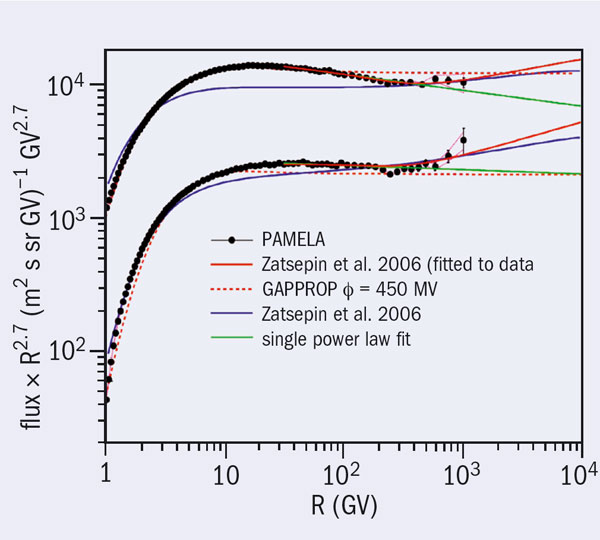
The satellite experiment Payload for Antimatter Matter Exploration and Light-nuclei Astrophysics (PAMELA) has reported finding differences between the shapes of the energy spectra of protons and helium nuclei in the cosmic radiation. The data thus seem to go against the generally accepted idea that cosmic rays gain their energy through acceleration in the remnants of supernovae, prior to diffusing through the Galaxy. The collaboration argues that more complex processes are needed to explain their observations.

PAMELA, which is run by a collaboration between several Italian institutes with additional participation from Germany, Russia and Sweden, went into space on a Russian satellite launched from the Baikonur cosmodrome in June 2006. The experiment consists of a magnetic spectrometer comprising a silicon tracker in a 0.48 T field produced by a permanent magnet, together with a time-of-flight system, an electromagnetic silicon-tungsten calorimeter, a “shower-tail catcher” scintillator and a neutron detector, all of which are shielded by an anticoincidence system. Its six-plane double-sided silicon micro-strip tracker provides information on absolute charge and track-deflection. The silicon-tungsten tracking calorimeter and the neutron detector are used in performing lepton–hadron discrimination.

The recent report is based on precision measurements of the proton and helium spectra in the rigidity range 1 GV–1.2 TV, which indicate that the spectral shapes of the two species are different and cannot be well described by a single power law. This challenges the conventional wisdom on the acceleration and propagation of cosmic rays. The data reveal a hardening in the spectra around 200 GV, which the collaboration says could be interpreted as an indication of different populations of cosmic-ray sources. One example of a multi-source model cited in the report published in Sciencexpress is that by V I Zatsepin and N V Sokolskaya (the blue curves in the figure), which considered novae stars and explosions in “superbubbles” as additional cosmic-ray sources.

AIDA makes EU-funded access to European facilities available

CCnew4_03_11

Access to six European test facilities is now available as part of a new EU project funded by the FP7 Capacities Programme. The Advanced European Infrastructures for Detectors at Accelerators (AIDA) project was launched in February and will last for four years.

Three of AIDA’s nine work packages are dedicated to transnational access. Under this scheme, researchers from EU member states (including FP7-associated countries) can apply for access to facilities at DESY, CERN, the Jožef Stefan Institute (JSI), the Université catholique de Louvain (UCL) and the Karlsruhe Institute of Technology (KIT). Access is offered free to the users. In addition, travel and subsistence costs can be covered by the EU funding. The majority of the user group must not be based in the same country as the facility (CERN, as an international organization, is not subject to this requirement). In addition, the research team should publish the results from the experiments carried out at the AIDA facility.

The primary criterion for selection of a proposal will be scientific merit but factors such as previous use of the facility and availability of similar facilities in the user’s home country will also be taken into account. User groups who have not accessed such facilities before are strongly encouraged to apply to this scheme.

At DESY there will be access to test beams of electrons with energies of up to 6 GeV. One of four different test areas can be used for the work. All areas have magnet control to select momentum and access to beam telescopes can be provided on request.

In the CERN East Area there will be access to several beam lines providing protons, neutrons or mixed particles with energies in the range 1–25 GeV. In the North Area, proton and electron beams of several hundred giga-electron-volts are available.

There is also access to three European irradiation facilities. At JSI in Slovenia, access to the Triga-Mark-III reactor will provide neutron irradiation facilities. At UCL in Belgium access to deuterons and protons will be available. Protons for irradiation will also be available at KIT in Germany.

ALICE gets with the flow

CCnew5_03_11

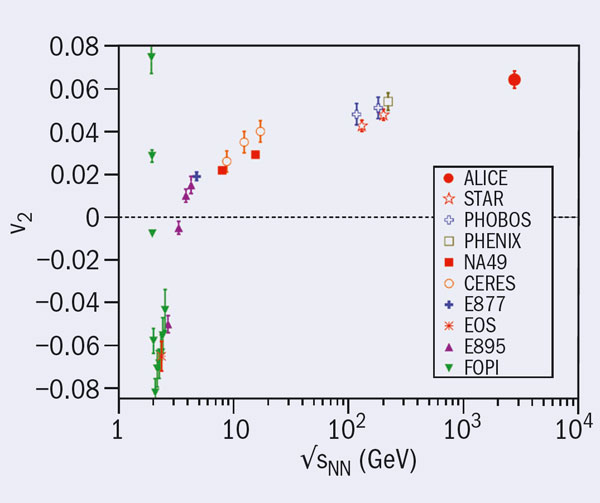
With data from the first heavy-ion run at the LHC, the ALICE collaboration has made the first observation of elliptic flow of charged particles in lead-lead collisions at 2.76 TeV per nucleon pair.

Flow is an interesting observable because it provides information on the equation of state and the transport properties of matter created in a heavy-ion collision. The azimuthal anisotropy in particle production is the clearest experimental signature of collective flow; it is caused by multiple interactions between the constituents of the created matter and the initial asymmetries in the spatial geometry of a non-central collision. The second Fourier coefficient of this azimuthal asymmetry is known as elliptic flow.

The magnitude of the elliptic flow depends strongly on the friction in the created matter, which is characterized by the ratio of shear viscosity to entropy ratio: η/s. A good fluid, such as water, has a small value of η/s and supports flow patterns such as waves in the ocean. By contrast, in a poor fluid, such as honey, flow patterns disappear quickly. Measurements of elliptic flow at the Relativistic Heavy Ion Collider (RHIC) at Brookhaven already revealed the fascinating fact that the hot and dense matter created in the collision there flows as a good fluid with almost no friction.

Surprisingly enough, the first theoretical calculation of η/s in heavy-ion collisions did not come from lattice QCD or transport theory – but from string theory. First calculations showed that in a strongly coupled N = 4 supersymmetric Yang Mills theory with a large number of colours, η/s can be calculated using a gauge gravity duality. The famous anti-de Sitter/conformal field theory (AdS/CFT) conjecture yields a ratio of η/s = h/4πkB, which was argued to be a lower bound for any relativistic thermal field theory.

At RHIC, a precise determination of the friction in the partonic fluid is complicated by uncertainties in the initial conditions of the collision, the relative contributions from the hadronic and partonic phase, and the unknown temperature dependence of η/s. Because this temperature dependence is unknown, it was not even clear if the elliptic flow would increase or decrease when going from RHIC to the LHC. A measurement of elliptic flow at the LHC was therefore one of the most anticipated results.

The measurements at 2.76 TeV by ALICE show that the elliptic flow of charged particles increases by about 30% compared with flow measured at the highest RHIC energy of 0.2 TeV. This result indicates that the hot and dense matter created in these collisions still behaves like a fluid with almost zero friction, providing strong constraints on the temperature dependence of η/s.

This first measurement also shows that elliptic flow – and thus the properties of the created matter – can be studied with unprecedented precision at the LHC. This is because of the increase in particle multiplicity compared with RHIC and the increase in the elliptic flow itself.

ATLAS goes in search of new physics

CCnew6_03_11

Only a few months after the end of the 2010 data taking, the ATLAS experiment is entering its discovery phase at the LHC. The collaboration has already released its first results on the full data for searches for the Higgs boson, for supersymmetry (SUSY) and for other extensions of the Standard Model. The sensitivity of these results, reported here for Higgs and SUSY, is better than expected from simulation studies made in the past, but so far none of the ATLAS searches have shown signs of new physics.

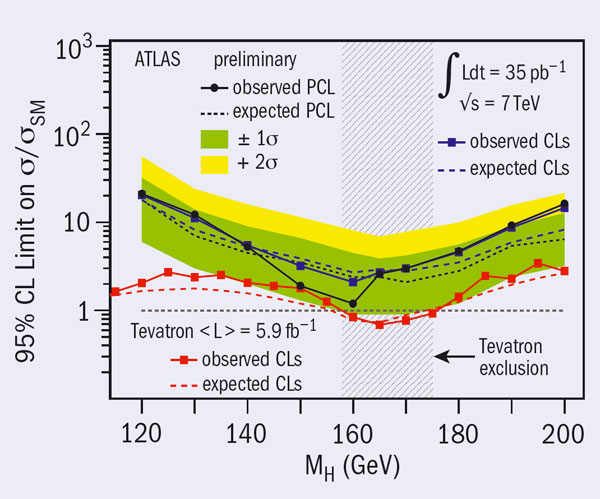
One specific example is the release of the first limits from ATLAS on the Higgs boson production cross-section in the WW decay channel, shown in figure 1 (ATLAS collaboration 2011a). Already with only 35 pb–1 of data, the best expected sensitivity is only 2.4 times that of the predictions from the Standard Model for a Higgs mass of 160 GeV, the region already excluded by experiments at Fermilab’s Tevatron. Excellent detector performance and good control of the backgrounds achieved using data-driven methods resulted in better limits than anticipated. This bodes extremely well for the 2011 run where the very good performance of the detector and analyses, combined with the predicted accelerator performance, should allow ATLAS to draw some much-anticipated conclusions on the search for the Higgs boson.

Another of the very active areas for ATLAS searches is the hunt for particles predicted by SUSY. This conceptually elegant theory predicts that for each known particle of the Standard Model, there exists a super-partner, where the partners of bosons are fermions and vice-versa. The model could also give a suitable candidate for dark matter: a stable neutral super-particle with no decays to known particles.

CCnew7_03_11

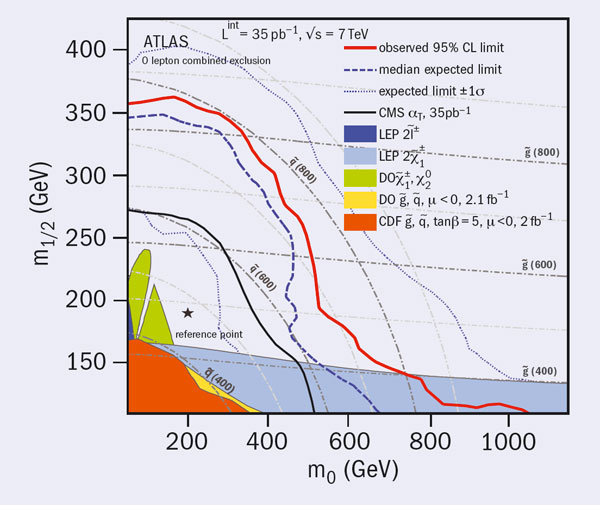
The ATLAS collaboration recently submitted its first results for SUSY searches for publication. One of these searches is in the final state with jets, missing energy and no leptons (ATLAS collaboration 2011b). To make sure no potential signal was missed in this analysis, the search was optimized and carried out combining several different signal topologies. No excess of events over the expected backgrounds is observed. The limits from this study provide the strongest constraints on the mass scales of SUSY to date (figure 2). The interpretation of these results in the minimal supergravity grand unification (mSUGRA) model excludes, at 95% confidence level, super-partners of the gluon and quarks with masses below 775 GeV, assuming they have the same mass.

ATLAS has recently completed many other analyses in the search for evidence for SUSY. These include a search with similar final states but with one (ATLAS collaboration 2011c) or two leptons, as well as a search requiring at least one jet to come from a b-quark. There are also results for searches for the super-partners of the neutrinos decaying into electron-muon final states and for stable hadronizing super-partners of quarks and gluons.

These Higgs and SUSY results are not the complete picture of ATLAS searches. A large number of topologies and final states have been studied, and limits at the tera-electron-volts scale have been set on several scenarios of new physics. These limits are in many cases the most stringent to date. The collaboration anticipates promising opportunities for discoveries with much larger data sets in 2011–2012.

CMS pursues the Higgs boson

CCnew8_03_11

The CMS collaboration has announced its first results on the measurement of the W+W production cross-section and on the related search for the Higgs boson in proton–proton collisions at the LHC at 7 TeV in the centre-of-mass. This is the first paper by CMS that includes searches for the Higgs boson.

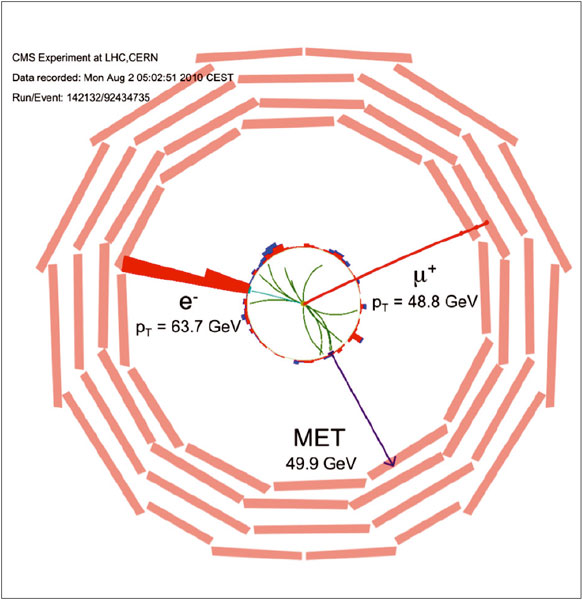
The data used for the analysis, recorded in the 2010 LHC proton runs, corresponds to an integrated luminosity of 35.5 ± 3.9 pb–1. Each W is observed through its decay into a charged lepton (electron or muon) measured in CMS; the corresponding neutrino escapes undetected (figure 1). Thirteen candidates were reconstructed in the data, while a total background was estimated of 3.29 ± 0.45 (stat.) ± 1.09 (syst.) events. The production cross-section was measured to be 41.1±15.3 (stat.) ± 5.8 (syst.) ± 4.5 (lumi.) pb. This is in good agreement with the prediction from next-to-leading-order QCD calculations.

The result is of particular interest because it is highly sensitive to possible non-Standard Model contributions to the self-interactions of the W bosons, specifically the WWγ and WWZ triple gauge boson couplings. It is also an irreducible background in the decay of the Higgs boson to W+W .

CCnew9_03_11

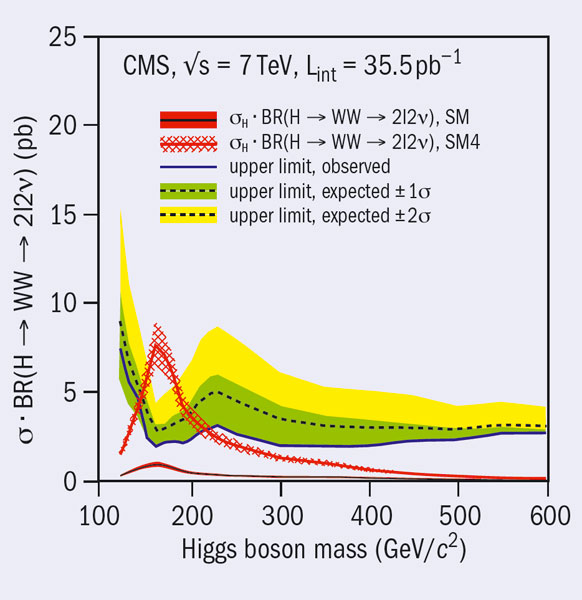
The data from the first year’s LHC run are insufficient to be sensitive to the Standard Model Higgs; for that, at least ten times the number of collisions will be necessary. However, a possible extension of the Standard Model incorporates a fourth family of fermions with very large masses. The presence of this fourth family substantially increases the production cross-section of Higgs bosons via gluon fusion and also alters the decay branching fractions. Higgs production could be enhanced by a factor of about nine, such that Higgs particles could be observed in the 2010 CMS data sample.

To select H→ W+W candidates, the CMS analysis uses additional observables such as the transverse momentum of the leptons, the azimuthal angle difference between the dileptons, and the dilepton mass. The analysis found no evidence of the Higgs boson in the 2010 data sample. This enables the Higgs mass range of 144–207 GeV/c2 to be excluded, at a 95% confidence level, for physics models that include a fourth generation of leptons and quarks. This constraint is more stringent for high masses than similar results from the Tevatron collider at Fermilab.

LHCb sets limits on rare B decays to dimuons

CCnew10_03_11

The decay of B0 and B0s mesons exclusively to dimuons (μ+μ) is one of the most important channels in the search for new physics in the flavour sector at the LHC. In the Standard Model, the decays are rare because they can proceed only by processes involving loop diagrams and are in addition helicity-suppressed. However, new particles, in particular those that arise in models with an extended Higgs sector, can augment the decay rates and thus provide signs of new physics.

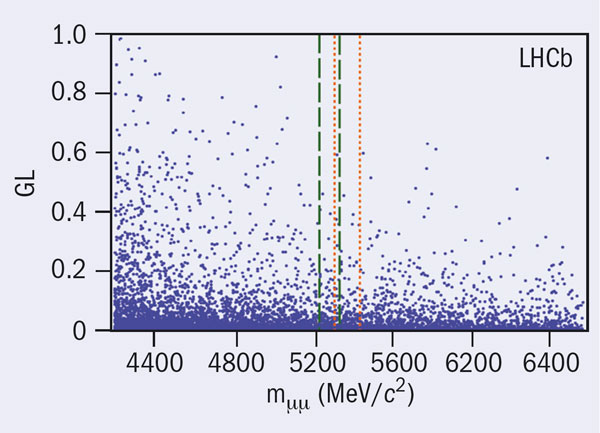
LHCb has published its first results for this important channel after searching for dimuon decays of both B0 andB0s in data collected at the LHC in proton–proton collisions at 7 TeV in the centre-of-mass. For the analysis, the collaboration used data from an integrated luminosity of around 37 pb–1 collected between July and October 2010.

They find no signal for either of the dimuon decays in this data sample: the observed numbers of events are consistent with the expectations for background. This allows the collaboration to place upper limits on the branching ratios for the two decays: B(B0s → μ+μ) < 5.6 × 10⁻⁸ and B(B0 → μ+μ) < 1.5 × 10⁻⁸ at 95% confidence level (CL). This is to be compared with Standard Model expectations of B(B0s → μ+μ) = 0.3 × 10⁻⁸ and B(B0 → μ+μ) = 0.01 × 10⁻⁸.

While there have previously been searches for B0(s) → μ+μ at e+e colliders, the highest sensitivity has so far been achieved at Fermilab’s Tevatron, thanks to the large bb– cross-section at hadron colliders. The most restrictive published limits at 95% CL come from the DØ collaboration’s analysis of 6.1 fb−1, yielding B(B0s → μ+μ) < 5.1 × 10⁻⁸, and the CDF collaboration’s analysis of 2 fb−1 yielding B(B0s → μ+μ) < 5.8 × 10⁻⁸ and B(B0 → μ+μ) < 1.8 × 10⁻⁸.

With less than 40 pb–1, LHCb has therefore already approached the sensitivity of existing measurements. This was possible thanks to the large acceptance and trigger efficiency of the experiment, as well as the increase in the bb cross-section at the higher energy of the LHC. With a much larger amount of data expected in 2011, the experiment should be able to explore smaller branching ratios, down to the interesting level of 10–8.

bright-rec iop pub iop-science physcis connect