A month after restarting in February, the LHC was once again breaking records. Following a period of commissioning, the first run with stable beams for physics at 7 TeV in the centre-of-mass began on 13 March, with a modest three bunches per beam and a luminosity of 1.6 × 1030 cm–2s–1. Then, after further machine-protection tests, the way was opened for increasing numbers of bunches to be introduced in “fills” for physics, culminating with 200 bunches per beam on the evening of 22 March. This gave a peak luminosity at ATLAS and CMS of 2.5 × 1030 cm–2s–1, comfortably beating last year’s record made with 368 bunches. By 25 March, the LHC had delivered an integrated luminosity of 28 pb–1, more than half of the total delivered in 2010.
The next challenge was to have not only more bunches but also at a closer spacing; 2010 saw running with 368 bunches with 150 ns spacing, while the run with 200 bunches this March was with 75 ns spacing. However, combining small bunch spacing with a high number of bunches leads to an effect known as “electron cloud”: synchrotron radiation from the protons releases electrons at the beam-screen, which are pulled towards the protons and knock out more electrons on hitting the opposite wall.
After a brief technical stop for maintenance, the operating team began a period of “scrubbing runs”, in which a high beam current is injected at low energy to induce electron clouds under controlled conditions. The aim is to release gas molecules trapped inside the metal, to be pumped out later, and decrease the yield of electrons at the surface. These runs had already paid off by 10 April when the number of bunches per beam reached 1020, with a total of 1014 protons per beam – another record for the LHC.
The CDF collaboration at Fermilab’s Tevatron has published two measurements that hint at the existence of physics beyond the well tested Standard Model of particles and their interactions. The first measurement revealed an unexpected asymmetry in the production of top/anti-top (tt) quark pairs. The second analysis unveiled surprising evidence for an excess of events that contain a W boson accompanied by two hadronic jets. The excess cannot be due to the long sought-after Higgs boson but could perhaps be explained by new physics ideas.
While both measurements rely on the Tevatron’s unique ability to produce proton–antiproton collisions, if the new physics hinted at in these results does exist, it will manifest itself in some other form in the particle collisions at the LHC at CERN.
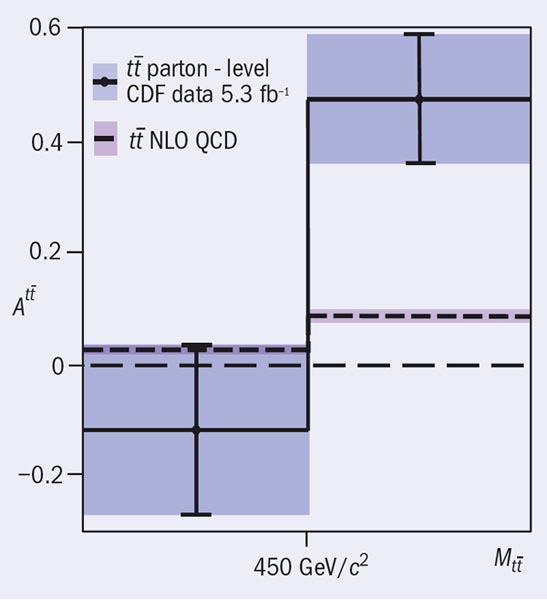
The Tevatron has been producing tt pairs since the early 1990s. In first-order Standard Model calculations, the direction of flight of tt pairs produced in proton–antiproton collisions should be independent of the colliding particles’ charge, thus there should be equal numbers of t and t quarks emitted along either beam direction. More detailed, next-to-leading-order calculations predict an asymmetry of 9 ± 1% at large rapidity, favouring the proton beam’s direction.
CDF announced in March that it measured a tt production asymmetry of 48 ±11% for an invariant mass of the tt pair (Mtt) larger than 450 GeV/c2, which is three standard deviations above the Standard Model expectation. The result is based on the analysis of 5.3 fb–1 of collision data, about half of the number of collisions that CDF has recorded to date. The asymmetries were observed in both the laboratory frame of reference and the tt rest frame. A number of theoretical models predict such asymmetries, including models with a Z’ or large extra dimensions.
The analysis was repeated more recently on events where the t and t quarks decay to a different final state. The asymmetry was again measured at close to a 3 σ level with a value of 0.42 ± 0.15 ± 0.05, averaged over all masses, compared with a 6% Standard Model expectation (T Aaltonen et al. 2011a). This confirms the earlier result with a completely independent data sample.
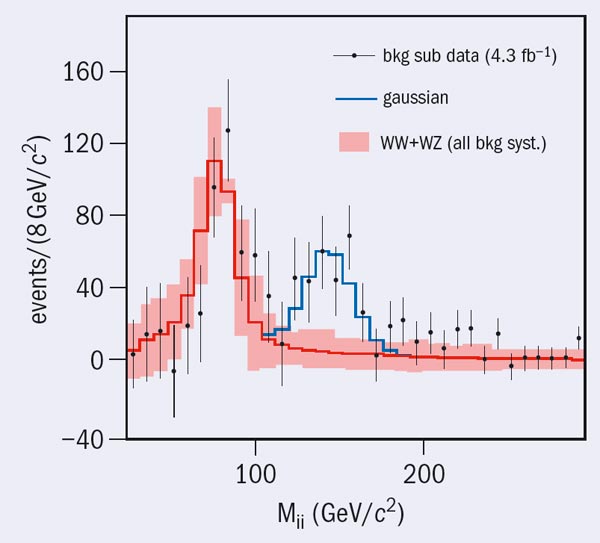
The second surprising result from CDF started out as a routine Standard Model measurement of collisions, where a W boson was detected in coincidence with two hadronic jets. The team found an unexpected peak in the spectrum of the invariant mass of the pair of jets. The excess of approximately 250 events appeared as a bump around 144 GeV/c2 (T Aaltonen et al. 2011b).
The analysis required the presence of a high-transverse-momentum, isolated lepton; a significant amount of missing energy; and two hadronic jets. The invariant mass spectrum of the jet pair shows a clear peak at 80–90 GeV from a W or Z boson decaying into a jet pair. The surprising peak shows up at a higher mass (figure 2). It has a width compatible with the CDF detector resolution and its significance is 3.2 σ, which takes into account systematics and trial factors. If the peak is from a single particle, the particle would have a production cross-section of approximately 4 pb–1.
The peak cannot result from the Higgs boson predicted by the Standard Model. If a Higgs boson had a mass of 140 GeV/c2 and such a large production rate, both the CDF and DØ experiments at the Tevatron would have seen its decay into pairs of W bosons a long time ago. Furthermore, such a Higgs would decay mainly into bottom-quark jets, which are not observed in an appreciable amount in the CDF data peak. There are, however, new physics ideas that predict the appearance of resonances with the observed features, such as technicolour-based models. If the peak does not originate from a new particle, particle physicists will need to reconsider how the Standard Model is used to make precise predictions for the production of a W boson and two jets.
Physicists from CDF and DØ are in the process of analysing larger data samples, up to 10 fb–1, to either refute or confirm these two results. At the same time, they may find even more interesting signals.
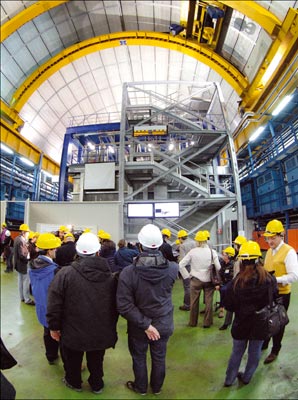
The experiment for Imaging Cosmic and Rare Underground Signals (ICARUS) was officially inaugurated on 29 March at the Gran Sasso National Laboratory (LNGS) of the INFN. The ceremony was attended not only by members of the ICARUS collaboration, but also by representatives from national and local authorities and companies involved in construction, as well as colleagues from other universities and institutes.
ICARUS started operating gradually from 27 May 2010 onwards. It has collected data from the start, recording the tracks of the rare cosmic rays that reach the laboratory, about 1400 m below the Gran Sasso massif and, above all, capturing interactions of the neutrino beam that travels some 700 km through the Earth’s crust from the CERN Neutrinos to Gran Sasso facility. The experiment will use the muon-neutrinos produced at CERN to study the phenomenon of neutrino oscillation, together with the OPERA experiment. In addition, ICARUS will study atmospheric neutrinos and those produced by the Sun, as well as events in the cosmos, such as supernovae explosions and the collapse of neutron stars. Another ambitious objective is the observation of nucleon decay.
ICARUS is the largest liquid-argon detector in the world, the culmination of 20 years of R&D in a project led by the Nobel laureate Carlo Rubbia, the spokesperson and “father” of the experiment. By using liquid argon to detect ionizing particles, the experiment can reconstruct charged-particle tracks and produce high-resolution images of interaction events in real time. Essentially a wire detector immersed in 600 tonnes of liquid argon, it records the passage of charged particles electronically, with the spatial and energy resolution of a bubble chamber, but more quickly.
The ICARUS collaboration comprises physicists from several sections of INFN and Italian university departments (L’Aquila, LNGS, Milan, Naples, Padua, Pavia) as well as groups of physicists from Poland, Russia and the US. The experiment was built in close collaboration with national industries. Cinel Strumenti Scientifici was responsible for the extremely refined mechanics of the detector, which has some 54,000 steel wires strung on huge frames of approximately 4 m × 18 m; the electronics were designed and constructed in collaboration with the CAEN Spa; and the cryostat and cryogenic systems were constructed in co-operation with Air Liquide Italia and Stirling, in the Netherlands.
Research teams think that there is little damage, if any, to the two large particle-physics experiments in the Soudan mine in Minnesota, following a fire in the access shaft on 17 March, which shut down both the mine and the experiments located 800 m underground.
When the fire was detected at around 9 p.m., the fire-protection system shut down the power to the Soudan Underground Laboratory, as designed. No personnel were in the mine at the time. The cause of the fire is believed to be linked to shaft-maintenance work earlier in the day.
Fire fighters extinguished the fire by pumping some 265,000 litres of water and fire-extinguishing foam down the access shaft. Some of the foam entered the caverns of the underground laboratory, which is managed by the University of Minnesota. The laboratory houses the 5000-tonne far detector of the Main Injector Neutrino Oscillation Search (MINOS) experiment, the Cryogenic Dark Matter Search (CDMS) experiment, managed by Fermilab, and several other smaller experiments.
Ten days after the fire, the first crew of scientists returned to the laboratory as electricians began restoring power. Residue of fire-fighting foam was found across large parts of the laboratory, however, researchers from CDMS found no apparent damage to their experiment. During the 10-day power outage, the experiment, which operates ultra-sensitive particle detectors at a temperature of about 50 mk, warmed to room temperature without losing vacuum. When the team turned the power back on, all cryogenic systems functioned as normal.
No water or foam was found on the electronics for MINOS. The experiment’s large electromagnetic coil was partially immersed in water and will be carefully dried out before being used once more. The coil provides the neutrino detector with a magnetic field for charged-particle identification.
There are several smaller experiments in the mine, including the CoGeNT dark-matter search. An assessment of these experiments will be made when full access to the underground laboratory is available.
Complete clean-up, final assessment and restart of the experiments will occur once a new power cable has been installed in the shaft, allowing full power to be restored to the laboratory.
A detailed analysis of observations of Cygnus X-1 by ESA’s International Gamma-ray Astronomical Laboratory (INTEGRAL) has found strongly polarized gamma-ray emission. The polarization suggests that the highest-energy emission from this famous galactic binary is emitted by the jets ejected by the black hole.
Discovered in 1964 with an X-ray sensitive rocket, Cygnus X-1 is the first Galactic binary system for which strong evidence for a black hole was found in the early 1970s. About 7000 light-years away in the Cygnus constellation, the black hole of about 10 solar-masses orbits a blue supergiant star of 35 times the mass of the Sun. This heavy stellar couple is tightly bound. Its separation is five times smaller than the Sun–Earth distance – close enough for the black hole to strip away some of the gas from the outer layers of the star.
The stolen gas falls onto the black hole and forms an accretion disc. Swirling up to relativistic velocities, the plasma in the inner disc is frictionally heated to millions of degrees, thus emitting X-rays. While some of the material will fall inside the event horizon of the black hole, a significant part may escape by following the lines of magnetic field generated by the accretion disc. Evidence of this process comes from the observation of two opposite radio jets, which are presumably ejected on both sides of the disc. This property makes Cygnus X-1 a “microquasar”, which is a Galactic scaled-down version of the massive black holes that power the nuclei of active galaxies.
Cygnus X-1 was the target of INTEGRAL’s first-light observation in November 2002. It has since been the subject of several studies, adding up to about two months of exposure time. Philippe Laurent of the Astroparticles and Cosmology (APC) centre in Paris and colleagues from Europe and the US searched for a polarized signal in this huge dataset.
The study of gamma-ray polarization requires non-standard analysis of the data. A successful technique was developed for the spectrometer of INTEGRAL, allowing the polarized radiation from the Crab Nebula to be measured (CERN Courier November 2008 p11). The current study instead uses the main imaging instrument and selects photons that happen to interact with both of its detector layers. Indeed, gamma rays with energies above around 250 keV can Compton-scatter on electrons in the upper layer and be deflected towards the second layer below. Because the Compton scattering angle depends on the polarization direction of the incident photon, it is therefore possible to measure the polarization properties of the incoming radiation.
Laurent and his team found a strong polarization fraction of 67 ± 30% for gamma rays at the highest detected energies in the 400–2000 keV range. The polarization is much lower in the 250–400 keV band, with an upper-limit of 20%. Spectroscopically, the polarized signal can be attributed to a power-law emission that starts to dominate a thermal-emission component just around 400 keV. A coherent magnetic field is needed to account for the observed polarization and this suggests a jet origin for the high-energy gamma rays.
The authors of the paper published by Science cannot distinguish between a synchrotron or an inverse-Compton origin for this polarized emission component. Synchrotron emission would imply electrons with energies around a few tera-electron-volts, which could then also account – via inverse-Compton scattering – for the tera-electron-volt photons detected from Cygnus X-1 by the MAGIC Cherenkov telescope in September 2006. An alternative, inverse-Compton scenario would correspond to the gamma-ray emission process in the neighbouring microquasar, Cygnus X-3 (CERN Courier January/February 2010 p11).
“Why still do experimental quantum electrodynamics, isn’t everything known?” This provocative question is often heard by the collaborators at one of the smaller CERN experiments, NA63. Their answer is almost as short as the question: it is precisely the fact that everything is supposed to be known that makes it interesting. This understanding enables the exploration of physics in regimes of strong electromagnetic fields, for example as a function of interaction times or in studies of scattering. The results cast light on phenomena in various branches of physics.
Take, as an example, the emission of beamstrahlung, which is expected in the next generation of electron–positron linear colliders, such as the Compact Linear Collider (CLIC) currently under conceptual design at CERN. Particles in a bunch of particles in one beam “see” the electric field in the opposing bunch as boosted by 2γ2–1, where γ is the Lorentz factor. This appears as a strong electric field in the bunch’s rest frame and leads to the emission of intense synchrotron-like radiation, which is known as beamstrahlung. The electric field seen by the particles is comparable to the so-called critical field, which depends only on the reduced Planck’s constant, ħ–, the speed of light, c, and the mass, m, and charge, e, of the electron – m2c3/h–e – and is equivalent to 1.32 × 10¹⁶ V/cm and a corresponding magnetic field of 4.41 × 10⁹ T. In such fields, quantum corrections to the emission of synchrotron radiation become important in determining the emission spectrum. They lead to a strong suppression when compared with the classical calculations that are applicable in most other contexts for synchrotron radiation emission.
Into the laboratory
The effects of strong fields are also relevant in many other branches, ranging from the so-called “bubble-regime” in plasma wakefields used for extremely high-gradient particle acceleration, through astrophysical objects such as magnetars, to intense lasers and heavy-ion collisions. The concept even applies in a gravitational analogue – Hawking radiation. Therefore, further investigation of the underlying phenomena is of broad interest.
Clearly, electric fields of the order the critical field are inaccessible in the laboratory. However, by replacing the opposing bunch in the example of a linear collider by a crystalline target, processes linked to the critical field can be studied with relative ease because the crystalline electric fields are orders of magnitude higher. At small angles of incidence to a crystallographic axis or plane, the strong electric fields of the nuclear constituents add coherently to form a macroscopic, continuous field with a peak value around 1011 V/cm. In the rest frame of an ultra-relativistic electron with γ around 105, the field encountered by the incident particle thus becomes comparable to the critical field.
Applications of these strong crystalline electric fields are widely known, in particular in “channelling”, where a beam of charged particles is steered by the fields within a crystal. This has been used, for example in the NA48 experiment at CERN, to deflect a well defined fraction of the main proton beam for the generation of kaons.
The NA63 experiment, following on from its predecessor, NA43, focuses on fundamental investigations of the strong fields themselves. The results have already shown that the emission of synchrotron radiation in the quantum regime is, indeed, well understood, being strongly suppressed as expected. These results mean that reliable estimates based on QED of beamstrahlung in future machines can now be made. In addition, the spin-flip component of the synchrotron-like radiation that is emitted as the beam passes through the crystal is many orders of magnitude higher in energy and intensity than that of a storage ring, with corresponding polarization times of femtoseconds instead of hours.
Strong scattering effects
The suppression in the emission of radiation arises loosely speaking because the field becomes so strong that the particle is deviated out of the formation zone necessary for the generation of the photon – in effect before it has time to generate the radiation. It is equivalent to a shortening of the formation zone. Although the concept of the formation zone was introduced more than 50 years ago by the Armenian physicist Mikhail Ter-Mikaelian, it is still a surprise to many that it can take time corresponding to macroscopic travel distances for a relativistic electron to emit a photon. This is the basis of the Landau-Pomeranchuk-Migdal (LPM) effect, where multiple scattering within the formation length leads to a reduction in radiation emission.
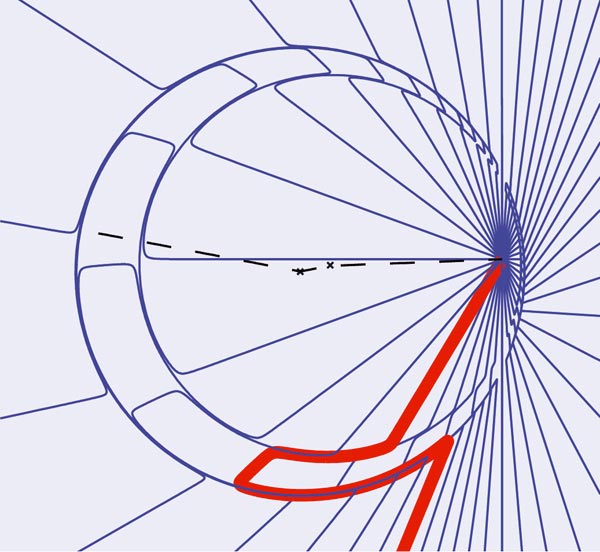
Figure 1 illustrates the suppression mechanism at play. It depicts the electric field from a particle, incident along the dashed line, that has scattered twice (at locations marked by crosses). Outside a radius given by the time since the scattering event, the field points towards the location that the particle would have had if it had not scattered. This is a result of the finite propagation time of information; inside the corresponding sphere, the field follows the particle. The transverse components correspond to radiation and, because of the short time between the scattering events, they are closely spaced and pointing in opposite directions. A distant observer looking at low frequencies will see two electric field lines that mutually cancel – and, therefore, less radiation. It is as if a “semi-bare” electron is interacting.
However, as the NA63 collaboration has recently shown, if a particle impinges on a target that is so thin that the formation zone extends beyond the target, then the LPM suppression is alleviated. To study this effect the collaboration measured the radiation emission from ultra-relativistic electrons in targets consisting of a number of thin foils of tantalum corresponding to 0.03%–5% radiation lengths. They found that, for the thinnest targets, the radiation emission agrees with expectations from the Bethe-Heitler formulation of bremsstrahlung, with the target acting as a single scatterer. Only as the thickness increases does the distorted Coulomb field resulting from the first scattering lead to a suppression of radiation emission in subsequent scattering such that the radiation yield becomes a logarithmic function of the thickness, eventually to become LPM suppression (Thomsen et al. 2010).
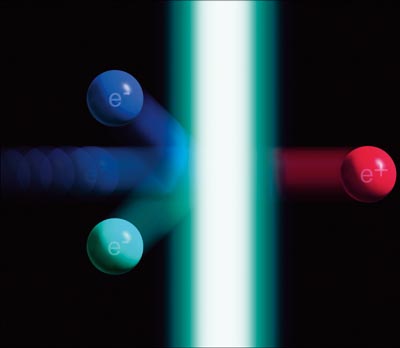
The NA63 collaboration has also studied higher-order processes, such as “trident production”, in which an electron impinging on an electromagnetic field produces a positron–electron pair directly through the emission of a virtual photon. The process is illustrated in figure 2 in a reference frame close to the rest frame of the incident electron, in which the field has the critical value. In the laboratory frame, the original particle plus the pair are all directed forwards in a three-prong pattern, giving rise to the name “trident”. The effect is reminiscent of a phenomenon studied by Oskar Klein and Fritz Sauter 80 years ago – the so-called Klein paradox. Klein was one of the first to do calculations using the celebrated equation of Paul Dirac. In 1929 Klein looked at the probability of reflection of an electron from the steep potential barrier provided by an electric field and found that the probability for transmission into a potential of infinite height approached the velocity of the incident electron in units of the speed of light, i.e. that transmission into a “forbidden” region approaches certainty. Soon after, Sauter found that the process takes place for electric fields beyond the critical field, i.e. when the field is so high that an electron transported over a Compton wavelength produces its rest mass, mc2. Today, this process is understood in terms of pair production at the boundary, but without knowledge of the positron this was an impossible conclusion for Klein, hence the name “Klein paradox”.
Studies by NA63 of trident production, with crystals of germanium a few hundred micrometres thick, have shown a similar phenomenon: that when the crystal is turned to an axial direction along the beam, giving rise to a critical field in the particle’s rest frame, the trident process increases significantly (Esberg et al. 2010). Recent calculations have shown that trident production is an important factor in the design of the collision zone at CLIC, underlining the relevance of these experimental investigations.
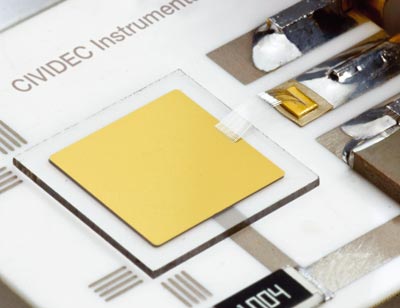
A suppression mechanism also occurs in the case of pair production. In this case mutual screening of the charges in the pair substantially reduces the energy deposition in matter in the vicinity of the creation vertex. Because of the directionality of the pair, at high energies this internal screening – the King-Perkins-Chudakov effect – takes place over a distance of several tens of micrometres. This is a distance comparable to the sensitive layers in a CCD or a silicon vertex detector (figure 3), which can be used to study the effect.
Finally, as Allan Sørensen of Aarhus University has recently calculated, bremsstrahlung from relativistic heavy ions is expected to show a peak-structure connected to the finite size of the nucleus. The detection of this effect is among the future plans of NA63.
So QED still presents challenges, even for the otherwise well known case of radiation emission. In the words of one of the originators of the quantum theory of beamstrahlung, Richard Blankenbecler: “It is surprising that there is so much more to learn about such a well understood process.”
Stories about how technology giants like Hewlett Packard started in a wooden garage appeal to everyone. Private venture capital is constantly searching for the right spin-off or newly founded company to emulate such success stories. Likewise, politicians try to create the right atmosphere for technology-driven projects in the hope of creating jobs and driving economic growth. Institutes like CERN are expected to stimulate this process of rejuvenation by generating new ideas and supporting a high turnover of students and staff to spread those ideas. Most institutes duly hold open days, run technology fairs, compile lists of their in-house technologies, apply for patents and support technology transfer in general.
However, much of technology transfer is possibly more subtle and incremental in nature. It is as if ideas have a life of their own and are working away steadily for years, often through seemingly unconnected events, while the different elements are being assembled. One example that has weaved its way through the activities of CERN and its member states concerns a particle detector using artificial diamond, which is finding an expanding role in the LHC experiments and machine, as well as in other applications.
Following the tracks
The advanced-technology landscape is constantly evolving and there is no absolute beginning or end to any particular development. The action moves from one field to another and is driven forward by different goals at different times. Here, the quest to produce artificial diamond provides an appropriate starting point. This was akin to the search for the philosopher’s stone – recorded efforts date back a hundred years – but the first person to succeed was William G Eversole of the Union Carbide Corporation in the US in 1952. Contrary to intuition and the bulk of earlier work, he used a low-pressure process called chemical vapour deposition (CVD).
The CVD technology made it possible to manufacture diamond coatings, films and precise shapes. Prior to this time, natural diamonds had been demonstrated as UV detectors in the 1920s and as ionizing radiation detectors in the 1940s. The advent of CVD diamond removed limitations arising from size, shape and uncertainty in material characteristics and provided a rich potential for the development of sophisticated particle detectors.
The transition from fixed-target physics to colliding-beam physics during the 1970s stimulated a tremendous growth in the technology of particle detectors, and the requirements for speed and radiation hardness increased with each new collider project. In 1989 the DIAMAS collaboration of the Superconducting Super Collider (SSC) project in the US was the first to propose diamond for its particle trackers. With the closure of the SSC the focus moved to CERN, where the RD42 collaboration for the Development of Diamond Tracking Detectors for High Luminosity Experiments at the LHC was founded in 1994. This collaboration looked into CVD diamond technologies under the leadership of Peter Weilhammer of CERN, Harris Kagan of Ohio State University (and formerly of the DIAMAS collaboration) and William Trischuk, who was a founding member of RD42 and co-spokesperson in the early days.
One important activity in this group was the development of a beam condition monitor (BCM) for ATLAS, under the project leadership of Marko Mikuz. In fact, the first diamond BCM had been proposed and constructed some time earlier by Patricia Burchat of SLAC and Harris Kagan of the BaBar experiment at SLAC. The CMS, ALICE and LHCb experiments quickly followed the lead from ATLAS and installed diamond beam monitors.
Just before RD42 got going, in 1993 Erich Griesmayer, a postdoc working for the AUSTRON study in CERN, nurtured the idea of building a gigahertz particle counter for medical applications and wrote a proposal for its use in hadron therapy. (AUSTRON was an initiative in technology transfer funded by the Austrian government and hosted by CERN to lend its expertise in machine design. It later metamorphosed into MedAustron, which was recently funded for construction in Wiener Neustadt, Austria, but that is another story.) At that time, Griesmayer used silicon for his base calculations, although the material was too slow for what he had in mind.
In 1995, he returned to Austria to head the Department of Electrical Engineering of the Technische Fachhochschule in Wiener Neustadt and later its spin-off company FOTEC. There he pursued his ideas for a counter capable of resolving 109 particles a second, still with hadron therapy in mind. Meanwhile, a fellow postdoc, Heinz Pernegger, was working at MIT in the Laboratory for Nuclear Science for the PHOBOS collaboration, building a silicon detector for the Relativistic Heavy Ion Collider at Brookhaven. Griesmayer and Pernegger found that they had a common interest and Griesmayer and his engineer Helmut Frais-Kölbl built the calibration electronics for PHOBOS. This was the start of a long and fruitful collaboration that continued within the RD42 collaboration. In particular, the pre-amplifiers for the ATLAS BCM were built for CERN by FOTEC.
This was already a successful spin-off story for Austria and CERN, demonstrating how CERN could stimulate hi-tech projects in member states, but history was to be made when the Wiener Neustadt Technische Fachhochschule became a full member of the ATLAS collaboration, supplying electronic components for the readout system of the new diamond BCM. This was an unprecedented move and an inspiration to educational institutions across Europe.
Diamond benefits
Compared with silicon, diamond produces a lower linear density of electron-hole pairs along the incident particle track, but this is more than balanced by the positive effects of much higher electron and hole mobilities and a quasi-zero noise contribution from the diamond (see box). The leading edge of a single-particle pulse can be resolved in tens of picoseconds and individual pulses can be resolved on a nanosecond scale. Diamond is also an extraordinary material for radiation resistance. This is not only from the point of view of damage; diamond also responds linearly to the incident flux and its range is limited by the attached electronics rather than the material of the detector. According to the application, a diamond detector can be configured as a particle-counting ionization chamber or an energy-measuring calorimeter.
The potential of the diamond detector was clear to Griesmayer, who conducted many tests on prototypes with different particles and particle energies at accelerators in Europe and the US. Eventually, he founded his own company, CIVIDEC Instrumentation GmbH, in December 2009, creating a second-generation spin-off. The company now produces beam-monitoring systems based on diamond detectors with ultra-fast, low-noise electronics. It also specializes in the R&D aspects of tailoring the systems to particular problems. CIVIDEC recently collaborated with CERN to instrument the LHC machine with diamond beam-loss monitors.
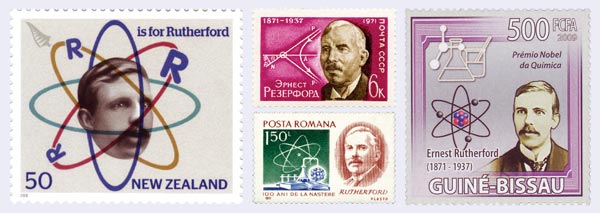
After three degrees and two years of research at the forefront of the electrical technology of the day, Ernest Rutherford left New Zealand in 1895 on a Exhibition of 1851 Science Scholarship, which he could have taken anywhere in the world. He chose the Cavendish Laboratory at the University of Cambridge because its director, J J Thomson, had written one of the books about advanced electricity that Rutherford had used as a guide in his research. This put the right man in the right place at the right time.
Initially, Rutherford continued his work on the high-frequency magnetization of iron, developing his detector of fast-current pulses to measure the dielectric properties of materials at high frequencies and hold briefly the world record for the distance over which electric “wireless” waves were detected. “JJ” appreciated Rutherford’s experimental and analytical skills, so he invited Rutherford to participate in his own research into the nature of electrical conduction in gases at low pressures.
Within five months of Rutherford’s arrival at the Cavendish Laboratory, the age of new physics had commenced. Wilhelm Röntgen’s discovery of X-rays was swiftly followed by Henri Becquerel’s announcement on radioactivity in January 1896. Rutherford capitalized on the new forms of ionizing radiation in his attempts to learn what it was that was conducting electricity in an ionized gas. He soon changed to trying to understand radioactivity itself and with his research determined that two types of rays were emitted, which he called “alpha” and “beta” rays.
Thomson continued mainly studying the ionization of gases. Less than two years after Rutherford’s arrival he had carried out a definitive experiment demonstrating that cathode rays were objects a thousand times less massive than the lightest atom. The electronic age and the age of subatomic particles had begun, though mostly unheralded. Rutherford was a close observer of all of this and became an immediate convert to – and champion of – subatomic objects. Beta rays were quickly shown to be high-energy cathode rays, i.e. high-speed electrons.
For Rutherford, however, there was no future at Cambridge. After only three years there he – as a non-Cambridge graduate – was not yet eligible to apply for a six-year fellowship, so in 1898 he took the Macdonald Chair of Physics at McGill University in Canada. (Cambridge changed its rules the following year.) From then on, the world centre of radioactivity and particle research was wherever Rutherford was based.
At McGill, he showed that radioactivity was the spontaneous transmutation of certain atoms. For this he received the 1908 Nobel Prize in Chemistry. He also demonstrated that alpha particles were most likely helium atoms minus two electrons, and he dated the age of the Earth using radioactive techniques. In studying the nature of alpha particles and by being the first to deflect them in magnetic and electric fields in beautifully conceived experiments, Rutherford observed that a narrow beam of alphas in a vacuum became fuzzy either when air was introduced into the beam or when it was passed through a thin window of mica.
Return to England
With blossoming international scientific fame, Rutherford was regularly offered posts in America and elsewhere. He accepted none because McGill had superb laboratories and support for research, but he was wise enough to let the McGill authorities know of each approach; they increased his salary each time. However, Rutherford also wished to be nearer the centre of science, which was England, where he would have access to excellent research students and closer contact with notable scientists. His desire was noted. Arthur Schuster, being from a wealthy family, said he would step down from his chair at Manchester University provided that it was offered to Rutherford, and in 1907 Rutherford moved to Manchester
At Manchester University Rutherford first needed a method of recording individual alpha particles. He was an expert in ionized gases and had been told by John Townsend, an old friend from Cambridge, that one alpha particle ionized tens of thousands of atoms in a gas. So, with the assistant he had inherited, Hans Geiger, the Rutherford-Geiger tube was developed.
Many labs at the time were studying the scattering of beta particles from atoms. People at the Cavendish Laboratory claimed that the large scattering angles were the result of many consecutive, small-angle scatterings inside Thomson’s “plum pudding” model of the atom – the electrons being the fruit scattered throughout the solid sphere of positive electrification. Rutherford did not believe that the scattering was multiple, so once again he had to quantify science to undo the mistaken interpretations of others.
Geiger was given the task of measuring the relative numbers of alpha particles scattered as a function of angle over the few degrees that Rutherford had measured photographically at McGill. However, photography could not register single particles. Nor was the Rutherford-Geiger detector suitable for “quickly” measuring particles scattered over small angles; it was not sensitive to the direction of entry of the alpha particle and all that they observed was the “kick” of a spot of light from a galvanometer. Yet one of the reasons for developing the Rutherford-Geiger tube had been to determine whether or not the spinthariscope invented by William Crookes did, indeed, register one flash of light for every alpha particle that struck a fluorescing screen.
So, Geiger allowed monochromatic alpha particles in a vacuum tube to pass through a metal foil and onto a fluorescing plate that formed the end of the tube. A low-power microscope, looking at about a square millimetre of the plate, allowed the alphas to be counted. It was tiring work, waiting half an hour for the eye to dark adapt, then staring at the screen unblinking for a minute before resting the eye. It is said that Rutherford often cursed and left the counting to the younger Geiger.
Another of Geiger’s duties was to train students in radioactivity techniques and it was Rutherford’s policy to involve undergraduates in simple research. So, when Geiger reported to Rutherford that a young Mancunian undergraduate was ready to undertake an investigation, Rutherford set Ernest Marsden the task of seeing if he could observe alpha particles reflected from metal surfaces. This seemed unlikely, but, on the other hand, beta rays did reflect.
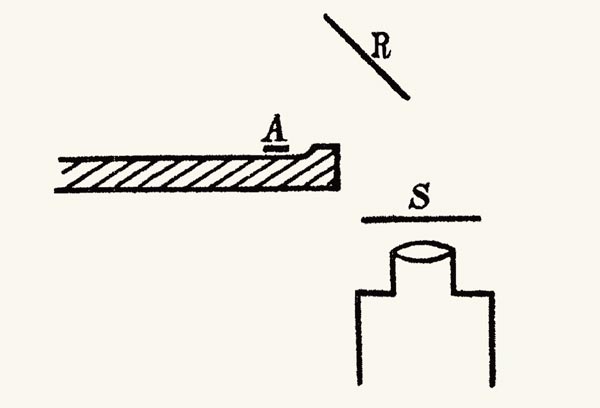
Marsden used the same counting system as Geiger, but had the alpha source on the same side of the metal as the fluorescing screen, with a lead shield to prevent alphas from going directly to the screen (figure 1). When he reported that he did see about 1 in 10,000 alphas scattered at large angles, Rutherford was astonished. As he later famously recalled: “It was as if a 15-inch naval shell had been fired at a piece of tissue paper and it bounced back.”
Geiger and Marsden published their measurements in the May 1909 issue of the Proceedings of the Royal Society, but the study laid fallow for more than a year, while Geiger continued obtaining more accurate results for his small-angle scattering from different materials and various thicknesses of foils. It is said that one day Rutherford went in to Geiger’s room to announce that he knew what the atom looked like. In January 1911 Rutherford was able to write to Arthur Eve in Canada: “Among other things, I have been interesting myself in devising a new atom to explain some of the scattering results. It looks promising and we are now comparing the theory with experiments.”
The nuclear atom
On 7 March 1911 Rutherford spoke at the Manchester Literary and Philosophical Society. Two other speakers followed him: one spoke on “Can the parts of a heavy body be supported by elastic reactions only?”, the other showed a cast of the “Gibraltar Skull”. A reporter from The Manchester Guardian was present and in the edition of 9 March (p3) succinctly paraphrased Rutherford: “It involved a penetration of the atomic structure, and might be expected to throw some light thereon.” Rutherford had asked Geiger to test experimentally his theory that the alpha scattering through large angles varied as cosec4(φ/2). He concluded that the central charge for gold was about 100 units, that for different materials the number was proportional to NA2 (where N was the number of atoms per unit volume and A the atomic weight), and that large-angle scattering (hyperbolic paths) was independent of whether the central charge is positive or negative. The reporter concluded: “…we were on the threshold of an enquiry which might lead to a more definite knowledge of atomic structure.”
Rutherford’s talk was published in the Proceedings of the Manchester Literary and Philosophical Society (Rutherford 1911a) and more fully in the Philosophical Magazine for May (Rutherford 1911b). In the latter, he acknowledged Hantaro Nagaoka’s mathematical consideration of a “Saturnian” disc model of the atom (Nagoaka 1904), stating that essentially it made no difference to the scattering if the atom was a disc rather than a sphere.
The nuclear atom created no great stir among scientists and the public at the time. Three nights after his announcement, Rutherford addressed the Society of Industrial Chemists on “Radium”. The nuclear atom was not mentioned by Sir William Ramsay in his opening address to that year’s meeting of the British Association, although his reported claims of various discoveries caused Schuster – who had stepped down to attract Rutherford to Manchester – to write a letter to The Manchester Guardian stating which of those were discovered by Rutherford.
Rutherford’s busy life continued as normal: accepting a Corresponding Membership of the Munich Academy of Sciences; giving talks on all manner of subjects but the nuclear atom; refuting several claims of cold fusion that came from Ramsay’s laboratory; motoring in the car recently purchased with the money that had accompanied his Nobel prize; and being involved with many organizations, including being a vice-president of both the Manchester Society for Women’s Suffrage and the Manchester Branch of the Men’s League for Women’s Suffrage. (At Canterbury College in New Zealand, his landlady and future mother-in-law was one of the stalwarts who in 1893 had obtained the vote for women in New Zealand.)
Rutherford’s Nobel Prize in Chemistry of 1908 was too recent for physicists to nominate him again for a prize. It was to be 1922 before he was next nominated, unsuccessfully. There have been 27 Nobel prizes awarded for the discovery of, or theories linking, subatomic particles but there was never one for the nuclear atom. However there was a related one. At the end of 1911 Rutherford was the guest of honour at the Cavendish Annual Dinner, at which he was, not surprisingly, in fine form. The chairman, in introducing him, stated that Rutherford had another distinction: of all of the young physicists who had worked at the Cavendish, none could match him in swearing at apparatus.
Rutherford’s jovial laugh boomed round the room. A young Dane, visiting the Cavendish for a year to continue his work on electrons in metals, took an immense liking to the hearty New Zealander and resolved to move to Manchester to work with him. And so it was that Niels Bohr received the 1922 Nobel Prize in Physics for “his services in the investigation of the structure of atoms and of the radiation emanating from them”. He had placed the electrons in stable orbits around Rutherford’s nuclear atom.
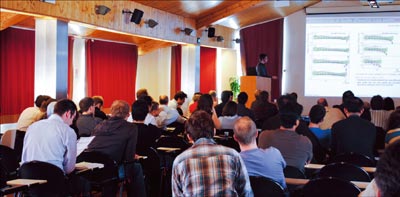
Held in the picturesque mountain setting of La Thuile in the Italian Alps, the international Rencontres de Moriond is one of the most important winter conferences for particle physics. Composed of meetings spread over two weeks, it covers the main themes of electroweak interactions, QCD and high-energy interactions, cosmology, gravitation, astroparticle physics and nanophysics. This article reviews some selected results from the approximately 90 talks presented at the 2011 QCD and high-energy interactions session on 20–27 March.
In the well known spirit of the Moriond meetings, the conference provided an important platform for young physicists to present their latest results. In particular, the sessions this year covered the search for the Higgs boson, the physics of heavy flavours and the top quark, the search for new objects and the first results from the heavy-ion run at the LHC. Lively discussions between theorists and experimentalists followed the presentations and were particularly motivating for the young physicists present.
The LHC had an outstanding first year of operation in 2010, with beam intensity rising systematically over the course of the year. The LHC experiments collected 35–40 pb–1 of proton–proton collision data, of which around 50% were taken during one of the last weeks of proton running. Lead–ion collisions were observed for the first time in November. In 2011 and 2012, most of the run time is planned for physics data-taking, with the aim of collecting 1–3 fb–1 of proton collisions per experiment in 2011.
In the quest for the highest collision energies, the LHC was preceded by the Tevatron at Fermilab in the US. In La Thuile, the collaborations for the CDF and DØ experiments at the Tevatron presented new, combined results, confirming that there is no Standard Model Higgs boson in the mass region between 159 GeV and 173 GeV (95% confidence level). This year, both collaborations also presented exclusion limits within this Higgs-mass region. The Tevatron will end its successful period of data-taking in September. With all of the collected data and improved analyses, the CDF and DØ teams expect to exclude the existence of the Higgs boson in the whole mass region between 114 GeV and 200 GeV – if it does not exist. On the other hand, the experiments will not have enough data to prove discovery if a Higgs does, indeed, exist in this mass region.
The CMS and ATLAS experiments at the LHC cannot yet reach the Tevatron experiments’ level of sensitivity in the search for the Higgs boson. However, within a year and if all goes well and the LHC delivers the expected number of collisions then both CMS and ATLAS will be able to explore the full range between 130 GeV and 460 GeV. If the teams do not see evidence of the Higgs in this wide mass region then they can conclude that no new particle exists with the properties of the Higgs boson and that mass. If a new signal does appear in the data, they will need to wait for more data and improved statistics before confirming any new discovery – but this will happen only in 2012.
The region for a low-mass Higgs, between the 114 GeV limit set by the experiments at the Large Electron–Positron collider and 130 GeV, is more difficult at the LHC. More data time will be needed to exclude or discover the Higgs in this region. The exclusion limits depend on the theoretical calculations of Higgs boson production. The theoretical uncertainties of these calculations formed the subject of a long and interesting discussion between experimentalists and theorists during the Moriond meeting.
One important area of the LHC programme relates to direct searches for new phenomena. The ATLAS and CMS collaborations presented results from the 2010 data-taking period, which show that new physics has not (yet?) been found. However, in many cases the exclusion limits have already surpassed the ones from the Tevatron. The search for new phenomena has always played an important role at the Moriond meetings and is set to become even more so following the increase in luminosity and energy at the LHC.
The LHC experiments are also searching indirectly for new physics. LHCb is doing so through the lens of rare decays of the B particle. This requires high sensitivity of the experimental apparatus and extremely high accuracy in the data analysis. At La Thuile, the LHCb collaboration showed that – after just a few months of operation – their detector has reached a sensitivity that in some cases is already comparable to other detectors that have run for years. These include the measurements of the rare decay of the Bs meson to pairs of muons, where the Standard Model branching ratio is precisely calculated, as well as the mixing frequency in the Bs system. By the end of 2011, LHCb may be able to measure, among other things, the production rate of like-sign muon pairs in B decay. This is important to complement the measurement by DØ, which showed an unexpectedly high matter–antimatter asymmetry in the number of pairs from B0 decay. LHCb should confirm whether or not the observed phenomenon can be associated with new physics.
In early December last year, the first ion–ion collisions at the LHC confirmed the astonishing jet-quenching phenomenon, one of the possible signatures of quark–gluon plasma. For the first time, the LHC experiments could actually see the disappearance of the energy of the recoiling jet that is interacting with the produced medium, providing new insights into the strong interaction through quantitative studies of the dynamics of jet quenching. The Moriond conference provided a good opportunity to discuss the redistribution of the jet energy, which happens over an unexpectedly wide angle, as observed recently by CMS and ATLAS. This is an important step towards understanding jet quenching, as well as the behaviour of the medium in heavy-ion collisions. In another highlight, the ALICE collaboration has found that the effects of the strongly interacting medium at lower particle momenta are stronger than those observed at the Relativistic Heavy Ion Collider (RHIC) at Brookhaven. These recent findings will give valuable input to theorists and improve understanding of the jet-quenching phenomenon, and the LHC will allow the effects of the medium to be studied at high particle momenta.
The top quark was discovered at the Tevatron in 1995 but it has yet to be explored fully because – with its high mass – it sits astride the border between Standard Model physics and new physics. At La Thuile, the CMS and ATLAS collaborations presented for the first time results of their analyses of the whole 2010 dataset. Their sensitivity in measurements of the top cross-section is approaching that of the Tevatron experiments and they are now ready to study other properties of the particle, for example making a precise measurement of the mass. For the time being, the most precise measurements of the properties come from DØ and CDF, but the LHC experiments have already seen the production of single top quarks, something that it took 14 years to observe at the Tevatron.
CDF and DØ have observed significant forwards–backwards tt asymmetries in the proton–antiproton collisions at the Tevatron, particularly at a tt mass above 450 GeV. This could be interpreted as a sign of new physics. The size of the effect is expected to be smaller in the proton–proton collisions of the LHC, so interesting comparisons with the Tevatron are not expected until the end of 2011.
The search for new physics requires an excellent understanding of Standard Model processes. In this respect, the LHC experiments have shown important progress in jet reconstruction and calibration, while theorists have made improvements in higher-order QCD corrections, discussed in detail at La Thuile. The agreement now achieved between experimental measurements and theoretical calculations is setting an important baseline in the search for new phenomena.
Meanwhile, far from the LHC, the Pierre Auger Observatory (PAO) in South America has opened the window to the study of interactions at far higher energies in the cosmic radiation. The PAO collaboration presented evidence of an unexpected effect: the highest-energy cosmic rays may have an important contribution from iron ions. This observation was possible because protons and iron nuclei generate showers of different shapes but confirmation of the effect will require a better understanding of these shower shapes.
During their long history the Rencontres de Moriond meetings have followed advances at the frontier of energy at the Tevatron, the frontier of flavour at the BaBar and BELLE experiments, the frontier in heavy-ions at RHIC and the detailed measurements of structure functions at the HERA electron–proton collider at DESY. This year, the evidence at La Thuile is that these excellent research programmes will all be continued at the LHC and its experiments.
When I first sat down with How to Teach Quantum Physics to Your Dog I was expecting a little light reading, something to pick up on Sunday after lunch. After all, if a dog could understand it, surely someone who has a PhD in physics wouldn’t find it too challenging? I was wrong.
Initially Chad Orzel’s analogies with squirrels and dog wavefunctions are both amusing and enlightening, but as the book moves on they don’t make his subject any clearer. By the time he has reached incoherence it is hard to see how anyone without a good grounding in physics would cope. But it is worth persevering.
Orzel’s style – especially his references to dog treats, bunnies and squirrels – get irritating at times, but despite this I found myself enjoying the book.
To quote Orzel, “quantum mechanics is often subtle and difficult to understand”. His book reminds us why that is, and overall he succeeds in making it a little clearer.
To provide the best experiences, we use technologies like cookies to store and/or access device information. Consenting to these technologies will allow us to process data such as browsing behavior or unique IDs on this site. Not consenting or withdrawing consent, may adversely affect certain features and functions.
Functional
Always active
The technical storage or access is strictly necessary for the legitimate purpose of enabling the use of a specific service explicitly requested by the subscriber or user, or for the sole purpose of carrying out the transmission of a communication over an electronic communications network.
Preferences
The technical storage or access is necessary for the legitimate purpose of storing preferences that are not requested by the subscriber or user.
Statistics
The technical storage or access that is used exclusively for statistical purposes.The technical storage or access that is used exclusively for anonymous statistical purposes. Without a subpoena, voluntary compliance on the part of your Internet Service Provider, or additional records from a third party, information stored or retrieved for this purpose alone cannot usually be used to identify you.
Marketing
The technical storage or access is required to create user profiles to send advertising, or to track the user on a website or across several websites for similar marketing purposes.