Comsol -leaderboard other pages

Topics

Head-to-head technology transfer for hadron therapy

Résumé

MedAustron : un projet de coopération inédit

MedAustron, le projet autrichien d’hadronthérapie, est l’aboutissement d’un long travail dans lequel le CERN s’est investi pour créer, par le biais du transfert de technologies, une communauté au service d’un accélérateur. L’article décrit l’évolution du projet : de sa naissance en 1989 après la chute du mur de Berlin, jusqu’aux premiers coups de pioche, il y a quelques mois. Le CERN, associé à toutes les phases du projet, s’est engagé dernièrement dans une étape essentielle : la formation intensive des équipes pour tous les aspects liés à la conception et à la construction de l’accélérateur.

The fall of the Berlin Wall in November 1989 and the subsequent disintegration of the Iron Curtain ended half a century of division for central Europe. Austria moved abruptly from being on the edge of two large political and economic powers to being at the centre of the reviving central European region. Anticipating the potential of the new situation, Meinhard Regler, of the Austrian Academy of Sciences Institute of High Energy Physics (HEPHY), started to campaign for a centre of excellence for scientific research with an international and multidisciplinary character that would stimulate new growth. In the first instance, the exact definition of the facility was left open. Among the possibilities were a synchrotron radiation facility, a centre for microelectronics and a computing centre, but whichever the final choice the aim was to equip the region with a tool for world-class research and to counter the “brain drain” of young scientists.

A commission chaired by Peter Skalicky, the Rector of the Technical University of Vienna, was set up under the patronage of the Austrian Academy of Sciences to study the project, provisionally called AUSTRON, that would fulfil this role. In spring 1991, at a meeting in Bratislava of the “Pentagonale” – a loose co-operation of states instigated by Austria in November 1989, which consisted of Austria, Czechoslovakia, Italy, Hungary and Yugoslavia – the decision was taken that AUSTRON should be a neutron spallation source. In October of that year the idea was developed further and endorsed by a panel of experts representing more than 50 research institutions, during a working week of the “Hexagonale” held at CERN (the addition of Poland to the Pentagonale in 1991 had created the “Hexagonale”, later to become the Central European Initiative).

Neutrons were an attractive proposition. Apart from “ticking all of the boxes”, neutron diagnostics were considered to be reaching a point where their use would increase sharply, as had been the case with synchrotron light some years earlier. There was also the so-called “neutron drought” that the pending closure of many nuclear reactors was likely to trigger. Carlo Rubbia, then CERN’s director-general, strongly encouraged Austria and – because Austria did not have its own accelerator community – he promised the vitally needed technology transfer from CERN’s accelerator experts.

By the end of December 1992, Erhard Busek, then minister for science and research, officially announced the support of the Austrian government. An international scientific advisory board was set up the following year under the chairmanship of Albert Furrer of the Paul Scherrer Institute (PSI) and a detailed study of the AUSTRON facility took place, hosted by CERN, with the resulting report published in November 1994. Upgrade studies continued into 1998 but sadly the project was faltering and was officially shelved in 2003. It seemed that CERN had lost the chance to stimulate the creation of a new accelerator community in a member state, but the ashes of AUSTRON contained the seed and fertilizer for a second project.

Well before AUSTRON, Robert R Wilson, who was working on cyclotrons at Lawrence Berkeley Laboratory (LBL), had written a paper in 1946 in which he proposed using the behaviour of protons at the Bragg peak (where they deposit most of their energy over a short distance at the end of their trajectory) for cancer therapy and in which he even had the foresight to mention carbon ions (CERN Courier December 2006 p24). LBL went on to pioneer hadron therapy, beginning with protons and helium ions and later, after the commissioning of the Bevalac in 1974, work started in earnest with heavier ion species. It continued for about 15 years until the world’s first hospital-based proton treatment centre, Loma Linda, opened in California in 1990. The accelerator equipment for Loma Linda was built with the help of Fermilab and its director – Wilson. In Europe, the first treatment using protons was performed for a cervical cancer in 1957 at the University of Uppsala, which has continued to be a leading proton-based treatment centre.

Seeds for a new project

In 1988, a two-year study for the European Light Ion Medical Accelerator (EULIMA) began to design a European cyclotron for treating deep-seated tumours with 400 MeV/nucleon carbon ions. CERN participated in this study and contributed an alternative design based on a synchrotron. This alternative design, which investigated advanced ideas for gantries and incorporated expertise gained from the Low Energy Antiproton Ring (LEAR) at CERN, firmly set the synchrotron as the preferred machine for light-ion therapy to the present day. This work inspired Regler together with Horst Schönauer at CERN to include a radio-biological facility in the original AUSTRON design study, so providing the seed for a second project.

Towards the end of the AUSTRON initiative, CERN was under considerable pressure from its own project for the LHC, but there was still a feeling of lost opportunities. Inside AUSTRON, Regler was not ready to give up and was thinking about the medical option, which he called Med-AUSTRON. At the same time, in Italy there was the Terapia con Radiazion Adroniche (TERA) project led by the indefatigable Ugo Amaldi, who was also wondering if CERN could be persuaded to host another study, but this time for a synchrotron for cancer therapy. CERN was particularly well positioned for studying the synchrotron design in view of the extensive R&D that teams there had carried out on slow-extraction schemes in both LEAR and the Proton Synchrotron (PS). These studies ranged from classic quadrupole-driven configurations to exotic ultraslow extractions using stochastic noise. However, it was not a forgone conclusion that CERN would agree in the light of the effort required for the LHC, but the conviction and support of Kurt Hübner, who was then director of accelerators, succeeded in establishing the Proton Ion Medical Machine Study (PIMMS) in the PS Division.

The PIMMS group was formed following an agreement between Med-AUSTRON and the TERA Foundation and was headed by Philip Bryant with expert help from CERN staff. The study group was later joined by Oncology-2000 in the Czech Republic and had a close collaboration with GSI at Darmstadt. The brief was to design a synchrotron-based centre capable of sub-millimetre accuracy for the conformal treatment of complex-shaped tumours by active scanning. Although the centre was to be primarily for carbon ions, protons were to be included. The effort focused first on the theoretical understanding of slow extraction and the techniques to produce a smooth beam-spill. The PIMMS team started work in January 1996 and published their report four years later.

Rise of MedAustron

The acceptance and funding of a project is never a quick process. Unsurprisingly, MedAustron, which had lost its capital letters to stress its independence from AUSTRON, became the subject of a new design study under Thomas Auberger and Erich Griesmayer in Wiener Neustadt, which was published in 2004. By now the weight of the various studies and the excellent proof-of-principle experiments carried out by laboratories such as LBL, GSI and PSI using their own high-energy physics machines, together with the growing involvement of industry, had changed the hadron-therapy landscape. Ion Beam Applications SA in Belgium was already dominating the market for turnkey, cyclotron-based proton facilities and Siemens in Germany was associating with Danfysik in Denmark for the up-and-coming market in carbon-ion machines. Germany was the first European country to fund a carbon-ion centre, with the Heidelberg Ion Therapy Centre; Italy was next with its Centro Nazionale di Adroterapia Oncologica (CNAO) in Pavia; and in 2004 Austria followed suit with the political approval and partial funding of MedAustron (which had now gained an italic front-end) in Wiener Neustadt.

In 2004, the Austrian federal government, the government of Lower Austria and the city of Wiener Neustadt put forward a plan for funding the nonclinical research part of MedAustron and in February 2005, PEG MedAustron GmbH was created under the direction of Theodor Krendelsberger to look after this funding and search for industrial investment partners in a public/private-partnership model for the funding of the medical treatment part. This did not work and the government of Lower Austria stepped forward and assumed the role of the main investor and created the EBG MedAustron GmbH in April 2007 under the direction of Martin Schima and later Bernd Mösslacher to oversee the construction (and future operation) of the facility.

With the conceptual design, funding and business plan in place, the need to formalize the technology transfer for the accelerator design was urgent because Austria had no accelerator community of its own. Discussions with CERN’s director-general at the time, Robert Aymar, and Steve Myers, then Accelerators & Beams Department leader, led to a strategy with three pillars. First, CERN agreed to help by hosting and intensively training the MedAustron team in all aspects of the accelerator design and construction. Second, collaboration agreements were signed with CNAO and PSI, which allowed MedAustron to benefit from the experience of the more advanced Italian project concerning the accelerator complex, as well as from the wealth of knowledge in PSI concerning gantry design and all aspects of medical operation. Some six employees of EBG MedAustron are currently integrated into the PSI activities. Finally, a wider programme of contact and interchanges with strong international partners was set up. This strategy is now well advanced and strongly supported by the current director-general of CERN, Rolf Heuer. Commissioning is expected to start in 2013 and treatments in 2015.

This was not the first time that CERN had hosted a team starting a new facility. In the 1970s, the newly formed European Southern Observatory was given its first home in CERN, followed in the 1980s by the European Synchrotron Radiation Facility. However, in the case of MedAustron, it was the first time that CERN had agreed not only to house a project but also to train the EBG staff by making a CERN staff member, Michael Benedikt, the Technical Project Leader. To date, 35 young engineers have been hired by EBG MedAustron and are working with the experts at CERN to design the MedAustron accelerator complex. The rapid hiring phase was greatly facilitated by the Austrian doctoral student programme, which furnished a third of this intake. Without the doctoral programme, which is funded by the Austrian federal government and has operated in CERN since 1993, it would not have been possible to find so many highly-qualified engineers so quickly.

MedAustron represents the most intensive “head-to-head” transfer of technology that CERN has ever undertaken. In many ways, it is the age-old system of master and apprentice and – as usually happens – the apprentice quickly overtakes the master who looks on proudly.

This is already apparent in the design refinements and new ideas that are being incorporated into the machine. The civil engineering has just started on the site in Wiener Neustadt and in one to two years the young team will fly from the nest at CERN to their new offices. This will be an exciting moment for all involved. For CERN it will mark the first time that an accelerator community has been set up in a member state through technology transfer, surely a reason to celebrate.

TOTEM probes new depths in pp elastic scattering

CCtot1_08_11

Forty years ago, the Intersecting Storage Rings (ISR) at CERN became the world’s first proton–proton collider, transporting the study of particle physics to much higher energies than was otherwise achievable. Now, the same is happening again at CERN as the LHC begins to open up a new high-energy frontier and it is interesting to find out how phenomena discovered at the ISR develop as the collision energy increases.

One of the first discoveries at the ISR was that the total proton–proton (pp) cross-section rises with energy: rather surprisingly, the proton becomes both larger and more opaque. Later, measurements of pp elastic scattering showed further unusual behaviour, revealing a peculiar structure in the variation of the differential cross-section with t, the four-momentum transfer squared. Now, the TOTEM collaboration at the LHC has published its first results on pp elastic scattering, which confirm that the behaviour observed at the ISR continues towards much higher energies.

The differential cross-section measured at the ISR showed a sharp peak at small values of |t| = (0.01–0.5) GeV2 that falls away exponentially to a dip, at about 1.4 GeV2, followed by a broad local maximum that eventually decreases more or less as |t|–8 (figure 1a). Measurements at different centre-of-mass energies in the range 23–62 GeV revealed that the sharp peak at low |t| appears to become narrower (“shrinks”) with rising energies, with the dip moving towards smaller values of |t|, indicating that the radius of the proton (rp2 ˜ 1 / |t|) is, in effect, increasing with energy. However, the power-law dependence at larger |t| values appeared not to depend on energy.

The ISR was also the world’s first proton–antiproton (pp) collider and measurements there showed a similar behaviour for the elastic differential cross-section (figure 1b), but without the pronounced dip, which was replaced instead by a broad “shoulder”. Between the ISR and the start-up of the LHC, the only measurement of pp elastic scattering was performed by the pp2pp experiment at Brookhaven’s Relativistic Heavy Ion Collider at 200 GeV in the centre-of mass over a limited |t| range around 10–2 GeV2. For pp, on the other hand, higher collision energies became available in the 1980s; first at CERN’s Super Proton Synchrotron (546 GeV) and then at Fermilab’s Tevatron (up to 1.96 TeV). Measurements at these energies showed that the pp cross-section continued to exhibit a similar shape as at the ISR, but without a pronounced dip as observed in pp scattering.

CCtot2_08_11

The LHC now presents the first opportunity to follow the behaviour observed at the ISR for pp scattering to higher energies, in particular with the experiment TOTEM, which stands for “TOTal cross-section, Elastic scattering and diffraction dissociation Measurement”. TOTEM is optimized for measuring elastic pp scattering over values of |t| ultimately in the range 0.001–10 GeV2. It can detect protons scattered at small angles by using silicon detectors in Roman Pots – movable insertions in the beam pipe that allow the detectors to be brought close to the beam. The experiment is located at point 5 on the LHC (together with CMS) and there are Roman Pot stations at distances of 147–149 m and 215–220 m from the interaction point. Each station contains two units that are 2–5 m apart and each consists of two pots in the vertical plane, which approach the beam from above and below, and one pot that moves horizontally. Each pot contains a stack of 10 specially designed silicon-strip detectors that have an insensitive region facing the beam of only a few tens of micrometres.

There are 512 strips per detector with 66 μm spacing and the detectors are oriented such that five of the 10 planes per pot are at +45° with respect to the edge near the beam, while the other five are at –45°. The trigger requires collinear hits in at least three of the five planes in each projection. This is implemented by programmable coincidence logic in integrated circuits that are mounted on the detectors and must therefore be radiation tolerant. Elastic candidate events require two reconstructed collinear diagonal tracks.

In a dedicated run of the LHC in October 2010, with only four proton bunches of 7 × 1010 protons per bunch, the TOTEM experiment acquired data for a total integrated luminosity of 6.1 nb–1 at a centre-of-mass energy of 7 TeV. The low-luminosity configuration of the LHC allowed the detectors to be brought in towards the centre of the beam to a distance of only seven times the 1σ width of the beam itself. The collaboration has analysed these data and in July published the first results on elastic pp scattering in the new high-energy region of the LHC.

CCtot5_08_11

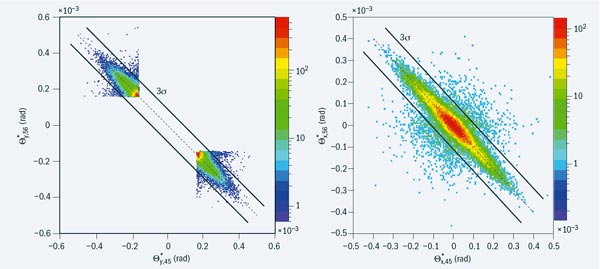
The figure on the front cover of this month’s CERN Courier shows the histogram of the intersection points of the selected tracks in this data set with the Roman-pot silicon detectors at 220 m from the interaction point. The tracks are indicated in the bottom silicon detectors at one side and in the top detectors at the other side of the interaction point, representing the pp scattering configuration; the coloured scale shows the number of tracks on a log scale, from less than 10 in the dark blue to more than 10,000 in the red. The displacement in the vertical direction (less than 2 mm for the red region) is to a first approximation proportional to the vertical scattering angle. With the current LHC beam optics the horizontal scattering angle leads to only a small displacement in the x direction. However, protons that have lost momentum are shifted in the +x direction by the dispersion of the machine. This means that elastically scattered protons remain close to x=0, while those that are diffractively scattered are displaced in the positive x direction (the green region). Already in the raw data, the accumulation of elastic events close to x=0 and near the edge of the detectors is clearly distinguishable from the background mainly from diffractive events. Thus |x| <0.4 mm is the first criterion for selecting elastic candidates.

Vertical and horizontal scattering angles can be deduced from measurements of the track displacement in y and the track angle in x at the Roman pot stations. For collinear tracks on either side of the interaction point, these angles should be the same – as is impressively demonstrated in figure 2. Collinearity cuts at 3σ, as shown in the figure, provide another powerful tool to reduce background further.

From a total of 5.28 × 106 recorded triggers, 293 × 103 events had the required constructed tracks and elastic topology, of which 70.2 × 103 passed the cut in |x| and 66.0 × 103 survived the final collinearity cuts. These events were then used to calculate the differential cross-section, the value of |t| being derived from the measured scattering angle.

CCtot3_08_11

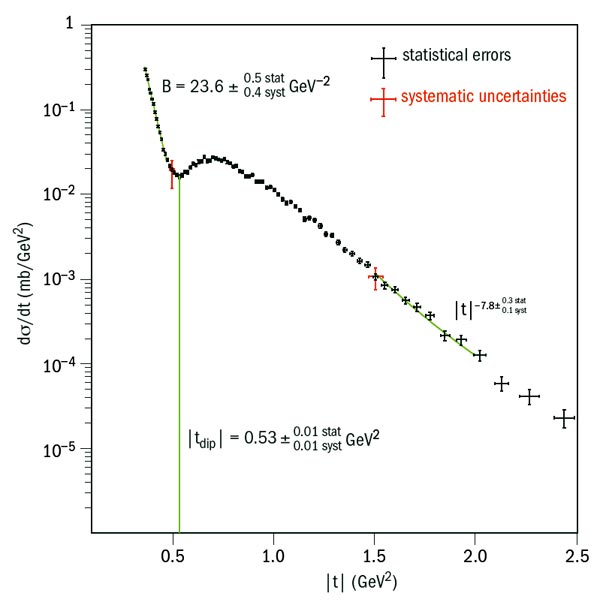
Figure 3 shows the differential cross-section that TOTEM has measured for elastic pp scattering in the |t| range 0.36 < |t| < 2.5 GeV2. It clearly exhibits the global features that were first seen at the ISR. At |t| < 0.47 GeV2 the data show an exponential decrease with a peak at low |t| sharpening with energy and leading to a well pronounced diffractive minimum at |t| = (0.53±0.01 stat.±0.01 syst.) GeV2, followed by a rounded peak that falls away as a power law, |t|–n, where n = 7.8 ±0.3 stat. ±0.1 syst. In particular, the data confirm the trend first observed at the ISR that the dip moves towards smaller values of |t| with increasing collision energy. At the ISR the dip appeared at a value of |t| around 1.4 GeV2; now, at a centre-of-mass energy of 7 TeV – some 100 times higher – TOTEM has found the dip to be near 0.5 GeV2. Interpreting this within the optical model, the proton continues to become larger with energy and consequently the total cross-section should rise further.

CCtot4_08_11

These first measurements of elastic scattering at LHC energies already begin to differentiate between various models. As figure 4 shows the position of the dip and the slopes at smaller and larger |t| agree with the predictions of some models but not with others. However, none of these models is capable of correctly predicting the measured size of the cross-section over the total |t| -range.

For the TOTEM collaboration this marks just the beginning. The experiment has already accumulated 5.8 pb–1 of data in high-luminosity runs that will extend the range in |t| to 4–5 GeV2. Special LHC beam optics for dedicated runs are presently being commissioned to reach much smaller |t| values down to below 0.01 GeV2. This will allow a better extrapolation of the differential cross-section to t = 0. A measurement of the total pp cross-section with a luminosity-independent method based on the optical theorem will then be possible for the first time in this new high-energy region. The TOTEM collaboration is confident that this data taking will start soon and that first results will be available around the end of 2011. Furthermore, diffractive phenomena are on the list of investigations. There is much to look forward to – in more ways than one.

From the Tevatron to Project X

Pier Oddone

The end of September marks the end of an era at Fermilab, with the shut down of the Tevatron after 28 years of operation at the frontiers of particle physics. The Tevatron’s far-reaching legacy spans particle physics, accelerator science and industry. The collider established Fermilab as a world leader in particle-physics research, a role that will be strengthened with a new set of facilities, programmes and projects in neutrino and rare-process physics, astroparticle physics and accelerator and detector technologies.

The Tevatron exceeded every expectation ever set for it. This remarkable machine achieved luminosities with antiprotons once considered impossible, reaching more than 4 × 1032 cm–2s–1 instantaneous luminosity and delivering more than 11 fb–1 of data to the two collider experiments, CDF and DØ. Such luminosity required the development of the world’s most intense, consistent source of antiprotons. The complex process of making, capturing, storing, cooling and colliding antiprotons stands as one of the great achievements by Fermilab’s accelerator team.

As the world’s first large superconducting accelerator, the Tevatron developed the technology that allowed later accelerators – including CERN’s LHC – to push beam energy and intensity even higher. But beyond its scientific contributions, an enduring legacy to mankind is the role it played in the development of the superconducting-wire industry. The construction of the accelerator required 135,000 lb of niobium-titanium-based superconducting wire and cable at a time when annual world production of these materials was only a few hundred pounds. Fermilab brought together scientists, engineers and manufacturers who developed a large-scale manufacturing capability that quickly found huge demand in another emerging field: MRI machines.

The life of the Tevatron is marked by historic discoveries that established the Standard Model. Tevatron experiments discovered the top quark, five B baryons and the Bc meson, and observed the first τ neutrino, direct CP violation in kaon decays, and single top production. The CDF and DØ experiments measured top-quark and W-boson masses, as well as di-boson production cross-sections. Limits placed by CDF and DØ on many new phenomena and the Higgs boson guide searches elsewhere – and continuing analysis of Tevatron data may yet reveal evidence for processes beyond our current understanding. Chris Quigg’s article in this issue gives further details on the Tevatron’s scientific legacy and results still to come (Long live the Tevatron).

As we bid farewell to the Tevatron, what’s next for Fermilab? Over the next decades, we will develop into the foremost laboratory for the study of neutrinos and rare processes – leading the world at the intensity frontier of particle physics.

Fermilab’s accelerator complex already produces the most intense high-energy beam of neutrinos in the world. Upgrades in 2012 will allow the NOνA experiment to push neutrino oscillation measurements even further. The Long-Baseline Neutrino Experiment, which will send neutrinos 1300 km from Fermilab to South Dakota, will be another leap forward in the quest to demystify the neutrino sector and search for the origins of a matter-dominated universe.

The cornerstone for Fermilab’s leadership at the intensity frontier will be a multimegawatt continuous-beam proton-accelerator facility known as Project X. This unique facility is ideal for neutrino studies and rare-process experiments using beams of muons and kaons; it will also produce copious quantities of rare nuclear isotopes for the study of fundamental symmetries. Coupled to the existing Main Injector synchrotron, Project X will deliver megawatt beams to the Long-Baseline Neutrino Experiment. A strong programme in rare processes is developing now at Fermilab with the muon-to-electron conversion and muon g-2 experiments. A strong foundation for Project X exists at Fermilab, with expertise in high-power beams, neutrino beamlines, and superconducting RF technology.

Project X’s rare-process physics programme is complementary to the LHC

Project X’s rare-process physics programme is complementary to the LHC. If the LHC produces a host of new phenomena, then Project X experiments will help elucidate the physics behind them. Different models postulated to explain the new phenomena will have different consequences for very rare processes that will be measured with high accuracy using Project X. If no new phenomena are discovered at the LHC, the study of rare transitions at Project X may show effects beyond the direct reach of particle colliders. Project X could also serve as a foundation for the world’s first neutrino factory, or – even further in the future – as the front end of a muon collider.

In parallel with the development of its intensity frontier programme, Fermilab will remain a strong part of the LHC programme as the host US laboratory and a Tier-1 centre for the CMS experiment, as well as through participation in upgrades of the LHC accelerator and detectors. Fermilab will also continue to build on its legacy as the birthplace of the understanding of the deep connection between cosmological observations and particle physics. The Dark Energy Survey, which contains the Fermilab-built Dark Energy Camera, will see first light in 2012. Better detectors are in development for the Cryogenic Dark Matter Search, and the COUPP dark-matter search is now operating a 60 kg prototype at Fermilab.

As Fermilab’s staff and users say goodbye to the Tevatron, we look forward to working with the world community to address the field’s most critical and exciting questions at facilities in the US, at CERN and around the world.

The Poetry of Physics and the Physics of Poetry

By Robert K Logan
World Scientific
Hardback: £42 $64
Paperback: £30 $43
E-book: $83

CCboo3_08_11

Robert Logan is a physicist who since 1971 has taught an interdisciplinary course, “The Poetry of Physics and the Physics of Poetry”, at the University of Toronto. In this book, which grew out of the course, he introduces the evolution of ideas in physics by first briefly recalling the ancient science of Mesopotamia, Egypt and China before addressing in detail the revolutions that started in the 16th century and the more modern advances, including the birth of the Standard Model of particle physics. Sprinkled with quotations from leading physicists of the respective times, the book reports in an interesting way the historical connections that lead from one discovery to another and the impact physics had on (and received from) other branches of science, philosophy, arts, theology, etc. Thus he hopes to convey not only the poetry or beauty of physics but also how physics has influenced the humanities.

The word “physics” derives from the Greek word phusis, meaning “nature”, and Logan wonders what physics would be without the ancient Greek philosophers. However, even with them, interest in science declined as theology became the dominant concern of the day. It was mainly thanks to René Descartes, who refused to accept past philosophical truths that he could not verify for himself (“Cartesian doubt”), and to other contemporary philosophers, that a change in attitude towards science began to develop in the beginning of the 17th century. During that period, Galileo Galilei, Johannes Kepler and several other scientists uncovered many mysteries of nature, which eventually led to Isaac Newton’s breakthroughs. In return, the philosophy of the British (Locke, Berkeley, Hume) and French (Voltaire, Condillac, Diderot, Condoret) movements was heavily influenced by Newton’s physics: their reflections were based directly on the scientific method.

Moving on, the scientific advances of the 20th century would not have been possible without the abstract mathematical concepts developed in the 19th century or technological breakthroughs such as the invention of the vacuum pump, which paved the way for the study of all gas-discharge experiments and led to the discovery of X-rays and the electron. Logan connects these and other discoveries very naturally, claiming along the way that the distinction between physics and chemistry is artificial and a “historic accident”.

Breakthroughs in science are based on the gift of abstract thinking, astronomy being one of the earliest examples. It is interesting to realize that the structure of certain languages is intimately connected to abstract thinking. According to the Toronto school of thought in communication theory, to which Logan has contributed, “the use of a phonetic alphabet and its particular coding led the Greeks to deductive logic and abstract theoretical science”. This was probably one of the main reasons that “abstract theoretical science is a particular outgrowth of Western culture” – as opposed to Eastern cultures, which use a much more complex alphabet.

Apart from discussing major physics discoveries, Logan also triggers readers (or at least his students) to acquire a critical attitude, quoting thinkers such as Thomas Kuhn and Karl Popper: “Science cannot prove that a hypothesis is correct. It can only verify that the hypothesis explains all observed facts and has passed all experimental tests of its validity.” After all, a physics course is more than just conveying acquired knowledge.

I can gladly recommend this book to anyone wanting to refresh their physics basics or who would like to learn about the implications that physics has for other disciplines, and vice versa. I certainly enjoyed reading it and nostalgically recalled several moments from my undergraduate studies. It is a pity that there are many misprints and some unclear sentences.

Introduction to the Theory of the Universe: Hot Big Bang Theory and Introduction to the Theory of the Universe: Cosmological Perturbations and Inflationary Theory

Introduction to the Theory of the Universe: Hot Big Bang Theory
By Dmitry S Gorbunov and Valery A Rubakov
World Scientific
Hardback: £103 $158
Paperback: £51 $78
E-book: $200

Introduction to the Theory of the Universe: Cosmological Perturbations and Inflationary Theory
By Dmitry S Gorbunov and Valery A Rubakov
World Scientific
Hardback: £101 $156
Paperback: £49 $76
E-book: $203

CCboo2_08_11

When a field is developing as fast as modern particle astrophysics and cosmology, and in as many exciting and unexpected ways, it is difficult for textbooks to keep up. The two-volume Introduction to the Theory of the Early Universe by Dmitry Gorbunov and Valery Rubakov is an excellent addition to the field of theoretical cosmology that goes a long way towards filling the need for a fully modern pedagogical text. Rubakov, one of the outstanding masters of beyond-the-Standard Model physics, and his younger collaborator give an introduction to almost the entire field over the course of the two books.

The first book covers the basic physics of the early universe, including thorough discussions of famous successes, such as big bang nucleosynthesis, as well as more speculative topics, such as theories of dark matter and its genesis, baryogenesis, phase transitions and soliton physics – all of which receive much more coverage than is usual. As the choice of topics indicates, the approach in this volume tends to be from the perspective of particle theory, usefully complementing some of the more astrophysically and observationally oriented texts.

CCboo1_08_11

The second volume focuses on cosmological perturbations – where the vast amounts of data coming from cosmic-microwave background and large-scale structure observations have transformed cosmology into a precision science – and the related theory of inflation, which is our best guess for the dynamics that generate the perturbations. Both volumes contain notably insightful treatments of many topics and there is a large variety of problems for the student distributed throughout the text, in addition to extensive appendices on background material.

Naturally, there are some missing topics, particularly on the observational side, for example a discussion of direct and indirect detection of dark matter or of weak gravitational lensing. There are also some infelicities of language that a good editor would have corrected. However, for those wanting a modern successor to The Early Universe by Edward Kolb and Michael Turner (Perseus 1994) or John Peacock’s Cosmological Physics (CUP 1999), either for study of an unfamiliar topic or to recommend to PhD students to prepare them for research, the two volumes of Theory of the Early Universe are a fine choice and an excellent alternative to Steven Weinberg’s more formal Cosmology (OUP 2008).

EPS-HEP 2011: the harvest begins

CCnew1_06_11

Impressive results, and so much more to come: this is the general feeling that more than 800 participants took home from the International Europhysics Conference on High-Energy Physics, EPS-HEP 2011, which was held in Grenoble on 21–27 July. After only a year of data-taking, the spectacular performance of the LHC and the amazingly fast data analysis by the experiments have raised current knowledge by a huge notch in searches for new physics.

Those who had hoped that the LHC would reveal supersymmetry early on may have been slightly disappointed, although each extended limit contributes to the correct picture and new physics is guaranteed, as many speakers reminded the audience. CERN’s director-general, Rolf Heuer reinforced this point, stating that for the Higgs boson in particular, either finding it or excluding it will be a great discovery.

On the search for the Higgs boson, both the CMS and ATLAS experiments at the LHC have observed small excesses of events in the WW and ZZ channels. Each one is statistically weak but taken together, they become interesting, as each team independently sees a small excess in the low range for the Higgs mass. While this is exactly how a Standard Model Higgs would manifest itself, it is still far too early to tell (The LHC homes in on the Higgs).

Another big topic of conversation was the report by the CDF collaboration at Fermilab of the first measurement of the rare decay Bs→μμ, appearing possibly stronger than predicted. On the other hand, the CMS and LHCb collaborations at the LHC showed preliminary results, which when combined provide a limit in contradiction with the CDF result (CMS and LHCb pull together in search for rare decay). More data will soon clarify what is happening here.

The session on QCD showed great progress in the field, with updates on parton-distribution functions from the experiments at HERA, DESY, as well as several results from the LHC experiments. These measurements are now challenging the precision of theoretical predictions, and will contribute towards refining the Monte Carlo simulations further. The experiments at Fermilab’s Tevatron and at the B-factories also presented improved and impressive limits in all directions in flavour physics, contributing to a clearer theoretical picture.

In neutrino physics, new results came from the T2K and MINOS experiments, giving the first indications of a sizeable mixing angle between the first and third neutrino generations (MINOS and T2K glimpse electron neutrinos). It was particularly moving to see how Japanese colleagues are recovering after the devastating earthquake and tsunami. Atsuko Suzuki, head of the KEK laboratory, thanked the particle-physics community for its extended support.

An important highlight of the conference was the award of the European Physical Society (EPS) High Energy and Particle Physics Prize to Sheldon Lee Glashow, John Iliopoulos and Luciano Maiani. They received this for their crucial contribution to the theory of flavour, currently embedded in the Standard Model of strong and electroweak interactions, which is still of utmost importance today.

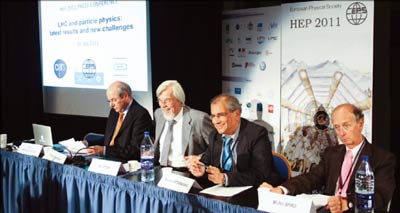
With the first results from significant amounts of data at the LHC, the conference attracted a great deal of interest from the world’s press. A press conference was held on 25 July to announce the EPS 2011 high-energy physics prizes, with contributions on the latest results from the LHC, the European strategy for particle physics, and the latest advances in astroparticle physics in Europe.

• A more detailed report will appear in the October issue of the CERN Courier.

LHC passes 2 fb–1

The LHC is enjoying a confluence of twos. On 5 August the total integrated luminosity delivered in 2011 passed 2 fb–1; the peak luminosity has risen to over 2 × 1033cm–2s–1; and fill number 2006 lasted for 26 hours, delivering an integrated luminosity of 100 pb–1.

Following the period of machine development that started at the end of June, the decision was taken to continue running with 50 ns bunch spacing and the maximum of 1380 bunches. Increases in luminosity must come from increasing the number of protons per bunch, or decreasing the transverse beam size at the interaction point. The size of the beams coming from the injectors has now been reduced to the minimum possible, bringing an increase in the peak luminosity of about 50%.

MINOS and T2K glimpse electron-neutrinos

The T2K and MINOS experiments, which are both designed to study neutrino oscillations over long baselines, have reported results from their searches for the appearance of electron-neutrinos in beams of muon-neutrinos produced at distant locations. On 15 June the T2K collaboration announced that it had observed an indication that muon-neutrinos are able to transform into electron-neutrinos over the 295 km baseline of their experiment in Japan. Ten days later, the MINOS collaboration announced its latest results on the same effect. Both experiments find a non-zero value for the neutrino mixing angle θ13. This would be zero if electron- and muon-neutrinos could not transform into each other.

Oscillations between the three known flavours of neutrino – electron, muon and tau – are described by a mixing matrix, which can be parameterized in terms of three angles, θ12, θ23, θ13, and a CP-violating phase. Observations of oscillations in solar neutrinos and atmospheric neutrinos have determined θ12 and θ23, respectively, leaving θ13 still unknown. The new results provide the first indications that this angle is not zero, via values of sin213.

The collaboration found 88 neutrino events registered in the Super-Kamiokande detector

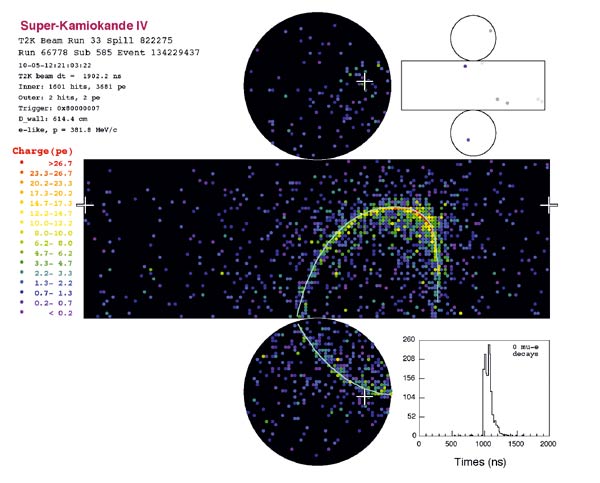
T2K (Tokai to Kamioka) uses the Super-Kamiokande detector in Kamioka to detect neutrinos produced at the Japan Proton Accelerator Research Complex (J-PARC) situated 295 km away. The new results are from an analysis based on all of the data collected between January 2010 – when the experiment began full operation – and 11 March 2011, when it was interrupted by the enormous earthquake in East Japan. This corresponds to a total of 1.43 × 1020 protons on the neutrino-production target. The collaboration found 88 neutrino events registered in the Super-Kamiokande detector, six of which are clearly identifiable as candidate electron-neutrino events. The expectation would be for 1.5 such events in this data sample if neutrino oscillations do not take place. The observation implies the appearance of electron-neutrinos in the experiment, with a probability of 99.3%. At 90% confidence level (CL), the data are consistent with 0.03 < sin213 < 0.28.

MINOS far detector

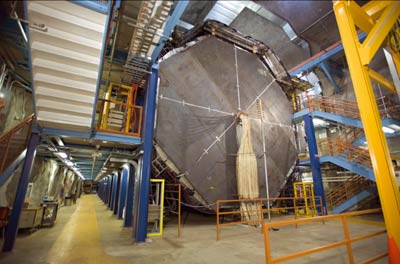
The MINOS (Main Injector Neutrino Oscillation Search) in the US sends a muon-neutrino beam 735 km through the Earth from the Main Injector accelerator at Fermilab to a 5000-tonne detector in the Soudan Underground Laboratory in northern Minnesota. In the recently announced analysis, based on 8 × 1020 protons on target, the collaboration found a total of 62 electron neutrino-like events. Only 48 events would be expected if muon-neutrinos do not transform into electron neutrinos.

Compared with T2K, MINOS uses a different method and a different analysis technique to search for electron-neutrino appearance. The MINOS collaboration extracts 2sin2θ23sin213, and finds that it is less than 0.12 at 90% CL, with a best fit of 2sin2θ23sin213 = 0.04. This improves on results that the collaboration obtained with smaller data sets in 2009 and 2010. The latest results disfavour θ13 = 0 at 89% CL, with a range that is consistent with that measured by T2K.

More work and more data are needed to confirm both these measurements. The T2K experiment collected about 2% of the proposed number of events before the massive earthquake hit in March. Once J-PARC resumes producing muon-neutrinos, which is planned to happen by the end of 2011, the experiment will continue accumulating events. MINOS will continue to collect data until February 2012. In addition, three nuclear-reactor-based neutrino experiments, which use different techniques to measure sin213, are in the process of starting up.

ALICE goes in search of charmonium in the quark–gluon plasma

CCnew4_06_11

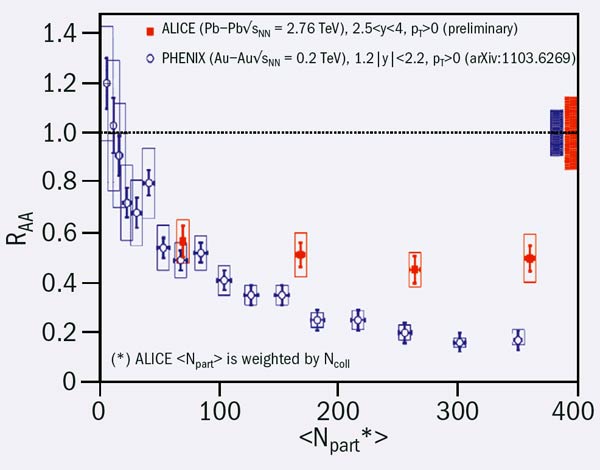
The ALICE collaboration has measured the nuclear modification (RAA) factor of J/Ψ mesons down to a transverse momentum (pT) equal to zero, in lead–lead (Pb–Pb) collisions at √sNN=2.76 TeV, delivered by the LHC in November 2010. The results, presented at the Quark Matter 2011 conference (Heavy ions in Annecy), hint at the recombination of charm and anticharm quarks in the quark–gluon plasma (QGP) formed in heavy-ion collisions at LHC energies.

The ALICE detector was conceived especially for measurements in heavy-ion collisions and is able to study QGP via comprehensive measurements of hadron abundances and correlations as well as of thermal photons. At LHC energies, new mechanisms of charmonium production in the QGP could occur. QCD calculations have predicted that a large number of charm quarks, around 50 c-c pairs, should be produced per central lead–lead collision at √sNN=2.76 TeV. These charm quarks would then coexist with the QGP during its dynamical evolution, like Brownian particles. A number of dynamical transport models predict that c and c quarks could then combine in later stages, leading to an enhancement of charmonium production in the most central Pb–Pb collisions.

ALICE detects charmonium down to pT=0 in two different rapidity domains: |y|<0.9 in the dielectron channel and 2.5<y<4 in the dimuon channel. The detection at low transverse momentum is crucial because the recombination of the charm and anticharm quarks is expected to be the main production mechanism for charmonium at low pT (pT<3 GeV/i>c). The different rapidity domains allow for the study of QGP with different charm densities.

In particular, ALICE has studied the nuclear modification factor, RAA, as a function of collision centrality for J/Ψ mesons. RAA is defined as the ratio of the yield measured in nucleus–nucleus (AA) collisions to that expected on the basis of the proton–proton yield scaled by the number of binary nucleon–nucleon collisions in the nucleus–nucleus reaction. The results from ALICE indicate that the J/Ψ RAA factor appears to show little dependence on centrality (see figure), a trend that is different from that observed at lower energies. The factor for central and mid-central collisions is larger at the LHC than was measured at lower centre-of-mass energy in gold–gold collisions in the PHENIX experiment at the Relativistic Heavy Ion Collider, Brookhaven. In complementary studies, the ATLAS and CMS collaborations at the LHC have measured a smaller J/ΨRAA factor at high pT (pT>6.5 GeV/c).

These observations contrast with expectations from the dissociation of charmonium through the mechanism of colour-screening in the QGP. They hint instead at the recombination of charm and anticharm quarks in the QGP as the main mechanism for J/Ψ production in central Pb–Pb collisions at LHC energies. ALICE’s analysis of J/Ψ production as a function of the pT and rapidity continues and should shed light on the topic soon.

ASACUSA measures antiproton mass with unprecedented accuracy

The Japanese-European ASACUSA experiment at CERN’s Antiproton Decelerator (AD) has reported a new measurement of the antiproton’s mass, accurate to about one part in a thousand million. This means that the measurement of the antiproton’s mass relative to the electron is now almost as accurate as that of the proton.

To make these measurements, the ASACUSA team first traps antiprotons inside antiprotonic helium, in which the negatively charged antiproton takes the place of an electron and occupies a Rydberg state, keeping it relatively far from the nucleus. The antiprotonic helium atoms thus live long enough to allow the frequencies of atomic transitions to be measured by laser spectroscopy. The frequencies depend on the ratio of the antiproton mass to the electron mass and ASACUSA has already used this technique to achieve record precision.

However, an important source of imprecision comes from Doppler broadening of the resonance observed when the laser is tuned to the transition frequency. The atoms move around, so that those moving towards and away from the laser beam experience slightly different frequencies. In the previous measurement in 2006, the ASACUSA team used just one laser beam, and the achievable accuracy was dominated by this effect. This time they have used two beams moving in opposite directions, with the result that the broadening for the two beams partly cancels out.

The resulting narrow spectral lines allowed the team to measure three transition frequencies with fractional precisions of 2.3–5 parts in 109. By comparing the results with three-body QED calculations, they find an antiproton-to-electron mass ratio of 1836.1526736(23), where the error (23) represents one standard deviation. This agrees with the proton-to-electron value, which is known to a similar precision.

bright-rec iop pub iop-science physcis connect