Comsol -leaderboard other pages

Topics

Discovery of accelerating universe wins Nobel prize

CCnew1_09_11

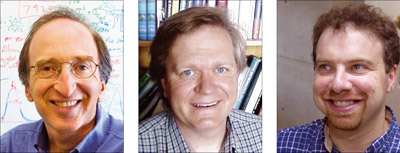
Saul Perlmutter, Brian Schmidt and Adam Riess have been awarded the 2011 Nobel Prize in Physics “for the discovery of the accelerating expansion of the universe through observations of distant supernovae”. Perlmutter, professor of astrophysics at the Lawrence Berkeley National Laboratory and University of California, Berkeley, receives half of the prize, with the other half being shared between Schmidt, distinguished professor at the Australian National University, and Riess, professor of astronomy and physics at Johns Hopkins University and the Space Telescope Science Institute. Their finding led to a dramatic change in perception of the universe by providing evidence for what has become known as “dark energy”.

In 1997 the Supernova Cosmology Project (SCP), led by Perlmutter and the High-z Supernova Search Team, led by Schmidt, were working independently on observations of distant Type 1a supernovae, using them as “standard candles” to measure cosmological distances as a function of time. (All such supernovae have similar intrinsic brightness, so their apparent brightness gives a measure of distance.) They expected to find evidence for a gradual slowdown in the expansion of the universe, resulting from the influence of gravity on the matter it contains.

Instead, the measurements revealed around 50 distant supernovae that appeared to be dimmer than predicted by calculations based on the gravitational effects of matter. In 1997 Gerson Goldhaber – well known in the particle-physics community – was the first person in the SCP team to notice the unexpected effect while plotting the brightness against redshift for Type Ia supernovae that the project had discovered. The same year, Adam Riess, then a research fellow at UC Berkeley who was leading an analysis of supernovae detected by the High-z project, uncovered a similar effect.

The observations pointed to the surprising conclusion that the expansion of the universe is not slowing under the influence of gravity, but is instead accelerating. This in turn implies the existence of some form of gravitationally repulsive “substance”, uniformly distributed across the universe, which counteracts the gravitational attraction of matter. This unknown substance has become known as “dark energy“.

The two teams published their results in 1998–1999 and since then their findings have been confirmed not only by further observations of supernovae but also by detailed measurements of fluctuations in the cosmic microwave background radiation and of baryon acoustic oscillations, i.e. clustering of baryonic matter in the early universe that also serves as a “standard ruler” for cosmological distance scales. All of the evidence suggests that dark energy contributes as much as 73% of the mass-energy content of the universe, with 23% from dark matter and only about 4% from normal baryonic matter – but the nature of both dark matter and dark energy remains unknown.
100 years of superconductivity

In November 1911, Heike Kammerlingth Onnes reported on the abrupt disappearance of resistance in mercury at 4.20 K. To mark the centenary of the discovery of superconductivity, this issue of CERN Courier looks at some of the aspects of its application – in particular in the context of particle accelerators – and at some more anniversaries. It is 75 years since type-II superconductivity was first observed in Kharkov (The discovery of type-II superconductors). Although sadly overlooked for 25 years, this made superconducting magnets a real possibility and led to the Tevatron – the first superconducting synchrotron – (Farewell to the Tevatron) and most recently the LHC, with its particular challenges (Superconductivity and the LHC: the early days), as well as to applications in medical scanners (PET and MRI: providing the full picture). First proposed 50 years ago, RF superconductivity also has an important role in many accelerators (Advances inacceleration: the superconducting way), exemplified in several of the applications of superconductivity at KEK, founded 40 years ago (Progress in applied superconductivity at KEK).

OPERA reports time-of-flight anomaly

The OPERA experiment in Italy’s INFN Gran Sasso Laboratory has sent ripples round the world with its findings that neutrinos created 730 km away at CERN arrive at the detector slightly earlier than if they were travelling at the speed of light.

The result is based on the observation of more than 15,000 neutrino events measured by the experiment, which observes the beam produced by the CERN Neutrinos to Gran Sasso (CNGS) project. Using high-statistics data taken in 2009, 2010 and 2011, the collaboration has measured the velocity of the muon-neutrinos reaching the detector with much higher accuracy than previous studies conducted using accelerator neutrinos. Upgrades to the CNGS timing system and to the OPERA detector, as well as the use of high-precision geodesy to measure the neutrino baseline, allowed the collaboration to achieve comparable systematic and statistical accuracies.

To perform the study, the OPERA collaboration teamed up with experts in metrology from CERN and other institutions to make a series of high-precision measurements of the distance between the source and the detector, and of the neutrinos’ time of flight. The distance between the origin of the neutrino beam and OPERA was measured with an uncertainty of 20 cm over the 730 km travel path. The neutrinos’ flight time was determined with an accuracy of less than 10 ns by using sophisticated instruments, including advanced GPS systems and atomic clocks. The time responses of all of the elements of the CNGS beamline and of the OPERA detector have also been measured with great precision.

The results indicate that neutrinos from CERN arrive early at Gran Sasso by 60.7 ± 6.9 (stat.) ± 7.4 (sys.) ns compared with the time that would be taken assuming the speed of light in vacuum. This anomaly corresponds to a relative difference of the muon-neutrino velocity, v, with respect to the speed of light, c, (v-c)/c = (2.48 ± 0.28 (stat.) ± 0.30 (sys.) × 10–5.

Given the potential far-reaching consequences of such a result, independent measurements are certainly needed before the effect can either be refuted or firmly established. While OPERA continues to gather more data, the MINOS collaboration in the US is planning to improve its measurement of the neutrino time of flight with the beam from Fermilab to the Soudan Underground Laboratory, about 730 km away.

Israel to become an associate member of CERN

CCnew2_09_11

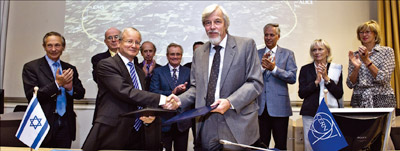
On 16 September, CERN’s director-general, Rolf Heuer, and the Israeli ambassador and permanent representative of Israel to the United Nations Office and other international organizations in Geneva, Aharon Leshno-Yaar, signed a document admitting Israel to associate membership of CERN, subject to ratification by the Knesset. Following ratification, Israel will become an associate member for a minimum of 24 months. Following this period, CERN Council will decide on the admission of Israel to full membership, taking into account the recommendations of a task force to be appointed for this purpose.

Israel has a strong tradition in both experimental and theoretical particle physics, with a major involvement at CERN during the 1990s in the OPAL experiment at the Large Electron–Positron (LEP) collider. Israel’s accession to observer status in 1991 followed an agreement to contribute funds to the CERN budget to support Israeli scientists, as well as providing equipment to CERN. The Israeli fund also contributed to running LEP and supported LHC construction and R&D for future accelerators. During its association with CERN, Israel has in addition supported Palestinian students at CERN, notably sending mixed Israeli–Palestinian contingents to CERN’s summer-student programme.

“It is a vital part of our mission to build bridges between nations. This agreement enriches us scientifically and is an important step in that direction,” says CERN director-general, Rolf Heuer. “I am very pleased that CERN’s relationship with Israel is moving to a higher level.”

In 2009, Israel was accepted as a special observer state, with the right to attend restricted Council sessions for discussions of LHC matters. Israel currently has strong involvement in the ATLAS experiment at the LHC and participates in a number of other experiments at CERN.

Gravitational waves: European detectors keep up the pace

For several years the European gravitational-wave detectors GEO600 (a collaboration between Germany and the UK), close to Hanover, and Virgo (a collaboration between Italy, France, the Netherlands, Poland and Hungary), close to Pisa, have been performing data-taking runs together with the LIGO detectors in the US. About a year ago the LIGO collaboration turned off its detectors to start an important upgrade, so this summer the European detectors joined forces to step up their search for gravitational waves in a last three-month data-taking run before Virgo also shuts down for its own upgrade.

GEO600 and Virgo had the good fortune to be on with an impressive 82% duty cycle at the time of the recent nearby supernova explosion. Unfortunately, the event on 24 August was too far away and of Type 1a, so releasing only a small amount of energy as gravitational waves. Analysis is nevertheless continuing at full speed.

These detectors are kilometre-scale Michelson laser-interferometers that work by measuring tiny changes caused by a passing gravitational wave in the lengths of their orthogonal arms. Laser beams sent down the arms are reflected from mirrors, suspended under vacuum at the ends of the arms, to a central photodetector. The periodic stretching and shrinking of the arms is then recorded as varying interference patterns.

The worldwide detector upgrades that are just starting will be a fundamental step forward. With current sensitivities, the probability of detecting a gravitational-wave burst in one full year of data-taking is estimated to be of the order of a few per cent. The upgrades aim to improve the sensitivities by a factor of 10 with respect to the present values, which should then extend the “listening” distance by a factor of 10. This will increase the volume of universe explored and the detection probability by a factor of 1000, offering the “certainty” of catching several gravitational-wave events a year.

The non-detection of gravitational waves so far has nevertheless allowed the derivation of several important scientific results. For example, important limits have been established on the production of gravitational waves of cosmological origin and by known pulsars. Improving the spin-down limit of the Crab and Vela pulsars should put limits on the ellipticity of the stellar mass-distributions, which are expected to be related to the magnetic asymmetries in these systems.

“Multimessenger” astrophysics has meanwhile begun, looking for coincidences of candidate gravitational-wave signals with gamma-ray bursts and signals from space-borne cosmic-ray detectors as well as neutrino and optical telescopes. Such clues will have paramount importance in studying the sources as soon as genuine gravitational-wave detection becomes routine after 2015, when detector upgrades are expected to be completed.

Kaonic hydrogen casts new light on strong dynamics

CCnew3_09_11

Hadronic bound systems with strange quarks, such as kaonic hydrogen, are well suited for testing chiral dynamics, especially in view of the interplay between spontaneous and explicit symmetry breaking. Effective field theories with coupled channels based on chiral meson–baryon Lagrangians have become well established as a framework for describing K–nucleon interactions at threshold, including much disputed Λ(1405) resonances and deeply bound antikaonic nuclear clusters lying just below the respective thresholds.

A recent precision measurement at the Laboratori Nazionali di Frascati of the strong-interaction-induced shift and width of the 1s level in kaonic hydrogen sheds new light on these basic problems in strong-interaction binding and dynamics. Kaonic hydrogen, in which a K replaces the electron, is produced by the capture of stopped K from the decay of φ mesons in hydrogen gas. The φ mesons are generated nearly at rest at the DAΦNE e+e collider, operating in a new, high-luminosity collision mode.

The shift and width of the kaonic 1s state is deduced from precision X-ray spectroscopy of the K-series transitions in the kaonic hydrogen. The emitted K-series X-rays, with energies of 6–9 keV, were detected by the recently developed Silicon Drift Detector for Hadronic Atom Research by Timing Application (SIDDHARTA) experiment, which performs X-ray–kaon coincidence spectroscopy using microsecond timing and the excellent energy resolution of about 180 eV FWHM at 6 keV of 144 large-area (1 cm²) silicon drift detectors that surround the hydrogen target cell. This method reduces the large X-ray background from beam losses by orders of magnitude. It has led to the most precise values for the 1s level shift, ε1s= –283 ± 36 (stat.) ± 6 (syst.) eV, and width Γ1s = 541 ± 89 (stat.) ± 22 (syst.) eV for kaonic hydrogen (Bazzi et al. 2011).

A recent study using next-to-leading-order chiral dynamics calculations of the shift and the width has shown excellent agreement with these measurements (Ikeda et al. 2011). Further measurements with similar accuracy are planned for the K-series X-rays from kaonic deuterium, using an improved SIDDHARTA-2 set-up to disentangle the isoscalar and isovector scattering lengths.

ALICE revolutionizes TOF systems

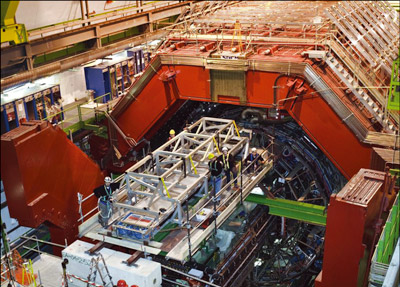
TOF sector in the ALICE

The ALICE detector is optimized to investigate collisions of heavy-ions – in practice lead–lead (Pb–Pb) – in which the production of quark–gluon plasma (QGP), a new state of matter, will provide invaluable insight into the “quark–gluon coloured world”. Many aspects of this new state make particle identification an obligation, especially in the study of strangeness enhancement and heavy-flavour production. One technique developed for ALICE is based on relatively “low-tech” detectors, considering the many areas of frontier technology employed at the LHC, but its performance is proving surprisingly good.

Time-of-flight (TOF) is one of several methods that ALICE uses to identify particles. In the mid range of momenta (0.5–2.5 GeV/c) the TOF array shows an excellent performance in separating pions from kaons. The system is based on the multigap resistive plate chambers (MRPCs), first developed in 1996. When built with small gas gaps, this type of detector shows exceptionally good intrinsic time resolution, below 50 ps – and full efficiency.

The ALICE TOF is made of 1593 MRPCs, each of which is 120 cm long and consists of a double-stack MRPC, with a total of 10 gaps 250 μm wide. The unusual feature of the device, however, is that even though the time resolution is at the cutting edge, the technology itself is relatively low-tech.

The resistive plates are made out of thin (400–550 μm thick) sheets of “soda-lime” glass (window glass) and fishing line is used to create the 250 μm spacing between the sheets. The simplicity of the construction and the relatively low cost allowed the collaboration to build a very large area TOF (around 140 m2) that covers the full ALICE barrel region, with 152 928 read-out pads.

Full exploitation of the extraordinary time resolution of the MRPC requires a suitable electronics chain. For this purpose, the “NINO” chip was developed in collaboration with CERN’s microelectronics group. The chip consists of an ultrafast amplifier and discriminator, which also provide charge information (needed for time-slewing corrections) by means of the time-over-threshold technique.

In addition to its extremely precise time response, the MRPC has low noise (singles rate of 0.06 Hz/cm2), which allows the TOF to be used as a trigger device for both cosmic rays and for collider physics. Another advantage is that all of the MRPC modules are operated at the same voltage and all of the thresholds of the front-end electronics are the same. This is in contrast to TOF arrays based on scintillators, where the high voltage of each phototube has to be carefully tuned.

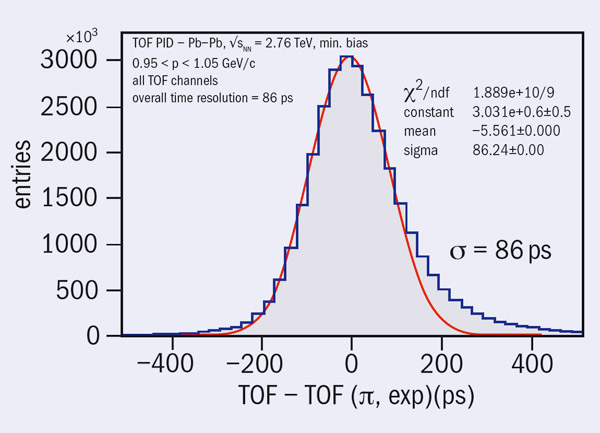
At present the global time resolution achieved in Pb–Pb collisions is 86 ps, including fluctuations on the time-zero of the event and the track length (see figure). This value matches the design goals and provides a fundamental contribution to the particle identification analysis, which is the prominent feature of the ALICE experiment. The time resolution is still being improved and the collaboration is highly motivated to exploit all the possibilities of this extremely precise and stable detector.

Meanwhile, the MRPC has revolutionized TOF technology and many research laboratories and experiments have quickly followed ALICE’s lead. These include the HARP experiment at CERN, the STAR experiment at the Relativistic Heavy Ion Collider and the FOPI experiment at GSI.

The ALICE TOF was built by the University and Sezione INFN of Bologna, the University of Salerno, the Institute for Theoretical and Experimental Physics in Moscow and the Department of Physics at Kangnung National University.

ATLAS looks at vector bosons plus jets…

CCnew6_09_11

While searches with 2011 LHC data for the Higgs and new physics caught the headlines over the summer, detailed studies of 2010 data continue to yield high-precision physics. For example, the ATLAS collaboration has published a number of results on the production of vector bosons (W and Z) based on the full 2010 dataset of 37 pb–1, including measurements that require additional jets in the final state.

The challenge of precision measurements of Standard Model vector-boson production is to understand and control the systematic uncertainties; this contrasts with many analyses that are still dominated by statistical uncertainties and can thus “simply” wait for more data. This challenge will increase in analyses of the larger 2011 data set, where ATLAS will probe higher jet-multiplicities and higher jet transverse-momenta. In addition to precise measurements of electroweak parameters, the study of W and Z bosons at the LHC tests perturbative QCD (pQCD) and it constrains the distribution of partons (quarks and gluons) inside the proton. W and Z bosons are also studied as background to other Standard Model signals and to look for new physics.

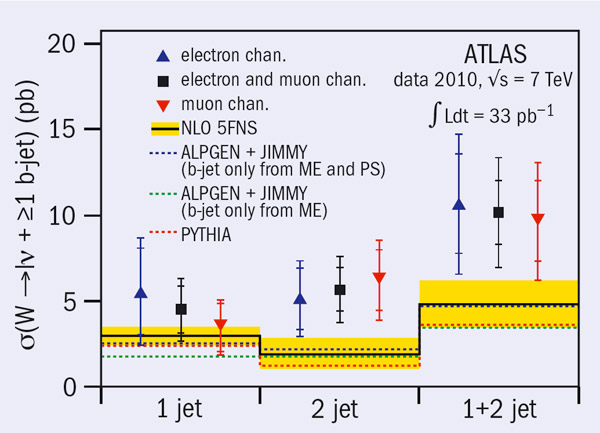
Two recent ATLAS results have focused on the production of a vector boson together with jets from b-quarks. The Z measurement is still statistically limited, while the W measurement is dominated by systematic uncertainties. The cross-section for inclusive Z + b-jets production agrees with next-to-leading-order pQCD calculations. For the production cross-section of a W with one or two b-jets, the results are again consistent within uncertainties, although the value observed is slightly higher than predicted (Fig. 1). These measurements with b-jets not only test pQCD for heavy quarks, they also assess what is a significant background source in searches, for example for associated Higgs production, where H→bb.

CCnew7_09_11

Considering the ratio of cross-sections rather than their absolute value has the advantage that many sources of systematic uncertainty cancel. ATLAS has recently published a measurement of the ratio of W and Z cross-sections with exactly one associated jet, complementing measurements of the individual channels. The ratio is measured as a function of the jet transverse-momentum. The systematic and statistical uncertainties are of comparable size, thereby providing the basis for a precision test of the Standard Model (Fig. 2). The results are in reasonably good agreement with a number of Monte Carlo predictions.

…and measures suppression of single jets in heavy-ion collisions

CCnew8_09_11

While primarily designed for proton–proton collisions, the ATLAS detector is also an excellent tool to perform measurements in the hot, dense environment of heavy-ion collisions, where temperatures reach tera-kelvin scales. So far, results include detailed measurements of collective properties of the system, such as “elliptic flow”, as well as of “hard probes”, such as jets, quarkonia and vector bosons.

Using the initial 2010 heavy-ion collision data from the LHC, the ATLAS collaboration published the first direct evidence that jets lose energy as they pass through the hot, dense medium, a process called jet “quenching”, leading to event-by-event asymmetries in the energies of the two jets. To characterize the effects of quenching from a different perspective, the next major jet measurement in lead–lead collisions undertaken by ATLAS was to establish the overall reduction in the rate of jets in more “central” collisions, where the two nuclei overlap more completely.

For the Quark Matter 2011 conference, ATLAS compared the rates for central events with those in more peripheral events that consist primarily of a few simultaneous nucleon–nucleon collisions. One surprising result is that, for jets above 100 GeV, the measured jet-suppression factor is independent of the measured jet energy. An even more surprising finding is that this result is the same for jets reconstructed with different “cone” radii, implying that the suppression is not accompanied by a substantial modification of the distribution of energy within a jet. By contrast, an ATLAS measurement of W boson yields using single muons showed no suppression at all.

This comparison, shown in the figure, was quantified using the variable RCP, the ratio of yields measured in central and peripheral collisions, each yield normalized by the relevant number of binary collisions. This quantity is unity if jets are produced in proportion to the number of binary collisions, but falls below one if the yields are suppressed in more central collisions.

The higher luminosities expected in 2011 will provide increased jet statistics, allowing the measurement of jets with even higher energies. At the same time, a more precise understanding of the fluctuations of soft particles, mainly from a rich spectrum of collective modes, will allow the measurement of lower-energy jets, which in preliminary results from the Relativistic Heavy Ion Collider show stronger modification from passage through the medium.

New results from CMS on top quarks

CCnew9_09_11

About a year ago, the CMS collaboration released its first publication on studies of the top quark – the measurement of the tt production cross-section at 7 TeV. The measurement was based on a data set of only 3 pb–1 of integrated luminosity and the top quarks were identified through the leptonic decay channels of the W boson. Now, a plethora of results on the top quark based on luminosities of 1–2 fb–1 have been released for the summer conferences, in particular for the TOP2011 workshop, held at the end of September at Sant Feliu de Guixol, Spain.

Top quarks decay almost exclusively into a W boson and a b-flavoured quark jet, leading to different event final states that can be used for selecting tops. Figure 1 gives an overview of the CMS results, which use more or less all of the decay modes. The most precise single measurement is the analysis where one W boson decays into leptons while the second W decays into hadrons and b-quark identification is used, giving a cross-section of 164.4 ± 14.3 pb, i.e. a precision of 8.5%. Precise measurements of the cross-section can also be converted into measurements of the top quark’s mass, within a given theoretical scheme. Currently, the CMS cross-section measurements allow for a precision on the top mass of about 7–8 GeV in such data extractions.

Further new analyses include a measurement of the difference in mass of the t and t, which is an interesting test of CPT invariance. For this study, data are used where one of the W bosons decays into a muon, allowing the event to be classified as t or t decay, depending on the charge of the muon. The difference in mass between the t and t is found to be 1.2±1.3 GeV, i.e. the result is compatible with equal mass within the uncertainty. This is the most precise result on this quantity to date.

Another interesting measurement concerns the charge asymmetry in top production. The experiments at Fermilab’s Tevatron reported asymmetries that are larger than expected. At the LHC, tt production is also slightly asymmetric in rapidity as a result of the different roles that the valence and sea quarks play in the production. CMS has studied this asymmetry by measuring the different widths of the rapidity distribution for t and t. The result gives an asymmetry of 1.6% with an uncertainty of about 3.5%; an asymmetry of about 1.3% is expected from theory. The agreement with the Standard Model is good within the measured uncertainties.

Finally, a challenging new measurement on the electroweak production of single top has been undertaken, namely tW associated production. While single top production in the top-quark channel was reported by the LHC experiments earlier this year, this measurement analyses a different final state; also, this channel is not accessible at the Tevatron. CMS finds an excess over expected background events with a significance of 2.7 σ, and is compatible with the expectation for tW production.

With several tens of thousands of top-quark pairs recorded so far, the detailed study of the properties of the heaviest quark is merely starting. Results based on the full 2011 data sample should be ready in time for the 2012 winter conferences.

bright-rec iop pub iop-science physcis connect