Comsol -leaderboard other pages

Topics

Getting excited about the Higgs?

Main auditorium

Tuesday 13 December 2011 is a day that many will remember. There was high anticipation of what the ATLAS and CMS collaborations would have to say about the latest results on the search for the elusive Higgs boson. Only senior management knew what the other collaboration was going to present, for the rest it was a well kept surprise.
CCnew2_01_12

From 8.30 a.m. onwards, physicists flocked into the main auditorium at CERN and by 10.30 a.m. the place was packed – three and a half hours before the talks even started – and no more people were being allowed in. The atmosphere was almost festive, maybe because the wireless network became saturated so that nobody could work. Similarly eager anticipation could be felt in a separate room where journalists representing the many news agencies and TV channels were able to share in the excitement.

But what was all of the excitement about?

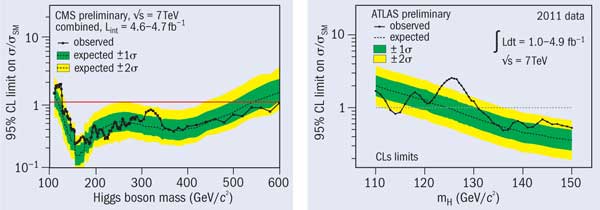
The short answer is that the presentations revealed that if the Higgs boson exists in the manner predicted by the Standard Model, then its mass is most likely between 115.5 and 127 GeV. To be more precise, the CMS collaboration rules out at 95% confidence level a Higgs boson with a mass larger than 127 GeV, while the ATLAS collaboration rules it out for masses below 115.5 GeV and larger than 131 GeV (with a small window of 237–251 GeV in mass not yet excluded by ATLAS). The upper limits on the exclusion region are 468 GeV for ATLAS and 600 GeV for CMS.

The ability to exclude the low-mass region was limited in both experiments by an excess of events around 120 GeV.

The ability to exclude the low-mass region was limited in both experiments by an excess of events around 120 GeV. Such excesses could be just background fluctuations or the first indications of a Higgs signal building up. These results are consistent with what is expected from the statistics accumulated so far, whether the low-mass Higgs exists or not.

The 2012 data campaign, during which the LHC is expected to deliver at least twice as many collisions as in 2011, should put to rest the 40-year quest for the Standard Model Higgs boson via either its discovery or its complete exclusion.

Only a month after the end of proton–proton collisions in 2011, both collaborations showed preliminary results using the full statistics of the year, corresponding to an integrated luminosity of 4.6–4.9 fb–1 – almost twice that shown at the summer conferences. The results unveiled in the presentations in December demonstrate the deep understanding achieved by each collaboration of detector performance and of the numerous backgrounds.

Both spokespeople, Fabiola Gianotti for the ATLAS collaboration and Guido Tonelli for the CMS collaboration, paid tribute in their presentations to the hundreds of physicists – most of them students and young post-docs – who have worked so hard in recent months to improve substantially the understanding of the detectors, in particular under the complex condition of ever increasing pile-up, where as many as 20 interaction vertices were reconstructed in a single event.

As a result of a coin toss by the director-general, Gianotti spoke first. The ATLAS collaboration had concentrated on updating the analyses in the channels that are most sensitive to the low-mass Higgs boson: H→γγ and the “golden channel”, H→ZZ→llll, where l indicates an electron or a muon. An update of the H→WW search with the data collected for the summer conferences was also shown. While in the first two channels the Higgs boson would be seen as a narrow peak on top of a broad background, the presence of the Higgs boson in the third channel would be seen as a more broad excess of events.

Tonelli then took the stage and presented a full array of CMS analyses – all including the full 2011 statistics – starting with the ones sensitive to the highest Higgs masses, H→ZZ →(llqq), (llνν), (llττ), continuing with H→WW, H→ττ, H→bb and finishing with H→γγ and the golden channel H→ZZ→ llll.

The energy and angular resolutions of the electromagnetic calorimeters are the key ingredients in the analysis of H→γγ, which is potentially the single-most sensitive mode in the low-mass region. The better the resolution, the narrower the peak in the invariant-mass distribution of the two photons and the easier it will be to see the Higgs, if it exists.

Despite having two different detector technologies – ATLAS uses a liquid argon sampling calorimeter, while CMS relies on crystals – the mass resolution obtained in both experiments in the channel with the best resolution is 1.4 GeV. For CMS, good mass resolution is possible thanks in particular to the major progress that has been achieved in understanding the calibration of the crystal calorimeter; in the central area of the calorimeter the performance is now close to nominal. The ATLAS calorimeter provides a similar mass resolution to that of CMS, despite intrinsically worse energy resolution. This is thanks to its capability to measure photon angles.

To explore all our coverage marking the 10th anniversary of the discovery of the Higgs boson ...
LHCb sees first evidence for CP violation in charm decays

Mass-difference spectra

The LHCb experiment was initially designed for the study of B physics (the “b” in its name stands for beauty, or b quark). However, the LHC is also a copious source of particles that contain the charm quark, such as the D meson, which also makes the experiment well suited to their study. The rate at which data are selected by the LHCb trigger and written to storage was therefore increased last year by 50%, to 3 kHz, with the extra capacity dedicated to charm. This has now paid off spectacularly, with one of the most interesting (and unexpected) results to come from the LHC so far: evidence of CP violation in charm decays.

CP symmetry, the combination of charge-conjugation, C, and parity, P, is known to be violated in B and K decays. It is an important property to study because it is a necessary ingredient for explaining the matter–antimatter asymmetry in the universe. The CP violation observed so far in B and K decays is consistent with the predictions of the Standard Model but is far too small to explain the observed matter–antimatter asymmetry. The prediction for D mesons in the Standard Model is that they should have little CP violation, at the level of 10–3 or less, but this may be enhanced by new physics.

The LHCb collaboration performed its search by measuring the difference in the CP asymmetry for two final states

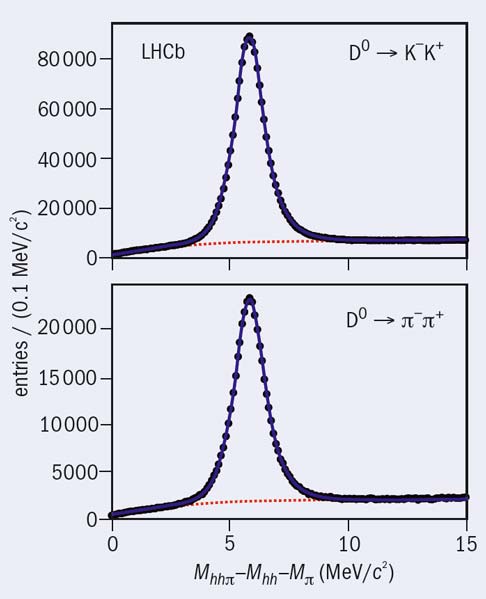
CP violation can be observed as a difference in the rate of D0 decays to a given final state, compared with the rate of the antiparticle D0 decays to the same final state. Because the effect being looked for is tiny, the LHCb collaboration performed its search by measuring the difference in the CP asymmetry for two final states, D0 → KK+ and D0 → ππ+, which is denoted by ΔACP. In this way, systematic uncertainties in the production and detection of particles compared with antiparticles should cancel, while the CP asymmetry, which is expected to have opposite sign for the two modes, should remain visible.

D → D0π± decays are used as the source of the neutral D-meson sample because the charge of the pion tags the produced particle as a D0 or D0 (see figure). The experiment has collected more than a million of these decays, a total more than 10 times greater than in measurements by experiments at B-factories. It is also larger than the data sample used to obtain the previously most precise result, from the CDF experiment at Fermilab’s Tevatron, and benefits from the clean selection made possible by LHCb’s ring-imaging Cherenkov detectors.

LHCb measures the asymmetry to be ΔACP = (–0.82 ± 0.21 ± 0.11)%, where the first error is statistical and the second systematic. The significance of the measured deviation from zero is 3.5 σ, giving the first evidence for CP violation in the charm sector, at a level that is higher than was expected. Establishing whether this result is consistent with the Standard Model, or the first hint of new physics, will require the analysis of additional data and improved theoretical understanding. LHCb has already collected almost a factor of two more data, with more to come this year, so this exciting first indication should be clarified soon.

ATLAS discovers its first new particle

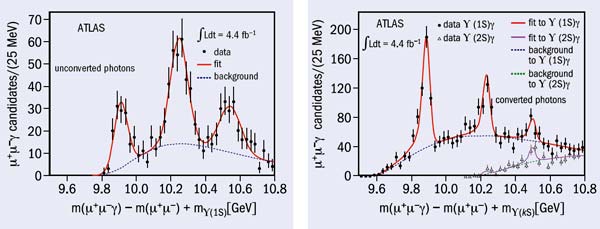
The spectrum of the χb states

The ATLAS collaboration has announced the discovery of the χb(3P), which is a bound state of a bottom quark and bottom antiquark (bb).

Bound states of a heavy quark and its antiquark – collectively called quarkonium – are the QCD analogues of the hydrogen atom, with each particle corresponding to a different energy level. For bb states, the S states are the well known ϒ particles, while the P states are known as χb. As with the hydrogen atom, transitions between these states can be observed through the emission of a photon (γ).

The collaboration discovered the new state through the radiative transitions χb(3P) → ϒ(1S) + γ and χb(3P) → ϒ(2S) + γ, followed by the decay of the ϒ to two muons. The figure shows the spectrum of the χ states: the leftmost peak is the χb(1P), the middle one the χb(2P) and the rightmost the new state, χb(3P). The photons were detected either by the electromagnetic calorimeter (in which case they remained unconverted) or, if they had interacted with material and converted to an e+e pair, by the ATLAS tracking detectors.

Usually, a new particle is discovered in one or at most two channels, and the first observation is at the very edge of statistical significance. However, ATLAS has seen the χb(3P) with three different signatures, in both the ϒ(1S) and ϒ(2S) channels, and the peaks are unmistakable. The outstanding performance of both the LHC and the ATLAS detector made such a clear observation possible.

Also in analogy with atomic physics, the visible peaks contain internal structure from hyperfine splitting among states of different angular momentum. These could be resolved with future data samples.

Studying the energy levels of quarkonium states provides information about the forces that bind quarks together. One surprise is that the χb(3P) is slightly heavier than predicted, implying that the quark–antiquark pair is a little more loosely bound than expected. The χb(3P) is just at the very limit of being bound, so the quark and antiquark are about as far apart from each other as they can possibly be.

Hadron spectra probe nature of matter in Pb–Pb collisions

In current understanding, the matter created in heavy-ion collisions – the quark–gluon plasma (QGP) – behaves as a nearly perfect liquid. The confirmation of this hydrodynamic behaviour, previously observed at Brookhaven’s Relativistic Heavy Ion Collider (RHIC), was one of the most eagerly awaited results from the first Pb–Pb collisions at the LHC. One of the crucial measurements for the characterization of the fireball produced in the collisions centres on the spectra of identified hadrons, which encode the collective expansion velocity in the QGP and hadronic stages. Moreover, their overall abundances are believed to be fixed at hadronization.

The ALICE detector was designed to perform these measurements with a unique combination of detectors for particle identification (PID): the silicon inner-tracking-system, the time-projection chamber and the time-of-flight detector. The collaboration has used these to measure the production of pions, kaons and protons in the range in transverse-momentum, pt, where most of the particles are produced (0.1 to about 3 GeV/c).

The figure shows the results compared with the expectation from a hydrodynamic model, revealing a good agreement with the predicted shapes (Floris 2011). Together with the results on the azimuthal anisotropy also reported by ALICE and the other LHC experiments, this represents the most direct confirmation of the hydrodynamic interpretation at the LHC. On an absolute scale, however, the model calculations shown in the figure significantly over-predict the production of protons – a surprise revealed by the first LHC data.

CCnew9_01_12

The production of soft hadrons (pt < 1–2 GeV/c) is generally described in a statistical language: it is assumed that particles are created in thermal equilibrium. This idea, dating back to a classic 1950 paper by Enrico Fermi, has proved successful over a range of collision energies (√s ˜ 2 GeV – 200 GeV) and provides a possible link to the temperature of the hadronization (or deconfinement phase transition).

At present, however, the yield ratios measured by ALICE seem to challenge both previous experiments and theory. While the K/π, Ξ/π and Ω/π ratios are compatible with the expectations from the thermal model with T ≈ 165 MeV, as in previous observations, the p/π ratio points to a significantly lower temperature. On the experimental side, there are indications of a similar effect at lower energies, which call for further investigations. On the theoretical side, a number of different possibilities are being investigated, none of them conclusive at the moment.

The unique PID capabilities of the ALICE experiment will continue to be crucial for the characterization of the deconfined matter produced in Pb–Pb collisions at the LHC. They also pave the way for a rich programme in proton–proton physics, especially in the soft physics domain, e.g. with the forthcoming measurement of fragmentation constraints with identified particles and spectra in high-multiplicity events.

New technique probes isovector transitions

CCnew10_01_12

A team at the National Superconducting Cyclotron Laboratory (NSCL) at Michigan State University has developed a new experimental technique for measuring (p, n) charge-exchange reactions at intermediate energies (˜100 MeV/nucleon) on rare isotopes. The main virtue of the technique is that it can be applied to study the isovector response of rare isotopes of any mass and up to high excitation energies. Previously, charge-exchange experiments with rare isotopes were restricted to light isotopes and final states at low excitation-energies.

The new technique has been applied first to study Gamow-Teller (GT) transitions from 56Ni – an important case for modelling electron-capture rates of interest for the late evolution of core-collapse and thermonuclear supernovae (Sasano et al. 2011 and Langanke 2011). Nuclear charge-exchange reactions at intermediate energies have long been used to study the spin-isospin response of stable nuclei and weak reaction rates, in particular for astrophysical purposes.

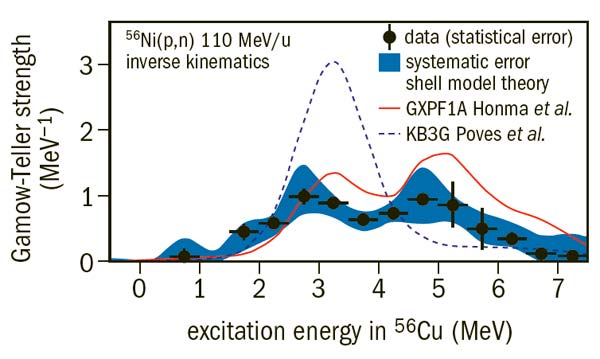
To study the (p, n) reaction on the rare nickel isotope, the experiment was performed in inverse kinematics. A beam of 56Ni particles at 110 MeV/u, produced by fast-fragmentation of 58Ni particles from the NSCL coupled-cyclotron facility on a thick production target, was directed at a liquid hydrogen target, which provided the proton “probe”. The newly constructed Low-Energy Neutron Detector Array detected recoil neutrons, allowing the excitation energy of the 56Cu reaction product and the centre-of-mass scattering angle to be deduced by measuring the neutron angle and energy. The S800 spectrograph detected heavy fragments (56Cu, or one of its decay products). After isolating the ΔL=0 components of the excitation-energy spectrum via their distinct forward-peaked angular distribution, the team was able to extract the GT transition strength, using the well established proportionality between the differential cross-section at vanishing momentum transfer and the GT strength.

The figure shows the extracted GT strength as a function of excitation energy and the comparison with two shell-model calculations based on different Hamiltonians. Because isospin symmetry-breaking effects are small and 56Ni has isospin I=0, the strength distribution for the 56Ni→56Cu reaction is nearly identical to that for the 56Ni→56Co reaction. The latter is of relevance for electron captures in stellar environments, while 56Ni plays a central role in the studies of weak reaction rates for supernovae. By benchmarking and improving the shell-model calculations for the N=Z=28 nucleus 56Ni, more reliable calculations of electron-capture rates for many nuclei in the iron group will be possible.

Meeting sets scene for LHC-luminosity upgrade

A design study for the High-Luminosity LHC (HL-LHC) project to upgrade the LHC has been launched with a meeting at CERN to bring together scientists and engineers from 20 institutes in Europe, Japan and the US. The goal is to prepare the ground for an LHC-luminosity upgrade scheduled for around 2020, which aims to take the LHC’s luminosity to 200–300 fb–1/year, a factor of 5–10 above the current design value. Upgrading the LHC for higher luminosity will involve a number of innovative technologies and challenges. These include cutting-edge 12 T superconducting magnets, compact and ultraprecise superconducting cavities for beam rotation, as well as 300-m-long, high-power superconducting links with almost zero energy dissipation.

The meeting on 16–18 November marked the initial step in the HiLumi LHC Design Study, which is supported through the European Commission’s Seventh Framework programme (FP7). Drawing on expertise from around the world, this 1st HiLumi LHC Collaboration Meeting included scientists and engineers from the well established CERN-KEK collaboration and US LHC Accelerator Research Program (LARP). Because it was a joint meeting with LARP, the first day was organized as a LARP collaboration meeting (LARP CM17), with a plenary session followed by two parallel sessions (Accelerator Physics and Magnet R&D), where the accent was on the LARP programme and its results.

The second day included various parallel sessions organized for LARP and for the HiLumi LHC study, as well the first HiLumi LHC Plenary Session, with presentations by the management and technical co-ordination. The first HiLumi LHC Collaboration Board also took place during a period of parallel sessions. The third day was devoted to a HiLumi LHC Public Session in CERN’s Main Auditorium to review the HL-LHC programme and CERN’s plans, as well as to discuss the US and Japanese involvement and the status of various work packages in the HiLumi LHC study.

For more about the meeting, see http://hilumilhc.web.cern.ch/HiLumiLHC/. A more detailed report on the study will appear in the March issue of CERN Courier.

Events that match companies and researchers

Beam diagnostics, beam-profile measurements and quality-assurance methods are of the utmost importance for every accelerator or facility, and especially for radiotherapy beams. While researchers strive for better instruments and methods, industrial companies look towards the research community for turning clever ideas and working prototypes into commercial products with improved accuracy and efficacy.

To foster the transfer of technologies based on high-energy physics, the HEPTech network has launched a series of workshops called “Industry – Academia matching events”. These include summary talks from both industry and the research community, with a poster gallery and live demonstrations. These are aimed at maximizing contact and collaboration between industrial companies and those researchers active in a particular field. The first event, on silicon photomultipliers, was held in February 2011 (p33).

The second event, on the technology and the opportunities for beam instrumentation and measurement, took place on 10–11 November. It was held at GSI Darmstadt, home to much of the early work on heavy-ion radiotherapy. Some 84 participants, including representatives from 18 industrial companies, gathered at the new GSI Conference Building. The next event is planned to take place at DESY this spring and will focus on position-sensitive silicon detectors. It will be organized by the collaboration for Advanced European Infrastructures for Detectors and Accelerators (AIDA) with the support of HEPTech.

European funding agencies push forward large astroparticle-physics projects

CCnew11_01_12

European funding agencies have welcomed the priorities for the future of astroparticle physics defined by the scientific community and have accepted the recommendations included in the update of the European roadmap for astroparticle physics, published on 21 November 2011.

This update comes after the first ever European roadmap for astroparticle physics, published in 2008. The goal was to define the research infrastructures necessary for the development of the field: the “magnificent seven” of astroparticle physics.

The roadmap is the product of a collaboration between the AStroParticle European Research Area (ASPERA) network of European national funding agencies responsible for astroparticle physics and the Astroparticle Physics European Coordination (ApPEC). “The update of the roadmap provides a better picture of what will come first on the menu,” said Christian Spiering, chair of the ASPERA and ApPEC Scientific Advisory Committee that produced the roadmap. Funding for each project is still subject to national decision-making processes and the roadmap recognizes that not all funding agencies will necessarily support each project.

The strategy reaffirms the support required for current experiments and planned upgrades, in particular in the areas of gravitational waves, dark-matter searches and the measurement of neutrino properties, as well as for underground and space-based infrastructures. The mid-term planning (2015–2020) includes four large projects to be constructed starting from the middle of this decade.

In the domain of tera-electron-volt gamma-ray astrophysics the Cherenkov Telescope Array (CTA) is clearly the worldwide priority project. CTA is an initiative to build the next-generation ground-based, very high-energy gamma-ray observatory, combining proven technological feasibility with a guaranteed scientific perspective. Some 800 scientists from 25 countries have already joined forces to build it.

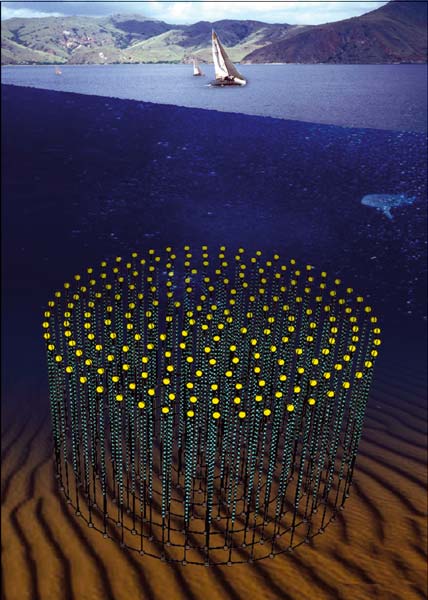
KM3NeT, the next-generation high-energy neutrino telescope in the Mediterranean Sea, is in its final stages of technology definition, with prototype deployment expected within the next 2–3 years. A project selected by the European Strategy Forum on Research Infrastructures, it is in an EU-funded preparatory phase, having obtained substantial regional funding.

LAGUNA is a megatonne-scale project for low-energy neutrino physics and astrophysics. It is at the interface with the CERN European Strategy update to be delivered in early 2013 and is currently the subject of an EU-funded design study.

Last, but not least, is a ground-based cosmic-ray observatory following in the footsteps of the Pierre Auger Observatory in Argentina. On longer time scales, similarly large infrastructures in the domain of dark energy or gravitational wave detection are being considered.

First results from Double Chooz

Physicists at the Double Chooz experiment have found an indication of a disappearance of electron-antineutrinos that is consistent with neutrino oscillations.

The Double Chooz experiment, which detects antineutrinos produced in the nearby nuclear reactor at Chooz in the French Ardennes, started data-taking in April 2011. The collaboration announced its first results seven months later at the 2011 LowNu conference held in Seoul, reporting new data consistent with short-range oscillations.

The result, on the disappearance of antineutrinos compared with the expected flux from the reactor, helps to determine the so-far unknown third neutrino-mixing angle, θ13. The observed deficit indicates oscillation with the following value: sin213 = 0.086 ± 0.041 (stat.) ± 0.030 (syst.) or, at 90% CL, 0.015 < sin213 < 0.16.

The measurement of this last mixing angle is important for future experiments aimed at measuring leptonic CP violation and relates indirectly to the matter–antimatter asymmetry in the universe.

‘Supernova of a generation’ reveals its nature

Astronomers have put under scrutiny the brightest and closest stellar explosion seen in the past 25 years. They have identified the supernova in the Pinwheel galaxy observed on 24 August 2011 as the explosion of a carbon-oxygen white-dwarf star triggered by mass accretion, most likely from a normal companion star.

Although a supernova – Latin for “super-new” – appears suddenly in the sky as a bright star, it is well known that the event marks the explosive demise of a star rather than its birth. Supernovae are rare, with a rate in the Milky Way of only about two per century (CERN Courier January/February 2006 p10). The majority of these stellar explosions (around 80%) are core-collapse supernovae, which result from the gravitational contraction of the central iron core of a star of more than about 10 solar masses that can no longer sustain nuclear fusion. While the core collapses into a neutron star or a black hole, the outer regions of the star are blown up in a gigantic explosion. Supernovae of type Ia are different. They are thought to be thermonuclear explosions of a white dwarf that result in complete disruption and leave no compact remnant. The historic supernovae of the years AD185, 1006, 1572 and 1604 have been identified to be of this type (CERN Courier December 2004 p15, CERN CourierMay 2011 p12, CERN CourierDecember 2011 p12).

The event, PTF11kly, detected on 24 August 2011 in the nearby Pinwheel galaxy (Messier 101) was also soon identified as a type Ia supernova (CERN Courier October 2011 p12). Although the explosion was invisible to the unaided eye, it was bright enough (peak magnitude of 9.9) to trigger the interest of professional and amateur astronomers alike. The early detection of SN 2011fe, as it is called now, and its optimal location in a face-on spiral galaxy some 20 million light-years away, offered a rare chance for a better understanding of the progenitors of type Ia supernovae. The results of these investigations have now been published in two papers in Nature.

The first study, led by Peter Nugent of the Lawrence Berkeley National Laboratory and the University of California, is based on the early observations of SN 2011fe. It was detected only 0.5 days after ignition and the luminosity at that time allowed the researchers to constrain the size of the progenitor star to be less than one tenth that of the Sun. This is strong evidence that the exploding star was a white dwarf. These dense stars contain the mass of the Sun within a size similar to the Earth and are the remnant cores of low-mass stars. Usually composed of carbon and oxygen, they maintain their structure via internal pressure from a degenerate gas of electrons. The star remains inert and stable as long as its mass does not reach the Chandrasekhar limit of 1.4 solar masses. When approaching this critical mass – for instance via accretion from a companion star – a runaway nuclear fusion of carbon ignites within the white dwarf and provokes the stellar explosion. The detection of the presence of carbon and for the first time also of oxygen in the spectrum of SN 2011fe confirms this scenario.

As for the nature of the companion star, there were basically three possibilities: a normal star; a much brighter red giant or helium star; or another white dwarf. Nugent and co-workers suggest a normal star based on the absence of the expected observational imprint that a white-dwarf merger of a giant star would leave. This is confirmed by the second study by Nugent’s colleague of the University of California, Weidong Li and collaborators. They find no bright source at the position of SN 2011fe in archival images, thus ruling out luminous red giants and almost all helium stars as the mass-donor. The two studies confirm observationally the origin of type Ia supernova, a class of explosion that are similar enough to each other to be considered “standard candles” – a property that enabled the 2011 Nobel prize winners to discover the accelerating expansion of the universe (CERN Courier September 2003 p23).

bright-rec iop pub iop-science physcis connect