Comsol -leaderboard other pages

Topics

Physics Beyond the Standard Models of Particles, Cosmology and Astrophysics

By H V Klapdor-Kleingrothaus, I V Krivosheina and R Viollier
World Scientific
Hardback: £136 $220

51om1W6Z7HL

This book contains the proceedings of the Fifth International Conference on Physics Beyond the Standard Models of Particle Physics, Cosmology and Astrophysics. It reviews the status and future potential and trends in experimental and theoretical particle physics, cosmology and astrophysics, in the complementary sectors of accelerator, nonaccelerator and space physics.

Theory of High-Temperature Superconductivity: A Conventional Approach

By Todor M Mishonov and Evgeni S Penev
World Scientific
Hardback: £57 $88
E-book: $114

514Cls3HRdL._SX339_BO1,204,203,200_

Drawing from the broad spectrum of phenomena, described in more than 100,000 articles on high-Tc superconductivity, the authors analyse the basic properties that can be understood within the framework of traditional methods of theoretical physics, e.g. for the overdoped cuprates. The book gives a pedagogical derivation of formulae describing the electron band-structure, penetration depth, specific heat, fluctuation conductivity, etc. Prediction of plasmons and their application for a new type of terahertz generators is also considered.

Strong Coupling Gauge Theories in LHC Era: Proceedings of the Workshop in Honor of Toshihide Maskawa’s 70th Birthday and 35th Anniversary of Dynamical Symmetry Breaking in SCGT

By H Fukaya et al. (ed.)
World Scientific
Hardback: £93 $150
E-book: $195

41vZOmBBe2L

This workshop was the sixth Nagoya strong-coupling gauge theory (SCGT) workshop and the first after Yoichiro Nambu, Makato Kobayashi and Toshihide Maskawa shared the 2008 Nobel Prize in Physics for their work in dynamical symmetry breaking. The purpose of the workshop was to discuss both theoretical and phenomenological aspects of SCGTs, with emphasis on the models to be tested in the LHC experiments.

Exclusive Reactions at High Momentum Transfer IV: Proceedings of the 4th Workshop

By Anatoly Radyushkin
World Scientific
Hardback: £109 $175
E-book: $223

615yZQ11EgL

These proceedings include talks given at the 4th Workshop on Exclusive Reactions at High Momentum Transfer at Jefferson Lab. The workshop focused on the application of a variety of exclusive reactions at high momentum-transfer, utilizing unpolarized and polarized beams and targets, to obtain information about nucleon ground-state and excited-state structure at short distances. This subject is central to the programmes of current accelerators and especially for planned future facilities.

Physics: A Student Companion

By Lowry Kirkby
Scion Publishing Ltd
Paperback: £27.99 $50

CCboo1_02_12

Lowry Kirkby once turned down an offer to study physics at Manchester University and instead went to Oxford. This was Manchester’s loss; she was clearly a model student, assiduous in producing, collating and annotating her lecture notes and using them to help her graduate with a top first-class degree in 2007. She has now turned these notes into a “student companion”.

As companions go, this is an excellent one and it should become a best friend to all physics undergraduates, particularly in those important, lonely weeks of study in the run-up to examinations. I encourage all lecturers to recommend this book to their students.

Lowry covers the bulk of the core physics required in degree programmes accredited by the Institute of Physics in the UK and most of the syllabus for the Graduate Record Examination in the US. This includes Newtonian mechanics and special relativity; electromagnetism; waves and optics; quantum physics; and thermal physics. These are taken to about the end of the second year of university study for a student majoring in physics. So, for example, the material goes as far as Fraunhofer diffraction in wave-optics, time-independent perturbation theory in quantum mechanics and the grand canonical partition function in statistical mechanics.

Clearly a single, relatively slim volume such as this (400 pages) cannot serve as a textbook for all these topics. But that is not its intention; it is meant as a supplement to the textbooks, a digest for students who have already studied and understood the details.

There are five aspects to the presentation of the material, which can be described as: commentary, summaries, boxed equations, derivations and worked examples. It all sits together very well indeed as a single-volume study aid. In a book with so much detail and so many equations, I found remarkably few errors or misprints. The author, proofreaders and editor are to be commended on the high standards of the production.

Do physics students still have bookshelves? If they do, then this book should have a place on all of them. But smart phones, tablets and e-readers now seem to be the preferred media. While the book is reasonably portable, an e-version would be just the sort of thing that today’s physics students would always want to have to hand.

Advanced Statistical Mechanics

By Barry M McCoy
Oxford University Press
Hardback: £57.70 $99

31xX4+OERcL._SY291_BO1,204,203,200_QL40_ML2_

Statistical mechanics is the study of systems where the number of interacting particles becomes infinite. Tremendous advances have been made over the past 50 years that have required the invention of entirely new fields of mathematics, such as quantum groups and affine Lie algebras. These have provided profound insights into both condensed matter physics and quantum field theory, but none of these advances are taught in graduate courses in statistical mechanics. This book is an attempt to correct this, beginning with theorems on the existence (and lack) of order for crystals and magnets and with the theory of critical phenomena, it continues by presenting the methods and results of 50 years of analytic and computer computations of phase transitions.

Radioactivity: A History of a Mysterious Science

By Marjorie C Malley
Oxford University Press
Hardback: £14.99 $21.95

CCboo2_02_12

Between 1899 and 1902, Polish physicist Marie Curie processed 100 kg of radioactive pitchblende ore – in 20 kg batches – by hand, in the courtyard of a leaky shed in Paris. The feat provided her with the atomic weight of radium and earned her a Nobel prize. But the research also left her with lifelong medical complications from exposure to radioactivity.

Marjorie C Malley’s comprehensive history of radioactivity captures the excitement, promise and tragedy of the “mysterious” field from its inception in the late 19th century to the present day. The narrative spans two continents and two world wars, taking in decorative uranium glassware, radium spas and atom bombs along the way. Avoiding technical detail, Malley explores the cultural, technological and scientific forces that shaped research in radioactivity, and relates the important personalities and discoveries that drove the field forward.

Malley’s cast spreads across France, Germany, the UK and Canada. We are introduced to Wilhelm Röntgen, discoverer of X-rays; Henri Becquerel, who noticed that invisible rays from uranium registered on photographic plates, even in the dark; and Marie Curie, who first applied electrical techniques to understanding radioactive substances and who discovered the elements radium and polonium in the process.

In Canada, Ernest Rutherford and Frederick Soddy investigated further the radioactivity of both uranium and thorium and found that in the course of emitting radiation they change into different elements. The shock of atomic transmutation – with its undertones of alchemy – was almost heresy to chemists at the time. When they returned to the UK, Rutherford went on to discover the atomic nucleus, while Soddy was the first to form the concept of isotopes.

Two aspects of Malley’s narrative stand out for me: the “reasonable” hypotheses that scientists put forward for the origins of radioactivity, which seem so outlandish now; and the shocking ignorance of the true medical dangers of radiation that prevailed until relatively late in the 20th century.

In fluorescent paint factories of the 1920s, workers wetted the tips of their brushes with their lips, swallowing radioactive radium in the process. Alpha radiation from the paint often led to the death of jaw tissue and mysterious cancers. Researchers regularly mixed radioactive solutions with their fingers: physicist Stefan Meyer had to give up playing the bass viol because of radiation damage to his fingers.

Malley’s clearly written text captures the intellectual excitement of early research into radioactivity, though I found her section on the cultural forces shaping radioactivity rather weak. Although she notes that individuals, scientific ideals, culture and nationalism (among others) triggered the spurt of research interest in radioactivity, I was unconvinced that research into radioactivity deserves a special place among the countless other scientific advances of the 20th century. Was its development really that unique? I also felt that in a history of radioactivity, the implications of using nuclear power – for good or evil – were rather glossed over in deference to scientific papers and super scientists.

In Radioactivity, Malley weaves disparate historical threads into an accessible and engaging narrative for the nonexpert. I would recommend this book, describing it as a well written and useful overview of the topic for students and teachers. Those seeking in-depth analysis of the implications of the technology – or biographies of the scientists involved – should look elsewhere.

Cornell sprints past milestones towards hard X-ray source

CCnew1_02_12

Synchrotron X-ray sources have become essential tools across the sciences, medicine and engineering. To continue the rapid pace of advances in these fields, researchers need much better high-intensity sources of short-wavelength X-rays to capture ultrafast phenomena and probe materials with atomic resolution. Existing continuous-duty synchrotrons fall short because they produce mostly incoherent light, so there is now a worldwide race to build coherent, high-flux hard X-ray sources.

Cornell University has for some time received funding to conceive, design and prototype innovative superconducting technology for an energy-recovery linac (ERL) as a basis for a next-generation source. Towards the end of 2011, the team at Cornell surpassed three important milestones on the road towards a coherent source and is now within striking distance of delivering performance that matches theoretical limits.

The goal of an ERL light source is to create ultralow-emittance electron bunches, accelerate them in a superconducting linear accelerator and then circulate them only once through a series of small-gap undulators to produce ultrabright, short pulses with a high fraction of transversely coherent, hard X-ray light. The electron’s energy is then recovered to accelerate a new, high-brightness beam. Three of the biggest R&D challenges are to prove that it is possible to build an electron injector with sufficient current and sufficiently small emittances, as well as a superconducting linac with sufficiently small energy consumption.

Cornell’s prototype injector has achieved the first milestone by delivering a continuous-duty current of 35 mA. This is the world record for any laser-driven photocathode electron gun and is above the specification for one of the proposed operating modes. The team is now ramping up the current to even higher levels.

The normalized emittance goals at Cornell are around 0.1 mm mrad for a bunch charge of about 20 pC and 0.3 mm mrad at some 80 pC, i.e. for a 100 mA beam of 1.3 GHz bunches. The emittances achieved for the bunch cores (the central 2/3 of the bunch) are <0.15 mm mrad at 20 pC and 0.3 mm mrad at 80 pC. The team expects even better values as the injector voltages are ramped up. For comparison, at 5 GeV a 0.1 mm mrad emittance yields a geometric horizontal emittance of 10 pm mrad. The current world-record storage-ring source, PETRA-III at DESY, operates with a geometric horizontal emittance of 1 nm mrad.

Finally the energy requirement for the first prototype cavity of Cornell’s X-ray ERL has been shown to be as small as proposed in a vertical cryogenic test (Q0 = 2 × 10¹⁰ at 16 MV/m), thus reaching the third milestone.

While much remains to be done, these achievements show that even this first prototype injector, when coupled with a linac and long undulators in a full-scale ERL light source, would already produce continuous-duty (1.3 GHz) pulses of hard X-ray beams of unprecedented coherence and pulse length.

• For more details, contact Georg.Hoffstaetter@cornell.edu or see http://erl.chess.cornell.edu.

Results from SPIN@COSY may bode well for RHIC

CCnew2_02_12

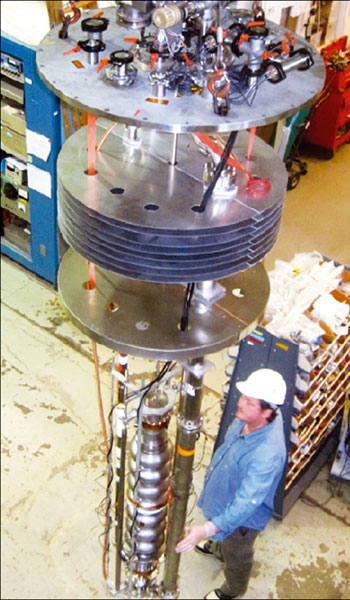
The SPIN@COSY polarized-beam team has found unexpectedly strong higher-order spin resonances when using 2.1 GeV/c polarized protons stored in the COSY COoler SYnchrotron at the Forschungszentrum Jülich. These results may help to increase the polarization in the Relativistic Heavy Ion Collider (RHIC) at Brookhaven when it is used as a 250 GeV/c polarized proton collider. The data were taken in April 2004 and presented in part at the International Spin Physics Symposium at Trieste the following September. However, the many partly overlapping data points had an unusually large scatter, so they allowed no firm conclusions to be reached. Now, after a challenging reanalysis, the team has published results that may spell good news for the work at RHIC.

In all of the other experiments by SPIN@COSY, the data showed the expected spread when beam parameters were varied upwards, e.g. in steps of 2, 4, 6, 8, 10 and then downwards, e.g. in steps of 9, 7, 5, 3, 1. However, this was not true for the April 2004 data. Indeed, when several of the sweeps were repeated for the second and third times, the data-spread increased. Clearly, these data needed a reanalysis, which began in 2009 after the other data from SPIN@COSY had been published.

The team obtained data for each resonance by measuring the polarization after sweeping COSY’s vertical (and later horizontal) betatron tunes slowly through the resonance with a narrow tune range of 0.002 in 2s, giving a tune sweep-rate of 0.001/s. The sweep-rate through all of the other resonances was made about 250 times faster by sweeping through a much larger range in a shorter time, typically a range of 0.125 in 0.5s. This reduced the effect of all of the other resonances by about 250-fold.

One possible cause of the spread in the data was a variation in the polarization stability of the polarized H ion source. Polarized ion-sources are sensitive devices, with several sextupoles and RF transition units, whose fields and frequencies must be precisely matched to maximize the polarization. The source polarization at COSY is measured by a low-energy polarimeter (LEP) and the values stored on a nearby computer; but in 2004 this computer was not connected to the computers in the main control room, where the 2.1 GeV/c data were stored. Fortunately, however, the stored LEP data from 2004 were still available in 2009, so that several gigabytes of data could be transferred from COSY to Michigan. There, a small team of two post-docs and four undergraduate students matched the LEP data from the source in time with the corresponding 2.1 GeV/c data. When the 2.1 GeV/c polarization data were renormalized to the LEP polarization data, much of the spread disappeared.

CCnew3_02_12

The team then refined the vertical betatron-tune data further by using what is possibly a new technique for combining many partly overlapping data points in an unbiased manner. Thirty-six pairs of data points were sequentially recombined, whenever both lay within a sequentially increasing (in 0.001 steps) range in betatron tune. This recombination continued for 76 steps until the results of recombining the data from low-to-high vertical betatron tunes and from high-to-low tunes were all identical. In the horizontal data only five pairs of overlapping points needed to be recombined.

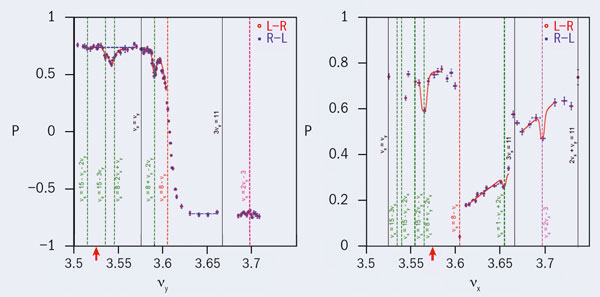
Figure 1 shows the results of this two-step reanalysis. The data clearly revealed that the long-held belief that lower-order spin resonances always caused more depolarization than higher-order resonances, and vertical spin resonances always caused more depolarization than horizontal resonances, was not correct for the 2nd- and 3rd-order resonances. The results showed that the single 2nd-order vertical resonance was far weaker than two of the 3rd-order vertical resonances (figure 2). They also showed that, while the 1st-order vertical resonance was so much stronger than the 1st-order horizontal resonance that it fully flipped the spin direction, this was certainly not true for the 2nd- and 3rd-order resonances. These unexpected results may help the RHIC polarized collider to increase its 250 GeV level of polarization further towards the 100 GeV level.

EXPLORER’s life comes to a fruitful end

CCnew4_02_12

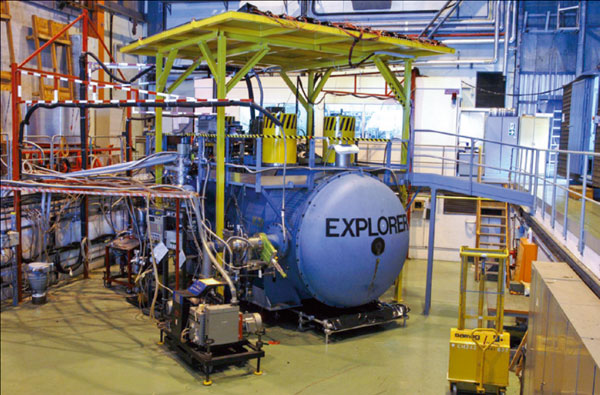
After 20 years of continuous operation, the EXPLORER gravitational-wave detector has come to the end of its long life as an experiment and left CERN. On 23 January it set off for a new existence at the European Gravitational Observatory (EGO) in Cascina, near Pisa, where it will become the main attraction in a new museum area. The detector’s main results span from the first modern upper limits on signals for gravitational waves bathing the Earth to the measurement of the dynamic gravitational field generated by an artificial source; from correlations with γ-ray and neutrino bursts to the acoustic detection of cosmic rays.

EXPLORER was the first gravitational-wave detector to reach the sensitivity and stability needed to perform long-term observations. Built and operated by INFN’s gravitational-wave groups at Rome and Frascati – first led by Edoardo Amaldi and Guido Pizzella and then by Eugenio Coccia – it was based on a cryogenic mechanical resonator, in the shape of a 3-m long aluminium cylindrical bar cooled to 2 K. It could be driven by a gravitational wave with spectral components at the bar’s resonant frequency, that is, about 1 kHz, and made use of superfluid helium to reduce thermal and vibrational noise and to allow the exploitation of high-sensitivity transducers and superconducting amplifiers. The experiment was able to detect changes as small as 10–19 m in the bar’s vibrational amplitude – a real achievement.

EXPLORER’s gravitational-wave sensitivity was limited to the strongest sources in the Galaxy. Now, the future of the field is represented by the network of large interferometers: the Laser Interferometer Gravitational-Wave Observatory with two interferometers in the US, Virgo at the EGO site in Italy, GEO in Germany and the Large-scale Cryogenic Gravitational wave Telescope in Japan. This network, which will comprise advanced versions of the instruments, should start detecting signals from many thousands of galaxies from the year 2015; typical sources of gravitational waves include supernovae, pulsars, and collisions of neutron stars and black holes. In the mean time, for the next three years, the Galaxy will be monitored by two modern cryogenic bars – Nautilus in INFN’s Frascati Laboratory and Auriga in INFN’s Legnaro Laboratory and by the GEO interferometer in Hanover.

• For more information, see http://gwic.ligo.org.

bright-rec iop pub iop-science physcis connect