By Richard J Szabo Imperial College Press
Hardback: £42 $68
E-book: $88
Originally published in 2004, this book provides a quick introduction to the rudiments of perturbative string theory and a detailed introduction to the more current topic of D-brane dynamics. The presentation is pedagogical, with much of the technical detail streamlined. The rapid but coherent introduction to the subject is perhaps what distinguishes this book from other string-theory or D-brane books. This second edition includes an additional appendix with solutions to the exercises, thus expanding the technical material and making the book more appealing for use in lecture courses. The material is based on mini-courses in theoretical high-energy physics delivered by the author at various summer schools, so its level has been appropriately tested.
By David Goodstein (eds.) World Scientific
Hardback: £57 $86
E-book: $112
This up-to-date collection of review articles offers a general introduction to cosmology by experts in various fields. It starts with “Galaxy Formation from Start to Finish” and ends with “The First Supermassive Black Holes in the Universe”, exploring in between the grand themes of galaxies, the early universe, the expansion of the universe, neutrino masses, dark matter and dark energy. Together the chapters provide a detailed view of what is known about the universe as well as what remains unknown. Students, researchers and academics interested in cosmology should find this book useful.
By Alessandro De Angelis Springer
Paperback: £19.99 €24.44
In telling the story of “the enigma of cosmic rays”, physicist and enthusiastic communicator Alessandro De Angelis traces the fascinating adventure of cosmic rays since their discovery a century ago. Today, the exploration of the mysteries of cosmic rays continues with even more powerful tools in a range of energies that extends 20 orders of magnitude.
Cosmic rays have always been puzzling. In the first decade of the 20th century, physicists were seeking a solution to the problem of why gold-leaf electroscopes – instruments that are still common in laboratories in schools today – discharge spontaneously. Many scientists faced this problem, including an Italian, Domenico Pacini, who made some important measurements by immersing his instruments under water at different depths and observing a marked decrease in the discharge rate. Indeed, Pacini was the first to give a clear indication that part of the natural radiation he detected came from the atmosphere and from the cosmos. However, his results were published only in Italian and had no great prominence – although Viktor Hess did mention Pacini several times in his speech when he obtained the Nobel Prize in Physics for the discovery of cosmic rays. Pacini’s work is yet another glaring example of a discovery that has not obtained the international recognition it deserves.
The riddles of cosmic rays do not end there. We still do not know for sure where they come from. They are deflected by the interstellar magnetic field so their direction of arrival cannot be connected to their starting point. Above all, we still struggle to understand what mechanism provides them with an energy that can in extreme cases reach the energy of a tennis ball concentrated in a single atomic nucleus. Enrico Fermi proposed a theory for the acceleration of cosmic rays that explains in part what is observed. However, there is still much to understand and we hope that recent and future results in high-energy astrophysics will be able to answer this fundamental question.
What is sure is that cosmic rays bring to the Earth pieces of the far-away universe. Furthermore, their high energy makes them interact with the atmosphere, producing secondary particles – as in powerful particle accelerators. For this reason, in the first half of the past century cosmic rays revealed the first particle of antimatter – the positron – and many new particles that led to the birth of elementary particle physics before accelerators made by humans turned it into a mature science. Even today, in the LHC era, the study of high-energy cosmic rays and the precision testing of their composition at intermediate energies are active fields of research, with experiments on Earth and in space. In particular the first evidence of neutrino oscillations – and thus of their mass – was observed by studying the secondary neutrinos produced by cosmic rays in the atmosphere.
This book by De Angelis traces the history of the study of cosmic rays in a documented, comprehensive way, often providing details both interesting and little known. It is easily readable and an excellent reference for anyone interested in fundamental physics and contemporary astrophysics.
By Jacques Vanier Imperial College Press
Hardback: £74 $120
Paperback: £33 $54
In this book, Jacques Vanier gives a comprehensive picture of the physical laws that appear to regulate the functioning of the universe, from the atomic to the cosmic world. It offers a description of the main fields of physics as applied to the atomic world and the cosmos, to describe how the universe evolved to its present state. This is done without equations, except for a few, although there is a short annexe for readers who wish to see how the principles and laws expressed in words can be visualized in the language of mathematics. The author also occasionally uses two young people placed in various situations to explain aspects of physics through their observations.
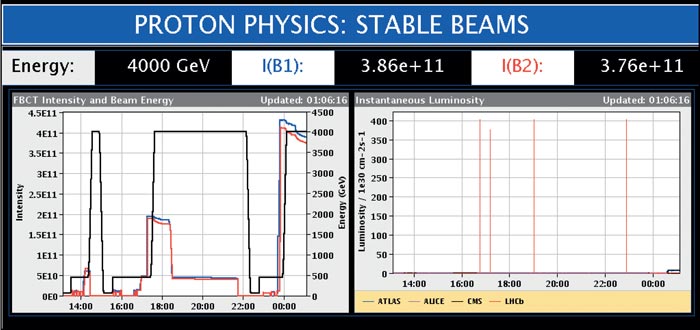
At 12.38 a.m. on 5 April, the LHC shift crew declared “stable beams” as two 4 TeV proton beams were brought into collision at the LHC’s four interaction points. This signalled the start of physics data-taking by the LHC experiments for 2012. The collision energy of 8 TeV is a new world record. By 11 April the LHC had already delivered a total integrated luminosity of 0.2 fb–1 to the experiments. Last year, it took six weeks achieve the same number.
Although the increase in collision energy is relatively modest, it translates to an increased discovery potential that can be several times higher for certain hypothetical particles. Some, such as those predicted by supersymmetry, would be produced much more copiously at 8 TeV than the 7 TeV of 2011. Larger numbers of Standard Model Higgs bosons, if they exist, will also be produced at 8 TeV but background processes that mimic the Higgs signal will also increase. That means that the full year’s running will still be necessary to convert the tantalizing hints seen in 2011 into a discovery – or to rule out the Standard Model Higgs particle altogether.
Protons were accelerated to 4 TeV for the first time on the evening 16 March just two days after beam returned to the machine for 2012. A period of beam commissioning followed, during which the teams checked that the various systems are working flawlessly with beam. The optics measurements included setting the β* of the squeezed beam at the interaction regions. The aim this year is to have a smaller β* of 60 cm for the ATLAS and CMS experiments. The smaller β* is then the thinner and more squeezed the beams are at the collision points, but it also requires that the collimators are positioned closer to the beam. The collimation system is therefore carefully set up in different machine modes: injection energy; full energy; full energy with squeezed bunches; and full energy with collisions. By provoking beam losses and making “loss maps”, the operators verify that the beam is lost in the collimation region and not in places where it can cause damage. All of these checks take place with a few, often low-intensity, bunches.
The LHC is now scheduled to run until the end of 2012, when it will go into its first long shutdown in preparation for running at an energy of 6.5 TeV per beam in late 2014, with the ultimate goal of ramping up to the full design energy of 7 TeV per beam.
A leading figure of 20th-century experimental physics, Edoardo Amaldi was one of the main players in the process that turned the dreams of large, transnational scientific projects among European countries into reality. While his role in the establishment of CERN is the prime example, he was also an active advocate for a European programme for space research and was instrumental in founding the organizations that were the precursors to ESA.
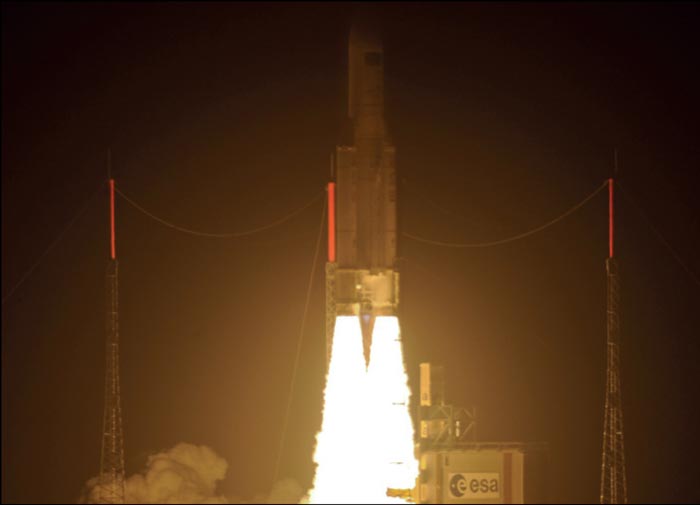
On 23 March ESA’s third Automated Transfer Vehicle (ATV), named in honour of Amaldi, was launched on board an Ariane rocket. It successfully docked with the International Space Station six days later, where it will remain for five months. The 20-tonne vessel, flying autonomously while being monitored from the ground, is delivering essential supplies and propellant, as well as reboosting the station’s altitude. The ATV docked with the 450-tonne orbital complex with a precision of 6 cm while circling the Earth at more than 28,000 km/h.
The Daya Bay reactor antineutrino experiment has observed the disappearance of electron-antineutrinos at a distance of about 2 km from the reactors. As briefly reported earlier, this provides strong evidence for a new kind of neutrino oscillation through a nonzero neutrino-mixing angle, θ13.
There has been good evidence for more than a decade that the electron-neutrino, muon-neutrino and tau-neutrino can morph into one another. This phenomenon of neutrino oscillation is a consequence of mixing between the three flavours of neutrinos, and oscillations between three neutrinos are described with three mixing angles, two mass-squared differences and one CP-violating phase. Two of the mixing angles, θ12 and θ23, have been measured to good precision but the third mixing angle, θ13, was poorly known.
A decade ago, the CHOOZ experiment set a limit of sin22θ13 < 0.17. However, newer analyses of the measurements with solar neutrinos and by the KamLAND experiment – as well as data from the T2K, MINOS and Double Chooz experiments – hinted that θ13 could be larger than zero. On 8 March, based on an exposure of 43,000 tonne-GWth-days, the Daya Bay collaboration reported the result of their measurement, sin22θ13 = 0.092 ± 0.016 (stat.) ± 0.005 (syst.), concluding that θ13 is significantly different from zero.
The Daya Bay experiment is located at the Daya Bay Nuclear Power Complex in China, 55 km northeast of Hong Kong. About 3.6 × 10²¹ low-energy electron-antineutrinos per second are produced by three pairs of nuclear reactors with a combined maximum thermal-power of 17.4 GWth. Three underground experimental halls connected by horizontal tunnels will eventually house eight antineutrino detectors (two in each near hall and four in the far site).
In each hall, the antineutrino detectors are submerged in a water pool that is partitioned optically into two zones. These two water-Cherenkov detectors tag cosmic-ray muons, which can generate background that mimics antineutrino interactions. The water also shields the detectors from ambient radiation that can generate background. The experiment identified electron-antineutrinos via the inverse beta-decay reaction νe + p → e+ + n, with 20 tonnes of 0.1% gadolinium-doped liquid scintillator in each antineutrino detector.
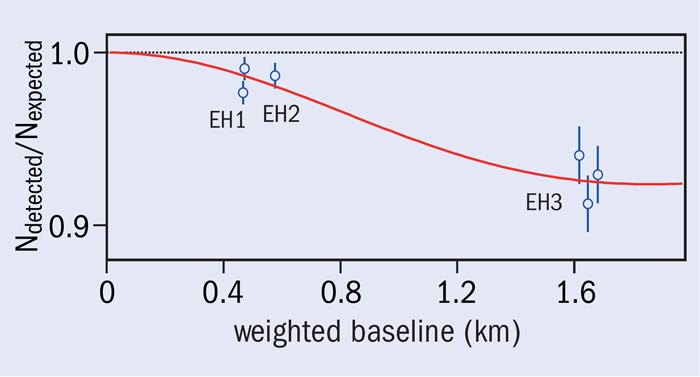
The data used for these first results were obtained with six antineutrino detectors – three deployed in the far hall, two in one of the near halls and one in the other near hall. When the number of detected electron-antineutrino events at the far site was compared with the expected number derived from the measurements in the near sites, a ratio of 0.940 ± 0.011 (stat.) ±0.004 (syst.) was found, indicating neutrino oscillation through θ13. Using the total number of detected events yielded a value of sin22θ13 that was 5.2 σ from zero.
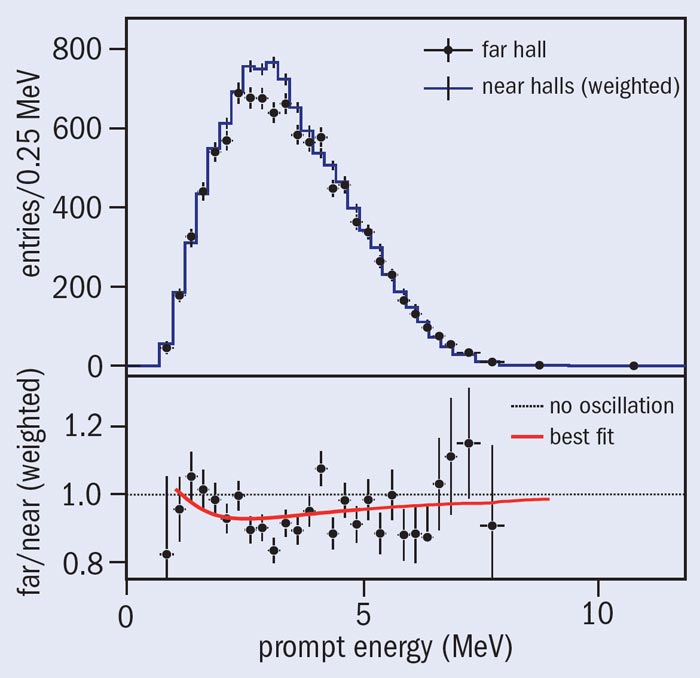
Figure 1 shows the disappearance of reactor electron-antineutrinos as a function of flux-weighted distance. Further evidence for this new kind of neutrino oscillation comes from the comparison of the observed and predicted energy spectra of the electron-antineutrinos at the far site. As figure 2 shows, the spectral distortion as a function of the prompt (positron) energy is also consistent with oscillation corresponding to sin22θ13 = 0.092.
Since the announcement of Daya Bay’s measurement of a nonzero value for θ13, the RENO collaboration has reported the observation of the disappearance of electron-antineutrinos by their experiment based in Korea. The value that they find for sin22θ13 is consistent with the results from Daya Bay.
A nonzero θ13 is crucial for designing experiments to search for CP-violation in the neutrino sector. These next-generation experiments will explore whether neutrinos oscillate differently from antineutrinos and answer the question of whether neutrinos can explain why matter is predominant in the universe. Furthermore, knowing the value of θ13 helps to complete the determination of the neutrino-mixing matrix and constrain models beyond the current Standard Model.
• The Daya Bay collaboration consists of 230 collaborators from 38 institutions worldwide. The experiment is supported by the funding agencies of China, the Czech Republic, Hong Kong, Russia, Taiwan and the US. Daya Bay is currently one of the largest collaborative scientific projects between China and the US.
As announced at the “Moriond” conference on 10 March, the LHCb collaboration has made the first observation of the decay B+ → π+μ+μ–. With a branching ratio of about 2 per 100 million decays, this is the rarest decay of a B hadron ever observed.
The LHCb experiment is designed to search for new physics in the rare decays and CP-violation of particles with heavy flavour, i.e. those containing the c or b quark. Such decays have previously been studied by the B-factory experiments BaBar and Belle, but LHCb is taking the field further as a result of two major advantages: not only are all of the varieties of heavy-flavour hadrons produced in the LHC’s high-energy collisions, but they are also produced at an enormous rate.
The B factories relied on the copious production of B+B– and B0B–0 pairs in the decay of the Υ(4S) resonance. However, in addition to those particles, collisions at the LHC also produce Bs, Bc and b baryons, which may provide an alternative route to finding new physics. This has been illustrated by recent results from LHCb on the rare decay Bs → μ+ μ–, where the strongest limit yet has been placed on the branching ratio of < 4.5 × 10⁻⁹ (at 95% CL), and the first evidence for CP-violation in the Bs system, as well as observation of new decay modes for Bc and the most precise measurements of the mass of a b-flavoured baryon.
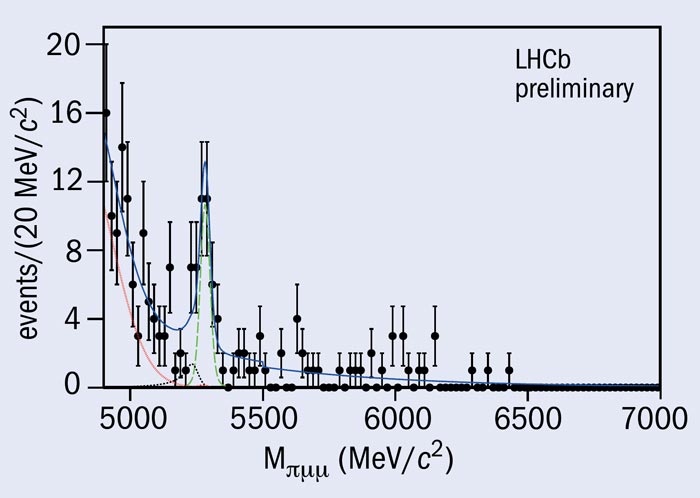
However, the large cross-sections and luminosity at the LHC mean that even for B+ and B0 decays, LHCb can now overtake the B-factory results. The decay B+ → π+μ+μ– is a good example: it is a flavour-changing neutral-current decay, which is strongly suppressed in the Standard Model as it proceeds via quark diagrams involving loops (box or penguin diagrams). The predicted branching ratio is (2.0 ± 0.2) × 10–8 in the Standard Model but could be enhanced by new physics. The best previous limit on this mode, from the Belle experiment at KEK, was < 6.9 × 10⁻⁸ (at 90% CL) (Belle collaboration 2008). Now LHCb has observed a clear signal for the decay, shown in the figure, with a significance of more than 5 σ. The measured branching ratio of (2.4 ± 0.6 (stat.) ± 0.2 (syst.)) × 10–8 is in good agreement with the expectation from the Standard Model. This observation opens the door to more detailed studies of rare b → d transitions, which will be possible with the increase in data in 2012.
The ATLAS experiment sent the results of more than 40 new analyses to “La Thuille”, “Moriond” and other winter conferences. These results covered the full scientific programme of the experiment, from precision measurements of Standard Model processes, through searches for the Higgs boson and new physical phenomena to the study of hot and dense matter probed in heavy-ion collisions.
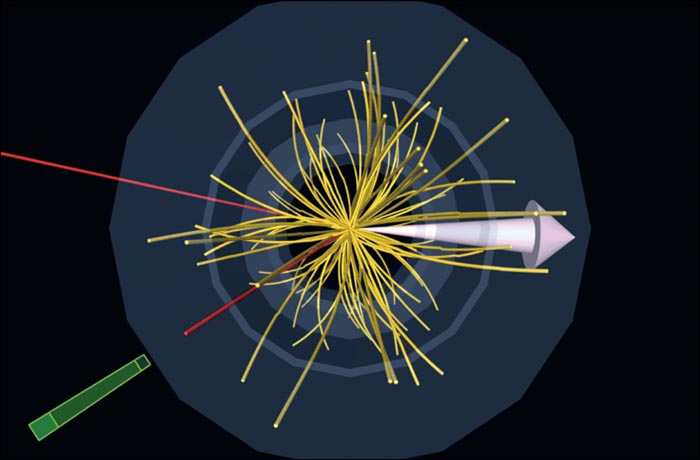
The collaboration has made a great deal of progress since the seminar on 13 December where preliminary results on the Higgs search in both the ATLAS and CMS experiments were presented. ATLAS has since used the full 2011 data set to search for a Standard Model Higgs boson in 12 different decay channels. Combining all of these results has left only three remaining windows for the Higgs: 115.5–131 GeV, 237–251 GeV and above 520 GeV. The upcoming data at the new centre-of-mass energy of 8 TeV will increase the sensitivity of both CMS and ATLAS, and allow the collaborations to make more definitive statements on the existence and mass of a Standard Model Higgs boson by the end of the year.
At moderate to high masses, the most sensitive searches for the Higgs boson involve its decays to two heavy electroweak bosons, either WW or ZZ. Because this search looks for an excess of events over the background from other diboson production it is important to measure the diboson background as accurately as possible. This measurement is also important in its own right: it depends on the strength of the interaction between the W boson, the Z boson and the photon. This strength is a fundamental parameter of the Standard Model and distinguishes it from other theories. These new measurements use the full 2011 data set and are twice as precise as previous ATLAS measurements.
In the Standard Model, the Bs meson is predicted to decay to a μ+μ– pair rarely: only 3 or 4 times in a billion. However, in various extensions of the Standard Model this rate can be increased by a factor of 10 or even a 100; it is one of the more sensitive indirect tests for new physics and complements some of the direct searches for new phenomena at the LHC. Other experiments both at Fermilab’s Tevatron and at the LHC have set upper limits on this decay in the range of 4.5–51 decays per billion. The ATLAS collaboration has now joined this search and has reported an upper limit of 22 decays per billion.
At the International Conference on High-Energy Physics (ICHEP) in Paris, ATLAS showed the first LHC results with sensitivity beyond that of previous experiments: limits on quark substructure obtained by studying events containing two jets. ATLAS has continued to investigate this category of events using the full 2011 data set. The additional data have provided extremely energetic events for ATLAS to study: in some cases the two jets have a combined mass above 4 TeV. There is still no evidence that quarks are made of smaller objects – but if they existed and were at least as large as 3 × 10–20 m, ATLAS would have detected them. This lack of observation allows the experiment to set a limit on the size of any quark substructure. In a complementary measurement looking for excited electrons or muons, which would also be an indication of substructure, ATLAS has set limits around 10–19 m.
Based on the new results previewed at these conferences, the ATLAS collaboration has sent more than 30 articles to scientific journals, with more in preparation. The next major round of conferences will be in summer and will include ICHEP 2012 in Melbourne. In addition to new results at a total collision energy of 7 TeV, the collaboration intends to show early results from 8 TeV collisions.
The ATLAS and CMS collaborations are carrying out a large-scale hunt for hypothetical heavy partners of the Standard Model gauge bosons, the W and the Z. The two experiments were designed to be sensitive to the decays of such particles, which are called, appropriately, W’ and Z’. The latest findings presented at the recent winter conferences show that so far these searches probe for W’ and Z’ particles with masses more than 20 times larger than those of their well known Standard Model counterparts.
The W and Z bosons, mediators of the weak force, are almost 100 times heavier than the proton. Their discovery, which was announced in 1983, had awaited the conversion of CERN’s Super Proton Synchrotron into a proton–antiproton collider to form the first machine energetic enough to produce them. Various theories provide motivation for the heavier W’ and Z’ bosons, and their existence would provide answers to many fundamental questions. For example, the extreme weakness of gravity – when compared with electromagnetism – could be explained by theories that include additional spatial dimensions and in which new heavy particles like a Z’ appear.
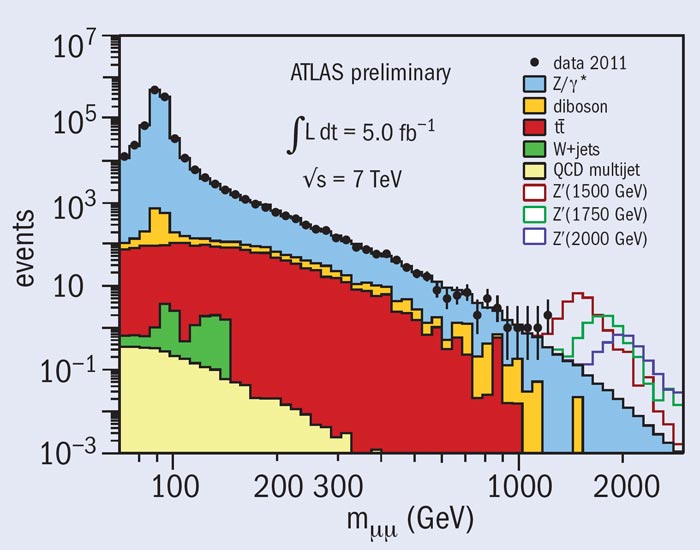
Strongly motivated by such theoretical arguments, physicists at the LHC have been hunting for these heavy partners of the W and Z since the collider started up. Many theories predict that the new gauge bosons would be similar to their light partners, only with larger masses. For example, the Z’ boson could decay to a lepton–antilepton pair, the same channel in which the Z was discovered. ATLAS and CMS have carefully analysed all such events and classified them into mass distributions, such as the one in figure 1 for dimuons in the ATLAS experiment. The black points represent the data and the coloured areas represent contributions expected in the Standard Model. The prominent feature is the Z-boson peak on the left side of the spectrum. If a Z’ boson exists, it should peak in a similar manner somewhere on the right, in the mass region around 1500–2000 GeV, as shown by the thin coloured lines.
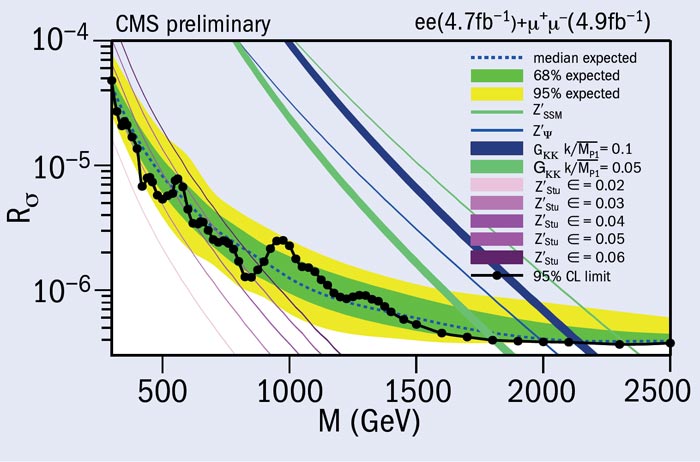
No clear evidence of the Z’ or W’ bosons has yet been observed, so the collaborations calculate the mass range where the existence of a hypothetical W’ or Z’ boson is excluded with 95% probability. Figure 2 shows the maximum allowed production rate (black points) as a function of the hypothetical Z’ boson mass, as allowed by the CMS data. The different theories, shown by continuous coloured lines, are excluded in the low-mass region where they predict a rate larger than that shown with the black line, but are still allowed in the high-mass region where they predict a lower rate. For example, the Standard Model-like Z’ boson predicted by the Sequential Standard Model is excluded up to 2300 GeV (2.3 TeV).
It might also be the case that the preferred decay channels of the Z’ bosons are different from those of the Z boson. For instance, the Z’ may prefer to decay into pairs of quarks or even a pair of the lighter partners – the W and Z of the Standard Model. It is therefore critical to explore all of the possible decay channels. These searches are about to be completed by the two collaborations using large data samples collected during the 2010–2011 runs. At the same time they are eagerly awaiting the 2012 data, with larger data samples of even more energetic collisions provided by the LHC. The hunt will then start anew and probe even higher masses
To provide the best experiences, we use technologies like cookies to store and/or access device information. Consenting to these technologies will allow us to process data such as browsing behavior or unique IDs on this site. Not consenting or withdrawing consent, may adversely affect certain features and functions.
Functional
Always active
The technical storage or access is strictly necessary for the legitimate purpose of enabling the use of a specific service explicitly requested by the subscriber or user, or for the sole purpose of carrying out the transmission of a communication over an electronic communications network.
Preferences
The technical storage or access is necessary for the legitimate purpose of storing preferences that are not requested by the subscriber or user.
Statistics
The technical storage or access that is used exclusively for statistical purposes.The technical storage or access that is used exclusively for anonymous statistical purposes. Without a subpoena, voluntary compliance on the part of your Internet Service Provider, or additional records from a third party, information stored or retrieved for this purpose alone cannot usually be used to identify you.
Marketing
The technical storage or access is required to create user profiles to send advertising, or to track the user on a website or across several websites for similar marketing purposes.