Comsol -leaderboard other pages

Topics

A neutrino telescope deep in the Mediterranean Sea

CCmed1_06_12

Particle physicists – like many other scientists – are used to working under well controlled laboratory conditions, with constant temperature, controlled humidity and perhaps even a clean-room environment. They would consider crazy anyone who tried to install an experiment in the field outside the lab environment, without shelter against wind and weather. So what must they think of a group of physicists and engineers planning to install a huge, highly complex detector on the bottom of the open sea?

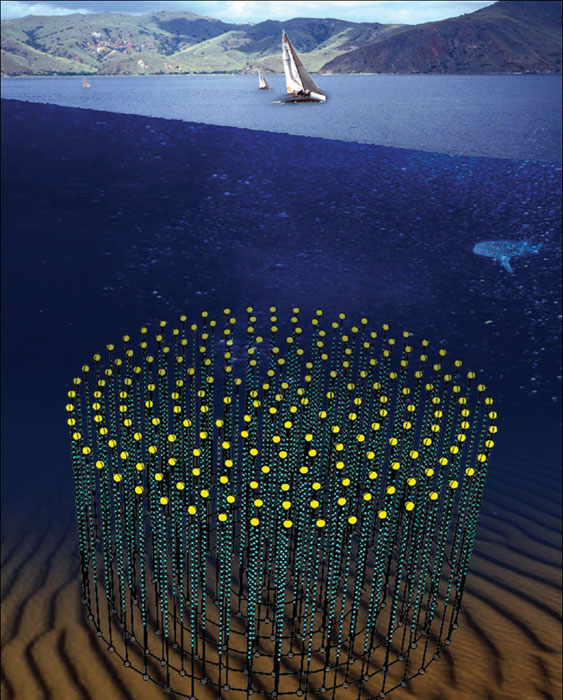
This is exactly what the KM3NeT project is about: a neutrino telescope that will consist of an array of photo-sensors instrumenting several cubic kilometres of water deep in the Mediterranean Sea (figure 1). The aim is to detect the faint Cherenkov light produced as charged particles emerge from the reactions of high-energy neutrinos in the instrumented volume of ocean or the rock beneath it. Most of the neutrinos that are detected will be “atmospheric neutrinos”, originating from the interactions of charged cosmic rays in the Earth’s atmosphere. Hiding among these events will be a few that have been induced by neutrinos of cosmic origin, and these are the prime objects that the experimenters desire.

Ideal messengers

Why are a few cosmic neutrinos worth the huge effort to construct and operate such an instrument? A century after the discovery of cosmic rays, the start of construction of the KM3NeT neutrino telescope marks a big step forwards in understanding their origin and solving the mystery of the astrophysical processes in which they acquire energies that are many orders of magnitude beyond the reach of terrestrial particle accelerators. This is because neutrinos are ideal messengers from the universe: they are neither absorbed nor deflected, i.e. they can escape from dense environments that would absorb all other particles; they point back to their origin; and they are produced inevitably if protons or heavier nuclei with the energies typical of cosmic rays – up to eight orders of magnitude above the LHC beam energy – scatter on other nuclei or on photons and thereby signal astrophysical acceleration of nuclei.

Only a handful of neutrinos assigned to an astrophysical source would convey the unambiguous message that this source accelerates nuclei – a finding that can not be achieved any other way. Of course, much more can be studied with neutrino telescopes. Cosmic neutrinos might signal annihilations of dark-matter particles, and their isotropic flux provides information about sources that cannot be resolved individually. Moreover, atmospheric neutrinos could be used to make measurements of unique importance for particle physics, such as the determination of the neutrino-mass hierarchy.

Driven by the fundamental significance of neutrino astronomy, a first generation of neutrino telescopes with instrumented volumes up to about a per cent of a cubic kilometre was constructed over the past two decades: Baikal, in the homonymous lake in Siberia; AMANDA, in the deep ice at the South Pole; and ANTARES, off the French Mediterranean coast. These detectors have proved the feasibility of neutrino detection in the respective media and provided a wealth of experience on which to build. However, they have not – yet – identified any neutrinos of cosmic origin.

These results and the evolution of astrophysical models of potential classes of neutrino sources over the past few years indicate that, in fact, much larger target volumes are necessary for neutrino astronomy. The first neutrino telescope of cubic-kilometre size, the IceCube observatory at the South Pole, was completed in December 2010. Its integrated exposure is growing rapidly and the discovery of a first source may be just round the corner.

Why then start constructing another large neutrino telescope? Would it not be better to wait and see what IceCube finds? To answer this question it is important to understand in somewhat more detail the way in which neutrinos are actually measured.

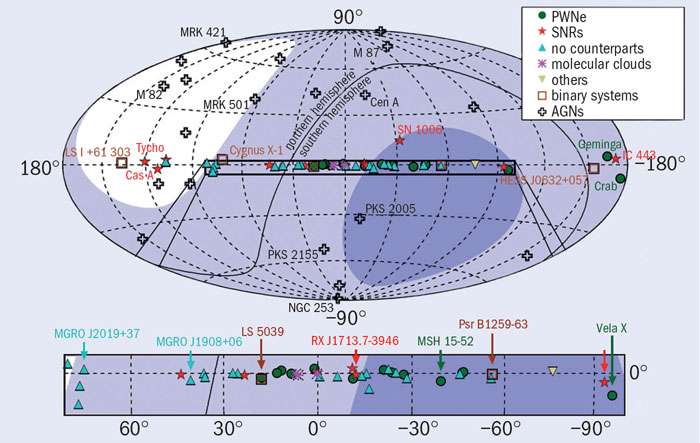
The key reaction is the charged-current (mostly deep-inelastic) scattering of a muon-neutrino or muon-antineutrino on a target nucleus. In such a reaction, an outgoing muon is produced that, on average, carries a large fraction of the neutrino energy and is emitted with only a small angular deflection from the neutrino direction. The muon trajectory – and thus the neutrino direction – is reconstructed from the arrival times of the Cherenkov light in the photo-sensors and the positions of the sensors. This method is suitable for the identification of neutrinos if they come from the opposite hemisphere, i.e. through the Earth. If they come from above, then the resulting muons are barely distinguishable from “atmospheric” muons that penetrate to the detector and are much more numerous. Neutrino telescopes therefore look predominantly “downwards” and do not cover the full sky. IceCube, being at the South Pole, can thus observe the Northern sky but not the Galactic centre and the largest part of the Galactic plane (figure 2).
CCmed2_06_12

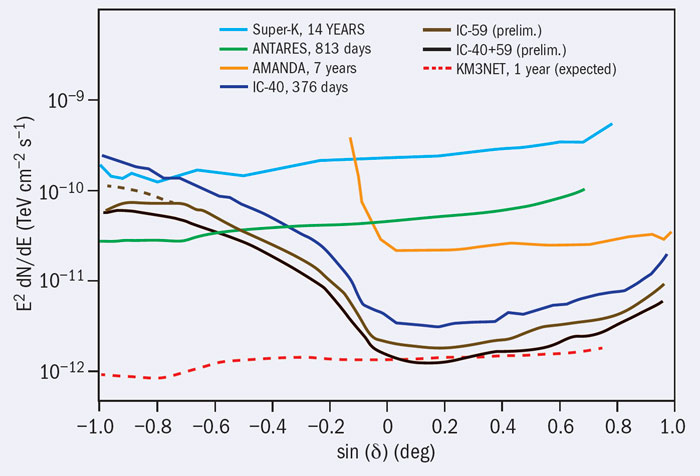
The KM3NeT telescope will have the Galactic centre and central plane of the Galaxy in its field of view and will be optimized to discover and investigate the neutrino flux from Galactic sources. Shell-type supernova remnants are a particularly interesting kind of candidate source. In these objects the supernova ejecta hit interstellar material, such as molecular clouds, and form shock fronts. Gamma-ray observations show that these are places where particles are accelerated to very high energies – but there is an intense debate as to whether these gamma rays stem from accelerated electrons and positrons or hadrons. The only way to give a conclusive answer is through observing neutrinos. Figure 3 shows the sensitivity of KM3NeT and other different experiments to neutrino point sources. According to simulations based on model calculations using gamma-ray measurements by the High Energy Stereoscopic System (HESS) – an air Cherenkov telescope – KM3NeT could make an observation of the supernova remnant RX J1713.7-3946 (figure 4) with a significance of 5σ within 5 years, if the emission process is purely hadronic.
CCmed3_06_12

The construction of a neutrino telescope of this sensitivity within a realistic budget faces a number of challenges. The components have to withstand the hostile environment with several hundred bar of static pressure and extremely aggressive salt water. That limits the choice of materials, in particular as maintenance is difficult or even impossible. In addition, background light from the radioactive decay of potassium-40 and bioluminescence causes high rates of photomultiplier hits, while the deployment of the detector requires tricky sea operations and the use of unmanned submersibles to make cable connections.

CCmed4_06_12

When the KM3NeT design effort started out with an EU-funded Design Study (2006–2009), a target cost of €200 million for a cubic-kilometre detector was defined. At the time, this was considered utterly optimistic in view of the investment cost for ANTARES of about €20 million. Now, in 2012, the collaboration is confident that it can construct a detector of 5–6 km3 for €220–250 million. This enormous development is partly a result of optimizing the neutrino telescope for slightly higher energies, which implies larger horizontal and vertical distances between the photo-sensors. The main progress, however, has been in the technical design. Almost all of the components have been newly designed, in many cases pursuing completely new approaches.

The design of the optical module is a prime example. Instead of a large, hemispherical photomultiplier (8- or 10-inch diameter) in a glass sphere (17-inch diameter), the design now uses as many as 31 photomultipliers of 3-inch diameter per sphere (figure 5). This triples the photocathode area for each optical module, allows for a clean separation of hits with one or two photo-electrons and adds some directional sensitivity.

CCmed5_06_12

All data, i.e. all photomultiplier hits, will be digitized in the optical modules and sent to shore via optical fibres. At the shore station, a data filter will run on a computer cluster and select the hit combinations in which the hit pattern and timing are compatible with particle-induced events.

Three countries (France, Italy and the Netherlands) have committed major contributions to an overall funding of €40 million for a first construction phase; others (Germany, Greece, Romania and Spain) are contributing at a smaller level or have not yet made final decisions. It is expected that final prototyping and validation activities will be concluded by 2013 and that construction will begin in 2013–2014. The installation will soon substantially exceed any existing northern-hemisphere instruments in sensitivity, thus providing discovery potential from an early stage.

Last, astroparticle physicists are not alone in looking forward to KM3NeT. For scientists from various areas of underwater research, the detectors will provide access to long-term, continuous measurements in the deep sea. It will provide nodes in a global network of deep-ocean observatories and thus be a truly multidisciplinary research infrastructure.

• For more information, see the KM3NeT Technical Design Report at www.km3net.org.
The discovery of air-Cherenkov radiation

CCair1_06_12

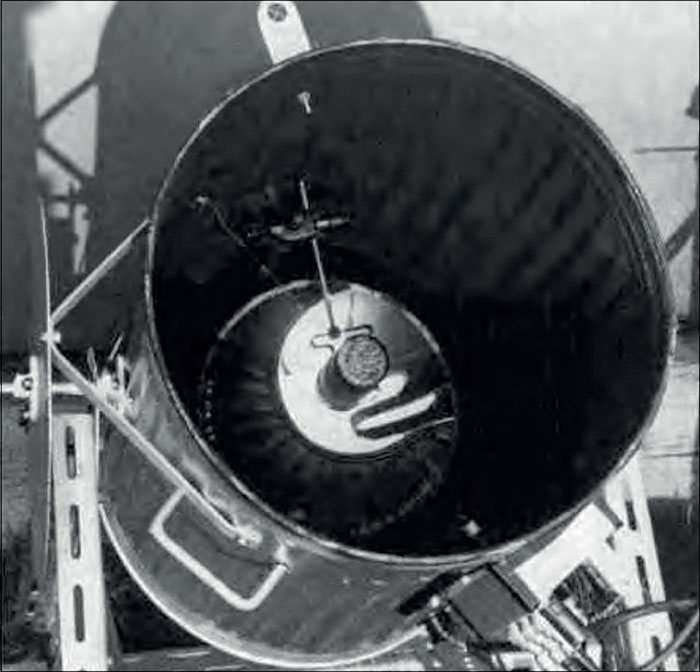
Sixty years ago, in September 1952, two young researchers at the UK’s Atomic Energy Research Establishment went out on a moonless night into a field next to the Harwell facility equipped with little more than a standard-issue dustbin containing a Second World War parabolic signalling mirror only 25 cm in diameter, with a 5 cm diameter photomultiplier tube (PMT) at its focus, along with an amplifier and an oscilloscope. They pointed the mirror at the night sky, adjusted the thresholds on the apparatus and for the first time detected Cherenkov radiation produced in the Earth’s atmosphere by cosmic rays (Galbraith and Jelley 1953).

William (Bill) Galbraith and John Jelley were members of Harwell’s cosmic-ray group, which operated an array of 16 large-area Geiger-Müller counters for studying extensive air showers (EAS) – the huge cascades of particles produced when a primary cosmic particle interacts in the upper atmosphere. Over several nights, by forming suitable coincidences between the Geiger-Müller array and their PMT, Jelley and Galbraith demonstrated – unambiguously – a correlation between signals from the array and light pulses of short duration (<200 ns) with amplitudes exceeding 2–3 times that of the night-sky noise. By cross-calibrating with alpha particles from a 239Pu source, they were further able to estimate that they were detecting three photons per square centimetre per light flash in the wavelength range of 300–550 nm. A new age of Cherenkov astronomy was born.

The sky at night

Five years before this observation, at a meeting of the Royal Society’s Gassiot Committee in July 1947 on “The emission spectra of the night sky and aurorae”, Patrick Blackett had presented a paper in which he suggested, for the first time, that Cherenkov radiation emitted by high-energy cosmic rays should contribute to the light in the night sky. Blackett estimated the contribution of cosmic-ray-induced Cherenkov light to be 0.01% of the total intensity, concluding: “Presumably such a small intensity of light could not be detected by normal methods.” Blackett’s work went largely unnoticed until a chance meeting at Harwell in 1952, which Jelley later recounted (Jelley 1986): “… hearing of our work on Cherenkov light in water, [Blackett] quite casually mentioned that … he had shown that there should be a contribution to the light of the night sky, amounting to about 10–4 of the total, due to Cherenkov radiation produced in the upper atmosphere from the general flux of cosmic rays.” Jelley continued: “Blackett was only with us a few hours, and neither he nor any of us ever mentioned the possibility of pulses of Cherenkov light, from EAS. It was a few days later that it occurred to Galbraith and myself that such pulses might exist and be detectable.”

The work of 1952 demonstrated the presence of short-duration pulses of light in coincidence with EAS but it did not prove that the light was, indeed, Cherenkov radiation. In particular, Galbraith and Jelley were aware that the light that they had observed could be also be produced either by bremsstrahlung or by recombination following ionization in the atmosphere. Thus, in the summer of 1953, they set out to establish the Cherenkov nature of the light pulses that they had observed.

Daunted by the vagaries of the British weather, they headed to the Pic du Midi observatory in France where, over six moonless weeks in July to September 1953, they carried out a series of experiments to determine the polarization and directionality of the light and also performed a rudimentary wavelength determination. This time they were equipped with four mirrors and two types of PMT. Conscious that the light-pulse counting rate would change with the noise level of the night sky, which in turn would depend on which part of the sky they were looking at, they devised a method of keeping the mean PMT current and, hence the noise, constant by using a small lamp next to the mirror.

Experimental conditions at the top of the mountain were challenging. EAS correlations were provided by requiring coincidences of signals from the PMTs with those from a linear array of five trays of Geiger-Müller counters, each tray 800 cm2 in area and aligned over almost 75 m – the positioning of these units was somewhat limited by the available space on the mountain (Galbraith and Jelley 1955). PMT pulses were recorded on an oscilloscope and subsequently photographed. Evidence for polarization of the observed light, a known characteristic of Cherenkov radiation, was clearly established by taking readings of a PMT with a polarizer placed over the PMT’s photocathode and calculating the ratio of the number of events seen when the polarizer was aligned parallel or perpendicular to the Geiger-Müller array. The result was a ratio of 3.0±0.5 to 1 for events seen in coincidence with two Geiger-Müller counter trays (Jelley and Galbraith 1955).

The two researchers also investigated the directionality of the observed light by plotting the coincidence rate of pulses seen in two light receivers (normalized accordingly) as a function of the angle between the two receivers. This experiment was done using pairs of receivers 1 m apart and was repeated with mirrors having different fields of view. The results fell between the two theoretical curves for Cherenkov and ionization light but they gave additional support for the premise that the light being observed was, indeed, Cherenkov light. In addition, the use of wide-band filters enabled Galbraith and Jelley to demonstrate that the light contained more blue light than green, which was another expected feature of Cherenkov radiation.

During their studies on the Pic du Midi, Jelley and Galbraith went on to explore the relationship between the light yield in the atmosphere and the energy of the shower, confirming, as expected, that larger light pulses were correlated with showers with higher particle densities. Finally, aware that their light receivers had both a considerable effective area and good angular resolution, they went on to search for possible point sources of cosmic rays in the night sky. The search yielded no statistically significant variations, and Galbraith and Jelley subsequently estimated that the receiver was sensitive to showers of energies of 1014 eV and above.

Following these studies in the early 1950s, it soon became apparent that use of the atmosphere as a Cherenkov radiator was a viable experimental technique. By the end of the decade, Cherenkov radiation in the atmosphere had been developed further as a means for studying cosmic rays – far away from the generally unsuitable British climate. In the Soviet Union, Aleksandr Chudakov and N M Nesterova of the Lebedev Physical Institute deployed a series of large-area Geiger counters along with eight light receivers at 3800 m in the Pamir Mountains to detect the lateral distribution of the Cherenkov light and thereby study the vertical structure of cosmic-ray showers. In Australia, around the same time, Max Brennan and colleagues of the University of Sydney used two or more mis-aligned light receivers to demonstrate the effects of Coulomb scattering of the charged particles in the cosmic-ray shower.

Meanwhile, at the International Cosmic Ray Conference in Moscow in 1959, Giuseppe Cocconi made a key theoretical prediction – that the Crab Nebula should be a strong emitter of gamma rays at tera-electron-volt energies. This stimulated further work, both by a British–Irish collaboration that included Jelley, and by Chudakov and his colleagues. The work at the Lebedev Physical Institute led in the early 1960s to the construction of the first air-Cherenkov telescope, with 12 searchlight mirrors, each 1.5 m in diameter and mounted on railway cars at a site in the Crimea close to the Black Sea.

The legacy

So, just a decade after the initial pioneering steps by Galbraith and Jelley, the first operational air-Cherenkov telescope had been built, setting in motion a chain of events that would ultimately lead in 1989 to the observation of gamma rays from the Crab Nebula by Trevor Weekes and colleagues at the Whipple telescope in the US. This breakthrough came nearly 25 years after Weekes had worked with Jelley in a collaboration between AERE and the University College Dublin, making the first attempts to detect gamma rays from quasars – a feat achieved only recently by the MAGIC air-Cherenkov telescope in the Canary Islands. Now, researchers around the world are teaming up to build the most sensitive telescope of this kind yet – the Cherenkov Telescope Array (Cherenkov Telescope Array is set to open new windows).

In writing only a few years ago about the work at Harwell, Weekes stated: “The account of these elegant experiments is a must-read for all newcomers to the field” (Weekes 2006). He also summed up well that first experiment by Galbraith and Jelley: “It is not often that a new phenomenon can be discovered with such simple equipment and in such a short time, but it may also be true that it is not often that one finds experimental physicists with this adventurous spirit!”

From ionization of air to beyond the LHC

CCvie1_06_12

In August, some 100 physicists will gather at Bad Saarow in Germany to celebrate the centenary of the discovery of cosmic rays by the Austrian scientist, Victor Hess. The meeting place is close to where Hess and his companions landed following their flight from Aussig during which they reached 5000 m in a hydrogen-filled balloon; Health and Safety legislation did not restrain them. Finding the rate of ion-production at 5000 m to be about three times that of sea level, Hess speculated that the Earth’s atmosphere was bombarded by high-energy radiation. This anniversary might also be regarded as the centenary of the birth of particle physics. The positron, muon, charged pions and the first strange particles were all discovered in cosmic rays between 1932 and 1947; and in 1938 Pierre Auger and colleagues showed, by studying cascade showers produced in air, that the cosmic-ray spectrum extended to at least 1015 eV, a claim based on the new ideas of QED.

Reviewing history, one is struck by how reluctant physicists were to contemplate particles other than protons, neutrons, electrons and positrons. The combination of the unexpectedly high energies and uncertainties about the validity of QED meant that flaws in the new theory were often invoked to explain observations that were actually evidence of the muon. Another striking fact is how many giants of theoretical physics, such as Bethe, Bhabha, Born, Fermi, Heisenberg, Landau and Oppenheimer, speculated on the interpretation of cosmic-ray data. However, in 1953, following a famous conference at Bagnères de Bigorre, the focus of work on particle physics moved to accelerator laboratories and despite some isolated discoveries – such as that of a pair of particles with naked charm by Kiyoshi Niu and colleagues in 1971, three years before the discovery of the J/ψ at accelerators – accelerator laboratories were clearly the place to do precision particle physics. This is not surprising because the beams there are more intense and predictable than nature’s: the cosmic-ray physicist cannot turn to the accelerator experts for help.

Cosmic rays remained – and remain – at the energy frontier but post-1953 devotees were perhaps over eager to show that particle-physics discoveries could be made with cosmic rays without massive collaborations. Cosmic-ray physicists preferred to march to the beat of their own drums. This led to attitudes that were sometimes insufficiently critical and the field became ignored or even mocked by many particle physicists. In the 30 years after Bagnères de Bigorre, a plethora of observations of dramatic effects were claimed, including Centauros, the Mandela, high-transverse momentum, the free quark, the monopole, the long-flying component and others. Without exception, these effects were never replicated because better cosmic-ray experiments were made or the relevant energies were superseded at machines. That many of the key results – good and bad – were hidden in the proceedings of the biennial International Cosmic Ray Conference did not help. Not that the particle-physics community has never made false claims: older readers will recall that in 1970 the editor of Physical Review Letters found it necessary to lay down “bump hunting” rules for those searching for resonances and, of course, the “split A2”.

However, another cosmic-ray “discovery” led to a change of scene. In 1983, a group at Kiel reported evidence for gamma rays of around 1015 eV from the X-ray binary, Cygnus X-3. Their claim was apparently confirmed by the array at Haverah Park in the UK and at tera-electron-volts energies at the Whipple Telescope in the US. Several particle physicists of the highest class were sucked into the field by the excitement. This led to the construction of the VERITAS, HESS and MAGIC instruments that have now created a new field of gamma-ray astronomy at tera-electron-volt energies. The construction of the Auger Observatory, the largest cosmic-ray detector ever built, is another major consequence. In addition to important astrophysics results, the instrument has provided information relevant to particle physics. Specifically, the Auger Collaboration has reported a proton–proton cross-section measurement at a centre-of mass energy of 57 TeV.

When the LHC began to explore the tera-electron-volt energy region, some models used by cosmic-ray physicists were found to fit the first rapidity-data as well as, if not better than, those from the particle-physics theorists. It is clear that there is more to be learnt about features of hadronic physics through studying the highest-energy particles, which reach around 1020 eV. Estimates of the primary energy that are made using hadronic models are significantly higher than those from the measurements of the fluorescence-light from air-showers, which give a calorimetric estimate of the energy that is almost independent of assumptions about particle physics beyond the LHC. Furthermore, the number of muons found in high-energy showers is about 30% greater than predicted by the models. The Auger Collaboration plans to enhance their instrument to extend these observations.

Towards the end of operations of the Large Electron–Positron collider at CERN, projects such as L3-Cosmics used the high-resolution muon detectors to measure muon multiplicities in showers. Now there are plans to do something similar through the ACME project, part of the outreach programme related to the ATLAS experiment at the LHC, but with a new twist. The aim is for cheap shower detectors of innovative design, paid for by schools, to be built above ATLAS – with students monitoring performance and analysing data. Overall, we are seeing another union of cosmic-ray and particle physics, different from that of pre-1953 but nonetheless one that promises to be as rich and fascinating.

Principles of Radiation Interaction in Matter and Detection (3rd edition)

By Claude Leroy and Pier-Giorgio Rancoita
World Scientific
Hardback: £153 $232
E-book: $302

41zesEncHwL._SX328_BO1,204,203,200_

Like its predecessors, this third edition addresses the fundamental principles of the interaction between radiation and matter and the principles of particle detection and detectors in a range of fields, from low to high energy, and in space physics and the medical environment. It provides abundant information about the processes of electromagnetic and hadronic energy deposition in matter, detecting systems, and performance and optimization of detectors, with additional information in the third edition. A part of the book is also directed towards courses in medical physics.

The Fundamentals of Imaging: From Particles to Galaxies

By Michael Mark Woolfson
Imperial College Press
Hardback: £65 $98
Paperback: £32 $48
E-book: £87 $127

71r0D2DMcWL

The range of imaging tools, both in the type of wave phenomena used and in the devices that utilize them, is vast. This book illustrates this range, with wave phenomena that cover the entire electromagnetic spectrum, as well as ultrasound, and devices that vary from those that simply detect the presence of objects to those that produce images in exquisite detail. The aim also is to give an understanding of the principles behind the imaging process and a general account of how those principles are utilized, without delving into the technical details of the construction of specific devices.

A Modern Introduction to Particle Physics (3rd edition)

By Fayyazuddin and Riazuddin
World Scientific
Hardback: £54 $82

413GV+kJZjL

The Pakistani brothers, who were both students of Abdus Salam, wrote the first edition of their book in 1992, based on lectures given in various places. Aimed at senior undergraduates or graduate students, it provides a comprehensive account of particle physics. Having first been updated in 2000, this latest edition contains many revised chapters, in particular those that cover subjects such as heavy flavours, neutrinos physics, electroweak unification, supersymmetry and string theory. Another addition is a substantial number of new problems. This self-contained book covers basic concepts and recent developments, as well as overlaps between astrophysics, cosmology and particle physics.

CERN’s accelerators, experiments and international integration 1959–2009. The European Physical Journal H 36 (4).

By Herwig Schopper et al. (ed.)
Springer

CCboo1_05_12

In 2009, CERN’s Proton Synchrotron (PS) reached its half century, having successfully accelerated protons to the design energy for the first time on 24 November 1959. Still in operation more than 50 years later, it is not only a key part of the injection chain to the LHC but also continues to supply a variety of beams to other facilities, from the Antiproton Decelerator to the CERN Neutrinos to Gran Sasso project. During its operation, the PS witnessed big changes at CERN; at the same time, particle physics itself advanced almost beyond recognition, from the days before quarks to the current reign of the Standard Model.

At the close of the anniversary year, CERN held a symposium in honour of the accelerator developments at CERN and the concurrent rise of the Standard Model: “From the PS to the LHC: 50 years of Nobel Memories in High-Energy Physics”. Fittingly, at the end of 2009, the LHC – the machine that everyone expects to take the first steps beyond the Standard Model – was just beginning to come into its stride after the first collisions in November.

Key players who had been close to all of these developments, including 13 Nobel laureates, came together for the symposium. Now, several of the talks have been written up and published in the latest edition of The European Physical Journal H – the journal launched in 2010 as a common forum for physicists, historians and philosophers of science. The edition also includes three additional articles that were invited to provide a more complete picture, by covering CERN’s Intersecting Storage Rings, the history of stochastic cooling and searches for the Higgs boson at the Large Electron-Positron (LEP) collider – which started up in 1989 and hence celebrated its 30th anniversary at the symposium.

Dip into the pages and you will find many gems: among the Nobel laureates, Jerome Friedman describes the work at SLAC that revealed the reality of quarks, which were unheard of in 1959; Jim Cronin revisits the early 1960s when he and his colleagues discovered CP violation; Jack Steinberger looks back at early experiences at CERN; Carlo Rubbia presents the story of the discovery of W and Z bosons at CERN; and Burt Richter recalls early ideas on LEP, from his days on sabbatical at CERN. On the accelerator side, the articles detail developments with the PS, as well as the highlights (and lowlights) of the construction and running of LEP. The invited article on stochastic cooling includes the work of Simon van der Meer, who shared the Nobel prize with Carlo Rubbia in 1984. Sadly, he was too ill to attend the symposium and passed away in March 2011.

All of the articles provide an interesting view of remarkable events through the reminiscences of people who were not simply “there”, but who played a big part in making them happen. They are a fascinating reminder of what particle physics was like in the past and well worth a read. They also reflect the different styles of the various individuals, but not so much, perhaps, as did the original presentations at the symposium. To get the full flavour, and to see all the participants, take a look at the recordings. There you will find still more gems.

IceCube observations challenge ideas on cosmic-ray origins

CCnew1_05_12

The IceCube collaboration, with a detector that looks at a cubic kilometre of ice at the South Pole, has searched for evidence of neutrinos associated with gamma-ray bursts (GRBs). They find none at a level 3.7 times lower than models predict, indicating that cosmic rays with energies above 108 TeV originate from some other source.

Where nature accelerates particles to 108 TeV has been one of the long-standing questions of extreme astrophysics. Although the flux of the highest-energy cosmic rays arriving at Earth is small, it pervades the universe and corresponds to a large amount of energy. Equally mysterious in origin, gamma-ray bursts (GRBs), some associated with the collapse of massive stars to black holes, have released a small fraction of a solar mass of radiation more than once a day since the Big Bang. The assumption is that they invest a similar amount of energy in the acceleration of protons, which explains the observed cosmic-ray flux. This leads to the 15-year-old prediction that when protons and gamma rays co-exist in the GRB fireball they photoproduce pions that decay into neutrinos. The prediction is quantitative (albeit with astrophysical ambiguities) because astronomers can calculate the number of photons in the fireball, and the observed cosmic-ray flux dictates the number of protons. Textbook particle physics then predicts the number of neutrinos.

With 5160 photomultiplier tubes, the IceCube experiment has transformed a cubic kilometre of Antarctic ice into a Cherenkov detector. Even while still incomplete, the instrument reached the sensitivity to observe GRBs, taking data with 40 and 59 of the final number of 86 photomultiplier strings. The measurement is relatively easy because it exploits alerts from the NASA’s Swift satellite and Fermi Gamma-Ray Space Telescope to look for neutrinos arriving from the right direction at the right time. The window is small enough to do a background-free measurement because accidental coincidence with a high-energy atmospheric neutrino is negligible.

During the periods of data-taking, some 307 GRBs had the potential to result in neutrinos that IceCube could detect. However, the experiment found no evidence for any neutrinos that could be associated with the GRBs. This implies either that GRBs are not the only sources of cosmic rays with energies exceeding 108 TeV or that the efficiency of neutrino production is much lower than has been predicted.

With GRBs on probation, the stock rises for the alternative speculation that associates supermassive black holes at the centres of galaxies with the enigmatic cosmic accelerators.

CMS discovers the Ξb*0

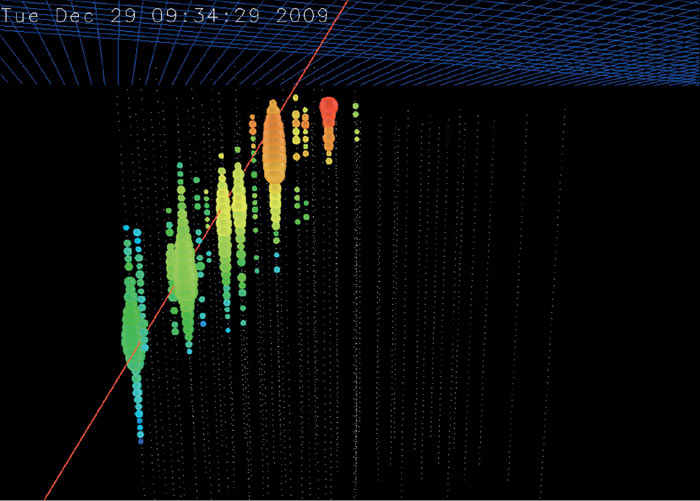
Display of typical event

The CMS experiment has discovered its first new particle. The new state is observed with a significance exceeding 5 σ and a mass of 5945.0 ± 2.8 MeV. This mass and the observed decay mode are consistent with its being the beauty-strange baryon known as Ξb*0.

Understanding the detailed spectroscopy of the various families of hadrons has been a quest of scientists ever since quarks were recognized as being the building blocks of protons, neutrons and other hadrons. Baryons are composed of three quarks and if they contain a beauty (b) quark and a strange (s) quark then they are members of the Ξb family. Depending on whether the third valence quark is a u or a d, the resulting baryon is either the neutral Ξb0 or the charged Ξb. While the charged and neutral lowest-mass states were already known, none of the heavier states had so far been seen. The newly discovered particle is probably the Ξb*0, with a total angular momentum and parity, JP = 3/2+. Its observation helps in understanding how quarks bind and in further validating the theory of strong interactions.

The observation was made in a data sample of 5.3 fb–1 proton–proton collisions at a centre-of-mass energy of 7 TeV, delivered by the LHC in 2011. Figure 1 shows a typical event, where a candidate Ξb*0 (also appropriately called the “cascade b baryon”) leads to a cascade of decays, Ξb*0 → Ξbπ+, Ξb → J/ΨΞ, J/Ψ → μ+μ, Ξ → Λ0π and Λ0 → pπ, ending in one proton, two muons, and three pions. The existence of the Ξb*0 is established by detecting all of these particles and measuring the charge, momentum and point of origin (the vertex) for each one. Requiring that the secondary decay vertices be displaced from the primary vertex reduces the background caused by random combinations of uncorrelated particles, which are copiously produced in high-energy proton–proton collisions.

New Baryon

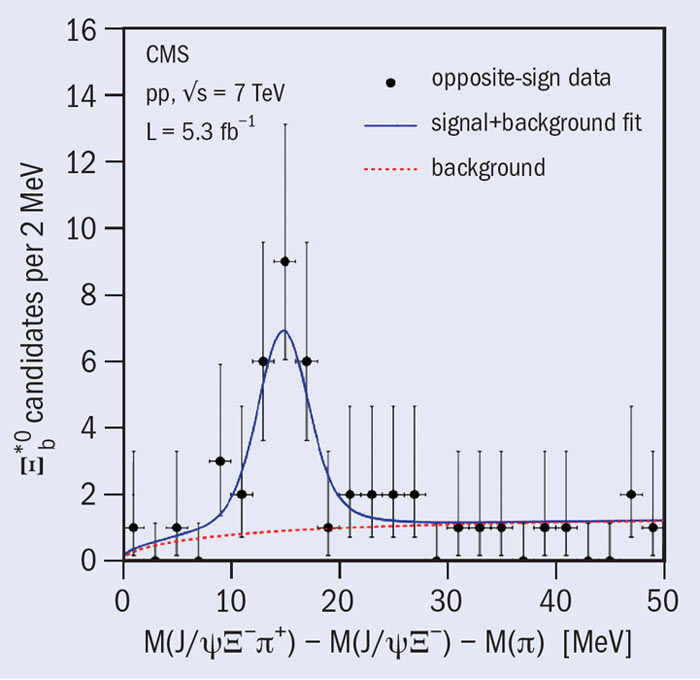
The invariant-mass distribution of the J/ΨΞ pairs shows a clear peak corresponding to the Ξb signal, with a mass in good agreement with the world average. The Ξb*0 is expected to decay promptly to Ξbπ+ pairs, so candidates were sought by combining the reconstructed Ξb with a track (assumed to be a pion) coming from the primary vertex. To cancel measurement errors partially and so increase the sensitivity, the analysis looked at the mass difference Q = M(J/ΨΞπ+) – M(J/ΨΞ) – M(π). Figure 2 shows the mass difference for 21 events in the range 12 < Q < 18 MeV, which clearly exceed the 3.0 ± 1.4 events expected in the absence of a new particle.

The detection of this new particle was possible thanks only to the excellent tracking and vertexing capabilities of the CMS experiment, combined with high-purity dimuon triggers that identify decays of the J/Ψ meson “on the fly”, before storing the events. This measurement shows that CMS can unravel complicated chains of particle decays and bodes well for future discoveries of rare particles.

Dijets confirm the Standard Model

Dijet measurements provide an excellent tool not only to probe high transverse-momentum parton interactions to study QCD but also to look for signs of new phenomena beyond the Standard Model. Thanks to the outstanding performance of the LHC in 2011, the ATLAS experiment recorded nearly 30,000 events with dijet masses above 2 TeV and even observed dijet masses up to 4.6 TeV.

CCnew6_05_12

The collaboration has used the full 2011 data sample – corresponding to nearly 5 fb–1 of integrated luminosity – for a measurement of the dijet cross-section as a function of mass and rapidity difference. The data were first corrected for detector effects – paying particular care to the effect of possible multiple interactions per beam crossing – and the measured cross-sections were then compared with various predictions of QCD. While there are small deviations in some models at the higher end of the spectrum, overall the agreement with QCD is reasonably good.

QCD predicts that the cross-section falls steeply with dijet mass. New, as yet unobserved, particles would typically give rise to resonances or bumps on top of this smoothly falling spectrum. ATLAS observes no bumps, allowing limits to be set on a number of theories that predict such particles.

Angular distributions can also be used to search for deviations from the Standard Model. They are typically measured in bins of dijet mass, where the scattering angle is transformed into a variable known as χ (see figure). The Standard Model predicts that these distributions should be relatively flat, while many theories beyond the Standard Model predict a rise at low values of χ.

The measured distributions are found to be in agreement with QCD predictions, allowing limits to be set on various models for new physics. For one of these models, where quarks are no longer fundamental particles but are instead composite objects, this analysis sets a limit on the compositeness scale – the scale of the constituent binding energies – at 7.8 TeV.

bright-rec iop pub iop-science physcis connect