Comsol -leaderboard other pages

Topics

ENLIGHT: catalysing hadron therapy in Europe

Résumé

ENLIGHT : catalyseur de la thérapie hadronique en Europe

Il y a dix ans, en février 2002, ENLIGHT, le Réseau européen de recherche sur la thérapie hadronique par les ions légers, tenait sa réunion inaugurale au CERN. Le but était de réunir des spécialistes de diverses disciplines, dont la radiobiologie, l’oncologie, la physique et l’ingénierie. Le réseau a été un catalyseur de l’établissement d’une plateforme européenne pour promouvoir l’hadronthérapie. Aujourd’hui, ENLIGHT++ compte quelque 400 participants de plus de 20 pays européens. Quelques-unes des figures de proue de la création d’ENLIGHT évoquent ici des souvenirs des premières années.

Ten years ago, in February 2002, the European Network for Light Ion Hadron Therapy (ENLIGHT) had its inaugural meeting at CERN (CERN Courier May 2002 p29). About 70 specialists attended this first gathering from different disciplines, including radiation biology, oncology, physics and engineering. This was a considerable achievement, coming at a time when “multidisciplinarity” was not yet a buzz-word. The EU-funded project, co-ordinated by the European Society for Therapeutic Radiology and Oncology (ESTRO), came to an end in the summer of 2005 with the final meeting in Oropa, in the Italian Alps. Here, it was widely acknowledged that ENLIGHT had been a key catalyst in building a European platform to propel hadron therapy forwards. The encouraging results motivated the community to discuss how to maintain and broaden the network (CERN Courier October 2005 p31).

Less than a year later, in March 2006, more than 100 scientists from 20 European countries arrived at CERN for the preparatory meeting of ENLIGHT++; the two plus signs indicate more countries and more hadrons with respect to the previous project (CERN Courier June 2006 p27). The enlarged group of participants agreed that the goals of the network could be met best through two complementary approaches: research in areas needed for highly effective hadron therapy; and networking to establish and implement common standards and protocols for treating patients. The primary mandate of ENLIGHT++ is therefore to develop strategies for securing the funding necessary to continue the initiative in these two fundamental aspects, mostly through dedicated EU projects, while the network itself carries on without specific funding.

A growing success

Since starting in 2002, ENLIGHT has been growing steadily and it now counts some 400 participants from more than 20 countries across Europe. It entered its second decade with four EC-funded projects under its umbrella: PARTNER (which came to an end in September), ULICE, ENVISION and ENTERVISION, with total funding of €24 million. All of these projects are directed towards the different aspects of developing, establishing and optimizing hadron therapy.

The success of ENLIGHT and ENLIGHT++ is the result of years of work aimed towards a unified approach towards hadron therapy in Europe. Here, some of the key players from the birth of ENLIGHT share their personal recollections of those early years.

J-P Gérard, Centre Antoine-Lacassagne, Nice and ESTRO

“ENLIGHT was launched in 2002 as a result of several years of European activity in the field of hadron therapy. Indeed, as early as the 1970s, particle-beam therapy was already considered an attractive field of research (J P Gérard et al. 1978). In the 1980s, the EULIMA project – established in collaboration with CERN – was the first European attempt to design a cyclotron to produce carbon-12 ions. The award of an honorary degree to Ugo Amaldi by Lyon University 1 in 1997 marked the origin of the ETOILE project for a carbon-ion facility in Lyon, which is now part of the ‘France HADRON’ project.

“At that time, radiation oncologists in Germany, Italy, Switzerland and Austria were actively engaged in the design of accelerators to produce protons and carbon-ion beams through the Proton Ion Medical Machine Study (PIMMS). I was president of ESTRO in the period 1999–2001, and the European Framework Programme offered a good opportunity to initiate a co-operative European action that would bring together all of the teams interested in the field.

“Thanks to the energy and vision of Germaine Heeren, the general secretary of ESTRO, it was possible to create the ENLIGHT group. A memorandum of understanding was signed in collaboration with CERN in 2002 and this became the basis of a call for a grant from the EU 5th Framework Programme (FP5).

“The grant was of a modest amount but represented a strong incentive to create, with the support of CERN, a dynamic collaboration between all of the radiation oncologists and physicists involved in this great hadron adventure. It is a real pleasure to see – 10 years later – that the dreams of these pioneers are becoming reality in Heidelberg, Pavia and other European centres, for the benefit of paediatric and adult patients.”

Richard Pötter, Medical University of Vienna

“ENLIGHT was founded on the basis of various developments in the field of particle therapy during the 1990s. Specific projects in different European countries had been conceived of but there was the common vision that these initiatives had to come together to strengthen efforts globally and establish light-ion radiotherapy successfully. Within ESTRO, a working group had already been initiated by prominent members of various European projects. This group prepared a comprehensive programme that included a range of topics, such as patient-selection modalities, preparation of clinical trials, technology, biology, imaging and health economics.

“An essential step forward was the decision to apply for an EC grant under the 5th Framework Programme, to fund the development of ENLIGHT with regards to these topics. The application was successful, so this European network gained a unique opportunity to enhance its activity through the different working groups and regular meetings, over a period of three years.”

Ugo Amaldi, TERA Foundation

“For me, the ENLIGHT project started with an e-mail received on Saturday 6 October 2001 from Germaine Heeren, secretary general of ESTRO. The subject line was “ESTRO Hadrons project – VERY URGENT” and it was addressed to many European radiation oncologists and physicists. The purpose – defined in a meeting chaired by Richard Pötter in December 2000 and better focused in a second meeting called by Jean-Pierre Gérard, who at the time was ESTRO president – was to submit a proposal by 18 October to the European FP5. In the e-mail, I was asked to co-ordinate the “theoretical physics and engineering part” of the proposal. Hans Svensson and Jean-Pierre Gérard had already been given the responsibilities of the ‘physics part’ and ‘the clinical tasks’, respectively.

“Since there were less than two weeks to the deadline, I exchanged the first e-mails with Germaine Heeren on Sunday and as of Monday morning I contacted all of the European groups that I knew. Most of them were informed of the fact that something was on the move and everybody said that, in principle, they agreed – but few people were ready to contribute to the write-up. Thus, I had to do a lot of the work myself, helped by Hans Svensson, but I still remember those hectic days with pleasure, because for me a European project initiated by ESTRO was the completion of 10 years of activity.

“In fact, the TERA Foundation had been conceived of in 1991: PIMMS, which was initiated at CERN by Meinhard Regler and myself in 1995 and led by Phil Bryant, had completed the design of an optimized proton–carbon synchrotron; and, last but not least, the Italian health minister, Umberto Veronesi, was drafting the law financing CNAO (the National Centre for Oncological Hadron Therapy), which was based on a modified version of PIMMS. A European project would have been the best framework for the next steps. Towards the end of the writing, there were some difficult moments – and here the intervention of Jürgen Debus was instrumental.

“I sent the text – for which Walter Henning had written a preface and Gerard Kraft had contributed the radiobiology part – to Germaine Heeren around noon of 18 October. The approval of ENLIGHT came on 6 February 2002, just one week before the opening of the inaugural meeting. This was held at CERN, following our request, supported by Hans Hoffmann who was then CERN’s director for technology transfer and scientific computing, and Luciano Maiani, CERN’s director-general at the time.”

Vision for 2022

ENLIGHT held its 10th anniversary meeting on 15 September 2012 at CNAO, in Pavia, with a look back at its founding, current progress and future challenges. Summarizing the historical perspective, Richard Pötter proposed building a European multicentre hadron therapy collaboration in close co-operation with ESTRO, EORTC and other key players in radiation oncology. This would gather under one umbrella the best clinical practices, research and development, together with education and training.

Progress in this young and vigorously developing scientific and medical discipline will be possible through joint basic and translational biology, clinical research and physics research. What it now requires is younger leadership, to be recruited from the many young and talented participants at the 10th anniversary meeting.

• PARTNER, ULICE, ENVISION and ENTERVISION are funded or co-funded by the European Commission under Grant Agreements 215840, 228436, 241851 and 264552. This article is based on one published in the first issue of ENLIGHT Highlights, see ENLIGHT: highlights.summer2012.pdf.

The three lives of DORIS: from charm quarks to cell biology

It is a seemingly simple question: when an electron scatters off a proton, how many photons are exchanged? The obvious answer would be: just one. Whether nature really acts as simply as this is, however, far from clear. The venerable storage ring DORIS at DESY is dedicating the last few weeks of its nearly 40 years of operation to this simple yet fundamental question. After three consecutive lives at the forefront of physics and with a wealth of scientific achievements, DORIS will be shut down for good at the end of 2012.

ARGUS detector

When DORIS ceases operation, it will leave behind some degree of nostalgia but most of all an invaluable scientific legacy in many fields. DORIS has been a pioneer in several ways: in accelerator science; in particle physics; and, notably, in the application of synchrotron radiation, where the machine helped spark a whole new field of photon science. “Synchrotron radiation measurements played an important role right from the start and the people working at DORIS fostered a creative spirit that let this young scientific field thrive,” says DESY’s photon-science director, Edgar Weckert. “This led to DESY becoming a global magnet for research with extremely intense X-ray light.” Indeed, various methods that today are standard techniques in photon science were developed at DORIS.

DORIS III ring

When DORIS went into operation in 1974, it was one of the world’s first storage rings. The concept of keeping the accelerated particles for repeated head-on collisions within the ring was only just beginning to compete with the practice of shooting them at a target all at once. Experience with DORIS certainly helped to develop this technology further. With a circumference of 289 m, DORIS started out in fact as two storage rings (hence the German name DOppel RIng Speicher, double storage ring) for electrons and positrons, with a maximum beam energy of 3.5 GeV each. However, because of technical difficulties, the machine was converted after three years into a single storage ring with two circulating beams.

Vacuum chamber HASYLAB

With its early particle-physics experiments, DORIS made important contributions to establishing the concept of quarks, which was still in question at the time. After the “November revolution” of 1974, when the unexpected J/ψ resonance was discovered at the Brookhaven National Laboratory and SLAC, DORIS helped to establish that the new particle was, indeed, a bound state of a new quark and its antiparticle, i.e. charm and anti-charm.

B-meson oscillations

In its second life, starting in 1982, an enhanced machine with a nearly doubled collision energy (compared with 1974) discovered and probed a host of new particles – and finally discovered spontaneous B-meson oscillations, probably the machine’s best known contribution to particle physics. The prolific ARGUS experiment at DORIS II observed that neutral B mesons spontaneously change into their antiparticles and vice versa. “The large mixing rate measured indicated that CP violation should also be observable in B-meson decays, which would be the second example of CP violation after the neutral K mesons,” explains DESY’s particle-physics director Joachim Mnich. CP violation is one of the pre-conditions to explain the observed dominance of matter over antimatter after the big bang. “The discovery at DORIS formed the foundation for further experiments, for instance with BaBar at SLAC and BELLE at KEK. But now we also know that the CP violation in the Standard Model is not sufficient to explain all of the matter in the universe. There have to be additional sources of CP violation beyond the Standard Model.” Today, B mesons and their oscillations are examined for instance by the LHCb experiment at CERN and soon also at the upgraded BELLE II experiment, in which DESY is participating.

Electron-density map

In 1991, DORIS was reborn in its third incarnation – as one of Europe’s brightest hard X-ray sources, bringing synchrotron-radiation applications and photon science to full bloom at DESY and beyond. There had been synchrotron-radiation measurements at DORIS right from the start in 1974, and only one year later the European Molecular Biology Laboratory (EMBL) established an outstation on the DESY campus to use the intense light for the investigation of biomolecules.

In 1980 the Hamburg synchrotron-radiation laboratory (HASYLAB) was founded, and while synchrotron-radiation techniques were constantly improving and their applications gaining weight, they were still riding piggyback on a particle-physics machine. This changed with the proposal of a DORIS “bypass” in 1986, specially designed to improve its synchrotron radiation. The northern straight section of the racetrack-shaped storage ring was to be replaced – or bypassed – by a 74-m-long, gently curved arc that offered space for additional wiggler magnets to enhance the quality and intensity of the X-ray beams. After approval of the plans, work began in 1990 and DORIS III went into operation only about a year later.

X-ray diffraction image

Unfortunately, the alteration had unforeseen consequences for the luminosity at ARGUS. Although the machine operators tried hard to improve this, the highly successful experiment had to stop taking data early because it was no longer competitive. In 1993 DESY decided to dedicate DORIS III exclusively to photon science, leaving particle physics to DORIS’ bigger sisters PETRA and HERA. Today, ARGUS graces DESY’s main entrance as a scientific landmark.

X-ray beams for all

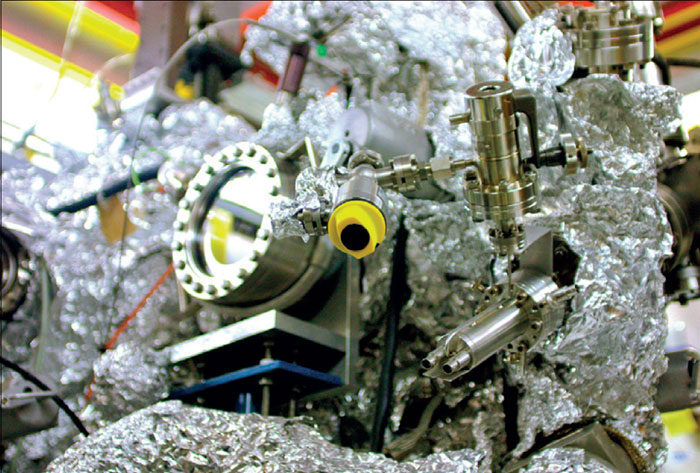
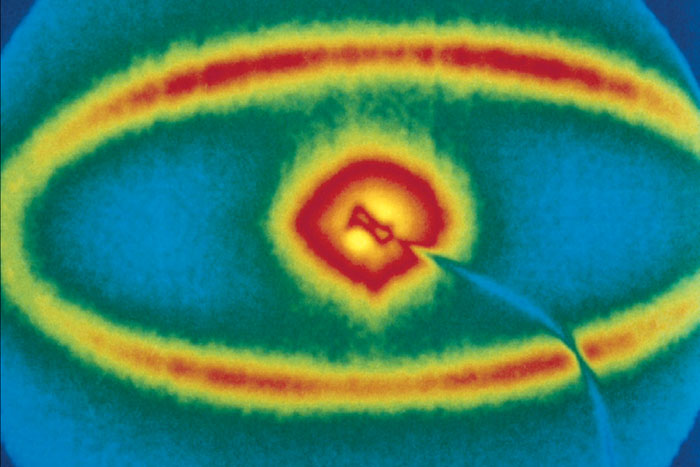
During its lifetime, DORIS has peered into nearly everything imaginable with its X-rays, from innovative alloys and magnetic nanostructures to biomolecules, viruses and corals. Even bronze-age axes, mediaeval palimpsests and hidden paintings by Dutch master Vincent van Gogh have been screened at DORIS. Thousands of guest scientists have used the facility every year. Eventually, there were more than 30 beamlines at DORIS, offering all sorts of X-ray techniques, with many results having a benefit for everyday life. Researchers there have investigated new kinds of electronics and routes towards better catalytic converters, evaluated new welding techniques and more effective luminescent materials for energy-saving lamps, developed medical and technical X-ray applications and studied the properties of clusters of atoms and even of the Earth’s interior.

Fuel Cell

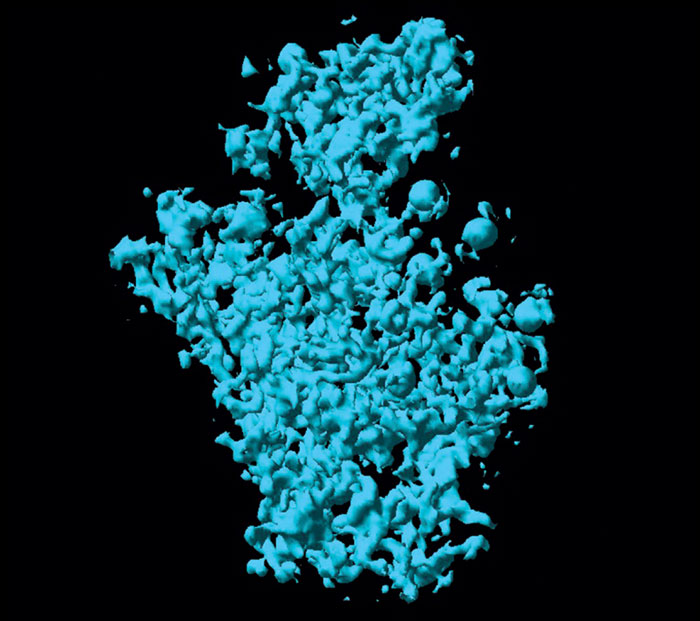
Among the countless scientific highlights, one in particular stands out. In 1999 the team of Ada Yonath, who was leading a Max Planck research group founded on the DESY campus in 1986, decoded the structure of the ribosome with the help of DORIS and different machines at other centres. The ribosome is the protein factory of the cell and is of central importance to life. It is an incredibly complex structure that seemed almost impossible to decode. “DESY provided us very generously with beam-time even back in the 1980s, when our project met worldwide scepticism as it was widely assumed that the structure of the ribosome might never be determined,” recalls Ada Yonath, who in 2009 received the Nobel Prize in Chemistry for her groundbreaking research.

OLYMPUS experiment

DORIS’s achievements are not only scientific. Over the years, the accelerator team maintained an innovative atmosphere and a remarkable collaborative spirit. Not only have several techniques that were pioneered at DORIS now become standards of photon science, the continued improvements also led to PETRA III, the world’s most brilliant X-ray source. Dedicated exclusively to photon science, PETRA III offers much more intense and much finer X-ray beams than DORIS, opening up new opportunities. “Some experiments, however, do not always require PETRA’s extraordinary brilliance,” says Wolfgang Drube of the DESY photon-science department. “Until now, these experiments have been located at DORIS.”

Profile of DORIS III

Type: storage ring
Particles: positrons
Circumference: 289.2 m
Beamlines: 33
Positron energy: 4.45 GeV
Initial positron beam current (5 bunches): 140 mA
Number of buckets: 482
Number of bunches: 1 (for tests), 2 and 5
Bunch separation (minimum): 964 ns (for tests), 480 ns and 192 ns
Horizontal positron beam emittance: 410 π nm rad
Vertical positron beam emittance: 12 π nm rad
Positron beam energy spread (rms): 0.11%
Curvature radius of bending magnets: 12.181 m
Magnetic field of bending magnets: 1.2182 T
Critical photon energy from bending magnets: 16.04 keV

To meet the continuing demand, DESY and its international partners are building two additional experimental halls at PETRA. The most successful of the DORIS III experiments will move into these extensions. “At several experimental stations, the beam will be up to 100 times more intense compared with DORIS,” explains Drube, who is leading the PETRA III extension project. This way, the best of DORIS will live on at PETRA III, which today is also complemented by DESY’s free-electron laser, FLASH. “The unique properties of our light sources are attractive for a multitude of research disciplines. Co-operation and exchange in these various disciplines stimulate research in the next generation,” stresses Weckert.

At the end of its lifetime, there is one more “half-life” in store for DORIS. Synchrotron-radiation operation ceased on 22 October but the rest of the year has been dedicated to a small but clever particle-physics experiment called OLYMPUS. The collaboration led by Richard Milner of Massachusetts Institute of Technology (MIT) will use it to compare in detail the scattering of electrons and positrons by protons to find out if more than one photon can be exchanged in this process. “Recent data suggest strongly that higher-order photon exchange is happening in certain situations,” says Milner. “The experiment is to measure the angular distribution of the scattering for electrons and positrons and compare it. If two-photon effects indeed are there, we should see a significant difference of the order of 5% at larger angles – that is around 60° – in this comparison.”

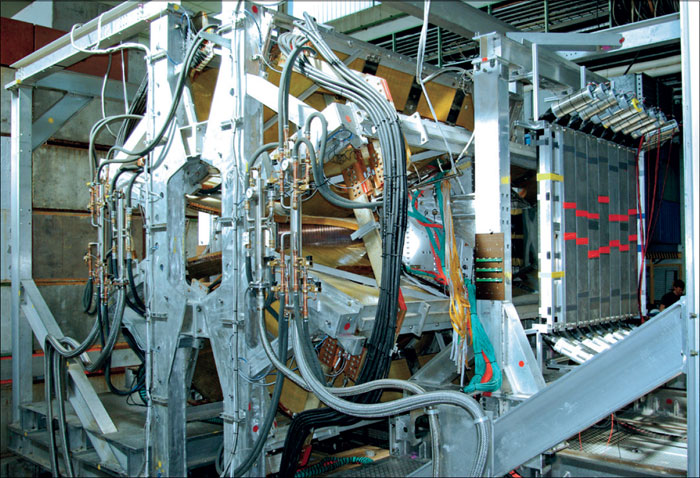
That this became possible is owed to a coincidence that Milner refers to as a miracle. His team had realized that the experiment that they wanted to do would be possible with a disused particle detector from MIT, and they were looking for a storage ring where intense electron and positron beams were readily available. “So, we came to DESY to discuss this and together we decided that we could attempt the experiment at the location of ARGUS. The miracle was that an experiment designed at MIT in the 1990s to do electron–proton scattering would fit exactly in the footprint of an experiment designed at DESY in the 1980s to look at things like B mixing. Essentially, you took one out and dropped the other one in. Everything fit on the rails of ARGUS!”

OLYMPUS may be DORIS’ last experiment but the legacy of this machine will live on for a long time.

Accelerators, light sources and all that jazz

CCpac2_10_12

Three years ago, the annual International Particle Accelerator Conference (IPAC) series was launched to reflect the increasingly global effort in the field, with Asia, Europe and North America hosting the meeting on a three-yearly basis. Following meetings in Kyoto (2010) and San Sebastián (2011), it was North America’s turn in 2012. IPAC’12 took place on 20–25 May at the Ernest N Morial Convention Center in New Orleans. True to its international mission, the conference attracted more than 1200 delegates from a diverse cross-section of nationalities, laboratories and areas of expertise. The scientific programme included plenary talks as well as invited and contributed oral presentations, with a healthy balance of speakers representing scientific research efforts from all three global IPAC regions.

Key themes

The conference opening reflected well this international balance and several of the key themes. It began with synchrotron light sources and free-electron lasers (FELs), as Joachim Stohr of the Stanford Radiation Light Source at SLAC highlighted the scientific revolution that is being enabled by X-Ray FELs. CERN’s Steve Myers described the first two years of operation at the LHC – a leading example of high-energy circular colliders, as well as of international collaboration. Accelerator-driven systems for the transmutation of nuclear waste provided one of the latest examples of developing accelerator applications, presented by Dirk Vandeplasche of SCK-CEN. Kenji Saito of KEK put the spotlight on accelerator technology, with a look at future prospects for RF superconductivity. To finish, the opening session moved back to North America and the theme of beam dynamics and electromagnetic fields as Sergei Nagaitsev described the novel concept of the Integrable Optics Test Accelerator that is under development at Fermilab using strong nonlinear magnetic focusing fields.

Proceeding from this synoptic overview, the programme divided into parallel invited oral sessions before the lunch break and contributed oral presentations after lunch. In each case the topical sessions and the topics of the individual speakers had been carefully arranged to avoid overlap of scientific content and/or other interests of the conference delegates. The layout at the New Orleans Convention Center afforded generous space for people to intermingle and easy access between the main hall and parallel sessions.

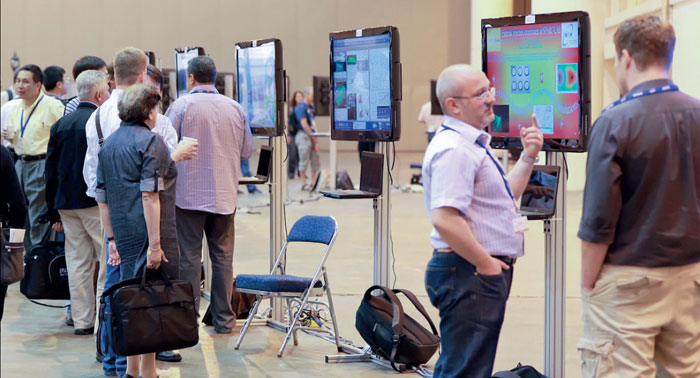
From Monday to Thursday, each afternoon also featured poster sessions arranged by topic in groups named after famous streets of central New Orleans. About 1250 posters were presented in all. A novel electronic poster session was appropriately held on “Bourbon Street” each afternoon. This session consisted of selected posters featuring colourful animated presentations showing complex machine designs, dynamical beam measurements and the results of 3D simulations, with 54 electronic posters in all. The posters were displayed on large flat screens with local PC connection.

A highly successful exhibit featuring 85 separate vendors was also arranged in the centre of the poster sessions, with ample seating arrangements for conversations between participants. The exhibitors generously sponsored a reception on Tuesday for all of the conference delegates and companions, including complimentary drinks and a buffet of Louisiana-style finger foods.

CCpac3_10_12

The programme on Wednesday afternoon contained a special session for industry, covering a range of forward-looking topics. These included projections for future accelerator projects in Asia presented by Zhentang Zhao of the Shanghai Institute of Applied Physics, a look at future medical accelerators by Kiyoshi Yasuoka from the University of Tsukuba and a review of present and future prospects for laser plasma acceleration by Wim Leemans of Lawrence Berkeley National Laboratory. These talks were followed by a review of accelerator-enabled materials development by Wendy Flavell of the University of Manchester, an overview of secondary-beam production by Jens Stadlmann of GSI and the benefits of accelerator R&D to society by Norbert Holtkamp of SLAC.

The IEEE-sponsored event for “Women in Engineering and Science” also took place on Wednesday after the poster sessions. This featured talks covering the demographics of women pursuing careers in engineering and science, personal experiences, objective evaluations and historical perspectives. The talks were delivered by Lia Merminga of TRIUMF, Mei Bei of Brookhaven National Laboratory (BNL), Tracy Morris of Louisiana State University (LSU) and Lorraine Day representing the Center for Advanced Microstructures and Devices (CAMD) at LSU. A buffet reception was held for approximately 50 participants among a display of posters depicting the lives and achievements of outstanding female engineers and scientists.

Thursday afternoon featured the annual awards session and an invited presentation on the LIGO Laser Interferometer Gravity-wave Interferometer by Rainer Weiss of Massachusetts Institute of Technology. Hasan Padamsee from Cornell and Vasili Yakimenko from BNL received the prestigious Particle Accelerator Science Award of the Institute of Electrical and Electronics Engineers/Nuclear and Plasma Science Society (IEEE-NPSS). Erdong Wang from BNL received the IEEE/NPSS student thesis award for studies of secondary emission and the thesis award of the American Physical Society Division of Physics of Beams (APS/DPB) went to Daniel Ratner from SLAC for work on beam dynamics in FELs.

CCpac4_10_12

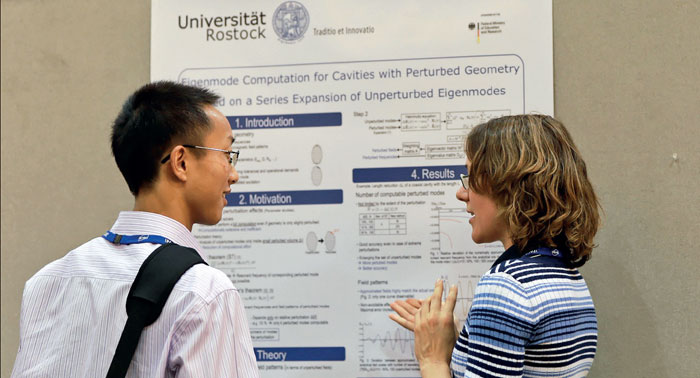
There were also prizes for student posters, exhibited at the Student Poster Session during the conference reception on Sunday. A total of 86 students from around the world received financial support to attend the conference, from the Asian Committee for Future Accelerators, the European Physical Society Accelerator Group and the APS/IEEE. The exhibition attracted an impressive 129 entries, the prizes going to Chen Xu at the Thomas Jefferson National Accelerator Facility (TJNAF) for work on the surface characterization of superconducting radio-frequency cavities and to Theodoros Argyropoulos at CERN for studies of longitudinal single-bunch instability thresholds in the Super Proton Synchrotron.

Parallel satellite meetings were held during the conference for the team behind the Joint Accelerator Conference Website (JACoW), the Joint Universities Accelerator School Advisory Board and the Fixed-Field Alternating Gradient collaboration. The online open-access journal Physical Review Special Topics – Accelerators and Beams (PRST-AB) hosted a “Meet the editors” evening during the conference and held its annual Editorial Board meeting. During the meeting, CERN’s Christine Petit-Jean-Genaz received the first PRST-AB Robert H Siemann Prize, a prize introduced to honour and recognize contributions to the scientific publishing process. A teacher’s day sponsored by the APS took place on the Tuesday. Local high-school science teachers heard from conference speakers during the event, which also included physics demonstrations on topics of current interest in particle accelerators.

The chair’s cocktail reception hosted by conference chair Vic Suller was held in the Mardi Gras World exhibition centre adjacent to the Morial Convention Center. Approximately 250 attended, comprising members of the international Organizing Committee, the Scientific Program Committee and the Local Organizing Committee, as well as support staff, session chairs and invited speakers. The conference banquet took place at the convention centre in the spacious La Nouvelle Orléans ballroom, the evening concluding with enthusiastic dancing to live music by a traditional-style jazz band.

After an invigorating week of accelerator science and engineering, the conference closing session featured plenary talks on the future of X-Ray FELs by Hans Braun from PSI, a review of proton accelerators at the intensity frontier by Paul Derwent from Fermilab and a much anticipated presentation on physics at the LHC – including implications for future high-energy physics programmes – by CERN’s director-general, Rolf Heuer, which foreshadowed the announcement later in the summer of the discovery of a Higgs-like boson at the LHC.

IPAC’12 was closed by the traditional hand-over of the IPAC gavel to the IPAC’13 conference chair, Zhentang Zhao, and the IPAC bell to the chair of the IPAC’13 Science Program Committee, Chuang Zhang. IPAC’13 will take place in Shanghai, with IPAC’14 to follow in Dresden and IPAC’15 in Newport News, Virginia, completing the second three-year cycle through Asia, Europe and North America.

An opportunity to tour the LIGO

On the Saturday after the closing day, participants had the opportunity to tour the laboratory of the Laser Interferometer Gravitational-wave Observatory (LIGO) in Livingston, north of New Orleans – one of the project’s two sites (the other being in Hanford, Washington). Building on Thursday’s guest seminar by Weiss, one of the project’s co-founders, the LIGO staff provided excellent guided tours of the control room, interaction region and a rare opportunity to enter experimental areas that would normally be closed off because of concerns about vibration.

No conference review would be complete without acknowledgment of those who worked for years in advance on the preparations. IPAC’12 was sponsored by the IEEE-NPSS and by the APS-DPB. It was hosted by LSU through its synchrotron-light facility, CAMD, located in Baton Rouge, Louisiana. Particular recognition goes to the small team of CAMD staff who worked diligently behind the scenes to provide local arrangements that spanned the full spectrum of conference needs.

Christine Petit-Jean-Genaz of CERN ran the Scientific Secretariat throughout the organization of the scientific programme, sharing the load with Cathy Eyberger from Argonne National Laboratory and Todd Satogata from TJNAF during the conference. Under their guidance the complete IPAC’12 editorial team, comprising 27 individuals from accelerator laboratories around the world, contributed more than 200 days of work to produce the IPAC’12 conference proceedings, which went online at the JACoW site on 23 July. The IPAC’12 organizers are indebted to the support of the international JACoW team, including its chair Volker Schaa from GSI and deputy Ivan Andrian from Elettra-Sincrotrone Trieste.

Advanced Topics in Quantum Field

Theory: A Lecture Course
By M Shifman
Cambridge University Press
Hardback: £45 $80
E-book: $64

CCboo1_09_12

Many interesting developments have taken place in quantum field theory (QFT) since the 1970s, and there is no better place to learn about them than this book. The author has been an active contributor to the field over the past four decades and he has produced a personal book based on his lectures over the years. Reading the table of contents virtually gives you vertigo because the depth and breath of the topics covered is simply staggering.

The book is structured as two parts: before and after supersymmetry – although many of the concepts introduced in the first part have an extension in the supersymmetric context, with interesting conceptual variations. All subjects are treated thoroughly and with great clarity. The opening chapter deals with the important subject of the phases of gauge theories and it continues with the many exotic objects that populate QFT, namely kinks, domain walls, strings, vortices, monopoles, skyrmions, instantons, chiral anomalies, confinement, chiral-symmetry breaking and a quick overview of lower-dimensional models related to the theory of phase transitions. The treatment of each subject is rather complete, and many difficult subjects are explained with exemplary clarity, for example the use of collective co-ordinates and their importance in the quantization of semiclassical states, as well as the interplay between chiral-symmetry breaking in QCD-like theories and confinement.

The author provides one of the most elegant and concise presentations of the use of instantons in gauge theories that I have ever seen. This is a notoriously complex subject, with important physical implications, such as the vacuum angle in QCD and the strong CP problem. The computations are carried out in detail and the reader is led by a safe hand through all of the delicate aspects of rather complex calculations. This is a great service to anyone trying to learn advanced QFT after a grounding in the standard courses in the subject.

In the second part of the book, the author provides a remarkably lucid and complete presentation of supersymmetry, supersymmetric gauge theories and all of their associated phenomenology. It is difficult to pack more information in the 150 pages dedicated to the subject. The phase diagram of supersymmetric gauge theories is rather complex and subtle. There is no one better suited than the author to introduce the subject; he has been one of its main contributors over the years. Subjects such as supersymmetry anomalies, the Witten index, the implications and uses of instantons within supersymmetry, the super-Higgs mechanism and the Russian beta-function are but a few of the subjects featured in this part of the volume.

This book is a must for anyone interested in learning about the developments in advanced field theory over the past few decades. It is a pedagogical and deeply insightful presentation by one of the masters in the field.

Supergravity

By Daniel Z Freedman and Antoine Van Proeyen
Cambridge University Press
Hardback: £45
E-book: $64

CCboo2_09_12

Since the work of Emmy Noether nearly a century ago, the idea of symmetry has played an increasingly important role in physics, resulting in spectacular successes such as Yang-Mills gauge theory along the way. Albert Einstein, in particular, realized that symmetry could be a foundational principle; his understanding that the space–time dependent (“local”) symmetry of general co-ordinate invariance could be used to build general relativity had an enormous impact on the development of 20th-century physics.

The current zenith of the local symmetry principle is the theory of supergravity, which combines general relativity with the spin-intermingling theory of supersymmetry to construct the richest and deepest symmetry-based theory yet discovered. Supergravity also lies at the foundation of string theory – a theory whose own symmetry principle has not yet been uncovered – and so is one of the central ideas of modern high-energy theoretical physics.

Unfortunately, since its invention in the 1970s, supergravity has been an infamously difficult subject to learn. Now, two of the inventors and masters of supergravity – Dan Freedman and Antoine Van Proeyen – have produced a superb, pedagogical textbook that covers the classical theory in considerable depth.

The book is notably self-contained, with substantial and readable introductory material on the ideas and techniques that combine to make up supergravity, such as global supersymmetry, gauge theory, the mathematics of spinors and general relativity. There are many well chosen problems for the student along the way, together with compact discussions of complex geometry. After the backbone of the book on N=1 and N=2 supergravities, there is an excellent and especially clear chapter on the anti-deSitter supergravity/conformal field theory correspondence as an application.

Naturally, any finite book has to cut short some deserving topics. I hope that any second edition has an expanded discussion on superspace to complement the current, clear treatment based on the component multiplet calculus, as well as a greater discussion on supergravity and supersymmetry in the quantum regime.

Overall, this is a masterful introduction to supergravity for students and researchers alike, which I strongly recommend.

Linac4 parts arrive from near and far

CCnew1_09_12

After a journey from Siberia of more than 13,000 km, a special delivery arrived at CERN on 14 September, bringing modules for Linac4, the new four-stage injector being built for the laboratory’s accelerator complex. A month earlier, the first major accelerating stage had made a shorter journey. Built entirely at CERN and designed in collaboration with CEA Saclay, the radio-frequency quadrupole (RFQ) was installed at the accelerator test stand in Building 152.

Linac4, which is the fourth hadron linac to be built at CERN, is set to replace Linac2 in 2017/2018 as the new first link in the acceleration chain for the LHC. Its four accelerating structures will increase the beam energy successively to 3 MeV, 50 MeV and 102 MeV before finally reaching 160 MeV. By accelerating hydrogen ions (H) instead of protons, Linac4 will bring several advantages. The use of H will enable injection into the PS Booster with essentially no losses and the increase in beam energy will allow a doubling of the maximum intensity from the Booster for the same emittance.

The 3-m-long RFQ will accelerate the beam from 45 keV to 3 MeV, directly from the source. The RF field not only accelerates the particles but also bunches them and provides longitudinal and transverse focusing, thereby defining the beam characteristics and the quality for the entire accelerator chain. The Linac4 team is currently performing the RF tuning of the RFQ cavity, while the ion source, which will provide protons for the tests, is being installed and connected. Once both of these steps have been completed, the team will begin testing the RFQ with beam.

The delivery from Siberia consisted of the first two of seven modules for a cell-coupled drift-tube linac (CCDTL). The first of its kind to be used in an accelerator, it will provide the energy increase from 50 MeV to 102 MeV. Weighing 2 tonnes each, the modules were disassembled into six components for transportation. Once at CERN, a visiting Russian team reassembled the modules before carrying out a series of tests. They repeated vacuum tests performed before the modules began their journey and made checks of radio-frequency properties and the alignment of the modules on their supports. Two further modules are due for delivery to CERN in December, while the final three will follow early next year.

The seven CCDTL modules took two and a half years to produce and were made entirely by a team outside CERN. The modules are the result of six years of close collaboration between two Russian research institutes: the All-Russian Institute of Technical Physics in Snezhinsk and the Budker Institute of Nuclear Physics in Novosibirsk, located in south-western and central Siberia. The collaboration was made possible by support from the International Science and Technology Centre, an intergovernmental organization set up in 1992 to help former weapons scientists redirect their skills towards peaceful activities.

• To keep up to date with news on the LHC, Linac4 and other developments, see The Bulletin, http://bulletin.cern.ch.

Celebrations, challenges and business as usual

CCnew2_09_12

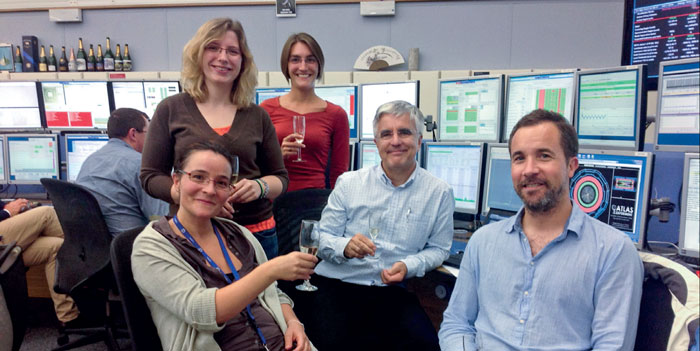
Champagne corks popped on 13 September as the LHC confirmed its potential as a multipurpose machine and successfully switched to a new running mode with proton–ion collisions. This achievement marked the first test with colliding beams in this mode, in preparation for the planned four-week proton–ion run in 2013.

Even though the LHC does not change magnetically, proton–ion operation is a challenge for the LHC RF system and its synchronization with the Super Proton Synchrotron. The proton and ion beams are injected and ramped with different RF frequencies; they then need to be re-phased and locked to provide a stable collision point. Despite a 36-hour break to repair a vacuum leak on one of the LHC wire scanners, the tests went well and the first 4 TeV proton–lead collisions were successfully recorded by the LHC experiments – an outstanding achievement for all of the teams involved (see Successful test of proton–ion collisions in LHCb).

A day later, the machine’s repertoire was extended further to collide “unsqueezed” proton beams at a β* of 1000 m (a measure of the envelope of the beam oscillations) at Points 1 and 5. This is to allow the ALFA and TOTEM experiments, co-located with ATLAS and CMS respectively, to probe proton–proton scattering at low angles (TOTEM extends study of elastic scattering). The tests were followed by a return to routine proton–proton collisions, with the integrated luminosity for the year passing 15 fb–1 in both ATLAS and CMS.

A five-day technical stop – the third this year – began on 17 September for scheduled maintenance and consolidation of systems, but with two out-of-the-ordinary interventions. These involved the replacement of the mirrors and supports of the beam synchrotron light monitors (BSRTs) and the replacement of one of the fast-pulsed kicker magnets used to inject the beam. The BSRTs had been put out of operation because of deformations caused by beam-induced heating. The injection magnets have also suffered from this heating, and waiting for them to cool down can delay the injection process by hours.

In total there are eight injection magnets in the machine. The “hottest” of these was replaced during the technical stop with a new version of the magnet with improved measures to reduce impedance. The LHC will gain some running time from this intervention, which will also allow the new design to be checked under operational conditions. The replacement of the injection magnet was carefully planned and executed successfully in four and a half days, requiring round-the-clock work from all of the teams involved.

It is always challenging to restart after a technical stop, with debugging, testing and requalification of all critical systems. A number of technical problems affected this recovery, which was further slowed down by the need to re-establish good vacuum conditions in the newly installed injection magnet. Once the so-called vacuum “scrubbing” was complete, the normal ramp-up in the number of bunches in the machine took place and nominal conditions were re-established on 30 September.

Despite the rocky restart, the LHC made a good recovery. On 6 October, an integrated luminosity of 286 pb–1 was delivered to the ATLAS and CMS experiments in the space of only 24 hours – a new record.

Peer-reviewed particle physics for all

A new initiative to provide open access to peer-reviewed particle physics research literature was launched at CERN on 1 October by the Sponsoring Consortium for Open Access Publishing in Particle Physics – SCOAP3. Open dissemination of preprints has been the norm in particle physics for two decades but this initiative now brings the peer-review service provided by journals into the open-access domain.

In the SCOAP3 model, funding agencies, research institutions, libraries and library consortia pool resources that are currently used to subscribe to journal content and they use them to support the peer-review system directly. Publishers then make electronic versions of their journals open access. Articles funded by SCOAP3 will be available under a Creative Commons, CC BY licence, meaning that they can be copied, distributed, transmitted and adapted as needed, with proper attribution.

Representatives from the science-funding agencies and library communities of 29 countries were present at the launch. The publishers of 12 journals, accounting for the vast majority of articles in particle physics, have been identified for participation in SCOAP3 through an open and competitive process. With a projected SCOAP3 budget of SwFr36 million over three years, more partnerships with key institutions in Europe, America and Asia are foreseen as the initiative moves through the technical steps of organizing the re-direction of funds from the current subscription model towards a common internationally co-ordinated fund. SCOAP3 expects to be operational for articles published as of 2014.

• For more information, see http://scoap3.org/.

TOTEM extends study of elastic scattering

A year after publishing first results on proton–proton elastic scattering at a centre-of-mass energy of 7 TeV at the LHC, the TOTEM collaboration now has new measurements based on the analysis of data collected in October 2011. These latest results extend the measurement of the differential elastic cross-section to smaller values of |t|, the four-momentum transfer squared. They also allow a new determination of the elastic and total proton–proton (pp) cross-sections.

CCnew3_09_12

TOTEM, which stands for “TOTal cross-section, Elastic scattering and diffraction dissociation Measurement”, is optimized for making precise measurements of particles that emerge from collisions in the forward direction, close to the direction of the LHC beams. This allows it to probe physics that is not easily accessed by other LHC experiments, in particular elastic pp scattering down to small values of |t|. It detects protons scattered at small angles by using silicon detectors in Roman Pots – movable insertions in the beam pipe that allow the detectors to be brought closer to the beam.

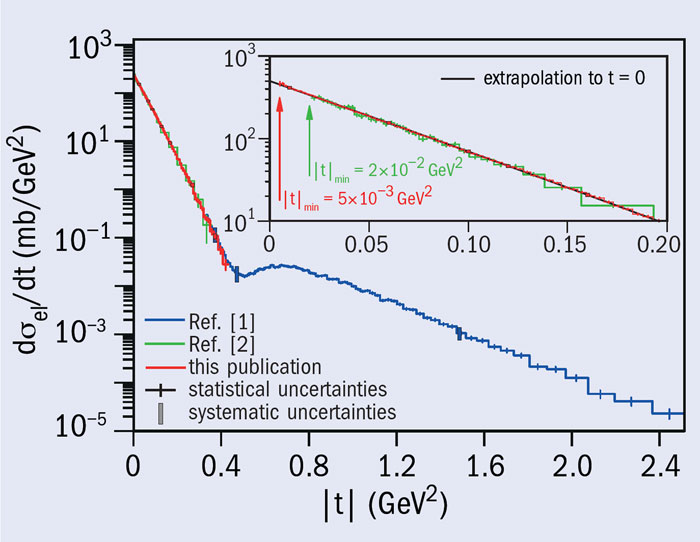
The first measurement of the differential elastic cross-section dσ/dt by TOTEM covered a range 0.36 < |t| < 2.5 GeV2, revealing features similar to those first observed at CERN’s Intersecting Storage Rings in the 1970s: a peak at low |t| with an exponential decrease leading to a pronounced dip, followed by a rounded peak that falls away as a power law. With the data taken in 2011, the collaboration has now extended the measurements down to 0.005 GeV2 – corresponding to scattering angles of some 20 µrad – enabling the observation of 91% of the elastic cross-section and further exploration of the exponential slope of dσ/dt at small |t|.

For these measurements, the Roman Pot detectors had to approach close to the beam centre – to a distance of around five times the transverse size of the beam – during a dedicated run in which the LHC beams were deliberately left relatively wide and straight as they collided, rather than being “squeezed” for maximum luminosity. This involved running the LHC with magnet settings such that the β function, which describes the envelope of the beam oscillations, had a value of β* – the distance to the point where the beam is twice as wide as at the interaction point – of 90 m.

The results show that the slope of dσ/dt remains constant down to 0.005 GeV2, so that an exponential fit with only one constant B = (19.9±0.3) GeV–2 describes all of the range 0.005 < |t| < 0.2 GeV2 (TOTEM collaboration 2012). The small error on B – a result of the high precision of the measurement and the large range of the fit – allows a precise extrapolation over the non-visible cross-section (the remaining 9%) to t = 0. Taken with the luminosity measured by the CMS experiment at the same interaction point, this gives an elastic pp cross-section of 25.4±1.1 mb at a centre-of-mass energy of 7 TeV and, using the optical theorem, yields a value for the total pp cross-section of 98.6±2.2 mb. In addition, the difference between the total and elastic cross-sections gives a precise indirect measurement of the fully inclusive inelastic cross-section, with no dependence on Monte Carlo models, notably in the low-mass extrapolation region.

The measurements are being repeated this year at a centre-of-mass energy of 8 TeV. In addition, the machine optics for a still larger β* of 500–1000 m is being developed, which will enable TOTEM to reach a value of |t| as small as 0.0005 GeV2. This is where the Coulomb and hadronic contributions to the differential cross-sections are about equal, allowing the study of Coulomb-hadronic interference and the determination of the ρ parameter (the ratio of the real to imaginary part of the forward hadronic scattering amplitude). The collaboration is also studying the possibilities for measurements of pp elastic scattering at high values of |t| because these could reveal further diffractive minima, as predicted by some models.

Large CP-violation effects appear in three-body B decays

One of the interesting ways to search for CP violation in B-meson decays is by using three-body decays of charged B mesons, i.e. B+ →K+KK+, K+ππ+, K+Kπ+ and π+ππ+ (and the charge-conjugated modes). In the 1.0 fb–1 of data accumulated in 2011, LHCb already recorded samples of these decays that are an order of magnitude larger than those available to previous experiments. The first studies of the K+KK+ and K+ππ+ decays were presented by the collaboration at the 2012 International Conference on High-Energy Physics in July, revealing evidence of large CP-violation effects (LHCb 2012a). Now, at the 7th International Workshop on the CKM Unitarity Triangle, held at the end of September, LHCb has complemented these with results from the rarer decays to K+Kπ+ and π+ππ+, finding evidence of even larger CP violation (LHCb 2012b).

CCnew5_09_12

While the inclusive CP asymmetries (which are integrated over the entire phase space, or the Dalitz plots, of the three-body decays) show evidence of CP violation, more pronounced effects are visible when looking at the variation of the effect in different regions. The LHCb analyses have used model-independent approaches – based on binning the Dalitz plot – to explore the local asymmetries.

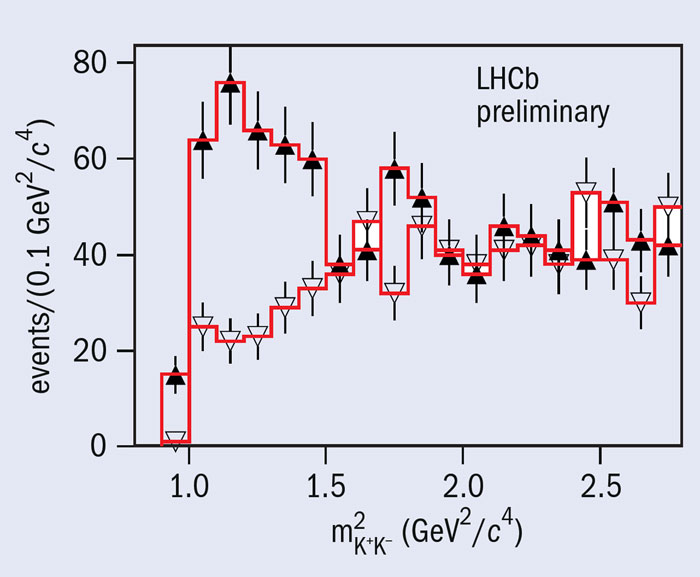
A remarkable feature of the new results is that the CP-violation effects appear to arise in regions of the Dalitz plots that are not dominated by contributions from narrow resonances. For example, previously the BaBar collaboration observed a broad feature at low values of the K+K invariant mass in B±→K+Kπ± decays (Aubert et al. 2007); in the LHCb data, this appears to be present only in B+ decays, as the figure shows, indicating direct CP violation in these decays. This points to some interesting hadronic dynamics that must generate the strong (CP conserving) phase difference that is necessary for direct CP violation to emerge.

To understand these effects further, the LHCb collaboration is now starting detailed studies of these channels and will also exploit the larger data sample that will be available after the 2012 running. The results from these analyses will also establish whether the observed CP violation is consistent with the expectations of the Standard Model or whether it has a more exotic origin.

bright-rec iop pub iop-science physcis connect