On 5 October, CERN’s director-general, Rolf Heuer, and the minister of education and culture of the Republic of Cyprus, George Demosthenous, signed an agreement under which the Republic of Cyprus will become an associate member state in the pre-stage to membership. Before it comes into force, the agreement has to be ratified by the Parliament of Cyprus.
In the early 1990s, physicists from the Republic of Cyprus took part in the L3 experiment at CERN’s Large Electron Positron collider before joining the CMS collaboration in 1995. A memorandum of understanding was signed between the University of Cyprus and CMS in 1999 under which Cypriot physicists have contributed to the development of the solenoid magnet and of the CMS electromagnetic calorimeter. They are also involved in the physics analyses of the CMS experiment, including certain searches for the Higgs boson and beauty quarks.
The Republic of Cyprus is the third country to accede to the status of associate member state in the pre-stage to membership, following Israel in 2011 and Serbia earlier this year.
On 12 September, during a short, highly successful pilot run, the LHC operated with protons in one beam and lead ions in the other, so providing the LHC experiments with their first proton–nucleus collision data and opening new horizons for the heavy-ion community at CERN. During these few hours of pilot running, the ALICE experiment collected about 2 million events, sufficient not only to check the readiness of the detector for the long proton-ion run scheduled for the beginning of 2013, but also to perform a first analysis of the data and produce important physics results.
After the start of the heavy-ion physics programme in 2010, the LHC experiments obtained many striking results related to the formation of the hot and dense hadronic state of matter emerging from the collisions of lead nuclei. This state – the quark–gluon plasma (QGP) – is expected to manifest itself through various signatures, such as the suppression of high-energetic jets in the medium, collective particle motion, enhancement of strange-particle production and suppressed quarkonia production. In addition, surprising scaling effects were observed in the particle multiplicity compared with measurements at lower energies. However, given the complexity of the lead–lead (PbPb) colliding system, an important step in the quest for QGP lies in decoupling the effects of cold nuclear matter that arise at the initial stage of the collisions.
The proton–nucleus system represents the perfect benchmark for studying these effects because the colliding components are elementary and give rise to processes where the effects of the medium produced in the collision are either small or even totally absent. The collisions are also interesting because they allow the exploration of nuclear parton distributions in the region of small parton fractional momenta, which are so far unmeasured. Proton–nucleus collisions can therefore provide the data needed to understand better the properties of PbPb collisions at the energy of the LHC. The study of the dense initial state also provides access to a completely new QCD regime where the parton densities are expected to be saturated.
Using the newly acquired data, the ALICE collaboration has been able to measure the charged-particle multiplicity density in proton–lead (pPb) collisions at a centre-of-mass energy of √sNN = 5.02 TeV (ALICE collaboration 2012a). Figure 1 compares this measurement with two main groups of theoretical models. The first group consists of models that incorporate nuclear modification – for example, shadowing – of the initial parton distributions; the second includes various saturation models. While the current experimental and theoretical precision is not sufficient for a detailed comparison, the figure shows that the data are described best by the model where the gluon shadowing parameter (sg) is tuned to previous experimental data at lower energies. Saturation models predict much steeper dependence on the pseudorapidity, which is not confirmed by the measurement.
Another important result from the analysis of the proton–nucleus data concerns the charged-particle transverse-momentum spectrum and the corresponding nuclear-modification factor (ALICE collaboration 2012b). The latter is calculated using the proton–proton data at collision energies of 2.76 TeV and 7 TeV as reference (figure 2). The result clearly indicates little or no modification of the production of charged particles with transverse momentum greater than 2 GeV/c, thus confirming that the suppression of high-energy jets in PbPb collisions is not a result of cold nuclear-matter effects. The comparison with the available theoretical predictions suggests that the models require further development because they have difficulties in describing the multiplicity and the transverse-momentum spectrum simultaneously.
One of the classic signals expected for a quark–gluon plasma (QGP) is the radiation of “thermal photons”, with a spectrum reflecting the temperature of the system. With a mean-free path much larger than nuclear scales, these photons leave the reaction zone created in a nucleus–nucleus collision unscathed. So, unlike hadrons, they provide a direct means to examine the early hot phase of the collision.
However, thermal photons are produced throughout the entire evolution of the reaction and also after the transition of the QGP to a hot gas of hadrons. In the PbPb collisions at the LHC, thermal photons are expected to be a significant source of photons at low energies (transverse momenta, pT, less than around 5 GeV/c). The experimental challenge in detecting them comes from the huge background of photons from hadron decays, predominantly from the two-photon decays of neutral pions and η mesons.
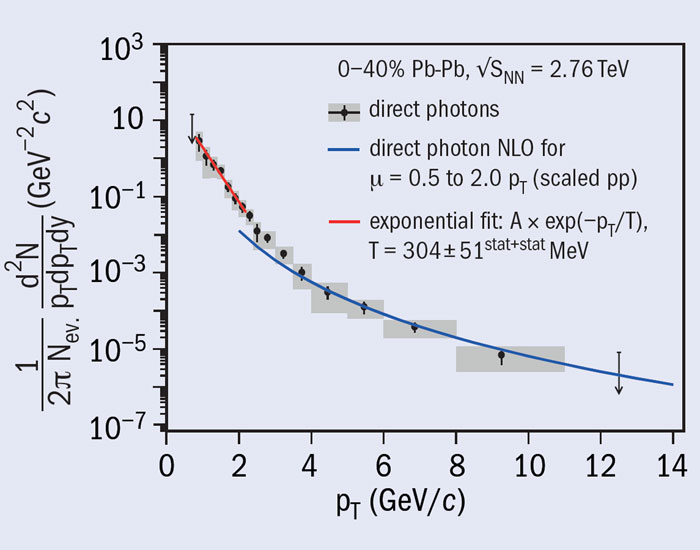
The ALICE experiment has measured photons produced in central PbPb collisions at a centre-of-mass energy per colliding nucleon pair, √sNN = 2.76 TeV, by reconstructing with the time-projection chamber the tracks of e+e– pairs produced by the conversion of photons in the inner detectors. The same sample of photons was also used to measure the pT spectrum of neutral pions. The analysis found an excess of direct photons of around 15% for 1 < pT < 5 GeV/c compared with the calculated decay-photon yields from neutral pions, η mesons and other mesons, with a somewhat larger excess at higher pT.
Direct photons are defined as photons not coming from decays of hadrons, so photons from initial hard parton-scatterings (prompt photons and photons produced in the fragmentation of jets) – i.e. processes already present in proton–proton collisions – contribute to the signal. Indeed, for pT greater than around 4 GeV/c, the measured spectrum agrees with that for photons from initial hard scattering obtained in a next-to-leading-order perturbative QCD calculation. For lower pT, however, the spectrum has an exponential shape and lies significantly above the expectation for hard scattering, as the figure shows.
The inverse slope parameter measured by ALICE, TLHC = 304 ± 51 (stat.+syst.) MeV, is larger than the value observed in gold–gold collisions at √sNN = 0.2 TeV at Brookhaven’s Relativistic Heavy-Ion Collider (RHIC), TRHIC = 221 ± 19 (stat.) ± 19 (syst.) MeV. In typical hydrodynamic models, this parameter corresponds to an effective temperature averaged over the time evolution of the reaction. The measured values suggest initial temperatures well above the critical temperature of 150–160 MeV (approx. 1.8 × 10¹² K) at which the transition between ordinary hadronic matter and the QGP occurs. The ALICE measurement also indicates that the LHC has produced the hottest piece of matter ever formed in a laboratory.
Searches in LHC data that do not depend on specific theoretical models provide a valuable complement to optimized, model-dependent searches because they have the capacity to uncover hints of the completely unexpected. In this spirit, the ATLAS collaboration has recently looked for events with like-sign leptons and three or more leptons, using the full 2011 LHC data set of nearly 5 fb–1, in the pursuit of signs of new physics. Unfortunately, no excess events compared against the Standard Model have been observed. However, the analyses have provided the information needed to set limits on a range of models and to set limits on the production of doubly charged Higgs bosons.
Prompt like-sign lepton pairs are rarely produced in Standard Model processes but they may be produced by fourth-generation quarks, supersymmetry, universal extra dimensions or processes in non-Standard Model Higgs models or new models. A recent study by ATLAS selected isolated electrons and muons and divided the events into dielectron, dimuon, and electron-muon categories. This analysis yielded upper limits on the cross-section of anomalous production of like-sign lepton pairs ranging between 1.7 fb and 64 fb (ATLAS 2012a). An extension to the analysis set limits on the production of doubly charged Higgs bosons decaying to pairs of electrons or muons (ATLAS 2012b).
Events with three or more prompt leptons in the final state are also rare in the Standard Model. A recent search for multilepton events by ATLAS identified isolated electrons, isolated muons and hadronically decaying taus and found only 1827 events with three or more leptons. These events were divided into four categories; depending on whether or not a Z boson was reconstructed from two opposite-charge electrons or muons in the event, and whether or not a tau candidate was present.
The figure shows results for these four categories: the limits on the number of events from non-Standard Model sources have been calculated and converted into limits on the “visible cross-section”, i.e. the cross-section that is observable after event selection. The limits on the visible cross-section are given as a function of increasing lower bounds on the missing transverse momentum, a quantity that may be large in models with new physics. The smallest lower bound, “X”, is 0 GeV for the off-Z channels (no reconstructed Z) and 20 GeV for the on-Z channels (with reconstructed Z). Limits are shown for events with more than 100 GeV of transverse momenta for the jets in the event (HTjets); an upcoming publication includes the corresponding limits for lower values of HTjets and other variables of interest. These visible cross-section limits can be converted into upper limits on the cross-section for many specific models, including the doubly charged Higgs and new theories yet to come.
The top quark is the heaviest point-like particle known. It weighs about as much as an atom of tungsten yet is an elementary building block of the Standard Model of particle physics. Its mass is one of the model’s important parameters and is directly related via radiative corrections to the masses of the W and Higgs bosons. Precise knowledge of the top quark’s mass is therefore extremely valuable to constrain theoretical models.
The CMS collaboration has measured the top-quark mass by exploiting all possible final states originating from different decays of W bosons produced in the decays of top quarks. Final states where the W boson decays into leptons are particularly “clean” (see figure). Such events are selected by requiring energetic jets in the central region of the CMS detector, of which at least one must be compatible with originating from a bottom quark (“b-tagged jet”), together with one or two isolated and high-energy leptons. The selected samples are extremely pure in top-quark-pair events, with estimated purities greater than 95% for events containing at least one electron or a muon.
For hadronically decaying W bosons, the reconstruction techniques make use of kinematic fits to improve the energy resolution and the likelihood methods that can handle the combinatorial ambiguities in finding the triplet of jets corresponding to the top-quark decay. The use of b-tagging helps considerably in constraining these ambiguities further. For dilepton events, the presence of two neutrinos accompanying the charged leptons from the W-boson decays requires alternative techniques.
All of the methods and channels used give consistent measurements of the top-quark mass. The results are now fully dominated by uncertainties other than statistical, with major contributions coming from the uncertainty associated with the jet-energy scale and how well the Monte Carlo simulations model the details of the top decay. The best single measurement of the mass of the top quark, from the e/μ+jets channel, results in a statistical uncertainty of 0.4 GeV and a systematic uncertainty of around 1 GeV.
The combined CMS measurement, accounting for correlations between uncertainties obtained in the individual channels, yields a total uncertainty of about 1 GeV. This result is already competitive (and in agreement) with the combined measurement from the CDF and DØ experiments at Fermilab’s Tevatron, as the figure shows. For a further reduction of the uncertainty, it will become important to employ novel measurement techniques.
The CMS collaboration has also measured the difference in mass between the top quark and its antiquark – an important test of the symmetry between matter and antimatter. This is done by splitting the sample of events with e/μ+jets into two subsamples with opposite lepton charges. The difference in quark–antiquark masses is compatible with zero with an uncertainty of about 0.5 GeV. This is the best precision on this mass difference to date.
After more than 15 years of precision top physics at the Tevatron, the baton in the race to understand nature’s heaviest quark has now passed to the LHC. With an uncertainty on the top-quark mass of 1 GeV, CMS is now at the forefront of precision physics in the top sector.
The large cross-section for charm production at the LHC, and the geometry and instrumentation of the LHCb detector, provide samples of charmed hadrons far larger than those accumulated by previous experiments. These allow the Standard Model to be tested by studying various interesting phenomena such as CP violation and mixing in D0 mesons.
The electroweak force can cause D0 mesons (consisting of a charm quark and an anti-down quark) to transform into their antiparticle, D0 (anti-charm and down), and back. Such “flavour oscillations” or “mixing” have been observed and studied in detail in K0, B0 and Bs0 mesons. In the charm system, however, the period of the oscillations is so long – over one hundred times the average lifetime of a D0 meson – that although the BaBar, Belle and CDF collaborations have reported strong evidence of the effect, none of them has been able to claim an unambiguous observation.
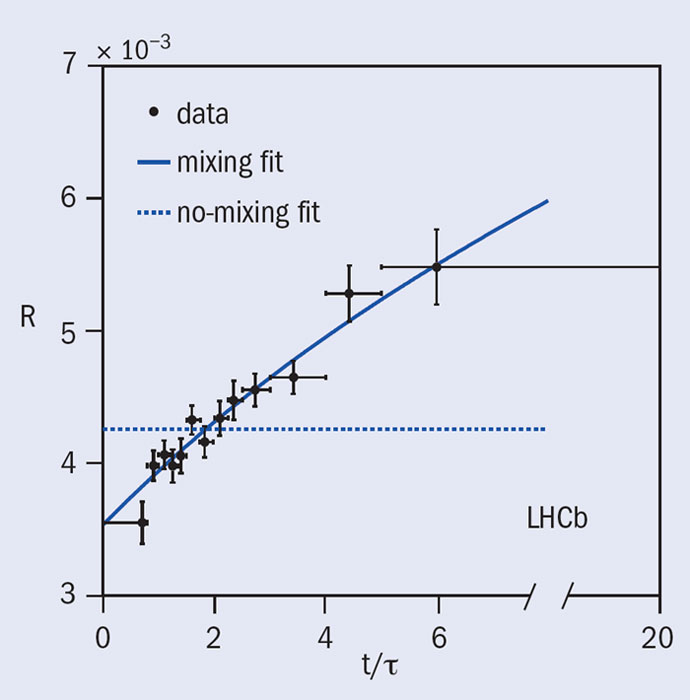
One of the best channels to search for charm mixing is the decay D0 → Kπ. The initial flavour can be identified by the charge of the accompanying pion in the decay D*+→D0π+ or D*–→D0π–. The mixing effect appears as a decay-time dependence of the ratio R between the number of reconstructed “wrong-sign” (WS) and “right-sign” (RS) processes: D0→K+π– and D0→K–π+, respectively, and their charge conjugates. The WS process can proceed either by a Cabibbo-suppressed decay or through flavour oscillation followed by a favoured decay. In the absence of mixing, R will be constant as a function of the D0 decay time, t, while, in the case of mixing, it is predicted to be an approximately parabolic function of t. Determining R in bins of t therefore allows a measurement of the mixing parameters, while also cancelling many potential sources of systematic uncertainty.
The figure shows the ratio WS/RS, measured by the LHCb experiment, as a function of decay time, from a total of 36,000 WS and 8.4 million RS decays selected from the 1.0 fb–1 of data recorded in 2011. The horizontal dashed line shows the no-mixing hypothesis; the solid line is the best fit to data when mixing is allowed. The clear time-dependence observed excludes the no-mixing hypothesis by 9.1σ. The oscillation parameters are determined with uncertainties about a factor two smaller than in previous measurements.
Since the Standard Model predictions for the mixing parameters have large uncertainties, the next step will be to focus on cleaner observables to search for possible contributions from new physics. In particular, LHCb is now well placed to investigate whether there is a CP-violating contribution to the oscillations, in contrast to the Standard Model expectation. This will be achieved by studying charm mixing in this and other decay channels and exploiting the large increase in data following the successful 2012 LHC run.
Researchers using the European X-ray astronomy satellite XMM-Newton have discovered a new source of low-energy cosmic rays in the vicinity of the Arches cluster, near the centre of the Milky Way. Their origin differs from that of higher-energy cosmic rays that originate in the explosions of supernovae.
Low-energy cosmic rays with kinetic energy less than half a billion electronvolts are not detected at Earth, since the solar wind prevents them from entering the heliosphere. Therefore little is known about their chemical composition and flux outside the solar system.
V Tatischeff, A Decourchelle and G Maurin, from the institutes of CNRS and CEA in France began by studying the X-ray emission that should theoretically be generated by low-energy cosmic rays in the interstellar medium. They then looked for signs of this in X-ray data collected by XMM-Newton since its launch in 1999. By analysing the properties of the X-ray emission of interstellar iron recorded by the satellite, they found the signature of a large population of fast-moving ions in the vicinity of the Arches cluster, about 100 light-years from the centre of the Milky Way. The stars in this cluster are travelling together at approximately 700,000 km/h. The cosmic rays are in all likelihood produced in the high-speed collision of the star cluster with a gas cloud in its path.
This is the first time that a major source of low-energy cosmic rays has been discovered outside the solar system. It shows that the shock waves of supernovae are not the only objects that can cause mass acceleration of atomic nuclei in the galaxy. These findings should make it possible to identify new sources of ions in the interstellar medium, and may lead to a better understanding of the effects of these energetic particles on star formation.
Researchers at the RIKEN Nishina Center for Accelerator-based Science have obtained the most unambiguous data to date on element 113. A chain of six consecutive α decays, produced in experiments at the RIKEN Radioisotope Beam Factory, conclusively identifies the element through connections to well known daughter nuclides.
In the experiment at the RIKEN Linear Accelerator Facility in Wako, near Tokyo, Kosuke Morita and his team fired zinc ions travelling at 10% the speed of light at a thin target of bismuth and used a custom-built gas-filled recoil ion separator coupled to a position-sensitive semiconductor detector to identify the reaction products. On 12 August they detected the production of a very heavy ion followed by a chain of six consecutive α decays, which they identified as the products of an isotope of element 113. The chain began with the decay to roentgenium-274 (element 111) and ended in mendelevium-254 (element 101).
The team previously detected element 113 in experiments conducted in 2004 and 2005, but were then able to identify only four α decays followed by spontaneous fission of dubnium-262 (element 105), which is not a well known process. The decay chain detected in the latest experiments takes an alternative route via α-decay, the data indicating that the dubnium decayed into lawrencium-258 (element 103) and finally into mendelevium-254. The decay of dubnium-262 to lawrencium-258 is well known and provides unambiguous proof that element 113 is the origin of the chain.
The INTEGRAL gamma-ray satellite has detected the radioactive decay of an isotope of titanium, 44Ti, in the remnant of the nearby supernova SN 1987A. This observation confirms that 44Ti powers the infrared, optical and ultraviolet emission that is still being observed 25 years after the stellar explosion.
On 24 February 1987, two astronomers at the Las Campanas Observatory in Chile and an amateur astronomer in New Zealand were the first to notice an unexpected bright star in the Large Magellanic Cloud, a small satellite galaxy of the Milky Way. They actually witnessed the first supernova to be visible to the naked eye since SN 1604, which was studied by Johannes Kepler (CERN Courier December 2004 p15, January/February 2006 p10). SN 1987A reached peak brightness in May that same year and slowly declined over the following months.
The shape of the light curve of a supernova – the evolution of the luminosity – is determined by the radioactive decay of elements produced during the explosion of the progenitor star. Nickel-56, with a half-life of six days, is responsible for the peak of the emission, while the radioactive decay of cobalt-56 to iron-56 slows down the subsequent decrease in brightness for several months (77 days of half-life). Over longer timescales, 44Ti is expected to dominate in sustaining the remnant emission of the explosion for decades (85 years of half-life).
The actual contribution of 44Ti to the late time emission of a supernova is poorly known. Indeed, the violent interaction of the stellar ejecta with the surrounding medium will lead to shock waves and additional emission blending with the contribution from this radioactive decay in the infrared to ultraviolet band. Theoretical simulations of SN 1987A suggest that the amount of 44Ti synthesized during the explosion is in the range 0.02–2.5 × 10⁻⁴ solar masses. This uncertainty by two orders of magnitude is because there are many unknowns in the physical properties of the stellar interior and of the explosive shock wave. Direct detection of 44Ti is thus important for improving the constraints on the physical conditions in this supernova explosion.
This breakthrough has now been achieved by a small group of astronomers led by Sergey Grebenev of the Space Research Institute in Moscow. His request for a long observation (around 40 days) of SN 1987A by ESA’s INTEGRAL gamma-ray satellite turned out to be highly fruitful. The decay of 44Ti can be directly detected by INTEGRAL through emission lines produced in both hard X-rays at energies of 67.9 keV and 78.4 keV and in gamma-rays at 511 keV and 1157 keV. While the observation of the latter lines yielded only upper limits, the former ones allowed a 4.7σ detection.
SN 1987A is visible in the energy band 65–82 keV, while it remains invisible in two adjacent bands. The emission corresponds to a mass of 44Ti of 3.1 ± 0.8 × 10⁻⁴ solar masses. This is slightly above the upper bound of the theoretical predictions but corroborates the results obtained for Cassiopeia A (1.6+0.6–0.3 × 10⁻⁴), the only other supernova remnant where 44Ti has been clearly detected. Both measurements favour theoretical models with important production of 44Ti during the stellar explosion.
This discovery arrives at the end of the INTEGRAL satellite’s 10th year in orbit. The anniversary of the launch was celebrated on 17 October during a conference in Paris. Among the highlights of the spacecraft’s mission so far are the mapping of electron–positron annihilations in the bulge of the Galaxy, as well as the detection of polarization in the Crab Nebula and in the black hole binary Cygnus X-1 (CERN Courier March 2008 p12, November 2008 p11, May 2011 p12). Over the years, INTEGRAL has detected and characterized hundreds of new, heavily obscured X-ray sources among which some – called super-fast X-ray transients – were observed to undergo extremely rapid and high-amplitude luminosity variations.
The last day of September saw an exciting coincidence of three competing experiments simultaneously releasing three new and directly similar results. The occasion was the CKM2012 workshop in Cincinnati and the subject of interest: excellent new measurements of the CKM phase, γ.
Two of the contenders were well known to each other, having battled for supremacy in B physics for more than a decade. The “B factory” experiments, Belle and BaBar, were designed on the same principle: e+e– collisions at the Υ(4S) resonance produce large numbers of BB pairs, which can be cleanly reconstructed in isolation. Except for a few selective technology choices, their most obvious dissimilarity is their location: Belle is at KEK in Japan while BaBar resides at SLAC in the US.
The meeting in Cincinnati saw these old foes joined by a new competitor, LHCb, which unlike the B factories collects its huge samples of bottom hadrons from high-energy proton–proton collisions at the LHC. Although there is little doubt that the CERN-based experiment will ultimately triumph with precision measurements of γ, on the morning of 30 September no one yet knew if that time had come.
Among the fundamental forces of nature, the weak force is special. Not only does it have a unique structure that gives rise to fascinating and often counter-intuitive physical effects, it is also highly predictive, making it excellent territory for searches for new physics. Perhaps the most celebrated phenomenon is CP violation – a common short-hand for saying that weak interactions of matter differ subtly from those of antimatter. Discovered in 1964 as a small effect (10–3) in KL0 decays, CP violation has more recently been observed as a large effect (10–2–10–1) in several B-meson decay modes.
The CKM matrix
The size and variety of CP violation in b-quark transitions is widely acknowledged as a triumphant validation of the Cabibbo-Kobayashi-Maskawa (CKM) description of quarks coupling to W± bosons. This mechanism explains three-generation quark-mixing – up-type quarks (u, c, t) transmuting to and from down-type quarks (d, s, b) via the charged weak current – in terms of a 3 × 3 matrix rotation of the quarks’ mass eigenstates into their weak-interaction eigenstates. CP violation arises naturally through the mathematically mandatory presence of one complex phase in this generically complex matrix. Furthermore, if nature indeed has only three quark generations and probability is conserved, then the CKM transformation must be unitary.
Unitary matrices have a property that the scalar product of any two rows or columns must equate to zero. In the case of the 3 × 3 CKM matrix, six equations can be written down that must hold true if there are three – and only three – generations of quarks. Of these six relations, which are all triangles on the Argand plane, the most celebrated is
V*ubVud +V*cbVcd +V*tbVtd = 0
where each VXY is one of nine CKM matrix elements that encode the strength with which quark X couples to quark Y. This triangle, whose internal angles are usually labelled α, β and γ, is widely publicized because it summarizes concisely the largest CP-violating processes in B mesons. Studying the geometry of this unitarity triangle (UT) tests the internal consistency of the three-generation CKM picture of quark mixing. The lengths of the sides of the UT are measured in CP-conserving processes, whereas the size of the angles (or phases) can be measured only via CP-violating decays.
In Cincinnati, the BaBar collaboration announced that it had achieved a measurement of γ = 69+17–16° from a combination of many analyses of B± → D(*)K± decays. The precision of around 25% can be compared with the precision with which the other two UT angles are known. The smallest of the three angles, β, is known to less than 4%, β = 21.4 ± 0.8°, principally from measuring the time-dependent CP asymmetry in the mixing and decay of B0 → J/ψK0 decays. The angle subtended by the apex of the triangle, α, is known to around 5%, α = 88.7+4.6–4.2°, from similar, time-dependent analyses of B0 → ππ and B0 → ρρ decays. Remembering that the three angles of a triangle always add up to 180°, it is clear that BaBar’s central value is remarkably close to the CKM expectation.
The Belle collaboration’s presentation quickly followed and explained a similar measurement of γ = 68+15–14°, the modest improvement perhaps being a result of the almost twice-as-large data set. As with BaBar, this number results from the careful combination of various measurements of CP-violating properties of B± → DK± and B± → D*K± decays.
Interfering amplitudes
The B factories’ common choice of B± → DK± decays is not a coincidence. Among the current UT angle analyses, only γ measurements use direct CP violation in charged B decays. This promises a simple asymmetry of matter versus antimatter but requires two interfering amplitudes resulting in the same, indistinguishable final state. They must have different CP-conserving phases (generally true for any two quantum processes) and be of similar magnitude, or the influence of the less-likely process is too hard to detect.
In the UT definition, γ is identified as the weak phase difference between b → c and b → u quark transitions. Figure 2 shows Feynman diagrams for two paths of B± → DK±. The one involving a b → c quark transition is labelled “favoured” because a b quark is most likely to decay to a c quark. The second diagram involves a b → u quark transition and is labelled “suppressed” because the chance of its occurrence is around 1% of that of the favoured process (i.e. the ratio of amplitudes, rB is around 0.1).
This all looks good except for the detail in figure 2 that the favoured diagram results in a D0 while the suppressed diagram yields a D0. For the two B decays to interfere, the two neutral particles must be reconstructed in a final state that is common to both, i.e. the D0 and D0 should be indistinguishable. This might occur in the following ways, all of which are studied by Belle, BaBar and to some extent, LHCb.
• CP-eigenstate decays of neutral D mesons are by definition equally accessible to D0 and D0. In this case, the interference – and hence the size of the direct CP violation – is around 10% (from rB in figure 2). Examples of this type are B± → [K+K–]DK± and B± → [KS0π0]DK± decays, where the D indicates that the particles in parentheses originated from a D meson.
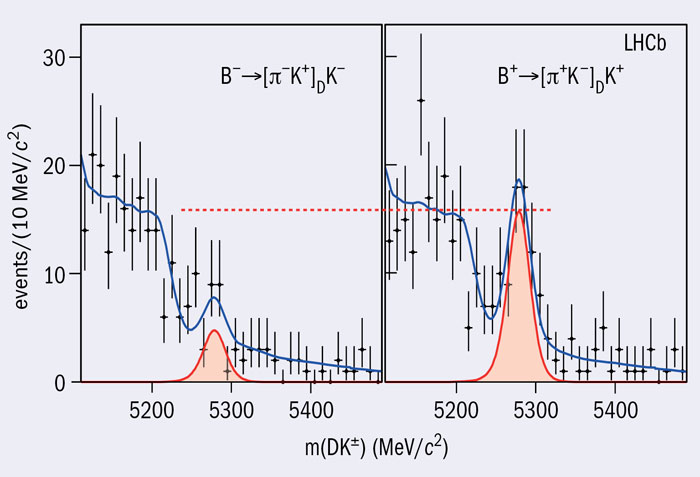
• The unequal rate of the favoured and suppressed B decays can be redressed by selecting D final states that have an opposite suppression. Such combinations are referred to as ADS decays, after their original proponents. The most obvious example is B± → [π±K+–]DK± decays where, importantly, the kaon from the D decay is of an opposite charge to that emanating from the B decay. In this particular case, the favoured B decay from figure 2 is followed by the doubly Cabibbo-suppressed D0 → π–K+ decay, whereas the suppressed B decay precedes a favoured D0 → K+π– decay. With this opposite suppression, the total ratio of amplitudes (rB/rD) is much closer to unity than the first case, so larger CP violation, and hence greater sensitivity to γ, is achieved.
• A third possibility considers multi-body D decays such as B± → [KS0π+π–]DK±. In this case, the kinematics of the three-body D decay is studied across a 2D histogram, the Dalitz plot. When the D → KS0π+π– Dalitz plot for B– → DK– decays is compared with that of B+ → DK+ decays, they look identical except for a few places where γ has induced CP violation. Some places on the Dalitz plot have large sensitivity to γ, others less, but a big advantage comes from understanding the CP-conserving phases that vary smoothly across the Dalitz plot. Such an analysis is complicated, but worth it as the patterns of CP asymmetry across the Dalitz plane can be solved by only one value of γ (modulo 180°). This compares well to the first two cases whose interpretations suffer from trigonometric ambiguities because of their non-trivial sinusoidal dependence on γ.
Both the Belle and BaBar results combine all of these methods using B± → DK± and B± → D*K± decays. This diversity is vital since the branching fraction of γ-sensitive decays is so small (proportional to |Vub|2) and only a few hundred events have been collected in these experiments, even after a decade of operation.
LHCb has different advantages and challenges. On one hand the huge cross-section for B production at the LHC means that LHCb has a considerable advantage in the number of charged-track-only decays that it can gather. On the other hand, because of the hadronic environment LHCb fairs less well with modes containing neutral particles. The D → KS0π+π– mode is still useful, but cannot be relied on as heavily as at the B factories. Modes with a π0 or a photon, notably the otherwise important B± → D*K±, D* → D0π0/D0γ suite of modes, have not yet been attempted at LHCb.
Nevertheless for the charged-track final states, such as the easiest ADS modes, LHCb has triumphed with first observations of the B± → [π±K+–]DK± mode (see figure 3), as well as the similarly interesting B± → [π±K+–π–π+]DK± mode. By measuring the large CP asymmetries in these modes, and with the help of an ambiguity-busting B± → [KS0π+π–]DK± analysis, the LHCb collaboration concluded the CKM2012 session by announcing a measurement of γ = (71.1+16.6–15.7)° from B± → DK± decays.
Such exotic processes are the reason for well established phenomena such as B-mixing and flavour-changing neutral-current decays
The simple combination of these three independent results (neglecting their common systematics) leads to the conclusion that γ is known to better than 14% accuracy: γ = 69.3+9.4–8.8°. This is illustrated in figure 1, which also shows the remarkable similarity of the three measurements and their mutual agreement with the expectation based on the world-average values of β and α.
The concluding theme in Cincinnati was that despite LHCb’s coming of age since CKM2010, the CKM description of the quarks’ weak interactions continues to prove impressively complete. It was noted however, that many flagship B-physics measurements, including the UT angles α and β, involve processes that contain quantum loops and/or boxes. Such exotic processes are the reason for well established phenomena such as B-mixing and flavour-changing neutral-current decays. Standard Model loop-processes contain the virtual existence of high-mass particles such as W±, top quarks and by extension, possibly non-Standard Model particles too. If they exist, and if they couple to quarks, such new-physics particles could be altering the physical behaviour of B mesons from the CKM-based expectation.
Detection of non-CKM effects is possible only if loop-sensitive observations can be compared with a gold-standard CKM process. B± → DK± decays provide exactly this. They are “tree-level” measurements (meaning, no loops) that are almost unique in heavy-flavour physics for their theoretical cleanliness. The measurement of γ in these modes is a measurement of γCKM, something the other two angles of the UT cannot boast with such certainty.
Though γ is currently the least well known UT property, by the end of this decade LHCb will have reduced its uncertainty to less than 5° (less than about 8%). By the end of the epoch of the Belle and LHCb upgrades, sub-degree precision looks likely. Such stunning precision will mean that this phase will become the CKM standard candle against which loop processes will be compared increasingly carefully.
To provide the best experiences, we use technologies like cookies to store and/or access device information. Consenting to these technologies will allow us to process data such as browsing behavior or unique IDs on this site. Not consenting or withdrawing consent, may adversely affect certain features and functions.
Functional
Always active
The technical storage or access is strictly necessary for the legitimate purpose of enabling the use of a specific service explicitly requested by the subscriber or user, or for the sole purpose of carrying out the transmission of a communication over an electronic communications network.
Preferences
The technical storage or access is necessary for the legitimate purpose of storing preferences that are not requested by the subscriber or user.
Statistics
The technical storage or access that is used exclusively for statistical purposes.The technical storage or access that is used exclusively for anonymous statistical purposes. Without a subpoena, voluntary compliance on the part of your Internet Service Provider, or additional records from a third party, information stored or retrieved for this purpose alone cannot usually be used to identify you.
Marketing
The technical storage or access is required to create user profiles to send advertising, or to track the user on a website or across several websites for similar marketing purposes.