
Comsol -leaderboard other pages

Topics

ICFP 2012 opens up interdisciplinarity

CCicf1_01_13

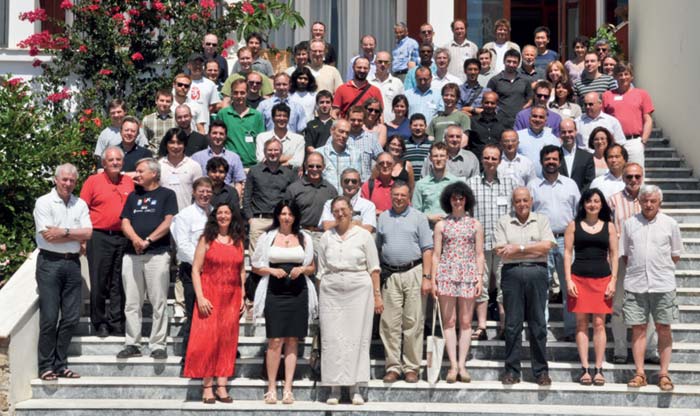
The International Conference on New Frontiers in Physics (ICFP) aims to promote scientific exchange between different areas of fundamental physics, with particular emphasis on future plans and related open questions. The first in the new series, ICFP 2012, which took place in Kolymbari, Crete, attracted 140 participants from fields ranging from particle physics and cosmology to quantum physics and the foundations of quantum mechanics – a discipline awarded the 2012 Nobel Prize in Physics. The following highlights reflect the main themes of the plenary talks, which were further elaborated in many parallel sessions.

One of the last conferences to hear enticing hints of an imminent Higgs-boson discovery

ICFP 2012 was one of the last conferences to hear enticing hints of an imminent Higgs-boson discovery, as the ATLAS and CMS collaborations at the LHC presented candidate signals for the Higgs boson with a local significance of 2.5–2.8σ at a mass of 125–126 GeV. At the same time, the CDF and DØ collaborations from the Tevatron at Fermilab also reported an excess near the same mass region with a local significance of 2.7σ. In other presentations, state-of-the-art theoretical calculations of the cross-section for a Standard Model Higgs boson were described, as well as a prediction for the Higgs boson mass of 121–126 GeV and the supersymmetric spectrum from finite unified theories. Implications beyond the Standard Model of both the mass and the large diphoton rate observed were also discussed. Reports on experimental searches for new physics, such as excited leptons, heavy neutrinos, new bosons, supersymmetry and gravity signatures, went further beyond the Standard Model, as did discussions of string theory and extra dimensions. Results from the LHC on di-jets accompanying vector bosons excluded at 95% confidence level the structure that the CDF experiment saw two years ago.

Talks on hadrons and QCD covered the latest lattice QCD results and presented theoretical predictions and the status of new states with heavy quarks and exotic hadrons, such as the Zb states discovered in 2011 by the Belle experiment at KEK. The latter are consistent with a minimal content of two quarks and two antiquarks. Within a new extended quark model that has both quarks and diquarks as building blocks, new QCD effects and interpretations emerge; for example, there are no radial excitations in low-energy QCD and hadrons can shrink. Reflecting the interdisciplinary theme of the conference, one approach to the description of the QCD phase diagram that was discussed involves a holographic model; Lorentz violation and holography were also discussed.

Highlights from heavy-ion experiments confirm that the hot and dense medium created in heavy-ion collisions behaves like a strongly interacting, almost perfect liquid – the strongly interacting quark–gluon plasma. The estimates of shear viscosity are consistent with the lower bound of the anti-de Sitter/conformal field-theory correspondence. The generated flow seems to affect even heavy particles, while jets and hadrons with high-transverse momentum are strongly quenched traversing this medium. An analogy was made between the higher-order flow coefficients that originate from the initial fluctuations of the “Little Bang” in central heavy-ion collisions and the measurements of the cosmic microwave background radiation that explore the initial fluctuations of the early universe after the Big Bang. Outstanding results have come from measurements of quarkonia, such as the indication of sequential suppression of quarkonia and of possible J/ψ regeneration at the LHC. The direct Υ(1S) state is not suppressed either at Brookhaven’s Relativistic Heavy-Ion Collider (RHIC) or at the LHC, while charmonium and bottomonium states with smaller dissociation temperatures than the Υ(1S), show a suppression at both RHIC and the LHC – as expected for a deconfined plasma of quarks and gluons within a colour-screening scenario.

An overview described the status of rare decays and CP violation, while results on the latter from LHCb and other LHC experiments set strong constraints on models and led to intriguing results that await an explanation either inside or outside the Standard Model. In particular, the isospin asymmetry in B → K μ+μ differs from the expectation by 4σ, while CP violation in the charm sector shows a 3.5σ deviation from the CP-conserving hypothesis. Results from the BaBar experiment at SLAC highlight a significant excess of events in B → D*τ ν decays at 3.4σ above the Standard-Model expectation, thus ruling out the type II two-Higgs-doublet model. BaBar has also made a direct observation of time-reversal violation at the 14σ level. The CP violation seen by LHCb in D-meson decays could arise from a fourth generation of quarks and leptons.

In the neutrino sector, an overview described the status of experiments on neutrinoless double-beta decay and their expected reach. According to the “forecast” given, the claimed evidence of the signal reported in 2001 by a subset of the Heidelberg-Moscow collaboration will be checked by the GERDA experiment in the Gran Sasso National Laboratory in the near future. Currently, the EXO-200 experiment sets the most competitive limit in the field and almost completely rules out the claim. The OPERA collaboration reported on new oscillation results from the search for ντ appearance, preliminary limits on oscillation parameters from the search for νμ → νe and an update on the measurement of neutrino velocity. New results from the T2K experiment in Japan confirm the first evidence for νe appearance presented in 2011 and provide a measurement of sin213. In reactor experiments, the Double Chooz collaboration presented results on sin213 that exclude the non-oscillation scenario at 3.1σ, while the high-precision measurements of sin213 presented by the Daya Bay collaboration exclude a zero value for θ13 at more than 7σ.

The quest to dark matter

The quest to determine the nature of dark matter is a challenge at the boundary of particle physics and astrophysics. Possible hints, for example from the Fermi Gamma-ray Space Telescope and the PAMELA experiment in space, were discussed in an overview of experimental searches and theoretical implications and expectations. Other results included limits on compact halo objects as dark matter obtained from gravitational microlensing, as well as the status of the Alpha Magnetic Spectrometer (AMS-02), which has been in orbit since May 2011. The status and recent upgrades of the DAMA/LIBRA experiment and its observation at 8.9σ for a candidate signal for dark-matter particles in the galactic halo, through an annual modulation signature, were reviewed at the conference, together with detailed studies of background. Other talks covered primordial scalar perturbations via conformal mechanisms and the experimental status of the Dark Energy Survey.

At a more mathematical level, participants learnt how gravity can be viewed as emerging out of the differential calculus in non-commutative geometry, with effects that include a separation of the inertial and gravitational masses of a test particle as its mass approaches the Planck mass. Aspects of string cosmology included a review of bouncing string-cosmologies in which the Big Bang is no longer regarded as the beginning of time, as well as a presentation on how dilaton-field dominance in early epochs enlarges the cosmologically allowed parameter space for supersymmetry at the LHC.

Talks on quantum physics covered, for example, Aharonov’s two-state vector formalism, in which hidden variables may exist if the requirement of causality is relaxed to allow – under appropriate circumstances – the effects of future events on past measurements. Transaction and non-locality in quantum field theory and cosmological consequences of a de Sitter non-local vacuum, involving David Bohm’s “holomovement” ideas, were also discussed, providing a link between cosmology and quantum physics, as were classical and quantum information acquisition, measurement and the positive-operator valued measure. An overview of quantum physics with massive objects included among other topics, the possibility of testing the predictions of quantum gravity, as well as the experimental perspectives of atom–photon interactions.

The future of physics

At a broader level, an overview talk presented the European Physical Society and its activities. Moreover, looking forward to the future generations of physicists, a presentation on educational projects was given to high-school teachers in nearby Chania, the second-largest city on Crete.

Sessions during the last two days of the conference addressed the future plans of particle and nuclear physics. These included the status of the eRHIC electron–ion collider project at Brookhaven and the Nuclotron-based Ion Collider facility at JINR, as well as an overview and outlook on heavy-ion collisions at the LHC. There were also presentations on the status and plans of major particle-physics projects, namely the Muon Collider, the International Linear Collider, the Compact Linear Collider and Super B. In addition, CERN’s future plans were highlighted, as were the ideas and actions of the European Strategy for Particle Physics group and its update plan, which is currently under preparation. The conference closed with an overview of the activities of the European Committee for Future Accelerators.

To prepare not only the students but all of the audience for an interdisciplinary week, a day of lectures preceded the conference. Discussions during the sessions and more informally, then offered the possibility to explore interdisciplinary knowledge. Results from these interactions appear in the papers contributed to the conference proceedings, which will be peer reviewed and published in the EPJ Web of Conferences in 2013.

ALICE takes new directions in charm-suppression studies

Using data from the second high-statistics lead–lead (PbPb) run of the LHC, which took place in 2011, the ALICE experiment is taking new directions in studying the interaction of charm quarks within strongly interacting matter at the high energy-density and temperature produced in these heavy-ion collisions. Following the observation of a large suppression of the production of charmed hadrons at high momentum (CERN Courier June 2012 p15), the collaboration is seeking further insight by quantifying the strength of this effect in different directions relative to the reaction plane, as well as by measuring the production of the charm-strange meson, Ds.

After production in initial hard partonic collisions, c and b quarks propagate across the expanding dense matter that has been formed in the PbPb collisions. Interactions with this medium’s constituents can lead to energy loss that results in the suppression of high-momentum hadrons, as observed for D mesons via the nuclear-modification factor RAA – the ratio of the yield measured in nucleus–nucleus collisions to that expected from a superposition of proton–proton collisions. It is an open question as to whether heavy quarks can be slowed down to the point of being affected by the collective expansion of the system or if they form hadrons by recombining with light quarks from the medium.

Because the overlap area of the two nuclei is almond-shaped, elongated in a direction perpendicular to the reaction plane (defined by the beamline and the impact parameter of the collision), non-central collisions exhibit an initial azimuthal anisotropy. ALICE measured RAA for charmed mesons by reconstructing secondary vertices from D0 → Kπ+ decays in two 90°-wide regions of azimuthal angle centred on the in-plane and out-of-plane directions. As the left panel of the figure shows, the observed suppression is larger in the out-of-plane region than in the in-plane region. This suggests that charm quarks lose more energy when having a longer path length in the medium, in the out-of-plane direction. In the low-momentum range, collective expansion under anisotropic pressure gradients could also contribute to the observed azimuthal asymmetry (CERN Courier April 2011 p7).

By exploiting the high statistics available with the 2011 PbPb run, as well as the vertexing and hadron identification capabilities of the detector, the ALICE collaboration has for the first time been able to reconstruct Ds+ →K+Kπ+ decays in heavy-ion collisions. Ds mesons are formed by a charm and a strange quark and are thus sensitive to the mechanism of c-quark hadronization – the process in which the quarks become bound in hadrons. In particular, if low-momentum c quarks hadronize by recombination, the Ds yield is expected to be enhanced with respect to that of non-strange D mesons, because of the high strangeness-content of the medium (CERN Courier December 2011 p20).

The right panel of the figure shows the values of RAA measured for Ds mesons in central collisions and reveals, at high momentum, an equally strong suppression as for non-strange D mesons. The suppression is reduced at lower momenta, although it remains consistent within uncertainties with that for non-strange D mesons. This is just a first measurement but it shows that with larger-statistics data samples from future LHC runs, ALICE should be able to draw firm conclusions on a possible enhancement of Ds production in PbPb collisions.

Quantum Gravity (Third Edition)

By Claus Kiefer
Oxford University Press
Hardback: £65 $117

41tdNNsxtoL
The search for a quantum theory of the gravitational field is one of the great open problems in theoretical physics. This book covers the two main approaches to its construction – the direct quantization of Einstein’s general theory of relativity and string theory. There is a detailed presentation of the main approaches used in quantum general relativity: path-integral quantization, the background-field method and canonical quantum gravity in the metric, connection and loop formulations.

Writing Science: How to Write Papers That Get Cited and Proposals That Get Funded

By Joshua Schimel
Oxford University Press
Hardback: £60 $99
Paperback: £22.50 $35

61QwnTX0e1L

Success is not necessarily defined by getting papers into print but by getting them into the reader’s consciousness. Writing Science is built on the idea that successful science writing tells a story. It shows scientists and students how to present their research in a way that is clear and that will maximize reader comprehension. This book takes an integrated approach, using the principles of story structure to discuss every aspect of successful science writing, explaining how to write clear and professional sections, paragraphs and sentences. The final section deals with challenges such as how to discuss research limitations and write for the public.

Relativistic Cosmology

By George F R Ellis, Roy Maartens and Malcolm A H MacCallum
Cambridge University Press
Hardback: £80 $130
E-book: $104

9781108812764

Using a relativistic geometric approach, this book focuses on the general concepts and relations that underpin the standard model of the universe. Part I covers foundations of relativistic cosmology. Part II develops the dynamical and observational relations for all models of the universe based on general relativity. Part III focuses on the standard model of cosmology, including inflation, dark matter, dark energy, perturbation theory, the cosmic microwave background, structure formation and gravitational lensing. It also examines modified gravity and inhomogeneity as possible alternatives to dark energy. Anisotropic and inhomogeneous models are described in Part IV, and Part V reviews deeper issues, such as quantum cosmology, the start of the universe and the multiverse.

LHC Physics

By T Binoth, C Buttar, P J Clark and E W N Glover (eds.)
Taylor & Francis
Hardback: £76.99

CCboo2_01_13

LHC Physics collects the written versions of lectures delivered at the Scottish Universities Summer School in Physics that took place in August 2009, in St Andrews, and covers many relevant issues for people working on the analysis of LHC data. The first nine chapters include discussions about QCD, the Higgs, B physics, forward physics, quark–gluon plasma and physics beyond the Standard Model, complemented by lectures on the LHC accelerator and detectors. The last three chapters cover Monte Carlo event-generators, statistics for high-energy-physics data analyses, and Grid computing. The lecturers are top-level experts and the book provides a nice introduction to many topics in high-energy physics, making it a valuable addition to many libraries around the world, including those of the hundreds of universities and institutes that participate in the LHC experiments.

The chapter on statistics is particularly useful as an introduction for the PhD students and postdocs who are heavily involved in data analyses. It addresses the relevance of Bayesian approaches and of the Markov-chain Monte Carlo tool, as well as the importance of providing results in the form of posterior probability distributions and how to deal properly with systematic uncertainties. It also overviews the topic of multivariate classifiers (with emphasis on “boosted decision trees”) and readers will probably appreciate the concluding remark that “while their use will no doubt increase as the LHC experiments mature, one should keep in mind that a simple analysis also has its advantages”.

Despite the book being published in 2012, it already seems somewhat old – a clear testimony to the amazing speed at which LHC results are being produced. Since the school took place, around 500 physics papers have been published by the LHC collaborations (a really impressive achievement), including many results that have significantly improved our understanding of most of the topics addressed in this book. While holding such summer schools is obviously important, one might wonder about the usefulness of the corresponding proceedings, especially when published more than two years after the school took place.

Léon Rosenfeld: Physics, Philosophy, and Politics in the Twentieth Century

By Anja Skaar Jacobsen
World Scientific
Hardback: £56
E-book: £69

CCboo1_01_13

The life of Léon Rosenfeld (1904–1974) spanned all of the three main epochs of the development of physics during the 20th century, at least according to the classification that Vicky Weisskopf expressed in a colloquium at CERN entitled “The development of science during this century”. So it should not be surprising that, as Anja Skaar Jacobsen of the Niels Bohr Archive demonstrates, the activities of this outstanding Belgian physicist cannot be grouped into a single category. Rosenfeld, who was extremely curious and erudite, contributed substantially to electrodynamics, to the Copenhagen interpretation of quantum mechanics and to the problem of the measurability of quantum fields. He was also a science historian, a tenacious political activist and, last but not least, the founding editor of the journal Nuclear Physics.

The first and second of the six chapters follow Rosenfeld’s life and interests through the 1930s up to the period where he actively participated in the formulation of the so-called Copenhagen interpretation of quantum theory and collaborated with Niels Bohr. The interface between science and politics in this period is specifically addressed in the third chapter. Rosenfeld never joined the communist party but progressively became a convinced leftist intellectual. Prior to the Stalinist purge in the second half of the 1930s, Copenhagen was also at the heart of political debates, hosting many leaders such as Lev Trotsky who visited Denmark in 1932. The fourth chapter describes how Rosenfeld survived the war in Utrecht where he took over the position of George Uhlenbeck, who left for the US in 1939. The final two chapters focus on his political commitment during the Cold War and on heated discussions surrounding the attacks on the Copenhagen interpretation, which Rosenfeld fiercely defended throughout his life.

The interests of Rosenfeld and the second “quantum generation” implicitly encourage debates. In a purely scientific context, there is the broad problem of the interpretation of quantum mechanics. The quantum theory of measurement was perceived as essential in the 1930s and throughout the 1940s. How does a classical object interact with a quantum system? Does it make sense to separate the world into quantum systems (the observables) and classical observers? The discussions leading to the most successful applications of quantum mechanics are a continuous source of reflection, from the early Einstein-Bohr controversy to Bell’s inequalities via the Bohmian interpretation of quantum theory. Quantum mechanics is not reducible either to a successful computational framework or to a philosophical perspective. It is, rather, a complicated mix of ideas that matured in one of the most difficult periods of European history. To understand quantum mechanics also means to understand the history of the first part of the 20th century: this is probably one of the main legacies, among others, of the life of Léon Rosenfeld.

Higgs Discovery: The Power of Empty Space!

By Lisa Randall
Bodley Head
Paperback: £4.99

CCboo2_10_12

Readers of CERN Courier need no introduction to Lisa Randall, the well known theoretical physicist. Her previous books, Warped Passages and Knocking on Heaven’s Door, are exceptionally interesting and surprisingly easy to read, especially when considering the complexity of the topics that she addresses. I cannot judge if the fluidity of her writing is a natural talent or the result of much hard work through several editorial iterations – but the result is outstanding. Her new book, Higgs Discovery: The Power of Empty Space, reports her reactions to the announcement by the CMS and ATLAS experiments that “a particle related to the Higgs mechanism had been found” – “I was flabbergasted” – and compiles her answers to the many questions that she has been asked since.

This is a small book of fewer than 50 pages, which can be read in a couple of hours. The writing style is refreshing and informal, with a warped sense of humour that helps to grab the target audience: the people who were fascinated with the discovery without knowing why. Sometimes it is a little repetitive and almost feels like “Higgs for dummies” but this is more a compliment than a criticism. Nowadays, most people forget to explain “the basics”, a challenge that Randall excels at. And she does not forget to wrap her teachings with passages that extend well beyond high-energy physics: “The Higgs boson discovery is more likely to be the beginning of the story than an end.” I wonder if she purposely paraphrased Winston Churchill.

I certainly agree that “the discovery is truly inspirational” and I am also glad that we can avoid the need to explain why not finding the Higgs boson would be even more interesting than actually finding it.

The 4% Universe. Dark Matter, Dark Energy, and the Race to Discover the Rest of Reality.

By Richard Panek
Oneworld
Paperback: £9.99

CCboo3_10_12

The 4% Universe is, as you might gather from the title, an account of how the scientific community has come to the idea that only (a little over) 4% of the universe seems to be made of the same stuff as you and me. In other words, normal matter is only a tiny percentage of all that there is, with the remainder being about 23% dark matter holding galaxies together and 73% being dark energy, which drives the acceleration of cosmic expansion.

This account is unusual, written more like a thriller than in the style of many popularizations. There is a great emphasis on not only describing the sequences of events leading to the discoveries of dark matter and dark energy but also of the people involved. Personalities, co-operations, disagreements, collaboration and individualism all take a large part of the stage, making the book lively and readable. I had originally planned to read it in chunks over a few days but found myself taking it all in during a single sitting, somewhat later into the night than I had planned!

This book would be a nice gift for anyone with a genuine interest in science but, oddly enough, it may be a hard read for someone without at least some background knowledge. At the same time, it is short on details (no equations, graphs, plots or photographs) for a practising physicist who is not so interested in the personal dramas involved. If you’re looking for a book about dark matter and dark energy per se, then this may not be the best choice. While the science is probably more than 4% of the book, the bulk is about sociology, history and politics.

Nevertheless, technical terms are well explained, down to footnotes for those who need to know what the Kelvin scale or a megaparsec is. The physics is pretty good, too, but not perfect in all places. For example, the discussion on the Casimir effect seems not quite to get that the energy density between the plates is negative with respect to the region outside.

The emphasis is very much on astronomy and astronomical observation and how data are collected and presented. Particle physicists should not expect much about the direct search for particles that could make up dark matter. The LHC merits a brief mention but without further discussion. Axions and neutralinos are introduced as dark-matter candidates but without any explanation of the ideas that gave rise to them.

Apart from the insights into the sociology of how “big astronomy” is done, I think that the book’s greatest merit is to drive home how much our view of the universe has changed in the past 100 or so years – from a rather simple, static universe to an expanding, even accelerating one, with far more stars and galaxies than had ever been imagined and, now, the realization that all of that visible matter may be only a few per cent of all that is. That, as well as to show how cosmology has made the giant step from being little different from theology to being a real scientific discipline.

About Time: From Sun Dials to Quantum Clocks, How the Cosmos Shapes Our Lives – And How We Shape the Cosmos

By Adam Frank
Oneworld
Paperback: £12.99

CCboo4_10_12

In 1963, Bob Dylan penned the song The Times They Are a-Changin’, which quickly became the anthem for a new generation. But according to Adam Frank’s provocative book, the times have always been changing: first, hunter-gatherers driven by the immediacy of hunger; then pioneer farmers dictated by the seasons. After that came a series of industrial revolutions: workers having to move to towns and adapt to factory drudgery; mechanical transport extending the span of distance of daily life; and today’s digital devices compressing time and distance even further (with the constant pressure to download the latest app or have the newest browser update).

About Time compares the accelerating pace of this race towards no clear destination with the evolution of cosmology, from ancient mythology to the modern picture of multiple universes. The changing world picture is continually benchmarked against the seemingly unpredictable emergence of new lifestyles as technology advances.

In doing so, the story line can lurch startlingly at times. It leaps from the introduction of labour-saving electrical household appliances in the early 20th century to the commissioning of the Mt. Wilson Hooker telescope; from the measurement of galactic red shifts and an apparently expanding universe to the cultural revolution brought about by domestic radio. The ideas of quantum mechanics are then wedged into two pages.

Frank’s illustrations cover a wide range. I appreciated being reminded of the tragic figure of British music producer Joe Meek, whose 1962 instrumental piece marking the technological miracle of Telstar resonated in contemporary lifestyle as the first British recording to appear in the US charts – one year before the Beatles, who the mercurial Meek had meanwhile chosen to ignore.

The book traces the key historical giants, from the Ancient Greek philosophers and before through to Albert Einstein, Edwin Hubble and beyond. Some figures are less familiar, for example Ambrose Crowley, a British industrial magnate who was a contemporary of Isaac Newton. Despite his obscurity, Crowley’s impact on technology is compared with that of Newton’s on science.

Some conventional ideas are sold short, for example the role of time in quantum physics and its deep connection with antimatter. Paul Dirac, the pioneer of antimatter, appears in a cameo role to introduce a whole section on the iconoclast Julian Barbour and his provocative book The End of Time. Barbour suggests that the continual quest to understand time fails because time itself is an illusion.

Although Frank’s About Time does not venture that far, it is an unconventional book, which could motivate an inquisitive young mind.

bright-rec iop pub iop-science physcis connect