Comsol -leaderboard other pages

Topics

US high-field quadrupole magnet passes test

CCnew1_07_13

The US LHC Accelerator Program (LARP) has successfully tested a powerful superconducting quadrupole magnet that will play a key role in developing a new beam-focusing system for the LHC. This advanced system – with other major upgrades to be implemented over the next decade – will allow the LHC to deliver a luminosity up to 10 times higher than in the original design.

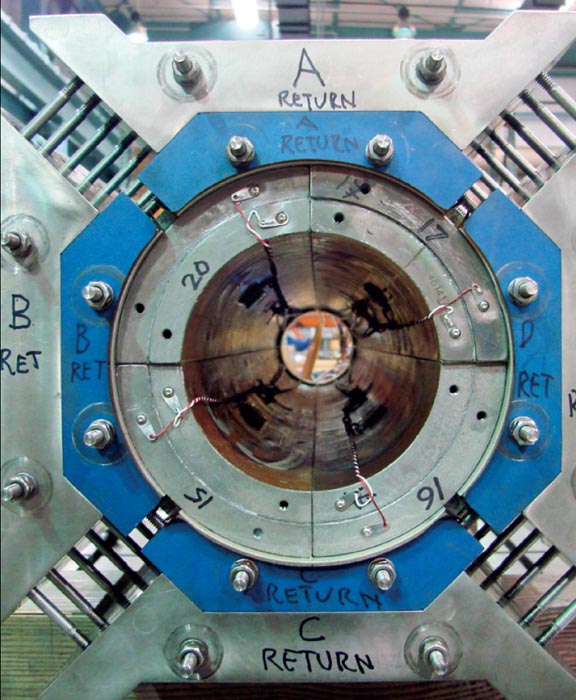
Dubbed HQ02a, the latest in LARP’s series of high-field quadrupole magnets is wound with cables of the brittle but high-performance niobium-tin superconductor (Nb3Sn). Like all LHC magnets, HQ02a is designed to operate in superfluid helium at temperatures that are close to absolute zero. However, it has a larger beam aperture than the current focusing magnets – 120 mm in diameter compared to 70 mm – and the magnetic field in the superconducting coils reaches 12 T – 50% higher than the current 8 T. The corresponding field gradient – the rate of increase of field strength over the aperture – is 170 T/m. In a recent test at Fermilab, HQ02a achieved all of its challenging objectives.

One of LARP’s primary goals is to support CERN’s plan to replace the quadrupole magnets in the interaction regions in about 10 years from now as part of the High Luminosity LHC project. Not only must the magnets produce a stronger field, they will also require a larger temperature margin and have to cope with the intense radiation, which comes hand in hand with the planned increase in the rate of energetic collisions. These requirements go beyond the capabilities of the niobium-titanium currently used in the LHC and in all previous superconducting magnets for particle accelerators.

Modern niobium-tin can operate at a higher magnetic field and with a wider temperature margin than niobium-titanium. However, it is brittle and sensitive to strain – critical factors where intense electrical currents and strong magnetic fields create enormous forces as the magnets are energized. Large forces can damage the fragile conductor or cause sudden displacements of the superconducting coils, releasing energy as heat and possibly resulting in a loss of the superconducting state – that is, a quench.

To address these challenges, LARP has adopted a mechanical support structure that is based on a thick aluminum shell, pre-tensioned at room temperature using water-pressurized bladders and interference keys. This design concept – developed at Berkeley under the US Department of Energy’s General Accelerator Development programme – was compared with the traditional collar-based clamping system used in Fermilab’s Tevatron and all of the subsequent high-energy accelerators and scaled up to 4 m in length in the LARP long “racetrack” and long quadrupoles. The HQ models further refined this mechanical design approach, in particular by incorporating full coil alignment.

The success of these tests not only establishes high-performance niobium tin as a powerful superconductor for use in accelerator magnets, it also marks a shift from R&D to development of the LARP magnets that will be installed for the LHC luminosity upgrade.

• LARP is a collaboration involving Berkeley, Brookhaven, Fermilab and SLAC, working in close partnership with CERN. It is now led by Giorgio Apollinari.

Networks Geeks: How They Built the Internet

By Brian E Carpenter
Springer
Paperback: £15 €21.09 $19.99
E-book: £11.99 €15.46 $9.99

CCboo3_07_13

In Network Geeks, Brian Carpenter weaves the history of the early internet into an entertaining personal narrative. As head of CERN’s computer-networking group throughout the 1980s, he is well placed to describe the discussions, the splits, the technical specifications and countless acronyms that made up the esoteric world of networking in the early days of the internet in Europe. Just don’t expect to be spared the technical details.

Carpenter joined CERN in 1971, at a time when computers filled entire rooms, messages were relayed by paper tape or punched card and numerous local networks ran bespoke software packages around the laboratory. Simplifying the system brought Carpenter into the world of the internet Engineering Task Force – the committee charged with overseeing the development of standards for internet technology.

I enjoyed the fictional account of a meeting of the Task Force in 1996, which gives a vivid idea of the sheer number of technical issues, documents and acronyms that the group tackled. That year, traffic was doubling every 100 days. Keeping up with the pace of change and deciding which standards and protocols to use – TCP/IP or OSI? – were emotive issues. As with any new technology, there was lobbying, competition and elements of luck. Nobody knew where the internet would lead.

Carpenter’s enthusiasm is the strength of Network Geeks. He recounts his early interest in science – a childhood of Meccano and Sputnik – with an easy nostalgia and his memories of informal meetings with often-bearded computer scientists show genuine warmth. But it is no easy read. The autobiographical narrative jumps jarringly between lyrical descriptions of the author’s youth and the rather mundane details of computer networking. At times I felt I was drowning in specifics when I was really hoping for a wider view, for implications rather than specifications.

Networks Geeks reminded me that the evolution of technology can be as much down to politics and luck as to scientific advances. It gave me a great overview of the climate in the early days on the internet. At the same, the heavy layers of jargon also reminded me why I’m no computer scientist.

A Journey with Fred Hoyle (2nd Edition)

By Chandra Wickramasinghe and Kamala Wickramasinghe (ed.)
World Scientific
Paperback: £28
E-book: £21

CCboo2_07_13

Fred Hoyle was undoubtedly among the most original thinkers of his time and one of the leading figures of 20th-century physics. From the purely scientific viewpoint, his name is associated with at least three ideas: the synthesis of heavy nuclear elements in the cores of supernovae (developed in collaboration with William Fowler, Margaret and Geoffrey Burbidge); the steady-state model of the universe (formulated together with Hermann Bondi and Thomas Gold); and some of the early applications of anthropic arguments to astrophysics and cosmology. Hoyle also contributed to many other fields – such as stellar structure, planetary formation, galactic dynamics and the origin of large-scale magnetism – where his creative imagination often made the difference.

A Journey with Fred Hoyle – now in a second edition that incorporates relevant developments that have occurred since the original was published in 2005 – is a respectful, lively and at times exciting tribute to an independent thinker, a capable teacher and an inventive scientist. It is an extremely well written collection of scientific memoirs and an intriguing journey in the realm of scientific controversies, which often accompany the achievements of those who like to think a little differently. The author started his PhD under the guidance of Hoyle in the early 1960s and was still collaborating with him in 2001 when Hoyle passed away. His narration begins in Cambridge where, from the mid-1950s to the mid-1960s, three disciplines thrived serendipitously: biology (with the monumental discovery of James Watson and Francis Crick of the famous double helix structure of genetic material); cosmology and astrophysics (with the work of Hoyle at the institute of astronomy and of Martin Ryle with the radio-astronomy group) and particle physics (with the Lucasian professorship of Paul Dirac).

The Cambridge atmosphere probably inspired a quest for the unification between astrophysics and biology – a field that later became known as astrobiology and gained funding and respect from the whole scientific community. The starting observation made by Hoyle and Wickramasinghe was that interstellar clouds are not made of ice, as originally thought in the 1950s and early 1960s, but rather of carbon. By analysing the way that interstellar dust dims starlight the authors proposed, in a crescendo, that the carbon was part of complex organic molecules and, eventually, bacteria or even viruses. This combination of science and inventiveness led to the theory of panspermia, i.e. the hypothesis that life exists throughout the universe distributed in meteorites and asteroids.

Is it really true that life on the Earth came from the cosmos? This is probably not the most relevant question. What matters here is to appreciate that the current success of astrobiology started – amid inevitable controversies – from the analysis of organic compounds in interstellar space. This is an interesting book and worth reading for those who like to follow the complicated fate of successful ideas. Recalling the title of Hoyle’s autobiography, we could say that “home” for scientists is, sometimes, “where the wind blows”.

Feynman’s Tips on Physics: Problem-Solving Supplement to the Feynman Lectures on Physics

By Richard P Feynman, Michael A Gottlieb and Ralph Leighton
Basic Books
Paperback: £11.99 $16.99

CCboo1_07_13

Originally published in hardback not long ago (Addison Wesley 2006), Feynman’s Tips on Physics is now available as a slim paperback, complete with some additional material. It is essentially a collection of four “lost” lectures and could be thought of as four chapters that somehow didn’t make it into The Feynman Lectures on Physics – the well known three-volume set by Feynman and colleagues Robert Leighton and Matthew Sands. To complement these, Michael A Gottlieb and Ralph Leighton (Robert’s son) have added a fifth chapter with selected problems from Exercises in Introductory Physics by Leighton Sr and Rochus Vogt. To set the scene, they also include a “memoir” by Sands on the origins of the famous three books in their distinctive red covers and – new for this edition – three interviews, with Leighton Sr, Vogt and Feynman himself.

The first thing to say is that the scientific level of the four lectures is far below that of the other published lectures. The first lecture, “Prerequisites”, is an elementary reminder about the importance of learning basic calculus and vector algebra and it is unlikely that anyone reading this review will find anything new. Perhaps the main point of interest is Feynman’s discussion on how to deal with not being the top member of a group comprised of many talented people. This might provide some inspiration to bright high-school students who go from being top of their class to no longer being at the top at a good university.

The second lecture, “Laws and Intuition” attempts to explain to students the importance of having a feel for the material and using physical intuition to back up mathematical calculations. This could help students, who far too often, in my experience, just want to know “what formula to use”.

“Problems and Solutions”, the third lecture, is pitched at a slightly more advanced level. It would be suitable for a good high school student or first-year university student and covers a range of interesting topics from satellite motion to rockets (including ion and photon propulsion) as well as a couple of simple particle-physics examples: electrostatic deflection of a proton beam and the determination of the charged-pion mass.

Last, “Dynamical Effects and Their Applications”, is essentially about gyroscopes. It contains little mathematics and the technology is quite dated but it is fun to read. In fact, even the datedness of some of the material has its charm. Feynman says: “Computing is mostly analogue at the moment, but it is likely that it’ll turn into digital – in a year or two, probably – because that has no errors in it.” How things have changed since 1962!

While there is not much here for the practising physicist, it is a quick and easy read and contains many interesting things about the history of The Feynman Lectures in Physics in the introduction (and the surprising statement that there are more than 170 errors in the 3 volume set). As such, it is worth the hour or two that it will take to read – and, after all, it is Feynman. While it is unlikely to find much use as a reference work, it would make a nice gift for someone about to start studying physics – but together with the full 3-volume set.

Handbook of Radioactivity Analysis (3rd edition)

By M L’Annunziata (ed.)
Academic Press
Hardback: €120
E-book: €129

9780123848734

Updated and much expanded, the new edition of this authoritative text provides the principles, practical techniques and procedures for accurately measuring radioactivity, from the low levels encountered in the environment to higher levels measured, for example, in radioisotope research, nuclear medicine and nuclear power. The book describes the basic principles of radiation detection and measurement and the preparation of samples; assists in the selection and use of appropriate radiation detectors; and presents state-of-the-art methods of analysis. Fundamentals of radiation properties, radionuclide decay and methods of detection provide the foundation of the analytical procedures. It is also suitable as a teaching text for university and training courses.

Strong in the rain

Strong in the Rain
By Lucy Birmingham and David McNeil
Palgrave Macmillan
Hardback: £17.99 $27.00
E-book: $12.99

CCbks3_06_13

Some dates will remain in the public consciousness forever, given their cultural impact. Personally, these would include 11 September 2001 (the attacks on the twin towers in New York), 7 July 2005 (the London Underground bombings) and 11 November (Armistice Day, commemorating the end of the First World War).

On 11 March 2011 the Tohoku earthquake occurred approximately 70 km off the coast of Japan. It was the most powerful earthquake ever to hit Japan and the fifth most powerful to be recorded since records began in 1900. The earthquake triggered powerful tsunami waves that reached heights of up to 40 m. The Japanese National Police Agency subsequently confirmed 15,883 deaths, ensuring that this date will live long in the Japanese cultural memory.

Strong in the Rain brings together six stories from people affected by the tragic events associated with the earthquake/tsunami on 11 March. The book is described as “part history, part science” and the authors use the experiences of the six people in the book, in addition to their own, to paint a tale of heroes and villains.

The book gets off to a slow start but the reading becomes gripping once the stories move on to the tales of the six central protagonists. It delves into the Japanese cultural strengths and weaknesses in equal measure, from the lack of information provided regarding the nuclear meltdown at the Fukushima Daiichi to the best qualities of the Japanese spirit and character, which are embodied in the town mayor who changes press coverage of the nuclear meltdown with a heartfelt plea uploaded to YouTube.

Living somewhere like the UK it is hard to picture the epic scale of this disaster but the authors weave between the stories of the protagonists to make you feel like you were there. The book manages to be both heart-breaking and uplifting in equal measure and the title Strong in the Rain – taken from a famous Japanese poem – becomes an apt description of the events that unfold.

Some books portraying historical events have the potential to become dated but I believe that Strong in the Rain will stand up well to the test of time. This is mainly because of the human stories within the book that leave you questioning how you might have behaved under similar stress. What would you leave and who would you save? What does it take to be a hero? It also leaves you thinking how important learning from the past is to save us all in the future. I would heartily recommend this book and will be lending it to all of my friends.

Materia Strana (Strange Matter)

Materia Strana (Strange Matter)
By J J Gómez Cadenas, translated from the original Materia Extraña, published by Espasa Calpe
Edizioni Dedalo
Paperback: €16

CCbks2_06_13

CERN has attracted the attention of a number of writers as a stage for their thrillers and in most cases they have been assisted on the scientific background by friends or by interviews with key CERN scientists. In Dan Brown’s Angels & Demons, CERN’s science portfolio was an excuse for writing a science-fiction novel in which special effects overshadow reality to create shocking situations. Bruno Arpaia’s L’Energia del Vuoto (Vacuum’s Energy) was more respectful of CERN’s science, providing detailed scientific descriptions but with the risk of breaking the rhythm of the novel. By contrast, J J Gómez Cadenas has been gifted with a rare combination of talents: he is a good writer and a professional particle physicist. As a result, Materia Strana is a powerful thriller based on an almost realistic scientific case that fits well with an engaging narration.

The possible existence of stable strange matter in the universe was put forward by Edward Witten and independently by Álvaro De Rújula and Sheldon Glashow in 1984. Some neutron stars could, indeed, be strange stars. The possibility that high-energy ion–ion collisions could create chunks of strange matter that would have a tendency to grow exponentially in size was debated when the Relativistic Heavy-Ion Collider started operating in the US. The probability of this happening has been calculated to be negligibly low but in Materia Strana it is assumed to be much higher – dangerously high for a high-luminosity, ion–ion LHC at CERN.

This is the main theme around which a truly international thriller develops involving Irene, the gifted young theoretician with Iranian roots and Héctor, an amazing experimental physicist from the US with multiple backgrounds as a boxer, soldier and scientist, who becomes involved in a highly dangerous mission in Iran – as well as with Irene. There is also Friedrich, the powerful but unscrupulous head of the large experiment that is likely to bring him the Nobel prize; Helena, the hyper-efficient, fighting and bright director-general of CERN; and Boiko, a natural-born killer, who escaped to Geneva from the horrors of Chernobyl and Grozny. The deadly fight between Hector and Boiko has the intensity of the pages of Khaled Hosseini’s The Kite Runner. Intermixed with dreams and ghosts crossing the border between life and death, these stories provide the texture for a decent thriller where good wins eventually over evil, although with a heavy toll.

The particle at the End of the Universe

The Particle at the End of the Universe
By Sean Carroll
Oneworld
Hardback: £16.99
Paperback: £9.99

CCbks1_06_13

In his latest book, Sean Carroll, author of the brilliant From Eternity to Here, has produced an accessible read aimed at the layperson interested in an up-to-date account of the state of particle physics and, in particular, the discovery of the Higgs boson. Carroll is well placed to offer the reader an in-depth view of the world of particle physics, being close enough to give a personal account yet maintaining the perspective of an onlooker. As a result he is a superb advocate of the case for “Big Science”, which he demonstrates to full effect in both the opening and closing chapters of the book, beginning with several snapshots of physicists celebrating the milestones that led up to the announcement of the major discovery at CERN on 4 July 2012.

By interweaving the scientific concepts with chapters on historical, social and political aspects of particle physics, Carroll dilutes the hard bits with human interest, appealing to the widest possible audience. He conveys the central importance of the Higgs discovery before going into the theory in any detail, so that we get an idea of what the fuss is about. He explains that the particle at the end of the universe is not a reference to the Higgs boson’s location in space or time but rather its location in our understanding, as the final piece of the Standard Model. This marks the end of the journey to describe our everyday surroundings and the beginning of a new era of full discovery. The theme is developed further when Carroll gets into his stride with dark matter, supersymmetry and string theory, demonstrating how the Higgs particle can act as a portal for exploring as yet unreachable phenomena.

True to the headline-grabbing comments of intrigue and drama in high-energy physics on the cover, the book recounts the chequered history of accelerators: the engineering challenges and the agonies of having your machine switched off when a major discovery could be just around the corner; or the frustrations of not getting the machine built at all, as with the Superconducting Super Collider. In this way, the account does justice to the magnitude and achievements of the LHC and its experiments.

What is meant by the “discovery” of a particle is also explained clearly, together with the issues concerning the timing and control of such announcements, especially given the high level of public interest. Concerning the difficulties of apportioning credit, Carroll proposes that scientific collaborations should be allowed to win the Nobel prize and that “Whoever gets that rule change implemented might deserve the Nobel Peace Prize”.

A couple of errors should be mentioned: the Higgs boson is repeatedly credited with distinguishing the electron from the neutrino and the up quark from the down, etc. The important qualification that this statement holds true only for the left-handed components of these particles is mentioned only latterly. Also, there is an unfortunate sign error in the diagram of Fleming’s left-hand rule – not a big deal in itself but enough to undermine confidence in the book for some readers, perhaps giving the impression that it has been rushed into print.

With this book Carroll consolidates his position as an exceptionally talented writer of difficult physics concepts for the layperson. He weaves together fascinating facts, amusing anecdotes and insightful analogies. In storyteller style, with colourful characters and thrilling plots, he propels the reader along the journey that particle physics has made in our lifetime. The layperson can empathize with the emotional highs and lows of research, the patience and tenacity required to bring a project like the LHC to completion and the laudable level of co-operation that the particle-physics community demonstrates to other large and complex organizations – to quote: “If only the United Nations could work like CERN, the world would be a better place.”

IceCube detects ultra-high-energy events and observes oscillations

The two observed events

Neutrino experiments – thanks to the nature of the particles themselves – are notoriously difficult and experiments that make use of the natural source of particles within the cosmic radiation face problems of their own. In detecting cosmic neutrinos, the IceCube Neutrino Observatory at the South Pole successfully contends with both of these challenges, as two papers to appear in Physical Review Letters reveal. They illustrate the observatory’s capabilities in particle physics and in astroparticle physics.

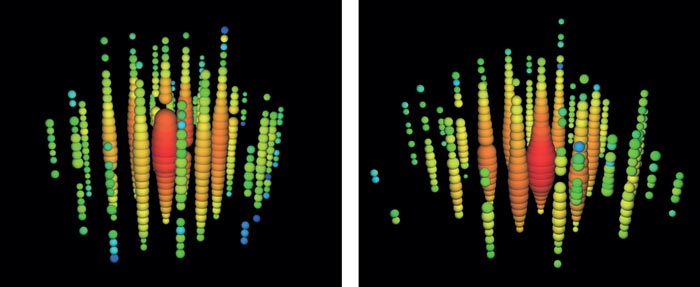
The potential for IceCube to meet its aim of detecting neutrinos from astrophysical sources has been boosted by the observation of two neutrino events with the highest energies ever seen. The events have estimated energies of 1.04±0.16 and 1.14±0.17 PeV – hundreds of times greater than the energy of protons at the LHC. The expected number of atmospheric background events at these energies is 0.082±0.004 (stat.)+0.04–0.057 (syst.) and the probability that the two observed events are background is 2.9 × 10–3, giving the signal a significance of 2.8σ (Aartsen et al. 2013a). While this is not sufficient to indicate a first observation of astrophysical neutrinos, the closeness in energy of the two events is intriguing and is already attracting the attention of theorists.

The analysis revealed the disappearance of low-energy, upwards-moving muon neutrinos and rejected the non-oscillation hypothesis with a significance of more than 5σ

Meanwhile, measurements of lower-energy neutrinos produced in the atmosphere have enabled the IceCube collaboration to make the first statistically significant detection of neutrino oscillations in the high-energy region (20–100 GeV). The data used for this analysis were collected between May 2010 and May 2011 by the IceCube and DeepCore detectors, which together make up the IceCube Neutrino Observatory. The IceCube detector consists of an array with 86 strings of digital sensors deployed in Antarctica’s ice sheet at depths in the range 1450–24507 m. This main array defines the high-energy detector, designed to detect neutrinos with energies from hundreds to millions of giga-electron-volts – that is, up to the peta-electron-volts and more of the observed high-energy events. The DeepCore subdetector adds eight additional strings near the centre of this array, six of which were deployed during the period covered by this analysis. The denser core allows lowering the energy threshold to about 20 GeV.

The analysis revealed the disappearance of low-energy, upwards-moving muon neutrinos and rejected the non-oscillation hypothesis with a significance of more than 5σ. This result verifies the first, lower-significance indication reported by the ANTARES collaboration. Using a two-neutrino flavour formalism, the IceCube collaboration derived a new estimation of the oscillation parameters, |Δm223| = 2.3+0.6–0.5 × 10–3 eV2 and sin223 > 0.93, with maximum mixing favoured. These values are in good agreement with previous measurements by the MINOS and Super-Kamiokande experiments.

More efficient event-reconstruction methods are being tested, which together with new data sets will increase the sensitivity of the IceCube and DeepCore detectors to atmospheric neutrino oscillations. As a result of these improvements, the IceCube collaboration is expecting to set further constraints on the oscillation parameters in the coming months.

ISOLDE experiments: from a new magic number to the rarest element

CCnew2_06_13

Two teams working on experiments at CERN’s ISOLDE facility have published results that extend knowledge in different areas of nuclear and atomic physics. The ISOLTRAP collaboration has measured the masses of exotic calcium nuclei using the new multi-reflection time-of-flight (MR-TOF) instrument, while a team working at the resonant-ionization laser ion source (RILIS) has made the first determination of the ionization potential of the radioactive-element astatine. The results from the two experiments demonstrate well the versatility of the ISOLDE facility.

The ISOLTRAP team used the facility to make exotic isotopes of calcium, with the aim of finding out how their nuclear “shell structure” evolves with increasing numbers of neutrons. By integrating the MR-TOF system into the experiment, the team has made precise determinations of the masses of calcium isotopes up to 54Ca. While the new device has already been applied successfully as a mass separator, this first use as a mass spectrometer has already led to a key finding and promises further important results in the future.

The results strengthen the prominence in calcium of a “magic number” that was not foreseen in the original nuclear shell model, for which Maria Goeppert-Mayer and Hans Jensen received the Nobel prize in 1963, exactly 50 years ago. In this model, the protons and neutrons in a nucleus form independent “shells” that are similar to those of electrons in atoms. The magic numbers correspond to full nuclear shells, in which the constituents are bound more tightly, leading to greater stability and lighter masses. With 20 protons and 20 neutrons, standard calcium, 40Ca, is doubly magic, while the rare and naturally occurring, long-lived isotope 48Ca has 28 neutrons – another magic number. The measurements by the ISOLTRAP team indicate a new closed-shell structure in 52Ca and therefore a new magic number of 32 (Wienholtz et al. 2013). Its shell strength of about 4 MeV rivals that of the classic magic numbers.

CCnew3_06_13

These measurements cast light on how nuclei can be described in the context of the fundamental strong force, in particular in terms of predictions using state-of-the-art theory that includes three-body forces, from physicists at the Technical University of Darmstadt. Calcium is the heaviest isotopic chain for which three-nucleon forces – based on an effective field theory of QCD – have been applied. The ISOLTRAP results are in excellent agreement with the theoretical calculations and they show that a description of extremely neutron-rich nuclei can be closely connected to a deeper understanding of nuclear forces.

One of the strengths of the ISOLDE facility is the RILIS source, which produces many of the beams. At the source, bunches of protons at 1.4 GeV from CERN’s Proton Synchrotron Booster are fired at a thick target of uranium carbide or thorium dioxide. The collisions produce nuclei of many different elements, which diffuse inside a metal cavity held at around 2000°C. Shining overlapping laser beams of chosen wavelengths into this cavity results in the selective ionization of some of the neutral atoms inside. After electrostatic extraction and magnetic mass-separation, the result is a pure beam of one isotope that travels on to a detector.

The latest element to come under scrutiny at RILIS is astatine. With a half-life of just over eight hours for its longest-lived isotope, 210As, astatine is the rarest naturally occurring element and one of the least known. Now, a team at ISOLDE has measured the element’s ionization potential for the first time, giving a result of 9.31751 eV (Rothe et al. 2013).

The measurement fills a long-standing gap in the Periodic Table because astatine is the last element present in nature for which this fundamental property remained unknown. It is of particular interest because isotopes of astatine are candidates for the creation of radiopharmaceuticals for cancer treatment by targeted alpha-particle therapy. The experimental value for astatine also serves as a benchmark for theories that predict the atomic and chemical properties of super-heavy elements, in particular the recently discovered element 117, which is an astatine homologue.

These two results demonstrate beautifully the wealth of ISOLDE’s tool-box for exploring nuclear physics. They complement well the recent results on the shape of radon nuclei that were observed in post-accelerated beams.

bright-rec iop pub iop-science physcis connect