Par Gilles Cohen-Tannoudji et Michel Spiro. Postface de Michel Serres. Gallimard
Broché: €9.90
Format numérique: €9.40
Gilles Cohen-Tannoudji et Michel Spiro revisitent plusieurs siècles de physique, en s’attardant bien sûr sur le XXe, qui a vu les révolutions de la théorie de la relativité et de la mécanique quantique. Si la partie consacrée au passage de la mécanique quantique à la théorie quantique des champs n’est pas de lecture vraiment aisée pour le non-spécialiste, celui-ci peut vite retrouver le rythme grâce à l’introduction des diagrammes et amplitudes de Feynman, qui sont une mise en musique de la théorie dynamique des interactions fondamentales. Le Modèle standard est évoqué rapidement, ainsi que les théories de jauge. La nécessité de mécanisme de BEH (pour Brout, Englert et Higgs) est alors introduite avec l’émergence des masses. Il faut noter que jamais les auteurs ne se laissent aller au raccourci facile de l’expression ” boson de Higgs ” ni ne parlent de ” particule de Dieu ” : tout au long de l’ouvrage, le boson est nommé, à juste titre, ” BEH “.
Le non-physicien devra s’armer de courage pour parcourir le chapitre sur la chromodynamique quantique mais en sera récompensé en découvrant l’explication de l’énigmatique titre du livre, qui associe le boson et le chapeau mexicain.
L’histoire du CERN, de sa compétition avec les laboratoires à accélérateurs d’outre-Atlantique et de ses succès, tient une grande place dans ce livre. Les auteurs n’hésitent pas à développer les aspects techniques de l’aventure. Le plaisir que j’ai eu à lire ce livre a été d’autant plus grand que j’ai eu le privilège d’interagir avec Michel Spiro durant son mandat de président du Conseil du CERN. Il m’appelait souvent tôt le matin afin d’avoir des nouvelles de la santé du LHC et voulait savoir pourquoi on ne poussait pas plus rapidement les performances de cette fantastique machine à découvertes. C’est dire l’importance qu’il attache à la découverte du boson BEH, annoncée le 4 juillet 2012 au CERN : consécration d’une longue traque mondiale qui n’a pu être obtenue que grâce à la conception, à la construction et à la mise en service de l’accélérateur LHC.
Les aspects politiques du CERN ne sont pas oubliés : ils sont décrits comme des ingrédients essentiels du succès de l’organisation, et cette description est magistralement développée dans la postface de Michel Serres, ode au CERN et à son mode de gouvernance, o¥ le philosophe défend l’idée que le modèle fonctionne si bien qu’il devrait être reproduit dans d’autres domaines des sciences. Cette postface remarquable de clarté et de richesse aurait pu être mieux valorisée – si le texte avait servi de préface, il aurait permis au lecteur de mesurer encore mieux le rôle du CERN dans la découverte du boson.
Ce livre, que les auteurs ont voulu à moins de 10 €, est écrit dans la langue de Louis de Broglie et François de Rose, pères fondateurs du CERN. Il décrit avec précision et passion la quête du boson BEH qui ouvre les portes la physique au-delà du Modèle standard. Ne boudons pas cette chance de pouvoir lire un tel ouvrage en français !
Il précise que l’aventure n’est pas terminée. Le boson BEH n’est qu’une étape et de nombreuses questions demeurent : le Modèle standard ne décrit que 4% de la matière de l’Univers. Comme le mentionnent les auteurs, il faut dès maintenant semer les graines des prochaines technologies des accélérateurs et des détecteurs afin d’être en mesure de construire les machines post-LHC. En fonction des résultats du LHC quand il fonctionnera à une énergie de 13–14 TeV après le long arrêt technique de 2013–2014, il faudra financer et construire un accélérateur capable d’atteindre des énergies proches de 100 TeV.
By Ian J R Aitchison and Anthony J G Hey CRC Press
Hardback: £82
The fourth edition of this well-established, highly regarded two-volume set continues to provide a fundamental introduction to advanced particle physics while incorporating new experimental results, especially in the areas of CP violation and neutrino oscillations. It offers an accessible and practical introduction to the three gauge theories included in the Standard Model of particle physics: QED, QCD and the Glashow-Salam-Weinberg (GSW) electroweak theory.
In the first volume, a new chapter on Lorentz transformations and discrete symmetries presents a simple treatment of Lorentz transformations of Dirac spinors. Along with updating experimental results, this edition also introduces Majorana fermions at an early stage, making the material suitable for a first course in relativistic quantum mechanics.
Covering much of the experimental progress made in the past 10 years, the second volume remains focused on QCD and the GSW electroweak theory – the two non-Abelian quantum gauge field theories of the Standard Model – and includes a new chapter on CP violation and oscillation phenomena. This new edition also discusses the exciting discovery of a boson with properties consistent with those of the Standard Model Higgs boson. It also updates many other topics, including jet algorithms, lattice QCD, effective Lagrangians, and three-generation quark mixing and the Cabibbo-Kobayashi-Maskawa matrix.
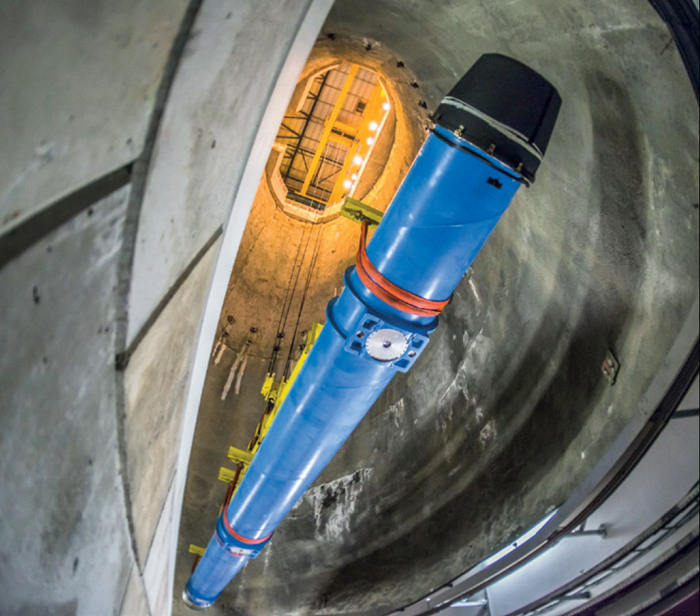
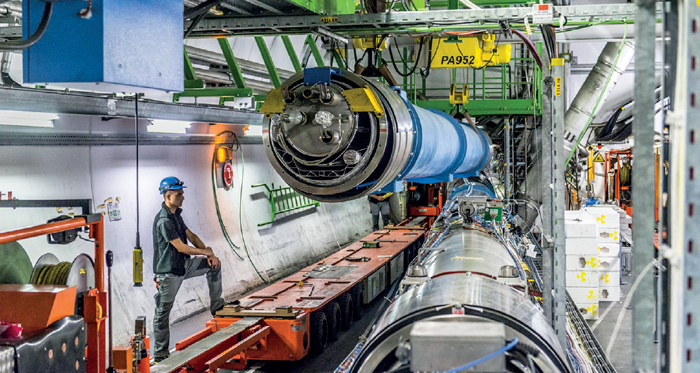
Work during the current long shutdown (LS1) of CERN’s accelerator complex is making good progress since starting in February this year. Of the LHC’s 1232 dipoles, 15 are being replaced together with three quadrupole-magnet assemblies. By the beginning of September, all of the replacement magnets had been installed in their correct positions and were awaiting reconnection.
Moving the heavy magnets requires specially adapted cranes and trailers. Moreover, there is only one access shaft – made for the purpose during the installation phase – that is wide enough to lower dipoles, each 15 m long and weighing 35 tonnes, to the tunnel. Underground, a specialized trailer carried the replacement magnets to where they were needed. Sensors fitted below the trailer enabled it to “read” and follow a white line along the tunnel floor.
Back in April, the first Superconducting Magnets and Circuits Consolidation (SMACC) teams began work in the tunnel. They are responsible for opening the interconnects between the magnets to lay the groundwork for the series of operations needed for the consolidation effort on the magnet circuits.
The cables of superconductor that form the LHC’s superconducting dipoles and quadrupoles carry a current of up to 11,850 A. The SMACC project was launched in 2009 to avoid the serious consequences of electric arcs that could arise from discontinuities in the splices between the busbars of adjacent magnets (CERN Courier September 2010 p27). The main objective is to install a shunt – a small copper plate that is 50 mm long, 15 mm wide and 3 mm thick – on each splice, straddling the main electrical connection and the busbars of the neighbouring magnets. Should a quench occur in the superconducting cable, the current will pass through the copper part, which must therefore provide an unbroken path. In total, more than 27,000 shunts will have to be put in place – an average of one every three minutes for the teams of technicians, who work on a number of interconnects in parallel.
By the end of summer, three quarters of the interconnect bellows between magnets had been opened. Almost all of the SMACC consolidation activities had been completed in sector 5-6 and the first bellows were being closed again ready for testing. In sector 6-7, the installation of the shunts was being completed and the procedure was starting in sector 7-8. The aim is for completion of the task in July 2014.
After more than a year of upgrades, Fermilab’s revamped accelerator complex is ready to send beam to its suite of fixed-target experiments, which now includes the new NOvA neutrino detector in northern Minnesota, 810 km north of the laboratory.
On 30 July, a beam of protons passed through the main injector for the first time since April 2012. With a circumference of 3.3 km, this synchrotron is the final stage of acceleration in the Fermilab accelerator complex, propelling protons from 8 to 120 GeV. Prior to the shutdown, the machine achieved a beam power of about 350 MW. The shutdown work paves the way to increase this to 700 MW.
The majority of this beam power from the main injector will be used to make neutrinos for the NOvA, MINOS and Minerva experiments. The first neutrinos were delivered on 4 September. A smaller fraction of the proton beam will go to the SeaQuest experiment and Fermilab’s Test Beam Facility. In the future, the main injector will also provide beam for the planned Muon g-2 and Mu2e experiments and the Long-Baseline Neutrino Experiment.
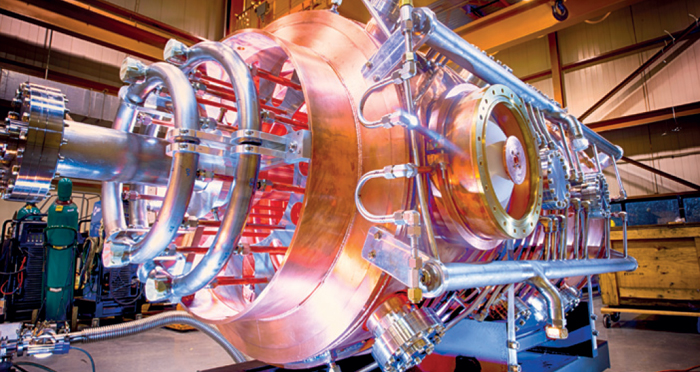
Following the revamp, Fermilab’s chain of accelerators begins with a new ion source and radio-frequency quadrupole (RFQ) to create a beam of negatively charged hydrogen ions, which are accelerated by the RFQ to an energy of 750 keV. The ions then enter the linac, which accelerates the particles to 400 MeV and sends them into the booster, where the particles pass through a foil that strips off the electrons and yields a proton beam. The upgraded booster, which accelerates protons to 8 GeV, now features solid-state RF stations and a few refurbished RF cavities. Once all of the RF cavities have been refurbished – in about two years from now – it will be able to operate at a repetition rate of up to 15 Hz. This work is part of the laboratory’s Proton Improvement Plan.
A major component of the upgraded accelerator complex is the revamped Recycler storage ring, which will play a major role in achieving higher beam power in the main injector. In the past, the Recycler stored 8 GeV antiprotons for the Tevatron collider. The Recycler is now being used for slip-stacking 8 GeV protons and as a result the main injector can deliver beam to Fermilab’s neutrino experiments every 1.3 s. Previously, it could send beam every 2.2 s only.
There are four neutral mesons that allow particle–antiparticle transitions – mixing – and so make ideal laboratories for studies of matter–antimatter asymmetries (CP violation). Indeed, such an asymmetry has already been observed for three of these mesons: K0, B0 and B0s. So far, searches for CP violation in the fourth neutral meson – the charm meson D0 – have not revealed a positive result. However, being the only one of the four systems to contain up quarks, the D0 mesons provide unique access to effects from physics beyond the Standard Model.
The LHCb collaboration presented recently two new sets of measurements at the CHARM 2013 conference, held in Manchester on 31 August–4 September. Both measurements use several million decays of D0 mesons into two charged mesons. The first is based on D0 → K+π– decays and their charge conjugate, from data recorded in 2011 and 2012. Owing to the Cabibbo-Kobayashi-Maskawa mechanism, the direct decay is suppressed relative to its Cabibbo-favoured counterpart. However, the final state can also be reached through mixing of the D0 meson into its antimeson, followed by the favoured decay D0 → K+π–.
These two components and their interference are distinguished through analysis of the decay-time structure of the decay – comparison of the structure for D0 and D0 decays measures CP violation. The results give the best measurements to date of the mixing parameters in this system and are consistent with no CP violation at an unprecedented level of sensitivity (LHCb 2013a).
The second measurement is based on decays into a pair of kaons or a pair of pions and uses data that were recorded in 2011. The asymmetry between the mean lifetimes measured in D0 and D0 decays is related to a parameter, AΓ, which is the asymmetry between the inverse effective lifetimes of decays to the specific final state. It is a measurement of so-called indirect CP violation. The results for the two final states are AΓ(KK) = (–0.35±0.62±0.12) × 10–3 and AΓ(ππ) = (0.33±1.06±0.14) × 10–3 (LHCb 2013b). This is the first time that a search for indirect CP violation in charm mesons has reached a sensitivity of better than 10–3.
The combination of previous measurements performed by the Heavy Flavor Averaging Group hinted at potentially nonzero values for the parameters of CP-violation in D0 mixing, |q/p| and φ. As the figure shows, the new results from LHCb do not support this indication. However, they provide extremely stringent limits on the underlying parameters of charm mixing, therefore constraining the room for physics beyond the Standard Model.
The international Daya Bay collaboration has announced new results, including their first data on how neutrino oscillations vary with neutrino energy, which allows them to measure mass splitting between different neutrino types. Mass splitting represents the frequency of neutrino oscillation while mixing angles represent the amplitude and both are crucial for understanding the nature of neutrinos.
The Daya Bay experiment, which is run by a collaboration of more than 200 scientists from six regions and countries, is located close to the Daya Bay and Ling Ao nuclear power plants, 55 km north-east of Hong Kong. It measures neutrino oscillation using electron antineutrinos created by six powerful nuclear reactors. Because the antineutrinos travel up to 2 km to underground detectors, some transform to another type and therefore apparently disappear. The rate at which they transform is the basis for measuring the mixing angle, while the mass splitting is determined by studying how the rate of transformation depends on the antineutrino energy.
Daya Bay’s first results were announced in March 2012 and established an unexpectedly large value for the mixing angle θ13 – the last of three long-sought neutrino mixing angles. The new results, which were announced at the XVth International Workshop on Neutrino Factories, Super Beams and Beta Beams (NuFact2013) in Beijing, give a more precise value – sin2 2θ13 = 0.090±0.009. The improvement in precision is a result both of having more data to analyse and of having the additional measurements on how the oscillation process varies with neutrino energy.
The KamLAND experiment in Japan and other solar neutrino experiments have previously measured the mass splitting Δm221 by observing the disappearance of electron antineutrinos from reactors some 160 km from the detector and the disappearance of electron neutrinos from the Sun. The long-baseline experiments MINOS in the US and Super-Kamiokande and T2K in Japan have determined the effective mass splitting |Δm2μμ| using muon neutrinos. The Daya Bay collaboration has now measured the magnitude of the mass splitting |Δm2ee| to be (2.54±0.20) × 10–3 eV2.
The result establishes that the electron neutrino has all three mass states and is consistent with that from muon neutrinos measured by MINOS. Precision measurements of the energy dependence should further the goal of establishing a hierarchy of the three mass states for each neutrino flavour.
The ILC site evaluation committee of Japan has announced the result of the assessment of the two candidate sites for an International Linear Collider (ILC). In a press conference held at the University of Tokyo on 23 August, the committee recommended the Kitakami mountains in the Iwate and Miyagi prefectures as the preferred location.
The search for an appropriate candidate site for the construction of an ILC in Japan has been ongoing since 1999, with more than 10 candidates announced in 2003. In 2010, the list was further reduced to two, consisting of Kitakami in the north-east of the main island of Japan and Sefuri in Kyushu, on Japan’s south-west island. The process to assess these two remaining candidates to narrow them down from a scientific point of view began in January this year.
A site-evaluation committee of eight members was formed within Japan. In addition, two sub-committees of 16 technical experts and 12 socio-environmental experts were created separately to provide expertise on issues such as geological conditions, environmental impact, possible problems during construction and the social infrastructure of each candidate site.
After more than 300 hours of meetings, the site-evaluation committee made a tentative choice in early July. This choice was then submitted and reviewed by an international review committee. The committee recognized that the process to choose the site had been conducted with great care and that the selected site has excellent geological conditions for tunnelling and stability.
• For more information, see the Japanese ILC Strategy Council website http://ilc-str.jp/.
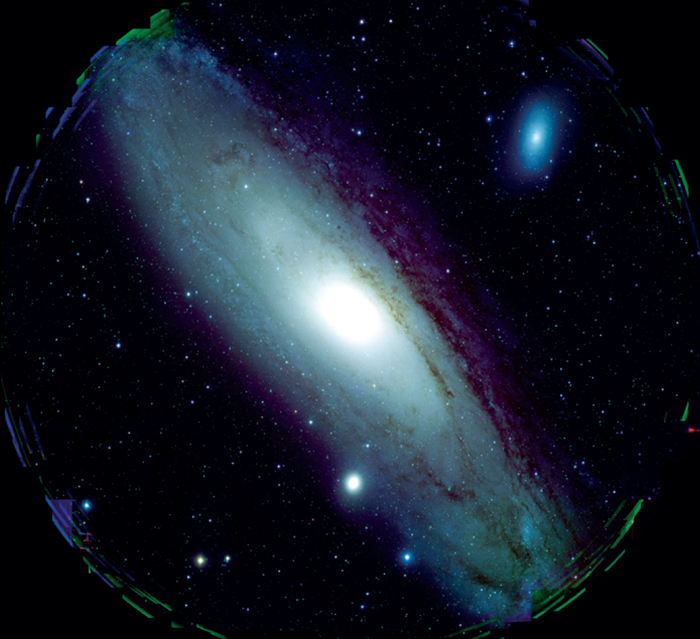
A stunning image of the nearby Andromeda galaxy (M31) captured by the Subaru Telescope’s Hyper Suprime-Cam (HSC) has demonstrated the instrument’s capability of fulfilling the goal to use the ground-based telescope to produce a large-scale survey of the universe. The combination of a large mirror, wide field of view and sharp imaging represents a major step into a new era of observational astronomy and will contribute to answering questions about the nature of dark energy and matter. The image marks a successful stage in the HSC’s commissioning process, which involves checking all of its capabilities before it is ready for open use.
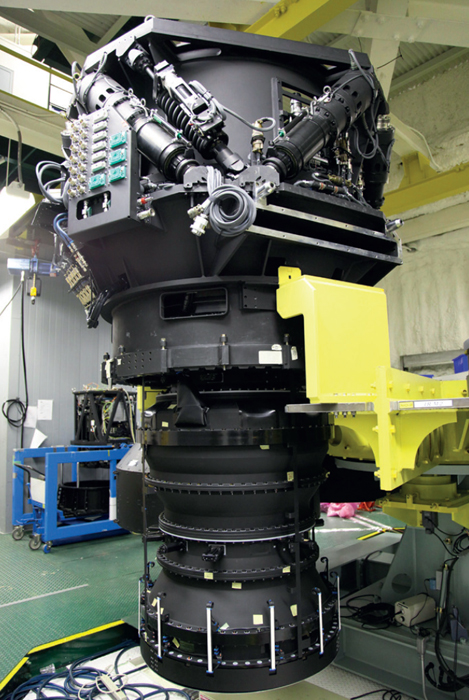
The Subaru Telescope, which saw first light in 1999, is an 8.2-m optical-infrared telescope at the summit of Mauna Kea, Hawaii, and is operated by the National Astronomical Observatory of Japan (NAOJ). The HSC – which was installed on the telescope in August last year – substantially increases the field of view beyond that which is available with the present instrument, the Subaru Prime Focus Camera, Suprime-Cam. The 3-tonnes, 3-m high HSC mounted at the prime focus contains 116 innovative, highly sensitive CCDs. Its field of view with a diameter of 1.5° is seven times that of the Suprime-Cam and with the 8.2-m primary mirror enables the high-resolution images that will underpin what will be the largest-ever galaxy survey.
First conceived of in 2002, the HSC Project was established in 2008. The major research partners are NAOJ, the Kavli Institute for the Physics and Mathematics of the Universe, the School of Science at the University of Tokyo, KEK, Academia Sinica Institute of Astronomy and Astrophysics and Princeton University, with collaborators from industry, Hamamatsu Photonics KK, Canon Inc. and Mitsubishi Electric Corporation.
Follow-up observations of a recent short-duration gamma-ray burst (GRB) provide the strongest evidence yet that these elusive bursts result from the merger of two neutron stars. The evidence is in the detection with the Hubble Space Telescope (HST) of a new kind of stellar blast – a kilonova.
During the 1990s, the detection of thousands of GRBs by the Burst and Transient Source Experiment (BATSE) revealed two bumps in the distribution of their duration. GRBs were therefore classified as being of either short or long duration, with a dividing line at 2 s. The origin of these brief flashes of gamma rays remained mysterious until the “rosetta stone” burst, GRB 030329 (CERN Courier September 2003 p15). A supernova explosion was found to be associated with this bright, relatively nearby burst of 29 March 2003 and therefore proved that long-duration GRBs result from core-collapse in massive stars. The collapse of the core forms a black hole, which powers a pair of relativistic jets that drill their way through the remains of the dying star and produce an energetic flash of gamma rays (CERN Courier June 2013 p12).
So what is the origin of the short-duration GRBs? Are they really of a different nature? The favoured hypothesis is that they are produced by the merger of two neutron stars, or a neutron star and a black hole (CERN Courier December 2005 p20). Theorists expect such mergers to produce neutron-rich radioactive isotopes, whose decay within days would lead to a transient infrared source. Such a hypothetical transient is called a kilonova because its brightness is about a thousand times that of a typical stellar nova, but is still 10 to 100 times less bright than a supernova explosion.
A team of astronomers led by Nial Tanvir of the University of Leicester now claims to have detected the first kilonova associated with the short GRB 130603B. The burst was detected on 3 June by the Burst Alert Telescope on the Swift spacecraft. The subsequent detection of an optical afterglow allowed the team to pinpoint the location of this genuine short GRB, which lasted only about 0.2 s. The burst occurred in a known galaxy at a redshift of z = 0.356, an ideal target for the sharp vision of the Hubble Space Telescope (HST).
Two HST observations have been performed: one nine days after the burst and the second after 30 days. While no transient source is detected in visible light, the earlier near-infrared image has a point source at the position of the burst’s afterglow, which is no longer present in the later observation. Furthermore, the brightness of this source is found to be significantly in excess of the extrapolation of the afterglow decay to nine days after the burst. This discrepancy reveals the presence of an additional component that Tanvir and his team suggest is the expected kilonova. The time delay, infrared brightness and the absence of emission in the visible light are characteristics that are all consistent with recent calculations for the emission of a kilonova.
If the infrared transient observed by the HST is correctly interpreted, this would be a new milestone in the understanding of GRBs. It would confirm that short GRBs are indeed produced by the merger of two compact stellar objects ejecting neutron-rich radioactive elements decaying in a kilonova blast. This would also be good news for searches for gravitational-wave signals from the merger of compact objects. Detecting the kilonova transient associated with a gravitational-wave signal would allow the location and distance of the source to be obtained, even in the absence of a detectable short GRB when the gamma-ray emission is pointing away from the Earth.
Numerous astronomical observations indicate that about one quarter of the energy content of the universe is made up of a mysterious substance known as dark matter. The Planck collaboration recently measured this to the precise percentage of 26.8%, which is slightly greater than the previous value from nine years of observations by the Wilkinson Microwave Anisotropy Probe (WMAP). Dark matter, which is five times more abundant than baryonic matter, provides compelling evidence for new physics and could be made of a new particle not present in the Standard Model. Theories beyond the Standard Model, such as supersymmetric models or theories with extra dimensions, suggest promising candidates and naturally predict so-called weakly interacting massive particles (WIMPs), which are stable or have lifetimes longer than the age of the universe.
There are several complementary strategies to detect dark matter. The ATLAS and CMS experiments at the LHC search for such particles produced in proton–proton collisions. Indirect searches, for example by the AMS-02 or IceCube detectors, aim at detecting the products of dark-matter annihilation in cosmic rays.
Because dark-matter particles are expected to be abundant in the Galaxy, with an energy density of about 0.3 GeV/c2/cm3 at the location of the Sun, the most direct strategy is to look for their interactions in laboratory-based detectors. In general, it is possible to study spin-independent WIMP–nucleon interactions – which scale with the square of the target’s mass number, A – or spin-dependent couplings to unpaired nucleons in the target nucleus. Because of their nonrelativistic Maxwellian velocity distribution with a typical speed of around 220 km/s and because the WIMPs interact significantly only with nuclei (and not with the electrons), the expected signal is a featureless exponential nuclear-recoil spectrum. The recoil energies depend on the mass of the WIMP and on the target material and are typically of the order of a few tens of kilo-electron-volts.
Because the expected interaction rates are small, a sensitive WIMP detector needs to feature a large target mass, an ultralow background and a low energy threshold. In addition, it should allow the distinction of the nuclear-recoil signal (from WIMPs and also from background neutrons) from the overabundant electronic-recoil background from γ and β radiation.
The most sensitive dark-matter detector to date is XENON100, which is operated by the XENON collaboration and situated at the Italian Laboratori Nazionali del Gran Sasso (LNGS), under about 1.3 km of rock that provides a natural shield from cosmic rays. The experiment searches for WIMP interactions in a target of 62 kg of liquid xenon. The noble gas xenon is cooled to around –90°C to bring it to the liquid state with a density of around 3 g/cm3. Its high mass number, A, of around 130 makes it one of the heaviest of all target materials for dark-matter detection.
The detector was built from materials selected for their low intrinsic radioactivity
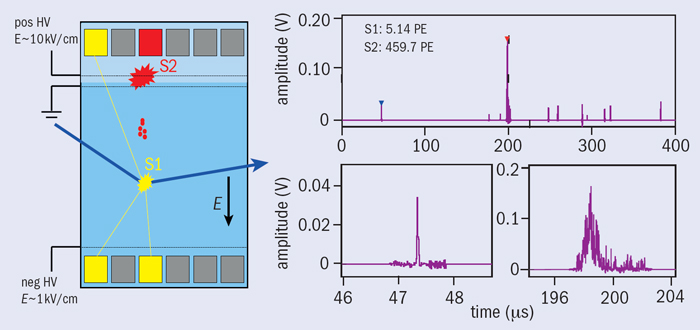
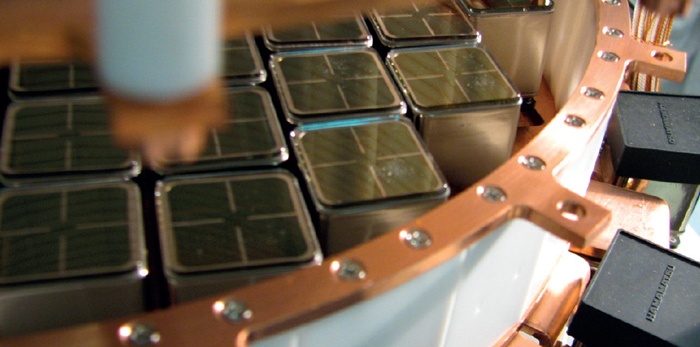
XENON100 is operated as a dual-phase time-projection chamber (TPC), as figure 1 illustrates. Particle interactions excite the liquid xenon, leading to prompt scintillation light, and also ionize the target atoms. A uniform electric field causes the ionization electrons to drift away from the interaction site to the top of the TPC. Here a strong electric field extracts them into the xenon-gas phase above the liquid. Subsequent scattering on the gas atoms leads to signal amplification and a secondary scintillation signal, which is directly proportional to the ionization extracted. Both the prompt and secondary scintillation light are detected by two arrays of low-radioactivity photomultipliers (PMTs), which are installed above and below the cylindrical target of around 30 cm height and 30 cm diameter (figure 2). The PMTs are immersed in the liquid and gaseous xenon to achieve the highest-possible light-detection efficiency and therefore the lowest threshold. The 3D position of the interaction vertex is obtained by combining the time difference between the prompt and the secondary scintillation signal with the hit pattern of the localized secondary signal on the array of 98 PMTs above the target. The number of secondary signals defines the event multiplicity.
The detector was built from materials selected for their low intrinsic radioactivity. Thanks to its novel detector design – placing most radioactive components outside of a massive passive shield – and the self-shielding provided by the liquid xenon, XENON100 features the lowest published background of all dark-matter experiments. The self-shielding is exploited by selecting only events that interact with the inner part of the detector (“fiducialization”) and by rejecting all events that exhibit a coincident signal in the active veto, which is made of 99 kg of liquid xenon that surrounds the target. Because of their small cross-section, WIMPs will interact only once in the detector, so background can be reduced further by selecting single-scatter interactions with a charge-to-light ratio typical for the expected nuclear-recoil events.
In the summer of 2012, the XENON collaboration published results from a search for spin-independent WIMP–nucleon interactions based on 225 live days of data (XENON collaboration 2012). No indication for dark matter was found but the derived upper limits are the most stringent to date for WIMP masses above 7 GeV/c2. The same data have now been interpreted in terms of spin-dependent interactions and the results published recently (XENON collaboration 2013). This latest analysis requires knowledge of the axial-vector coupling and the nuclear structure of the two xenon isotopes with unpaired nucleons, 129Xe and 131Xe. Improved calculations were employed here, which are based on chiral-effective field-theory currents. Compared with older calculations, these yield superior agreement between calculated and predicted nuclear energy-spectra (Menendez et al. 2012).
The specific nuclear structure of the relevant xenon isotopes leads to different sensitivities for the two extreme cases that are usually considered. For the case where WIMPs are assumed to couple to protons only, the new XENON100 limit is competitive with other results (figure 3). Indirect dark-matter searches looking for signals from the annihilation of WIMPs trapped in the Sun (which mainly consists of protons) are particularly sensitive to this channel. For the neutron-only coupling, XENON100 sets a new best limit for most masses, improving the previous constraints by more than an order of magnitude (figure 3).
The aim is to reach a dark-matter sensitivity two orders of magnitude better than the current best value
While XENON100 continues to take science data at LNGS, the development of a larger liquid-xenon detector is well under way. XENON1T will be about 35 times larger than XENON100, with a TPC of around 100 cm in height and diameter. The aim is to reach a dark-matter sensitivity two orders of magnitude better than the current best value. This will probe a significant part of the theoretically favoured WIMP parameter space but will require the radioactive background of the new instrument to be 100 times lower than that of XENON100. The greatly increased liquid xenon target mass of more than two tonnes helps to achieve this goal.
The largest background challenge comes from uniformly distributed traces of radioactive radon (mainly 222Rn) and krypton (85Kr, present in natural krypton at a fraction of about 10–11) dissolved in the xenon, because the background from these isotopes cannot be reduced by target fiducialization. To achieve the background goals for XENON1T, the contamination of radon and krypton in the xenon filling will be reduced to below a level of parts per 1012 by careful material selection and surface treatment and by cryogenic distillation, respectively. Additionally, all of the construction materials for the detector are being carefully selected based on their intrinsic radioactivity using ultrasensitive germanium detectors. A few of the world’s most sensitive detectors are owned and operated by institutions in the XENON collaboration.
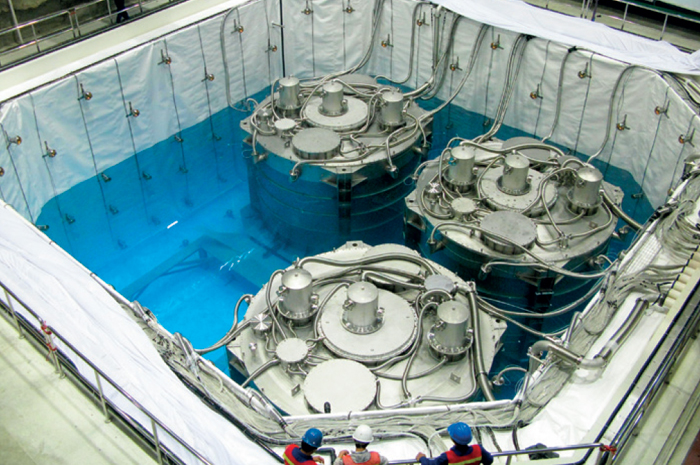
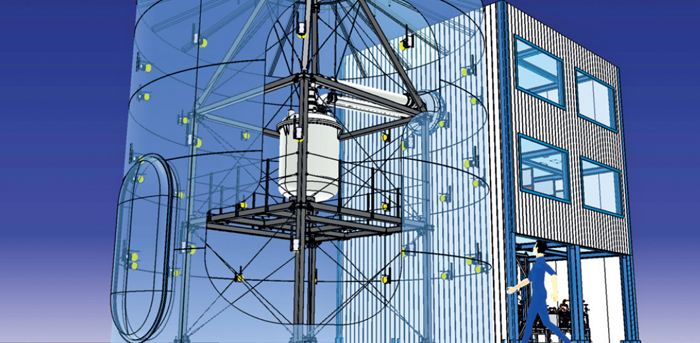
The XENON1T detector will be placed inside a large water shield to protect it from environmental radioactivity (figure 4). The water will be equipped with PMTs to tag muons via emission of Cherenkov light, because muon-induced neutrons could mimic WIMP signals. The construction of the water tank is underway in Hall B of LNGS and will be finished by the end of 2013. Together with the XENON1T service building, it will be the first visible landmark of the experiment underground. The other XENON1T systems – from detector and cryogenics to massive facilities for the storage and purification of xenon – are currently being designed, built, commissioned and tested at the various collaborating institutions. In particular, the challenges associated with building a TPC of 100 cm drift length, which will be the longest liquid xenon-based TPC ever, are being addressed with dedicated R&D set-ups.
Once the main underground facilities are erected, the XENON1T low-background cryostat – to contain the TPC and more than three tonnes of xenon – will be installed inside the water shield. The infrastructure for the storage, purification and liquefaction have been designed to handle more than double the amount of xenon initially used in XENON1T. Their commissioning underground is expected to be completed by the summer of 2014. The timeline foresees commissioning of the full XENON1T experiment by the end of 2014 and the first data by early 2015. After two years of data-taking, XENON1T will reach a sensitivity of 2 × 10–47 cm2 for spin-independent WIMP-nucleon cross-sections at a WIMP mass of 100 GeV/c2. This is a factor 100 better than the current best WIMP result from XENON100.
To provide the best experiences, we use technologies like cookies to store and/or access device information. Consenting to these technologies will allow us to process data such as browsing behavior or unique IDs on this site. Not consenting or withdrawing consent, may adversely affect certain features and functions.
Functional
Always active
The technical storage or access is strictly necessary for the legitimate purpose of enabling the use of a specific service explicitly requested by the subscriber or user, or for the sole purpose of carrying out the transmission of a communication over an electronic communications network.
Preferences
The technical storage or access is necessary for the legitimate purpose of storing preferences that are not requested by the subscriber or user.
Statistics
The technical storage or access that is used exclusively for statistical purposes.The technical storage or access that is used exclusively for anonymous statistical purposes. Without a subpoena, voluntary compliance on the part of your Internet Service Provider, or additional records from a third party, information stored or retrieved for this purpose alone cannot usually be used to identify you.
Marketing
The technical storage or access is required to create user profiles to send advertising, or to track the user on a website or across several websites for similar marketing purposes.