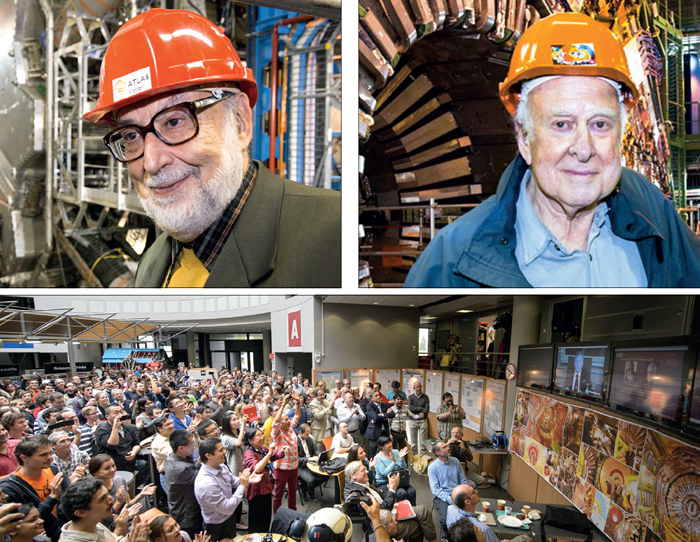
Champagne corks popped at CERN on 8 October, to celebrate the award of the 2013 Nobel Prize in Physics to François Englert, professor emeritus at the Université libre de Bruxelles, and Peter Higgs, professor emeritus at the University of Edinburgh. They received the honour “for the theoretical discovery of a mechanism that contributes to our understanding of the origin of mass of subatomic particles, and which recently was confirmed through the discovery of the predicted fundamental particle, by the ATLAS and CMS experiments at CERN’s Large Hadron Collider”. The announcement of the discovery by the ATLAS and CMS collaborations took place at CERN on 4 July last year.
“I’m thrilled that this year’s Nobel prize has gone to particle physics,” said CERN’s director-general, Rolf Heuer. “The discovery of the Higgs boson at CERN last year, which validates the Brout–Englert–Higgs mechanism, marked the culmination of decades of intellectual effort by many people around the world.”
The Brout–Englert–Higgs (BEH) mechanism was first proposed in 1964 in two papers published independently – the first by Belgian physicists Robert Brout (now deceased) and his colleague Englert, the second by British physicist Higgs. It explains how the force responsible for β decay turns out to be much weaker than electromagnetism, but it is better known as the mechanism that endows fundamental particles with mass. A third paper, published by Americans Gerald Guralnik and Carl Hagen with their British colleague Tom Kibble, further contributed to the development of the new idea, which now forms an essential part of the Standard Model of particle physics. A key prediction of the idea, as was pointed out by Higgs, is the existence of a massive boson of a new type. After searches in earlier experiments, mainly at CERN and Fermilab, the particle was finally discovered by the ATLAS and CMS experiments at the LHC in 2012.
The Standard Model describes both the fundamental particles from which all the visible matter in the universe is made and the interactions that govern their behaviour. It is a remarkably successful theory that has been thoroughly tested by experiment over many years. Until last year, the BEH mechanism was the last remaining piece of the model to be experimentally verified. Now that it has been found, experiments at CERN are searching assiduously for physics beyond the Standard Model.
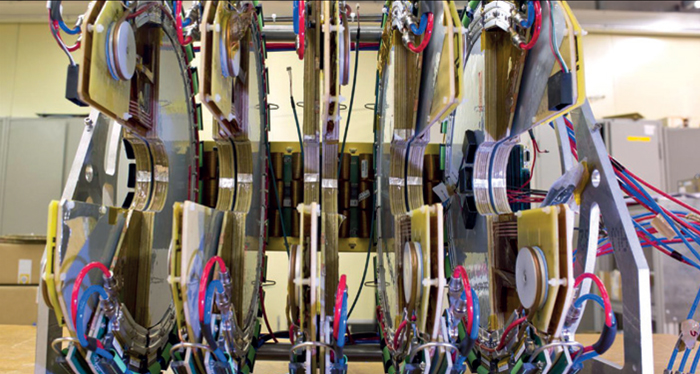
The ALICE experiment, with its state-of-the-art detection systems, produced a wealth of results during Run 1 of the LHC (2009–2013) – driving a new impetus in the field of heavy-ion collisions. While Run 2 (2015–2017) will see the consolidation and completion of the scientific programme for which the experiment was originally approved, the ALICE collaboration has already taken up the challenge to make a quantitative leap in the precision of its observations by exploiting the high luminosity anticipated for the LHC in Run 3 (2019–2022). The plan is to upgrade the detector during the LHC’s second long shutdown, just before Run 3. In September, the LHC Committee (LHCC) approved an addendum to the letter of intent for the ALICE upgrade programme concerning the project for the Muon Forward Tracker (MFT) – an assembly of silicon pixel planes serving as internal tracker, in the forward acceptance of ALICE’s muon arm.
The basic idea behind the MFT concept – measuring muons both before and after the hadron absorber, then matching the two pieces of information – is well established in the field of heavy-ion physics, having been exploited both at CERN’s Super Proton Synchrotron and more recently at Brookhaven’s Relativistic Heavy-Ion Collider. Evaluation of the expected scientific impact of such a major upgrade required the preparation of a detailed letter of intent, the first draft of which was submitted to the ALICE collaboration in December 2011. The final document received internal approval in March 2013 and the first discussions with the LHCC started two months later.
There are three main pillars of the MFT’s contribution to the ALICE physics programme: dimuon measurement of prompt charmonia states J/ψ and ψ´, to study in-medium colour-screening and hadronization mechanisms of cc pairs; measurement of charm and beauty production via single muons and J/ψ particles from B decay, allowing a tomography of the medium via study of the energy loss of heavy quarks; and low-mass dimuon measurements, to study thermal radiation from quark–gluon plasma and search for in-medium modifications of the spectral functions of light vector mesons. The technical feasibility was also demonstrated as reported in the letter of intent – from the choice of the CMOS pixel technology to aspects related to the detector mechanics and cooling. It is also worth emphasizing that ALICE is the only LHC experiment that is designed to perform precision measurements at forward rapidities in the high-multiplicity environment of heavy-ion collisions.
What will the MFT do for ALICE? Put simply, it will be like wearing a pair of glasses to correct myopia. The MFT will reveal the details of the muon tracks in the vertex region, allowing not only a powerful rejection of background muons but also access to measurements that are not feasible with the existing muon spectrometer. A prime example is the disentanglement of prompt (charm) and displaced (from beauty) J/ψ production (figure 1), which is achievable only by measuring precisely the distance between the primary vertex of the collision and the vertex in which the J/ψ is produced. Because such distances are in the order of a few hundreds of micrometres, a dedicated vertex detector is needed. Figure 2 illustrates how this measurement becomes possible only with the addition of the MFT to the current muon spectrometer set-up.
The team involved with the MFT project must now provide details on all of the technological aspects, producing a Technical Design Report in the second half of 2014 – the final effort before assembling the first pieces of the detector. Then four more years of intense work will be needed before the MFT is installed and becomes operational in the ALICE cavern in 2019.
Experimenters from LHCb and theorists recently met at CERN to discuss the best ways to obtain the most out of the rich harvest of data from the LHC.
Despite the large size of modern particle-physics collaborations, every experiment faces issues that arise because resources do not match ambitions. For LHCb, the 70 journal papers the collaboration has submitted this year are only the tip of the iceberg of the interesting and often unique measurements that could be achieved. Because this iceberg might be able to fracture the hull of the Standard Model, it is essential to maximize the output of physics. This makes close communication with theorists crucial.
To facilitate such discussions, on 14–16 October LHCb held a workshop at CERN on “Implications of LHCb measurements and future prospects”. Following the tradition of two earlier meetings in the series, approximately 50 theorists from around the world joined members of the LHCb collaboration for intense discussions. Sessions covered charm mixing and CP violation, B mixing and CP violation, rare decays and “forward exotica”, including topics such as the production of top quarks and Higgs bosons in the LHCb acceptance. There was also a session dedicated to the interplay of LHCb results with, for example, studies of the Higgs boson and searches for supersymmetry at ATLAS and CMS.
One of the hottest topics concerned recent measurements by LHCb of the angular distribution of the decay products of B0 → K*0μμ transitions that have revealed tension with the prediction of the Standard Model (LHCb collaboration 2013). The observable known as P5´ – shown in the figure as a function of the dimuon invariant-mass squared (q2) – is particularly interesting. This parameter is sensitive to the modulation of the angular distribution that depends on the interaction between different operators contributing to the decay. It is therefore sensitive to the effects of physics beyond the Standard Model. Additionally, P5´ is insensitive at leading order to theoretical uncertainties related to the K* hadronic form factor. However, corrections from higher-order terms introduce residual uncertainty. The tension in the data can be reduced if the uncertainty is allowed to be larger than original estimates – an observation that sparked a debate about the best estimate of the size of the so-called “power corrections”.
Several key points emerged from the discussion. On the theory side, further studies can help to understand the uncertainties in the form factor. Experimentally, improved analyses with the full LHCb data sample of 3 fb–1 are keenly anticipated: with this large data sample and exploiting the power of the LHCb particle identification system, it might be possible for the first time to perform a full angular analysis that also separates the subtle Kπ S-wave component from the K* signal. Moreover, continuing discussions between theorists and experimenters will be needed to understand which of several different approaches to control the uncertainties is the most sensitive to physics beyond the Standard Model.
The TOTEM collaboration has made the first measurement of the double diffractive cross-section in the very forward region at the LHC, in a range in pseudorapidity where it has never been measured before.
Double diffraction (DD) is the process in which two colliding hadrons dissociate into clusters of particles, the interaction being mediated by an object with the quantum numbers of the vacuum. Because the exchange is colourless, DD events are typically associated experimentally with a large “rapidity gap” – a range in rapidity that is devoid of particles.
The TOTEM experiment – designed in particular to study diffraction, total cross-sections and elastic scattering at the LHC – has three subdetectors placed symmetrically on both sides of the interaction point. Detectors in Roman pots identify leading protons, while two telescopes detect charged particles in the forward region. These two telescopes, T1 and T2, are the key to the measurement of double diffraction in the very forward region. T2 consists of gas-electron multipliers that detect charged particles with transverse momentum pT > 40 MeV/c at pseudorapidities of 5.3 < |η| < 6.5. The T1 telescope consists of cathode-strip chambers that measure charged particles with pT > 100 MeV/c at 3.1 < |η| < 4.7. (Pseudorapidity, η, is defined as –ln(tan θ/2), where θ is the angle of the outgoing particle relative to the beam axis, so a higher value corresponds to a more forward direction.)
For this novel measurement, TOTEM selected the DD events by vetoing T1 tracks and requiring tracks in T2. This is equivalent to selecting events that have two diffractive systems with 4.7 < |η|min < 6.5, where ηmin is the minimum pseudorapidity of all of the primary particles produced in the diffractive system. The measurement used data that were collected in October 2011 at a centre-of-mass energy of 7 TeV during a low pile-up run with special β* = 90 m optics and with the T2 minimum-bias trigger. After offline reconstruction, the DD events were selected by requiring tracks in both T2 arms and no tracks in either of the T1 arms. This allowed the extraction of a clean sample of double-diffractive events.
The analysis of these events led to a result for the double diffraction cross-section of σDD = (116±25) μb, for events where both diffractive systems have 4.7 < |η|min < 6.5. The measured values for the cross-section are between the predictions of the hadron-interaction models, Pythia and Phojet, for the corresponding ranges in η.
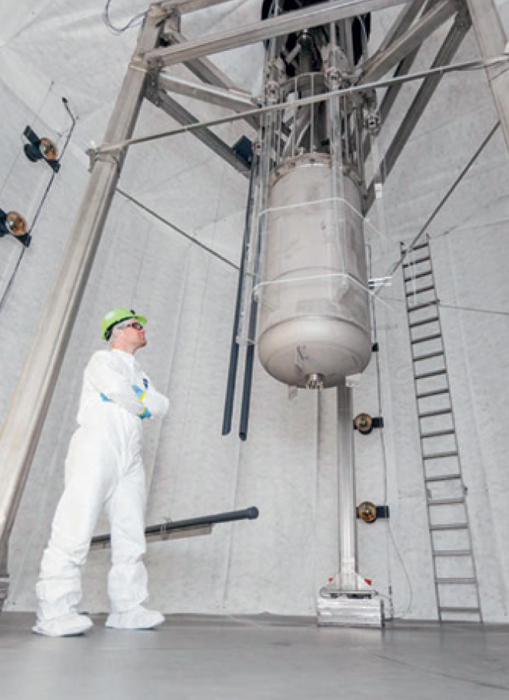
The collaboration that built and runs the Large Underground Xenon (LUX) experiment, operating in the Sanford Underground Research Laboratory, has released its first results in the search for weakly interacting massive particles (WIMPs) – a favoured candidate for dark matter.
The LUX detector holds 370 kg of liquid xenon, with 250 kg actively monitored in a dual-phase (liquid–gas) time-projection chamber measuring 47 cm in diameter and 48 cm in height (cathode-to-gate). If a WIMP strikes a xenon atom it recoils from other xenon atoms and emits photons and electrons. The electrons are drawn upwards by an electrical field and interact with a thin layer of xenon gas at the top of the tank, releasing more photons. Light detectors in the top and bottom of the tank can detect single photons and so the two photon signals – one at the interaction point, the other at the top of the tank – can be pinpointed to within a few millimetres. The energy of the interaction can be measured precisely from the brightness of the signals.
The detector was filled with liquid xenon in February and the first results, for data taken during April to August, represent the analysis of 85.3 live days of data with a fiducial volume of 118 kg. The data are consistent with a background-only hypothesis, allowing 90% confidence limits to be set on spin-independent WIMP–nucleon elastic scattering with a minimum upper limit on the cross-section of 7.6 ×10–46 cm2 at a WIMP mass of 33 GeV/c2. The data are in strong disagreement with low-mass WIMP signal interpretations of the results from several recent direct-detection experiments.
Researchers using NASA’s Chandra X-ray Observatory have found evidence that the normally dim region close to the supermassive black hole at the centre of the Milky Way flared up with at least two luminous outbursts during the past few hundred years. This was deduced from the light echoes of these outbursts on nearby gas clouds.
The motion of the stars at the centre of the Galaxy – which is seen from Earth as the Milky Way – has indicated the existence of a black hole with a mass of about four million times that of the Sun at the position of the radio source Sagittarius A*, or Sgr A* (CERN Courier November 2012 p15). This supermassive black hole is remarkably quiescent with an X-ray luminosity only about 10 orders of magnitude below the emission of active galactic nuclei. To explain such a weak emission, theorists developed a new class of models for which gas accretion onto a black hole would be radiatively inefficient. Nevertheless, despite its low emission, Sgr A* displays some activity in the form of flares. These occur almost daily and last less than about an hour. During a flare, the flux increases by a factor that ranges from a few to about a hundred at most, well below the emission potential of such a massive black hole.
X-ray astronomy began only 50 or so years ago, but there are ways to probe the earlier activity of this apparently dormant giant. One of them is to observe the X-ray emission of gas clouds surrounding the supermassive black hole. An outburst from Sgr A* could be reflected by the clouds towards Earth. The reflected light would then replay the original event with a delay, just as sound echoes reverberate long after the original noise was created. A beautiful example of such a light echo was witnessed around the flaring star V838 Monocerotis (Picture of the Month, CERN CourierJune 2003 p13 and May 2005 p13).
A group of French astrophysicists with colleagues from the US and Germany used the high-resolution images from the Chandra satellite to investigate the past activity of Sgr A*. In data collected from 1999 to 2011, the team – led by Maïca Clavel from the AstroParticle and Cosmology (APC) laboratory in Paris – observed strong variations of the X-ray emission of clouds located near the Galactic centre. The X-ray echoes suggest that Sgr A* would have been at least a million times brighter had it been observed during X-ray outbursts of the past few hundred years.
This is the first time that astronomers have seen both increasing and decreasing X-ray emission in the same structures. Because the change in X rays lasts for only two years in one region and more than 10 years in others, this new study indicates that at least two separate outbursts were responsible for the light echoes observed from Sgr A*. These were likely to have been produced when large clumps of material – possibly from a disrupted star or planet – fell into the black hole. Some of the X rays produced by these episodes would then have produced X-ray fluorescence emission in gas clouds a hundred light years away from the black hole.
This study suggests that the recent quiescence of Sgr A* is only temporary and that the Milky Way’s black hole can flare up whenever enough matter approaches its event horizon. During the past summer, a cloud of gas was observed to have been ripped apart by the tidal forces near Sgr A*. It remains to be seen how much X-ray radiation the accretion of some of this gas might produce in the coming months. A much stronger past activity of the nucleus of the Galaxy is also suggested by the detection by the Fermi Space Telescope of the two huge gamma-ray bubbles blown out on both sides of the Milky Way (CERN Courier January/February 2011 p11).
Mention CESAR today in accelerator circles and the likely reaction will be “Caesar who?” However, the CESAR we are writing about was not a person. It was the CERN Electron Storage and Accumulation Ring – a small machine, just 24 m in circumference, but of decisive importance for the direction in which CERN’s accelerators evolved. To understand why, we have to go far back in CERN’s history, to well before the first beam in the 26 GeV Proton Synchrotron (PS).
In 1956, when components for the PS were starting to be assembled, thoughts were already turning to what should come after. So in 1957, a group was constituted within the PS Division for research on new ideas for high-energy accelerators. An intensive exchange on such ideas ensued between CERN, the US and Novosibirsk (in what was then the USSR). Theoretical studies were supplemented by building prototypes for experimental studies and plans were made for entire model accelerators.
Apart from accelerators with energies well beyond that of the future PS, the concept of colliding beams – where the centre-of-mass energy would be orders of magnitude higher than achievable with beams on stationary targets – was gaining interest. The problem, however, was in obtaining sufficient beam intensity. The novel idea of “beam stacking”, i.e. accumulation of many beam pulses of low intensity into a beam of high intensity, pioneered by a group at the Midwestern University Research Association (MURA) in the US, showed the way to go.
The PS started up brilliantly in November 1959, soon far exceeding its design intensity of 1010 protons per pulse and promising to go much further. That opened the possibility for the PS to be the injector for a proton–proton collider consisting of two synchrotron rings, in which successive PS pulses would be accumulated through beam stacking at 26 GeV, without the need for further acceleration. However, experience with beam stacking needed to be gained and important aspects of the collider rings had to be verified experimentally. To this end, the design of a small strong-focusing synchrotron-type model started in 1960 – and so CESAR was conceived.
As a model, CESAR had to be small – 24 m in circumference – and yet the particles had to be highly relativistic, which meant the use of electrons. On the other hand, effects from synchrotron radiation had to be negligible, which meant low magnetic fields – 130 G (13 mT) in the bending magnets – and a corresponding kinetic energy of 1.75 MeV. The 2 MV van de Graaff generator already ordered for the fixed-field alternating-gradient (FFAG) model that CERN had previously intended to build therefore fitted the bill as injector.
In 1961, the group that had been formed in 1957 was extended to become the Accelerator Research Division. It had groups to design the Intersecting Storage Rings (ISR) and the 300 GeV machine, which was to become the Super Proton Synchrotron. The CESAR group completed both the design of the storage-ring model and the ordering and building of components that had begun in 1960, and prepared for construction in a new experimental hall. Construction, installation of the magnet system and, in particular, the preparation of the vacuum system took place in 1962–1963. During this time, the long-awaited van de Graaff generator arrived. Its conditioning took months, through which loud bangs from spark-overs rang around the hall.
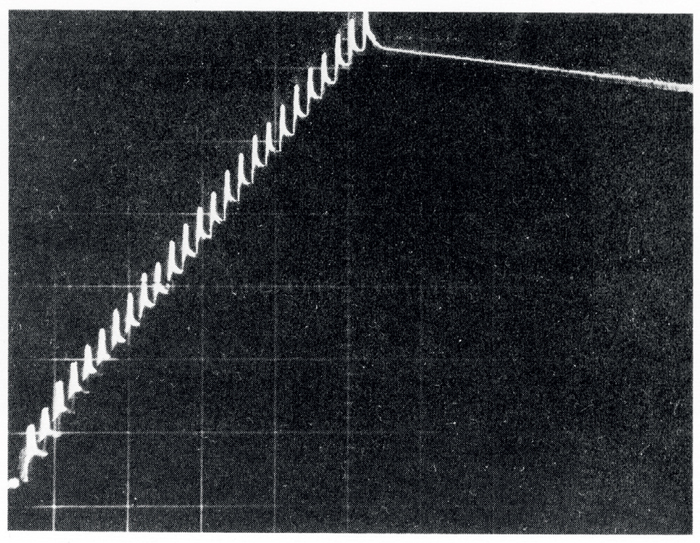
Finally, in summer 1963, the first beam was injected into the completed CESAR (figure 1). However, it would not circulate. To make it do so turned out to be a tedious job. The cause was that the magnetic fields were extremely low – 130 G in the bending magnets and a mere 15 G (1.5 mT) at the poles of the quadrupole magnets – compounded by the fact that the magnets were not laminated but made of massive soft iron. After powering a bending magnet, it took more than a day for its magnetic field to settle down to within 10–4 of its final value. The overhead crane had always to be parked at the end of the hall, as its position influenced the path of the electrons. Jokingly, we even evoked the phase of the Moon! Every power failure was a catastrophe, from which it took days to recover. Nevertheless, we finally made it. Early in the morning of 18 December 1963, the beam circulated.
A challenging experimental and technical programme lay ahead. Foremost, we had to demonstrate RF-capture of the injected beam and beam stacking and measure the stacking efficiencies for various modes of stacking. Of equal importance, we had to prove that a vacuum of 10–9 Torr, as required for the ISR, could be achieved in an extended accelerator system. We also had to measure beam lifetime in terms of number of turns, as an input to the considerations about long-term stability of the ISR beams. Later, there were also studies of the influence of higher-order resonances on emittance and beam lifetime.
Through 1964 and 1965, beam stacking was the dominant topic. Measurements showed that the stacking efficiency depended on various parameters more or less as theory and simulations predicted. Several variants of the stacking process were successfully developed, all with high efficiency and some approaching 100%. The vacuum system reached pressures of 2 × 10⁻⁹ Torr and clearly showed that lower pressures could be achieved. The beam lifetime of about 1 s was consistent with the calculated scattering on the residual gas.
In June 1965, CERN Council approved the ISR Project. CESAR had done its job
By early 1965, we therefore had enough positive results to bolster the conviction that the ISR could achieve sufficiently intense beams with sufficiently long lifetimes. In June 1965, CERN Council approved the ISR Project. CESAR had done its job.
Experiments with CESAR, however, continued until the end of 1967, delivering a host of results that were useful later for the ISR, its vacuum system and its stacking operation. And there was another benefit from CESAR. It was an excellent accelerator school, from which several accelerator physicists emerged to play important roles in CERN’s subsequent projects.
One can muse about the course that CERN’s accelerator history might have taken without CESAR and its results. The ISR would not have been built. Would we then have dared to convert the SPS to a proton–antiproton collider? And without the competence and experience gained with these two colliders, would we have dared to propose the LHC? We opine that CESAR was decisive in setting CERN on the collider course – a course of great success – and that tiny CESAR is actually the great-grandfather of the giant LHC.
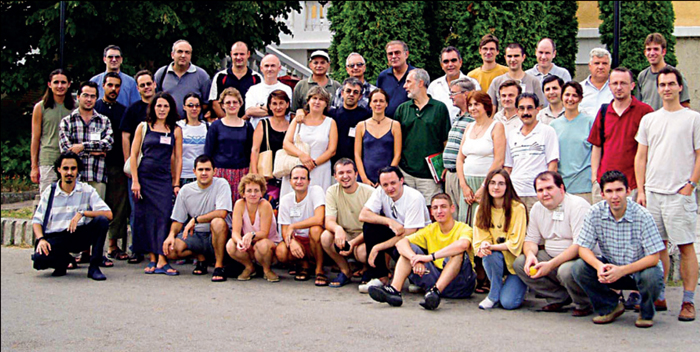
On 29 August 2013, on the ground floor of Building FST01 of the Faculty of Pure and Applied Sciences at the University of Cyprus in Nicosia, 31 students filed silently into the two classrooms of the CERN School of Computing and took a seat in front of a computer. An hour later they were followed by a second wave of 31 students. They were all there to participate in the 12th occasion of a unique CERN initiative – the final examination of its computing school.
The CERN School of Computing (CSC) is one of the three schools that CERN has set up to deliver knowledge in the organization’s main scientific and technical pillars – physics, accelerators and computing. Like its counterparts, the CERN Accelerator School and what is now the European School of High-Energy Physics, each year it attracts several-dozen participants from across the world for a fortnight of activities relating to its main topic.
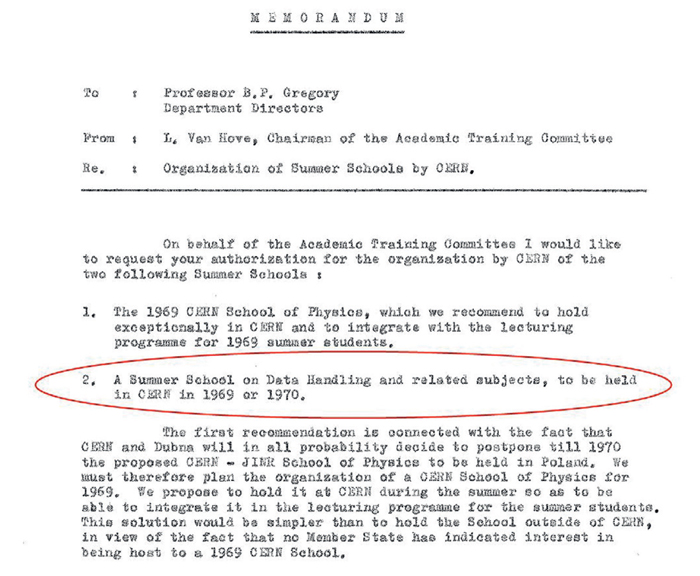
How and why was the CSC set up? On 23 September 1968, future director-general Léon van Hove put forward a proposal to the then director-general, Bernard Gregory, for the creation of a summer school on data handling. This followed a recommendation made on 21 May 1968 to the Academic Training Committee by Ross MacLeod, head of the Data and Documents Division, the forerunner of today’s Information Technology Department. The proposal recommended that a school be organized in summer 1969 or 1970. The memorandum from van Hove to Gregory gave a visionary description of the potential audience for this new school: “It would address a mixed audience of young high-energy physicists and computer scientists.” Forty-five years later, not a word needs to be changed.
The justification for the school was also prophetic: “One of the interests of the Data Handling Summer School lies in the fact that it would be useful not only for high-energy physicists but also for those working in applied mathematics and computing. It would be an excellent opportunity for CERN to strengthen its contacts with a field which may well play a growing role in the long-range future.” With the agreement of Mervyn Hine, director of research, Gregory approved the proposal on 15 November 1968 and on 20 December MacLeod proposed a list of names to van Hove to form the first organizing committee. Alongside people from outside CERN – Bernard Levrat, John Burren and Peter Kirstein – were Tor Bloch, Rudi Böck, Bernard French, Robert Hagedorn, Lew Kowarski, Carlo Rubbia and Paolo Zanella from CERN.
The first CSC was not held at CERN as initially proposed but in Varenna, Italy, in 1970. It was realized quickly that the computing school – with the physics and accelerator schools – could be effective for collaboration between national physics communities and CERN. Until 1986 the CSC was organized every other year, then yearly starting with the school in Troia, Portugal, in 1987. To date there have been 36 schools, attended by 2300 students from five continents.
Ten years ago, I took over the reins of the school and proposed a redefinition of its objectives as it entered its fourth decade: “The school’s main aim is to create and share a common culture in the field of scientific computing, which is a strategic necessity to promote mobility within CERN and between institutes, and to carry out large transnational computing projects. The second aim is the creation of strong social links between participants, students and teachers alike, to reinforce the cohesion of the community and improve the effectiveness of its shared initiatives. The school should be open to computer scientists and physicists and ensure that both groups get to know each other and acquire a solid grounding in whichever of these domains is not their own.”
Moreover, the new management proposed three major changes of direction. First, they vowed to reinvigorate the resolutely academic dimension of the CSC, which during the years had gradually and imperceptibly become more like a conference. Conferences are necessary for scientific progress – they are forums where people can present their work, have their ideas challenged, have fruitful discussions about controversial issues and talk about themselves and what they do. The interventions at conferences are short, sometimes redundant or contradictory. The transmission of facts and opinions becomes more prominent than the transfer of knowledge. I took the view that this should not be the primary role of the CSC, since conferences such as the Computing in High-Energy Physics series serve this purpose perfectly. The academic dimension was therefore progressively re-established through the implementation of three principles.
Three principles
The first academic principle concerns the organization of the teaching. A deliberately limited number of teachers – each giving a series of lessons of several hours – ensures coherence between the different classes, avoids redundancy and delivers consistent content, more than a series of short interventions. Moreover, for several years now all of the non-CERN teachers have been university professors. This is not the result of a strict policy but it is worthy of note that the choice of teachers has been consistent with this academic ambition.
The second principle for restoring the academic dimension concerns the school’s curriculum. The main accent is on the transmission of knowledge and not of know-how. In this way, the CSC differs from training programmes organized by the laboratories and institutes, which are focused on know-how. The difference between knowledge and know-how is an important principle in the field of learning sciences. To get a better understanding of this distinction, the management of the school established relations with experts in the field at an early stage, particularly at the University of Geneva.
Knowledge is made up of fundamental concepts and facts on which additional knowledge is built and developed to persist over time
What are the differences? Knowledge is made up of fundamental concepts and facts on which additional knowledge is built and developed to persist over time. Moreover, the student acquires knowledge, incorporates it into his or her personal knowledge corpus and transforms it. Two physicists never have the same understanding of quantum mechanics. On the other hand, know-how – which includes methods and the use of tools – can generally be acquired autonomously with few prerequisites. With the exception of physical skills – such as knowing how to ride a bike or swim – which we tend not to lose, know-how requires regular practise so that it is not forgotten. Knowledge is more enduring by nature. Finally – and this is one of the main differences – knowledge can be transposed more readily to other environments and adapted to new problems. That at least is the theory. In practice, the differences are sometimes less clear. This is the challenge with which the CSC tries to get to grips each year when defining its programme – are we really operating mainly in the field of knowledge? The school is made up in equal parts of lectures and hands-on sessions, so do the latter not relate more to know-how? Yes, but the acquisition of this know-how is not an end in itself – it provides knowledge with a better anchorage.
The third principle of the academic dimension is evaluation of the knowledge acquired and recognition of the required level of excellence with a certificate. Following requests from students who wanted the high level of knowledge gained during the school to be formally certified, the CSC Diploma was introduced in 2002 to recognize success in the final exam and vouch for the student’s diligence throughout the programme. To date, 671 students have been awarded the CSC Diploma, which often figures prominently in their CVs. But that’s not all. Since 2008, the academic quality of the school, its teachers and exam has been formally audited each year by a different independent university. Each autumn, the school management prepares a file that is aimed at integrating the next school into the academic curriculum of the host university. The universities of Brunel, Copenhagen, Gjøvik, Göttingen, Nicosia and Uppsala have analysed and accepted CERN’s request. As a result, they have each awarded a formal European Credit Transfer System (ECTS) certificate to complement the CERN diploma.
This academic reorientation of the school is one of the three main renewal projects undertaken during the past 10 years. The second relates to the school’s social dimension. The creation of social links and networks between the participants and with their teachers has become the school’s second aim. This is considered to be a strategic objective because not only does it reinforce the cohesion of the community, it also improves the efficiency of large projects or services, such as the Worldwide LHC Computing Grid, through improved mutual understanding between the individuals contributing to them.
The main vehicle chosen for socialization is sport. Every afternoon, a large part of the timetable is freed up for a dozen indoor and outdoor sports. Tennis, climbing or swimming lessons are given, often by the school’s teachers. Each year, participants discover an activity that is new to them, such as horse riding, sailing, canoeing, kayaking, scuba diving, rock climbing, cricket and mountain biking. The sport programme is supported by the CERN Medical Service and is associated with the “Move! Eat better” initiative. A second vehicle for socialization – music – is being considered and could be introduced for future schools. The intention is to give those who are interested the opportunity each afternoon to take part in instrumental music or choral singing or to discover them for the first time, with the same aim as for sport of “doing things together to get to know each other better”.
The third renewal project is plurality. In contrast to CERN’s high-energy physics and accelerator schools, which have organized several annual events for a number of years, the CSC has long remained the organization’s only school in the field of computing. However, since 2005 the CSC management has organized the inverted CSC (iCSC, “Where students turn into teachers”) and starting in 2013 the thematic CSC (tCSC). The idea behind the inverted school is simple – to capitalize on the considerable amount of knowledge accumulated by the participants in a school by inviting them to teach one or more lessons at a short school of three to five half-days, organized at CERN at the mid-point between two summer schools. To date, 40 former students have taught at one of these inverted schools.
It should be noted that the academic principle is still predominant. The goal is not to talk about oneself or one’s project but to present a topic, an innovative one if possible. This is not always easy, so each young teacher who is selected is assigned a mentor who follows the design and production of the lesson across three months. The inverted school has another aim – it is also a school for learning to teach. It represents the second link in a chain of training stages for new teachers for the main school. The first link, for those who are interested, is to give a short academic presentation while attending the main school. After the iCSC, i.e. the second link, some are invited to give an hour’s lesson at the main school before the last stage – their full integration into the teaching staff. This process generally takes several years.
During the latest CSC in Nicosia, five out of the 11 teachers were younger than 35. Three of them had passed through the CSC training chain. Along with their forthcoming colleagues, they are the future of the school. Leaving the CSC after 11 years as its director, I am confident that the next generation is ready to take up the baton.
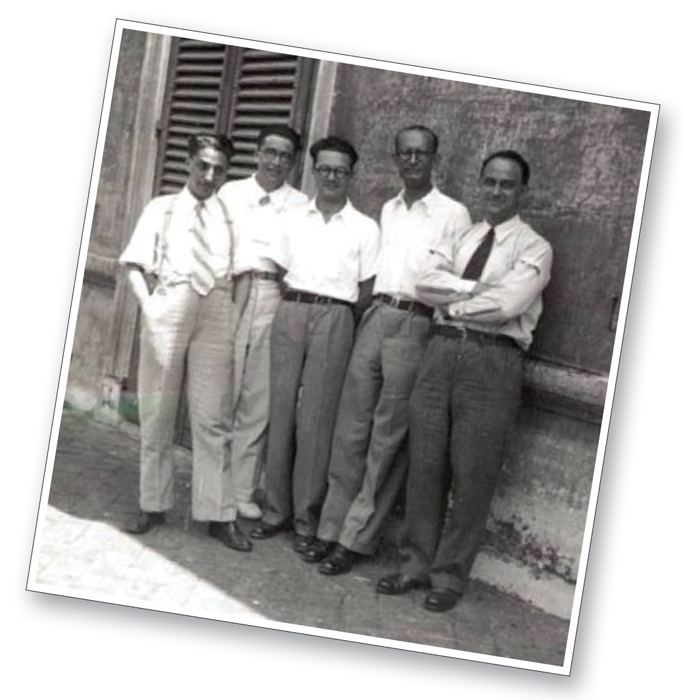
Bruno Pontecorvo (1913–1993) was born in Pisa but his scientific life began in Rome, when he was accepted into the group of physicists working at Sapienza University of Roma with Enrico Fermi. It was a small but exceptional group of young people attracted by the strong personality of Fermi, who were later known as “the boys of Via Panisperna” from the name of the street where the physics institute was located at that time. Pontecorvo arrived in Rome in time to participate in the discovery of radioactivity induced by slow neutrons, for which Fermi was to receive the Nobel Prize in Physics in 1938. A famous picture shows the group at the time of the discovery, with the notable absence of Bruno (figure 1). This was for good reason – he was behind the camera, taking the picture.
On 11–12 September 2013, Sapienza University of Rome celebrated Pontecorvo’s centenary with an international scientific symposium – The Legacy of Bruno Pontecorvo: the Man and the Scientist. (Another was held later in Pisa.) Inaugurated in the presence of the president of the republic, Giorgio Napolitano (figure 2), it was attended by distinguished physicists from Italy and other European countries, as well as Japan, Russia, the US and CERN. The talks revisited different sides of Pontecorvo’s long and multifaceted scientific life, which was marked by his lucid and deep passion for science and his important contributions to several branches of nuclear and particle physics.
It was a life sharply divided in two parts by his sudden move to the Soviet Union in the summer of 1950, when he went from England via Italy and Sweden, to reappear five years later in Dubna as part of the Soviet scientific establishment. Presenting an historical perspective of Pontecorvo’s life, Frank Close spoke of “a life of two halves”. One could add a third life – the one lived during the decline and dissolution of the Soviet system, with periodic visits to Italy and disenchantment in the 1980s, which are well described in a book by Miriam Mafai, Il lungo freddo (The Long Cold), published in 1990.
Jack Steinberger opened the meeting by speaking about when he was a student of Fermi and Pontecorvo came to Chicago from Canada to visit his old mentor. Pontecorvo had discovered that the capture of the muon by nuclei, measured by Marcello Conversi, Ettore Pancini and Oreste Piccioni in Rome, was consistent with having the same strength as electron capture – that is, that the muon and the electron, besides having the same electric charge, share the same coupling in the weak interaction. It was the start of the lepton family and the universality of the weak interaction, which would eventually evolve into the long story of electroweak unification. Steinberger was doing his thesis with Fermi on muon decay, which led him to discover the continuum character of the electron’s spectrum, entirely analogous to nuclear beta decay.
Pontecorvo’s research during his Canadian period was presented by Giuseppe Fidecaro, who delved into the development of the radiochemical method to detect neutrinos – later applied by Raymond Davis to detect solar neutrinos. Luigi Di Lella described the studies by Pontecorvo and Ted Hincks on muon decay, including the search for the decay μ → e γ – a long saga, which also saw Steinberger as a protagonist and which continues today with the MEG experiment at PSI. Di Lella ended with the ideas that Pontecorvo developed in Dubna on high-energy neutrino interactions, somehow anticipating the independent line of research carried out at Brookhaven by Leon Lederman, Melvin Schwarz and Steinberger, which eventually led to the discovery of the two kinds of neutrino in 1962 and the award of the Nobel prize in 1988.
An important part of the conference was dedicated to neutrino oscillations – Pontecorvo’s other great intuition – with an update on solar and atmospheric neutrino oscillations by Till Kirsten and Yoichiro Suzuki, respectively. An overall view was given by Samoil Bilenky from Dubna, who was a collaborator and friend of Pontecorvo for a long time.
In Dubna, Pontecorvo became the reference figure for many Russian physicists and also for the physicists from Western Europe and CERN who visited countries in the East (figure 3). Ettore Fiorini brought his recollections of Pontecorvo at the Balaton School, in Hungary, at the time of the discovery of neutral currents, while Ugo Amaldi spoke of his relations with Pontecorvo at Dubna, when the Russian participation in the DELPHI experiment at the Large-Electron Positron collider was taking shape.
Two historical talks gave an idea of the depth of Bruno Pontecorvo’s personality.
Nadia Robotti documented the path of Pontecorvo in the Panisperna group. From his initial position as the youngest and most inexperienced member of the group – he was called “the cub” – he went on to become in few years a respected researcher, signing one publication with Fermi and Rasetti alone, and owner of part of the slow-neutron technologies. Later, when the group in Rome started to split up, Pontecorvo moved independently from Fermi to find a position in Paris, in the laboratory of Frédéric Joliot and Irène Curie, where he arrived in spring 1936 as a fully formed and independent investigator in the most advanced fields of nuclear physics.
Precious testimony
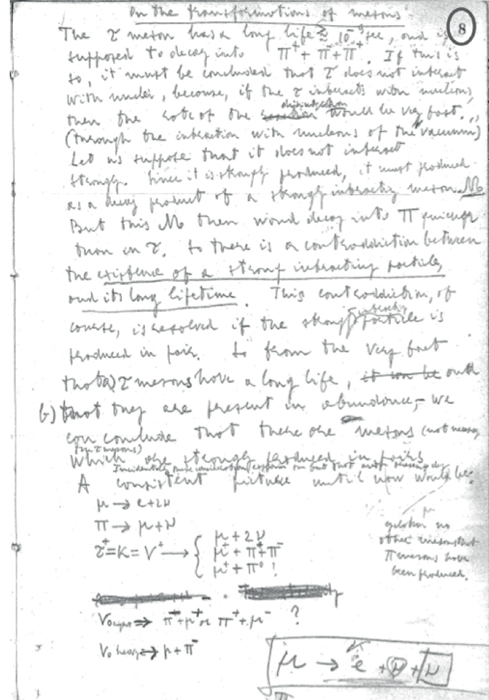
In a second historical talk, Rino Castaldi brought a precious testimony from when Pontecorvo arrived in Dubna. It was a hand-written log book begun on 1 November 1950, which Gloria Spandre and Elena Volterrani obtained from Pontecorvo’s eldest son, Gil. Page after page, written in minute but precise writing with remarkably few cancellations, reconstruct a picture of Pontecorvo building up his future activity in particle physics in the new laboratory where he had chosen to spend his life. From issues in the life of an experimental physicist and ideas about new experiments, through glimpses about his thoughts on the mysterious strongly produced but long-lived particles (the strange particles), to a tantalizing formula for muon beta decay, with one neutrino encircled and the other in a box (figure 4) – could this be a hint that the two neutrinos might be different? We can leave the answer to Pontecorvo himself. Much later, he described his earlier activity on the weak interaction in a contribution to the International Colloquium on Particle Physics in Paris in July 1982:
“I have to come back a long way (1947–1950). Several groups, among which J Steinberger, E Hincks and I, and others were investigating the (cosmic) muon decay. The result of the investigations was that the decaying muon emits 3 particles: one electron…and two neutral particles, which were called by various people in different ways: two neutrinos, neutrino and neutretto, ν and ν´, etc. I am saying this to make clear that for people working on muons in the old times, the question about different types of neutrinos has always been present…for people like Bernardini, Steinberger, Hincks and me…the two neutrino question was never forgotten.”
The centenary symposium took place in the Aula Magna of Sapienza University in Rome, where Fermi worked from 1935 to 1938, the year of his departure to Stockholm (for the Nobel prize) and then to the US. Organized with efficiency by the indefatigable Carlo Dionisi, professor of physics at Sapienza, it was an occasion for the larger Pontecorvo family – the Italian and Russian branches – to gather, cheer and greet friends and colleagues.
From 1945 to 1990, the development of scientific educational and research capacities in physics in the Balkans followed the political and economic courses of the relevant countries. Yugoslavia and the six republics in its federation developed ties – to a greater or lesser extent – with both the East and the West, while Romania and Bulgaria became well integrated into the scientific system of the Soviet Union and the Eastern Bloc. In these countries and in the entire Balkans, the period was marked by a significant increase in the number of scientists – primarily in the field of physics – and scientific publications. There was also a substantial rise in the level of university education and scientific infrastructure, which had been lower before the Second World War or limited to a small number of exceptional yet isolated individuals or smaller institutions. Greece and Turkey were connected mainly to the US or Western Europe, while Albania was in self-imposed isolation for much of this period.
The years following 1990 brought significant changes, which were particularly dramatic and negative for the countries that were created after the break-up of Yugoslavia. The wars waged on the territory of the former Socialist Federal Republic of Yugoslavia and enormous economic problems resulted in the devastation of scientific capacities, the leaving of mainly young physicists and the stopping of many programmes and once-traditional scientific meetings – in particular the world-renowned “Adriatic meetings”. Less dramatic but more significant changes took place in Bulgaria, Romania and even Moldavia and the Ukraine – countries on the periphery of the Balkans but in the same neighbourhood. The number and quality of students graduating in physics, as well as financial investment in all forms of scientific educational work, plummeted. The number of researchers and PhD students, in particular, dropped so significantly in the majority of university centres that the critical mass necessary for teaching at graduate level as well as for teamwork and competitiveness was lost. The remaining young research groups and students – some only 100 km apart – had no form of communication, exchange or co-operation. European integration – if it began at all – proceeded slowly, while many previously established ties were severed.
Wess and WIGV
The origins of the Southeastern European Network in Mathematical and Theoretical Physics (SEENET-MTP) are linked to Julius Wess and his initiative “Wissenschaftler in globaler Verantwortung” (WIGV) – “Scientists in global responsibility” – launched in 1999 (Möller 2012). Wess was professor at the Ludwig Maximilian University (LMU) of Munich and director of the Max Planck Institute (MPI) for Physics in Munich. Like most people in Europe, he deplored the Yugoslav Wars of the 1990s and this eventually turned into a resolve to engage hands-on in re-establishing scientific co-operation with the scientists of former Yugoslavia during the “Triangle meeting” in Zagreb in 1999. Wess collected information about the remaining links between scientists in the new countries of the former Yugoslavia and the rest of the world, and especially between the former Yugoslav countries. He also found out about the institutional and economic situation of the universities and institutes.
The first network meeting of WIGV was organized in Maribor, Slovenia, in May 2000
The first network meeting of WIGV was organized in Maribor, Slovenia, in May 2000. It was followed by activities such as the Eighth Adriatic Meeting in Dubrovnik, Croatia, and the First German-Serbian School in Modern Mathematical Physics in Soko Banja, Serbia, in 2001. Three postdoc positions and many short-term fellowships were established in Munich, supported by the German Academic Exchange Service (DAAD), the German Research Foundation (DFG) and the Federal Ministry of Education and Research (BMBF). The biggest and, in a sense, the most important action was the Scientific Information Network for South East Europe (SINSEE/SINYU) project to establish new high-speed fibre capacity across large distances, especially for the scientific community, with SINYU covering the region of the former Yugoslavia.
Unfortunately, between the summers of 2002 and 2003 the WIGV initiative lost its momentum. Many of the financial ad-hoc instruments created for the region ended during this time. Wess also needed to pause because of serious health problems in 2003. However, between October 2000 and December 2002 the idea of a “southeastern European” rather than “Yugoslav” network in mathematical and theoretical physics emerged and evolved in discussions between Wess, myself and other colleagues who visited Munich or took part in numerous meetings supported by WIGV.
Our impression was that a critical mass of students and researchers in the region of the former Yugoslavia could not be achieved and that a larger context should be attempted – the Balkans. In addition to the former Yugoslavia, this would include Bulgaria, Greece, Romania, Turkey, etc. We hoped that this kind of approach would have a political as well as scientific dimension, alongside other benefits. Agreement was quickly reached and the name Southeastern European Network in Mathematical and Theoretical Physics (SEENET-MTP) was created. With the personal recommendations of Wess, I visited CERN, the International Centre for Theoretical Physics (ICTP), the UNESCO headquarters in Paris and the UNESCO Venice office to promote the idea. In the course of discussions, the foundations were laid for support for the future network.
The SEENET-MTP Network
The founding meeting of the network was set up as a workshop – the Balkan Workshop (BW2003) on Mathematical, Theoretical and Phenomenological Challenges Beyond the Standard Model, with Perspectives of Balkans collaboration – that was held as a satellite meeting of the Fifth General Conference of the Balkan Physical Union, in Vrnjačka Banja, Serbia, in August 2003. This made it possible to have a regional meeting, with representatives from nearly all of the relevant countries present. Unlike the First German–Serbian School and some other actions, Germany’s contribution to the budget of BW2003 was no more than a third. The organization of the workshop was not without some controversy. It was a difficult but important lesson in the writing of applications for funding, proposals for projects and their implementation. The meeting, which had excellent lecturers, ended with the ratification of a letter of intent, followed by the election of myself as co-ordinator of the Network and Wess as co-ordinator of the Scientific-Advisory Committee (SAC) for the network (Djordjević 2012).
The most complex meeting of the network was the Balkan Summer Institute (BSI2011) with 180 participants and four associated events
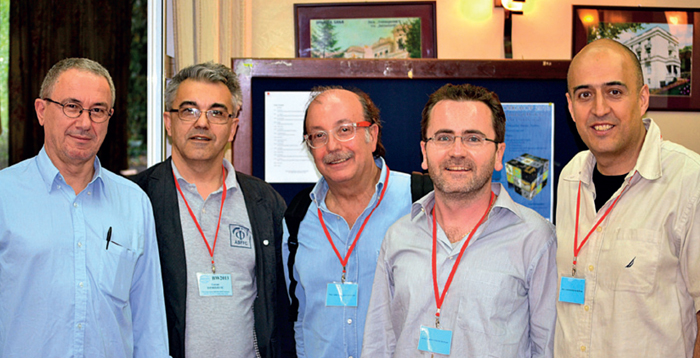
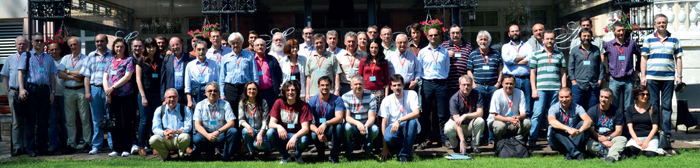
While singling out the role of individuals might seem disproportionate, it is a pleasure to underline the role of Boyka Aneva in motivating colleagues from Sofia, Mihai Visinescu for those from Romania, Goran Senjanović of ICTP for his service as co-ordinator of the Network SAC (2008–2013) and the first and the current presidents of the Representative Committee of the SEENET-MTP Network, Radu Constantinescu of Craiova (2009–2013) and Dumitru Vulcanov of Timisoara, respectively. Starting in 2003 with 40 members and three nodes in Niš, Sofia and Bucharest, the network has grown steadily to its current size, now covering almost all of the countries in the Southeastern European region plus Ukraine. The Balkan Workshops series is an important part of the SEENET-MTP programme (see box). The most complex meeting of the network was the Balkan Summer Institute (BSI2011) with 180 participants and four associated events.
The main goals of the network and its activities and results can be summarized as follows.
• To organize scientific and research activities in the region and the improvement of interregional collaboration through networking, the organization of scientific events and mobility programmes. The network has organized 15 scientific meetings (schools and workshops) and supported an additional 10 events. Around 1000 researchers and students have taken part in these meetings. Through UNESCO projects, followed by the ICTP project “Cosmology and Strings” PRJ-09, there have been more than 200 researcher and student exchanges in the region, about 150 seminars and 100 joint scientific papers. In co-operation with leading publishers both in the region and the rest of the world, the network has published numerous proceedings, topical journal issues and two monographs. It has also implemented 15 projects, mainly supported by UNESCO, ICTP and German foundations.
• To promote the exchange of students and encourage communication between gifted pupils motivated towards natural sciences and their high schools. Three meetings and contests in the “Science and society” framework have been organized in Romania with 100 high-school pupils and undergraduate students. The network was a permanent supporter and driving force in establishing and supporting the first class for gifted high-school pupils in Niš, Serbia, and its networking with similar programmes.
• To create a database as the foundation for an up-to-date overview of results obtained by different research organizations and, through this, the institutional capacity-building in physics and mathematics. The SEENET-MTP office in Niš, established in 2009, in co-operation with the University of Craiova and UNESCO Venice office, set up the project “Map of Excellence in Physics and Mathematics in SEE – the SEE MP e-Survey Project”. It has collected a full set of data on 40 leading institutions in physics and mathematics in seven Balkan countries.
BW2013: 10 years of the network
This year’s Balkan workshop – BW2013 Beyond the Standard Models – was held on 25–29 April in Vrnjačka Banja, Serbia, just like the first one. The meeting also provided an opportunity to mark 10 years of the network, which now consists of 20 institutions from 11 countries in the region and has 14 partner institutions and more than 350 individual members from around the world. It was organized by the Faculty of Science and Mathematics and SEENET-MTP office, Niš, in co-operation with the CERN Theory Group, the International School for Advanced Studies (SISSA) and ICTP, with the Physical Society Niš as local co-organizer.
The workshop offered a platform for discussions on three topics: beyond the Standard Model, everyday practice in particle physics and cosmology, and regional and interregional co-operation in science and education. The first two days were devoted to purely scientific problems, including new trends in particle and astroparticle physics: theory and phenomenology, cosmology (classical and quantum, inflation, dark matter and dark energy), quantum gravity and extra dimensions, strings, and non-commutative and non-archimedean quantum models. It was an opportunity to gather together leading experts in physics and students from the EU and Eastern Europe to discuss these topics. The third day was organized as a series of round tables on building sustainable knowledge-based societies, with a few invited lecturers and moderators from the Central European Initiative (CEI), UNESCO, the European Physical Society (EPS) etc.
In total, 78 participants from 25 countries came to the events. Around 30 invited scientific talks, 15 panel presentations and several posters were presented. The EPS president John Dudley, EPS-CEI chair Goran Djordjević and former EPS presidents Macie Kolwas and Norbert Kroó were among the panellists. Mario Scalet (UNESCO Venice), Fernando Quevedo (ICTP), Luis Álvarez-Gaume, Ignatios Antoniadis and John Ellis (CERN), Alexei Morozov (ITEP, Moscow), Guido Martinelli (SISSA), Radomir Žikić (Ministry of Education and Science, Serbia) and others contributed greatly to the overall discussion and decisions made towards new projects. Dejan Stojković (SUNY at Buffalo) was unable to attend but has contributed a great deal as lecturer, adviser and guest editor in many network activities. Under the aegis and with the support of the EPS, the first meeting of the EPS Committee of European Integration (EPS-CEI) took place during the workshop and the first ad-hoc consortium based on the SEENET-MTP experience for future EU projects established.
SEENET-MTP: main network meetings
• BW2003 Workshop, Vrnjačka Banja, Serbia
• BW2005 Workshop, Vrnjačka Banja, Serbia
• MMP2006 School, Sofia, Bulgaria
• BW2007 Workshop, Kladovo, Serbia
• MMP2008 School, Varna, Bulgaria
• SSSCP2009 School, Belgrade-Niš, Serbia
• EBES2010 Conference, Niš, Serbia
• QFTHS2010 School and Workshop, Calimanesti, Romania
• BSI2011 Summer Institute, Donji Milanovac, Serbia
• QFTHS2012 School and Workshop, Craiova, Romania
• BW2013 Workshop, Vrnjačka Banja, Serbia
Despite the unexpected success of the SEENET-MTP initiative, its future faces challenges: to provide a mid-term and long-term financial base through EU funds, to prove its ability to contribute to current main lines of research, to extend the meeting’s activities from Bulgaria, Romania and Serbia and to other countries in the network, to organize a more self-connected and permanent training programme through topical one-week seminars for masters and PhD students in its nodes and, possibly in the future, joint masters or PhD programmes.
SEENET-MTP and physicists in the SEE region still need a partnership with leading institutions, organizations and individuals, primarily from Europe. In addition to LMU/MPI, the role of which was crucial in the period 2000–2009, and the long-term partners UNESCO and ICTP, the most promising supporters should be EPS, SISSA and CEI, as well as the most supportive one in the past few years – CERN and its Theory Group.
To provide the best experiences, we use technologies like cookies to store and/or access device information. Consenting to these technologies will allow us to process data such as browsing behavior or unique IDs on this site. Not consenting or withdrawing consent, may adversely affect certain features and functions.
Functional
Always active
The technical storage or access is strictly necessary for the legitimate purpose of enabling the use of a specific service explicitly requested by the subscriber or user, or for the sole purpose of carrying out the transmission of a communication over an electronic communications network.
Preferences
The technical storage or access is necessary for the legitimate purpose of storing preferences that are not requested by the subscriber or user.
Statistics
The technical storage or access that is used exclusively for statistical purposes.The technical storage or access that is used exclusively for anonymous statistical purposes. Without a subpoena, voluntary compliance on the part of your Internet Service Provider, or additional records from a third party, information stored or retrieved for this purpose alone cannot usually be used to identify you.
Marketing
The technical storage or access is required to create user profiles to send advertising, or to track the user on a website or across several websites for similar marketing purposes.