Anyone trying to apply the solid knowledge of quantum field theory to actual LHC physics – in particular to the Higgs sector and certain regimes of QCD – inevitably meets an intricate maze of phenomenological know-how, common lore and intuition, often historically grown, about what works and what does not. These lectures are intended to be a brief but sufficiently detailed primer on LHC physics that will enable graduate students and any newcomer to the field to find their way through the more advanced literature, as well as helping them to start work in this timely and exciting field of research.
Following a resolution unanimously adopted at the 169th session of the CERN Council on 12 December, CERN is set to admit Israel as the organization’s 21st member state. Israeli membership will be effective from the date on which Israel formally notifies UNESCO that it has ratified the CERN Convention. CERN was established under the auspices of UNESCO, and UNESCO remains the depository of the CERN Convention. Israeli has been an associate member of CERN since 2011.
Israel’s formal association with CERN began in 1991, when the country was granted observer status by Council in recognition of the major involvement of Israeli institutions in the OPAL experiment at the Large Electron–Positron collider, accompanied by contributions to the running of the accelerator. Today, Israel is involved with the ATLAS experiment at the LHC and the ALPHA and COMPASS experiments, as well as experiments at the ISOLDE facility. In addition, Israel contributes to the LHC and to the CLIC accelerator design study, and operates a tier-2 centre of the Worldwide LHC Computing Grid. Israel also supports the involvement of Palestinian students at CERN.
Israel’s forthcoming membership of CERN follows a decision taken by Council in 2010 to enlarge the organization’s membership. At the same time, Council established the status of associate membership for countries wishing to have limited participation in CERN’s programme, accompanied by limited benefits of membership. All new applicants for full membership must pass through a period of at least two years as an associate member before Council takes a decision on full membership. A country can also apply for associate membership in its own right.
Following this decision, Israel became CERN’s first associate member in 2011, followed by Serbia in 2012. Cyprus and Ukraine will become associate members as soon as their national parliaments ratify the accession agreements. Discussions are still underway with Slovenia regarding membership, and with Brazil, Pakistan, Russia and Turkey, all of which have applied for associate membership. Romania has the status of candidate for accession, having applied for full membership before the new procedures came into effect.
On 29 September, it will be 60 years since CERN – the European Organization for Nuclear Research – came into being as the first scientific pan-European endeavour. Just a few years after the Second World War, 12 European countries joined forces and built what has become the world’s largest particle-physics laboratory. To mark the anniversary, this year CERN will celebrate 60 years of cutting-edge science for peace. In this issue, CERN’s current director-general writes how the organization has fulfilled the vision of its founders to provide for collaboration among European states in pure and fundamental scientific research “with no concern for military requirements” (Viewpoint: A celebration of science for peace). Celebratory events will take place throughout the year in the member states – now numbering 21 – and at CERN. In particular, at the beginning of July a joint event with UNESCO in Paris will mark the anniversary of the initial signing, in 1953, of the convention that was to establish the organization under the auspices of UNESCO a year later. On 29 September, an event at CERN attended by high-level representatives from all of the member states will celebrate – 60 years to the day – the official birth of the organization in 1954.
• For more about 60 years of CERN in this and future issues of CERN Courier, look out for the logo!
The IceCube collaboration has reported evidence, at the 4σ level, for a diffuse (i.e. isotropic) flux of high-energy extra-terrestrial neutrinos, mostly above 60 TeV (Aartsen et al. 2013). Using two years of data, the analysis selected 28 events – including the two events previously reported with energies above 1 PeV. This is substantially above the background estimate of 12.1 events.
In the energy range 60 TeV to 2 PeV, the data are well described by a neutrino energy spectrum that varies as E–2, with a flux Eν2φ <1.2±0.4 × 10⁻⁸ GeV cm–2 s–1 sr–1. This is near the Waxman–Bahcall bound – the flux expected if cosmic-ray nuclei undergoing acceleration interact strongly in their sources and transfer most of their energy to secondary particles (mainly π± and K±) whose decays produce neutrinos. For an E–2 spectrum, the data indicate that there must be a cut-off at a few peta-electron-volts, otherwise more energetic events would have been seen. Alternatively, the energy spectrum might be somewhat softer: an E–2.2 spectrum fits the data well.
The analysis combined multiple techniques to isolate the 28 events from a much larger background of downward-going cosmic-ray muons and atmospheric neutrinos. The event selection was simple. It involved choosing events that originated within the detector and produced more than 6000 observed photoelectrons. The origination criteria used the outer portion of the detector as a veto, therefore removing events with early light, which could be from entering tracks. The analysis estimated the muon backgrounds using two independent, nested veto regions around a smaller fiducial volume. Events tagged in the outer veto that missed the inner veto were used to determine the veto-miss fraction. The veto also eliminated energetic, downward-going atmospheric neutrinos, which should be accompanied by a cosmic-ray air shower with energetic muons that should trigger the veto.
The selection criteria were largely insensitive to the event topology, so the analysis selected νe, νμ and ντ interactions, providing they occurred inside the detector. The events fall into two classes: long tracks (muons) from νμ charged-current interactions, plus cascades, electromagnetic or hadronic showers from νe and most ντ charged-current interactions, and neutral-current interactions of any flavour. Most of the events that IceCube sees are atmospheric νμ charged-current interactions, but the requirement that the events originate within the detector, depositing 6000 photoelectrons, changes the fraction. Of the 28 events found, only seven are classed as track-like. While this is consistent with the 1:1:1 ratio of νe:νμ:ντ, it is a lower fraction of tracks than expected for atmospheric neutrinos, which are mostly νμ.
Figure 1(a) shows the deposited energy for the 28 events, together with the expected backgrounds for muons, conventional atmospheric neutrinos and prompt atmospheric neutrinos from the decay of charmed particles. The atmospheric neutrino fluxes include the effect of the downward-going veto. There is a substantial uncertainty for the prompt flux, which has not yet been observed – the range is based on theoretical estimates, with upper limits from previous IceCube studies. Although the two 1 PeV neutrinos are prominent, the signal rises above the background at energies above 60 TeV. The black line shows the best fit to an E–2 astrophysical signal.
Figure 1(b) compares the zenith angle distribution of the data with the same background estimates. The muon background is entirely downward-going, while the atmospheric neutrino background is largely upward-going, owing to a combination of the downward-going veto and the absorption of high-energy neutrinos in the Earth. An isotropic extra-terrestrial signal would also be mostly downward-going because of this absorption. Of the 28 selected events, 24 are downward-going, which is more than expected from the background plus the astrophysical component from the fit. The excess is about 1.5σ. The angular agreement for a purely atmospheric neutrino flux is even worse.
This analysis shows that cosmic accelerators emit a significant fraction of their energies as neutrinos. The collaboration has also studied the arrival directions of the events, but observes no significant clusters. However, follow-up studies should further characterize the radiation and pin down its source. Already, some tantalizing hints have been presented at the 2013 International Cosmic Ray Conference.
Breakthrough of the Year
The first observations of high-energy cosmic neutrinos by IceCube was named 2013 Breakthrough of the Year by Physics World and also featured in Wired’s list of top scientific discoveries of 2013. Physics World highly commended nine other achievements, including the discovery of pear-shaped nuclei at CERN’s ISOLDE facility, the Planck space telescope’s most precise determination ever of the cosmic microwave background radiation and the South Pole Telescope’s measurement of B-mode polarization in the radiation. Wired also listed the dark-matter results from the LUX experiment.
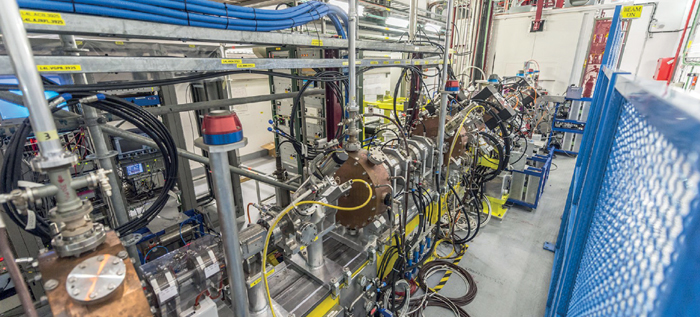
On 14 November, a beam of negative hydrogen ions was successfully accelerated for the first time to 3 MeV in Linac4. This marked the start of a two-year commissioning phase for the new linear accelerator that will replace Linac2 as the low-energy injector in CERN’s accelerator complex. When this chain of accelerators that ultimately serves the LHC is in operation, the negative hydrogen ions will be stripped of their two electrons and converted into protons at injection into the Proton Synchrotron Booster.
In the first months of 2013, the Linac4 collaboration commissioned the radio-frequency quadrupole (RFQ) at a dedicated test stand. The 1.5-tonne RFQ, constructed completely at CERN, sits at the start of the Linac4 beam line and takes the beam from 45 keV to 3 MeV in just 3 m.
During the summer, the team moved the RFQ, the medium-energy beam transport (MEBT) line and the diagnostic line to their final location in the Linac4 tunnel. In parallel, a new negative-hydrogen-ion source was assembled, installed and successfully commissioned in the tunnel. After a short RF commissioning period, the beam was accelerated to 3 MeV and transported to the beam dump at the end of the diagnostic line.
By the end of 2013 – only a few months into installation – most of the Linac4 infrastructure was in place. Not only have the RFQ and MEBT, with its fast beam chopper, been placed in their final locations, the majority of the RF klystrons on the surface have also been installed. In parallel, a second-generation negative-hydrogen-ion source has been commissioned on the test stand, delivering a beam in excess of 50 mA just before the end of the year.
Once commissioning to 3 MeV is completed in February, three more RF accelerating sections will be installed progressively to take the ion beam to its final energy. Drift tube linacs (DTL) will take the beam to 50 MeV; cell-coupled DTLs will take it to 100 MeV; and, finally, pi-mode accelerating structures will take it up to 160 MeV.
Last year, the ATLAS and CMS collaborations confirmed that the new boson found in 2012 was indeed a Higgs boson with a mass around 125 GeV. The discovery relied on the observation of decays to pairs of bosons, namely photons, Ws and Zs – the carriers of the electromagnetic and weak forces – and provided strong support for the idea that the Brout–Englert–Higgs mechanism is responsible for the mass of the W and Z bosons, while leaving the photon massless. Now, with the full LHC data sets from 2011 and 2012, the two collaborations have turned their attention to testing whether the Higgs field also gives mass to fermions, i.e. quarks and leptons.
The CMS collaboration announced its first results on the coupling of the recently discovered Higgs boson to fermion pairs at the Rencontres de Moriond conference, in March 2013. At the time, the search for the Higgs-boson decays to b b and τ+τ– had yielded evidence with a combined significance of 3.4σ for the Higgs coupling to third-generation fermions.
Now, the updated search for decays to τ+τ–, based on an improved analysis of 4.9 fb−1 of LHC data collected at a collision energy of 7 TeV in 2011 and 19.7 fb−1 collected at 8 TeV in 2012, has revealed a 3.4σ excess at the mass of the Higgs boson in this channel alone. Taken together with the 2.1σ excess found in the earlier searches by CMS for b decays, this gives a combined significance of 4.0σ for the two channels, compared with an expectation of 4.2σ for a Standard Model Higgs boson. The observed rate for Higgs production with subsequent decay into b quarks or τ leptons divided by the expected rate for a Standard Model Higgs gives the ratio μ = 0.90±0.26, which suggests that the particle does indeed behave like a Standard Model Higgs boson.
By contrast, the search for decays of the Higgs boson to μ+μ– yields no signal, just as expected from the fact that the μ has nearly 17 times less mass than the τ, making the decays of the Higgs to μ+μ– some 290 times less frequent than those to τ+τ–. Likewise, the search for the Higgs-boson decay into a pair of electrons – which should be even more rare, given that the electron is 200 times lighter than the muon – returned empty handed. From this, it can be inferred that the couplings of the Higgs boson to leptons of different generations are not universal, in contrast to, for example, the couplings of the Z bosons, which do not distinguish between lepton flavours.
These measurements used the full capabilities of the CMS experiment, combining information from all of the detector’s components to reconstruct and measure the energy of each individual particle emerging from the proton–proton collision, via a “particle flow” algorithm. This technique allows τ decays to be identified efficiently, while rejecting the background from “jets” of particles originating from quarks and gluons. The precise charged-particle tracking of CMS helps identify jets coming from b quarks. In the case of Higgs-boson decays to τ+τ–, the data have a strong peak at a τ+τ– mass corresponding to that of the Z boson, which is produced much more copiously than Higgs bosons. The analysis was developed and optimized in a “blinded” way, i.e. not looking at the signal in the data, to avoid introducing a bias.
By carefully measuring and controlling this background, a clear signal from Higgs decays remains after subtracting the background (figure 1).
Armed with an array of techniques and decay modes with which to study the Higgs boson, CMS will continue to measure its properties ever more precisely – using present and future data – and to search for additional new particles, including possible cousins of the Higgs boson.
The ATLAS collaboration presented its first results on fermionic decays of the Higgs boson using the full 2012 data set in the di-muon and b b decay channels at the winter and summer conferences in 2013, respectively. However, the results did not yet establish the fermionic decays expected from a Standard Model Higgs boson. ATLAS has now found strong evidence for Higgs decays to fermions, using 20.3 fb−1 of LHC data taken at a proton collision energy of 8 TeV in the centre of mass. This is an important test of the Standard Model, which predicts such decays.
Branching ratios for the Standard Model Higgs boson are predicted to scale with the mass-squared of the decay products. Hence the two fermionic final states expected to be most abundant are b b quark pairs and τ+τ– lepton pairs, the most massive of the fermions to which the Higgs boson can decay.
ATLAS has looked for all possible τ+τ– decay channels, namely to two leptons, to one lepton plus hadrons and to hadrons only. The analysis was optimized to test whether a 125 GeV Higgs boson decays to a τ+τ– pair and suppresses contributions that have a τ+τ– invariant mass away from 125 GeV, including the Z → τ+τ– background, although the main remaining background is still Z → τ+τ–. Thanks to the detector’s powerful lepton identification capabilities and the application of sophisticated analysis methods, the contamination from backgrounds to the τ+τ– final state could be reduced greatly. Remaining backgrounds were estimated directly from the data, or taken from simulation with their rates normalized to data in signal-free control regions. To avoid any possible bias, the analysis was developed and optimized without looking at the signal in the data (blinded).
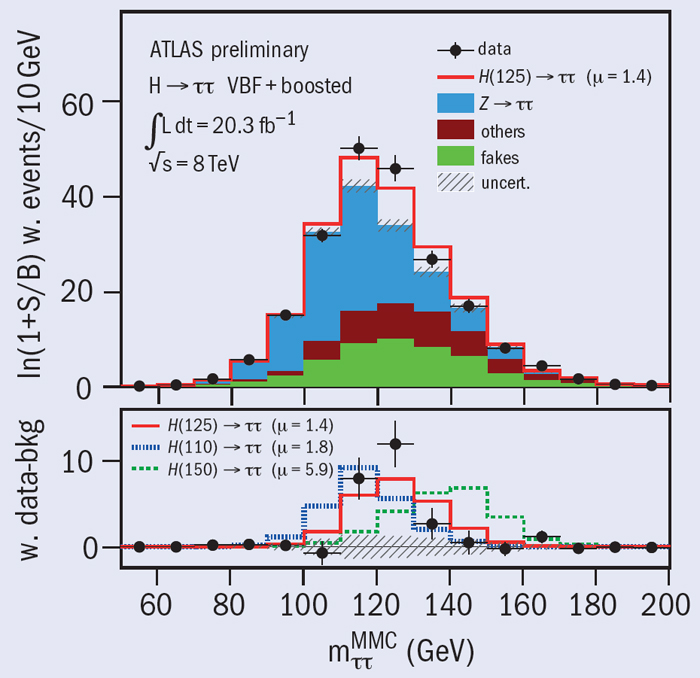
After “unblinding”, ATLAS observes an excess of events (figure 2) in a region consistent with the previously measured mass of the Higgs boson (125 GeV) and a statistical significance of 4.1σ, against 3.2σ expected. The ratio of the observed signal to that expected for a Standard Model Higgs decaying to a τ+τ– pair yields μ = 1.4+0.4–0.5, which is compatible with one.
ATLAS also searched for the decay of a Higgs boson to a muon pair. Because the Higgs boson couples to mass and the mass of the muon is 17 times lower than that of the τ, the H → μ+μ– rate is expected to be around 290 times lower than that of H → τ+τ–. The absence of a signal in the ATLAS μ+μ– search, setting an upper limit of 9.8 times the H → μ+μ– rate predicted by the Standard Model, therefore provides strong evidence that the Higgs boson does not decay to leptons in a flavour-blind way, but favours decays to heavy leptons, as predicted by the Standard Model.
These results, which are derived from the LHC’s first run, are so far compatible with the Standard Model predictions. The broad physics programme of ATLAS, which includes precision measurements of the properties of the Higgs boson, will continue to test the Standard Model in the years to come.
These results from the two collaborations now establish the coupling of the Higgs bosons to fermions. More data will allow testing the Higgs couplings at a deeper level, where other models for physics beyond the Standard Model predict differences. The next LHC run, which begins in 2015, is expected to produce several times the existing data sample. In addition, the proton collisions will be at higher energies, producing Higgs bosons at higher rates.
The LHCb collaboration has recently made the world’s most precise measurement of the lifetime of the B+c meson – a fascinating particle that has both beauty and charm.
The heavy flavours of beauty and charm are produced in proton–proton collisions at the LHC in quark–antiquark pairs. The resulting hadrons usually contain the original pair, as in the case of quarkonia, or a single heavy quark bound to the abundantly produced light quarks. However, in rare cases, a c quark and a b antiquark combine into a B+c. Since the top quark, t, decays too quickly to form hadrons, this is the only meson composed of two particles carrying different heavy flavours. As such, it offers a unique laboratory to test theoretical models of both the strong interaction, which accounts for its production, and the weak interaction, via which the meson has to decay. Indeed, the lifetime of the B+c meson is one of the key parameters that provide a test-bench for theoretical models. Knowledge of the lifetime is also essential to develop selection algorithms and to improve the accuracy of the branching-fraction determination for most B+c decay modes.
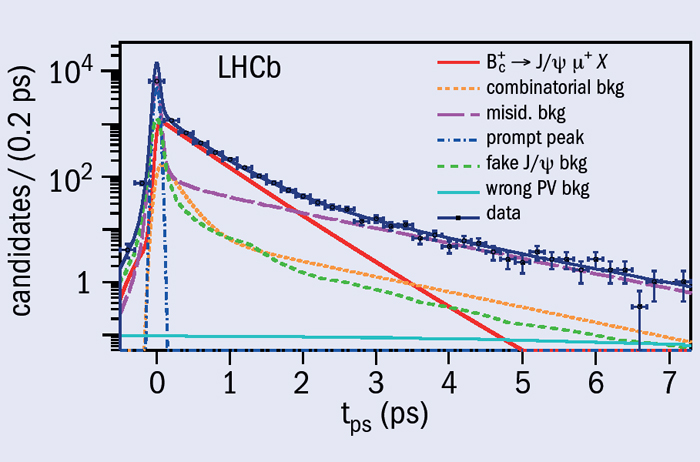
Following initial investigation at the Tevatron, the B+c meson is being studied extensively at the LHC. In particular, the LHCb collaboration has already published several observations of new decay channels and the world’s most precise determination of the B+c mass. Now, the collaboration has achieved the world’s most precise measurement of the lifetime by studying the semileptonic decays B+c → J/ψμν, with the subsequent decay J/ψ → μ+ μ–. The particle identification capabilities of LHCb allow a high-purity sample to be selected for these three-muon decays without any requirement on the decay time, therefore not biasing the measured lifetime. Using the data sample collected in 2012, about 10,000 signal decays were selected – the largest sample of reconstructed B+c decays to have ever been reported.
The challenge with semileptonic decays is that the B+c kinematics is not completely reconstructed, because of the impossibility of detecting the neutrino. This effect can be corrected on a statistical basis, although at the cost of introducing an uncertainty owing to the theoretical model of the decay used for the correction. LHCb developed a technique to constrain this model-dependence using data and found that the corresponding systematic uncertainty is small.
The result for the lifetime is 509±15 fs. This is twice as precise as the current world-average from the Particle Data Group, obtained combining measurements by the CDF and D0 experiments at the Tevatron, and opens the door for a new era of precision B+c studies.
After intense preparations and consensus building, the SCOAP3 open-access publishing initiative started on 1 January. With the support of partners in 24 countries, a large proportion of scientific articles in the field of high-energy physics will become open access at no cost for any author: everyone will be able to read them; authors will retain copyright; and generous licences will enable wide re-use of this information. Convened at CERN, this is the largest-scale global open-access initiative ever built, involving an international collaboration of more than 1000 libraries, library consortia and research organizations. SCOAP3 enjoys the support of funding agencies and has been established in co-operation with leading publishers.
Eleven publishers of high-quality international journals are participating in SCOAP3. Elsevier, IOP Publishing and Springer, with their publishing partners, have been working with the network of SCOAP3 national contact points. Reductions in subscription fees for thousands of participating libraries worldwide have been arranged, making funds available for libraries to support SCOAP3.
The objective of SCOAP3 is to grant unrestricted access to articles appearing in scientific journals, which so far have been available to scientists only through certain university libraries, and generally unavailable to the wider public. Open dissemination of preliminary information, in the form of pre-peer-review articles known as preprints, has been the norm in high-energy physics and related disciplines for two decades. SCOAP3 sustainably extends this opportunity to high-quality peer-review service, making the final version of articles available within the open-access tenets of free and unrestricted dissemination of science with intellectual property rights vested in the authors and wide re-use opportunities. In the SCOAP3 model, libraries and funding agencies pool resources that are currently used to subscribe to journals, in co-operation with publishers, and use them to support the peer-review system directly instead.
• Partners in the following countries have formalized their participation in SCOAP3: Austria, Belgium, Canada, China, Denmark, France, Germany, Italy, Japan, Norway, Portugal, Sweden, Switzerland, United Kingdom and the United States of America. Partners in the following countries are completing the final steps to formally join SCOAP3: the Czech Republic, Finland, Greece, Hungary, Korea, the Netherlands, Spain, South Africa and Turkey.
The following publishers and scientific societies are participating in SCOAP3 with 10 high-quality peer-reviewed journals in the field of high-energy physics and related disciplines: the Chinese Academy of Sciences, Deutsche Physikalische Gesellschaft, Elsevier, Hindawi, Institute of Physics Publishing, Jagellonian University, Oxford University Press, Physical Society of Japan, SISSA Medialab, Springer, Società Italiana di Fisica.
When the CERN Council approved the updated European Strategy for Particle Physics at a special meeting in Brussels last May, it recognized the High Luminosity LHC (HL-LHC) project as the top priority for CERN and Europe. A month later, after Council had approved its integration into the CERN Medium Term Plan for 2014–2018, the HL-LHC entered a new phase, as it passed from design study to an approved project.
To mark this approval, the 3rd joint annual meeting of the HiLumi LHC Design Study and the US LHC Accelerator Research Program (LARP) took place in conjunction with the HL-LHC kick-off meeting. The event was held in November at Daresbury Laboratory in the UK, bringing together more than 160 scientists from countries around the world, including Japan, Russia and the US. Directors of major accelerator laboratories were present as invited speakers.
The kick-off meeting underlined the role of the HL-LHC as a necessary tool for extending physics beyond the LHC. The important roles of CERN and the high-energy physics community were also emphasized. Developing new technologies – for example, magnets with a field 50% above the present LHC technology – opens the way for a future higher-energy machine requiring even higher magnetic fields, such as the recently proposed Future Circular Collider.
Highlights reported by the design-study work-package leaders at the meeting included final parameters for the layout and finalized main layout for the machine; important developments in crab-cavity hardware; a detailed layout for improving collimation; and the assembly and characterization of two 10-m-long MgB2 cables that have been tested up to 5 kA and at 20 K in the superconducting-link configuration.
The HL-LHC project is currently in the design and prototyping phase and should release a Preliminary Design Report in the middle of 2014, with the Technical Design Report for construction at the end of 2015.
In studies at the Beijing Electron–Positron Collider (BEPCII), the international team that operates the Beijing Spectrometer (BESIII) experiment has found evidence for a family of what could well be four-quark states. The new results follow the discovery of the electrically charged Zc(3900) in March last year.
These breakthroughs are the result of a dedicated study by the BESIII collaboration of the decays of the puzzling Y(4260) state. Discovered by the BaBar collaboration at SLAC in 2005, this state has a well-established mass that is inconsistent with the interpretation that it consists only of a charm quark, c, and an anti-charm quark, c. Moreover, it tends to decay to charmonium (cc states) plus conventional mesons rather than to a pair of charmed particles, as expected for a particle of this mass. So, more complicated models for its composition need to be considered, such as the addition of more quarks to the system, the existence of excited gluons binding the cc system, or even more exotic scenarios. The problem has been to find a way to distinguish experimentally between the different theoretical possibilities.
By tuning the energy at which electrons and positrons annihilate at BEPCII to the mass of the Y(4260), the BESIII collaboration has been able to produce the state directly and collect large samples of its decays. The first surprising result was the discovery of the Zc(3900), a charged state that decays π± J/ψ. To decay this way, the Zc(3900) must contain a charm quark and an anticharm quark (to form the neutral J/ψ), together with something else that is charged, i.e., additional lighter quarks. Hence, it must be (at least) a four-quark object.
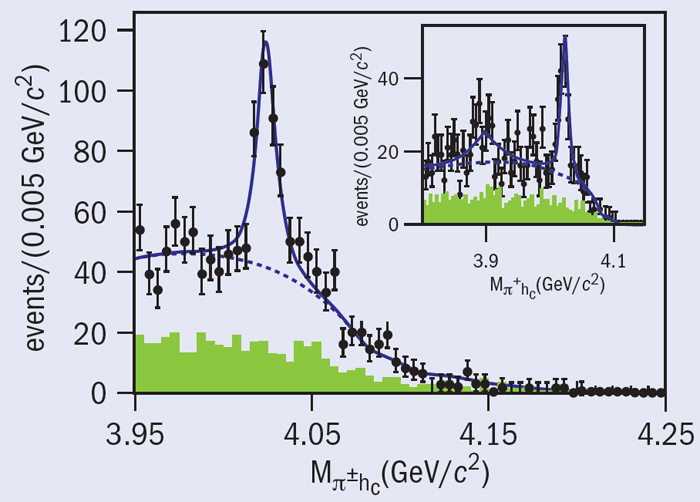
Since then, the BESIII collaboration has discovered a partner to the Zc(3900) – the Zc(4020). The new state appeared in the decay π±hc (BESIII collaboration 2013a). Like the Zc(3900), the Zc(4020) is electrically charged and decays to a particle consisting of a cc – in this case, the hc – so the interpretation is the same: it must also be a four-quark object. It appears, therefore, that the BESIII collaboration has begun to unveil a whole family of four-quark objects.
One possible clue for the interpretation of the Zc(3900) and Zc(4020) is that they appear near the minimum masses required to allow decays to pairs of D mesons (each consisting of a charm quark and an anti-up or anti-down quark). The Zc(3900) has a mass just above the combined mass of the D and D* and the Zc(4020) has a mass just more than twice that of the D*. So one idea is that the Zc(3900) is a four-quark bound state consisting of a D and a D*, each composed of two quarks. Similarly, the Zc(4020) could be a D*D* bound state. BESIII has explored this piece of evidence further by studying experimentally the charged D*D and D*D* systems, both of which show clear enhancements with properties similar to those of the Zc(3900) and Zc(4020) (BESIII collaboration 2013b and 2013c).
Another clue to the nature of all of these states came with the discovery of what appears to be a Y(4260) decaying to a photon and another particle, designated the X(3872) (BESIII collaboration 2013d). Unlike the Zc(3900) and the Zc(4020), the X(3872) is electrically neutral and has been experimentally established for more than 10 years. It has long been suspected of being a four-quark object, but it has been difficult to distinguish this interpretation from others as it has no electric charge. Now that BESIII has observed it alongside the Zc(3900) and Zc(4020), it seems that a definitive theoretical interpretation must be closer at hand.
To provide the best experiences, we use technologies like cookies to store and/or access device information. Consenting to these technologies will allow us to process data such as browsing behavior or unique IDs on this site. Not consenting or withdrawing consent, may adversely affect certain features and functions.
Functional
Always active
The technical storage or access is strictly necessary for the legitimate purpose of enabling the use of a specific service explicitly requested by the subscriber or user, or for the sole purpose of carrying out the transmission of a communication over an electronic communications network.
Preferences
The technical storage or access is necessary for the legitimate purpose of storing preferences that are not requested by the subscriber or user.
Statistics
The technical storage or access that is used exclusively for statistical purposes.The technical storage or access that is used exclusively for anonymous statistical purposes. Without a subpoena, voluntary compliance on the part of your Internet Service Provider, or additional records from a third party, information stored or retrieved for this purpose alone cannot usually be used to identify you.
Marketing
The technical storage or access is required to create user profiles to send advertising, or to track the user on a website or across several websites for similar marketing purposes.