Comsol -leaderboard other pages

Topics

A rich harvest of results in Prague

The 42nd international conference on high-energy physics (ICHEP) attracted almost 1400 participants to Prague in July. Expectations were high, with the field on the threshold of a defining moment, and ICHEP did not disappoint. A wealth of new results showed significant progress across all areas of high-energy physics.

With the long shutdown on the horizon, the third run of the LHC is progressing in earnest. Its high-availability operation and mastery of operational risks were highly praised. Run 3 data is of immense importance as it will be the dataset that experiments will work with for the next decade. With the newly collected data at 13.6 TeV, the LHC experiments showed new measurements of Higgs and di-electroweak-boson production, though of course most of the LHC results were based on the Run 2 (2014 to 2018) dataset, which is by now impeccably well calibrated and understood. This also allowed ATLAS and CMS to bring in-depth improvements to reconstruction algorithms.

AI algorithms

A highlight of the conference was the improvements brought by state-of-the-art artificial-intelligence algorithms such as graph neural networks, both at the trigger and reconstruction level. A striking example of this is the ATLAS and CMS flavour-tagging algorithms, which have improved their rejection of light jets by a factor of up to four. This has important consequences. Two outstanding examples are: di-Higgs-boson production, which is fundamental for the measurement of the Higgs boson self-coupling (CERN Courier July/August 2024 p7); and the Higgs boson’s Yukawa coupling to charm quarks. Di-Higgs-boson production should be independently observable by both general-purpose experiments at the HL-LHC, and an observation of the Higgs boson’s coupling to charm quarks is getting closer to being within reach.

The LHC experiments continue to push the limits of precision at hadron colliders. CMS and LHCb presented new measurements of the weak mixing angle. The per-mille precision reached is close to that of LEP and SLD measurements (CERN Courier September/October 2024 p29). ATLAS presented the most precise measurement to date (0.8%) of the strong coupling constant extracted from the measurement of the transverse momentum differential cross section of Drell–Yan Z-boson production. LHCb provided a comprehensive analysis of the B0→ K0* μ+μ angular distributions, which had previously presented discrepancies at the level of 3σ. Taking into account long-distance contributions significantly weakens the tension down to 2.1σ.

Pioneering the highest luminosities ever reached at colliders (setting a record at 4.7 × 1034 cm–2 s–1), SuperKEKB has been facing challenging conditions with repeated sudden beam losses. This is currently an obstacle to further progress to higher luminosities. Possible causes have been identified and are currently under investigation. Meanwhile, with the already substantial data set collected so far, the Belle II experiment has produced a host of new results. In addition to improved CKM angle measurements (alongside LHCb), in particular of the γ angle, Belle II (alongside BaBar) presented interesting new insights in the long standing |Vcb| and |Vub| inclusive versus exclusive measurements puzzle (CERN Courier July/August 2024 p30), with new |Vcb| exclusive measurements that significantly reduce the previous 3σ tension.

Maurizio Pierini

ATLAS and CMS furthered their systematic journey in the search for new phenomena to leave no stone unturned at the energy frontier, with 20 new results presented at the conference. This landmark outcome of the LHC puts further pressure on the naturalness paradigm.

A highlight of the conference was the overall progress in neutrino physics. Accelerator-based experiments NOvA and T2K presented a first combined measurement of the mass difference, neutrino mixing and CP parameters. Neutrino telescopes IceCube with DeepCore and KM3NeT with ORCA (Oscillation Research with Cosmics in the Abyss) also presented results with impressive precision. Neutrino physics is now at the dawn of a bright new era of precision with the next-generation accelerator-based long baseline experiments DUNE and Hyper Kamiokande, the upgrade of DeepCore, the completion of ORCA and the medium baseline JUNO experiment. These experiments will bring definitive conclusions on the measurement of the CP phase in the neutrino sector and the neutrino mass hierarchy – two of the outstanding goals in the field.

The KATRIN experiment presented a new upper limit on the effective electron–anti-neutrino mass of 0.45 eV, well en route towards their ultimate sensitivity of 0.2 eV. Neutrinoless double-beta-decay search experiments KamLAND-Zen and LEGEND-200 presented limits on the effective neutrino mass of approximately 100 meV; the sensitivity of the next-generation experiments LEGEND-1T, KamLAND-Zen-1T and nEXO should reach 20 meV and either fully exclude the inverted ordering hypothesis or discover this long-sought process. Progress on the reactor neutrino anomaly was reported, with recent fission data suggesting that the fluxes are overestimated, thus weakening the significance of the anti-neutrino deficits.

Neutrinos were also a highlight for direct-dark-matter experiments as Xenon announced the observation of nuclear recoil events from8B solar neutrino coherent elastic scattering on nuclei, thus signalling that experiments are now reaching the neutrino fog. The conference also highlighted the considerable progress across the board on the roadmap laid out by Kathryn Zurek at the conference to search for dark matter in an extraordinarily large range of possibilities, spanning 89 orders of magnitude in mass from 10–23 eV to 1057 GeV. The roadmap includes cosmological and astrophysical observations, broad searches at the energy and intensity frontier, direct searches at low masses to cover relic abundance motivated scenarios, building a suite of axion searches, and pursuing indirect-detection experiments.

Lia Merminga and Fabiola Gianotti

Neutrinos also made the headlines in multi-messenger astrophysics experiments with the announcement by the KM3Net ARCA (Astroparticle Research with Cosmics in the Abyss) collaboration of a muon-neutrino event that could be the most energetic ever found. The energy of the muon from the interaction of the neutrino is compatible with having an energy of approximately 100 PeV, thus opening a fascinating window on astrophysical processes at energies well beyond the reach of colliders. The conference showed that we are now well within the era of multi-messenger astrophysics, via beautiful neutrinos, gamma rays and gravitational-wave results.

The conference saw new bridges across fields being built. The birth of collider-neutrino physics with the beautiful results from FASERν and SND fill the missing gap in neutrino–nucleon cross sections between accelerator neutrinos and neutrino astronomy. ALICE and LHCb presented new results on He3 production that complement the AMS results. Astrophysical He3 could signal the annihilation of dark matter. ALICE also presented a broad, comprehensive review of the progress in understanding strongly interacting matter at extreme energy densities.

The highlight in the field of observational cosmology was the recent data from DESI, the Dark Energy Spectroscopic Instrument in operation since 2021, which bring splendid new data on baryon acoustic oscillation measurements. These precious new data agree with previous indirect measurements of the Hubble constant, keeping the tension with direct measurements in excess of 2.5σ. In combination with CMB measurements, the DESI measurements also set an upper limit on the sum of neutrino masses at 0.072 eV, in tension with the inverted ordering of neutrino masses hypothesis. This limit is dependent on the cosmological model.

In everyone’s mind at the conference, and indeed across the domain of high-energy physics, it is clear that the field is at a defining moment in its history: we will soon have to decide what new flagship project to build. To this end, the conference organised a thrilling panel discussion featuring the directors of all the major laboratories in the world. “We need to continue to be bold and ambitious and dream big,” said Fermilab’s Lia Merminga, summarising the spirit of the discussion.

“As we have seen at this conference, the field is extremely vibrant and exciting,” said CERN’s Fabiola Gianotti at the conclusion of the panel. In these defining times for the future of our field, ICHEP 2024 was an important success. The progress in all areas is remarkable and manifest through the outstanding number of beautiful new results shown at the conference.

An obligation to engage

Science is for everyone, and everyone depends on science, so why not bring more of it to society? That was the idea behind the CERN & Society Foundation, established 10 years ago.

The longer I work in science, and the more people I talk to about science, the more I become convinced that everyone is interested in science whether they realise it or not. Many have emerged from their school education with a belief that science is hard and not for them, but they nevertheless ask the very same questions that those at the cutting edge of fundamental physics research ask, and that people have been asking since time immemorial: what is the universe made of, where did we come from and where are we going? Such curiosity is part of what it is to be human. On a more prosaic level, science and technology play an ever-growing role in modern society, and it is incumbent on all of us to understand its consequences and engage on the debate about its uses.

The power to inspire

When I tell people about CERN, more often than not their eyes light up with excitement and they want to know more. Experiences like this show that the scientific community needs to do all it can to engage with society at large in a fast-changing world. We need to bring people closer to an understanding of science, of how science works and why critical evidence-based thinking is vital in every walk of life, not only in science.

Laboratories like CERN are extraordinary places where people from all over the world come together to explore nature’s mysteries. I believe that when we come together like this, we have the power to inspire and an obligation to use this power to address the critical challenge of public engagement in science and technology. CERN has always taken this responsibility seriously. Ten years ago, it added a new string to its bow in the form of the CERN & Society Foundation. Through philanthropy, the foundation spreads CERN’s spirit of scientific curiosity.

Rolf-Dieter Heuer

The CERN & Society Foundation helps the laboratory to deepen its impact beyond the core mission of fundamental physics research. Projects supported by the foundation encourage talented young people from around the globe to follow STEM careers, catalyse innovation for the benefit of all, and inspire wide and diverse audiences. From training high-school teachers to producing medical isotopes, donors’ generosity brings research excellence to all corners of society.

The foundation’s work rests on three pillars: education and outreach, innovation and knowledge exchange, and culture and creativity. Allow me to highlight one example from each pillar that I particularly like.

One of the flagships of the education and outreach pillar is the Beamline for Schools (BL4S) competition. Launched in 2014, BL4S invites groups of high-school students from around the world to submit a proposal for an experiment at CERN. The winning teams are invited to come to CERN to carry out their experiment under expert supervision from CERN scientists. More recently, the DESY laboratory has joined the programme and also welcomes high-school groups to work on a beamline there. Project proposals have ranged from fundamental physics to projects aimed at enabling cosmic-ray tomography of the pyramids by measuring muon transmission through limestone (see “Inside pyramids, underneath glaciers“). To date, some 20,000 students have taken part in the competition, with 25 winning teams coming to CERN or DESY to carry out their experiments (see “From blackboard to beamline“).

Zenodo is a great example of the innovation and knowledge-exchange pillar. It provides a repository for free and easy access to research results, data and analy­sis code, thereby promoting the ideal of open science, which is at the very heart of scientific progress. Zenodo taps into CERN’s long-standing tradition and know-how in sharing and preserving scientific knowledge for the benefit of all. The scientific community can now store data in a non-commercial environment, freely available for society at large. Zenodo goes far beyond high-energy physics and played an important role during the COVID-19 pandemic.

Mutual inspiration

Our flagship culture-and-creativity initiative is the world-leading Arts at CERN programme, which recognises the creativity inherent in both the arts and the sciences, and harnesses them to generate benefits for both. Participating artists and scientists find mutual inspiration, going on to inspire audiences around the world.

“In an era where society needs science more than ever, inspiring new generations to believe in their dreams and giving them the tools and space to change the world is essential,” said one donor recently. It is encouraging to hear such sentiments, and there’s no doubt that the CERN & Society Foundation should feel satisfied with its first decade. Through the examples I have cited above, and many more that I have not mentioned, the foundation has made a tangible difference. It is, however, but one voice. Scientists and scientific organisations in prominent positions should take inspiration from the foundation: the world needs more ambassadors for science. On that note, all that remains is for me to say happy birthday, CERN & Society Foundation.

Combining clues from the Higgs boson

CMS figure 1

Following the discovery of the Higgs boson in 2012, the CMS collaboration has been exploring its properties with ever-increasing precision. Data recorded during LHC Run 2 have been used to measure differential production cross-sections of the Higgs boson in different decay channels – a pair of photons, two Z bosons, two W bosons and two tau leptons – and as functions of different observables. These results have now been combined to provide measurements of spectra at the ultimate achievable precision.

Differential cross-section measurements provide the most model-independent way to study Higgs-boson production at the LHC, for which theoretical predictions exist up to next-to-next-to-next-to-leading order in perturbative QCD. One of the most important obser­vables is the transverse momentum (figure 1). This distribution is particularly sensitive both to modelling issues in Standard Model (SM) predictions and possible contributions from physics-beyond-the-SM (BSM).

In the new CMS result, two frameworks are used to test for hints of BSM: the κ-formalism and effective field theories.

The κ-formalism assumes that new physics effects would only affect the couplings between the Higgs boson and other particles. These new physics effects are then parameterised in terms of coefficients, κ. Using this approach, two-dimensional constraints are set on κc (the coupling coefficient of the Higgs boson to the charm quark), κb (Higgs to bottom) and κt (Higgs to top). None show significant deviations from the SM at present.

CMS figure 2

Effective field theories parametrise deviations from the SM by supplementing the Lagrangian with higher-dimensional operators and their associated Wilson coefficients (WCs). The effect of the operators is suppressed by powers of the putative new-physics energy scale, Λ. Measurements of WCs that differ from zero may hint at BSM physics.

The CMS differential cross-section measurements are parametrised, and constraints are derived on the WCs from a simultaneous fit. In the most challenging case, a set of 31 WCs is used as input to a principal-component analysis procedure in which the most sensitive directions in the data are identified. These directions (expressed as linear combinations of the WCs) are then constrained in a simultaneous fit (figure 2). In the upper panel, the limits on the WCs are converted to lower limits on the new physics scale. The results agree with SM predictions, with a moderate 2σ tension present in one of the directions (EV5). Here the major contribution is provided by the cHq3 coefficient, which mostly affects vector-boson fusion, VH production at high Higgs-boson transverse momenta (V = W, Z) and W-boson decays.

The combined results not only provide highly precise measurements of Higgs-boson production, but also place stringent constraints on possible deviations from the SM, deepening our understanding while leaving open the possibility of new physics at higher precision or energy scales.

Dignitaries mark CERN’s 70th anniversary

On 1 October a high-level ceremony at CERN marked 70 years of science, innovation and collaboration. In attendance were 38 national delegations, including eight heads of state or government and 13 ministers, along with many scientific, political and economic leaders who demonstrated strong support for CERN’s mission and future ambition. “CERN has become a global hub because it rallied Europe, and this is even more crucial today,” said president of the European Commission Ursula von der Leyen. “China is planning a 100 km collider to challenge CERN’s global leadership. Therefore, I am proud that we have financed the feasibility study for CERN’s Future Circular Collider. As the global science race is on, I want Europe to switch gear.” CERN’s year-long 70th anniversary programme has seen more than 100 events organised in 63 cities in 28 countries, bringing together thousands of people to discuss the wonders and applications of particle physics. “I am very honoured to welcome representatives from our Member and Associate Member States, our Observers and our partners from all over the world on this very special day,” said CERN Director-General Fabiola Gianotti. “CERN is a great success for Europe and its global partners, and our founders would be very proud to see what CERN has accomplished over the seven decades of its life.”

NA62 observes its golden decay

In a game of snakes and ladders, players move methodically up the board, occasionally encountering opportunities to climb a ladder. The NA62 experiment at CERN is one such opportunity. Searching for ultra-rare decays at colliders and fixed- target experiments like NA62 can offer a glimpse at energy scales an order of magnitude higher than is directly accessible when creating particles in a frontier machine.

The trick is to study hadron decays that are highly suppressed by the GIM mechanism (see “Charming clues for existence“). Should massive particles beyond the Standard Model (SM) exist at the right energy scale, they could disrupt the delicate cancellations expected in the SM by making brief virtual appearances according to the limits imposed by Heisenberg’s uncertainty principle. In a recent featured article, Andrzej Buras (Technical University Munich) identified the six most promising rare decays where new physics might be discovered before the end of the decade (CERN Courier July/August 2024 p30). Among them is K+→ π+νν, the ultra-rare decay sought by NA62. In the SM, fewer than one K+in 10 billion decays this way, requiring the team to exercise meticulous attention to detail in excluding backgrounds. The collaboration has now announced that it has observed the process with 5σ significance.

“This observation is the culmination of a project that started more than a decade ago,” says spokesperson Giuseppe Ruggiero of INFN and the University of Florence. “Looking for effects in nature that have probabilities of happening of the order of 10–11 is both fascinating and challenging. After rigorous and painstaking work, we have finally seen the process NA62 was designed and built to observe.”

In the NA62 experiment, kaons are produced by colliding a high-intensity proton beam from CERN’s Super Proton Synchrotron into a stationary beryllium target. Almost a billion secondary particles are produced each second. Of these, about 6% are positively charged kaons that are tagged and matched with positively charged pions from the decay K+→ π+νν, with the neutrinos escaping undetected. Upgrades to NA62 during Long Shutdown 2 increased the experiment’s signal efficiency while maintaining its sample purity, allowing the collaboration to double the expected signal of their previous measurement using new data collected between 2021 and 2022. A total of 51 events pass the stringent selection criteria, over an expected background of 18+32, definitely establishing the existence of this decay for the first time.

NA62 measures the branching ratio for K+→ π+νν to be 13.0+3.3–2.9× 10–11 – the most precise measurement to date and about 50% higher than the SM prediction, though compatible with it within 1.7σ at the current level of precision. NA62’s full data set will be required to test the validity of the SM in this decay. Data taking is ongoing.

Using U-spin to squeeze CP violation

LHCb figure 1

The LHCb collaboration has undertaken a new study of B → DD decays using data from LHC Run 2. In the case of B0→ D+D decays, the analysis excludes CP-symmetry at a confidence level greater than six standard deviations – a first in the analysis of a single decay mode.

The study of differences between matter and antimatter (CP violation) is a core aspect of the physics programme at LHCb. Measurements of CP violation in decays of neutral B0 mesons play a crucial role in the search for physics beyond the Standard Model thanks to the ability of the B0 meson to oscillate into its antiparticle, the B0 meson. Given increases in experimental precision, improved control over the magnitude of hadronic effects becomes important, which is a major challenge in most decay modes. In this measurement, a neutral B meson decays to two charm D mesons – an interesting topology that offers a method to control these high-order hadronic contributions from the Standard Model via the concept of U-spin symmetry.

In the new analysis, B0→ D+D and Bs0→ Ds+Ds are studied simultaneously. U-spin symmetry exchanges the spectator down quarks in the first decay with strange quarks to form the second decay. A joint analysis therefore strongly constrains uncertainties related to hadronic matrix elements by relating CP-violation and branching-fraction measurements in the two decay channels.

In both decays, the same final state is accessible to both matter and antimatter states of the B0 or Bs0 meson, enabling interference between two decay paths: the direct decay of the meson to the final state; and a decay after the meson has oscillated into its antiparticle counterpart. The time-dependent decay rate of each flavour (matter or antimatter) of the meson depends on CP-violating effects and is parameterised in terms dependent on the fundamental properties of the B mesons and the fundamental CP-violating weak phases β and βs, in the case of B0 and Bs0 decays, respectively. The tree-level and exchange Feynman diagrams participating to this decay process, which in turn depend on specific values of the terms in the Cabibbo–Kobayashi–Maskawa quark-mixing matrix, determine the expected value of the β(s) phases. This matrix encodes our best understanding of the CP-violating effects within the Standard Model, and testing its expected properties is a crucial means to fully exploit closure tests of this theoretical framework.

The study of differences between matter and antimatter is a core aspect of the physics programme at LHCb

The analysis uses flavour tagging to identify the matter or antimatter flavour of the neutral B meson at its production and thus allows the determination of the decay path – a key task in time- dependent measurements of CP violation. The flavour-tagging algorithms exploit the fact that b and b quarks are almost exclusively produced in pairs in pp collisions. When the b quark forms a B meson (and similarly for its antimatter equivalent), additional particles are produced in the fragmentation process of the pp collision. From the charges and species of these particles, the flavour of the signal B meson at production can be inferred. This information is combined with the reconstructed position of the decay vertex of the meson, allowing the flavour-tagged decay-time distribution of each analysed flavour to be measured.

Figure 1 shows the asymmetry between the decay-time distributions of the B0 and the B0 mesons for the B0→ D+Ddecay mode. Alongside the Bs0→ Ds+Ds data, these results represent the most precise single measurements of the CP-violation parameters in their respective channels. Results from the two decay modes are used in combination with other B → DD measurements to precisely determine Standard Model parameters.

From blackboard to beamline

BL4S alumni

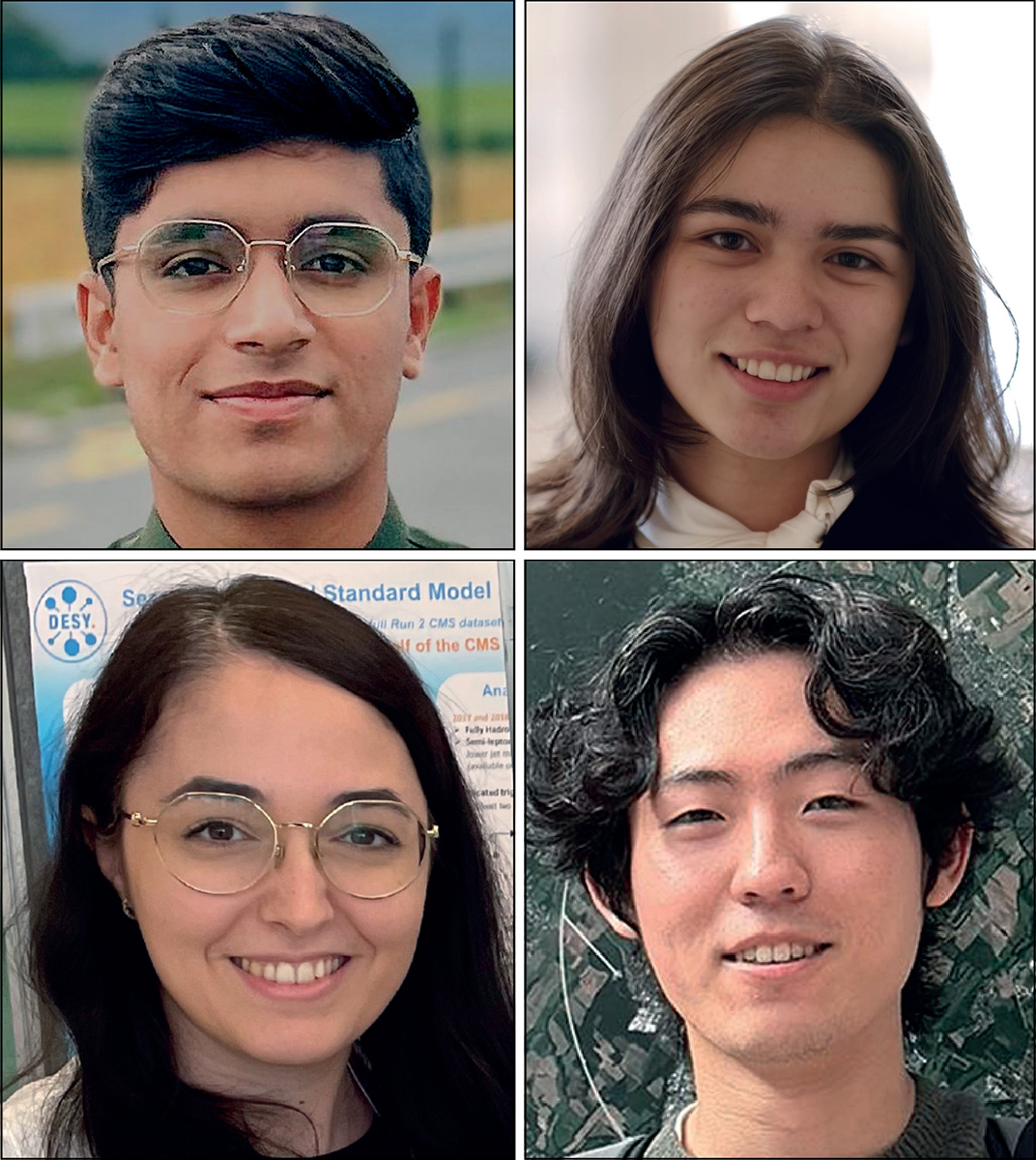
High-school physics curricula don’t include much particle physics. The Beamline for Schools (BL4S) competition seeks to remedy this by offering high-school students the chance to turn CERN or DESY into their own laboratory. Since 2014, more than 20,000 students from 2750 teams in 108 countries have competed in BL4S, with 25 winning teams coming to the labs to perform experiments they planned from blackboard to beamline. Though, at 10 years old, the competition is still young, multiple career trajectories have already been influenced, with the impact radiating out into participants’ communities of origin.

For Hiroki Kozuki, a member of a winning team from Switzerland in 2020, learning the fundamentals of particle physics while constructing his team’s project proposal was what first sparked his interest in the subject.

“Our mentor gave us after-school classes on particle physics, fundamentals, quantum mechanics and special relativity,” says Kozuki. “I really felt as though there was so much more depth to physics. I still remember this one lecture where he taught us about the fundamental forces and quarks… It’s like he just pulled the tablecloth out from under my feet. I thought: nature is so much more beautiful when I see all these mechanisms underneath it that I didn’t know existed. That’s the moment where I got hooked on particle physics.” Kozuki will soon graduate from Imperial College London, and hopes to pursue a career in research.

Sabrina Giorgetti, from an Italian team, tells a similar story. “I can say confidently that the reason I chose physics for my bachelor’s, master’s and PhD was because of this experience.” One of the competition’s earliest winners from back in 2015, Giorgetti is now working on the CMS experiment for her PhD. One of her most memorable experiences from BL4S was getting to know the other winning team, who were from South Africa. This solidified her decision to pursue a career in academia.

“You really feel like you can reach out and collaborate with people all over the world, which is something I find truly amazing,” she says. “Now it’s even more international than it was nine years ago. I learnt at BL4S that if you’re interested in research at a place like CERN, it’s not only about physics. It may look like that from the outside, but it’s also engineering, IT and science communication – it’s a very broad world.”

The power of collaboration

As well as getting hands-on with the equipment, one of the primary aims of BL4S is to encourage students to collaborate in a way they wouldn’t in a typical high-school context. While physics experiments in school are usually conducted in pairs, BL4S allows students to work in larger teams, as is common in professional and research environments. The competition provides the chance to explore uncharted territory, rather than repeating timeworn experiments in school.

2023 winner Isabella Vesely from the US is now majoring in physics, electrical engineering and computer science at MIT. Alongside trying to fix their experiment prior to running it on the beamline, her most impactful memories involve collaborating with the other winning team from Pakistan. “We overcame so many challenges with collaboration,” explains Vesely. “They were from a completely different background to us, and it was very cool to talk to them about the experiment, our shared interest in physics and get to know each other personally. I’m still in touch with them now.”

One fellow 2023 winner is just down the road at Harvard. Zohaib Abbas, a member of the winning Pakistan team that year, is now majoring in physics. “In Pakistan, there weren’t any physical laboratories, so nothing was hands-on and all the physics was theoretical,” he says, recalling his shock at the US team’s technical skills, which included 3D printing and coding. After his education, Abbas wants to bring some of this knowledge back to Pakistan in the hopes of growing the physics community in his hometown. “After I got into BL4S, there have been hundreds of people in Pakistan who have been reaching out to me because they didn’t know about this opportunity. I think that BL4S is doing a really great job at exposing people to particle physics.”

All of the students recalled the significant challenge of ensuring the functionality of their instruments across one of CERN’s or DESY’s beamlines. While the project seemed a daunting task at first, the participants enjoyed following the process from start to finish, from the initial idea through to the data collection and analysis.

“It was really exciting to see the whole process in such a short timescale,” said Vesely. “It’s pretty complicated seeing all the work that’s already been done at these experiments, so it’s really cool to contribute a small piece of data and integrate that with everything else.”

Kozuki concurs. Though only he went on to study physics, with teammates branching off into subjects ranging from mathematics to law and medicine, they still plan to get together and take another crack at the data they compiled in 2020. “We want to take another look and see if we find anything we didn’t see before. These projects go on far beyond those two weeks, and the team that you worked with are forever connected.”

For Kozuki, it’s all about collaboration. “I want to be in a field where everyone shares this fundamental desire to crack open some mysteries about the universe. I think that this incremental contribution to science is a very noble motivation. It’s one I really felt when working at CERN. Everyone is genuinely so excited to do their work, and it’s such an encouraging environment. I learnt so much about particle physics, the accelerators and the detectors, but I think those are somewhat secondary compared to the interpersonal connections I developed at BL4S. These are the sorts of international collaborations that accelerate science, and it’s something I want to be a part of.”

FCC builds momentum in San Francisco

The Future Circular Collider (FCC) is envisaged to be a multi-stage facility for exploring the energy and intensity frontiers of particle physics. An initial electron–positron collider phase (FCC-ee) would focus on ultra-precise measurements at the centre-of-mass energies required to create Z bosons, W-boson pairs, Higgs bosons and top-quark pairs, followed by proton and heavy-ion collisions in a hadron-collider phase (FCC-hh), which would probe the energy frontier directly. As recommended by the 2020 update of the European strategy for particle physics, a feasibility study for the FCC is in full swing. Following the submission to the CERN Council of the study’s midterm report earlier this year (CERN Courier March/April 2024 pp25–38), and the signing of a joint statement of intent on planning for large research infrastructures by CERN and the US government (CERN Courier July/August 2024 p10), FCC Week 2024 convened more than 450 scientists, researchers and industry leaders in San Francisco from 10 to 14 June, with the aim of engaging the wider scientific community, in particular in North America. Since then, more than 20 groups have joined the FCC collaboration.

SLAC and LBNL directors John Sarrao and Mike Witherell opened the meeting by emphasising the vital roles of international collaboration between national laboratories in advancing scientific discovery. Sarrao highlighted SLAC’s historical contributions to high-energy physics and expressed enthusiasm for the FCC’s scientific potential. Witherell reflected on the legacy of particle accelerators in fundamental science and the importance of continued innovation.

CERN Director-General Fabiola Gianotti identified three pillars of her vision for the laboratory: flagship projects like the LHC; a diverse complementary scientific programme; and preparations for future projects. She identified the FCC as the best future match for this vision, asserting that it has unparalleled potential for discovering new physics and can accommodate a large and diverse scientific community. “It is crucial to design a facility that offers a broad scientific programme, many experiments and exciting physics to attract young talents,” she said.

International collaboration, especially with the US, is important in ensuring the project’s success

FCC-ee would operate at several centre-of-mass energies corresponding to the Z-boson pole, W-boson pair-production, Higgs-boson pole or top-quark pair production. The beam current at each of these points would be determined by the design value of 50 MW synchrotron-radiation power per beam. At lower energies, the machine could accommodate more bunches, achieving 1.3 amperes and a luminosity in excess of 1036 cm–2 s–1 at the Z pole. Measurements of electroweak observables and Higgs-boson couplings would be improved by a factor of between 10 and 50. Remarkably, FCC-ee would also provide 10 times the ambitious design statistics of SuperKEKB/Belle II for bottom and charm quarks, making it the world-leading machine at the intensity frontier. Along with other measurements of electroweak observables, FCC-ee will indirectly probe energies up to 70 TeV for weakly interacting particles. Unlike at proposed linear colliders, four interaction points would increase scientific robustness, reduce systematic uncertainties and allow for specialised experiments, maximising the collider’s physics output.

For FCC-hh, two approaches are being pursued for the necessary high-field superconducting magnets. The first involves advancing niobium–tin technology, which is currently mastered at 11–12 T for the High-Luminosity LHC, with the goal of reaching operational fields of 14 T. The second focuses on high-temperature superconductors (HTS) such as REBCO and iron-based superconductors (IBS). REBCO comes mainly in tape form (CERN Courier May/June 2023 p37), whereas IBS comes in both tape and wire form. With niobium-tin, 14 T would allow proton–proton collision energies of 80 TeV in a 90 km ring. HTS-based magnets could potentially reach fields up to 20 T, and centre-of-mass energies proportionally higher, in the vicinity of 120 TeV. If HTS magnets prove technically feasible, they could greatly decrease the cryogenic power. The development of such technologies also holds great promise beyond fundamental research, for example in transportation and electricity transmission.

FCC study leader Michael Benedikt (CERN) outlined the status of the ongoing feasibility study, which is set to be completed by March 2025. No technical showstoppers have yet been found, paving the way for the next phase of detailed technical and environmental impact studies and critical site investigations. Benedikt stressed the importance of international collaboration, especially with the US, in ensuring the project’s success.

The next step for the FCC project is to provide information to the CERN Council, via the upcoming update of the European strategy for particle physics, to facilitate a decision on whether to pursue the FCC by the end of 2027 or in early 2028. This includes further developing the civil engineering and technical design of major systems and components to present a more detailed cost estimate, continuing technical R&D activities, and working with CERN’s host states on regional implementation development and authorisation processes along with the launch of an environmental impact study. FCC would intersect 31 municipalities in France and 10 in Switzerland. Detailed work is ongoing to identify and reserve plots of land for surface sites, address site-specific design aspects, and explore socio-economic and ecological opportunities such as waste-heat utilisation.

Hypertriton and ‘little bang’ nucleosynthesis

ALICE figure 1

According to the cosmological standard model, the first generation of nuclei was produced during the cooling of the hot mixture of quarks and gluons that was created shortly following the Big Bang. Relativistic heavy-ion collisions create a quark–gluon plasma (QGP) on a small scale, producing a “little bang”. In such collisions, the nucleosynthesis mechanism at play is different from the one of the Big Bang due to the rapid cool down of the fireball. Recently, the nucleosynthesis mechanism in heavy-ion collisions has been investigated via the measurement of hypertriton production by the ALICE collaboration.

The hypertriton, which consists of a proton, a neutron and a Λ hyperon, can be considered to be a loosely bound deuteron-Λ molecule (see “Inside pentaquarks and tetraquarks“). In this picture, the energy required to separate the Λ from the deuteron (BΛ) is about 100 keV, significantly lower than the binding energy of ordinary nuclei. This makes hypertriton production a sensitive probe of the properties of the fireball.

In heavy-ion collisions, the formation of nuclei can be explained by two main classes of models. The statistical hadronisation model (SHM) assumes that particles are produced from a system in thermal equilibrium. In this model, the production rate of nuclei depends only on their mass, quantum numbers and the temperature and volume of the system. On the other hand, in coalescence models, nuclei are formed from nucleons that are close together in phase space. In these models, the production rate of nuclei is also sensitive to their nuclear structure and size.

For an ordinary nucleus like the deuteron, coalescence and SHM predict similar production rates in all colliding systems, but for a loosely bound molecule such as the hypertriton, the predictions of the two models differ significantly. In order to identify the mechanism of nuclear production, the ALICE collab­oration used the ratio between the production rates of hypertriton and helium-3 – also known as a yield ratio – as an observable.

ALICE measured hypertriton production as a function of charged-particle multiplicity density using Pb–Pb collisions collected at a centre-of-mass energy of 5.02 TeV per nucleon pair during LHC Run 2. Figure 1 shows the yield ratio of hypertriton to 3He across different multiplicity intervals. The data points (red) exhibit a clear deviation from the SHM (dashed orange line), but are well-described by the coalescence model (blue band), supporting the conclusion that hypertriton formation at the LHC is driven by the coalescence mechanism.

The ongoing LHC Run 3 is expected to improve the precision of these measurements across all collision systems, allowing us to probe the internal structure of hypertriton and even heavier hypernuclei, whose properties remain largely unknown. This will provide insights into the interactions between ordinary nucleons and hyperons, which are essential for understanding the internal composition of neutron stars.

Charming clues for existence

In November 1974, the research groups of Samuel Ting at Brookhaven National Laboratory and Burton Richter at SLAC independently discovered a resonance at 3.1 GeV that was less than 1 MeV wide. Posterity soon named it J/ψ, juxtaposing the names chosen by each group in a unique compromise. Its discovery would complete the second generation of fermions with the charm quark, giving experimental impetus to the new theories of electroweak unification (1967) and quantum chromodynamics (1973). But with the theories fresh and experimenters experiencing an annus mirabilisfollowing the indirect discovery of the Z boson in neutral currents the year before, the nature of the J/ψ was not immediately clear.

“Why the excitement over the new discoveries?” asked the Courier in December 1974 (see “The new particles“). “A brief answer is that the particles have been found in a mass region where they were completely un­expected, with stability properties which, at this stage of the game, are completely inexplicable.”

The J/ψ is now known to be made up of a charm quark and a charm antiquark. Unable to decay via the strong interaction, its width is just 92.6 keV, corresponding to an unexpectedly long lifetime of 7.1 × 10–21 s. Charm quarks do not form ordinary matter like protons and neutrons, but J/ψ resonances and D mesons, which contain a charm quark and a less-massive up, down or strange antiquark.

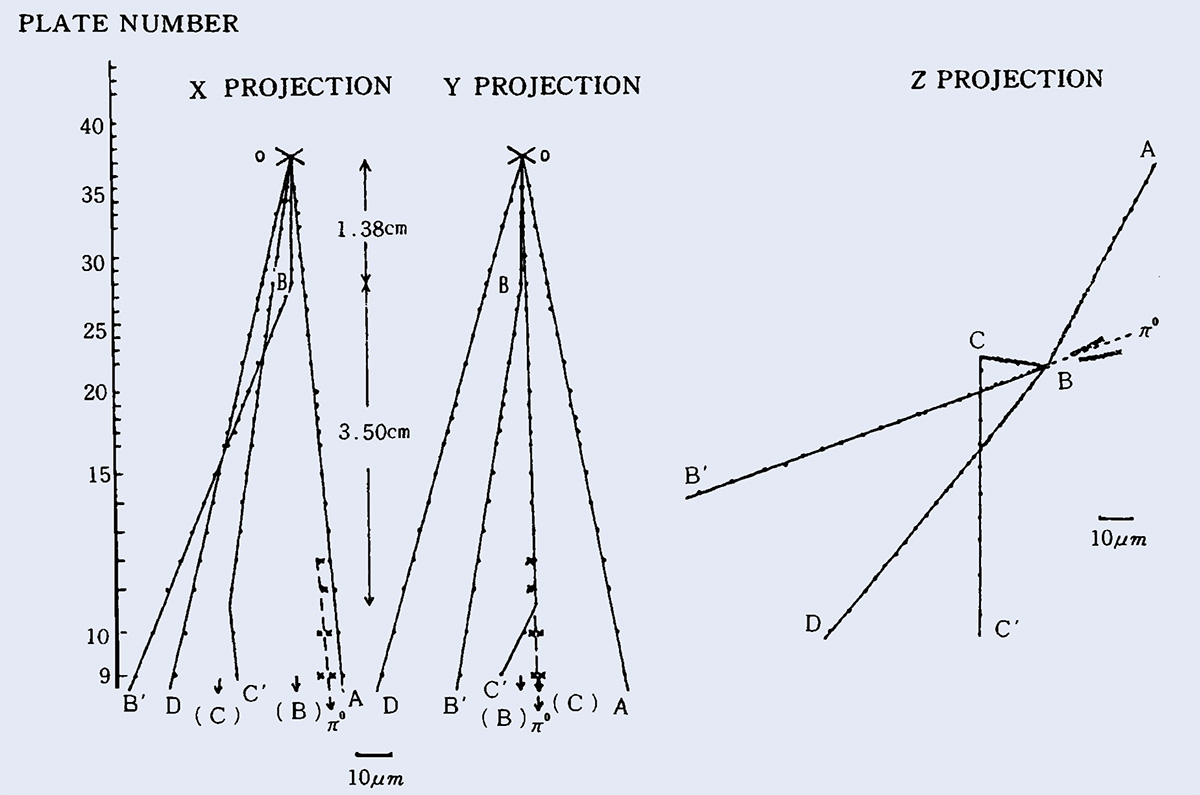
A 1971 cosmic-ray interaction in an emulsion chamber aboard a Japanese cargo aeroplane

Fifty years on from the November Revolution, charm physics is experiencing a renaissance. The LHCb, BESIII and Belle II experiments are producing a huge number of interesting and precise measurements in the charm system, with two crucial groundbreaking results on D0 mesons by LHCb holding particular significance: the observation that they violate CP symmetry when they decay; and the observation that they oscillate into their antiparticles. The rate of CP violation is particularly interesting – about 10 times larger than the most sophisticated Standard Model (SM) predictions, preliminary and uncertain though they are. Are these predictions naive, or is this the first glimpse of why there is more matter than antimatter in the universe?

Suppressed

Despite the initial confusion, the charm quark had already been indirectly discovered in 1970 by Sheldon Glashow, John Iliopoulos and Luciano Maiani (GIM), who introduced it to explain why K0 μ+μ decays are suppressed. Their paper gained widespread recognition during the November Revolution, and the GIM mechanism they discovered impacts cutting-edge calculations in charm physics to this day.

Previously, only the three light quarks (up, down and strange) were known. Alongside electrons and electron neutrinos, up and down quarks make up the first generation of fermions. The detection of muons in cosmic rays in 1936 was the first evidence for a second generation, triggering Isidor Rabi’s famous exclamation “Who ordered that?” Strange particles were found in 1947, providing evidence for a second generation of quarks, though it took until 1964 for Murray Gell-Mann and George Zweig to discover this ordering principle of the subatomic world.

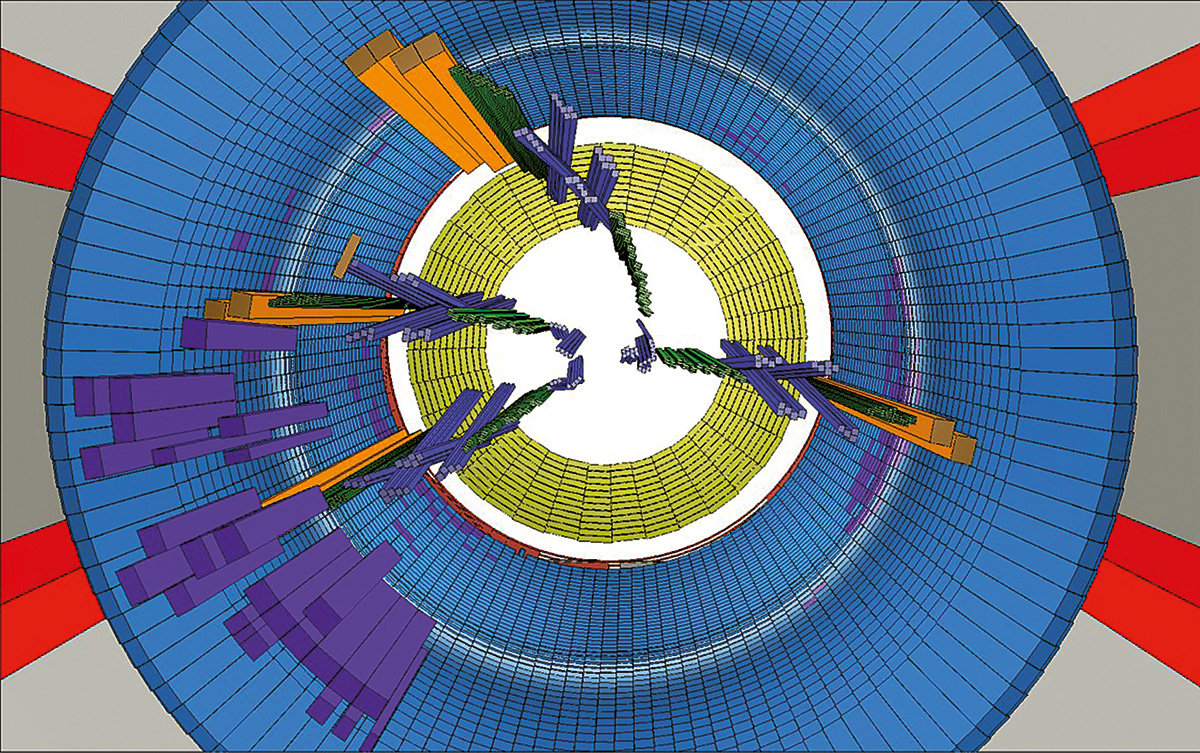
A J/ψ event in the BESIII detector

In a model of three quarks, the decay of a K0 meson (a down–antistrange system) into two muons can only proceed by briefly transforming the meson into a W+W pair – an infamous flavour-changing neutral current – linked in a loop by a virtual up quark and virtual muon neutrino. While the amplitude for this process is problematically large given observed rates, the GIM mechanism cancels it almost exactly by introducing destructive quantum interference with a process that replaces the up quark with a new charm quark. The remaining finite value of the amplitude stems from the difference in the masses of the virtual quarks compared to the W boson, mu2/MW2 and mc2/MW2. Since both mass ratios are close to zero, K0 μ+μ is highly suppressed.

The interference is destructive because the Cabibbo matrix describing the coupling strength of the charged weak interaction is a rotation of the two generations of quarks. All four couplings in the matrix – up–down (cos θC), charm-strange (cos θC), charm-down (sin θC) and up-strange (–sin θC) – arise in the decay of a K0 meson, with the minus sign causing the cancellation.

Maybe the charm quark will in the end provide the ultimate clue to explain our existence

The direct experimental detection of the first particle containing charm is typically attributed to Ting and Richter in 1974, however, there was already some direct evidence for charmed mesons in Japan in 1971, though unfortunately in only one cosmic-ray event, and with no estimation of background (see “Cosmic charm” figure). Unnoticed by Western scientists, the measurements indicated a charm-quark mass of the order of 1.5 GeV, which is close to current estimates. In 1973, the quark-mixing formalism was extended by Makoto Kobayashi and Toshihide Maskawa to three generations of quarks, incorporating CP violation in the SM by allowing the couplings to be complex numbers with an imaginary part. The amount of CP violation contained in the resulting Cabibbo–Kobayashi–Maskawa (CKM) matrix does not appear to be sufficient to explain the observed matter–antimatter asymmetry in the universe.

The third generation of quarks began to be experimentally established in 1977 with the discovery of ϒ resonances (bottom–antibottom systems). In 1986, GIM cancellations in the matter–antimatter oscillations of neutral B mesons (B0–B0 mixing) indicated a large value of the top-quark mass, with mt2/MW2 not negligible, in contrast to mu2/MW2 and mc2/MW2. The top quark was directly discovered at the Tevatron in 1995. With the discovery of the Higgs boson in 2012 at the LHC, the full particle spectrum of the SM has now been experimentally confirmed.

Charm renaissance

More recently, two crucial effects in the charm system have been experimentally confirmed. Both measurements present intriguing discrepancies by comparison with naive theoretical expectations.

Matter–antimatter mixing

First, in 2019, the LHCb collaboration at CERN observed the first definitive evidence for CP violation in charm. A difference in the behaviour of matter and antimatter particles, CP violation can be expressed directly in charm decays, indirectly in the matter–antimatter oscillations of charmed particles, or in a quantum admixture of both effects. To isolate direct CP violation, LHCb proved that the difference in matter–antimatter asymmetries seen in D0→ K+K and D0→ π+π decays (ΔACP) is nonzero. Though the observed CP violation is tiny, it is nevertheless approximately a factor 10 larger than the best available SM predictions. Currently the big question is whether these naive SM expectations can be enhanced by a factor of 10 due to non-perturbative effects, or whether the measurement of ΔACP is a first glimpse of physics beyond the SM, perhaps also answering the question of why there is more matter than antimatter in the universe.

Two years later, LHCb definitively demonstrated the transformation of neutral D0 mesons into their antiparticles (D0–D0mixing). These transitions only involve virtual down-type quarks (down, strange and bottom), causing extreme GIM cancellations as md2/MW2, ms2/MW2  and mb2/MW2 are all negligible (see “Matter–antimatter mixing” figure). Theory calculations are preliminary here too, but naive SM predictions of the mass splitting between the mass eigenstates of the neutral D-meson system are at present several orders of magnitude below the experimental value.

Theoretical attempts to reproduce experimental measurements

The charm system has often proved to be more experimentally challenging than the bottom system, with matter–antimatter oscillations and direct and indirect CP violation all discovered first for the bottom quark, and indirect CP violation still awaiting confirmation in charm. The theoretical description of the charm system also presents several interesting features by comparison to the bottom system. They may be regarded as challenges, peculiarities, or even opportunities.

A challenge is the use of perturbation theory. The strong coupling at the scale of the charm-quark mass is quite large – αs(mc) ≈ 0.35 – and perturbative expansions in the strong coupling only converge as (1, 0.35, 0.12, …). The charm quark is also not particularly heavy, and perturbative expansions in Λ/mc only converge as roughly (1, 0.33, 0.11, …), assuming Λ is an energy scale of the order of the hadronic scale of the strong interaction. If the coefficients being multiplied are of similar sizes, then these series may converge.

Numerical cancellations are a peculiarity, and often classified as strong or even crazy in cases such as D0–D0 mixing, where contributions cancel to one part in 105.

The fact that CKM couplings involving the charm quark (Vcd, Vcs and Vcb) have almost vanishing imaginary parts is an opportunity. With CP-violating effects in charm systems expected to be tiny, any measurement of sizable CP violating effects would indicate the presence of physics beyond the SM (BSM).

A final peculiarity is that loop-induced charm decays and D-mixing both proceed exclusively via virtual down-type quarks, presenting opportunities to extend sensitivity to BSM physics via joint analyses with complementary bottom and strange decays.

At first sight, these effects complicate the theoretical treatment of the charm system. Many approaches are therefore based on approximations such as SU(3)F flavour symmetry or U-spin symmetry (see “Using U-spin to squeeze CP violation”). On the other hand, these properties can also be a virtue, making some observables very sensitive to higher orders in our expansions and providing an ideal testing ground for QCD tools.

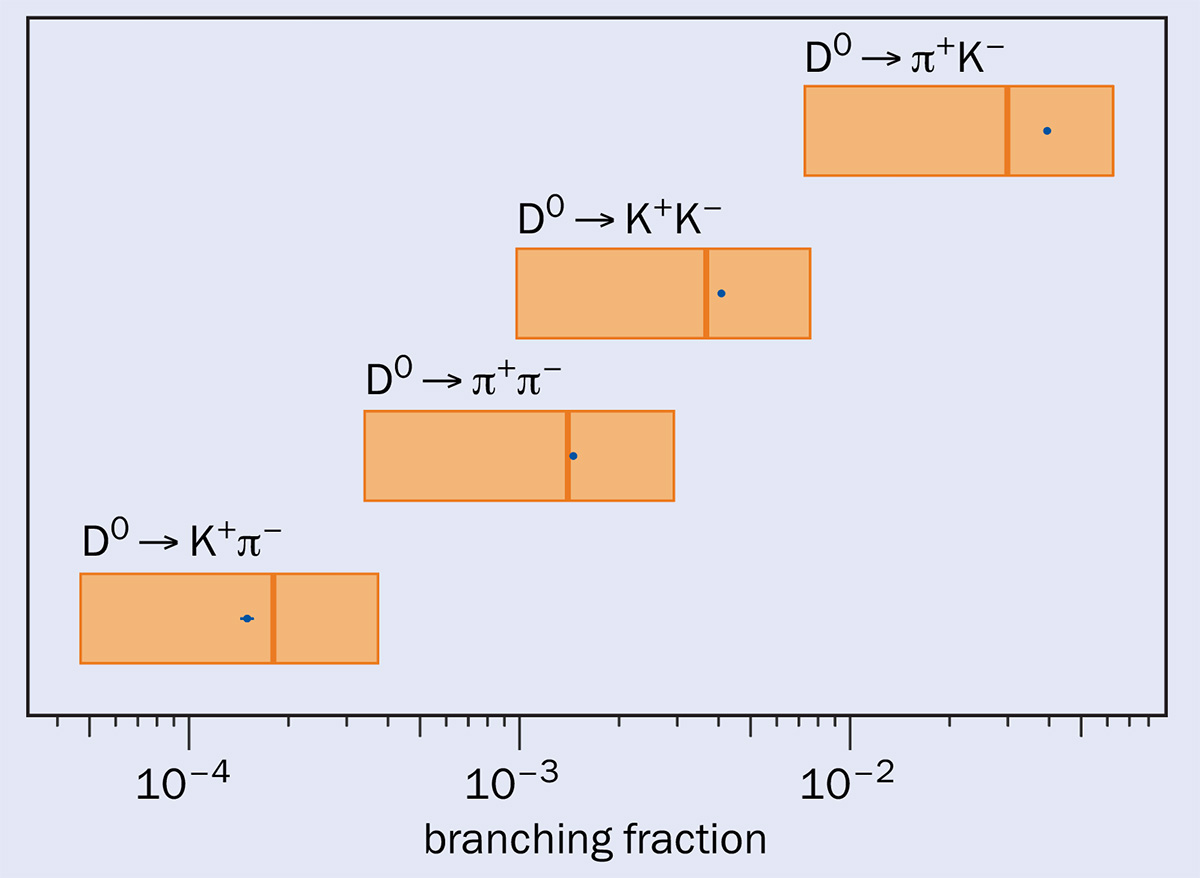
Branching fractions of non-leptonic two-body D0 decays

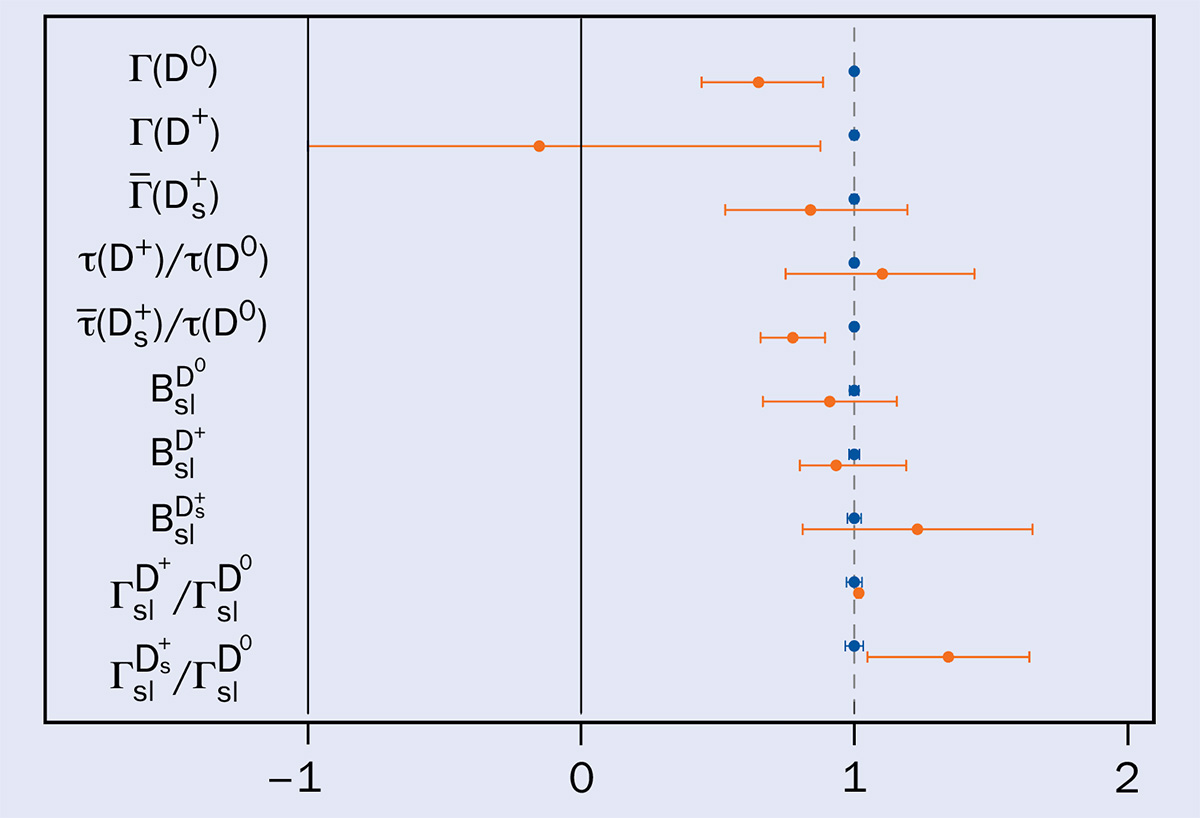
Thanks to many theoretical improvements, we are now in a position to start answering the question of whether perturbative expansions in the strong coupling and the inverse of the quark mass are applicable in the charm system. Recently, progress has been made with observables that are free from severe cancellations: a double expansion in Λ/mcand αs (the heavy-quark expansion) seems to be able to reproduce the D0 lifetime (see “Charmed life” figure); and theoretical calculations of branching fractions for non-leptonic two-body D0 decays seem to be in good agreement with experimental values (see “Two body” figure).

All these theory predictions still suffer from large uncertainties, but they can be systematically improved. Demonstrating the validity of these theory tools with higher precision could imply that the measured value of CP violation in the charm system (ΔACP) has a BSM origin.

The future

Charm physics therefore has a bright future. Many of the current theory approaches can be systematically improved with currently available technologies by adding higher-order perturbative corrections. A full lattice-QCD description of D-mixing and non-leptonic D-meson decays requires new ideas, but first steps have already been taken. These theory developments should give us deeper insights into the question of whether ΔACP and D0–D0 mixing can be described within the SM.

More precise experimental data can also help in answering these questions. The BESIII experiment at IHEP in China and the Belle II experiment at KEK in Japan can investigate inclusive semileptonic charm decays and measure parameters that are needed for the heavy-quark expansion. LHCb and Belle II can investigate CP-violating effects in D0–D0 mixing and in channels other than D0→ K+K and π+π. The super tau–charm factory proposed by China could contribute further precise data and a future e+e collider running as an ultimate Z factory could provide an independent experimental cross-check for ΔACP.

Another exciting field is that of rare charm decays such as D+→ π+μ+μ and D+→ π+ νν, which proceed via loop diagrams similar to those in K0→ μ+μ decays and D0–D0 oscillations. Here, null tests can be constructed using observables that vanish precisely in the SM, allowing future experimental data to unambiguously probe BSM effects.

Maybe the charm quark will in the end provide the ultimate clue to explain our existence. Wouldn’t that be charming?

bright-rec iop pub iop-science physcis connect